Computational Finance (ICCF2019)
Iñigo Arregui
José A. García
Carlos Vázquez
editors
Computational Finance
Universidade da Coruña, Servizo de Publicacións
Number of pages: 227 21×29,7 cm
Contents: pp. 5–11
Author index: pp. 225–227
ISBN: 978–84–9749–725–1
PersistentURL:http://hdl.handle.net/2183/23188 CDU:336:(519.6+51-3)
IBIC:KFF|UDBM|KJK|KCLF
This book is released under a Creative Commons license
Book of abstracts
Contents
Aknowledgements . . . 13
Foreword . . . 15
Plenary lectures
21
René Aïd, Dylan Possamaï, Nizar Touzi
Optimal electricity demand response contracting with responsiveness incentives . . . 23 Stéphane Crépey, Romuald Elie, Wissal Sabbagh, Shiqi Song
When Capital is a Funding Source: The XVA Anticipated BSDEs . . . 24 Griselda Deelstra
On multivariate European option and barrier option pricing in regime-switching models 25 Bruno Dupire
The Perils of Parameterization . . . 26 Peter A. Forsyth
Multi-period Mean CVAR Asset Allocation: Is it Advantageous to be Time Consistent? 27 Julien Guyon
The Joint S&P 500/VIX Smile Calibration Puzzle Solved . . . 28 Monique Jeanblanc, Libo Li
Characteristics of random times . . . 29 Ruediger Kiesel, Nikolaus Graf von Luckner, Anke Kramer
Applications of Deep Learning to Partial Differential Equations and Finance . . . 32 Christoph Reisinger, Yufei Zhang
Deep neural network approximations to high-dimensional control and games in finance 33 Nizar Touzi
Continuous time Principal Agent and optimal planning . . . 34 Antony Ware
Polynomial maps of polynomial processes for energy prices . . . 35
Minisymposium 1: Analytical and numerical methods for option pricing
37
Manuel L. Esquível, Nadezhda P. KrasiiSome financial market models obtained by Euler discretization of continuous models 39 João Guerra, Manuel Guerra, Zachary Polaski
Asset allocation using option-implied distributions in an exponentially tempered sta-ble Lévy model . . . 43 Sara D. Lopes, Carlos Vázquez
LIBOR market model including credit risk under real world measure . . . 44 Ana. M. Monteiro, Antonio A. F. Santos
Large scale nonparametric estimation of risk-neutral densities through jointly use of constraints based on call and put option prices . . . 45 Carlos Oliveira
Investment with decreasing cost due to technological innovation improvements . . . 50 Michele Pignotti, María Suárez-Taboada, Carlos Vázquez
Mining extraction projects: mathematical analysis and
numerical methods for new PDE models . . . 51
Minisymposium 2: Approximation methods from numerics, probability and
sta-tistical learning in computational finance
53
Kathrin Glau, Daniel Kressner, Francesco StattiLow-rank tensor approximation for Chebyshev interpolation in parametric option pricing . . . 55 Michèle Vanmaele
Pricing American options using radial basis functions . . . 56 Wolfgang Stockinger
Simulation of McKean SDEs, multi-level Monte Carlo schemes and applications in computational finance . . . 57 Elisabetta Carlini, Athena Picarelli, Francisco Silva
A penalty scheme and policy iteration for stochastic hybrid control problems with nonlinear expectations . . . 61 Lotfi Boudabsa, Damir Filipovi´c
Learning with kernels in finance . . . 62 Linus Wunderlich, Kathrin Glau
Efficient numerical techniques for parametric problems in option pricing . . . 63 Christian P. Fries
Stochastic Algorithmic Differentiation of discontinuous functions (and other stochas-tic operators) and application in mathemastochas-tical finance . . . 64
Minisymposium 3: Consumption and investment under mortality risk
65
Petar Jevtic, Minsuk Kwak, Traian PirvuLongevity bond pricing in equilibrium . . . 67 Mogens Steffensen
Optimal design: from insurance policy to economic policy . . . 68 Fabio Gómez, Jaime Londoño
Optimal consumption, investment, and life insurance purchase: a state-dependent utilities approach . . . 70 Jaime A. Londoño
State-dependent utility with mortality risk . . . 74
Minisymposium 4: Local volatility models and inverse problems
75
Jorge P. Zubelli, Vinicius AlbaniA splitting strategy for the calibration of jump-diffusion models . . . 77 Bruno Dupire
A new view at local volatility and local correlation . . . 78 Stéphane Crépey
Deep calibration of local volatility . . . 79 Julien Guyon
Inversion of convex ordering: local volatility does not maximize the price of VIX futures 80
Minisymposium 5: Machine learning methods in computational finance
81
Sofie ReynersMachine learning for quantitative finance: fast derivative pricing . . . 83 Lukas Gonon
Reservoir computing with stochastic inputs: volatility forecasting . . . 84 Ganna Marchenko
Minisymposium 6: Modelling and valuation techniques for energy markets
87
María del Carmen Calvo-Garrido, Matthias Ehrhardt, Carlos VázquezPricing swing options in electricity markets with two stochastic factors: PIDE model-ing and numerical solution . . . 89 Michael Coulon, Jonas Ströjby
Wind park valuation and risk management in German intraday power markets . . . . 91 Klaus Spanderen
Efficient Gas Swing and Storage valuation with Neural network and PDE/MC . . . . 92 Derek Bunn, Ekaterina Abramova
Forecasting intra-day price spread density matrices for electricity storage operations 93
Minisymposium 7: Numerical Methods for PDEs in finance
95
Lynn Boen, Karel in ’t HoutOperator splitting schemes for the two-asset Merton jump-diffusion model . . . 97 Christina Christara, Yuwei Chen
A penalty-like method for CVA pricing by a PDE model . . . 98 Olivier Bokanowski, Kristian Debrabant
BDF finite difference schemes for diffusion equations with obstacle . . . 102 Bertram Düring, Alexander Pitkin
High-order compact finite difference scheme for option pricing in stochastic volatility jump models . . . 103
Minisymposium 8: Qualitative and quantitative aspects of nonlinear PDEs based
models arising in mathematical finance
105
Iñigo Arregui, Beatriz Salvador, Daniel Ševˇcoviˇc, Carlos Vázquez
PDE models for American options with total value adjustment and two stochastic factors107 Daniel Ševˇcoviˇc, José Cruz
On solutions of a partial integro-differential Black-Scholes equation in Bessel potential spaces . . . 111 Soˇna Kilianová, Mária Trnovská, Daniel Ševˇcoviˇc
Dynamic portfolio pptimization via a Hamilton-Jacobi-Bellman equation . . . 112 José Cruz, Daniel Ševˇcoviˇc
Option pricing in illiquid markets with jumps . . . 113 Igor Melicherˇcík, Aleš ˇCerný, Gábor Szücs
Outhmane Mounjid, Mathieu Rosenbaum, Pamela Saliba
A ranking methodology for market making activity . . . 122 Côme Huré
Some neural network-based schemes to solve high-dimensional nonlinear PDEs . . . 123 Shuoqing Deng, Xun Li, Huyen Pham, Xiang Yu
Optimal relative consumption by competing with past spending maximum . . . 124 Ankush Agarwal, Emmanuel Gobet
Finite variance unbiased estimation of stochastic differential equations . . . 125 Lokman Abbas-Turki
Conditional Monte Carlo learning for diffusions . . . 126 Arnaud Lionnet
Numerical approximation of BSDEs with polynomial growth driver . . . 127 Lorenc Kapllani, Long Teng, Matthias Ehrhardt
Multistep schemes for solving Backward Stochastic Differential Equations on GPU . . 128
Contributed talks
129
Jennifer Alonso-García, Michael Sherris, Samuel Thirurajah, Jonathan Ziveyi
Incorporating taxation in the valuation of variable annuity contracts: the case of the guaranteed minimum accumulation benefit . . . 131 Pol Álvarez, Argimiro Arratia
HPC framework for multiple evaluation of supervised learning models and a famous expert for stock screening using fundamental factors . . . 135 Argimiro Arratia, Albert Dorador
Models of stock prices with overnight gap and flash crash to test stop-loss rules efficiency139 C. Bayer, C. Ben Hammouda, R. Tempone
Hierarchical adaptive sparse grids for option pricing under the rough Bergomi model 143 Nikolay Bondarenko, Geoffrey Kingston, Pavel Shevchenko
Optimal life-contingent insurance under bid-ask spreads . . . 144 Anastasia Borovykh
Understanding generalisation in noisy time series forecasting . . . 146 Dan Cheng, Pasquale Cirillo
A reinforced URN process modeling of recovery rates and recovery times . . . 147 Pasquale Cirillo, Dan Cheng
A urn-based nonparametric modeling of the dependence between PD and LGD with an application to mortgages . . . 149 Javier de Frutos, Víctor Gatón
A spectral method for an optimal investment problem with transaction costs under potential utility . . . 154 Andrea Fontanari, Iddo Eliazar, Pasquale Cirillo, Cornelis W. Oosterlee
Portfolio risk and the quantum majorization of correlation matrices . . . 155 Raquel Gaspar
Archil Gulisashvili, Raúl Merino, Marc Lagunas, Josep Vives
Higher order approximation of call option prices under stochastic volatility models . 165 Nikolay Gudkov, Jonathan Ziveyi
Pricing and hedging of guaranteed minimum benefits using power series approxima-tion techniques . . . 169 Jonathan Hüser, Uwe Naumann
Regression likelihood ratio method Monte Carlo sensitivities . . . 173 Emma M. Iglesias, Garry D. A. Phillips
Pseudo-maximum likelihood estimation and testing in the constant elasticity of vari-ance continuous time model . . . 178 Margaret Insley, Peter A. Forsyth
Climate games: Who’s on first? What’s on second? . . . 179 Kentaro Kikuchi
A term structure interest rate model with the exit time from the Quantitative Easing Policy . . . 180 Fabien Le Floc’h, Cornelis W. Oosterlee
Arbitrage-free implied volatility interpolation by spline collocation . . . 184 Geoffrey Lee, Zili Zhu, Bowie Owens
Introducing two mixing fractions to a lognormal LSV model . . . 190 Sunju Lee, Younhee Lee
Real option pricing on finite time horizon . . . 194 Álvaro Leitao, Luis Ortiz-Gracia, Justin L. Kirkby
Continuous Time Markov Chain approximation of the Heston model . . . 195 Shuaiqiang Liu, Cornelis W. Oosterlee
Calibration neural networks for financial models . . . 200 Zororo S. Makumbe, Youssef El-Khatib, Josep Vives
Some results on the Hybrid Heston-SLV Model With Jumps: Pricing, Hedging and Sensitivities. A Malliavin approach . . . 201 Zsolt Nika
Investment strategies with long memory: log-optimal solution and approximations by stochastic gradient . . . 205 María R. Nogueiras, Ignacio Ruiz, Mariano Zeron
Numerical approximation of dynamic initial margin: Chebychev on the market space analysed . . . 206 Rebeca Peláez, Ricardo Cao, Juan M. Vilar
Probability of default estimation using a nonparametric approach . . . 208 Vladimir Petrov, Anton Golub, Richard Olsen
Instantaneous volatility seasonality of high-frequency markets in directional-change intrinsic time . . . 210 Jiang Pu
Serguei Vassilovski, Alex Kreinin
Multi-curve interest rate modeling with Hull-White and Black-Karasinski . . . 217 Samyukta Venkataramanan, Stephen O’Sullivan
Parameter estimation of affine term structure models . . . 221 Guan Yan, Stefan Trück
Interconnectedness of spot electricity prices. A dynamic network analysis . . . 223 Wenjun Zhang, Jiling Cao, Gaurav Kapoor, Xinfeng Ruan
Path-dependent leveraged exchange-traded fund option pricing . . . 224
The Organizing Committee wants to thank the plenary lecturers, minisimposia organizers, speakers and members of the Scientic Committee. Also our aknowledgements to all the attendants and par-ticipants of the present edition of ICCF. All of them highly contributed to the success of ICCF2019 in A Coruña.
We also want to thank the support of the following institutions:
- Abanca
- Afundación
- Centro de Investigación en Tecnologías de la Información y Comunicaciones (CITIC)
- European Consortium for Mathematics in Industry, ECMI
- Fundación Pedro Barrié de la Maza
- Grupo de investigación M2NICA de la Universidad de A Coruña
- Horizon 2020 EU Program, through the MSCA-ITN-EID "ABC-EU-XVA"
- Instituto Tecnológico de Matemática Industrial, ITMATI
- Universidade da Coruña
- Xunta de Galicia, through the Program "Ayudas de Consolidación para Grupos de Referencia Competitiva"
This volume contains the abstracts of the Third International Conference on Computational Finance (ICCF 2019), held in A Coruña, Spain, between 8 and 12 July 2019, and coorganized by the Univer-sidade de A Coruña,
http://iccf2019.udc.es/
.The 2019 edition of ICCF was a satellite conference of the International Congress on Industrial and Applied Mathematics (ICIAM 2019) held in Valencia,
http://iciam2019.org
.Initiated in 2015, this is the third of a biennial series of conferences in Computational Finance launched by the consortium of the European project FP 7 Marie Curie ITN STRIKE-Novel Methods in Computational Finance 2013-2016. Former editions took place in December 2015 at University of Greenwich (United Kingdom) and in September 2017 at Universidade de Lisboa (Portugal). As a key activity of the ECMI Special Interest Group on Computational Finance and Energy Markets, the ICCF 2019 was held in A Coruña.
These series of conferences represent a forum for financial industry scientists, experts and re-searchers, to present recent and breakthrough developments in modelling and numerical methods in financial problems, and also to promote the collaboration between academia and financial indus-try.
This edition focused on recent advances in research and practice in financial mathematics and computing, for both academic researchers and practitioners. It consisted of plenary lectures, given by international leading academics and industry researchers working on subjects of particular rele-vance for the theory and practice of quantitative finance, and contributed talks organized in thematic sessions.
The purpose of ICCF2019 is:
• To foster discussions and collaborations among applied mathematicians, probabilistics, statis-ticians, computational specialists and researchers and practitioners in financial industry, deep-ening cooperation and promoting a proficuous interplay with the cross-fertilization of ideas.
• Lévy Processes in Finance
• Interest Rate Modelling
• Credit Risk Modelling
• Portfolio Management
• Models for Risk Management
• Commodities Markets
• Energy Market Models
• Big Data Analytics
• Computational Methods and High Performance Computing in Finance
• Market Microstructure.
Finally, it should be pointed that more than 100 professors, researchers, students and industrial experts attended and/or presented their achievements, thus contributing to the success ICCF2019.
Michael Coulon, University of Sussex, UK
Matthias Ehrhardt, Bergische Universität Wuppertal, Germany
Maria Rosario Grossinho, ISEG Lisboa, Portugal
Choi-Hong Lai, University of Greenwich, UK
Jaime A. Londoño, Universidad Nacional de Colombia
María R. Nogueiras, HSBC London, UK
Cornelis W. Oosterlee, CWI and TU Delft, The Netherlands
Andrea Pascucci, Università di Bologna, Italy
Daniel Ševˇcoviˇc, Comenius University, Slovakia
Carlos Vázquez, Universidade da Coruña, Spain (Chair)
Ana Almécija, Universidade da Coruña
Iñigo Arregui, Universidade da Coruña (Chair)
MaCarmen Calvo, Universidade da Coruña
Ana MaFerreiro, Universidade da Coruña
José A. García, Universidade da Coruña
Álvaro Leitao, Universidade da Coruña
José G. López, Universidade da Coruña
Beatriz Salvador, Universidade da Coruña
María Suárez, Universidade da Coruña
Optimal electricity demand response contracting
with responsiveness incentives
Ren´e A¨ıd
Universit´e Paris–Dauphine, PSL University
Email: [email protected]
URL:https://sites.google.com/view/reneaid/home
Dylan Possama¨ı
Columbia University
Email: [email protected]
Nizar Touzi
´
Ecole Polytechnique
Email: [email protected]
URL:http://www.cmap.polytechnique.fr/touzi/
Abstract. Despite the success of demand response programs in retail electricity markets in reducing average consumption, the literature shows failure to reduce the variance of consumers’ re-sponses. This paper aims at designing demand response contracts which allow to act on both the average consumption and its variance. The interaction between the producer and the consumer is modeled as a Principal-Agent problem, thus accounting for the moral hazard underlying demand response programs. The producer, facing the limited flexibility of production, pays an appropriate incentive compensation in order to encourage the consumer to reduce his average consumption and to enhance his responsiveness. We provide closed–form solution for the optimal contract in the case of linear energy valuation. Without responsiveness incentive, this solution decomposes into a fixed pre-mium for enrolment and a proportional price for the energy consumed, in agreement with previously observed demand response contracts. The responsiveness incentive induces a new component in the contract with payment rate on the consumption quadratic variation. The calibration of our model to publicly available data of a large scale demand response experiment predicts a significant increase of responsiveness under our optimal contract, a significant increase of the producer satisfaction, and a significant decrease of the consumption volatility.
When Capital is a Funding Source:
The XVA Anticipated BSDEs
St´ephane Cr´epey
Universit´e d’´Evry-Val d’Essonne, France
Email: [email protected]
Romuald Elie
Universit´e de Paris–Est, France
Wissal Sabbagh
Universit´e du Maine, France
Shiqi Song
Universit´e d’´Evry-Val d’Essonne, France
On multivariate European option and barrier option pricing in
regime-switching models
Griselda Deelstra
Universit´e libre de Bruxelles, CP210, boulevard du Triomphe, 1050 Bruxelles, Belgium.
Email: [email protected]
URL:http://homepages.ulb.ac.be/∼grdeelst
Abstract. First, we will concentrate upon the pricing of some multivariate European options when the underlying asset prices are driven by Markov-modulated L´evy processes (MMLPs) with dependence between the asset’s components, and where synchronous jumps are allowed. In par-ticular, the asset prices may jump whenever there is a change of phase of the underlying Markov process. When considering exchange options and quanto options, pricing formulae are based upon the characteristic exponents by using the well known FFT methodology. For the evaluation of spread and basket options in this general regime-switching framework, we provide lower and upper bounds to the exact option prices based upon ideas from Caldana and Fusai (2013) and Caldana et al. (2016). These bounds are obtained via univariate Fourier inversion under the assumption that the joint characteristic functions of the MMLPs are known.
Next, we consider the risk-neutral pricing of vanilla, digital and down-and-out call options when the (single) underlying asset price evolves like the exponential of a Markov-modulated Brownian motion (MMBM) with two-sided phase-type jumps. The price of such options is intimately related to the first passage properties of the MMBM. To analyse these first passages, we randomize the time hori-zon using Erlang distributions with suitable parameters and apply matrix-analytic methods. This provides us with closed form approximations of the option prices, with a very high precision, as shown by several numerical illustrations.
Joint work with: Sinem Kozpınar, Guy Latouche, Matthieu Simon.
The Perils of Parameterization
Bruno Dupire
Bloomberg L.P., 731 Lexington Ave, New York, NY 10022, USA
Email: [email protected]
Multi-period Mean CVAR Asset Allocation: Is it Advantageous
to be Time Consistent?
Peter A. Forsyth∗
Cheriton School of Computer Science, University of Waterloo, Waterloo ON, Canada, N2L 3G1
Email: [email protected]
URL:https://cs.uwaterloo.ca/ paforsyt/
Abstract. We formulate the multi-period, time consistent mean-CVAR (Conditional Value
at Risk) asset allocation problem in a form amenable to numerical computation. Our numerical algorithm can impose realistic constraints such as: no shorting, no-leverage, and discrete rebalancing. We focus on long term (i.e. 30 year) strategies, which would be typical of an investor in a Defined Contribution (DC) pension plan. A comparison with pre-commitment mean-CVAR strategies shows that adding the time consistent constraint compares unfavourably with the pure pre-commitment strategy. Since the pre-commitment strategy computed at time zero is identical to a time consistent strategy based on an alternative objective function, the pre-commitment mean-CVAR strategy is implementable in this case. Hence it would seem that there is little to be gained from enforcing time consistency.
Keywords: multi-period mean-CVAR, time consistent, pre-commitment, asset allocation
∗This work was supported by the Natural Sciences and Engineering Research Council of Canada
The Joint S&P 500/VIX Smile Calibration Puzzle Solved
Julien Guyon
Bloomberg L.P., Quantitative Research, 731 Lexington Ave, New York, NY 10022, USA
Email: [email protected]
URL:http://cermics.enpc.fr/∼guyon/
Abstract. Since VIX options started trading in 2006, many researchers and practitioners have tried to build a model that jointly and exactly calibrates to the prices of S&P 500 (SPX) options, VIX futures and VIX options. So far the best attempts, which used continuous-time jump-diffusion models on the SPX, could only produce an approximate fit. In this talk we solve this puzzle using a discrete-time model. Given a VIX future maturityT1, we build a joint probability measure on the
SPX atT1, the VIX atT1, and the SPX atT2=T1+30 days which is perfectly calibrated to the SPX
smiles atT1 andT2, and the VIX future and VIX smile atT1. Our model satisfies the martingality
constraint on the SPX as well as the requirement that the VIX atT1 is the implied volatility of the
Characteristics of random times
Monique Jeanblanc
LaMME, 23 Boulevard de France, 91037 Evry Cedex, France
Email: [email protected]
URL:http://www.maths.univ-evry.fr/pages perso/jeanblanc/
Libo Li
UNSW, Sydney
Email: [email protected]
Abstract. The purpose of this talk is to present the processes associated to a random time (we call them characteristics) useful to perform computations: pricing, portfolio optimization. One of them is the intensity, another one is the Az´ema supermartingale, a last one is the conditional density.
In a second part, we show how we can construct random times with given characteristics.
Analysis of intraday power markets using Hawkes processes
Ruediger Kiesel
Universit¨at Duisburg–Essen, Germany
Email: [email protected]
Nikolaus Graf von Luckner
Universit¨at Duisburg–Essen, Germany
Email: [email protected]
Anke Kramer
Universit¨at Duisburg–Essen, Germany
Email: [email protected]
Valuation Adjustments in Practice
Andrea Pallavicini
Department of Mathematics, Imperial College, London.
Email: [email protected]
Abstract. The financial crisis started in 2007 has shown that any pricing framework must include from the very beginning the possibility of default of any market player. As a consequence derivative valuation and risk analysis have moved from exotic derivatives managed on simple single-asset classes to simple derivatives embedding credit risk and new, or previously neglected, types of complex and interconnected non-linear effects.
The detailed analysis of how a trade is really implemented between two counterparties in the market is a requirement to track all the possible costs and risks. Derivative valuation is adjusted to include counterparty credit risk and contagion effects along with funding costs due to collateral posting, treasury policies, and regulatory constraints. A second level of complexity is produced by moving from a single trade to the whole bank portfolio. Aggregation-dependent valuation processes, and theirs operational challenges, arising from non-linearities are discussed both from a mathematical and practical point of view.
By following the developments of recent literature, an arbitrage-free valuation framework is devel-oped for bilateral counterparty risk adjustments, inclusive of wrong-way and contagion risks, collater-alization and funding costs. The resulting valuation equations take the form of semi-linear PDEs, or backward SDEs, depending only on real market rates and processes, and no longer on unobservable risk-free rates. Collateralization is described starting from the day-by-day operations followed by the counterparties to implement the credit support annex. Segregation and re-hypothecation policies are discussed both for bilateral-traded and centrally-cleared deals along with funding implications. Margining and funding costs are included into the derivation of pricing formulae, along with their relationship with hedging strategies and liquidity policies. Fund transfer pricing procedures driving the business strategies of the bank are presented and their impact on funding costs is described.
Applications of Deep Learning to Partial Differential Equations
and Finance
Olivier Pironneau
Sorbonne University, Paris, France
Email: [email protected]
Abstract. Neural networks have been game changers in many optimization and classification problems. Google, Facebook and Nvidia have written highly optimized and user-friendly open source toolboxes with which it is easy to assess to potentials of deep learning on control, inverse and classification problems for distributed systems. On the other hand the mathematical results which certify that the problems are solved are few.
In this talk we will try to survey the mathematical results available and present applications on 3 classes of problems:
• Classification of linear PDEs.
• Identification of parameters for fluid structure problem and for the Heston model in finance.
Deep neural network approximations to high-dimensional control
and games in finance
Christoph Reisinger
University of Oxford, United Kingdom
Email: [email protected]
Yufei Zhang
University of Oxford, United Kingdom
Email: [email protected]
Abstract. In this talk, we discuss the feasibility of algorithms based on deep artificial neural networks (DNN) for the solution of high-dimensional stochastic control problems and zero-sum games arising in financial engineering. In the first part, we show that in certain cases, including those with open loop controls, the value functions can be represented by a DNN whose complexity grows at most polynomially in both the dimension of the state equation and the reciprocal of the required accuracy, demonstrating that DNNs can break the curse of dimensionality. In the second part, we exploit policy iteration to reduce the nonlinear problem into a sequence of linear problems, which are then further approximated via a multilayer feedforward neural network ansatz. We establish that in suitable settings the numerical solutions converge globally in the H2
−norm. Moreover, we construct the optimal feedback controls based on the superlinear convergence of the numerical solutions. Preliminary numerical experiments are presented to illustrate the theoretical results and to demonstrate the effectiveness of the method.
Continuous time Principal Agent and optimal planning
Nizar Touzi
´
Ecole Polytechnique, Palaiseau, France
Email: [email protected]
URL:http://www.cmap.polytechnique.fr/∼touzi
Polynomial maps of polynomial processes for energy prices
Antony Ware
Dept. of Mathematics and Statistics, University of Calgary, Canada
Email: [email protected]
URL:people.ucalgary.ca/∼aware
Abstract. In the context of energy price modelling, prices are formed from exponential maps of underlying factor processes, and the mathematical convenience this offers means that this is no surprise. In this talk we will show various ways in which models based on polynomial maps of polynomial processes (PMPP models) can function in a similar way.
Polynomial processes have the property that expectations of polynomial functions of the future state of the process, conditional on the current state, are themselves polynomial functions of the current state. It is this property that means that PMPP models also provide a level of mathematical convenience (for forming futures prices). But they also provide an additional level of flexibility, which means that they are capable of capturing the extreme dynamics that are commonly seen in energy market prices even with relatively tame dynamics in the underlying factor process.
We will end by discussing numerical methods for the valuation of energy contracts in the PMPP setting.
Analytical and numerical methods for
option pricing
Organized by
Some financial market models obtained by Euler discretization
of continuous models
Manuel L. Esqu´ıvel∗
Department of Mathematics and CMA, FCT NOVA, UNL, 2829–516 Caparica, Portugal
Email: [email protected]
URL:http://ferrari.dmat.fct.unl.pt/personal/mle/
Nadezhda P. Krasii†
Don State Technical University, Gagarin Square 1, Rostov-on-Don 344000, Russian Federation
Email: [email protected]
URL:https://donstu.ru/structure/cadre/krasiy-nadezhda-pavlovna
Abstract. We present and study several discrete time financial models with one risky asset and a risk free asset that may thought to result as a discretization of a suitable continuous time model. We compare the pricing results, obtained with these models, with results obtained from the related continuous time models. Our approach relies on some known important results describing a particular class of discrete time models – the conditionally Gaussian models – a class that, nevertheless, contains many interesting instances. We aim at a better understanding of the implications of the discretization procedures which are inevitable, both at the parameter estimation and derivative price computation moments, by reason of the computational implementations.
1. Introduction.
Given a financial market model with dynamics defined by stochastic differentialequations (SDE) we have that often, the estimation procedures rely in the observation of the processes at discrete times and so, it would be natural to consider discrete time models associated to the initially given continuous time models. As it happens, the Euler-Maruyama discretization scheme (see [3, p. 62]) allows us to consider models for which it is possible to retrieve a computable martingale measure. The case of a SDE model with deterministic coefficients, dealed in Section 3 below, is easier. A more general case, with the coefficients being allowed to be random, is treated in Section 4.
2. Discretization of a discounted price process.
Let (Ω,F,P) be a complete probabilityspace and (Bt)t≥0 a standard Brownian motion and F = (Fn)n≥0 the Brownian filtration. For the
financial market model we may consider a SDE of the type:
dSt=µtStdt+σtStdBt, t∈[0, T], S0=s0∈R∗+,
as a model for stock prices and admitting a strong solution. We suppose that the risk free rate process (ρt)t∈[0,T] of the market satisfies dρt = ρtdt, t ∈ [0, T], ρ0 = 1 and that (µt)t∈[0,T], (σt)t∈[0,T] and
∗This work was partially supported by the Funda¸c˜ao para a Ciˆencia e a Tecnologia (Portuguese Foundation for Science
and Technology) through the project UID/MAT/00297/2019 (Centro de Matem´atica e Aplica¸c˜oes – CMA)
†This work was done under partial financial support of RFBR (Grant n. 19-01-00451)
Xt= log
We now consider the Euler-Maruyama discretization of a stochastic differential equation having in mind applying it to an equation such as (2). LetT <+∞be the temporal time horizon,and for a given integer
N ≥1 let:
∆t:= ∆Nt= T
N.
Suppose that (Xt)t∈[0,T]is a continuous time stochastic process adapted to Brownian filtration (Ft)t∈[0,T].
Consider the discretized stochastic process given by:
Xk∆t, k= 0,1, . . . , N ,
that has a natural interpretation as the process of observations of the continuous time process made at the epochs 0,∆t,2∆t, . . . , T. Let us consider the discrete time stochastic process defined by:
∀k≥0, X(k+1)∆t=Xk∆t+µ((k+ 1)∆t) ∆t+σ((k+ 1)∆t) ∆t·Zk+1, (3)
where we have that (Zk)k≥1 is a sequence of standardized normal random variables.
3. The non random coefficients case.
In the simpler case —for formula (3)— in which(µt)t∈[0,T], (σt)t∈[0,T]are non random, we have thatF= (Fn)n≥0may be the natural filtration generated
by (Zk)k≥0 or, equivalently by (Xk∆)k≥0 —as the coefficientsµeσare non random— and we have the
following result.
Proposition 3.1. The sequence of random variables defined by,
Yk = exp −
As a consequence, by considering the probability space (Ω,F,Q) withQdefined by:
∀F ∈FQ[F] =
model and the risk free rate are random we may also consider the discrete market model obtained by the Euler-Maruyama discretization of the continuous market model by using what we may call the Girsanov theorem in discrete time in the conditionally Gaussian case. In [8, pp. 433–446] and in [1, pp. 123–125] we may find a detailed explanation that can be summarized in the next result.
Theorem 4.1. Let(Ω,F,P)be a complete probability space andF= (Fn)n≥0 a filtration ove rthis space
such asF0={∅,Ω}. Let the process X= (Xn)n≥1 verify the following decomposition:
∀n≥0, Xn+1=Xn+µn+1+σn+1Zn+1,
with (µn)n≥1 and (σn)n≥1 previsible processes, (Zn)n≥1 an F- adapted process of independent random
variables identically distributed such that the law of Zn conditioned to Fn−1 is a standardized normal
random variable. Let the Girsanov process be given by:
Yn:= exp −
such that the following Novikov condition is verified:
∀n≥1, E
1. the Girsanov process Y= (Yn)n≥1 is aF uniformly integrable martingale which converges, almost
surely to a random variableY∞ verifying:
P[Y∞≥0] = 1 eE[Y∞] = 1;
2. considering the pprobability measureQdefined obver (Ω,F)by:
∀F ∈F, Q[F] =
We observe that the hypothesis made thatZncondicioned toFn−1is a standardized Gaussian implies
that the probability law ofXn+1−Xn conditioned toFn−1 is given forF∈F, by:
Following [8, pp. 62, 103] this formula may be interpreted by saying that the probability law ofXn+1−Xn conditioned to Fn−1is a mixture of Gaussian random variables with parameters µn, and σn2 that in themselves are random variables
Remark 4.2. The second result in the theorem 4.1. is that in the probability space (Ω,F,Q)the law of Xn+1−Xn conditioned toFn−1 is given forF ∈F, by:
that is, with the new probabilityQ, the coefficientµn is suppressed and we now have a local martingale.
now be described as follows. We have discrete time observations of a discounted price process and we want to model it as a discrete conditionally Gaussian model to which we may apply theorem 4.1. in order to obtain a martingale measure and to price derivatives. We may consider following [8, pp. 89, 104–108], a discrete model in which the discounted price process (Sn)n≥1, defined in a filtered probability space
(Ω,F,P,F) and adapted toF= (Fn)n≥0 satisfying,
Sn=S0eh1+h2+...hn withE[|hn|]<+∞, (6) withhn=µn+σnnwhere (n)n≥1is a sequence of independent standardized Gaussian random variables
adapted toFand,
Law (hn |Fn−1) =N(µn, σ2n), (7) with the processes (µn)n≥1and (σn)n≥1predictable with respect toFand formula (7) having an
inter-pretation similar to the one given for formula (5). This class of models for (hn)n≥1 is quite rich as it
encompasses, among others, the ARMA(p,q), the ARCH(p) and the GARCH(p,q) models. For instance, for the ARMA(p,q) model we haveFn=σ(1, . . . , n), the prescribed initial conditionsh1−p, . . . , h−1, h0
and1−q, . . . , −1, 0and,
µn =a0+a1hn−1+. . . aphn−p+b1n−1+. . . bpn−q ,
withσn≡σconstant. Estimating the adequate time series model we may get under suitable hypothesis a martingale measure and the possibility of computing derivative prices. There are nevertheless important questions to be dealt with, namely, under what conditions, the model given by (6) and (7),
• is a Euler-Maruyama discretized model of a continuous time model? That is, does the discretized model converges —see [6]— to some continuous time market model with good properties?
• is a arbitrage free and complete model —see [4] and [5]— for all discretization steps considered?
We will develop some instances of models studied under the methodology here presented.
References
[1] Ole E. Barndorff-Nielsen and A. N. Shiryaev (2010).Change of time and change of measure.volume 13. Singapore, World Scientific, 1rst edition.
[2] A. Etheridge (2002).A course in financial calculus.Cambridge: Cambridge University Press.
[3] St. M. Iacus (2008)Simulation and inference for stochastic differential equations. With R examples.
New York: Springer.
[4] J. Jacod and A. N. Shiryaev (1998). Local martingales and the fundamental asset pricing theorems in the discrete-time case.Finance and Stochasticsvol. 2 (3): 259–273.
[5] R. Jarrow and P. Protter (2012). Discrete versus continuous time models: Local martingales and singular processes in asset pricing theory. Finance Research Letters, 9 (2):58 – 62.
[6] J. P. Lesne, J. L. Prigent, and O. Scaillet (2000). Convergence of Discrete Time Option Pricing Models Under Stochastic Interest Rates. Finance and Stochastics 4 (1): 81–93.
[7] P. M. Robinson (1989) Nonparametric estimation of time-varying parameters. In Peter Hackl, editor,
Statistical Analysis and Forecasting of Economic Structural Change, pages 253–264. Springer Berlin Heidelberg.
Asset allocation using option-implied distributions in an
exponentially tempered stable L´
evy model
Jo˜ao Guerra
CEMAPRE, REM and ISEG, Universidade de Lisboa, Portugal
Email: [email protected]
Manuel Guerra
CEMAPRE, REM and ISEG, Universidade de Lisboa, Portugal
Email: [email protected]
Zachary Polaski
ISEG, Universidade de Lisboa, Portugal
Email: [email protected]
Abstract. We explore the fundamental optimal asset allocation problem using option-implied distributions when the underlying risky asset price is modeled by an exponentially tempered stable L´evy process. The risk-neutral densities are extracted from option prices and are transformed to the risk-adjusted (real-world) densities. The optimal portfolios are constructed, rebalanced periodically and their performance is analyzed. We found that the portfolios formed using option-implied dis-tributions under the L´evy market model, which are flexible enough to capture the higher moments of the implied distribution, are far more robust to left-tail market risks and offer statistically sig-nificant improvements to risk-adjusted performance when investor risk aversion is low, however this diminishes as risk aversion increases.
Keywords: Asset Allocation, L´evy processes, Option-Implied Distributions, Portfolio Optimization
JEL Classification: C10, C51, G11, G13, G17
LIBOR Market Model including credit risk under the
real world measure
Sara Dutra Lopes
Universidade de Lisboa, ISEG, CEMAPRE, Portugal
Email: [email protected]
Carlos V´azquez
Universidade da Coru˜na, Campus de Elvi˜na, s/n, 15071 A Coru˜na, Spain
Email: [email protected]
Abstract. In this article, we present a methodology to simulate the evolution of interest rates for multiple credit ratings under the real world probability measure, as needed for risk management calculations, e.g., to compute Value at Risk indicators.
Given the current market conditions where negative interest rates are present, in our methodology the presence of negative interest rates is allowed while ensuring the positivity of credit spreads, taking into account that investors demand a risk premium for bonds with higher credit risk.
More precisely, we implement the multidimensional Shifted Lognormal LIBOR market model with credit risk ratings and specify the the market price of risk vector process needed to perform simulations of the real world forward rates in future.
Keywords: Real World Model, Scenario Simulation, Interest Rate, Shifted Lognormal Market Model, Market Price of Risk, Credit Risk, Credit Ratings
References
[1] Dutra Lopes S., V´azquez C. (2018). Real-World Scenarios With Negative Interest Rates based on the LIBOR Market Model. Applied Mathematical Finance, 25, 466–482.
[2] Eberlein E., Grbac Z. (2013). Rating based L´evy Libor model.Mathematical Finance, 23, 591–626.
[3] Sch¨onbucher P. (2001). A Libor Market Model with Default Risk. SSRN Electronic Journal,
Large scale nonparametric estimation of risk-neutral densities
through jointly use of constraints based on call and put option
prices
A. M. Monteiro
Faculdade Economia, CeBER, GEMF, Universidade Coimbra, Av. Dias da Silva, 165, Coimbra, Portugal
Email: [email protected]
Antonio A. F. Santos
Faculdade Economia, CeBER, GEMF, Universidade Coimbra, Av. Dias da Silva, 165, Coimbra, Portugal
Email: [email protected]
Abstract. Option pricing theory determines the structure of call and put option pricing func-tions. Usually, in a nonparametric risk neutral density estimation based on kernel functions, con-straints are imposed locally, not allowing for restrictions related to the fact that density integrates one, and to global imposed convexity and monotonicity. Also, we propose a new global risk-neutral density estimation approach, based on kernel functions imposing those constraints and permitting the simultaneously use of calls and puts without applying the put-call parity formula. Our approach is tested through a simulation experiment using Heston’s model.
1. Introduction.
The availability of huge amounts of option data leads to different ways of dealingwith existing problems. By this way new approaches and methods could appear giving rise to new strategies and opportunities. A few years ago a fundamental change occur in capital markets allowing access to massive intra-day high-frequency data. In fact, among other factors, electronic trading and high-frequency trades are responsible for this change in available data. This huge amount of data, usually called Big Data, plays a fundamental role in several domains namely, in risk management. However, this process raises some concerns since it augments the susceptibility to errors.
We propose a novel approach for risk-neutral density (RND) estimation based on a nonparametric regression setting [2, 1, 7]. First, we consider a strategy to solve a generalized least squares problem by estimating simultaneously all variables of the problem. This contrast with existing kernel approaches that follow a local nonparametric estimation. Global estimation allows to redefine a set of constraints related to the definition of a density function and to no-arbitrage constraints. Regarding these last constraints, existing approaches using kernel functions do not provide a guarantee that, density estimates integrate one over its support. Second, following [6] we use call and put option prices directly in the optimization problem. Previous approaches have used one-side version of option prices, since they essentially used call prices through put-call parity formula. Using call and put option prices simultaneously improves the robustness of RND estimation. Reformulating our local polynomial approach [6], we propose a nonparametric kernel method using global optimization.
2. No-arbitrage constraints and risk-neutral densities.
[4] and [3] derive a way ofesti-mating RNDs from financial options prices, by considering second derivatives of option pricing functions. The European call option price, for contracts on the underlying assetS, can be given by
C(St, X, σt, τ, r, δ) =e−r τ
Z ∞
X
(ST −X)f(ST|St, σt, r, δ, τ)dST,
where t represents the current date, X the strike price, r the risk-free interest rate, St the current underlying asset price, ST the asset price at maturity, τ =T−t the time-to-maturity, δthe dividend
When considering the price of a European put option, we have
P(St, X, σt, τ, r, δ) =e−r τ
Z X
0
(X−ST)f(ST|St, σt, r, δ, τ)dST.
Central to the results presented in this paper is the fact that, risk-neutral density functions and respective cumulative distribution functions are inter-related through first and second derivatives of call and put pricing functions. They can be expressed as,
f(ST|St, σt, r, δ, τ) = erτ ∂ These relations between first and second derivatives of call and put pricing functions, risk-neutral den-sities and respective cumulative distribution functions will be explored within the nonparametric esti-mation process. Through a no-arbitrage framework, bound constraints for the call pricing function and respective derivatives assume the form
−e−r τ ≤ ∂X∂C(X)≤0; ∂
2C
∂X2(X)≥0; C(X)≥0, ∀X∈[0,∞[. (3)
By using put-call parity, the same kind of constraints can be associated with the put pricing function
0≤ ∂P
∂X(X)≤e
−r τ; ∂2P
∂X2(X)≥0; P(X)≥0 ∀X ∈[0,∞[. (4)
These constraints, and the equality ones above, will be used within a quadratic optimization problem associated with an extended criterion function. The constraints just considered are the only ones possible in the implementation of a sequential local estimation approach. If a global framework is considered, a further set of constraints can be added, namely the ones that impose that the call (put) pricing function is monotone decreasing (increasing) on strikes, and respective first derivatives are monotone increasing, implying the convexity of the respective pricing functions. The aim is to estimate a risk-neutral density, as non-negativity constraints were already considered, we only have to add the constraint related to integration to one. This will be the subject mainly addressed in this paper, and made us develop what we designated as a global nonparametric estimation.
3. Global vs local nonparametric estimation.
When applied to an economical problem,theoretical results can give different degrees of guidance on sound characteristics of a function relating dependent and independent variables. The cases where the bounds too stringent are rare, meaning that, for example, the theory says that on average when one variable grows the other also grows, and vice-versa. [2] presented a nonparametric kernel regression problem to estimate RNDs. For the kernel regression, it is assumed that the process can be described asyi =m(xi) +σ(xi)εi, wherem(x) is the unknown function to be estimated at a given point x. If the function needs to be approximated for different points, in the sense of approximating the function as a whole, sequential local nonparametric estimations can be performed. [2] use the Nadaraya-Watson (NW) estimator, where the implied volatility function is defined through a kernel estimator. Black-Scholes formula is then used to calculate a call pricing function and its second derivative, the estimated risk neutral density. Other authors such as [1, 9, 8] improve this approach by introducing new features to the respective optimization problem.
functions, and also of their first and second derivatives. For call pricing functions, as functions of strikes, it must be assured that they are monotone decreasing and convex. Also near the boundaries, they must comply with no-arbitrage constraints. On the other hand, their first derivatives resembles a cumulative distribution function subtracted by one, and the second derivatives must be proportional to a density function. This is a lot of structure that should be incorporated within an estimation method to obtain interpretable estimates. The same kind of analysis can be performed for puts, considering monotone increasing and convex functions. These important characteristics cannot be taken into account when a sequential point by point estimation method, without global constraints, is implemented to approximate call and put pricing functions, and respective derivatives. Without such global constraints, there is no guarantee that estimated functions are monotone or convex. On the other hand, as the main object of interest is the risk-neutral density, and due to the necessary characteristics of a density function, positiveness and integration to one, the global estimation approach guarantees that estimates comply with such characteristics.
In the context of RND estimation through nonparametric regression methods, using NW estimator is equivalent to a zero order local polynomial approximation (local constant), the associated optimization problem is an unconstrained one. We begin with a local cubic polynomial approximation, considering jointly calls and puts, and the restrictions from (1) to (4). In this paper, we went further by considering global nonparametric estimation method that approximates the objects of interest, for a set of points
{xj}mj=1 representing a partition for the range of RND to estimate.
With this general approach we can include constraints implicit on (1) through (4), constraints asso-ciated with monotonicity and convexity of option pricing functions, and also, the one making explicit that estimated RNDs must integrate one. These results are obtained by estimating the coefficients
βl(k)(xj), l = c, p; k = 0,1,2,3; j = 1, . . . , m defined through a global criterion function that can be and finally,Bis the set of constraints defined through the following set of equalities and inequalities,
−βc(1)(xj) +βp(1)(xj) =e−rτ ; βc(2)(xj)−βp(2)(xj) = 0
Through this problem, a grid of points{xj}mj=1is defined to approximate call and put pricing functions,
and their respective first and second derivatives. These elements are encompassed onβl(k)(xj), which are estimated jointly. This framework makes use of all the theoretical structure behind the definition of risk-neutral prices and respective densities associated with options. All the drawbacks associated with a partial view of the problem, making use of cleaning data procedures, smoothing intermediate
35 40 45 50 55 60
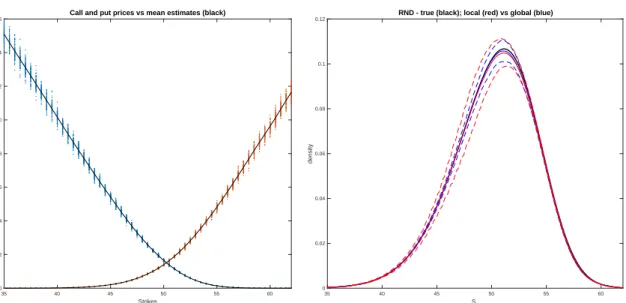
Figure 1: Heston option prices with put and call mean estimates (left-side);RND estimation; sequential local estimation (red), median (solid line), 90% confidence intervals (dashed lines);global estimation (blue), median (solid line), 90% confidence intervals (dashed lines)
steps, and even ad-hoc tuning procedures can be removed by this global view of the problem. It has to be noticed that this approach can result in a large scale optimization problem. Considering that the functions of interest are approximated through 100 points, the decision vector has length of 800, and 1 601 constraints need to be considered. As the quadratic programming problem is strictly convex it has a feasible solution, having the advantage of being able to integrate all relevant factors that need to be considered.
4. Empirical demonstration.
Our aim in this research is to demonstrate that RNDs estimationaccuracy is improved using a global nonparametric estimation. This approach is compared with a sequential local nonparametric estimation. The former allows a new set of constraints to be included in the optimization problem associated. The global approach allows to consider all no-arbitrage constraints in the estimation process. Using this general framework, pricing functions will comply with theoretical-based results, and the resulting RND estimation gives a proper density function, strictly positive that integrates one. Compared with a sequential local approach, more accurate estimates are obtained, which results in narrower confidence intervals.
To demonstrate the feasibility and robustness of the considered global nonparametric estimation of the RND, we considered a simulated experiment where the [5] model is used, in this case the true RND is known. By simulating n samples with Heston’s prices, added with errors, the estimation process is applied successively and the distribution of the estimators can be approximated, which allows the computation of confidence intervals. Using [5] model allows us to consider a more general diffusion process which is subjected to stochastic volatility, but still compatible with a closed form for option prices. By considering a negative value for the leverage effect, negative asymmetric RNDs are obtained. For the underlying process it is assumeddSt=µdt+√vtStdWt,dvt=κ(θ−vt)dt+σ√vtdZt, where
and respective parameters, theorical prices for calls and puts are calculated, and using a fine grid for strike prices, first and second derivatives are calculated numerically with high precision. This is assumed to be the true RND. For the range of strikes considered, steps of 0.5 were adopted, and for each, 79 observations were simulated for calls and puts, mimicking intraday data with a frequency of 5-min within a daily transaction period. In the figure it is compared the true RND and respective estimates given through the evolution of three quantiles, 5%, 50%, and 95%. Using the extreme quantiles, a confidence interval of 90% is established, and we can appreciate the degree of accuracy obtained. In the tails, intervals are extremely narrow, less in the center due to the curvature, and its influence on the bias and standard error of nonparametric estimators. However, due to the structure imposed, mean and first derivatives compatible with no-arbitrage constraints, and proper density functions are a by-product of the method, without the need of further intermediate steps within the estimation process.
5. Concluding remarks.
The approach developed in this paper leads to a proper smoothrisk-neutral density due to the imposed constraints considered in a global estimation framework. With this approach no further ad-hoc tuning procedures need to be implemented in order to obtain interpretable estimates. Through the definition of a large scale optimization problem, including all relevant con-straints, it is guaranteed that estimates mimic monotone and convex option pricing functions. Second derivatives estimates are compatible with the definition of a RND, positiveness and integration to one. Further, simulation results show that this approach represents an improvement in terms of accuracy when compared with a sequential local estimation framework.
References
[1] A¨ıt-Sahalia Y., Duarte J. (2003).Nonparametric option pricing under shape restrictions. Journal of Econometrics, 116, 1, 9–47.
[2] A¨ıt-Sahalia Y., Lo A. W. (1998). Nonparametric estimation of state-price densities implicit in financial asset prices. The Journal of Finance, 53, 2, 499–547.
[3] Banz R. W., Miller M. H. (1978). Prices for state-contingent claims: Some estimates and applica-tions. Journal of Business, 653–672.
[4] Breeden D. T., Litzenberger R. H. (1978).Prices of state-contingent claims implicit in option prices. Journal of Business, 621–651.
[5] Heston S. L. (1993). A closed-form solution for options with stochastic volatility with applications to bond and currency options. Review of Financial Studies, 6, 2, 327–343.
[6] Monteiro A. M., Santos A. A. F. (2019). Conditional risk-neutral density from option prices by local polynomial kernel smoothing with no-arbitrage constraints. Review of Derivatives Research, forthcoming.
[7] Monteiro A. M., T¨ut¨unc¨u R. H., Vicente L. N. (2008). Recovering risk-neutral probability density functions from options prices using cubic splines and ensuring nonnegativity. European Journal of Operational Research, 187, 2, 525–542.
[8] Song Z., Xiu D. (2016).A tale of two option markets: Pricing kernels and volatility risk. Journal of Econometrics, 190, 1, 176–196.
[9] Yatchew A., H¨ardle, W. (2006). Nonparametric state price density estimation using constrained least squares and the bootstrap. Journal of Econometrics, 133, 2, 579–599.
Investment with decreasing cost due to technological innovation
improvements
Carlos Oliveira
ISEG, University of Lisbon, Portugal
Email: [email protected]
Abstract. In this paper we address, in the context of real options, an investment problem with two sources of uncertainty: the price (reected in the revenue of the rm) and the level of technology. The level of technology impacts in the investment cost, that decreases when there is a technology innovation. The price follows a geometric Brownian motion, whereas the technology innovations are driven by a Poisson process. As a consequence, the investment region may be attained in a continuous way (due to an increase of the price) or in a discontinuous way (due to a sudden decrease of the investment cost). For this optimal stopping problem no analytical solution is known, and therefore we propose a quasi–analytical method to find an approximated solution that preserves the qualitative features of the exact solution. This method is based on a truncation procedure and we prove that the truncated solution converges to the solution of the original problem.
Mining extraction projects: mathematical analysis and
numerical methods for new PDE models
Michele Pignotti
Department of Mathematics, University of Bologna, Italy
Email: [email protected]
Mar´ıa Su´arez-Taboada
Department of Mathematics, University of A Coru˜na, Spain
Email: [email protected]
Carlos V´azquez
Department of Mathematics, University of A Coru˜na, Spain
Email: [email protected]
Abstract. In this work, a new mathematical model related to a mining extraction project under uncertainty is proposed. We mainly follow the modelling approaches developed in [1] and [3], where the commodity price and the resource size are considered as the relevant stochastic factors. The main innovative modelling feature comes from considering the extraction rate to be proportional to the commodity price. In this way, an ultraparabolic hypoelliptic differential operator governs the associated PDE of the mathematical model. The mathematical analysis allows to obtain the existence and uniqueness of a classical solution. Uniqueness follows from a suitable Feynman-Kac representation formula and existence is obtained after a suitable change of variables, the determina-tion of sub and supersoludetermina-tions and passing to the limit from problems in bounded domains to the unbounded one. For the numerical solution, after justifying the required boundary conditions on the computational bounded domain, the proposed numerical techniques consist of a Crank-Nicolson characteristics method for the time discretization to cope with the convection dominating setting and Lagrange finite elements for the discretization in the commodity and resource variables. Finally, some numerical examples are discussed. Further details are available in [2].
References
[1] Brennan M.J., Schwartz E.S. (1985),Evaluating natural resources investments, J. Bus., 58, 135–157.
[2] Pignotti M., Su´arez-Taboada M., V´azquez C. (2019)A new mathematical model for pricing a mine extraction project, Nonlinear Analysis: Real World Applications, 50, 8–24.
[3] Su´arez-Taboada M., V´azquez C. (2019),Numerical methods for PDE models related to pricing and expected lifetime of an extraction project under uncertainty, Discrete Contin. Dyn. Syst. Ser. B., 24(8), 3503–3523.
Approximation methods from numerics,
probability and statistical learning in
computational finance
Organized by
Low-rank tensor approximation for Chebyshev interpolation in
parametric option pricing
Kathrin Glau∗
EPF Lausanne and Queen Mary University of London
Email: [email protected]
URL:http://www.maths.qmul.ac.uk/ kglau/
Daniel Kressner
EPF Lausanne
Email: [email protected]
Francesco Statti
EPF Lausanne
Abstract. We propose a new method for the efficient computation of high-dimensional para-metric conditional expectations such as option prices. The method extends the recently developed approach of [1] to high dimensionality in the parameter space. To overcome the curse of dimensional-ity, we additionally exploit low-rank structures. The core of our method is to express the tensorized interpolation in tensor train (TT) format and to develop an efficient way, based on tensor completion, to approximate the interpolation coefficients. The method is based on a novel adaptive sampling strategy for tensor completion. Efficiency is, moreover, gained from an offline/online decomposition. As examples we consider American option pricing in the Heston model and European basket option pricing in the multi-dimensional Black-Scholes model. We treat parameter spaces of dimen-sions up to 25. The numerical results confirm the low-rank structure of these problems and the effectiveness of our method compared to advanced techniques.
Figure 1: Representation of financial data. Left: tensor of values at interpolation nodes, middle: reduc-tion by sampling, right: data representareduc-tion in TT-format.
References
[1] M. Gaß, K. Glau, M. Mahlstedt, M. Mair (2018). Chebyshev interpolation for parametric option pricing, Finance and Stochastics, 22, pp. 701–731.
[2] K. Glau, D. Kressner, F. Statti (2019).Low-rank tensor approximation for Chebyshev interpolation in parametric option pricing. Preprint on ArXiv: https://arxiv.org/abs/1902.04367
∗This project has received funding from the European Union’s Horizon 2020 research and innovation program under
grant 665667.)
Pricing American options using radial basis functions
Mich`ele Vanmaele
Department of Applied Mathematics, Computer Science and Statistics, Ghent University, Belgium
Email: [email protected]
Abstract. We study the price of American options as solutions to partial differential equations. We will discuss several methods depending on the type of option and the type of model. For example under Heston’s stochastic volatility model we propose a radial basis function with partition of unity method applied to a linear complementary formulation of the free boundary partial differential equation problem. This results in an algebraic problem with sparse matrices which have a moderate condition number. Next, a Crank-Nicolson time discretisation is combined with the operator splitting method to get a fully discrete problem. To better control the computational cost and the accuracy, adaptivity is used in the spatial discretisation.
Simulation of McKean SDEs, Multi-level Monte Carlo
schemes and applications in computational finance
Wolfgang Stockinger
University of Oxford, United Kingdom
Email: [email protected]
Abstract. In the first part of this talk, we will present schemes for the simulation of McKean SDEs, e.g., the particle method which is used to approximate the true distribution of the current state of some process. Considering time-stepping schemes, classical approaches, such as the Euler-Maruyama method and the tamed Euler-scheme find applications for these SDEs. Here, we also introduce an adaptive scheme and demonstrate its performance numerically for several examples.
Moreover, we discuss a range of existing Multi-level Monte Carlo schemes for McKean SDEs and consider their applications in computational finance. In particular, calibration conditions for local stochastic volatility models (LSVMs) lead to a complex class of McKean SDEs, which require the use of kernel density estimation methods. Quasi-Monte Carlo methods applied to this problem can significantly improve the variance convergence rate of estimators for certain conditional expectations appearing in the calibration problem. This will be demonstrated numerically for multiple examples of LSVMs.
A truncated semi-Lagrangian scheme for second order
degener-ate Hamilton-Jacobi-Bellman equations in bounded domains
Elisabetta Carlini∗
Piazzale Aldo Moro 5, Roma, Italy
Email: [email protected]
Athena Picarelli†
Via Cantarane 24, Verona, Italy Email: [email protected]
Francisco Silva‡
123, Avenue Albert Thomas, Limoges, France Email: [email protected]
Abstract. We study the numerical approximation of parabolic, possibly degenerate, Hamilton-Jacobi-Bellman (HJB) equations in bounded domains. It is well known by the seminal paper [1] that convergence of the numerical approximation to the exact solution of the equation (considered here in the viscosity sense) is achieved under the assumptions of monotonicity, consistency and stability of the scheme. While standard finite difference schemes are in general non monotone, the so-called semi-Lagrangian (SL) schemes (see [2, 3] and the references therein) are monotone by construction. These schemes make use of a wide stencil and, when the equation is set in a bounded domain, this typically causes an overstepping of the boundary. A truncated version of SL schemes has been presented in [4]. We discuss here a suitable modification of this scheme adapted to the treatment of degenerate boundary problems.
References
[1] G. Barles and P.E. Souganidis. Convergence of approximation schemes for fully nonlinear second order equations. Asymptotic Analysis, 4(3):271–283, 1991.
[2] F. Camilli and M. Falcone. An approximation scheme for the optimal control of diffusion processes.
ESAIM: Mathematical Modelling and Numerical Analysis, 29(1):97–122, 1995.
[3] K. Debrabant and E.R. Jakobsen. Semi-Lagrangian schemes for linear and fully non-linear diffusion equations. Mathematics of Computation, 82(283):1433–1462, 2013.
[4] C. Reisinger and J. Rotaetxe Arto. Boundary treatment and multigrid preconditioning for semi-Lagrangian schemes applied to Hamilton–Jacobi–Bellman equations. Journal of Scientific Comput-ing, 72(1):198–230, 2017.
∗University of Rome La Sapienza †University of Verona
Statistical Learning For Higher Moments of Asset Returns
Damir Filipovic
Swiss Finance Institute and EPF Lausanne Email: [email protected]
Amir Khalilzadeh
Swiss Finance Institute and EPF Lausanne
Email: [email protected]
Abstract. Statistical learning methods has received increasing attention in financial economics recently. In particular, researchers tend to revisit the familiar and fundamental empirical problems such as return prediction and measuring risk premia in asset pricing. We augment this growing literature by investigating the second moment of risky asset returns. In particular, we study the predictability of realized variances and covariances of stock returns for the firms in the US. Knowledge about the direction as well as size of comovements of the asset returns is of great importance to both academia and industry for asset management and portfolio risk management purposes. We do so by designing a statistical learning framework where a large set of stock-level and macro-finance features form a function beyond what is devised by standard linear methods. In particular we deploy decision tree learning method in order to carve the functional form that results in the best out of sample forecast for the realized covariance. Our main finding is that statistical learning methods consistently enrich our understanding of the behaviour of asset return covariances. Ultimately, we are interested in conducting a comparative analysis across various statistical learning methods and find independent key factors that best explain the cross-section and time series of asset returns covariances.
Small-time and large-time smile behaviour for the rough Heston
model
Stefan Gerhold
TU Wien
Email: [email protected]
Martin Forde
King’s College London
Benjamin Smith
King’s College London

![Figure 2: Optimal stopping boundary by the proposed method (ETD) with h = 0.01, k = h 2 and the FDM from [2] for the problem with parameters (21).](https://thumb-us.123doks.com/thumbv2/123dok_es/4002223.676515/118.892.118.392.149.349/figure-optimal-stopping-boundary-proposed-method-problem-parameters.webp)