Sinusoidal magnetic structure in a three-dimensional antiferromagnetic Co
2(OH)AsO
4:
Incommensurate-commensurate magnetic phase transition
I. de Pedro,1,2J. M. Rojo,2 J. Rodríguez Fernández,1M. T. Fernández-Díaz,3and T. Rojo2,
*
1CITIMAC, Facultad de Ciencias, Universidad de Cantabria, 39005 Santander, Spain
2Departamento de Química Inorgánica, Facultad de Ciencia y Tecnología, Universidad del País Vasco, 48080 Bilbao, Spain 3Institut Laue-Langevin, BP 156X, F-38042 Grenoble Cedex, France
共Received 26 December 2009; revised manuscript received 10 March 2010; published 23 April 2010兲 Co2共OH兲AsO4 has been prepared by hydrothermal synthesis and characterized from x-ray and neutron powder diffraction. The structure consists of a three-dimensional framework in which Co共1兲O5-trigonal bi-pyramid dimers and Co共2兲O6-octahedra chains are simultaneously present. The magnetic structure has been determined by neutron共D2B and D1B兲 powder-diffraction data. Below 22 K, the Co2共OH兲AsO4phase shows an incommensurate antiferromagnetic structure along the b direction. The propagation vector共0,␦, 0兲 is tem-perature dependent with a value of␦= 0.430 at the lowest temperature共1.8 K兲. Magnetization measurements of Co2共OH兲AsO4show a complex magnetic behavior with the presence of three different signals. Between 6 and 21 K, a strong dependence of the magnetic field is observed with a shift of the inflexion point associated to the three-dimensional antiferromagnetic ordered from 18 K at 1 kOe to 20.1 K at 90 kOe. The small splitting observed in the zero-field-cooled-field-cooled curves at low temperatures is characteristic of ferromagnetic interactions but saturation is not reached even up to 90 kOe. Heat-capacity measurements show an unusual dependence on the magnetic field for antiferromagnetic transitions with a jump at the Neél temperature quite small共2 J/Kmol兲. The magnetic contribution exhibits a -type anomaly associated to the three-dimensional antiferromagnetic ordering. Surprisingly, the anomaly grows with the magnetic field and becomes better defined. Neutron powder diffraction in different fields shows a magnetic phase transition. The incommensurate magnetic structure evolves at low temperatures toward a collinear AF phase for fields higher than 35 kOe.
DOI:10.1103/PhysRevB.81.134431 PACS number共s兲: 75.30.Kz, 61.05.fm
I. INTRODUCTION
In the last years, the compounds showing a “metal-insulator” transition have attracted much attention in solid-state physics and chemistry since the discovery of additional fascinating magnetic phenomena. Many cobalt-based com-pounds present this type of phenomenology, such as the mag-netic frustration system, Ca3Co2O6,1 which shows in the
magnetically ordered state a ferromagnetic coupling between the magnetic ions along the chains whereas the interchain nearest-neighbor interaction is antiferromagnetic共AF兲. Other Co-based systems with spin state S = 3/2 show a three-dimensional共3D兲 Neel ordering at low temperature, with un-usually large magnetic anisotropy such as BaCo2Si2O7,2
CoNb2O6,3 CoV2O6,4and BaCo2V2O8.5 Moreover, in some
cases, they present also interesting field-induced magnetic transitions. For example, a spin-flop transition in CoNb2O6 共Ref.3兲 and an order-disorder transition in BaCo2V2O8共Ref. 6兲 have been described.
In the case of the phosphate and arsenate cobalt com-pounds, additional useful chemical and physical properties 共magnetic, heterogeneous catalysis, ion exchange, etc.兲7–10
have been found out. The stoichiometries and a wide variety of structural types built of interconnected MO6 共M
= Ti, V , Cr, Fe, Mo, . . .兲 octahedra and XO4 共X=P,As兲
tetra-hedra make them an appropriate domain to study the rela-tionships between the physical properties and the crystal packing features.7,8
The crystal structure of the Co2共OH兲XO4 共X=P,As兲
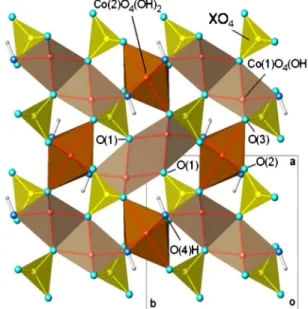
共Refs.11–13兲 compounds consists of condensed network of a vertex and edge-sharing CoO6, CoO5 y XO4 subunits 共see
Fig.1兲. The Co共II兲 ions can be sited in two different octahe-dral and trigonal bipyramidal topologies. The edge-sharing 关Co共2兲O4共OH兲2兴 octahedra give rise to linear chains
propa-gated along the c axis whereas the edge-sharing 关Co共1兲O4共OH兲兴 trigonal bipyramids constitute dimeric
enti-ties. The chain of octahedra, the dimeric unites, and the tet-rahedral groups share corners thereby forming a three-dimensional network.
FIG. 1. 共Color online兲 Projection of the crystal structure of Co2共OH兲XO4共X=P and As兲 along the 关001兴 direction.
We have recently discovered in the hydroxy phosphate Co2共OH兲PO4 共Ref. 11兲 the coexistence of antiferromagnetic
ordering and a spin-glass behavior in an insulator compound. In this phase, a magnetic frustration in the Co共1兲 magnetic moments is observed as due to the presence of antiferromag-netic interactions between Co共2兲 neighbor chains. Further-more, it is worth mentioning the existence of a superex-change angle Co共1兲-O共3兲-Co共2兲 with a value of 107° that involves ferromagnetic couplings between chain and dimer neighbors ferromagnetically coupled. This exchange angle was the higher angle found in the literature for a ferromag-netic exchange pathway and plays an interesting role in the magnetic behavior of this system.11 The partial substitution
of transition-metal ions in the structure severely affects the magnetic properties14,15giving rise to the evolution of the 3D
antiferromagnetic system in the Co2−xCux共OH兲PO4 solid
solution15 up to a spin-gap system in the Cu
2共OH兲PO4
phase,16the spin-glasslike state in the共Co,Ni兲
2共OH兲PO4
de-tected below 10 K,14or the higher ferromagnetic interactions
at lower temperatures in Co1.7Mn0.3共OH兲PO4coexisting with a similar spin-glass state observed in the nonsubstituted co-balt hydroxy phosphate.17
The similar ability of AsO43−and PO43−tetrahedra to sta-bilize anionic frameworks and the greater size of the AsO43− anions predict some differences in the crystal packing fea-tures that could modify the complex magnetic properties ex-hibited in these phases. In this work, we present a deeper magnetic study of Co2共OH兲AsO4 in order to determine 共i兲
the nature of the main magnetic interactions and their anomalies,共ii兲 the magnetic structure of the low-temperature ordered phase, and共iii兲 the magnetic variations with respect to the isostructural Co2共OH兲PO4 compound. Magnetostruc-tural correlations of these cobalt 共II兲 phases are also de-scribed.
II. EXPERIMENTAL A. Synthesis
Hydrothermal techniques have been used to prepare the Co2共OH兲AsO4synthetic phase in the laboratory. This
arsen-ate has been found in the nature as a solid solution with adamite Zn2共OH兲AsO4 mineral.18,19 Our synthetic pathway
to obtain a pure cobalt phase begins with the preparation of the Co3共AsO4兲2· 8H2O precursor, which was previously
described.20Due to the low solubility of the Co共II兲 hydrated
arsenates, long reaction times and pH values in the 6–8 range were needed. Approximately 0.2 g of the hydrated pre-cursor were disgregated in 35 ml of water and placed in a Teflon-lined stainless-steel autoclave under autogeneous pressure generated by a temperature of approximately 170 ° C.
The contents of Co and As were determined by induc-tively coupled plasma atomic emission spectroscopy per-formed with an ARL Fisions 3410 spectrometer, confirming the Co2共OH兲AsO4chemical formula. The thermogravimetric
study was performed up to 800 ° C under air in a Perkin-Elmer TGA-DSC System 7 thermobalance. The decomposi-tion curve reveals an initial 共⬃1%兲 weight loss associated with water absorbed on the surface from the atmosphere and
at 660 ° C a second step 共⬃3.5%兲 attributed to the loss of water obtained from the decomposition of 2 f.u. At tempera-tures above 700 ° C, additional weight losses were not ob-served on the thermogravimetric curve. These results are in good agreement with those obtained in other hydroxy phos-phate and arsenate-related compounds.11,12,14
B. X-ray and neutron powder-diffraction experiments
Room temperature x-ray powder-diffraction data of mi-crocrystalline purple samples were used to evaluate the pu-rity of the Co2共OH兲AsO4product. The data were collected in
the 10°ⱕ2ⱕ90° range in steps of 0.02° with an integra-tion time of 16 s per step using a Philips X’Pert-MPD x-ray diffractometer with secondary beam graphite monochro-mated Cu K␣ radiation. The Co2共OH兲AsO4 data were fitted
using the pattern matching routine of the program
FULLPROF,21 in an orthorhombic cell with the Pnnm space
group as previously determined by Keller et al.13The x-ray refined unit-cell parameters a = 8.281共1兲, b=8.566共1兲, c = 6.038共1兲 Å, ␣==␥= 90°, V = 429.4共1兲 Å3, and Z = 4 are
close to those reported 关a=8.286共2兲,b=8.594共2兲,c = 6.051共1兲 Å,V=430.9 Å3, Z = 4兴 from single-crystal data.13
No extra diffraction peaks were observed, concluding that the synthetic products correspond to a pure phase which will be used in the study of the magnetic properties.
Neutron powder-diffraction measurements were per-formed on the D1B and D2B powder diffractometers at the Institute Laue-Langevin 共ILL兲 of Grenoble. About 5 g of Co2共OH兲AsO4were employed in the experiments, placed in
a cylindrical vanadium container and held in a liquid-helium cryostat. The high resolution of D2B共1.5938 Å兲 was used to obtain extensive and accurate structural data at room tem-perature and 2 K respectively, over a large angular angle 0 °ⱕ2ⱕ150°. The structure determined by using x-ray single-crystal data of cobalt hydroxy arsenate13was used as a
starting model for the refinements. High flux and medium resolution of D1B at 2.525 Å were used to study the thermal evolution of the sample in the temperature range 1.8–50 K to solve the magnetic contributions of the neutron patterns. The diffraction patterns were collected every 2 K and 25 min in the angular range 10°ⱕ2ⱕ90°. The Rietveld method22
was used to refine simultaneously the nuclear and magnetic structures. All the patterns were analyzed using the FULL-PROF program suite.21 The background was fitted using the
polynomial refinable function and a pseudo-Voigt function was chosen to generate the line shape of the diffraction peaks. The D1B patterns were refined sequentially, taking as starting parameters of each pattern those resulting from the refinement of the proceeding one.
C. Magnetic measurements
dc magnetic-susceptibility measurements of powdered samples were performed using Quantum Design共QD兲 physi-cal property measurement system-superconducting quantum interference device magnetometers whilst heating from 2 to 300 K in different applied magnetic from 1 to 90 kOe, after cooling in either the presence共field cooling, FC兲 or the ab-sence 共zero-field cooling, ZFC兲 of the applied field.
Magne-tization as a function of field 共H兲 was measured using a standard QD PPMS magnetometer in the −90ⱕH/kOe ⱕ90 range in the temperature range of 2–20 K after cooling the sample in zero field. ac magnetic-susceptibility measure-ments were performed using the same QD PPMS system with an alternate excitation field 共Hac兲 of 10 Oe and a
fre-quency of 1000 Hz. Field-dependent data were collected from 2 to 60 K at a fixed frequency of 1000 Hz with applied fields from 0 to 90 kOe.
Heat capacity has been measured between 1.8 and 300 K with a standard relaxation method using a two-tao model. In order to guarantee a good thermal contact, apiezon N grease was used to glue the sample to the sample holder. The ad-denda共sample holder plus grease兲 was measured at different magnetic fields before the sample measurements and then subtracted from the total heat capacity in order to get the sample heat capacity. The sample was an 11.2 mg plate ob-tained compressing the original thin powder.
III. RESULTS A. Nuclear structure
The structural refinements of Co2共OH兲AsO4were carried
out from high-resolution neutron powder-diffraction patterns 共D2B兲 recorded at room temperature with =1.5938 Å. The Rietveld refinement was fitted in the Pnnm space group and cell parameters reported for a single-crystal specimen by Keller et al.13 as starting point. It should be noted that the
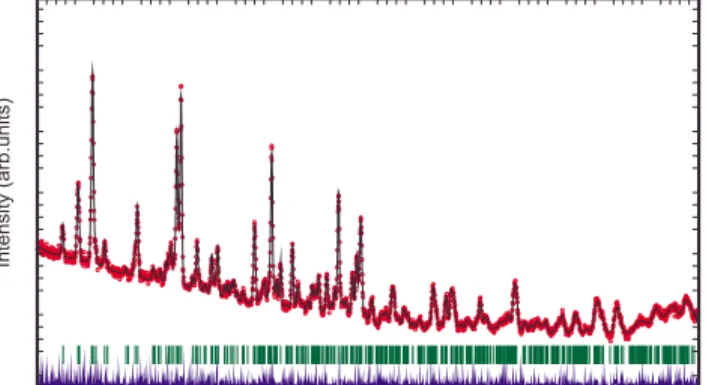
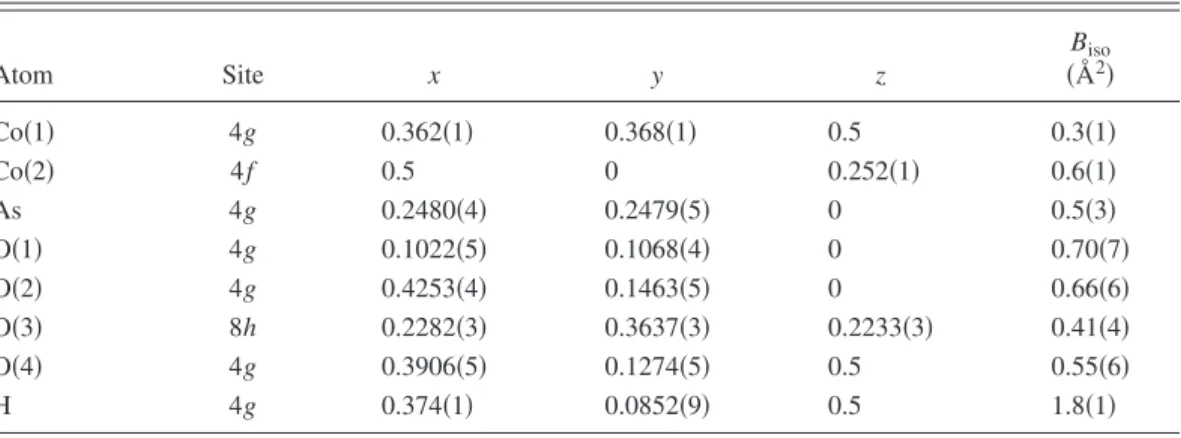
quality of our results permits the localization of the hydrogen ions in the structure. The experimental, calculated, and dif-ference neutron powder-diffraction profiles are shown in Fig. 2. There is no significant mismatch between the observed intensity and the calculated profile. The room-temperature structural parameters and the reliability factors from D2B data refinements are summarized in TableI. The final refined positional and thermal parameters are given in TableII. The main interatomic distances, angles for Co2共OH兲AsO4 are
listed in TableIII.
The crystal structure of the Co2共OH兲AsO4 phase can be described as formed by two crystallographically distinct sites for the metal ions 共see Fig.3兲. Co共1兲 is fivefold coordinated by oxygen atoms in approximately trigonal-pyramidal geom-etry where one of the apical positions is occupied by an OH group. Co共2兲 exhibits a distorted octahedral geometry with two long apical Co共2兲-O共3兲 bonds and four shorter equatorial links, two of which are hydroxide groups in cis configuration 共see Table III兲. The axial and equatorial O-Co共2兲-O mean angles in the Co共2兲O6 octahedra are 171° and 87°,
respec-tively. The octahedra sharing the O共2兲-O共2兲 and the O共4兲H-O共4兲H edges give rise to linear chains propagated along the z axis. For the Co共1兲O5 polyhedra, each trigonal bipyramid
exhibits three set of O-Co共1兲-O angles around 95°, 123°, and an axial to 165°. In addition, the trigonal bipyramids consti-tute dimeric entities, sharing the O共1兲-O共1兲 edge 共see Fig.3兲. Both sublattices, Co共2兲 chains and Co共1兲 dimers are cross linked via oxygen关O共3兲, O共4兲H兴 bridges.
In the Co2共OH兲AsO4 phase, the arsenate groups exhibit
three different bond lengths and four different bond angles where mean distances and angles are 1.69共1兲 Å and 109共5兲°, respectively. The As-O values and O-As-O angular regions show that the AsO4 tetrahedra are fairly regular as in the
majority of the adamite-type M2共O/OH兲XO4 compounds.
This fact could affect the magnetic properties of the transition-metal arsenate compounds due to the degree of distortion of the M共2兲O4共OH兲2 octahedra and M共1兲O4共OH兲
trigonal bipyramidal geometries. Finally, the chain of octa-hedral, the dimeric unites, and the arsenate anions share cor-ners, thereby forming a three-dimensional framework, result-ing in a condensed structure without any identifiable channels or pores. The bond distances and angles obtained 10 20 30 40 50 60 70 80 90 100 110 120 130 140 150 2 θ(∫) Intens ity (ar b.un its )
FIG. 2.共Color online兲 Observed 共circles兲, calculated 共solid line兲, and difference共at the bottom兲 neutron-diffraction 共D2B, ILL兲 pro-files for Co2共OH兲AsO4at room temperature. Vertical marks corre-spond to the position of the allowed reflections for the crystallo-graphic structure.
TABLE I. Details of Rietveld full-profile refinement from D2B neutron powder-diffraction pattern at room temperature for Co2共OH兲AsO4.
Compound Co2共OH兲AsO4
Space group Pnnm共No. 58兲
a共Å兲 8.2587共2兲 b共Å兲 8.5801共1兲 c共Å兲 6.0391共1兲 V共Å3兲 427.94共3兲 Instrument D2B共ILL兲 Radiation共Å兲 1.5938 Monochromator Ge共335兲 Z 4 2 range 共deg兲 0–150
2 step-scan increment 共deg兲 0.05
No. of reflections 433
No. of profile parameters 26
Reliability factors共%兲
RP=兺兩yi,obs−共1/c兲yi,calc兩/兺yi,obs 16.6 RWP=关兺wi兩yi,obs−共1/c兲yi,calc兩2/兺wi关yi,obs兴2兴1/2 14.4 RB=关兺兩Iobs− Ical兩兴/兺Iobs 8.14
for the hydroxy arsenate compound are in good agreement with those of the Co2共OH兲PO4 phase.11,12
B. Magnetic properties
Variable-temperature magnetic-susceptibility measure-ments between 1.8 and 300 K are represented in Fig.4. The molar magnetic susceptibility shows a complex behavior with the presence of three different characteristic tempera-tures. First, m increases as the temperature decreases from
room temperature and reaches a rounded maximum at ap-proximately 30 K. Below 19 K, a strong increase in magnetic signal with a new inflexion point close to 6 K appears.
The experimental data obey a classical Curie-Weiss law above 80 K with a extrapolated Curie temperature close to −62 K and an effective paramagnetic moment per formula unit 共f.u.兲 of eff= 3.26B. The negative Weiss temperature
together with the decrease in themT vs T indicates that the
major magnetic interactions in this compound are antiferro-magnetic. The abrupt upturn of the susceptibility at TN
⬇19 K corresponds to the onset of AF order, as will be described later from neutron powder-diffraction data. It should be noted that this behavior is clearly different from that described for the homologous Co2共OH兲PO4 compound
where the AF ordered appears at approximately 70 K. The temperature dependence of ZFC-FC curves at 1 kOe does not show any difference above 15 K 关see inset in Fig. 4兴. Below this temperature, the curves show a small splitting attributed to the existence of a small ferromagnetic compo-nent in the Co2共OH兲AsO4 compound. This magnetic irre-versibility grows on increasing the applied field up to 20 kOe 共Fig.5兲. When the applied field is higher, the irreversibility decreases in intensity and almost disappears for a magnetic field of 90 kOe. Besides, the irreversibility temperature is strongly dependent on the magnetic field共from 12 K down to 5 K at fields of 0.5 kOe and 90 kOe, respectively兲.
As can be seen in Fig. 5, above 20 K, the ZFC is not affected by the external magnetic field. However, the inflec-tion point at around 18.2 K for a field 1 kOe, attributed to the antiferromagnetic ordering, is moved when the magnetic field is increased to a temperature of 20.1 K for an applied field of 90 kOe关see inset in Fig.5兴. In addition, the inflexion point at around 6 K is transformed into a new and
well-TABLE II. Final refined positional and thermal parameters from the neutron-diffraction pattern共D2B兲 at room temperature for Co2共OH兲AsO4.
Atom Site x y z Biso 共Å2兲 Co共1兲 4g 0.362共1兲 0.368共1兲 0.5 0.3共1兲 Co共2兲 4f 0.5 0 0.252共1兲 0.6共1兲 As 4g 0.2480共4兲 0.2479共5兲 0 0.5共3兲 O共1兲 4g 0.1022共5兲 0.1068共4兲 0 0.70共7兲 O共2兲 4g 0.4253共4兲 0.1463共5兲 0 0.66共6兲 O共3兲 8h 0.2282共3兲 0.3637共3兲 0.2233共3兲 0.41共4兲 O共4兲 4g 0.3906共5兲 0.1274共5兲 0.5 0.55共6兲 H 4g 0.374共1兲 0.0852共9兲 0.5 1.8共1兲
TABLE III. Main interatomic distances共Å兲 and angles 共deg兲 for Co2共OH兲AsO4 共D2B, RT兲. Symmetry code: i=
1 2− x , y − 1 2, 1 2− z; ii =12− x ,12+ y ,12− z; iii= x −12,12− y , z −21; iv= −x , −y , 1 − z; v = x −12,12 − y ,12− z; vi= −x , −y , −z; and vii= x , y , −z; viii= x , y , 1 − z.
Bond distances 共Å兲
Co共2兲O4共OH兲2octahedron Co共1兲O4共OH兲 trigonal bipyramid Co共2兲-O共2兲i,iv 2.070共9兲⫻2 Co共1兲-O共4兲H 2.076共9兲 Co共2兲-O共4兲Hi,iv 2.059共9兲⫻2 Co共1兲-O共1兲ii 2.072共9兲 Co共2兲-O共3兲ii,iv 2.222共2兲⫻2 Co共1兲-O共1兲iii 1.996共8兲 Co共1兲-O共3兲i,viii 2.003共4兲⫻2 AsO4tetrahedron As-O共1兲 1.707共5兲 As-O共2兲 1.703共5兲 As-O共3兲i,viii 1.683共3兲⫻2 Bond angles 共deg兲
Co共2兲O4共OH兲2octahedron Co共1兲O4共OH兲 trigonal bipyramid O共2兲-Co共2兲-O共2兲 84.8共9兲 O共1兲-Co共1兲-O共1兲 75.5共4兲 O共2兲-Co共2兲-O共3兲 96.5共3兲⫻2 O共1兲-Co共1兲-O共3兲 123.3共3兲⫻2 88.9共3兲⫻2 95.4共4兲⫻2 O共2兲-Co共2兲-O共4兲H 94.7共3兲⫻2 O共1兲-Co共1兲-O共4兲H 89.7共4兲 170.8共4兲⫻2 165.2共5兲 O共3兲-Co共2兲-O共3兲 172.5共2兲 O共3兲-Co共1兲-O共3兲 113.0共2兲 O共3兲-Co共2兲-O共4兲H 92.6共3兲⫻2 O共3兲-Co共1兲-O共4兲H 92.6共4兲⫻2 81.9共3兲⫻2 O共4兲-Co共2兲-O共4兲H 87.0共4兲 AsO4tetrahedron O共1兲-As-O共2兲 104.0共4兲 O共1兲-As-O共3兲 110.4共3兲⫻2 O共2兲-As-O共3兲 112.7共3兲⫻2 O共3兲-As-O共3兲 106.5共2兲
defined maximum when the magnetic field is 20 kOe, as their intensity subsequently decreases as the field increases.
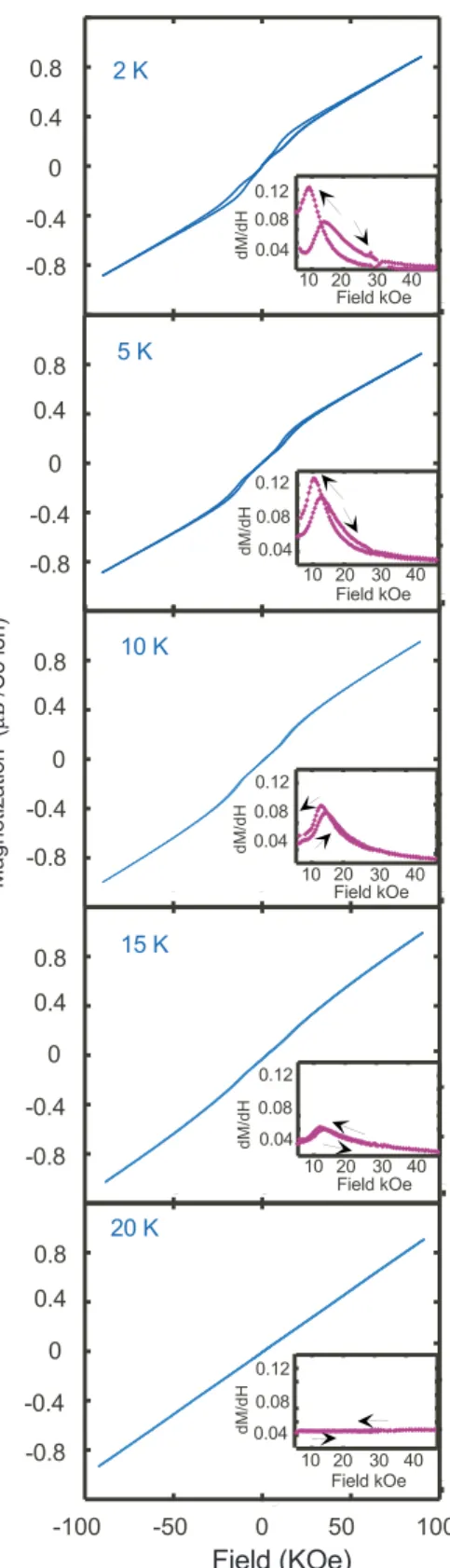
Dependence on the magnetization with applied magnetic field at different temperatures has been represented in Fig.6. As can be seen, at 2 K, the magnetization versus the applied field follows a process in stages characteristic of a metamag-netic transition. Up to 3.5 kOe, no magmetamag-netic irreversibility is observed while between 3.5 and 40 kOe, a small irreversibil-ity appears with ⌬Hmax of 4.5 kOe 共see inset figure of dM/dH兲. With increasing temperature, the magnetic
irrevers-ibility decreases, reaching a value of⌬Hmax= 1.5 kOe at 10
K. Indeed, at 15 K, the magnetization still shows a weak metamagnetic transition at H = 12.5 kOe but no irreversibil-ity is observed. Finally, at 20 K, the magnetization curve shows a lineal behavior in the whole applied field range sug-gesting the absence of magnetic order. It is worth mentioning that the magnetic moment at 2 K and 90 kOe is quite differ-ent from the theoretical saturation magnetic momdiffer-ent for this compound共3.4B/mol兲, indicating the existence of a strong
anisotropy. This general behavior is clearly different from that observed in the Co2共OH兲PO4 compound in which the
hysteresis loop has a small coercitivity characteristic of spin glasses.11
The thermal evolution of the ac susceptibility at different magnetic fields is shown in Fig. 7. Three different tempera-ture regions as described for the magnetic-susceptibility data can be observed: 共i兲 the presence of a rounded maximum at around 30 K in the real共
⬘
兲 component of the susceptibility which remains practically unchanged when applying mag-netic field, 共ii兲 the inflection point located on the real 共⬘
兲 component of the susceptibility below 20 K, associated with long-range antiferromagnetic ordering. It becomes more de-fined 共more three dimensional兲, moving toward higher tem-peratures as the applied magnetic field is increased共see inset in Fig.7兲, reaching a value of 20.3 K at 90 kOe. The absence of signal in the imaginary共⬙
兲 component of the susceptibil-ity above 15 K confirms the origin of the antiferromagnetic ordering,11and共iii兲 the inflection point at around 6 K, in thereal共
⬘
兲 and imaginary 共⬙
兲 component of the susceptibility confirms that it turns into a maximum defined for an applied field of 5 kOe. This signal decreases in intensity, with shifts in temperature as the magnetic field increases becoming ex-tinct in fields above 30 kOe.The temperature dependence of the molar heat capacity 共Cp兲 for Co2共OH兲AsO4is shown in Fig.8. Calorimetric
mea-surements in the absence of external magnetic field reveal a small maximum 共⌬Cp= 2 J/Kmol兲 centred at 18.6 K 共see
upper inset in Fig.8兲. This anomaly does not have the typical appearance of a second-order transition of but it can be associated with the establishment of a three-dimensional an-tiferromagnetic order in good arrangement with the magnetic-susceptibility data. Besides, no anomaly is ob-served below 10 K, which prompted us to propose that the magnetic contribution around 6 K observed in the magnetic-susceptibility measurements is not of a long-range type 共im-plying a disordered magnetism兲. Above the peak, Cp
in-creases continuously due to the phonon contribution and does not show any tendency to saturation even up to room temperature, where the value of Cp is 160 J/Kmol, still far
from the expected value according to the Dulong and Petit law23 共224.5 J/Kmol兲. This is due to the presence of light
atoms with very high excitation energy. FIG. 3. 共Color online兲 Partial polyhedral view of the packing of
Co2共OH兲AsO4in the z direction. Tetrahedra have not been shown for clarity.
FIG. 4. 共Color online兲 Thermal evolution of the molar magnetic susceptibility 共m兲 at 1 kOe for Co2共OH兲AsO4. The inset shows low-temperature ZFC-FC measurements at 1 kOe.
0.05 0.06 0.07 0.08 0.09 4 8 12 16 20 24 28 1 kOe 5 kOe 10 kOe 20 kOe 30 kOe 50 kOe 90 kOe χ m (emu/mol O e) T (K) 0.045 0.046 0.047 0.048 0.049 16 17 18 19 20 21 22 23 24 χm (emu/molOe) T (K) T N
FIG. 5. 共Color online兲 Low-field ZFC-FC magnetic susceptibil-ity at difference fields. The inset shows the field dependence of the long-range ordering temperature.
In order to extract the magnetic contribution共Cmag兲, that
phonon 共Cpho兲 should be determined. The exact calculation of Cphois difficult due to the absence of a suitable
nonmag-netic isomorphous compound. As it was satisfactorily used for Co2共OH兲PO4,11an estimation of Cphowas obtained using
the Debye model24and considering the existence of two
De-bye temperatures, the smaller one 共1兲 associated to the
heavy ions such us Co and As共n1兲 and the higher one 共2兲
associated to the O and H light ions 共9−n1兲. The best fit to
the experimental data for Tⱖ60 K is obtained for 1
= 270 K, 2= 1048 K, and n1= 3.6 ions. The magnetic con-tribution共Cmag兲 with temperature dependence is shown in the
lower inset of Fig. 8. Apart from the maximum associated with the three-dimensional magnetic order around 19 K, an-other anomaly like a shoulder circa 30 K is observed. This kind of broad maximum could come from different origins: 共i兲 bidimensional magnetic ordering, 共ii兲 short-range mag-netic interactions, or共iii兲 a crystalline electrical field, as will be analyzed later in the discussion.
Heat-capacity measurements have been taken in the pres-ence of several magnetic fields. Because the phonon contri-bution is not affected by the magnetic field, we have sub-tracted those values from the experimental data and obtained the magnetic contributions 共see Fig. 9兲. Usually, the effects of the magnetic field on antiferromagnetic or ferromagnetic transition become more rounder共and decrease in height兲 the anomaly, shifting it to either low 共antiferromagnetic兲 or high 共ferromagnetic兲 temperatures. In our case, unexpect-edly, the maximum associated to the three-dimensional or--0.8 -0.4 0.4 0.8 10 K -0.8 -0.4 0.4 0.8 -100 -50 0 50 100 Field (KOe) 2 K 5 K Magnetization (µΒ /Co ion) -0.8 -0.4 0.4 0.8 15 K -0.8 -0.4 0.4 0.8 20 K -0.8 -0.4 0.4 0.8 dM/dH dM/dH 10 20 30 40 0.04 0.12 0.08 Field kOe dM/dH 0 0 0 0 0 10 20 30 40 0.04 0.12 0.08 Field kOe 10 20 30 40 0.04 0.12 0.08 Field kOe dM/dH 10 20 30 40 0.04 0.12 0.08 Field kOe 10 20 30 40 0.04 0.12 0.08 Field kOe dM/dH
FIG. 6. 共Color online兲 Magnetization vs applied magnetic field at different temperatures for Co2共OH兲AsO4. The insets show the derivate of magnetization with magnetic field.
0.05 0.07 0.09 0 Oe 1 KOe 2 KOe 5 KOe 10 kOe 20 kOe 30 kOe 50 kOe 70 kOe 90 kOe Hac = 10 Oe υ = 1000 Hz 0.04 0.05 16 20 22 T (K) 0.0001 0.0003 0.0005 10 30 50 T (K) 18 0.08 0.06 0.04 0.0004 0.0002 0 20 40 χ (emu /mo l) χ (emu/mol) χ (emu/mol) 0.045 0.055 ″ ″ ′
FIG. 7.共Color online兲 Thermal evolution of the ac susceptibility of Co2共OH兲AsO4 at different dc applied fields with an ac field Hac= 10 Oe and frequency of 1000 Hz. The inset shows the fre-quency dependence of the long-range ordering temperature.
dering grows with field and becomes better defined 共see up-per inset of Fig. 9兲. These anomalous results will be explained later from neutron powder-diffraction data. In or-der to unor-derstand this surprising phenomenon, we have plot-ted the evolution of both, the temperature of the maximum and the temperature of the inflexion point above the maxi-mum as a function of the applied magnetic field. Both mag-nitudes evolve in the same way: nearly constant up to 10 kOe, a sudden increase between 2 and 60 kOe and, finally a tendency to saturation above 80 kOe共see lower inset in Fig. 9兲.
C. Low-temperature neutron diffraction
The thermal evolution of the D1B patterns is shown in Fig. 10. For the high-temperature NPD patterns, all the Bragg reflections can be indexed in the orthorhombic Pnnm space group. The refined lattice parameters at 50 K a = 8.241共8兲 Å, b=8.564共8兲 Å, and c=6.028共6兲 Å show a small shift with respect to the 300 K data 关a=8.258共1兲 Å,
b = 8.580共1兲 Å, and c=6.039共6兲 Å兴 due to effect of
tem-perature. New peaks appear in the patterns with decreasing temperature below 25 K confirming the onset of a magnetic ordering with a TNvalue of 21 K. These new peaks can be
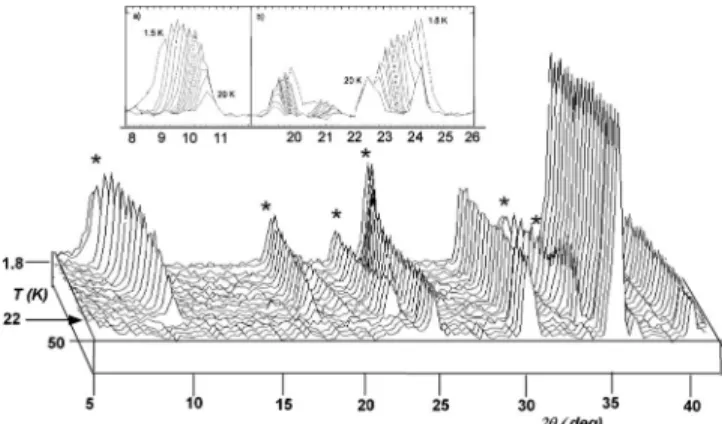
indexed with the propagation vector k =共0,␦, 0兲, indicating the existence of an incommensurate 共IC兲 antiferromagnetic structure along the b direction. The modulation wave vector characterizing the oscillatory magnetic order is temperature dependent with a value of 共0,␦, 0兲, where ␦= 0.430 at the lowest temperature共1.8 K兲 of these measurements. As can be seen in Fig.10, the intensity of the magnetic reflections in-creases in a monotonous way below TNand reaches
satura-tion at low temperature. Presence of anomalies indicating a modification of the long-range spin arrangement was not ob-served.
The magnetic structure was solved by means of symmetry-representation analysis25 using the program
BASIREPS.26The possible representations were systematically
checked with FULLPROF program.21After refining, the
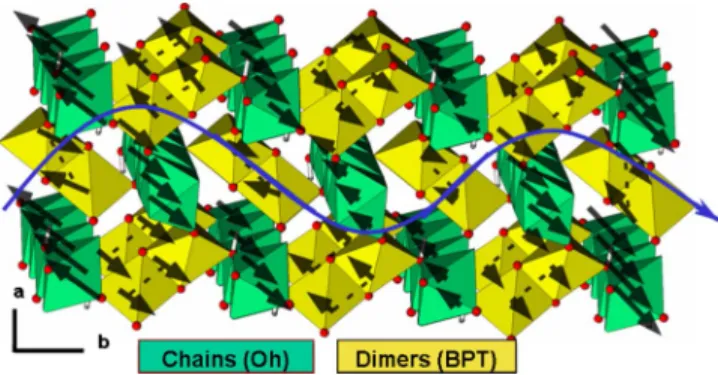
Fou-rier components of the atomic magnetic moments for each irreducible representation, a ⌫1共00Gz兲 for site 4b and the mixing of ireps⌫2共00fz兲 and ⌫3共00az兲 for site 4g were ob-served as the best solution共see symmetric analysis in Appen-dix兲. Rietveld refinements of this solution with a magnetic moment perpendicular to the propagation vector in the z di-rection gave a fully satisfactory fit 共Fig. 11兲. Hence, Co2+ moments are ordered with the magnetic moment modulated in a longitudinal sinusoidal wave perpendicular to the propa-gation vector. This ordering is visualized in Fig. 12. The components of the refined magnetic moments of Co共1兲 and Co共2兲 are 2.81共1兲Band 3.64共3兲B, respectively, with a
re-sultant magnetic moment of 3.22共2兲B per Co2+ ion. The
nuclear and magnetic discrepancy factors are Rp= 16.1, Rwp
= 14.4,2= 2.61, R
Bragg= 6.9, and Rmag= 14.4.
0 20 40 60 80 100 120 0 50 100 150 200 Cp Cpho Cmag T (K) Cp (J/molK) 0 2 4 6 8 0 10 20 30 40 50 60 70 T (K) Co 2(OH)AsO4 C mag (J/molK) 0 4 8 12 16 4 8 12 16 20 24 28 32 Cp (J/molK) T(K)
FIG. 8. 共Color online兲 Specific heat of Co2共OH兲AsO4between 1.8 and 200 K. Experimental data共blue full dots兲, estimated phonon contribution共black full line兲, and magnetic contribution 共red dots兲. Upper inset shows the experimental data and lower inset the mag-netic contribution at low temperatures.
Cmag (J/K mol) T(K) Cmag (J/Kmol) 0 2 8 10 Tmax Tinflex B(kOe ) 4 6 T(K) T (K) T (K) Cmag (J /Kmol ) T (K) B (kOe) 0 10 20 30 40 50 15 10 5 0 19 20 21 6 8 10 12 14 18 19 20 21 22 2 kOe 90 kOe T N
FIG. 9. 共Color online兲 Magnetic specific heat as a function of temperature in the presence of external magnetic fields 共H ⱕ90 kOe兲 of Co2共OH兲AsO4. The upper inset shows an enlarge-ment around the Neel temperature and the lower inset the evolution of both, the temperature of the maximum and the temperature of the inflexion with the applied magnetic field.
FIG. 10. Thermal evolution of the D1B patterns between 1.8 and 50 K. The共ⴱ兲 dots show the magnetic contributions. The inset shows the magnetic reflections共a兲 0–10, ⫾100 and the neighbor 共b兲 ⫾1–10 from 8° to 12° and 18° to 26°, respectively.
The magnetic moment was refined from the D1B data at all available temperatures. The nuclear structure and aniso-tropic temperature factors were kept from the refined D2B data at 2 K. The thermal dependence of the ordered magnetic moments is represented in Fig.13. It can be observed that the three-dimensional magnetic order starts at 21 K, the ordering temperature being similar in both sublattices. The curves of the Co共1兲 and Co共2兲 moments rapidly increase from 21 K to approximately 15 K with a change in the slope at around 12 K共Fig.13兲. The magnetic moment for the Co共1兲 and Co共2兲 ions in the dimer groups and chains slowly increases with practically linear variation from 2.64共4兲Band 3.46共5兲Bat
12 K to 2.81共1兲Band 3.64共3兲Bat 1.8 K. Furthermore, the
refined magnetic moments of the Co共2兲 octahedral ions are always higher than those of the Co共1兲 trigonal bipyramidal geometry in the whole temperature range studied. In addi-tion, the ␦component of the magnetic propagation vector k
continuously decreases with increasing temperature from 0.43 to 0.36共see inset in Fig.13兲.
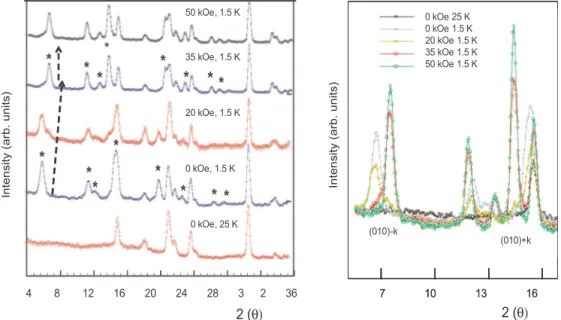
Neutron powder diffraction at different temperatures and fields were performed using a 50 kOe cryomagnet coupled to D2B diffractometer共=1.5938 Å兲. During the field experi-ments, the high-intensity nuclear reflection 共3, 2, 0兲 was measured repeatedly to control the correct orientation of the sample. In Fig. 14, we present the results from magnetic neutron diffraction with magnetic field at 1.5 K. In addition, we show the neutron diffraction of zero field and 25 K 共para-magnetic state兲 for comparison.
We find that the propagation vector k共0,␦, 0兲 is highly dependent on the magnetic field between 0 and 35 kOe. At zero field, magnetic Bragg intensities can be detected at共0, 0.43, 0兲 originations from an incommensurate antiferromag-netic structure along the b direction共Fig.11兲. When the mag-netic field increases, the magmag-netic bragg reflections of IC phase continuously decrease in intensity and there appear new magnetic satellites that can be indexed with a propaga-tion vector 共0, 0.33, 0兲. At 35 kOe, a sudden drop in all incommensurate peak intensities, denoting the transition of the magnetic structure into collinear AF magnetic phase共Fig. 15兲. The new increase in the magnetic field 共50 kOe兲 pro-duces significant changes in the magnetic intensities but not in the peak positions of the magnetic phase共Fig.14兲. This is a result of the increase in the magnetic ordering of commen-surable structure in good agreement with the surprising phe-nomenon observed in specific-heat data.
As can be observed in Fig.16, the applied magnetic field up to 50 kOe does not change the value of the ordering temperature. However, for values higher than 30 kOe, the external magnetic field seems to overcome the competing interactions that give rise to the incommensurate ordering. A magnetic phase transition takes place as a function of the magnetic field to a commensurate structure with propagation vector 共0, 0.33, 0兲. The resolution of this commensurate structure is under way.
0 20 40 60 80 100 120 140 160 2θ(∫) Intens ity (ar b.u ni ts ) Yobs Ycalc Yobs-Ycalc Bragg_position
FIG. 11. 共Color online兲 Neutron diffraction profiles of Co2共OH兲AsO4at 2 K obtained in D2B. Crosses are experimental, solid line calculated, and blue line differential data. First line of vertical marks corresponds to the position of the allowed reflexion for the crystallographic structure and the second line marks the magnetic reflexions.
FIG. 12. 共Color online兲 Incommensurate antiferromagnetic structure of Co2共OH兲AsO4along the b direction. The ordering of the magnetic moments of Co2+is in z direction for three crystallo-graphic unit cells for the two crystallocrystallo-graphic positions共dimers and chains兲. The sinusoidal modulation of the magnetic moments is also shown. Note that at a given temperature共2 K兲, there is only one propagator vector but there may be differences of phases between the magnetic sites.
0 1 2 3 4 4 8 12 16 20 24 28 Dimers Chains T (K) 0.35 0.4 0.45 0 6 12 18 24 T (K) µ( µ β ) δ( r.l.u )
FIG. 13. 共Color online兲 Magnetic moment for Co2共OH兲AsO4 refined from neutron data obtained with D1B as a function of tem-perature for chains and dimers of the Co2+ions. The inset shows the magnitude of the propagation vector共0,␦, 0兲 as a function of tem-perature. Solid lines are only visual guidelines.
IV. DISCUSSION AND CONCLUSIONS
The magnetic behavior of Co2共OH兲AsO4shows the
pres-ence of two types of magnetic interactions: 共i兲 three-dimensional antiferromagnetic interactions dominating at
high temperatures, which are those responsible for the high extrapolated negative Curie-Weiss temperature and共ii兲 ferro-magnetic interactions at temperatures lower than 15 K, where the field-cooled magnetization increases. This fact can be explained as due to the existence of ferromagnetic inter-actions in an overall antiferromagnetic behavior which pre-dominates at high temperatures.
The dependence of the magnetization with applied mag-netic field follows a process in stages characteristic of a metamagnetic transition below 19 K. The value of the magnetic moment at 2 K and 90 kOe is far below the theoretical saturation magnetic moment for this compound 共3.4B/mol兲, indicating the existence of a strong anisotropy.
The magnetic irreversibility in ZFC-FC curves grows on in-creasing the applied field up to 20 kOe and almost disappears for a magnetic field of 90 kOe. In addition, the inflexion point at around 6 K, observed at 1 kOe, is transformed into a new and well-defined maximum when the magnetic field is
Intensity (arb.units ) * 50 kOe, 1.5 K 35 kOe, 1.5 K 20 kOe, 1.5 K 0kOe, 1.5 K 0kOe, 25 K 4 8 12 16 20 24 28 3 2 36 0 kOe 25 K 0kOe 1.5 K 20 kOe 1.5 K 35kOe 1.5 K 50 kOe 1.5 K (010)-k (010)+k 7 10 13 16 Intensity (arb.units ) * 50 kOe, 1.5 K 35 kOe, 1.5 K 20 kOe, 1.5 K 0kOe, 1.5 K 0kOe, 25 K 4 8 12 16 20 24 28 3 2 36 0 kOe 25 K 0kOe 1.5 K 20 kOe 1.5 K 35kOe 1.5 K 50 kOe 1.5 K (010)-k (010)+k * 50 kOe, 1.5 K 35 kOe, 1.5 K 20 kOe, 1.5 K 0kOe, 1.5 K 0kOe, 25 K 4 8 12 16 20 24 28 3 2 36 0 kOe 25 K 0kOe 1.5 K 20 kOe 1.5 K 35kOe 1.5 K 50 kOe 1.5 K (010)-k (010)+k 7 10 13 16 Intensity (arb. units) Intensity (arb. units) 2 (θ) 2 (θ)
FIG. 14. 共Color online兲 共Left兲 Evolution of the neutron-diffraction peaks of Co2共OH兲AsO4at different fields at 1.5 K obtained in D2B compared with the zero field and 25 K.共Left兲 Magnetic peaks are marked with ⴱsign. Step narrows are visual guidelines for the eyes showing the shift of the共010兲-k peak. 共Right兲 Enlargement of the low angle diffraction.
35 kOe 1.5 K 0 kOe 1.5 K (010)-k(100)±k (110)-k (010)+k (-120)-k (010)-k (100)±k (-120)-k (010)+k 4 8 12 16 20 24 28 32 36 40 44 48 2 (θ) (110)-k Intensity (arb .U nits ) 35 kOe 1.5 K 0 kOe 1.5 K 35 kOe 1.5 K 0 kOe 1.5 K (010)-k(100)±k (110)-k (010)+k (-120)-k (010)-k (100)±k (-120)-k (010)+k 4 8 12 16 20 24 28 32 36 40 44 48 2 ( ) (110)-k Intensity (arb .u nits )
FIG. 15. 共Color online兲 Neutron diffraction profiles of Co2共OH兲AsO4at 0 and 35 kOe obtained in D2B. Crosses are ex-perimental, solid line calculated, and blue line differential data. First line of vertical marks corresponds to the position of the al-lowed reflexions for the crystallographic structure and the second line marks the magnetic reflexions.
H (T) T (K) 5 10 15 20 25 1 2 3 4 5 IC collinear AF Paramagnetic
FIG. 16. 共Color online兲 Magnetic phase diagram of Co2共OH兲AsO4. Blue circles are neutron diffraction obtained in D2B. The thin broken curve marks a boundary where different mag-netic phases could not be resolved in the diffraction pattern.
20 kOe. The fit of the magnetic data to a Brillouin law27 at
different fields in this region of temperature indicates the nonexistence of magnetic impurities共see supplementary ma-terial兲.
Three-dimensional antiferromagnetic ordering between Co2+ ions appears at around 20 K, showing an unusual magnetic behavior with the magnetic field. The inflection point on magnetic-susceptibility data, associated with long-range antiferromagnetic ordering, becomes more defined 共more three dimensional兲, moving toward higher tempera-tures 共⬇2 K兲 as the applied field increases. Besides, re-gards heat-capacity data, another unusual effect with the magnetic field is observed. The maximum associated to the three-dimensional ordering grows with the field, becom-ing better defined. This behavior can be explained as an incommensurate-commensurate magnetic phase transition with the magnetic field.
Another anomaly appears at approximately 30 K as a rounded maximum or shoulder in magnetic-susceptibility and Cmagdata, respectively. The nonappearance of anomalies in this region of temperature in powder-diffraction data indi-cates the absence of long-range spin arrangement. This sig-nal is not affected by the extersig-nal magnetic field and it could be originated by the existence of bidimensional magnetic order, the presence of short-range magnetic interactions or crystalline electrical field.
The possible existence of a bidimensional magnetic order precursor to the three-dimensional ordering circa 30 K could be analyzed from the magnetic heat-capacity data with quasi-two-dimensional antiferromagnetic Heisenberg models with varying interplanar couplings,28
C3D= C− Cplane= Cinter+ Ccross.
The purely interplane contribution Cinterand cross term Ccross are given by
Cinter=关具nz2典 − 具nz典2−具nz典兴/N, Ccross= 2关具np− nz典 − 具np典具nz典兴/N,
where n are the numbers of bond operators in the expansion acting within a single layer共np兲 and between two layers 共nz兲
and N is the system of size.
The comparison of the experimental magnetic heat capac-ity of Co2共OH兲AsO4 with the theoretical model shows a
good agreement 共Fig.17兲, where correlations between two-dimensional coupling constants共shoulder width to 30 K兲 are lower than the dimensional coupling constants 共peak at 19 K兲.
Another possibility is the presence of short-range mag-netic interactions. However, the fit of the magmag-netic- magnetic-susceptibility data at 1 kOe above 25 K to a classical bidi-mensional model gave negative results. Besides, until now, an adequate theoretical model to study these types of inter-actions in heat-capacity data has been not described despite the presence of compounds that show similar magnetic behavior.29
Finally, we have also considered the possible effect of the crystalline electrical field 共CCEF兲 on the magnetic
contribu-tion in this temperature region. Theoretical calculacontribu-tions30
in-dicated that the hexacoordinated Co共II兲 ion presents a low quadruplet separated by an energy⌬1from the first excited doublet whereas in the pentacoordinated Co共II兲 ion, the lower levels are two doublets separated by an energy⌬2. The
addition of these two contributions共Cpho+ CCEF兲 to the heat
capacity, fits the experimental data above the ordering tem-perature quite well 共Fig. 18兲. The best fit is obtained for values of 1= 299 K, 2= 1057 K, n1= 3.7, ⌬1= 80 K, and
⌬2= 85 K, respectively. Therefore, from these results, we
can conclude that all contributions proposed to explain the magnetic anomaly at approximately 30 K should be taken into consideration.
The incommensurate magnetic structures are character-ized by modulations of their spin arrangements over periods which are long compared to the size of the chemical cell and not commensurate with the underlying lattice.31 In our case,
the Co2共OH兲AsO4 phase shows an incommensurate
antifer-Model Experimental 0 1 2 3 4 5 6 7 0 10 20 30 40 50 60 T (K) Cmag (J/molK)
FIG. 17. 共Color online兲 Comparison of the experimental mag-netic heat capacity of Co2共OH兲AsO4 共red兲 with the theoretical model for anisotropic Heisenberg antiferromagnetic system 共see text兲. 0 20 40 60 80 100 120 0 50 100 150 200 Cp CPho + CCEF CCEF CPho T (K) C p (J /Kmo l) Co2(OH)AsO4 0 1 2 3 0 10 20 30 40 T (K) Cmag (J/Kmol)
FIG. 18. 共Color online兲 Specific heat of Co2共OH兲AsO4between 1.8 and 200 K. Experimental data共blue full dots兲, estimated phonon contribution and crystal-field effect 共CCEF兲 共blank full line兲, and magnetic contribution共red dots兲.
romagnetic structure along the b direction below 22 K with the propagation vector 共0,␦, 0兲 temperature dependent, will ␦= 0.430 being he value at the lowest temperature共1.8 K兲.
The magnetic structure of Co2共OH兲AsO4 consists of fer-romagnetic arrangements between the Co共2兲 octahedral chains and Co共1兲 trigonal bipyramidal dimers along the
c-axis-modulated antiferromagnetic between subnets in
di-rection b共Fig.12兲. The magnetic interactions in each sublat-tice,关Co共2兲O8兴⬁octahedral chains, and关Co共1兲2O8兴 dimeric units, together with the interactions through the 兩OH−兩 and arsenate groups give rise to a three-dimensional antiferro-magnetic coupling in good agreement with the results ob-tained from the magnetic measurements. Electronic para-magnetic resonance and reflectance diffuse spectroscopies indicate that only Co2+ions are present in this phase.30,32In
this way, the markedly different saturated magnetic moments in Co2共OH兲AsO4 with two chemically similar Co2+ cations
must be based on the differences between the geometries around the two cation sites. Spontaneous static ordering of the magnetic moments at low temperatures is caused by ex-change interactions between the moments, making it ener-getically favorable for them to align, either parallel or anti-parallel.
If we consider the commensurate AF structure of the iso-morphous Co2共OH兲PO4phase,11the appearance of an
ampli-tude modulated by changing the PO43− for AsO43− anions
demonstrated the strong anisotropy magnetocristalline present in these Co2共OH兲XO4 共X=P and As兲 phases. The main magnetic exchange pathways present in these isomor-phous compounds are shown in Table IV and Fig. 19. The shorter Co-Co distances range between 2.9 and 3.65 Å and consequently direct interactions are not negligible. Ferro-magnetic couplings are observed in the superexchange Co-O-Co interactions in both the edge-sharing关Co共1兲2O6共OH兲2兴
trigonal bipyramidal dimers and关Co共2兲O4共OH兲2兴 octahedral
chains whose angles range from 91.7° to 103.0° leading to TABLE IV. Selected geometrical parameters, bond lengths共Å兲, and angles 共deg兲 related to the possible
magnetic superexchange pathways for Co2共OH兲XO4共X=P and As兲. The data were obtained from D2B. Direct and through bonding distances, Co-Co共Å兲
As P As P Co共1兲-O共1兲-Co共1兲 3.22 3.24 Co共1兲-O共1兲-Co共1兲 4.11 4.07 Co共1兲-O共1兲-X-O共3兲-Co共1兲 5.48 5.49 Co共1兲-O共1兲-X-O共3兲-Co共1兲 7.47 7.21 Co共1兲-O共4兲H-Co共2兲 3.62 3.65 Co共1兲-O共4兲H-Co共2兲 4.05 4.02 Co共1兲-O共3兲-Co共2兲 3.59 3.55 Co共1兲-O共3兲-Co共2兲 4.23 4.45 Co共1兲-O共3兲-X-O共2兲-Co共2兲 5.59 5.64 Co共1兲-O共3兲-X-O共2兲-Co共2兲 7.52 7.22 Co共2兲-O共4兲H-Co共2兲 2.90 2.99 Co共2兲-O共4兲H-Co共2兲 4.04 4.04 Co共2兲-O共2兲-Co共2兲 3.13 3.04 Co共2兲-O共2兲-Co共2兲 4.18 4.12 Co共2兲-O共2兲-X-O共3兲-Co共2兲 5.95 6.05 Co共2兲-O共2兲-X-O共3兲-Co共2兲 7.72 7.61 Length of exchange pathway
Angles 共deg兲
Co-O-Co Co-O-X O-X-O X-O-Co
As P As P As P As P Co共1兲-O共1兲-Co共1兲 103.0 101.6 Co共1兲-O共1兲-P-O共3兲-Co共1兲 125.6 133.0 110.2 110.2 126.0 131.0 Co共1兲-O共4兲H-Co共2兲 126.2 123.2 Co共1兲-O共3兲-Co共2兲 116.9 107.0 Co共1兲-O共3兲-P-O共2兲-Co共2兲 126.6 125.0 112.0 110.2 122.0 127.0 Co共2兲-O共4兲H-Co共2兲 91.7 92.4 Co共2兲-O共2兲-Co共2兲 97.2 92.1 Co共2兲-O共2兲−X-O共3兲-Co共2兲 122.0 128.6 112.0 110.2 116.0 112.0
FIG. 19. 共Color online兲 Schematic view of the exchange path-ways for Co2共OH兲XO4共X=P and As兲. Interactions via vertex oxy-gen bridges of the phosphate and arsenate groups.
ferromagnetic interactions in both compounds. On the other hand, superexchange interactions Co共1兲-O共4兲H-Co共2兲 共Fig. 19兲 with a mean exchange angle of 123.2° and 126.2° for phosphate and arsenate, respectively, give rise to antiferro-magnetic couplings.
It is worth mentioning the comparison of the magnetic exchange interaction, Co共1兲-O共3兲-Co共2兲, between dimers and their neighbor chains in the Co2共OH兲XO4 共X=P and As兲
phases共TableIVand Fig.19兲. In this way, in the phosphate phase, this magnetic exchange has a striking angle of 107° 共for ferromagnetic interactions through the xz plane兲 which was considered essential in the competition between dimers and chains in order to ensure cooperativeness of the freezing process associated to a spin-glass state of this phase.11
How-ever, the substitution of the PO43−by AsO43−anions modifies substantially the magnetic exchange Co共1兲-O共3兲-Co共2兲 angle from 107° to 116.9° for the phosphate and arsenate, respec-tively, relaxing the magnetic frustration system of Co2共OH兲PO4leading to an incommensurate phase with
anti-ferromagnetic interactions共sinusoidal amplitude modulated兲 in Co2共OH兲AsO4共Fig.13兲. Finally, the magnetic interactions
propagated via 兩XO4兩 tetrahedra 共X=P,As兲 characterized by
both the O-X-O and X-O-Co angles give rise to a three-dimensional antiferromagnetic coupling.
In summary, the obtained results indicate the existence of an anomalous three-dimensional antiferromagnetic ordering influenced by the magnetic field in the Co2共OH兲AsO4phase.
The presence of both the strong anisotropy of the Co共II兲 ions and the magnetic frustration in the Co共1兲 and the neighboring Co共2兲 sublattices could be responsible for the complex mag-netic behavior observed in this compound. Besides, an incommensurate-commensurate magnetic phase transition from IC to collinear commensurate antiferromagnetic state can explain the unusual magnetic properties observed in this compound.
ACKNOWLEDGMENTS
This work was financially supported by the Universidad
del País Vasco/EHU共UPV/EHU兲 under Grant No. GIU06/11 and by MEC research under Projects No. MAT 2007-66737-c02-01 and No. MAT 2008-06542-c04兲.
APPENDIX Symmetry analysis
In order to determine the magnetic structure of the Co2共OH兲AsO4, it is very important to classify the possible
spin configurations according to the irreducible representa-tions 共ireps兲 of the space group for the propagation vector. For Co2共OH兲AsO4, all the magnetic reflections can be
in-dexed using a propagation vector k = kybⴱ with ky⬍1/2. Symmetry analysis for space group Pnnm with this kind of propagation vector has previously been performed for the 4b position, obtaining the different basis functions of the ireps describing the magnetic ordering at this site.33The extended
analysis for all magnetic sites and their final results are sum-marized in Table V. For Co2共OH兲AsO4, the center of sym-metry is lost. The coset representatives of Gkare 共x,y,z兲; 共 −x + 1/2,y+1/2,−z+1/2兲; 共x,y,−z兲; 共−x+1/2,y+1/2,z − 1/2兲. There are four one-dimensional irreducible represen-tations. The basis functions of positions 4b共named S兲 and 4g 共named R兲 are also given. We have used an extension to complex basis functions with the Bertaut notations34 for the modes F, A, C, and G. The value of w is eiky. The
number-ing of atoms in the 4b site is S1共0,0,z兲; S2共−x+1/2,y + 1/2,−z+1/2兲; S3共x,y,−z+1兲; and S4共−x+1/2,y+1/2,z
+ 1/2兲 with z⬇0.2597. The atoms in the 4g site split in two orbits previously related by the center of symmetry having the same basic functions. The coupling between these two orbits is usually positive or negative but in the general case, there is a phase factor between them. The cobalt atoms of the first orbit are R1共x,y,1/2兲; R2共−x+1/2,y+1/2,−z+1/2兲
and those of the second orbit: R3共1−x,1−y,1/2兲; R4共−x
+ 3/2,y−1/2,−z+1/2兲, with x⬇0.3642 and y⬇0.3645. The symbols共f, a兲 used to describe the basis functions for the Co orbits correspond for F and A for a two-atoms orbit. TABLE V. Irreducible representations共ireps兲 for the group of the propagation vector Gkk = kybⴱ共ky⬍1/2兲 in the space group Pnnm.
⌫ 1 n n
Basis functions vectors, S共,k,兩 j兲 for 4b site Basis functions vectors, S共,k,兩 j兲 for 4g site
m S1 S2 S3 S4 R1 R2 R3 R4 ⌫1 1 −w −w 共100兲 共−w00兲 共−100兲 共w00兲 Ax 共010兲 共0w0兲 共0−10兲 共0−w0兲 Cy 共001兲 共00−w兲 共001兲 共00−w兲 Gz 共001兲 共00w兲 fx 共00w兲 共001兲 fx ⌫2 1 共100兲 共−w00兲 共100兲 共−w00兲 Gx 共100兲 共w00兲 fx 共w00兲 共100兲 fx 共010兲 共0w0兲 共010兲 共0w0兲 Fy 共010兲 共0w0兲 ay 共0w0兲 共010兲 ay 共001兲 共00−w兲 共00−1兲 共00w兲 Az ⌫3 1 共100兲 共w00兲 共−100兲 共−w00兲 Cx 共010兲 共0−w0兲 共0−10兲 共0w0兲 Ay 共001兲 共00w兲 共001兲 共00w兲 Fz 共001兲 共00−w兲 az 共00w兲 共00−1兲 az ⌫4 1 共100兲 共w00兲 共100兲 共w00兲 Fx 共100兲 共−w00兲 ax 共w00兲 共−100兲 ax 共010兲 共0−w0兲 共010兲 共0−w0兲 Gy 共010兲 共0w0兲 fy 共0w0兲 共010兲 fy 共001兲 共00w兲 共00−1兲 共00−w兲 Cz
The decomposition of the full reducible magnetic rep-resentation ⌫ 共of dimension three times the number of atoms in the primitive cell兲 for 4b is ⌫4b=⌺⫾n⌫
= 3⌫1⫾3⌫2⫾3⌫3⫾3⌫4, the corresponding decomposition
for the two 4g sites is ⌫4g1,4g2=⌫1⫾2⌫2⫾⌫3⫾2⌫4. The number of free parameters for a magnetic structure corre-sponding to an irep is equal to the product共nfree= nd兲 of the
number of times共n兲 the irep ⌫n is contained in⌫ and the dimension 共d兲 of the irep. This is also the total number of independent basis function vectors.
The magnetic moment of the atom “j,” in the cell with origin at the lattice point Rn, in a magnetic structure
charac-terized by the set of propagation vectors兵k其, is given by the Fourier series, mnj=⌺兵k其Skje2kiRn, where the sum is ex-tended to the whole set of propagation vectors. For k at the interior of the Brillouin zone, the vector −k should also be present and Skj= Skjⴱ. The physical meaning of the basis func-tions of the irep⌫in describing a magnetic structure is that the Fourier coefficients Skj are linear combinations of the constant vectors S ␣共k,v,兩 j兲 so that
SKj=⌺␣C␣S␣共,k,兩j兲.
For a given propagation vector k and a given irep ⌫n, the
index␣ runs between 1 and n and between 1 and d共for details, see Ref. 25兲. The coefficients C␣ can be real or purely imaginary. By varying these coefficients, we obtain the whole class of magnetic structures satisfying the symme-try of the propagation vector. Let us consider two examples for the cobalt sublattices constructed with the representation
⌫3. The irep is of dimension 1 共so =1 and the summation
index over is therefore removed兲 and it is contained three times in ⌫4bso the number of coefficients is 3 共␣= 1 , 2 , 3兲.
The possible magnetic structures described by this irepare given by SK1=⌺␣C␣S␣共,k,1兩1兲 = C1共1,0,0兲 + C2共0,1,0兲 + C3共0,0,1兲 =共C1,C2,C3兲, SK2=⌺␣C␣S␣共,k,1兩2兲 = C1共w,0,0兲 + C2共0,− w,0兲 + C3共0,0,w兲 = w共C1,− C2,C3兲, SK3=⌺␣C␣S␣共,k,1兩3兲 = C1共− 1,0,0兲 + C2共0,− 1,0兲 + C3共0,0,1兲 = 共− C1,− C2,C3兲, SK4=⌺␣C␣S␣共,k,1兩4兲 = C1共− w,0,0兲 + C2共0,w,0兲 + C3共0,0,w兲 = w共− C1,C2,C3兲.
If, e.g., C1= C3= 0, the structure corresponds to a collinear longitudinal sinusoidal structure. If C2= 0, and C1= iC3with C3 purely imaginary, the structure corresponds to a helix
with a cylindrical envelope. If C1= 0 and C2= iC3 the
struc-ture is a cycloid, etc.
To solve the magnetic structure, one has to look for the set of coefficients that give rise to the best agreement between observed and calculated magnetic intensities. This part of the analysis may be undertaken simply by trial and error, by hand or using Monte Carlo techniques.
1S. Agrestini, L. C. Chapon, A. Daoud-Aladine, J. Schefer, A. Gukasov, C. Mazzoli, M. R. Lees, and O. A. Petrenko, Phys. Rev. Lett. 101, 097207共2008兲.
2R. D. Adams, R. Layland, C. Payen, and T. Datta,Inorg. Chem.
35, 3492共1996兲.
3S. Kobayashi, S. Mitsuda, M. Ishikawa, K. Miyatani, and K. Kohn,Phys. Rev. B 60, 3331共1999兲.
4Z. He, J. I. Yamaura, Y. Ueda, and W. Cheng,J. Am. Chem. Soc.
131, 7554共2009兲.
5Z. He, D. Fu, T. Kyömen, T. Taniyama, and M. Itoh, Chem.
Mater. 17, 2924共2005兲.
6Z. He, T. Taniyama, T. Kyömen, and M. Itoh,Phys. Rev. B 72,
172403共2005兲.
7T. Kanazawa, Inorganic Phosphate Materials共Elsevier Science, Amsterdam, 1989兲.
8R. C. Haushalter and L. A. Mundi,Chem. Mater. 4, 31共1992兲; A. Clearfield,Chem. Rev. 88, 125共1988兲.
9W. R. Rapoport and C. P. Khattaak,Appl. Opt. 27, 2677共1988兲; G. T. Forrest, Laser Focus World 25, 23共1989兲.
10J. M. Rojo, J. L. Mesa, R. Calvo, L. Lezama, R. Olazcuaga, and T. Rojo,J. Solid State Chem. 145, 629共1999兲.
11J. M. Rojo, J. L. Mesa, L. Lezama, J. L. Pizarro, M. I. Arriortua, J. Rodriguez Fernandez, G. E. Barberis, and T. Rojo,Phys. Rev. B 66, 094406共2002兲.
12W. T. A. Harrison, J. T. Vaughey, L. L. Dussack, A. J. Jacobson, T. E. Martin, and G. D. Stucky,J. Solid State Chem. 114, 151 共1995兲.
13P. Keller, H. Hess, and F. Zettler, Neues Jahrb. Mineral. Abh.
134, 147共1979兲.
14I. de Pedro, J. M. Rojo, J. L. Pizarro, J. Rodríguez Fernández, J. Sánchez Marcos, M. T. Fernández-Diaz, M. I. Arriortua, and T. Rojo,J. Phys.: Condens. Matter 18, 3767共2006兲.
15I. de Pedro, J. M. Rojo, J. L. Pizarro, J. Rodríguez Fernández, J. Sánchez Marcos, M. T. Fernández-Diaz, M. I. Arriortua, and T. Rojo,J. Mater. Chem. 17, 3915共2007兲.
16A. A. Belik, H. J. Koo, M. H. Whangbo, N. Tsujji, P. Naumov, and E. Takayama-Mourachi,Inorg. Chem. 46, 8684共2007兲.
17I. de Pedro, J. M. Rojo, L. Lezama, and T. Rojo,Z. Anorg. Allg.
Chem. 633, 1847共2007兲.
18F. C. Hawthorne, Can. Mineral. 14, 143共1976兲. 19R. J. Hill, Am. Mineral. 61, 979共1976兲.
20J. M. Rojo, J. L. Mesa, J. L. Pizarro, L. Lezama, M. I. Arriortua, and T. Rojo,Mater. Res. Bull. 31, 925共1996兲.
21J. Rodríguez-Carvajal, Physica B 192, 55共1993兲and later un-published versions; the program is a strongly modified version of that described by D. B. Wiles and R. A. Young, J. Appl. Crystallogr. 14, 149共1981兲.
22H. M. Rietveld,J. Appl. Crystallogr. 2, 65共1969兲.
24P. Debye,Ann. Phys. 344, 789共1912兲.
25Y. A. Izymov, V. E. Naish, and R. P. Ozerov, Neutron Diffraction of Magnetic Materials共Consultants Bureau, New York, 1991兲. 26J. Rodríguez-Carvajal,
BASIREPS, ftp://ftp.cea.fr/pub/llb/divers/ BasIreps
27B. D. Cullity, Introduction to Magnetic Materials 共Addison-Wesley, Reading, MA, 1972兲.
28P. Sengupta, A. W. Sandvik, and R. R. P. Singh,Phys. Rev. B 68,
094423共2003兲.
29A. M. Durand, P. Klavins, and L. R. Curruccini,J. Phys.:
Con-dens. Matter 20, 235208 共2008兲; A. Yaouanc, P. Dalmas de Reotier, V. Glazkov, C. Marin, P. Bonville, J. A. Hodges, P. C. M. Gubbens, S. Sakarya, and C. Baines, Phys. Rev. Lett. 95,
047203共2005兲.
30M. E. Foglio, M. C. dos Santos, G. E. Barberis, J. M. Rojo, J. L. Mesa, L. Lezama, and T. Rojo, J. Phys.: Condens. Matter 14, 2025共2002兲.
31T. Chattopadhyay,Science 264, 226共1994兲.
32I. de Pedro, J. M. Rojo, J. Rodríguez Fernández, L. Lezama, and T. Rojo, Eur. J. Inorg. Chem.共to be published兲.
33J. Rosset-Mignod, in Methods of Experimental Physics: Neutron Scattering, edited by K. Skold and D. L. Price共Academic, New York, 1987兲, Vol. 23C.
34E. F. Bertaut, Acta Crystallogr., Sect. A: Cryst. Phys., Diffr.,