Spanish bilingual system functionality
Analysis of bilingual educational context in Spain.
Student: Laura Fernández Morena
Tutor: Javier Díez Saiz Primary Education
INDEX
Abstract ……… 3
Resumen ………
3
Key words ………
3
Palabras clave ………
3
1.
INTRODUCTION ……… 4
2.
Methodology and theoretical framework……… 7
3.
Aims………. 9
a.
General aim
b.
Operative aims
4.
Conclusions………
56
5.
BIBLIOGRAPHY………..
60
Abstract
A descriptive analytical study of the introduction and evolution of bilingual programs in the community of Madrid. This analysis of the psychological and cognitive advantages of bilingualism has the primordial objective of observing how these programs can and must be adapted to the society that it affects. By doing so, it also aims to create a more natural education, making innovations to current approaches, and to suit different forms of socialization emerging today. The study contains several analyses that demonstrate an obvious context of “non-positive bilingualism pragmatism”, with particular focus on certain assumptions and approaches, and corresponding critical reflections which propose potential avenues for improvement, simple information or possible subsequent investigations.
Resumen
Un estudio analítico descriptivo que muestra la implantación en la Comunidad de Madrid de los programas bilingües y cómo han evolucionado. Analiza las ventajas psicológicas y cognitivas del bilingüismo y considera como objetivo primordial del bilingüismo ser analizado y evaluado para, seguidamente, ser adaptado en dualidad con la sociedad a la que afecta. Se busca así recrear una educación más natural, innovando la actual y reivindicando en ella esa necesaria evolución, siempre al compás de las diferentes formas de socialización emergentes en la actualidad. Contiene varios análisis que muestran un contexto evidente de “un pragmatismo no positivo del bilingüismo” y ciertas hipótesis, críticas y reflexiones para la posible mejora del mismo, con posibilidad de generalización, simple información o posibles investigaciones a posteriori.
Key words
Bilingualism, analysis, Madrid, Integrated Content and Language Learning (CLIL), bilingual program, English, Spanish...
Palabras clave
1.
INTRODUCTION
One of the most unique features of the contemporary world is the emphasis placed on the acquisition of a second language as a guarantee of competitiveness in an increasingly globalized world. This has led the world's governments to develop plans to promote bilingualism. (Jiménez, J. R. B., & Parra, Y. J. F., 2012, p. 99)
World is getting globalized at same time as we are getting European citizens, more and more linked in every way, cultural, economical…
To get in contact and have a better relationship with other countries, and also to have possibilities to understand and communicate each other bilingualism is becoming essential.
In this work it is explained the importance of bilingualism in nowadays globalized world for all the citizens. How European Union is getting aware about it and so it´s creating several programs in all the countries that set it; like bilingual projects.
It is normally English the language that is chosen, cause it´s the main language used in all over the world, but also many other languages, getting with this learning of a second language as bilingual countries, that we could accept more other cultures, and is giving also a lot of other benefits that bilingualism have, and this work is going to mention too.
It will be exposed the way that bilingualism programs work, and how they manage to start, history of them and some of the most important data to get to know them. But focus it on Madrid, the Spanish system that we are going to analyze from a point of view of a descriptive study.
So here comes a hypothesis about what can be wrong if all the good points of natural education, and in bilingualism itself, (that also will be explained in a theoretical essay, based in author experience and also in many sources), aren´t working as they should. And how these problems can be shown by students and their marks or their incomplete learning.
With a qualitative, descriptive and subjective research, using weapons as interviews or testing studies, we will get to know many results that will show us a possible problem that is needed to solve in education, and more specific in bilingualism education.
That can be a big opportunity to critic the system, the programs, to make educational members aware of the importance of analyze every time and refresh education every time a new idea, project, program, etc., tries to be part of education, and how is essential also to adapt in the context.
As it is exposed here, bilingualism is very important, and it can be very dangerous for quality of education to let it work in an inappropriate way.
Personally this work will make me fulfill some of the competences that are assumed to be mine at the end of the teaching degree, as we will see here:
To know the curriculum areas of primary education, the interdisciplinary relationship between them, the assessment criteria and the body of didactic knowledge concerning the respective teaching procedures and learning.
Deal effectively with language learning situations in multicultural and multilingual contexts. Encourage reading and critical commentary of texts from the various scientific and cultural content in school curriculum domains.
Design and regulate learning spaces in diverse contexts which attend to gender equality, equity and respect for human rights which satisfy the values of citizenship education.
Promote coexistence in the classroom and beyond, resolve discipline problems and contribute to peaceful conflict resolution. Encourage and value effort, perseverance and personal discipline in the students
Knowing the organization of primary schools and the diversity of actions comprising operation. Perform the functions of tutoring and guidance to students and their families, meeting the unique educational needs of students. Assume that the exercise of the teaching function must be refined and adapted to scientific, educational and social life along changes.
Collaborate with different sectors of the educational community and the social environment. Assuming the educational dimension of the teaching profession and promote democratic education for active citizenship.
Ponder classroom practices to innovate and improve teaching. Acquire habits and skills for independent and cooperative learning and promote it among students.
Understanding the role, possibilities and limits of education in today's society and the fundamental abilities which affect primary education schools and their professionals. Knowing models of quality improvement with application to schools.
Between some others competences.
2. Methodology and theoretical framework
Within the framework of this work in dualism with the above, there are initiatives and European cooperation, which has been called, Content and Language Integrated Learning [Aprendizaje Integrado de Contenidos y Lengua (AICOLE)]. An innovative approach that links the teaching and learning not only the foreign language but also with the foreign language in other areas or subjects.
As we have said it focuses on pedagogical basis provided by the Integrated Learning Content and Language, [ AICOLE (Aprendizaje Integrado de Contenidos y Lengua) ]; which presents the learning of knowledge and contents as a process in which the native language is involved and the second language model that sets the bilingualism in the center.
To speak about methodology, we should know:
One of the first activities that have taken place was the direct contact with social agents and institutions that maintain a direct relationship with the population that is involved in bilingualism, in order to obtain qualitative and quantitative data directly related to studies and interventions before my study and therefore related to the focus of it.
I contacted professors, main people responsible of bilingualism programs, native language assistants, and agents related to the topic, mainly bilingualism professionals in Madrid and in the location specified to be discussed later which was chosen because I was being part of that college in my teaching practices.
Also my own experience there.
As for the choice of the sample was not done randomly, but as we'll see this is a school where it can be more easily generalized the sample, as the majority of its population is of a rather low purchasing power.
Qualitative methodology
Methodology focused on issues not amenable quantification. For this have been carried out several interviews with those involved in the education system we mentioned earlier, through which relevant information has been obtained, but at the same time subjective and therefore not quantifiable, on specific aspects pertaining directly our research.
The interviews sought to gather information related to the opinion and participation of the agents involved in the educational system. To gather their views on different levels and according to different themes.
On the other hand, over the research for data collection,
3. Aims
a.
General aim
In a schematic way:
-Diagnostic of the flaws in the implementation of bilingualism from a descriptive study through students testing.
In another words:
This work aims to include a descriptive analysis of all proposed (The Spanish bilingualism and how is being working) and carried out correctly to implement bilingualism and its various forms in the Spanish educational system and its functionality. Having this work as a source of information, as an introduction to deeper studies or as a critical point of view to be aware of the always claimed "recycling" of the educational system and programs inside it. Understanding the recycling as a way to restructure and refresh everything that is involved in educational system to cope with evolution of society and to be able to cover the necessary education of the members of that society.
Since it is necessary to make constructive criticism analysis of all actions and developments affecting the educational system, also very occasionally, as the social, psychological, cultural, cognitive ... evolution of the society members that make up the social section affected by this change is very quick and very varied in each context.
Also it is needed to step up the “auto-criticism” which education and all the people involved in educational system must take as an “every day work”.
With the auto-criticism education has the power to follow the necessities of the new generations of more and more global engaged students.
Within the objectives it attempts to answer to the consequent justification and corroborated them.
Also between the objectives, it is aimed to have a descriptive analysis of the functionality of bilingualism, that means how it works in the reality in every way the bilingualism and its resources, in a specific localization as its Madrid.
With this general descriptive analysis, we could guess some possible fails that can be assume as a “Must” of educational researches, cause of the importance of the bilingualism nowadays.
To bypass difficulties from the duality of ‘evolution of population necessities over bilingualism’ and ‘evolution of bilingualism around population (learners), it is necessary first to know the importance of that, and get informed about it.
And also, it is aimed to make a personal critic, analysis and show of all my experiences, learning and assumptions or theories that I have been creating in all my teaching degree and may be used as a frame of a possible context of deeper investigations.
Mainly they arise from the demands of the professional situation as regards active member of the education system. But it is true that, as a person in society to whom affects the education system, everyone is "accomplice, victim and executioner" as a member of the educational community. The skills involve both theoretical knowledge or skills (conceptual: knowledge); practical (procedural: the know-how); and attitudinal (ethics, values, "knowing how to be").
It must be taken into consideration to cope, as we said, this holistic approach, before you can certainly acquire all this information collected and to be able to understand, transfer and manage a significant notion in the competition and knowledge of the biological and psychological development of students concerning the sample collected by the investigation (Infant and Primary).
Knowing and being competent to analyze and catalog the processes that govern learning as well as in the planning, development and evaluation of curriculum contents. Especially it is competent in the use and application of research methods in the primary stage and know basics, principles, characteristics and laws related to primary education in Spanish and international education system.
b. Operative aims
Relevant information about bilingualism
The relatively recent development around bilingual education whichis being experienced in Europe is caused by a growth of relevance in the European Union to increase the knowledge of foreign languages in its member countries.
This happens by several major factors, including the fact that “besides helping to foster mutual understanding between peoples, [foreign languages knowledge] is a prerequisite for a mobile workforce and contribute to the competitiveness of the economy of the European Union".1
In one of the reference sources of this study, the community of Madrid lists some positive aspects related to multilingualism which is considered in the preceding paragraph. Certain advantages which are worth bringing up:
● The linguistic and cultural diversity is an integral part of European identity. It is a common heritage, a wealth, a challenge and an asset for Europe at once.
● The multilingualism is a major cross-cutting issue, encompassing the social, cultural, economic spheres and therefore educational spheres.
● The promotion of less widely used European languages represents an important contribution to multilingualism.
● The effort to promote language learning should be even redoubling, as well as the effort to value the cultural aspects of linguistic diversity at all levels of education and training and, equally, to inform about the variety of European languages and their dissemination in the world.
1 Conclusions of the Council of 19 May 2006 on the European Indicator of linguistic competence.
● Multilingualism also gives particular significance in promoting cultural diversity, inter alia, through media and content online transmission and intercultural dialogue within Europe and with other world regions. Tradition has a special role in this process by linking the languages and cultures and enabling abroad access to works and ideas.
● The linguistic diversity within Europe constitutes an added value for the development of economic and cultural relations between the European Union and the rest of the world. ● The multilingualism contributes to the development creativity by stimulating the access to
other ways of thinking, interpreting the world and expressing the imagination. (Comunidad, D. M., 2010, p. 13)
All this about Europe, but in this context, focusing on Spain, with its wide variety of situations within their autonomous communities, and going slow and progressive, has already entered in the group of EU countries that have been involved in this aspect.
But it is known an earlier introduction of bilingualism in Spain in 1996 as a teaching model. The cooperation agreement signed between the Ministry of Education and the British Council, promoted in Spain the possibility of getting the degree in the relevant countries of the languages in which bilingualism the degree has engaged itself.
Then through the Bilingual Schools program since 2004, which more and more schools resources and new age cohorts are joining. All this gives new meaning, more substance and strength to move on bilingualism in the education system in the region.
This is mostly in terms of bilingualism measures moving from Europe to Spain and focusing on Madrid. Guiding the data as public schools and the education system more "audited" and somehow more reliable data and closer for everyone.
And, also, we find that each implementation of any new educational contribution or any news incident on change details of education, we find that new needs will emerge going to be covering.
Thus, to continue to face the challenge of innovation by improving the education system; in any direction and issue that innovate.
Before turning to the descriptive analysis, let´s see some more information about the program of bilingual schools, discussed above, the main base of bilingual education in the educational system of the Community of Madrid.
This program of bilingual schools is done in kindergarten and primary schools which are chosen by the Ministry of Education so that they carry out the implementation of this program.
The program targets selected center completely and not a party or a line of the same, as in the model sections based bilingualism in other regions of Spain.
It is progressively implemented starting with the first year of primary education, introducing each course each year until reaching cover all primary.
Within the framework of this work in dualism with the above, there are initiatives and European cooperation, which has been called, Content and Language Integrated Learning [Aprendizaje Integrado de Contenidos y Lengua (AICOLE)]. An innovative approach that links the teaching and learning not only the foreign language but also with the foreign language in other areas or subjects.
The goal is to get the same content and tackle objectives from both languages. 30% of the curriculum is taught in English in any area except mathematics and Spanish (Castilian language and literature). In addition, areas of English Language and Knowledge of the Natural, Social and Cultural sciences are taught in English language compulsory throughout the entire stage.
There is a bilingual program coordinator in each school, who must be teacher specializing in foreign language, (English), designated by the principal. He/she is responsible for monitoring everything related to the bilingual program, organize, plan, review, and generally make everything to flow properly.
According to research sources used for this work, these centers assigned to the bilingual program are endowed with some financial aid, a budget that reaches 3000 Euros the first year and from the second year of activity an amount equal to 20% of the budget usually held by the center.
They also provide teaching and learning materials, technological equipment, training courses for teachers, language assistants ... that the Region of Madrid brings to each center or, at least, the Community of Madrid make sure the centers obtain it.
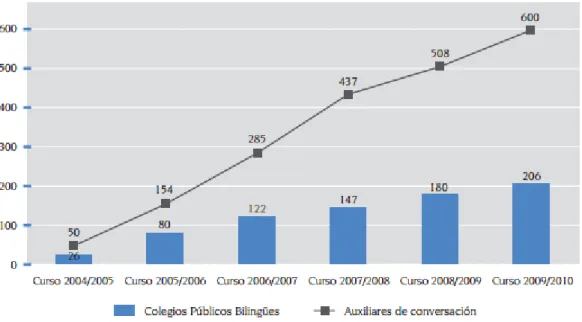
*Evolution of language assistants of the bilingual program in the bilingual public schools. Years 2004/2005 to 2009/2010*
(Comunidad, D. M., 2010, p. 34)
At this point in collecting information and data, it would be appropriate to have information on program implementation and evolution.
According to one of the sources:
Figure 1.2 shows the evolution of the total number of schools in which it has been applied, the bilingual education program, and Table 1.3 presents the data organized by territorial area and ownership. The numbers indicate an average growth rate of implementation, in terms of centers attached to the Program: 44.8 centers per course.
*Evolution of the assigned schools to the bilingual schools program in Madrid by guidance of territorial area. Years 2004/2005 to 2009/2010*
(Comunidad, D. M., 2010, p. 29)
*Evolution of the number of students in bilingual schools program in Madrid. Years 2004/2005 to 2009/2010*
*Evolution of the number of students in bilingual schools program in Madrid according to kind of school (public or half state-funded half private). Years 2004/2005 to 2009/2010*
Curvilinear graphs above show, clearly, the acceleration of the implementation process. This is the result of the superposition of two phenomena: the progression, year after year, of the number of courses affected in the same center stage and successive additions of new centers to the program (see Figure 1.2). This explains, how quickly it has grown the number of students benefited.
(Comunidad, D. M., 2010, p. 29 y 30)
The Order of the Ministry of Education which is regulated by the procedure of obtaining of Entitlement Linguistic in foreign languages, (1672/2009 of 16 April (BOCM May 8)) sets two ways to get that rating: by a test conducted by the: General Directorate of Human Resources or running positively and successfully certain activities of the Specific Training Plan designed by the Ministry of Education for this Program.
Now more visually to observe the evolution of teachers and their qualification in order to participate in the program:
*Evolution of the number of teachers able to teach in the bilingual schools program. Years 2005/2006 to 2009/2010*
(Comunidad, D. M., 2010, p. 33 y 34)
But overall, the most important assessment comes when the students are being tested. It is an external test to have a measure of linguistic acquired notions by the students, of which is responsible Trinity College.
*Results of TRINITY tests 2nd and 4th level of primary education in the bilingual schools program. Years 2006/2007 to 2008/2009*
(Comunidad, D. M., 2010, p. 37 y 38)
Before moving to the objectives that support this research and data collection to meet the hypothesis of the functionality of bilingualism, it seems appropriate to create a solid basis but incomplete, let´s call it ornamental, the concept of bilingualism with some interesting connotations from a source used for general notions and this quote; (as for full understanding of this work it is needed a minimum notional value, a basis on issues and concepts such as bilingualism and glimpse minimally the conscious competencies, defined above):
Languages in contact, that is bilingualism at the societal level and bilingualism, its counterpart at the individual level, are an integral part of human behavior. With globalization and increasing population movement due to immigration and greater geographical and social mobility and with the spread of education, contacts between cultures and individuals are constantly growing. While bilingual individuals already outnumber monolinguals, it can be expected that this trend will continue in the twenty-first century.
(Hamers, J. F., & Blanc, M., 2000, p. 1)
Provide an overview of the current education system and its potential deficiencies
Inside the base that supports unbalanced educational system cataloged and referenced by too many stimuli negatively formulated, because of certain base of values which were recreated by a society and culture covered in a past that is pressed in changing laws and changing generations, which need to broaden the horizons of socialization and must combine the innovation with the realization of new values adapted to the new forms that prevail in globalization that is contextualized and diverse and very exclusive located in every situation.
And especially in child and adolescent stage, when more is the impact of that education and cognitive development, in the social base, always focusing on the needs of students and their natural state for learning, individualization and the proportional weight of learner and educator, never unbalanced. (Teaching playing with the weight of psychologists and researches ...)
We can approach a natural learning;
Nobody teaches syntax or grammar to their descendants, and we can see can be considered, that everyone, from very little know how to use this knowledge (for the praxis of language), although of course is not aware that owns, and uses them.
This is the natural learning, but focused on the class, keeping in mind that they are aware of that learning and knowledge itself, which increases its effectiveness but always in practical way to its conscious use in situations that really serve to problem solving and this generates, that autonomy of the learner that makes him being able to take his knowledge to himself.
From infancy to adulthood and elderly, we learn every day naturally by our innate predisposition to know the context, the world that we have around us and concerns us.
We nourish ourselves from information around us, experience and especially we fail trial and error, and of course we try to find our way, that is, individualization and subjectivity in the way of implementing a knowledge of a test of experience. As each person has characteristics that make it unique, in every experience and how they adapt to their cognitive consciousness.
These skills are permanent knowledge in our brains, more than memory, not even long-term memory. They are knowledge, we have learned with our senses and our system of adaptation, and to become significant, and it is a natural way of learning, they are stored as language, like endure urine, or walking …
But before you can move to get this training, which is even obvious, we must get rid of the powerful establishment that has been created, immunity to coherent, as always, for disloyalty to basic and substantial task of educating the social base, or that is, to educate society from infants to recreate another type of society, "unburned".
Roger Schank, is one of the first authors in the field of artificial intelligence and cognitive psychology, which has developed the Conceptual Dependency Theory.
For this author, the school walks away hopeless and harshly of natural learning as trial and error, it is essential to achieving all that inherently involves the concept of natural learning.
The school has always been ignored and even mistreated not only left out, this type of learning. The education system has always taught in a completely opposite way to natural learning processes.
Children / as they have an insatiable curiosity which acts as a guide to find the right learning, of what they need to know and when they need to know it. The right guaranteed in this way learning attaches great autonomy as an individual, which well-nourished and encouraged gives us, as guarantee "the resolving power" of almost any problem.
Here comes the problem of enlarge social fears and negativity in the teaching-learning system, which happens to be the dictatorship of fear by negative messages and reinforcements in the same way, negative, to achieve learning. Leaves no room to trial and error.
We live in a hurried society that rejects childhood, its time and "its manias", in short: its nature. And adding to this that we have neither the energy nor the dedication, by laziness or ignorance, to tolerate the characterization of childhood and adolescence, for this reason simply, our response is so negative, incoherent and cruel as "discredit" the answers given by these stages, "deny them" and "scold them". (Finally, and before going to work with an investigation and to deal with this parallel reality, by the desire to get even with this natural learning reality provided, would encourage the figurative idea of this before;
"Understood as: The generation of what I call," NO students. ""
And it will be explained below which to me is a "NO student."
When any student has the feeling imposed by its main referents not be enough to achieve or get overcome himself or herself, on Their Own, any obstacle or problem solving that will be submitted in daily life, inside and outside school.
This is a serious problem, first social, for our way of negative learning, transferred to our personal and social evolution. Since our educational base consists of negative messages: Do not do that! Do not touch that! do not go there ...!
Then, fear of everything, since experience on the one hand, if you take to the negative meaning, gives you the right to be afraid and to avoid certain things, we avoid our “life students”, we get the avoiding of falling into mistakes, and the learning involved. Is it better; and this I cannot know; let suffer the mistake and learn from truth and significantly through experience, or is it enough experience collecting information from an alien experience? and… if so, in infants, in the same way as in adults?
An important question that no one has time to develop, and if they do, no one has time or notions to answer it.
Second educational system. That recreates this negativity and "bring it on a pedestal," formalizing it and giving credit to use it as the only way, and socially accepted, and never criticized. Take it as the only way to foster educational foundation of sociocultural appearance, without thinking for a second what it entails.
A problem that is severely emphasized in the social / educational / cultural contexts. With people at risk of social exclusion, with all kinds of social problems. Since the references become more uncertain, more violent, more incomplete and even more harmful or null.
Not to mention all other educational, referents media and all the information around us and especially in childhood, affecting more, because they cannot be critical, another error, we not teach them to be critical and assertive as negativity, not even excuse, it is No and never really know why.
One of the worst things about this educational foundation so embedded in the social shell and accepted, is that it is complicated that global learners; since globalization among other things has achieved this mostly massive global educational base, except as poverty and Division of "worlds developed" and "undeveloped", can actually damage more than the third part of the population world; but apart from that, the worst, as I was saying, it may be difficult to turn around this problem, complicated to award another way of teaching and learning when it has been installed and the population already lives with it normally.
That´s because, usually learners stop responding to other methodologies, reinforcements or references. Although it is not entirely impossible to change the basis, it is true that this complicates the change, (the settlement of negativity as functional social education.)
So the characterization of childhood, understood as natural and lived predisposition to learning, among others, it is denatured and destroyed. The society wants to see grow up very fast infants, they want everything to be learning fast and accurate, without patience many times, no tolerance others, no questions accepted, "energy without control", or attitudes that are not valued as "practical" or "right", all eyes set in adulthood. "hush and not move"
It is condemned. Instead of accompanying and guiding the re-generation of society, understood as the new beings that occupy society and all that it entails, only pragmatic is sought as you prepare for adulthood or "throwing into adulthood”. children are never children.
One advantage bilingualism it's Said to have got is to improve intelligence, with many studies on the measurement of intelligence. in bilingual products of society.
An example of this is contained in the sources of this work where Madorah Smith, a psychologist interested in demonstrating the influence of bilingual experience in intelligence, after wandering in the investigation having exercised the experiment, only with a global intelligence, not with different intelligences as she did in the review and restatement of her research, where, with two intelligences, verbal and nonverbal delivered its opinion at her work:
... That bilingual individuals outperformed monolingual not only in the means of non-verbal intelligence, but also in verbal intelligence. "(Sanz, C., 1999, p. 8)
From this source we can get how researchers agree that the experience of living with two languages
promotes flexibility in mind, greater willingness and ability to form concepts and more diversified set
of mental skills. In contrast to the monolingual groups which have a more homogeneous and unitary
structure of intelligence to be used as a resort for whole intellectual type of tasks entrusted.
The measurement of functionality and therefore the consequent improvement proposal that would be incipient with the above analysis, should encourage the main objective of improving bilingualism and bring people to “the naturalness of bilingualism”, this can have a positive impact on all aspects of intellectual improvement that carries the real bilingualism.
So it is important the objective of achieving a real and practical bilingual education, having that work as a source to start this main goal of nowadays education.
For that we must first show the importance of bilingualism, apart from the introductory ones. Another aim to get in this work.
Especially through didactic, but always from a cautious, analytical, critical analysis and our eyes focus on improving bilingualism itself.
Knowing and assuming the necessary skills and the necessary learning of the pupil of the same skills, such as: communication and intercultural skills. Basis that supports bilingual learning. (Adding that within these core competencies would be linguistic or grammatical competence).
We can also begin as a target to compare and contrast the current approach to established bilingualism and see this as opposed, in order to pick the best of each and be able to change or differentiate embracing the best of each type of coping bilingualism in school
According to sources, there are more types of learning models:
Multilingual models multicompetence model, dynamic model of multilingualism, multiliteracies model. (Cots J.M., Ibarraran A., Irun, M, Lasagabaster, D; Llurda, E.; Sierra, JM, 2010, p. 24-28).
Which would be a good subject matter. There will be no introduction to the concepts to keep building the root of this work and not dissociate it from its main topic.
According to other sources of information that support research, analysis and data collection to underpin the set, (Abdelilah-Bauer, B., 2007, p. 98-113):
Main ideas that can elicit from this source is the fundamental importance of motivation for learning another language different from mother tongue, talking about meaningful learning, referring as well to the values targeted by psychologists and researchers that supports meaningful learning and its variants, which support many educational theories and methodologies of great importance to the education system, and may be higher if they found objective way within a subjective system of feeding and hence are perverted, Seek through the expression.
Other ideas are some other problems such as delaying the onset of language in bilingual groups, as opposed to monolingual. Later, as a stuttering speech problems, difficulty in finding in those extended by bilingualism cognitive systems, proper communication on certain occasions, because the fact of having more information is positive, but also causes spend more time in organizing this information and to transmit it correctly and pragmatically.
Qualitative study of possible deficiencies of the implementation of the
bilingualism in students
Hypothesis:
In a schematic way:
- Regarding the implementation of bilingualism in the same way in different contexts, often without the resources or adequate adaptation, the apprenticeships taught and acquired are incomplete or erroneous. The principles of bilingualism given to education are not adequate, cannot get the benefits of bilingual education; and "not bilingual" and general education in school became more difficult. Then the students are full of the potential disadvantages that come with bilingualism if it is not performed accurately.
So, in conclusion, one of the general hypothesis would be that is needed to analyze and bypass the best way and tackle with the naturalness which is given by bilingualism, by the natural learning conveniently used by humans and society, within the education system, problems that bilingualism can exert on the mind and the socialization of individuals named bilingual.
Contextualization and descriptive study
With all the foregoing analysis, the information that would be more useful to unmask will be how the bilingual system actually works in Madrid and perhaps to be more reliable, in a less favorable context, to see the limitations of Spanish bilingual system in its truth.
To do so, my sample takes place in the context and reality of a public school in Madrid:
Name of the Center or Public Education: Juan Sebastián Elcano
Location:Mirasierra, 29, 8026, Madrid
Some information about the context of the sample:
Public Education Center "Juan Sebastian Elcano" is located in Madrid, a municipality and a city in Spain. The city is the capital of Spain and the Community of Madrid. Also known as the Town and Court, is the most populous in the state, with 3,165,235 residents in 2014, but with the inclusion of the metropolitan area the number of population amounts to 6,543,031 residents, thus being the third or fourth metropolitan area, according to the source, behind those of Paris and London, and in some sources also behind the Ruhr, and the third most populous city in the European Union, behind Berlin and London.
According to the Foreign Population Report (presented by the Regional Immigration Forum and conducted through 3,000 surveys), to June 1, 2013 lived in the region 5,568,245 people, of which 974,665 were immigrants, ie, 14.90%. It is the lowest number of immigrants in the community since 2006, when the number reached 949,354. Earlier this year, the figure still slightly over one million: 1,000,108. (Article of 2013)
The center is exactly on the Mirasierra Street, 29 Madrid.
In the Neighborhood / District MOSCARDO / USERA. Within the district of Usera, already in the limit with the district of Carabanchel and Arganzuela. In the immediate area there are three other schools, one of the state and two concerted, and a sports center (Juan Valera) and a health center (las Calesas)...
The Center has good public transport infrastructure: Usera metro next to the school and regular bus lines in various directions. It has gardens, open spaces such as "Madrid Rio", endowed with cultural, recreational and sports facilities Usera has not removed the complex of suburb district of the times of development, when it accumulated, without order, poverty gathered together at the gates of the capital. The strong public investment tries to recover the lost time, but the equipment is not the only solution for a district that maintains high levels of unemployment and crime, low education and low income per capita.
Ten of the 21 districts in which the capital is divided are the most insecure areas of the city. His neighbors suffer a range of varied crimes, which highlights the new phenomenon of gangs and murders are the bloodiest and tragic chapter. Including Usera.
Social and cultural circumstances of the Center:
Most students who hosts this school, are in the area. The relative provenance of each of them is not very varied, generally all students are foreigners, except for a minority of Spanish students. (CHINA, Latin America, the most common, and many other nationalities, and on the other side of Gypsy ethnic group or culture).
Socioeconomic status is medium-low. Both parents in a high percentage do not work, many housewives, and the rest, with its varied occupational profile, mostly in sectors of trade, services, labor level, without requiring studies. Being thus, the school is forced to respond with different services to family needs. (School Cantina, tutoring, extracurricular activities the majority free services, by the municipality, NGOs and associations outside the institution partners work together, or the center helps with textbooks, etc.)
The center is included by the local government in the bilingual program of the Community of Madrid. The center is at the moment seated in the first and second year of primary school. And in Infant Education.
In order to make a reliable sample of the viability of bilingualism in this context I started from educating and educators the major roles that underpin the education system and fully enrolled in the bilingual program.
Hence, what we want to measure with this test is the knowledge acquired in Spanish (language assumed as a mother language), compared to the English knowledge of one of the subjects taught in English, like: Sciences.
"Assumed" is mentioned, talking about the mother tongue because of the problems the bilingual system has on the adaptation of foreign students, who do not even have the “native language”, in this case Spanish.
The test was performed on a first grade. (6/7 years). During 1ºA. 20 students.
There are 12 girls and 8 boys. It is the first level, which works best, among other things, the best tutoring, for the right family background in general, families are more concerned about the students, and there are several very good students. (Talking in a very poor environment with majority of people in risk of social exclusion).
There are 3 with record of absenteeism. one of them all, is having social services behind though as it was discovered almost at the end of the course, from school said they could do nothing.
These are children with incredible potential, but with a disadvantaged social context, depending on the case, but in general.
They are very active and collaborators, but the work of a new language involves large difficulties of understanding and expressing to them. Noting that many are immigrants and have no basis even in the Spanish language.
It is to say that they are dispersed easily, easily wrapped in a violent environment, and respect for the rules is difficult to follow, because of that activity and disruptive socializing, but nevertheless, are very good potential students.
And being so young and being in an initial level of school as they are, first grade they are very malleable in all aspects.
This is mainly for children to have the reference to know the form, content and appearance of implementation of activities; and therefore only measured, more objectively, the knowledge that the questions ask. (Not understanding the question, for example).
Test sample:
Escucha y rodea en el mapa:
LISTENIGN: Museo, museo. Escuela, escuela. Piscina, piscina. Parque, parque.
Oficina de correos, oficina de correos. Biblioteca, biblioteca. Supermercado, supermercado.
Iglesia, iglesia. Banco, banco.
Ahora mira el mapa:
¿Dónde está la escuela? La escuela está en la Calle Mayor. Cerca del parque. Rodéala.
¿Dónde está la biblioteca? La biblioteca está en la Calle Norte. A su izquierda está el cine.
Rodéala.
¿Dónde está la piscina? La piscina está en la Calle Verde. En frente del museo. Rodéala.
Escucha y colorea:
LISTENIGN: Yo vivo en la Calle mayor, en el número 24, mi casa es amarilla. Mi
vecina vive en la calle mayor, en el número 26, su casa es rosa. La casa de mi amiga es verde,
ella vive en la Calle mayor en el número 30. Mi profesora vive en la Calle mayor, su casa es
el número 28 y es roja. En el número 32 vive un desconocido, su casa es la casa azul de la
Calle mayor.
Usa el código. Rodea.
Completa con las palabras. Luego usa el código y
Escucha y colorea.
LISTENIGN: Podemos ver agua en muchas partes. Las nubes: el agua en las nubes es
gas. Lluvia: El agua en la lluvia es líquida. Mar: El agua en el mar es líquida. Nieve: El agua
en la nieve es sólida. Hielo: El agua en el hielo es sólida. Río: El agua en el río es líquida.
Usa el código y colorea.
* This exercise could not be completed because they had not yet seen it in the lesson
According to the results is created a descriptive analysis here. especially looking whether the knowledge was acquired and what percentage of the class.
*Results of first grade of the second evaluation*
This may be defined as the science scores are very positive. The number of students who did not pass, could be only the students who are struggling. (Such lack basic reading and writing, absenteeism, lack of basis for the Spanish language, etc.)
*Evolution 1ºA course grades in the second term of evaluation*
The results of the corrected proofs are not found in the annexes because they cannot expose for privacy and school rules. No numerical evaluation will take place as the greatest interest is to appreciate the knowledge they have acquired.
From there on we can see from the results that would verify whether or not the functionality of bilingualism in Spain, Madrid.
Now with all this information it made an analysis of the comparison and contrast of all results:
Correcting tests, the most common errors were: spelling errors or lack of notions of concepts in the Spanish language.
Listening exercises, obviously they did not have much trouble, even for those without the mother tongue alleged (Spanish) perfected. This happens because in one language, but not the mother tongue one, if you are involved in the context of language, listening skills are the first skills flowing, (listening comprehension). The production of language, either spoken or written will come with more practice of the language.
However other types of students, which are common also in the education of today in Spain, those without reading and writing basis, could not, either in Spanish or in English, show their knowledge in a written test.
A collation of such pupils, bilingualism can give trouble in locating phonetics, in morphology, and all levels that someone must achieve to achieve reading and writing skills in general, they may be interrupted by the teaching of two different phonetics, from two different languages. (Especially when there are no bases settled of any of the languages).
Nor is there any basis on which the knowledge of several languages, dialects, etc. It is set up for children and clarifies concepts and spelling, to improve the functionality of bilingualism. Perhaps also the great lack of resources: human, etc.
This could be achieved by focusing more on the subject of Spanish language, and in general, more interdisciplinary culture within the education system to reinforce notions, since they are all linked, and more, the lower the level of the learner.
On the other hand, "free interviews" (Interviews carried out in individual questionnaire mode for greater power of disinhibition and objectivity when answering) were performed.
Sample "free interview":
Entrevista Bilingüismo y su función en el sistema educativo
Interview bilingualism and its function in the educative system
Se respetará el anonimato.
Anonymity is respected.
● Puesto que ejerce en el sistema educativo:
o Position you execute in the educational system:
● Tareas relacionadas con el bilingüismo dentro y fuera del sistema educativo. Su función y
explicación libre de las mismas.
o Tasks related to bilingualism within and outside the educational system. The function or
functions that you have there. (Feel free to explain these functions).
● Describe cómo es tu contexto educativo.
o Describe your educational background.
● Qué opinas del bilingüismo en el sistema educativo español. Centra y explica en tu
distrito, localización, contexto (O centro educativo, etc.).
o What do you think of bilingualism in the Spanish educational system? (Just, if you know
If you don't know about the Spanish one, so, which is the bilingual system you are involved
in?
Focus and explain, in your district, location, context (or school, etc.) how bilingualism works.
● Qué aspectos generarías, cambiarías o modificarías, explícalos. Extiéndete lo que desees.
o What aspects would you generate, exchange or modify, explain them. Expand your
answer as you want
● Comenta factores, etc. que tú veas más positivos de tu contexto o del contexto general del
sistema educativo que te concierne. (Céntrate más en torno al bilingüismo).
o Discuss factors, etc. you see more positive in your context or the general context of the
educational system that concerns you. (Focus more about bilingualism).
● ¿Conoces otro sistema educativo o has participado en él? Comenta tu experiencia o
nociones. Diferencias y cosas que se podrían plasmar en el sistema educativo español.
(Pueden ser contextos educativos diferentes dentro de España).
o You know another educational system or have participated in it. Discuss your experience
or notions. Differences and things that could capture in the Spanish educational system.
● En resumen, en tu opinión, el bilingüismo, tal cual está instaurado, ¿genera un
funcionamiento positivo? SÍ o no. Por qué.
o In short, in your opinion, bilingualism, as it is established, generates a positive operating?
Yes, or no. Why?
Alguna otra información que pueda aportar.
Any other information you can provide.
Muchas gracias por realizar esta entrevista. Sus datos serán utilizados solamente para contexto
educacional.
These interviews were done by: the language assistant school, bilingual program coordinator of the center, the teachers of English as a subject, and then out of school to related somehow to bilingualism, for more points of view on this educational paradigm.
* The results will be attached in annexes.
4.
Conclusions
Analysis of results:
In general, the above results, along with these, together with the experience of the author that I can agree to offer the same points, poof that speaks volumes about the accuracy of certain assumptions on which has been split the search for information and research.
Basically bilingual functionality is possible, but not in the way in which is being carried out. The whole system is "tied" by certain problems that make it unable to realize a real and practical bilingualism, beneficial to the learners and society.
Then there is the lack of resources in schools, especially in impoverished certain contexts. Lack of materials, lack of training, lack of personal resources, teaching aids, etc. Resources needed to reach that actual functionality and quality and a fair practice.
Another factor that could disrupt harshly functionality of bilingualism would be educational contexts. The role of the family, failure in certain ways and not supporting the education of the student ...
The role of teachers, not having necessary training in certain aspects of bilingualism, such as know not to use human resources provided by the bilingual system of Madrid language assistants.
The role of government, in conducting evaluations for example, running a test in the early primary grades can feel like falling too big burden on the subject and certain results, forgetting many other areas or school issues, and exerting pressure very negative and unnecessary in students with tests with such connotations.
Especially the context of students, the chances of it within its capabilities, but above all cultural, social references, their native language, their more or less disadvantaged context and resources ... this is perhaps the biggest problem, on However, that functionality is sought, can reach all alike.
Not creating social differences ghettos, or certain social stigma for the best preparation of certain social classes with greater resources and more opportunity to acquire functional bilingualism for their lives.
"Education equals, education makes us different and intensifies personalities, and the vernacular
of every person, but make us equal around the unique concept of person, respect and social
CRITICAL CONSIDERATIONS
"The more languages you speak, the more human you will be" (Central Europe)
It is clear that the limitations of this analysis exists, however although it may seem that falls short, it is possible that it can go further than any other sample analysis because the used sample is possible to generalize, subjective but, by its context in sociocultural disadvantaged is most often given in the Community of Madrid than any other context, richer.
On the other hand, the risk of data only taken in one context must always be taken into account, since it can never be right at all.
Whenever there is a study within the sociological, the social, the human being can never be achieved at all, since it will never be subjective, since both the sample and the researcher inevitably belong to the spectrum of social being and subjectivity it is intrinsic to this aspect.
Besides to reflect and likewise an invitation to the reflection and critical research topic, it may also have been able to obtain, most humbly opinion, certain basic criteria and manifests of caring, improvement and refinement of the subject itself.
As for limiting all data are accurate because they are taken from literature sources contrasted, and personal experiences and tests, more or less objective, but real, to get information of all roles regarding education and bilingual system under investigation.
The sample size is unreliable, but as mentioned in advance, it is possible to generalize more than perhaps any other samples, because of its non-idyllic context, more realistic. Although it is expected that each context has its uniqueness.
As a final conclusion we could say that the functionality of bilingualism can be perfectly acquired, one possibility is to approach a sample of functional bilingualism that already exists and adapt to carry it out in our context.
In any case education of languages in the globalized world in which we live. Give more resources to society to communicate and to get ahead in the society in which it is located, it gives opportunities and grows, founded principles and values exercises.
Communication, healthy socialization, values and principles of humanity and sharing education, that is paramount. Education, anyway, but fair, clear and functional.
5. BIBLIOGRAPHY
Abdelilah-Bauer, B. (2007). El desafío del bilingüismo: crecer y vivir hablando varios idiomas (Vol. 45). Gilberto Pérez del Blanco.
Aebli, H. (1998). Factores de la enseñanza que favorecen el aprendizaje autónomo (Vol. 57). Narcea Ediciones.
Appel, R., & Muysken, P. (1996). Bilingüismo y contacto de lenguas. Ariel.
Comunidad, D. M. (2010). Los programas de enseñanza bilingüe de la comunidad de Madrid. Un estudio comparado.
Cots J.M., Ibarraran A., Irun, M, Lasagabaster, D; Llurda, E.; Sierra, JM (2010). Plurilingüismo e interculturalidad en la escuela: reflexiones y propuestas didácticas. Barcelona: ICE/Horsori.
De Grado, M. D. L. T. Maestro/a en Educación Primaria. Por la Universidad de Valladolid.
Hamers, J. F., & Blanc, M. (2000). Bilinguality and bilingualism. Cambridge University Press.
Jiménez, J. R. B., & Parra, Y. J. F. (2012). El fenómeno bilingüe: perspectivas y tendencias en bilingüismo. Revista Universidad de La Salle, (59), 99-124.
López, J. (2013). Coaching, el proceso natural de aprendizaje. Recuperado de:
http://terrassainforma.com/2013/12/coaching-el-proceso-natural-de-aprendizaje-2/
Moreira, M. A. (1993). Aprendizaje significativo: Un concepto subyacente. Recuperado de http://www. if. ufrgs. br/~ moreira/apsigsubesp. pdf.
Moreira, M. A. (2005). Aprendizaje significativo crítico. Indivisa: Boletín de estudios e investigación, (6), 83-102.
Pozo, J. I. (1989). Teorías cognitivas del aprendizaje. Ediciones Morata.
Sanz, C. (1999). Bilingüismo, capacidad cognitiva y aprendizaje de lenguas: contextos sociales-contextos mentales. Centro de Estudios sobre Comunicación Interlingüística e
Intercultural, Universidad de Valencia.
Vigotsky, L. S. (1979). El desarrollo de los procesos psicológicos superiores (pp. 159-178). M. Cole (Ed.). Barcelona: Crítica.
Vygotski, L. S. (1984). Aprendizaje y desarrollo intelectual en la edad escolar. Infancia y aprendizaje, 7(27-28), 105-116.
6. ANNEXES
RESULTS "free interviews"
*If it was necessary the interviews were translated into English language*
Interview Bilingualism and its role in education
Anonymity is respected.
Position you execute in the educational system:
Tutor teacher of fourth grade.
Tasks related to bilingualism within and outside the educational system. The function or functions
that you have there. (Feel free to explain these functions).
I teach: Science, English, Drawing and Painting and Spanish. The first three areas are fully
bilingual, 100% of the sessions are in English.
I am responsible for scheduling and conducting such programming so that students reach the
goals set following the official curriculum, my level does not follow the new Education Act
(LOE) so we continue with the LOMCE. In this program I set the objectives and content, I pose
the methodological approach, attention to diversity in the classroom, the activities to develop, evaluation of students and myself. Groupings, materials, resources… are also aspects that are
Describe your educational background.
I work in a bilingual school that has concert with the British Council. 50% of the contents are
given in L2 and pre-primary education are taught around 8 weekly sessions of English. We have
two language assistants, one for each stage and two language assistants also distributed in stages.
Until this school year did not carry textbooks in the area of English, but at the end of last year, the
decision to bring a printed material especially for reassurance and support to families, a decision
was taken, with which I was not agree but I assume.
What do you think of bilingualism in the Spanish educational system? (Just, if you know about it).
What I think about bilingualism is summarized in one sentence ... bilingualism yes but not like
this.
I think people call bilingualism to anything, as long as part of the curriculum is taught in a foreign
language and I do not think so.
What aspects would you generate, exchange or modify, explain them. Expand your answer as you
want
I don´t think you have to teach the area of science in English, I think it should increase the hours
of English, they have to be taught by bilingual or high level teachers accredited in that language
and with adequate methodological trained teachers. It seems essential to me the weight given to
the use of the L2 in Infant Education.
As I said, the methodology and approach would have to change radically. Also the attitude of
families. This is not to translate what has been worked in class.
I worry about the attention to diversity, particularly students / with special educational needs, in
Discuss factors, etc. you see more positive in your context or the general context of the
educational system that concerns you. (Focus more about bilingualism).
It is essential to have native assessors and assistants of conversation. The methodological
knowledge of the first are very valuable. The British Council offers training that is of very good
quality. Families generally have very good disposition to bilingualism.
You know another educational system or have participated in it. Discuss your experience or
notions. Differences and things that could capture in the Spanish educational system.
In short, in your opinion, bilingualism, as it is established, generates a positive operating? Yes, or
no. Why?
I think it's demonstrated the effectiveness of the Spanish educational system in language teaching,
we must be doing something wrong when our students begin learning the first a foreign language
and finishing knowing the least. Why do not we look around and educational models that really
work?
Any other information you can provide.
Interview bilingualism and its function in the educative system
Anonymity is respected.
Position you execute in the educational system:
Native English language assistant
Tasks related to bilingualism within and outside the educational system. The function or functions
that you have there. (Feel free to explain these functions).
My job title is ‘Language and Culture Assistant.’ I am meant to get kids excited about
speaking English. The idea, I think, is that if they meet someone from far away who speaks
English, they will be interested and excited to learn to communicate. My main task therefore
is to speak only in English with the students and to try to make English feel fun and useful. I
help the primary teacher prepare materials and work with students in small groups and
individually to give them extra support and to prepare them for the external Trinity exam. I
prepare activities, games and worksheets for the students with whom I work.
Describe your educational background.
This is my first time working in a public school because I have not studied teaching (my
degree is in English literature). Because of this, I only have my own primary school
experience to compare to this one. I was very lucky to attend a small school in a small town.
Parents were very involved and supportive and the school was well-funded. When I arrived
in October, I was shocked to see that many children, in first and second grade in Juan
Sebastian Elcano, had no books and that in first grade, even basic things like pencils
constantly seemed in short supply. The school is colorfully painted, but lacks green space in
which the students can play. The school also has no Wi-Fi and the internet and lights often
What do you think of bilingualism in the Spanish educational system? (Just, if you know about it).
If you don't know about the Spanish one, so, which is the bilingual system you are involved in?
Focus and explain, in your district, location, context (or school, etc.) how bilingualism works.
Our school has only had the bilingual program for two years, so it is difficult to see how
successful it will be as we cannot observe the progress of upper grades. It is difficult to
watch first graders struggling to understand and stay engaged, but I am encouraged when I
work with second graders who now understand nearly everything I say and can express
themselves fairly well in English. I imagine that if they continue to learn at this rate, the
program will be a success. In the beginning, I was unsure about Science being taught in
English because it seemed to me that children could advance much more quickly and
explore complex ideas sooner if they were learning in their own language. The second grade
teacher Esther has done a great job though making science interesting in English, filling her
classes with experiments and hands-on investigations, so now I understand how Science can
be given in English without a problem as long as the teacher is willing to add to the book.
What aspects would you generate, exchange or modify, explain them. Expand your answer as you
want
I think that the children are at an ideal age for learning a new language and are learning
very quickly, so that is positive. Most of what I would change has to do with the struggles
the students face at home, lack of familial support, etc. that effects their studies. I also see
the corresponding effect that this can have on the teachers, who can often feel exhausted and
overwhelmed by the situations they face, lack of books, lack of parental encouragement,
lack of motivation and lack of extra support for the children who most need it. I also think
that having a teacher have his or her class all day can be really helpful at this age. I know
that that could be difficult to achieve in a bilingual situation as the students should become
accustomed to only speaking in English with the English teacher and speak Spanish with a
different teacher. I just think that so much time is lost when the students switch classes and