161
ÁGORA PARA LA EF Y EL DEPORTE|
AGORA FOR PE AND SPORT Nº14(2)mayo – agosto 2012,161-177|E-ISSN:1989-7200
re
cib
id
ac
ep
ta
USING RESPONSIBILITY-BASED STRATEGIES TO EMPOWER IN SERVICE PHYSICAL
EDUCATION AND HEALTH TEACHERS TO LEARN AND IMPLEMENT TPSR
1
USANDO ESTRATEGIAS BASADAS EN LA RESPONSABILIDAD PARA CAPACITAR A LOS PROFESORES DE
EDUCACIÓN FÍSICA Y DE LA SALUD A APRENDER E IMPLEMENTAR EL ‘TPSR’
Sylvie
BEAUDOIN
(Université de Sherbrooke – Canada)
2ABSTRACT
Teaching Personal and Social Responsibility,
or TPSR (Hellison, 1995; 2003; 2011), is considered to be
one of the best-articulated models for promoting responsibility in physical education and other physical
activity settings. Its underlying values and intent fit well in the Province of Québec (Canada)
educational program and could provide teachers with effective strategies to promote these outcomes.
The objective of this article is to present an alternative way to teach TPSR to in-service physical
educators. It aims to show how responsibility-based strategies were used to empower teachers to
learn and implement TPSR in a school-based setting. An action research was conducted with two
physical educators during the 2008-2009 school year, including a six-month self-supervision process.
Data were collected from (a) participants observations; (b) semi-structured interviews with PEH
teachers; (c) post-teaching self-reflections; and (d) researcher’s log. Results showed strong evidence of
the use of four responsibility-based strategies to support each teacher throughout the process of TPSR
implementation: (a) empowering teachers through self-supervision; (b) providing opportunities for
success; (c) setting expectations; and (d) nurturing a respectful relationship. This study contributes to
the TPSR literature by describing the use of responsibility-based teaching strategies to educate other
professionals to “do” TPSR.
RESUMEN
El modelo de
Enseñanza de la Responsabilidad Personal y Social
, ‘TPSR’ (Hellison, 1995; 2003; 2011), es
considerado uno de los mejor articulados para promover la responsabilidad desde la educación física
(EF) u otros contextos de actividad física. Sus valores e intenciones se adecúan bien al programa
1 This study was supported by a grant from the Fonds québécois de recherche sur la société et la culture (FQRSC) (2007-2010)
educativo de la provincia de Québec (Canadá) y podrían proporcionar a los profesores estrategias
eficaces para lograr dichos resultados. Este artículo tiene por objeto presentar una forma alternativa
de enseñanza del TPSR a los docentes de EF. Se trata de mostrar el modo en que distintas estrategias
basadas en la responsabilidad fueron usadas para capacitar a los profesores en el aprendizaje y
aplicación del TPSR en el contexto escolar. Para ello, me centraré en el trabajo de investigación-acción
llevado a cabo con dos docentes de EF durante el curso 2008-09, el cual incluía también un proceso de
auto-supervisión de seis meses. Los datos fueron recopilados mediante (a) observaciones de los
participantes; (b) entrevistas semi-estructuradas con profesores de EF; (c) reflexiones tras las clases; y
(d) el diario de la investigadora. Los resultados confirmaron el uso de cuatro estrategias basadas en la
responsabilidad como apoyo a cada docente durante el proceso de implementación de TPSR: (a)
capacitando a los docentes por medio de la auto-supervisión; (b) proporcionándoles oportunidades de
éxito; (c) ayudándoles en la definición de expectativas; y (d) alimentando una relación respetuosa. El
presente estudio amplía la literatura sobre TPSR al describir el uso de estrategias de enseñanza
basadas en la responsabilidad con el fin de educar a otros profesionales en la aplicación del TPSR.
KEYWORDS. Physical education; responsibility; professional development; teachers’ training; action-research.
PALABRAS CLAVE. Educación Física; responsabilidad; desarrollo profesional; formación del profesorado;
investigación-acción.
1. INTRODUCTION
Teaching Personal and Social Responsibility, or TPSR (Hellison, 1995; 2003; 2011), is
TPSR has been used as an instructional model by many physical educators over the years (Hellison, 2003), very few studies have reported on its implementation through school-based physical education.
In Canada, education is within provincial jurisdiction. Therefore, each province or territory has its own ministry or department of education, responsible for its own educational curriculum. While there are some similarities between educational systems in Canada, each one presents significant differences corresponding to the needs and characteristics of the population it serves. The Province of Québec’s educational context is well suited for the inclusion of a holistic model such as TPSR, as responsibility development is a key feature of the Québec elementary school education program (QEP). Three interrelated competencies are to be taught through the physical education and health (PEH) curriculum: (a) performing movement skills in different physical activity settings; (b) interacting with others in different activity settings; and (c) adopting a healthy, active lifestyle (Gouvernement du Québec, 2001). The purpose of the program is to ‘‘help students gain a sense of self-responsibility for their fitness and health’’, as well as developing ‘‘positive attitudes in their relationships with others [...] to enable students to adapt to the requirements of modern life’’ (ibid., p. 272). However, despite its focus on the development of students’ responsibility, the QEP does not provide teachers with clear indications on how to teach responsibility in their settings. As the underlying values and aims of TPSR fit well in the QEP competency-based approach, its implementation in a school-based setting also has the potential to provide teachers with effective strategies to promote these outcomes.
Each province also has its own Physical Education Teacher Education (PETE) requirements. In order to teach physical education in the Province of Québec, one has to complete a four-year bachelor degree in PEH, including 700 hours of internship. After completion of the degree, however, there is no compulsory in-service training. Physical educators are more than often left alone in their professional development (Spallanzani & Robillard, 1995). Yet, as Doolittle (2011, p. 117) stated, “[…] it is not a simple matter to educate other professionals to ‘do’ TPSR”. For instance, ‘‘one-shot’’ workshops have limited effectiveness in promoting change in teaching practices (Ko, Wallhead & Ward, 2006; Martinek & Hellison, 2009). On the other hand, teachers are unlikely to change on their own and might need external support (Little, 1993; Little & Houston, 2003). While a growing body of literature documents the impacts of TPSR implementation on program participants (Balderson & Martin, 2011; Gordon, 2010; Hellison & Walsh, 2002; Wright & Burton, 2008; Wright et al., 2010), little is known about program leaders’ training and support (Wright, 2009). More evidence is needed that could help us understand how to better help on-site in-service teachers and how to empower them throughout their journey towards implementing TPSR in their classrooms.
2. REVISITING THE PROCESS
Participants and setting
Physical education and health (PEH) is mandatory in all elementary schools in the Province of Québec, but each school has the right to choose the time allotted to PEH. In our two research settings, the allotted time was 120 minutes per week.
Two physical educators who showed interest in learning TPSR were offered the opportunity to participate in a year-long action research project. The first teacher, Caroline (pseudonyms are used for both teachers), was a 27-year-old woman working in an elementary school located in a wealthy rural community. She was starting her 4th year as a PEH teacher. She initially chose her 5th-6th-graders’ class of 23 students (age 10-12) for TPSR implementation. However, she soon decided that she wanted to implement TPSR in all her classes to ease behavioral management issues. The second teacher, Robert, was a 25-year-old man beginning his second year as a PEH teacher. He was teaching in an urban elementary school, located in an underserved community. He chose his 6th-graders’ class of 20 students (age 11-12) to implement TPSR. He wanted to implement TPSR so that his students could learn about and practice responsible behaviors and attitudes in PEH in order to make better decisions outside the gym.
Self-supervision
An action research project was conducted during the 2008-2009 school year, including a six-month self-supervision process. Results presented in this article are drawn from a doctoral dissertation that addressed TPSR implementation in a school-based setting (Beaudoin, 2010). This article will focus on the description of each PEH teacher’s self-supervision activities and the responsibility-based strategies that were used to empower them throughout the course of TPSR implementation.
Buchanan (2001) stated that frequent structured dialogue and reflection sessions might lead to better TPSR implementation. Mrugala (2002) also suggested that a system supporting self-evaluation throughout implementation should help teachers to better learn and implement the TPSR model. Moreover, a school-based approach promoting active learning is reported to be an effective way to implement a new instructional model (Sinelnikov, 2009). Therefore, using a framework such as self-supervision to support in-school TPSR implementation might be an effective responsibility-based strategy.
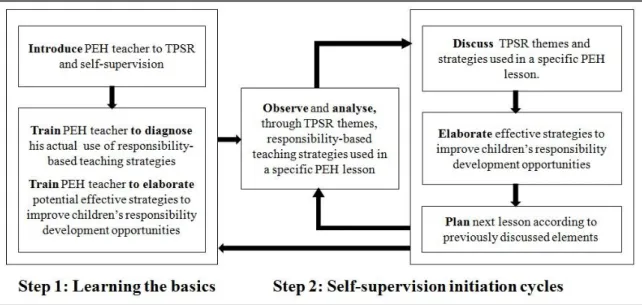
Spallanzani & Robillard, 1995). Figure 1 shows the self-supervision process applied to the TPSR model implementation.
Figure 1. Self-supervision process applied to TPSR implementation (adapted from Brunelle et al., 1988)
The first step of a self-supervision process is introduction to the object of supervision (in this case, the TPSR model), and then, to each stage of the self-supervision process itself. More specifically, the PEH teacher is trained to self-reflect on the responsibility-based teaching strategies he is currently using, and to elaborate new strategies that might potentially be implemented in his class.
Data collection and analysis
Data were collected from: (a) participants observations; (b) semi-structured interviews with PEH teachers; (c) post-teaching self-reflections; and (d) researcher’s log. Audio-recorded data were transcribed verbatim. Data was analysed through thematic coding (Denzin & Lincoln, 2003) to identify relevant themes. Using multiple sources facilitated data triangulation, which supports trustworthiness.
Caroline and Robert self-supervision’s processes
Because each self-supervision process was different, results regarding each teacher will be presented separately. A description of self-supervision activities will be shown then, a self-supervision process story line and evidence of TPSR implementation will be described.
Caroline
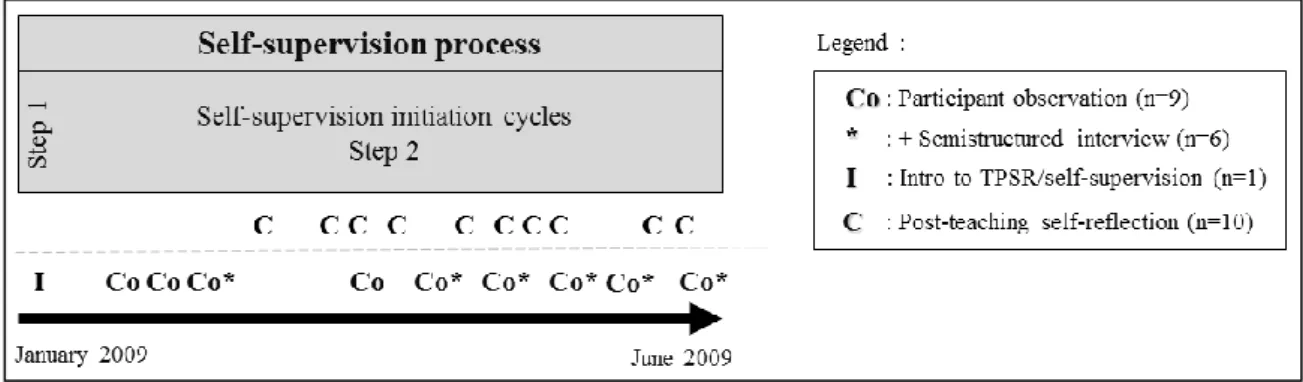
Data sources relating to Caroline represent more than 60 hours of participant observations (n=9) and 470 minutes of interviews, including 70 minutes of post-teaching self-reflections. Figure 2 shows a description of the activities that occurred during her six-month self-supervision process.
Figure 2. Caroline’s self-supervision activities
A total of nine participant observations were completed in Caroline’s setting during the six-month self-supervision process. Six semi-structured interviews were also conducted, along with ten post-teaching self-reflections.
Caroline’s self-supervision process story line
During her introduction to TPSR and self-supervision, Caroline asked for support to clearly understand what she had to do in order to implement TPSR in her setting. She needed to be shown how to present the TPSR model to the students and to be given a list of specific teaching strategies to choose from to effectively teach TPSR. She admitted that she would have to make an effort to commit herself to be accountable for completing self-supervision activities.
implementation on her own. One of her main struggles was her inefficiency in identifying problematic situations in her own teaching. She asked for an intense follow-up with the sfollow-upervisor, especially to help her self-reflect on her teaching.
Caroline started to audio-record her post-teaching self-reflections more than a month after beginning her self-supervision process. Her self-reflections were mainly focused on the description of the context of each lesson rather than a self-reflection on responsibility-based teaching strategies that were used and their impact on the students.
The first participant observations identified some problems in Caroline’s teaching that needed to be addressed before consideration could be given to implementing TPSR. Not only did she struggle with basic class management, her competency to teach physical activity content was also an issue. In order to help her progress through her professional development, a major change was needed. Instead of focusing mainly on TPSR implementation, Caroline was invited to reflect on effective teaching strategies such as academic learning time, opportunity to respond and meaningful tasks for her students. This intervention was prioritized in order to shift her attention to what her students were actually doing in her class.
The supervisor’s visits and support became more frequent throughout Caroline’s self-supervision process. During each visit, the interventions were oriented towards helping Caroline to improve her effectiveness as a teacher. However, while the reflection-on-action process became easier as the supervisor’s visits increased, a lack of basic teaching skills was still observed through participant observations.
TPSR implementation
Despite a slight change in Caroline’s post-teaching self-reflections, there was little significant change in her teaching practices. Participant observations showed evidence of the use of some TPSR features, such as posting the levels on a gym wall and conducting awareness talks to remind students required level-one (respect) and level-two (participation and effort) behaviors and attitudes. However, it was clearly used as a behavior management tool, to support teacher-directed class management strategies.
‘‘It is important for my students to learn to be responsible in PEH. It is easier for me to teach: it eases class management in general’’. (Caroline,
semi-structured interview, July 2nd)
Robert
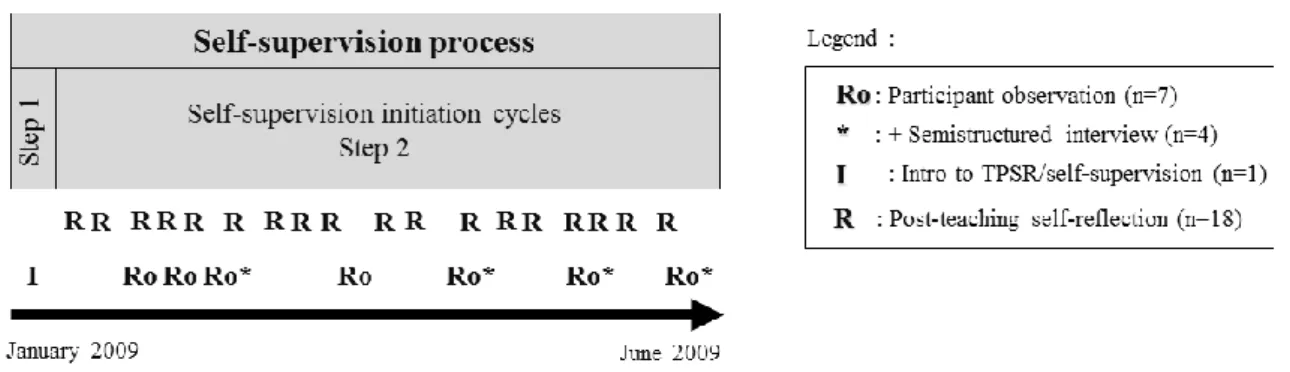
Robert’s self-supervision process (figure 3) shows a different profile to that of Caroline.
Figure 3. Robert’s self-supervision activities
Data sources for Robert represent more than 50 hours of participant observations (n=7) and 460 minutes of various interviews. He did 18 self-reflections over a five-month period, for a total of 233 minutes (versus 70 minutes for Caroline). Although the objective is not to compare both teachers’ processes, results show how the same professional development strategy can be experienced very differently by two individuals.
Robert’s self-supervision process story line
During the introduction to TPSR and self-supervision, Robert showed commitment by taking positive initiatives, such as elaborating on responsibility-based teaching strategies that might be implemented right away in his class. He also demonstrated his interest by taking in-depth notes and asking lots of questions. He showed open-mindedness to reflection-on-action, as he thought it would compel him to take the time to commit to his professional development.
Robert started to audio-record his post-teaching self-reflections the day after he was introduced to TPSR and self-supervision. He was able to effectively observe and analyse the responsibility-based teaching strategies he used during specific PEH lessons. He added specific examples of his students’ behaviors and attitudes to show the impact of these strategies. When facing a problematic situation, he was able to elaborate potentially effective strategies, either by himself or with the support of a colleague. The following post-teaching self-reflection usually included a follow-up on the problematic situation, describing what was done and how it worked (or not).
As a result of Robert’s high level of professional accountability, the supervisor’s visits became less frequent, as planned initially in the self-supervision process. Participant observations turned out to be a way to gather evidence of TPSR implementation process.
TPSR implementation
He implemented a consistent TPSR lesson-plan format, in which students were invited to reflect on responsible behaviors throughout the PEH lesson. He also created a tool for his students to self-reflect on transfer issues. Students were invited to write, on a blank TPSR poster put up on a gym wall, examples of responsible behaviors they had experienced in other settings. For instance, they could describe how they were respectful of others (level-one) or showed leadership (level-four) in their community. Examples were discussed at the end of the lesson during a group meeting. Several other strategies were used to help students take responsibility, like the talking bench (Hellison, 2003) for conflict resolution, self-grading, and gradually shared decision making.
TPSR effective implementation could also be seen through the impact it had on the students. Robert here talks about Felix, who had big issues with self-control before being introduced to the model:
‘‘At the end of the lesson, when I asked Felix to tell me what level he achieved, he told me ‘‘level four’’. I asked him why, just to hear him say it. He said that he helped Val when she struggled with her gymnastics’ moves. That was exactly what I had seen! I told him I was very proud of him!’’ (Robert, post-teaching self-reflection, March 18th)
However, Robert struggled in implementing strategies to promote leadership. He did use peer teaching, but these leadership opportunities were only available to the most talented students. Nevertheless, clear evidence of successful TPSR strategies showed that he had taken big steps towards authentic implementation of the model.
Using responsibility-based strategies to support TPSR implementation
Mrugala (2002) stated that physical educators who want to implement the TPSR model might benefit from a support which relies on the same values as the ones they are trying to implement. In order to facilitate TPSR implementation through self-supervision, TPSR values should then be embedded in the supervisor’s behaviors and attitudes.
Data analysis showed strong evidence of the use of four responsibility-based strategies in both self-supervision processes. These strategies were used by the supervisor to support each teacher through the TPSR implementation. After a short description of each strategy, specific examples, gathered from data, will be given.
Empowering teachers through self-supervision
In the case of Robert, data showed that gradually empowering a teacher through self-supervision might be an efficient responsibility-based strategy which could help them implement a new instructional model like TPSR.
“If I had not self-reflected, I would not have changed my teaching methods […] some situations would have stayed the same, and would have been problematic over and over throughout the year. Self-reflection forced me
to try new things and to adapt.” (Robert, semi-structured interview, July 10th)
The supervisor’s role is to facilitate this empowerment process, by gradually shifting responsibility for the self-supervision initiation cycles to the teachers, whose decision making is also enhanced, leading to the creation of new strategies to teach personal and social responsibility to the students. Even when it does not reach its full potential for empowerment, as happened with Caroline, self-supervision or the help of an external person can still be beneficial. Indeed, expectations need to be adjusted to the professional development stage of the teacher, as noted in the researcher’s log:
“Caroline struggles just to get organized, not only in her self-supervision process, but also in her teaching tasks. If I refer to the model, her biggest challenge is to get to level-3, self-direction. Currently, she is mostly at level-2, and she seems to need a lot of support. She asked me to come more often to help her self-reflect, as she has a hard time doing it by herself.” (Researcher’s log, April 14th)
Because taking charge of their professional development gradually empowers teachers and gives them opportunities for self-reflection, self-supervision might be, to a certain extent, an effective responsibility-based strategy to teach TPSR.
Providing opportunities for success
Strong evidence of providing opportunities for success was present in both self-supervision processes. A strategy that was used by the supervisor for both teachers was to reinforce good teaching practices. Often, the two teachers were using strategies without being fully conscious of their positive impact on their students’ responsibility development. In other words, they were teaching for personal and social responsibility without knowing it. It was a great opportunity for the supervisor to reinforce the use of these strategies while drawing connections with the TPSR model. Here is an example in Caroline’s case, as noted in the researcher’s log:
“At the end of the lesson, I told Caroline that she used a great strategy with Catherine and Elizabeth, when she invited them to do peer-teaching with Molly and Julie, who had trouble with some gymnastic moves. I said that it was a good strategy to promote leadership and caring, TPSR model’s level-4. She answered: Yes, you are right, although I didn’t do it for that purpose… but it’s true, it worked, they were great leaders throughout today’s lesson!” (Researcher’s log, March 20th)
priority in order to help her obtain some success through the self-supervision process, even if it was not directly in line with its main objective: TPSR implementation. Therefore, we needed to focus on teaching matters that were closer to her concerns. Here is an excerpt of the researcher’s log:
“What she said in the semi-structured interview today tells me that the self-reflection questions are far from her actual concerns. We need to make major adjustments for self-reflection to be more effective, if we want to see some changes in her teaching practices. I think the best strategy right now might be to use her concern about her student’s motivation to increase the quality of the physical activity content of her lessons. This step back seems to be needed before implementing TPSR, and might also be helpful for her
sense of self-efficacy.” (Researcher’s log, March 20th)
Providing opportunities for success is an efficient responsibility-based strategy to use when teaching, whether it involves adults or children.
Setting expectations
When teaching personal and social responsibility to children, setting clear expectations of responsible behaviors and attitudes is an important strategy (Wright & Craig, 2011). These two instances showed in different ways that it might also be true when supporting TPSR implementation, as clear expectations should be set for efficient responsibility-based teaching strategies. A vital activity that was instrumental to this aim was the process of introducing TPSR and self-supervision. During a two hour session, each teacher individually participated in an active workshop with the supervisor where TPSR values, model and themes were discussed. Through specific examples, vignettes and questions, the teachers became more familiar with the model and its responsibility-based teaching strategies. Here’s what Robert had to say at the end of the workshop:
“These strategies… I use some of them already, but I did not realize that they could help kids become more responsible. I used them as class management strategies instead… I see things differently now. I will continue to use these strategies, but with a different mindset: to help kids learn to be
more responsible.” (Robert, semi-structured interview, Jan 29th)
Setting expectations was also achieved by giving specific examples to each teacher, either through direct interventions during participant observations or through semi-structured interviews. Here’s what Caroline had to say about having specific examples during her semi-structured interviews:
“I liked it better when we did the self-reflections together (through
Another way to help teachers envision responsibility-based teaching strategies was by modeling them. Modeling was done mostly with Caroline during participant observations. For example, here’s an intervention that was done to show her how she might increase her students’ involvement (level-2; participation and effort) by giving them challenges.
“David was struggling with juggling and was just about to lose his temper. I decided to help him with some tricks and new challenges. I came back to see him once in a while to raise the challenges, according to his progress. He showed self-control and great attitude for the rest of the lesson. At the end, Caroline asked him to show his new tricks to everyone. He was so proud! I think I did the right thing by modeling this strategy, but I have to beware not to become the teacher instead of her.” (Researcher’s log, April 14th)
Therefore, setting clear expectations either through the introduction to the TPSR model, specific examples during or after the lesson, and modeling, tends to be an effective responsibility-based strategy when supporting its implementation.
Nurturing a respectful relationship
When teaching TPSR to children, Hellison notes that, “none of the other ideas matter if a certain kind of relationship with kids is not developed” (Hellison, 2011, p. 25). Establishing a respectful relationship is also essential when being involved in a process such as self-supervision. Data showed that participant observations were a great way for the supervisor to develop a strong relationship with both teachers. A regular on-site presence, throughout the school day, led to the development of a relationship based on trust, respect and understanding. At the end of the school year, both Caroline and Robert reported the positive impacts of such a regular presence:
“It was helpful that you came to visit once every three weeks throughout the school year. And, since you stayed with me all day, you saw my day by day life with the kids. I guess it is now easier for you to understand the struggles we are facing here, in a low-income area. You saw the kids’ progress too. Like Felix, who struggled at first with self-control and became a
leader in gymnastics at the end of the year.” (Robert, semi-structured
interview, July 10th)
“I liked it when you came to visit. You pointed out things that I did not see at first. I really liked that feedback. The fact that you visited often also made you see how it works in our school, which is different in every school… and how I am as a teacher. And the self-reflections… you helped me a lot there too! I had a hard time with them and you were there to help me with some
questions, providing examples when needed.” (Caroline, semi-structured
Nurturing a respectful relationship also implies to adjust and adapt to the teacher’s concerns. Caroline’s self-supervision process showed strong evidence of this, not only to preserve a good relationship, but also to foster commitment into professional development.
“Between two lessons, I asked Caroline if she needed help with the physical activity content. There was a moment of silence. I felt I might have gone too far, too fast. I decided to wait and see what would come next. Shortly after, she started to talk about her students’ motivation (or lack of it!). I jumped into this window of opportunity and asked her to tell me what she thought her students needed to get involved in PEH. Her eyes brightened. Shortly after, she was talking about physical activity content quality and how it is important for students’ motivation. […] It led to adding a couple of questions to her post-teaching self-reflections. One of them was on the
quality of physical activity content.” (Researcher’s log, March 20th).
Giving a voice to teachers through self-supervision, listening to their concerns and giving them a helpful hand whenever needed also emerged from data as important aspects for nurturing a respectful relationship.
3. DISCUSSION AND CONCLUSION
The purpose of this article was to present an alternative way to support in-service PEH teachers through TPSR implementation. It described how responsibility-based strategies were used to empower teachers to learn and implement TPSR in their settings. Results support the use of a self-supervision framework to educate in-service PEH teachers to “do” TPSR. It confirms, to a certain extent, the findings of Sinelnikov (2009), that on-site school-based approach that provides active learning is an effective way to implement a new instructional model.
However, these findings raise important issues. First, self-supervision takes time and great commitment, both from the teacher and the supervisor. One needs to be truly convinced of the importance of teaching personal and social responsibility to get involved in such an intense and long-term process. However, regular feedback and reflection minimized the content wash-out effect that could be experienced after a “one-shot” workshop (Sinelnikov, 2009). Moreover, self-reflection also offered a great opportunity for teachers to improve their efficiency (Hellison & Templin, 1991), while empowering them in their professional development.
responsibility-based education (TARE). Nine teaching strategies were identified as evidence of robust implementation of a responsibility-based pedagogy. As Wright and Craig (2011, p. 207) stated, “such tools could have applications for teacher training and professional development”. Indeed, these strategies could be integrated into a self-supervision process for TPSR implementation. Besides providing teachers with clear expectations of efficient responsibility-based teaching strategies, it could also help improve fidelity to the model.
A third issue refers to the possible existence of a basic level of teaching efficiency as a prerequisite for TPSR implementation. Mixed successes achieved by Caroline confirms Hellison (2003, p. 18) sayings that one ‘‘needs to master three sets of content – physical activity knowledge, physical-activity related pedagogical skills, and TPSR’’ to teach students to be more personally and socially responsible. Besides, Hellison (2003, p. 125) sees TPSR implementation as a “series of sequential stages”. For example, he suggests to start by introducing TPSR beginning levels (1 and 2), and use awareness talks to gradually implement TPSR vocabulary, as Caroline did with her students. Walsh (2008) also suggests developmental stages for preservice teachers to implement TPSR with middle and high-school students. As they gain confidence and ability in empowering their students, preservice teachers are invited to move on to the next stage, towards authentic TPSR implementation. In this study, it is obvious that Robert was further ahead with TPSR implementation than Caroline. However, as Hellison (2003, p. 126) stated: ‘‘Teaching practices that don’t permit students to take responsibility obviously will hinder development of personal and social responsibility, but awareness is a
beginning’’. Therefore, self-supervision might be a promising strategy to provide
teachers with the help needed according to their stage of development, empowering them to create their own steps along TPSR implementation.
Moreover, it raises the issue of the program goals’ transference outside the gym. Hellison (2003, p. 19) stated that ‘‘Transfer is really the ultimate point of teaching kids to take personal and social responsibility’’. As teaching for transfer is an important part of TPSR, students would benefit from having a coherent set of values promoted not only in physical education, but in other school-related settings. PEH teachers might become key transfer agents by leading other school members to promote these values (Wright and Burton, 2008). In this study, Robert’s success with teaching personal and social responsibility to his students in PEH increased awareness and interest of the school board and of some colleague teachers. Implementing TPSR through self-supervision provide him with opportunities for success that had an impact on his colleagues school-wide. Nevertheless, more evidence is needed on the TPSR model school-wide implementation, and on its impacts on the program goals’ transference.
working from kids’ strengths, respecting their individuality and giving them a voice and opportunities to make decisions are important qualities one should embrace. Responsibility-based strategies used through self-supervision processes are in line with these qualities, which support the fact that being relational is also important when mentoring adults learning to teach TPSR.
This article described how responsibility-based strategies were used to empower teachers to learn and implement TPSR in their professional settings. It contributes to TPSR literature by providing evidence of an alternative way to educate other professionals to “do“ TPSR. It also emphasized the importance of using responsibility-based teaching strategies with adults who are willing to learn and implement the TPSR model. However, more studies are needed to evaluate the long term impacts of the use of a school-based self-supervision strategy. It would be interesting to see if these teachers are still involved in a post-teaching self-reflection routine without the regular visits of an external person. Fostering interactions amongst TPSR French-speaking practitioners might also be an interesting responsibility-based strategy to study. In this study, both teachers implemented TPSR on their own, in their unique setting. Sharing successes and struggles with other in-service teachers dealing with similar issues might have been useful for better implementation. Being part of a group might also help long-term commitment into teaching personal and social responsibility. In fact, more evidence is needed on responsibility-based strategies that might empower in-service teachers to implement TPSR in their settings.
REFERENCES
Balderon, D.W. & Martin, M. (2011). The efficacy of the personal and social responsibility model in a physical education setting. PHEnex Journal, 3 (3), 1-15.
Beaudoin, S. (2010). S’approprier des pratiques visant la responsabilisation par l’actualisation d’une démarche d’autosupervision: une recherche-action en éducation physique et à la
santé au primaire. [Taking ownership of practices targeting accountability through
self-supervision: An action research in physical education and health in elementary school] Unpublished doctoral dissertation, Université de Sherbrooke, Sherbrooke, Canada.
Brunelle, J., Coulibaly, A., Brunelle, J.P., Martel, D. & Spallanzani, C. (1991). La supervision pédagogique. [Educational supervision] Éducation physique et sport, 227, 58-63.
Brunelle, J., Drouin, D., Godbout, P. & Tousignant, M. (1988). La supervision de l’intervention en
activité physique. [Supervision of physical activity interventions]. Montréal: Gaëtan Morin
Éditeur.
Buchanan, A.M. (2001). Contextual challenges to teaching responsibility in a sports camp. Journal
of Teaching in Physical Education, 20, 155-171.
Denzin, N.K. & Lincoln, Y.S. (2003). The landscape of qualitative research: theories and issues (2nd
ed.) Thousand Oaks: Sage Publications.
Gordon, B. (2010). An examination of the responsibility model in a New Zealand secondary school physical education program. Journal of Teaching in Physical Education, 29, 21-37.
Gouvernement du Québec (2001). Québec Education Program. Québec: Ministère de l’Éducation.
Hellison, D. (1995). Teaching responsibility through physical activity. Champaign, IL: Human Kinetics.
Hellison, D. (2003). Teaching responsibility through physical activity (2nd ed.). Champaign, IL: Human Kinetics.
Hellison, D. (2011). Teaching personal and social responsibility through physical activity (3rd ed.). Champaign, IL: Human Kinetics.
Hellison, D. & Martinek, T. (2006). Social and individual responsibility programs. In D. Kirk, D. Macdonald & M. O’Sullivan (Dir.), The handbook of physical education. London: Sage, pp., 610-626.
Hellison, D. & Templin, T. (1991). A reflective approach to teaching physical education. Champlain, IL: Human Kinetics.
Hellison, D. & Walsh, D. (2002). Responsibility-based youth program evaluation: A process-based assessment. Journal of Teaching in Physical Education, 22, 369-381.
Ko, B., Wallhead, T. & Ward, P. (2006).Chapter 4: Professional development workshops – what do teachers learn and use? Journal of Teaching in Physical Education, 25, 397-412.
Little, J.W. (1993). Teachers’ professional development in a climate of educational reform.
Educational evaluation and policy analysis, 15 (2), 129-151.
Little, M.E. & Houston, D. (2003). Research into practice through professional development.
Remedial and Special Education, 24 (2), 75-87.
Martinek, T. & Hellison, D. (2009). Youth leadership in sport and physical education. New York, NY: Palgrave Macmillan.
Metzler, M. (2005). Instructional models for physical education (2nd ed.). Scottsdale, AR: Holcomb Hathaway.
Mrugala, J. (2002). Exploratory study of responsibility model practitioners. Unpublished doctoral dissertation, University of Illinois, Chicago.
Parker, M. & Stiehl, J. (2005). Personal and social responsibility. In J. Lund and D. Tannehill (Eds)
Standards-based Physical Education Curriculum Development, Boston, MA: Jones and
Bartlett, pp. 130–153
Petitpas, A.J., Cornelius, A.E., Van Raalte, J.L. & Jones, T. (2005). A framework for planning youth sport programs that foster psychosocial development. The Sport Psychologist, 19, 63-80. Randall, L. (1992). Systematic supervision for physical education. Champaign, IL : Human Kinetics. Roy, M., Beaudoin, S., Perreault, G., Turcotte, S., Spallanzani, C. & Desbiens, J.F. (2010). Formation à la communication pédagogique en entraînement sportif par la réflexion partagée
s’inscrivant dans des démarches de supervision clinique et d’autosupervision [Teaching
Educational communication skills in sports training through shared reflections as part of clinical supervision and self-supervision approaches]. In C. Amans-Passaga, N. Gal-Petitfaux, P. Terral, M. Cizeron, M.-F. Camus (éds). L’intervention en sport et ses contextes institutionnels:
cultures et singularité de l’action [Interventions in sports and their institutional contexts:
Shields, D. & Bredemeier, B. (1995). Character development and physical activity. Champaign, IL: Human Kinetics.
Sinelnikov, O. (2009). Sport education for teachers: Professional development when introducing a novel curriculum model. European Physical Education Review, 15 (1), 91-114.
Spallanzani, C. & Robillard, C. (1995). Application d’une stratégie d’autosupervision pour amener
des enseignants à réfléchir sur leurs pratiques pédagogiques [Implementing a self-supervision
strategy to motivate teachers to reflect on their educational practices]. In C. Paré (Ed.),
Mieux enseigner l’éducation physique? Pensez-y! [Better teaching in PE? Think about it!].
Trois-Rivières, Presses de l’Université du Québec, pp. 283-300.
Walsh, D.S. (2008). Strangers in a strange land: Using an activity course to teach an alternative curriculum model. Journal of Physical Education, Recreation and Dance, 79(2), 40-44.
Walsh, D.S., Ozaeta, J. & Wright, P. (2010). Transference of responsibility model goals to the school environment: Exploring the impact of a coaching club program. Physical Education and
Sport Pedagogy, 15(1), 15-28.
Wright, P.M. (2009). Research on the personal and social responsibility model: is it really in the margins? In L.D. Housner, M.W. Metzler, P.G. Schempp & T.J. Templin (Eds.), Historic traditions and future directions of research on teaching and teacher education in physical education
Morgantown, West Virginia University FIT, pp. 289-296.
Wright, P.M. & Burton, S. (2008). Implementation and outcomes of a responsibility-based physical activity program integrated into an intact high school physical education class. Journal of
Teaching in Physical Education, 27, 138-154.
Wright, P.M. & Craig, M. (2011). Tool for Assessing Responsibility-Based Education (TARE): Instrument Development, Content Validity, and Inter-Rater Reliability. Measurement in
Physical Education and Exercise Science, 15, 204-219.