UDC 711
E. Khairullina, L. Santos Ganges
1Valladolid University, Instituto Universitario de Urbanística, Spain, Valladolid, 47014, Salamanca Avenue 18 e-mail: [email protected]; [email protected]
THE ROLE OF THE PUBLIC TRANSPORT SYSTEM
CONFIGURATION IN THE COMPACT URBAN FORM
OF THE SOCIALIST CITY IN THE 1960s
Abstract. In the 1960s the scientific progress in traffic engineering and transport development brought new possibilities, methods and demands forchanges in the urban form and structure. A socialist city was oriented towards the implementation of a double objective: a city for both automobile use and for public transport. The urban structure was planned to provide the conditions for car use, while the unlimited growth of this reticular structure was expected to be controlled or ordered by the closed configurations of the public transport network. These ideas were similar in Eastern Europe, the USSR, and Great Britain. The objective of the article then is to understand the causes of applying different configurations of public transport networks and, the effects they had on the urban form. This will be approached with an analysis of urban planning methods and public transport in the cities of the Eastern Bloc. Compact urban form was strongly related to thecoherence of the city structure and its flexibility for possible future development. The basic criteria for planning werethe equal distribution of passenger flows, continuity of the trip and frequency of transport which changed their spatial interpretations during the period.
Keywords: Public transport, urban form, socialist city, USSR, Eastern Europe.
"During the 1960s and beyond, urban planning and, above all, the so-called urban economy made an enormous disciplinary effort to see how the form of transport networks expressed in terms of accessibility or coverage indicators affected the location of activities by means of the usefulness that gave them a certain territorial position."
Manuel Herce, 2009
Introduction
These words allow us to understand that the 1960s was the period of time when interrelationships between traffic engineering, transport and urban planning began. It was the period when fast, motorized and suburban transport entered into competition with each other, and they needed both coordination among themselves and a change in urban structure. This issue was the problem faced by the Eastern Bloc planners along with the problem of the rationalization of their planning decisions. On the one hand, providing people with public transportation was a basic need to ensure the social and economic development of the country. While on the other hand, the development of the transport infrastructure was also related to motorized transport for the future developmentand the creation of a society which had an image of both progressivity and modernity. The complexity and novelty of the problem led to a variety of solutions that were aimed at finding a balance between the compactness of urban forms and economic issues.
The main ideas of the Eastern Bloc planners were based on the work of the British engineers who similarly searched for solutions in traffic planning which were oriented towards urban compactness. One of them was Alker Tripp (1947) who, during thepost-war period, proposed several solutions in urban design to separate the flows of road and pedestrian transport (Khairullina, 2018). The other author was Colin Buchanan (1963) with his concern for the quality of the urban environment and growing road traffic. He proposed paying attention to land use and
the location of activities that generated traffic in transport infrastructure. However, during the period both ideas eventually were reinterpreted in accordance with socialist politics.
Socialist five-year plans in the 1960s were designed to bring order to the many public projects that had to be carried out, an order that also required coordination between administrations. In the post-war period, the urgency of needs gave clear priority to sectoral projects and plans. The development of the country was linked to large production projects and the provision of housing, so that "separated planning" predominated and centralized planning did not ensure the integration of vertical policies. In the 1960s, there was time for another way of planning, due to political changes, academic and technical progress, and because urgency was no longer the justification for everything. Transport was a very powerful instrument for improving the economic conditions of the socialist system, but it had to be interrelated not only with the centres of production and consumption in the territories, but also with the functionality of the urban space. This was an important issue which needed urgent improvement.
The socialist economy's ideology of division of labour and the ambiguous concept of a socialist city in terms of the coherence of urban growth meant that an entity had to be planned in the form of an integrated system, where the city and transport planning had to converge. Inter-urban and Inter-urban transport should complement each other and the specialization of the functions of the transport modes and the coordination of their operation should de materialized.
Contemporary studies lack afocus related to the influence of the geometric factor of transport networks on urban planning decisions. Meanwhile, there are a variety of works that have different approaches with regards to the issue of transport such as the planning of fast tramways (Seidenglanz, Kvizda, Nigrin, Tomes, Dujka, 2015), car-oriented urban planning (Beyer, 2011, Siegelbaum, 2009), interrelations and policies in urban transport and traffic (Schmucki, 2001, Kulakov, Trofimenko, 2016), etc.
Therefore, the aim of the article is to understand the context of the changes in the integration between urban and transport planning through the study of the proposals in the configuration of the urban transport network. This allows us to understand why the need for integrated plans appeared, and how integration and rationalization affected the urban form. The article focuses on the USSR, Eastern European countries, as well as England, which shared several similarities in the development of urban and transport planning ideas.
It will be concluded that during the 1960s there was a major shift in the integration of transport and urban planning that was related to political change and a more intensive rationalization of economic resources. This influenced the shift from utopian proposals to ones that were more differentiated and integrated in relation to the existing situation; which was the basis for the development of the urban form of the socialist city in the 1970s-1980s.
Curved enclosed network configurationsin public transport
The paradigm shift in urban planning in N. Khrushev's time in 1954 did not occur instantly because time was needed to adapt to the new principles, to carry out the first experimental projects and to evaluate the results. After these first projects and plans, the urban planning congress was organized in Moscow in 1960, where both the new directions of urban development and urgent problems were announced. Among the problems highlighted there were those of traffic rationalization and the role of urban transport in the development of the society. In East Germany, the book "Traffic in the modern city" by Wolfgang Weisel was published with the influence of this congress in 1962. The author raised the integration problem between transport and city planningwhich could be resolved with greater coordination between different specialists. The other problem was related to traffic rationalization with regards to the functional division of different urban transport modes. Similar ideas appeared in different publications in the USSR, for example, in "The organization of traffic on streets and highways", A. Polyakov, 1965.
berelatedspatially to urban planning. Different studies were carried out on the geometric characteristics and economic profitability of a public transport network. In this first stage, the integration between transport and urban planning was understood as the search for the appropriate network configurations and location decisions for a balanced distribution of traffic. The decisions on the configuration of the rapid transport network had several objectives, such as providing compactness, limiting city growthor ordering urban space.
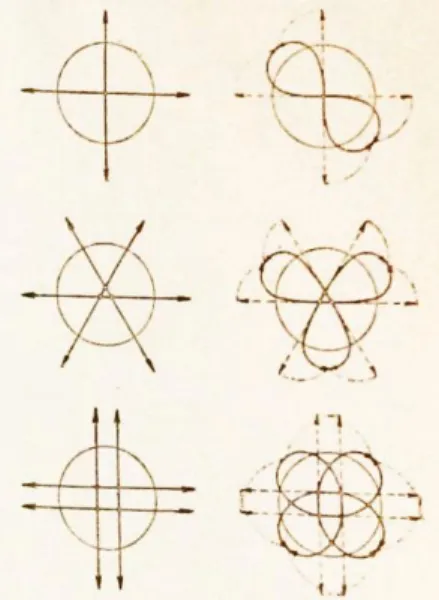
Among the proposals we can highlight the studies by OrestKudryavtsev in the book "The problems of the Soviet urban planning", in 1963. According to Kudryavtsev, the main objective of the research on the configurations of the rapid public transport network was to provide the minimum distance for people to travel through the creation of different location variants of both departure and arrival points (1963, p. 38-39). Theimportance of the balanced distribution of passenger flows, the limitation of modal interchanges, and waiting time, resulted in attention paidto geometric forms or shapes of networks. The forms, such as eight, nine, circular, line, loop, and their variations, were named as enclosed curvilinear systems.
The word "system" was then applied for the first time in studies as a result of the aspiration to turn the discipline of urbanism into a science, following Ludwig von Bertalanffy and Karl Popper’s proposals. Systems theory was oriented towards establishing the applicable principles for many disciplines. The inherent complexity of its implementation sometimes required considering this scientific approachbased onopen and dynamic systems. In the case of Kudryavtsev's proposal the enclosed systems were not the systems because they were not a part of something, nor did they consist of the elements, and rather they were the transport schemes with the land uses associated with the geometric qualities of the configuration.
The curvilinear network configuration probably appeared as a result of disadvantages in flexibility of regular network configurations such as radial, radio concentric, rectangular. Although not sufficiently studied and applied in urban practice, this type of network may have arisen from the possibility of connecting existing land uses, adapting to the site topography and minimizing the non-rectitudecoefficient.
At the same time understanding the difficulty of applying these configurations, Kudryavtsev proposed several examples of their application in the existing city, where the ends of the streets were rounded to create the looped configuration(Fig.1)or were adapted to the rectangular configuration of motorized transport (Fig. 2).
Figure 1. The transformation schemes of rectangular, radial systems in enclosed curvilinear systems. Kudryavtsev, 1963. The possibility of converting existing cities into a compact urban model
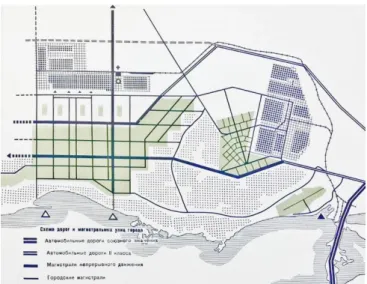
However, as these ideas were difficult to apply to existing cities, they were mainly applied in the planning of new cities. Among the applications of those ideas in the USSR, the new city of Tselinograd (for 350,000 inhabitants) planned in 1963 by the Central Research and Project Institute of Urban Planningwith the participation of Kudryavtsev can be highlighted. The idea was to apply a closed configuration of the express bus network that was connected to the city centre in the middle of the route. This created the possibility of organising an "eight" form public transport route. The express bus route located on the reserved platform was combined with the motorised transport network (Fig. 3).
Another example can be found in England, a small city of Runcorn planned for 202,000 inhabitants in 1965, with the intention to limit the use of private transport. The Runcorn project was one of the first new cities in England to achieve the planned balance between private and public transport by dividing the flows of both with a 50/50 ratiowith the application of express bus network independent from motorized transport (Runcorn New Town, 1967, p.70). It can be also highlighted by variations in enclosed configurations and functional specialisation of different express bus itineraries.
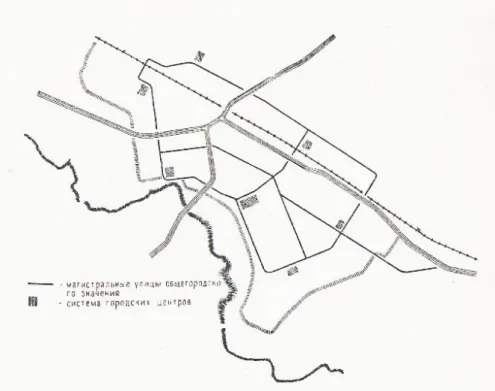
In Eastern European countries, ideas about enclosed configurations of the public rapid transit network were not so developed in the new cities because of their small size. However, we can noticethe similar tendency to create a closed configuration in urban extensions, such as, for example, in East Germany, in Halle and its new part Halle West, planned in 1961. The main idea in this project was balanced redistribution of traffic between the two parts of the city creating a compact urban model through the annular configuration of an urban transport network (Fig.4).
Figure 3. The model for the new city in the USSR.The SourceCentral Research and Project Institute of Urban Planning. 1964. One of the interpretations of circular and eight form configurations in the new city. The planning of the public transport network in relation to the motorised transport network
configurations, the possibility of extending transport lines was considered. Thus, we see that the importance of fluid urban traffic organization led to transport network solutions with enclosed configurations that received extensive application in both the East and West Blocs during the 1960s.
Figure 4. The traffic study for the city of Halle, 1961. Source: GebietsplanungBezirke Halle, 1961, Bundesarchiv, DH 2/21466. Prolonging semi-circular street into annular configuration
Motorized transport and the advantages of the rectangular grid network
Together with the concern for traffic rationalization in rapid public transport, the configurations of the motorized transport network were developed. Economic geometric parameter studies were carried out to find the balance between network density, the number of intersections and, accessibility. Apart from the operation of buses and trolleybuses, private transport played a significant role in the socialist regime and all the necessary infrastructure was planned for future use. This possibly could be explained by several reasons:
The large and complex road infrastructures created the imaginary part of the communist party as a symbol of progressivity and modernity. The competition with the Western Bloc for dominance in the world required the representation of technological advances and their spatial implementation in large and complex road infrastructure constructions. Another reason could be the importance of traffic planners in urban planning. Traffic planners were treated as people who could address the complexity of traffic planning with mathematical calculations and models. They therefore had a decisive voice in urban planning. The planning logic based on engineering arguments such as a concern to plan maximum road infrastructure capacity with apossibility of future expansion became the main principle of the planning of the motorized transport infrastructure in that period. On the other hand, it may also be the Socialist regime's concern for circulation and accessibility to ensure the efficiency of cities and the economy in general. In the post-war period most cities did not have a classified and functionally specialized street structure, therefore, the construction of roads and rationalization of the existing street structure became the main problem for the Eastern Bloc. Slow access and loss of time meant loss of economic benefit.
flows in the transverse and longitudinal road directions. The longitudinal roads were planned to connect the centralities, while the transversal ones received the traffic load between the residences and industries. This preference for the linear form and rectangulargrid configuration was especially maintained in new cities, e.g. in the planning of cities such as Toliatti (Fig. 5), Novolipetsk, Nizhnekamsk, etc.
Similar ideas also appeared in the studies of transmission rectangular grid configurations in England. Rectangular configurations in a linear form received attention as the most appropriate solutions for both car and public transport use (Fig. 6). Primarily for giving possibility to uniformity of urban development (Favaz, Newell, 1975) In short, priority was given to the operation of motorized transport and the possibilities of the meshed network to provide multiple means of access. This was not comfortable for rapid public transport, which needed a different spatial organization logic.
Thus, we see that in the 1960s, transport planners made a significant effort to determine alternative configurations of transport networks to traditional radioconcentric models. Both linear and enclosed curvilinear configurations were considered capable of providing stable and balanced spatialrelationships in terms of activity and traffic distribution. As a result, cities with radioconcentric plans had a tendency to expand in a linear form. Examples include cities such as Ivanovo in the USSR, Kosice in Czechoslovakia, Erfurt in East Germany. On the other hand, in larger cities, the urban form approached the circle form, levelling existing radial lines with the new directions of urban development to provide a compact form.
Figure 5. Toliatti's plan, 1967. Diagram of the main and secondary streets. Source: The city of Toliatti, The general plan for the new part of the city, the first phase of construction. 1968-1971.
Figure 6. Studies in transportation and land use structures in England,1967, Source: Jamieson.G.B., Mackay W., Latchford J.C.R. Urban studies. Vol. 4. № 3
In general, in these works we see that the itineraries of the different modes of transport were not planned, but rather the transport was adapted to the infrastructure already planned and built in the cities. The location of suburban transport lines and their stops were also not integrated with urban transport. The problem then was the disintegrated planning between the different transport services, leading to economically unsatisfactory results in urban planning. In 1966, the political change in the USSR led to a series of decisions that marked the beginning of a new stage in the integration between transport, traffic and the city.
complex and strong rationalization consolidated through multiple conferences. In the urban planning sector, the problem was compounded by a lack of complex and coordinated planning of all modes of urban transport. The idea of rationalization was related to the need for coordinating passengers’ volume, the form of the network and the distribution of routes (Niewand, 1969, p. 72). The concepts of integration and rationalization in the transport system meant the same thing, although they did not always have the same results.
The first work on this issue was carried out between 1964 and 1967. In East Germany, as a result, a book was published in the form of the general guidelines "The development of transport in East Germany between the 6th and 7th SED days" drawn up by the special research group on transport, the Ministry of Transport, county and city councils’ offices, etc. In the USSR, the ideas of transport rationalization were announced in the collective work "Methodological in public transport and street network planning", in 1968, and in connection with the improvement of research into transport rationalization, institutes of socialist economic management in transport were set up. The other issue was to choose the main mode of urban transport, which, if previously related to monorail, metro, etc., in the mid-1960s was decided in favor of what was then called “fast tram”. The pre-existence of the infrastructure for this type of transport in the cities, and the technological ease of its introduction were important criteria for socialist rationalization. First, a rationalization of the tramway network was needed through the elimination of branching of lines, and the rectification of transport routes based on axis principle (BürofürStadtverkehr des Rates der Stadt Dresden, 1969). On the other hand, rationalization meant managementin the location of transport networks, identifying where the use of rapid tram transport should be intensified, and where it should be eliminated and replaced by public motorized transport.
All these changes needed to reconsider previous ideas in transport network configurations and create a more rational vision. In this connection, the article by V. Sheshtokas "The perspective definition of the urban transport network parameter" in 1968, the USSR Architecture, was important. The author’smain idea was that passengers’ journeys should define the configuration of the urban transport network that depended on the location of activities, and not just on the balanced distribution of traffic and network configuration. The criteria of the demand (actual and potential) were thus balanced with the criteria of an urban strategy and equally distributed transport network.
The enclosed configurations were recognized as simple in their interpretations, and they also led to the increase in the length of the transport infrastructure and the separate displacements with distinct reasons (1968, p. 47). Attention should then have been paid to the influence of urban structure on the volume and load of urban traffic. Therefore, the ideas of regular public transport network configurations such as grid and radial were returned. The traffic load balance tried to be reached through variations in type and displacement of land uses related to accessibility of the transport network, characteristics of transport modes, population density, etc.
Figure 7. V. Sheshtokas' proposal for the city model and for the city of Kaunas, Source: the USSR Architecture, 1968, p. 46-47. The return to regular transport network configurations and attempts
to control network load through land-use change
Conclusions
Following this study, we can observe a major change in urban transport network configurations in the 1960s. At the beginning of the period, the configuration of the transport network was planned on large-scale projects aimed at creating a new model of the socialist city. The indeterminacy in technological development of rapid public transport resulted in the importance in motorized transport infrastructure planning. The development of both systems is explained by the fact that the hierarchization of space required the hierarchization of urban transport, rapid public transport with the function of carrying mass passenger flows with enclosed network configurations for compactness of the urban plan. While motorized transport was used for secondary flows with a rectangular grid configuration to distribute the flows and provide a proportionate urban extension.
These ideas were developed both in the Eastern Bloc cities and in some cities in England, which allow us to understand that the balanced distribution of traffic was a common concern based on the geometric qualities of the transport network. However, the policy of rationalization made it possible to broaden this vision with the qualities of the urban environment, the characteristics of different modes of transport and the coordination between different departments in the Eastern Bloc countries.
References
1. Beyer, E. (2011) ‘Planning for Mobility Designing City Centers and New Towns in the USSR and the East Germany in the 1960s’, in the Socialist Car Automobility in the Eastern Bloc, Siegelbaum, L. H. (eds.).
2. Kulakov, A., Trofimenko, K. (2016) ´Transport Planning and Transport Modeling´ Transport Systems
of Russian Cities, M. Blinkin and E. Koncheva (eds.).
3. Schmucki, B. (2001) ‘Der TraumvomVerkehrsfluss: StädtischeVerkehrsplanungseit 1945
imdeutsch-deutschenVergleich’, Frankfurt, Campus.
4. Seidenglanz, D., Kvizda, M., Nigrin, T., Tomes, Z., Dujka, J. (2016) Czechoslovak light rail — Legacy of socialist urbanism or opportunity for the future? Journal of Transport Geography, Volume 54, June, 414-429.
5. Siegelbaum, L. H. (2009) ‘On the side: Car culture in the USSR, 1960s-1980s’, Technology and Culture. 50, 1,1-23.
Bibliography
1. BürofürStadtverkehr des Rates der Stadt Dresden (1969) ‘Wie? Wohin? Des neuenStrassenbahnliniennetzes’.4.
2. GorodToliatti. ‘Generalplan of the new part of the city. The project of the first part of construction’.1968-1971. (1967) Moskva.
3. ‘GebietsplanungBezirke Halle’ (1961) Berlin, Bundesarchiv, DH 2/21466.
4. Fawaz, M.Y., Newell, G. F. (1976) ‘Optimal spacings for a rectangular grid transportation network’
Transportation Research, Volume 10, Issue 2, 111-119.
5. Herce, M.(2009)‘Sobre la movilidad de la ciudad’, Editorial Reverté. Barcelona. p. 54.
6. Khairullina, E. (2018) ‘La planificación urbana y el tráfico rodado: Las ideas de AlkerTripp en la URSS’ Revista Ciudades 21, Valladolid.
7. Kudryavtsev, О.К. (1963) ‘About the structure of transport networks’, processdings ‘Problemsof the Societ urban planning’, Moscow, National publishing house of literature on civil construction,
architecture and building materials.
8. MinisterratderDDR, MinisteriumfurVerkehrswesen. (1967) ‘ZurEntwicklung des Verkehrswesens der DDR zwischendem VI und VII Parteitag der SED’.
9. Jamieson, G.B., Mackay W., Latchford, J.C.R. (1967) ‘Transportation and land use structures’, Urban studies, Vol. 4, №3.
10.Niewand, G. (1969) Der offentlichepersonennahverkehrimGeneralverkehrsplan Dresden, DDR Verkehr, 72.
11.Polyakov, A. A. (1965) ‘Traffic organization on the city streets’, Moscow, Transport Publishing House.
12.Runcorn Development corporation. (1967) ‘Runcorn New Town’, Nottingham, Hawthornes of
Nottingham limited,70.
13. Sheshtokas, V. (1968) ‘Determining the parameters of prospective city transport network’, The
USSR Architecture, 44-48.
14.The Central Research and Project Institute of Urban Planning (1966) ‘Principles of the Soviet urban planning’, Volume 1, Moscow, Stroiizdat.
15.The Central Research and Project Institute of Urban Planning. (1964) ‘Tselinograd.The experience of urban planning’, Moscow, The publishing house of the literature on construction.
16.The Central Research and Project Institute of Urban Planning (1968) ‘Methodological recommendations on planning public transport networks, streets and roads’, Moscow.
Scientific Editors I. Kukina, I. Fedchenko, Ia. Chui
U73 Urban Form and Social Context: from Traditions to Newest Demands : Proceedings ofthe XXV ISUF International Conference, Krasnoyarsk, July 5–9, 2018 / Scientific Editors : I. Kukina, I. Fedchenko, Ia. Chui. – Electronic data (105 Мb). – Krasnoyarsk : Siberian Federal University, 2019. – Electronic optical disk (CD-Rom). – System requirements : PC not below class Pentium I ; 128 Mb Ram ; Windows 98/XP/7 ; Adobe Reader v 8.0 and above. – Screen title.
ISBN 978-5-7638-4127-5
The collection of proceedings contains reports of the International conference “Urban Form and Social Context: from Traditions to Newest Demands”, July 5–9, 2018, which took place at Siberian Federal University.
The conference covered a wide range of issues.
The authors of the published materials are responsible for the authenticity and accuracy of citations, names and other information, as well as for the compliance with intellectual property laws.
UDC 721.01(083) BBK 85.110я43
© Siberian Federal ISBN 978-5-7638-4127-5 University, 2019
Electronic scientific publication
Computer layout by A.A. Bykova
Signed for printing on Аpril 18, 2019. Order No. 8035 Replicated on machine-readable media
Siberian Federal University Library and Publishing Complex
660041, Krasnoyarsk, Svobodny prospect, 82 a Tel.: (391) 206-26-67; http://bik.sfu-kras.ru,
СONFERENCE CHAIR
Irina Kukina
Siberian Federal University
SCIENTIFIC COMMITTEE
Michael Barke
Northumbria University, (UK) Vicente Colomer
Universitat Politècnica de València (Spain) Kai Gu
University Auckland (New Zealand) Anna Agata Kantarek
Politechnika Krakowska (Poland) Teresa Marat-Mendes
University Institute of Lisbon (Portugal) Wendy McCLURE
University of Idaho (USA) Vítor Oliveira
University of Porto (Portugal) Ivor Samuels
University of Birmingham (UK) Giuseppe Strappa
Università di Roma (Italy) Jeremy Whitehand
University of Birmingham (UK) Ding Wowo
Nanjing University (China) Elena A. Akhmedova
Samara State Technical University (Russia) Igor Bondarenko
Scientific Research Institute of Theory and History of Architecture and Urban Planning Nina A. Konovalova
Scientific Research Institute of Theory and History of Architecture
Galina A. Ptichnikova
Scientific Research Institute of Theory and History of Architecture and Urban Planning Mikhail V. Shubenkov
Moscow Architectural Institute
ORGANIZING COMMITTEE
Sergei M. Geraschenko Siberian Federal University Irina G. Fedchenko Siberian Federal University Iana V. Chui
Siberian Federal University Elena N. Logunova
Siberian Federal University Anna M. Kulikova
Siberian Federal University Sergei S. Pavlyut
Siberian Federal University
Organizing Team
ISUF 2018 Working Group,
Zhang Chi
ROAMING ON THE LANE OF THE CITY WALL ... 21 Wang Haoyu
STUDY ON THE INHERITANCE OF CHINESE TRADITIONAL SPACE STRUCTURE
IN SHUIANSHANJU RECEPTION CENTER IN HANGZHOU, CHINA ... 33 Meng Zhou, Ying Zheng
EXPLORING THE TYPOLOGICAL PROCESS OF RESIDENTIAL UNIT IN LILONG HOUSING
IN TIANJIN, CHINA ... 41 Merkulova M., Baltinate A.
PRESERVING THE WOODEN HOUSING ESTATE AS AN IMPORTANT PART OF YENISEISK
HISTORICAL AND ARCHITECTURAL ENVIRONMENTIN XIX–XX CENTURIES ... 49
Konovalova N.A.
COMPACTION OF SPACE IN CONTEMPORARY JAPANESE MEGALOPOLISES ... 55
Perkova M.V., Kolesnikova L.I., Tribuntseva K.M.,Sementsov S.V.
ARCHITECTURAL AND PLANNING FEATURES OF EDUCATIONAL INSTITUTIONS OF THE LATE XIX – EARLY XX CENTURY AS A CHARACTERISTIC
OF IDENTITY OF THE HISTORIC TOWN CENTER ... 61 Theme 2. FRINGE BELTS, DEVELOPMENT WITHIN THE NEWEST DEMANDS
Batalova N.S.
NATIONAL MENTALITY AS A FACTOR IN THE MORPHOGENESIS OF THE CITY SUBURBS
(ОN THE EXAMPLE OF KRASNOYARSK) ... 69 Logunova E.
URBAN FRINGE BELTS AND SUBURBAN AREAS: SIMILARITIES AND DIFFERENCES ... 77
Carvalho Thereza
ACTIVE BORDERS, POLYCENTRIC CITIES, MISCELLANEOUS MAKERS ... 81 Theme 3. HISTORICAL URBAN FABRIC
Ying Jiang
MICRO-REGENERATION FOR TRADITIONAL RESIDENTIAL AREAS: THE CASE OF NANHU
COMMUNITY IN NANJING, CHINA ... 92 Ayşe Sema Kubat, Ela Akdoğan, Mert Akay
VISUAL IMPACT ANALYSIS IN URBAN MORPHOLOGY: THE CASE OF THE GOLDEN HORN,
ISTANBUL ... 105 Hangwelani Hope Magidimisha, Lovemore Chipungu
THE IMPACT OF ISLAND CITY IN THE POST-APARTHEID SOUTH AFRICA:
FOCUS ON BANTUSTANS ... 118 Mei Qing
TRANSFORMATION MECHANISM OF HISTORICAL URBAN FABRIC IN HANKOU, WUHAN... 129 Farzana Mir, Fahmida Nusrat
HISTORICAL EDIFICES OF RAMNA: A PROSPECTIVE HERITAGE ROUTE IN URBAN DHAKA ... 138 Wang Haoyu, Li Zhenyu
COMPARISON STUDY OF TYPICAL HISTORICAL STREET SPACE BETWEEN CHINA AND GERMANY: FRIEDRICHSTRASSE IN BERLIN AND CENTRAL STREET
IN HARBIN AS EXAMPLES ... 151 Zhang Yidan, Li Zhenyu
THE SPATIAL FABRIC ANALYSIS OF HARBIN JINGYU HISTORICAL BLOCK BASED ON THE
Lian Tang, Wowo Ding
STREETWALL AND PLOT PATTERN: CASE STUDIES IN NANJING, CHINA ... 191
Kholodova L.P.
FROM “URBAN HERITAGE PRESERVES” TO CONTROLLED DEVELOPMENT
OF HISTORICAL URBAN ENVIRONMENTS ... 200 Theme 4. PSUF – POST SOCIALIST URBAN FORM
Ptichnikova G.A.
A COMPREHENSIVE VIEW ON THE EVOLUTION OF URBAN SPATIAL STRUCTURE
OF THE LARGEST POST-SOVIET CITIES IN RUSSIA ... 206
Shubenkov Mikhail ... 215 SPATIAL IMBALANCE OF URBAN DEVELOPMENT OF SETTLEMENTS AND WAYS
OF ITS SOLUTION IN MODERN CONDITIONS ... 215
Bobkova E.A.
UTOPIA AND CRISIS OF THE POST-SOCIALIST CITY: HISTORICAL TRANSFORMATIONS
OF THE 19th AND 20th CENTURY MOSCOW ... 221 Vladan Djokic, Aleksandra Djordjevic, Ana Zoric ... 230 DEPARTMENT STORE’S ROLE IN MODERNIZATION AND “DEMODERNIZATION”
OF CITY CENTERS IN EX-YUGOSLAVIA ... 230
Gorsha A.A., Kukina I.V., Chui Y.V.
EXPERIENCE OF TRANSFORMING PUBLIC SPACES OF RESIDENTIAL AREAS
IN THE SECOND HALF OF THE 20th CENTURY IN GERMANY ... 240
Nagiyev N.H., Gahramanova Sh.Sh., İsbatov İ.A.
PROBLEMS OF EFFECTIVE LAND USE AND ENVIRONMENTAL PLANNING IN CITIES:
THE CASE-STUDY OF BAKU ... 248
Saveleva E.
THE SOVIET LEGACY IN THE URBAN MORPHOLOGY OF MAJOR RUSSIAN CITIES ... 259
Kukina I.V., Fedchenko I.G.
RETHINKING EVOLUTION OF SPATIAL STRUCTURE OF RUSSIAN MICRODISTRICT
IN THE POST-SOVIET SPACE ... 273 Ivor Samuels, Anna Agata Kantarek
STREETS WITHOUT DOORS; A TWENTIETH CENTURY PHENOMENON? ... 281 Baymuratova S.Kh., Baymuratov R.F., Sabitov I.N.
UFA PLANNING STRUCTURE TRANSFORMATION ... 298
Theme 5. THE EVOLUTION OF URBAN FORM UNDER THE SOCIAL INFLUENCE Canuto R., Nóbrega M.L.C., Sena A.
CAMPUS AND CITY: THE ROLE OF PILOTIS AS A SOCIAL INTEGRATOR AT THE CATHOLIC
UNIVERSITY OF PERNAMBUCO, RECIFE, BRAZIL ... 306 Lin Zhehan
THE RESEARCH ON TRANSFORMATION OF THE CITY-LANDSCAPE BOUNDARY
AND ADJACENT URBAN FABRIC IN HUBIN AREA ... 315 Lina Zhang, Wowo Ding
THE EVOLUTION OF CHINESE DANWEI SYSTEM AND ITS INFLUENCE
ON PLOT DEVELOPMENT: THE CASE OF NANJING ... 319
de R.E.Koning, A. Nes van
MORPHOLOGICAL ANALYSIS OF SETTLEMENTS IN THE ARCTIC: A COMPARATIVE ANALYSIS OF FOUR SETTLEMENTS WITH DIVERGING IDEOLOGIES ON SVALBARD ... 332 Li Xin
Fedchenko I.G.
THE INFLUENCE OF URBAN LIFE ON URBAN FORM OF RESIDENTIAL UNITS ... 378 Dong Xiao
INFLUENCE MECHANISM BETWEEN LAND SYSTEM REFORM AND VILLAGE PLAN
TRANSFORMATION: TAKING VILLAGES ON HANGJIAHU PLAIN AS AN EXAMPLE ... 384 Duan Xiaotian, Wei Xiaoyu
URBAN REGENERATION UNDER THE INFLUENCE OF SOCIETY, CULTURE AND POLICY: COMPARISON OF THREE HISTORICAL STREETS (AREAS) IN THE FORMER FRENCH
CONCESSION IN SHANGHAI ... 395 Qian Chen, Zhang Qin
TRANSFORMATION OF TYPO-MORPHOLOGY OF COLUMBIA CIRCLE IN SHANGHAI
CHANGING DISTRICT ... 402 Zifeng Sheng, Yuetong Zhao
THE EVOLUTION OF URBAN PUBLIC SPACE UNDER SOCIAL INFLUENCE: A CASE STUDY
OF SAVANNAH HISTORIC DISTRICT ... 409
Adonina A.V., Artemeva T.G.
SOCIAL CONTEXT AS A CATALYST FOR THE EVOLUTION OF REALIZED UTOPIAN MODEL
OF URBAN MORPHOSTRUCTURE: THE CASE OF TOGLIATTI, RUSSIA ... 415 Theme 6. TOOLS OF ANALYSIS
Bin Cong, Wei You, Wowo Ding
ASSESSING STREET SPATIAL CHARACTER: COMBINING FRACTAL ANALYSIS
OF STREET EDGES AND SKYLINE ... 425 Mengmeng Geng, Lian Tang, Wowo Ding
A QUANTITATIVE APPROACH MEASURING STREETSCAPE ... 440
Leung T.M., Kukina I.V., Lipovka A.Y.
A PARAMETRIC DESIGN FRAMEWORK FOR A SPATIAL STRUCTURE OF OPEN SPACE
DESIGN IN EARLY DESIGN STAGES ... 457
Kilina E.F., Kukina I.V., Lipovka A.U.
INFLUENCE OF THE ELECTRIC TRANSPORT SYSTEMON THE DEVELOPMENT
OF KRASNOYARSK CITY MORPJOLOGY. ANALYSIS USING OPEN BIG DATAAND GIS ... 465
Engelgardt A.E.
BIG DATA RANKING SYSTEM AS AN EFFECTIVE METHOD OF VISUALIZING THE QUALITY
OF URBAN STRUCTURAL UNITS ... 473
Zhorov Y.V.
PARAMETRIC MODELING OF URBAN DEVELOPMENT ... 481
Malko A.V.
DATABASE OF THE ARCHITECTURAL AND HISTORICAL CONTEXT OF CULTURAL HERITAGE SITES (DENKMALPFLEGERISCHERERHEBUNGSBOGEN) AS AN INSTRUMENT
OF HISTORICAL AND ARCHITECTURAL ANALYSIS IN GERMANY ... 486 Theme 7. URBAN FORM AND TECHNOLOGY
Hekler Martina
URBAN TRANSFORMATION IN SEOUL AND SINGAPORE: ON THE IMPACTS
OF DIGITALIZATION, MOBILITY STRATEGIES, AND URBAN GOVERNANCE... 500 Huimin Ji, Wei You, Wowo Ding
AN APPROACH TO DESCRIBE BLOCK-BASED SPATIAL CONFIGURATION ... 505
Khairullina E., Santos Ganges L.
THE ROLE OF THE PUBLIC TRANSPORT SYSTEM CONFIGURATION IN THE COMPACT
THE ECONOMY INTERPRETATIONS OF MORPHOLOGICAL TRANSFORMATION
OF WORK-UNIT NEIGHBORHOOD IN CHINA: A CASE STUDY OF KUNMING (1960–2010) ... 532 Sumayah Layij Jasim
PRINCIPLES AND METHODS OF LANDSCAPE AND URBAN RECONSTRUCTION OF THE SPATIAL PLANNING STRUCTURE IN DESTRUCTIVE CITIES IN THE CONTEXT
OF SUSTAINABLE DEVELOPMENT (ON THE EXAMPLE OF G. BAGDAG AND MOSUL) ... 541
Moskaleva A.V., Geraschenko S.M., Frolovskaia A.V., Gil Martín L.M., Hernández Montes E.
FREE-FORM SHELL STRUCTURES AS ART OBJECTS IN THE URBAN ENVIRONMENT ... 547
Mikitenko N.L., Storozheva S.P.
URBAN SPACE IN ANIMATION: IMAGES OF SOCIAL SPACE ... 554
Rakhimzhanova L.Sh.
SMART GEOMETRY CREATES A SMOG FREE CITY ... 562 PENG Dandan, QINQin, HU Youpei
A STATISTICAL RESEARCH ON THE TYPICAL PATTERNS OF MODERN HOUSING FABRICS,
CASE STUDY OF NANJING, CHINA ... 567
Gushchin A.N., Sanok S.I., Tatrnikova Y.S.
INVESTIGATION OF THE SPATIAL DENSITY OF PUBLIC AND BUSINESS OBJECTS
IN ALARGECITY WITH THE HELP OF GEOINFORMATION TECHNOLOGIES ... 577
Berseneva M.L., Gofman E.Y., Gumennaya O.V., Yakshina A.A., Mitckevich O.S., Danilovich E.V., Nikitina O.S.
THE IMPACT OF CONSTRUCTION INDUSTRY ON THE CONTENT OF HEAVY METALS
IN THE AIR ENVIRONMENT OF KRASNOYARSK CITY ... 583
Theme 8. URBAN IDENTITY Krzysztof Nawratek, Belova D.A.
RESPONSIBILITY OF THE UNION OF ARCHITECTS FOR SUSTAINING THE LOCAL VISUAL AND CULTURAL IDENTITY OF KRASNOYARSK AS A PROSPECTIVE CULTURAL CAPITAL
OF EASTERN SIBERIA ... 587
Bobyleva N.I.
SOCIO-ANTHROPOLOGICAL MODEL OF MODERN URBAN ENVIRONMENT:
A HUMAN IN THE CITY, A CITY IN THE HUMAN ... 598
Bundova E.S.
CITY IMAGE DURING INTERNATIONAL EVENTS ... 603
Smolyaninova O.G., Popova Y.V.
THE STUDY OF URBAN IDENTITY OF THE SIBERIAN FEDERAL UNIVERSITY STUDENTS ... 611
Shlokina A.A.
ETHNIC PECULIARITIES OF CULTURE AS A TOOL FOR BUILDING URBAN IDENTITY ... 615
Shchenkov A.S.
SMALL HISTORIC TOWNS OF RUSSIA. PRESERVING ORIGINALITY AND IDENTITY ... 620
Bruyns G., Nel D., Higgins Ch.
FLAT CITY VERSUS VOLUMETRIC CITY, RE-APPLICATION OF THE LAYERED MOVEMENT
NETWORK APPROACH ... 629 TIAN Mengxiao
LAND RECLAMATION AND CREATION OF NEW VILLAGES THE CASE STUDY
OF SHA TIAN TOWN ON THE PEARL RIVER ESTUARY ... 640 Zhang Chi, Li Zhenyu
RIVERSIDE TRANSFORMATION AS URBAN LANDSCAPE CASE STUDY
ON THE YANGPU RIVERSIDE RECONSTRUCTION IN SHANGHAI, CHINA ... 656 Theme 9. URBAN LANDSCAPE HISTORY AND SOCIO-CULTURAL
SMALL ARCHITECTURAL FORMS IN THE ORGANIZATION OF URBAN ENVIRONMENT ... 674 Mikkel B. Tin
PUBLIC PARKS IN THE NORTH: DESIGNED TO LIBERATE OR DISCIPLINE OUR BODIES? ... 680 Ali Reza Arsiya, Mehrdad Mazloomi
AN INVESTIGATION ON THE INFLUENCE OF RIVER ON MORPHOLOGICAL ASPECTS
OF HISTORICAL CITY ... 687
Theme 10. URBAN MORPHOLOGICAL METHODS AND TECHNIQUES Yuan Huang, Yanxiao Pan, Shuxian Chen, Jason Ching, Yu Xi
A COMPARATIVE STUDY ON THERMAL ENVIRONMENTAL PERFORMANCE
OF THE URBAN FORM PROTOTYPES BASED ON LOCAL CLIMATE ZONE (LCZ) SCHEME ... 701 Higgins Christopher D., Nel Darren, Bruyns Gerhard
SLOPE, LAYERS, AND WALKABILITY: ESTIMATING THE LINK BETWEEN PEDESTRIAN
ACCESSIBILITY AND LAND VALUES IN THE MORPHOLOGY OF HIGH DENSITY CITIES ... 713 Koc A., Kubat A.S.
MORPHOLOGICAL TECHNIQUES FOR ASSESSING URBAN FORM OF ISTANBUL’S HISTORICAL PENINSULA ... 723 Ma Yafei, Tang Lian, Ding Wowo
MAPPING THE RELATIONSHIP BETWEEN SITE CODING AND STREET SPATIAL
CONFIGURATION: CASE STUDY IN NANJING, CHINA ... 734 Fangli Chen, Yuan Huang
A NEW COMPARATIVE ANALYSIS OF LOCAL URBAN MORPHOLOGY BASED
ON LOCAL CLIMATE ZONES: A STUDY USING MOBILE SURVEYS IN CHENGDU TESTBED ... 752
Krasheninnikov A.
ACCESSIBILITY AND CONNECTIVITY AS THE KEY FACTORS OF THE MACRO-SPACE IN BUILT ENVIRONMENT ... 766
Rasuleva I., Kudasheva D.
THE IMPLOSIVE APPROACH IN RESEARCH AND URBAN ENVIRONMENT DESIGN ... 772 Lovra Éva
THE URBAN TYPOLOGY MATRIX (1867–1918) ... 779 Theme 11. URBAN MORPHOLOGICAL THEORY
Bolshakov A.G., Belomestnykh S.S.
MORPHOGENESIS OF THE STREET NETWORK AND QUARTERS OF THE CITY OF IRKUTSK... 789
Bondarenko I.A.
URBAN PLANNING TRADITIONS AND REQUIREMENTS OF THE PRESENT ... 804 Yuan Huang, Pu Bian, Wenyan Cai, Yanxiao Pan
LHASA URBAN MORPHOLOGY EVOLUTION AND CONSTRUCTION PATTERNS ANALYSIS ... 810 Todor Stojanovski, Östen Axelsson
TYPO-MORPHOLOGY AND ENVIRONMENTAL PERCEPTION OF URBAN SPACE ... 816 Yu Xi, Jingyi Liu , Yuan Huang
A REVIEW OF THE RELATIONSHIP BETWEEN URBAN GREENING MORPHOLOGY AND URBAN
CLIMATE ... 829 Van Nes A.
THE APPLICATION OF MODAL LOGICS FOR THEORY BUILDING IN URBAN MORPHOLOGY
AND SPACE SYNTAX ... 841
Petrosyan E.Kh., Kukhina I.V., Lipovka A.U.
MULTI-LAYER ANALYSIS OF MORPHOLOGY OF THE CITY OF KRASNOYARSK BASED
ON CONCEPT URBAN LANDSCAPE UNITS ... 851 Carlo Andrea Biraghi, Michele Caja, Sotirios Zaroulas
Akhmedova E.A., Vavilonskaya T.V.
SMART СITY. “A TRIAD OF DEVELOPMENT AGENTS” ... 875 Tsarev V.I.
NIKOLAEVSKAYA SLOBODA: THE FUTURE CITY-GARDEN IN KRASNOYARSK ... 886 LI Zhenyu, WANG Haoyu
RESEARCH ON LANDSCAPE-ORIENTED URBAN DESIGN: ON THE EXAMPLE OF QIXIAN NEW
INDUSTRIAL DISTRICT DESIGN IN FENGXIAN, SHANGHAI ... 895
Unagaeva N.A.
REDEVELOPMENT OF HISTORICALLY VALUABLE TERRITORIES OF KRASNOYARSK ... 901 Ma Cheng
URBAN MORPHOLOGY AND SPATIAL OPTIMIZATION STRATEGY OF INDUSTRIAL SMALL
TOWN IN CHINA UNDER “NEW URBANIZATION MOVEMENT” – A CASE STUDY OF TANGZHA ... 909 Nel Darren, Bruyns Gerhard, Higgins Christopher D.
URBAN DESIGN, CONNECTIVITY AND ITS ROLE IN BUILDING URBAN SPATIAL RESILIENCE ... 915
Sedova A., Balakina A., Ciaramella A.
URBAN REGENERATION IN RUSSIA THROUGH NEGLECTED CHURCHES ... 925
GrigorievaE.M., Petrovskaya M.V., Gabdrakhmanov N.K.
TRANSITION TO PROJECT FINANCING IN HOUSING CONSTRUCTION AS A NEW VECTOR
OF URBAN DEVELOPMENT ... 931
Bushmkova Yu.V., Mezenina K.O.
REFLECTION OF THE PAST IN THE MODERN DEVELOPMENT: USOLYE CASE STUDY ... 944 Qi Yuan, Feihong Lin
THE RELATIONSHIPS BETWEEN URBAN MORPHOLOGY AND ACCESSIBILITY
TO WATERFRONT AREA: CASE STUDY OF NINGBO THREE-RIVER JUNCTION AREA ... 956
Semina A.E., Maximova S.V.
ECOLOGICAL CORRIDORS’ MORPHOLOGY INSIDE THE URBAN STRUCTURE IN FORMING
THE ENVIRONMENTAL FRAME OF THE CITY ... 963 Gustavo Fierro O., Gonzalo Hoyos B.
STUDY OF THE CORRIDOR URBAN FORM OF 10 DE AGOSTO AVENUE
IN QUITO CITY – ECUADOR ... 968
Galkina H., Grinkrug N.
EDIFICE OF ARCHITECTURAL SPACE DEVELOPING IN EXTREME CONDITIONS OF MARS... 977 Zihan Cai, Ming Lu
RESEARCH ON SUSTAINABLE DESIGN OF HISTORIC BLOCKS BASED ON INHABITANT
SOCIAL INTEGRATION MEASUREMENT: A CASE STUDY OF HARBIN IN CHINA ... 983
Khrichenkov A.V., Ryzhova O.O.
POSSIBILITY OF RENOVATING THE TERRITORY OF RESIDENTIAL BUILDINGS DATING FROM 1958 TO 1970
Amelchugov S.P., Berseneva M.L., Gofman O.V., Mitckevich O.S., Danilovich E.V., Yakshina A.A., Nikitina O.S.
ASSESSMENT OF STRESS RESISTANCE OF EMPLOYEES OF THE CONSTRUCTION