FACULTAD DE FILOSOFÍA Y LETRAS
DEPARTAMENTO DE FILOLOGÍA INGLESA
TESIS DOCTORAL:
The Concept of ‘Genetic Modification’ in
a Descriptive Translation Study (DTS)
of an English-Spanish Corpus
of Popular Science Books on Genetic Engineering:
Denominative Variation, Semantic Prosody and
Ideological Aspects of Translation Strategies
Presentada por Mª Cristina Bayón García
para optar al grado de doctora en
Traducción e Interpretación
Dirigida por:
Dr. D. José María Bravo Gozalo (Universidad de Valladolid)
Acknowledgements
I used to think that a good piece of work was the result of a brilliant mind but, after accomplishing this PhD dissertation, I realized that the crucial element is the help and support given by the experts that inspired me for this project. The experts I owe my greatest debt of gratitude are my Ph.D. supervisors. It is not easy to find the appropriate words to thank them for their valuable advice and guidance when they have shared so much of their time and knowledge with me.
Throughout all the time devoted to this dissertation, I would like to express my gratitude towards my PhD supervisor Prof. José María Bravo, for having been supportive of my work and enthusiastic about my ideas. I am so very grateful to him for his recommendation of heading to Norway for the alignment of the corpus and for providing everything I needed at the Institute for Bilingual Terminology and Specialized Translation (ITBYTE/CITTAC) at Universidad de Valladolid (UVa).
It has also been my good fortune to have drawn upon the friendship and expertise of Dr. Gibson Ferguson, as his everyday support and his faith in me moved mountains. I would like to note my profound gratitude to him for being my supervisor during my stay at the University of Sheffield (UK). Back home in Spain, his generosity of spirit, his encouraging feedback, and the sharing of his time and wisdom in spite of the distance made that I worked on this dissertation with much more energy than I expected.
With regard to the rest of the stays abroad, I am deeply indebted to Prof. Guy Cook for being my supervisor at the Open University during my four-month stay in Milton Keynes (UK) and for showing me his way of working, which was a constant source of motivation.
I am also extremely grateful to Knut Hofland for being my supervisor during my six-month stay at the University of Bergen (Norway) and for making me feel at home at UniComputing, formerly UNIFOB/AKSIS (Department of Language, Culture and Information Technology). I appreciate more than I can say that he supervised the corpus alignment and other technical matters as well as for strengthening the bonds of friendship beyond supervision.
At the same time, I am deeply grateful to family and friends for their moral support and sacrifice when it was most needed. My heartfelt gratitude is also for my friend and colleague, Paula de Santiago, to whom I do thank for the insightful and fruitful discussions about terminology. Other faculty members in the UVa, Dr. Beatriz Méndez and Dr. Isabel Pizarro have been a balsam of unconditional support. Other colleagues, Dr. Müge Satar and Dr. Maria Leedham, from the Open University, and Dr. Teun van Dijk, from Universitat Pompeu Fabra, have been very helpful in providing references and help. The group of Isabel Bermejo from
The beautiful design of the cover is thanks to the 3D modeler, Rubén Martínez,
http://www.ruben-martinez.com/, who has made the proofreading much more appealing.
As for the funding, I am grateful to La Junta de Castilla y León, institution from which I received my PhD scholarship.
I also had the support of a Marie Curie fellowship –Multilingua– that allowed me to carry out the alignment of the parallel corpus in Bergen (Norway).
CONTENTS [abridged]
PART I: THEORETICAL FRAMEWORK
1. Introduction 1
2. Popular Science as a Specialized Language (LSP) 13
3. Object of Study: The Theoretical Framework of Denominative Variation (DV), Semantic Prosody (SP) and Translation Strategies (Ideological Aspects of Translation)
49
PART II: METHODOLOGY
4. Research Design and Methodology: Corpus Linguistics (CL) and Descriptive Translation Studies (DTS)
119
PART III: ANALYSIS AND RESULTS
5. Data Analysis 211
6. Conclusions 385
7. References 411
CONTENTS [unabridged]
List of abbreviations and acronyms ……….. xix
General list xix
British and American Organisms xxi
List of figures and tables ...………. xxiii
Summary of the main points in Spanish.……….……….. xxxiii
PART I: THEORETICAL FRAMEWORK
1. Introduction ... 1
1.1. Aims and motivation
1.1.1. Popular science as language for special purposes (LSP): Denominative variation (DV)
1.1.2. Semantic prosody (SP)
1.1.3. Ideological aspects of translation (Translation Studies) 1.2. Research questions
1.2.1. Denominative variation 1.2.2. Semantic prosody
1.2.3. Translation strategies and ideology 1.3. Outline
1.4. Hypotheses
1.4.1. LSP and DV 1.4.2. SP
1.4.3. Translation Studies (TS)
2. Popular Science as a Specialized Language (LSP)... 13
2.1.Language for special purposes (LSP)
2.2.General language vs. specialized language (LSP) 2.3.Defining specialized languages (PAL)
2.3.1.Cabré‟s tripartite model (1993) 2.3.1.1. Pragmatic criteria 2.3.1.2. Functional criteria 2.3.1.3. Linguistic criteria 2.3.2.Formal criteria: Genre analysis
2.3.2.1. Genre and text type 2.3.2.2. Register and discourse 2.3.2.3. Style
2.4.PAL vs scientific popularization: How to detect specialization 2.5.Defining scientific popularization
2.5.1.Semi-expert magazines 2.5.2.University coursebooks 2.5.3.Popular science books
3. Object of Study: ... 49 The Theoretical Framework of Denominative Variation (DV), Semantic Prosody (SP) and ideological aspects of translation strategies
3.1.Denominative variation
3.1.1.Theories of Terminology
3.1.1.1. General Theory of Terminology (GTT) (Wüster) 3.1.1.2. Communicative Theory of Terminology (CTT) (Cabré) 3.1.1.3. Sociocognitive Terminology (Temmerman)
3.1.1.4. A comparison of terminological theories 3.1.2.Key concepts of Terminology
3.1.2.1. What is a term?
3.1.2.2. Denominative variation
3.1.3.Terminology of genetic engineering (GE) 3.1.3.1. Basic terms: What is biotechnology? 3.2. Semantic prosody
3.2.1.Defining semantic prosody
3.2.1.1. Semantic preference and semantic prosody 3.2.1.2. Concordance, collocate and collocation 3.2.2.Studies on semantic prosody
3.2.2.1. Semantic sets (anti- and pro-GM) and metaphors in GM discourse 3.3.Translation studies and ideological aspects of translation
3.3.1.Key concepts of translation 3.3.1.1. Translation theories 3.3.1.2. Translation equivalence
3.3.1.2.1. Translation shifts
3.3.1.2.2. Universals of translation and translation norms
3.3.1.3. Translation ideology: Interlinguistic ideology of translating 3.3.2.Translating popular science texts
3.3.2.1. Intralinguistic translation: Intralinguistic ideology of GE terms 3.3.2.2. Interlinguistic translation
3.3.2.2.1. Lexical aspects of scientific and technical translation
3.3.2.3. Intersemiotic translation 3.4.Final remarks
PART II: METHODOLOGY
4. Research Design and Methodology………. 119
Corpus Linguistics (CL) and Descriptive Translation Studies (DTS)
4.1.Scope of the study
4.1.1. Exploratory study 4.1.2. Pilot study
4.2.Corpus compilation: Design and alignment
4.2.1. An introduction to corpus linguistics (CL)
4.2.1.1. A historical overview of corpus linguistics 4.2.1.1.1. Pre-electronic corpora
4.2.1.2.Corpus defining traits
4.2.1.2.1. Representativeness 4.2.1.2.2. Sizeand balance
4.2.1.3.Optional annotation („mark-up‟)
4.2.1.3.1. Structural mark-up (textual mark-up)
4.2.1.3.2. Part of Speech mark-up (POS, wordclass tagging) 4.2.1.3.3. Grammatical mark-up (syntactic parsing)
4.2.1.3.4. Other formsof Annotation
4.2.1.4.Types of corpora 4.2.1.4.1. Parallel
4.2.1.4.2. Comparable
4.2.1.5.Uses of corpora
4.2.1.5.1. In lexicographic research
4.2.1.5.2. In researching grammar, discourse and genre
4.2.1.5.3. In translation studies
4.2.1.5.3.1. Corpus-based TS 4.2.1.5.3.2. Mining terminology
4.2.1.5.3.3. Computer-aided Translation Tools (CAT) 4.2.1.5.3.4. Machine Translation (MT) Systems
4.2.1.6.Key concepts in corpus studies: Frequency 4.2.1.7.Software tools for the analysis of corpora 4.2.1.8.Advantages and limitations
4.2.2. Corpus design of this study
4.2.2.1. Building criteria for text selection 4.2.2.2. Materials
4.2.3. Implementation 4.2.3.1. Encoding 4.2.3.2. XML-coding 4.2.3.3. Alignment 4.2.3.4. POS tagging 4.2.3.5. Software tools
4.3.Corpus exploitation: DTS model (Toury 1995)
4.3.1. An introduction to Translation as research methodology (analytical model): Descriptive Translation Studies (DTS)
4.3.1.1. Placement of the TT within its culture system
4.3.1.2. Identification of translation shifts for ST-TT segments 4.3.1.3. Implication of the decision-making problems
4.3.2. Qualitative analysis: Placement of the ST and TT into their culture systems
4.3.2.1. Documentation stage 4.3.2.2. Field diagram
4.3.3. Quantitative analysis: Recognition of ST-TT segments at terminological, phraseological and translational levels
4.3.3.1. Terminology: Wordlists, keyword lists and term lists 4.3.3.1.1. Preselection: Wordlists
4.3.3.1.2. Keyword lists
4.3.3.1.3. Term extraction
4.3.3.1.4. Detailed Consistency List (DCL)
4.3.3.2. Phraseology: Concordance and semantics
4.3.3.2.1. Preselection: Collocations of terms and keywords
4.3.3.2.2. Semantic prosodyextraction
4.3.4. The search for norms and decision-making implication for future translating.
4.4. Final remarks
PART III: ANALYSIS AND RESULTS
5. Data Analysis ……… 211
5.1.Pilot study
5.1.1.Bill Lambrecht 5.1.2.Stephen Nottingham 5.1.3.Jeffrey Smith
5.1.4.Pilot study conclusions
5.2.Qualitative analysis: Placement of the ST and TT into their culture systems 5.2.1.Description of the popular science books
5.2.2.Comparison of ST-TT covers 5.2.3.Documentation stage
5.2.4.Field diagram
5.3.Quantitative analysis: Recognition of ST-TT segments at terminological, phraseological and translational levels
5.3.1.Type/token ratio (TTR) 5.3.2.Monolexical wordlists
5.3.2.1.Lexical preselection for the English corpus 5.3.2.2.Lexical preselection for the Spanish corpus 5.3.3.Keyword lists
5.3.3.1.Semantic preference in the English corpus 5.3.3.2.Semantic preference in the Spanish corpus 5.3.4.Denominative variation
5.3.4.1.Technical terms (biology): DNA and gene/s
5.3.4.2.Subtechnical terms: Crop/s and food
5.3.5.Semantic prosody
5.3.5.1.Technical terms (specialized field): Genetic + N
5.4.Norm-searching: Comparison of English-Spanish data sets (ideological aspects) 5.4.1.General strategies about the translation of DVs
5.4.2.General strategies about the translation of Semantic Prosodies (SPs) for DVs: Adj + N (DNA, gene/s, food/s and crop/s)
5.4.3.General strategies about the translation of book titles 5.5.Final Remarks
6. Conclusion ………. 385
6.1.Theoretical framework conclusions 6.1.1.LSP and popular science
6.1.2.Object of analysis: DV, SP and translation strategies (TS) 6.1.3.Analytical tool: Corpus Linguistics (CL)
6.2.Data analysis conclusions 6.2.1.Denominative variation 6.2.2.Semantic prosody
6.2.3.Translation strategies (norm-searching) 6.3.Final remarks
6.3.1.Limitations of the study 6.3.2.Further research
6.3.3.Concluding remarks
7. References ……… 411
7.1.Offline 7.2.Online
8. Appendices……….. 433
8.1. Appendix 1: 61 English popular science books on GE
8.2. Appendix 2: Raw list of 16 English-Spanish translated books
8.3. Appendix 3: Excluded books
8.4. Appendix 4: Books comprising the GE_P-ACTRES corpus
8.5. Appendix 5: Authors’ background of GE_P-ACTRES corpus
8.6. Appendix 6: Anchor wordlist for the TCA2 software
8.7. Appendix 7: ST-TT segments for the study of denominative variation
8.8. Appendix 8: Semantic prosodies
8.9. Appendix 9: Peninsular Spanish monolingual corpus of popular science books
LIST OF ACRONYMS AND ABBREVIATIONS
General list
CL Corpus Linguistics
DM Discourse marker
DTS Descriptive Translation Studies
DU Discourse Unit
DV Denominative variation
GE Genetic Engineering
GE_P-ACTRES The complete corpus for this PhD dissertation
GL General Language
GM Genetically Modified
GMO Genetically Modified Organism
L1 Left collocates (e.g. one to the left of the node) LGP Language for General Purposes
LSP Language for Special Purposes
NP Noun Phrase
OCR Optical Character Recognition
PP Prepositional Phrase
PU Phraseological unit
R2 Right collocates (e.g. two to the right of the node)
sci sci corpus
Sci pop Scientific popularization
SL Source Language
SP Semantic prosody
soc soc corpus
ST Source Text
TL Target Language
TM Translation Memory
TT Translated Text
TU Terminological unit
USK Units of Specialized Knowledge 5MH Book number (5), author initials (MH)
British and American organisms
ACFNP Advisory Committee on Novel Foods and Processes, an independent body of experts, advises on the health aspects of all applications to market novel foods in the UK. It was the ACNFP that first raised concerns about antibiotic-resistance marker genes in foods produced using GM ingredients
ACRE Advisory Committee on Releases to the Environment, a body made up of independent scientists, which since 1997 has operated within the GM Policy and Regulation Unit of DEFRA (Department for Environment, Food and Rural Affairs) [UK] CVM FDA‟s Center for Veterinary Medicine
EPRI Electric Power Research Institute [US] OTA Office of Technology Assessment [US]
PTO U.S. Patents and Trademark Office (PTO) [US]
RAFI Rural Advancement Foundation International (ETC Group) WWF World Wide Fund for Nature
Regulation of GMOs in the US is through:
EPA Environmental Protection Agency
CFSAN FDA‟s Center for Food Safety and Applied Nutrition FDA Food and Drug Administration
LIST OF FIGURES AND TABLES
PART I: Theoretical framework page
Fig. 1.1 Diagram of the materials (English-Spanish parallel corpus) and the scope of this study (three aims)
3
Fig. 1.2 Figure illustrating the relationship between GL and the LSP variety under study (popular science books of GE) along with the three-dimensional object of analysis (denominative variation, semantic prosody and ideological aspects of translation strategies)
4
Fig 1.3 Research outline along with the three-fold object of study 8 Fig. 2.1 Diagram of deep and surface structure of language comprising General
Language (GL) and Language for Special Purposes (LSP)
16
Fig. 2.2 Diagram of several genres according to PAL and scientific popularization 17 Fig. 2.3 Diagram of the horizontal –thematic– and vertical axes –pragmatic,
functional and linguistic criteria– for characterizing LSP (based on Cabré’s model of 1993)
21
Table 2.4 Table of the theoretical background, teaching context, scope of study and representative linguists of the three schools of genre (based on Yunick 1997)
26
Fig. 2.5 The gradual dependency of GL from a high to a low level of specialization 29 Table 2.6 A comparison of the different levels of specialization according to Gläser
(1995), Göpferich (1995) and Pearson (1998)
30
Table 2.7 A genre-based comparison between a research article, a university textbook and a popular science article (based on Parkinson and Adendorff 2004)
41
Fig. 2.8 Continuum of specialization of PAL and scientific popularization 42 Table 2.9 Similarities and differences between research articles and popular
science books
44
Table 2.10 Changes in organization, syntax and vocabulary in a research article, a popular science article and a newspaper article (based on Myers 1994)
45
Table 3.1 Traditional, communicative and sociocognitive theories of terminology 56 Fig. 3.2 Visual representation of the phenomena of banalization and
terminologization
58
Fig. 3.3 Polyhedral dimensions of ‘root’ as a general-language and specialized lexical entities
59
Fig. 3.4 Tridimensional view of a term under the communicative and sociocognitive theories of terminology
60
Fig. 3.5 USK diagram (adapted and translated from Spanish) of terminological (TU) and phraseological units (PU) according to Estopá (2001: 67)
62
Table 3.6 Different lexical processes for a neologism of form in Spanish medical terminology adapted from Gutiérrez Rodilla (2005: 44)
63
Table 3.7 Adj + N pattern with examples of terminological and discourse units (based on Estopá 2001)
64
Fig. 3.8 x- and y-coordinates to represent the degree of denominative variation and level of specialization
67
Table 3.9 Discourse markers used to detect denominative variation in Bach and Suárez (2002: 121-5)
68
Fig. 3.10 Biotechnology disciplines according to the Institute of Biotechnology (IBT) in Jülich (Germany) (http://www.fz-juelich.de/ibt/research/)
72
Fig. 3.11 Flow chart of the four basic terms in this study –Biotechnology, GE, GMO and transgenic– according to Pedauyé Ruiz et al. (2000: 21)
73
Table 3.12 Adapted from the studied semantic prosodies gathered in Xiao and McEnery (2006: 106)
Table 3.13 Processes of semantic patterns through semantic preference, semantic prosody and semantic association
80
Table 3.14 Three-dimensional frame of collocations, their operational level and their dependency
83
Table 3.15 Common features of semantic prosody along with specific features suggested by Sinclair and Louw (based on Stewart 2010: 160-1)
85
Table 3.16 Right collocates of the Spanish verb ‘aumentar’ (increase) (Bayón García 2007: 20)
86
Table 3.17 Right collocates of the Spanish verb ‘reducir’ (decrease) (Bayón García 2007: 21)
86
Table 3.18 Language used by pro-GM newspapers when referring to arguments for and against GM technology (Cook et al. 2006: 18) (emphasis added)
90
Table 3.19 Language used by anti-GM newspapers when referring to arguments against and in favor of GM technology (Cook et al. 2006: 19-20) (emphasis added)
91
Table 3.20 Key phrases and metaphors of social discourse about the GM debate according to Cook (2004)
91
Table 3.21 Holmes’ classification of Translation Studies (Toury 1995: 10) (Also available to download at http://isg.urv.es/library/papers/holmes_map. doc)
92
Fig. 3.22 Intrinsic linguistic core concepts in translation theory (textual level) and extrinsic complementary models and theories from other disciplines (paralanguage level)
95
Fig. 3.23 Chronology of translation approaches according to Quah (2006: 23) 96 Fig. 3.24 Continuum of equivalence ranging from formal, lexical and
source-oriented to dynamic, functional and target-source-oriented
101
Fig. 3.25 Three-dimensional facet of equivalence: functional, pragmatic and communicative
103
Table 3.26 Baker’s definitions of ‘universals of translation’ (1993: 176-7) 104 Fig. 3.27 A Greimassian semiotic analysis on the GMO controversy (Bayón García
2009)
116
PART II: Methodology page
Table 4.1 Books used for the exploratory study 122
Fig. 4.2 Corpus work procedure adapted from Biber (1992: 195) 124
Table 4.3 Books used for the pilot study 125
Table 4.4 Different types of annotation, their tagging and examples of required software
134
Table 4.5 Different criteria to classify corpora 136
Table 4.6 Types of comparable corpora according to Baker (1995) and Laviosa (2003a)
138
Fig. 4.7 WS Tools 5 screenshot of the language option 153 Fig. 4.8 Basic screenshot of freeware AntConc 3.2.4. 153
Table 4.9 Building criteria for the GE_P-ACTRES corpus 159
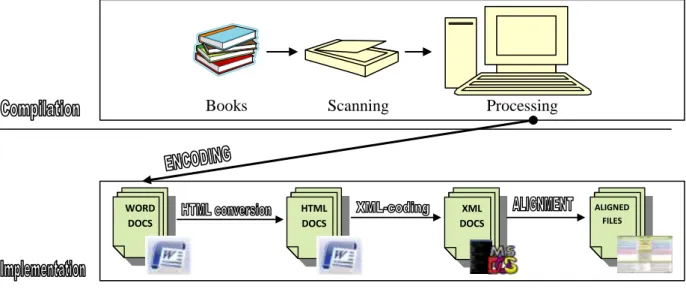
Table 4.10 List of popular science books in the GE_P-ACTRES corpus 161 Fig. 4.11 The GE_P-ACTRES corpus encoding and alignment stages 162 Fig. 4.12 Sentence break diagram consisting of two sentences (S1 and S2) in the
running text
164
Fig. 4.13 Internal structure of an html example from 6LA_EN: Ch. 4 166
Fig. 4.14 XML-coding 167
Fig. 4.15 Batch file execution 167
Fig. 4.16 Batch file list of commands 167
Fig. 4.17 Log file execution 168
Fig. 4.19 In-the-process xtml document (6LA_EN: Ch.3) broken down into paragraphs 169 Fig. 4.20 Xml document (6LA_EN: Ch.3) broken down into sentences 170
Fig. 4.21 Command prompt errors 170
Fig. 4.22 The set of programs that prepare the corpus from html to xml 171
Fig. 4.23 TCA2 aligning methods under settings 172
Fig. 4.24 TCA2 Aligning software 173
Fig. 4.25 Screenshot of the output files 174
Fig. 4.26 ACTRES website at the University of Valladolid 176
Fig. 4.27 CWB search interface for GE_P-ACTRES 177
Table 4.28 Outline of Toury’s DTS research model (1995) based on Munday (2007) 179 Table 4.29 Matching of Toury’s DTS research model (1995) with Williams and
Chesterman’s guidelines (2007) for data analysis on TS 180 Fig. 4.30 Biotechnology at the European Commission website 184
Fig. 4.31 Biotechnology at the USDA website 184
Fig. 4.32 Biotechnology at the Australian government website 185 Fig. 4.33 Institute for Responsible Technology website (Fairfield, Iowa) 185 Fig. 4.34 US Council for Biotechnology Information website 186 Fig. 4.35 Spanish Association of Biotechnology (SEBIOT) website 189
Fig. 4.36 Screenshot of LA4.html bitext 190
Table 4.37 Matching of Toury’s DTS research model (1995) and Williams and Chesterman’s guidelines (2007) with Teubert’s (1999) for data analysis on TS
191
Table 4.38 Matching of Teubert’s procedure (1999) with the method of this PhD dissertation
192
Fig. 4.39 WST5 option for the selection of a stopword list 193
Fig. 4.40 Setting a low p value in WST5 195
Fig. 4.41 WST5 dispersion plot for keywords in 8BL book 196
Fig. 4.42 Narrow-span linkages of top keywords 197
Fig. 4.43 Term search for ‘gene’ at IATE database 199
Fig. 4.44 Term search for ‘genetic’ at ILOTERM database 199
Fig. 4.45 Term search for ‘transgenic’ at UNTERM database 200
Fig. 4.46 Glossary of biotechnology at ISAAA website (M terms) 200
Fig. 4.47 Glossary of biotechnology at FAO website 201
Fig. 4.48 Wordlist Controller of Detailed Consistency Analysis 202 Fig. 4.49 Detailed Consistency List (DCL) of ‘modified’ from WST5 202 Fig. 4.50 Pull-down menu to choose inferential statistics in WST5 203
Fig. 4.51 Concordance of ‘modified’ from WST5 205
Fig. 4.52 Patterns of ‘modified’ from WST5 206
Fig. 4.53 Dispersion plot of ‘modified’ under Concordance from WST5 206 Fig. 4.54 Uniform plot of ‘modified’ under Concordance from WST5 206 Fig. 4.55 Bilingual concordance of ‘modified’ from AKSIS search form 207
PART III: Analysis and Results page
Fig. 5.1 Label from organic products certified by the Soil Association 229
Fig. 5.2 Monsanto website 230
Table 5.3 Overall corpus size of GE_P-ACTRES 236
Fig. 5.4 Type/token ratio in the English corpus 237 Fig. 5.5 Type/token ratio in the Spanish corpus 237 Table 5.6 English 50 top-frequent tokens (both lexical and grammatical words) 238 Table 5.7 Spanish 50 top-frequent tokens (both lexical and grammatical words) 239
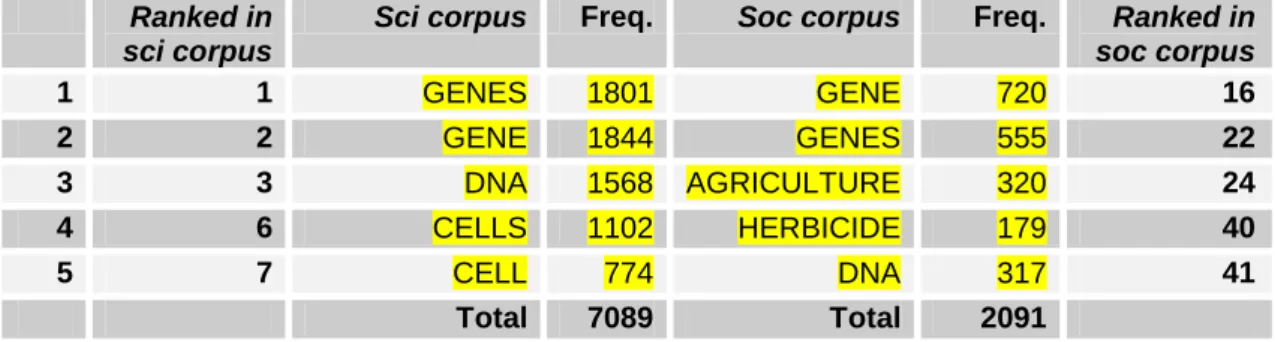
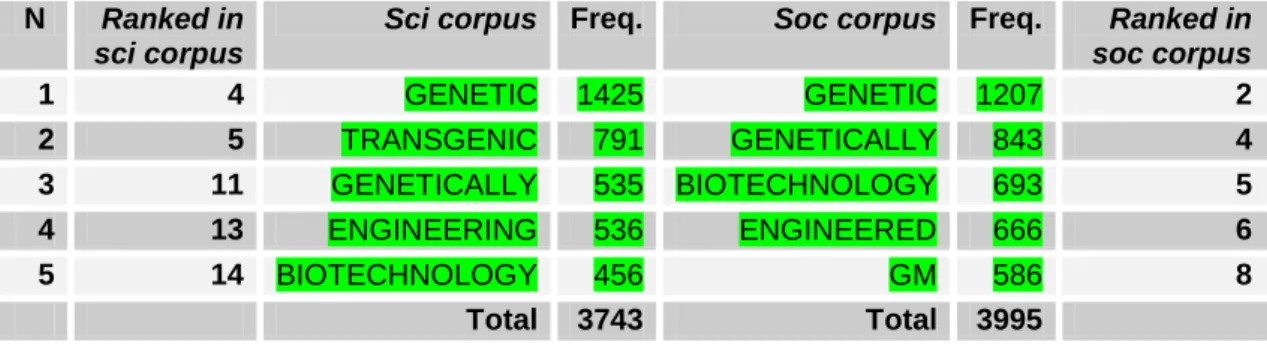
Table 5.8 English 50-top keywords 241
corpora
Table 5.12 English 5-top technical terms (science) in the sci and the soc corpora 248 Table 5.13 English 5-top technical terms (specialized field of GE) in the sci and the
soc corpora
248
Table 5.14 English 5-top subtechnical keywords in the sci and the soc corpora 249
Table 5.15 Spanish 50-top keywords 250
Table 5.16 Spanish keywords extracted from the sci corpus 251
Table 5.17 Spanish keywords extracted from the soc corpus 252-3 Table 5.18 Lexical distribution of the 50-top keywords in Spanish sci and soc
corpora
253
Table 5.19 Spanish 5-top technical keywords (science) in the sci and the soc corpora 254 Table 5.20 Spanish 5-top technical keywords (specialized field) in the sci and the soc
corpora
254
Table 5.21 Spanish 5-top subtechnical keywords in the sci and the soc corpora 255 Table 5.22 The linguistic phenomena studied in this dissertation paired up with
keywords
256
Table 5.23 Number of tokens, frequency and relative frequencies of ‘DNA’ in the English sci and soc corpora
257
Fig. 5.24 English collocates for ‘Adj + DNA’ in the sci and the soc corpora 258 Fig. 5.25 Sample of concordance lines for ‘Recombinant DNA’ in the sci corpus 259 Fig. 5.26 Sample of concordance lines for ‘Recombinant DNA + N’ in the sci
corpus
259
Fig. 5.27 Concordance of ‘Transgenic DNA’ in the sci corpus 259 Fig. 5.28 Concordance of ‘Manipulated DNA’ and the least frequent collocates in
the sci corpus
260
Table 5.29 Denominative variants of ‘Adj + N (DNA)’ in the English sci corpus 260 Fig. 5.30 Sample of concordance lines for ‘Recombinant DNA’ in the soc corpus 261 Fig. 5.31 Concordance of ‘altered/GM/GMO/genetically modified + DNA’ in the
soc corpus
261
Fig. 5.32 Concordance of ‘altered/GM/GMO/genetically modified + DNA’ in the soc corpus
262
Table 5.33 Denominative variants of ‘Adj + N (DNA)’ in the English soc corpus 262 Fig. 5.34 Pie chart of denominative variants of ‘Adj + N (DNA)’ in the English sci
corpus
263
Fig. 5.35 Pie chart of denominative variants of ‘Adj + N (DNA)’ in the English soc corpus
263
Fig. 5.36 Spanish collocates for ‘Adj + DNA’ in the sci and the soc corpora 264 Table 5.37 Denominative variants of ‘N (ADN) + Adj’ in the Spanish sci corpus 264 Fig. 5.38 Sample of concordance lines for ‘ADN recombinante’ in the sci corpus 265 Fig. 5.39 Concordance of ‘ADN transgénico’ in the sci corpus 265 Fig. 5.40 Concordance of ‘ADN manipulado’ in the sci corpus 265 Fig. 5.41 Concordance of the least frequent collocations of ‘ADN + adj’ in the sci
corpus
266
Fig. 5.42 Concordance of ‘ADN extraño’ in the sci corpus 266
Table 5.43 Denominative variants of ‘N (ADN) + Adj’ in the Spanish soc corpus 266 Table 5.44 Sample of concordance lines for ‘ADN recombinante’ and ‘ADN
modificado/modificado genéticamente/genéticamente modificado’ in the soc corpus
267
Fig. 5.45 Concordance of ‘ADN transgénico/manipulado/alterado’ in the Spanish soc corpus
267
Fig. 5.46 Concordance of ‘ADN GM/OMG’ in the Spanish soc corpus 267 Fig. 5.47 Pie chart of denominative variants of ‘N (ADN) + Adj’ in the Spanish sci
corpus
Fig. 5.48 Pie chart of denominative variants of ‘N (ADN) + Adj’ in the Spanish soc corpus
268
Table 5.49 English and Spanish collocates for ‘DNA’ in the sci corpus 269 Table 5.50 English and Spanish collocates for ‘DNA’ in the soc corpus 269 Table 5.51 Number of tokens, frequency and relative frequencies of ‘gene/s’ in the
English sci and soc corpora
270
Fig. 5.52 English collocates for ‘Adj + gene/s’ in the sci and soc corpora 271 Fig. 5.53 Sample of concordance lines for ‘Resistance GROUP’ in the sci corpus 271-2 Fig. 5.54 Concordance lines of ‘Engineered GROUP’ in the sci corpus 272 Fig. 5.55 Concordance lines of ‘Genetically engineered GROUP’ in the sci corpus 272 Fig. 5.56 Concordance lines of ‘Altered gene/s’ in the sci corpus 272-3 Fig. 5.57 Concordance lines of ‘biopesticide / herbicide-tolerance / insecticidal /
Roundup Ready gene/s’ in the sci corpus 273 Table 5.58 Denominative variants of ‘Adj + N (gene/s)’ in the English sci corpus 273 Fig. 5.59 Concordance lines of ‘Resistant GROUP’ in the soc corpus 274 Fig. 5.60 Concordance lines of ‘Transgenic gene/s’ in the soc corpus 274 Fig. 5.61 Concordance lines of ‘Insecticide GROUP’ in the soc corpus 274 Fig. 5.62 Concordance lines of ‘Roundup Ready gene/s’ in the soc corpus 275 Fig. 5.63 Concordance lines of ‘Modified gene/s’ in the soc corpus 275 Fig. 5.64 Concordance lines of ‘Engineered genes’ in the soc corpus 275 Fig. 5.65 Concordance lines of ‘Altered/engineered/Terminator/pesticide/GM
gene/s’ in the soc corpus 275
Table 5.66 Denominative variants of ‘Adj + N (gene/s)’ in the English soc corpus 276 Fig. 5.67 Pie chart of denominative variants of ‘Adj + N (gene/s)’ in the English sci
corpus
276
Fig. 5.68 Pie chart of denominative variants of ‘Adj + N (DNA)’ in the English soc corpus
277
Fig. 5.69 Spanish collocates for ‘Adj + gene/s’ in the sci and soc corpora 277 Fig. 5.70 Sample of concordance lines for ‘Gen/es de resistencia’ in the sci corpus 278 Fig. 5.71 Concordance lines of ‘Altered gene/s’ in the sci corpus 278 Fig. 5.72 Concordance lines of ‘biopesticide/herbicide-tolerance/insecticidal
/Roundup Ready/gene/s’ in the sci corpus
278
Table 5.73 Denominative variants of ‘N (gen/es) + Adj’ in the Spanish sci corpus 279 Fig. 5.74 Concordance lines of ‘Gen/es resistente/s’ in the soc corpus 279 Fig. 5.75 Concordance lines of ‘Gen/es transgénico/s’ in the soc corpus 280 Fig. 5.76 Concordance lines of ‘Gen/es insecticida/s’ in the soc corpus 280 Fig. 5.77 Concordance lines of ‘Gen/es Roundup Ready’ in the soc corpus 280 Fig. 5.78 Concordance lines of ‘Gen/es modificado/s’ in the soc corpus 280 Fig. 5.79 Concordance lines of ‘Gen/es sometido/s a la IG’ in the soc corpus 281 Fig. 5.80 Concordance lines of ‘Genes alterados; gen/es Terminator; genes GM;
gen pesticida’ in the soc corpus 281
Table 5.81 Denominative variants of ‘N (gen/es) + Adj’ in the Spanish soc corpus 281-2 Fig. 5.82 Pie chart of denominative variants of ‘Adj + N (gene/s)’ in the Spanish sci
corpus
282
Fig. 5.83 Pie chart of denominative variants of ‘Adj + N (gene/s)’ in the Spanish soc corpus
282
Table 5.84 English and Spanish collocates for ‘gene/s’ in the sci corpus 283 Table 5.85 English and Spanish collocations for ‘gene/s’ in the soc corpus 283 Table 5.86 Number of tokens, frequency and relative frequencies of ‘food/s’ in the
English sci and soc corpora
284
Fig. 5.90 Sample of concordance lines for ‘Genetically engineered food/s’ in the sci corpus
286
Fig. 5.91 Sample of concordance lines for ‘New/novel food/s’ in the sci corpus 286 Fig. 5.92 Concordance lines of ‘Transgenic food/s’ in the sci corpus 287 Fig. 5.93 Concordance lines of ‘Modified/genetically altered food/s’ in the sci
corpus
287
Table 5.94 Denominative variants of ‘Adj + N (food/s)’ in the English sci corpus 287 Fig. 5.95 Sample of concordance lines for ‘GM food/s’ in the soc corpus 288 Fig. 5.96 Sample of concordance lines for ‘Genetically modified food/s’ in the soc
corpus
288
Fig. 5.97 Sample of concordance lines for ‘Genetically engineered food/s’ in the soc corpus
289
Fig. 5.98 Sample of concordance lines for ‘Modified / test-tube food/s’ in the soc corpus
289
Fig. 5.99 Sample of concordance lines for the least frequent collocations for ‘food/s’ in the soc corpus
290
Table 5.100 Denominative variants of ‘Adj + N (food/s)’ in the English soc corpus 291-2 Fig. 5.101 Pie chart of denominative variants of ‘Adj + N (food/s)’ in the English sci
corpus
292
Fig. 5.102 Pie chart of denominative variants of ‘Adj + N (food/s)’ in the English soc corpus
293
Fig. 5.103 Spanish collocates for ‘Alimento/s + Adj’ in the sci and soc corpora 293 Fig. 5.104 Sample of concordance lines for ‘Alimento/s transgénico/s’ in the sci
corpus
294
Fig. 5.105 Sample of concordance lines for ‘Alimento/s MG’ in the sci corpus 294 Fig. 5.106 Sample of concordance lines for paraphrasis and ‘Nuevos alimento/s
GROUP’ in the sci corpus 294
Fig. 5.107 Sample of concordance lines for ‘Alimento/s modificados (genéticamente)/genéticamente modificados/manipulados genéticamente’ in the sci corpus
295
Fig. 5.108 Denominative variants of ‘N (food/es) + Adj’ in the Spanish sci corpus 295 Fig. 5.109 Sample of concordance lines for ‘Alimento/s GM/transgénicos’ in the soc
corpus
296
Fig. 5.110 Sample of concordance lines for ‘Alimento/s modificado/s genéticamente’ in the soc corpus
296
Fig. 5.111 Sample of concordance lines for middle-frequency terms ‘Alimento/s genéticamente modificado/s, modificado/s, paraphrasis and de tubo de ensayo’ in the soc corpus
296-7
Fig. 5.112 Sample of concordance lines for the least frequent occurrences for
‘Alimentos’ in the soc corpus 297
Table 5.113 Denominative variants of ‘N (alimento/s) + Adj’ in the Spanish soc corpus
297-8
Fig. 5.114 Pie chart of denominative variants of ‘N (alimento/s) + Adj’ in the Spanish sci corpus
299
Fig. 5.115 Pie chart of denominative variants of ‘N (alimento/s) + Adj’ in the Spanish soc corpus
300
Table 5.116 English and Spanish collocates for ‘food/s’ in the sci corpus 300 Table 5.117 English and Spanish collocates for ‘food/s’ in the soc corpus 301 Table 5.118 Concordance of ‘Transgenics’ in the sci corpus 301 Table 5.119 Number of tokens, frequency and relative frequencies of ‘crop/s’ in the
English sci and soc corpora
302
Fig. 5.123 Sample of concordance lines for ‘Genetically modified crop/s’ and ‘Bt
crop/s’ in the sci corpus 304
Fig. 5.124 Sample of concordance lines for ‘Genetically * crop/s’ in the sci corpus 304 Fig. 5.125 Concordance lines of the least frequent collocates for ‘crop/s’ in the
English sci corpus
305
Table 5.126 Denominative variants of ‘Adj + N (crop/s)’ in the English sci corpus 305 Fig. 5.127 Sample of concordance lines for ‘Transgenic crop/s’ in the soc corpus 306 Fig. 5.128 Sample of concordance lines for ‘Genetically modified’ and ‘Modified
crop/s’ in the soc corpus 306
Fig. 5.129 Sample of concordance lines for medium-frequency collocates for ‘crop/s’ in the English soc corpus
307
Fig. 5.130 Sample of concordance lines for least frequent collocates for ‘crop/s’ in the English soc corpus
307
Table 5.131 Denominative variants of ‘Adj + N (crop/s)’ in the English soc corpus 307-8 Fig. 5.132 Denominative variants of ‘Adj + N (crop/s)’ in the English sci corpus 308 Fig. 5.133 Denominative variants of ‘Adj + N (crop/s)’ in the English soc corpus 309 Fig. 5.134 Spanish collocates for ‘Cultivo/s* + adj’ in the sci and soc corpora 309 Fig. 5.135 Sample of concordance lines for ‘Transgénico/s’ as adjective in the sci
corpus
309
Fig. 5.136 Sample of concordance lines for ‘Transgénico/s’ as noun in the sci corpus 310 Fig. 5.137 Sample of concordance lines for ‘Resistentes GROUP’ in the sci corpus 310 Fig. 5.138 Sample of concordance lines for ‘Cultivos modificados genéticamente’
and ‘Cultivos Bt’ in the sci corpus 310
Fig. 5.139 Sample of concordance lines for the least frequent collocates for ‘crop/s’ in the Spanish sci corpus
311
Table 5.140 Denominative variants of ‘N + Adj (cultivo/s)’ in the English sci corpus 311 Fig. 5.141 Sample of concordance lines for the most frequent collocates for ‘crop/s’
in the Spanish soc corpus
312
Fig. 5.142 Sample of concordance lines for the least frequent collocates for ‘crop/s’ in the Spanish soc corpus
312
Table 5.143 Denominative variants of ‘N + Adj (cultivo/s)’ in the English soc corpus 313 Fig. 5.144 Denominative variants of ‘N (cultivo/s*) + Adj’ in the Spanish sci corpus 314 Fig. 5.145 Denominative variants of ‘N (cultivo/s*) + Adj’ in the Spanish soc corpus 314 Table 5.146 English and Spanish collocates for ‘crop/s’ in the sci corpus 315 Table 5.147 English and Spanish collocates for ‘crop/s’ in the soc corpus 315
Fig. 5.148 Plot of ‘genetic’ in the English sci corpus 317
Fig. 5.166 Concordance of ‘manipular’ in the Spanish soc corpus 328 Fig. 5.167 Concordance of ‘modificación genética’ in the Spanish sci corpus 330-1 Fig. 5.168 Concordance of ‘modificar’ in the Spanish sci corpus 331 Fig. 5.169 Concordance of ‘modificación genética’ in the Spanish soc corpus 332 Fig. 5.170 Concordance of ‘modificar’ in the Spanish soc corpus 334 Fig. 5.171 Concordance of ‘recombinación genética’ in the Spanish sci corpus 333 Fig. 5.172 Concordance of ‘recombinar’ in the Spanish sci corpus 333 Fig. 5.173 Concordance of ‘recombinar’ in the Spanish soc corpus 333 Fig. 5.174 Concordance of ‘genetically + adjective + noun’ in the English sci corpus 334 Table 5.175 Frequency of the ‘genetically’ + ‘adjective’ (+ noun) pattern in both
English sci and soc corpora to analyze semantic prosody
335
Table 5.176 Semantic sets of ‘genetically’ + ‘modified + noun’ in 2SA book from the English sci corpus
336
Table 5.177 Semantic sets of ‘genetically’ + ‘modified + noun’ in the English sci corpus
338
Fig. 5.178 Favorable and unfavorable semantic prosodies of ‘release(s) of’ + ‘genetically modified + noun’ in the English sci corpus 339 Fig. 5.179 Unfavorable and ‘negative concern’ semantic prosodies of ‘release(s) of’
+ ‘genetically engineered + noun’ in the English sci corpus
339-40
Fig. 5.180 ‘Concern’ semantic prosody of ‘release(s) of’ + ‘genetically altered +
noun’ in the English sci corpus 340
Table 5.181 Extract of semantic sets of ‘genetically’ + ‘engineered + noun’ in 4JR book from the English soc corpus
341
Table 5.182 Semantic sets of ‘genetically’ + ‘modified + noun’ in the English soc corpus
341-2
Fig. 5.183 Unfavorable, ‘negative concern’ and favorable semantic prosodies of ‘release(s) (of)’ + ‘genetically engineered/modified + noun’ in the English soc corpus
343-4
Fig. 5.184 Unfavorable semantic prosody of ‘release(s) of’ + ‘genetically altered +
noun’ in the English soc corpus 344
Fig. 5.185 Positive and negative semantic sets for ‘genetically engineered + noun’ in the company of key adjacent collocates (e.g. increase) in the English soc corpus
345
Table 5.186 Frequency of the ‘genéticamente’ + ‘Adj’ (+ Noun) / ‘Adj’ + ‘genéticamente’ (+ Noun) pattern in both Spanish sci and soc corpora to analyze semantic prosody
346
Table 5.187 Semantic sets of ‘N + Adj + genéticamente* / N + *genéticamente + Adj’ in the Spanish sci and soc corpora
346
Table 5.188 Semantic sets of ‘N + Adj + genéticamente* / N + *genéticamente + Adj’ in 1ER book from the Spanish sci corpus
347
Table 5.189 Extract of semantic sets of ‘N + Adj + genéticamente* / N + *genéticamente + Adj’ in 1ER book from the Spanish soc corpus 348 Fig. 5.190 Unfavorable and favorable semantic prosodies of ‘liberación(es) (de)’ +
‘N + (genéticamente + Adj / Adj + genéticamente)’ in the Spanish corpora
349
Table 5.191 Number of DVs in the English and Spanish sci and soc corpora 350
Fig. 5.192 Corpus size of every book (ST) and their TTs 350
Table 5.193 Number of DVs in the English and Spanish sci and soc corpora, along with the number of explicit and simplified DVs
351
Fig. 5.194 Percentage of DVs for technical and subtechnical terms in the English corpora
352
Fig. 5.195 Percentage of DVs for technical and subtechnical terms in the Spanish corpora
352
Table 5.197 ST-TT segments for DV of the pattern ‘Adj + DNA’ in the soc corpus 354 Fig. 5.198 Search for ‘genetically modified’ (ST) in IATE databank website 354-5 Fig. 5.199 Search for TTs corresponding to ‘genetically modified’ in TermSciences
website
355
Table 5.200 ST-TT segments for DV of the pattern ‘Adj + gene/s’ in the sci corpus 356 Table 5.201 Complete ST-TT segments for ‘engineered gene/s’ translated as ‘gen/es
manipulado/s’ in the sci corpus 357
Table 5.202 ST-TT segments for DV of the pattern ‘Adj + gene/s’ in the soc corpus 357 Table 5.203 Complete ST-TT segments for ‘(genetically) engineered gene/s’ translated
as ‘gen/es sometidos a la ingeniería genética’ in the soc corpus
358
Table 5.204 ST-TT segments for DV of the pattern ‘Adj + food/s’ in the sci corpus 359 Table 5.205 ST-TT segments for DV of the pattern ‘Adj + food/s’ in the soc corpus 360-1 Table 5.206 ST-TT segments for DV of the pattern ‘Adj + crop/s’ in the sci corpus 362 Table 5.207 ST-TT segments for DV of the pattern ‘Adj + crop/s’ in the soc corpus 364-5 Table 5.208 SPs of DVs for ‘Adj + DNA’ in the sci and soc corpora 366 Table 5.209 SPs of DVs for ‘Adj + gene/s’ in the sci and soc corpora 367 Table 5.210 Bilingual concordances for ‘Adj + gene/s’ as examples of dual semantic
prosody in the soc corpus
368-9
Table 5.211 Bilingual concordances for ‘Adj + food’ as examples of dual semantic prosody in the sci corpus
370
Table 5.212 SPs of DVs for ‘Adj + food/s’ in the sci and soc corpora 372 Table 5.213 Bilingual concordances for ‘Adj + food’ as examples of dual semantic
prosody in the soc corpus
373-4
Table 5.214 Bilingual concordance for ‘Bt-engineered crops’ as an example of dual semantic prosody in the sci corpus
375
Table 5.215 SPs of DVs for ‘Adj + crop/s’ in the sci and soc corpora 376 Table 5.216 Bilingual concordance for ‘Adj + crops’ as an example of dual semantic
prosody in the soc corpus
377
Table 5.217 List of popular science books in the GE_P-ACTRES corpus 378 Table 5.218 ST-TT pair segment containing ‘genetically engineered’ translated as
‘modificado genéticamente’ 379
Table 5.219 ST-TT pair segment containing ‘genetically modified’ translated as
‘transgénicos’ 379
Table 5.220 ST-TT pair segment containing ‘engineered’ translated as ‘alteradas
genéticamente’ 380
Table 5.221 ST-TT pair segment containing ‘weapon’ translated as ‘arma’ 381 Table 5.222 ST-TT pair segment containing ‘powerful way’ translated as ‘arma’ 382 Table 5.223 ST-TT pair segment containing ‘everything’ translated as ‘armas’ 382 Table 5.224 ST-TT pair segment containing ‘gun’ translated as ‘arma’ 382 Table 5.225 ST-TT pair segment containing ‘arma’ translated as the TT
(http://sli.uvigo.es/CLUVI/cluvi_en.php?ocuL1=&ocuL2=&ocuL3=arma &ocuL4=&direccionconsulta=ocu)
SUMMARY OF THE MAIN POINTS IN SPANISH
(This section is part of the fulfillment for the International PhD certification)
Resumen de los principales aspectos tratados en la presente tesis que lleva por título: “El concepto de ‘modificación genética’ a través de un Estudio Descriptivo de Traducción (DTS) de un corpus inglés-español de libros de divulgación científica sobre ingeniería genética: Variación denominativa, prosodia semántica y aspectos ideológicos de la traducción”.
La presente tesis doctoral sigue el esquema que se muestra a continuación:
ÍNDICE de CONTENIDOS
PARTE I: MARCO TEÓRICO
1. Introducción xxxv
2. La divulgación científica como Lengua Especializada (LSP) xliii 3. Objeto de estudio: La Variación Denominativa (VD), la Prosodia
Semántica (PS) y las estrategias traductológicas (aspectos ideológicos de la traducción)
xlix
PARTE II: METODOLOGÍA
4. Diseño del presente estudio y su metodología: Lingüística de Corpus (LC) y los Estudios Descriptivos de Traducción (EDT)
lxiii
PARTE III: ANÁLISIS Y RESULTADOS
5. Análisis de los resultados lxix
1. Introducción ...
1.1. Objetivos y motivación:
Divulgación científica y Variación Denominativa (VD)
Prosodia Semántica (PS)
Aspectos ideológicos de la traducción (Traductología) 1.2. Preguntas de investigación
Variación Denominativa
Prosodia Semántica
1. Introducción
La presente tesis se centra en la extracción de los términos más frecuentes pertenecientes a un corpus de ingeniería genética. La extracción de los resultados del corpus sobre ingeniería genética está orientada a examinar tres fenómenos lingüísticos (variación denominativa, prosodia semántica y aspectos ideológicos de estrategias traductológicas), como se muestra a continuación:
Fig. 1.11: Diagrama de los materiales (corpus paralelo) y objetivos de estudio.
1.1. Objetivos y motivación
El objetivo general de este proyecto consiste en examinar el concepto de modificación genética a través de 3 fenómenos lingüísticos: la variación denominativa, la prosodia semántica y los aspectos ideológicos de las principales estrategias de traducción observadas en el corpus seleccionado para este estudio. Éste no sólo se centra en las características lingüísticas que definen el discurso de la divulgación científica (objetivo 1), sino también en aquellas que transforman el discurso científico en cultural, social e incluso en discurso político (objetivo 2). El primer objetivo se centra en estudiar las características predominantes de la divulgación científica, tanto en el corpus de lengua inglesa (TO) como en el de lengua española (TM), mediante la ayuda de listas de palabras (wordlists), de palabras clave (keywords) y de términos. El segundo objetivo tiene como propósito comparar las prosodias semánticas de términos en las dos lenguas de trabajo con la ayuda de Concord en Wordsmith Tools 5 y de un programa de búsquedas que alberga concordancias bilingües (AKSIS search form), desarrollado en la Universidad de Bergen (Noruega).
1 The illustrations (e.g. figures and tables) maintain the numerical sequence of the original English
version.
CORPUS PARALLELO:
TO: Inglés
TM: Español
Objetivo 1: Variación denominativa (Terminología)
(Listas de palabras clave y términos)
Objetivo 2: Prosodia semántica (Fraseología)
(Concord function & AKSIS Search form)
Objetivo 3: Estrategias traductológicas
(Estudios de Traducción)
En cuanto a la elección de la temática de los textos o lenguaje de especialidad, los textos que conforman el corpus se han seleccionado por una serie de razones. La temática provoca un desafío lingüístico si se asume que la problemática actual sobre los organismos modificados genéticamente tiene un correlato lingüístico. A esto se une que las estrategias traductológicas son varias teniendo en cuenta que términos como genetically engineered no tiene una traducción directa en español.
Las dificultades que se derivan de la traducción de fenómenos lingüísticos como la variación denominativa, la prosodia semántica y la inserción de ideología convierten estos tres elementos en las características distintivas de la presente tesis.
Fig. 1.2: Ilustración de la relación entre la lengua general (GL) y el lenguaje de especialidad (LSP) (libros de divulgación científica sobre ingeniería genética) junto con los tres aspectos a estudiar en la presente tesis (variación denominativa, prosodia semántica y estrategias traductológicas).
Estos tres fenómenos lingüísticos serán el objeto de estudio de nuestro corpus compilado a base de libros de divulgación científica. Las razones por las que se ha elegido este corpus son varias, entre ellas podemos destacar que el género de los libros de divulgación aún está por ser estudiado exhaustivamente; es además un género donde el debate está servido, debido a las ideas frecuentemente contrapuestas de los principales participantes; y, por último, el estatus del inglés como lingua franca hace que géneros que se dan en niveles comunicativos de experto a experto (e.g. en inglés) vayan desapareciendo en otras lenguas como en el caso del español, el cual queda relegado a entornos divulgativos, valgan de ejemplo, los libros de divulgación científica. Por esta razón, el capítulo 2 trata de la divulgación científica como lenguaje de especialidad, distinguiéndolo del lenguaje general a base de unas
LSP
Popular Science of GE
GL
Denominative variation
Semantic prosody
características marcadas en el lenguaje especializado, como son la frecuencia de variantes denominativas de los términos especializados clave o más prominentes.
El capítulo 3 introduce el marco teórico de la variación denominativa dentro de la rama de la terminología, junto con el fenómeno de la prosodia semántica y aspectos ideológicos de la traducción interlingüística. La prosodia semántica es un rasgo pertinente que merece la pena estudiar por la sencilla razón de que las variantes denominativas seleccionadas pueden mostrar síntomas de prosodia semántica, favorable, desfavorable o neutral, a pesar de que los términos, se asume, están exentos de cualquier tipo de intención semántica. Y reiteramos que pueden mostrar síntomas debido a que la divulgación científica de algunos de los libros que componen este corpus aparece como un género muy dado a los juicios de valor. La función potencial de las expresiones de valoración, que muchas veces no son fáciles de identificar dentro del discurso, puede afectar a la objetividad del lenguaje científico al revelar el escritor cierta subjetividad sobre el tema a tratar, en este caso la ingeniería genética, no exenta de controversia en lo que respecta al colectivo, por ejemplo, de consumidores. Además de la prosodia semántica, la última parte del capítulo 3 está dirigida a la investigación de aquellas estrategias tomadas por el traductor que exhiben algún tipo de rasgo ideológico, diferente de la versión original del texto fuente.
1.2. Preguntas de investigación
Estos apuntes teóricos sobre el marco epistemológico de estudio nos sirven para estructurar las preguntas de investigación de la siguiente manera:
VARIACIÓN DENOMINATIVA.
¿Cuáles son las diferentes variaciones denominativas de los organismos modificados genéticamente (e.g. genetically engineered food, genetically modified food, Frankenstein foods, mutant potatoes, GM foods)? ¿Hay algún correlato lingüístico que asocie una determinada variante denominativa con un término clave en particular? ¿Hay algún libro de los que conforman el corpus que muestre una mayor tendencia a la variación denominativa? ¿Depende la variación denominativa del lenguaje utilizado, del nivel de especialidad, del tema del que trata el corpus o del tipo de autor que ha escrito el libro?
PROSODIA SEMÁNTICA.
IDEOLOGÍA EN LAS ESTRATEGIAS TRADUCTOLÓGICAS.
¿Es el corpus de español más propenso a mostrar variación denominativa o es el de lengua inglesa? ¿Es la traducción de variantes denominativas más prolífica en número si lo comparamos con las que se muestran en el texto origen? ¿Se da la estrategia de la explicitación, uno de los universales de traducción, a la hora de traducir variantes denominativas? ¿Se mantienen las mismas prosodias semánticas del original a la hora de traducir? ¿Qué tipo de equivalencia se manifiesta en la traducción de variantes denominativas y prosodias semánticas?
La respuesta a estas preguntas pretende contribuir a la práctica de la traducción especializada enriqueciendo la enseñanza y aprendizaje de rasgos lingüísticos pertenecientes a los lenguajes de especialidad.
Debido a que el estudio de la prosodia semántica se ha extendido gracias a la difusión que le ha otorgado la lingüística de corpus, dedicaremos una sección dentro de la metodología, a desarrollar la contribución de esta disciplina a los estudios lingüísticos. En el capítulo de la metodología también se explican los pasos a seguir a la hora de compilar y explotar el corpus especializado, junto con las fases que traza Toury (1995) para llevar a cabo un estudio descriptivo de traducción (DTS). La compilación pone de manifiesto que la variedad de autores de los libros que conforman el corpus se puede agrupar en dos categorías. La primera abarca autores científicos expertos (corpus sci) y la segunda, es un grupo misceláneo de periodistas, ecologistas y economistas (corpus soc).
1.3. Hipótesis: VD, PS y Estrategias traductológicas
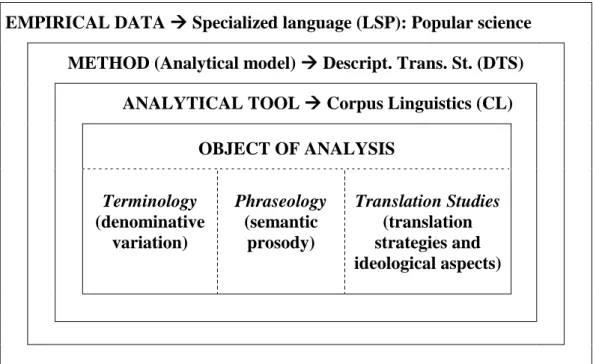
Una vez establecidas las líneas de investigación del marco teórico, el método de análisis (DTS), la herramienta analítica (lingüística de corpus) y los datos empíricos (corpus de ingeniería genética), podemos hacer un esquema de la estructura del presente estudio (fig. 1.3) y delinear las hipótesis de trabajo:
algunas con un significado desviado del contexto científico (e.g. manipulated vs engineered).
EMPIRICAL DATA Specialized language (LSP): Popular science
METHOD (Analytical model) Descript. Trans. St. (DTS)
ANALYTICAL TOOL Corpus Linguistics (CL)
OBJECT OF ANALYSIS
Terminology
(denominative variation)
Phraseology
(semantic prosody)
Translation Studies
(translation strategies and ideological aspects)
Fig. 1.3: Mapa conceptual junto con el triple objeto de estudio.
ii) Las hipótesis que se relacionan con la prosodia semántica tienen que ver con el hecho de que este fenómeno tiende a ocurrir en el contexto de la lengua general. Sin embargo, como la divulgación científica es el estrato más bajo dentro de los niveles comunicativos de especialidad creemos que los rasgos lingüísticos de la prosodia semántica se verán reflejados en nuestro corpus de biotecnología y con más fuerza en el corpus soc, quizá más que en el corpus de escritores científicos (sci). A pesar de que los términos están desprovistos de carga emocional, creemos que algunas variantes denominativas mantienen esta característica mientras que otras pueden mostrar rasgos de un lenguaje evaluativo. Términos como genetically engineered y genetically modified pueden no exhibir prosodia semántica. Dicho de otro modo, muestran una prosodia semántica neutral, mientras que altered y manipulated pueden ser vulnerables a desarrollar un tipo de prosodia semántica que muestre juicios de valor tanto positivos como negativos debido a la preferencia colocacional con elementos léxicos que expresen aspectos convencionalmente favorables o desfavorables (risks, concerns, opposition).
2. La divulgación científica como Lengua Especializada (LSP) ...
2.1.Lengua General vs. Lengua de Especialidad (LSP) 2.2.¿Qué son los lenguajes de especialidad?
2.2.1. El modelo tripartito de Cabré (1993) 2.2.2. El criterio formal: El concepto de género
2.3.¿Qué es la Divulgación Científica?
Artículos de revistas semi-especializadas
Manuales de texto de universidad
Libros de divulgación científica
2. La divulgación científica como Lengua Especializada (LSP)
El marco teórico tiene por objeto examinar el estado de la cuestión de las disciplinas sobre las que se sustenta el futuro análisis. La primera de ellas es la disciplina que se ocupa de los lenguajes de especialidad ya que la presente tesis investiga textos sobre ingeniería genética cuyo léxico, lo hemos considerado, como lenguaje de especialidad.
2.1. Lengua General vs Lengua de Especialidad (LSP)
Los lenguajes especializados se nutren de una serie de recursos que los hacen reconocibles, distintivos y diferentes de la lengua general del día a día. Uno de esos rasgos diferenciadores es la terminología, junto con el uso específico que se hace del lenguaje, cuya base es la lengua general.
Fig. 2.1: Diagrama de la lengua general (GL) y los diferentes lenguajes de especialidad (LSP) dentro de los cuales se encuentra PAL y la divulgación científica.
La especificidad de un lenguaje recibe la denominación de PAL, que es una propuesta de Edo Marzá (2008: 12-13) para designar a los lenguajes de especialidad desde los más a menos especializados. Sin embargo, en esta tesis, PAL tiene un uso restringido para designar los lenguajes más especializados, es decir, la comunicación entre expertos. El resto de niveles entre PAL y la lengua general se podrían denominar divulgación científica (scientific popularization) de los que el más bajo en especialización de conocimientos, popular science, es el nivel empírico que encontramos en nuestro corpus de libros divulgativos.
COMMON CORE
GL LSP1 LSP2 LSP3
PAL
(expert-to-expert communication)
Scientific popularization