The presence of psychopathological problems in the early stages of child development, is no longer a matter of debate (Angold & Egger, 2007; Egger & Angold, 2006). The need to assess such problems is widely recognised (Carter, Briggs-Gowan, & Davis, 2004), but the inclusion of self-information from young children is still considered to be secondary in many clinical settings. Young children’s ability to report on or experience certain emotions has been questioned, with some researchers pointing to developmental diffi culties in understanding, recalling or labelling certain feelings. The low reliability of information provided by young children in structured interviews (Edelbrock, Costello, Dulcan, Kalas, & Conover, 1985; Valla, Bergeron, Bidaut-Rusell, St-Georges, & Gaudet, 1997) has fostered the belief that children are not reliable reporters of their emotions. Other researchers have explored factors that may affect concordance rates, (Granero, Ezpeleta, Doménech, & de la Osa, 1998; Granero, Ezpeleta, Doménech, & de la Osa, 2008) together with the impact of not including children in the diagnostic process; some suggest that structured interviews may not be appropriate.
Excluding young children from the diagnostic process is a particular concern in the context of Intimate Partner Violence (IPV). Many studies have shown the negative effects of IPV on children’s development (Iwaniec, 2006), including externalising and internalising problems, diffi culties in social relationships, aggressive problem-solving strategies (Magen, 1999), poor academic achievement and limited empathetic ability (Rossman, 1998). However, due to the privacy and secrecy surrounding this «family matter», children exposed to IPV often have a sense of fear, guilt and shame. As a result of the lack of developmentally appropriate diagnostic instruments, and ethical considerations about the appropriateness of asking children directly about IPV, children have become the «invisible victims», to quote Osofsky (1995).
Self-reports involving children younger than 8 years of age have only been used on a very limited basis, although their usefulness has been demonstrated (Sourander et al., 2005). It is well documented that children as young as 5 years old may be able to report reliably on some aspects of their emotional and behavioural diffi culties if the questions are put to them properly (Coplan, Closson, & Arbeau, 2007; Luby, Belden, Sullivan, & Spitznagel, 2007; Russell, 1990). It has also been stated that young children can accurately report on traumatic events (Berliner, Hyman, Thomas, & Fitgerald, 2003). Norwood (2007), using the Strengths and Diffi culties Questionnaire (Goodman, 2007) with children under 11, showed that young children are able to distinguish accurately between externalising and internalising symptoms.
Fecha recepción: 16-2-11 • Fecha aceptación: 24-6-11 Correspondencia: Nuria de la Osa Chaparro Facultad de Psicología
Universidad Autónoma de Barcelona 08193 Barcelona (Spain) e-mail: [email protected]
Diagnostic value of the Dominic Interactive Assessment with children
exposed to intimate partner violence
Nuria de la Osa, Lourdes Ezpeleta, Roser Granero, Beatriz Olaya and Josep María Doménech
Universidad Autónoma de Barcelona
This article reports on the diagnostic validity of the Dominic Interactive Assessment (DIA) in a sample of Spanish children exposed to intimate partner violence (IPV). The study participants included 55 children aged between 6 and 11 years whose mothers visited an IPV counselling centre. Psychopathology and functional impairment were used as the main criteria for assessing predictive and discriminative accuracy, as well as incremental validity, of DIA. The results indicate that DIA permits obtaining useful information from children. This information improves the prediction and validity of the process of clinical assessment of children exposed to IPV. Children’s self-reports could prove effective in identifying cases in this high-risk population when developmentally adequate instruments and functional criteria are used.
Parents’ reports are known to have poor concordance with those of children (Kraemer et al., 2003). Lack of concordance, however, should not be used as an excuse to exclude young children from the diagnostic process since concordance does not necessarily improve over time, and adolescents’ or older children’s information is not in agreement with that of the parents either (de los Reyes & Kazdin, 2005; Ezpeleta, de la Osa, Doménech, & Navarro, 1995). In fact, children make independent contributions to parents’ and teachers’ predictions of their mental states (Ialongo, Edelsohn, & Kellam, 2001; Knutson, Lawrence, Taber, Bank, & DeGarmo, 2009; Sourander et al., 2005). The source of discordance does not seem to be age but a different point of view on problems. This disagreement is especially signifi cant as regards internalising disorders (Granero et al., 2008).
The availability of instruments that are properly adapted and validated for specifi c populations is very limited. This issue looms even larger when the possibility of including children’s self-reports in the diagnostic process is envisaged. One of the few appropriated self-reported instruments to assess the psychopathology of young children is the Dominic Interactive Assessment (DIA) (Valla et al., 1997; Valla, Bergeron, & Smolla, 2000). It is a DSM-IV-based computerised questionnaire designed to screen for the most frequent mental health problems in children aged 6 to 11 years. Clinicians studying the validity of the application with a group of French children reported that the DIA allows children at play to report fears, separation anxiety and phobias that they would otherwise be ashamed to talk about (Valla et al., 2002). The reliability and concurrent validity of the application were also the focus of a longitudinal study that tracked the long-term effects of cocaine use during pregnancy. The internalising results correlated with those obtained by measuring negative effects (Linares, Short, Singer, Russ, & Miness, 2008). No previous studies have focused on DIA’s diagnostic value in Spain, or on its usefulness in evaluating the consequences of IPV on children’s mental health.
The main goal of this article is to evaluate the effectiveness of the DIA in a population of children exposed to IPV answering two main questions: 1) do children add information to mother’s reports when using this instrument?, 2) does the inclusion of children’s self-reports in the assessment process of IPV improve the prediction
of functional impairment on a structured interview? In order to analyse the kind of new information children contribute, we took into consideration those answers from mothers and children that should be related, as they refer to theoretically similar problems, but which were not, as well as the unexpected relations between theoretically different constructs.
Method Participants
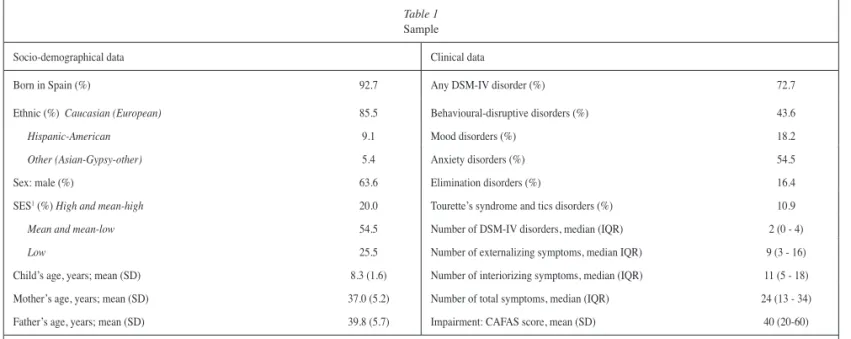
The results discussed in this article were obtained from a research project aimed at evaluating the mental health of a population of children and adolescents exposed to IPV. A total of 55 children aged 6 to 11 years, whose mothers were visiting an IPV counselling centre in Barcelona, Spain, participated in the study. Table 1 presents the participants’ socio-demographical and clinical data.
Measures
The children’s psychopathology was assessed using the current parent’s version of the Diagnostic Interview for Children and Adolescents (DICA-P), (Reich, 2000). DICA covers the most frequent diagnostic categories in accordance with DSM-IV (American Psychiatric Association, 1994); it has been adapted and validated for the Spanish population, with good psychometric properties (Ezpeleta, de la Osa, Doménech, Navarro, & Losilla, 1997; de la Osa, Ezpeleta, Doménech, & Navarro, 1996).
The Child Behaviour Checklist (CBCL) (Achenbach & Rescorla, 2001) also assesses psychopathology. It contains 113 items designed to evaluate the feelings and behaviour of children and adolescents aged 6 and 18 years, as reported by their parents. Internalising, externalising symptoms and total score based on the mothers’ reports were used for the purposes of our study.
The Child and Adolescent Functioning Assessment Scale (CAFAS) and the Preschool and Early Childhood Functional Assessment Scale (PECFAS) (Hodges, 1995) determine the extent to which a subject’s functioning is impaired in each of eight
Table 1 Sample
Socio-demographical data Clinical data
Born in Spain (%) 92.7 Any DSM-IV disorder (%) 72.7
Ethnic (%) Caucasian (European) 85.5 Behavioural-disruptive disorders (%) 43.6
Hispanic-American 9.1 Mood disorders (%) 18.2
Other (Asian-Gypsy-other) 5.4 Anxiety disorders (%) 54.5
Sex: male (%) 63.6 Elimination disorders (%) 16.4
SES1 (%) High and mean-high 20.0 Tourette’s syndrome and tics disorders (%) 10.9
Mean and mean-low 54.5 Number of DSM-IV disorders, median (IQR) 2 (0 - 4)
Low 25.5 Number of externalizing symptoms, median IQR) 9 (3 - 16)
Child’s age, years; mean (SD) 8.3 (1.6) Number of interiorizing symptoms, median (IQR) 11 (5 - 18)
Mother’s age, years; mean (SD) 37.0 (5.2) Number of total symptoms, median (IQR) 24 (13 - 34)
Father’s age, years; mean (SD) 39.8 (5.7) Impairment: CAFAS score, mean (SD) 40 (20-60)
psychosocial areas (scales). CAFAS was used to assess children aged 8 to 11; PECFAS was used for the children aged 6 to 7. In both instruments, one area includes many different examples of impaired functioning; the assessment is scored based on four levels of impairment (0= no or minimal; 10= mild or distress; 20= moderate; and 30= severe). CAFAS has good psychometric properties in the Spanish population (Ezpeleta, Granero, de la Osa, Doménech, & Bonillo, 2006). We analysed the binary classifi cation (no or minimal impairment versus mild to severe impairment), as well as the total score based on the sum of the scores in each of the parts. Due to the lack of a «gold standard» with respect to the informants, functional impairment was used as the criteria. It has been proved as a better predictor of long term prognosis than symptoms’ severity or type (Angold, Costello, Farmer, Burns, & Erkanly, 1999; Vanders Stoep, Weiss, McKnight, Beresford, & Cohen, 2002).
The DIA (Valla et al., 2000) includes 80 situations presenting DSM-IV’s symptoms and 10 situations presenting randomly mixed strengths and abilities, backed by verbal and visual support. The situations, that take the form of a video-game, show a child in daily-life environments (e.g. at home, at school, with friends). Children are asked by a voice-over to indicate, by pressing a green (YES) or red (NO) button, whether or not they act, feel or think like the character does. A few introductory pictures show the children how to proceed. Frequency and duration criteria were replaced with a cut-off point indicating increasing disorder severity (Valla et al., 2002). Three categories were established for North American populations for the questionnaire responses (likely absent, possible, likely present). Administration takes about 15 minutes. The children’s responses are automatically recorded and analysed by the application. Depending on the gender and ethnic background of the child being assessed, the questionnaire features a boy or girl with corresponding ethnic characteristics. No training is required. The paper version of DIA has been extensively validated (Valla, Bergueron, Bidaut-Rusell, St. Georges, & Gaudet, 1994, 1997), with the intraclass correlation coeffi cient (ICC) between test and retest ranging from 0.71 to 0.81. Internal consistency was approximately 0.89; kappa values ranged from 0.64 to 0.88
between the Dominic and DSM-III-R diagnoses. The internal consistency of the Spanish version scales was very similar to the original one, with values of 0.88 and 0.89 for the Externalising and Internalising symptom scales.
Procedure
Women visiting an IPV counselling centre were offered the possibility to participate in the study, together with their children aged 4 to 17 years (our fi nal sample included only children aged 6 to 11 years).
The study was reviewed by the ethics review board at the researchers’ university. Confi dentiality was guaranteed and the mothers received a detailed personal and oral report of the results. If necessary, referrals to mental health service providers were suggested.
Written consent from the mothers and verbal consent from the children participating in the study were obtained. Children and mothers were assessed simultaneously but separately by two clinical psychologists. Children were asked to complete the DIA. Psychologists fi lled in the CAFAS/PECFAS following the interviews. Mothers were asked to answer the CBCL; nine of them did not return it. There were no statistical differences between respondents and non-respondents as regards age, sex, socio-economic status, psychopathology or impairment.
Statistical analysis
The statistical analysis was carried out with SPSS 17 for Windows. Logistic regressions evaluated the discriminative accuracy of DIA-Total score according to the presence of functional impairment. Hierarchical logistic regressions also evaluated the incremental validity of the prediction of these two criteria after the presence of any DSM-IV disorder (obtained through the DICA-IV) was adjusted. In this last analysis, the DICA measure was entered into the fi rst step, as well as the children’s sex and age (as covariates); incremental accuracy of the prediction was estimated with the changes (increases) in Nagelkerke’s R-square. Finally,
Table 2
Pearson correlation between CBCL and DIA scores
DOMINICJ PHO SAD GAD MOOD ODD BEH ADHD STR INT EXT TOT
CBCL: syndrome scales
Anxious-depressed -.07 -.11 .23* .39* .29* -.07 .35* -.41* .29* .31* .32*
Withdrawal-depressed -.10 -.03 .35* .41* .34* -.16 .47* -.12* .37* .44* .41*
Somatic complaints -.20 -.09 .05* .19* .14* -.01 .21* -.28* .08* .21* .13*
Delinquent problems -.08 -.16 .40* .33* .20* -.04 .29* -.33* .37* .28* .35*
Thought problems -.10 -.27 .27* .31* .25* -.20 .23* -.21* .31* .25* .30*
Inattention -.05 -.06 .39* .38* .24* -.07 .41* -.35* .38* .37* .40*
Breaking rules -.10 -.22 .37* .28* .20* -.13 .26* -.29* .35* .25* .32*
Aggressive problems -.22 -.28 .35* .28* .23* -.03 .26* -.25* .35* .24* .32*
Internalising -.01 -.08 .25* .40* .31* -.01 .41* -.34* .29* .38* .35*
Externalising -.19 -.28 .37* .29* .22* -.06 .27* -.27* .36* .25* .33*
Total -.08 -.10 .39* .40* .32* -.07 .44* -.40* .39* .40* .42*
convergent validity between DIA scores and CBCL was measured through Pearson’s correlation.
Due to the association between psychopathology and children’s sex and age, standardised DIA scores (by sex-age) were analysed in this study. Data are available from authors.
Results
Table 2 shows the association between the scores obtained on the CBCL answered by mothers, and the children’s answers to DIA. There was no correlation between the phobias (PHO), separation anxiety disorder (SAD) and behavioural problems (BEH) self-reported by children and any of the problems self-reported by mothers. There were a number of signifi cant correlations between the rest of the DIA variables and the CBCL. Still, some of those correlations are between theoretically unrelated scales. General anxiety disorder (GAD) self-reported by children correlated with mothers’ reports of behavioural problems, or rule breaking behaviour. MOOD scale correlated with the CBCL delinquent problems scale. ADHD self-reported by children was associated with anxious and withdrawal problems reported by mothers. Internalising symptoms (INT) reported by children had signifi cant correlations with mothers’ reports about rule-breaking behaviour or aggression problems. On the other hand, some expected correlations were absent such as those between self-reported (SAD) and anxious-depressed problems reported by mothers or between the (BEH) score in the DIA scale and the rule-breaking behaviour or aggression problems CBCL scores. (MOOD) and (ADHD) had the largest number of correlations. Despite a very high number of correlations between self-reported (GAD) and CBCL scales none of the correlations appeared between the expected ones.
Table 3 shows the correlations between the DIA scores and the number of symptoms in the corresponding DICA disorders. All of them were signifi cant except for SAD, GAD and Internalising problems.
As regards the second question, the analysis of the area under the ROC curve (AUC) confi rmed the predictive value of the DIA
total score (see Table 4), with values over 0.80, for predicting the presence of impairment and 0.76 for the presence of CBCL clinical range scores.
DIA contributes to the prediction of impairment or to the presence of clinical range CBCL scores in the presence of any disorder in DICA-IV as can be seen in Table 5 by up to 10% when measured with a dimensional scale (CAFAS). This increase is statistically signifi cant in the CBCL case.
Discussion
DIA is a valuable instrument in the assessment process of children living in IPV contexts. It provides additional information to that provided by the mothers. It is a good predictor of impairment and behavioural and emotional problems and increments the validity of the process by adding information to a diagnostic structured interview.
Sadness and hyperactivity seem to be the easiest problems for children and parents to recognise and agree upon. Sadness might be evident as it is usually expressed with tears or by withdrawal. Hyperactivity usually leads to complaints by adults; as the children are confronted about the problem they may also become aware of the diffi culties they are causing. However, in some other cases the information provided by parents and children differs. For example, mothers may report the presence of disruptive behaviour, whereas children report feeling anxious. The restlessness associated with anxiety problems may be misinterpreted by mothers. Also the weak correlation between phobias could be due to the diffi culty of establishing the «normality» of fears in young children (Ezpeleta et al., 2007).
When children report anxiety problems, these are related to most of the problems reported by mothers. This relation is especially signifi cant with BEH, which could mean that both sources report and detect the presence of problems but give them a different cause and explanation. In order to defi ne what kind of information the
Table 3
Association between DICA and DIA scores
Dominic scale DSM-IV
(symptoms-disorder)
Pearson’s R: Dominic and DICA number of symptoms
R
Specifi c phobias Specifi c phobias .28*
Separation anxiety Separation anxiety .18*
Generalised anxiety Generalised anxiety .05*
Mood Mood .31*
ODD ODD .29*
Antisocial problems Conduct disorder .12*
ADHD ADHD .34*
Internalising Internalising .12*
Externalising Externalising .31*
Total Total .31*
* Signifi cant Pearson’s correlation coeffi cient, R2 and AUC (.05)
Table 4
Predictive value of DIA on impairment
p OR 95%
CI (OR) Se Sp AUC R
2
Impairment:
PECFAS-CAFAS .053 4.01 0.98 16.3 0 97.9 28.6 .824 .309
CBCL>65 .008 2.61 1.29 05.27 52.6 81.5 .761 .240
Results obtained in logistic regression. Se: sensitivity; Sp: Specifi city CBCL: T-scores higher than 65 in any interiorizing-exteriorizing-total scales AUC: Area under ROC curve. R2: Nagelkerke’s coeffi cient
Table 5
Incremental validity of DIA on structured interview DICA-IV
Informant for DICA-IV Mother (N= 55)
Criteria p OR ΔR2
Impairment: PECFAS-CAFAS .057 3.48* .104
CBCL>65 .024 2.27* .103
First step: presence of any disorder in DICA, as well as children’s sex and age (covariates) ΔR2: Change (increase) in Nagelkerke’s coeffi cient due to DIA total score
children add, we could conclude that mothers and children differ especially in their perception of the presence of fear and anxiety. Children report on emotional problems when mothers only comment on behavioural trouble. Parents’ diffi culties in identifying problems such as GAD in their young children were also encountered, in line with many other previous studies (Achenbach, McConaughy, & Howell, 1987; Kraemer et al., 2003).
The different information provided by different informants supports, once again, the idea that we must contend with low levels of agreement between informants (Kraemer et al., 2003), continue to explore the convenience of gold —standards which differ from the «best informant», and to reject the idea that children’s information is of less value because of the lack of convergence with adults.
Some studies show that battered women might have diffi culties identifying their children’s emotions as they are more irritable, less involved in their children’s education and care and exhibit less emotional warmth (Margolin, Gordis, Medina, & Oliver, 2003), as a result of their overwhelming life situation, Therefore, children’s points of view seem to be especially relevant in IPV situations.
Evidence Based Assessment principles (Mash & Hunsley, 2005) encourage the testing of the incremental validity of instruments as an argument to be included in an assessment process. As regards the question about the predictive and incremental validity of the DIA, it is an effective predictor of and screener for mental health disorders and functional impairment involving young children in at-risk populations. Obtaining information from children who usually deny problems and refuse to talk about their life situations is certainly worthwhile and improves the validity of the assessment process. The results of this study support the idea that
in this context the inclusion of the children’s self-report enhances the clinical decisions.
Functional impairment appears to be an effective benchmark for verifying children’s self-reports. Our fi ndings support the validity of young children’s reports of depressed mood and feelings as confi rmed by previous studies (Ialongo et al., 2001). Children are also capable of reporting on behaviour that is adversely affecting their activities at school and home.
The present study is not free of limitations. Firstly, it was not designed to evaluate the reliability and validity of the DIA, since the sample size and characteristics were inadequate; the results can only be generalised to children exposed to IPV. Secondly, the small sample size may have infl uenced the results by suggesting that there were no sex and age-related differences.
Our study supports the idea that it is possible to design effi cient and developmentally appropriate instruments for clinical practice and research and that children’s self-reports should be included in the diagnostic process. It is particularly important to explore children’s own perceptions and feelings and to investigate the predictive strength of assessments of children’s subjective experiences in the area of mental health.
This is the fi rst study to use criteria other than parents’ concordance and clinician’s diagnoses for the purpose of evaluating the DIA as an effective clinical instrument. The criterion used, functional impairment, could be particularly useful in the assessment of children exposed to IPV.
Acknowledgements
The research reported in this article was supported by Grant SEJ2005-01786 from the Spanish Ministry of Education and Science.
References
Achenbach, T., McConaughy, S.H., & Howell, C.T. (1987). Child/ adolescent behavioral and emotional problems: Implications of cross-informant correlation for situational specifi city. Psychological Bulletin, 101, 213-232.
Achenbach, T., & Rescorla, L.A. (2001). Manual for the ASEBA school-age forms and profi les. Burlington, VT: University of Vermont, Research Center for Children, Youth and Families.
American Psychiatric Association (1994). DSM-IV: Diagnostic and statistical manual of mental disorders. Washington, DC: APA. Angold, A., Costello, E.J., Farmer, E.M.Z., Burns, B.J., & Erkanli, A.
(1999). Impaired but undiagnosed. Journal of the Academy of Child and Adolescent Psychiatry, 38, 129-137.
Angold, A., & Egger, H.L. (2007). Preschool psychopathology: Lessons for the lifespan. Journal of Child Psychology and Psychiatry and Allied Disciplines, 48(10), 961-966.
Berliner, L., Hyman, I., Thomas, A., & Fitgrald, M. (2003). Children’s memory of trauma and positive experiences. Journal of Traumatic stress, 16, 229-236.
Carter, A.S., Briggs-Gowan, M.J., & Davis, N.O. (2004). Assessment of young children’s social-emotional development and psychopathology: Recent advances and recommendations for practice. Journal of Child Psychology and Psychiatry, 45(1), 109-134.
Coplan, R., Closson, L., & Arbeau, K. (2007). Gender differences in the behavioral associates of loneliness and social dissatisfaction in kindergarten.
Journal of Child Psychology and Psychiatry, 48(10), 988-995.
Domenech, J.M. (2007). SPSS Macro ROC. ROC Analysis [computer program]. Bellaterra: Universitat Autònoma de Barcelona. Available at: http://www.metodo.uab.cat/macros.htm.
Edelbrock, C., Costello, A.J., Dulcan, M.K., Kalas, R., & Conover, N.C. (1985). Age differences in the reliability of the psychiatric interview of the child. Child Development, 56, 265-275.
Egger, H.L., & Angold, A. (2006). Common emotional and behavioral disorders in preschool children: Presentation, nosology and epidemiology.
Journal of Child Psychology and Psychiatry, 47(3), 313-337.
Ezpeleta, L., Granero, R., de la Osa, N., Doménech, J.M., & Bonillo, A. (2006). Assessment of functional impairment in Spanish children.
Applied Psychology: An International Review, 55(1), 130-143. Ezpeleta, L., Guillamón, N., Granero, R., de la Osa, N., Domènech, J.M.,
& Moya, I. (2007). Prevalence of mental disorders in children and adolescents from a Spanish slum. Social Science & Medicine, 64(4), 842-849.
Ezpeleta, L., de la Osa, N., Doménech, J.M., & Navarro, J.B. (1995). Diagnostic interview for children and adolescents (DICA-R) and their parents-revised: acuerdo diagnóstico entre niños/adolescentes y sus padres. Revista de Psiquiatría de la Facultad de Medicina de Barcelona, 22(6), 153-163.
Ezpeleta, L., de la Osa, N., Doménech, J.M., Navarro, J.B., & Losilla, J.M. (1997). Fiabilidad test-retest de la adaptación española de la diagnostic interview for children and adolescents (DICA-R). Psicothema, 9, 529-539.
Goodman, R. (1997). The strengths and diffi culties questionnaire. Journal of Child Psychology and Psychiatry, 38, 581-586.
Granero, R., Ezpeleta, L., Doménech, J.M., & de la Osa, N. (2008). What single reports from children and parents aggregate to attention defi cit-hyperactivity disorder and oppositional defi ant disorder diagnoses in epidemiological studies. European Child and Adolescent Psychiatry, 17(6), 356-364.
Hodges, K. (1995). Child and Adolescent Functional Assessment Scale. Ypsilanti, MI: Eastern Michigan University, Department of Psychology.
Hollingshead, A.B. (1975). Four factor index of social status. New Haven, CT: Unpublished manuscript, Yale University, Department of Sociology.
Ialongo, N.S., Edelsohn, G., & Kellam, S.G. (2001).A further look at the prognostic power of young children’s reports of depressed mood and feelings. Child Development, 72(3), 736-747.
Iwaniec, D. (2006). Research review: Risk and resilience in cases of emotional abuse. Child and Family Social Work, 11, 73-82.
Ialongo, N., Edelsohn, & Kellam, S. (2001). A further look at the prognostic power of young children’s reports of depressed mood. Child Development, 72(3), 736-747.
Knutson, J.F., Lawrence, E., Taber, S.M., Bank, L., & DeGarmo (2009). Assessing children’s exposure to Intimate Partner Violence. Clinical Child Family Psychology Review, 12, 157-173.
Kraemer, H.C., Measelle, J.R., Ablow, J.C., Essex, M.J., Boyce, W.T., & Kupfer, D.J. (2003). A new approach to integrating data from multiple informants in psychiatric assessment and research: Mixing and matching contexts and perspectives. American Journal of Psychiatry,
160(9), 1566-1577.
Linares Scott, T.J., Short, E.J., Singer, L.T., Russ, S.W., & Minnes, S. (2006). Psychometric properties of the Dominic Interactive Assessment: A computerized self-report for children. Assessment, 13(1), 16-26. Luby, J.L., Belden, A.C., Sullivan, J., & Spitznagel, E. (2007). Preschoolers’
contribution to their diagnosis of depression and anxiety: Uses and limitations of young child self-report of symptoms. Child Psychiatry and Human Development, 38, 321-338.
Magen, R.H. (1999). In the best interest of battered women: Reconceptualizing allegations of failure to protect. Child Maltreatment, 4, 127-135. Margolin, G., Gordis, E.B., Medina, A.M., & Oliver, P.H. (2003). The
co-occurrence of husband-to-wife aggression, family-of-origin aggression, and child abuse potential in a community sample: Implications for parenting. Journal of Interpersonal Violence,18, 413-440.
Mash, E.J., & Hunsley, J. (2005). Evidence based assessment of child and adolescent disorders: Issues and challenges. Journal of Clinical Child and Adolescent Psychology, 34, 362-379.
Norwood, S. (2007). Validity of self-reports of psychopathology from children of 4-11 years of age. Vulnerable Children and Youth Studies, 2(2), 89-99.
de la Osa, N., Ezpeleta, L., Doménech, J.M., & Navarro, J.B. (1996). Fiabilidad entre entrevistadores de la DICA-R. Psicothema, 8(2), 359-368.
Osofsky, J.D. (1995). Children who witness intimate partner violence: The invisible victims. Social Policy Reports: Society for Research in Child Development, 9, 1-16.
Reich, W. (2000). Diagnostic interview for children and adolescents (DICA). Journal of the American Academy of Child & Adolescent Psychiatry, 39(1), 59-66.
de los Reyes, A., & Kazdin, A.E. (2005). Informant discrepancies in the assessment of childhood psychopathology: A critical review, theoretical framework and recommendations for further studies. Psychological Bulletin, 131(4), 483-509.
Rossman, B.B. (1998). Descartes’ error and post-traumatic stress disorder: Cognition and emotion in children who are exposed to parental violence. In G.W. Holden, R. Geffner & E.N. Jouriles (Eds.), Children exposed to marital violence (pp. 223-256). Washington, DC: American Psychological Association.
Russell, J.A. (1990). The preschooler’s understanding of the causes and consequences of emotions. Child Development, 61, 1872-1881. Sourander, A., Haavisto, A., Ronning, J.A., Multimäki, P., Parkkola, K.,
Santalahti, P., Nikolakaros, G., Helenius, H., Moilanen, I., Tamminen, T., Piha, J., Kumpulainen, K., & Almovist, F. (2005). Recognition of psychiatric disorders and self-perceived problems: A follow-up study from age 8 to age 18. Journal of Child Psychology and Psychiatry, 46(10), 1124-1134.
Valla, J.P., Bergeron, L., Bidaut-Russell, M., St-Georges, M., & Gaudet, N. (1994). A structured pictorial questionnaire to assess DSM-III-R based diagnoses in children (6-11 years): Development, validity and reliability. Journal of Abnormal Child Psychology, 22(4), 403-423. Valla, J.P., Bergeron, L., Bidaut-Russell, M., St-Georges, M., & Gaudet,
N. (1997). Reliability of the Dominic-R: A young child mental health questionnaire combining visual and auditory stimuli. Journal of Child Psychology and Psychiatry, 38(6), 717-724.
Valla, J.P., Bergeron, L., & Smolla, N. (2000). The Dominic-R: A pictorial interview for 6-to-11-year-old children. Journal of the American Academy of Child and Adolescent Psychiatry, 39, 85-93.
Valla, J.P., Kovess, V., Chan Chee, C., Bertiaume, C., Vantalon, V., Piquet, C., Gras-Vincendon, A., Martin, C., & Alles-Jardel, M. (2002). A French study of the Dominic Interactive. Social Psychiatry and Psychiatric Epidemiology, 37, 441-448.