
Master’s Thesis
Solution of the Navier-Stokes Equation using the
Method of Characteristic Curves
Student
Jos´
e David Villegas Jim´
enez
Responsible professor
Manuel Julio Garc´ıa Ruiz
Department of Mechanical Engineering
Universidad EAFIT
Medell´ın
Abstract
This project deals about the solution of the Navier Stokes Equations by the Method of Characteristics. This method is used to eliminate the convective part of equations of the convection-diffusion type, conducting the material derivative in a Lagrangian manner along the characteristic curves of each node in a fixed grid. Following this approach, the method is able to solve the incompressible Navier Stokes Equations with the advantage of using large timesteps. In the present case, the solution of the well known Lid Driven Cavity Flow problem is obtained for several Reynolds numbers, showing good agreement when compared to solutions obtained by other methods.
Keywords: Characteristic curves, Finite Element Method, Lagrange-Galerkin Method, Backward Euler, Lid Driven Cavity Flow
Contents
1 Preliminary Concepts 3
1.1 Navier Stokes Equation . . . 3
1.2 The Concept of Characteristic Curve . . . 5
2 Characteristic-based Split Method (CBS) 7 2.1 Galerkin Based Characteristic Method . . . 7
2.1.1 Convection-diffusion equation . . . 7
2.1.2 Navier Stokes equation . . . 9
2.2 Spatial discretization . . . 12
2.2.1 Step 1 . . . 12
2.2.2 Step 2 . . . 20
2.2.3 Step 3 . . . 23
2.3 Fixed Grid implementation. . . 26
2.4 Discussion . . . 29
3 Solution of the NS Equation using the Lagrange-Galerkin method 30 3.1 Lagrange Galerkin Method . . . 30
3.1.1 Variational formulation and spatial discretization . . . 31
3.1.2 Temporal discretization. . . 33
3.2 Case study: Lid Driven Cavity Flow . . . 36
3.3 Results . . . 38
3.4 Conclusion . . . 47
A Stokes flow: calculation of local matrices 48
Introduction
The description of fluid flow behavior is governed by the Navier Stokes Equation. Al-though there is not yet an analytical solution for this equation, several numerical tech-niques have been developed, achieving approximate solutions that have contributed to the solution of problems in different fields of Engineering. Methods such as Finite Differences and Finite Volumes were developed decades ago and have been the inspiration for new methods. The Finite Element Method was intended for structural analysis but it has become popular in fluid dynamics because of its ability to treat boundary conditions and its well defined mathematical basis.
The traditional way to solve the Navier Stokes system in FEM is by using the Galerkin method. The lack of upwinding techniques (adaptative methods according to the direc-tion of propagadirec-tion of the transported field) evidenced the popularity of Finite Difference and Finite Volume methods. Further research in FEM helped the method to gain popu-larity due to upwinding techniques, like the Streamline Upwind Petrov Galerkin (SUPG), becoming the most suitable method to deal with instabilities and to improve the finite element solution. Segal (2011)
Other methods to solve the transient incompressible Navier Stokes system are the pressure correction methods, optimization strategies (Uzawa algorithm)Temam (1977), projection schemes, Fractional Step Methods and recently, a group of meshless methods which are becoming popular because complex geometries as well as large deformations, nonlinearities, crack simulations can be treated with ease. The problem with some of these methods is the definition of boundary conditions. These kinds of methods include, the Element-Free Galerkin Method (EFG)Belytschko et al. (1994), Isoparametric Finite Point Method Wang and Takao (2004), Meshless local Petrov-Galerkin (MLPG) Atluri and Zhu (1998), Smooth Particle Hydrodynamics (SPH)Gingold and Monaghan (1977), Moving Particle Semi-Implicit Method (MPS)Koshizuka et al. (1998), among others.
The characteristic based method is followed according to the work done byZienkiewicz et al.(2005),Zienkiewicz et al.(1999) and contributions of (Nithiarasu(2003),Nithiarasu (2002)). This method is based on a splitting technique proposed by Chorin (1968), re-lated to Fractional Step Methods in which velocity and pressure operators are decoupled. The use of an artificial compressibility method is convenient to overcome computational difficulties when treating the conservation equation Nithiarasu (2003).
The formulation of a Lagrange-Galerkin Method, first introduced by Benque et al. (1980) involving Characteristic curves is covered in the second part of this work. This method is proved to be efficient for convection dominated problems as illustrated by Boukir et al. (1997), Achdou and Guermond (2000), Pironneau (1982) and is stated as a mixture of a traditional Galerkin Method for spatial variables with a Lagrangian formulation for time. This method is set as a mixed formulation in which, a penalty method to solve the system of equations introduces a small perturbation coefficient in the conservation equation, in order to be able to solve the matricial system, achieved after proposing a variational formulation for the problem.
Chapter 1
Preliminary Concepts
1.1
Navier Stokes Equation
The Navier Stokes equations describe the behavior of viscous fluids and are derived from the conservation laws, namely, the Newton’s law of motion, the continuity equation and the energy equation. These coupled set of equations are Hyperbolic Partial Differential Equations of first or second order that describe time-dependent convection dominated problems. The law of momentum conservation states thatthe rate of change of momentum
of a particle equals the sum of external forces applied to it, therefore it is important to
mention that the deduction of the Navier Stokes equation is based on this law. The left hand side of equation 1.1 shows the rate of change of momentum , while the right hand side shows the sum of body forces, acting throughout the volume of a body (i.e gravitational forces), and contact forces, interacting with the fluid element throughout its surface (i.e viscous forces).
ρ
∂u
∂t +u· ∇u
| {z }
Change in momentum
= div(σ) | {z }
Surf ace f orce
+ ρb
|{z}
Body f orce
. (1.1)
In order to achieve the Navier Stokes set of equations, a constitutive relation for the stress (σ) must be defined and incorporated; for a Newtonian incompressible fluid (div(u) = 0) we have,
σ = 2µD−pI.
whereσσσ is the stress,µµµis the dynamic viscosity,D= 12 ∇u+∇uT
is the strain rate or deformation tensor, p is the pressure and Iis the identity matrix.
The set of equations is now complete:
ρ
∂u
∂t +u· ∇u
= µ∇2u+ (µ+λ)∇(div(u))− ∇p+ρb
∇ ·u = 0. (1.2)
For the case of incompressible fluids, density (ρ) is constant and the second term of 1.2 vanishes.
ρ
∂u ∂t
|{z}
Local accel.
+ u· ∇u
| {z }
Convective accel.
| {z }
M aterial derivative
= µ∇2u | {z }
V iscous term
− ∇p
|{z}
P ressure term
+ ρb
|{z}
Body f orce term
∇ ·u = 0. (1.3)
In order to complete the Navier Stokes problem, the set of equations must be subjected to initial and boundary conditions. Initial conditions refer to the definition of initial values for the velocity and pressure fields, while boundary conditions are imposed on the boundary ΓΓΓ = Γ1∪Γ2∪Γ3 of an open fluid domain denoted by ΩΩΩ.
Figure 1.1: Open fluid domain Ω with its boundary Γ = Γ1∪Γ2∪Γ3
Boundary conditions are of three types as follows,
Dirichlet u = g onΓ1
N eumann h = [σ]n onΓ2
1.2 The Concept of Characteristic Curve 5
where g is a defined function or constant, h is the traction or surface force,α is a constant and uref is a reference velocity.
1.2
The Concept of Characteristic Curve
The scheme of a partial differential equation like the convective transport equation is:
∂φ
∂t +a(x, t) ∂φ
∂x =Q(x, t) (1.5)
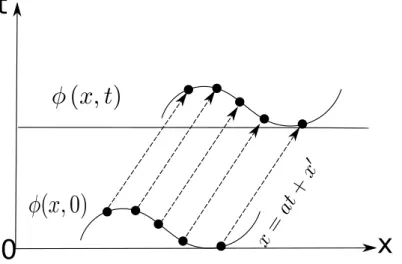
where φ is the scalar quantity to be transported, a is the change of position in time andQis the source term. The goal is to find a family of curves in the (x, t) plane in which the problem reduces to an ordinary differential equation. The information in the scalar quantity φ can propagate in time by means of the speed of propagation a in function of a point in time and space a(x, t). The direction given by a = dxdt is the characteristic direction of propagation. If the PDE is linear, this speed of propagation is constant and the characteristic curves are fixed in the space-time plane (x, t). Furthermore, if the linear PDE has constant coefficients, the characteristic curves will be straight lines in plane (x, t) Donea and Huerta(2003).
One can observe that, after transforming the PDE to an homogeneous form, and assuming that the speed of propagation is constant, the equation can be expressed as:
∂φ ∂t +a
∂φ
∂x = 0. (1.6)
In this way we can express the equation 1.6 as ∂φ∂t = 0 along curves given by ∂x ∂t =a.
The solution to ∂x∂t = a is x = at+x0 with x0 being a constant of integration. The solution is a straight line that provides transport in time of the spatial profile given by
x
t
0
Figure 1.2: Transport of a quantity φ through characteristics.
φ is constant for the curve so along the characteristic curve x−at = x0,when intro-ducing the initial condition φ(x,0) = f(x), the solution φ(x, t) in any instant of time t
and any position x is
Chapter 2
Characteristic-based Split Method
(CBS)
The characteristic based method is used to find a solution of fluid dynamics equations for any condition of the flow (compressible or incompressible) by means of a standard Galerkin procedure on characteristic curves. The method called CBS byZienkiewicz et al. (2005) is able to eliminate the convective part of the equation of momentum conservation after setting it out in a Lagrangian fashion. Further discretization of the convection-diffusion equation will provide ideas for the treatment of Navier Stokes Equations.
2.1
Galerkin Based Characteristic Method
2.1.1
Convection-diffusion equation
After laying out the concept of characteristic curves, the solution of mass and momentum equations (Navier-Stokes Equations) for velocity and pressure variables (u and p) is con-sidered. The main idea is to achieve the solution of these equations following a Galerkin procedure based on characteristics.
In this method, the convection-diffusion equation can be split in two parts, a convective term and a diffusive term that are discretized in a separate style. We have then the
convection-diffusion equation:
∂φ ∂t
|{z}
T ime term
+ ∂
∂xj
(ujφ)
| {z }
Convective term − ∂ ∂xi k∂φ ∂xi
| {z }
Dif f usive term
+ Q
|{z}
Source term
= 0. (2.1)
The split is done according to (2.2) as
φ=φ∗+φ∗∗ (2.2)
∂φ∗ ∂t +U
∂φ ∂x = 0
∂φ∗∗ ∂t − ∂ ∂x k∂φ ∂x
+Q= 0. (2.3) This split will be explained subsequently while discretizing the Navier Stokes Equa-tions.
The idea of the characteristic based Galerkin method is to perform a time discretiza-tion for the convecdiscretiza-tion-diffusion equadiscretiza-tion in moving coordinates (characteristics). This operation is done having in mind the elimination of the convective term and the use of a standard Galerkin procedure for the spatial discretization of remaining terms.
Taking the convection-diffusion equation on moving coordinates x0:
∂φ(x0)
∂t
| {z }
T ime term
− ∂
∂x0i
k∂φ ∂x0i
| {z }
Dif f usive term
+ Q(x0) | {z }
Source term
= 0. (2.4)
Discretization of the time term is performed by setting out an approximation of the scalar quantity φ in two different states of time: present time (t = tn), and a later time
(t = tn+1). The approximation uses an operator L acting on the scalar quantity to be transported on both time moments
∂φ
∂t =L(φ) (2.5)
∂φ ∂t ≈
φn+1−φn
∆t =L(φ)
L(φn+1) U nknown(Implicit)
L(φn) Known(Explicit) (2.6)
2.1 Galerkin Based Characteristic Method 9
scheme is the semi-implicit θ = 12, often called Crank-Nicolson.
∂φ ∂t ≈
φn+1−φn
∆t =θL(φ
n+1) + (1−θ)L(φn)
θ = 1 Implicit
θ = 12 Semi−implicit θ = 0 Explicit
(2.7)
After the discretization process, an expression for the explicit convection-diffusion equation is achieved,
φn+1−φn=−∆t
∂(Ujφ)
∂xj − ∂ ∂xi k∂φ ∂xi +Q
t=n
+ ∆t2
2 Uk
∂ ∂xk
∂(Ujφ)
∂xj − ∂ ∂xi k∂φ ∂xi +Q
t=n
.
(2.8)
The advantage of using this equation is that it is written in conservative form, and is explicit because it is evaluated at present time t=n.
2.1.2
Navier Stokes equation
In a similar fashion we can discretize the Navier–Stokes equations in time:
In the Navier Stokes Equations the quantity to be transported is the velocity φ =
ρui = Ui. The convective term becomes the convective acceleration and the diffusive
term is the divergence of the strain forces, which are in fact given by the gradient of the velocity. Finally, the pressure term is treated as a source term as well as the body forces. Hence, the Navier–Stokes equations represent the convection-diffusion of momentum per unit mass
∂Ui
∂t + ∂ ∂xj
(ujUi)−
∂τij
∂xj
+ ∂p
∂xi
−ρgi
| {z }
Source term
= 0. (2.9)
The scalar quantity is given by Ui =ρui.
scheme with θ = 12, we can obtain an explicit equation for a time instant t =n
∆Ui =−∆t
∂ ∂xj
(ujUi)−
∂τij
∂xi
+ ∂p
∂xi
−ρgi
n +∆t
2
2 uk
∂ ∂xk
∂ ∂xj
(ujUi)−
∂τij
∂xi
+ ∂p
∂xi
−ρgi
n
.
(2.10)
The following step is to split the equation isolating the pressure terms and expressing the change of velocity ∆Ui as the sum of two auxiliary variables ∆Ui∗ and ∆U
∗∗
i , according
to (2.11):
∆Ui = ∆t
− ∂
∂xj
(ujUi) +
∂τij
∂xi
+ρgi
n
−∆t∂p
n+θ2
∂xi
+∆t 2
2 uk
∂ ∂xk
∂ ∂xj
(ujUi)−
∂τij
∂xi
−ρgi
n
| {z }
∆Ui∗
+∆t 2
2 uk
∂ ∂xk
∂pn+θ2
∂xi
| {z }
∆U∗∗
i
(2.11)
∆Ui = ∆Ui∗+ ∆U
∗∗
i . (2.12)
The pressure terms that were separated are stored in the auxiliary variable ∆Ui∗∗, whereas remaining terms are stored in ∆Ui∗. Higher order terms in the stress tensor are neglected
∆Ui∗ = ∆t
−∂(ujUi)
∂xj
+∂τij
∂xj
+ρgi+
∆t
2 uk
∂ ∂xk
∂(ujUi)
∂xj
−ρgi
n
. (2.13)
∆Ui∗∗=−∆t∂p
n+θ2
∂xi
+ ∆t 2
2 uk
∂2pn
∂xk∂xi
2.1 Galerkin Based Characteristic Method 11
∂ρ
∂t + div(ρu) = 0 (2.15)
and also
1
c2
∂p
∂t =−div(ρu).
Therefore, ∂ρ ∂t = 1 c2 ∂p
∂t =−div(ρu) = − ∂Ui
∂xi
Using a θ time approximation for the conservation equation ∆ρ
∆t =
1
c2 n
∆p
∆t =−
∂Un+θ1
i
∂xi
, (2.16)
which can be expanded as
1
c2 n
∆p
∆t =−
∂Un+θ1
i ∂xi =− ∂Un i ∂xi
+θ1
∂∆Ui
∂xi
,
and splitting the velocity
1
c2 n
∆p
∆t =−
∂Un i
∂xi
+θ1
∂ ∂xi
(∆Ui∗ + ∆Ui∗∗)
.
Using the equation for ∆U∗∗ (2.14)
1
c2 n
∆p
∆t =−
∂Uin ∂xi
+θ1
∂ ∂xi
∆Ui∗+−∆t∂p
n+θ2
∂xi
+∆t 2
2 uk
∂2pn ∂xk∂xi
.
Since the last term is of superior order, and expanding pn+θ2 =pn+θ
2∆p,
1
c2 n
∆p
∆t =−
∂Un i
∂xi
+θ1
∂∆Ui∗ ∂xi
+−∆tθ1
∂ ∂xi
∂pn
∂xi
+θ2
∂∆p ∂xi
. (2.17)
The method finishes with the solution of the equations after a Galerkin procedure in the following order:
3. Solve (2.14) to establish values for velocity and pressure in tn+1.
If a compressible problem is treated, it becomes necessary to get the energy equation solved.
2.2
Spatial discretization
2.2.1
Step 1
The time discretization process through the characteristic based Galerkin method provides a solution procedure for which it is necessary to follow a spatial discretization of equations using the standard Galerkin method in order to achieve a matricial system of equations. The process starts with the variational treatment of equation 2.13to be taken to its weak form
∆Ui∗ = ∆t
−∂(ujUi)
∂xj
+∂τij
∂xj
+ρgi+
∆t
2 uk
∂ ∂xk
∂(ujUi)
∂xj
−ρgi
n
.
The equation can be expressed in vector notation as follows:
∆U∗ = ∆t
−div(u⊗U)+ div(τ) +b+∆t
2 [∇(div(u⊗U)−b)]u n
(2.18)
Both sides of the equation are multiplied by an arbitrary function v, with the same features and from the same space ofu, and integrated over the whole domain of analysis Ω.
Z
Ω
∆U∗·v
| {z } 1
= Z
Ω ∆t
"
−div(u⊗U) | {z }
2
+ div(τ) | {z }
3
+ b
|{z} 4
+ ∆t 2
∇(div(u⊗U)−b)u
| {z }
5
n ·v.
(2.19)
2.2 Spatial discretization 13
U
Ui(x) =
X
b
e
UibNb(x) vi(x) =
X
a
e
vaiNa(x) (2.20) witha,b: node number andi: dimension index. ucan be expressed in vector notation as
u=X
i b
e
ubiNb(x)ˆei (2.21)
which we will call index approximation of the vector field. And the compact notation which requires to be written as
N = [N1, N2, . . . , Nn], u˜i =
u1i
.. . un i ,
wheren is the number of nodes. Then
ui =Nu˜i and u=Nu˜
where ˜u is the matrix, form by the nodal values in the 1,2 and 3 directions
˜
u=N[ ˜u1u˜2u˜3] =N
u11 u12 u13
..
. ... ...
un
1 un2 un3
As said before, we must start the process with the first term. 1. RΩ∆Ui∗·vi
Z
Ω
∆Ui∗·vi ≈
Z
Ω
Nb∆Ueib∗Na e
via =ev
a i∆Ueib∗
Z
Ω
NaNb
The product of both basis function vectors gives the mass matrix of the equation,
Mab
e
vai Mab∆Ueb ∗
i =
D e
vi, M∆Ue ∗
i
E
2. RΩ div(u⊗U)·v
Let us continue with the discretization of the second term denoted by 2 in (2.19): Z
Ω
div(u⊗U)·v.
Z
Ω
∂ ∂xj
(ujUi)vi ≈
Z
Ω
∂ ∂xj
(ujUeibNb) e
viaNa
=evaiUeib Z
Ω
∇(uNb)Na
| {z }
Cab =evai CabUeib =Devi, CUei
E
.
3. RΩdiv(τ)·v
The third term is the divergence of the deviatoric stress tensor τ. We must begin integrating by parts the inner product of the divergence tensor with the arbitrary function v
Z
Ω
∂τij
∂xj
vi =
Z
Ω
div(τ)·v = Z
Ω
div(τi)vi
where τi = [τi1, τi2, τi3], is the ith row of the stress tensor. Using the divergence theorem 1
Z
Ω
div(τi)vi =−
Z
Ω
hτi,∇vii+
Z
Γ
hτivi,ni.
1 GivenF a vector function andg a scalar function, the divergence theorem stands
Z
Ω
div (Fg) =
Z
Ω
div (F)g+hF,∇gi
=
Z
Γ
2.2 Spatial discretization 15
The same result can be obtained using index notation and integration by parts Z
Ω
∂τij
∂xj
vi =−
Z
Ω
τij
∂vi
∂xj
+ Z
Γ
τijvinj
=−
Z
Ω
∇v : τ
| {z }
a
+ Z
Γ
ht,vi
| {z }
b
where ti =τijnj is the traction on the surface
After integration we get two terms, the first one (a) is integrated over the domain and contains a Frobenius inner product of matrices often called double dot product, whereas the other (b) is simply evaluated at the boundary and contains the traction or product between the stress tensor and a normal vector on the surface.
A:B =X
ij
AijBij
a. First, the term integrated over the domain is discretized: For a Newtonian fluid the following relationship is true,
τ = 2µ
− 1
3div()I
with = 1
2(∇u+∇u
T),
whereµis the dynamic viscosity,=(u) is the strain rate andIis the identity matrix. It should be noted that and τ are linear functionals. That is, given
u and v inV a vector space of admissible velocities, and given α ∈R, then (i) (u+v) = (u) +(v)
(ii) (αv) =α(u).
The same holds for the divergence and grad operators div(αu+βv) = αdiv(u) +βdiv(v)
∇(αu+βv) =α∇(u) +β∇(v).
have
(u) = (ubiNbei) =ubi(Nbei).
By definition,
(u)rs =
1
2(ur,s+ur,s), so in the same manner
(Nbei)rs=
1
2((Nbei)r,s+ (Nbei)r,s) = 1
2(Nb,sδir+Nb,rδis). Therefore,
(u)rs =ubi(Nbei)rs=
ubi
2 (Nb,sδir+Nb,rδis). (2.22) In the divergence case
div(u) = u,kk,
therefore
div(ubiNbei) =ubi(Nbei),kk =ubiNb,kδik, (2.23)
and in the gradient case
∇(v) = vr,s,
therefore
∇(vjaNaej) = (vjaNaej)r,s =vajNa,sδjr. (2.24)
Merging (2.22), (2.23) (2.24), and using index notation
σ :∇v = 2µ
(u)− 1
3div()I
:∇v
= 2µ
(u)rs−
1 3ukkδrs
vr,s
=µubi
(Nb,sδir +Nb,rδis)−
2
3Nb,kδikδrs
vaiNa,sδjr.
2.2 Spatial discretization 17
in a compact form as
Z
Ω
σ :∇v=ubivaiKjiab, (2.25) with
Kijab = Z
Ω
(Nb,sδir+Nb,rδis)−
2
3Nb,kδikδrs
Na,sδjr. (2.26)
Combining two indexes in one yields
α= 2(a−1) +j β = 2(b−1 +i).
We can rewrite the expression above in simple matrix notation as
hv,Kui.
b. The term integrated over the boundary Γ contains the traction and is dis-cretized as follows:
Z
Γ
t·v ≈
Z
Γ
tiNaev
a i
=evai
Z
Γ
tiNa
=evai
2
fia
where
Z
Γ
tiNa =
2
fia (2.27)
in compact form, and combining subindices the last product can be interpreted as a dot product. The final discrete expression for the term is
Z
Ω
div(τ)·v → hv,Kui+
v,
2
f
(2.28)
4. RΩb·v
the element
Z
Ω
b·v ≈
Z
Ω
ρgiNavai
=vai
Z
Ω
ρgiNa
=evai
1
fia
= v, 1 f where Z Ω
ρgiNa=
1
fia. (2.29)
5. RΩ∇(div(u⊗U)−b)u·v
The next term to discretize is the stabilizing term denoted by number 5. It should be mentioned that this term has two components: a matrix and a vector. To ease the process, we may take advantage of alternative ways to face up the reduction of this term by using the Frobenius inner product of matrices and integration by parts (First Green identity).
This term can now be discretized following this procedure: Z
Ω
[∇(div(u⊗U)−b)
| {z }
αij
u]·v (2.30)
Z
Ω
[∇α]ijujvi ≡
Z
Ω
[∇α] : (v⊗u)≡
Z Ω ∂αi ∂xj
viuj.
This term must be integrated by parts:
Z Ω ∂αi ∂xj
viuj = −
Z
Ω
αi
∂viuj
∂xj
+
Z
Γ
αi(viuj)nj
= −
Z
Ω
2.2 Spatial discretization 19
Now, we can replace α for its original expression from (2.30). Operating the inner product, the idea is to discretize resulting terms separately:
Z
Ω
hdiv(u⊗U)−b,div(v⊗u)i
Z
Ω
hdiv(u⊗U),div(v⊗u)
| {z }
5.1
i −
Z
Ω
hb,div(v⊗u) | {z }
5.2
i.
Let us start with the first integral:
5.1
Z
Ω
hdiv(u⊗U),div(v⊗u)i = Z
Ω
∂ujUi
∂xj
∂viuk
∂xk
≈
Z
Ω
∂(ujNbUeib)
∂xj
∂(Na
e
va iuk)
∂xk
≈ ev
a iUeib
Z
Ω
∂(ujNb)
∂xj
∂(ukNa)
∂xk
≈ ev
a iUeib
Z
Ω
∇(uNb)∇(uNa)
| {z }
Kab s
≈
D e
via, KsabUeib E
.
5.2
Z
Ω
hb,div(v⊗u)i = Z
Ω
ρgi
∂(viuk)
∂xk
≈
Z
Ω
ρgi
∂(Na
e
va iuk)
∂xk
≈ veai Z
Ω
ρgi
∂(Nauk)
∂xk
≈ veai Z
Ω
ρgi∇(uNa)
| {z }
fa s
≈ hev
a i , f
a si.
At this point, each of the terms of (2.19) is discretized so we can replace the compact form into the equation:
D e
va, Mab∆
e
Ub∗
i
E = ∆t
h
−Devia, CabUeib E
− e
via, Kτabuebi+hevai , fi+ ∆2t D
e
via, KsabUeib E
− hevai , fsaii.
Sincev is an arbitrary function, we can express the system of equations for ∆Uei∗ as:
Mab∆Ueib∗ = ∆t
−CabUeib− Kτabuebi +f + ∆t
2 K
ab s Ueib−
∆t
2 f
a s
∆Ueib∗ =− 1
Mab∆t
CabUeib+ Kτabeubi −f− ∆t
2
KsabUeib+ fsa
.
2.2.2
Step 2
Discretization of step 2 is done in a similar way as Step 1. Let us recall the pressure equation ∆ρ= 1 c2
t=n
∆p=−∆t
∂Ui
∂xi
+θ1
∂∆Ui∗ ∂xi
−∆tθ1
∂2pn
∂xi∂xi
+θ2
∂2∆p
∂xi∂xi
.
2.2 Spatial discretization 21 ∆ρ= 1 c2
t=n
∆p=−∆t
∂Un i
∂xi
+θ1
∂∆Ui∗ ∂xi
−∆tθ1
∂ ∂xi
∂pn+θ2
∂xi
.
Multiplying this equation by an arbitrary functionv, and integrating over the domain Ω
1
c2
t=n
∆p·v =−∆t
∂Ui
∂xi
+θ1
∂∆Ui∗ ∂xi
−∆tθ1
∂ ∂xi
∂pn+θ2
∂xi ·v 1 c2
t=n
∆p·Navia=−∆t
Z
Ω
∂ ∂xi
Ui+θ1∆Ui∗−∆tθ1
∂pn+θ2
∂xi
·Npavia
1
c2
t=n
∆p·Npavia=−∆t
Z
Ω
Npa ∂ ∂xi
Ui+θ1∆Ui∗−∆tθ1
∂pn+θ2
∂xi
·via
1
c2
t=n
∆p·Npavai =−vai∆t
Z
Ω
Npa
|{z}
F
∂ ∂xi
Ui+θ1∆Ui∗−∆tθ1
∂pn+θ2
∂xi
| {z }
G
.
The integration by parts process recalls the equation: Z
Ω
∂F ∂xi
G + F∂G ∂xi
dΩ = Z
Γ
F GnidΓ
Then, integrating by parts the right side of (2.2.2), we obtain two terms, one over the domain and other over the surface:
1
c2
t=n
∆p·Npavia=
via
∆t Z Ω ∂Na p ∂xi
Ui+θ1∆Ui∗−∆tθ1
∂pn+θ2
∂xi
−
Z
Γ
Npa
Ui+θ1∆Ui∗−∆tθ1
∂pn+θ2
∂xi
ni
1
c2
t=n
∆p·Npavia=
via
∆t
Z
Ω
∂Npa ∂xi
Ui+θ1∆t Z
Ω
∂Npa ∂xi
∆Ui∗−∆t2θ1 Z
Ω
∂Npa ∂xi
∂pn+θ2
∂xi
−∆t
Z
Γ
Npa
Ui+θ1∆Ui∗−∆tθ1
∂pn+θ2
∂xi
ni
| {z }
fp
Interpolation of velocity U gives:
1
c2
t=n
∆p·Npavia=
vai
∆t Z Ω ∂Na p ∂xi
NbUeib+θ1∆t Z
Ω
∂Na p
∂xi
Nb∆Ueib∗−∆t2θ1 Z Ω ∂Na p ∂xi ∂pn ∂xi
+θ2
∂∆p ∂xi
−fp
.
Interpolation of pressure pgives:
1
c2
t=n
Npb∆fp·Npavia=
vai
h
∆tRΩ∂N
a p
∂xi N
b
e
Uib+θ1∆tRΩ ∂N
a p
∂xiN
b∆
e
Uib∗−∆t2θ1 R
Ω
∂Na p
∂xi ∂(Nb
ppe n)
∂xi
−∆t2θ1θ2 R
Ω
∂Na p
∂xi ∂(Nb
p∆fp)
∂xi
−fp
i
.
Now, it is necessary to arrange together the terms for ∆fp and e
2.2 Spatial discretization 23 1 c2
t=n
NpbNpa
| {z }
Mab
+∆t2θ1θ2 Z
Ω
∂Npa ∂xi
∂Npb ∂xi
!
| {z }
Hab f ∆pvia=
via∆t
Z Ω ∂Na p ∂xi Nb
| {z }
Gab e
Uib+θ1 Z Ω ∂Na p ∂xi Nb
| {z }
Gab
∆Ueib∗ −∆tθ1 Z Ω ∂Na p ∂xi ∂Nb p ∂xi !
| {z }
Hab
e
pn−fp
.
Due to the features of the arbitrary function v, we can remove it from the equation, obtaining a system of equations for ∆fp
Mab+ ∆t2θ1θ2Hab
f
∆p= ∆thGabUeib+θ1Gab∆Ueib∗−∆tθ1Hab e
pn−fp
i
.
2.2.3
Step 3
After calculating ∆Ui∗ and ∆p, it is time to calculate the correction of velocity given in (2.14):
∆Ui∗∗=−∆t∂p
n+θ2
∂xi
+ ∆t 2
2 uk
∂2pn
∂xk∂xi
.
Let us remember the split proposed at the beginning of the section:
∆Ui = ∆Ui∗+ ∆U
∗∗
i .
Then, we must accomplish a new discretization process to obtain values for ∆Ui.
Multiplying the equation by an arbitrary functionv following Galerkin’s procedure,
∆Ui·v = ∆Ui∗·v+ ∆U
∗∗
i ·v
∆Ui·v = ∆Ui∗·v+
−∆t∂p
n+θ2
∂xi
+∆t 2
2 uk
∂2pn ∂xk∂xi
·v.
Z
Ω
∆Ui·Naev
a i =
Z
Ω
∆Ui∗·Naevia+ Z
Ω
−∆t∂p
n+θ2
∂xi
+∆t 2
2 uk
∂2pn ∂xk∂xi
·Naevai.
Now, interpolation of ∆Ui and ∆Ui∗ yields:
Z
Ω
Nb∆Ueib·Na e
via= Z
Ω
Nb∆Ueib∗·Na e
via−
Z
Ω ∆t∂p
n+θ2
∂xi
Naevia+ Z
Ω ∆t2
2 uk
∂2pn ∂xk∂xi
Naevai
We can relate both terms for velocity, the auxiliary term ∆U∗, and the change of velocity ∆U, and then take out nodal expressions from the integrals:
Z
Ω
Nb∆Ueib·Na e
via−Nb∆Ueib∗·Na e
via=−
Z
Ω ∆t∂p
n+θ2
∂xi
Naevia+ Z
Ω ∆t2
2 uk
∂2pn
∂xk∂xi
Naevai
Z
Ω
∆Ueib−∆Ueib∗
NaNbevia =−
Z
Ω ∆t∂p
n+θ2
∂xi
Naevia+ Z
Ω ∆t2
2 uk
∂2pn
∂xk∂xi
Naevai
∆Ueib −∆Ueib∗
e
vai
Z
Ω
NaNb =−∆t
Z
Ω
∂pn+θ2
∂xi
Naevai +∆t 2
2 Z
Ω
uk
∂2pn
∂xk∂xi
Naevia.
It is time to interpolate the pressure terms and operate them in order to obtain a matricial form:
∆Ueib −∆Ueib∗
e
vai
Z
Ω
NaNb =−∆t
Z
Ω
∂pn
∂xi
+θ2
∂∆p ∂xi
Naevia
+∆t 2 2 Z Ω uk ∂ ∂xk ∂pn ∂xi
Naevai.
2.2 Spatial discretization 25
∆Ueib−∆Ueib∗
e
via
Z
Ω
NaNb =−∆t
Z
Ω
∂(Npbpen)
∂xi
+θ2
∂(Npb∆fp)
∂xi
!
Naevia
+ ∆t 2 2 Z Ω uk ∂Na ∂xk
∂(Npbpen)
∂xi
!
e
via
and expanding
∆Ueib−∆Ueib∗
e
vai
Z
Ω
NaNb =−∆teviapen
Z
Ω
Na∂N
b p
∂xi
−∆teviaθ2∆fp Z
Ω
Na∂N
b p
∂xi
+∆t 2
2 ev
a ipe
n Z Ω uk ∂Na ∂xk
∂Npb ∂xi
!
.
Notice that some terms are equal to those achieved in Step 2
∆Ueib−∆Ueib∗
e
via
Z
Ω
NaNb
| {z }
Mab
=−∆tevaipen
Z
Ω
Na∂N
b p
∂xi
| {z }
Gab
−∆tevaiθ2∆fp Z
Ω
Na∂N
b p
∂xi
| {z }
Gab +∆t
2
2 ev
a ipe
n
Z
Ω
∂(ukNa)
∂xk
∂Nb p
∂xi
!
| {z }
Pab
.
Rewriting by using the matrices in curl brackets, and factoring:
∆Ueib−∆Ueib∗
e
viaMab =−∆tveia
Gabpen+θ2∆fp
+ ∆t 2 P ab e pn .
As in the other steps, the arbitrary function v can be removed:
∆Ueib−∆Ueb ∗
i
Mab =−∆t
Gabpen+θ2∆fp
+∆t 2 P
ab
e
pn
∆Ueib = ∆Ueib∗− 1
Mab∆t
Gabpen+θ2∆fp
+ ∆t 2 P ab e pn .
1. Find ∆Ui∗
∆Ueib∗ =− 1
Mab∆t
CabUeib+ Kτab e
ubi −f− ∆t
2
KsabUeib+ fsa
.
2. Find ∆p
Mab+ ∆t2θ1θ2Hab
f
∆p= ∆thGabUeib+θ1Gab∆Ueib∗−∆tθ1Hab e
pn−fp
i
.
3. Find ∆Ui for time tn+1
∆Ueib = ∆Ueb ∗
i −
1
Mab∆t
Gabepn+θ2∆fp
+∆t 2 P
ab
e
pn
.
2.3
Fixed Grid implementation
2.3 Fixed Grid implementation 27
1 2
3 4
x
y
a b
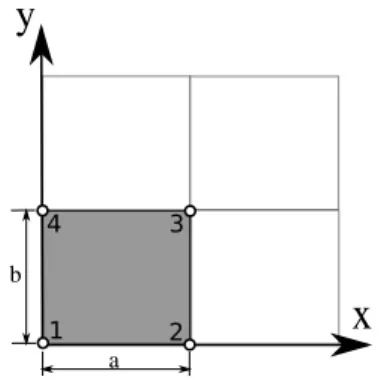
Figure 2.1: Node numbers and connectivity order for a square element in a cartesian grid
The functions are
N1 =
1− x
a 1−
y b
N2 =
x a
1− y
b
(2.31)
N3 =
xy ab N4 =
1− x
a
y
b,
where a and b are the dimensions of the element in x and y directions, respectively. As the changes in density are negligible when treating incompressible flow regimes, the time term of conservation equation can be dismissed. When using explicit time stepping schemes, the transient density term can be changed by an equivalent pressure term, both terms are linked by a compressibility parameter, the speed of soundc. When the speed of sound is very high (approaches infinity) a stern limitation of the time step appears affecting the explicit feature of the solution. Because of this consideration, the use of an artificial compressibility parameter β instead of the speed of sound, eliminates the restriction of the time step at the second step of the split. The selection of the artificial compressibility parameter is based on the convective and diffusive velocities of the problem, and calculated locally. In the present work, as the mesh is fixed, this parameter is calculated once. β
uconv =
√
uiui (2.32)
udif f =
2
hRe (2.33)
In these equations,his the local element size, unique for this work, andReis the Reynolds number. Now, after calculating both velocities, the timestep is obtained from choosing the minimum value of the following relation:
4t=min(4tconv,4tdif f) (2.34)
where:
4tconv =
h
uconv+β
; 4tdif f =
h2Re
2 (2.35)
In order to accelerate convergence of the method, Nithiarasu(2003) proposes the use of a safety factor varying from 0.5 to 2.0 depending on the problem. This factor can be seen multiplying the calculated 4t in the work of de Carvalho et al. (2009).
2.4 Discussion 29
2.4
Discussion
Chapter 3
Solution of the NS Equation using
the Lagrange-Galerkin method
3.1
Lagrange Galerkin Method
The Lagrange-Galerkin method is used to find the solution to a problem involving con-vection. The method is suitable to find the solution to any hyperbolic equation like the Navier Stokes set. The solution of the convective part is done in a lagrangian fashion, following the trajectory of each material point in the domain, which is fixed in space. The advantage of performing such solution is to get rid of remeshing thus avoiding for example the formulation of ALE methods. The use of large timesteps makes this method more efficient than Eulerian schemes Giraldo (1998), Ferretti (2013). The procedure is intended to solve the equations for incompressible flow only. Let’s recall the Navier-Stokes Equations,
ρ
∂u
∂t + (u· ∇)u
−µ4u+∇p = ρf
div(u) = 0 (3.1)
Where u is the velocity field, p is the pressure, µ is the dynamic viscosity and ρ is the density. The convective acceleration can be ignored if the fluid velocity is low compared to viscous forces (Stokes flow) but in case of high speed flows this is the dominant term of the equation. Dividing both sides of the equation to the density, constant for the case
3.1 Lagrange Galerkin Method 31
of incompressible flow, an alternate formulation of the problem can be achieved.
∂u
∂t + (u· ∇)u
−ν4u+ 1
ρ∇p = f
div(u) = 0 (3.2)
To complete the set of equations, boundary and initial conditions are needed. Ini-tial condition u(x, t = 0) = u0(x) must be divergence-free. Boundary conditions are of Dirichlet and Neumann type. In general, the Dirichlet boundary condition is defined as a function g(x, t=t) at the boundary ∂Ω,whereas the homogeneous Dirichlet condition used to define the No slip condition is set asu(x, t=t) = g(x, t=t) in∂Ω, (uΓ= 0) The mixed condition, derived from the variational formulation is defined asµ∂u∂n−pn =gin ΓN.
3.1.1
Variational formulation and spatial discretization
The equation is transformed from its strong form to a discrete system of matricial equa-tions. The process starts with the multiplication of each term of the equation with a test function defined over an adequate vector space, and integration using Green’s for-mula. Functional spaces are defined as V = H01(Ω) for the velocity and Q = L20(Ω) =
q∈L2(Ω) ;RΩq dx= 0 for the pressure. In this way we get,
Z
Ω
∂u
∂t ·v dx+
Z
Ω
[(u· ∇)u]·v dx−
Z
Ω
ν4u·v dx+1
ρ
Z
Ω
∇p·v dx = Z
Ω
f ·v dx
Z
Ω
div(u)·q dx = 0 (3.3)
After multiplying the test function, the diffusive and pressure terms are integrated by parts and expanded.
Z
Ω
∂u
∂t ·v dx+
Z
Ω
[(u· ∇)u]·v dx
| {z }
T otal accel.
+ν
Z
Ω
∇u:∇v dx
| {z }
A
Z
p·div(v)dx
| {z }
BT
−ν
Z
∂Ω
∂u ∂nv ds+
Z
∂Ω
pv·n ds = Z
Ω
f ·v dx
Z
Ω
div(u)·q dx
| {z }
B
= 0 (3.4)
It can be observed that after rearranging terms, the discrete formulation can be lead into a matricial system involving a matrixAfor the laplacian operator, a matrixB involv-ing the pressure gradient as well as its transpose which has into account the divergence of the velocity field in the mass conservation equation. According toElman et al. (2006), the matricial system is
A 0 BxT
0 A BT y
Bx By 0
ux uy p = Fx Fy 0 (3.5) where,
A = BxT
Z
Ω
∇u:∇v; BTx =−
Z
Ω
p·div(vx); ByT =−
Z
Ω
p·div(vy)
Bx = −
Z
Ω
q·div(ux); By =−
Z
Ω
q·div(uy) (3.6)
3.1 Lagrange Galerkin Method 33
equation. Z
Ω
∂u
∂t ·v dx+
Z
Ω
[(u· ∇)u]·v dx−
Z
Ω
ν4u·v dx+1
ρ
Z
Ω
∇p·v dx = Z
Ω
f ·v dx
Z
Ω
div(u)·q dx−
Z
Ω
p·qdx = 0 (3.7)
After the approximation it is possible to introduce a mass matrix that multiplies the perturbation coefficient. This matrix must be inverted and may become inefficient when using small values of because the resulting system may be ill conditioned and present trouble when solving via iterative methodsSegal (2011). In this case a value of = 1e−4 is used. A way to penalize the mixed system and eliminate the pressure term is by lumping of the mass matrix and its multiplication with the perturbation coefficient. However, the solution is equivalent to replace the mass matrix for the identity matrix so additional computation is avoided Gunzburger(1989)
The system to solve now becomes,
A 0 BxT
0 A BT y
Bx By −I
ux uy p = Fx Fy 0 (3.8)
3.1.2
Temporal discretization
The set of local and convective acceleration define the concept of total acceleration or material derivative in the Navier Stokes equation. The material derivative is the starting point to perform the temporal discretization process in characteristic curves. According to Pironneau(1982) and Donea and Huerta(2003) , with reference to a Lagrangian point of view, along the characteristic curve, the material derivative is reduced to a time derivative which can be discretized by an implicit method in a finite difference method scheme.
Du Dt =
∂u
∂t + (u· ∇)u
= u
n+1−un
∗
In this way the Navier Stokes Equation becomes,
un+1−un
∗
dt −ν4u
n+1 + 1
ρ∇p
n+1
= fn+1
div un+1 = 0 (3.10)
The un∗ term is obtained after solving the characteristic curve equation for a material point of the mesh. According toPironneau(1982) andBermudez et al.(2006), for a given point (x, y) ∈Ω , the characteristic curve that passes through that point is the function
X(x, t) that solves the Initial Value Problem,
∂X
∂τ = u(X, τ)
X(t) = x (3.11)
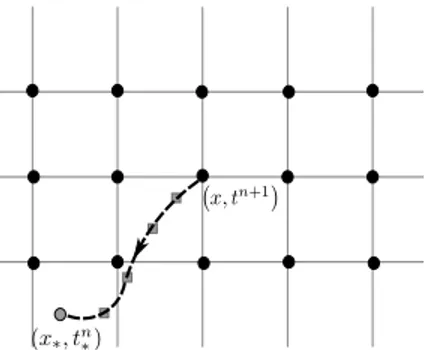
The idea of the method is to follow the trajectory of a material point in the domain through its characteristic curve, finding the position where the point was an instant of time before, performing there the calculation of the scalar quantity being transported. For the case of the Navier Stokes equation, the transported variable is the velocity un
∗. After solving this velocity variable, it is replaced on equation3.10and the system is solved for time tn+1. This procedure is done iteratively until the convergence of the method is reached (1e−5 for velocity and pressure residuals)
Figure 3.1: Trajectory of a material point through its characteristic curve
Figure 3.1 shows the trajectory of a material point of the domain, travelling from a position labeled (tn+1) to the position where it was before at time tn. Gray squares
3.1 Lagrange Galerkin Method 35
process,done by using a Backward Euler scheme (see equation3.12)
x∗ =x−u(x)dt (3.12)
wherex∗ is the position where the particle was an instant before,x is the position on the grid, andu(x) the value of the velocity evaluated on the grid.
The general algorithm for the Navier Stokes solver is presented in1. The basic features of a CFD simulation are defined on this algorithm.
Algorithm 1 General algorithm for the Navier Stokes solver
Preprocessing
Define physical properties
Detect boundaries in the domain Assign boundary and initial conditions Create local matrices
Processing
Assembly global matrices
Solve the transient term (Characteristics) Solve the Stokes system
Post processing
Plot results
Algorithm 2 Computation of the characteristics
Preprocessing
fort= 0 tot=tf inal with increments dt do
Create internal node array
for Each internal nodedo
Find position (xn+1, yn+1) Find velocity at (xn+1, yn+1)
forτ = 0 to dt do
Call Backward Euler function
Find element number
Find connectivity
Find node coordinates
Call the interpolation function to obtainun∗
Update velocity Update position
end for
Solve the Stokes system
Store results
end for
Update variables
end for
Plot results
The inner cycle is used to calculate the position where the material point was at time
tn. It is important to mention that the inner cycle uses an internal timestep value denoted by τ
The implementation was done in C++ using SuiteSparse, a suite of sparse matrix packages, for the solution of the matricial system.
3.2
Case study: Lid Driven Cavity Flow
3.2 Case study: Lid Driven Cavity Flow 37
Figure 3.2: Lid driven cavity flow
The domain is discretized with a structured fixed grid, with squareQ1b/Q1 elements, which is the smallest subspace that guarantees stability as it satisfies the LBB condition Fourestey and Moubachir (2002). This configuration presents a square element with velocity degrees of freedom in each corner and center nodes, and pressure degrees of freedom only at the corners of the element. In contrast to the work reviewed in the literature, the development of the method of characteristics is done using a structured square mesh, providing another perspective of the solution. The use of a structured grid for this type of problems has not been seen in the literature yet. This type of element is closely related to the P1b/P1 triangular element which is a simplification of the widely known Hood-Taylor element. The element used in the implementation can be seen in figure3.3.
Figure 3.3: Q1b/Q1 element
treatment of problems in which the geometry of the domain changes in time. The method has been used for phase change problems, elasticity problems, and it might be suitable for problems involving fluid structure interaction. The advantage of using this approach is because there is no need for remeshing, ideal for the characteristic curve implementation. Regarding to the implementation, the points of the mesh are not stored but calulated according the maximum dimensions of the domain. In this way, the mesh data (points and connectivity) is only needed for post processing the results. In figure 3.4a fixed mesh of 32 x 32 elements can be seen. Observe that the node at the center of each element is not plotted.
Figure 3.4: Finite Element Fixed Grid (32 x 32) elements
3.3
Results
3.3 Results 39
(a) Horizontal line for measurement (b) Vertical line for measurement
Figure 3.5: Horizontal and Vertical lines for velocity measurement
In order to compare the velocity values, seven points were distributed on each line, according the documentation of Ghia et al. (1982). A fixed mesh of 129 x 129 square elements was used. In the following tables the results for several Reynolds number are compared,
ForRe= 100,
Re 100
Position ux
y Ghia et al. OpenFOAM CharNS
1.0 1.0 1.0 1.0
0.9688 0.78871 0.79176 0.7730 0.7344 0.00332 0.004072 0.00084
0.5 -0.20581 -0.2087 -0.20417 0.2813 -0.15662 -0.15746 -0.15394 0.0625 -0.04192 -0.04197 -0.04266
0.0 0.0 0.0 0.0
Re 100
Position uy
x Ghia et al. OpenFOAM CharNS
1.0 0.0 0.0 0.0
0.9609 -0.07391 -0.07805 -0.08019 0.8594 -0.22445 -0.23354 -0.22714 0.5 0.05454 0.05751 0.05342 0.2266 0.17507 0.17901 0.1759 0.0703 0.10091 0.10336 0.10389
0.0 0.0 0.0 0.0
Table 3.2: (uy) Velocities through the horizontal line of the cavity for Re= 100
Results for the velocity in horizontal direction (ux) through the vertical line, and the
velocity in vertical direction (uy) through the horizontal line for Re = 100 are shown in
figure 3.6
0 0.2 0.4 0.6 0.8 1
-0.4 -0.2 0 0.2 0.4 0.6 0.8 1
y
Velocity in x [m/s]
Ghia OpenFOAM CharNS
(a)ux,Re= 100
-0.25 -0.2 -0.15 -0.1 -0.05 0 0.05 0.1 0.15 0.2
0 0.2 0.4 0.6 0.8 1
V
elo
cit
y
in
y
[m/s]
x
Ghia OpenFOAM CharNS
(b)uy,Re= 100
Figure 3.6: Velocities forRe= 100
3.3 Results 41
Re 400
Position uy
x Ghia et al. OpenFOAM CharNS
1.0 0.0 0.0 0.0
0.9609 -0.15663 -0.16089 -0.1504 0.8594 -0.44993 -0.45056 -0.4163 0.5 0.05186 0.05238 0.05601 0.2266 0.30203 0.30159 0.25803 0.0703 0.19713 0.19698 0.17620
0.0 0.0 0.0 0.0
Table 3.4: (uy) Velocities through the horizontal line of the cavity for Re= 400
Re 400
Position ux
y Ghia et al. OpenFOAM CharNS
1.0 1.0 1.0 1.0
0.9688 0.68439 0.6863 0.6513 0.7344 0.16256 0.16149 0.1451 0.5 -0.11477 -0.11498 -0.1213 0.2813 -0.32726 -0.32625 -0.2993 0.0625 -0.09266 -0.09216 -0.0788
0.0 0.0 0.0 0.0
Table 3.3: (ux) Velocities through the vertical line of the cavity for Re= 400
0 0.2 0.4 0.6 0.8 1
-0.4 -0.2 0 0.2 0.4 0.6 0.8 1
y
Velocity in x [m/s]
Ghia OpenFOAM CharNS
(a)ux,Re= 400
-0.5 -0.4 -0.3 -0.2 -0.1 0 0.1 0.2 0.3 0.4
0 0.2 0.4 0.6 0.8 1
V
elo
cit
y
in
y
[m/s]
x
Ghia OpenFOAM CharNS
(b)uy Re= 400
Figure 3.7: Velocities forRe= 400
Now,the tables with the results for a Reynolds number of 1000 are shown below. Some values slightly differ from the references.
Re 1000
Position ux
y Ghia et al. OpenFOAM CharNS
1.0 1.0 1.0 1.0
0.9688 0.57492 0.57721 0.5315 0.7344 0.18719 0.18524 0.16848
0.5 -0.06080 -0.06126 -0.0613 0.2813 -0.27805 -0.27702 -0.26271 0.0625 -0.20196 -0.19874 -0.1711
0.0 0.0 0.0 0.0
3.3 Results 43
Re 1000
Position uy
x Ghia et al. OpenFOAM CharNS
1.0 0.0 0.0 0.0
0.9609 -0.27669 -0.28819 -0.2681 0.8594 -0.42665 -0.42197 -0.39546
0.5 0.02526 0.02575 0.02555 0.2266 0.33075 0.32940 0.30655 0.0703 0.29012 0.29008 0.25719
0.0 0.0 0.0 0.0
Table 3.6: (uy) Velocities through the horizontal line of the cavity for Re= 1000
Plotting the results forRe= 1000 in figure 3.8
0 0.2 0.4 0.6 0.8 1
-0.4 -0.2 0 0.2 0.4 0.6 0.8 1
y
Veloccity in x [m/s]
Ghia OpenFOAM CharNS
(a) ux,Re= 1000
-0.5 -0.4 -0.3 -0.2 -0.1 0 0.1 0.2 0.3 0.4
0 0.2 0.4 0.6 0.8 1
V
elo
cit
y
in
y
[m/s]
x
Ghia OpenFOAM CharNS
(b)uy,Re= 1000
Figure 3.8: Velocities forRe= 1000
Re 3200
Position ux
y Ghia et al. OpenFOAM CharNS
1.0 1.0 1.0 1.0
0.9688 0.48296 0.4640 0.35982 0.7344 0.19791 0.1919 0.17418 0.5 -0.04272 -0.03561 -0.04511 0.2813 -0.24427 -0.231938 -0.1923 0.0625 -0.35344 -0.36277 -0.2885
0.0 0.0 0.0 0.0
Table 3.7: (ux) Velocities through the vertical line of the cavity for Re= 3200
Re 3200
Position uy
x Ghia et al. OpenFOAM CharNS
1.0 0.0 0.0 0.0
0.9609 -0.47425 -0.4885 -0.42656 0.8594 -0.37401 -0.3628 -0.2737
0.5 0.00999 0.01372 0.0221 0.2266 0.29030 0.28412 0.23192 0.0703 0.40917 0.38948 0.28326
0.0 0.0 0.0 0.0
Table 3.8: (uy) Velocities through the horizontal line of the cavity for Re= 3200
3.3 Results 45
0 0.2 0.4 0.6 0.8 1
-0.4 -0.2 0 0.2 0.4 0.6 0.8 1
y
Velocity in x [m/s]
Ghia OpenFOAM CharNS
(a) ux,Re= 3200
-0.5 -0.4 -0.3 -0.2 -0.1 0 0.1 0.2 0.3 0.4 0.5
0 0.2 0.4 0.6 0.8 1
V
elo
cit
y
in
y
[m/s]
x
Ghia OpenFOAM CharNS
(b)uy,Re= 3200
Figure 3.9: Velocities forRe= 3200
Comparing the results from figures(3.6,3.7,3.8,3.9) it can be observed that horizontal velocity values (ux) found with the implementation of the characteristics method are
similar to the references, in which a finite volume method was used. There is only one of the points in which the velocity differs about 10% according to reference Ghia et al. (1982). Analyzing the graphs for the velocity in vertical direction (uy), when the Reynolds
number is increased, velocities show little discrepancy when compared with the references. This difference might be due to the presence of numerical diffusion, proper of a first order upwinding method, therefore affecting the stability of the solutionFourestey and Piperno (2004).
Nevertheless, with the mesh used, vortices can be seen at Re= 1000 and Re= 3200, see figure3.10. Vortex formation is generated according the behavior of the flow as stated by Erturk et al. (2005). The main vortex can be seen, located near the center of the cavity, while as the Reynols number is increased, other vortices appear (secondary and tertiary vortices). The location of the primary vortex center is very close to the value reported by Ghia et al. (1982) (see table3.9). It can be seen in figure 3.10c
Coordinate Ghia et al. CharNS x 0.5313 0.534884 y 0.5625 0.565891
(a)Re= 100 (b) Re= 400
(c) Re= 1000 (d) Re= 3200
3.4 Conclusion 47
3.4
Conclusion
The development of the Lagrange-Galerkin method is able to solve the Navier Stokes equation for incompressible flow combining advantages from the Eulerian and Lagrangian schemes, as it can be implemented on a fixed mesh avoiding the process of remeshing. When using this method, transient problems can be solved efficiently using large timesteps whenever the characteristic curve is sufficiently smooth, in other words, if it can be split in small sections. Compared to the CBS scheme, the discretization process is much clearer as it derives from a variational formulation of the Stokes problem and the material deriva-tive is treated as a simple time derivaderiva-tive which can be discretized in a finite difference manner. Moreover, the imposition of boundary conditions is also clearer because of the appearance of these in the variational formulation in a natural way.
Appendix A
Stokes flow: calculation of local
matrices
|STOKES FLOW
Calculation of Matrices Jose David Villegas
BASE FUNCTIONS AND GRADIENT
restart:
with(LinearAlgebra): with(CodeGeneration):
#An Introduction to the FEM 3rd Ed. J.N Reddy pag. 535
# Base Functions for a four node element with origin at lower left corner (1)
# 4---3 # | | # h | 5 | # | | # 1---2 # h
N1:=-(3/2)*x/h-(3/2)*y/h+x*y/h^2+1+(1/2)*(x^2+y^2)/h^2: N2:=(1/2)*x/h-(1/2)*y/h-x*y/h^2+(1/2)*(x^2+y^2)/h^2: N3:=-(1/2)*x/h-(1/2)*y/h+x*y/h^2+(1/2)*(x^2+y^2)/h^2: N4:=-(1/2)*x/h+(1/2)*y/h-x*y/h^2+(1/2)*(x^2+y^2)/h^2: N5:=2*x/h+2*y/h-2*(x^2+y^2)/h^2:
# Base functions Vector N = Nu = Np
N := Vector([N1,N2,N3,N4,N5]): Np:= Vector([N1,N2,N3,N4]):
# Calculation of the gradient for the functions
dN:=Matrix(5,2): for i from 1 to 5 do
dN[i,1]:= simplify(diff(N[i],x)); dN[i,2]:= simplify(diff(N[i],y)); od:
dN:
MATRICES CALCULATION
Ident:= IdentityMatrix(4):
for r from 1 to 5 do for s from 1 to 5 do
Mlocal[r,s] := simplify((int(int(N[r]*N[s],y=0..h),x=0..h))): Mlump[r,r] :=Mlump[r,r] + Mlocal[r,s]:
od: od:
for r from 1 to 4 do for s from 1 to 4 do
Stab[r,s]:=-Ident[r,s]*epsilon:#*Mlump[r,s]: od:
od:
A matrix (Equal to CBS H matrix)
A:=Matrix(5,5): for i from 1 to 5 do for j from 1 to 5 do
A[i,j] := simplify(kinvisc*int(int(dN[i,1]*dN[j,1]+
dN[i,2]*dN[j,2],y=0.. h),x=0..h)): od:
od:
f1 := Vector(5): for r from 1 to 5 do
f1[r] := simplify(int(int(dt*(1/rho)*rho*g1*N[r],y=0..h),x=0..h)): od:
f2 := Vector(5): for r from 1 to 5 do
f2[r] := simplify(int(int(dt*(1/rho)*rho*g2*N[r],y=0..h),x=0..h)): od:
Byt:=Matrix(5,4):
for r from 1 to 4 do for s from 1 to 5 do
Bx[r,s]:=simplify((-1/rho)*int(int(Np[r]*dN[s,1],x=0..h),y=0..h)): od:
od:
for r from 1 to 4 do for s from 1 to 5 do
By[r,s]:=simplify((-1/rho)*int(int(Np[r]*dN[s,2],x=0..h),y=0..h)): od:
od:
Bx: By:
Bxt:=rho*Transpose(Bx): Byt:=rho*Transpose(By):
K matrix
K:=Matrix(14,14):
#A1
K[1,1]:=dt*A[1,1]+Mlocal[1,1]: K[1,2]:=dt*A[1,2]+Mlocal[1,2]: K[1,3]:=dt*A[1,3]+Mlocal[1,3]: K[1,4]:=dt*A[1,4]+Mlocal[1,4]: K[1,5]:=dt*A[1,5]+Mlocal[1,5]:
K[2,1]:=dt*A[2,1]+Mlocal[2,1]: K[2,2]:=dt*A[2,2]+Mlocal[2,2]: K[2,3]:=dt*A[2,3]+Mlocal[2,3]: K[2,4]:=dt*A[2,4]+Mlocal[2,4]: K[2,5]:=dt*A[2,5]+Mlocal[2,5]:
K[3,1]:=dt*A[3,1]+Mlocal[3,1]: K[3,2]:=dt*A[3,2]+Mlocal[3,2]: K[3,3]:=dt*A[3,3]+Mlocal[3,3]: K[3,4]:=dt*A[3,4]+Mlocal[3,4]: K[3,5]:=dt*A[3,5]+Mlocal[3,5]:
K[4,1]:=dt*A[4,1]+Mlocal[4,1]: K[4,2]:=dt*A[4,2]+Mlocal[4,2]: K[4,3]:=dt*A[4,3]+Mlocal[4,3]: K[4,4]:=dt*A[4,4]+Mlocal[4,4]: K[4,5]:=dt*A[4,5]+Mlocal[4,5]:
K[6,6]:=dt*A[1,1]+Mlocal[1,1]: K[6,7]:=dt*A[1,2]+Mlocal[1,2]: K[6,8]:=dt*A[1,3]+Mlocal[1,3]: K[6,9]:=dt*A[1,4]+Mlocal[1,4]: K[6,10]:=dt*A[1,5]+Mlocal[1,5]:
K[7,6]:=dt*A[2,1]+Mlocal[2,1]: K[7,7]:=dt*A[2,2]+Mlocal[2,2]: K[7,8]:=dt*A[2,3]+Mlocal[2,3]: K[7,9]:=dt*A[2,4]+Mlocal[2,4]: K[7,10]:=dt*A[2,5]+Mlocal[2,5]:
K[8,6]:=dt*A[3,1]+Mlocal[3,1]: K[8,7]:=dt*A[3,2]+Mlocal[3,2]: K[8,8]:=dt*A[3,3]+Mlocal[3,3]: K[8,9]:=dt*A[3,4]+Mlocal[3,4]: K[8,10]:=dt*A[3,5]+Mlocal[3,5]:
K[9,6]:=dt*A[4,1]+Mlocal[4,1]: K[9,7]:=dt*A[4,2]+Mlocal[4,2]: K[9,8]:=dt*A[4,3]+Mlocal[4,3]: K[9,9]:=dt*A[4,4]+Mlocal[4,4]: K[9,10]:=dt*A[4,5]+Mlocal[4,5]:
K[10,6]:=dt*A[5,1]+Mlocal[5,1]: K[10,7]:=dt*A[5,2]+Mlocal[5,2]: K[10,8]:=dt*A[5,3]+Mlocal[5,3]: K[10,9]:=dt*A[5,4]+Mlocal[5,4]: K[10,10]:=dt*A[5,5]+Mlocal[5,5]:
#Bxt
K[1,11]:=dt*Bxt[1,1]: K[1,12]:=dt*Bxt[1,2]: K[1,13]:=dt*Bxt[1,3]: K[1,14]:=dt*Bxt[1,4]:
K[2,11]:=dt*Bxt[2,1]: K[2,12]:=dt*Bxt[2,2]: K[2,13]:=dt*Bxt[2,3]: K[2,14]:=dt*Bxt[2,4]:
K[3,11]:=dt*Bxt[3,1]: K[3,12]:=dt*Bxt[3,2]: K[3,13]:=dt*Bxt[3,3]: K[3,14]:=dt*Bxt[3,4]:
K[4,11]:=dt*Bxt[4,1]: K[4,12]:=dt*Bxt[4,2]: K[4,13]:=dt*Bxt[4,3]: K[4,14]:=dt*Bxt[4,4]:
K[5,11]:=dt*Bxt[5,1]: K[5,12]:=dt*Bxt[5,2]: K[5,13]:=dt*Bxt[5,3]: K[5,14]:=dt*Bxt[5,4]:
#Byt
K[6,12]:=dt*Byt[1,2]: K[6,13]:=dt*Byt[1,3]: K[6,14]:=dt*Byt[1,4]:
K[7,11]:=dt*Byt[2,1]: K[7,12]:=dt*Byt[2,2]: K[7,13]:=dt*Byt[2,3]: K[7,14]:=dt*Byt[2,4]:
K[8,11]:=dt*Byt[3,1]: K[8,12]:=dt*Byt[3,2]: K[8,13]:=dt*Byt[3,3]: K[8,14]:=dt*Byt[3,4]:
K[9,11]:=dt*Byt[4,1]: K[9,12]:=dt*Byt[4,2]: K[9,13]:=dt*Byt[4,3]: K[9,14]:=dt*Byt[4,4]:
K[10,11]:=dt*Byt[5,1]: K[10,12]:=dt*Byt[5,2]: K[10,13]:=dt*Byt[5,3]: K[10,14]:=dt*Byt[5,4]:
#Bx
K[11,1]:=dt*Bx[1,1]: K[11,2]:=dt*Bx[1,2]: K[11,3]:=dt*Bx[1,3]: K[11,4]:=dt*Bx[1,4]: K[11,5]:=dt*Bx[1,5]:
K[12,1]:=dt*Bx[2,1]: K[12,2]:=dt*Bx[2,2]: K[12,3]:=dt*Bx[2,3]: K[12,4]:=dt*Bx[2,4]: K[12,5]:=dt*Bx[2,5]:
K[13,1]:=dt*Bx[3,1]: K[13,2]:=dt*Bx[3,2]: K[13,3]:=dt*Bx[3,3]: K[13,4]:=dt*Bx[3,4]: K[13,5]:=dt*Bx[3,5]:
K[14,1]:=dt*Bx[4,1]: K[14,2]:=dt*Bx[4,2]: K[14,3]:=dt*Bx[4,3]: K[14,4]:=dt*Bx[4,4]: K[14,5]:=dt*Bx[4,5]:
#By
K[11,6]:=dt*By[1,1]: K[11,7]:=dt*By[1,2]: K[11,8]:=dt*By[1,3]: K[11,9]:=dt*By[1,4]: K[11,10]:=dt*By[1,5]:
K[13,8]:=dt*By[3,3]: K[13,9]:=dt*By[3,4]: K[13,10]:=dt*By[3,5]:
K[14,6]:=dt*By[4,1]: K[14,7]:=dt*By[4,2]: K[14,8]:=dt*By[4,3]: K[14,9]:=dt*By[4,4]: K[14,10]:=dt*By[4,5]:
#S
Bibliography
Y. Achdou and J.-L. Guermond. Convergence analysis of a finite element projection/lagrange-galerkin method for the incompressible navier-stokes equations.
SIAM Journal of Numerical Analysis, 37:799–826, 2000.
S.N Atluri and T. Zhu. A new meshless local petrov galerkin (mlpg) approach in compu-tational mechanics. Computational Mechanics, 22:117–127, 1998.
T. Belytschko, Y.Y. Lu, and L. Gu. Element free galerkin methods. International Journal
for Numerical Methods in Engineering, 37:229–256, 1994.
J.P. Benque, B. Ibler, and G. Labadie. A finite element method for navier-stokes equations.
In Proceedings from the Third International Conference on Finite Elements in Flow
Problems. Alberta, Canada, 1980.
A. Bermudez, M. Nogueiras, and C. Vasquez. Numerical analysis of convection-diffusion-reaction problems with higher order characteristics/finite elements. part i: Time dis-cretization. SIAM Journal on Numerical Analysis, 44(5):1829–1853, 2006.
K. Boukir, B. Maday, B. M´etivet, and E. Razafindrakoto. A high order characteris-tics/finite element method for the incompressible navier-stokes equations. International
Journal for Numerical Methods in Fluids, 25:1421–1454, 1997.
A. Chorin. Numerical solution of navier-stokes equations. Mathematics of Computation, 22(104):748–762, 1968.
M. P. de Carvalho, V. L. Scalon, and A. Padilha. Analysis of cbs numerical algorithm execution to flow simulation using the finite element method. Ingeniare Revista chilena
de Ingenier´ıa, 17(2):166–174, 2009. doi: 10.4067/S0718-33052009000200005.




![figure 3.6 00.20.40.60.81 -0.4 -0.2 0 0.2 0.4 0.6 0.8 1y Velocity in x [m/s] GhiaOpenFOAMCharNS (a) u x ,Re = 100 -0.25 -0.2-0.15-0.1-0.0500.050.10.150.2 0 0.2 0.4 0.6 0.8 1Velocityiny[m/s]xGhiaOpenFOAMCharNS(b) uy,Re = 100](https://thumb-us.123doks.com/thumbv2/123dok_es/6896414.843054/46.918.114.800.631.934/figure-y-velocity-x-ghiaopenfoamcharns-velocityiny-xghiaopenfoamcharns-uy.webp)

