Patients Monitoring System based on a Wireless
Sensor Network Adaptive Platform
E. Romero#1, A. Araujo#2, P. Malagón#3, J.C. Vallejo#4, J.M. Moya#5, O. Nieto-Taladriz#6
Electronic Engineering Department, Universidad Politécnica de Madrid E.T.S.I.Telecomunicación, Ciudad Universitaria, 28040 Madrid (Spain) {1elena, 2araujo, 3malagon, 4jcvallejo, 5josem, 6nieto}@die.upm.es
Abstract— Guaranteeing ubiquity and appropriateness of health services provision to the users constitutes a priority issue for the Public Health Authorities. This paper presents an innovative Wireless Personal Area Network architecture that takes advantage of some of the features provided by Intelligent Environments -large number of devices, heterogeneous networks and mobility enhancement- in order to adapt and personalise ambient conditions to the user profile.
I. INTRODUCTION
The ageing of the population and, consequently, the growing of chronic diseases results in a change in the way health care services are provided. New technology developments could be a potential answer to the requirements of a society demanding for better healthcare delivery [1]. Previous experiences urge for the improvement in human-machine interfaces that enable users (i.e. mostly elderly people) to deal easily and non-intrusively with technology [2][3]. Lately, innovation in the area has come with Ambient Intelligence (AmI) [4][5] as limitations brought on by ageing are expected to be overcome by new technologies, based on the design of easy to use and easy to learn devices that work transparently and pervasively to aid the user [6].
Therefore, next generation follow-up and homecare systems have several important challenges to face. On the one hand, from the users’ side, there is a need to develop non-intrusive systems that require a minimum human machine interaction and provide the right medical services on a highly-usable basis, enhancing the augmented environment while making computers disappear in the background. On the other hand, the big issue is to implement these necessities by means of affordable solutions for Public and Private Healthcare Institutions, only achievable by means of low cost infrastructures easy to install and maintain.
Wireless Personal Area Networks (WPAN) allow several biomedical (ECG, pulse oximetry, blood pressure, etc.) and environmental sensors to be connected within the same network. They provide information about behavioural patterns and helping ageing and ill populations with everyday activities and health care follow up.
WPAN’s capabilities that make them optimal, compared to other networks, for the support of a health monitoring system are stated below:
Self-management. The network can automatically route data packets using neighbour nodes. It can also adapt its own topology to react to network changes. That means the user needs neither adding new nodes/sensors to the network nor considering nodes’ break-up.
Context awareness. The network adapts its behaviour according to environmental variables, such as user preferences, moment of the day on which the usage takes place, season, etc; that govern the system.
Heterogeneity and dynamism. Devices of different nature and characteristics must be interoperable and able to adapt to a network composed by different nodes depending on the particular environment, user and application.
Low cost. Networks can not be deployed massively if they are not affordable. Moreover, healthcare providers will not use them in clinical routine if they are not cost-efficient or do not have important benefits over traditional healthcare delivery.
Performance with limited resources. Limited processing power, tight memory sizes and low power consumption are crucial for this design. Batteries are required to last long enough to allow several measures taking place, as well as supporting the wireless radio link power consumption.
Security. Refusing intrusions, avoiding denial of service, driving the system into a safe state in case of failure, etc. are a must for real scenario setups, since sensitive and personal data will be in transit through the network.
Trust. The large number of devices included in the network and the low cost wireless devices provide redundancy. This redundancy is useful for security policies, routing protocols and trust devices services.
profile, which will serve as input for an actuators network with distributed intelligence that will adapt ambient conditions accordingly. Finally, the proposed solution has been implemented and validated in a real home system scenario for the monitorization of chronic patients.
II. ARCHITECTURE
WPANs are constituted by several nodes. Each node - i.e. sensing device- has three different parts. First, the biomedical or environmental sensor itself: an off-the-shelf OEM board (ECG, pulse oximeter) or an ad-hoc module (accelerometer, PIR, camera...). All these sensors have low data rates. Camera has processing capacity and it only sends processing instructions. Sensors have been provided with a second component, an autonomous power supply. As the power requirements of each sensor are different, customized supply stages have been designed using a standard interface with commercial AAA batteries and always looking for the highest efficiency that maximizes sensors’ lifetime.
Finally, the third part added provides the “intelligence”: awareness of patient’s willingness to perform a measurement, network functionality (e.g. routing, reconfiguration), etc. The connection between sensor’s and intelligence’s layer depends on each sensor: parallel I/O, SPI, A/D converter, etc. All these interfaces are implemented within the intelligence module (Fig 1).
Fig. 1 Intelligence module
The key component of this stage is a radio transceiver in the ISM band of 2,4 GHz that implements the physical layer and the MAC layer of the IEEE 802.15.4 wireless standard. The main characteristics featured are:
Possible bit rates: 250 Kbps, 40 Kbps or 20 Kbps.
We are using 250Kbps.
Possible network topologies: star, point to point and mesh. The topology used for developing the system is mesh (See Fig 2).
Support for low latency devices.
Channel access using CSMA-CD (Carrier Sense
Multiple Access/Collision Detection).
Dynamic address allocation.
Low power consumption.
Fig. 2 ZigbeeTM topologies
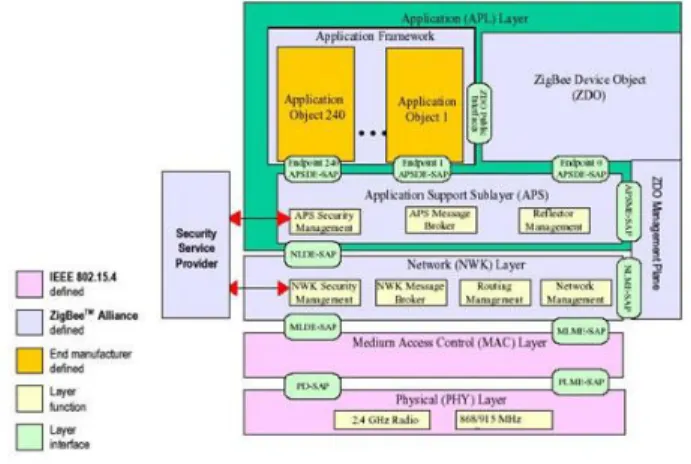
Therefore, the network requirements and functionality suit perfectly with the given standard. In order to implement the remaining layers of the ZigbeeTM protocol stack, a low-cost 8051 microcontroller that connects to the radio transceiver through an internal SPI communication interface has been used. The commonly used OSI architecture has been discarded in favour of a service-based architecture with ZigbeeTM like protocol support (See Fig 3).
Fig. 3 ZigbeeTM stack protocol
The aim of this design is to implement applications that arise as a mere aggregation of services and relations between services, rather than a node-focused orientation, simplifying the development of user applications [7][8].
III. SERVICES
The proposed services are built on top of an AP layer that abstracts network or hardware specific tasks to the application. This middleware allows sending data to any node of the network without considering its location, sending broadcast messages, etc, and all this made possible by a simple and unique interface (based on query-response) that can be dynamically instantiated in any node at any time.
This allows easily compose applications to take into account many complex aspects, such as privacy, safety, load balancing, low energy consumption, etc. [9][10] in a totally transparent way to the user.
encapsulate it as system services, so that once the system is running the addition of a new application becomes easy.
An interoperable, reliable system, abstracting the hardware from the applications has been designed, developed and implemented. It is important to highlight that the size of the prototype is not comparable to that of wearable devices, but the aim of this work was just to emulate the behaviour of future wearable sensors, not to miniaturize existing ones.
The architecture described above allows supporting services that provide an added value to the system, such as user modelling, context adaptability, user and object tracking, face and 2D recognition, tangible interfaces, common sense or reputation. According to the defined system requirements, the most appropriate services for the design process are described below.
User Modelling (UMS)
These systems use the existing technologies to recognize interests, habits, behaviours and needs of the users in a concrete spatio-temporal situation. This information, named context in AmI, is stored in a data base specifically designed to this kind of services as an attribute-value pair constituting users profiles. During the execution time, the system processes the input data, matches coincidences in the database, acquires new data pairs, establishes new links between input data and determines possible systems responses. This service allows providing specific and personalized services according to the user needs [11].
The designed system includes a set of pre-programmed procedures which evolve to self-adapt to user routines and preferences depending on the patient behaviour. The system will gradually improve its level of understanding and knowledge of the user’s habits; therefore will have a more complete model of the user behavioural patterns.
Besides, this system might offer in the future, by means of user tracking, identification, and broad context information; multi-user responses, depending on several factors such as week day, season, presence of third users, etc. Thus, the system is completely integrated in the life of the user in a transparent way, making easy the daily tasks and taking care of the user health in a non-pervasive mode [12] [13].
User Tracking Service (UTS)
User tracking systems are currently widely used in the implementation of security platforms and applications for elderly people. This kind of systems allows basic movement patterns identification and future actions prediction.
In the system described, these features have been implemented through the integration of image processing-based sensors. This kind of sensors is processing-based on filter combinations, mathematical operations, frames comparisons, images mixers, etc. They are able to detect movements and activity parameters such as speed and direction of the mobile object.
The utilization of this kind of device offers a wide range of possibilities for the above scenario since it is able to detect
intrusions, to perform easy daily tasks or to identify alarms produced by fallen or by long user inactivity periods.
Next lines illustrate one example of the system used in the user daily routine tasks.
This system is able to detect the user behaviour patterns when he goes to bed and as a result, it conditions the room according to the user preferences: light and temperature level, alarm activation, security requirements and, most importantly, the system activates the necessary procedures so mobility impaired people gets into bed in a easy and comfortable way.
Reputation Service
The sharing of information within the sensor’s network, each one acquiring multiple contextual data, allows the system to detect unusual behaviours in its own functioning / operating.
Thus, the network is capable of self-evaluating and discovering possible malfunctioning sensors. In this case, the system informs the user and ignores the data sensed from this device if the error persists. This service enhances the system’s reliability and security, both imperative features since the system handles confidential data and critical applications such home security systems [14].
Taking into account that nodes can fail and that are vulnerable to attacks because its low resources, the system has been designed for minimize the consequences of such problems. In this way, the network implements redundant information from different sources and sensing technologies, while the reputation system continuously evaluate the trust level of each node. Moreover, the failing node can be isolated and ignored if the problem cannot be solved.
IV. MONITORING PATIENT SERVICE
General description
The Patient Monitoring Service is an example of implementation of the concepts and services described in previous sections. It provides a transparent and non-intrusive way of supervising the patients. An application scenario of such service could be a wireless cardiac monitoring system deployed in patients’ home providing a supporting tool for cardiac diseases diagnosis, including functionality to foster independent living of patients.
The system deployed in a residential environment is a WPAN which features a gateway; several biomedical sensors (such as electrocardiograph, pulse oximeter, blood pressure meter, etc.), environmental sensors (camera, presence detectors, InfraRed sensors, etc.); user interfaces adapted to patients profile in order to guide them in the monitoring procedure (start of an exam, low battery level indication, etc.) and several ambient actuators (alarms, light switches, appliances, etc.) which can adapt to the situation according to the context and the collected data.
appropriate conditions in the environment, taking the patients state into account.
The medical parameters considered in the system are: oxygen saturation in blood, heart rate, blood pressure, ECG, glucose level in blood. The pathologies studied are Heart Failure and Cardiac Arrhythmia.
Home care aims at, on one hand, having more frequent measures than with traditional procedures and, on the other hand, monitoring patient’s evolution, making possible the early prediction of a worsening.
The parameters measure is done once or twice per day, including several tests depending on the illness. One or two minutes are enough to finish the tests. Data is gathered by the gateway, analyzed (real-time analysis is not needed) and sent to a telemedicine server in a healthcare institution (i.e. hospital, primary care, etc.) so a specialist can check the results.
Personal Area Network Architecture
The wireless sensor network consists of five different elements: a gateway (the network coordinator and data collector), biomedical sensors (used to monitor the patient’s vital signs), environmental sensors (used to monitor home conditions and events), home actuators (used to change home conditions) and the user interface (to inform of upcoming exams, problems, etc).
Fig. 4 Personal Area Network
The functionality of the different elements is explaining below.
Gateway
The gateway has twofold capability. On one hand, it is used to communicate with the environmental sensors and to give orders to the ambient actuators, achieving the best conditions at home. On the other hand, it is used to communicate with the biomedical sensors of the patient and to send data to and from healthcare institutions. The information regarding the doctor’s prescription is sent to the gateway, where it is stored, processed and routed to the specific sensor, stating the duration, sample rate, quality of the measure, amplification factor, or any precise parameter needed to collect the data.
Sensors
The sensors have been developed as stand alone wireless devices, powered with batteries, and have been provided of automatic start of the measure, discovery, and auto-configuration facilities. That means that the patient does not need to take care of configuring nor connecting them, for instance, to upload or download the data collected. It is important to note that the user does not need to ensure either that the sensors are powered on and off, as they are suspended and resume automatically after a given time.
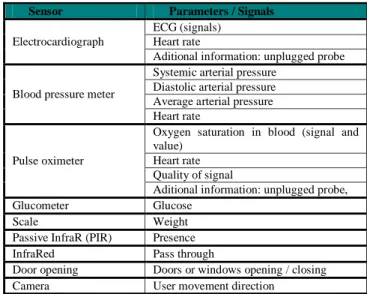
Sensors included in this scenario and data, parameters and signals associated to them are:
Sensor Parameters / Signals
Electrocardiograph
ECG (signals) Heart rate
Aditional information: unplugged probe
Blood pressure meter
Systemic arterial pressure Diastolic arterial pressure Average arterial pressure Heart rate
Pulse oximeter
Oxygen saturation in blood (signal and value)
Heart rate Quality of signal
Aditional information: unplugged probe,
Glucometer Glucose
Scale Weight
Passive InfraR (PIR) Presence
InfraRed Pass through
Door opening Doors or windows opening / closing
Camera User movement direction
User interface
The designed system focuses on the patient interface, obviating the medical one. The home care system needs an easy-to-use interface providing the following information:
In idle mode:
Start of a test
State of each sensor batteries Failure in a sensor
During a test
Test state (correct, failure)
After a test
Test state (correct, repeat the test, errors in test)
The user interface (see Fig. 5) has an intuitive code which transmits the information to the patient, using sounds and multicolour panels associated to the sensors.
Each panel has three colours (red, green and blue), which can be combined to get seven different colours. They visually transmit the information from the gateway to the patient, indicating the state of the sensor associated to the panel. The user interface can produce different periods of blinking to give different information. The messages and code transmitted to the patient are:
Panel Message
Fast blinking green Start a test NOW
Slow blinking green Test proceeding correctly
Fixed green Test ended properly
Blue Sensor is unproperly put.
Yellow Battery low. Connect the sensor to the charger
Red Failure or sensor error. Notify the hospital
The user interface includes a buzzer that makes sounds to notify new messages to the patient. People unable to distinguish colours can also use the interface since there are three different lengths of sounds, combined to indicate the state of the sensor involved. The messages and code transmitted to the patient are:
Panel Message
●●●●●● Start a test NOW
─ ─ ─ Test proceeding correctly
●● ─ Test ended properly
●●●● ─ Sensor is unproperly put.
●─ ●─ ●─ Battery low. Connect the sensor to the charger
Failure or sensor error. Notify the hospital
In the home conditioning part, it is fundamental to let the system interact with the user proactively, warning the user for security or medical reasons. When the system detects anomalies, either in the user’s general activity or in a concrete physiological parameter, it warns the patient as transparently as possible: colour codes in walls, acoustic interfaces, extra-sensorial aspects, etc. In other cases, where the user doesn’t need to be informed, the system is designed to provide a completely transparent interface, so the system can act autonomously with initiative, evolving, learning and making decisions, letting the user rectify its actions. The rectification is done in a natural way, so the user never needs to tell the system that the decision made was wrong. With the user modelling system, the environment has its own methods to take rectifications into account and evolve to improve its performance. This design avoids the need of manual introduction of parameters or data to the platform; it is the reiteration of actions what will lead the user to feel completely satisfied with the performance of the system.
Using easy-to-learn or even completely transparent interfaces, an accessible environment can be achieved. This environment is adaptable to any user, avoiding the communication man-machine barriers and obtaining a very intuitive system appropriate and opened to any kind of user.
V. CONCLUSIONS
The proposed Wireless Personal Area Network architecture takes advantage of their main features: large number of
devices, heterogeneous networks and mobility enhancement, in order to adapt and personalise ambient conditions to the user profile for a Patients Monitoring Scenario. This approach is based on the aggregation of services with different capabilities.
The basic services presented (User Modelling Service, User Tracking Service and Reputation Service, and their implementation in a real world) allow the Patients Monitoring Scenario. This scenario has been validated by eight patients and four medical professionals (two cardiologists and two 2 medical doctors) who are checking the system and patient evolution. The feedback obtained will be used for the enhancement of the features of the platform. Besides, Intelligent Environments have proven to provide valuable tools to assist people with chronic health conditions or disabilities to gain independence and overcome barriers.
ACKNOWLEDGMENT
This paper has been supported by the DGUI of the Comunidad de Madrid and the Universidad Politécnica de Madrid under the GR-1703-2007 project. The authors would like to thank all LSI members and Marta Ortega for their support during the development of the paper.
REFERENCES
[1] The Euser Project. eUser – Workpackage 1: Conceptual and Analytical
Framework (Part A and Part C). European Commission, 6th Framework
Programme. Contract number: IST-2002-507180
[2] Morlion B, Knoop C, Paiva M, Estenne M. Internet-based home
monitoring of pulmonary function after lung transplantation. American Journal of Respiratory and Critical Care Medicine vol 165, sup 5, pp 694-697. 2002..
[3] Hernandez C, Casas A, Escarrabill et al. Home hospitalization of
exacerbated COPD patients. A randomized controlled trial of clinical efficacy and costs of services for chronically ill patients. ERJ vol 21, sup 1, pp 58-67. 2003.
[4] Trivedi, M.M., Huang, K.S., Mikic, I. Dynamic context capture and
distributed video arrays for intelligent spaces. Systems, Man and Cybernetics, Part A, IEEE Transactions on, vol. 35, sup. 1, pp 145-163, 2005 (ISSN: 1083-4427).
[5] Cucchiara, R., Grana, C., Prati, A., Vezzani, R. Probabilistic posture classification for Human-behavior analysis. Systems, Man and Cybernetics, Part A, IEEE Transactions on, vol. 35, sup. 1, pp 42-54, 2005 (ISSN: 1083-4427).
[6] Remagnino, P.; Foresti, G.L. Ambient Intelligence: A New
Multidisciplinary Paradigm. Systems, Man and Cybernetics, Part A, IEEE Transactions on, vol. 35, sup. 1, pp 1-6, 2005 (ISSN: 1083-4427).
[7] M.Sgroi, et al. A Service-Based Universal Application Interface for
Ad-hoc Wireless Sensor Networks. Junio, 2003
[8] A.Araujo. Metodología para el desarrollo de aplicaciones basada en
servicios sobre entornos inteligentes. PhD. Thesis. May 2007 [9] S. Coleri, A. Puri, and P. Varaiya. Power Efficient system for Sensor
Networks. 8th IEEE International Symposium on Computers and Communication Proceedings (ISCC 2003).
[10] J.M. Rabaey, et al. PicoRadio supports ad hoc ultra-low power wireless
networking. IEEE Computer, 33, 7, pp 42-48. 2000
[11] Kobsa, Alfred. Generic User Modeling Systems, User Modeling and
User-Adapted Interaction 11, no. 1-2 (2001): 49-63
[12] Want, et al. Context-Aware Computing Applications.
http://ieeexplore.ieee.org/iel2/3875/11297/00512740.pdf
[13] Chen, and Kotz. A Survey of Context-Aware Mobile Computing
Research. http://www.cs.dartmouth.edu/reports/TR2000-381.pdf
[14] E. Romero. Análisis y diseño de un sistema de vigilancia basado en el