* Corresponding author.
E‐mail address: [email protected]
Postal address: Ciudad Universitaria S/N. ETSI Agrónomos. 28040. Madrid. Spain
FACTORS IMPACTING THE MARKET SHARE OF CONSTRUCTION AND DEMOLITION (C&D)
WASTE RECYCLING SOLUTIONS
Jiménez Rivero A.1, Lund‐Nielsen H.2, de Guzmán Báez A.1, García Navarro J.1
1 Grupo de Investigación Sostenibilidad en la Construcción y la Industria giSCI ‐ UPM,
Departamento de Construcción y Vías Rurales, Escuela Técnica Superior de Ingenieros Agrónomos, Universidad Politécnica de Madrid, Spain.
2 Gypsum Recycling International A/S, Denmark.
Abstract
Current EU Directives force the Member States to assure by 2020 that 70% of the
Construction and Demolition (C&D) waste is recovered instead of landfilled. While some
countries have largely achieved this target, others still have a long way to go. For better
understanding the differences arising from local disparities, six factors related to
technical, economic, legislative and environmental aspects have been identified as crucial
influences in the market share of C&D waste recycling solutions. These factors are able to
identify the causes that limit the recycling rate of a certain region. Moreover, progress
towards an efficient waste management can vary through the improvement of a single
factor. This study provides the background for further fine‐tuning the factors and their
combination into a mathematical model for assessing the market share of C&D recycling
solutions.
Keywords: Construction and Demolition (C&D) waste, market share, recycling, technical
1 Introduction
To find reliable statistics related to Construction and Demolition (C&D) waste
management for the different countries is a difficult task, even more if referred to
different fractions or different end routes such as re‐use and recycling. As far as recycling
is concerned, two different approaches can be followed: separating wastes at the source
of generation or sending them mixed up to a sorting facility, choice that depends on
whether there is space for on‐site sorting, if there are sorting facilities or recycling
facilities nearby and among other circumstances, the final decision of the contractor. This
simple example involves different possibilities that, combined with other decisions taken
throughout the construction, demolition or deconstruction process, together with the
characteristics of a specific region or country (economic situation, environmental
awareness, etc.) have a direct impact in the amount of C&D waste that is being properly
managed.
Through the analysis of literature, different research studies related to factors impacting
waste management have been found and are briefly described below:
- Suttibak & Nitivattananon (2008) investigated the factors influencing the
performance of solid waste management covering different recycling programs
located in several urban areas of Thailand.
- (Lu & Yuan, 2010) aimed to identify the Critical Success Factors (CSFs) for C&D waste
management within the context of Shenzhen’s construction industry, one of the
regions of China. Wan, Shen, & Yu (2014) aimed to establish the relationship between
one of the major categories impacting market share of C&D waste recycling:
legislative.
These studies provide an adequate background for the formulation of this study.
However, none of them focus on analyzing the market share of C&D waste recycling
solutions from a multi‐criteria approach and valid for any country or region.
On these grounds, a new methodology aiming to set the basis for assessing the market
share of C&D waste recycling solutions is presented, by means of technical, economic,
legislative and environmental factors, enabling to study the causes that may limit the
recycling rate in a certain region. This methodology also determines how progress
towards a high rate of C&D waste recycling can be achieved through the improvement of
a single factor or combination of several factors.
2 Methodological approach
This research provides a set of major factors for analyzing the situation leading to C&D
waste recycling instead of landfilling and for any particular region. In order to receive
input related to C&D waste management practices of different stakeholders (including
recycling centres, public and private landfills owners and waste management companies),
surveys and personal interviews were conducted in 8 European countries. The objective
was to better understand the differences between countries that are currently
experiencing a high rate of C&D waste recycling with those where most of the C&D waste
is mixed up and sent to landfill. The results obtained, together with the data collected
from the published literature has provided the basis for the formulation of the set of
3 Results and discussion
The crucial factors identified have been grouped in four categories: technical, economic,
legislative and environmental. Each of them is described in the following sections.
3.1 Technical factors
3.1.1 Reach of the recycling system (RRS)
RRS describes the share of the C&D waste that can be reached by the established recycling
system in the market (table 1). It is influenced by the following sub‐factors:
- Geographical coverage: representing the presence of recycling facilities in a certain
region.
- Recycling waste strategy: may limit RRS if the recycling system is only opened to
certain waste fractions or specific manufacturer's waste.
Recycling system
existence Sub‐factors RRS value
No ‐ 0
Yes
Geographical coverage
0 < RRS≤ 1
Recycling waste strategy
Table 1. RRS value
3.1.2 Level of segregation of a certain fraction from the rest of C&D waste (SS)
SS represents the amount of a certain waste fraction that can be separated from the rest
of C&D waste generated (table 2). A certain C&D waste can be separated:
- On site. When source segregation occurs.
- In a transfer station. The waste is transported to the transfer station forming part of
C&D mixed wastes. As a consequence, a variable percentage is disintegrated into
small pieces difficulting its further segregation.
Segregation SS value
No ‐ 0
Yes On site 0 < SS≤ 1
Transfer station Table 2. SS value
3.2 Economic factor
3.2.1 Competitiveness of the recycling solution compared to local landfills (CRS)
CRS is the relative competitiveness of the C&D waste recycling solution in a given country,
compared to landfill disposal. Overall the market share will heavily depend on:
- Whether a recycling solution has been established in a given country and,
3.3 Legislative factors
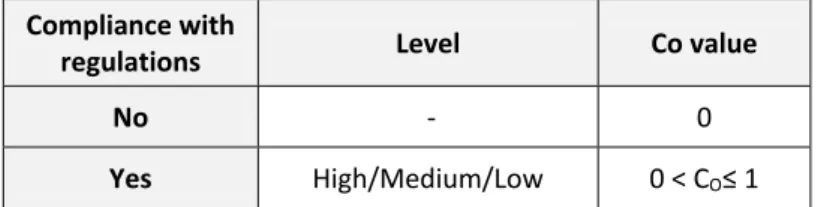
3.3.1 Level of compliance with the existing regulations (CO)
This factor describes the share of the total C&D waste market that follows the existing
regulations (table 3). The driver for not following regulations is to achieve a lower
economic cost for the disposal of the waste.
Compliance with
regulations Level Co value
No ‐ 0
Yes High/Medium/Low 0 < CO≤ 1
Table 3. Co value
3.3.2 Legal alternative cheaper destinations for the waste (AS)
AS is a determining factor that describes the share of C&D waste market for which legal
alternative solutions exist, that are cheaper than landfills. If such solutions exist the
amount of waste disposed in landfills will be reduced. However, if they are more
expensive than landfills they will not be established.
The alternative solutions may be found all over a country or only in certain areas or
regions, this fact can also limit the share that is caught by these legal alternative
3.4 Environmental factor
3.4.1 Environmental focus (ES)
For a certain share of the C&D waste, other factors will determine where the waste ends
up. Thus, there will be a certain amount of the waste owners that will decide to treat
waste in the most environmental friendly way no matter the cost, which generally will
drive to the recycling solution.
The waste owner may choose to disregard the cost and demand the recycling solution
due to general environmental or climate concerns or to requirements from the building
owner as a consequence of the wish to obtain certain environmental profile or fulfill the
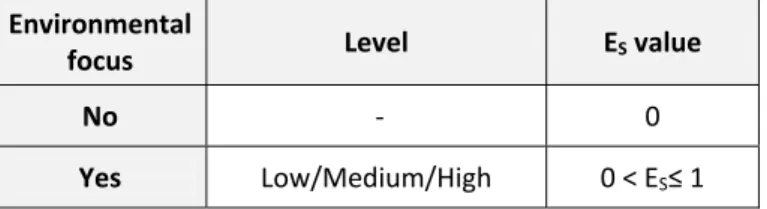
requirements in any existing environmental assessment tool. Thus, ES describes the share
of the C&D waste market, where environmental factors determine the destination of the
waste (table 4)
Environmental
focus Level ES value
No ‐ 0
Yes Low/Medium/High 0 < ES≤ 1
Table 4. ES value
4 Conclusion
A total of six factors that influence the existence of a market for C&D waste recycling
solutions have been identified with the aim of helping to detect the causes that limit the
recycling rate of C&D waste in a market and what can be done in order to improve the
factors, as well as the major sub‐factors and procedures for better estimating each value.
The combination of these factors into one single equation is being fine‐tuned and will
allow obtaining an estimation of the market share of C&D waste recycling solutions for a
region or country.
Acknowledgement
This study was drafted with results obtained under the framework of the GtoG project,
supported by the European Commission – DG Environment through the Life +
programme; under contract number LIFE11 ENV/BE/001039.
References
Lu, W., & Yuan, H. (2010). Exploring critical success factors for waste management in
construction projects of china. Resources, Conservation and Recycling, 55 (2), 201‐208.
Suttibak, S., & Nitivattananon, V. (2008). Assessment of factors influencing the
performance of solid waste recycling programs. Resources, Conservation and Recycling,
53 (1–2), 45‐56.
Wan, C., Shen, G. Q., & Yu, A. (2014). The role of perceived effectiveness of policy
measures in predicting recycling behaviour in Hong Kong. Resources, Conservation and
Recycling, 83, 141‐151.