Author(s): S. Talavera, F. Bastida, P. L. Ortiz, M. Arista
Source: International Journal of Plant Sciences, Vol. 162, No. 2 (March 2001), pp. 343-352
Published by: The University of Chicago Press
Stable URL: http://www.jstor.org/stable/10.1086/319573
.
Accessed: 25/10/2011 11:25
Your use of the JSTOR archive indicates your acceptance of the Terms & Conditions of Use, available at
.
http://www.jstor.org/page/info/about/policies/terms.jsp
JSTOR is a not-for-profit service that helps scholars, researchers, and students discover, use, and build upon a wide range of
content in a trusted digital archive. We use information technology and tools to increase productivity and facilitate new forms
of scholarship. For more information about JSTOR, please contact [email protected].
The University of Chicago Press is collaborating with JSTOR to digitize, preserve and extend access to
International Journal of Plant Sciences.
343
Int. J. Plant Sci. 162(2):343–352. 2001.
q2001 by The University of Chicago. All rights reserved. 1058-5893/2001/16202-0012$03.00
POLLINATOR ATTENDANCE AND REPRODUCTIVE SUCCESS IN
CISTUS LIBANOTIS
L. (CISTACEAE)
S. Talavera,1,
* F. Bastida,† P. L. Ortiz,* and M. Arista*
*Departamento de Biologı´a Vegetal y Ecologı´a, Universidad de Sevilla, Apdo. 1095, 41080 Sevilla, Spain; and †Departamento de Ciencias Agroforestales, Universidad de Huelva, Ctra. Palos s/n, 21071 Huelva, Spain
We studied pollen flow and reproductive success in two different-density stands ofCistus libanotis, a self-incompatible species. The pollinator spectrum comprised Hymenoptera, Coleoptera, and Diptera, but their relative frequencies at the flowers differed between stands. The pollen loads carried by insect visitors were from a considerable number of plant species (up to 11 species) apart fromC. libanotis. Hymenoptera showed the highest activity rate and the highest flower visitation rate and carried by far the highest number of both total pollen grains and C. libanotis pollen grains. These factors indicate that Hymenoptera are the most effective pollinators and the major contributors toC. libanotisreproductive success. Nevertheless, considering the insect species, a dipteran, the syrphidEristalis tenaxappears to be more effective than some Hymenoptera on the basis of itsC. libanotis–pollen carrying ability. Fluorescent dust dispersal indicated that the neighborhood area for pollen dispersal was different among stands and could change during the flowering season. Considering the reproductive output over the flowering season, differences in pollinator spectrum and in pollen flow among stands did not affect the reproductive success ofC. libanotisindividuals; both fruit and seed set were similar among stands.
Keywords: Cistus libanotis, bees, flies, pollen flow, pollen loads, reproductive success.
Introduction
In flowering plants, gene flow occurs through movement of pollen grains and seeds, with pollen flow often being the major component (Levin and Kerster 1974). In zoophilous plant spe-cies, the pattern by which pollen is deposited as a pollinator visits a sequence of flowers strongly influences pollen dispersal distances (Levin and Kerster 1974). Other factors that may affect dispersal include relative flowering time (Campbell 1985), pollen morphology (Heslop-Harrison 1981), flower density (Campbell and Waser 1989), and nectar production rates (Galen and Plowright 1985). Most of these factors affect pollinator attendance, which in turn influences dispersal (Craig 1989).
The distance moved by pollinators is often short (Levin and Kerster 1969; Fenster 1991), but pollen dispersal distance is greater because of pollen carryover (pollen from any single flower is not completely deposited on the next one in sequence; Kerster and Levin 1968; Thomson and Plowright 1980; Waser and Price 1983; Karron et al. 1995b). Different groups of flower visitors carry different amounts of pollen (Schemske and Horvitz 1984; C. M. Herrera 1987): for example, Hy-menoptera and other insects with long-haired bodies are ex-pected to carry greater amounts of pollen grains than others, such as beetles or flies (C. M. Herrera 1987; Pacini 1992). However, some bees and bumblebees move pollen into their pollen baskets, where it may no longer be available for pol-lination. In this way, the amount of pollen deposited by a
1Author for correspondence; e-mail [email protected].
Manuscript received June 2000; revised manuscript received September 2000.
flower visitor is highly variable and is dependent not just on the amount of pollen being carried but also on the length of the visit, the condition of the individual flower, and the be-havior of the pollinator during the visit (Pettersson 1991). The contribution to a plant’s reproductive success that a visitor makes is determined by both its effectiveness and its visitation rate (Motten et al. 1981). Pollinator effectiveness has been defined in different ways (see Inouye et al. 1994; i.e., effec-tiveness has been defined as the seed set resulting from a single visit [Beattie 1972]). The visitation rate of a pollinator depends on its abundance or frequency, i.e., the number of individual visitors in a plant population, and on the pollinator’s activity rate, i.e., the number of flowers each individual visits per unit time. Thus, a less abundant but very active visitor could ac-count for an equivalent visitation rate compared with that associated with a more abundant but less active visitor.
We examined pollen flow inCistus libanotisL. (Cistaceae) in southern Spain. The large, open flowers of this species, with large-area stigmata and numerous stamens, offer copious and accessible pollen and nectar (Ortiz 1994). We studied the fol-lowing: (1) flower visitors: spectrum, activity rates, visitation rates, foraging behavior, and the amount and quality of pollen grains they carried; (2) variation in pollen dispersal through the flowering period and among stands, and (3) the effect of these factors on the reproductive success ofC. libanotis.
Material and Methods
Study Site and Study Species
377189–377209N and long. 67309–67229W) in Huelva Province in southwest Spain. The climate is typically Mediterranean, with a mean annual temperature of 16.27C and mean annual rainfall of 563 mm. Vegetation in the study area consists of a mixed woodland of stone pine (Pinus pineaL.) and cork oak (Quercus suber L.). The shrub layer is composed mainly of Cistaceae [Cistus salvifolius L. and Halimium halimifolium (L.) Willk.], Lamiaceae (Rosmarinus officinalis L.), Legumi-nosae (Genista triacanthos Brot. and Cytisus grandiflorus Brot.), Myrtaceae (Myrtus communisL.), and Arecaceae ( Cha-maerops humilisL.).
The species studied,Cistus libanotis, is a shrub of 60–150 cm in height; this species is endemic to the southwest of the Iberian Peninsula. It is self incompatible (F. Bastida, unpub-lished data) and flowers in spring. The white flowers are ca. 30 mm in diameter, have about 70 stamens, and produce nectar that is accumulated in the stamen base. In our study period, the flowers lasted only a day: they opened at ca. 0900 hours, and between 1300 and 1800 hours (depending on pollination), the petals dropped and the sepals closed.
In the study area,C. libanotisis locally dominant and forms both dense and sparse stands. The study was conducted in two such stands ofC. libanotisof about 2000 m2each. The stands differed in plant density, 0.5 plants/m2versus 4.0 plants/m2, and were separated by a firebreak that was 15 m wide.
Insect Visitors
In 1996 in both stands, we monitored insect visitors to flow-ers by 15-min censuses separated by 45-min intervals through-out the day (from 0900 to 1500 hours) at two periods of flowering: middle season, when flower density is the highest (the peak of flowering), and late season, when flower density is much lower (the tail of flowering). Censuses were performed in plants of similar size in which the number of flowers was counted daily; the numbers of insect visits per census were expressed in terms of visits to 100 flowers in order to ho-mogenize the data. Thirty-one censuses were made at each density and flowering period; thus, a total of 31 h of censuses was made. When possible, we recorded activity rates (number of flowers that an individual insect visited per minute). For insects with very little activity, the rate was assigned to one or two discrete classes (!0.1 or ca. 0.1 flowers visited per minute).
Visitation rates were estimated in a relative fashion, we defined an index (IVR) accounting for the two components of the vis-itation rate of an insect species: its frequency at the flowers (F, number of individuals of an insect species relative to the total number of insects included in the census) and its mean activity rate (AR),I pF#AR. Insect behavior at the flowers
VR
was monitored to determine pollen or nectar foraging. We analyzed pollen carried on the bodies of floral visitors both qualitatively and quantitatively. Specialized pollen-carrying organs of Hymenoptera were separated before analysis, and pollen grains accumulated in these organs were not considered. For qualitative analysis, a small amount of stained glycerine jelly was pressed to all parts of the body of each insect under a binocular microscope. In the small Coleoptera, all pollen grains were removed in this fashion, thus allowing simultaneous quan-titative analysis. The jelly was transferred to a slide, melted, covered with a cover glass, and then sealed with paraffin. Pollen
grains were identified and counted, and the frequency of each pollen type was calculated. Identification was accomplished with the aid of a pollen key (Valde´s et al. 1987). The following terms were used for pollen grain frequencies: “predominant pol-len”—more than 45% of the pollen grains counted; “frequent pollen”—between 16% and 45% were counted; “rare len”—between 3% and 15% were counted; and “sporadic pol-len”—less than 3% of the pollen grains were counted (Louveaux et al. 1978). For quantitative analysis, other intact insects were used, except in the small Coleoptera (see above). Each insect was immersed in 2 mL of water-detergent solution for 24 h. Then each insect was energetically shaken to remove pollen, and the insect was removed. From each sample, 20 replicates of 5 mL were extracted, their pollen grains were counted, and the number was adjusted for the total volume.
Pollen Dispersal
Pollen dispersal distance was estimated using fluorescent dust, which is reported to mimic pollen grains closely in some systems (Stockhouse 1975; Waser and Price 1982; Webb and Bawa 1983; Waser 1988; Rademaker et al. 1997) and is thus of value for qualitative investigation on pollen dispersal (Thomson et al. 1986). Tracking of fluorescent dust was per-formed on 2 d at the peak and on 1 d at the tail end of the flowering season in 1996 and on 1 d at peak flowering in 1997. On each day, one source plant was selected from the center of each stand, and the stamens of its flowers were brushed with fluorescent dust. The number of brushed flowers was proportional to the flowering intensity; at peak flowering, about 60 flowers were brushed in each stand, and at the tail of flowering, about 25 were brushed. We censused all receptive flowers present at 2-m intervals, to a distance of 26 m from the source. Dust movements were tracked on pistils at the end of the day, just after flower petals fell. We excised samples of pistils at each 2-m interval in the four cardinal point directions. These pistils were examined in the laboratory under an ultra-violet lamp in order to calculate the proportion of flowers receiving fluorescent dust in each sample. From these data, we calculated the distribution of dispersal distances, taking into account the fraction of receptive flowers sampled at each dis-tance. We used this frequency distribution to calculate the axial variance of pollen dispersal, which is directly proportional to genetic neighborhood area (Crawford 1984; Parra et al. 1993). To calculate axial variance, we assumed that the radial distance to the source of a plant is the midpoint of the interval at which it was located.
Reproductive Success
TALAVERA ET AL.—POLLINATOR ATTENDANCE INCISTUS LIBANOTIS 345
Table 1
Number of Visitors per Census and per 100 Flowers at Peak and at Tail of Flowering in Low- and High-Density Stands ofCistus libanotis, Mean Activity Rates, Relative Visitation Rates, and Foraging Behavior
Visitors
Low-density stand High-density stand
Mean activity rate IVR
Foraging behavior
Peak Tail Peak Tail
Coleoptera:
Anthaxia nigritula 3 6 2 0 !0.1 !0.3 P
Cantharidae 6 11 5 1 Ca. 0.1 0.6 P
Exosoma lusitanica 24 40 23 7 Ca. 0.1 0.2 P
Heliotaurus rucicoides 3 7 3 0 Ca. 0.1 0.3 P
Oedemeridae 3 5 2 0 Ca. 0.1 0.2 P
Diptera:
Bombyliidae 0 0 2 0 4.5 51.5 (2) 2.3 N
Calliphoridae 2 6 0 4 0.9 50.3 (5) 2.5 N
Empidiidae 16 8 37 10 Ca. 0.1 1.7 N
Eristalis tenax 4 6 8 0 6.6 50.8 (13) 28.4 N
Muscidae 8 9 7 6 0.4550.05 (2) 3.6 N
Syrphidae 1 0 0 0 … … N
Hymenoptera:
Andrena nitidiuscula 5 5 0 0 1 (1) 2.4 P
Dasypoda altercator 13 14 12 5 13.3 50.8 (9) 138.3 P/N
Dasypoda crassicornis 8 12 4 3 25.7 51.4 (9) 164.5 P/N
Dasypodasp. 16 25 3 2 11.8 50.9 (9) 128.6 P/N
Halictussp. 0 8 0 0 40 (1) 76.0 P/N
Note. Np31censuses. Numbers in parentheses are sample sizes.IVRprelative visitation rates. Npnectar foraging; Pppollen foraging.
Results
Insect Visitors
The spectrum of visitors toCistus libanotisflowers was com-posed of Diptera (32%), Hymenoptera (32%), and Coleoptera (35%). However, Coleoptera remained for long periods on the same flower, so it is likely that some individuals were counted more than once, as censuses were carried out at 45-min in-tervals. Thus, the importance of this group may be overesti-mated.Exosoma lusitanicawas the most frequent Coleopter-ans. The Coleoptera observed foraged exclusively for pollen. The most frequent Dipterans were Empidiidae, Muscidae, and Syrphidae (predominantly Eristalis tenax), in that order. All the Diptera observed onC. libanotisflowers foraged for nectar. Despite the frequency ofEmpis, their behavior indicates that they are not pollinators. They are small and gain access to the nectar from the outer part of the stamens, only rarely touching the stigma. The only Hymenoptera visitingC. libanotisflowers were bees, and of these, three species were the most frequent: Dasypoda crassicornis, Dasypoda altercator, and Dasypoda sp. (table 1). Most Hymenoptera foraged both for nectar and pollen; the only exception was Andrena nitidiuscula, which gathered pollen exclusively. It has been observed that fre-quently bee visits were physically deterred byE. tenax.
Hymenoptera showed the highest mean activity rate (16.251.4flowers/min), followed by Diptera (3.750.7 flow-ers/min) and Coleoptera (ca. 0.1 flowflow-ers/min). However, marked differences were found within each insect order. Of the Diptera,E. tenaxand Bombyliidae were much more active than the rest, and among Hymenoptera, the activity rates of Halictussp. andD. crassicorniswere notably higher than those of the other bees (table 1).
Hymenoptera showed the highest visitation rates, measured
by theIVRindex, followed by Diptera.IVRvalues for Coleoptera were very low, as might be expected based on their low activity rates (table 1). In the low-density stand, Hymenoptera and Co-leoptera were more frequent on the flowers than Diptera, and the reverse was the case in the high-density stand (fig. 1); in this stand, E. tenaxwas very abundant, and thus, bees were fre-quently ousted from it. These differences between stands in the frequency distribution of insect visitors at the order level were very significant during both the peak (test for independence,
, , ) and the tail ( ,
2 2
x p15.13 P!0.001 dfp2 x p20.31 P!
, ) of flowering. Moreover, Hymenoptera were 0.001 dfp2
much more diverse in the low-density stand;A. nitidiusculaand Halictussp. visited only this stand (table 1). In the high-density stand, there was a general trend for the number of visits to decrease during the flowering period (x2 , ; fig.
p33.56 P!0.01
1), Calliphoridae being the sole exception (table 1). The opposite trend was found in the low-density stand ( 2 ,
x p9.12 P!
); again, some Diptera (Empidiidae andSyrphus) were the 0.01
exception.
Fig. 1 Number of insect visitors at peak and at tail of flowering in the high- and low-density stands ofCistus libanotisin 1996.
types) and Diptera (4.3 types; table 2). However, Oedemeridae (Coleoptera) andE. tenax (Diptera) carried as many pollen types as Hymenoptera. Most pollinators carried a predominant pollen type. About 79% of the Diptera analyzed carriedC. libanotis pollen as “predominant type”; this percentage de-creased to 66% in Coleoptera and to 35% in Hymenoptera (appendix).
Quantitative analyses showed that Hymenoptera carried by far the greatest number of pollen grains, with a mean of 16,713 grains (specialized pollen-carrying organs not considered), fol-lowing by Diptera (1589 grains) and Coleoptera (241 grains; table 2). Of these pollen grains, the proportion ofC. libanotis pollen was higher in Coleoptera and Diptera than in Hyme-noptera (table 2). However, although the proportion of pollen grains of other taxa was very high in Hymenoptera (64.7%), the total number of C. libanotis pollen grains was also the highest. Marked differences in the total number of pollen grains and in the fraction ofC. libanotispollen carried by the visitors were found within each insect group (table 2). Among Diptera, onlyE. tenaxcarried considerable numbers of pollen grains. The other Diptera carried numbers of pollen grains that were similar to, or even lower than, those of some Co-leoptera (table 2).
Pollen Dispersal
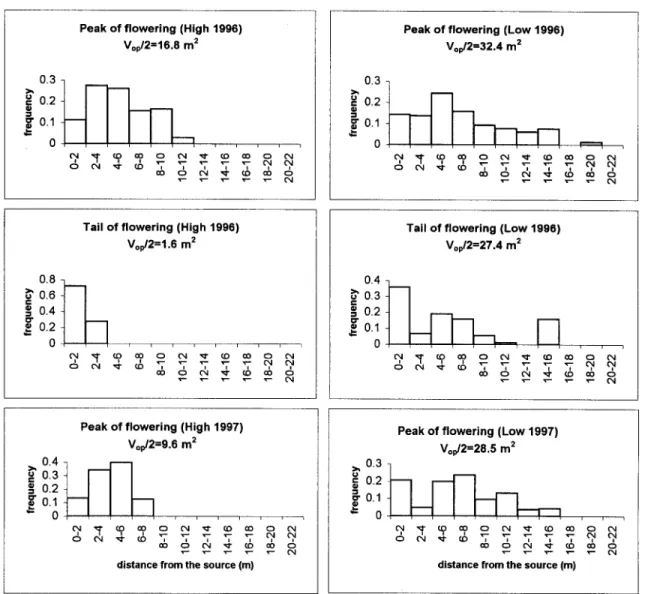
Axial variance of pollen dispersal, and thus genetic neigh-borhood area, was always higher in the low-density stand at both the peak and the tail of flowering (fig. 2). In the
low-density stand, axial variance showed little variation between the different periods studied, whereas in the high-density stand, axial variance was markedly variable, reaching the highest value at the peak of flowering season in 1996 and the lowest at the tail of flowering in 1996 (fig. 2).
Reproductive Success
Fruit set was quite high in all the plants, ranging from 69.5% to 87.8%. Both stands registered similar mean fruit set values, 81.3% in the low-density stand and 78.9% in the high-density stand (table 3). The number of ovules per capsule was mark-edly variable, ranging from five to 35. Among stands, the num-ber of ovules per capsule was similar, with a mean of about 20 ovules (table 3). Seed set (number of ovules that transform into seeds) was not apparently different among stands, aver-aging 83.9% in the high-density stand and 85.9% in the low-density stand.
Discussion
The interactions betweenCistus libanotisand insect polli-nators recorded in this study were generalist in nature; the plant species was visited by a variety of pollinating agents that in turn visited other species with diverse floral types. Moreover, the pollinator spectrum ofC. libanotisshowed local differences without variation in female fecundity. These results are in agreement with the idea that unspecificity of plant-pollinator systems seems to be a rule rather than an exception (Herrera 1995; Waser et al. 1996).
Pollinator spectra of otherCistusspecies have been studied in the Iberian Peninsula: Coleoptera, Diptera, and Hyme-noptera were always present, but their relative proportions were highly variable among species and sites (Brandt and Gottsberger 1988; Herrera 1988; Bosch 1992; Talavera et al. 1993). At two of these sites, Lepidoptera were also found, but in low proportion (Herrera 1988; Bosch 1992). We have not observed Lepidoptera onC. libanotisflowers, but their absence is possibly a consequence of the high nectar concentration of this species in our study site (170%; Ortiz 1994).
When excluding pollen types that potentially result from contamination, such as Pinus, the diversity of pollen types found on everyC. libanotispollinator may be attributable to two causes: the insect is visiting different flower species at the same time and/or some of these pollen types are leftover from flowers that were exploited earlier. We do not know the for-aging histories of insects, but it is probable that many if not all of the well-represented pollen types come from simulta-neously visited sources. It is remarkable that several Cistaceae are among the best-represented types. Cistaceae species have similar floral structures and flowering periods (J. Herrera 1987), so they may compete for the service of the same pol-linators (Levin and Anderson 1970; Mosquin 1971). When a pollinator is visiting a large number of heterospecific plants, pollen dispersal distances of a single species decrease (Camp-bell 1985). In this way, seasonal variation in plant species composition could cause fluctuation in the neighborhood areas during the flowering.
TALAVERA ET AL.—POLLINATOR ATTENDANCE INCISTUS LIBANOTIS 347
Table 2
Results of Qualitative and Quantitative Analyses of Pollen Carried on Bodies of Insect Visitors toCistus libanotisFlowers
Visitors
Mean number of pollen grains/individual
Pollen grains of
C. libanotis(%)
Pollen grains of other Cistaceae (%)
Other pollen
grains (%) Number of pollen types
Anthaxia nigritula 11 (1) 36.4 (1) 0 (1) 63.6 (1) 3 (1)
Cantharidae 102.5529.8 (4) 55.1516.7 (4) 30.6515.5 (4) 14.253 (4) 451.15 (4)
Exosoma lusitanica 406.25105.4 (6) 77.1510.2 (6) 6.653.2 (6) 16.357.6 (6) 4.350.73 (6)
Heliotaurus ruficollis 184.55113.5 (2) 49.6522.9 (2) 1953.5 (2) 31.4526.4 (2) 4.550.7 (2)
Oedemeridae 157.5546.5 (2) 61.8521.1 (2) 26.1518.9 (2) 12.152.2 (2) 6.550.7 (2) Total Coleoptera 241557 (15) 61.657.5 (13) 10.953 (13) 22.855.7 (13) 4.550.43 (15)
Bombyliussp. 69 (1) 70 (1) 23 (1) 7 (1) 4 (1)
Calliphoridae 738 (1) 76 (1) 22 (1) 2 (1) 5 (1)
Empissp. 3995167 (4) 89.453.5 (8) 7.552.8 (8) 351 (8) 2.850.42 (8)
Eristalis tenax 4672.851327 (6) 50.6514.2 (6) 42.2514 (6) 7.152.4 (6) 6.351.0 (6)
Muscidae 115568 (3) 67.6516.3 (3) 352.5 (3) 29.3514.6 (3) 3.350.4 (3)
Syrphussp. 196577 (5) 67.5517 (5) 25.4517.1 (5) 4.851.06 (5) 4.850.6 (5)
Total Diptera 1588.65596.6 (20) 71.155.9 (24) 20.553.6 (24) 7.852.4 (24) 4.350.4 (24)
Andrena nitidiuscula 5389 (1) 6 (1) 22 (1) 72 (1) 5 (1)
Dasypoda altercator 25,154522,160 (4) 34.5512.8 (8) 19.858.5 (8) 45.7514.4 (8) 5.750.8 (8)
Dasypoda crassicornis 14,890510,630 (2) 69.053.0 (2) 14.753.4 (2) 16.150.3 (2) 850 (2)
Dasypodasp. 30105470 (2) 15.553.5 (2) 33528 (2) 51.1524.5 (2) 850 (2)
Halictussp. 25,326 (1) 43 (1) 44 (1) 13 (1) 10 (1)
Total Hymenoptera 16,71358812 (10) 35.258.5 (14) 24.456.1 (14) 40.359.1 (14) 6.650.6 (14)
Note. In Hymenoptera, specialized pollen-carrying organs were not considered. In each case, the sample size is given between parentheses.
groups, but they carried more pollen ofC. libanotisthan Dip-tera, and much more than Coleoptera. The amount and quality of the pollen carried by insect visitors indicate that Hyme-noptera could be more effective as pollinators than Diptera and Coleoptera, as it has been reported previously in other plant-pollinator systems (Primack and Silander 1975; Ehren-feld 1979; O’Brien 1980; Hippa et al. 1981). In addition, Hymenoptera showed the highest flower visitation rate, both because of their high frequency at the flowers and their high activity rates. This fact, together with their high pollen-carrying performance, indicates that Hymenoptera are the ma-jor contributors to theC. libanotisreproductive success. How-ever, this ought to be taken cautiously because the effect of single visits on pollen deposition on stigmas also depends on insect behavior on the flowers. Moreover, the species within each insect group differed markedly. Taking into account the amount ofC. libanotispollen carried by each species,Halictus sp.,Dasypoda crassicornis, andDasypoda altercator, in that order, and, to a lesser extent,Eristalis tenax andDasypoda sp., can be considered the most effective pollinators. Thus, a dipteran (E. tenax) was more effective than some Hymenop-tera. In contrast, other Diptera, such as Muscidae, were as ineffective as some Coleoptera (e.g.,Exosoma lusitanica). Con-sidering visitation rates of each insect species, the same five species were the most important pollinators, but in a different order:D. crassicornis,D. altercator,Dasypodasp.,Halictus sp., andE. tenax. Thus, pooling data of individual species into order categories can distort the effects of a particular pollinator species on a plant’s reproductive success.
The pollinator spectrum was different in each stand, with Hymenoptera being more frequent in the low-density stand. Bee-mediated pollen dispersal is strongly correlated with plant spacing (Levin and Kerster 1969); therefore, in low-density stands, gene flow (via pollen) caused by Hymenoptera would be greater than in high-density stands. Although the
experi-mental design does not allow a test for any density effect, our results could be explained on the basis of differences in density of individuals among stands. In the low-density stand ofC. libanotis, axial variance for pollen dispersal, and thus neigh-borhood area, was greater than in the high-density stand. In the high-density stand, the main flower visitors were Dipterans; thus, the shorter distance of pollen dispersal could also be a result of this difference in the pollinator spectrum.
In the high-density stand, axial variance for pollen dispersal also changed over the season, and the neighborhood area reached the maximum size in middle season. In this case, the marked decrease of insect visits to flowers in late season could account for the short distance of pollen dispersal. In the low-density stand, reduction in the number of insect visits was not observed in late season, and, as would be expected, differences in axial variance for pollen dispersal between the peak and the tail of flowering were not pronounced. The decrease in the number of insect visits observed at late season in the high-density stand probably reflects a reduction in the absolute abundance of pollinators. This reduction could have also hap-pened in the low-density stand, but the very low density of flowers in this stand at this period could allow the maintenance of the number of visits to flowers.
Thus, identity and abundance of pollinators as well as flower density play significant roles in determining dispersal distances and, consequently, neighborhood areas, inC. libanotisstands. This fact is particularly important because seed dispersal inC. libanotisis extremely limited (F. Bastida, unpublished data), and so pollen flow appears to be the major component of gene flow in this species.
Fig. 2 Frequency distribution of flowers receiving fluorescent dust at different distances from the source plant in both high- and low-density stands ofCistus libanotisat peak and at tail of flowering in 1996 and at peak of flowering in 1997.Vop/2 is the axial variance for pollen dispersal.
dispersing to very short distances; thus, differences in repro-ductive success between densities resulting from biparental in-breeding could be expected. However, as far as can be inferred from our results, this species did not seem to discriminate between cross pollen on the basis of distance to source plants: fruit set, number of seeds per capsule, and seed set were fairly high in plants growing at low and at high densities. Similar results have been found in other self-incompatible species (Ell-strand et al. 1978; Watkins and Levin 1990). This contrasts with the results of many studies of insect-pollinated self-compatible species, in which a positive correlation between population density and outcrossing has been found (Van Treu-ren et al. 1993; Karron et al. 1995a); in these studies, the low outcrossing rates in sparse populations were attributable to the higher levels of geitonogamous pollinations, because for-aging pollinators tend to move short distances (Karron et al. 1995a). Negative effects of geitonogamy in self-incompatible species basically number two: reduced pollen dispersal and possibly reduced female fecundity resulting from the dilution
TALAVERA ET AL.—POLLINATOR ATTENDANCE INCISTUS LIBANOTIS 349
Table 3
Reproductive Characteristics of theCistus libanotisPlants in 1996
Characteristics
Low-density stand High-density stand
Mean5SE Range (n) Mean5SE Range (n)
Fruit set (%) 81.351.6 69.5–87.7 (10) 78.951.4 71.8–87.8 (10) No. ovules/capsule 20.050.4 16.3–23.6 (30) 19.950.5 13.6–28.9 (30) No. seeds/capsule 17.350.4 13.4–21.4 (30) 16.750.4 12.6–21.1 (30)
Seed set (%) 85.950.5 5.6–100 (30) 83.950.5 14.3–100 (30)
and similar between stands; that seems to indicate that there is no pollen limitation, as was also reported by J. Herrera (1987). These facts, taken together with the low number of ovules per flower, mean that interference by self pollen is prob-ably low. In fact, the effect of geitonogamy on female fecundity is most evident in pollen-limited populations (Snow 1982; Ga-len 1985).
The effect of a pollinator visit, from the plant’s perspective, is seed production, and this effect is a closer measure of plant fitness than is pollen deposition (Dieringer 1992). However, since seed set inC. libanotisseems not to be pollen limited, pollinator preferences probably have a larger impact on male reproductive success than on the female function of its her-maphroditic flowers. Thus, inC. libanotis, increasing distance
from the pollen source beyond the nearest neighbor does not significantly improve seed production but does increase gene flow via pollen.
Acknowledgments
We are grateful to C. O´ Toole and J. M. Mateo for Hyme-noptera and Coleoptera identification, respectively, and to Drs. N. Waser and P. E. Gibbs for helpful comments on the man-uscript. This research was supported by grant 4086 (Ayuda a los Grupos de Investigacio´n) from Junta de Andalucı´a and by the Spanish DGICYT (PB91-0070-C03-03) of the program “Flora Iberica.”
Appendix
Table A1
Pollen Grains Found on the Bodies of the Insects Analyzed Qualitatively
Insect visitor Predominant pollen Frequent pollen Rare pollen Sporadic pollen
Anthaxia nigritula … Cistus libanotis,
Echium plantagineum
Lactuceae …
Cantharidae C. libanotis Cistus ladanifer Pinus pinea …
Cantharidae C. libanotis C. ladanifer P. pinea …
Cantharidae Tuberaria guttata C. ladanifer C. libanotis,
Ranunculus parviflorus,Carduus meonanthus
Cistus salvifolius,P. pinea
Cantharidae C. libanotis … P. pinea C. ladanifer
Exosoma lusitanica C. libanotis Lactuceae C. ladanifer,C.
meonanthus
…
E. lusitanica C. libanotis … … P. pinea
E. lusitanica C. libanotis … C. ladanifer C. meonanthus,P.
pinea
E. lusitanica C. libanotis … C. ladanifer P. pinea, Lactuceae,C.
meonanthus
E. lusitanica … C. libanotis,C.
ladanifer, Lactuceae
… C. salvifolius,R.
parviflorus,P. pinea,
C. meonanthus
E. lusitanica C. libanotis … Lactuceae C. ladanifer,P. pinea
Heliotaurus ruficollis E. plantagineum C. libanotis C. salvifolius,
Lactuceae
C. ladanifer
H. ruficollis C. libanotis … C. ladanifer,C.
salvifolius
P. pinea
Oedemeridae C. libanotis … C. salvifolius,
Brassicaceae
(Continued)
Insect visitor Predominant pollen Frequent pollen Rare pollen Sporadic pollen
Oedemeridae … C. libanotis,C.
ladanifer
C. salvifolius,T. guttata,C. meonanthus,
Eucalyptussp.
P. pinea
Bombylius C. libanotis C. ladanifer P. pinea C. meonanthus
Calliphoridae C. libanotis C. ladanifer … Quercus suber,C.
meonanthus,P. pinea
Empis C. libanotis C. salvifolius C. meonanthus C. ladanifer
Empis C. libanotis … … C. ladanifer,P. pinea
Empis C. libanotis … … …
Empis C. libanotis … C. ladanifer,C.
salvifolius
P. pinea
Empis C. libanotis … … P. pinea
Empis C. libanotis … … P. pinea
Empis C. libanotis … C. ladanifer Q. suber
Empis C. libanotis … T. guttata, Liliaceae C. meonanthus
Eristalis tenax C. ladanifer C. libanotis C. salvifolius,C.
meonanthus
P. pinea
E. tenax … C. libanotis,C.
salvifolius,C. ladanifer
… C. meonanthus,P.
pinea
E. tenax C. ladanifer C. libanotis,C.
salvifolius
… C. meonanthus,P.
pinea,Silene scabriflora
E. tenax C. libanotis … C. salvifolius R. parviflorus,T.
guttata,E. plantagineum, Lactuceae
E. tenax C. libanotis … C. ladanifer,C.
salvifolius, Lactuceae,
C. meonanthus,R. parviflorus
Q. suber,S. scabriflora,
E. plantagineum,
Campanulasp.,P. pinea
E. tenax C. libanotis … C. ladanifer P. pinea,C.
meonanthus,
Lavandula stoechas
Muscidae C. libanotis … … C. ladanifer,P. pinea
Muscidae C. libanotis S. scabriflora … E. plantagineum
Muscidae … C. libanotis,E.
plantagineum
Halimium halimifolium, Lactuceae
…
Syrphus C. ladanifer … Lactuceae C. libanotis,P. pinea,
E. plantagineum
Syrphus C. libanotis … … C. salvifolius,
Brassicaceae,P. pinea
Syrphus C. libanotis … C. ladanifer,C.
salvifolius,P. pinea
…
Syrphus C. libanotis … C. ladanifer Campanulasp.,E.
plantagineum
Syrphus C. libanotis C. ladanifer C. meonanthus C. salvifolius,E.
plantagineum,Q. suber,Eucalyptussp.
Andrena nitidiuscula E. plantagineum T. guttata C. libanotis,C.
ladanifer
Campanulasp.
Dasypoda altercator C. libanotis … C. meonanthus C. ladanifer,C.
salvifolius,S. scabriflora,E. plantagineum, Lactuceae,P. pinea
D. altercator … C. libanotis,C.
ladanifer,C. salvifolius
… P. pinea,C.
TALAVERA ET AL.—POLLINATOR ATTENDANCE INCISTUS LIBANOTIS 351
Table A1
(Continued)
Insect visitor Predominant pollen Frequent pollen Rare pollen Sporadic pollen
D. altercator E. plantagineum … … C. libanotis,C.
ladanifer, Lactuceae
D. altercator H. halimifolium Lactuceae C. libanotis,E.
plantagineum
R. parviflorus,C. meonanthus
D. altercator E. plantagineum H. halimifolium C. libanotis C. ladanifer,Lactuceae,
Poaceae,C. meonanthus,P. pinea
D. altercator C. libanotis … C. ladanifer C. salvifolius,
Rosmarinus officinalis,P. pinea
D. altercator C. libanotis C. meonanthus C. salvifolius,
Lactuceae
C. ladanifer,P. pinea
D. altercator Lactuceae … … C. libanotis
Dasypoda crassicornis C. libanotis … C. ladanifer,C.
salvifolius,C. meonanthus,R. officinalis
P. pinea, Lactuceae,E. plantagineum
D. crassicornis C. libanotis C. ladanifer C. meonanthus C. salvifolius,P. pinea,
H. halimifolium, Lactuceae,E. plantagineum
Dasypodasp. C. ladanifer … C. libanotis, Lactuceae C. salvifolius,T.
guttata,Q. suber,P. pinea,Campanulasp.
Dasypodasp. Lactuceae C. libanotis C. ladanifer,E.
plantagineum,P. pinea
T. guttata,L. stoechas,
Chamaerops humilis
Halictus … C. libanotis,C.
ladanifer
C. salvifolius,S. scabriflora
T. guttata,E. plantagineum, Lactuceae,P. pinea,
C. meonanthus,Q. suber
Note. A pollen type was “predominant” when it represented more than 45% of the total number of counted pollen grains, “frequent” when it represented between 16% and 45% of grains, “rare” when it represented between 3% and 15% of grains, and “sporadic” when it represented less than 3% of grains.
Literature Cited
Beattie AJ 1972 The pollination ecology ofViola. 2. Pollen loads of insect-visitors. Wasting 9:13–25.
Bosch J 1992 Floral biology and pollinators of three co-occurring
Cistusspecies (Cistaceae). Bot J Linn Soc 109:39–55.
Brandt U, G Gottsberger 1988 Flower phenology, pollinating insects and breeding systems inCistus,HalimiumandTuberariaspecies in Portugal. Lagascalia 15:625–634.
Campbell DR 1985 Pollen and gene dispersal: the influences of com-petition for pollination. Evolution 39:418–431.
Campbell DR, NM Waser 1989 Variation in pollen flow within and among populations ofIpomopsis aggregata. Evolution 43:1444–1455. Craig JL 1989 Seed set inPhormium: interactive effects of pollinator behaviour, pollen carryover and pollen source. Oecologia 81:1–5. Crawford TJ 1984 The estimation of neighbourhood parameters for
plant populations. Heredity 52:273–283.
Dieringer G 1992 Pollinator effectiveness and seed set in populations ofAgalinis strictifolia(Scrophulariaceae). Am J Bot 79:1018–1023. Ehrenfeld JG 1979 Pollination of three species ofEuphorbiasubgenus
chamaesycewith special reference to bees. Am Midl Nat 101:87–98. Ellstrand NC, AM Torres, DA Levin 1978 Density and rate of
ap-parent outcrossing inHelianthus annuus(Asteraceae). Syst Bot 3: 403–407.
Erdtman G 1945 Pollen morphology and taxonomy. III.MorinaL. with an addition on pollen-morphological terminology. Sven Bot Tidskr 39:187–191.
Fenster CB 1991 Gene flow in Chamaecrista fasciculata (Legumi-nosae). I. Gene dispersal. Evolution 45:298–409.
Ferna´ndez I, PL Ortiz 1987 Cistaceae. Pages 135–143inB Valde´s, MJ Dı´ez, I Ferna´ndez, eds. Atlas polı´nico de Andalucı´a Occidental. Instituto de Desarrollo Regional. Universidad de Sevilla, Sevilla. Galen C 1985 Regulation of seed set onPolemonium viscosum: floral
scents, pollination and resources. Ecology 66:792–797.
Galen C, RC Plowright 1985 The effects of nectar level and flower development on pollen carry-over in inflorescences of fireweed ( Epi-lobium angustifolium) (Onagraceae). Can J Bot 63:488–491. Herrera CM 1987 Components of pollinator “quality”: a
compara-tive analysis of a diverse insect assemblage. Oikos 50:79–90. ——— 1995 Floral traits and plant adaptation to insect pollinators:
Herrera J 1987 Biologı´a reproductiva de algunas especies del mator-ral de Don˜ana. Ann J Bot Madrid 44:483–497.
——— 1988 Pollination relationships in southern Spanish Mediter-ranean shrublands. J Ecol 76:274–287.
——— 1992 Flower variation and breeding systems in Cistaceae. Plant Syst Evol 179:245–256.
Heslop-Harrison J 1981 Stigma characteristics and angiosperm tax-onomy. Nord J Bot 1:401–420.
Hippa H, S Koponen, O Osmosen 1981 Pollen transport and polli-nating efficiency of flower visitors to the cloudberry (Rubus cha-maemorusL.) in northern Fennoscandia. Rep Kevo Subarct Res Stn 17:58–66.
Inouye DW, DE Gill, MR Dudash, CH Fenster 1994 A model and lexicon for pollen fate. Am J Bot 81:1517–1530.
Karron JD, NN Thumser, R Tucker, AJ Hessenauer 1995a The influ-ence of population density on outcrossing rates inMimulus ringens. Heredity 75:175–180.
Karron JD, R Tucker, NN Thumser, JA Reinartz 1995b Comparison of pollinator flight movements and gene dispersal patterns in Mi-mulus ringens. Heredity 75:612–617.
Kerster HW, Levin DA 1968 Neighborhood size inLithospemum car-oliniense. Genetics 60:577–587.
Levin DA, WW Anderson 1970 Competition for pollinators between simultaneously flowering species. Am Nat 194:455–467.
Levin DA, HW Kerster 1969 The dependence of bee-mediated pollen and gene dispersal upon plant density. Evolution 23:560–571. ——— 1974 Gene flow in seed plants. Evol Biol 7:139–220. Louveaux J, A Maurizio, G Vorwohl 1978 Methods of
melissopal-ynology. Bee World 59:139–157.
Mosquin T 1971 Competition for pollinators as a stimulus for evo-lution of flowering times. Oikos 22:398–402.
Motten AF, DR Campbell, DE Alexander, HL Miller 1981 Pollination effectiveness of specialist and generalist visitors to a North Carolina population ofClaytonia virginica. Ecology 62:1278–1287. O’Brien MH 1980 The pollination biology of a pavement plain:
pol-linator visitation patterns. Oecologia 47:213–218.
Ortiz PL 1991 Melitopalinologı´a en Andalucı´a Occidental. Univer-sidad de Sevilla, Sevilla.
——— 1994 The Cistaceae as food resources by honey bees in SW Spain. J Apic Res 33:136–144.
Pacini E 1992 Seduction and deception in pollen and seed dispersal. G Bot Ital 126:161–168.
Parra V, CF Vargas, LE Eguiarte 1993 Reproductive biology, pollen and seed dispersal, and neighborhood size in the hummingbird-pollinatedEcheveria gibbiflora(Crassulaceae). Am J Bot 80:153–159. Pettersson MW 1991 Pollination by a guild of fluctuating moth pop-ulation: option for unspecialization in Silene vulgaris. J Ecol 79: 591–604.
Primack RB, JA Silander Jr 1975 Measuring the relative importance of different pollinators to plants. Nature 255:143–144.
Rademaker MCJ, TJ de Jong, PGL Klinkhamer 1997 Pollen dynamics of bumble-bee visitation onEchium vulgare. Funct Ecol 11:554–563. Schemske DW, CC Horvitz 1984 Variation among floral visitors in pollination ability: a precondition for mutualism specialization. Sci-ence 225:519–521.
Snow AA 1982 Pollination intensity and potential seed set in Passi-flora vitifolia. Oecologia 55:231–237.
Snow AA, TP Spira, R Simpson, RA Klips 1996 The ecology of gei-tonogamous pollination. Pages 191–216inDG Lloyd, SC Barrett, eds. Floral biology. Chapman & Hall, New York.
Stockhouse RE 1975 A new method for studying pollen dispersal us-ing micronized fluorescent dusts. Am Nat 96:241–245.
Talavera S, PE Gibbs, J Herrera 1993 Reproductive biology ofCistus ladanifer(Cistaceae). Plant Syst Evol 186:123–134.
Thomson JD, RC Plowright 1980 Pollen carryover, nectar rewards and pollinator behaviour with special reference toDiervilla lonicera. Oecologia 46:68–74.
Thomson JD, MV Price, NM Waser, DA Stratton 1986 Comparative studies of pollen and fluorescent dye transport by bumble bees vis-itingErythronium grandiflorum. Oecologia 69:561–566.
Valde´s B, MJ Dı´ez, I Ferna´ndez 1987 Atlas polı´nico de Andalucı´a Occidental. Instituto de Desarrollo Regional. Universidad de Sevilla, Sevilla.
Van Treuren R, R Bijlsma, NJ Ouborg, W Van Delden 1993 The effects of population size and plant density on outcrossing rates in locally endangeredSalvia pratensis. Evolution 47:1094–1104. Waser NM 1988 Comparative pollen and dye transfer by pollinators
ofDelphinium nelsonii. Funct Ecol 2:41–48.
Waser NM, L Chittka, MV Price, NM Williams, J Ollerton 1996 Generalization in pollination systems, and why it matters. Ecology 77:1043–1060.
Waser NM, ML Fugate 1986 Pollen precedence and stigma closure: a mechanism of competition for pollination betweenDelphinium nelsoniiandIpomopsis aggregata(Polemoniaceae). Oecologia 70: 573–577.
Waser NM, MV Price 1982 Experimental studies in pollen carryover: effects on floral variability inIpomopsis aggregata. Oecologia 62: 262–268.
——— 1983 Optimal and actual outcrossing in plants, and the nature of plant-pollinator interaction. Pages 341–359inCE Jones, RJ Little, eds. Handbook of experimental pollination biology. Van Nostrand, New York.
——— 1991 Reproductive costs of self-pollination inIpomopsis ag-gregata (Polemoniaceae): are ovules usurped? Am J Bot 78: 1036–1043.
Watkins L, DA Levin 1990 Outcrossing rates as related to plant den-sity inPhlox drummondii. Heredity 65:81–90.