12th WCTR, July 11-15, 2010 – Lisbon, Portugal
1
THE SPANISH TERRITORIAL CONTEXT: AN ANALYSIS IN LIGHT OF THE EUROPEAN URBAN SUSTAINABLE MOBILITY PLANS
MARÍA EUGENIA LÓPEZ-LAMBAS, CRISTINA LÓPEZ-GARCÍA DE LEÁNIZ TRANSYT-Universidad Politécnica de Madrid [email protected]; [email protected]
ABSTRACT
The current land use patterns (low-density, sprawl, etc.) and their impacts on transport and mobility force to the implementation of Urban Sustainable Mobility Plans (USMP) as a strategy to achieve urban sustainable mobility. Those plans already existing in some European countries have been recently implemented in Spain; however, since the core of those strategies lays on the territorial and administrative structure of each country, this is the main aspect that the authors have examined, together with the impact of different policy documents from the European Commission (Action Plan on Urban Mobility, Urban Environment Strategy, etc.)
So, in this paper the authors have analyzed the territorial and administrative contexts from countries that could be considered as pioneers in the adoption of USMP, and the role that both mobility and transport issues play on them (if so) and, hence, into the barriers and constraints to implement those plans. Given their similar government structure Italy and Spain are the cases finally selected to make a comparison.
To do so, the legal competencies on land use and mobility of the different levels of authorities, have been analyzed showing, in the Spanish case at least, the lack of integration of the USMP in the land use planning, with a remarkable exception: the Law on mobility of the Catalonian regional government. The Italian case, being different since the integration is well defined in the legal realm, fails into practice due in part to the many sectoral planning regulations.
As main conclusions, the authors outline the most significant barriers for the implementation of USMP, the need of a compulsory framework to develop integrated land use/transport strategies, the problems that the so called subsidiarity principle entails since this process should be leaded by the highest institutional levels (European Union and National Governments), and some feasible actions that could be taken from the different administrative levels to overcome these constraints.
12th WCTR, July 11-15, 2010 – Lisbon, Portugal
2
1. INTRODUCTION
“Urbanisation has been a clear trend in the past decades and is expected to continue, with the proportion of European population residing in urban areas increasing from72% in 2007 to 84% in 2050. The proximity of people and activities is a major source of advantages that drive urbanisation. However, in the past 50 years, the growth of urban areas across Europe was even larger than that of the resident population. This urban sprawl is the main challenge for urban transport, as it brings about greater need for individual transport modes, thereby generating congestion and environmental problems” (COM 2009) 279.
Prior to this statement, in May 2007 the Leipzig Charter on Sustainable European Cities was signed with the aim to improve the policy setting for integrated urban development, with a particular focus on deprived communities. To achieve suchoverarching objective would be necessary to strengthen the coordination at local and city-regional level, as well as getting to all stakeholders (economic agents, citizens, etc) involved.
The Chart emphasized the need to improve the quality of life and the environment through sustainable, accessible and affordable urban transport, with coordinated links to the city-regional transport networks; this is, exactly, one of the main objectives of the Urban Sustainable Mobility Plans (USMP).Such willingness found in the Spanish Law 2/2008, on Land Planning, since, for the first time, a national law states the principle of urban and regional sustainable development (art. 2).
There are other documents inspired by the same principles, among them the EC’s
Thematic Strategy on the Urban Environment (COM 2005), where the role of the urban areas in order to fulfill the UE’s sustainable development strategy is clearly remarked. In fact, this Green Paper also stresses a range of problems, from poor air quality, congestion, noise, poor quality built environment, green house gas emissions, etc., to urban sprawl, as the main consequences of a way of life strongly dependent on private car and fossil fuels, exhorting local authorities to implement USMP.
More recently, the EC has launched its Action Plan on Urban Mobility (COM 2009 490), aiming at applying different measures on urban mobility from 2009 to 2012, starting with a strong will to designing USMP, first helping local authorities in measure implementation them and then, and then focusing on develop regional strategic objectives.
12th WCTR, July 11-15, 2010 – Lisbon, Portugal
3
and challenges, such as reduce the negative externality effects of transport on the urban environment1.
In this context an USMP provides cities with a planning tool found by a set of actions aiming at the implementation of more sustainable ways of travelling into the city (i.e: walking, cycling and public transport). These transport modes make compatible economic growth with social cohesion and environment protection, guaranteeing a better quality of life for all2. So, USMPs are an effective instrument to curve the damaging effects of the current urban mobility trends.
This paper has explored different approaches in Europe on this matter, finding a common starting point: a previously existing legal framework, most limited in the Spanish case.
COUNTRY LAW YEAR INSTRUMENT
France LOTI (Loi d’Orientation des Transports
Intérieurs)
1982 PDU (Plans de Déplacements
Urbains)
UK Transport Act 2000 LTP (Local Transport Plans)
Italy Legge 340/2000 (Disposizioni per la
delegificazione di norme e per la
semplificazione di procedimenti
amministrativi)
2000 PUM (Piano Urbano della
Mobilità)
Table 1: Legal framework in several European countries
After the analysis, a first conclusion has emerged: the lack of accountability regarding the funding, together with a poor statutory development seems to be on the basis of the slow implementation of such these plans.
The authors have chosen the cases of Italy and Spain since they both a decentralized have similar territorial and administrative regulatory environment.
2. NEED FOR AN INTEGRATED LAND-USE AND TRANSPORT POLICY
Regardless of the negative impacts of urban mobility, it can not be ignored that around 85% of the EU’s GDP is generated in cities, since urban areas are key to growth and employment.
1
According to the EC, urban transport accounts for 40% of CO2 emissions and 70% of emissions of other pollutants arising from road transport (COM 2009) 279.
12th WCTR, July 11-15, 2010 – Lisbon, Portugal
4
To make compatible sustainable mobility (or transport) with urban competitiveness, there is no other way than to find out policies from the land- use side, to help decision makers cope with the increasing negative transport impacts (NZTA, 2008); policies such as:
- Parking regulation and management: Removal of Minimum parking requirements with public parking priced to reflect the underlying land value and demand.
- Flexible zoning and urban containment: Applied to discourage development in isolated and distant areas until such time as transport costs are directly and efficiently charged to users.
- Development
incentives: To stimulate
development in identified growth areas.
- Urban renewal and Transit Oriented Development (TOD): Facilitated through increased investment and / or reduced compliance costs.
12th WCTR, July 11-15, 2010 – Lisbon, Portugal
5
interactions between transport and land use, and the timescale for implementing innovative solutions”.
The EC’s Action Plan on Urban Mobility (2009) is a good step towards this direction. The Plan proposes twenty measures to encourage and help local, regional and national authorities in achieving their goals for sustainable urban mobility in order to facilitate their policy making. The proposal regarding planning is quite simple: integrated planning can provide adequate to the many mobility challenges that cities are currently facing. For a better understanding of the problem and to facilitate the take up of quick responses, the Commission is preparing information material and launching promotional activities over the next four years. In 2012 it will conduct a review of the implementation of this Action Plan as well as an assessment of the need for further action.
3. THE SPANISH CONTEXT FOR MOBILITY AND TOWN PLANNING
The XXI century claims for a major dynamism in passenger and freight transport. In this sense, what always was considered as a vantage for the urban development and citizen’s quality of life, is more and more becoming one of their main threats, and nowadays most cities suffer from environmental problems, such as poor air quality, congestion, noise, urban sprawl, waste, etc., in a great deal due to transport.
Local administration plays a significant role in improving the urban environment; but any isolated action is not relevant if not followed by other ones at a highest level, such as regional or national.
This is why all the mobility policies should not keep confined to just one administration’s domain and get the citizen’s support. Land Planning Authorities are those with higher possibilities to act in this field, together with those of transport, since it is from the land use planning where the city model is defined. In fact, land use and mobility is the core of SUMPs (Sustainable Urban, called LTPs – Local Transport Plans – in the UK, PDUs – Plans de Déplacements Urbains – in France, PUMs – Piano Urbano della Mobilità – in Italy and PMUSs – Planes de Movilidad Urbana Sostenible – in Spain); all of them (except this last as we will further explain) legally bounded by a key feature in common: the coherence with national/regional strategies.
Nevertheless, the different territorial organization (as well as administrative) of these four approaches, has led us to constrain the analysis to Italy and Spain, since both countries seem to have a more similar decentralized territorial division.
12th WCTR, July 11-15, 2010 – Lisbon, Portugal
6
- European Union
- National Government
- Autonomous Regions (AR): 17, plus two autonomous cities (Ceuta and Melilla, in the North of Africa)
- Local Administration: 50 provinces and more than 8,000 municipalities.
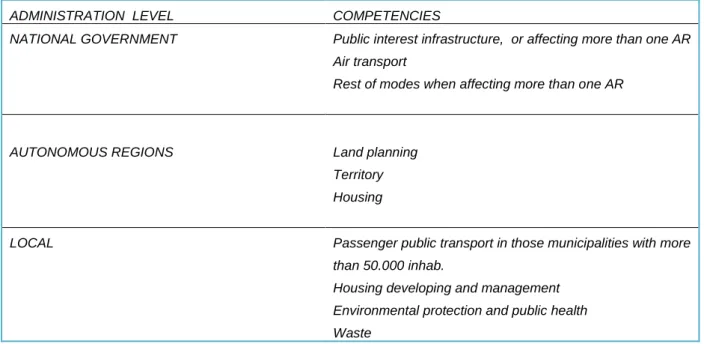
Under this constitutional umbrella, all those competencies not specifically attributed to the State, are assigned to the AR, according to their Statute of Autonomy. All those competencies not assumed by those statutes are developed by the national rules, under the principle of subsidiarity.
ADMINISTRATION LEVEL COMPETENCIES
NATIONAL GOVERNMENT Public interest infrastructure, or affecting more than one AR
Air transport
Rest of modes when affecting more than one AR
AUTONOMOUS REGIONS Land planning
Territory Housing
LOCAL Passenger public transport in those municipalities with more
than 50.000 inhab.
Housing developing and management
Environmental protection and public health Waste
Table 2: Territorial competencies by administration level
3.1. National Government
In April 2009, the Spanish Sustainable Mobility Strategy has been passed. This policy document contains a number of action proposals to be adopted by the Public Administration, private companies, social agents and citizenship in general, with the aim to bring about a change in the current mobility model towards a more efficient and sustainable one.
These proposals will mainly focus on the transport, land use and energy planning processes given their direct effect on mobility. To do so, a development of the basic legislation on the sustainable mobility principles will be promoted.
12th WCTR, July 11-15, 2010 – Lisbon, Portugal
7
- Creation of the Sustainable Mobility Committee, a consultant, advisor and cooperation body for all the mobility stakeholders. Among its functions, to coordinate of the Public Administrations, to evaluations the actions adopted, and to inform about any legal project affecting mobility.
- The promotion of Sustainable Mobility Plans, according to the Spanish Sustainable Mobility Strategy, as the only way to be eligible for public funding to support public transport system.
- The promotion of Green Transport Plans to foster the use of public transport and sustainable mobility among the employees.
- The promotion of clean road transport, by applying specific rules for the acquisition of clean and energetically efficient vehicles by the Public Administrations.
- The promotion of the electric car usage.
- The adjustment of the basic freight railway network to make feasible the circulation of trains with at least 750 m length, and the improvement of the road and railway connections with the ports of public interest.
As it will be shown, most of the land use regulations keep on decoupling land use planning and mobility, despite the fact that the last National Law (RDL 2/2008, June 20th) claims for sustainable development as its main goal: “An urban environment where the land occupation is efficient, with infrastructures and services enough, and where land uses be combined and implemented in a functional way, as they fulfill a social function” (art. 2.2.c)
3.2. Autonomous Regions (AR)
Currently, except for Baleares, the rest of the Autonomous Regions have passed its own land use planning Law. They have the competence to approve the Land Use Master Plan, where the model of the city to be developed is defined. In addition, the environmental agency supervising the compliance with sustainable urban development depends on the AR as well.
12th WCTR, July 11-15, 2010 – Lisbon, Portugal
8
REGION LAW ARTICLE CONTENT
Madrid Ley 9/2001, de 17 de julio, del Suelo
Art. 48.2. The Partial Development Plan for the programmed urban land must include specific studies for the
connection, enlargement o strengthening of each one infrastructure, facilities, local and supra local public services for the future population…,urban and regional public transport by road or railway….
Cataluña Ley 2/2002, de 14
de marzo, de urbanismo
Art. 56.1.b) Urban Master Plans.[….] must include guidelines
on urban sustainable development, mobility of people and goods and public transport
Art. 66.1.g) Partial Development Plans must justify the compliance with the general land use planning on
sustainable mobility.
País Vasco Ley 2/2006, de 30
de junio, de Suelo y Urbanismo
Art. 3.3. c) The town planning will assume as guidance criterion…..a) a sustainable land cover oriented to
revamping and reusing, as well as the utilization of
empty houses better than new developments ,avoiding zoning and sprawl…aiming to reduce mobility generation…b)Sustainable mobility
oriented to reduce the unnecessary use of motor
vehicles, giving priority to all those modes environmentally friendly, through an integrated
planning
Castilla- León Ley 4/2008, de 15 de septiembre, de
Medidas sobre Urbanismo y Suelo
Art. 36.2.a) In urban and programmed urban land, the
thoroughfare network will be designed according to
the public transport and pedestrian routes need.
Aragón Ley 3/2009, de 17
de junio, de Urbanismo
Art. 24.c) In not consolidated urban and programmed urban land, developers must [….] afford and implement, where appropriate….public transport
infrastructures to guarantee a sustainable mobility according to the traffic generated.
12th WCTR, July 11-15, 2010 – Lisbon, Portugal
9
Specifically regarding mobility, only the Catalonian Government has passed a Law (9/2003), which really aims at integrating land use planning and sustainable urban development. The law’s objectives are the following (art. 3):
- To integrate economic and urban development policies and mobility policies, in order to minimize the number of trips, guaranteeing the accessibility to the work places, home and other culture, leisure, social, health, etc. places, at the least environmental cost possible.
- To plan and implement infrastructures and transport services under sustainability criterion
- To link land use planning with the public transport supply.
Its aims and principles could be resumed as follows:
- To develop a sustainable development model to allow the citizens a high level of quality of life
- An integrated vision of the mobility, giving the priority to the more sustainable means: public transport, bike, pedestrian, complementarily to the rational use of the private car
- To foster intermodality, to maximize the efficiency of the transport resources
- To minimize energy and land consumption
- To promote the use of ITS
3.3. Municipalities
Local Governments design the Land Use Master Plan (so called General Plan), which has to be approved by the AR. Each General Plan defines the territorial model of the municipality and establishes the land use regime.
Additionally, Local Governments are entitled for zoning in detail (Plan Parcial), so they decide the location, intensity and typology of the land uses, as well as the road network and parking policy. In other words, they rule on the urban space organization and mobility demand (in fact, they elaborate and implement the Sustainable Urban Mobility Plans) (POZUETA, 2000).
Hierarchically speaking, the last link in the chain of the mobility planning is the Urban Mobility Plan, compulsory for those municipalities with more than 100,000 inhabitants and to be updated every 6 years.
12th WCTR, July 11-15, 2010 – Lisbon, Portugal
10
On the contrary, Cataluña has created the so called Consorcio del Área Metropolitana de Barcelona (Barcelona Metropolitan Area Consortium), made up of the Association of Municipalities of the Barcelona Metropolitan Area, the Metropolitan Transport Authority and the Metropolitan Environmental Authority. The Consortium shares a common territorial space, densely populated, with open spaces, services and infrastructures of intense use.
So, the authors have considered Cataluña a good case study to develop what the aim and scope of this paper is, despite the fact that there are not yet consolidated results since the measures have only been recently launched.
3.4. The Catalonian Autonomous Region
The basic pillars of Cataluña’s mobility are as follows:
INSTRUMENT
OBJECTIVE
PLANNING
Regional Mobility Guidelines
(DRM)
Set up criteria, time
objectives, proposal and
performance indicators
Master Mobility Plan (PDM)
Territorial development of
the DRM
Urban Sustainable Mobility Plan
(PUM)
To shape the municipalities’
Sustainable mobility policy
MANAGEMENT
Territorial Mobility Authorities
(ATM)
Elaborate and manage the
PDM
MONITORING
Catalonian Mobility Observatory
Gather and dissemination of
mobility information
PARTICIPATION Territorial Mobility Board
Advisory and participation
body
Table 4: Cataluña’s main mobility planning instruments
The so called DRM3 was passed by the 362/2006 Decree, and its main objective is the improvement of competitiveness, the increase of the social inclusion (through the universal accessibility concept) and the increase of the quality of life. In short, the DRM tries to set up sustainable mobility patterns among the citizens.
From a total of 20 Guidelines, those with direct incidence in land use matters pursue the following aims:
3 The original name “National Mobility Guidelines” could lead to a certain confusion; hence, we have opted for
12th WCTR, July 11-15, 2010 – Lisbon, Portugal
11
- To “introduce” public transport, pedestrians and bikes accessibility, both into the
planning process of the new developments and the urban areas already consolidated.
- To improve load/unload and freight distribution into the planning process of the new developments and urban areas already consolidated.
- To develop the different planning mobility tools, considering accessibility in public transport to those areas far from the urban zones.
The territorial scope of the Barcelona Metropolitan Area’s PDM covers a surface of 3,236 km2, a population of 4,84 million of inhabitants, and is made up of 164 municipalities. It started with a diagnosis of the mobility system, whose first conclusion is the need to integrate land use planning and mobility in order to stop the unsustainable urban sprawl (both residential and industrial), guaranteeing to all citizens the sustainable mobility. The proposed measures are the following:
- To foster a polycentric territorial planning, grouping the industrial areas to make them share the different services.
- To promote the integration into the urban mobility planning of the PDM objectives together with those of the sectoral plans, such as road safety, environment, etc., in such a way that certain infrastructures (parking, park and ride, for trucks, etc.), could be constructed since there has been a previous “land reserve”.
- To develop a land use regulation that make compulsory the location of activities according to the road and railway existing network, the need for working places, the logistics typology, and the nearness of housing.
On the other hand, a big step ahead to link land use development and mobility forecast from the initial phase of planning, is the Decree 344/2006, of Evaluation Studies of Generated Mobility, where development projects must incorporate such a study, guidelines and procedure. Furthermore, the Decree sets up the obligation for developers to fund those developments origin of this ”new mobility”.
3.5. Urban Sustainable Mobility Plans in Spain
In Spain, the implementation of Urban Sustainable Mobility Plans (Plan de Movilidad Urbana Sostenible – PMUS) is not compulsory, with the remarkable exception of the Mobility Law issued by the Catalan Government in 2003. In fact, the PMUSs were launched within the framework of a strategic plan, formed by both the National Master Plan for Infrastructures and Transport and the Energy Savings and Efficiency Strategy.
12th WCTR, July 11-15, 2010 – Lisbon, Portugal
12
process, good practices, etc. Finally, since they are not compulsory, to foster the PMUSs implementation National funding is anticipated.
Depending on the kind of measures to be implemented the time horizon varies from 2 to 8 years. As for the objectives, the guide does not provide a list beyond those that the word “sustainable” suggests: the plan will depend on each particular case, since the needs of each city are different, but it is recommended that the plan be kept within a regional strategy, with coordination at the municipal and regional levels.
Since PMUSs are not enforced by law, the only way to make somehow obligatory their implementation is, obviously, the promise of funding (López-Lambas, Corazza et al, 2010), and in this sense, the monitoring of the plan appears as a key instrument to control the investments, since only linking funding to results the success of the plan could be more or less guaranteed.
However, the real nature of the Spanish PMUS is showed up in the recent one from Valdemoro, a little city 30 km South of Madrid (63,000 inhabitants). Conscious that land-use planning can be an effective means of defining suitable goals, but requires consistent implementation over many years to be successful, Valdemoro’s PMUS remarks that it is not a construction Project. In this sense, does not present a rigid structure -forcing how to design a particular junction, to set an example-, but step by step, in stages. So, what it is now a proposal tomorrow will be a real project; for example, now the need for improvement of the pedestrian network it is presented, but will be tomorrow when the “where” will be decided.
4. THE ITALIAN CASE: A BRIEF APPROACH
In Italy, the scenario is similar since the levels of government are quite the same and, hence, the Italian territorial context also seems to be the same that the Spanish one. So, giving the fact that Italy was, as well, one of the European countries among the first in implementing Urban Mobility Plans, we have tried to merge both legislations to find out where the keys for a successful land use and mobility planning could lay.
Indeed, at European level, and from a territorial point of view, Italy seems to be closer to Spain than the rest of countries. On the other hand, is one of the first European countries that adopted an integrated legislation on mobility and land use planning. Given that fact, we have considered of interest the comparison between both Italian and Spanish contexts, since, on the other hand, its consolidated experience on urban mobility plans allows us to draw some results and conclusions, otherwise impossible to do since in Spain only very recently the Urban Sustainable Mobility Plans have opened its path.
12th WCTR, July 11-15, 2010 – Lisbon, Portugal
13
(specially Agenda 21 and EMAS –Eco-Management and Audit Scheme), and the rules on Impact Environmental Assessment, most of all for the urban areas (Law 443/2001).
On the other hand, regarding transport, the main planning instrument is the Master Transport Plan (Law 245/1984). This Law entitles the Government to coordinate and harmonise the national, regional and autonomous provinces competences. The Plan is passed by the Cabinet and is updated every 3 years.
At regional level, the Regional Transport Plan (Law 151/1981) entitles the Regions to define the regional transport policy in coordination with the objectives of the national Master Transport Plan, and with the territorial settlement and economic development forecast, in order to integrate and coordinate the railway network as well, avoiding undesirable concurrence.
Finally, according to the 285/1992 Decree, from April 30th (Nuovo Codice della Strada), in Italy only Urban Traffic Plans (UTPs) are compulsory for all cities with more than 30,000 inhabitants. The Decree also states that those traffic plans must take into account all the urbanism tools – as well as transport plans (art. 36). Furthermore, they must respect the rules emanated from the Public Work Ministry according to the general objectives of the territorial planning.
Eight years later (2000), the 340/2000 National Law prompted (but did not require) municipalities with more than 100,000 inhabitants to enforce plans to manage local mobility problems under the name of Piano Urbano della Mobilità (Urban Mobility Plans-UMP). In practice, since 2000, UMPs must be considered an evolution of former regulatory tools– UTPs- whose main aim is enforcing regulations on private traffic issues, such as congestion or parking management. In fact, many municipalities, entitled to implement such plans, have adopted UMPs, whereas UTPs are still in the making due to the broadness of the scope of the UMPs, which includes the provision of long-term strategies to manage private traffic, transit and parking, etc., providing decision-makers with the opportunity to manage all the mobility-related problems with just one planning tool (Lopez-Lambas, Corazza et al, 2010). So, could be said that UMPs have substituted UTP, which, in turn, have adopted its primary function: the traffic and road network regulation.
In 2002, a first set of Guidelines for the implementation of UMPs were launched making coordination with environmental and territorial programs, compulsory; namely those plans regarding to industrial, leisure and residential development, all of them regional planning instruments.
So, the current situation could be resumed as follows:
12th WCTR, July 11-15, 2010 – Lisbon, Portugal
14
- Regional Planning provides the rules for drawing up the UMPs, but the definition of the strategies and measures relies on the local authorities who must choose the best solutions from the economic point of view, as well as the financial and technical feasibility for each measure included in the plan.
Anyway, the approval from the Region regarding the coherence and compatibility with the regional planning is compulsory; otherwise the funding is not provided which, by the way, in practice, seems to be the only way to enforce the law.
To set a good example, the Peruggia’s Regional Transport Plan (RTP, Umbria Region), approved in 2003, and with a time horizon of 10 years (2004-2013), envisages the integration of the railway network with the road network. Furthermore, the RTP provides the guidelines for the elaboration of the Peruggia UMP that, coherently, includes several actions such as interchanges, railway connections, etc.)
So, it seems that, contrary to the Spanish situation, in Italy land use planning and mobility planning seems to be complementary, and provides a good example of integration. However, this “complementarity” it is only true in the legal realm but not in practice, and it is also linked to a hierarchical system obsolete, at least from the point of view of the most advanced existing practices from both disciplines (AIPCR, 2006), due in part to the many sectoral planning regulations: parking, road safety, traffic, etc.
5. DISCUSSION, CONCLUSION AND FURTHER RESEARCH
5.1. Discussion
There are many complex interactions between transport and land use but effective planning can help ensure that development encourages sustainable travel behavior. It has been verified that using land-use planning successfully as an instrument to influence transport activities requires long-term thinking (25–30 years); but just because of that it is time to act bearing in mind that the sustainability of the transport system goes through the rationalization of the urban process. For instance, establishing targets on environmental impacts is one way to start formulating a long-term vision with effects on the short/medium term; but since the responsibility falls on the national, regional and local authorities, we can easily understand that the lack of coordination makes territorial authorities to be lost in confusion, as the cases here analyzed have confirmed.
12th WCTR, July 11-15, 2010 – Lisbon, Portugal
15
major coordination among authorities will benefit not only the sustainability of the whole system, but will help to reduce costs since synergies should (must) be profited, avoiding undesirable overlapping.
On the other hand, at European level, the Action Plan on urban mobility (2009) is a good step towards this objective. The Plan proposes twenty measures to encourage and help local, regional and national authorities in achieving their goals for sustainable urban mobility in order to facilitate their policy making process. The proposal regarding planning is quiet simple: integrated planning can provide a good response to the many mobility challenges that cities are currently facing. To a better understanding of the problem and to facilitate the take up of quick responses, the Commission prepares information material and launches promotional activities over the next four years and, in 2012 a review of the implementation of this Action Plan will be conducted as well as the assessment of the need for further action.
As far as the European Commission has committed itself to produce guidelines to implement USMP, those guidelines should act as the umbrella that covered the different national plans, suggesting a minimum content for each one in such a way that all of them had a common evaluation framework, with a set of indicators and goals that allowed, through a benchmarking exercise, the dissemination of good practices. Existing initiatives, such as ELTIS database, provide a good urban mobility observatory, with information and support about solutions already in place, training and educational material and, in short, a practical exchange of experiences.
5.2. Conclusion
For all we know, the need to insert transport planning into land use planning regulations emerges as an obvious remark. But it is important as well to bear in mind that the remote the authorities are - from a hierarchical point of view-, one from another, the less that integration will be effective. “High level” and “isolated” rules will not produce any substantial effect on the man in the street’s mobility patterns. As the Italian case confirm, transport planning should be included “organically” into the land use planning, not into the sectorialised instruments that normally are not put into practice due to different reasons, from luck of funding to lack of willingness. In this sense, the Catalonian mobility scheme, through the integration into the urban mobility planning of the Master Mobility Plan objectives with those sectors, sets a precedent towards the right direction.
However, the existence of a previous legal framework enforcing the development of integrated policies appears as a necessary but not satisfactory condition. There are financial and even cultural barriers still to overcome and, for instance, it has been observed that some municipalities where the adoption of a USMP has not been enforced, the plan has been adopted as part of a strong political eagerness and citizen’s participation.
12th WCTR, July 11-15, 2010 – Lisbon, Portugal
16
Catalonia, the Spanish autonomous region, provides a good example of how mobility and land use planning can succeed together. Even more, it is the proof of a depth change of mentality in the Spanish panorama, as well as the national Law of Land Use (2008), whose main concern – territorial and urban sustainable development – has borne fruits in the autonomous legislation, although it is soon to confirm the results in practice.
In fact, the autonomous regulation has approached the objectives and the measures to be implemented through several ways:
- A top-bottom scheme through the land use plans, starting from those territorial that set the guidelines to the municipal planning, defined and detailed into the development plans.
- Demanding from the town planning regulation a more sustainable land cover, in order to avoid zoning and urban sprawl.
- A public thoroughfare planning that considers primarily public transport and pedestrian needs, more than private vehicle.
- Obliging land developers to share the costs of the public transport infrastructures.
Overcoming the barriers: participation scheme of the different levels of government.
12th WCTR, July 11-15, 2010 – Lisbon, Portugal
17
lead to the Member States to, one way or another, oblige the local governments to adopt a USMP and, in the second case, only those municipalities having adopted a USMP could apply for certain European funds or a specific funding system could be created.
As far as the European Commission has committed itself to produce guidelines to implement USMP, those guidelines should act as the umbrella that covered the different national plans, suggesting a minimum content for each one in such a way that all of them had a common evaluation framework, with a set of indicators and goals that allowed, through a benchmarking exercise, the dissemination of good practices. Existing initiatives, such as ELTIS database, provide a good urban mobility observatory, with information and support about solutions already in place, training and educational material and, in short, a practical exchange of experiences
.
5.3. Further research
The Sustainable Economy Bill, passed by the Spanish Government in March 2010 seems to be the perfect occasion to put in practice a real integrated land use and mobility planning. In fact, this law has made disappear in practice the Bill on Sustainable Mobility, in the Parliament since 2007 and not yet passed. First, because at national level and with legal enforcement, a definition of Urban Sustainable Mobility Plan is provided4, and secondly, because it is prescriptive to adequate its content to the planning instruments involved, especially those relative to infrastructures, transport and energy saving; and third because by the first time all the USMP must include tools and mechanisms to allow its monitoring and revision.
Nevertheless, the implementation of a USMP is not yet fully compulsory nor in Spain neither European countries; in the first case, only the fact that from year 2012 all the municipalities and autonomous regions applying for national funding earmarked to their public transport systems5, must have implemented one of these Plans, also coherent with the Spanish Sustainable Mobility Strategy, gives room for a sensible optimism. Within this financial framework, the national Government should play a crucial role to influence on local decisions about land-use and transport.
But it is important to note that, mutatis mutandis, the Spanish Government seems to have followed the unattended recommendations of the European Social and Economic Committee
(TEN 414), which claimed for the creation of a specific funding instrument derived from the EU’s structural6 and cohesion funds to promote urban mobility, conditioning its allocation to
4
Urban Sustainable Mobility Plans are a set of actions which main objective is to implement more sustainable travelling modes developing transport modes that make compatible the economic growth, the social cohesion and the environment protection, in this way guarantying a better quality of life for all citizens (art. 121).
5
The National Budget Law 26/2009 (December 23rd), allocates 69 million € for the local entities obliged to provide public transport services to its population. In practice, this means, broadly speaking, all those municipalities with more than 50.000 inhabitants.
12th WCTR, July 11-15, 2010 – Lisbon, Portugal
18
the adoption of a USMP. Given the rigorous principle of subsidiarity that prevents the European Union from legislate at the local level, in practice only through this, let’s say, indirect way – together with the environmental via- seems probable the coordination among local, regional, national and EU authorities in order to integrate urban mobility policies.
6. REFERENCES
Co-evolution of Transportation and Land Use: Modeling Historical Dependencies in Land Use and Transportation Decision Making (2009) .Oregon Transportation Research and Education Consortium (OTREC) OTREC-RR-09-08.
Colegio de Ingenieros de Caminos, Canales y Puertos. Comisión de Transportes. (2008) Libro Verde del Urbanismo y la Movilidad.
COM (2001), 370 final. White paper. European Transport Policy for 2010: time to decide.
COM (2005) 718 final. Towards a Thematic Strategy on the Urban Environment.
COM (2007) 551. Green Paper: Towards a new culture for urban mobility.
COM(2009) 490 final, Communication from the commission to the European parliament, the council, the European economic and social committee and the Committee of the Regions, Action Plan on Urban Mobility {SEC(2009) 1211}{SEC(2009) 1212}
COM(2009) 279 final. A sustainable future for transport: Towards an integrated, technology-led and user friendly system. Brussels, 17.6.2009
EUROPEAN ENVIRONMENT AGENCY. TERM 2007: Indicators tracking transport and environment in the European Union (Report 1/2008).
EUROPEAN ECONOMIC AND SOCIAL COMMITTEE (TEN 414 - CESE 40/2010). Draft opinion of the Section for Transport, Energy , Infrastructure and the Information Society on the Communication from the Commission to the European Parliament, the Council, the European Economic and Social Committee and the Committee of the Regions: Action Plan on Urban Mobility.
EUROPEAN SPATIAL DEVELOPMENT PERSPECTIVE, 1999
12th WCTR, July 11-15, 2010 – Lisbon, Portugal
19
LEIPZIG CHARTER ON SUSTAINABLE EUROPEAN CITIES, 24 May 2007
López-Lambas, M.E., Monzón, A, Corazza M., Musso A, Urban Mobility Plans throughout Europe: a definitive challenge towards sustainability (2010a), Transportation Research Board, 89th Conference, Washington 2010, proceedings.
López- Lambas, María Eugenia (2008), Sustainable Mobility in Metropolitan Areas, 9th Highway and Urban Environment Symposium, Madrid, (in press)
May, Anthony D. Shepherd Simon P., Emberger,Guenter Andrew Ash, Xiaoyan Zhang, and Neil Paulley (2005), Optimal Land Use–Transport Strategies Methodology and Application to European Cities Transportation Research Record 1924.
MINISTERIO DE MEDIO AMBIENTE. (2009). Estrategia Española de Movilidad Sostenible.
MINISTERIO DE MEDIO AMBIENTE. (2007). Libro Verde de medio ambiente urbano.
New Zealand Transport Agency (2008), Managing transport challenges when oil prices rise. Research Report 357 –ISBN 978-0-478-33416
POZUETA, J. (2000). Movilidad y planeamiento sostenible. Cuadernos de Investigación urbanística. Instituto Juan Herrera, Madrid.
World Road Association (Associazione Mondiale della Strada –AIPCR), Comitato Nazionale Italiano (2006), Politiche di Sviluppo e Trasporto Integrato nelle aree urbane, a cura di Giovanni Corona.