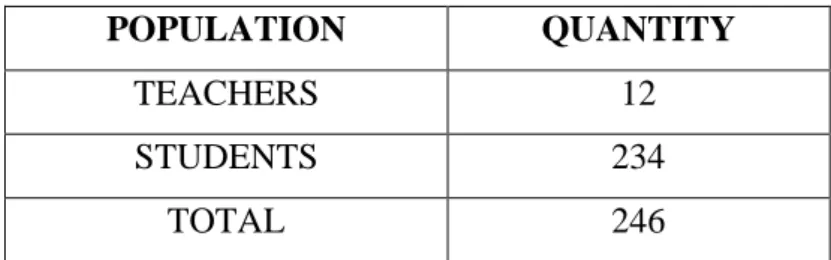
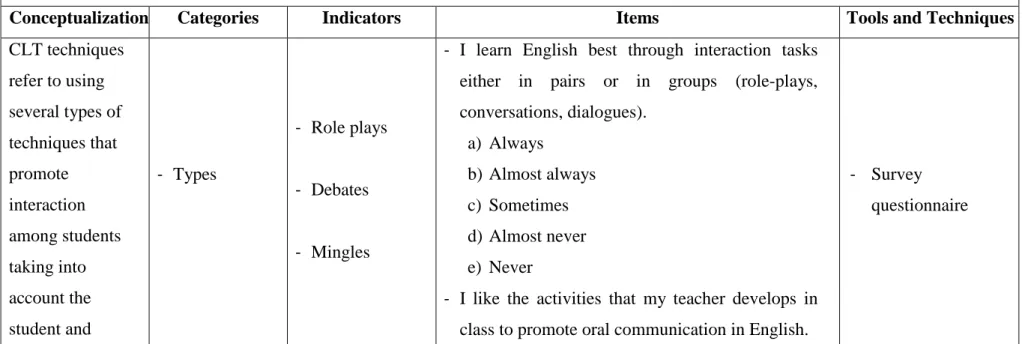
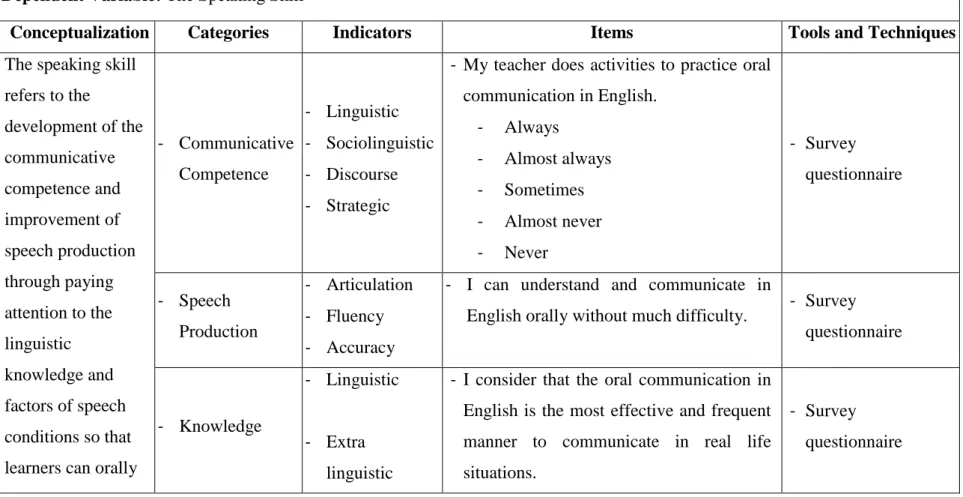
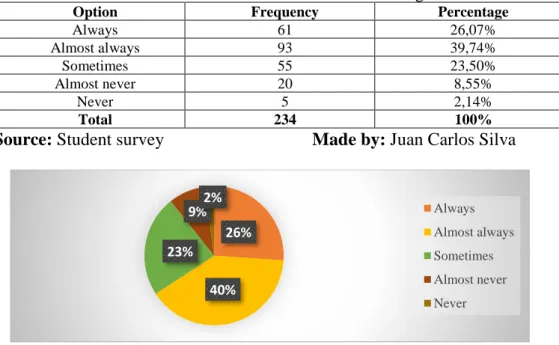
UNIVERSIDAD TÉCNICA DE AMBATO
DIRECCIÓN DE POSGRADO
MAESTRÍA EN ENSEÑANZA DEL IDIOMA INGLÉS COMO
LENGUA EXTRANJERA
Tema: “COMMUNICATIVE LANGUAGE TEACHING TECHNIQUES FOR ENRICHING THE SPEAKING SKILL IN HIGH SCHOOL STUDENTS”
Trabajo de Investigación, previo a la obtención del Grado Académico de Magíster en Enseñanza del Idioma Inglés como Lengua Extranjera
Autor: Licenciado Juan Carlos Silva Valencia
Director: Licenciada Sarah Jacqueline Iza Pazmiño Magíster
Ambato – Ecuador 2018
ii
A la Unidad de Titulación de la Universidad Técnica de Ambato
El Tribunal receptor del Trabajo de Investigación presidido por el Doctor Héctor Fernando Gómez Alvarado, e integrado por los señores: Licenciada Lorena Monserrath Meléndez Escobar Magíster, Licenciada Judith Alexandra Silva Chávez Magíster, Licenciada Ximena Alexandra Calero Sánchez Magíster, Miembros del Tribunal designados por la Unidad de Titulación de la Universidad Técnica de Ambato, para receptar el Trabajo de Investigación con el tema: “COMMUNICATIVE LANGUAGE TEACHING TECHNIQUES FOR ENRICHING THE SPEAKING SKILL IN HIGH SCHOOL STUDENTS” elaborado y presentado por el señor Licenciado Juan Carlos Silva Valencia, para optar por el Grado Académico de Magíster en Enseñanza del Idioma Inglés como Lengua Extranjera, una vez escuchada la defensa oral del Trabajo de Investigación el Tribunal aprueba y remite el trabajo para uso y custodia en las bibliotecas de la UTA.
--- Dr. Héctor Fernando Gómez Alvarado Presidente del Tribunal
--- Lic. Lorena Monserrath Meléndez Escobar, Mg.
Miembro del Tribunal
--- Lic. Judith Alexandra Silva Chávez, Mg. Miembro del Tribunal
--- Lic. Ximena Alexandra Calero Sánchez, Mg. Miembro del Tribunal
iii
AUTORÍA DEL TRABAJO DE INVESTIGACIÓN
La responsabilidad de las opiniones, comentarios y críticas emitidas en el Trabajo de Investigación presentado con el tema: “COMMUNICATIVE LANGUAGE TEACHING TECHNIQUES FOR ENRICHING THE SPEAKING SKILL IN HIGH SCHOOL STUDENTS” le corresponde exclusivamente a: el Licenciado Juan Carlos Silva Valencia, Autor bajo la Dirección de la Licenciada Sarah Jacqueline Iza Pazmiño Magíster, Directora del Trabajo de Investigación; y el patrimonio intelectual a la Universidad Técnica de Ambato.
--- Lic. Juan Carlos Silva Valencia
c.c.1804377065 AUTOR
--- Lic. Sarah Jacqueline Iza Pazmiño, Mg.
c.c.0501741060 DIRECTORA
iv
DERECHOS DE AUTOR
Autorizo a la Universidad Técnica de Ambato, para que el Trabajo de Investigación, sirva como un documento disponible para su lectura, consulta y procesos de investigación, según las normas de la Institución.
Cedo los Derechos de mi trabajo, con fines de difusión pública, además apruebo la reproducción de este, dentro de las regulaciones de la Universidad.
--- Lic. Juan Carlos Silva Valencia
c.c.1804377065 AUTOR
v
ÍNDICE GENERAL DE CONTENIDOS
Portada... ………..i
A la Unidad de Titulación de la Universidad Técnica de Ambato ... ii
Autoría del Trabajo de Investigación ... iii
Derechos de Autor... iv Índice General ... v Índice de Gráficos ... ix Índice de Cuadros ... x Agradecimiento ... xi Dedicatoria ... xii
Resumen Ejecutivo... xiii
Executive Summary ... xv INTRODUCTION ... 1 CHAPTER I ... 3 THE PROBLEM ... 3 1.1 Research Topic ... 3 1.2 Problem Statement ... 3 1.2.1 Contextualization ... 3 1.2.2 Critical Analysis ... 6
1.2.4 Research Problem Formulation ... 9
1.2.5 Questions ... 9
1.2.6 Delimitation of the Research Problem ... 10
1.3 Justification ... 10
vi 1.4.1 General Objective... 12 1.4.2 Specific Objectives... 12 CHAPTER II ... 13 THEORETICAL FRAMEWORK ... 13 2.1 Research Background ... 13 2.2 Philosophical Foundation ... 16 2.3 Legal Foundation ... 17
2.3.1 Dialectical View of Conceptualizing Variables ... 23
2.3.2 Independent Variable Framework ... 23
2.3.3 Dependent Variable Framework ... 36
2.4 Hypothesis ... 49
2.5 Identification of Variables ... 49
CHAPTER III ... 50
METHODOLOGY ... 50
3.1 Research Approach ... 50
3.2 Basic Research Modality ... 51
3.2.1 Bibliographic Documentary Research ... 51
3.2.2 Observational ... 51
3.3 Level of Research ... 51
3.3.1 Exploratory ... ………51
3.3.2 Descriptive ... 51
3.4 Population and Sample ... 52
3.4.1 Population ... 52
3.4.2 Sample ... 52
vii
3.5.1 Operationalization of the Independent Variable ... 53
3.5.2 Operationalization of the Dependent Variable ... 55
3.6 Tools and Techniques ... 57
3.7 Data Collection Plan ... 57
3.8 Process and Analysis Plan ... 57
CHAPTER IV ... 58
ANALYSIS AND INTERPRETATION ... 58
4.1 Analysis of results ... 58
4.2 Data Interpretation ... 58
4.3 Hypothesis Verification ... 78
4.3.1 Hypothesis Approach ... 78
4.3.2 Selection of the Level of Significance ... 78
4.3.3 Description of the Population... 78
4.3.4 Statistical Specifications ... 78
4.3.5 Specification of the regions of acceptance and rejection ... 78
4.3.6 Rule of decision... 79
4.3.7 Data collection and calculation of statistics ... 79
4.3.8 Final Decision ... 83
CHAPTER V ... 84
CONCLUSIONS AND RECOMMENDATIONS ... 84
5.1 Conclusions ... 84
5.2 Recommendations ... 85
CHAPTER VI ... 86
THE PROPOSAL ... 86
viii
6.2 Background of the Proposal ... 86
6.3 Justification ... 87 6.4 Objectives ... 88 6.4.1 General ... 88 6.4.2 Specific objectives ... 89 6.5 Feasibility Analysis ... 89 6.6 Foundation ... 90 6.7 Methodology ... 91 6.7.1 Handbook of CLT Techniques ... 95
6.8 Administration Of The Proposal ... 173
6.9 Evaluation Of The Proposal ... 173
REFERENCES ... 174
ix
ÍNDICE DE GRÁFICOS
Graph Nº: 1 Problem Tree. Analysis ... 6
Graph Nº: 2 Fundamental Categories ... 20
Graph Nº: 3 Graphics Independent ... 21
Graph Nº: 4 Graphics Dependent ... 22
Student Survey Graph Nº: 5 I consider that the oral communication ... 58
Graph Nº: 6 I learn English best through interaction ... 59
Graph Nº: 7 My teacher does activities to practice oral ... 60
Graph Nº: 8 I like the activities that my teacher develops in class ... 61
Graph Nº: 9 The activities that are done in class mostly permit me to ... 62
Graph Nº: 10 My teacher tells me what I did right or wrong and what ... 63
Graph Nº: 11 The activities done in class mainly focus on oral... 64
Graph Nº: 12 I can understand and communicate in English ... 65
Graph Nº: 13 My teacher motivates me to speak and communicate in ... 66
Graph Nº: 14 We are given enough time, clear instructions and proper ... 67
Teacher Survey Graph Nº: 15 I consider that the oral communication in English ... 68
Graph Nº: 16 I think that my students learn English best when ... 69
Graph Nº: 17 I do activities to practice oral communication in English ... 70
Graph Nº: 18 I think my students like the activities that I use to promote oral .. 71
Graph Nº: 19 The activities that I do in class mostly allow learners... 72
Graph Nº: 20 I tell my students what they did right or wrong and what ... 73
Graph Nº: 21 The activities done in class mainly focus on oral... 74
Graph Nº: 22 I think my students can understand and communicate ... 75
Graph Nº: 23 I motivate my students to speak and communicate in English ... 76
Graph Nº: 24 I give enough time, clear instructions and proper guidance ... 77
Graph Nº: 25 Average questions 1 TO 5 ... 80
Graph Nº: 26 Average questions 6 TO 10 ... 81
x
ÍNDICE DE CUADROS
Table Nº: 1 Population ... 52
Table Nº: 2 Operationalization of the Independent Variable ... 53
Table Nº: 3 Operationalization of the Dependent Variable ... 55
Student Survey Table Nº: 4 I consider that the oral communication... 58
Table Nº: 5 I learn English best through interaction ... 59
Table Nº: 6 My teacher does activities to practice oral... 60
Table Nº: 7 I like the activities that my teacher develops in class ... 61
Table Nº: 8 The activities that are done in class mostly permit me to ... 62
Table Nº: 9 My teacher tells me what I did right or wrong and what ... 63
Table Nº: 10 The activities done in class mainly focus on oral ... 64
Table Nº: 11 I can understand and communicate in English ... 65
Table Nº: 12 My teacher motivates me to speak and communicate in ... 66
Table Nº: 13 We are given enough time, clear instructions and proper... 67
Teacher Survey Table Nº: 14 I consider that the oral communication in English ... 68
Table Nº: 15 I think that my students learn English best when ... 69
Table Nº: 16 I do activities to practice oral communication in English ... 70
Table Nº: 17 I think my students like the activities that I use to promote oral .... 71
Table Nº: 18 The activities that I do in class mostly allow learners ... 72
Table Nº: 19 I tell my students what they did right or wrong and what ... 73
Table Nº: 20 The activities done in class mainly focus on oral ... 74
Table Nº: 21 I think my students can understand and communicate ... 75
Table Nº: 22 I motivate my students to speak and communicate in English ... 76
Table Nº: 23 I give enough time, clear instructions and proper guidance ... 77
Table Nº: 24 Test T Comparison between students and teachers in each ... 79
Table Nº: 25 Test T Comparison between ... 80
Table Nº: 26 Student’s T-test: Summary of each question ... 81
Table Nº: 27 Operating Model ... 93
xi
AGRADECIMIENTO
Después de expresar mi gratitud a Dios por permitirme haber logrado otro objetivo en mi vida estudiantil, deseo agradecer a mi tutora y directora de tesis, Mg. Sarah Iza, por todo el apoyo y la orientación brindada a lo largo del arduo proceso del desarrollo de la tesis. Estoy muy agradecido por las sugerencias dadas, la paciencia y el tiempo dedicado para ayudarme a escribir mi tesis de una manera muy coherente y sistemática. También, me gustaría agradecer a los docentes expertos quienes gustosamente me ayudaron con la validación de las encuestas para su respectiva aplicación.
Igualmente, agradezco al señor rector de la Unidad Educativa Ambato, quien me permitió desarrollar el proyecto de investigación en esta institución. Del mismo modo, extiendo un agradecimiento especial a mis colegas del área por brindarme valiosas recomendaciones e ideas que contribuyeron positivamente al desarrollo de mi tesis. Además, agradezco a Sarah de St. Aubin, nativa hablante del idioma inglés, por ayudarme a corregir varios errores en el uso del idioma al redactar mi tesis. Finalmente, agradezco a los estudiantes que colaboraron y fueron parte de este proyecto de investigación.
xii
DEDICATORIA
En primer lugar, quiero dedicar este trabajo investigativo a Dios, pues él siempre ha sido mi apoyo, guía y protector en todo momento; el que me dio la vida, la inteligencia, la fuerza y el coraje para estar donde estoy ahora. Le dedico todo mi esfuerzo y las largas horas de trabajo invertidas en este proyecto de investigación porque sé que, si él no me hubiera cuidado, dándome salud y un sentido de determinación, estoy seguro de que no habría logrado dar este paso tan importante en mi vida profesional.
También dedico este trabajo realizado a mi familia por su incondicional soporte moral, pues ellos han sido quienes me han motivado a seguir creciendo académicamente y hacer que mis sueños se hagan realidad. Dedico esta labor de manera muy especial a mi madre, quien siempre ha mostrado su preocupación por mi progreso y éxito durante este arduo proceso de preparación. De manera similar, dedico este trabajo a mi padre, quien a pesar de no estar aquí conmigo, ya que está en los cielos, estoy muy seguro de que se sentiría orgulloso de mí por haber logrado otro objetivo en mi carrera estudiantil.
xiii
UNIVERSIDAD TÉCNICA DE AMBATO DIRECCIÓN DE POSGRADO
MAESTRÍA EN ENSEÑANZA DEL IDIOMA INGLÉS COMO LENGUA EXTRANJERA
TEMA:
“TÉCNICAS DE ENSEÑANZA DEL LENGUAJE COMUNICATIVO PARA ENRIQUECER LA DESTREZA ORAL EN ESTUDIANTES DE
COLEGIO”
AUTOR: Licenciado Juan Carlos Silva Valencia
DIRECTORA: Licenciada Sarah Jacqueline Iza Pazmiño Magíster FECHA: 17 de noviembre del 2017
RESUMEN EJECUTIVO
Este proyecto de investigación tiene como objetivo analizar cómo las técnicas de
enseñanza del lenguaje comunicativo influyen en el enriquecimiento de destreza
oral del idioma inglés en los estudiantes de colegio. Para determinar cómo estas dos variables están interrelacionadas, se realizó extensa investigación mediante la lectura de varios libros, artículos y revistas en relación con cada variable. Se prestó especial atención al libro "Técnicas y Principios en la Enseñanza de Idiomas" escrito por Larsen (2000), para recopilar información sobre la variable independiente (Técnicas de Enseñanza del Lenguaje Comunicativo) y "Cómo Enseñar la Destreza Oral" de Thornbury (2005) para obtener información sobre la variable dependiente (La Destreza Oral). Además, se aplicó una encuesta con 10 preguntas a 12 profesores de inglés y 234 estudiantes de segundo año de bachillerato después de haber sido validada por tres expertos. Esta encuesta permitió obtener un panorama más aproximado de cómo estas dos variables se toman en consideración y se aplican en las clases de inglés de la Unidad Educativa Ambato. Una vez que los resultados fueron cuidadosamente analizados y sistemáticamente tabulados, la hipótesis establecida fue verificada mediante el uso
xiv
de la prueba T de Student. Estos resultados indicaron que, ciertamente, las técnicas de enseñanza del lenguaje comunicativo sí influyen en el enriquecimiento de la destreza oral en los estudiantes de secundaria. Los resultados obtenidos también llevaron a establecer varias conclusiones y recomendaciones. Una de las conclusiones más importantes señaló que la mayoría de los estudiantes considera que aprenden inglés a través de tareas interactivas, pero desafortunadamente los docentes no parecen aplicar con frecuencia una variedad de técnicas que fomentan comunicación en el aula. Por lo tanto, se vio que los estudiantes no tienen suficientes oportunidades para interactuar entre ellos y así practicar el uso del idioma de una manera auténtica, divertida y significativa. La recomendación para esta conclusión fue diseñar un manual que incluye 20 técnicas de enseñanza del lenguaje comunicativo (algunas adaptadas y otras creadas) que los profesores pueden utilizar en sus clases para que sus alumnos sean alentados a practicar la destreza oral con más frecuencia. Por lo tanto, la propuesta para abordar el problema de investigación identificado en este proyecto de investigación es la presentación del manual con 20 técnicas basadas en el método comunicativo de enseñanza, las cuales se distribuyen para abordar y mejorar varias habilidades secundarias como la fluidez, la pronunciación, la gramática, el vocabulario y las funciones.
Descriptores: aulas de inglés, comunicación, destreza oral, encuesta, estudiantes de colegio, habilidades secundarias, manual, profesores de inglés, prueba T de student, técnicas de enseñanza del lenguaje comunicativo.
xv
UNIVERSIDAD TÉCNICA DE AMBATO DIRECCIÓN DE POSGRADO
MAESTRÍA EN ENSEÑANZA DEL IDIOMA INGLÉS COMO LENGUA EXTRANJERA
THEME:
“COMMUNICATIVE LANGUAGE TEACHING TECHNIQUES FOR ENRICHING THE SPEAKING SKILL IN HIGH SCHOOL STUDENTS”
AUTHOR: Licenciado Juan Carlos Silva Valencia
DIRECTED BY: Licenciada Sarah Jacqueline Iza Pazmiño Magíster DATE: 17 de noviembre del 2017
EXECUTIVE SUMMARY
This research project is intended to analyze how communicative language teaching techniques influence the enrichment of the speaking skill in high school students. In order to determine how these two variables are interrelated, extensive research was done by reading several books, articles and journals in relation to each variable. Special attention was given to the book “Techniques and Principles in Language Teaching” written by Larsen (2000), for gathering information about the independent variable (Communicative Language Teaching Techniques) and “How To Teach Speaking” by Thornbury (2005) to get information about the dependent variable (The Speaking Skill). Furthermore, a survey entailing 10 questions was applied to 12 English teachers and 234 second year baccalaureate students after it was validated by three experts. This survey permitted to get a more approached panorama of how these two variables are taken into consideration and applied in the English classrooms of the Ambato High School. Once the results were cautiously analyzed and systematically tabulated, the established hypothesis was verified through using the Student’s T-test. These results stated that indeed, communicative language teaching techniques do influence the enrichment of the speaking skill in high school students. The results obtained also led to draw several
xvi
conclusions and recommendations. One of the most important conclusions pointed out that the majority of students believe that they learn English best through interactive tasks, but unfortunately teachers do not seem to frequently apply a variety of techniques that foster communication in the classroom. Hence, it was seen that students do not get enough opportunities to interact among themselves to practice using the language in such an authentic, enjoyable and meaningful manner. The recommendation for this conclusion was to devise a handbook, which entails 20 communicative language teaching techniques (some adapted, and others created) that teachers can use in their classes so that their students are encouraged to practice their speaking skill more often. Therefore, the proposal to address the research problem identified in this investigative project is the presentation of the handbook with 20 CLT techniques, which are distributed to address and enhance several speaking subskills such as fluency, pronunciation, grammar, vocabulary and functions.
Key words: communicative language teaching (CLT) techniques, speaking skill, speaking subskills, student’s T-test, survey, English teachers, high school students, English classrooms, communication, and handbook.
1
INTRODUCTION
Currently, being able to speak English as a foreign or second language has become a necessity rather than a mere vanity. The twenty-first century has brought many dramatic changes, not only in technology but also in education and linguistics. Nowadays, English is addressed as the ‘Lingua Franca’ or the global language since it is taught and spoken all over the world to communicate among speakers of different languages.
But what is the methodology that has gained more acceptance in English classrooms? Unquestionably, the answer to this inquiry is the communicative language teaching method. The effectiveness of this approach when teaching or learning a new language is very promising. Kamal & Ibrahim (2017) postulate that the CLT method has emerged to substitute inefficent and traditional approaches that were used until some decades ago. Currently, the communicative approach is the one suggested to use in English classes no matter where in the world this language is being taught.
However, are English teachers really using this communicative method to effectively teach the language to their students? If this question were asked to some teachers and students anywhere in the world, perhaps in many cases the answer would be, ‘Yes!’, but in others, the response would still be, ‘No!’. In Ecuador, for example, the Ministry of Education (2014) in the National English Curriculum Guidelines acknowledges the following issue: “That the Communicative Approach is currently the most recognized, accepted norm in the field of language teaching and learning worldwide because it comprises a theoretically well-informed set of principles about the nature of language and of language learning and teaching.” Hence, the CLT method is strongly suggested to use when teaching English to high school students in Ecuadorian institutions.
2
Despite this ministerial recommendation, many Ecuadorian teachers do not seem to be utilizing the CLT approach to teach English; or at least this is what has been observed in the province of Tungurahua, specifically at Ambato High School. As a result, the topic of this research project is focused on this particular phenomenon, which deserves careful attention and analysis in order to identify the background of the problem, but more importantly, the solution to eradicate inappropriate or obsolete application of traditional teaching methods to teach students English.
The general structure of this thesis encompasses 6 chapters; each one contains information related to the research topic. The structure is described as follows: CHAPTER I.- It talks about the problem, its contextualization and critical analysis. It entails the prognosis, the formulation of the problem, the questions, the research problem formulation, the justification and the objectives.
CHAPTER II.- The theoretical framework is addressed here, including the research background, philosophical and legal foundation. It gives all information about the fundamental categories (dependent and independent variables). It also mentions the hypothesis, which will be later accepted or rejected.
CHAPTER III.- It is about the research methodology. It has the research approach, basic research modality, the level of research, the population, the operationalization of variables, and the tools and techniques used for the data collection.
CHAPTER IV.- It encompasses the analysis and interpretation of results as well as the hypothesis verification through applying a statistical test.
CHAPTER V.- It covers the conclusions and recommendations made based upon results obtained after their analysis and interpretation.
CHAPTER VI. - It talks about the proposal and its components such as the topic, justification, objectives, methodology, its administration and evaluation.
3 CHAPTER I THE PROBLEM 1.1 Research Topic
“Communicative Language Teaching Techniques for Enriching the Speaking Skill in High School Students.”
1.2 Problem Statement 1.2.1 Contextualization
The expansion of information and globalization has led to make more people and countries use English to communicate and exchange thoughts for different purposes and in different contexts. Currently, the dominance of this language has undoubtedly changed the perspective and direction of many areas (Xue & Zuo, 2013). Due to great amounts of research done by lots of investigators, it is universally acknowledged that English is one of the most widely spoken languages in the world and millions of people speak it officially, as well as a second language or as a foreign language. Indeed, learning English as a second or foreign language entails being able to speak it accurately and fluently, but more importantly, learning English implies being capable of using the language smoothly in real contexts of any kind and in any place. Currently, speaking this particular language represents opportunities for getting a job, studying abroad, travelling for business, and so forth. In other words, English is a way of communication that directly or indirectly opens numerous doors all over the world.
However, learning English as a foreign language may not turn out to be as easy as it might seem for some people around the world. In fact, several non-native speakers worldwide dare to say that speaking the language is rather complicated. Paakki (2013) in her research paper, found out that students from Finland and Japan argued that speaking English was not straightforward due to a variety of reasons.
4
For example, their prior educational methodology used by their teachers was grammar oriented and theoretical rather than practical and communicative. Besides, the deficiency of practice and direct exposure to the language greatly affected their performance in the speaking skill. Similarly, being afraid of making mistakes was another factor for deterring them from speaking in English. Another aspect that negatively contributed to this issue was the mixture of accents heard in those settings. Learners did not fully understand the language; consequently, their oral performance was weak and not clear enough to be understood. Therefore, the speaking skill is universally difficult to enrich in learners unless they do not regularly face the barriers mentioned above by Paakki in her investigation.
In Ecuador, the situation seems to be relatively the same in terms of learning English easily and effectively. The obstacles that Paakki found out in students when trying to develop their oral skill are quite similar. In this country, unfortunately, there are still many teachers who are adopting methods, strategies and techniques which are not necessarily efficient and meaningful to teach the language, specially the speaking skill. Some educators are still employing ineffective ways to make their students develop their oral performance, and obviously, they fail to do so since the methodology used was inaccurate. In other words, some teachers are still using traditional methods, which belong to past decades. In addition to that, students do not have enough practice to enhance this skill. They are also afraid of making mistakes and being mocked by their classmates. Another reason why learners are not fluent and accurate in English according to the level they should be in is that they are not that interested in learning the language, so they do not strive to practice and speak in English as much as possible. All these factors tremendously affect the enrichment of this skill among Ecuadorian learners.
Indeed, the Ministry of Education (2014) makes emphasis on the development of this particular skill in students proposed by the National Curriculum Guidelines for English as a Foreign Language. Nevertheless, the level required for each group of students in different school years in public and private institutions according the
5
Common European Framework (CEFR) is not fully reached. In fact, it is very challenging and complicated to make all or at least most students get the level of English proposed by the National Curriculum based on the CEFR. It is imperative to consider that pupils may not achieve their expected language level because of several educational, situational, or geographical factors. For example, even though the National Curriculum is for all the country, the Ministry of Education needs to consider that the settings are not the same for the Coast, Amazon, Highlands and Galápagos regions. Students from each region have different backgrounds, classroom facilities; and the language exposure varies according to the area in the country. Some learners might have more opportunities to practice speaking the language than others. Hence, the efficacy of learning English in Ecuador varies from region to region even if the teaching material (books) are the same for all public schools in the country.
Now, the public institutions that are found in the province of Tungurahua do not entirely seem to strive to make their students speak English in a meaningful, accurate and fluent manner. It is common for teachers, specifically from Ambato, to make comments about their students and say that they are not eloquent in English—at least not in the way they should be. Additionally, local students from this city do not seem to enjoy English classes as they state that this subject turns out to be tedious, complicated to understand, and not very meaningful for their lives. Besides that, students from different schools in this city do not show a satisfactory level of English when they speak. What is more, they are usually reluctant to talk because they feel they are unable to do so. They do not have the sufficient input and self-confidence as to try to establish a conversation in English.
In Ambato High School, it is easy to notice that students are not generally accurate and fluent enough when speaking in the foreign language. Most of them have trouble when trying to interact in English even though this school is considered to be one of the best public institutions in the city. Taking the targeted group of students, which in this case is the Second Year Baccalaureate, it is disappointing to
6
see that many of them cannot use the language to have a decent conversation when talking about familiar topics that align with B1 according the Common European Framework. Even though they have been studying English for several years, and they are in the penultimate level of high school, their English is not good enough. It is sad to say that the majority of these learners are unable to speak the target language in the way they ought to. Therefore, something must be done to help pupils enhance their speaking skills and achieve the level of English proposed by the Ministry of Education. Educators must take advantage of time coming up with meaningful communicative language teaching techniques that foster speaking in class and using the language in real context situations.
1.2.2 Critical Analysis
1.2.2.1 Problem Tree Analysis
Graph Nº: 1 Problem Tree. Analysis Made by: Juan Carlos Silva
The lack of using communicative language teaching techniques for enriching the speaking skill in High School Students.”
Students do not show interest and enthusiasm in learning the language. Learners only memorize language rules and cannot communicate.
Pupils do not get to practice speaking English with their classmates. Students do not make progress in speaking and may feel anxious and frustrated.
The focus is mostly on language form rather than meaning.
There are not enough tasks for students to interact among themselves. Inappropriate support and feedback given based on their oral performance. Teachers regularly use inappropriate methodology to teach English.
7
One of the salient reasons for students to have such a low level of interest and enthusiasm in learning English is often because teachers do not use an appropriate methodology to teach this language. This issue is so relevant to consider since it harshly affects learners not only in their motivation to learn the language, but also in their performance when they have to demonstrate what they have learnt. Vibulphol (2016) found out that many researchers agreed on stating that motivation plays a big role when learning a language. If students are highly motivated, they are more likely to learn the language easily; on the other hand, if they are demotivated, their performance will be lower than the ones who are enthusiastic about learning to speak the target language. Hence, the very first affair to consider when teaching a language is the methodology being used by the instructors and how much teachers do to motivate learners to actively get engaged in the learning process.
Similarly, another factor that negatively contributes to hinder learners from being competent in English is the wrong focus on language patterns. Al-Nammari, James, & Ramachandran (2009) within Dong (2016) argue that regularly, teachers are found trying to convey their English knowledge and grammar structure, meanwhile learners are only sitting there making an effort to receive and process the input, which is transmitted in a passive manner. Hence, many teachers focus on how the language forms: its grammatical rules, formulas, abstract knowledge rather than language functions. In other words, mistakenly, teachers do not concentrate on interaction patterns, and that is the reason why learners cannot communicate effectively in the target language because they are more concerned about memorizing the grammar rules taught by their instructor.
Another reason for this problem to take place is due to the fact that teachers do not provide enough opportunities for learners to actively interact among themselves in class. Consequently, they cannot practice developing this important skill. Indeed, teaching grammar, vocabulary, reading, writing and listening are important too, but speaking should be the most relevant skill to focus on since students need to be able to communicate in English more than being able to use proper language forms.
8
Larsen (2000) points out that being able to communicate requires more than just mastering the rules of linguistic usage, it also requires being able to use language functions appropriately. Likewise, he also posits that one of the prominent accountabilities of teachers is that they need to provide situations in the classroom which foster interaction.
Giving learners inappropriate support and feedback based on their oral performance is another issue that affects the enrichment of the speaking skill. Whenever students strive to talk, teachers are expected to give them positive feedback and praise their attempt to actively participate in class. Additionally, error correction needs to be wisely carried out because if teachers try to correct every single mistake learners make when speaking, it will definitely discourage them from taking part in interaction tasks. Another consequence is that their affective filter will increase and their level of anxiety and frustration towards learning English will begin to emerge as well. Gower et al. (1995) suggested that teachers should not correct learners while they are developing a speaking task because their willingness to keep on striving to speak may be hindered. He, on the other hand, recommended addressing those mistakes afterwards, but only the most important ones, which are certainly affecting communication (Sikder, 2016). Thus, teachers must be quite sensible when giving feedback and assistance to students while the enrichment of the speaking skill is efficiently taking place.
1.2.3 Prognosis
If the fact that the lack of using efficient communicative language teaching techniques for enriching the speaking skill in second year baccalaureate students at Ambato High School is not successfully solved now, it will negatively affect their future academic, social and professional lives. First, these students starting third Bach will have to face more challenges in this subject because of two crucial aspects. Initially, this will be so because obviously the material and content to cover, the language functions and skills will be more demanding and will require learners to have good prior knowledge to be successful communicators in class.
9
Secondly, in third year baccalaureate the number of English hours is reduced from five to three, which is a tremendous disadvantage for them as learners will have less exposure to the language. Therefore, it is in second year baccalaureate where students and teachers must optimize time and develop as many interactive tasks as possible. Similarly, afterwards, if students are planning to study at university, they need to have, at least, an elementary level of English to be able to talk about familiar topics in class. If that is not the case, students will be having a hard time at the university and they can even fail the semester in English class. In fact, that is the case of many students for not having a decent management of the speaking skill.
Likewise, if they are making plans to travel abroad where English is spoken and they cannot communicate in this language smoothly, their trip may turn into a chaos for being unable to speak English when visiting public places, or dealing with unexpected situations where their mother tongue is not possible to use. Additionally, these students will eventually get a job, and being able to speak English represents a great strength in their résumé. In several job interviews, managers ask candidates if they speak at least some basic English to be able to be hired. Therefore, if teachers now do not employ effective communicative language teaching techniques in their classes, they will be harshly affecting their students’ lives hindering them from having a better future in anything they do.
1.2.4 Research Problem Formulation
How do communicative language teaching techniques help to enrich the speaking skill in high school students?
1.2.5 Questions
- To what extent are English teachers using communicative language teaching techniques to enrich the speaking skill in high school students?
- How confident do students feel when they have to communicate in English orally either inside or outside the classroom in real life situations?
10
- What is the outcome of using communicative language teaching techniques to enrich the speaking skill in high school students?
1.2.6 Delimitation of the Research Problem Field: Education
Area: Teenage Education
Specific Field: Teaching and Learning
1.2.6.1 Temporal Delimitation
Second Semester of the school year 2016-2017
1.2.6.2 Spatial Delimitation
This investigation took place at Ambato High School with second year baccalaureate students.
1.3 Justification
Unquestionably, ‘Speaking’ is one of the most significant skills to be highly developed in students who are learning English as a second or foreign language. Oradee (2012) states the following: “Speaking is the most important and essential skill” pg. 533. But he also points out that indeed, the most difficult skill for learners to develop is speaking, usually because they are not exposed to authentic language situations where they can communicate and socialize on topics of their interest. Thus, when pupils are learning this language, the best and most direct manner to demonstrate they actually understand English is by speaking. In a real context, more than being inside the classroom, students at first sight are not required to read or write in English in order to let the others know they are competent in the foreign language. Instead, they are expected to smoothly establish a conversation and fluently talk about different topics in a coherent and organized manner using appropriate language patterns such as grammar, vocabulary, intonation and pronunciation.
11
Learners, however, cannot really accomplish that level of fluency and accuracy when speaking English unless they have had lots of practice in class with several tasks that foster a better performance in their oral speech. It is the teachers’ responsibility to train learners and make them speak in English as much as possible through using numerous communicative language teaching techniques. According to Pourhossein (2014), the idea of interaction has gained more popularity in EFL (English as a Foreign Language) classrooms because several researchers have found in their studies that when communicative tasks are proposed in class, learners can construct new knowledge and their oral production is tremendously enhanced. Pourhossein also contends that teachers should strive to encourage learners to talk among themselves by trying to reduce their talking time. Instead, learners ought to be given many opportunities for them to speak in class.
Having said that, it is imperative that educators promote interaction in class using real context situations so that learners can prepare themselves once they have to face the outside world. Furthermore, teachers need to urgently implement the use of interactive tasks to provide learners a better classroom environment, where they can actively participate and utilize the language in a meaningful manner. It is traditional, insensible and tedious for students to try to learn English when all they have to do, mostly, is just sit down, listen to the teacher, have some repetition drills and complete the textbook doing grammar exercises. Undoubtedly, students need a lot more than this; English is a language, which must be practiced through talking to others. That is what a language means: a system of communication; and the best and more authentic way to communicate effectively is by speaking.
Therefore, it is fundamental to find out the impact of communicative language teaching techniques on the development of the speaking skill of second year baccalaureate students to help them be more accurate and fluent in English when using it to communicate in authentic settings. If teachers endeavor to make their students take part in interactive tasks in class as much as possible providing
12
different real contexts, pupils will be able to effectively communicative with other people anywhere and anytime. In other words, through promoting and using communicative language teaching techniques, teachers will not be merely helping learners to enjoy the English class more and improve their scores in the subject. But more importantly, they will be tremendously contributing to helping them be prepared to face the real world when entering the university, travelling abroad, getting a job or merely being in contact with native speakers. These are strong, convincing reasons to support and justify the development of this research.
1.4 Objectives
1.4.1 General Objective
To analyze how communicative language teaching techniques help to enrich the speaking skill in high school students.
1.4.2 Specific Objectives
1. To determine to what extent English teachers are using communicative language teaching techniques in the classroom to promote oral interaction among high school students.
2. To detect how confident students feel when they have to communicate in English orally in real life situations.
3. To propose the creation of a handbook that entails several appealing and practical communicative language teaching techniques that enrich the speaking skill in high school students
13 CHAPTER II
THEORETICAL FRAMEWORK
2.1 Research Background
After sifting through the repository of a couple of universities, it was concluded that several researchers have attempted to address topics, which are somehow connected to this current area of investigation. Hence, from the great variety of topics existing online, I have picked the ones that are mostly related to the topic proposed in this thesis.
The first correlated topic is named as: “Estrategias Metodológicas Significativas en el Desarrollo de la Comunicación Oral del Idioma Inglés de los Alumnos de los Segundos Años de Bachillerato Técnico de la Unidad Educativa ‘Nueva Primavera’ del Año Lectivo 2013-2014” proposed by Toalombo (2014) at the Central University of Ecuador. In her thesis, she came to these conclusions:
- The English teachers at this institution do not carry out a variety of practical tasks to teach English and apply a method which is behavioral that requires learners to memorize language patterns.
- Similarly, teachers do not promote autonomy in learners. In other words, learners are not encouraged to use technology appropriate to learn the language.
- Teachers do not use techniques that motivate students to learn the language and use it through communicative tasks.
- Pupils do not develop the speaking skill in the way they should give the activities proposed in class do not attempt to enhance this skill.
As seen in these conclusions, it is demonstrated in a different context (school and city) that the problem with developing the speaking skill in students is quite common and concerns a lot of researchers. According to the findings of her
14
thesis, English teachers are not employing an appropriate methodology to help learners improve their communicative skills.
Another associated topic is the one proposed by Gaibor (2015) at the Technical University of Ambato named as: “EL Aprendizaje basado en el Método de Casos y la Destreza Oral del Idioma Inglés en los Estudiantes del Tercer Año de Bachillerato General Unificado de la Unidad Educativa Mayor Ambato”. This researcher drew the following conclusions:
- The method of cases for developing the speaking skill is not in English classes in third year baccalaureate of Ambato school.
- Even though the kind of situations that are used in class are related to real contexts, they are limited and do not really allow learners to express their experiences in such an authentic manner. Likewise, teachers do not give learners the chance of analyzing and giving solutions to problems that can emerge in real life.
- Interactive tasks are rarely carried out in English classes. Subsequently, learners do not get opportunities for interacting among themselves through having debates, conversations or merely sharing experiences with each other.
- The English teachers working at this institution are not familiar with the method of cases, which is a useful tool to enhance the speaking skill in students. This is easily proved when looking at the poor performance of students at the moment of trying to keep a conversation in the target language.
This researcher certainly points out that students who are in third year baccalaureate are not competent in the speaking skill, which indicates that they urgently need to deal with tasks that foster communication among themselves so that they can enhance this productive skill.
15
The closest topic found is: “Communicative Language Teaching y la Destreza del Speaking en los Estudiantes del Tercer Año de Bachillerato Técnico del Colegio Nacional Mariano Benitez del Cantón Pelileo Provincia del Tungurahua” by Flores (2015) at the Technical University of Ambato. The author drew the next conclusions:
- The Communicative Language Teaching approach indeed plays an important role in the speaking skill of third year baccalaureate students.
- Teachers generally consider that these communicative tasks are not very useful to apply with frequency since they require a lot of time, which is not necessarily productive for them to invest in activities like this.
- Teachers do not give that much relevance to interactive techniques such as role plays, games and group work tasks; consequently, students are unable to successfully achieve a competent level in their speaking skill.
- Overall, what English teachers have done in class is not bad; however, if they employ the communicate language teaching as part of their methodology, learners will significantly improve their communicative skills and will make their classes more entertaining and meaningful.
In my view, I strongly agree with this author since employing CLT techniques will tremendously help students be more fluent and accurate when speaking English. As illustrated above, communicative language teaching is certainly suggested by other researchers because the activities this approach proposes are authentic and fruitful for students.
In general, I can see that the investigators mentioned above along with their thesis have strived to demonstrate that the speaking skill as an issue that concerns both teachers and students. However, none of them have done much to solve this problem. With this investigation, though, it is intended to go beyond, demonstrating and doing what the other researchers have failed to accomplish.
16 2.2 Philosophical Foundation
This research is based upon two significant paradigms: the constructivist paradigm proposed by Jean Piaget (1972), and the Social Interactionist approach proposed by Lev Vygotsky (1978). These two paradigms directly address the topic of this thesis, which is concerned with communication and the speaking skill in the classroom.
The constructivist paradigm encourages students to construct their own knowledge, ideas and learning situations where they can freely use the language acquired according to their needs and interests. With this approach, students will be dealing with authentic tasks that resemble real situations in the world where they have to use the input in meaningful contexts. Besides, constructivism promotes collaborative work boosting learners to share their knowledge to equally succeed through cooperation rather than competition.
Similarly, the social interactionist matches with the communicative language teaching method as it stimulates interaction among students in the class. Vygotsky (1978) states that learning a language can smoothly take place when there is oral communication among human beings. Therefore, in order for students to successfully learn to speak English, they need to interact with their classmates through having discussions about their likes, experiences, interests and so forth. They also need to practice socializing situations that are relevant and authentic in the real world.
Hence, with the combination of these two paradigms, students will be using the language to build their own ideas based on a real situation, but more importantly, they will be sharing those thoughts with others so that their speaking skill easily improves within an interactive, enjoyable and practical context.
17 2.3 Legal Foundation
The legal statutes that support this research are the following:
- Organic Law of Intercultural Education (2015) Art. 7. The Rights of Students
a. “Be fundamental executors in the educational process.” Indeed, students have the right to play an active role in class and teachers should come up with tasks and activities that foster individual, pair and group work so that they can develop their linguistic, sociolinguist, discourse and strategic competences appropriately.
Art. 11. The Obligations of Teachers
i. “Give students support and pedagogical monitoring to overcome the lag and difficulties in learning and development of competences, capacities, abilities and skills.” Unquestionably, teachers are accountable for providing pupils proper classroom opportunities for them to learn. This can be done by utilizing a variety of methods, strategies and techniques that address all the multiple intelligences that students have. Furthermore, learners need suitable support and positive feedback; this way, they will feel motivated and learn the language effortlessly as long as their instructors are there to guide them, acting as a facilitator of knowledge and giving them chances to use the language in authentic contexts.
Art 31.- Competences of the Academic Council and the Intercultural or Bilingual Educational Circuit.
d. "Develop strategies for continuous improvement of the educational area including professional development of administrators and teachers." In other words, this article urges teachers to continuously train themselves through attending seminars, courses, or any type of educational programs that they will make them better instructors. Nowadays, students require teachers who are high qualified and prepared to teach them and convey the input utilizing innovative methodological strategies and techniques.
18
- National Curriculum Guidelines (2014) by the Ministry of Education. Introduction - A key issue: “That the Communicative Approach is currently the most recognized, accepted norm in the field of language teaching and learning worldwide because it comprises a theoretically well-informed set of principles about the nature of language and of language learning and teaching.” As it is seen in this assertion, the Ministry of Education itself greatly supports the use of the communicative approach for the benefits it contributes to the learning of English. Hence, it is highly recommended that teachers employ CLT to teach English as a FL in all Ecuadorian institutions.
A specific objective: “By the end of the 2nd year Bachillerato, students will be able to communicate with some confidence on familiar routine and non-routine matters related to their interests and educational field.” That implies that students at this point should be capable of keeping a decent conversation based on the topics mentioned as they had already practiced dealing with those functions throughout the school year they just finished.
A specific objective: “By the end of the 2nd year Bachillerato, enter unprepared into
conversations on topics that are familiar, of interest, or pertinent to everyday life within the personal and educational domain (e.g. family, hobbies, travel, etc.).” When students have actually acquired the language to communicate in real contexts, they do not need to think about what grammar structure to use, or what is the correct lexis they are expected to employ according to what they learned in the course book with the teacher. Instead, they just talk without much effort and thinking; language comes out easily and start speaking confidently because they know they have the tools to do so. In real life, they do not need to practice before having a conversation about a familiar topic; they just need to interact as much as they can to demonstrate that they are certainly competent in English.
An essential assessment indicator: “Follow the main points in an informal discussion with acquaintances and colleagues (real or imaginary) provided speech
19
is clearly articulated in standard dialect.” In order for students to be able to follow the essential points in a discussion either real or unreal effortlessly, they need to have practiced in class first working on speaking tasks that allowed them to interact among themselves through having role-plays, simulations, dialogues, debates, and so forth. Once, they have dealt with these situations several times in different contexts, they will undoubtedly be able to perform appropriately outside the classroom.
- English Curriculum (2016) by the Ministry of Education:
One of the core principles in the curriculum: “The communicative language approach: language is best learned as a means to interact and communicate, rather than as a body of knowledge to be memorized.” In the national curriculum, this approach is also mentioned and well supported because it promotes interaction in class. Consequently, learners through talking to each other will best learn English avoiding memorizing tedious, hard language patterns such as grammar rules.
One of the key features of the learner-centered curriculum: “Learning is an active, dynamic process. It occurs more effectively when students are actively involved, rather than passively receiving information.” This is absolutely true because the more active students are, the more they learn since working on interactive, enjoyable tasks, learners are engaged and motivated to learn the language. English then does not turn into a tedious subject, but into an appealing one.
One of the Epistemological Foundations and Pedagogical Responses: “Constructivist theories of knowledge and the central role of language and communicative competencies in CLIL frameworks can be best expressed through a communicative approach to teaching.” As we can see, the constructivism paradigm is worth of taking into consideration for the essential role it plays when learning a language. If students are given the opportunity to talk about the input they just internalized with their classmates, and then creatively use it in new ways
20 Communicative Language Teaching Strategies Communicative Language Teaching Techniques Language The Speaking Skill
as they consider, the learning process comes to be more meaningful and fun for students.
Curricular Thread 2: Oral Communication (Listening and Speaking): “The EFL curriculum recognizes the importance of listening and speaking as essential skills in the communicative competence of English language learning.” Indeed, the two productive skills go hand in hand because they are virtually utilized at the same time. Both are essential to develop so that communication can properly take place. However, listening does not seem to have the same difficulty to develop. Students usually show that they understand English spoken in class mostly by the teacher. Nevertheless, this does not really happen with the speaking skill. When they have to talk, they are often reluctant to do so because they are not used to interacting in class or merely do not have the sufficient tools to have a good oral performance.
Fundamental Categories
Independent Variable Dependent Variable
Graph Nº: 2 Fundamental Categories Made by: Juan Carlos Silva
Communicative Language Teaching Method
Communication
21
Communicative
Language Teaching
Techniques
Characteristics and Principles Emphasis on fluency Tasks promote interaction Techniques Role Plays Mingles Simulations Jigsaw Tasks Debates Theories Language Learning Strategies Achievement Strategies Reduction Strategies Roles Teacher Students Advantages Student-centeredness Focus on meaning CLT Method BackgroundIndependent Variable Interrelated Graphics
Graph Nº: 3 Graphics Independent Made by: Juan Carlos Silva
22
The Speaking Skill
Speech Production Articulation Accuracy Fluency Conceptualization and formulation Knowledge Linguistic Extralinguistic Speech Conditions Affective F Performance F Cognitive F Communication Components Forms of Communication Language Skills of a language The origins of language Second Language Learning The communicative Competence
Linguistic Sociolinguistic Discourse Strategic Dependent Variable Interrelated Graphics
Graph Nº: 4 Graphics Dependent Made by: Juan Carlos Silva
23
2.3.1 Dialectical View of Conceptualizing Variables 2.3.2 Independent Variable Framework
Communicative Language Teaching Method
Background
When the Communicative Language Teaching (CLT) method emerged for the first time in the 1970s and 1980s as a new language teaching approach, it was received with a sense of general enthusiasm and eagerness. Teachers as well as teaching institutions all over the world began to modify their standard methodologies. Starting with syllabi and classroom materials, they quickly attempted to adopt and implement this new and innovative approach. Much of this scholastic fervor was due to the fact that rather than simply focusing on grammar and vocabulary acquisition, the CLT more practically concentrates on developing the student’s communicative competence. (Richards, 2006)
Historically speaking, Communicative Language Teaching came at an opportune moment for change. Ansarey (2012) catalogues several prominent teaching methods in use throughout the 1970’s and 80’s such as the Grammatical Translation Method (GTM), the Direct Method (DM), the Audio-Lingual Method (ALM), and others of similar fashion. However, she also notes that the most effective method for achieving communicative competence in students is unquestionably CLT. The reason for this is relatively straightforward: CLT is concentrated not so much on increasing the students’ grammatical knowledge as enabling them to obtain meaning from the target language. A demonstrable indicator of success in acquiring English as a Foreign Language is in the quality of the communicative competence developed by EFL students; in other words, language knowledge that can be used in real-life contexts.
Additional proof of the utility of CLT is specifically in the way that it categorizes language as a system for expressing meaning. Richards & Rodgers (2001) explain
24
that in CLT, communication and interaction are the actual focus of language. Functional and communicative patterns are reflected within the structure of language, and hence its grammatical and structural characteristics are not the principal components.
Yoon (2004) describes how CLT has had great acceptance as an effective manner of teaching English as a Foreign Language. Yoon is another researcher who emphasizes that CLT is focused on learning to effectively communicate rather simply obtaining grammatical structure. Larsen (2000) contends that this real-world efficiency begins in the classroom, as students use the target language through a variety of communicative activities such as role-playing, problem-solving tasks, speaking games, etc. As a result of this, students are able to build-up confidence and experience within these simple and controllable simulations, which in turn aids them in real world use of English.
Theories
Language theory
Initially, socio linguistics, which is a branch of science where sociology and linguistics are analyzed together, emerged in the sixties because people were fond of effectively communicating with each other. Sometime later, however, a new perspective was proposed; the language was not seen as a system of connected elements, which ultimately form a rule. Instead, language was considered as a vehicle to be able to maintain social interaction and easily express meaning. In other words, at first language was based on the linguistic competence, but later it was changed to the communicative competence (Richards & Rogers, 1986; Savignon, 1991). Savignon (1991) points out that communicative competence entails language learners being able to interact with other people in order to generate meaning. Javad (2014) contends that generally speaking, this competence is accountable for conveying and interpreting messages as well as negotiating meaning with others in particular settings.
25 Learning theory
Richards and Rodgers (1986) found out that there are two major types of learning theories being the following:
a) Cognitive theory. - learning is seen a process of learning new information, grasping it, and then relating that input to pre-existing mental knowledge. Macdonough (1981) pointed out that error emergence is utterly normal when learning a language and it is part of the cognitive process. It demonstrates the students are assimilating new information, at the beginning there might be many errors, but little by little, they will vanish. b) Skills theory. - Richards and Rodgers (1986) postulated that mental and
behavioral traits of performance are connected to this theory given that it provides chances of using the language authentically and naturally in situations that require spontaneous and unplanned language usage for communicative purposes.
Characteristics
Communicative Language Teaching is one of the newest methods proposed to teach English as a second or foreign language . This approach is widely accepted for the correct theoretical view regarding the language learning and teaching (Javad, 2014). Javad (2014) states that several researchers such as Richards and Rodgers, 1986; Savignon 1991; Brown, 1994 establish some of the salient CLT characteristics in the following way:
1. Even though it is known that learners need wide linguistic knowledge, it is also important to highlight the function of knowledge. In fact, being able to communicate in different contexts through using several functions is far more relevant than merely focusing on language patterns (Larsen-Freeman & Johnson, as cited in Javad, 2014).
2. Fluency and accuracy are matching principles when utilizing communicative techniques. Nevertheless, fluency seems to have more
26
relevance than accuracy since in order to promote active student engagement in oral tasks, students need to speak as much as possible without really worrying about making mistakes in grammar, vocabulary, pronunciation, etc. These mistakes should mostly be correct when they strongly affect communication (Brown, as cited in Javad, 2014).
3. The design of communicative language teaching techniques is to encourage students to get engaged in authentic, meaningful and enjoyable contexts where the language is being interactively used. In order to promote oral communication in the class, teachers need to do propose real-life activities such as role plays, games, simulations, dramas, etc. These tasks are supposed to spur students to think creatively so that they can deal with settings that require spontaneity as well as improvisation rather than dull repletion drills. At this point, authentic material such as realia should be implement so that these activities can quite resemble the real situations in life (Johnson & Morrow, as cited in Javad, 2014).
4. Indeed, grammar plays an important role when learning a language, but as mentioned before, it should not be the focus of the class. Teachers need to find innovative manners to teach grammar in such a fun, meaningful and authentic context. This can be done by wisely employing CLT. This method can actually address grammar topics or any other theme as long as the teacher is smart and creative enough to create contexts utilizing techniques that are suitable for each targeted topic. Therefore, grammar should be taught through having fun, interactive tasks in class (Savigno & Thompson, as cited in Javad, 2014).
5. This approach is restricted to the oral production only. Rather, it embraces all the four skills: reading, listening, writing, and speaking. Of course, communication is crucial in a CLT classroom, and this can be done through sharing information in several ways working on a variety of activities that
27
engage all students to actively take part of the class. Teacher is not the primary source of communication; students can use the language among themselves (Celce-Murcia, as cited in Javad, 2014).
6. Group and pair work tasks should be promoted for students to negotiate meaning, and transfer information the others might be lacking. Nonetheless, teachers should be sensible and not overuse these strategies in class because not all contexts are suitable for this kind of activities. Teachers can make students work in pairs or in groups as long as they are dealing with problem-solving exercises and time allotted is being wisely utilized (Celce-Murcia, Thompson & Savignon, as cited in Javad, 2014).
7. Larsen (as cited in Javad, 2014) contends that error production is perceived as a natural result of the oral production enhancement and thus this issue is accepted. Teachers must avoid correcting every single mistake their students make because this can affect their willingness to speak; consequently, they will not develop their oral skill effectively. Therefore, it is suggestible to ignore mistakes that are irrelevant; teachers should mostly correct the errors that can be tremendously affecting communication.
8. With regards to evaluation, this should be based upon both fluency and accuracy. Teachers should employ formal and informal assessment tools to evaluate students’ knowledge. But these tools need to address authentic communication and should focus on qualitative assessment rather than quantitative evaluation, which mainly focuses on isolated linguistic traits (Madsen, Hughes, Larsen-Freeman, Savigonon, as cited in Javad, 2014).
9. Larsen (as cited in Javad, 2014) points that learners’ mother tongue is irrelevant when learning a second language. Instead, the target language is essential to employ at all times so that effective communication and classroom management can properly take place. As opposed to this