Accepted Manuscript
Title: The critical role of the operating conditions on the Fenton oxidation of 2-chlorophenol: Assessment of PCDD/Fs formation
Author: Marta Vallejo M. Fresnedo San Rom´an Inmaculada Ortiz Angel Irabien
PII: S0304-3894(14)00585-8
DOI: http://dx.doi.org/doi:10.1016/j.jhazmat.2014.07.020
Reference: HAZMAT 16113
To appear in: Journal of Hazardous Materials Received date: 25-4-2014
Revised date: 25-6-2014
Accepted date: 13-7-2014
Please cite this article as: M. Vallejo, M.F.S. Rom´an, I. Ortiz, A. Irabien, The critical role of the operating conditions on the Fenton oxidation of 2-chlorophenol: Assessment of PCDD/Fs formation, Journal of Hazardous Materials (2014), http://dx.doi.org/10.1016/j.jhazmat.2014.07.020
This is a PDF file of an unedited manuscript that has been accepted for publication. As a service to our customers we are providing this early version of the manuscript. The manuscript will undergo copyediting, typesetting, and review of the resulting proof before it is published in its final form. Please note that during the production process errors may be discovered which could affect the content, and all legal disclaimers that apply to the journal pertain.
Accepted Manuscript
The critical role of the operating conditions on the Fenton oxidation of
2-chlorophenol: Assessment of PCDD/Fs formation
Marta Vallejoa, M. Fresnedo San Romána, Inmaculada Ortiza*, and Angel Irabiena
aDepartamento de Ingenierías Química y Biomolecular. ETSIIyT. Universidad de
Cantabria, Avda. de los Castros, 39005, Santander, Spain
*Corresponding Author. Phone: +34 942 201585; fax: +34 942 201591; e-mail: [email protected].
KEYWORDS
2-chlorophenol, Fenton oxidation, hydrogen peroxide dose, temperature effect, chloride influence, PCDD/Fs formation
Highlights
Oxidation byproducts were quantified when 2-CP s was treated by Fenton process. H2O2 dose, Tª and chloride show positive influence in the degradation of 2-CP.
TOC balance was only closed with H2O2 at 100% of the stoichiometric dose and 70ºC.
Besides, PCDD/Fs formation, promoted in presence of chloride, was quantified.
ABSTRACT
This work assesses the influence of the operating conditions H2O2 dose (20 or 100% of
Accepted Manuscript
the oxidation medium in the formation of polychlorinated dibenzo-p-dioxins anddibenzofurans (PCDD/Fs) during Fenton treatment of aqueous samples of
2-chlorophenol, 2-CP , one of the strongest precursor of PCDD/Fs. After 4 h of oxidation in the experiments carried out with 20% H2O2 chlorinated phenoxyphenols and
biphenyls, which are intermediates in PCDD/Fs formation, as well as PCDD/Fs were observed, resulting in concentrations 11 times higher than in the untreated sample. Additionally, when NaCl was also present in the reaction medium, PCDD/Fs were formed at higher extent, with a total concentration 74.4 times higher than in the untreated 2-CP solution. Results depicted a preferential formation of PCDFs over PCDDs, with dominance of lower chlorinated PCDD/Fs (tetra and penta-PCDD/Fs). Besides, the formation of the most toxic PCDD/Fs congeners (2,3,7,8-PCDD/Fs) was not favored under the operating conditions used in this work.
1. INTRODUCTION
Chlorophenols (CPs) are a family of organic compounds listed as priority pollutants by the U.S.EPA’s Clean Water Act [1] and by the European Decision 2455/2001/CE [2] due their acute toxicity, resistance to biodegradation, tendency to bioaccumulate, and suspected carcinogenicity [3]. CPs have been applied as wood preservatives and disinfectants, and serve as intermediates in the synthesis of some insecticides,
herbicides, pharmaceuticals and dyes [4]. CPs may be formed during waste incineration, pulp bleaching, and water disinfection [5]. As a result of their wide use and production for many years, and the past practice of chemical waste disposal in ordinary landfills, CPs have been detected in industrial wastewaters, surface waters, groundwater, soils and municipally treated drinking waters [6,7].
Wastewater treatment is necessary to remove CPs before their potential discharge into the environment. Biological processes are effective only when CPs are present in low
Accepted Manuscript
concentrations due to its inhibition of microbial growth, and physical/chemicaltreatments require post-treatment processes to remove the pollutants [7]. Alternatively, advanced oxidation processes (AOPs) offer many advantages to these aforementioned remediation techniques. They are based on the formation of very active species,
typically hydroxyl radicals (OH·), to remediate target organic compounds in wastewater.
Fenton oxidation involves the generation of OH· from H2O2using Fe2+as a catalyst at
acidic pH [8]. The highly reactive OH· initiate the oxidative destruction of organic compounds leading to the formation of carbon-centered radicals, R·, which can be further oxidized by Fe3+, O2, H2O2, OH·, or other intermediates to form a stable and
oxidized product [9,10].
Several studies emphasize the relative ease of use and efficacy of Fenton oxidation treatment for various industrial waters, and for the remediation of CPs [5,8,11,12]. One important limitation in the treatment of heavily polluted wastewaters by Fenton
oxidation may be its high H2O2consumption. To maintain economic feasibility, lower
oxidant concentrations have been proposed, but this may lead to the formation of stable, and potentially toxic, aromatic intermediates. One important consideration for Fenton oxidation, therefore, is the potential formation of byproducts that can be more
dangerous than the target parent compounds. For example, the formation of coupling-reaction aromatic byproducts, such as chlorinated biphenyls, dibenzofurans and dibenzodioxins, have been addressed from a qualitative and/or semi-quantitative perspective during the treatment of CPs under nonstoichiometric Fenton system conditions [13-15]. CPs are potential precursors of the formation of polychlorinated dibenzo-p-dioxins and dibenzofurans (PCDD/Fs), and may also contain many
Accepted Manuscript
organic pollutants regulated internationally by the Stockholm Convention, characterized by their persistence, bioaccumulative behaviour and toxicity [18].To date, a thorough understanding of PCDD/Fs and other related byproducts formation during the application of AOPs for the abatement of chlorinated organic compounds is lacking. This work, therefore, evaluates the reaction products, with especial and detailed quantitative assessment of PCDD/Fs, during Fenton treatment of solutions containing 2-chlorophenol (2-CP). The influence of H2O2 dose, temperature and presence of chloride
ions in the reaction media on the potential formation of PCDD/Fs has been evaluated. Furthermore, in order to provide a better understanding of the reaction mechanisms that are involved in their formation the distribution of intermediates oxidation products has been analyzed.
2. MATERIALS AND METHODS
2.1. Fenton oxidation experiments
All the chemicals used were analytical grade reagents. Fenton oxidation experiments consisted of 1L of 15.56 mM 2-CP, and were performed in batch mode in magnetically stirred (700 rpm) glass reactors. The initial pH was adjusted to 3.0 with HNO3. Excess
H2O2 was removed by NaHSO3 when the oxidation time was reached. All experiments
were done in duplicate under the operating conditions listed in Table 1. H2O2 doses
corresponding to 100% (202.28 mM) and 20% (40.44 mM) of the theoretical
stoichiometric amount to oxidize 2-CP were used. Two different temperatures, 20ºC and 70ºC, were evaluated, and the presence of chloride (56.34 mM) in the reaction medium was tested.
Accepted Manuscript
H2O2 (mM) 40.44 40.44 40.44 202.28 202.28 202.28 Fe+2 (mM) 0.18 0.18 0.18 7.22 7.22 7.22 Tª (ºC) 20 20 70 20 70 70 NaCl (mM) - 56.34 - - - 56.34 2.2. Analytical methods.Total organic carbon (TOC) analysis was performed using a TOC-V CPH (Shimadzu). 2-CP and aromatic reaction intermediates were quantified using a HPLC (Waters 2690) equipped with a reversed-phase column LC-8 (Supelco) and a PDA detector, and using 4 mM H2SO4as the mobile phase at = 211 nm.
Quantification of acetic, formic, maleic, fumaric and oxalic acids were made using ion chromatography with anionic suppression (Dionex ICS-1100) with a conductivity cell detector (ASR-ULTRA model). An IonPac AS9-HC (4 mm) column was used as the stationary phase with a mobile phase of 9 mM solution of Na2CO3 at 1 mL min-1.
Samples were L-L extracted with dichloromethane, concentrated in a rotary evaporator (Buchi R-210) and analyzed by GC-MS (Shimadzu QP2010 Ultra) with a capillary column (HP-5ms, 30 m length, 0.25 mm internal diameter). Confirmation of all
structural assignments for the identified compounds was made using the NIST08 spectra library.
2.3. PCDD/Fs analysis
Standard Method U.S.EPA 1613 (1994) for PCDD/Fs analysis was used in this study. Briefly, samples (0.45 L) were spiked with 10 µL of a 15 13C-labeled PCDD/Fs solution (EPA 1613 LCS) dissolved in acetone. PCDD/Fs were extracted with dichloromethane in triplicate. The organic extract was concentrated in a rotary evaporator (Buchi R-210),
Accepted Manuscript
transferred to n-hexane, treated with H2SO4 and extracted twice with n-hexane. Theorganic phase was then dried with Na2SO4 and concentrated in the rotary evaporator to
approximately 1-2 mL. The extract was then filtered and further cleaned-up using an automated system (Power-PrepTM, Fluid Management Systems) through silica, alumina and PX-21 active carbon columns (Technospec). The purified extract was concentrated using a rotary evaporator, transferred into a vial and concentrated to dryness under N2.
Before analysis, an internal standard (EPA 1613 ISS) was added to the sample. Purified samples were analyzed by the SERCROM Service (University of Cantabria) using high resolution gas chromatography-high resolution mass spectrometry (HRGC-HRMS), whereas it must be noticed that in previous works the formation of coupling reaction products during the Fenton oxidation of CPs was faced using low resolution MS. The HRGC system is comprised of a TRACE GC UltraTM gas chromatograph equipped with a split/splitless injector (Thermo Electron S.p.A.) and a DB-5 MS fused silica capillary column (J&W Scientific). The column was connected through a heated transfer line (270°C) to a DFS high-resolution magnetic sector mass spectrometer with BE geometry (Thermo Fisher Scientific). Positive electron ionization (EI+) mode with ionization energy of 45 eV was used in the source at 270 ºC. The mass spectrometer was operated in SIM mode at 10000 resolution power (10% valley definition).
Detection limits were calculated as the concentrations that gave instrumental responses within a signal-to-noise ratio of 3.
Quantitative analyses were performed using the isotopic dilution method. Relative response factors, obtained from the calibration curve by analyzing CS-1 to CS-5
standard solution mixtures, were used to determine the target compound’s concentration in the samples. The recoveries of labeled standards were calculated using the ISS standard.
Accepted Manuscript
2.4. Quality control.
The reliability of the PCDD/Fs analytical methodology was assured by analyses of ultrapure water samples spiked with native PCDD/Fs standards (EPA 1613 PAR), blank samples and the EPA 1613 LCS standard. The average recoveries were in the range of 74.3 to 105.6% for13C12- labeled 2,3,7,8-PCDD/Fs congeners, and were within the
ranges established by the EPA 1613 method. Blanks representing all sample preparation steps were analyzed and indicated that congeners were either not detected or below the detection limits.
3. RESULTS AND DISCUSSION
3.1. Effect of H2O2 dose on Fenton degradation of 2-CP
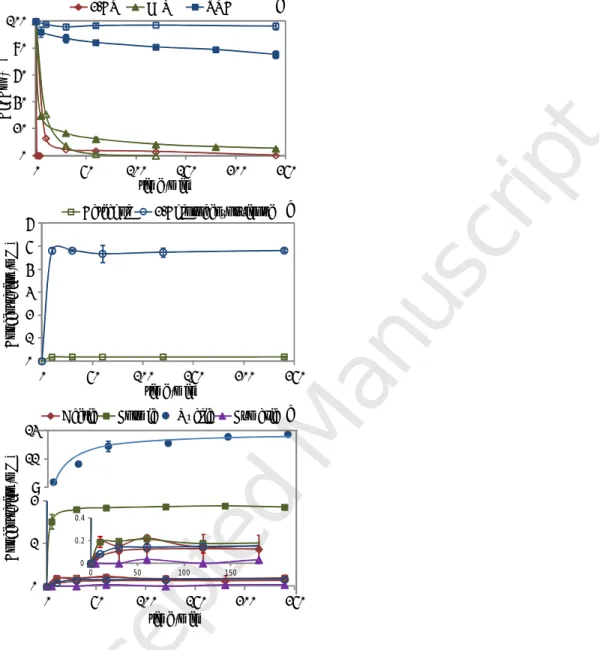
The effect of two different concentrations of H2O2(20 and 100% of the stoichiometric
H2O2 dose) on the Fenton oxidation of 2-CP was investigated. Although oxidation was
effective for both concentrations, it was faster with 100% H2O2 due to a higher OH
Accepted Manuscript
0 20 40 60 80 100 0 50 100 150 200 250 C i / C o ( % ) time (min) 2-CP H₂O₂ TOC 0 1 2 3 4 5 6 0 50 100 150 200 250 C on ce nt ra tio n (m M ) time (min) Catechol 2-Chlorobenzoquinone 9 1113 Acetic Formic Oxalic Fumaric
0 1 2 0 50 100 150 200 250 time (min) 0 0.2 0.4 0 50 100 150 C on ce nt ra tio n (m M ) a b c
Figure 1. Effect of H2O2 dose on: a) 2-CP, H2O2 and TOC; b) aromatic intermediates; c).organic
acids. Empty dots: 20% stoichiometric, solid dots: 100% stoichiometric.
However, even when 2-CP was completely degraded, the mineralization was far from complete at both H2O2 initial concentrations. With H2O2 at 20% of the stoichiometric
value, TOC was reduced only by 4%, and remained constant after 30 min, whereas using the stoichiometric amount of H2O2 (100%) higher TOC removal was achieved
(22.9% after 4 h). This is likely due to both the low concentration of H2O2remaining in
Accepted Manuscript
form complexes with Fe(III), deactivating its capacity to regenerate Fe(II) anddiminishing OH· production [19].
Aromatic intermediate products were identified only in samples containing 20% H2O2.
Concretely, 2-chlorobenzoquinone and catechol (Figure 1b), reached maximum concentrations at 5 min and remained at constant values after 30 min, coinciding with total H2O2 consumption. The cleavage of the aromatic ring led to the formation of
aliphatic carboxylic acids: acetic, formic, oxalic and fumaric acids. Although the same organic acids were identified with both H2O2 dose (fumaric acid was not detected at
20% H2O2), higher concentrations were obtained with H2O2 at 100% because of the
higher OH· availability.
3.2. Effect of Temperature on Fenton degradation of 2-CP
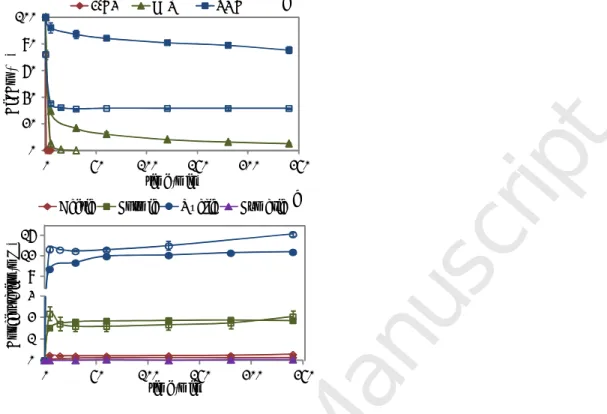
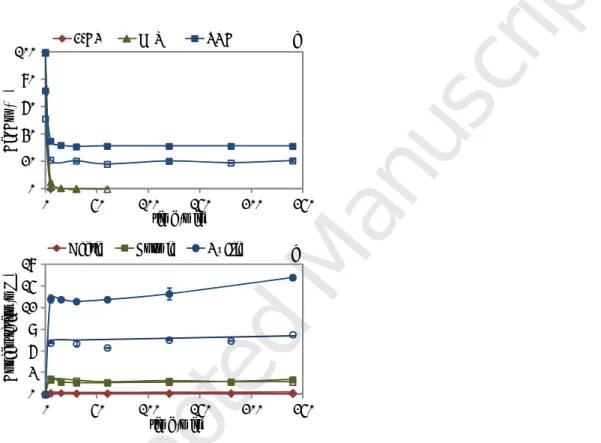
The analysis of 2-CP degradation was performed at two different temperatures, ambient (20ºC) and 70ºC, for both H2O2 concentrations (20% and 100% of the stoichiometric
dose). Faster degradation of 2-CP was observed at 70ºC than at room temperature for both H2O2 concentrations, as would be expected due to the increase in the kinetic
Accepted Manuscript
0 20 40 60 80 100 0 50 100 150 200 250 C i / C o ( % ) time (min) 2-CP H₂O₂ TOC 4 8 12 16 0 50 100time (min)150 200 250Acetic Formic Oxalic Fumaric
0 1 2 3 0 50 100 150 200 250 time (min) C on ce nt ra tio n (m M ) a b
Figure 2. Effect of Temperature with H2O2 at 100% in: a) 2-CP, H2O2 and TOC; b) organic
Accepted Manuscript
0 2 4 6 0 50 100 150 200 250 C on ce nt ra tio n (m M ) time (min) Catechol 2-Chlorobenzoquinone 0 20 40 60 80 100 0 50 100 150 200 250 C i / C o ( % ) time (min) 2-CP H₂O₂ TOC 0 0.2 0.4 0.6 0 50 100 150 200 250 C on ce nt ra tio n (m M ) time (min)Acetic Formic Maleic Oxalic
a
b
c
Figure 3. Effect of Temperature with H2O2 at 20% in: a) 2-CP, H2O2 and TOC; b) aromatic
intermediates; c).organic acids. Empty dots: 70ºC, filled dots: 20ºC.
Although some authors claim that the thermal instability of H2O2 is a limitation for the
use of Fenton oxidation at high temperatures [20], Zazo et al. [21] found that increasing the temperature in the range 25 to 130ºC enhanced mineralization rates. Accordingly, our results indicate that the overall mineralization was considerably more effective at 70ºC (Figures 2a and 3a). The reduction in TOC increased from 3% at 20ºC to 27% at 70ºC (H2O2 at 20%, 4h) and from 23% at 20ºC to 69% at 70ºC (H2O2 at 100%, 4 h).
Accepted Manuscript
The concentration of the main aromatic intermediate products, 2-chlorobenzoquinone and catechol, which were only identified with 20% H2O2,was lower at 70ºC than at20ºC in agreement with the enhancement in TOC mineralization. On the other hand, the temperature increase resulted in high concentrations for some organic acids, formic and oxalic at 20% H2O2, and oxalic acid with 100% H2O2. Although the temperature
increment favored TOC degradation, a complete mineralization could not be achieved, accordingly to section 3.1, because of H2O2consumption and the resistance of some
carboxylic acids, such as oxalic acid, to Fenton degradation. 3.3. Effect of chloride on Fenton degradation of 2-CP
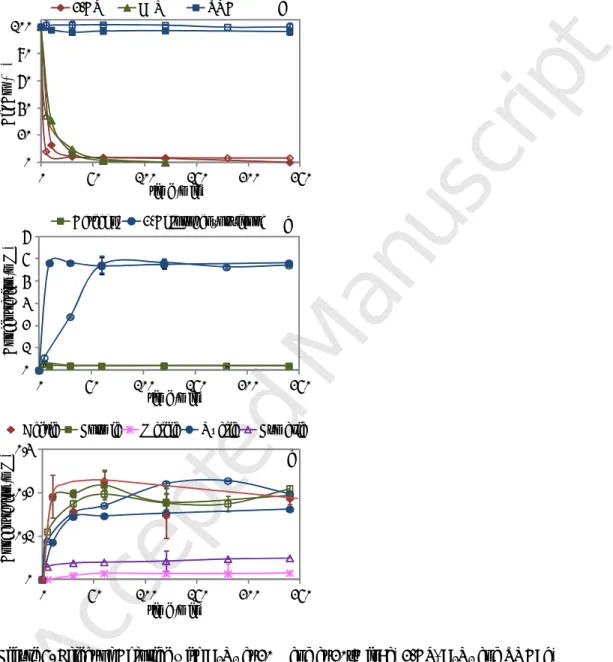
Since chloride may be one product of 2-CP degradation and high concentrations of inorganic salts, especially NaCl, have been measured in wastewaters, such as those generated during the manufacture of pesticides, pharmaceuticals, dyes, and from landfill leachates [22-24], the effect of 2-CP was analyzed using two sets of experiments, differently favored in terms of TOC removal (H2O2 at 100% and at 70ºC; H2O2 at 20%
and 20ºC) and in the presence of 2000 mg L-1 (56.34 mM) of Cl-.
With 100% H2O2 and 70ºC, the presence of Cl- in the reaction medium did not affect the
degradation of 2-CP, but increased the mineralization of TOC by 11% in comparison to samples without Cl-(Figure 4). As was shown by Micó and coworkers [25], this fact can be attributed to the formation of chloride radical anions (Cl·) from the reaction between OH· and Cl- (reactions 1 to 3), which contribute to the degradation of organic compounds.
(reaction 1) (reaction 2) (reaction 3)
Accepted Manuscript
Although Cl· formation requires OH· scavenging, and Cl· are generally less reactive than OH· with organic species, the magnitude of rate constants for Cl·reactions with organic compounds are comparable to those for OH· [25,26]. Additionally, Pignatello [27] found that the scavenging effect of OH· by Cl- is noticeable above 10 mM Cl-; we have, accordingly, used Cl- concentrations higher than 10 mM.0 20 40 60 80 100 0 50 100 150 200 250 C i / C o ( % ) time (min) 2-CP H₂O₂ TOC 0 3 6 9 12 15 18 0 50 100 150 200 250 C on ce nt ra tio n (m M ) time (min) Acetic Formic Oxalic
a
b
Figure 4. Effect of Chloride with H2O2 at 100% and at 70ºC in: a) 2-CP, H2O2 and TOC; b)
organic acids. Empty dots: with NaCl, filled dots: without NaCl.
These results were opposed to other studies where Cl- significantly inhibited organic matter removal via OH·scavenging, as well as ferric ion complexation [25].
Nevertheless, the formation of ferric chlorocomplexes that affect the regeneration of Fe2+, can be overcome if Cl-concentrations are less than 200 mM [28], as was also observed in this study. Alternatively, with 20% H2O2and at 20ºC, the presence of Cl
-did not affect the degradation of 2-CP and the overall TOC removal (Figure 5). These results suggest that when using low concentrations of Fenton reagent, the lower
Accepted Manuscript
production of OH·leads to preferential degradation of the main organic contaminant, 2-CP. 0 20 40 60 80 100 0 50 100 150 200 250 C i / C o ( % ) time (min) 2-CP H₂O₂ TOC 0 1 2 3 4 5 6 0 50 100 150 200 250 C on ce nt ra tio n (m M ) time (min) Catechol 2-Chlorobenzoquinone 0 0.1 0.2 0.3 0 50 100 150 200 250 C on ce nt ra tio n (m M ) time (min)Acetic Formic Maleic Oxalic Fumaric
a
b
c
Figure 5. Effect of Chloride with H2O2 at 20% and at 20ºC in: a) 2-CP, H2O2 and TOC; b)
aromatic intermediates; c) organic acids. Empty dots: with NaCl, filled dots: without NaCl.
3.4. TOC and Cl-balance
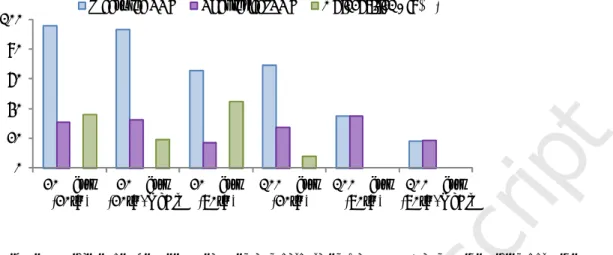
Theoretical TOC values after 4 h of treatment were calculated in order to account for the detected intermediate products and compared to the experimentally measured TOC data (Figure 6).
Accepted Manuscript
0 20 40 60 80 100 20% estq (20ºC) 20% estq (20ºC, NaCl) 20% estq (70ºC) 100% estq (20ºC) 100% estq (70ºC) 100% estq (70ºC, NaCl) Measured TOC Theoretical TOC Unidentified Clˉ (%)Figure 6. Differences between measured and calculated TOC (mM) and unidentified chloride (%) after 4h.
The difference between measured and theoretical TOC values decreased with increasing H2O2 dose and temperature. After 4 h, the TOC balance was only 100% satisfied with
100% H2O2 at 70ºC. Under experimental conditions other than 100% H2O2and 70ºC, a
difference between the measured and quantified TOC was observed and attributed to the presence of unidentified oxidation intermediates, which may be aromatic condensation species [21]. In addition, Cl-measurements were only balanced when the TOC was balanced. It is, therefore, likely that the aforementioned condensation byproducts included chlorinated organic compounds.
There are significant gaps in the understanding of the formation and identity of aromatic intermediates when using pronounced substoichiometric H2O2 to CPo molar ratios for
Fenton oxidation [13]. In order to identify some of these unknown byproducts, samples were analyzed using GC-MS. Working with 20% H2O2, the main species identified at
low retention times were chlorobenzenediols, mainly as 2-chlorohydroquinone, 4-chlorocatechol and 4-chloresorcinol (which were only detected by GC-MS, suggesting low yields). Compounds with higher molecular weights, such as condensation products formed by two-chlorinated aromatic rings, were detected at higher retention times. They
Accepted Manuscript
were primarily 4-chloro-3-(4-chlorophenoxy)phenol (m/z: 254, 184) and4,4'-dichloro[1,1'-biphenyl]-3,3'-diol (m/z: 254, 155). The formation of coupling-reaction aromatic byproducts is supported by the development of a brownish reagent medium [29] and have also been reported during the treatment of chlorinated phenols under nonstoichiometric Fenton [13] and Fenton-like systems [14,15, 30]. Nevertheless, these compounds are present in low concentrations that do not balance the differences
observed in the TOC. Therefore, it is likely that there were unknown analytes remaining in the solution. However, such compounds are susceptible to oxidation, as the organic carbon balance was closed by increasing H2O2 dose and temperature. Similarly, Sedlak
and Andren [29] identified the formation of colored aromatic polymers during the Fenton oxidation of chlorobenzenes that were further oxidized by subsequent OH· attack.
3.5. Formation of PCDD/Fs during the Fenton degradation of 2-CP
Since 2-CP is a potent precursor of PCDD/Fs, and its Fenton oxidation byproducts (i.e., chlorinated hydroxybipehnyls and phenoxyphenols) are key intermediates in the
formation of PCDD/Fs from chlorinated phenols [31,32], the assessment of the potential formation of PCDD/Fs as minor byproducts during Fenton oxidation of 2-CP is
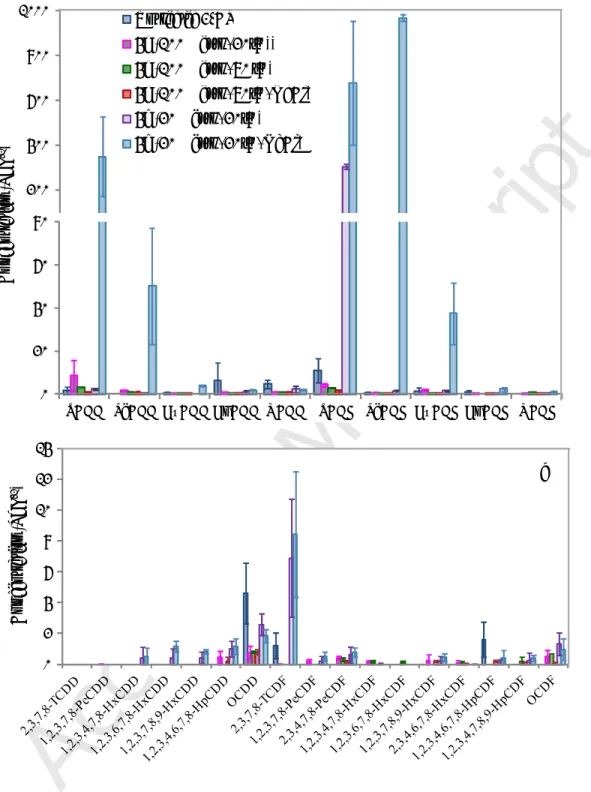
necessary. PCDD/Fs analyses were performed after 4 h of treatment under the operating conditions discussed in sections 3.1, 3.2 and 3.3. The homologue profiles of total PCDD/Fs and the congener profiles of 2,3,7,8-PCDD/Fs in untreated 2-CP solutions and in oxidized samples (4 h) are shown in Figure 7a and 7b, respectively.
Accepted Manuscript
0 200 400 600 800 1000 Untreated 2-CP 4h (100% estq, 20ºC)) 4h (100% estq, 70 ºC) 4h (100% estq, 70ºC, NaCl) 4h (20% estq, 20ºC) 4h (20% estq, 20ºC, NaCl) 0 20 40 60 80TCDD PeCDD HxCDD HpCDD OCDD TCDF PeCDF HxCDF HpCDF OCDF
C on ce nt ra tio n (P g L -1) 0 2 4 6 8 10 12 14 C on ce nt ra tio n (P g L -1) b
Figure 7. PCDD/Fs concentration: a) homologue profile of total PCDD/Fs; b) congener profile of 2,3,7,8-PCDD/Fs.
As can be observed in Figure 7a, three groups of homologues (HpCDD, OCDD, and TCDF) were detected at very low concentration (4.6-12.2 pg L−1) in the untreated water
Accepted Manuscript
solutions containing 2-CP. For 100% H2O2, although new groups of homologuesappeared in the oxidized sample, in comparison to the untreated one, a significant PCDD/Fs formation was not observed. Besides, the concentration of some homologue groups, namely TCDD and TCDF, decreased when working at 70ºC. On the other hand, after 4 h of treatment with 20% H2O2, relatively large quantities of PCDD/Fs were
observed, resulting in concentrations (312.9 pg L-1, Table 1SI) 11 times higher than in the untreated sample. Results from figure 7a showed a preferential formation of PCDFs over PCDDs, so the formation of PCDFs intermediate products seemed to be favored over the corresponding for PCDDs. According to Duesterberg and Waite [33], the electrophilic addition of OH· to CPs followed by water elimination results in the formation of Cl-phenoxy radicals. These radicals have been identified as key intermediates in basically all suggested pathways for PCDD/Fs formation [34]. The oxidative coupling reactions of Cl-phenoxy radicals with other radicals and/or
molecules give rise to bioaromatic intermediates such as biphenyls and phenoxyphenols and then to PCDD/Fs [35,36]. Since radical-molecule pathway requires chlorine and hydroxyl displacement, steps that are not energetically favored, the radical-radical pathway is considered the major pathway for the formation of PCDD/Fs [36].
Furthermore, when NaCl was present in the reaction medium, PCDD/Fs were formed at higher extent, with a total PCDD/Fs concentration (2092 pg L-1Table 1SI) 74.4 times higher than in the untreated 2-CP solution, highlighting the significance of ubiquitous Cl-in the reaction medium. Chlorine radicals (Cl·), formed from the reaction between OH· and Cl- as was described in section 3.3, could contribute to PCDD/Fs formation by chlorination of their precursors as well as of lower chlorinated PCDD/Fs. The
dominance of lower chlorinated PCDD/Fs (tetra and penta derivatives) underscores the reactivity dynamics of the reaction medium where lower chlorinated compounds (2-CP
Accepted Manuscript
and its derivatives) predominate, progressing with time to PCDD/Fs by means ofchlorination/condensation reactions.
Among total PCDD/Fs, congeners with chlorine at 2,3,7,8 positions (a total of 17 PCDD/Fs congeners) are of particular interest due to their high toxicity and potential effects on human health. Only two 2,3,7,8-PCDD/Fs, OCDD and 2,3,7,8-TCDF, were detected at very low concentrations (1.2−4.6 pg L−1) in the untreated 2-CP solution (Figure 7b). After 4 h of treatment using 20% H2O2, both congeners remained in the
reaction medium although at low concentrations, 2.6 pg L-1 for OCDD and 6.9 pg L-1for 2,3,7,8-TCDF (Table 2 SI). Similar values were obtained when NaCl was added to the reaction medium (20% H2O2), with concentration values of 1.8 pg L-1 for OCDD and
8.4 pg L-1 for TCDF (Table 2 SI). For both systems, the rest of the 2,3,7,8-PCDD/Fs were observed at negligible concentrations. Under the remaining operating conditions and taking into account the low PCDD/Fs concentrations and the
experimental error, the formation of 2,3,7,8-PCDD/Fs could not be confirmed. Therefore, the formation of the less toxic PCDD/Fs congeners was favored under the operating conditions used in this work. Although PCDD/Fs have been shown to be formed in very small concentrations (i.e. 2092 pg L-1), it must be emphasized that these low yields do not eliminate environmental threats, as many compounds, such as
PCDD/Fs, are toxic even at very low concentrations. In fact, the maximum contaminant level established by the U.S. EPA is 30 pg L-1 of the equivalent 2,3,7,8-TCDD. In addition, as PCDD/Fs are highly persistent in the environment and their lipophilic nature causes them to accumulate through food chains, there can be adverse effects for biota (including humans) from very low and continuous exposure to these compounds. The formation of PCDD/Fs has also been reported during the treatment of chlorinated phenols using other AOPs. Vollmuth et al. [37] found that the photolytic treatment of
Accepted Manuscript
pentachlorophenol (PCP) in water resulted in the formation of several congeners of PCDD/Fs. Hong et al. [38] observed the presence of 1,2,3,4,6,7,8-HpCDD and OCDD as a minor transformation product during the photolysis of PCP. Furthermore,photolytical and photocatalytical treatment of triclosan in water solutions have been shown to result in the formation of some PCDD congeners [39-41]. On the other hand, Holt et al. [42] found that the concentration of 93 PCDD/F congeners in two pesticide formulations increased between 3000 to 5600% after exposure to natural light. More recently, Vallejo et al. [43] assessed the formation of PCDD/Fs as a result of the electrochemical treatment of 2-CP as a function of the type of electrolyte used. When NaCl was used as electrolyte, the concentration of total PCDD/Fs increased by 26,800 times compared to the untreated sample (equivalent to the toxicity index of 220 pg-ITEQ L-1).
Regarding Fenton oxidation, Fukushima and Tatsumi [44] observed the formation of OCDD during the photo-Fenton treatment of PCP. Poerschmann et al. [13] observed the generation of chlorinated biphenyls, diphenyl ethers, benzofurans and related
compounds during the Fenton oxidation of 2-CP under substoichiometric conditions. More recent studies report the formation of similar compounds, including
dichlorodibenzodioxins, as a result of Fenton-like treatment of several CPs with
substoichiometric doses of H2O2 and low quantities of iron [14,15]. These observations,
in combination with the results presented in this paper, serve to confirm our recent observations of increasing concentrations of PCDD/Fs congeners during the Fenton treatment of different leachate samples from a municipal waste landfill [45].
4. CONCLUSIONS
This work reports the importance of understanding the effects of the operating
Accepted Manuscript
byproducts (i.e., PCDD/Fs). Substoichiometric H2O2concentrations lead to theformation of PCDD/Fs, and PCDD/F concentrations increase when Cl- is in the reaction medium. Our analyses represent a valuable contribution because they go beyond the previously published results, in which the formation of dioxins and related compounds was covered from a qualitative approach. Furthermore, these results provide evidence for the necessity of using proper operating conditions during the Fenton treatment of chlorinated pollutants, in particular when PCDD/Fs precursors and/or Cl-are present, or may be formed, in the treated samples.
AUTHOR INFORMATION Corresponding Author
*(I.O.) Phone: +34 942 201585; fax: +34 942 201591; e-mail:[email protected]. ACKNOWLEDGMENTS
Financial support from the projects CTQ2011-25262 and CTQ2008-00690 (Ministerio de Economía y Competitividad- MINECO/SPAIN and Fondo Europeo de Desarrollo Regional- FEDER) is gratefully acknowledged. MV is indebted to the Spanish Ministry of Science and Innovation for the FPI grant BES-2009-025363.
REFERENCES
[1] Unites States Environmental Protection Agency. Health and Environmental Effects Profile No. 135; USEPA: Washington DC, 1980.
[2 ] EC Decision 2455/2001/CE. Establishing the list of priority substances in the field of water policy and amending Directive 2000/60/EC (L331 of 15-12-2001).
Accepted Manuscript
[3] T. Methatham, M.W. Lu, C. Ratanatamskul, Removal of 2,4-dichlorophenol as herbicide’s by-product by Fenton’s reagent combined with an electrochemical system, Desalin. Water Treat. 32 (2011) 42-48.[4] Z. Shi, M.E. Sigman, M.M. Ghosh, R. Dabestani, Photolysis of 2-chlorophenol dissolved in surfactant solutions, Environ. Sci. Technol. 31 (1997) 3581-3587. [5] M. Pera-Titus, V. García-Molina, M.A. Baños, J. Giménez, S. Esplugas, Degradation of chlorophenols by means of advanced oxidation processes: a general review, Appl. Catal. B-Environ. 47 (2004) 219-256.
[6] G.W. Muna, N. Tasheva, G.M. Swain, Electro-oxidation and amperometric detection of chlorinated phenols at boron-doped diamond electrodes: a comparison of microcrystalline and nanocrystalline thin films, Environ. Sci. Technol. 38 (2004) 3674-3682.
[7] N. Oturan, M. Panizza, M.A. Oturan, Cold incineration of chlorophenols in aqueous solution by adavanced electrochemical process electro-fenton. Effect of number and position of chlorine atoms on the degradation kinetics, J. Phys. Chem. 113 (2009) 10988-10993.
[8] P. Bautista, A.F. Mohedano, J.A. Casas, J.A. Zazo, J.J. Rodriguez, An overview of the application of Fenton oxidation to industrial wastewaters treatment, J. Chem. Technol. Biotechnol. 83 (2008) 1323-1338.
[9] Y. Deng, J.D. Englehardt, Treatment of landfill leachate by the Fenton process, Water Res. 40 (2006) 3683-3694.
[10] D. Hermosilla, M. Cortijo, C.P. Huang, Optimizing the treatment of landfill leachate by conventional Fenton and photo-Fenton processes, Sci. Total. Environ. 407 (2009) 3473-3481.
Accepted Manuscript
[11] V. Kavitha, K. Palanivelu, Degradation of 2-chlorophenol by Fenton and photo-Fenton processes- A comparative study, J. Environ. Heal. A A38 (2003) 1215-1231. [12] J.A. Zimbron, K.F. Reardon, Fenton’s oxidation of pentachlorophenol, Water Res. 43 (2009) 1831-1840.[13] J. Poerschmann, U. Trommler, T. Górecki, F.D. Kopinke, Formation of chlorinated biphenyls, diphenyle ethers and benzofurans as a result of fenton driven oxidation of 2-chlorophenol, Chemosphere 75 (2009) 772-780.
[14] M. Muñoz, Z.M. de Pedro, J.A. Casas, J.J. Rodriguez, Assessment of the generation of chlorinated byproducts upon fenton-like oxidation of chlorophenols at different conditions, J. Hazard. Mater. 190 (2011) 993-1000.
[15] M. Muñoz, Z.M. de Pedro, G. Pliego, J.A. Casas, J.J. Rodriguez, Chlorinated byproducts from the Fenton-like oxidation of polychlorinated phenols, Ind. Eng. Chem. Res. 51 (2012) 13092-13099.
[16] R. Weber, Relevance of PCDD/PCDF formation for the evaluation of POPs destruction technologies - Review on current status and assessment gaps, Chemosphere 67 (2007) S109−S117.
[17] J. Koistinen, J.V.K. Kukkonen, A. Sormunen, E. Mannila, S. Herve, T. Vartiainen, Bioaccumulation, bioavailability and environmental fate of chlorophenol impurities, polychlorinated hydroxydiphenylethers and their methoxy analogues, Chemosphere 68 (2007) 1382-1391.
[18] Stockholm Convention on Persistent Organic Pollutants, 2001. Stockholm Convention, Geneva, Switzerland
Accepted Manuscript
[19] H. Nakagawa, E. Yamaguchi, Influence of oxalic acid formed on the degradation of phenol by Fenton reagent, Chemosphere 88 (2012) 183-187.[20] P.R. Gogate, A.B. Pandit, A review of imperative technologies for wastewater treatment I: oxidation technologies at ambient conditions, Adv. Environ. Res. 8 (2004) 501-551.
[21] J.A. Zazo, G. Pliego, S. Blasco, J.A. Casas, J.J. Rodriguez, Intensification of the Fenton process by increasing the temperature, Ind. Chem. Res. 50 (2011) 866-870. [22] J. Bacardit, J. Stötzner, E. Chamarro, S. Esplugas, Effect of salinity on the photo-Fenton process, Ind. Eng. Chem. 46 (2007) 7615-7619.
[23] O. Primo, M.J. Rivero, I. Ortiz, Photo-Fenton process as an efficient alternative to the treatment of landfill leachates, J. Hazard. Mater. 153 (2008) 834-842.
[24] A. Anglada, A. Urtiaga, I. Ortiz, Pilot scale performance of the electro-oxidation of landfill leachate at boron-doped diamond anodes, Environ. Sci. Technol. 43 (2009) 2035-2040.
[25] M.M. Micó, J. Bacardit, J. Malfeito, C. Sans, Enhancement of pesticide photo-Fenton oxidation at high salinities, Appl. Catal. B-Environ. 132-133 (2013) 162-169. [26] Y. Deng, E. Rosario-Muniz, X. Ma, Effects of inorganic anions on Fenton oxidation of organic species in landfill leachate, Waste Manag. Res. 30 (2010) 12-19. [27] J.J. Pignatello, Dark and photoassisted Fe3+-catalyzed degradation of
chlorophenoxy herbicides by hydrogen-peroxide, Environ. Sci. Technol. 26 (1992) 944-951.
[28] M.C. Lu, Y.F. Chang, I.M. Chen, Y.Y. Huang, Effect of chloride ions on the oxidation of aniline by Fenton’s reagent, J. Environ. Manage. 75 (2005) 177-182.
Accepted Manuscript
[29] D.L. Sedlak, A. Andren, Oxidation of chlorobenzene with Fenton’s reagent.Environ, Sci. Technol. 25 (1991) 777-782.
[30] A. Detomaso, A. Lopez, G. Lovecchio, G. Mascolo, R. Gurci, Practical
applications of the fenton reaction to the removal of chlorinated aromatic pollutants – Oxidative degradation of 2,4-dichlorophenol, Environ. Sci. Pollut. Res. 10 (2003) 379-384.
[31] R. Weber, H. Hagenmaier, Mechanism on the formation of polychlorinated dibenzo-p-dioxins and dibenzofurans from chlorophenol in gas phase reactions, Chemosphere 38 (1999) 529-549.
[32] W. Liu, M. Zheng, D. Wang, Y. Xing, X. Zhao, X. Ma,Y. Qian, Formation of PCDD/Fs and PCBs in the process of production of 1,4-dichlorobenzene, Chemosphere 57 (2004) 1317-1323.
[33] C.K. Duesterberg, T.D. Waite, Kinetic modeling of the oxidation of
p-hydroxybenzoic acid by fenton’s reagent: implications of the role of quinines in the redox cycling of iron, Environ, Sci. Technol. 41 (2007) 4103-4110.
[34] F. Xu, W. Yu, Q. Zhou, R. Gao, X. Sun, Q. Zhang, W. Wang, Mechanism and direct kinetic study of the polychlorinated dibenzo-p-dioxin and dibenzofuran
formations from the radical/radical cross-condensation of 2,4-dichlorophenoxy with 2-chlorophenoxy and 2,4,6-tri2-chlorophenoxy, Environ, Sci. Technol. 45 (2011) 643-650. [35] M. Altarawneh, B.Z. Dlugogorski, E.M. Kennedy, J.C. Mackie, Mechanisms for formation, chlorination, dechlorination and destruction of polychlorinated dibenzo-p-dioxins and dibenzofurans (PCDD/Fs), Prog. Energy Combust. Sci. 35 (2009) 245–274.
Accepted Manuscript
[36] Q. Zhang, S. Li, X. Qu, X. Shi, W. Wang, A quantum mechanical study on the formation of PCDD/Fs from 2-Chlorophenol as precursor, Environ. Sci. Technol. 42 (2008) 7301–7308.[37] S. Vollmuth, A. Zajc, R. Niessner, Formation of polychlorinated dibenzo-p-dioxins and polychlorinated dibenzofurans during the photolysis of
pentachlorophenol-containing water, Environ. Sci. Technol. 28 (1994) 1145-1149.
[38] J. Hong, D.G. Kim, C. Cheong, S.Y. Jung, M.R. Yoo, K.J. Kim, T.K. Kim, Y.C. Park, Identification of photolytical transformation products of pentachlorophenol in water, Anal. Sci. 16 (2000) 621-626.
[39] K. Aranami, J.W. Readman, Photolytic degradation of triclosan in freshwater and seawater, Chemosphere 66 (2007) 1052-1056.
[40] J.M. Buth, M. Grandbois, P.J. Vikesland, K. McNeill, W.A. Arnold, Aquatic photochemistry of chlorinated triclosan derivatives: potential source of
polychlorodibenzo-p-dioxins, Environ. Toxicol. Chem. 28 (2010) 2555-2563. [41] K. Sankoda, H. Matsuo, M. Ito, K. Nomiyama, K. Arizono, R. Shinohara, Identification of triclosan intermediates produced by oxidative degradation using TiO2
in pure water and their endocrine disrupting activities, Bull. Environ. Contam. Toxicol. 86 (2011) 470-475.
[42] E. Holt, R. Weber,G. Stevenson, C. Gaus, Formation of dioxins during exposure of pesticide formulations to sunlight, Chemosphere 88 (2012) 364-370.
[43] M. Vallejo, M.F. San Román, I. Ortiz, Quantitative assessment of the formation of polychlorinated derivatives, PCDD/Fs, in the electrochemical oxidation of
2-chlorophenol as function of the electrolyte type, Environ. Sci. Technol. 47 (2013b) 12400-12408.
Accepted Manuscript
[44] M. Fukushima, K. Tatsumi, Degradation pathways of pentachlorophenol by photo-Fenton systems in the presence of iron(III), humic acid, and hydrogen peroxide,Environ. Sci. Technol. 35 (2001) 1771-1778.
[45] M. Vallejo, M.F. San Román, I. Ortiz, Comparative study of the destruction of polychlorinated dibenzo-p-dioxins and dibenzofurans during Fenton and