
COMPARATION BETWEEN PULSED Nd:YAG LÁSER SUPERFICIAL
TREATMENT AND CERAMIC COATING IN CREEP TEST OF TÍ-6AI-4V
ALLOY
Reis, A.G.
1a; Reis, D.A.P.
1b; Moura Neto, C.
1c; Onoro, J.
2 d;
Oliveira, H.S.
1e; Couto, A.A.
3Afinstituto Tecnológico de Aeronáutica, Divisáo de Eng. Mecánica, S. J. Campos, Brazil.
2Universidade Politécnica de Madrid, UPM, Madrid, Espanha.
instituto de Pesquisas Energéticas e Nucleares, IPEN, Sao José dos Campos, Brazil
4Universidade Presbiteriana Mackenzie, Sao Paulo, Brasil.
a [email protected], bdanielireis@hotmail, [email protected],d [email protected],e
[email protected], [email protected]
Keywords: creep, plasma-sprayed coatings, pulsed láser, titanium alloy.
Abstract: The objective of this work was evaluating the creep resistance of the TÍ-6A1-4V alloy
with superficial treatment of pulsed Nd:YAG láser and ceramic coating in creep test of TÍ-6A1-4V
alloy. It was used TÍ-6A1-4V alloy as cylindrical bars under forged and annealing of 190°C by 6
hours condition and cooled by air. The TÍ-6A1-4V alloy after the superficial treatment of pulsed
Nd:YAG láser and ceramic coating was submitted to creep tests at 600°C and 125 at 319 MPa,
under constant load mode. In the Nd:YAG pulsed láser treatment was used an environment of 40 %
N and 60 % Ar, with 2.1 W of power and 10 m/s of speed. Yttria (8 wt.%) stabilized zirconia (YSZ)
with a CoNiCrAlY bond coat was atmospherically plasma sprayed on TÍ-6A1-4V substrates by
Sulzer Metco Type 9 MB. The obtained results suggest the láser treatment on TÍ-6A1-4V alloy
improved its creep resistance.
Introduction
Development of alloys to increase creep strength, so permitting the use of higher turbine entry
temperatures, has resulted in a general reduction in chromium and increase in aluminum content of
nickel superalloys. This has had relatively little effect on high-temperature oxidation resistance, but
has had a very significant adverse effect on corrosión resistance in the lower temperature range in
salt-contaminated environments. Such environments are experienced by aircraft operating between
airfields with approaches low over the sea with relatively short sector times. Improvements in aero
gas turbine performance in terms of power, efficiency and weight have necessitated the use of high
One of the major factors limiting the life of titanium alloys in service is their degradation due to
gaseous environments, in particular, the one containing oxygen, especially at elevated temperatures,
during the long term use [3]. The sensitivity of titanium alloys to high temperature exposure is a
well-known phenomenon. When titanium alloys are heated to temperatures above approximately
800°C, oxygen, hydrogen and nitrogen penétrate into them. The penetration of the above elements is
thought to be undesirable because it increases hardness and brittleness while decreasing the
toughness of the alloy [4]. Interaction of titanium alloys with oxygen not only causes loss of the
material by formation of oxides, but also causes embrittlement in the subsurface zone of the
component due to oxygen enrichment [3].
Titanium alloys is one of the most technologically important materials in the aeronautic and
aerospace field for its high strength and lightweight. However, this material does not possess
satisfactory tribological property. For this reason, surface strengthening of titanium alloys has
attracted much attention [5].
Láser oxidation or nitridation of titanium surfaces are interesting for local hardening and
improvement of wear resistance. It is known that melting of the surface layer to enhance the
chemical reactions, avoiding significant vaporization and particulates removal, represents the main
requirement in direct láser surface oxidation or nitridation of metallic targets in controlled reactive
atmospheres [6,7].
To prevent the superficial oxidation and in the grain boundary the sample is plasma sprayed
coated Yttria (8 wt%) stabilized zirconia (YSZ) with CoNiCrAlY (AMDRY 995C), an technique
studied recently named thermal barrier coating (TBC). The YSZ ceramic coating, which is the outer
layer, is used to insulation and the CoNiCrAlY metallic coating, which is the inner layer, prevent
corrosion/oxidation at high temperatures and stick the YSZ ceramic coating to the titanium alloy.
These characteristics provide an improvement in the creep resistance [8-12].
The aim of the present paper was to measure the creep resistance of the TÍ-6A1-4V alloy with
superficial treatment of pulsed Nd:YAG láser and ceramic coating in creep test of TÍ-6A1-4V alloy.
A substantial part of the creep research has been devoted to TÍ-6A1-4V due to its industrial and
technological importance.
Experimental Procedure
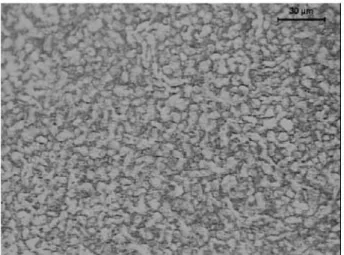
The chosen material for the present study was hot-forged 12.7 mm diameter rod of commercial
TÍ-6A1-4V alloy with the same specifications as published by ASTM [13]. The microstructure (Fig.
in the a grain boundaries [14]. Tensile testing was performed at 600°C in air according to ASTM
standard E 21 specification [15]. The tensile properties are summarized in Table 1 namely, 0.2%
yield stress (YS), ultimate tensile stress (UTS), elongation (EL) and reduction of área (RA). The
initial creep stress levéis were determined from the elevated temperature tensile properties given in
Table 1. The Nd:YAG láser treatment parameters used are presented in Table 2, it was used ROFIN
DY 033 láser and Talymap Silver 4.0 software. Yttria (8 wt.%) stabilized zirconia (YSZ) (Metco
204B-NS) with a CoNiCrAlY bond coat (AMDRY 995C) was atmospherically plasma sprayed on
TÍ-6A1-4V substrates by Sulzer Metco Type 9 MB. Constant load creep tests were conducted with
TÍ-6A1-4V alloy at 600°C. The creep tests were conducted on a standard creep machine at stress of
250 and 319 MPa. Samples with a gauge length of 18.5 mm and a diameter of 3.0 mm were used for
all tests. The creep tests were performed according to ASTM E139 standard [16].
Fig. 1. Micrograph of TÍ-6A1-4V alloy as-received.
Table 1 - Tensile properties of TÍ-6A1-4V alloy.
T[°C]
600
YS [MPa])
377
UTS [MPa]
407
EL [%]
46
RA [%]
85.7
Table 2 - Láser treatment parameters.
Parameters Power focal length lens láser scanning speed
environment
depth above the specimen surface distance between focusing lens
-target
láser pulsed energy diameter láser spot
Nd-YAG Láser 1.6- 10 W 100-160 mm
50 mm/s 40% N + 60% Ar
0.2-4.5 um
89 mm
diameter central zone incident láser intensity
distribution
0.04-0.24 mm 3.1x10⁹ W/cm2
Gaussian
Results
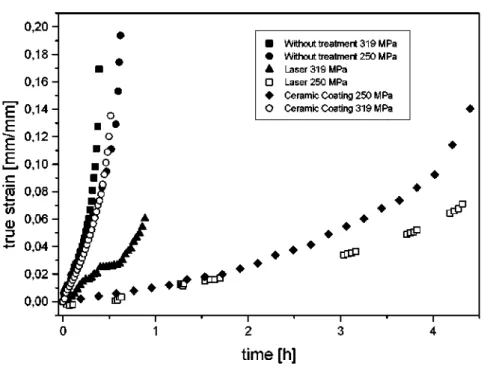
Representative creep curves of TÍ-6A1-4V are showed in Fig. 2.
(0 (O
<D 3
• • •
D
•
O
Without treatment 319 MPa Without treatment 250 MPa Láser 319 MPa Láser 250 MPa Ceramic Coating 250 MPa Ceramic Coating 319 MPa
¿p mP
d j P
. * * * * * * *
time [h]
Fig. 2. Typical creep curves of TÍ-6A1-4V at 600°C.
Results from the creep tests at 600°C are summarized in Table 3, which shows the valúes of
stress (a), primary creep time (tp), secondary creep rate (e*s), final creep time (tf), final strain (sf) and
reduction of área (RA).
Figure 2 shows that most of the creep life of this alloy is dominated by a constant creep rate that
is thought to be associated with a stable dislocation configuration due to recovery and hardening
process [9-10, 17]. The higher creep resistance of TÍ-6A1-4V is observed in láser treated samples in
all cases.
The reduction of the steady-state creep rate (Table 3) demonstrates that the higher creep
resistance of TÍ-6A1-4V is observed in láser treated samples. This fact is related to the hardening
superficial formed in TÍ-6A1-4V alloy by the láser treatment. It is a well known fact that hard
surface and interstitial solid solutions increase the creep resistance of certain alloys. The hardening
superficial during creep tests, increases rupture life. It is possible that controlled penetration of
oxygen into the alloy TÍ-6A1-4V could increase its creep resistance without seriously altering its
Table 3 - Creep data at 600°C. Treatment Without treatment Ceramic coating Láser Without treatment Ceramic coating Láser [MPa] 250 319 tp [h] 0.03 0.38 0.63 0.01 0.03 0.21 E'S [1/h] 0.1906 0.0104 0.0127 0.5698 0.1401 0.0357 tf [h] 0.62 4.59 4.32 0.39 0.51 0.92 cf [mm/mm] 0.1938 0.1490 0.0711 0.1742 0.1353 0.0627 RA [%] 75.83 71.91 12.73 62.99 69.75 11.51 Conclusions
Constant load creep tests were conducted with TÍ-6A1-4V alloy at 600°C and stress of 250 and
319 MPa. When the TÍ-6A1-4V láser treated alloy was tested the effect of the oxidation was smaller
and the behavior of the creep curves showed that the life time was better. There was an increasing of
life time. Occurred a decreasing of steady state creep in function of the reduction of oxidation
process, showing that for the TÍ-6A1-4V alloy their life time was strongly affected by the superficial
treatment that was submitted because the oxidation suffered by the material.
Acknowledgment
FAPESP, CAPES and CNPq for financial support.
References
[1] G.W. Meetham: Materials Science and Technology Vol. 2 (1986), p.290.
[2] I. Gurrappa and A.K. Gogia: Surface and Coatings Technology Vol. 139 (2001), p.216.
[3] K.V. Sai Srinadh, andK.V. Singh: Bull. Mater. Sci. Vol. 27 (2004), p. 347.
[4] A. Rosen, and A. Rottem: Mater. Sci. Eng. Vol. 22 (1976), p. 23.
[5] X. Chen, G. Wu, R. Wang, W. Guo, J. Yang, S. Cao, Y. Wang, and W. Han: Surface & Coatings
Technology Vol. 201 (2007), p. 4843.
[6] E. Gyórgy, I.N. Mihailescu, P. Serra, A. Pérez del Pino and J.L. Morenza: Surface and Coatings
Technology Vol. 154 (2001), p. 63.
[7] E. Gyórgy, P. Serra, A. Pérez del Pino and J.L. Morenza: Surface and Coatings Technology Vol.
[8] D.A.P. Reis, C.R.M. Silva, M.C.A. Nono, M.J.R. Barboza, F. Piorino Neto, E.A.C. Pérez:
Materials at High Temperatures Vol. 22 (2006) p. 449.
[9] M. J. R. Barboza, C. MouraNeto, and C.R.M. Silva: Mater. Sci. Eng. A Vol. 369 (2004), p. 201.
[10] D.A.P. Reis, C.R.M. Silva, M.C.A. Nono, M.J.R. Barboza, F. Piorino Neto and E.A.C. Pérez:
Mater. Sci. Eng. A Vol. 399 (2005), p. 276.
[11] M.J.R. Barboza, E.A.C Pérez, M.M. Medeiros, D.A.P. Reis, M.C.A Nono, F. Piorino Neto and
C.R.M. Silva: Mater. Sci. Eng. A Vol. 428 (2006), p. 319.
[12] D.A.P. Reis, C. Moura Neto, C.R.M. Silva, M.J.R. Barboza and F. Piorino Neto: Mater. Sci.
Eng. A 486 (2008), p. 421.
[13] E.B. Howard and L.G. Timothy in: "Metals Handbook" (Desk edition, ASM International,
1985).
[14] D. Lee, S. Kim, S. Lee and C.S. Lee: Metall.and Mater.Trans. A Vol. 32 (2001), p. 315.
[15] Annual Book of ASTM Standards in: "American Society of Testing and Materials".
Philadelphia, PA, 03.01, (1995), p. 129-136.
[16]. Annual Book of ASTM Standards in: "American Society of Testing and Materials".
Philadelphia, PA, 03.01, (1995), p. 257-267.
![Table 3 - Creep data at 600°C. Treatment Without treatment Ceramic coating Láser Without treatment Ceramic coating Láser [MPa] 250 319 tp [h] 0.03 0.38 0.63 0.01 0.03 0.21 E'S [1/h] 0.1906 0.0104 0.0127 0.5698 0.1401 0.0357 tf [h] 0.62 4.59 4.32 0.39 0.51 0.92 cf [mm/mm] 0.1938 0.1490 0.0711 0.1742 0.1353 0.0627 RA [%] 75.83 71.91 12.73 62.99 69.75 11.51 Conclusions](https://thumb-us.123doks.com/thumbv2/123dok_es/6762423.829933/5.892.149.744.166.446/treatment-treatment-ceramic-coating-treatment-ceramic-laser-conclusions.webp)