An Experimental Platform for large-scale
research facing FI-IoT scenarios
Jesús Bernat Vercher1,José Manuel Hernández-Muñoz1, Luis Hernández Gómez 2, Alfonso Tierno Sepúlveda1
1
Telefónica I+D, Madrid, Spain, 2Universidad Politécnica de Madrid, Madrid, Spain
{bernat, jmhm, atierno}@tid.es; [email protected]
Abstract: Providing experimental facilities for the Internet of Things (IoT) world is of paramount importance to materialise the Future Internet (FI) vision. The level of maturity achieved at the networking level in Sensor and Actuator networks (SAN) justifies the increasing demand on the research community to shift IoT testbed facilities from the network to the service and information management areas. In this paper we present an Experimental Platform fulfilling these needs by: integrating heterogeneous SAN infrastructures in a homogeneous way; providing mechanisms to handle information, and facilitating the development of experimental services. It has already been used to deploy applications in three different field trials: smart metering, smart places and environmental monitoring and it will be one of the components over which the SmartSantander project, that targets a large-scale IoT experimental facility, will rely on.
Keywords: Internet of Things, testbeds, Experimental Facilities, Future Internet, Ubiquitous Sensor Networks, Wireless Sensor Networks, WS&AN
1.
Introduction
Contemporary society is continuously demanding more services based on smart environments. Smart grids, smart metering, home automation, eHealth, logistics, transportation, environmental monitoring are just some depicting examples of the new wave of services that will be widely used in the next forthcoming years. These solutions will be driven by the Future Internet (FI) technologies in general and the Internet of Things (IoT) in particular, where the power of combining ubiquitous networking with embedded systems, RFID, sensors and actuators makes the physical world itself a relevant part of any information system.
From the research community it is considered of vital importance to have access to experimental facilities where the new research trends can be tested in real environments. For the Internet of Things this is even more critical, since it represents a vision where millions of devices need to be connected to deliver real-time information, and simulations or tests with a small number of them are of very limited value.
Nowadays, some important activities are building testbeds, such as the FIRE initiative [1], but the ones that are available (OneLab2 [2], PII [3], Federica [4]…) are not inherently designed for IoT experimentation. Others more specific, as WISEBED [5], are dedicated to sensor network experimentation, but very far away from testing real IoT application scenarios.
networking with new functions that facilitate the research at the information and service level.
This paper presents an experimental platform designed to facilitate the development of new IoT services providing among others:
Horizontality: support of different application domains, so multiple services can be implemented simultaneously using the same infrastructure;
Heterogeneity: support of different sensor and actuator technologies, access mechanisms, radio standards, etc.;
Information management support;
Security, privacy, and trust;
Such platform has already been used to perform field trials in three different environments: smart metering, environmental monitoring and smart places. We advocate that large-scale experimental environments, founded on realistic business models, are critical for guiding the development of IoT infrastructures. To this aim our Experimental Platform is currently being evolved and integrated within components developed in SENSEI [18] and WISEBED [5] to implement a city-scale infrastructure within the SmartSantander EU project [7] where about 20,000 IoT devices are addressed.
The rest of the paper is organized as follows: in Section 2 we discuss the role that Next Generation Networks can play in the evolution of the IoT. Sections 3 and 4 describe the Experimental Platform design and reference architecture. Section 5 describes the field trials and related implementation issues, and, finally, Section 6 presents our conclusions.
2.
Next Generation Networks for IoT
The Next Generation Network (NGN) [8] is a packet-based network able to provide telecommunication services and to make use of multiple broadband, QoS-enabled transport technologies. In NGN concept, service-related functions are independent from underlying transport-related technologies. So the cornerstone of NGN is the decoupling of services and transport, which allows them to be offered separately and to evolve independently. Consequently NGN provides a good set of principles that can empower the development of IoT applications at two levels: the integration of heterogeneous IoT devices and the facilities offered to develop services.
Sensor and Actuator Networks (SANs) will be used in a broad set of heterogeneous application scenarios leading to a big variety of deployments with completely different communication infrastructures, protocols, data-rates, latencies, etc. For example, in some cases, SANs could be available through a broadband Internet connection, while in others they could be accessible through GRPS connectivity.
One of the most crucial aspects of NGN is the homogeneous supportof multiple mobile and fixed access networks like hybrid fiber-coaxial (HFC), power line communications (PLC), satellite, GPRS, CDMA, GSM, HSDPA or xDSL. This characteristic makes it key for supporting highly diverse deployment scenarios, e.g. a Sensor Network connected to an xDSL line or a sensor attached to a mobile phone. Moreover, since these networks are spread almost everywhere, they offer a huge range of geographic coverage for potential deployments.
NGN also provides a set of core functions needed for developing final customer services like identification, authorization, authentication, privacy and security, quality of service (QoS), accounting, billing, service discovery and mobility, which are also desirable for IoT architectures. These features, together with Service Oriented enablers, as presence,
However, as the International Telecommunication Union (ITU) pointed out in [9], some of these facilities offered by NGN need to be extended to provide the support required for IoT scenarios [10]. Therefore it would be valuable to consider other approaches that provide services access to sensors networks as the Open Geospatial Consortium (OGC®) Sensor Web Enablement (SWE) initiative [11]. SWE has defined a set of standards that create the foundational components that will enable the Sensor Web concept, where services will be capable to access any type of sensors through the Web. In this paper we advocate that both approaches, NGN and SWE, correctly combined, can create a powerful architecture suitable to support the new wave of future IoT applications.
3.
Experimental Platform: Functions and Principles
In this section we describe the main functionalities provided by our experimental platform, the Ubiquitous Sensor Network (USN) Platform, and the design principles that motivated the specified architecture that will be described in Section 4. A more detailed discussion on its requirements and rationality has been presented in [12].
3.1– USN Functionalities
The main goal of the USN platform is to provide an infrastructure that allows the integration of heterogeneous and geographically disperse sensor networks into a common facility, where services can be developed and experimented in a simple and efficient way. This objective has been reflected by providing the following functionalities:
Sensor Discovery: The platform provides information about all the registered sensors, allowing efficient look-up procedures based on the information they provide.
Observation Storage: A repository where observations or sensors data are stored to allow later retrieval or information extraction.
Publish-Subscribe-Notify: The platform allows services to subscribe not just to the observations provided by the sensors but also to complex conditions involving also other sensors and previous observations.
Homogeneous Remote Execution capabilities: This functionality allows executing tasks in the sensor nodes, either to change configuration parameters or to call actuator commands.
3.2– USN Design principles
The previous set of capabilities has been provided maintaining three major design principles: unified information modelling, unified communication protocol and horizontally layered approach.
Unified information modelling. The information is provided to the services using a unified information model, regardless of the particular information model used by the sensor technologies. This principle is applied both to the sensor descriptions and the observations. In the USN platform we decided to use the SensorML [13] to represent the different IoT resources and the Observations and Measurements (O&M) standard [14] [15], both from the OGC®, to model the measures (or observations) generated by those resources. Although they do not provide semantics, the W3C through the Semantic Sensor Network Incubator Group [16], is extending its definition to allow semantic annotation.
platform to the applications. For all of them HTTP and Web Services can be used as well as the SIP protocol for publishing.
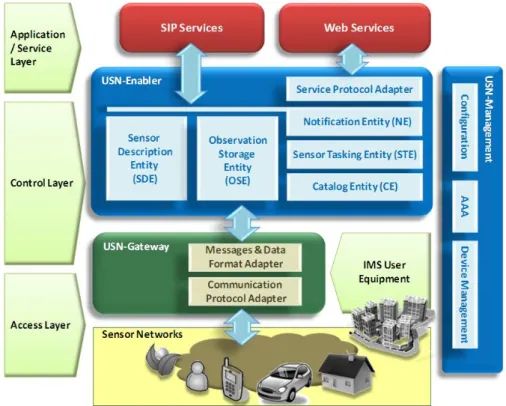
Horizontally layered approach: The platform is build following a layered approach, so services and networks are decoupled to evolve independently [12]. Current NGN architecture already decouples services and networks following a SOA. This split allows the deployment of services using current Internet and NGN networks or even future communication infrastructures in a transparent manner. The platform has extended the NGN decoupling support at two levels (see Figure 1):
At the service layer, where an enabler will assist applications and services to access IoT infrastructures.
At the access layer, were a component called USN-Gateways will provide the unified entry point for the heterogeneous IoT deployments.
Figure 1: Experimental USN Platform: Reference Architecture
4.
Experimental Platform: Reference Architecture
The USN-platform [12], as shown in Figure 1, is composed of two main components, the
USN-Enabler (that interfaces with services) and the USN-Gateways (that interacts with Sensor networks). The platform has been inspired by the OGC Sensor Web Enablement (SWE) activity that defined a set of standards used in our platform (SensorML, Observation & Measurements, Sensor Observation Service, Sensor Planning Service, Sensor Alert Service and Web Notification Service [11]).
4.1– USN-Gateway
The USN-Gateway represents a logical entity acting as data producer to the USN-Enabler. It implements two main adaptation procedures to integrate any physical or logical Sensor and Actuator Networks (SANs): the communication protocol adaptation and the sensor data adaption (see section 3.2). It publishes the information to the USN-Enabler using the Sensor Observation Service interface defined by the OGC.
By applying these two conversions, the USN-Enabler is independent of the networking and data technology used in the SANs. Besides, the USN-Gateway is considered as user equipment in IMS (IP Multimedia Subsystem) providing functionalities for registration, authentication, authorization, billing, etc. IMS is the NGN 3GPP all-IP platform that also provides SIP-based core scalable message routing [12].
4.2– USN-Enabler
The functionality provided to services and described in section 3.1 is offered in two ways, synchronous and asynchronous, by the USN-Enabler through the following entities:
The Sensor Description Entity (SDE) is responsible for keeping all the information of the different sensors registered in the USN-Platform using SensorML language.
The Observation Storage Entity (OSE) is responsible for storing all the information that the different sensors provides to the platform. This information is stored using the O&M language.
The Notification Entity (NE) is the interface with any sensor data consumer that require filtering or information processing. The main functionalities provided by this entity are the subscription (receive the filter that will be applied), the analysis of the filters (analyse the filter condition) and the notification (notifies the application when the condition of the filter occurs).
The Sensor Tasking Entity (STE) allows services to perform requests operations to the sensor network, for example, a request to gather data without the need to wait for an answer. After requesting, a service will receive an immediate confirmation response and when the requested data is available it will receive the corresponding alert. This function is mainly useful to configure and control actuators.
The Service Protocol Adapter (SPA) provides protocol adaptation between the Web Services environment and USN-Enabler protocols (SIP and HTTP) to facilitate the development of services in an environment different to the IMS.
The Catalogue and Location Entity (CLE) provides mechanisms in a distributed environment to discover which of the different instances of the entities can support the request a user might be interested in. For example, in an architecture where several Sensor Description Entities (SDEs) exist, a client might be interested in a particular sensor. The client should interrogate the CLE to know which particular existing SDEs contain the information requested.
5.
Testbed deployments facing large-scale IoT scenarios
Before tackling the important challenges of large-scale research, as the urban-scale scenario represented by the SmartSantanader project [7], we deployed three different testbeds that are described below. They allowed us to test, validate, and even improve – when necessary– the interoperability among different platform instances under realistic settings. Focussed on potentially high-impact application areas, each testbed was defined involving its interested stakeholders.
security policies. This field trial was very useful in demonstrating the horizontal re-use of the platform in applications such as logistic or home automation. Mobility and interactivity were two major technical challenges as users can receive/publish personalized information in their mobile phones and personal twitter, and context-aware information was displayed on three interactive screens showing information about the meeting, the location of the attendees, the environmental conditions of the room, advertisements, etc.
Smart metering: a one-year field test was conducted using electronic water consumption meters. Three different scenarios were implemented: two outdoor deployments, one with grouped and the other with distributed meters, and an indoor deployment. Major challenges in this scenario were robust operation under adverse environmental conditions and efficient integration of sensors (smart meters capabilities) with the mobile network infrastructure.
Environmental monitoring: this testbed provides fire detection and alert in a forest environment based on the deployment of temperature and light sensors. Technological challenges in this scenario were the joint processing of indoor sensors and remote outdoor sensors, and the efficient and reliable management of alarm messages over both the Internet and the mobile network.
These testbeds were developed over ZigBee technology, using a total number of 77 sensors, 66 nodes, 13 routers and 5 coordinators (4 ZigBee/GPRS).
5.1– Implementation issues for USN Gateway and USN Enabler
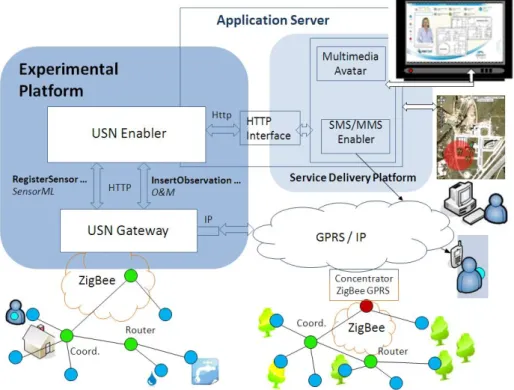
Most remarkable results of our testing scenarios were the identification of several specific issues related to the USN Gateway and USN Enabler implementations, also some real field problems like interferences between different radio technologies were also found. Main functional elements common to all of our three experimental testbeds are illustrated in Figure 2.
Figure 2: Field Trial Architecture Implementation
(those carried by visitors) used a simple localization algorithm based on the power level received from fixed-location routers.
Connecting ZigBee networks to USN Gateways was implemented in two different ways (see Figure 2). In situations of physical proximity, USN Gateways were directly integrated into ZigBee networks. While for larger distances between Zigbee networks and USN Gateways (i.e. outside the radio coverage of Zigbee networks) an IP connection to an external concentrator was used. This concentrator translates Zigbee binary messages into IP and tunnel them using a TCP/IP socket with a simple heading (in our implementation a Zigbee node was connected to a Wavecom GSM/GPRS modem).
Once connected, USN Gateways implement mechanisms to announce new resources and/or sensor measurements notified from ZigBee networks (in binary format). HTTP connections to the USN Enabler were defined (see Figure 2) using RegisterSensor, for adding a new sensor description using SensorML, and InsertObservation for adding new sensor observations using O&M format. Only a concrete set of transformations between ZigBee profiles and OGC standards were implemented, the ones used in these tests.
Scalability is a key issue for any platform to support large-scale IoT scenarios. Preliminary simulations showed how our platform was able to relay on inherent NGN IMS scalability by making USN Gateways to be registered (SIP-REGISTER) as user terminals, and through the use of SIP-PUBLISH together with HTTP connections for sensors and observations registration and information exchanges. However the impact of the specific traffic patterns generated by IoT environments is still an open issue to be researched. What we found in testing highly dynamic scenarios (such as the smart places) was the need to implement distributed mechanisms to support node mobility between USN Gateways. Mobility support was implemented using a peering messaging mechanism between USN Gateways entirely managed by them.
Finally, as illustrated in Figure 2, USN Enabler entities were integrated into an Application Server. That allowed us to make use of other enablers from an open Telco Service Delivery Platform (SDP) for sending/receiving SMS/MMS messages, making individual and group calls, video calls, avatar gestures, text–to–voice translation, management and control of SIM, etc. This integration into an Open SDP is providing an invaluable testbed for validating the business efficiency of the developed USN Enabler. New context-aware services can now be easily created in a cost-effective way through a seamless exploitation of NGN capabilities such as: multimedia (IMS), security, authentication, presence, user profiling, etc. For example, in the Smart Places scenario, when a visitor enters the meeting room, his identity is announced to the rest of the attendees (if the meeting has not yet begun) or displayed on a screen to avoid disruption. Users, if allowed by the user privacy rules managed in their network user profile, can receive/publish personalized information in their mobile phones and/or personal twitter. They can also receive context-aware information displayed on three different multimedia screens that, embedding an interactive avatar, offer real-time information about the meeting, the location of the attendees, the environmental conditions of the room, personalized advertisements, alarms etc. Unauthorized attendees to the meeting are detected and announced by the meeting manager in order to avoid intrusiveness of unknown people in a business meeting. Also in the testbed, some laptops were provided with location and accelerometer sensors to demonstrate the means for preventing them from being stolen. In case they move without authorization, theft alarms are raised, and SMSs were sent to the security staff.
6.
Conclusions
[20], current services and technologies for accessing real-world information are typically limited to vertical solutions for specific applications. This misleads to inefficient and expensive service infrastructures, preventing the true IoT paradigm from being successfully developed. Obviously each vertical domain of business applications can have its own peculiarities, but only the development of cross-domain horizontal technological solutions will promote a competitive scenario where multiple applications can dynamically choose among different infrastructures based on their availability, security, quality of service etc.
In this paper we have presented an Experimental Platform for large-scale research on FI IoT scenarios harmonizing most recent NGN and OGC® Sensor Web principles. The functional design has been directed to overcome entry-barriers to future IoT applications providing common functionalities that will lead to more efficient and cost effective deployments. By allowing the orchestration of specific Enablers, integrated into an Open Service Delivery Platform, the proposed architecture can be considered as an evolved technological infrastructure illustrating the role of Telco operators in future IoT ecosystems. Our Experimental Platform is being designed bearing in mind that IoT development must be closely coordinated with the parallel deployment of several usage areas following various requirements-specification-prototype-experimentation cycles. Three different testbeds (smart places, smart meters and environmental monitoring) have been described, together with their impact on specific requirements on the Platform capabilities. As an excellent catalyst for IoT research, our Platform is currently being evolved to become part of a city scale infrastructure for IoT within the SmartSantander project.
Acknowledgements
Although only a few names appear on this paper author’s list, this work would not have been possible without the contribution and encouragement of many people, particularly all the enthusiastic team of the SmartSantander project, partially funded by the EC under contract number FP7-ICT-257992.
References
[1]FIRE project, http://cordis.europa.eu/fp7/ict/fire/home_en.html. [2] OneLab2ONELAB project, http://www.onelab.eu/.
[3] PII project, http://www.panlab.net. [4] FEDERICA, http://www.fp7-federica.eu.
[5] WISEBED - Wireless Sensor Network Testbeds, http://www.wisebed.eu.
[6] Balazinska, et al. “Data Management in the Worldwide Sensor Web”. IEEE Pervasive Computing, April-June 2007. [7] SmartSantander, http://www.smartsantander.eu.
[8] ITU-T. Series Y Recommendations: General Overview of NGN. Y.2001. (Dec. 2004).
[9] ITU-T. Series Y Recommendations: Overview of ubiquitous networking and of its support in NGN. Y.2002. (Oct. 2004).
[10] ITU-T. Series Y Recommendations: Requirements for support Ubiquitous Sensor Network (USN) applications and services in NGN environment. Y.2221. (Jan. 2010).
[11] Botts, G. Percivall, C. Reed, and J. Davidson, "OGC Sensor Web Enablement: Overview and High Level Architecture," Open Geospatial Consortium Inc. White Paper Version 3, 2007.
[12] Bernat, J., Marín, S., González. A., Sorribas, R., Villarrubia, L., Campoy, L., Hernández, L. Ubiquitous Sensor Networks in IMS: an Ambient Intelligence Telco Platform. ICT Mobile Summit, 2008. 10-12 June, Stockholm. [13] OGC® OpenGIS® Sensor Model Language (SensorML) Implementation Specification. Version 1.0.0. OGC
Reference number 07-000. http://www.opengeospatial.org/projects/groups/sensorweb.
[14] OGC®. OpenGIS® “Observations and Measurements –Part 1 – Observaton schema”. Version 1.0. OGC Reference number 07-022r1. http://www.opengeospatial.org/projects/ groups/sensorweb.
[15] OGC®. OpenGIS® “Observations and Measurements – Part 2 – Sampling Features”. Version 1.0. OGC Reference number 07-022r3. http://www.opengeospatial.org/projects/ groups/sensorweb
[16] W3C Semantic Sensor Network Incubator Group. http://www.w3.org/2005/Incubator/ssn/ [17] OMA Service Environment Archive, http://www.openmobilealliance.org/technical/release_
program/ose_archive.aspx
[18] SENSEI project , http://www.sensei-project.eu
[19] Harbour Research, Machine-to-Machine & Smart System Forecast, 2010-2014.