Juan Francisco Ortega-Moran , J. Blas Pagador , Luisa Fernanda Sánchez-Peralta ,
Patricia Sánchez-González , José Noguera , Daniel Burgos , Enrique J. Gómez ,
Francisco M. Sánchez-Margallo
A B S T R A C T
Introduction: E-learning web environments, including the new TELMA platform, are increasingly being used to
provide cognitive training in minimally invasive surgery (MIS) to surgeons. A complete validation of this MIS e-learning platform has been performed to determine whether it complies with the three web quality dimensions: usability, content and functionality.
Methods: 21 Surgeons participated in the validation trials. They performed a set of tasks in the TELMA platform,
where an e-MIS validity approach was followed. Subjective (questionnaires and checklists) and objective (web analytics) metrics were analysed to achieve the complete validation of usability, content and functionality.
Results: The TELMA platform allowed access to didactic content with easy and intuitive navigation. Surgeons
performed all tasks with a close-to-ideal number of clicks and amount of time. They considered the design of the website to be consistent (95.24%), organised (90.48%) and attractive (85.71%). Moreover, they gave the content a high score (4.06 out of 5) and considered it adequate for teaching purposes. The surgeons scored the pro-fessional language and content (4.35), logo (4.24) and recommendations (4.20) the highest. Regarding func-tionality, the TELMA platform received an acceptance of 95.24% for navigation and 90.48% for interactivity.
Conclusions: According to the study, it seems that TELMA had an attractive design, innovative content and
interactive navigation, which are three key features of an e-learning platform. TELMA successfully met the three criteria necessary for consideration as a website of quality by achieving more than 70% of agreements regarding all usability, content and functionality items validated; this constitutes a preliminary requirement for an ef-fective e-learning platform. However, the content completeness, authoring tool and registration process required improvement. Finally, the e-MIS validity methodology used to measure the three dimensions of web quality in this work can be applied to other clinical areas or training fields.
1. Introduction
Since the 1980s, the adoption of electronics, new image transmis-sion technologies and more evolved instruments in the field of surgery has facilitated the development of a revolutionary new surgical tech-nique: minimally invasive surgery (MIS). Thus, it is possible to perform MIS procedures that have advantages over open surgery. The benefits
include the optimisation of resources in health systems and, regarding patients, shorter and less painful post-operative care, less tissue trauma, shorter hospital stays and faster recovery, allowing for a swifter return to daily life [1-4]. However, MIS also has some drawbacks [5,6],
mainly related to spatial and technical limitations, that must be ad-dressed with tremendous specialised training in specific MIS skills.
Table 1
e-Learning platforms for surgical training
Medical Institution Specialties/categories Video
repository
Authoring tool Recommendations Professional network Assessment/learning
curves
WebSurg [19]
LESS [20]
Laptube [21]
Medicana Life [22]
Cirugía [23]
WebOp [24]
Medting [25]
Surgical & Medical Procedures [26]
Do Surgery [27]
TELMA [28]
Dr. Marcos Berry
DePuy Synthes Institute c/o J & J Medical Ltd Consortium of TELMA project
after registration. Payment access for HD videos and master classes Only professional section requires registration Free access to videos
Free access to videos
Free access to content
No, just a video section Yes
Yes
No
No
No
No
No
General and digestive; endocrine; paediatric; Free access to regular content Yes thoracic; urology; gynaecology;
cardiovascular; endoscopic; skull base; arthroscopy and upper limb surgery General Surgery; Urology; Gynaecology
Laparoscopy
ENT, OB/GYN, plastic surgery, radiology, urology and 29 other non-surgical categories Gallbladder/kidney stones; hernias; gastroesophageal reflux disease; bariatric surgery; surgery and diabetes; minimally invasive surgery
Abdomen, neck, hand, hernias, proctology, thorax
General surgery, digestive oncologic surgery, surgical specialty, OBGYN, radiology, urology and 14 other non-surgical categories Anaesthesia, emergency medicine, internal medicine, orthopaedics, family medicine, paediatrics, general surgery, training physician, cardiology
Central nervous system; hip; foot & ankle; hand, finger & wrist; knee; shoulder & elbow; spine
Minimally invasive surgery
Free access to videos
Free access to content
Access after registration. Free access to sample procedures
Free access to videos after registration and approval
Free access after registration
Yes (no enhancement options) No
No
Yes
Yes
No
Comments on content Post-test questions for CME credits. No learning curve
User channels; comments on content User channels; comments on content No
No
No
No
Discussion Forum, comments on content, contacts Comments on content, contact other users No
is conducted so that surgeons can learn the theory behind the surgical procedure. Once the theory is established, surgeons apply the knowledge and acquire the surgical skills and abilities necessary to perform the surgical procedure through psychomotor training [8]. Educational multimedia re-sources have been used for decades in medical education [9]. However, the incorporation of new technologies in MIS cognitive training is increasing
[10] with special emphasis on web technologies for e-learning that contain multimedia digital content based on surgical videos [11,12]. This satisfies the need that surgeons identified some years ago for the creation of web platforms with didactic content to complete their cognitive training [13].
The acceptance of web-based education through e-learning in the surgical field is growing and shows great potential [14]. In fact, some studies have demonstrated that Internet platforms based on multimedia content for surgical training can improve surgeons' performance [15]. Moreover, this emerging approach allows surgeons to optimise time and resources for training [16] since distance education has become an efficient method of teaching surgery [17], and is even more useful in the case of blended learning, that combines in-person and online learning [18].
Table 1 summarises the different characteristics of the currently
available e-learning platforms related to MIS training. This study spe-cifically focuses on the TELMA platform, which allows for adaptive learning in MIS training [28].
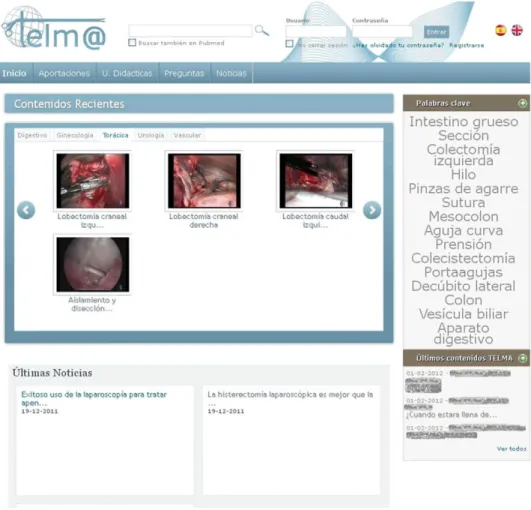
TELMA (Fig. 1) is a new technology enhanced learning (TEL) platform that improves the user experience with four-pillared architecture. The pillars include (1) an authoring tool that facilitates the creation of video-based, structured, enhanced, didactic content; (2) a learning content and knowledge management system that offers users adaptive learning based on their pro-gress and behaviours in TELMA, as well as a modular and scalable system to capture, catalogue, search and retrieve multimedia content; (3) an evaluation module that provides both formative and summative feedback to the trainee and (4) a professional network for collaborative learning between users.
Furthermore, TELMA allows for informal learning between users and allows adaptive learning for each user, providing educational content that is speci-fically designed for surgeons, without installing additional software.
To get a high-quality tool for e-learning training in MIS, it is necessary to perform user-level validation beyond the face validity of the platform. The validation of educational technology during the development stage helps to identify necessary adjustments, facilitating the avoidance of obstacles to learning [29]. Furthermore, to the best of our knowledge, there is no lit-erature regarding the validation of e-learning platforms for MIS in terms of usability, content and functionality. In other fields, some studies have per-formed the validation of e-learning platforms for medical students [30-32],
but such validation has only addressed usability, neither content or func-tionality. Other studies have taken things a step further by evaluating two features, for instance, the usability and functionality of a medical web-based platform [33] or the content and usability of technology [29] or a website
[34,35] for health education. The present study analyses the usability,
content and functionality of TELMA from the user's point of view in order to determine, for the first time, whether a website for MIS training is eligible to be considered a high-quality website according to the three web quality dimensions [36,37]: web appearance, web content and technical adequacy.
2. Material and methods
2.1. Design and study sample
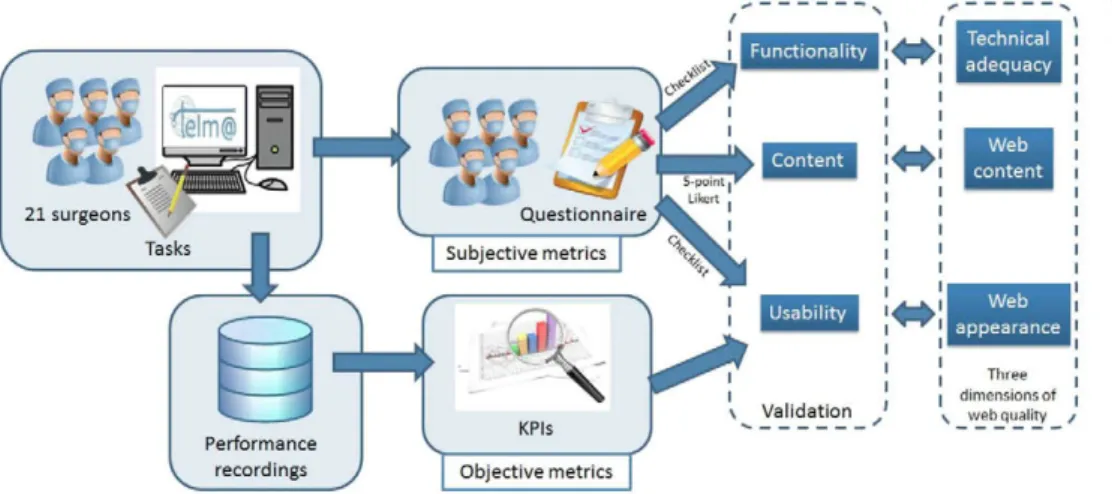
To evaluate the three dimensions of web quality, a quantitative study design, as shown in Fig. 2, has been developed. This process of validating TELMA is based on the e-MIS validity methodology [38].
Only the specific methods for the development phase indicated in the
e-MIS validity methodology have been used in this work because the
TELMA platform is not yet available for public use.
Fig. 1. Spanish version of the TELMA platform that shows surgical videos by specialty.
Contenidos Recientes
Digestivo
O
Ginecología Torácica
m
Lobectomia craneal izqu...•
Aislamiento y disección...Urología Vascular
Lobectomia craneal derecha
f 1
Lobectomia caudalizqui...
O
Intestino grueso Sección Colecto mía
izquierda Hilo Pinzas de agarre
Sutura Mesocolon Aguja curva
Prensión Colecistectomía
Portaagujas Decúbito lateral
Colon Vesícula biliar
Aparato digestivo
Últimas Noticias
Exitoso uso de la laparoscopía para tratar apart...
19-12-2011
La histerectomia laparoscóptca es mejor que la 19-12-2011
&s#n
««* " - — . a K M W 01-O2-2OÍ
Performance
L recordings
Technical adequacy
Three
dimensions of webquality
Fig. 2. Study design, including objective (KPIs) and subjective (questionnaire) metrics, for evaluating the three dimensions (functionality, content and us-ability) of web quality.
Twenty-one surgeons recruited from the Jesús Usón Minimally Invasive Surgery Centre (JUMISC) (Cáceres, Spain) and Son Llátzer Hospital (Palma de Mallorca, Spain) voluntarily participated in the validation tests. Each participant performed the following tasks in TELMA under no supervision and with a limited amount of time per task:
1. Signing up;
2. Uploading a surgical video, including metadata; 3. Editing the uploaded video;
4. Completing a didactic unit (reading the unit's content and com-pleting the evaluation test);
5. Creating a question or contribution.
In order to measure the performance of surgeons without previous training, a TELMA webmaster set the time limit per task to three times the necessary amount of time.
2.2. Ethical considerations
All the surgeons were informed of the objectives of the research project, the purpose of the study, its length and procedure, the reason for their selection, the institutions responsible for the research and the contact people for any question. In addition, the surgeons all received information about the confidentiality and anonymity of the research data. They were all informed that their participation in the survey was voluntary and that they could withdraw from the study at any time if they wished to.
2.3. Data collection and evaluation
Once the surgeons involved in the study carried out the specified tasks, they had to fill in a questionnaire (see Appendix) in order to obtain subjective metrics of validation. To ensure the validity of the questionnaire, a set of experts participated in its development and de-sign, performing some preliminary tests to estimate the duration of the survey and to identify potential failures or questions that might be difficult to understand. An initial demographic section was included to collect the personal information of the respondents and determine their profiles. Next, the survey included two "yes/no" checklists with a list of requirements regarding the functionality and usability of the TELMA platform. Moreover, a 5-point Likert scale survey (1-completely dis-agree, 5-completely agree) was used to evaluate the content of the web
environment. At the end of each section, an open-ended question al-lowed the surgeons to add comments or suggestions to improve the usability, content and functionality of TELMA.
Simultaneously, the performance of every surgeon was recorded (with a screen recording software) and analysed using web analytics methods to extract objective metrics of usability. In this sense, key
performance indicators (KPIs) were used to measure usability objectively
based on these recordings:
• KPI1: Average number of clicks per task,
• KPI2: Percentage of users who complete the task in a limited amount of
time,
• KPI3: Average total time per task (in seconds),
• KPI4: Number of clicks necessary to access the functionality,
• KPI5: Efficiency, defined as the minimum, number of clicks necessary to
complete the task divided by the average number of clicks per task.
The results obtained from the paper-based questionnaires and KPIs were analysed using descriptive statistics. The KPIs were compared to ideal values, shown in Table 3, that a webmaster or expert adminis-trator had obtained. The ideal values of the questionnaires were the highest (100% for the checklists and 5 for the Likert scale).
According to previous studies [29], a 70% of agreement has been set as the minimum threshold for positive validation (3.5 in the Likert scale).
In this way, usability, content and functionality validations were performed using both objective and subjective metrics, which were directly associated with the three dimensions of web quality: web ap-pearance, web content and technical adequacy, respectively.
3. Results
3.1. Demographic characteristics of participants
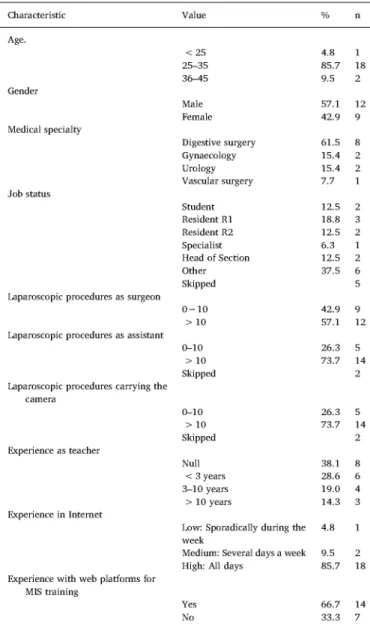
The demographic characteristics of participants are listed in
Table 2. The participants in the study were mostly aged between 25 and
T a b l e 2
Demographic characteristics of the participants.
Characteristic Value % n
3.2. Validation of usability — web analytics method
Table 3 shows a comparative analysis of the results that the subjects
involved in the study (surgeons) and an expert administrator
(web-master) obtained. The results that the latter obtained were considered to
be ideal values.
T a b l e 3
Results of usability validation shown as obtained average values by Surgeons vs
Webmaster. KPI1: clicks per task (number), KPI2: task performed (%), KPI3: time per task
(seconds), KPI4: clicks per functionality (number) and KPI5: efficiency (parts per unit, where 1 is the maximum and 0 is the minimum).
Task. KPIs (Surgeons/Webmaster)
KPI1 ( # ) KPI2 (%) KPI3 (s) KPI4 ( # ) KPI5
Signing up 1 5 . 7 / 1 1 1 0 0 / 1 0 0 1 0 4 . 3 / 5 0 1.3/1 0 . 7 / 1 Uploading a surgical video 2 7 . 6 / 1 2 9 4 . 7 / 1 0 0 1 9 3 . 9 / 9 2 1.5/1 0 . 4 / 1 Editing the uploaded 6 . 3 / 3 3 8 . 9 / 1 0 0 1 3 7 . 1 / 7 9 1.6/1 0 . 5 / 1
video
Completing a didactic unit 1 9 . 2 / 1 1 1 0 0 / 1 0 0 1 9 4 . 8 / 1 5 9 2 . 1 / 2 0 . 6 / 1 Creating a question or 1 7 . 8 / 7 1 0 0 / 1 0 0 1 6 0 . 0 / 1 0 8 2 . 5 / 2 0 . 4 / 1
contribution
The average number of clicks per task (KPI1) that the surgeons made was a little more than double that which the webmaster made. However, the necessary number of clicks did not reach this ratio for signing up (15.7/11) and completing a didactic unit (19.2/11). Almost all the surgeons completed all the tasks (KPI2), with the only exception being video editing (38.9%). Regarding video editing, the participants had some difficulty finding the editing button, as shown in Fig. 3. The average time spent on a task (KPI3) exceeded twice the ideal when uploading a surgical video (193.9/92 s) and when signing up (104.3/ 50 s). Each functionality was accessed using less than twice the minimum necessary number of clicks (KPI4). Finally, the efficiency of clicks per task (KPI5) was 0.52 on average, with the signing up task obtaining the highest value (0.7).
3.3. Validation of usability — checklist method
The results of the checklist for the TELMA usability validation ap-pear in Fig. 4, indicating the percentage of surgeons who agreed with each referenced question. It is pleasant to note that all the items ob-tained over 80% of acceptance. Regarding the design of TELMA, the highest percentage (100% of acceptance) was achieved for the
text-background colour contrast question. The surgeons were of the opinion
that the font type and size facilitated reading (90.48%) and that the website
was attractive (85.71%). Of these good results, the lowest value
(80.95%) was obtained for the questions regarding clear and concise
navigation labels, the appropriate number of buttons/links and the proper use of colours on the website.
As for the layout, the highest level of acceptance (95.24%) was obtained for the question regarding the consistency of the overall design
of the website, while the lowest level of acceptance was achieved for the
question regarding the correct use of the visual space (80.95%). Furthermore, 90.48% of the surgeons assented to the question re-garding the organisation of the website. Finally, 85.71% of participants held the following opinions: the website pages are not long, information
overload is avoided and areas of high informative hierarchy take precedence for more relevant content.
Some of the comments related to usability that the participants added follow:
• "The 'save' and 'send' buttons corresponding to the creation of content
are outside the initial display area, so it is difficult to locate them when needed,"
• "There are buttons that are not intuitive. For example, the indication of
'draft' when editing content does not specify that the display is ex-clusively for the user who is editing the content"
3.4. Validation of content — survey method
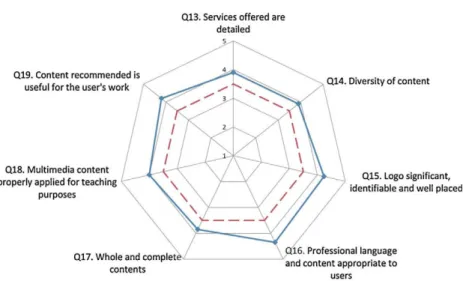
The results of the questionnaire for the TELMA content validation are shown in Fig. 5. Surgeons rated the TELMA content with a mean score of 4.06 points out of 5. Of the questions, those regarding
profes-sional language and content appropriate to the users (4.35) and the logo being significant, identifiable and placed in a prominent place (4.24) were
scored the highest. By contrast, the lowest scored questions were those regarding completeness of content (3.85), the services being detailed (3.90) and the diversity of content (3.90). Slightly more favourably scored questions were those regarding the website's proper application of
multi-media content for teaching purposes (4.00) and content recommended by the application containing useful material for the user's work (4.20).
Participants offered some comments related to the content of TELMA:
• "The platform is at an excessively early stage for the proper assessment of
the content,"
• "More clinical cases and more news of new developments required."
Age.
Gender
Medical specialty
Job status
Laparoscopic procedures as surgeon
Laparoscopic procedures as assistant
Laparoscopic procedures carrying the camera
Experience as teacher
Experience in Internet
Experience with w e b platforms for MIS training
< 2 5 2 5 - 3 5 3 6 - 4 5
Male Female Digestive surgery Gynaecology Urology Vascular surgery Student Resident R l Resident R2 Specialist Head of Section Other Skipped
0 - 1 0 > 10
0 - 1 0 > 10 Skipped
0 - 1 0 > 10 Skipped
Null < 3 years 3 - 1 0 years
> 10 years
Low: Sporadically during the week
Medium: Several days a week High: All days
Yes No 4.8 85.7 9.5 57.1 42.9 61.5 15.4 15.4 7.7 12.5 18.8 12.5 6.3 12.5 37.5 42.9 57.1
2 6 . 3 73.7
2 6 . 3 73.7 38.1 28.6 19.0 14.3 4.8 9.5 85.7 66.7 3 3 . 3
Im@
D Buscar tambi#n «rt Pubmed Sitz
m
DesconectarFig. 3. Spanish version of the TELMA
plat-form with problematic video-editing button inside the red box. (For interpretation of the references to colour in this figure legend, the reader is referred to the web version of this article.)
3.ed Profesional V Crear Contenido Crear Video
i
Titulo
! S Í « S M * » « W K >
Especialidades
Definir especialidades
Palabras Claves
Definir palabras claves Autot es Definir autores Ettttoiot Definir editores
Descripción
Sistema vascular Tórax Anatomía Aparato digestivo
Aparato urinario Aparato genital
« . . a r i i l i B . f l í W 16-03-2011 - « * » » " - » » ; ¡ « S « B a »
Vesícula biliar
Design
Q l . Appropriate contrast text color-background
Q6. Website colors properlv used
Q5. Attractive website
Layout
Q7. No long website pages
Q2. Font type and size facilitates reading
Q12. Correct use of the visual space of the page
03. Clear and concise navigation labels
Ql 1. Avoided information overload
as. Organized website
09. Consistent overall design of the website
Q4. Appropriate number of buttons/links
Q10. More relevant content In areas of high Informative
Fig. 4. Results (in blue) of usability validation of TELMA in relation to its design and layout (% surgeons agree). Red dashed line indicates the minimum threshold necessary for positive
validation. (For interpretation of the references to colour in this figure legend, the reader is referred to the web version of this article.)
3.5. Validation of functionality — checklist method
Fig. 6 shows the results of the checklist for validating the
func-tionality of TELMA, indicating, in each case, the percentage of surgeons who agreed with the statement. The results show that more than 75% of the surgeons confirmed all functionalities. Among these, the users'
re-gistration form excelled (100% of acceptance), with the surgeons
con-sidering it appropriate. Following this, some of the other high scoring functionalities were easy navigation through the website (95.24%),
inter-active features between the system and users (90.48%) and not requiring the download or installation of phig-ins to enjoy the content of TELMA
(89.47%). On the other hand, the control of learning progress in detail (75%), the consistency, validity and ease of identification of links (76.19%) and the search engine of the website (76.19%) received the lowest scores among the measured functionalities. Other results with high acceptance
percentages were as follows: the website allows users to discuss issues and
easily share their experiences with other users (85.71%), the languages in which the website is available are sufficient (80.95%), the online authoring tool allows the easy and correct creation of surgical videos (80.95%) and the application recommends content properly adapted to user needs
(77.78%).
At the end of the questionnaire, the surgeons added some comments to improve the functionality of TELMA:
• "There are links that are not functional,"
• "In the search results, the content type (news, videos, didactic unit, etc.)
is not indicated,"
• "The number of videos displayed on the screen should be indicated, as
well as the total number of videos by specialty,"
Q19. Content recommended ¡s useful for the user's work
Q18. Multimedia content properly applied for teaching
purposes
Content
Q13. Services offered are detailed
Q14. Diversity of content
Fig. 5. Results (in blue) of content validation of TELMA (from 1
— completely disagree to 5 —completely agree). Red dashed line in-dicates the minimum threshold for positive validation. (For inter-pretation of the references to colour in this figure legend, the reader is referred to the web version of this article.)
Q15. Logo significant, identifiable and well placed
Q17. Whole and completi contents
Q16. Professional language and content appropriate to
users
4. Discussion
The growing incorporation of e-learning platforms with multimedia didactic content in surgical training could improve surgeons' perfor-mance. However, the complete web quality validation of e-learning platforms of this kind is still missing from the literature. Past studies dedicated to the validation of medical websites have separately focused on usability, functionality or content features. In this study, we went a step further and performed a complete web quality analysis of usability, content and functionality all together. Assessing the three factors allows for the verification not only of whether the TELMA platform meets user requirements regarding its design and layout, but also of whether it offers appropriate content and operates correctly. From our perspective, this kind of preliminary analysis should be mandatory before the per-formance of other e-learning efficacy studies.
There is little evidence regarding learners' effective use of tech-nology to support their training [39]. In this sense, our study can pro-vide favourable information, demonstrating that it is possible for sur-geons to accomplish tasks effectively (measured in terms of a minimum
number of clicks). Therefore, although additional studies regarding this will be necessary, we believe that such a feature would facilitate the efficient achievement of the learning objectives of the platform. It is also interesting to note that the number of clicks necessary to achieve any of the functionalities of TELMA is low and very close to the ideal. This feature makes it easier for surgeons to find functionalities and use them in a few steps, as noted by Gebera [40], who proposed educational websites properly oriented to allow the user to find content and adapt paths according to existing knowledge and needs. Furthermore, with regard to usability, the present study obtained good results that agreed with previously defined features (the website's attractiveness and in-tuitiveness, among others) [40,41] and whose confirmation was pos-sible based on the high percentage of fully performed tasks. The only exception was the editing of a video with the offline authoring tool, which requires improvement, perhaps by paying special attention to the placement and visibility of buttons [41]. The average time per task was fairly good, with slightly more time during the signing up process. This should be improved by removing unnecessary fields, as Peterson [41]
indicated. The surgeons positively rated the design and layout of
Q30. Online Authoring Tool create surgical videos correctly and easil
Q29. Limited and appropriate users registration form
Q28. No need t o download and install additional plugins
Functionality
Q20. Easy navigation 100'
Q27. Sufficient languages
Q21. Consistent, valid and easy to identify links
Q22. Convenient search engine that enables advanced search
Q23. Users can control their learning progress
Q24. Users can easily discuss issues
and share their experience
Fig. 6. Results (in blue) of functionality
va-lidation of TELMA (% surgeons agree). Red dashed line indicates the minimum threshold for positive validation. (For interpretation of the references to colour in this figure legend, the reader is referred to the web version of this article.)
Q26. Easy t o use i n t e r a c t s features
TELMA, obtaining, in all cases, an agreement rate above 80%. The
text-background colour contrast question (100% of agreement) in particular
matched the proper use of colours that Al-Qeisi et al. [42] suggested. In terms of content validation, the surgeons rated all the items with good scores and perceived the content to meet their needs, considering the information to be precise, complete and easily understandable. Rocha [43] stated that the user's satisfaction correlates with the re-levancy, accuracy, completeness and comprehensibility of the in-formation content of a website. As such, the results of this study de-monstrate positive user feedback regarding the TELMA platform: All the features received scores higher than 3.5 (the threshold of 70% that de Goes et al. [29] indicated), with the lowest score (3.85) being the one regarding the completeness of the content. During the running stage of TELMA, more diverse and innovative content should be developed through the collaboration of users, who will be active co-producers of content. In this sense, the TELMA platform, with the help of social media, can facilitate informal learning, allowing the users to add and share the results of their learning achievements and to participate in collective knowledge generation [44]. It is important to note that young surgeons, such as those involved in this study, are engaged to create, organise and share content, contributing their experience to the en-hancement of web platforms for MIS training. Moreover, the use of informal communication (comments, threads, etc.) results in the social interaction between users, enriching their learning process.
Regarding functionality validation, platform navigation was easy for the surgeons, thereby achieving one of the most important features of a high-quality website [45]. User-friendliness and ease of navigation are two important requirements that TELMA satisfies, and these influ-ential factors guarantee user engagement with the e-learning system
[46]. In their absence, users become frustrated and drop out of the
application. TELMA's achievement is great not only because it is de-sirable that such pages include interactivity [47] but also because this interactivity is an essential element where student learning and atti-tudes regarding multimedia web-based learning platforms are con-cerned. It makes the training easy and intuitive, and increases the quality of the education [48]. At the same time, TELMA does not re-quire to download or install plug-ins to access its content, a feature that the surgeons rated positively. This is consistent with the results of Sisson et al. [49], who indicated that such learners usually access content from medical schools, hospitals or public workstations, where it is possible that they do not have permission to download and install new software. Furthermore, according to Dyrbye et al. [50], TELMA does not present technical barriers as additional plug-ins or software are not required.
In general, the surgeons positively scored the usefulness and con-venience of the TELMA platform. Therefore, it seems that they would accept web-based education through this e-learning platform. Such acceptance is growing and has great potential in the surgical field.
4.1. Limitations
This study had some limitations. First, it is possible that there was a bias in the results as the participants participated voluntarily, in-creasing the likelihood that they held more positive attitudes towards research [51] and the use of information and communication tech-nology (ICT). Second, the study was carried out in two institutions with a specific training programme, so the results may have been too specific to generalise to other settings. Third, the relatively small participant sample size and the non-representation of all surgical specialties limited the study's generalisability, although the high proportion of digestive surgeons with respect to other specialties is in line with the actual distribution of working surgeons in Spain.
5. Conclusions
Over the years, many Internet platforms have appeared with the aim
of satisfying surgeons' need for the creation of web platforms with di-dactic content. Their goal has been to enable the surgeons to complete their cognitive training in MIS and apply the knowledge to their sub-sequent psychomotor training. Nevertheless, as far as we know, sur-geons (final users) have not validated any of these platforms in terms of usability, content and functionality to ensure their ultimate acceptance. The results obtained in this study suggest that TELMA offers surgeons the solution they desire while successfully achieving the three re-quirements of web platform quality. All the items that the participants assessed in the questionnaires about usability, content and functionality received more than 70% of their agreement and the usability KPIs ob-tained were closed to ideal values.
Since the results obtained in the first usability, content and func-tionality validation of a MIS e-learning platform were largely positive, this study can be taken as a basis upon which developers of similar websites can build assessments of the quality of their platforms and their development. It should be taken into account that the content of the platform must be innovative, complete, precise and adapted to the users' previously determined needs and profiles. Interactivity is a key feature that should be included, and barriers to users' participation, such as the requirement to install additional software, should be eliminated. However, some features should be improved so that all assessment metrics are closer to the ideal values, and, therefore, the e-learning platform is higher in quality. For instance, tasks with the au-thoring tool obtained the lowest values, so buttons for the creation and edition of videos should be properly placed on the left side of the video creation section with high visibility to facilitate the task for users. Moreover, this is particularly relevant for the field of surgery as sur-geons lack the time and knowledge to use the video editing tools. For this last reason, further studies should be performed to check the ap-propriateness of including video editing tools in MIS e-learning plat-forms. Moreover, the registration form should only include the neces-sary fields to expedite and facilitate the process. This will prevent users from leaving the website due to a cumbersome registration process. In the present version of TELMA, the fields included in the registration form are the name, surname, email, alternate email, birthdate, phone, mobile phone, password, password confirmation, nationality, profes-sional category, surgical specialty, affiliation, clinical interest, and general interest fields. We think that these fields should be reduced to the name, surname, email, password, professional category, and sur-gical specialty fields. Finally, the e-learning platform should not be launched until more content completeness is achieved in the develop-ment stage.
It has been shown that the e-MIS validity methodology can be properly used to validate the three web quality dimensions of an e-learning platform. This methodology covers the assessment of the us-ability and functionality of a web page and the assessment of its con-tent. It allows for both objective and subjective metrics of validation, thereby achieving the complete evaluation of the platform. While these methods were applied to the specialist area of MIS in this study, they can easily be used for the validation of e-learning platforms in other clinical areas and even in other fields of training. We suggest that all e-learning platforms undergo this complete validation of usability, con-tent and functionality to guarantee that the platform can be properly used to perform studies for the assessment of the quality and efficacy of e-learning.
Conflicts of interest
The authors report no conflicts of interest. They alone are re-sponsible for the content and writing of this article.
Authors contribution
Furthermore, Juan Francisco Ortega Moran led the study and the pre-paration of the manuscript. Juan Francisco Ortega Moran, J. Bias Pagador and Luisa Fernanda Sánchez Peralta designed the methodology of validation developed in the study and analysed the results obtained. In the performance of such tasks, they enjoyed the cooperation of Enrique J. Gómez, Patricia Sánchez González and Daniel Burgos. José Noguera led the validation tests that were carried out in Son Llátzer Hospital in Palma de Mallorca, Spain, while Juan Francisco Ortega Moran led those performed in JUMISC in Cáceres, Spain. Francisco M. Sánchez Margallo coordinated and supervised all of this study's tasks, which were developed with the teamwork of JUMISC. All authors ap-proved the final draft of the paper for submission.
Acknowledgements
Atos Research and Innovation led the TELMA project, with the Biomedical Engineering and Telemedicine Centre of the Universidad Politécnica de Madrid acting as its scientific coordinator. The other participants were JUMISC, Son Llátzer Hospital, Cepal and ISID. TELMA has the acknowledgement of the INES technological platform.
Proyecto Industrial TS-020110-2009-85 of the Ministry of Industry, Tourism and Commerce, Spain, partially funded this work.
Appendix A. Supplementary data
Supplementary data associated with this article can be found, in the online version, at http://dx.doi.Org/10.1016/j.ijmedinf.2017.07.001.
References
[1] A. Da Luz Moreira, R.P. Kiran, H.T. Kirat, F.H. Remzi, D.P. Geisler, J.M. Church, et al., Laparoscopic versus open colectomy for patients with American Society of Anesthesiology (ASA) classifications 3 and 4: the minimally invasive approach is associated with significantly quicker recovery and reduced costs, Surg. Endose. 24 (6) (2010) 1 2 8 0 - 1 2 8 6 .
[2] A.I. Lazzarino, K. Nagpal, A. Bottle, O. Faiz, K. Moorthy, P. Aylin, Open versus minimally invasive esophagectomy: trends of utilization and associated outcomes in England, Ann. Surg. 252 (2) (2010) 2 9 2 - 2 9 8 .
[3] M.Y. Wang, M.D. Cummock, Y. Yu, R.A. Trivedi, An analysis of the differences in the acute hospitalization charges following minimally invasive versus open pos-terior lumbar interbody fusion, J. Neurosurg. Spine 12 (6) (2010) 6 9 4 - 6 9 9 . [4] D.J. Lee, P.H. Kim, C.J. Koh, Current trends in pediatric minimally invasive urologic
surgery, Korean J. Urol. 51 (2) (2010) 8 0 - 8 7 .
[5] M.F.G. Ramirez, J.C. Gómez, E.M.G. Neira, S. Rugeles, D. Suárez, L. Torregrosa, Evaluación del mejoramiento de habilidades básicas para cirugía laparoscópica por medio del entrenamiento con un videojuego, Revista Ciencias de la Salud 12 (2014) 9 - 2 0 .
[6] I. García, I.A.S. de Armas, A. Pimpalwar, Current trends in pediatric robotic surgery, Bangladesh, J. Endosurg. 2 (1) (2014) 1 5 - 2 8 .
[7] B. Solomon, C. Bizekis, S.L. Dellis, J.S. Donington, A. Oliker, L.B. Balsam, et al., Simulating video-assisted thoracoscopic lobectomy: a virtual reality cognitive task simulation, J. Thorac. Cardiovasc. Surg. 141 (1) (2011) 2 4 9 - 2 5 5 .
[8] L.F. Sánchez-Peralta, J. Sánchez-Fernández, J.B. Pagador, F.M. Sánchez-Margallo, New technologies in minimally invasive surgery training: w h a t do surgeons de-mand? Cir. Cir. 81 (2013) 3 8 6 - 3 9 2 .
[9] S.D. Yavner, M.V. Pusic, A.L. Kalet, H.S. Song, M.A. Hopkins, M.W. Nick, et al., Twelve tips for improving the effectiveness of web-based multimedia instruction for clinical learners, Med. Teach. 37 (3) (2015) 2 3 9 - 2 4 4 .
[10] G. Wulf, C. Shea, R. Lewthwaite, Motor skill learning and performance: a review of influential factors, Med. Educ. 44 (1) (2010) 7 5 - 8 4 .
[11] A.K. Rapp, M.G. Healy, M.E. Charlton, J.N. Keith, M.E. Rosenbaum, M.R. Kapadia, YouTube is the most frequently used educational video source for surgical pre-paration, J. Surg. Educ. 7 3 (6) (2016) 1 0 7 2 - 1 0 7 6 .
[12] A.K. Sowan, J.A. Idhail, Evaluation of an interactive web-based nursing course with streaming videos for medication administration skills, Int. J. Med. Inform. 83 (8) (2014) 5 9 2 - 6 0 0 .
[13] F.M. Sánchez-Margallo, L.F. Sánchez-Peralta, J.B. Pagador, J.L. Moyano-Cuevas, J.F. Noguera-Aguilar, P. Sánchez-González, et al., Nuevas tecnologías en cirugía de mínima invasión. Encuesta sobre e-learning y contenidos multimedia, Cir. Esp. 88 (2010) 2 2 3 .
[14] N. Jayakumar, O. Brunckhorst, P. Dasgupta, M.S. Khan, K. Ahmed, E-Learning in surgical education: a systematic review, J. Surg. Educ. (2015).
[15] C. Pape-Koehler, M. Immenroth, S. Sauerland, R. Lefering, C. Lindlohr, J. Toaspern, M. Heiss, Multimedia-based training on Internet platforms improves surgical per-formance: a randomized controlled trial, Surg. Endose. 27 (2013) 1 7 3 7 - 1 7 4 7 . [16] K.E. Schifferdecker, N.B. Berman, L.H. Fall, M.R. Fischer, Adoption of
computer-assisted learning in medical education: the educators' perspective, Med. Educ. 46 (11) (2012) 1 0 6 3 - 1 0 7 3 .
[17] S. Huwendiek, C. Duncker, F. Reichert, B.A. De Leng, D. Dolmans, C.P. van der Vleuten, et al., Learner preferences regarding integrating, sequencing and aligning virtual patients with other activities in the undergraduate medical curriculum: a focus group study, Med. Teach. 3 5 (11) (2013) 9 2 0 - 9 2 9 .
[18] K.R. Aryal, J. Pereira, E learning in surgery, Indian J. Surg. 76 (6) (2014) 4 8 7 - 4 9 3 . [19] WeBSurg — the e-surgical reference, h t t p : / / w w w . w e b s u r g . c o m /, 2016 (Accessed 14
December 2016).
[20] LESS — Laparo-Endoscopic Single-Site Surgery, h t t p : / / w w w . o l y m p u s - e u r o p a . c o m /
medical/en/medical_systems/applications/general_surgery/less_l/laparo_ endoscopic_single_site_surgery_l. h t m l / , 2016 (Accessed 14 December 2016). [21] LapTube —Express your surgical skill, h t t p : / / l a p t u b e . n e t /, 2016 (Accessed 14
December 2016).
[22] Medicana Life —Medical videos, http://www.medicanalife.com/, 2016 (Accessed 14 December 2016).
[23] Cirugía —Dr. Marcos Berry, h t t p : / / w w w . c i r u g i a . n e t / i n d e x . h t m l, 2016 (Accessed 14 December 2016).
[24] WebOp —All about surgical operations, h t t p : / / w w w . w e b o p . d e /, 2016 (Accessed 14 December 2016).
[25] Medting —Medical Exchange, h t t p : / / m e d t i n g . c o m /, 2016 (Accessed 14 December 2016).
[26] Surgical & Medical Procedures Reference Training | Procedures Consult, h t t p : / / www.proceduresconsult.com/medical-procedures/, 2016 (Accessed 14 December 2016).
[27] Surgery.com - Online training and knowledge sharing for orthopaedic surgeons. http://www.do-surgery.com/, 2016 (Accessed 14 December 2016).
[28] P. González, D. Burgos, I. Oropesa, V. Romero, A. Albacete, L.F. Sánchez-Peralta, et al., TELMA: technology-enhanced learning environment for minimally invasive surgery, J. Surg. Res. 182 (1) (2013) 2 1 - 2 9 .
[29] F.D.S.N. de Goes, L.M.M. Fonseca, R.A.A. de Camargo, G.F. de Oliveira, H.R. Felipe, Educational technology anatomy and vital signs: evaluation study of content, ap-pearance and usability, Int. J. Med. Inform. 84 (11) (2015) 9 8 2 - 9 8 7 . [30] T. Taveira-Gomes, A. Saffarzadeh, M. Severo, J.M. Guimaráes, M.A. Ferreira, A
novel collaborative e-learning platform for medical students-ALERT STUDENT, BMC Med. Educ. 14 (1) (2014) 143.
[31] C.W.M. Tarn, A. Eastwood, Available, intuitive and free! Building e-learning Summary points
What was already known on the topic
• Minimally invasive surgery (MIS) is a relatively new technique with advantages over open surgery, but it requires much specialised training.
• The new e-learning platform TELMA has been developed for MIS cognitive training. It allows adaptive learning for the user and specific MIS learning content, including improve-ments over existing MIS web platforms.
• A website can be considered to be of high quality if it meets the three dimensions of web quality: web appearance, technical adequacy and web content.
What this study added to our knowledge
• This study is the first of its kind to perform a usability, content and functionality validation of a MIS e-learning platform. • The results obtained in this study show that TELMA offers
surgeons a web platform with didactic content, which they requested to complete their cognitive training and which also successfully meets the three web platform quality requirements.
• Regarding its design, it is necessary to enhance the visibility and placement of buttons and functionalities and to remove unnecessary fields. The platform's content must be innova-tive, complete and precise and should be adapted to the users' previously determined needs and profiles. Functionally, it should enhance interactivity and eliminate barriers to users' participation, for instance, the requirement to install additional software.
modules using web 2.0 services, Med. Teach. 34 (12) (2012) 1 0 7 8 - 1 0 8 0 . [32] L.O. Reis, O. Ikari, K.A. Taha-Neto, A. Gugliotta, F. Denardi, Delivery of a urology
online course using moodle versus didactic lectures methods, Int. J. Med. Inform. 84 (2) (2015) 1 4 9 - 1 5 4 .
[33] F. Balzer, W.E. Hautz, C. Spies, A. Bietenbeck, M. Dittmar, F. Sugiharto, et al., Development and alignment of undergraduate medical curricula in a web-based, dynamic Learning Opportunities, Objectives and Outcome Platform (LOOOP), Med. Teach. (2015) 1-9 (ahead-of-print).
[34] G.S. Ryan, M. Haroon, G. Melvin, Evaluation of an educational website for parents of children with ADHD, Int. J. Med. Inform. 84 (11) (2015) 9 7 4 - 9 8 1 .
[35] A.K. Sowan, L.S. Jenkins, Designing, delivering and evaluating a distance learning nursing course responsive to students' needs, Int J. Med. Inform. 82 (6) (2013) 5 5 3 - 5 6 4 .
[36] A.M. Aladwani, A cross-cultural comparison of Kuwaiti and British citizens' views of e-government interface quality, Gov. Inf. Q. 30 (1) (2013) 7 4 - 8 6 .
[37] A.M. Aladwani, P.C. Palvia, Developing and validating an instrument for measuring user-perceived w e b quality, Inf. Manag. 39 (6) (2002) 4 6 7 - 4 7 6 .
[38] J.F. Ortega Moran, J.B. Pagador, L.F. Sánchez Peralta, E.J. Gómez Aguilera, F.M. Sánchez-Margallo, 'e-MIS Validity: Metodología de Validación a Nivel de Usuario de Plataformas de e-Learning en Cirugía de Mínima Invasión'. Simposio
Pluridisciplinar sobre Diseño y Evaluación de Contenidos Digitales Educativos, SPDECE-2011, 2 0 1 1 , Ciudad Real.
[39] C. Pimmer, S. Linxen, U. Gróhbiel, A.K. Jha, G. Burg, Mobile learning in resource-constrained environments: a case study of medical education, Med. Teach. 3 5 (5) (2013) 1 1 5 7 - 1 1 6 5 .
[40] O.T. Gebera, Criterios de valoración sobre la usabilidad pedagógica en la formación continua docente, Razón y Palabra 17 (81) (2012) 2 1 - 2 3 .
[41] E.T. Peterson, The Big Book of Key Performance Indicators. Book Two in the Web Analytics Demystified Series, first ed., (2006).
[42] K. Al-Qeisi, C. Dennis, E. Alamanos, C. Jayawardhena, Website design quality and usage behavior: unified theory of acceptance and use of technology, J. Bus. Res. 67 (11) (2014) 2 2 8 2 - 2 2 9 0 .
[43] L. A. Rocha, Three-dimensional model for the global quality of a website, Int. J. Inf. Syst. Bus. 10 (4) (2012) 4 3 6 - 4 4 6 .
[44] N. Dabbagh, A. Kitsantas, Personal learning environments, social media, and self-regulated learning: a natural formula for connecting formal and informal learning, Internet High. Educ. 15 (1) (2012) 3 - 8 .
[45] S. Nitayaprapha, Retaining users in a commercially-supported social network, World Acad. Sci. Eng. Technol. Int. J. Soc. Manag. Econ. Bus. Eng. 8 (1) (2014). [46] N. Mai, P. Heykyung, L. Min-Jae, S. Jian-Yuan, O. Ji-Young, Technology acceptance
of healthcare E-learning modules: a study of korean and malaysian students' per-ceptions, TOJET: Turk. Online J. Educ. Technol. 14 (2) (2015).
[47] K. Worwa, J. Stanik, Quality modelling for web-based information systems, Biuletyn Instytutu Systemów Informatycznych (2011) 7 7 - 8 6 .
[48] M.G. Violante, E. Vezzetti, Virtual interactive e-learning application: an evaluation of the student satisfaction, Comput. Appl. Eng. Educ. 2 3 (1) (2015) 7 2 - 9 1 . [49] S.D. Sisson, F. Hill-Briggs, D. Levine, How to improve medical education website
design, BMC Med. Educ. 10 (1) (2010) 30.
[50] L. Dyrbye, A. Cumyn, H. Day, M. Heflin, A qualitative study of physicians' ex-periences with online learning in a master's degree program: benefits, challenges, and proposed solutions, Med. Teach. 31 (2) (2009) 4 0 - 4 6 .