EVERY GIRL IN ASPAEN GIMNASIO CANTILLANA IN FIRST GRADE
A RESEARCH PROJECT PRESENTED TO
THE PROGRAM OF B.A. IN TEACHING ENGLISH AS A FOREIGN LANGUAGE SCHOOL OF EDUCATION
UNIVERSIDAD NACIONAL ABIERTA Y A DISTANCIA COLOMBIA
IN PARTIAL FULFILLMENT
OF THE REQUIREMENTS FOR THE DEGREE OF LICENCIADO EN INGLÉS COMO LENGUA EXTRANJERA
BY
BLANCA JULIANA GÓMEZ ROJAS
DECEMBER 2018
ABSTRACT
The importance of a good reading performance goes beyond enjoyment and achievement of this skill. Reading is one of the important tools students will use to reach not only academic but professional success. Finding a new way to help students achieve this goal has been a widely studied matter for teachers and one of the most relevant ones. Hulya K. (2012) believed “that without a solid foundation of reading strategies the students will struggle throughout their academic and adult life.” The students of first grade in ASPAEN Gimnasio Cantillana are receiving a bilingual education and it is imperative to find ways to help them achieve better levels of success in reading in their second language as soon as possible. The following research is only a part of the many efforts to know learn about their particular characteristics to help students in this school obtain high levels of sufficiency.
ACKNOWLEDGMENTS
TABLE OF CONTENTS
ABSTRACT ... ii
ACKNOWLEDGMENTS ... iii
LIST OF TABLES ... vii
LIST OF GRAPHICS ... viii
INTRODUCTION ...9
Significance of the Study ... 10
Statement of the Problem ... 12
Objectives ... 14
General Objective ... 14
Specific Objectives ... 14
LITERATURE REVIEW ...15
METHODOLOGY ...21
Research Approach ... 22
Type of study ... 24
Applied Research Definition... 24
Population ... 25
Instruments ... 25
Participants’ Observations ... 26
Quantitative Data ... 26
Strategies ... 27
Scaffolding ... 27
The S-RUNR System ... 28
Shadow Reading ... 29
RESULTS ...30
Parents and Students Interviews and Class Observation ... 30
What is the Family Situation of the Students in this Classroom Like? ... 30
What Are the Students’ Characteristics? ... 31
What Were the Students’ Reading Comprehension Levels at the Beginning of the School Year? ... 33
What is the Students’ Engagement Level? ... 34
Application of Strategies and Data Recollection ... 34
Scaffolding: Predicting, Making Connections, Visualizing, Inferring, Questioning and Summarizing ... 34
The S-RUNR System (Using the note-taking Cornell method): Survey, Read, Underline, Note taking, Review ... 36
Shadow Reading: Learners “Shadow” Their Interlocutors’ Oral Language Through Complete and Selective Repetition and Later Summarize the Repeated Text ... 37
Most Successful Strategy ... 38
DISCUSSION ...40
CONCLUSION ...43
APPENDIX B: CALENDARS ...52
APPENDIX C: RESEARCH TOOLS ...53
Family Situation Questionnaire ... 53
Learning Styles Test ... 54
Students and Families’ Progress Checking Questionnaire ... 55
Students’ Performance Observation Form ... 55
Students’ Success Level Before and After the Application of Strategies Table ... 57
APPENDIX D: Reading Material and QuestionAIREs. ...58
Readings Used before the Implementation of Reading Strategies ... 58
Strategy 1: Scaffolding (Predicting, making connections, visualizing, inferring, questioning and summarizing) ... 60
Strategy 2: The S-RUNR System (Using the note-taking Cornell method) ... 61
Strategy 3: Shadow reading ... 63
The most successful strategy ... 64
LIST OF TABLES
Table 1. Family form and students’ homework companion ...30
Table 2. Students’ age ...31
Table 3. First grade students’ learning styles. ...32
Table 4. Students’ success level of performance at the beginning of the school year ...33
Table 5. Students success level using scaffolding strategies. ...35
Table 6. Students’ success level using the S-RUNR System ...37
Table 7. Students success level using shadow reading as a reading strategy. ...38
LIST OF GRAPHICS
Graphic 1. Family form and students’ homework companion ...31
Graphic 2. Students’ age ...32
Graphic 3. First grade students’ learning styles ...32
Graphic 4. Students’ success level of performance at the beginning of the school year. ...33
Graphic 5. Students’ success level using scaffolding strategies. ...36
Graphic 6. Students’ success level using the S-RUNR System. ...37
Graphic 7. Students’ success level using shadow reading as a reading strategy. ...38
CHAPTER 1
INTRODUCTION
ASPAEN Gimnasio Cantillana is an international school which offers a bilingual education for its students. This is why for the girls who are in first grade, it is imperative to acquire good reading skills in L2 as soon as possible. During their first year of primary
education, girls see themselves involved in the process of learning how to read and write in their second language at the same time they are strengthening their reading and writing learning process in their mother tongue. For many students, this implies a huge effort, and it is important to find ways to help them achieve this goal successfully having into account different
characteristics such as age, styles of learning, learning disabilities and abilities, and family backgrounds.
the new findings about the steps, methods and new tools proposed to give the best answers to the research questions.
Significance of the Study
Reading is a skill that must be mastered by every child, and being reading in L2 an essential ability to acquire for students in ASPAEN Gimnasio Cantillana, the low levels of performance in this group is a situation that presents a problem worthy of study and analysis, in order to find the most suitable strategies to apply during the course of their first year.
If students want to improve their vocabulary, therefore, their speaking and writing, they must do a lot of reading. When students have a good reading habit, speaking and writing come along without even noticing. In 2015 Majed Abdulkareem Alharbi, conducted a study about the Correlation between Learning Styles and Reading Comprehension in this study Alharbi M.A. (2015) proclaims that:
EFL reading teachers can benefit by findings from these kinds of study, through carefully designing appropriate strategy based reading instruction that is grounded in learning style and schema theory, and by allowing a diversity of reading modes in the classroom to cater for the needs and styles of learning of a variety of students. (p.p. 1265)
This encourages me to conduct this research, to find possible solutions and ideas for a better learning environment and opportunity for knowledge growth. He also states that “Curriculum designers should encourage reading instructors to be flexible in the teaching of reading materials and choosing teaching strategies that are appropriate for their students learning styles.” Alharbi, M. A. (2015). This statement reinforces the need to look for the right materials and strategies to bust this particular group of students into higher levels of proficiency.
languages during the same developmental time period may actually provide children with bilingual reading and language processing advantages” (Kovelman, Baker & Petitto, 2008). Due to this observation that follows from the study: Should bilingual children learn reading in two languages at the same time or in sequence? Bilingual education gives students in Cantillana a big opportunity to improve not only their reading skills but also their metacognition, gaining an advantage among their Spanish-only scholars pairs and future life competitors.
Nevertheless, for students in this group, it has been a little difficult to start training and connect with the reading process, and it is important to determine the factors that cause this difficulty. To begin with, at least four of the students who attend this course have recognized learning disabilities. “Students with learning disabilities are among the most vulnerable at chronic risk for not learning” (Garnett, K. 2010); a systematic study of this situation must help me, as their teacher, to identify what these learners need, recognizing that inclusion is not about treating every student in the same way but working on finding ways to treat them differently in the search of a fairer classroom.
Another aspect to take into account is the family background. Studies show that:
opening a hide area of study to look for the best way to help these students in the process of learning how to read.”
Serious study of the students’ type, characteristics, and proficiency, followed by the test of the most suitable reading strategies must be applied to find strategies which help these students improve their reading skills and therefore their academic success.
Statement of the Problem
ASPAEN Gimnasio Cantillana is a bilingual school located in Piedecuesta, Santander. At this school, most of the girls start their bilingual education from the beginning of their school life in their preschool Yatay (the associated pre-school which shares the same principles and
mission), it means that they have been in contact with the language from a very young age (2 or 3 years old), even before their writing and reading learning process starts.
Even though, once they start their writing-reading process and learn the letters of the alphabet, in pre-K, they are instructed in Spanish. It takes them a year to finish the process of learning the code, start building words and turning them into sentences. This is a long and complicated process they enjoy, but then, they get to first grade and see themselves faced with the challenge of reading in a second language. It has been difficult to make them change their patterns and succeed at reading in English and the students of first grade are having a low reading performance in their L2.
and language. “Young children can learn two reading systems and two languages concurrently and without confusion, especially if such dual reading and language exposure occurs early in life”. (Kovelman, Baker & Petitto, 2008). Nevertheless, when students in ASPAEN Gimnasio Cantillana get to first grade, their writing-reading process in their mother tongue is only partially finished. This is why some of them avoid the opportunities they have to develop this skill in their second language (activities like reading along with the teacher, developing individual exercises or just practicing in class) because that gives them a feeling of insecurity and frustration.
Most of the students are very adaptable and enjoy learning new things, but this is a real classroom, in the real world and students in this class are as different as individuals in our society can be. There are four characteristics which may be causing this problem, and they are worthy of study: First of all, there is age, students in this particular class are between the ages of five and seven and this means a huge difference when it comes to cognitive stages of childhood
can be a source of stress and distraction; children from families characterized as disengaged have disruptive behavior and had more difficulty focusing and cooperating.”
Objectives
General Objective
To find the most appropriate reading strategies to be implemented in the first grade of ASPAEN Gimnasio Cantillana for the improvement of their L2 reading skills.
Specific Objectives
To analyze the particular strengths, weaknesses, and needs found among the girls that attend the first grade in ASPAEN Gimnasio Cantillana.
To evaluate the students’ performance in their Second Language (English) reading activities after the application of different reading strategies.
CHAPTER 2
LITERATURE REVIEW
Acquisition of a second language is a very important tool for students and future professionals. This is why; it has become so common to have an early start in bilingual
education. Studies confirm that brain flexibility is higher at pre-school ages, therefore the sooner a child acquires the Basic English Skills (reading, writing, speaking and listening), the better results can be achieved. Asher, J. & Garcia, R. (1984) cited in Kennedy.T.(2016) claim that: “research has concluded that the window for acquiring syntax may close as early as age 5 or 6, while the window allowing for the addition of new words may never close”. Similarly, Nash (1997) also cited by Kennedy states that: “the ability to learn a second language undergoes a steady and inexorable decline after the age of 6”. Having this in mind, it is important to develop good reading skills and habits in the students of first grade in ASPAEN Gymnasia Cantillana before they finish the school year in order to prepare them for the challenges and advantages that learning two languages at the same time bring.
relationship between the use of strategies, awareness and reading comprehension. Successful readers are more aware of strategic reading and they probably use strategic reading techniques”. (H. Şenay Sen. 2009).
Evidently, it is not only a matter of finding learning strategies that can be of help for this particular group but more importantly of finding a way to get the students involved as active learners.
Regarding literacy in bilingual students and the difficulties or opportunities that this may represent in the reading learning process, it seems that there are more benefits than disadvantages for the students. David Ramirez, Ph.D. conducted a study to provide guidance to the
development of quality pre-service and in-service literacy training programs, instructional materials, and accountability procedures to provide bilingual students with optimal teaching and learning opportunities. He declares that:
What is special for bilingual children is that reading awareness is developed more quickly and successfully in their primary language and that contrary to popular opinion,
developing the child's primary language skills does not delay, but rather can accelerate the development of English literacy skills. (Ramirez. 2000.)
Ramirez (2000) found that “systematic phonics instruction is most successful for early elementary students (K and Grade 1), especially among those with reading problems”. Finally, he concludes that:
literacy development in either language, but also seems to provide the learner with heightened skills necessary for literacy. (Ramirez. 2000.)
Ramirez studies demonstrate that it is imperative in these cases to promote the teacher’s awareness in the topic and change instruction patterns in order to make a better use of the situation.
Any kind of study about the student’s characteristics is important for the welfare of the process, but it is not only what teachers can use to improve their students’ performance what matters, even more, the knowledge of the students’ limitations and contexts can give a clear view of what best suit the student’s needs. Geske and Ozola (2008) analyzed data from (International Association for the Evaluation of Educational Achievement) Progress in International Reading Literacy Study (PIRLS) 2001 to find out the reasons behind the low level of reading literacy among primary school students. They found that “the socioeconomic position of a family considerably influences students’ reading literacy achievements”. They also found that “usually children from families with one or two children have better achievements in reading literacy, they have comparatively more books and their parents have a good education”. According to their study:
and reading aloud at school are not the factors promoting reading literacy. (Geske and Ozola. 2008)
Geske and Ozola’s findings call for deeper involvement and study of the student’s particular situation in every classroom.
Going from the knowledge and recognition of the student’s characteristics and particular situation, it is important to go further into the solutions and strategies that can be implemented in the classroom. Hulya K. (2012) conducted an action research applied to a number of 14 of his students in order to find out whether or not reading strategies could help these students’ reading comprehension studies. Hulya analyzed the improvement of the students reading skills after they have taken presentations on reading strategies. The teacher-researcher used six strategies;
predicting, making connections, visualizing, inferring, questioning, and summarizing. The strategies were introduced to the students and practiced for three weeks. The results of the reading awareness scale showed that “there was a lack of knowledge in the area of reading strategies in his students at the beginning of the study and that after a comprehensive study, there was an improvement in their success”. He saw an increased understanding of reading
comprehension strategies and an improvement in reading comprehension of the students. Hulya demonstrated that there is a huge relation between scaffolding and self-awareness of the
strategies that can be used and the student’s success.
Research shows good readers are actively involved with the text, and they are aware of the processes they use to understand what they read. Teachers can help improve student comprehension through the instruction of reading strategies. Predicting, making
According to Duke & Pearson (2005) cited by Hulya K, (2012): “It is important to teach the strategies by naming the strategy and how it should be used, modeling through the think-aloud process, group practice, partner practice, and independent use of the strategy “.
Another method that has been tested and could be easily implemented in this particular case is the note taking Cornell Method:
With this method, different parts of the notebook page have different functions. Notes are recorded on one half, keywords and concepts are recorded in another area called the recall column, and a summary is recorded at the bottom of the page. This method has some advantages such as more organized notes, quick identification of keywords and concepts, exams, aesthetic arrangement of information, and easy scanning. Students can easily make a summary of the reading material and record it at the end of the notes. The summary may be in sentences or short phrases. (O’Malley and Chamot, 1990).
Finally, an adaptation of conversational shadowing form Murphey (2001): “a pedagogical technique in which L2 learners “shadow” their interlocutors’ oral language through complete and selective repetition”. With this technique, the teacher can be the reader and students the
“shadowers”. Students repeat and summarize the repeated text after various repetitions and the use of images. As Murphey (2001) states:
This strategy would be used in this study expecting great results because students at this age enjoy collaborative activities and:
CHAPTER 3
METHODOLOGY
The following research was held through the lines of pragmatism. There are many beliefs about the causes that may be affecting the students’ performance as well as there are many different reading strategies that can be of help for the aim of this research. Thus, there is an obvious need to look for the truth in both cases. Pragmatism offers the researcher the best way to test these hypotheses and come to a realistic and practical result to be implemented after the study.
Peirce’s pragmatism, cited by Philip L. Campbell (2011), sustains that “any hypothesis may be admissible, in the absence of any special reasons to the contrary, provided it be capable of experimental verification and only in so far as it is capable of such verification”.
Campbell explains that:
Pragmatism is the collective name for a family of theories emphasizing the practical consequences of holding a belief as a means of evaluating the truth of that belief. A belief is true if it brings about a satisfactory result in a particular inquiry or
investigation. Truth cannot be separated from the specific context of an investigation, nor can it be divorced from the interests of the inquirer, the history of such
Research and conclusions are to be developed in order to deny or confirm assumptions and possible solutions using pragmatism as a tool to avoid mistakes.
The research line for this study is: “Childhood, Education and Diversity”, being this, a line of study which generates a reflective and constructive knowledge space about childhood diversity and the educational scope in which they develop, promoting the creation, and
strengthening of better educational environments for children. It was important for me to inquire about the different possibilities of improvement in this area to find new and better ways to do my job and help my students to achieve higher levels of proficiency.
Research Approach
To find the most appropriate reading strategies to be implemented in the first grade of ASPAEN Gimnasio Cantilana in order to improve the L2 reading skills of the students in this particular group. The researcher needed to go through two different stages in the research process. First of all, it was important to analyze the different characteristics found among these students, to determine their particular strengths, weaknesses, and needs. Then the researcher had to test the use of different reading strategies and evaluate the students’ performance in their second Language (English) reading activities to find the ones that help them better achieve higher levels of proficiency, approaching the study by induction and deduction. In order to do that, the best option to develop this research was to use a mixed methodology.
There are two very good characteristics of qualitative methodologies which suit this research: “Qualitative methodologies whose subject matter is people, include: ethnography, case studies, and bibliographical research” (Robson. 2002) and “The main characteristics of
extensively used in educational studies; the techniques used are accounts, participant observation, and personal constructs” (Cohen. 2007).
There is a need to start the research studying this particular group, its characteristics and the way in which these characteristics affect their results in class. Exploratory visits, participant’s observations and interviews were an important part of this first stage. Patton (2002) cited by Yilmaz K. (2013) states:
There are some situations or questions that qualitative research methods illustrate better than quantitative ones or vice versa. For instance, qualitative methods are especially effective to study a highly individualized program in which learners who have different abilities, needs, goals, and interests proceed at their own pace. In this case, quantitative methods can provide parsimonious statistical data through mean achievement scores and hours of instruction. But, in order to understand the meaning of the program for
individual participants, their points of view and experiences should be illustrated with their own words via such qualitative methods and techniques as case studies and interviews which provide the detailed, descriptive data needed to deepen our understanding of individual variation. (p. 315)
“For an objective reading of reality, the quantitative researcher employs empirical methods to test if a valid premise can be deduced from a valid conclusion” (Cohen, 2007).
“Research strategy is directed toward quantification in order to provide explanations for the findings that can be generalized. This is a nomothetic approach in which findings are presented as objective facts and established truths” (Gray, 2004).
The need for a mixed methodology is imperative in this particular case due to the many factors that can affect the students’ performance and the many different strategies that can be implemented.
Type of study
The purpose of this research is to find a way to improve the reading skills of the students of first grade in ASPAEN Gymnasia Cantillana with the implementation of reading strategies. In order to do that the researcher will have to study the different situations and students’
characteristics to find the reasons for the student’s low levels of proficiency and use that knowledge to choose the strategies that might best help these particular group of students improve their reading skills, try these strategies with the students, measure their improvements and based on these observations define a practical solution to the problem. Therefore, it is necessary to carry out an applied research.
Applied Research Definition
Applied research aims at finding a solution for an immediate problem facing a society or an industrial/business organization. Research aimed at certain conclusions (say, a
a broad base of applications and thus, adds to the already existing organized body of scientific knowledge. (Kothari, 1990, p.3)
Population
This study is held upon 15 students of first grade in ASPAEN Gymnasia Cantillana, they are all girls and they are between the ages of 5 and 7. These students have different styles of learning, and there are at least five students who present special learning disabilities from TDH to a simple lack of attention or bad study habits. Last but not least, some students in this class, just like many others in these modern times, are in the middle of a family crisis facing parents’ divorce, the absence of a father figure or even going through the suffering of having a close relative going through the very hard challenges of fighting a serious illness.
The students in this course are having problems achieving good levels of reading comprehension. ASPAEN Gimnasio Cantillana is an international school, which offers a bilingual education for its students. This is why for the girls who are in first grade, it is very important to acquire good reading skills as soon as possible.
At this level, students are able to understand simple instructions and short stories when they have audio and visual support, but it is very difficult for them to follow up and infer
meaning even from short readings. They are always willing to learn new things and enjoy second language interaction with the teacher and partners with a little degree of fluency and accuracy.
Instruments
these strategies with the students, measure their improvements and based on these observations define a practical solution to the problem. These are the instruments the researcher will use:
Participants’ Observations
The researcher has every day access to the study group, observations will be held in every class, to determine the student’s level of engagement and their reading performance and how they improve or diminish after the implementation of L2 reading strategies and constant promotion of students’ engagement with their second language (English) reading learning
process (See Appendix C for Students’ Performance Observation Form Template and Example).
Interviews
Parents and students were interviewed regularly to determine their particular
characteristics, possible causes for the student’s low L2 reading skills, monthly improvement and level of engagement with the process. During these interviews parents were proposed to get involved in their children reading learning process and asked to accompany this process, creating a home school connection (See Appendix C for Students and Families’ Progress Checking Questionnaire).
Quantitative Data
Family Situation:
During the month of February, during the first parents-teacher meeting, the researcher met with parents to talk about the family situation and its involvement in the student’s reading learning process (See Appendix C for Family Situation Questionnaire Template).
Students’ Characteristics (Age and Learning Styles):
Reading performance (Before and after the implementation of L2 reading
strategies)
To measure the student’s reading performance the researcher used five questions at the end of the readings, the number of correct answers to these questionnaires were used to measure the students’ level of success. (See Appendix C for the Students’ success level before and after the application of strategies table)
At the beginning of the year, the researcher used three different readings, and each of the readings included five reading comprehension questions (See Appendix D for Reading Materials and Questionnaires).
Starting in March, once a week, strategies were implemented randomly with different texts, to test which of them better helped students achieve understanding and reading
comprehension.
In order to get students familiar with each reading strategy the researcher used each strategy for a month.
The students answered the questionnaires in order to show their understanding of the texts and the way this improve after the application of the different reading strategies (See Appendix D for Reading Materials and Questionnaires).
Strategies
Scaffolding
“Improving reading skills through effective reading strategies”. Hülya K. (2012) proposed the following strategies for her research:
Predicting: Students use the title, pictures and keywords to predict what the story is going to be about.
Visualizing: After reading the texts students make drawings about the story, including the settings, characters, and actions that were more relevant for them at the beginning, the middle and the end of the story.
Making Connections: Students sit on a circle on the classroom floor and tell each other about own experiences that relate with the story, they also talked about other stories that were similar or relatable.
Summarizing: Students use images to summarize the stories writing short sentences to retell the story.
Questioning: Students answer questions before, during, and after readings.
Inferring: Students use a table to describe the character feelings, intentions and future actions inferring this information from the reading.
The S-RUNR System
The S-RUNR System, using the note-taking Cornell method. This strategy was taken from: “The learning strategy center, from the Cornell University” whom Adapted it from How to Study in College 7/e by Walter Pauk, 2001 Houghton Mifflin Company.
During the month of April, students used this strategy to read in class. These are the steps they had to follow with the two readings prepared for this stage:
Read: Students read the text material and write the heading on a piece of notebook paper (in their notes) in the left margin.
Underline: After they finish reading a paragraph, they think about what was important and underline or highlight that information in the textbook.
Note Taking: When they finish highlighting, they take notes on the key information next to the heading that they write earlier in their notes. Then they summarize the highlighted
information with their own words.
Review: When they finish reading the entire chapter, they look over the notes that they made for five to ten minutes. Students check their memory by covering their notes and reciting the main notes out loud.
Shadow Reading
During the months of June and July (stopping for three weeks due to the middle year vacation break), students used an adaptation of conversational shadowing created by Murphey (2000), according to what Commander, M., & de Guerrero, M. (2013) explained about it in their report. These are the steps they had to follow during the two readings prepared for this stage:
Shadow Reading: The learners are provided with shadow-reading strategy in which they are required to listen to their teacher and repeat the passage in a well-disciplined imitative task.
CHAPTER 4
RESULTS
Parents and Students Interviews and Class Observation
After holding interviews with parents and students, the study found out that the respondents have a very high motivation towards the reading process but parents as much as students feel insecure and do not have the proper instruction to face this challenge, therefore it is imperative to put a plan into practice in the recognition of weaknesses and strategies to use to strengthen students’ ability to read.
What is the Family Situation of the Students in this Classroom Like?
Table 1
Family form and students’ homework companion
Study with Parents
Study with other relatives
Study with a maid
Study with a private
teacher Study alone Mother and
Father(married) 3 2 2 2 2
Mother or Father
(divorced) 1 1 0 0 0
Single Parent 1 0 1 0 0
Graphic 1. Family form and students’ homework companion
What Are the Students’ Characteristics?
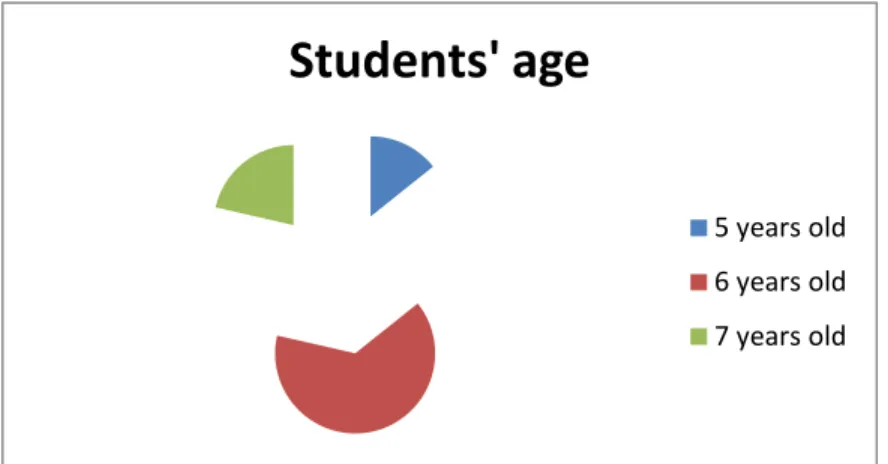
Many factors differentiate each of the members of the group selected for this study. First of all, there is age, students in this particular class are between the ages of 5 and 7 and this means a huge difference when it comes to cognitive stages of child development. It is also important to mention the different styles of learning, most of the girls, 7 out of 15 are kinesthetic learners, 5 are auditory learners, and only 3 of them are visual learners. This was determined through the application of the Lynn O´Brien learning style test taken by the students and held by the psychology department of the school.
Table 2: Students’ age 0 2 4 6 8 10 12 Mother and Father(married) Mother or Father (divorced) Single Parent Study alone
Study with a private teacher
Study with a maid
Study with other relatives
Study with Parents
STUDENTS' AGE
Number of students
5 years old 2
6 years old 9
Graphic 2. Students’ age Table 3:
First grade students’ learning styles.
FRIST GRADE STUDENTS' LEARNING STYLES
Number of students
Visual 3
Auditory 5
Kinesthetic 7
Graphic 3. First grade students’ learning styles
Students' age
5 years old
6 years old
7 years old
First Grade Students'
Learning styles
Visual
Auditory
What Were the Students’ Reading Comprehension Levels at the Beginning of the School
Year?
To measure the student’s reading performance, the researcher used three different readings which included five reading comprehension questions.
Class observation allowed the researcher to realize that the students were not reading throughout the whole text, they focused in unknown vocabulary and did not answer the questions with accuracy because they did not have a method or a strategy to help them achieve this task. Table 4:
Students’ success level of performance at the beginning of the school year
Ss with poor performance (1 Correct answers)
Ss with basic performance (2 or 3 Correct answers) Ss with succesful performance (more than 4 correct answers)
Reading 1 9 3 3
Reading 2 9 4 2
Reading 3 8 4 3
Graphic 4. Students’ success level of performance at the beginning of the school year.
0 2 4 6 8 10 12 14 16
Reading 1 Reading 2 Reading 3
Ss with successful performance (more than 4 correct answers)
Ss with basic performance (2 or 3 Correct answers)
What is the Students’ Engagement Level?
Class observations helped conclude that they felt very insecure when they were reading, and the sentence: “I don’t understand” was heard with frequency in the classroom. Of the 15 students only 3 were happy to develop the activities proposed and subsequently, these three students were the only ones able to find the answers by themselves. Even though when asked about if they wanted to learn how to read in English 13 students answer affirmatively, showing motivation towards the reading process, differing from their motivation towards the activities proposed and their willingness to work during class.
These observations show the urgent need for reading strategies to support the process and help them recognize their role in the acquisition of new learning strategies.
Application of Strategies and Data Recollection
Knowing that most of the students are kinesthetic learners and considering the students’ age range (5 to 7 years old), before readings, vocabulary was presented in various activities which included movement using flashcards, song, and videos to helps students get familiar with new words and contextualize the readings. Outdoor reading was also included in the program and sometimes the students change location in the classroom (sit on the floor, stand next to the desk or work in couples) to go to the following stage in each of the strategies used.
Scaffolding: Predicting, Making Connections, Visualizing, Inferring, Questioning and
Summarizing
During the month of March, after the use of this strategy, the students’ reading
Using these strategies, students were able to develop self-awareness of their reading process, could easily understand the readings and give answers to the proposed questions. The process was time-consuming but students were engaged with the activities and could better comprehend the readings and develop the activities.
Students used the title, pictures, and keywords to predict what the story was going to be about. After reading the texts students made drawings about the story, including the settings, characters, and actions that were more relevant for them at the beginning, the middle and the end of the story. Students sat on a circle on the classroom floor and told each other about own
experiences that relate with the story, they also talked about other stories that were similar or relatable. Then, students used images to summarize the stories writing short sentences to retell the story and answer questions before, during, and after readings. Finally, students used a bar graph to describe the character feelings, intentions and future actions inferring this information from the reading.
Table 5:
Students success level using scaffolding strategies.
ss with poor performance (1 Correct answers)
Ss with basic performance (2 or 3 Correct answers)
Ss with successful performance (more than 4 correct answers)
The big red bus 2 4 9
Graphic 5. Students’ success level using scaffolding strategies.
The S-RUNR System (Using the note-taking Cornell method): Survey, Read, Underline,
Note taking, Review
During the month of April, after the use of this strategy, the students’ reading
comprehension was measured by the number of correct answers to the reading comprehension questions they had to answer after the two readings prepared for this stage.
During the month of April, students used this strategy to read in class. These were the steps they had to follow with the two readings prepared for this stage:
Students went through the reading and quickly glanced at drawings. Then, read the final sentence of the reading. This gave them a general idea of what the reading covered. Then, students read the text material and wrote the heading on a piece of notebook paper (in their notes) in the left margin. After they finished reading a paragraph, they thought about what was important and underlined or highlighted that information in the textbook. When they finished highlighting, they took notes on the key information next to the heading that they wrote earlier in their notes. Then they summarized the highlighted information with their own words. When they had finished reading the entire chapter, they looked over the notes that they made for five to ten minutes. Students checked their memory by covering their notes and reciting the main notes out loud. 0 2 4 6 8 10 12 14 16
The big red bus The Ker-PLUNK
Ss with successful performance (more than 4 correct answers)
Ss with basic performance (2 or 3 Correct answers)
ss with poor
Table 6:
Students’ success level using the S-RUNR System
Graphic 6. Students’ success level using the S-RUNR System.
Shadow Reading: Learners “Shadow” Their Interlocutors’ Oral Language Through
Complete and Selective Repetition and Later Summarize the Repeated Text
During the month of June and July, after the use of this strategy, the students’ reading comprehension was measured by the number of correct answers to the reading comprehension questions they had to answer after the two readings prepared for this stage.
The learners were provided with shadow-reading strategy in which they were required to listen to their teacher and repeat the passage in a well-disciplined imitative task. Then students
0 2 4 6 8 10 12 14 16
Max Can Do It! The elves and the shoe maker
Ss with successful performance (more than 4 correct answers)
Ss with basic performance (2 or 3 Correct answers)
Ss with poor
performance (1 Correct answers)
Ss with poor performance (1 Correct
answers)
Ss with basic performance (2 or 3 Correct answers)
Ss with successful performance (more than 4 correct answers)
Max Can Do It! 4 4 7
The elves and the
summarized what they had comprehended from the text, writing the story in their own words with the help of pictures.
Table 7:
Students success level using shadow reading as a reading strategy.
Ss with poor performance (1 Correct answers)
Ss with basic performance (2 or 3 Correct
answers)
Ss with successful performance (more than 4 correct answers)
Bot on the moon 6 4 5
Five friends and an
elephant 5 6 4
Graphic 7. Students’ success level using shadow reading as a reading strategy.
Most Successful Strategy
During the month of August, and after the observations, students followed scaffolding strategies: Predicting, making connections, visualizing, inferring, questioning and summarizing, recognizing this strategy like the most successful among students, corroborating that the selected
0 2 4 6 8 10 12 14 16
Bot on the moon Five friends and an elephant
Ss with succesful
preformance (more than 4 correct answers)
Ss with basic performance (2 or 3 Correct answers)
strategies helped students develop self-awareness of their reading process and easily understand the readings, finding the answers to the proposed questions with accuracy and independence. Table 8:
Students’ success level using the most successful strategy
Ss with poor performance (1 Correct answers)
Ss with basic performance (2 or 3 Correct
answers)
Ss with succesful performance (more than 4 correct answers)
Funny Fish 2 3 10
Graphic 8. Students’ success level using the most successful strategy.
0 5 10 15 20
Funny Fish
Ss with succesful
preformance (more than 4 correct answers)
Ss with basic performance (2 or 3 Correct answers)
CHAPTER 5
DISCUSSION
After the study and analysis of the particular characteristics of this group, and testing the use of different strategies according to the students’ needs, the researcher has found important information to make decisions about the methods and tools that may help this group to improve their reading skills in English.
Meetings with parents helped recognize a few difficult home environments to have into account when planning for instruction in this classroom. Among the students of this class there are girls with absence of the mother figure, absence of the father figure, divorced parents, many face separations from their parents’ figure due to a very strict job schedule and others are having financial problems at home that are starting to impact the family lifestyle.
Activities which include movement, lots of visual and outdoor displacement must be included in the strategies to use in this particular group having into account their kinesthetic tendency.
The first strategy used was the implementation of various scaffolding strategies; they were very successful and help students improve their levels of reading comprehension. Class observation allowed the researcher realize that the students were very engaged with the activities, they helped them connect with the readings and gave them the vocabulary and structures needed to understand the readings and answer with accuracy the comprehension questions.
The S-RUNR System (Using the note-taking Cornell method): Survey, Read, Underline, Note taking and Review, were somehow successful and help students improve their levels of reading comprehension. Nevertheless, the activities required a lot of support from the teacher and it was very difficult for students to find the main idea or the most important part in each paragraph. With the help of the teacher, they underlined that information and it was very helpful for the rest of the process. Note taking was guided and some students struggled to summarize the reading using their own words. The good thing was that after finishing note taking they had a very good idea of what the reading was about and could answer comprehension questions on their own.
Class observations allowed the researcher realize that the students were not very engaged with the activities, because they were anxious all the time and asked for help with avidity. Even though most of the students were able to enjoy and understand the readings at the end, it was a very wasting process.
CHAPTER 6
CONCLUSION
At the beginning of the school year, students had a low level of success developing reading activities and showing reading comprehension, because they did not have a structured strategy to develop these kinds of activities.
Homeschool connection is required, but follow up activities must be restricted for the end of the school year when students are expected to improve their reading skills. Family situations and students learning habits make it essential to find ways to help them focus on their work implementing a special routine to get them ready to start classwork and monitoring their work constantly.
The first strategy implemented included: Predicting, making connections, visualizing, inferring, questioning and summarizing, these reading comprehension practices give the students the scaffolding needed to have success developing the exercises and answering the
comprehension questions with accuracy, improving notoriously their levels of reading comprehension.
struggle to summarize the reading using their own words. There is a high probability of success answering the reading comprehension questions after the activities because this strategy helps students have a very good idea of what the reading is about. Nevertheless, students were not very engaged with the activities, they were anxious all the time and asked for help with avidity. Therefore, the researcher does not consider this option like the most suitable for the group.
The third reading strategy included shadow reading and summarization of the readings using pictures. It was not a very successful strategy and it didn’t help students improve their levels of reading comprehension. The lack of pre-reading activities is crucial for the failure of this strategy. Students have problems understanding the reading because they cannot make connections to previous knowledge or contextualize the readings. Repetition is not enough for them to have a full reading comprehension or infer words meaning. Even though, the use of images to summarize the readings is of help and allows some students to accomplish the tasks with success.
REFERENCES
Alharbi, M. A. (2015). Reading strategies, learning styles and reading comprehension: A correlation study. Journal of Language Teaching and Research, 6(6), 1257-1268. Retrieved on March 28th, 2017 from
https://pdfs.semanticscholar.org/7a31/a8e16fd7da684729bfc86a8ce610c45773b1.pdf Aubrey, C., David, T., Godfrey, R., & Thompson, L. (2005). Early childhood educational
research: Issues in methodology and ethics. Routledge. London and Newyork. Retrieved on April 15th, 2107 from
https://books.google.com.co/books?id=A4aRAgAAQBAJ&pg=PA226&lpg=PA226&dq =Goodwin,+W.L.+and+Goodwin,+Understanding+quantitative+and+qualitative+researc h+in+early+childhood+education.+New+York:+London.&source=bl&ots=HVhQX4aPN
6&sig=wkn5dFD1r8-hlc6R8KePpaUQGR0&hl=es&sa=X&ved=0ahUKEwjYjLaL18rTAhWEZCYKHTf3CQ QQ6AEILDAB#v=onepage&q=Goodwin%2C%20W.L.%20and%20Goodwin%2C%20 Understanding%20quantitative%20and%20qualitative%20research%20in%20early%20c hildhood%20education.%20New%20York%3A%20London.&f=false
Bell, J. (2006) Doing Your Research Project: A guide for the first-time researchers in Education, Health and Social Science. (4th ed). [PDF]. Retrieved on April 15th, 2017 from
http://download.bioon.com.cn/upload/month_0901/20090113_7cb038ba5f8c7cd441b6wr SiYo6wbIR6.attach.pdf
Retrieved on March 28th, 2017 from
https://www.ncbi.nlm.nih.gov/pmc/articles/PMC3685861/
Bryman, A. (2004) Social Research Methods. (2nd ed). Oxford: Oxford University Press. Retrieved on April 20th, from
https://books.google.com.co/books?hl=es&lr=&id=N2zQCgAAQBAJ&oi=fnd&pg=PP1 &dq=Bryman,+A.+(2004)+Social+Research+Methods.+(2nd+ed).+Oxford:+Oxford+Uni versity+Press&ots=dnRuGXQ9pj&sig=3MtL0XuuCpLSdlNbofCEujtShGQ#v=onepage &q&f=false
Cohen, L., Manion, L. and Morrison, K. (2007). Research Methods in Education. (6th ed.). [PDF]. London: Routledge Falmer. Retrieved April 15th,2017 from
https://islmblogblog.files.wordpress.com/2016/05/rme-edu-helpline-blogspot-com.pdf Commander, M., & de Guerrero, M. (2013). Reading as a social interactive process: The impact
of shadow-reading in L2 classrooms. Reading in a Foreign Language, 25(2), 170-191. Retrieved March 13th, 2018 from
https://files.eric.ed.gov/fulltext/EJ1015756.pdf
Garnett, K. (2010). Thinking about Inclusion and Learning Disabilities: A Teachers Guide, pp 7-12. Division of Learning Disabilities of the Council for Exceptional Children. Retrieved April 15th, 2017 from
http://www.readingrockets.org/article/what-are-classrooms-students-learning-disabilities Geske, A., & Ozola, A. (2008). Factors influencing reading literacy at the primary school level.
H. Şenay Şen. (2009). The relationship between the use of metacognitive strategies and reading comprehension. Procedia - Social and Behavioral Sciences. Elsevier. Retrieved on April 20th, 2017 from
http://www.sciencedirect.com/science/article/pii/S1877042809004078
Hülya K. (2012). Improving reading skills through effective reading strategies. Procedia - Social and Behavioral Sciences. Elsevier. Volume 70, 25 January 2013, Pages 709-714.
Retrieved on April 16th, 2017 from
http://ac.els-cdn.com/S1877042813001146/1-s2.0-S1877042813001146-
main.pdf?_tid=967d3d18-2a01-11e7-8fd3-00000aacb35f&acdnat=1493157376_8852c1f95d8da8d7f6df7dcf1ed6c03f
Kennedy, T. (2006). Language Learning and Its Impact on the Brain: Connecting Language Learning with the Mind Through Content-Based Instruction. Foreign Language Annals, 39(3), pp.471-486. Retrieved on December 18, 2017 from:
https://zdoc.site/queue/language-learning-and-its-impact-
Kim, C. (2017). Academic Success Begins at Home: How Children Can Succeed in School. The Heritage Foundation. Retrieved on April 6th, 2017 from
http://www.heritage.org/education/report/academic-success-begins-home-how-children-can-succeed-school
Kothari, C. R. (2004). Research methodology: Methods and techniques. New Age International. Retrieved on March 18th, 2017 from
Mellati, M., Khademi, M., & Etela, P. (2014). Strategy-Based Instruction: Explicit Strategy Training and Iranian EFL Learners Test Performance. International Journal of English Language and Literature Studies, 3(4), 356-368. Retrieved on May 24th, 2017 from
https://www.researchgate.net/publication/308401319_Strategy-Based_Instruction_Explicit_Strategy_Training_and_Iranian_EFL_Learners'_Test_Perfor mance
O’Brien, L. (1990). Test para determinar el Canal de Aprendizaje de preferencia [PDF]. Retrieved on November 20th, 2017 from
http://pnliafi.com.ar/wp-content/uploads/2016/07/test-canal-de-aprendizaje-de-preferencia.pdf
O'malley, J. M., O'Malley, M. J., & Chamot, A. U. (1990). Learning strategies in second language acquisition. Cambridge university press. Retrieved on June 12th, 2017 from https://books.google.es/books?hl=es&lr=&id=0TIq53s326EC&oi=fnd&pg=PR8&dq=O %27malley,+J.+M.,+O%27Malley,+M.+J.,+%26+Chamot,+A.+U.+(1990).+Learning+str ategies+in+second+language+acquisition.+Cambridge+university+press.&ots=6V69PuY faA&sig=zk-3adHt9s5P-dek4AM128PG2M4#v=onepage&q&f=false
Philip L. Campbell. (2011) Peirce, Pragmatism, and The Right Way of Thinking [PDF]. Sandia National Laboratories. Retrieved on March 28th, 2017 from
ttps://fas.org/sgp/eprint/peirce.pdf
& Policy (pp. 19-20) [PDF]. Retrieved on April 16th, 2017 from https://ncela.ed.gov/files/rcd/be023769/bilingualism_and_literacy.pdf
Robson, C. (2002). Real World Research. (2nd ed.) [PDF]. Oxford: Blackwell. Retrieved on April 15th, 2017 from
http://www.dem.fmed.uc.pt/Bibliografia/Livros_Educacao_Medica/Livro34.pdf Sadeghi, E., Afghari, A., & Zarei, G. R. (2016). Shadow-Reading Effect on Reading
Comprehension: Actualization of Interactive Reading Comprehension: (A Vygotskyan View!). English Language Teaching, 9(3), 130-138. Retrieved on Marsh 5th, 2017 from https://files.eric.ed.gov/fulltext/EJ1095587.pdf
Yilmaz K. (2013). Comparison of Quantitative and Qualitative Research Traditions: epistemological, theoretical, and methodological differences. European Journal of Education, 48(2),311-325. Retrieved on April 20th, 2017 from
https://pdfs.semanticscholar.org/f45f/993702833849749b3ddd83e1673728d569eb.pdf Your family 'type' can affect your kids at school (2010). Usatoday30.usatoday.com. Retrieved on
April 6th, 2017 from
APPENDIX A: PHOTOGRAPHIC EVIDENCE
APPENDIX B: CALENDARS
In order to study the characteristics of the group, the difficulties they were facing in regards to their reading learning process and find the most suitable reading strategies to be applied in this particular classroom to help the students improve their reading skills, the
researcher used the following calendar to organize the activities that would take place during the first three terms of the year.
ACTIVITY February March April June July August
Parents and students’
interviews X X
Questionnaires and tests X X X X X X
Class observations X X X X X X
Use of different reading
strategies in class X X X X X X
Data analysis X X X
Different strategies were applied during the school year following this schedule:
Strategy to be used
during this month March April June July August
Scaffolding X
The S-RUNR System (Using
the note-taking Cornell
method)
X
Shadow reading X
The strategy which better
APPENDIX C: RESEARCH TOOLS
In order to analyze the particular strengths, weaknesses, and needs of the students, the researcher used different questionnaires.
Family Situation Questionnaire
FAMILY SITUATION QUESTIONNAIRE TEMPLATE Family form:
Mother and father (married) ____ Mother or father (divorced)____ Single mother or father____
Who helps the student with homework? Mother or father___
Other relatives (grandfather, aunt, uncle, sister, brother…)____ Maid___
Private Teacher___ No body___
How do you think you can get involved in your child’s reading learning process:__________________________________________________
Learning Styles Test
The students took a test to determine their learning styles created by Lynn O´Brien (1990), retrieved from: http://pnliafi.com.ar/wp-content/uploads/2016/07/test-canal-de-aprendizaje-de-preferencia.pdf
Students and Families’ Progress Checking Questionnaire
Parents and students were interviewed regularly answering open questions about their particular family situation to determine their particular characteristics, possible causes for the student’s low L2 reading skills, monthly improvement and level of engagement with the process.
The researcher proposed the following questions in order to find relevant information for the study:
For parents:
1. How is the family doing?
2. Have you experienced any difficulty at home during the last month?
3. Did you notice any improvement in the way your child reads and comprehends the readings? How?
For students:
1. Do you enjoy reading in class?
2. Do you understand the readings in class?
3. Do you think that you can answer the questions with independence after the activities proposed for the readings?
Students’ Performance Observation Form
OBSERVATION FORM TEMPLATE (created by the researcher)
Teacher: __________________________
Number of students present: ______ Duration of the activity: ____ Strategy used: ______________________
Reading: ____________________________
Number of students actively participating: ________
Number of student who required teacher assistance to finish the task: ________ Short description of the students’ behavior during the activities: _______________ What activities were useful and why: __________________________
What activities presented a problem and why: ____________________________
Example:
OBSERVATION FORM TEMPLATE (created by the researcher)
Teacher: Blanca Juliana Gómez
Number of students present: ___15___ Duration of the activity: ____45 minutes
Strategy used: The S-RUNR System (Using the note-taking Cornell method): Survey, Read, Underline, Note taking and Review.
Reading: Max can do it!
Number of students actively participating: ___6_____
Number of student who required teacher assistance to finish the task: ___15_____
anxious all the time and asked for help with avidity
What activities were useful and why: After finishing note taking they had a very good idea of what the reading was about and could answer comprehension questions on their own. Most of the students were able to enjoy and understand the readings at the end
What activities presented a problem and why: Underline the main idea of the paragraphs, because it was very difficult for students to find the main idea or the most important part in each paragraph. Note taking was guided and some students struggled to summarize the reading using their own words.
Students’ Success Level Before and After the Application of Strategies Table
In order to measure the students’ success level after the application of different strategies, the researcher used five different comprehension questions after the readings. The level of
success was measured by the number of correct answers using the following table created by the researcher:
Ss with poor performance (1 Correct answers)
Ss with basic performance (2 or 3 Correct answers)
Ss with successful performance (more than 4 correct answers) Name of the
APPENDIX D: READING MATERIAL AND QUESTIONAIRES.
Readings Used before the Implementation of Reading Strategies
Reading 1: “I go to school”
Taken from the students’ Language Arts book: Cambridge Global English, Learner’s book 1. Cambridge University Press. (P.18)
Questionnaire:
1. Who are the charecters in the story?
______________________________________________________.
2. Who goes to school?
a. a girl b you c. a squierrel.
3. Who hops?
a. a rabbit b. a duck c. a squierrel.
4. Write one thing the girl sees in her way to school?
____________________________________________________________.
5. When does the girl go to school?
Reading 2:
“Families work and have fun”
Taken from the students’ language Arts Book: Cambridge Global English, Learner’s book 1. Cambridge University Press. (P. 32)
Questionnaire:
1. What is the reading about?
a. a small family b.different families c. your family
Read the sentences say which ones are true: 2. The children play together ______ 3. The father cooks the dinner ______ 4. The girl tidies her room ______
5. Who works on the computer?
______________________________________________________
Reading 3: “Little Red Hen”
Taken from the students’ language Arts Book: Cambridge Global English, Learner’s book 1. Cambridge University Press. (P. 74)
Questionnaire:
1. Who are the characters in the story?
_______________________________________________________
Read the sentences say which ones are true:
3. The Chick and the Duck eat the bread ______ 4. The Chick and the Duck are busy______
5. Who pick the wheat, grinds the wheat and makes the bread? _______________________________________
Strategy 1: Scaffolding (Predicting, making connections, visualizing, inferring,
questioning and summarizing)
Reading 1: “The big red bus”
Taken from the students’ reading book: Collins International Primary English Level 1. Cambridge International Examinations. (P. 3)
Questionnaire:
1. Where is the bus going?
_______________________________________________________
Read the sentences say which ones are true: 2. The bus is very slow_____
3. The passed the pond ______ 4. You press the bell to get off______
Reading 2: The Ker-PLUNK
Taken from the students’ language Arts Book: Cambridge Global English, Learner’s book 1. Cambridge University Press. (p.46)
Questionaire:
1. Who are the charecters in the story?
______________________________________________________.
2. Which Character is wise?
a. The Rabbit b. The Lion c. A Duck
3. Why is rabbit scared?
____________________________________________________________.
4. What really made the sound Ker-PLUNK?
____________________________________________________________.
5. Which characters are silly?
____________________________________________________________.
Strategy 2: The S-RUNR System (Using the note-taking Cornell method)
Reading 1:
“Max Can Do It!”
Taken from the students’ reading book: Collins International Primary English Students’ Book 1. Cambridge International Examinations. (p.12)
Questionnaire:
2. Who likes looking at bugs under trees?__________________
Read the sentences say which ones are true: 3. Bee Rex got stuck up a tree____ 4. Max cannot help Bee ______ 5. Max’ friends made a ladder______
6. Who is more friendly?
_______________________________________
Reading 2:
“The elves and the shoe maker.”
Taken from the students’ language Arts Book: Cambridge Global English, Learner’s book 1. Cambridge University Press. (p.60)
1. What is the shoemaker doing at the beginning of the story? a. The shoe maker is singing.
b. The shoe maker is sleeping. c. The shoe maker is eating.
2. How do the elves help the shoe maker? 3. How does the shoemaker help the elves?
Read the sentences say which ones are true: 4. The Shoemaker is selling less shoes ______
Strategy 3: Shadow reading
Reading 1:
“Bot on the moon”
Taken from the students’ reading book: Collins International Primary English Level 1. Cambridge International Examinations. (p.32)
1. Who are the characters of the story?_____________________ 2. How did Bob travel to the moon? _______________________ 3. What did Bot buy in the moon shop?____________________ a. A card and a moon rock. b. A golf club.
4. Was Bot’s rocket fast or slow?_________________________ 5. What did Bot loose on the moon?
a. The card b. His best golf club c. His rocket.
Reading 2:
“Five friends and an elephant”
Taken from the students’ language Arts Book: Cambridge Global English, Learner’s book 1. Cambridge University Press. (p.88)
Questionnaire:
1. Why can’t the friends see the elephant? d. Because the elephant is too big. e. Because they are small.
f. Because they are blind.
a. Tame and gentle b. big and smelly c. blind
3. Which part of the elephant feels like a rope? ______________
4. Which part of the elephant feels like a big strong tree? ____________ 5. How can the friends know the elephant better?___________________
The most successful strategy
Reading: “Funny Fish”
Taken from the students’ reading book: Collins International Primary English Level 1. Cambridge International. (p.42)
Questionnaire:
1. How many fish were swimming in the sea at the beginning of the story? ______ 2. Why is the last fish sad?
a. Because the big fish can see him. b. Because noone ever looks at him. c. Because he is bright and funny.
Read the sentences say which ones are true: 3. The fish were swimming in a pond. _______ 4. One fish hid under stone. _______
Consentimiento Informado para Participantes de Investigación
El propósito de esta ficha de consentimiento es proveer a los participantes en esta investigación con una clara explicación de la
naturaleza de la misma, así como de su rol en ella como participantes.
La presente investigación es conducida por Blanca Juliana Gómez, de la Universidad Nacional Abierta y a distancia. La meta de
este estudio es encontrar las estrategias más apropiadas para mejorar la habilidad lectora en la segunda legua de las niñas de primero (Ingles).
La información familiar y los resultados de las pruebas aplicadas a las estudiantes se manejaran con total confidencialidad y solo
serán usadas para datos estadísticos. Los nombres de las niñas o las familias no serán mencionados durante este estudio, pero los resultados
de su rendimiento en las actividades propuestas y la observación de clases serán material importante para el manejo estadístico de la
investigación.
Si tiene alguna duda sobre este proyecto, puede hacer preguntas en cualquier momento durante su participación en él. Igualmente,
puede retirarse del proyecto en cualquier momento sin que eso lo perjudique en ninguna forma.
Desde ya le agradecemos su participación.
Acepto que mi hija participe voluntariamente en esta investigación, conducida por Blanca Juliana Gómez. He sido informado (a)
de que la meta de este estudio es encontrar las estrategias más apropiadas para mejorar la habilidad lectora en la segunda legua de las niñas de
primero (Ingles)._____________
He sido informado de que puedo hacer preguntas sobre el proyecto en cualquier momento y que puedo retirarme del mismo
cuando así lo decida, sin que esto acarree perjuicio alguno para mi persona. De tener preguntas sobre mi participación en este estudio, puedo
contactar a Blanca Juliana Gómez Rojas al teléfono 301-2587775.
---