IMAGE ANALYSIS OF A TOURIST DESTINATION: MALAGA, SPAIN Fernando Almeida-García
Janire Domínguez-Azkue University of Malaga, Spain
1. Introduction
The destination image is multidimensional in nature and the knowledge the individuals have of the destination and also their personal traits and opinions play an important role in it. Therefore, it is a complex construction in which the different information sources are decisive. Thus, the destination image plays a key role in both marketing and tourism location.
The city of Malaga, located in Southern Spain, lies on the Costa del Sol (Coast of the Sun), a tourist area largely identified with seaside tourism. In recent years Malaga city has been trying to distance itself from the “sun and sand” tourism segment and it has chosen to position itself as a cultural destination (Diario Sur, 2014; The New York Times, 2015). In this regard, the effectiveness of the image of Malaga differentiated from a seaside destination image is analysed in the present study.
The main objective of this research is to perform an analysis of the current image of the city and of the target one. A detailed study of the obtained results will enable us to take a close look at the tourists’ attitudes towards Malaga city and it will provide us with information to improve or design new differentiation strategies. This is the first academic study on Malaga’s destination image.
Malaga is a Spanish municipality in Andalusia and it is located, as already mentioned, in the Costa del Sol, beside the Mediterranean Sea. The city had 566,913 inhabitants (2014) and an accommodation supply of 9,598 bed places and nearly one million of tourists (2013). We decided to focus the research on Malaga city, on the Costal del Sol, Spain, a traditionally touristic place which in the recent years is trying to specialize in urban and cultural tourism.
2. Literature review
Since mid-1970s destination image has been studied but it still remains open to a further study and debate. The assessment and analysis of the destination image has been studied in academic literature and it has contributed to the understanding of tourist behaviour (Beerli & Martin, 2004). The complexity of the destination image concept has been studied from diverse scientific fields, such as psychology (Hanyu, 1993), anthropology, sociology, geography or marketing (Gallarza, Gil&Calderón, 2002), besides tourism (Baloglu&McCleary, 1999). The study of destination image has been a significant
on destination image have focused on the cognitive image, but at the same time, in recent years the number of studies focused on the affective image is increasing. In addition, some authors (Bosque&Martin, 2008; Morais&Lin, 2010) believe that both cognitive and affective components are equally important and influential in creating a destination image, so they have decided to focus their researches on a model that brings together both components, as it is made in the present research.
The hypotheses proposed in the current research are the following:
H1: The preconceived image of the tourist destination is a multidimensional concept composed of several dimensions, including cognitive and affective assessments.
H2: Individuals who have been to Malaga have a more positive image of the city compared to those who have not travelled to Malaga.
H3: Rest and relaxation are the main reasons for travelling to Malaga city rather than cultural or social motivations.
H4: Malaga does not have a distinguished image from the “sun and sand” tourism segment associated with the Costa del Sol.
3. Methods and materials
In the current research a descriptive and inferential analysis of the results has been made, as well as a comparative analysis between two groups –nationals and foreigners– in order to enable a comparison of the different opinions among them. Moreover, a factor analysis of the cognitive and affective components of the destination image has been conducted.
This study is based on the questionnaires on the destination image previously developed by other authors (Baloglu&McCleary, 1999; San Martín, 2005). The survey is addressed to those who have visited Malaga before and to those who have never been to the city and, as stated previously, sample of foreign nationality has been collected: from America and from other European countries. These respondents have not been randomly selected but by incidental sampling. The surveys were undertaken over a short period of time –from 14 April to 28 April, 2014– and were distributed both on paper and online for those geographically dispersed. 301 valid responses were achieved.
The questions in the survey were divided into four categories: (i) questions on socio-demographic variables, (ii) questions on the cognitive component of the destination image, (iii) on the affective component and (iv) on the motivational component. A 61-item self-report questionnaire has been designed and all 61-items were measured by a five-point Likert-type scale. We have used SPSS v.20 to process and analyse the data collected. First, a descriptive analysis of the variables and the result has been contacted. After that, an inferential analysis has been carried out using the non-parametric test of Mann-Whitney and finally, a factorial analysis with VARIMAX rotation and Kaiser Normalization.
According to data obtained these are the main results of the research:
Descriptive analysis
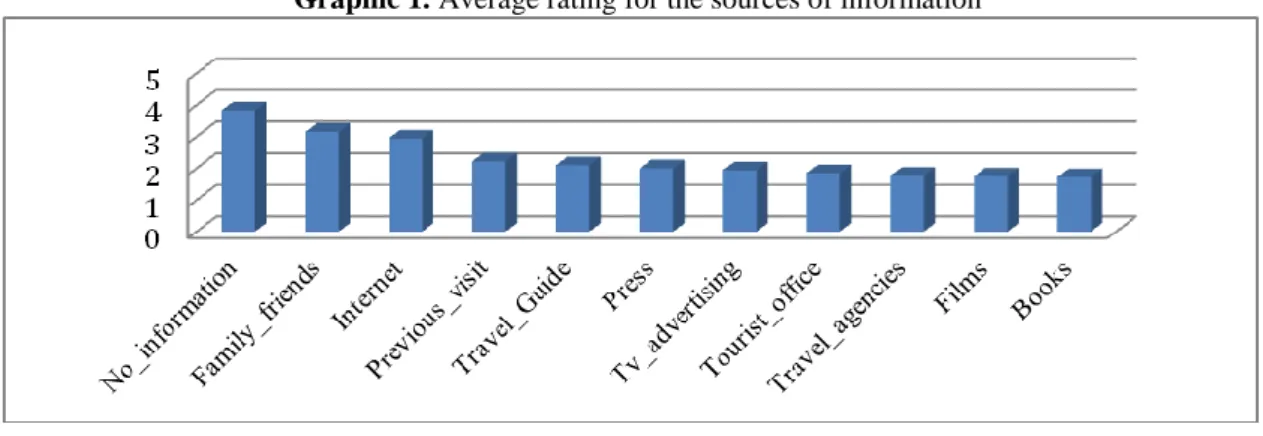
(i) The visit to the city. This question is important to create the profiles of the visitors and tourists and we found out that 49.5% of respondents have travelled to Malaga. (ii) The sources of information (graphic 1) from which respondents have obtained information about the city or about tourist products related to the city. Most respondents claim to have no information about the city of Malaga and those who do have some kind of information they obtain it from family and friends and from the Internet in third place. This statement could respond to a weak positioning of the destination, especially in America.
Graphic 1. Average rating for the sources of information
(iii) Tourism products associated with Malaga. Respondents associated the city of Malaga with the “sun and sand” tourism, followed some way behind by gastronomic and wine tourism and even further by cultural and heritage tourism. The comparative analysis (Mann-Whitney Test) only points out a statistically significant difference between those who have travelled to the city and those who have never been to Malaga, for the “sun and sand” segment: those who have been to the city associate even more the city with this segment than those who have never travelled to Malaga.
Analysis of the components of the image
The cognitive and affective components of the target image of the city of Malaga have been analysed. To that end, we have followed the steps used before: a comprehensive descriptive analysis and a comparative analysis (Mann-Whitney test).
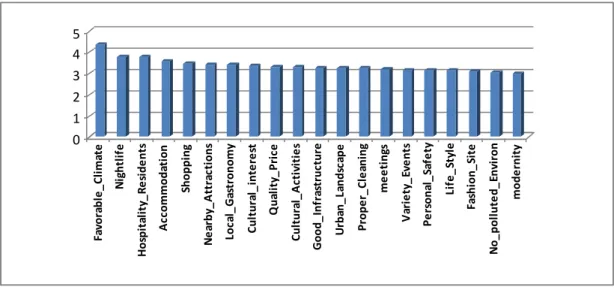
(i) Cognitive component. The climate in Malaga is highly appreciated by respondents, (graphic 2) as well as the nightlife and the hospitality of the residents. The lowest scores are for the non-polluted environment and for seeing Malaga as a city in fashion or a city which transmits modernity.
0 1 2 3 4 5 Fa vo ra b le _ C li ma te N ig h tl if e H o sp it al it y_ R e si d e n ts A cc o mm o d at io n Sh o p p in g N e ar b y_ A tt ra ct io n s Lo ca l_ Ga st ro n o my C u lt u ra l_ in te re st Q u al it y_ P ri ce C u lt u ra l_ A ct iv it ie s Go o d _ In fr as tr u ct u re U rb an _ La n d sc ap e P ro p e r_ C le an in g me e ti n gs V ar ie ty _ Ev e n ts P e rs o n al _ Sa fe ty Li fe _ St yl e Fa sh io n _ Si te N o _ p o ll u te d _ En vi ro n mo d e rn it y
After application of the Mann-Whitney test, statistically significant differences are revealed. Travellers who have visited Malaga have a more positive assessment of almost all the attributes of the city that those who have not travelled to the city before.
(ii) Regarding the affective component, measured by a semantic differential based on a five-point Likert-type scale (graphic 3), the results show that all factors are evaluated more positively than negatively. Malaga is considered, in the first place, as a pleasant destination and the consideration of Malaga as an exciting city has obtained the lowest results. The Mann-Whitney test has been applied again in order to verify the differences between the two groups already mentioned. A significant difference has been found in the “boring-amusing” variable and in the “unpleasant-pleasant” one. In both cases respondents who have already travelled to Malaga have given a higher score compared to those who have never been to the city.
Graphic 3. Affective component
Depresing Streful Boring Unpleasant Pleasant Amusing Relaxing Exciting
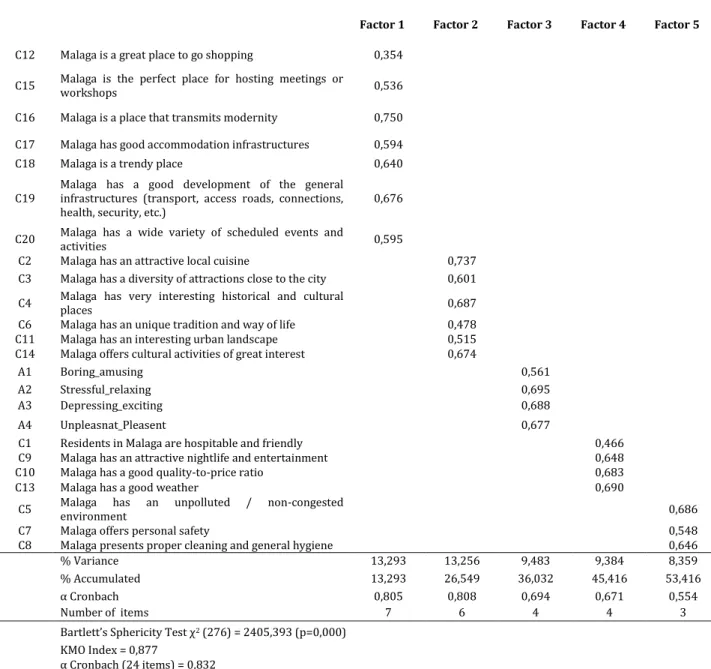
Then, a factor analysis of these components (cognitive and affective) has been conducted, in order to identify possible underlying dimensions of perception in the set of attributes. This factor analysis of the components is used to reduce the large amount of data, by grouping together those attributes related to each other under the same dimension. For this purpose, the VARIMAX method of rotation with Kaiser Normalization has been used. Once the rotation is completed, the significant factors which explain at least one variable have been selected. Thus, among the 24 displayed attributed (Table 1), we have obtained five different factors which explain 53,42% of variance using factor analysis.
Table 1. Factor analysis of destination image
Factor 1 Factor 2 Factor 3 Factor 4 Factor 5
C12 Malaga is a great place to go shopping 0,354
C15 Malaga is the perfect place for hosting meetings or workshops 0,536
C16 Malaga is a place that transmits modernity 0,750
C17 Malaga has good accommodation infrastructures 0,594
C18 Malaga is a trendy place 0,640
C19 Malaga has a good development of the general infrastructures (transport, access roads, connections, health, security, etc.)
0,676
C20 Malaga has a wide variety of scheduled events and activities 0,595
C2 Malaga has an attractive local cuisine 0,737
C3 Malaga has a diversity of attractions close to the city 0,601
C4 Malaga has very interesting historical and cultural places 0,687
C6 Malaga has an unique tradition and way of life 0,478
C11 Malaga has an interesting urban landscape 0,515
C14 Malaga offers cultural activities of great interest 0,674
A1 Boring_amusing 0,561
A2 Stressful_relaxing 0,695
A3 Depressing_exciting 0,688
A4 Unpleasnat_Pleasent 0,677
C1 Residents in Malaga are hospitable and friendly 0,466
C9 Malaga has an attractive nightlife and entertainment 0,648
C10 Malaga has a good quality-to-price ratio 0,683
C13 Malaga has a good weather 0,690
C5 Malaga has an unpolluted / non-congested environment 0,686
C7 Malaga offers personal safety 0,548
C8 Malaga presents proper cleaning and general hygiene 0,646
% Variance 13,293 13,256 9,483 9,384 8,359
% Accumulated 13,293 26,549 36,032 45,416 53,416
α Cronbach 0,805 0,808 0,694 0,671 0,554
Number of items 7 6 4 4 3
Bartlett’s Sphericity Test χ2 (276) = 2405,393 (p=0,000)
KMO Index = 0,877
α Cronbach (24 items) = 0,832
One the analysis has been conducted, we observe that the indicators that demonstrate the validity of the analysis (Bartlett test and Kaiser-Meyer-Olkin coefficient) show satisfactory results. Factor 1 groups the attributes associated with infrastructure and fashion, Factor 2 brings together the attributes related to the cultural environment and the particularity of the destination, Factor 3 is the one which includes the 4 attributes that form the affective image, Factor 4 includes attributes related to lifestyle and day to day aspects and the last one, Factor 5, refers to the atmosphere of the destination that the individuals perceive. This shows that the destination image is multidimensional and that it is formed by a cognitive component, which can be divided into different dimensions, including clearly a cognitive and an affective component.
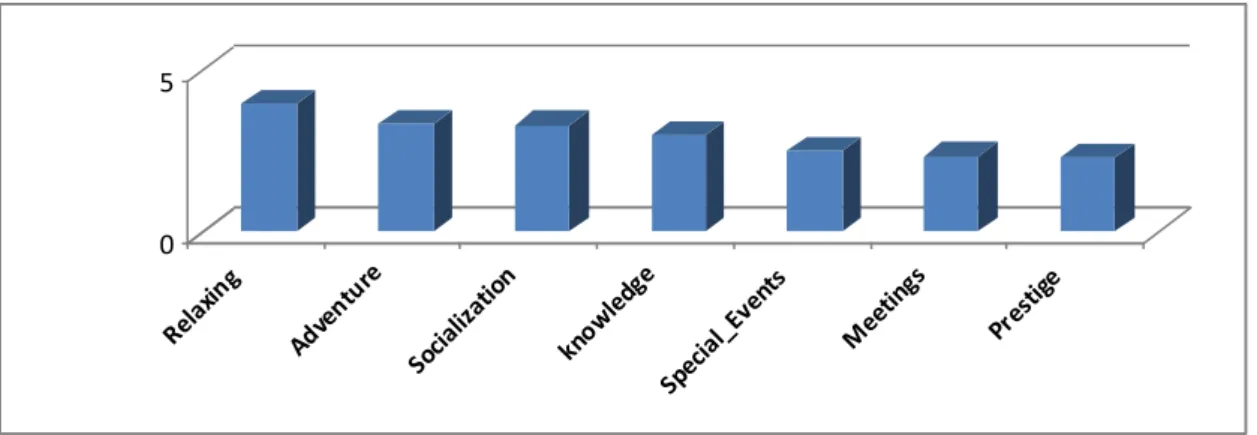
the city would be for relaxing, for adventures or for social grounds. On the other hand, they would not be so willing to return due to reasons related to knowledge, adventure nor to attend special events.
Graphic 4. Motivational component
0 5
Rela xing
Adve ntur
e
Socia lizat
ion
knowl edge
Spec ial_E
vent s
Mee tings
Pres tige
5. Discussion and Conclusions
The four initial hypotheses are demonstrated.
Hypothesis 1: The factor analysis, as well as the other analysis carried out, highlights the multidimensional character of the image of destination.
Hypothesis 2: The comparative analysis (Mann-Whitney Test) highlights the different behaviour of the two groups surveyed: Travellers who have visited Malaga have a more positive perception of the destination.
Hypothesis 3: The descriptive analysis shows that rest and relaxation is the main reason for travelling to Malaga instead of cultural reasons.
Hypothesis 4: The descriptive analysis indicates that the city of Malaga is still identified as a “sun and sand” destination, despite the significant investments made by the destination in the cultural offer.
References
Baloglu, S. & McCleary, K. (1999). A Model of Destination Image Formation. Annals of Tourism Research, 26(4), 868-897.
Beerli, A. & Martín, J. (2004). Tourists’ characteristics and the perceived image of tourist destination: a quantitative analysis. A case study of Lanzarote, Spain. Tourism Management, 25, 623-636.
Bosque, I. R., y San Martín, H. (2008). Tourist satisfaction: a cognitive-affective model.
Annals of Tourism Research, 35(2), 551-573.
Gallarza, M. G., Gil, I. & Calderón, H. (2002). Destination Image: Towards a Conceptual Framework. Annals of Tourism Research, 29(1), 56-78.
Hanyu, K. (1993). The affective meaning of Tokyo: verbal and nonverbal approaches, Journal of Environmental psychology, 13(2), 161-172.
Hunt, J.D. (1975). Images as a Factor in Tourism Development. Journal of Travel
Research, 13(3), 1-7.
Morais, D. B. y Lin, C. H. (2010). Why do first-time and repeat visitors patronize a
destination? Journal of Travel & Tourism Marketing, 27(2), 193-210.
Zhang, H., Fu, X., Cai, L. y Lu, L. (2014). Destination image and tourist loyalty: A