ESCUELA UNIVERSITARIA DE EDUCACIÓN
TRABAJO DE FIN DE GRADO DE
EDUCACIÓN INFANTIL
ALUMNA: SARA RODRÍGUEZ COSGAYA
TUTORA: ANA ISABEL DÍEZ GONZÁLEZ
Curso Académico 2012/2013
Palencia, 26 de junio de 2013.
TASK-BASED LEARNING AND
PROJECT WORK AS METHODS TO
2
RESUMEN
Hoy en día, el aprendizaje en inglés en las aulas de infantil comienza a ser un tema de estudio e investigación. Dicha tarea concierne a los futuros maestros de infantil especialistas en inglés. Partiendo del enfoque globalizador, como eje central en el proceso de aprendizaje de los alumnos y con este nuevo rol del profesor de infantil nos preguntamos cómo podríamos trabajar en ambas lenguas diseñando un curriculum integrado. Esta idea se convierte en la cuestión principal sobre la que centraremos este trabajo con el fin de proporcionar una forma de trabajar. Debido a la similitud entre los Proyectos de trabajo y el método por tareas presentamos una propuesta de trabajo basada en la utilización de ambas metodologías, utilizando el cuento como un recurso clave para unir ambos métodos y crear una educación coordinada en español y en inglés.
Palabras clave: Método por tareas, Proyectos de trabajo, profesor de educación infantil especialista en inglés, enfoque globalizador y curriculum integrado.
ABSTRACT
Nowadays, the learning in English in Early Years becomes a subject of study and research, whose work concerns Infant future teachers specialized in English. Based on the Global approach, as the backbone of the learning process of students and with this new Infant teacher role how we could work in both languages by creating a integrated curriculum. This idea is become the main issue on which we focus on this work to provide a way of working. Because of the similarity between Projects Work and Task-Based Learning we present a proposal based on the use of both methodologies, using the tale as the key resource in order to unit both methods and create a coordinate education in English and in Spanish.
3
INDEX
1. Introduction 4
2. Objectives 5
3. Justification 6
3.1. Connection between the proposal and competences of the title 6
3.2. Learning in English in Early year 8
4. Theoretical foundation 10
4.1. How children learn 10
4.2. Project Work (P.W) 10
4.3. Task-Based Learning (T.B.L) 13
4.4. The tale as a key resource 16
4.5. How to build a coordinate education between English and Spanish 16
5. Methodology 18
6. Syllabus proposal 19
6.1. Introduction 19
6.2. Context of the proposal: Frómista School 20
6.3. Objectives 23
6.4. Design 23
6.5. Evaluation 29
6.6. Unit: “The three little pigs” 30
7. Final considerations 38
7.1. Result analysis 38
7.2. Conclusions 39
8. References 40
9. Appendix 42
Objectives of the official curriculum 42
Unit “The three little pigs” 47
4
1. INTRODUCTION
Nowadays the learning a foreign language has assumed a new importance in the minds of many educators. Thus, the school has a significant role, due to the fact that in Early Years children are involved in more than one language, not only in the mother tongue. For this reason, school has to create a plurilingual and intercultural education as the Council of Europe says where different languages work together, wherefore teachers have to pay attention to the way of working. Through an integrated curriculum between English and Spanish children can achieve an integral and harmonious development as future citizens.
It is said that English and Spanish are different subject even in Early Years. However, this is a misconception because it is necessary to apply a global approach in Infant Education so that children can have a homogeneous education. It requires the work of a specialist in Infant Education and also expert on didactic of second language acquisition. Hence, this is a hard task which teachers have to deal with. This work cannot tackle in an individual way, it is necessary the work together among teachers and families. Nevertheless, there is a key element, the inclusion of the new teacher role of infant education who can be a specialist of English as well. There is not a unique way to achieve the change. With this project it is offered the perspective to work with the same topic in English and in Spanish for Early Years using a known tale as a key resource in order to link Task-Based Method and Project Work so as to build a coordinate education.
5
2. OBJECTIVES
For developing this work, it is necessary to establish some specific objectives which will organize the specific line to follow.
Analyze the importance of teaching-learning English in official documents.
Identify characteristics of Task-Based Method and Project Work so as to use
these methods in Early Years.
Propose an annual sequence for third course of Infant Education, second cycle.
Make a didactic proposal for a coordinated work between English and Spanish
language lessons establishing a tale as the main theme of this proposal. (This objective is thought for a specific context, Frómista School “Pablo Sáenz”).
Promote a cooperation culture between school and families fostered the Project
Work.
Maximize the professional development for future infant teachers, as specialists
6
3. JUSTIFICATION
3.1.
CONNECTION
BETWEEN
THE
PROPOSAL
AND
COMPETENCES OF THE TITLE.
“The fundamental objective of the degree is to train professionals with a capacity to direct educational services to children from the first cycle of Infant Education and for the elaboration and tracing of the pedagogical proposal referred to in the Article 14 of
the Organic Law 2/2006, May 3rd and to provide the second cycle of Infant education1”
(My translation).
This is the main objective which a future teacher has to achieve if he or she wants to obtain the degree in Infant Education. Through this work I can improve and it allows me to strengthen the skills and competences that an infant teacher must have. However, it is necessary to take into account objectives related to the four years, three of them as an Infant Education future teacher and another one as an English specialist teacher in Early Years. Furthermore, I would like to mention specific objectives and competences which are related to this work:
Objectives:
Design, develop and evaluate educational proposals that use animation to read
and dramatization in the approach to English in Infant Education2. (My
translation)
Mastering the foreign language curriculum (English) in Infant Education.3(My
translation).
1
“El objetivo fundamental del título es formar profesionales con capacidad para la atención educativa directa a los niños y niñas del primer ciclo de educación infantil y para la elaboración y seguimiento de la propuesta pedagógica a la que hace referencia el artículo 14 de la Ley Orgánica 2/2006, de 3 de mayo, de Educación y para impartir el segundo ciclo de educación infantil”
This objective appears in “Memoria de la titulación de Grado en Educación Infantil” from Uva university.http://www.uva.es/export/sites/default/contenidos/gobiernoUVA/Vicerrectorados/bak/Vicerect oradoCalidadInnovacion/Grado/CCSS/UVaGradoEducacionInfantil.pdf (Consulted: May 29th 2013).
2
“Diseñar, elaborar y evaluar propuestas didácticas que utilicen la animación a la lectura y la dramatización en la aproximación al inglés en Educación Infantil”.
3 “
7
Competences:
Being able to transmit to children the functional learning of a foreign language4.
(My translation).
Knowing about children’s literature and developing strategies for children’s
approach to literacy texts both oral and written5. (My translation).
Finally, all the objectives have a relationship with this work, due to the fact that an aim of this work is fostering the development between objectives and competences which are related to Infant Education.
4
“Ser capaces de transmitir a los niños y niñas el aprendizaje funcional de una lengua extranjera”.
5
8
3.2. LEARNING IN ENGLISH IN EARLY YEARS
The right to education is the number twenty six according to human rights6.
Furthermore, our present education law, L.O.E, says in the preamble: “A good
education is the best wealth and the main resource of a country and their citizens7” (My
translation). For this reason the word education is really important.
However, it is necessary to know if there appears in the law something related to English in Early Years. Fortunately, there are two education purposes which are connected with learning in English and in Spanish in Infant Education: “Training in the respect and recognition of the linguistic and cultural plurality of Spain and of
interculturalism as an enriching element of society8” and “The communication training
in an official and co-official language, if any, and in one or more foreign languages9”
(Preliminary title, chapter I, 2 article) (My translation). Besides, there is a specific objective for Infant Education: “Developing communicative skills in different languages
and expression ways10”. (Title I, chapter I, 13 article). (My translation).
In addition, there are also pedagogical principles: “It corresponds to the education authorities promoting an introduction to the foreign language learning in the second
cycle to Early years, especially in the last year11” and “The educational content of Infant
Education will be organized in areas related to the personal experiences of children and their development and will be tackled through global activities that are interesting and
meaningful for children12” (Title I, chapter I, 14 article). (My translation) This last one
is really important, due to the fact that the global approach has to be a main line to work with children in Early Years.
On the other hand, The Common European Framework (2001) promotes a curricula based on plurilingual and intercultural education. Besides, the Council of Europe
6
Human rights http://www.youthforhumanrights.org/ (Consulted: June 2nd 2013).
7
“Una Buena educación es la mayor riqueza y el principal recurso de un país y de sus ciudadanos”
8“La formación en el respeto y reconocimiento de la pluralidad lingüística y cultural de España y de la
interculturalidad como un elemento enriquecedor de la sociedad”.
9
“La capacitación para la comunicación en la lengua oficial y cooficial, si hubiere, y en una o más lenguas extranjeras”.
10
“Desarrollar habilidades comunicativas en diferentes lenguajes y formas de expresión”.
11
“Corresponde a las administraciones educativas fomentar una primera aproximación a la lengua extranjera en los aprendizajes del segundo ciclo de la educación infantil, especialmente en el último año”.
12
9
promotes the design of syllabus centered on language in use13, which refers to the need
to be able to use the language in specific domains14 in an autonomous way to create
independent learners15. Thus, this document gives a common basis for the elaboration of
language syllabuses, curriculum guidelines, textbooks, examinations, and resources. It is a common reference for describing language learning, teaching and assessment in order to facilitate both, teaching and learning.
Besides, there is another program which refers to this topic; this is The CLIL (Content and Language Integrated Learning). “The acronym CLIL is used as a generic term to describe all types of provision in which a second language (a foreign, regional or minority language and/or another official state language) is used to teach certain subjects in the curriculum other than the language lessons themselves” (Eurydice Inform, 2006, p. 8). Although this document is not intended for Infant Education it is a language policy document which can be a reference so as to guide English specialist teacher. The present infant children will be future primary children.
Depending on the kind of the school, there is a reference program. Although, Frómista School is not a British-Spanish school, we keep in mind the British- Spanish integrated curriculum as a model. It means that it takes into account the global development of children (cognitive, physical, emotional and social skills). This project is based on teaching in English, not teaching English; so teachers have to plan through topics which are interesting for children and must be always contextualized and linked to real life in order to make learning significant for children.
In conclusion, we can see that there are different documents which support or guide the teaching-learning in English in Infant Education. For this reason, we consider that this topic is really important with this work. Likewise, we have the opportunity to offer a proposal to develop a coordinate education between English and Spanish.
13
Language in use refers to the capability which children have to develop in order to be able to use the language in real situations. This term involve all components of a language for an efficient communication.
14
Domain refers to the broad sectors of social life in which social agents operate. A higher order categorization has been adopted here limiting these to major categories relevant to language learning/teaching and use: the educational, occupational, public and personal domains (The Common European Framework of Reference for Language, 2001, p.10).
Www.coe.int/t/dg4/linguistic/Cadre1_en.asp(Consulted: June 4th 2013).
15
10
4. THEORETICAL FOUNDATION
4.1. HOW CHILDREN LEARN.
Children learn establishing multiple connections between the knowledge that they know and the new knowledge that they are going to learn (Ausubel 1968). Likewise, as it was said before the global approach has to lead the learning process in Infant Education. Nevertheless, it is necessary to keep in mind the Constructive Approach. The constructive learning, as the word indicates, builds knowledge through children’s experiences. Bruner’s (1972) ideas follow this approach. He says that people development occurs through interactions between a child with other children and adults, the language that they used and the systematic organization of the concepts they have. “The process of learning awakens a whole set of internal and evolutionary processes that will take place when the child interacts with the adults around and in cooperation with peers.” (My translation based on Vygotski, 1979, p. 139).
4.2. PROJECT WORK (P.W).
The early years in a child are important years for all aspects of development. “Children’s natural disposition to be intellectually curious and to investigate their environment, emerges” (Katz, 1995, p. 2). The project work methodology is based on a global approach, so this is a proper method to apply in Early Years as an infant teacher. However, how is a project defined? “A natural method of education connecting students with the real world outside education’s ivory tower” (Gull, 1993). Likewise, there is another interesting definition, “The project approach allowed children to develop in their own unique way, to interact actively with others and have hands on experience of the physical world, allowing learning to emerge from an integration of cognitive and social experience” (Kohlberg & Mayer, 1972). Furthermore, Katz (1994) says that:
11 Once several definitions have been introduced about a Project Work, F. Hernández and M. Ventura (1995) offers the theoretical foundation which leads the Project Work:
Significant learning.
Favorable attitude for knowledge.
Content’s forecast with a logic structure design by the teacher.
Functionality meaning about what it is necessary to learn.
Compressive memorization.
Assessment of the process.
On the other hand, we need to know how we can apply this method. In the class, the Project Work arises out of problematic situation which provokes curiosity, interests, or perplexity in children. In that moment, the problem is related to children’s prior knowledge. Then, the teacher asks the pupils about they want to know. When the group have established it with the help of the teacher, it is necessary to search for information in order to solve them. The selected information will become the children’s knowledge. The teacher provides different activities to work with them. In this method, each step prepares the next steps to be followed. In this learning process, the child has an active role so that he can understand, organize and assimilate the information.
With this methodology, the teacher can cover all areas of curriculum and does not just focus on one thing such as literacy. Likewise, the Project Work can help the teacher to integrate all areas of the curriculum in an engaging way. Furthermore, this method enables the teacher to integrate knowledge and skills in meaningful ways.
12
The structure16 of the Project Work is a guide to support children’s learning, not the end
result. For this reason, this is the process which can help us develop the Project Work.
16
This structure is based on the structure presented by Harris Helm & Katz Gonshaw (2011) in their book
Young investigators. The project approach in the early years (p.12)
Posible topic emerges
Initiated by the teacher
Decide whether topic is appropriate and practical
Reexamine anticipatory concepts and skills. Emerging from child interest OR NO Interest low, not consistent with goals, not practical YES Interest high, consistent with goals, practical Detect knowledge: List questions for
investigation.
Key
Child activity Teacher Activity
Teacher and Child Activity Parent involvement opportunity P
Investigate P Share information Explore with materials Represent what was learnt through writing, drawing… Review the project and assess achievement of goals P Prepare expert visitors P Indicate what was learnt, identify new questions, repeat investigation and representation
Final task: share the story of the
13 This method has a potential advantage of children because parents are interested and involved in the child’s work. There are many ways in which parents can become involved in Projects. “Parents’ involvement in their children’s education is significantly related to children’s success in school” (Henderson & Berla, 1994, p.6). There are many ways in which parents can become involved in Projects:
Reading the informative notes that children and teacher write in the classroom
about the Project Work.
Searching for information with their children about the topic that students have
to look for.
Can be volunteers in activities in the classroom.
Participate in trips.
The relationship between school and families provides the development of multiple intelligences like the emotional (intrapersonal e interpersonal).
4.3. TASK BASED LEARNING (T.B.L).
What is the meaning of a task? “any activity that learners engage in to further the process of learning a language” (Williams and Burden, 1997, p. 168). Another definition of task is the following, “a goal-oriented activity in which learners use
language to achieve a real outcome17” (Willis, 1998, p. 3). There are many different
kinds of tasks, some examples are these: Comparing; Sharing opinions, personal experiences; Creative task or projects; Problem solving; Listing; Ordering, sorting & classifying. Thus, tasks can be designed for any topic or suitable text.
Nevertheless, we considered three essential conditions to develop this method, as Willis (1998, p. 4) has defined, as:
Exposure to the target language in use, both spontaneous and planned language, in spoken and written form.
Opportunities to use the target language to express meaning-both in private and in public situations, in pair and small group interactions, monologue and writing.
17
14 Motivation to engage with and try to understand the exposure, and to use what
they know to communicate what they mean.
How many steps do you need to follow to apply this method? At first, the teacher chooses a topic which has to be interesting for children. Then he or she plans the final task which children will be able to achieve at the end of the unit. However, what kind of final task? We consider that a communicative task could be excellent to enable children
to develop literacy skills, multiple intelligences18 and key competences. Key
competences are related to achieve a fixed task in a fixed context. Likewise, the
competences will be acquired by developing tasks.
Nevertheless, to develop this final task, previously, children have to achieve some sub-tasks. Thus, we design some different sub-tasks which are steps to obtain the outcome of the final task. Finally, the type of the text which we are going to use in the unit is related to the final task. For this reason, we keep in mind the age of the pupils and the term of the year to apply an appropriate text adapted to children needs.
Related to tasks, according to S. Fernández (2001, p. 17-21) there are main lines to develop Task- Based Learning:
Develop communicative competence.
Thinking carefully about learner’s linguistic needs and motivation.
Development of a didactic practice through communicative interaction, oral and
writing communication, inside and outside the classroom.
Need to provide authentic and contextualize language.
Emphasis on the learning process.
Inquiry and application learning strategies and autonomy development.
Integral development to communicative skills.
“Encouraging young children to learn a language with which they are unfamiliar requires specific strategies” (Williams & De Gaetano, 1985, p. 213). For this reason,
18
15 we bear in mind some strategies to promote a foreign language acquisition in
Monolingual Speakers as Williams & De Gaetano (1985) says in A multicultural,
bilingual approach to teaching young children:
The teacher will need to use as much body language as possible as emblems,
illustrators, adaptors and affect displayers (Hervás Hernández (1998)) Thus, the teacher has to know what kind of public speech she is going to use and how (non-verbal language and paralanguage). This public speech builds children’s private speech.
The second thing to keep in mind as teachers are planning such an activity is that
they should build from the concepts which the child has already learned in their first language.
It is also very important that the teacher provides a limited amount of new
vocabulary. Besides, she has to encourage children to say the new words during the activity, so it is necessary that the teacher repeats frequently these words. Through songs and games children can use the new vocabulary which is being taught.
Finally it is really important to create a safety environment where children feel
secure to learn. Thus, children have the possibility to manipulate and explore the materials we bring to the class for them to work with, like flashcards, puppets, etc.
In addition, it is necessary to use some techniques from other methods so that children achieve an integral development. For instance we keep in mind some of the leading
ideas and techniques from the Natural Approach19 (1987) such as:
Input hypotheses; it means that the input (i+1) we offer as the teacher to our
pupils should be a bit more difficult than what they can understand (i). Children
will be able to understand the input helping them through contextualizing and using non-verbal language code.
Another hypothesis we use from the Natural Approach is the affective filter
hypotheses. It says that the lessons must have three features: the teacher has to
provide motivation to pupils; if students are self-confident they will learn better
and the teacher must reduce as much as they can the level of anxiety. It is
19
16
necessary to know that children can go through a silent period20 when they are
learning a foreign language. If the teacher takes this into account, the anxiety low level would be reached.
Besides, we take into account some techniques from Total Physical Respond. This method says that the teachers should provide contextualized and compressible orders to their pupils. Relate to the silent period, it is not necessary for children to talk till they feel confident to do it, due to the fact that they can answer with their body (Kinetic intelligence). Non-verbal language is really important for teachers and students; teachers must use a clear paralanguage and non-verbal language when they are talking so that children can understand what they are saying.
4.4. THE TALE AS A KEY RESOURCE
Once upon a time… is a phrase which children learn at a very young age. Tales lay important foundations for children’s learning. However, what is the meaning of a tale?
According to R.A.E 21 (Royal Spanish Academy). (2001) a tale is “Fictional short
story22”. Moreover, according to the Cambridge International Dictionary of English
(1995), a tale is, “a story, especially one that might be invented or difficult to believe”. The tale can help the child to distinguish between fantastic and realistic elements.
Although in this work, the tale has a main importance as key resource to build a coordinate education between English and Spanish in Early Years. From a book, we link both methodologies, Task-Based Learning and Project Work to work in a global approach. There are many books which can be worked in Infant Education.
4.5. HOW TO BUILD A COORDINATE EDUCATION BETWEEN
ENGLISH AND SPANISH.
Once we have seen both methodologies, as an infant teacher I will use Project Work and as an English specialist teacher I will use Task-Based Learning. However, there are
20
This term refers to the stage before verbalize in the mother tongue or in a foreign language when children or adults understand what it is said, but they are not prepared to do it.
21
Diccionario de la Real Academia Española.
22
17 some questions that we have to answer: Why use Task-Based Learning? Why use Project Work? And finally, Why use both methodologies?
Why use Task-Based Learning?
First of all, it is necessary to know that tasks provide organization to integrate the different elements of the learning process. Moreover, according to Vygotsky (1979) when more development is produced in a child is during the task moment. Through the task the communication is presented in a global way related to the real life. Thus, learners use the language to solve a problem, do a puzzle, play a game, make a list or share and compare experiences.
Why use Project Work?
First of all, the dialogue is the key to start a Project Work. With this dialogue, children can express through verbal language their opinions, ideas, hypothesis, etc. Thus, this is an advantage, due to the fact that they express their interest (in this period they have a lot of interests), then the teacher can link their interests and curiosity with possible contents that she has prepared before. So the teacher has to deal with the improvisation and with a previous structure about contents to work with. Besides, in these dialogues the contents arise step by step. Therefore, the teacher selects the contents and the group begins with the investigation. This methodology enable children to dialogue, interact with their partners, be critical and be responsible about their own learning process. Ultimately, they can be more independent learners.
Why use both methodologies?
18
5. METHODOLOGY
Through the present work I offer a proposal in order to work in a coordinate way between English and Spanish in Early Years. Thus, the R.A.E. (2001) defines the verb observe as “examine carefully”. Furthermore, another definition says “a mode of collecting the information by applying a well studied and planned strategy depending on
some predetermined objectives23” (My translation).
In order to develop this work it has been necessary to observe, in some case, it was possible the participant observation so as to implement Task Based Learning in English lessons. During my training period I observed the method used in Infant Education by the teachers in the school. From there, the main question arose; as future infant teacher and English specialist, why not applying a coordinate education between English and Spanish?
It was necessary to establish objectives to guide the process of this work. Thus, the process followed began with searching information. It was necessary to read about the present situation about the teaching-learning in English in Early years, so the education law and other documents, as Common European Framework of Reference for Languages. Then, it was necessary to choose what methods could be helpful to work with three areas of work (Self-knowledge and personal autonomy, Knowledge of the environment and Languages: Communication and Representation) in order to develop literacy skills, science thinking, key competences and multiple intelligences so that children could be independent learners. The observation “entails the systematic description of events, behaviours, and artefacts in the social setting chosen for study” (Marshall & Rossman, 1989, p. 79). Another step was, observe and analyze a real context. Likewise, it was necessary to expand on my knowledge through some readings about how children learn in Early Years. The final step is planning a proposal to offer a coordinate perspective.
23“un modo de recoger información mediante la aplicación de una estrategia perfectamente estudiada y
19
6.
SYLLABUS PROPOSAL
6.1. INTRODUCTION
This project arises as a need to coordinate the curriculum between English and Spanish lessons in Early Years, as an Infant teacher and English specialist teacher I would be when finishing my studies. If the global approach is a main principle in Infant Education, children will learn in a significant way. With this proposal it is provided an integrated curriculum, following the global approach, so that this proposal could be a positive experience for children.
Another aspect relevant to be said about this proposal is that this is an annual syllabus24
for children who are five years old, so this is for third course of Infant Education in the second cycle. However, it would necessary to develop previous activities before applying the syllabus. These activities are related to the teacher and families.
Furthermore, different tales are used to create a global approach, due to the fact that the tale offers a connection between English and Spanish, because in the Task-Based Learning and in the Project Work the contents are related to this tale. Likewise in order to understand better this, we offer an example about a unit with the tale “The three little pigs”.
Finally, although this project is thought for a specific context, because we situated this proposal in Frómista School, the design can be a reference as a beginning for other teachers who want to work in a coordinate way between English and Spanish. Although, this proposal can be helpful for English specialist teacher and Infant teacher, this is a proposal which it thought to be develop by a teacher who is infant teacher and English specialist teacher.
24
20
6.2. CONTEXT OF THE PROPOSAL: FRÓMISTA SCHOOL
School characteristics.
The school ‘Pablo Sáenz’ is in the village ‘Frómista’, in Palencia’s province. Besides there are students from other seven villages like Piña de Campos or Támara. This is a rural school of Infant and Primary Education. This is a bilingual school since 2011/2012. This course is the second year with the bilingual section which begins in Primary Education.
Qualitative analysis.
What happens when the school has a bilingual section? It implies that some changes are needed. In this school, there had been some changes.
First of all, most of the rooms are named in English. Furthermore, the written text on them includes an image about the places described. Secondly, the school has introduced and celebrated some festivals which have Irish origin like Halloween and Saint Patrick’s Day. All the students have celebrated them. They have done typical dances, they have watched films in English, they have developed different workshops, they have made informative displays, etc. Besides, in Spanish festivals the English has an important role. For instance, for the Book Day celebration there are different English activities, a storyteller for Early Years and first cycle of Primary. The other Primary courses dramatize a tale and recite English poems.
In addition, in the library, a place has been created as the English corner with books for Primary students. More books for younger children are expected as well.
Classroom characteristics
21
Qualitative analysis
How is this group? This is an active and participative group, due to the fact that they show interest and pay attention to different tasks. One of the main advantages of being a rural school is that children can participate in an active way in all the activities. Furthermore, they have a good relationship between them because they play together inside and outside the classroom and the school. They know that they are part of a group.
Each child has their own personality that will characterize them as individuals, in such a way that this is a complex and varied classroom. Regards to individual capacities there are three developmental levels.
First of all, there is a child who has a higher cognitive capacity than the rest of the class. He shows curiosity for acquiring knowledge. He is a self-confident and creative child. Besides, this pupil uses frequently the musical and kinetic intelligence to know and explore the world.
In the second level, there are two children. One of them is a participative child. However, in some moments he tends to act in an impulsive way. He is charming and hard-working. His logical-mathematical intelligence is more developed than the others. Thus, he does not apply the linguistic intelligence with the same ability, so he has problems with the pronunciation and writing words. The other student is a calm and hard-working person. He uses the linguistic intelligence easily. However it is necessary to reinforce activities for him to be able to develop the logical-mathematic intelligence.
Finally, in the third level there is a child, who shows infant behaviours regards to his age. He is cheerful and happy child. He usually applies kinetic intelligence to learn, due to the fact that he is an active pupil.
22
Classroom management
The classroom management is really important for children’s development. However, we have to bear in mind that the group influences the classroom. Thus, it is necessary to
know the children to adapt the class in order to promote learning.
These children have an infant teacher, a teacher for English, another for religion, and a different one for psychomotor and music.
How do the infant teacher and the English specialist teacher work?
On one hand, the infant teacher combines two methodologies. She works with different areas and didactic units. The meeting area is the main space in the classroom, as it has many connections with the other areas in the class. Thus, the meeting area provides a united context.
On the other hand, the English specialist works in the same class. He mainly uses the meeting area to develop the lessons. Furthermore he uses also the computer area and the children’s tables. Through different songs, children can develop the different tasks that the teacher offers. He uses flashcards and materials that he creates specially for this class. Two sessions per week are dedicated to English. The text book is not required for the English class.
Qualitative analysis
Both teachers develop infant curriculum. Each one of them establish at the beginning of the course the way to work, the kind of methodology, the topics, the main materials and resources, etc. The observation to these two teachers was my motivation to do this proposal. Thus, as it is said before, an interesting question arose; How can I, as a future
23
6.3. OBJECTIVES
These objectives can be helpful to create a coordinate education between English and Spanish in Early years. Likewise, we provide these aims which this proposal follows:
Establish a classroom schedule and corners which integrate the learning process
in the most natural way.
Use the tale as key tool to involve all the contents which children have to
develop.
Inform the families at the beginning of the course about the way to work and
show how important our implication is in their children’s learning.
Create a syllabus proposal taking into account the topic, the tale, the text and the
final task.
6.4. DESIGN
Corners and areas
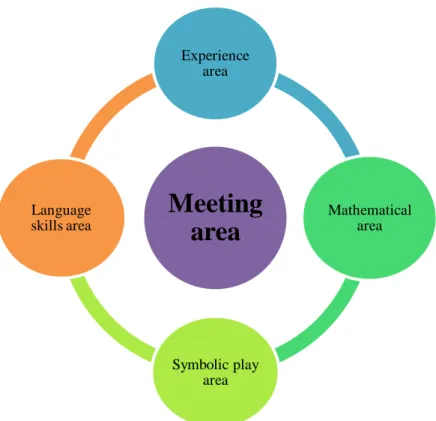
Although T.B.L. and P.W. are the main methodologies, it is necessary to support them with corners; the space should be disposed by different work areas. Montessori (1912) provided this methodological proposal. Thus, these are the main areas that we provide:
Meeting area: This is the backbone of the classroom, because all the corners are
linked through this area. In this place children can share experiences and knowledge.
Experience area: This area confers a significant learning because children can
observe and explore developing the science thinking.
Mathematical area: the logical-mathematical intelligence can be worked in this
corner.
Language skills area: listening & understanding, writing, speaking and reading
24
Symbolic play area: This corner provides different opportunities to children in
order to develop the imagination, the socialization and represent roles from daily life.
Figure 1: classroom corners
Classroom schedule
The teacher has to create a classroom schedule in order to establish routines. When children know the daily routines they can focus on learning instead of guessing what is the following step that they have to develop. Thus, the routines confer an organization to the class connecting the times and the activities. In Early Years, children perceive the world in a global way, for this reason, the schedule has to create connections between facts and contents so that children perceive the life in a global way. Furthermore, with the schedule teacher has to create a positive environment in order to provide a safe atmosphere. Thus, children know what they have to do each moment, so they can feel confident to express in their mother tongue or in a foreign language. As it is said before, the teacher must apply the affective filter hypothesis. Thus, children can increase their self-esteem and feel part of a group. In addition, it is necessary to establish the time for the English lessons and the time for the ones in Spanish. In Frómista School children
Meeting
area
Experience area
Mathematical area
Symbolic play area Language
25 have two English sessions per week, however in this proposal we have added one more because we consider that it could be more positive for them. Apart from Task-Based Learning and Project Work, it is necessary to use corners to organize the class in different spaces which are related to their learning process. According to it, this could be a clear schedule:
The tale
The tale is the most important aspect of this proposal, as it is a key tool. For this reason, the teacher has to select very carefully the tales she wants to work with the children. She has to choose the appropriate tales for the children’s age, for their interests, their capacities, etc. In this Syllabus we provide different topics and tales. We use tales from Sunshine C (Alario, C. et all. (2008)) and other tales which are written by Eric Carle, among other authors. The teacher has to keep in mind that the tale can be dramatized by children in English and the story enables contents which children can work with in science using Spanish. Furthermore, the tale is a resource which in many occasions the teacher has to adapt so that children can achieve the final task. With the “Three little
Monday Tuesday Wednesday Thursday Friday
First routine Meeting area Project
Work
T.B.L (English)
T.B.L. (English)
T.B.L.
(English) Project
Work Project Work
Project Work Project Work
Music Psychomotor
Take the lunch Playtime Relaxation
Religion
Take care of the pet Go to the school library Specialist in
audition and language
Project Work
Project Work
Construction
corner Symbolic corner Library corner Project Work
26 pigs” (Sunshine C) it was necessary an adaptation because the real tale was “The three little friends”. We could keep the three little friends if the main contents are similar.
Families
At the beginning of the course, teacher has to inform to the families about the way to work so that they can understand how their children work in the class. Moreover, the teacher has to show the real need for families’ collaboration so that their children increase their knowledge. Likewise, the relationship between the teacher and the family has to be in this way:
Figure 2: Relationship between the teacher, the families and the environment.
The students are the main objective in this proposal, due to that fact that we want to create independent learners. However, it will be harder if there is not a close relationship between school, families and environment.
Syllabus
This is an annual syllabus for children who are 5 and 6 years old. In this proposal children celebrate Irish festivals as Halloween and Spanish festivals as Constitution Day. While in English children work with Halloween story, in Spanish lessons they can develop a Project Work where they have to investigate the pumpkin and other vegetables.
School
27 In the first term:
First of all we work with “hello” unit because of the beginning of the course. It
is a fantastic moment to establish guidelines as rules, routines, rituals and a classroom management, so in this first unit we don’t use a tale. The type of the text is instructional due to the fact that it is the beginning of the course.
The next unit is “our body”, because if they know the classroom management
they are ready to learn about the nearer topic for them, themselves. Thus, the teacher can work with the first area in Infant Education “Self-knowledge and personal autonomy”. In this unit children can work with the first tale “Our body”. (Alario, C. et all. (2008).
Then they can work with some festivals as Halloween, Constitution Day,
Christmas, Carnival and Easter. In some of these festivals, children can work with a song instead of a tale. The tale “the rainbow fish” is used in the Carnival unit. However, it is necessary to adapt the text of this story due to the difficulty. Thus, in English they can dramatize the tale preparing the disguise which they will use in the representation and in the school festival. Furthermore, in Spanish it was a perfect tale to develop a project where emotions can be worked.
In the second term:
The tale “The very hungry caterpillar” is a fantastic story to introduce in the
class a pet, like caterpillar in order to foster the value of responsibility. Moreover, children can learn the caterpillar life. In English they can work with many contents as the colours, the numbers, and the fruits.
“My town” is a tale which children can know their city and different
professions.
The three bears is a tale that children usually know and they usually like.
Besides with this tale the teacher can work with the number, the sizes, animals of the forest, etc.
In the third term:
The tale “Deep, deep, under the sea” and “Little cloud” provide different
28 work with some topics like the universe, the weather, etc. depending on children’s interest. With the late “Little cloud” is necessary to adapt the text so that children can dramatize the tale.
In the trip outside the tale can be different depending on the kind of the trip
children will do before holidays, for example, going to the zoo, the tale will be related to this topic and if the trip is a visit to a farm the tale will be related to it.
The last unit is “My achievement” where children can be aware of what they
have known along the academic year.
5 YEAR OLDS
1
stTERM
2
ndTERM
3
rdTERM
Topic: Hello
Task: Remember routines and establish rules.
Text: Instructional
Topic: The caterpillar.
Tale: “The very hungry caterpillar”, by Eric Carle.
Task: Dramatize the tale.
Text: Narrative
Topic: The three little pigs
Tale: “The three little pigs”.
Task: Dramatize the tale of unit & search their research.
Text: Narrative
Topic: Our body
Tale: “Our body” (Sunshine C).
Task: Dramatize the tale of unit & search their
researches.
Text: Narrative
Topic: Carnival
Tale: “The rainbow fish” Task: Prepare the
carnival’s festival.
Text: Narrative
Topic: Deep, deep, under the sea
Tale: “Deep, deep, under the sea”
Task: Dramatize the tale of unit & search theirs researches.
Text: Narrative
Topic: ‘Halloween’
Task: Represent the chant ‘Hocus Pocus’
Text: Narrative
Topic: My town
Tale: “My town”
(Sunshine C).
Task: Dramatize the tale & share their researches.
Text:
Topic: Water day
Tale:“Little cloud” by Eric Carle.
Task: Dramatize the tale
&share their researches
Text: Narrative
Topic: Constitution day
Task: Do a passport
Text: Descriptive
Topic: The three bears
Tale: “The three bears” Task: Dramatize the tale of unit.
Text: Narrative
Topic: Trip-outside (discovering the World).
Tale: Depend on the trip.
Task: Trip
Text: Narrative
Topic: ‘Christmas’
Task: Sing the ‘Christmas carol’
Text: Narrative
Topic: Easter
Task: Build Pascua’s eggs. Text: Narrative
Topic: My achievement
Task: Make a self-assessment
29
6.5. EVALUATION
As evaluation is intimately tied to the rest of the syllabus, we consider that after the implementation it is necessary an evaluation, due to the fact that the term evaluation is synonymous with improvement and refinement. Thus, the main interest is evaluating the learning-teaching process. Likewise, some key questions in evaluation are “what”, “who”, “when” and “how”.
Nunan (1988) says in The Learner-Centred Curriculum that the evaluation can occur at
various levels. We followed a micro-evaluation; “is conducted at the classroom level and involves teachers and learners” (Nunan, 1988, p116). Thus, it will be necessary to think about the implementation in the daily routine. For this reason, the main instrument to evaluate will be the participant observation. In order to think about what teacher has seen in the classroom, she or he will use field diary so as to register the useful information. Besides, the family collaboration in this process is quite necessary, due to the fact that they can provide information about their children in their house.
30
6.6. UNIT: “THE THREE LITTLE PIGS”
With this proposal we propose to use a tale as a key resource in order to combine the Task-Based Learning and Project Work accepting the theoretical foundation afore mentioned. The three little pigs is a traditional tale which children like listening to. In our proposal, we have used “The three little pigs”. Although this book is a folk tale, it’s a proper material to use. In fact, in English children can work with the story because they know the story and the concepts the teacher will work with them. Moreover, in Spanish lessons children can work with the elements of the story.
Through this tale, children will develop two final tasks. In English lessons they will be able to dramatize the tale ‘the three little pigs’. In Spanish lessons they will be able to share their research.
How does the project arise? One morning the puppet of the class tells everybody that she has a new book to show them. Then teacher shows the three little pigs to the children in the meeting area. However, when children are looking at the book, there is something wrong; in the book the three little houses have disappeared. Thus, the dialogue begins and this is how the teacher can begin with the Project Work and the Task-Based Learning.
6.6.1. Expectations
In Early Years works with multiple intelligences, which provides an education focuses on each child individually, wherefore the child’s needs can be attended; each pupil is different from the others, each pupil has different capacities.
31 At the end of this unit all the children must be able to...
Follow the daily routines: hello song, happy or sad and the weather.
Link each gesture with the proper animal.
Keep the pace of the song.
Participate in the lesson.
Acquire a role in the dramatization.
Follow the main structure of the story.
Follow the turn in the representation.
Share the information that they have searched.
Draw what they have learnt.
At the end of this unit most of the children should be able to...
Verbalize the characters of the tale.
Associate the illustrator and gestures in the song
Respond to instructions with non-verbal language.
Point to the flashcard’s animals.
Acquire a role in the dramatization and act taking into account the main
characteristics of the animal.
Make hypothesis and questions about what they want to know.
Draw and write what they have learnt.
At the end of this unit some of the children could be able to...
Associate the illustrator and gestures in the song and sing the song.
Put in order the complete sequence of the story.
Respond in English language to some orders.
Verbalize the complete dialogue of his/her character.
Participate actively in the lessons, for example as a volunteer.
Act like a teacher: order things to his / her classmates.
Help their classmates to develop the activities.
32
6.6.2. Task-Based Learning: Objectives
First of all it is necessary to keep in mind the Spanish Curriculum25 to find what areas,
objectives and contents we want to develop.
This template26 shows the objectives, the outcomes and the main activities that we want
to develop through Task-Based Learning.
Lesson Learning goals
Learning outcomes
Children will be able to… Main activity
1
Recognizing animals and houses which have differences (size and material).
Identify the animals and the houses and describe some of their features.
What‘s missing?
2
Participating in the memory game.
Verbalize the name of the
flashcard. Memory game.
3
Representing the song of the unit.
Use illustrator and nod following rhythm.
Song: ‘The three Little pigs’.
4
Following the sequence of the story
Interact answering and making different gestures.
Storyteller: ‘The
three Little pigs’.
5 Building a pieces house. Blow the pieces’ house. Game: who is it?
6
Sequencing the story of the tale.
Put in order the sequence of the story.
Sequence the story.
7
Creating the puppets of the story.
Paint and glue the puppet. Make the story
puppets.
8
Identifying their
character and their turn in the representation.
Identify their turn in the representation.
Represent the tale ‘the three little
pigs’.
9
Moving in a delimited space.
Acting out a role.
Dramatize a given role in the story
Dramatize the tale ‘the three
little pigs’.
25
Appendix with the objetives of the Real Decerto REAL DECRETO 1630/2006, de 29 de diciembre, por el que se establecen las enseñanzas mínimas del segundo ciclo de Educación infantil.
26
33
6.6.3. Main resources:
These are the main resources which the teacher can use in their Task-Based Learning lessons:
Display.
Flashcards: little pig, medium pig, big pig, wolf, straw house, wood house and
brick house.
Magic bag; Cloth;
Song: The three little pigs.
Tale: ‘the three little pigs’
Paper; Images of the story; Scissors; Glue;
Little theatre. Puppets (little pig, medium pig, big pig and wolf).
6.6.4. Project Work
In the Spanish lessons when the teacher uses Project work, it is necessary to take into account that the previous structure which is flexible; it is a way to organize teacher’s work. (See page 12). However, using the tale, “the three little pigs”, we can consider how to work and what contents to develop with children. For this reason, then we introduce the three phases to develop the project work.
34
Phase 1: This is the first phase where the Project Work arises and therefore it begins. In this part, the teacher has an important role, because she provides the material, a tale, so that the Project arises. Previously, the teacher has chosen the tale “Three little pigs” to choose possible topics and contents in order for children to learn. In the meeting area teacher prepares an activity to detect children‘s knowledge. Thus, the teacher asks: What do students know? What do students want to know?
Topic: The pet of
the class show the book “The three little pigs”,
where are the houses?
Initiated by the teacher
The three little pigs: three materials.
Emerging from child interest OR
NO
If the topic it is not interesting for children, teacher has to introduce a
new one.
YES
Possible Contents through the tale:
Materials property: straw, wood and bricks.
Origin and use of these materials.
1º Activity to detect knowledge:
What do students know? What do students want to
know?
35
Phase 2: When the children know what they want to know the investigation begins. In this phase, children have an active role, due to the fact that they have to investigate what they want to know. Nevertheless, families have an important role in children’s learning too, because they have to search the information with their children. Furthermore, when the teacher knows what children don’t know and they want to know, she has to be a researcher too. Besides, the teacher has to talk to the families about the new Project Work in order to suggest their collaboration. For this reason the teacher has to know the parents ‘job to suggest a visit in the class to the families, though the teacher has to prepare activities. When children have the information then they share what they have found out. Thus, the observation, the experimentation, the hypothesis and more begin.
Reexamine anticipatory concepts and skills: Teacher has to add new possible contents which children want to know.
Prepare expert visitors: Talk to the families so as to participate in the project. In this case, there is a father who is farmer and another who works
as mason.
P
Investigate
Children have to investigate at home with their families about what they want to know.
P
Share information:
When they have the information, they share what they have searched. Besides, they create a specific corner with all materials for the project.
Explore with materials: Teacher prepares different activities to achieve the questions that they have. Some activities:
Explore with the materials.
Make the project dossier to write all they have learnt.
Make the dictionary of the project.
Make “adobe”.
Different experiments relate to three materials to know their properties better.
Represent what was learnt through writing, drawing…they work with writing skill.
36 In this phase, children can develop science experiments, due to the fact that in the first course of Primary Education they will have this subject. They will do some experiments related to the flotation, the resistance, the weight and the measure.
Phase 3: This is the final part of the Project Work. When children have thought about the hypothesis, when they have observed, experienced, investigated and noted down the results, they are prepared to develop the final task: share their research. With this activity they put into practice the Living together program, due to the fact that they can invite another class to show what they have known. To complete the Project Work, the teacher has to apply activities so as to assess to the children and other in which children can assess themselves in order to be aware of what they have learnt with this Project. Moreover the teacher will ask the families about the children’s implication in the work. Finally the teacher will put all the activity cards which children have done in a dossier so that children can have all the information in this place.
Final task: share the story of the projects. They will invite the other group and they will do a representation to share what they know. It
is necessary to dedicate some lessons to test what children want to say.
Review the project and assess achievement of goals:
Teacher assess what they know using the observation like main tool to assess. Nevertheless, teacher has prepared activities to
assess children.
In this part, teacher can ask the families about the work that children have developed in the
home.
P
Key
Child activity Teacher Activity
37
6.6.5. Assessment criteria
Finally, this is the assessment criteria; in which teacher assess the English and Spanish lessons. Some items are worked in both languages. Nevertheless, there are others which are specific to each language.
Assessment criteria
All the children must be able to...
Link the gesture with the proper character. Participate in the lessons
Acquire a role in the dramatization.
Name the flashcards presented in the forest display. Accept rules and assume turns in the game.
Use their body making gestures to represent the song. Listen their classmates and respect turns
Represent what they learn Follow the rules of the game. Manipulate the three materials Most of the children
should be able to...
Use their body making gestures to represent the song. Answer the questions about the story.
Follow the rules of the game. Sequence the images of the story. Follow the steps to create the puppet. Follow the story and act out in their turn. Act out a character.
Share the knowledge that they have learnt. Some of the children
could be able to...
Make hypothesis about they want to investigate. Answer the question of the story using English verbal language.
38
7. FINAL CONSIDERATION
7.1. RESULT ANALYSIS
First of all, this is a proposal so we don’t know the real effect in a classroom because it has not been implemented yet. Although planning this process enables a process tracing what it is necessary to detect possible improvements or changes. When the teacher develops this proposal it is important to analyze strengths and bounds. Thus, know the context where the teacher works.
What opportunities can this way to work offer? Use Task-Based Learning provides the opportunity to organize the way to work so that children can achieve a final task. Use Project work enables children to develop abilities to investigate, explore, and use a scientific thinking. These methodologies allow the teacher to create a global approach. Furthermore, infant literature offers many resources to make other proposals. There are many other books through which the teacher can build the annual syllabus.
What kind of limitations does this proposal have? Mainly, the main limitation is the coordinated work between teachers, between the Infant teacher and the English specialist teacher. Thus, it is necessary to encourage these professionals to work together. For this reason, the new Infant teacher role (Infant teacher specialized in English) has an advantage, because she can coordinate the proposal in order to design an integrated curriculum between both languages.
39
7.2. CONCLUSIONS
The Project that I have created is supported in the need to use a tale as the key to begin. There are many books which can be selected to work with. However, it is important to know the group of children to detect their needs and interests. Nevertheless, with this project I propose the combination between two methodologies; Task based Learning and Project work. Through these methodologies we can create an integrated curriculum where all the areas can be developed. Furthermore, it is interesting to say that this way of working allows the teacher to develop Art & Crafts and Science which children will work in Primary Education. Thus, we try to create a relationship between Early Years and Primary Education.
Likewise, an infant teacher says that “practice is the theory in action and the theory is
the element which we can understand better and analyze our practice27” (My translation)
(Domínguez Chillón, 2004, p 15). We keep in mind the theory but the family implication it a key element. For this reason, it is necessary that the family support the school so that children can develop in an integral way.
To sum up, I want to highlight the importance about the new professional role of infant teacher, who is also a specialist English teacher. This innovative figure can change the perspective to work with a global approach in Infant Education integrating an intercultural and pluricultural education. Thus, the teacher has to be aware of two
aspects: the investigation as main tool in order to improve her educational practice and
the illusion to develop the hard tasks of a teacher.
27
40
8. REFERENCES
Books:
Bruner, J. (1972). The relevance of education. London.: Allen and Unwin.
Díez Navarro, C. (1999). Un diario de clase no del todo pedagógico. Trabajo por
proyectos y vida cotidiana en la escuela infantil. Madrid: Ediciones de la Torre.
Domínguez Chillón, G. (2004). Proyectos de trabajo. Una escuela diferente. Madrid:
La Muralla.
Fernández, S.(coord.) (2001). Tareas y proyectos en clase. Madrid: Edinumen.
García, J. E. y García, F.F. (1989). Aprender investigando. Una propuesta
metodológica basada en la investigación. Sevilla: Diada.
Harris Helm, J. & Katz Gonshaw, L.(2011) Young investigators. The project approach
in the early years. United Stated of America: Teacher College, Columbia University.
Henry, J. (1994). Teaching through projects. Open and Flexible Learning. London:
Routledge.
Hervás Hernández, G. (1998). La comunicación verbal y no verbal. Madrid: Playor.
Lebrero Baena, M. P. y otros. (1998). Unidades didácticas. Especialización del
profesorado en Educación Infantil (0-6 años)-MÓDULO III-1. Madrid: UNED.
Nunan, D. (1988). The learner-centred curriculum. Glasgow: Cambridge University
Press.
Stephen D. Krashen (1987) Principles and practice in second language acquisition.
London: Prentice-Hall International.
Vygotsky, L. S (1979). El desarrollo de los procesos psicológicos superiores.
41
Williams, L. R. & De Gaetano, Y. (1985). ALERTA. A multicultural, bilingual
approach to teaching Young children. United States of America: Addison-Wesley.
Dictionaries:
RAE (2001). Diccionario de la Real Academia Española. Madrid: RAE. http://www.rae.es/rae.html (Consulted: June 10th 2013).
Cambridge International Dictionary of English (1995). Cambridge International
Dictionary of English. Cambridge: Cambridge University Press.
http://dictionary.cambridge.org/ (Consulted: June 10th 2013).
Journal:
Littlewood, W. (2004). The task-based approach: some questions and suggestions. ELT
Journal, 58(4), 320.
Articles:
Willis, J. (1998) Task-based learning. English teaching professional, 3 – 6.
Official documents
Decreto 1630/2006, de 29 de diciembre, por el que se establecen las enseñanzas mínimas del segundo ciclo de Educación infantil (B.O.E. número 4 de 4 de enero de 2007).
Ley Orgánica 2/2006, de 3 de mayo, de Educación (B.O.E. número 106 de 4 de mayo de 2006).
Resources:
Alario, C. et all. (2008). Sunshine C. Madrid: Pearson Education.
Carle, E. (1998) Little Cloud. London:Puffin books.
Carle, E. (1994). The very hungry Caterpillar. London: Hamish Hamilton.