FACULTAD de FILOSOFÍA Y LETRAS
DEPARTAMENTO de FILOLOGÍA INGLESA
Grado en Estudios Ingleses
TRABAJO DE FIN DE GRADO
The Production and Perception of the Epenthetic Vowel in
Stop and Continuant Clusters in English: An Analysis of
Vowel-Insertion Among English L2 Speakers
.
Celia del Campo López
Tutor: Enrique Cámara-Arenas
ABSTRACT
This study investigates the production and perception of epenthetic stops in Spanish
speakers’ acquisition of English (L2). Our main goal is to study the process by which a vowel epenthesis arises in the pronunciation of Spanish speakers, breaking English CV constructions. We will focus on vowel sound additions in different words containing the initial <s>C cluster (X position). Starting from the assumption that epenthetic vowels are a production-based repair process or language “domestication”, we carried out several experiments to characterize a specific type of epenthesis that we will refer to as intrusive vowel epenthesis. Finally, we will further investigate through data collection and analysis if there are any contextual conditions (cognitive or articulatory constraints) which promote the epenthesis incorporation.
Key words: articulatory, cluster, cognitive, epenthesis, intrusive, vowel.
Este trabajo de fin de grado consiste en un análisis de la producción y la percepción de los golpes epentéticos en la adquisición del inglés (L2) por parte de hablantes de español. Nuestro objetivo principal es estudiar el proceso mediante el cual aparece una epéntesis vocálica en la pronunciación de los españoles, rompiendo las construcciones consonánticas del inglés. Nos centraremos en los momentos de adición de una vocal ante la constricción o
‘cluster’ <s>C (posición X). Asumiendo que las vocales epentéticas son un proceso de
reparación o una “domesticación” del lenguaje, llevaremos a cabo varios experimentos para caracterizar un tipo de epéntesis específica que denominaremos epéntesis vocálica intrusiva. Finalmente, investigaremos más a fondo a través de la recogida de datos y del análisis si existe alguna condición contextual (cognitiva o articulatoria) que favorezca la incorporación de la epéntesis.
TABLE OF CONTENTS
1) Introduction………1
2) Objectives………...7
3) Methodology………...8
3.1) Participants………...9
3.2) Procedure……….11
3.3) Linguistic analysis……….………..12
3.4) Acoustic analysis……….13
4) Results and method of analysis………..……….17
4.1) Linguistic results………..17
4.2) Acoustic results………...….20
5) Discussion………...22
6) Conclusion……….………….27
Bibliography………28
1
1. Introduction
Epenthesis is a commonly described process in many languages and it is indeed a term widely used in phonetics and phonology. According to Crowley (1997), while lenition (‘butter’ pronounced as /'bʌrər/) and other types of sound loss —aphaeresis, apocope, syncope, cluster reduction, and haplology— tend to be usual sound changes in other languages, in Romance languages sounds are mostly added rather than dropped. He claims that the addition of an extra sound in languages like English seems to occur as “a way of
emphasising what we are saying by sharply cutting off the flow of air, perhaps symbolising the fact that the speaker's intention is absolutely final” (p. 6). Sound addition can occur in any stressed syllable and it can take place at the beginning, middle or at the end of words (initial, underlying or coda position). Nevertheless, this addition has a different purpose in Romance languages, since most of them tend to have a syllabic structure (CV or VCV) which does not allow consonant clusters.
Firstly, we find two main processes concerning the addition of an extra sound in phonetics. On the one hand, we have excrescence —or consonant epenthesis (some authors talk about consonantal and vocalic epenthesis, but we will just stick to the easier terms). It describes the process by which a consonant is added between two other consonants in a word, especially at the middle of it. On the other hand, the term anaptyxis —or vowel epenthesis—
2
English language) and the type of epenthetic stops we are targeting are the ones unpermitted by English rules. They are considered a mistake, as they are used as a tool to repair or break a consonant structure, and this stop epenthesis is not an avoidable phonetic effect for Spanish people who start learning English. Indeed, the kind of approach we are pointing out is like the one Farwaneh (2009) describes in her Arabic language study. She claims that this type of preference for the application of several phonological changes has one main goal: to avoid consonant clusters.
In response to this constraint, a rule may delete a consonant […] epenthesize a vowel […] or block the addition of a consonant […]. Thus, heterogeneous phonological changes like epenthesis […] conspire to achieve a
homogeneous target, the ban of triconsonantal or biconsonantal clusters. (p. 84)
3
San Segundo broadens her study and, following Selinker’s (qtd. in San Segundo
2012) theories, she discusses a concept named “interlanguage”. This is formed by three
different competences: (1) the student’s mother tongue; (2) the student’s interlanguage,
which shows his capacities in the L2; and (3) the second language’s system (p. 244).
Interlanguage is shaped by L1-transferring, previous learning stages and an overgeneralization of L2 language patterns, which implies that there is a dominant psychological framework in the human brain which activates when speakers try to learn a second or third language. Since L2 speakers often cannot perceive phonological differences, (for example, Spanish speakers cannot discriminate between English /a:/ [car] and /æ/ [cat]) they have a tendency to map new sounds onto their mother tongue’s phonetic system,
provoking that L2 sound to be “domesticated”.Although the word language “domestication”
is usually employed in translation strategies, we will employ this term throughout our research paper to refer to L1 transferring processes. Considering that the term interlanguage is used to describe structural representations, it has a close relationship with the epenthesis itself. For instance, if we have the word ‘stake’, English speakers will know that it contains one syllable. However, a Spanish speaker would use a rule of his native tongue —all words start with a CV or VCV structure (see Farwaneh 2009)— beforehand and would transfer it to the English word so that he conceives it as containing two syllables. In other words, the speaker would conceive stake (/steɪk/) as /es-teɪk/ or /əs-teɪk/ (depending on the level of
“domestication”), inserting any of the previous combinations and producing a foreign accent or utterance.
This demonstrates that acquiring the sound patterns of a new language is difficult because speakers perceive speech in terms of the phonological processes or phonetic rules of
their mother language. Donnegan (2002) argues in her natural phonology study that “the
uniqueness of each language’s natural phonology lies in […] the set of processes that it allows
4
because, as Jilka (2014) explains, once a sound category exists in memory, “it functions like a magnet for other sounds” (p. 7). This is the reason why Spanish speakers, who do not have the <s>C structure on their mind, tend to hear and pronounce initial clusters as if they contained an epenthetic sound before them. Their neural commitment to a learned structure interferes with the processing of information and makes them produce a foreign accent. Only young learners or experienced learners (like English Studies ones) can slightly modify their sound map. When facing a CV structure, Spanish speakers can produce full vowels (like [ɛ] and [ə]) or what we have termed as ‘glottalic attack’. Although the glottalic theory comes from Proto-Indo-European language evolution and it is related with consonants, our definition of glottalic attack has nothing to do with that. A glottalic attack is what we define as a small air burst in front of the cluster articulated with a glottalic airstream mechanism (see Jilka 2015).
5
Figure 1: A small diagram showing the relationship between ‘foreign language’, ‘mother tongue’, and ‘foreign accent’ according to Jilka. The speaker tries to learn a new foreign accent (L2) and he ends up transferring
phonological representations from his mother tongue (L1). Thus, the foreign accent would be placed outside the L1 area, but would not be a proper L2 articulation yet as the picture shows.
We believe that both phonological and phonetic foreign accents are related to our research question as it seems that these two categories often make a distinction between unexperienced and experienced learners of a language. The fundamental difference between the first and second language is that they have a different starting point. Indeed, the L1 has a solid foundation in the mother tongue. Apart from the clusters themselves, some linguists have created a catalogue of potential difficulties for L2 learners on different phonetic and phonological levels. They include terms like syllable structure, stress, duration, intonation, pitch, rhythm, and speech rate. Syllable structure and stress are two of the major problems Spanish speakers face when learning English, as the former presents problems with the cluster component and the latter transfers word stress from the L1 to the L2. Additionally, age plays an important role in language acquisition, as a young brain is still capable of adapting structures to the requirements of a specific language. Beside age, many other factors also influence L2 performance (aptitude, instruction, psychological traits, motivation, acculturation, etc.), thus the effect of age is difficult to isolate. Nevertheless, language acquisition difficulties are not only cognitive. Barnitz (qtd. in Nishimura 2012) states that
6
phonetics. It could be due to carelessness or the inability to control the articulators in the
movements”. (p.12) In other words, articulatory mistakes are as important as cognitive ones when perceiving distinct sounds and categorizing them in meaningful ways.
Unlike other studies which move towards English-Spanish contrastive analysis, this paper advocates for studying intrusive epenthetic vowels at the beginning of fricative /s/ clusters through what is known as language “domestication” or transferring. Within this framework, the goal of the present study is to characterize this type of epenthesis and frame it as an intrusive vowel epenthesis that Spanish speakers use to “domesticate” an abnormal
consonant construction in the L2. To explain this language transferring or “domestication”,
several theories mentioned along this area will be used, as they help us to explain how the speakers use this mechanism to normalize the inexistent cluster component in their native tongue and how is this reflected in the different tasks they are asked to fulfil. To do so, we
have styled the epenthesis position with three letters: ‘X’ position (initial cluster), ‘Y’
position (medial to the word) and ‘Z’ position (final cluster). Thus, as previously mentioned,
we will limit our research to X position along our study, focusing on <s>C consonant cluster combinations.
Another research topic of the present investigation is whether there is ample difference between basic, intermediate or advanced (English Studies) Spanish learners of English (L2). Then, the question addressed in this paper will be why is this intrusive epenthesis produced in a language which originally lacks what other linguists call a prosthetic [e] (Cardoso, Guadarrama and Mejía 2012; Crowley 1997; Ladefoged 1971; Nishimura 2011) and if there are any contextual conditions which promote the epenthesis incorporation (more precisely, how do the cognitive or articulatory constraints affect L2 consonant clusters). This will be achieved through careful exploration of the properties of a typical
7
connect the two. Which approach we adopt (articulatory or cognitive) is important in the study of epenthesis in English, but we cannot conclude which approach is more prominent. Nevertheless, we are expecting our participants to have more cognitive constraints in lower English levels than in higher ones and we believe that cognitive constraints are something that late bilingual learners (English Studies students) overcome with time.
2. Objectives
The main objective of this paper is to explore valid and reliable data on the production and perception of intrusive epenthetic vowels by Spanish speakers and characterize this type of production, as it has not been studied thoroughly in the field of the linguistics and acoustic phonetics. Within this broad theme, our research had some specific objectives:
x To understand the impact of the native language (L1) on learning processes and particularly on initial consonant clusters.
x To further investigate the two initial cluster dimensions (continuant and stop clusters) and simply check if the intrusive element is easier for the participants to overcome in any of the “domesticated” cases.
x To determine the error depth among the different participants and conclude whether
the intrusive epenthetic stop is mainly produced due to an articulatory or cognitive difficulty.
x To classify the intrusive epenthetic stop into two main categories: vowel epenthesis or glottalic attack.
x To shed light on a topic that has not been fully explored before and characterize the intrusive epenthetic vowel as a production-repair process prevailing in Spanish learners of English.
8
levels). In other words, since we already know that L1 constraints affect L2 acquisition, we expected basic and some intermediate participants to struggle with cluster constraints and to produce intrusive epenthetic vowels or what we titled as glottalic attacks.
3. Methodology
In this section, we present the procedure followed to achieve the objectives previously mentioned. Informal observations, data recording and theoretical considerations led us to expect that the selected participants would suit our experimental study. All the target items that will be subsequently referred to were studied according to two different perspectives: (1) phonetic perspective, which refers to the study of the characteristics of sounds produced by the speakers of a given language, and (2) phonological perspective, which establishes a distinction among the different sounds of a language (acoustic sound conceptualization).
To get a complete overview of the epenthesis itself, we investigated this process in other languages (like Catalan and Arabic) and even in Modern English to see how epenthesis is studied by several authors among the different linguistic communities. Although we were able to find some studies concerning the epenthetic vowels in English produced by Spanish learners of English, we could not make a direct relationship between our productions and other Spanish speakers’ previous productions. The closer epenthetic analysis that we found - which did not discuss epenthetic vowels in an intrusive initial position, and also focused on epenthesis elision - is a research paper conducted by students at the Faculty of Languages of UAEM in Mexico (Cardoso, Guadarrama and Mejía 2012). It discusses “the epenthesis
phenomenon which appears when Mexican English learners add a vowel phoneme to a consonant cluster” (p. 42). Then, San Segundo (2012) centres her study on the epenthesis produced by Spanish speakers too, but she does not define the epenthesis itself. Indeed, her main goal is to address to the Optimality Theory and other language “domestication”
9
consonants are quite limited and “the most famous phenomenon regarding epenthetic vowels
is the epenthesis which is found in loanwords adopted in Japanese […] Thus, we find examples such as bag /bæg/ pronounced as /baggu/” (14). Nevertheless, none of the papers already mentioned studied or tried to characterize the epenthesis as an intrusive production-repair process.
3.1. Participants
Firstly, all the participants of the study signed a paper in their native tongue (Spanish) in which they gave their consent to participate in a controlled experiment (see appendix). We found it very important for participants to understand that their participation in the experiment was completely voluntary. To ensure that they understood this, they had to sign a consent form, stating the nature of the study. The form itself explained that no personal data (apart from age or gender) would be collected and that these data would only be managed by the student and the tutor themselves. Plus, they were reminded that they were free to abandon the experiment at any time if they wished to.
For the study, every participant was given the same instructions before they undertook the experimental task. Then, each participant was identified with a letter (from A to R). It should be noted, however, that some of the encountered epenthesis were difficult to detect
due to the speaker’s linguistic variations and level of English (as previously commented in
10
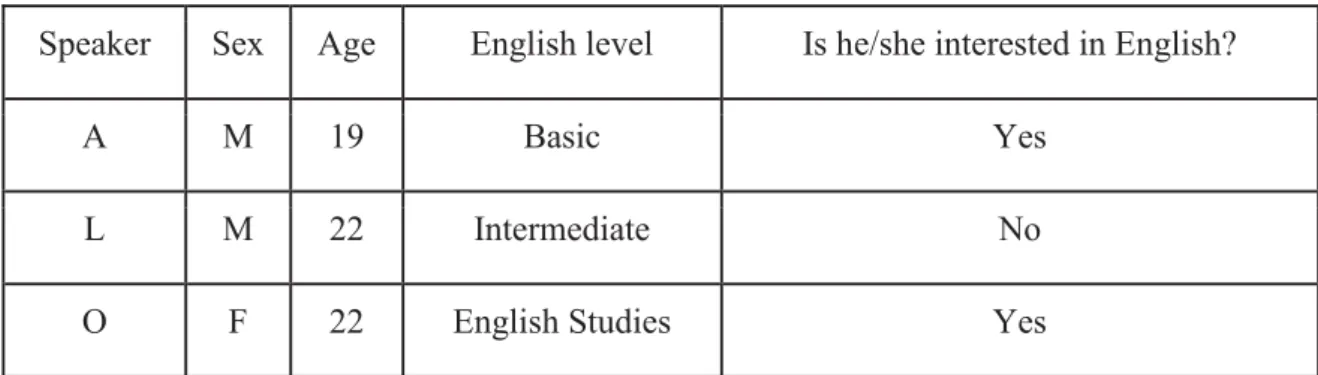
Twenty Spanish speakers participated in this experiment, though they had different levels of English and the number of participants was reduced to eighteen during the development of the study: the participants were divided into basic (A1-A2), intermediate (B1) and advanced level (English Studies students), according to the European Framework of Reference for Languages. All the participants were born in Spain and the groups were formed by 8 women and 10 men with ages ranging from 13 to 34 years old. Most of them used English in school or at work. All basic and intermediate speakers’ lengths of English language experience were relatively similar: for ten years to twelve years approximately. From the above, we can see that most of the speakers are still learners of English, and have spoken and listened to English just in their own country, which means the chances of producing epenthesis or realizing that they produced it are high enough for our study. The difference of the results between these speakers and the speakers who have had experiences in living abroad is not that noticeable, since only 20% of the participants have stayed in a foreign country for more than three months, so it will not be examined in the following chapter. Furthermore, in this part of the study, participants were required to give their gender (male, female, or non-specified), age, level of English, level of pronunciation, and to state why they were interested (or not) in studying English, as both individual differences and motivation play an influential role in second language acquisition. The method we used to classify our participants goes as follows:
Speaker Sex Age English level Is he/she interested in English?
A M 19 Basic Yes
L M 22 Intermediate No
O F 22 English Studies Yes
11
3.2. Materials
The procedure consisted of two separated tasks, so it was a two-part controlled experiment. Both tests used words with <s>C initial clusters and the reason why we chose that cluster combination is because the English writing system contains up to 46 permissible two-item initial consonant clusters. Besides, s<C> clusters are particularly difficult for people who speak Romance languages (see Farwaneh 2009), and we believe that it is especially difficult for Spanish speakers. Once we had our two experiments designed, we attempted to answer our research questions by means of linguistic and acoustic analyses.
3.3. Linguistic analysis
First, with a view to test if there was a correlation between letters and phonemes and if the participants were aware of consonant clusters, a list of 100 words was designed. Inside that list, 40% of the words contained an /sp/ (/spl/, /spr/), /st/ (/str/), /sk/ (/skr/, /skl/), /sr/, /sm/, /sn/, /sl/, or /sw/ consonant cluster (40 out of 100). Using some common English words, we selected the following samples:
x sp: space, speak, spill, sport, spoon
x spl: split
x spr: sprout
x st: star, stay, step, stir, stone
x str: strange
x sk: skate, sketch, skill, skip, skull
x skl: sklant
x skr: skreigh
x sl: slade, sleep, slippers, slope, slug
12
x sn: snake, snail, snap, sneak, snooze
x sw: swatch, sweat, sweater, swirl, swung.
We designed this kind of test because most of the studies concerning epenthetic stops that we previously reviewed do not include linguistic experiments in their procedures. The participants were asked to divide those 100 words into syllables for two main reasons. First, it would permit us to test the participant’s ability and therefore it would allow us to see the differences between basic or intermediate speakers and the English Studies ones. Then, this operation was necessary to prove our research question: if a participant introduces one extra syllable when speaking and he even conceives the word as having an added syllable that means we are encountering a more profound error type in which the participant -who adds an intrusive epenthetic vowel- also possesses or assimilates an incorrect phonological structure.
3.4. Acoustic analysis
Then, as we wanted to prove if the intrusive epenthesis is also produced due to
speakers’ articulatory constraints, we proposed a dissimilar activity. It consisted of two different test models which included s<C> clusters in initial position: part A contained
plosive stop clusters −/sp/, /sph/, /st/, /sk/− whereas part B dealt with continuants −/sv/, /sl/, /sm/, /sn/, and /sw/− following all the word-initial clusters Cruttenden (1994) considers in his
Gimson’s Pronunciation of English:
/sp/: spare /st/: stain /sk/: scarce /sm/: smoke /sn/: snake /sl/: slow /sf/: sphere /sw/: swear /spl/: splice /spr/: spray /spj/: spume /str/: stray /stj/: stew /skr/: scream /skj/: skewer /skw/: square
13
All the epenthetic items were used at the beginning of each sentence, using other indiscriminate sentences to mislead the participants. Fortunately, none of the participants noticed. Here, we show the first five sentences of each model (see appendix):
x Cindy started to cry.
x Spacemen are my heroes.
x You know what I mean.
x What is the temperature now?
x Spheroid culture is used by several researchers.
x Sharon is the youngest in my family.
x Sweets may spoil your teeth.
x The job doesn’t require special skills. x My husband and I live in Edinburgh.
x Slugs live beneath the earth.
For the acoustic analysis we used several programs, just to test the capacities each program had to offer. Firstly, the recording data were registered with a mobile application owned by CIAmedia and then they were digitalized with Audacity, Speech Analyzer and Cool Edit. For now, it is sufficient to say that the human ear is capable of detecting sound waves with a wide range of frequencies, but since some of the intrusive epenthetic stops tended to be unclear and were difficult to identify by ear, we also made use of the different programs to clarify those unsure productions. After being amplified and segmented in Audacity, these results have been studied using a spectrum to detect possible visual cues and to attain the fundamental frequency estimation of each fragment.
14
indicator in the spectrum. On the one hand, we focused on the intrusive vowels produced by the speakers. We distinguished between fully-developed vowels −like [ɛ] and [ə]− and what
we titled as ‘glottalic attacks’ (small air bursts in front of the cluster). Although the schwa is difficult to detect due to its short duration, we have included it in the first division to differentiate it from glottalic attacks, considering that both [ɛ] and [ə] are marked by the presence of formants in the spectrum. Then, since vowels have the gross shape of the waveform pattern, we can detect the emergence of periodic waveforms before the fricative /s/ in the oscillogram. This implies that a vowel epenthesis has been produced. On the other hand, we had to pay attention to the line spectrum:
Figure 2: Speaker K line spectrum in Cool Edit. Mannel (2008) states that “a line spectrum is a spectral representation that displays the frequencies and relative intensities of the component sine waves. Each sine wave is displayed as a single vertical line placed at the appropriate frequency on the x-axis. The height of the line represents the amplitude of the component sine wave”.
15
distinguishing vowels from each other, we are more interested in the frequency curves and formants rather than in the raw spectrum of the wave.
Although each vocal tract shape has a characteristic filter function depending on the individual (see Jilka 2014), we can consider that all vowels produced have periodical waveforms, so we can classify them according to the number of formants they have. Formants are energy crests which are the result of resonances in the vocal tract. They are usually referred to as F1, F2, F3, etc. F1 is influenced by tongue body height, whereas F2 is influenced by tongue body position (front or back). They both determine the quality of each sound and, normally, the values of the frequencies of F1 and F2 are sufficient to distinguish most vowel contrasts. In our case, we will consider two vowels: [e] (F1= >500 Hz; F2= <3000 Hz) and [ə] (F1= 500 Hz; F2 = 1500 Hz) as epenthetic vowels to delimit the scope of our study. We should mention the fact that we found the delimitation of [e] troublesome as its formants seem more variable depending on the vowel’s quality and the person analysing these data. On the other hand, the fricative /s/ was taken to occur from onset to offset appearing above 4000 Hz, since it is an aperiodic sound.
Figure 3: Spectrogram showing the words "bead" "bid" "bade" "bed" "bad." We marked the formants of [e] in red, as this is one of the vowels we are going to study. According to this analysis, [e] is formed by F2 (under 1000 Hz) and F1 (under 3000 Hz) (Gramley, 2008).
16
reflected in the spectrum (see appendix). We must point out the difficulties in detecting glottalic attacks, as they could not be detected by any of the programs. These air bursts can only be appreciated by the human ear, so if the person analysing those data is not able to perceive it, no program will be able to interpret it. Moreover, some of the schwas were also difficult to identify as some of the programs do not detect formants under an established rule. Thus, we alternated between Speech Analyzer and Cool Edit for the sake of obtaining an accurate data gathering. In figure 5 we will find an example of what occurs when testing the
participants. Additionally, we could not use filtering either, because “when we filter a complex sound we permit some frequencies to pass through the filter and we block other frequencies from passing” (Mannel 2008).
17
Figure 4: Speaker A (basic) and speaker O (English Studies) pronouncing the same sentence in Speech
Analyzer: ‘Students in Canada need to work harder’ (ˈstjuːdənts). We notice that speaker A has produced a
schwa because we see some colouring in the spectrogram (F1= 500Hz), although the program has not marked the formants with blue lines. On the contrary, speaker O produces a perfect /s/ with no sound contamination that goes beyond the scope (4000Hz). The blue lines are not marking periodic waves (formants) but regular vocal fold vibrations.
4. Results and method of analysis
4.1 Linguistic results
18
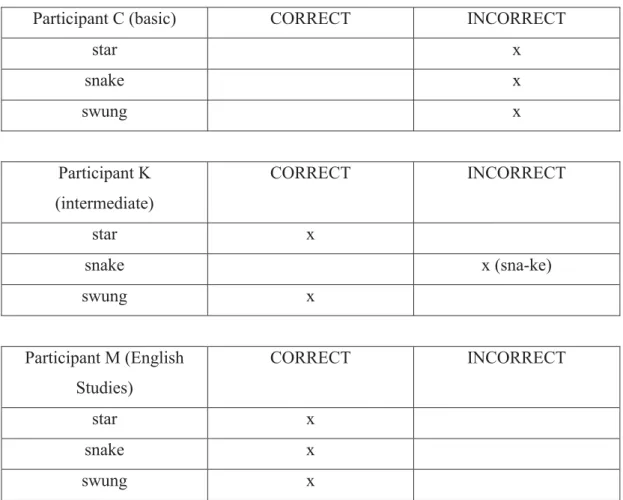
Participant C (basic) CORRECT INCORRECT
star x
snake x
swung x
Participant K (intermediate)
CORRECT INCORRECT
star x
snake x (sna-ke)
swung x
Participant M (English Studies)
CORRECT INCORRECT
star x
snake x
swung x
Table 3: Three tables containing basic, intermediate and English Studies morphological results. Participant K made an incorrect division but noticed the cluster had to go together.
19
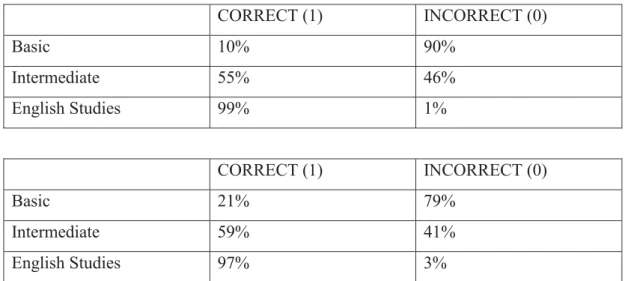
CORRECT (1) INCORRECT (0)
Basic 10% 90%
Intermediate 55% 46%
English Studies 99% 1%
CORRECT (1) INCORRECT (0)
Basic 21% 79%
Intermediate 59% 41%
English Studies 97% 3%
Table 4: Two tables containing hit and error percentages of basic, intermediate, and English Studies participants.
Figure 5: Two bar charts containing stop and continuant consonant clusters results. Blue bars mark the accurate word divisions (hits) whereas orange bars mark wrong word divisions (mistakes). We observed that one intermediate participant had great results (participant G) and that exception should be marked in the analysis.
0 5 10 15 20
STOP CONSONANT CLUSTERS
0 5 10 15 20
20
4.2 Acoustic results
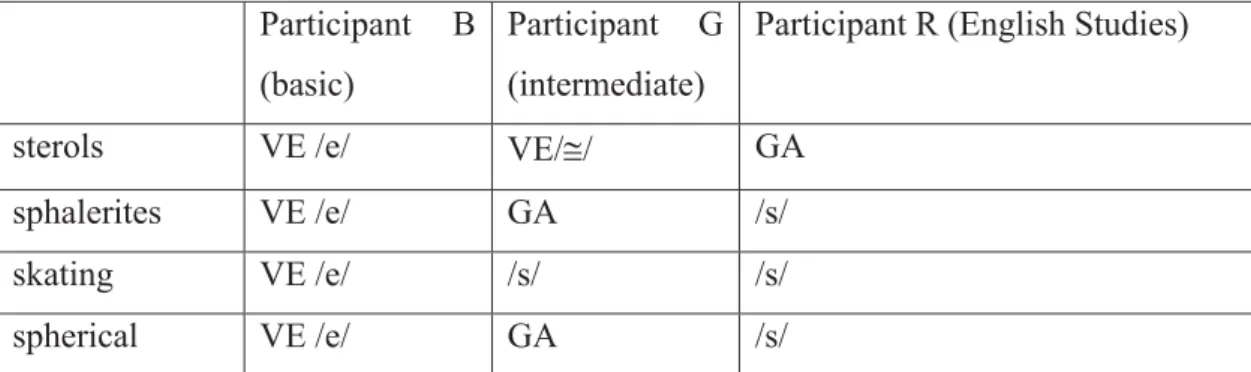
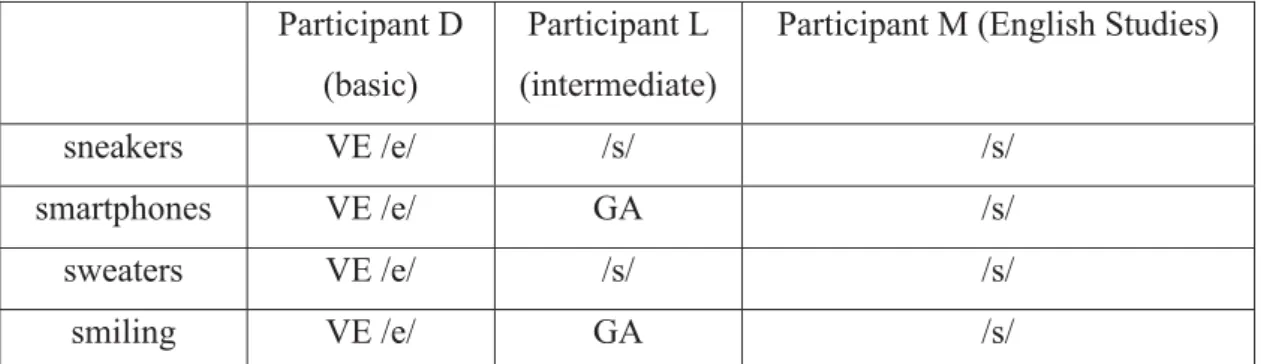
As mentioned before, we carried out two sets of analyses of both the stop productions and the continuant productions. For all the epenthetic sentences containing s<C> initial clusters, we evaluated the proportion of outputs containing epenthetic clusters, which was exactly 33% in each test. This allows us to determine whether they are general patterns or a simple coincidence. Firstly, we recorded the interpreted results using two Excel spreadsheets. In each spreadsheet, we used different indications to express to what extent the participants had committed an epenthetic stop (or not). In pursuance of figuring which acoustic cues are decisive in the perception of epenthetic stops, we calculated the number of times the epenthetic vowels or glottalic attacks were produced using the following terminology: VE /e/ (vocalic epenthesis [Spanish e]), VE/#/ (vocalic epenthesis [English /ə/]), and GA (glottalic attack). For items in which no epenthetic burst was produced, we wrote /s/ (no epenthesis [English fricative /s/]) for the purposes of computing correlations. In tables 5 and 6, we can distinguish the differences between three arbitrary participants:
Participant B (basic)
Participant G (intermediate)
Participant R (English Studies)
sterols VE /e/ VE/#/ GA
sphalerites VE /e/ GA /s/ skating VE /e/ /s/ /s/ spherical VE /e/ GA /s/
Table 5: A sample table showing basic, intermediate, and English Studies participants’ performance when pronouncing s + stop clusters.
21
/s/. English Studies participants obtained 2 /e/, 3 /ə/, 10 GA and 21 /s/. To sum up, focusing on the correct production of the fricative /s/, all the participants had a 34% hit rate.
Participant D (basic)
Participant L (intermediate)
Participant M (English Studies)
sneakers VE /e/ /s/ /s/ smartphones VE /e/ GA /s/ sweaters VE /e/ /s/ /s/
smiling VE /e/ GA /s/
Table 6: A sample table showing basic, intermediate, and English Studies participants’ performance when pronouncing s + continuant clusters.
Then, if we move to the continuant cluster experiment –which contained 45 results−
basic level participants obtained 18 /e/, 7 /ə/, 8 GA and 12 /s/. Intermediate level participants obtained 10 /e/, 1 /ə/, 7 GA and 27 /s/. English Studies participants obtained 0 /e/, 0 /ə/, 8 GA and 37 /s/. Surprisingly, focusing on the correct production of the fricative /s/, all the participants had an 82% hit rate.
34%
66%
82%
18%
H I T R A T E M I S T A K E R A T E
HIT AND MISTAKE RATE
22
Figure 6: Bar chart showing the participants’ complete hit and mistake rate. On the one hand, participants had a 34% hit rate and a 66% mistake rate when encountering stop clusters. On the other hand, they had an 82% hit rate and an 18% mistake rate when encountering continuant clusters.
5. Discussion
One of the major findings of the present investigation is that phonetic differences between stop and continuant clusters hold across Spanish speakers for <s>C clusters. Since the interpretation of the results reported in the paper needed to be verified, we decided to see if there was any difference between stop and continuant clusters by testing the participants. The first test consisted of word division, which managed to clarify if there were any cognitive limitations that led to a missing representation of a phoneme. Then, the second test was
composed by different sentences trying to test the participants’ articulatory limitations. In addition, some of the epenthetic stops produced by native speakers of English were studied to compare our results with previous studies in the field (such as Farwaneh 2009; Nishimura 2011; Recasens 2012; and San Segundo 2014). Since no accurate study concerning the intrusive epenthetic stops produced by Spanish learners of English was found, a comparison between the productions of our Spanish participants and the productions obtained in previous studies on the field could not be made. However, we could use other languages’ epenthetic
productions (underlying epenthesis, for example) as a reference.
Concerning the linguistic test, we listed several words expecting the participants to divide those words into syllables. Indeed, this activity is part of a knowledge base that speakers inherit from their native language, so the L1 is an instrument for organizing the information they learn. For them, breaking up words into sequences of discrete phonemes is just an academic exercise, but for us it is a key element to determinate to which extent they
23
they do not know how to segment them. Nevertheless, they divide the individual occurrences as how they would be divided in their own native tongue. They split the fricative /s/ to compensate the absence of a vowel, adapting that CV combination into a C-CV one (s-nake, s-port, s-leep). Although it is true that intermediate level participants still had a remarkable error rate, most of them noticed the <s>C combination had to be together. Subsequently, we find examples like sna-ke, spor-t or sle-ep, where they maintain the <s>C cluster, and it seems that continuant clusters or glide consonants (like /w/) are easily identifiable combinations for them in behalf of the semivowel. This can also be related to the constraint-based structures formerly mentioned: the participants recognize the English words listed in the exercise and they realize the <s>C cluster cannot be separated. Then, they apply the same rule along the rest of the items.
However, English Studies participants did not follow that premise. Instead of applying Spanish rules to the English words, they already knew basic structures of the target language and they split the items based on their English proficiency level. Indeed, although they just had a 10% error rate, it seems that their mistakes were due to some lack of awareness
(for example, the word “slippers” caused them some trouble when attempting to divide it), so this view goes against the cognitive constraints the first two groups had and move more toward an articulatory difficulty. This means that we required the creation of a different type of test to assess if the epenthesis is just a matter of cognitive constraints or if, as previously proposed, articulatory constraints are involved in the process as well. Furthermore, younger participants had a lower hit rate than adults. Adults gain more experience with abstract reasoning and formal operations (in other words, cognitive operations), so they are aware of the cluster construction and they repeated the same operation throughout the activity. Indeed,
24
capacity to divide words correctly in the target language. Nevertheless, we still need to process the results of the second test, as speakers’ productions may differ in articulatory
coordination in consonant clusters in terms of degrees of gestural overlap (phonological accent).
Moving to the acoustic results, we realized that that speakers’ productions may differ
in <s>C clusters articulatory coordination in terms of degrees of gestural overlap (phonological accent). According to our auditory impressions, we could see a higher hit rate among continuant clusters than stop clusters. Another relevant difference was a higher degree of resistance to pronounce a clear /s/ when encountering an initial <s>C cluster. Most of the participants added at least a glottalic attack to compensate the absence of a vowel. On the one hand, basic level participants tended to pronounce pure vowels (/e/ and /ə/) whereas
English Studies participants had less issues concerning /s/ productions, so the prominence of intrusive epenthetic stops is clearly less frequent in this group. This means that they have already acknowledged L2 patterns since they had almost 100% correct cluster divisions in the first test and more than 80% correct cluster productions. Data from the test revealed that intrusive epenthetic stops are something that advanced learners reduce with time and exposure to English. Concerning intermediate level participants, they were shown to be in a
medial position, mostly adding /ə/ or glottalic attacks. In fact, they have the highest glottalic
attack rates. This is related with Selinker’s interlanguage theory and the tendency to map new
sounds onto the mother tongue’s phonetic system by “domesticating” them (in other words, instead of pronouncing a complete /e/, they added an initial air burst in front of the consonant to compensate the absence of a vowel). Additionally, apart from the intrusive element, we noticed that our data show compensatory lengthening of the /s/ in more advanced levels whenever they added a vowel or a simple air burst in front of the cluster.
25
intrusive epenthetic stop productions before <s>C in clusters by exploring both the phonologic and phonetic areas involved in the presence or absence of the stop realization. Finally, data show that stop insertion may be conditioned by utterance position (in this case, X position) and contextual factors (like the English proficiency level). According to the data gathered from both tests and according to our auditory impression, stop clusters seemed to appear more difficult for all the participants, including English Studies ones. This was successfully perceived in unexperienced levels, showing the impact of the cognitive constraints of the L1.
26
Figure 3: A bar chart showing the type of constraint influence each of the three groups had —cognitive (orange) or articulatory (blue).
6
5
0 0
1
6
0 1 2 3 4 5 6 7
Basic Intermediate English Studies
Type of constraint
27
6. Conclusion
This paper aimed to characterize a kind of epenthetic production we referred to as intrusive epenthetic stop. This utterance is produced by Spanish speakers when encountering <s>C clusters and it is a production-repair process used to solve a CCV structure that they
do not encounter in their mother tongue’s language system. In order to check if there were any contextual conditions (cognitive or articulatory constraints) promoting that intrusive epenthesis incorporation, we decided to explore both the linguistic and acoustic dimensions of language. In addition, other epenthetic stops produced by native speakers of English were studied to compare them with our former study. Since no accurate study concerning the epenthesis in X position produced by Spanish speakers was found, the comparison between our study and previous studies on the field was not possible. However, the comparison between Spanish speakers and other native speakers of Catalan, Arabic o Japanese could be made. The results of this study are summarized as follows. (1) We realized that the results of the L2 Spanish speakers’ productionsaccord with Selinker’s interlanguage theory and other
28
BIBLIOGRAPHY
Arenas, E. C. (2012). Curso de pronunciación de la lengua inglesa para hispano-hablantes:
a native cardinality method. Valladolid: Universidad de Valladolid.
Cardoso, J., Guadarrama, L., & Mejía, E. (2012, August). ELISIÓN DE LA EPÉNTESIS EN
DIFERENTES NIVELES DE INGLÉS EN LA FACULTAD DE LENGUAS DE LA UAEM.
[PDF]. Mexico: Lengua y voz.
Crowley, T. (1997). An Introduction to Historical Linguistics [PDF]. Oxford: Oxford
University Press.
Cruttenden, A., & Gimson, A. C. (1994). Gimson’s pronunciation of English / revised by
Alan Cruttenden (5th ed.). London: E. Arnold.
Crystal, D. (2011). A dictionary of linguistics and phonetics. Malden, Mass.: Blackwell.
Donnegan, P. (2002). Phonological Processes and Phonetic Rules [PDF]. Mānoa,
Honolulu: University of Hawaii.
Farwaneh, S. (2009). Toward a Typology of Arabic Dialects: The Role of Final Consonantality (A. Metcalfe, Ed.). Journal of Arabic and Islamic Studies, 9, 82-109.
Free English Dictionary, Translations and Thesaurus. (2017, June 4). Cambridge
Dictionary.
Gramley, V. (2010, May). Acoustic phonetics. Retrieved June 20, 2017.
29
Jilka, M. (n.d.). What is foreign accent? Augsburg: Philologisch-Historische Fakultät. (2014)
Jones, D., & Gimson, A. C. (1988). Everymans English pronouncing dictionary (14th ed.).
Dent, London: Everyman Reference.
Ladefoged, P. (1971). Elements of acoustic phonetics. Chicago: Univ. of Chicago Press.
Ladefoged, P. (1969). Three areas of experimental phonetics: stress and respiratory activity,
the nature of vowel quality, units in the perception and production of speech (2nd ed.).
London: Oxford U. Press
Nishimura, R. (2011, January 6). Stop Epenthesis in Nasal-Fricative Clusters Produced by
Japanese Learners of English: Focusing on ns-clusters and ms-clusters [PDF]. Tokyo.
Recasens, D. (2012). The phonetic implementation of underlying and epenthetic stops in
word final clusters in Valencian Catalan [PDF]. Barcelona: Universitat Autonoma de Barcelona & Institut d’Estudis Catalans.
San Segundo Fernández, Eugenia. Estudio de la epéntesis en el aprendizaje de ataques
silábicos complejos en inglés por hablantes de español: aproximación al marco de la Teoría
de la Optimidad. N.p.: Verba, 2014. PDF.
Solé, J., Sabater, M., Speeter, P., & Ohala, M. (2007). Experimental approaches to
phonology[PDF]. Oxford: Oxford University Press.
SPEECH ACOUSTICS: Department of linguistics [Web]. (2008). Macquarie University.
Warner, N., & Weber, A. (2001). Perception of epenthetic stops [PDF]. Journal of
30
APPENDIX
31
Appendix II: Table containing all the sentences in the acoustic analysis:
1. Cindy started to cry. 2. Spacemen are my heroes 3. You know what I mean 4. What is the temperature now? 5. Spheroid culture is used by several
researchers.
6. I was reading in the terrace when I saw him
7. Superman’s new film is incredible.
8. Sponges are the oldest living animals.
9. They can’t dance at all.
10.Do they live in Washington? 11.Stay here and wait.
12.I don’t drink coffee.
13.There is good sunlight outside. 14.Students in Canada need to work
harder.
15.The surprise party was organized by aunt Sue.
16.She really needs you.
17.Spencer lives in Trafalgar Square. 18.Josh goes to Dublin every
summer.
19.Tomatoes have more vitamin C than oranges.
20.Sketching is the key of art success.
1. Sharon is the youngest in my family.
2. Sweets may spoil your teeth. 3. The job doesn’t require special
skills.
4. My husband and I live in Edinburgh.
5. Slugs live beneath the earth. 6. The dancers were wearing
colourful costumes.
7. Nina’s brother is a secret agent. 8. Sranan is the language that my
family speaks.
9. You should take an umbrella. 10.I saw a girl with blue eyes.
11.Slades are sold during Christmas season.
12.I warned you about it. 13.Carol is allergic to sea food. 14.Swords are kept in the Peter
Johnson’s Museum.
15.She has wrinkles in her forehead. 16.Is your cousin studying in New
York?
17.Snails are considered delicious in French cuisine.
32
21.I’ve already collected over 100
stamps.
22.I was laughing at him.
23.Skull patterns are his favourites. 24.Sandra became a great singer three
years ago.
25.The man was angry at her.
26.Sterols are a type of organic molecules.
27.Can I eat pizza?
28.I think Cindy should take a holiday.
29.Sphalerites contain zinc sulphide and variable iron.
30.I am studying for the Chinese test. 31.You must pay your taxes.
32.Skating is for all ages. 33.We have a lot in common. 34.Did you see anything suspicious? 35.Spherical toys are John’s
favourites.
36.He makes his dad proud of him
19.Frank really likes camping. 20.Sneakers are the new fashion
trend.
21.Teachers expect good behaviour from their students.
22.Does Robin have a dog?
23.Smartphones are stealing our time. 24.Eating salty food makes me
thirsty.
25.The museum guide arrived 20 minutes late.
26.Sweaters are Lilith’s favourite
piece of clothing.
27.Can you tie your long hair? 28.Samantha loves watching horror
films.
29.Smiling is a key element in job interviews.
30.I always eat too much at the weekends.
31.They play cricket very well. 32.Smells are sent to the brain. 33.My best friends weren’t with me
yesterday.
34.Dave often dreams about winning the lottery.
33
36.Some animals use colour for disguise.
37.How old is the woman sitting next to you?
38.Sleeping less than 5 hours increases death risk.
39.The book is about a haunted house. 40.Patrick is always very calm. 41.Sri Lanka is the place where they
got married.
42.The twins became ill at the same time.
43.You have to drink more water. 44.Sravana is the fifth month of the
Hindi calendar.
34


![Figure 3: Spectrogram showing the words "bead" "bid" "bade" "bed" "bad." We marked the formants of [e] in red, as this is one of the vowels we are going to study](https://thumb-us.123doks.com/thumbv2/123dok_es/5828476.748855/20.892.137.749.681.879/figure-spectrogram-showing-words-marked-formants-vowels-going.webp)