FACULTAD de FILOSOFÍA Y LETRAS
DEPARTAMENTO de FILOLOGÍA INGLESA
Grado en Estudios Ingleses
TRABAJO DE FIN DE GRADO
The Fictionalization of the Middle Ages in
The Pillars of
the Earth
Vanesa Méndez Gómez
Tutor: Marta Gutiérrez Rodríguez
ABSTRACT
The Fictionalization of the Middle Ages in The Pillars of the Earth deals with a comparison between what historians said about the Middle Ages society, and what is depicted by Ken Follett in his novel The Pillars of the Earth. This novel presents in great detail the image of the Middle Ages society, and it contains also a perfect depiction of the Gothic cathedral and how it was built. I am going to focus in some specific aspects of the medieval society, as for instance, the social stratification, the women, the church, and the way of life in terms of trade and housing. This project expects to show if an author of historical novels, in this case Ken Follett, sustains his novels in a truthful information with the help of historians to make the novel more reliable.
Keywords: Middle Ages, medieval society, historical novel, The Pillars of the Earth, Gothic cathedral, and fictionalization.
RESUMEN
The Fictionalization of the Middle Ages in The Pillars of the Earth es el nombre de mi proyecto de fin de grado. Se trata de una comparación entre lo que cuentan los historiadores sobre la Edad Media y lo que Ken Follett refleja en su novela Los Pilares de la Tierra. Esta novela presenta la imagen de la sociedad de la Edad Media al detalle, y ofrece también una perfecta descripción de la catedral gótica y su construcción. Me voy a centrar en ciertos aspectos específicos de la sociedad medieval como por ejemplo la estructura de la sociedad en clases, la mujer, la iglesia, y el modo de vida relacionado con el comercio y el ámbito doméstico. Este proyecto pretende mostrar si un autor de novelas históricas, en este caso Ken Follett, basa sus novelas en hechos reales con la ayuda de la información aportada por los historiadores para hacer su novela más real.
CONTENTS
INTRODUCTION ... 1
1. THE MIDDLE AGES ... 3
1.1.CHURCH ... 3
1.1.1. GOTHIC CATHEDRAL ... 3
1.1.2. RELIGIOUS LIFE ... 4
1.2.SOCIAL STRATIFICATION ... 5
1.3.WOMEN... 7
1.4.WAY OF LIFE ... 8
2. KEN FOLLETT AND THE PILLARS OF THE EARTH ... 11
2.1.CHURCH ... 12
2.1.1. GOTHIC CATHEDRAL ... 12
2.1.2. RELIGIOUS LIFE ... 16
2.2.SOCIAL STRATIFICATION ... 16
2.3.WOMEN... 18
2.4.WAY OF LIFE ... 19
3. ANALYSIS ... 21
3.1.CHURCH ... 21
3.1.1. GOTHIC CATHEDRAL ... 21
3.1.2. RELIGIOUS LIFE ... 21
3.2.SOCIAL STRATIFICATION ... 22
3.3.WOMEN... 25
3.4.WAY OF LIFE ... 26
4. CONCLUSION ... 29
INTRODUCTION
The Fictionalization of the Middle Ages in The Pillars of the Earth is a dissertation that deals with a comparison between the society in the Middle Ages as presented by historians (the church, people, political leaders, etc.) and the image the novel The Pillars of the Earth
by Ken Follett shows about these aspects of the medieval life. The main objective of this project is to discover if the novelists, in this case Ken Follett, followed the image the historians introduce about the Middle Ages society or instead they used their own imagination to depict the situation in the Middle Ages.
One of the reasons of the choice of the topic of my dissertation The fictionalization of the Middle Ages in The Pillars of the Earth is a self-interest about Gothic cathedrals and historic novels, and how writers followed or not the image historians showed about this period of time, the Middle Ages. This novel presents very well the image of the society and individuality of people in the Middle Ages, and it also includes a great depiction of the Gothic cathedral and how it was developed.
1. THE MIDDLE AGES
The Middle Ages in Britain began in 1066 with the Normal Conquest, and it ended in 1485 with the War of the Roses. In this section of my dissertation, I am going to describe what historians said about different aspects of the Middle Ages as, for instance, the church, the social stratification of people, women, and the way of life.
1.1.CHURCH
1.1.1. GOTHIC CATHEDRAL
The cathedrals were the most important monuments in the cities at the beginning of the Middle Ages. They were the most representative symbol and they will change adapting to the life conditions the society imposed, as for instance population growth or an economic recession. The cities grew and people of the cities were constantly at war, the fact of having a great cathedral provided a great importance for the cities, and people of these cities were able to defend better their properties because around the cathedrals, people began to build great walls to defend their cities better. This historical period was also recognized because it represented the change from the Romanesque cathedrals to the Gothic ones as Juan Manuel Martín García pointed out in his work (Martín García 2012: 720-721). He also adds that the Gothic cathedral was like a mirror in which the world is reflected. This world wanted to symbolize in the cathedral all the aspects that conformed its particular vision of the reality (Martín García 2012: 720). The concept of God also changed, it grew and people started to emphasize its image. They used the cathedral as an instrument to extol the figure of God; so we could find stained glass windows with biblical images and bigger buildings where the light was the protagonist.
the symbolic representation of God. Related to the art itself, we have to highlight the changes the Gothic cathedral introduced both inside and outside. About the year 1200, the Gothic architecture began to gain importance. Gothic buildings could be identified by the changes they introduced like the usage of pointed arches instead of semicircular arches, the cross vaults that provide slenderness and clarity, the doorways, and the arcades. The Gothic cathedrals had three different heights. Firstly we found the arcade, then there was a gallery, and lastly we could see the triforium or clerestory that achieved this name because of its windows with three spaces. These cathedrals were mostly big buildings with a central nave and two or four aisle naves; the central nave should be twice as wide and as high as the aisles, and they were connected by some arcades that were separated by columns. This fact differs from the Romanesque style in the width and roughness of the columns, bigger in the Romanesque period (Martín García 2012: 728).
1.1.2. RELIGIOUS LIFE
Talking about people, medieval men and women were born as members of the church just because of birth, they had no decision of denominations and they could not have the opportunity to choose the place where they wanted to attend services. Parishes were established in a geographical area, and people were expected to praise their parish church unless they were on a trip. Normally, kings were the ones who designated bishops and not popes as the majority of people thought (Lehmberg 2002: 128-132).
In the Middle Ages the church was not only destined to religious events; it was also related to the everyday life of ordinary people because of the liturgies that had connection to the farming activity because they followed an annual cycle. Gothic cathedrals had a great range of interest; some members of the gentry wanted to mark the place of their burials, so they elaborated tombs and monuments to the cathedral (Lehmberg 2002: 132-138). The lords appropriated lands of the church and designated church professions as bishops and abbots;
locally fell under the control of lords whose only interest was political and economic gain.” (Lyon 1964: 15).
Churchmen (bishops, parish priests, popes, etc) belonged to many of the states of the medieval social pyramid, so we can find bishops who fit in aristocracy because they had landed estates, or priests who had to survive with the tithes of their people. Some of the churchmen were well-off, while others had to survive in difficult conditions as peasants or middle class people who were also known as yeomen (Lehmberg 2002: 118-119).
If we focus on books that talk about the church in the Middle Ages as The High Middle Ages 1000-1300 we find the fact that the clergy was mostly ignorant regarding education; there were only few that could write and read Latin so not every clerk could perform the divine service. However, we can appreciate a change in the 10th century with a reform
called “the monastic reform” from which popes started to demand the recognition of being
the heads of the church universal (Lyon 1964: 16).
1.2.SOCIAL STRATIFICATION
Related to the social stratification, different authors prefer different social stratification, as for instance Stanford E. Lehmberg, who distinguished between three estates in medieval
society: “the First Estate was ‘those who pray’ (clergy), the Second Estate ‘those who fight’
people (monarch, nobles, knights, and vassals). All these social classes present many differences between them in terms of legacy, rights, way of living, duties, works, etc.
Fig 1. Feudalism in medieval Europe (Traina, 2009).
The aristocracy is the highest group in this social classification; it is the upper class in the Middle Ages. Inside the aristocracy we can find several titles as duke, marquis, earl, viscount, or lords. Dukes, marquises and earls used the names of the territories where they lived for the designation of their titles, as for example, the Duke of York. This division is ordered by their wealth, so dukes were richer than marquises; marquises were richer than earls, etc. Most of these people were very rich and they could own land estates that have several retainers and tenants.
At that time the builder was more than a craftsman; he knew very well the technical and technological procedures of architecture, and had a great experience; he was like a professional architect (Martín García 2012: 726).
The social group that is at the bottom of the pyramid is the one of the peasants who were dedicated mostly to agricultural jobs. Inside the group of the peasants we can distinguish between free and unfree people. Each of them differs because of the rights; free peasants could move to other cities, buy or sell the lands, and manage their affairs as they wanted; however, unfree people were not able to move to other places, they could not sell or buy
lands on their own, and they needed the lord’s allowance to marry. Peasants’ families were
not too big; they were generally formed by a husband, a wife, and the children; but not the families of their children. It was really strange to find a family which contains different generations living together (Lehmberg 2002: 116-117).
1.3.WOMEN
Medieval society was dominated by men, but women were also important. The importance of women was completely different from the one of men. Men were related to the government, the war, the land management, or professions that need strength; while women were related to housing. We have to distinguish between ordinary women and aristocratic ones. The first group was formed by women who belonged to lower and middle classes; they dedicated to their families and the domestic economy. Ordinary women were an essential part of the domestic sphere of society; they worked as cookers, cleaners, care takers, laundresses, etc. Men were the ones who brought money to the houses but most of women probably worked harder and more than men; however, they did not receive any income for their work. Women must maintain homes and also had to bear and rear the children. We have to highlight the fact that many women died because of home accidents
although women’s works were less dangerous than men’s works (Lehmberg 2002:
which the power of aristocratic women grew, and women were put in a better place of the panorama although ordinary women still remained in a lower position.
Fig 2. Women during the Middle Ages (Joax, 2008).
On the other hand, we find aristocratic women that had a completely different role in
society. They had the opportunity of “managing large households of servants and retainers
as well as large families of their own” (Lehmberg 2002: 119-120). Aristocratic women also took part of the social life; they were present at banquets, dances, and several social events of the court.
1.4.WAY OF LIFE
In the Middle Ages people worked in several professions, but the most important ones, as we can see in the previous points of this paper, were the trade and the housing. Each of these professions were generally related to a particular gender; trade was related to men, and housing to women.
so they started to demand their own control and English merchants achieved this right in the 14th century: “They gained royal charters that allowed them to set up monopolistic centers on the Continent, called staples, as centers of activity” as Lehmberg said in his work (2002: 124).
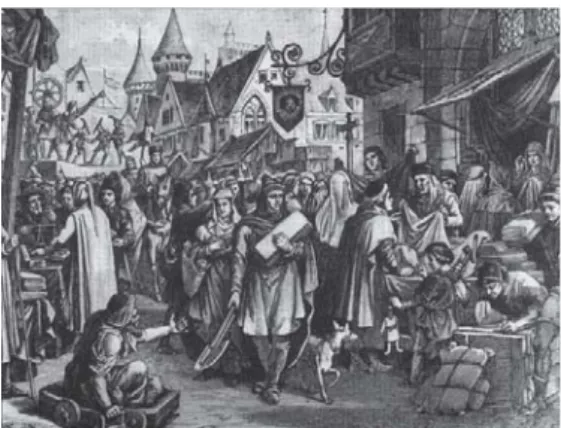
Fig 3. Trade (Opperman, 2013).
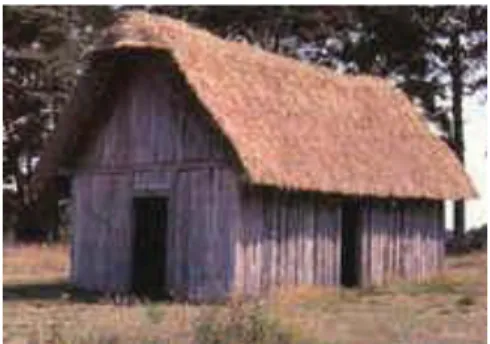
As I mentioned before, housing was the other activity that stood out in the Middle Ages; it was related to women rather than men because they were the ones who stayed at home most of the time and made all the work in the houses (take care of children, housework, cooking, etc.) Houses of ordinary people were not big; they were simple houses no better than shacks, so we can guess that they lived in difficult conditions. Most of the houses of common people were built of wood which was a very dangerous material if there was a fire
that was very common at that time. Lehmberg mentioned that “the roofs were frequently
2. KEN FOLLETT AND THE PILLARS OF THE EARTH
This point of my dissertation deals with the figure of Ken Follett, and with his novel The Pillars of the Earth. Ken Follett is a British writer; he was born in 1949. He wrote suspense and historic novels. He is one of the best known novelists at this time; he sold millions of books, more than 90 million. Before he became a novelist, his aspiration was to be a captain of industry; but he became a reporter and because of that he started to write stories. He wrote many books until he achieved his first success that was called Eye of the Needle. It was before his first successful novel when he decided to introduce one of his personal obsessions, cathedrals, in his novels; so he wrote The Pillars of the Earth among others.
Ken Follett said about this book: “Nobody who reads it ever looks at a church or a
cathedral the same” (Winfrey 2008).
As I said in the previous paragraph, The Pillars of the Earth is one of the best known book written by Ken Follett. It is a historical novel that deals with a view of family life and the church in the 12th century in England. This novel provides a tale full of failures and successes of some generations of families in Kingsbridge. The main figure in Kingsbridge is the priest Philip and the plot goes around his dream of building a great cathedral in his town. To make this work, he employs Tom, a builder who has the same idea about cathedrals as Philip. The novel presents a big fascination with Gothic architecture, especially with the idea of the cathedral. It provides great details of the architectural and technical characteristics of the Gothic architecture of that period. The essence of the novel deals with historical aspects as the battle for the English throne between Stephen and Maud. However, the focus of attention is the construction of the cathedral, and also the life
struggles of Tom’s family. This family is challenged by some difficulties as poverty,
famine, or torture; but they are rewarded with love and prosperity. The story starts with the hanging of a strange man, and the curse his lover made to people who accused her lover; her name is Ellen and she is pregnant of a kid who will be a central character of the novel,
Jack. Jack and Ellen became part of Tom’s family when his wife died, and they go together
they fight because of the love of Aliena. The story ends with mature Aliena and Jack, they have their own children and assume roles as leaders in Kingsbridge (Foster 2014).
Through the novel we find different characters who belonged to different social classes; the
main characters of this novel are the prior Philip, Tom’s family (Alfred, Martha, Tom,
Ellen, and Jack), and Aliena. Philip is the abbot of Kingsbridge cathedral and monastery, he is the leader of the village. Tom is the master builder of the cathedral of Kingsbridge; he teaches Alfred, his son, and Jack, his stepson, the art of building. Alfred becomes master builder but he is soon pushes into the background by Jack. Ellen is Tom’s second wife and
Jack’s mother; she is considered as a witch because of the curse she makes at the beginning
of the story. Finally, Aliena is the daughter of Earl Bartholomew; she belongs to aristocracy at the beginning but she becomes poor and has to work as a wool merchant; she marries
Alfred but she finally becomes Jack’s wife.
I am going to present the medieval society as Ken Follett described it in some of the chapters of his book. I divided this point in different sections as the previous point: the church, the social stratification, the women, and the way of life.
2.1.CHURCH
2.1.1. GOTHIC CATHEDRAL
The Pillars of the Earth focuses on the Gothic cathedral in great detail. During the whole novel, Ken Follett gives us an in-depth vision of the construction of the Gothic cathedral of Kingsbridge.
In the novel, Tom is the character that is bounded to the cathedral, although when he died,
Alfred and Jack (his son and his stepson) were the ones who occupied “the cathedral job.”
The first part of this novel introduces the idea of building a new cathedral because they wanted to extol the figure of God. The construction of these buildings must be perfect due to two main reasons: cathedrals were made for God, and they had very big dimensions so their construction resulted very complicate. Ken Follett describes in the first chapter the cathedral as:
A cathedral was a church like any other, in principle; it was simply the church where the bishop had his
throne. But in practice cathedral churches were the biggest, richest, grandest and most elaborate. A
cathedral was rarely a tunnel with windows. Most were three tunnels, a tall one flanked by two smaller
ones in a head-and-shoulders shape, forming a nave with side aisles. The side walls of the central tunnel
were reduced to two lines of pillars linked by arches, forming an arcade. The aisles were used for
processions – which could be spectacular in cathedral churches – and might also provide space for small
side chapels dedicated to particular saints, which attracted important extra donations. Cathedrals were the
most costly buildings in the world, far more so than places or castles, and they had to earn their keep.
(Follett:291)
In the previous quote we can observe that Follett provides a great vision of the cathedrals since the first chapter. He does not mention only the figure of the cathedral, he immerses in the architectural elements that take part of it. The detailed description of cathedrals makes the novel very truthful. In chapter five, Ken Follett describes how the protagonist of the novel, Tom, wanted to build the cathedral. He gives details about what are the elements that a cathedral should have: the section was formed by a high arcade with a flat top, a triangular roof, two arcades with bended tops in the middle of the nave (the side aisles), a stone arch to join the central nave with the side aisles, etc. Follett provides even the three levels in which the cathedral should be divided and the measurements that it should have as we can appreciate in the following fragment:
It was pierced at three levels. The bottom half was hardly a wall at all: it was just a row of columns, their
tops joined by semicircular arches. It was called the arcade. Through the archways of the arcade could be
seen the round-headed windows of the aisles. […] Above each arch of the arcade was a row of three
small arches, forming the tribune gallery. […] Above the gallery was the clerestory, so called because it was pierced with windows which lit the upper half of the nave. […] Tom designed the three levels of the
nave wall – arcade, gallery and clerestory – strictly in the proportions 3:1:2. The arcade was half the
height of the wall, and the gallery was one third of the rest. (Follett: 245)
As I have said in the second paragraph of this section, Tom is the central character in relation to the cathedral, but there are two other important characters that gained importance when Tom died: Jack and Alfred. Alfred achieved the work because of his father, but the person who was interested really in the job is Jack. He decided to go abroad (Spain and France), and there he discovered new elements and new ways of constructing the cathedral. So, when he returned to England, he applied all that he learnt in the cathedral. With the character of Jack we discover a new way of building a vault as Follett describes in chapter twelve:
Instead of a smooth, continuous barrel, or a creased groin vault, this ceiling had ribs which sprang up
from the tops of the columns and met at the apex of the roof. The ribs were thick and strong, and the
triangular sections of ceiling between the robs were thin and light. The monk who was keeper of the
fabric explained to Jack that it was easier to build that way: the ribs were put up first, and the sections
between were simpler to make. This type of vault was also lighter. […] What was so striking about it, he
finally decided, was the way the ribs, coming down from the apex of the vault to the capitals on top of the
columns, seemed to dramatize the way the weight of the roof was being carried by the strongest
members. The ribs made the logic of the building visible. (Follett: 594-595)
also big windows decorated with colored stained glass windows that provided light to the building.
Jack returned to England, and we appreciate changes in the way of building the cathedral; he decided that the cathedral must have a Latin cross floor plan. He introduced the changes he learnt in France, so he made all higher and narrower. The cathedral contained at that moment shafts that rose through the gallery and finished in the ribs of the vault; pointed windows that provided light to the building; fine and delicate moldings; and a decoration that had to do with the stone foliage. The building seemed very different from the previous one:
The new building looked unreal: it was too tall, too slender, too graceful and fragile to stand up. It
seemed to have no walls, nothing to hold up the roof but a row of willowy piers reaching eloquently
upward. Like everyone around him, William craned his neck to look up, and saw that the piers continued
into the curved ceiling to meet at the crown of the vault, like the overarching branches of a stand of
mature elms in the forest. (Follett: 682)
At the very end of the novel, we can appreciate a great Gothic cathedral with elements bound to the Gothic architecture, so the author of the book has followed in great detail the
art and he did not invent any “fictional” element. In the following paragraph we can observe this fact and how Kingsbridge’s cathedral was the reason of the enlargement of the
city.
It was breathtaking. The immensely tall nave supported by a row of graceful flying buttresses. The west
end had three huge porticos, like giants’ doorways, and rows of tall, slender, pointed windows above,
flanked by slim towers. The concept had been heralded in the transepts, finished eighteen years ago, but
this was the astonishing consummation of the idea. There had never been a building like this anywhere in
England. […] The church was even more impressive inside. The nave followed the style of the transepts,
but the master builder had refined his design, making the columns even more slender and the windows
larger. But there was yet another innovation. […] The light from outside shone through the colored glass,
“There had never been a building like this anywhere in England.” This sentence is the one
which describes perfectly what Tom and Jack had achieved at the end, a cathedral that was the center and the wealth of the city.
2.1.2. REIGIOUS LIFE
In the first chapter, Follett presents the monastic life through Ellen’s story when she had to stay in a nunnery. From this story we can appreciate the life in the convent and the rules they must follow:
She learned to read and write, she mastered music and numbers and drawing, and she added Latin to the
French and English she had spoken in her father’s household. Life in the convent was not so bad, in the
end. It was a single-sex community with its own particular rules and rituals, and that was exactly what
she was used to. All the nuns had to do some physical labor […] Poverty never worried her. Obedience
did not come easily, but it did come, eventually. The third rule, chastity, never troubled her much […]
(Follett: 25)
This quote is related to nunneries, but chapter two deals also with the monk’s votes that are exactly the same as the nun’s ones: poverty, obedience, and chastity. This chapter also introduces the idea that if monks disobeyed some of these votes, they were punished by solitude, flagellation, excommunication, or expulsion. Likewise, chapter ten talks about the monastic life; it says:
Being a monk was the strangest and most perverted way of life imaginable. Monks spent half their lives
putting themselves through pain and discomfort that they could easily avoid, and the other half muttering
meaningless mumbo jumbo in empty churches at all hours of the day and night. They deliberately
shunned anything good-girls, sports, feasting and family life (Follett: 503)
2.2.SOCIAL STRATIFICATION
the city was established, and the materials the houses were made: “candlelight flickered
behind the shutters of the substantial wood and stone houses around the square, the homes of prosperous craftsmen and trades” (Follett: 4). This allows us to know that richer people lived in better houses (stone instead of wood) and they were set next to the square of the city. The prologue also mentions the highlighted citizen, the main professions in the town: butcher, baker, tanner, smith, and cutler.
The second chapter of the novel introduces a historical fact; it presents the figure of Henry I and how the war started because he had not a great successor for the throne (he had children but they were bastards, he only had a legitimate child but she was a girl). During the whole novel, this historical fact is present, and we discover how Maud and Stephen disputed the throne. In the following quote we can appreciate the main discussion for the throne:
The king had many other children, of course, Francis went on. At least twenty of them, including my
own lord, Earl Robert of Gloucester; but as you know, they are all bastards. Despite his rampant
fecundity he managed to father only one other legitimate child and that was a girl, Maud. A bastard
can’t inherit the throne, but a woman is almost as bad. (Follett: 84)
The book presents the different way of wearing that people of different social classes had. Lords wore short and black tunics, black breeches and leather shoes. Earls wore long tunics with wide sleeves, and butlers wore short tunics and round hand. Noble people always wear leather boots or sandals instead of clogs. Soldiers wore long boots, leather tunics and helmets. We can generalize that higher people wore short tunics, and they distinguished between them because of the other complements they wore as hats, sleeves, etc.
money working or even they had not any money. Lower people had to pay an income, and if they did not pay it, the lord could hit them. Related to money, there were some laws in the cities that people should accomplish because, on the contrary, they were sent to the exile, mutilated or hanged.
2.3.WOMEN
Women are portrayed in this novel; they perform important roles during the whole novel. I have to highlight two women because they are completely different from the view historians gave of medieval women: Ellen and Aliena. Each one has an important role in this novel because of the things they do. Ellen is a widow who lives in the forest with her
son, so she has to survive by herself and not with a man’s help. She decides to live with
Tom without being married, but they have some struggles when prior Philip discovers that they are living in sin. Ellen should leave Kingsbridge although she returns many times later. She transmits Jack her strength in life, and advises him to fight for his dreams.
On the other hand, we have the figure of Aliena, who firstly belongs to the aristocracy but when her father dies, she loses all her power and she turns into a peasant. The figure of Aliena develops more in the novel than the figure of Ellen; she decides to establish in Kingsbridge where she lives with her brother, Richard. She works very hard and she finally becomes an important wool seller although she has many troubles because of being a woman. She marries Alfred and he abuses her and obligates her to sleep in the roof; and when she appears finally happy with Jack, there is a law which cannot allow them to live together because of her marriage to Alfred, as we can observe in the following fragment:
“You could marry Aliena if her first marriage was annulled.” “Can then be done?” “It should be
automatic, if, as you say, the marriage was never consummated.” “What do I have to do?” “Apply to an ecclesiastical court. Normally it would be Bishop Waleran’s court, but in this case you probably
should go straight to the archbishop of Canterbury.” “And is the archbishop bound to agree?” “In
In the fragment above we see the trouble of Aliena but we can also appreciate the fact of re-marriage when someone was married before. People could not re-marry whenever they wanted; they had to obey the ecclesiastical rules, and asked the bishop for the suppression of the previous marriage. We can also observe the fact that a couple could not live together until they were married; if they disobeyed, they could be punished.
2.4.WAY OF LIFE
The first chapter provides many characteristics about how was Medieval society divided, the different clothes each social class wore, their traditions, etc. We can observe that ordinary people’s houses were composed only of one or two rooms; there was one room where people spent most of their time, and kitchens were separated and distant because of the fire hazards. We can see how working class people received a lower income for working during the harvest, they had to change animals for money, and if someone committed a crime, they should live in the forest.
3. ANALYSIS
In this section of the project, I present a comparison between what historians said about the Middle Ages and what Ken Follett said about medieval society in one of his novels, The Pillars of the Earth. I am going to analyze the church, the social stratification, women, and the way of life (trade and housing) through the commentary of some comparative tables.
3.1.CHURCH
3.1.1. GOTHIC CATHEDRAL
The comparison of this section deals with two different aspects related to the church: the cathedral and the people who belong to the church. In relation to the cathedral, historians and the novel do not differ so much, as we can observe in table 1. Both treat the cathedrals as the center of the cities, the monuments on which life is around. Historians and the novel agree that Middle Ages was the beginning of the change from Romanesque to Gothic architecture, and both show several elements of the Gothic art as for instance: arcades, naves, side aisles, cross vaults, pointed arches, etc. The novel depicts very well the reality as we can observe in the fact of the height of the cathedral, the distribution of the different architectural elements, the way the Gothic cathedral was built, etc.
3.1.2. RELIGIOUS LIFE
HISTORIANS NOVEL
CHURCH Cathedrals were the most important
monuments in the cities. Cathedrals were
the mirrors in which the world is reflected.
Middle Ages Æ change from Romanesque
to Gothic.
Architectural elements.
Church people: kings were the ones who
designated bishops; the clergy was mostly
ignorant talking about education.
Cathedrals were the center of
the cities, all the life was around
them. Life was reflected in
cathedrals.
Change from Romanesque to
Gothic.
Architectural elements.
Monastic life: votes.
Table 1. Historians and Ken Follett’s view of church in Middle Ages.
3.2.SOCIAL STRATIFICATION
The social stratification I chose divides society in three groups: peasants, middling groups, and aristocracy. Each group differentiates from the others in the rights they had as we can appreciate in table 2. The novel also talks about different social groups, and apart from the rights, the author also makes the difference of classes because of the way of wearing.
The group that is lower in the social stratification is the peasants. Historians talked about two subgroups inside this social group: unfree peasants and free peasants; whereas the novel does not mention any distinction between them. The novel mixes the rights of these two different groups of peasants, and it shares that peasants could manage their lands but
they needed the lord’s permission (in the case of the novel we have the figure of William Hamleigh who visits the peasants’ houses to collect taxes for their lands). Historians
contradiction with historians in the case of Aliena. We find in the same house living together Aliena, Jack (her husband), Ellen (her mother-in-law), Martha (her husband’s half -sister), and the kids; so more than one generation.
Talking about middling groups, historians said that they had the right of owning lands and cultivating them; some of the middle class people could even have tenants for doing the work. These people were related to the trade, they worked with foreign exchange and luxury business. The novel includes craftsmen in the middle class people, and they were also related to trade. They had to change basic aliments like milk, eggs, meat, and grain, for things that they could not make themselves such as salt, rope, or pots. Talking about money, they received it in contrast of peasants; shopkeepers sell things; craftsmen earn salaries. Builders were part of the middle class people; they were in an advantageous position because they knew the technical and technological procedures of architecture. This fact is illustrated in the novel; we can see how Tom applied his main notions of architecture to the construction of the Gothic cathedral. Ken Follett depicts this character as someone who knew exactly how to build a cathedral, and this figure shows interest because of the architecture as we can observe in the following fragment:
He was mesmerized by the challenge of making soft, round shapes out of hard rock. The stone had a
will of its own, and if he tried to make it did not want to do, it would fight him, and his chisel would
slip, or dig in too deeply, spoiling the shapes. But once he had got to know the lump of rock in front
of him he could transform it. The more difficult the task, the more fascinated he was. (Follett: 452)
HISTORIANS NOVEL
PEASANTS Two groups:
- Unfree.
- Free.
Families: husband, wife and unmarried
children; not several generations live
together.
We do not find a distinction in
groups. They had to work to
survive. They were under lord
or king’s control. Peasants did
not need money because they
have lands.
Families: Aliena lives with her
brother, her children, Martha
(her husband’s half-sister), Jack
(her husband.)
MIDDLING
GOUPS
Own lands and cultivate them, and
some of the middle class people have
few tenants for doing this work.
Related to trade Æ foreign exchange
and luxury business.
Trade: craftsmen had to change
milk, eggs, meat, and grain for
things that they could not make
themselves as salt, rope, or pots.
ARISTOCRACY Several titles: duke, marquis, earl,
viscount, or lords (ordering by wealth)
Most of these people were very rich
and can own land estates that have
several retainers and tenants.
Way of wearing: short tunics.
Money: the king has the taxes;
lords have incomes. They
enjoyed money without paying
anything.
3.3.WOMEN
In this section I am going to analyze the comparison of women as historians saw them and as Ken Follett depicted them. As we can see in table 3, historians divided women in two groups: ordinary women, and aristocratic ones; and in the novel we can also see this classification in figures like Aliena or Ellen in the case of ordinary women, and Aliena (at the beginning of the novel she belongs to the aristocracy) in the case of aristocratic women.
Historians said that ordinary women were dedicated to the domestic sphere, so they were cookers, cleaners, care takers, etc. but they did not receive any income for these jobs. Ken Follett, with the character of Aliena, agrees with the historians; she had to take care of her children, she had to make the home labors, etc. However, Aliena worked also outside as a wool merchant because she had to survive without any men’s help. The case of Ellen is not very different; she lost her first husband, so she had to earn a living and maintain her son
without a husband’s help. She was very independent although she decided to share her life
with Tom.
I love you, she said fiercely. I loved you from the moment I saw you. I always wanted a man who
would be strong and gentle, and I thought there was no such thing. Then I saw you. I wanted you.
But I could see you loved your wife. My God, how I envied her. I’m sorry she died, truly sorry,
because I can see the grief in your eyes, and all the tears waiting to be shed, and it breaks my heart to
see you so sad. But now that she’s gone, I want you for myself. […] She took him by the hand, and
they walked away from the cave together. (Follett: 64)
He turned and looked around the other side of the hall, and saw Aliena immediately. She looked
quite different today. Yesterday she had been dressed up for the cathedral, in silk and fine wool and
linen, with rings and ribbons and pointed boots. […] Aliena was concentrating. Their painted
wooden board was shaped like a cross and divided into squares of different colors. The counters
appeared to be made of ivory, white and black. The game was obviously a variant of merels, or
ninemen’s morris, and probably gift brought back from Normandy by Aliena’s father. (Follett: 141
-142)
HISTORIANS NOVEL
WOMEN Ordinary women: dedicated to their
families and the domestic economy. Not
many rights.
Aristocratic women: social life.
Ellen: a widow who lives in the
forest without a man’s help.
Aliena: from aristocracy to
peasantry.
Table 3. Historians and Ken Follett’s view of women in Middle Ages.
3.4.WAY OF LIFE
The way of life is very similar in the novel and as historians depicted it. Historians positioned trade as the principal way of life; it was the main profession of people of different classes. Every person in the cities had sheep, so most of them worked as wool merchants. In the novel, we can see this way of life in the characters of prior Philip and Aliena. At the beginning she had to fight so much because she was a woman, and normally, women did not work. However, Philip helped her sending her the wool he had.
passed out into the suburb called Newland. Here the houses were like peasant hovels, made of wattle-and-daub, with large gardens such as village houses had” (Follett: 418).
This was very dangerous because of the fire, and for the same reason, kitchens were separated from the main rooms, as this fragment tells: “The kitchen would be a separate building, for every kitchen caught fire sooner or later, and there was nothing for it to build
them far away from everything else” (Follett: 10). In the case of richer people, houses were
bigger and they were made of other materials like stone. They lived in castles because they had to provide their tenants a room where they could live.
HISTORIANS NOVEL
TRADE AND
HOUSING
Trade: wool. The church was also owner
of large lands, especially monasteries
which provided some pastures for sheep.
Housing: women. Houses of ordinary
people were not big. Most of the common
people houses were built of wood.
Trade: wool. Aliena and Philip
worked as wool merchants.
Ordinary people houses were
composed only for one or two
rooms.
4. CONCLUSION
This dissertation has helped me in understanding better the situation in the Middle Ages, and it has also shown me that Ken Follett followed the historians information to write his novel, The Pillars of the Earth. The project has also helped me to expand my research methods, and to increase my historical knowledge. The main objective of my dissertation, as I proposed in the introduction, was to discover if the novelists followed the image the historians introduce about the Middle Ages society or instead they used their own imagination to depict the situation in the Middle Ages.
I discover that the historians’ point of view and the novel have many similarities which makes the novel very truthful. The novel depicts in great detail the social life of people, talking about the different social classes and how they lived. We can appreciate that the image Ken Follett gives about the social stratification and their rights and way of life is very close to the image historians proposed. The book clearly depicts some aspects of medieval life, as for instance, the church, the women, the social stratification, and the way of life. Talking about the church, I have learnt how religious people were very close to the construction of the cathedral because of the idea of extolling God. Women had an important role in society as we saw, although their image was that of someone who stayed at home taking care of children. In relation with the social stratification, I have learnt that the Middle Ages society was an unbalanced society with many social strata that differed from each one because of their rights. The novel helps the reader to imagine how the life of medieval people was, and it is also a tool for learning history.
more reliable. Finally, the third section of the project shows a comparison between the real information and the fiction. We can observe in this point, how the novel did not differ so much with the reality although it provides a bit of fictionalization, as mostly of the novels.
5. BIBLIOGRAPHY
Follett, Ken. The Pillars of the Earth. USA: Penguin Group, 1996. Epub.
Foster, Michael. “The Pillars of the Earth by Ken Follett”. 2014. eNotes.com, Inc. [Accessed 13 July 2014.] <http://www.enotes.com/topics/pillars-earth>
Joax. “Women during Middle Ages”. 2008. Medievality.com. [Accessed 4 July 2014.] < http://www.medievality.com/medieval-women.html>
Lyon, Bryce D. (ed.) The High Middle Ages 1000-1300. University of California, Berkeley: The Free Press of Glencoe, 1964.
Lehmberg, Stanford .E. The Peoples of the British Isles: A New History: from Prehistoric Times to 1688. Chicago: Lyceum Books, 2002.
Martín García, Juan M. “Los Pilares de la Tierra: Novela Histórica y Arquitectura en la Europa de las Catedrales”. Mundos Medievales: Espacios, Sociedades y Poder: homenaje al profesor José Ángel García de Cortázar y Ruiz Aguirre. Santander: PUbliCan, 2012.
Opperman, David. “Trade”. 2013. Faith & Heritage. [Accessed 8 July 2014.] < http://faithandheritage.com/2013/11/in-defense-of-economic-and-social-nationalism-why-libertarianism-must-die-part-4/>
Traina, Amanda. “Feudalism in Medieval Europe”. 2009. Gregorian Court University. [Accessed 9 July 2014.] <http://gcuonline.georgian.edu/wootton/Medieval.htm>