
Search for top and bottom squarks from gluino pair production in final states with missing transverse energy and at least three b jets with the ATLAS detector
22
0
0
Texto completo
(2) Eur. Phys. J. C manuscript No. (will be inserted by the editor). Search for top and bottom squarks from gluino pair production in final states with missing transverse energy and at least three b-jets with the ATLAS detector The ATLAS Collaboration. July 19, 2012. Abstract This letter reports the results of a search for top and bottom squarks from gluino pair production √ in 4.7 fb−1 of pp collisions at s = 7 TeV using the ATLAS detector at the LHC. The search is performed in events with large missing transverse momentum and at least three jets identified as originating from a bquark. Exclusion limits are presented for a variety of gluino-mediated models with gluino masses up to 1 TeV excluded. Supersymmetry (SUSY) [1–9] provides an extension of the Standard Model (SM) which resolves the hierarchy problem [10–13] by introducing supersymmetric partners of the known bosons and fermions. In the framework of the R-parity conserving minimal supersymmetric extension of the SM (MSSM) [14–18], SUSY particles are produced in pairs and the lightest supersymmetric particle (LSP) is stable, providing a possible candidate for dark matter. In a large variety of models, the LSP is the lightest neutralino (χ̃01 ). The coloured superpartners of quarks and gluons, the squarks (q̃) and gluinos (g̃), if not too heavy, would be produced in strong interaction processes at the Large Hadron Collider (LHC) and decay via cascades ending with the LSP. The undetected LSP results in missing transverse miss momentum – whose magnitude is referred to as ET – while the rest of the cascade yields final states with multiple jets and possibly leptons. In the MSSM, the right-handed and left-handed squarks, q̃R and q̃L , can mix to form two mass eigenstates q̃1 and q̃2 . The mixing effect is proportional to the masses of the SM fermion partners and can therefore be large for the third generation. This may lead to the lightest sbottom (b̃1 ) and stop (t̃1 ) mass eigenstates being much lighter than the other squarks. As a consequence, b̃1 and t̃1 could be produced with relatively large cross-sections at the LHC,. either directly in pairs, or through g̃g̃ production followed by g̃ → b̃1 b or g̃ → t̃1 t decays. This letter extends the search for gluino-mediated b̃1 and t̃1 production at ATLAS reported earlier [19], which used 2.05 fb−1 of data collected in the first half of 2011 at a centre-of-mass energy of 7 TeV. The present analysis comprises the full 2011 dataset of 4.7 fb−1 and miss adopts an improved selection that requires large ET , no electron or muon and at least three jets identified as originating from b-quarks (b-jets) in the final state. Results are interpreted in four simplified models where sbottoms or stops are the only squarks produced in the gluino decays, leading to final states with four b-quarks. Searches in similar scenarios have also been reported by the CMS Collaboration [20]. The ATLAS detector [21] consists of inner tracking devices surrounded by a superconducting solenoid, electromagnetic and hadronic calorimeters and a muon spectrometer with a toroidal magnetic field. The inner detector provides precision tracking of charged particles for |η| < 2.51 . It is immersed in a 2 T magnetic field from the solenoid and consists of a silicon pixel detector, a silicon strip detector and a straw tube tracker that also provides transition radiation measurements for electron identification. The calorimeter system covers the pseudorapidity range |η| < 4.9. It is composed of sampling calorimeters with either liquid argon (LAr) or scintillating tiles as the active medium. The muon 1 ATLAS uses a right-handed coordinate system with its origin at the nominal interaction point (IP) in the centre of the detector and the z-axis along the beam pipe. The x-axis points from the IP to the centre of the LHC ring, and the y axis points upward. Cylindrical coordinates (r, φ) are used in the transverse plane, φ being the azimuthal angle around the beam pipe. The pseudorapidity is defined in terms of the polar angle θ as η = − ln tan(θ/2).The distance ∆R in the p η − φ space is defined as ∆R = (∆η)2 + (∆φ)2 ..
(3) 2. The ATLAS Collaboration. is less than 2% for light-quark and gluon jets, 10% for τ leptons decaying hadronically and 25% for c-quark jets. The b-jets are identified within the nominal acceptance of the inner detector (|η| < 2.5) and are required to Samples of simulated events are used for the descriphave pT > 30 GeV. To compensate for the differences tion of the background and to model the SUSY signal. between the b-tagging efficiency and the mistag rates The dominant sources of background come from events in data and MC simulation, b-tagging scale factors are with b-quarks in the final state. Monte Carlo (MC) samapplied to each jet in the simulations, as described in ples of tt̄, W /Z and diboson events produced in assoRefs. [37–39]. ciation with light- and heavy-flavour jets are generated Electrons are reconstructed from energy clusters in with ALPGEN [22] and the parton distribution function the electromagnetic calorimeter matched to a track in (PDF) set CTEQ6L1 [23]. These samples are generated the inner detector. Electron candidates are required to with different maximum numbers of additional partons have pT > 20 GeV and |η| < 2.47 and must satisfy at the matrix-element level. Diboson samples are genthe “medium” selection criteria described in Ref. [40]. erated with up to three additional partons, tt̄+jet and + − Muons candidates are identified using a match between Z(→ ℓ ℓ )+jets (ℓ = e,µ,τ ) samples with up to five adan extrapolated inner detector track and one or more ditional partons, and W (→ ℓν)+jets and Z(→ ν̄ν)+jet track segments in the muon spectrometer, and are resamples with up to six additional partons. Single top quired to have pT > 10 GeV and |η| < 2.4. quark production is simulated with MC@NLO [24] using To resolve overlaps between reconstructed jets and the next-to-leading-order (NLO) PDF set CTEQ6.6 [25]. leptons, jets within a distance of ∆R = 0.2 of an elecThe fragmentation and hadronisation for the ALPGEN tron candidate are rejected. Furthermore, any lepton and MC@NLO samples are performed with HERWIG [26, candidate with a distance ∆R < 0.4 to the closest re27], using JIMMY [28] for the underlying event. Sammaining jet is discarded. Events containing any remainples of tt̄+W , tt̄+Z and tt̄+W W events are generated ing electrons and muons are vetoed in the control and with MADGRAPH [29] interfaced to PYTHIA [30]. The sigsignal regions defined in Tables 1 and 2. nal samples are generated using Herwig++ [31]. The MC samples are processed through the ATLAS detector The measurement of the missing transverse momenmiss simulation [32] based on GEANT4 [33] taking into account tum two-dimensional vector (and its magnitude ET ) the effect of multiple pp interactions per bunch crossis based on the transverse momenta of all remaining jets ing. For the comparison with data, all SM background with |η| < 4.9, all electron and muon candidates and all cross-sections are normalised to the results of highercalorimeter clusters not associated to such objects. order calculations when available, using the same values Events are selected using triggers requiring one high miss as in Ref. [19]. pT jet and ET . Different trigger thresholds were used Jets are reconstructed from three-dimensional calorime- to cope with the increasing luminosity. These triggers are fully efficient for this analysis, which requires one jet ter energy clusters using the anti-kt jet algorithm [34, miss with pT > 130 GeV and ET > 160 GeV at the offline 35] with a radius parameter of 0.4. The measured jet reconstruction stage. Events must pass basic quality energy is corrected for inhomogeneities and for the noncriteria to reject detector noise and non-collision backcompensating nature of the calorimeter by using pT grounds. They are also required to have a reconstructed and η-dependent correction factors, and additional corprimary vertex associated with five or more tracks with rections for pile-up are applied [36]. Jets are required to pT > 0.4 GeV; when more than one such vertex is found, have pT > 20 GeV, and are reconstructed in the range the vertex with the largest summed p2T of the associ|η| < 4.9. Events are rejected if they include jets failing ated tracks is chosen as the hard interaction vertex. the quality criteria described in Ref. [36], or if there is Events are required to have at least three b-tagged jets, any selected jet with |η| < 2 for which the scalar sum of and two jet-multiplicity regions (NJ ≥ 4 and NJ ≥ 6) the transverse momenta of its associated tracks is less are considered by selecting jets with |η| < 2.8 and than 5% of the jet pT . A neural-network-based algopT > 50 GeV. rithm [37] is used to identify jets containing a b-hadron Two variables are calculated from the reconstructed decay. This uses as inputs the output weights of differobjects to further select the events: meff and ∆φmin . ent algorithms exploiting the impact parameter of the The effective mass meff is defined as the scalar sum of inner detector tracks, the secondary vertex reconstrucmiss and the pT of all selected jets in a given jetthe ET tion and the topology of b- and c-hadron decays inside multiplicity region. The ∆φmin is defined as the minthe jet. Three operating points are used, corresponding imum azimuthal separation between the selected jets to efficiencies of 60%, 70% and 75% for tagging b-jets in a MC sample of tt̄ events. In all cases the tagging rate and the missing transverse momentum direction. Plac-. spectrometer has separate trigger and high-precision tracking chambers which provide muon identification and momentum measurement for |η| < 2.7..
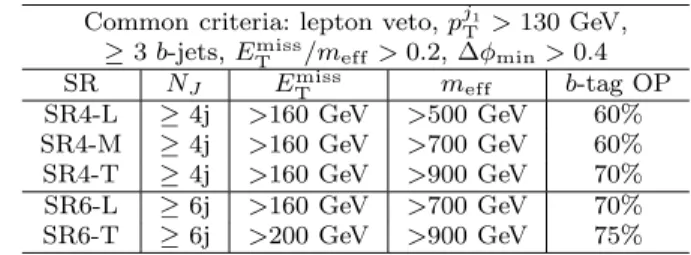
(4) Search for top and bottom squarks in final states with missing transverse energy and at least three b-jets. 3. Common criteria: lepton veto, pjT1 > 130 GeV, miss ≥ 3 b-jets, ET /meff > 0.2, ∆φmin > 0.4 miss SR NJ ET meff b-tag OP SR4-L ≥ 4j >160 GeV >500 GeV 60% 60% SR4-M ≥ 4j >160 GeV >700 GeV ≥ 4j >160 GeV >900 GeV 70% SR4-T SR6-L ≥ 6j >160 GeV >700 GeV 70% ≥ 6j >200 GeV >900 GeV 75% SR6-T. Common criteria: lepton veto, pjT1 > 130 GeV, miss = 2 b-jets, ET /meff > 0.2, ∆φmin > 0.4, miss ET > 160 GeV, meff > 500 GeV CR NJ b-tag OP corresponding SR CR4-60 ≥ 4j 60% SR4-L, SR4-M 70% SR4-T CR4-70 ≥ 4j CR6-70 ≥ 6j 70% SR6-L 75% SR6-T CR6-75 ≥ 6j. Table 1 Definition of the five signal regions based on the miss number of jets (NJ ), the ET , meff requirements and the b-tagging operating point (OP).. Table 2 Definition of the four control regions used to estimate the tt̄+jets background.. miss ing the requirements ∆φmin > 0.4 and ET /meff > 0.2 reduces the amount of multi-jet background, where miss ET results from mis-reconstructed jets or from neutrinos emitted close to the direction of the jet axis. Two sets of signal regions are defined which yield good signal sensitivity for the various models and parameter values studied here. They are characterised by having at least four (SR4) or six (SR6) jet candidates, no electron or muon, and are further classified as loose miss (L), medium (M) or tight (T) depending on the ET and meff thresholds and on the b-tagging operating point. The requirements that characterise each signal region are summarised in Table 1. The main source of reducible background is the production of tt̄ events in association with additional jets followed by the leptonic decay of one W boson, where the lepton is not reconstructed or is misidentified as a jet (mainly through the hadronic decays of a τ lepton). This background is estimated by normalising the MC event yield in the signal region to the extrapolated event yield observed in a tt̄-dominated control region. Systematic uncertainties that are correlated between the control and the signal regions largely cancel out in this procedure. Additional sources of reducible background are single top, tt̄+W /Z and W /Z+heavy-flavour jets. Their contributions are taken from MC simulation and account for 10% to 20% of the total background depending on the signal region. The irreducible background tt̄+bb̄ is also estimated from MC simulation and accounts for about 10% of the total background in all signal regions. The reducible contribution from multi-jet events is estimated with a data-driven method, based on a jet response smearing technique [41], and is found to account for less than 5% of the total background in all signal regions. Four control regions where the tt̄+jets background accounts for more than 80% of the total yield are defined by applying the same jet requirements and lepton veto as in the signal regions, but requiring exactly two b-jets instead of three or more. The requirements miss meff > 500 GeV and ET > 160 GeV are applied to all control regions to make them kinematically similar. to the signal regions, while reducing the contamination from possible SUSY signal events. The definition of the control regions is summarised in Table 2. The numbers of expected SM events in the four control regions, as predicted by the jet smearing technique for multi-jet events and by MC simulation for other processes, are compared to those observed in data in Table 3. The results agree within experimental errors. CR CR4-60 CR4-70 CR6-70 CR6-75. tt̄+jets 330 ± 90 490 ± 125 38 ± 11 40 ± 12. others 65 ± 25 100 ± 35 7±3 10 ± 4. SM 395 ± 115 590 ± 160 45 ± 13 50 ± 15. data 402 515 46 52. Table 3 Expected numbers of SM events and observed data events in the four tt̄ control regions. The contribution from tt̄+jets events is taken directly from MC simulation. The column “others” includes the contributions from single top, tt̄+bb̄, tt̄+W /Z and W /Z+jets processes, also estimated from MC simulation, and the contribution from multi-jet events which is estimated with the jet smearing technique and accounts for less than 5% of the total background. The column “SM” shows the total expected background and is the sum of the columns “tt̄+jets” and “others”. The uncertainties include all detector-related systematic uncertainties.. The dominant detector-related systematic effects are due to the jet energy scale (JES) and resolution (JER) uncertainties, and the uncertainty on the b-tagging efficiency and mistag rates. The JES uncertainty is derived from a combination of simulations, test beam data and in-situ measurements [36], and includes additional uncertainties due to the jet flavour and nearby jets. Uncertainties on the JER are obtained with an in-situ measurement of the jet response asymmetry in di-jet events. These uncertainties on jets are propagated to miss the ET measurement, and additional uncertainties miss on ET arising from energy deposits not associated with any reconstructed objects are also included. The b-tagging uncertainty is evaluated by varying the η-, pT and flavour-dependent scale factors applied to each jet in the simulation within a range that reflects the systematic uncertainty on the measured tagging efficiency and mistag rates..
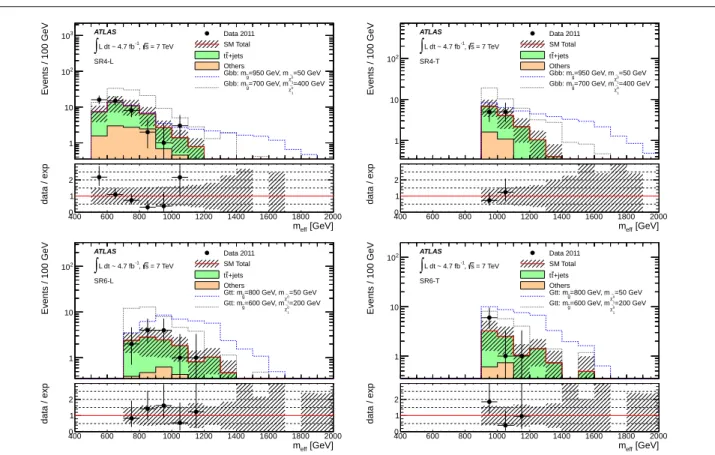
(5) 4. The systematic uncertainties in the modelling of the tt̄+jets background are assessed as follows: the uncertainty due to the choice of the MC generator is estimated by comparing the leading-order ALPGEN generator to the MC@NLO generator; the uncertainty due to the factorisation and matching scale ambiguities in ALPGEN are estimated by independently varying their nominal settings by factors of one half and two; the uncertainty due to the finite number of additional partons at the matrix-element level is assessed by comparing inclusive ALPGEN samples generated with up to three and up to five extra partons. Finally the PDF uncertainties are estimated using the MSTW2008NNLO PDF set. Uncertainties of 100% are assumed for the multi-jet prediction and for the cross-section of tt̄ and W /Z production in association with a bb̄ pair. For tt̄+W /Z production, an uncertainty of approximatively 70% has been derived from the variations of the factorisation and renormalisation scales and from the PDF uncertainties [42]. The tt̄+jets yield in each signal region is extrapolated from the measured number of events in the corresponding control region (as per Table 2) using a fit based on the profile likelihood method [43]. Each pair of control and signal regions is fitted separately, assuming no signal events. The free parameter in each fit is the tt̄+jets overall normalisation scale, while the contributions from subdominant background processes are fixed at the expected value. Systematic uncertainties are treated as nuisance parameters constrained with a Gaussian function and correlations are taken into account where appropriate. The results of the fits and the numbers of observed events for each signal region are summarised in Table 4. The fitted values of the normalisation factors for tt̄+jets are compatible with one and the main impact of the data-driven estimate is a reduction in the uncertainty by approximately a factor of two. Figure 1 shows the measured meff distributions and the MC predictions for the SM backgrounds in each signal region. Also shown are the prediction of two benchmark signal models described below. The reliability of the MC extrapolation of the tt̄ background to larger b-jet multiplicities has been checked in validation regions defined with kinematic cuts similar to those used in the control and signal regions, except that exactly one isolated electron or muon is required. miss The transverse mass of the lepton and the ET is required to be less than 100 GeV in all validation regions to minimise the possible contamination from stop production. The extrapolated event yield in the validation regions with at least three b-jets from the validation regions with exactly two b-jets is found to be consistent with the number of observed events for all b-tagging operating points.. The ATLAS Collaboration SR SR4-L SR4-M SR4-T SR6-L SR6-T. tt̄+jets (MC) 33.3 ± 7.9 (32.6 ± 15.4) 16.4 ± 4.1 (16.1 ± 8.4) 9.6 ± 2.1 (11.4 ± 5.4) 10.3 ± 3.3 (10.0 ± 6.2) 8.3 ± 2.4 (7.9 ± 5.3). others. SM. data. 11.1 ± 4.9. 44.4 ± 10.0. 45. 6.6 ± 2.9. 23.0 ± 5.4. 14. 3.7 ± 1.6. 13.3 ± 2.6. 10. 2.4 ± 1.4. 12.7 ± 3.6. 12. 1.6 ± 1.1. 9.9 ± 2.6. 8. Table 4 Comparison between the results of the fits and the numbers of observed events in the five signal regions. The tt̄+jets event yield predicted by the MC simulation is quoted in parentheses. The column “others” includes the contributions from single top, tt̄+bb̄, tt̄+W /Z, W /Z+jets and multijet processes. Multi-jet events contribute less than 5% of the total background. The column “SM” shows the total expected background and is the sum of the columns “tt̄+jets” and “others”. The uncertainties include the statistical and systematic uncertainties.. The background predictions have been further validated using a data-driven method that simultaneously estimates all SM background contributions with at least one misidentified b-jet. This method consists of predicting the number of jets originating from b-quarks in each event by solving a system of equations based on the number of b-tagged and non b-tagged jets in the event, along with the b-tagging efficiency and mistag rates. Consistent background predictions with respect to the fit results have been found in all signal regions. Limits for non-SM signal at 95% confidence level (CL) are derived by testing the signal plus background hypothesis in each signal region with the CLs prescription [43]. These limits are obtained with fits similar to those used to estimate the background in each signal region, except that the number of observed events in the signal region is added as an input to the fit and a second free parameter for the non-SM signal strength, constrained to be non-negative, is adjusted in the likelihood maximisation. This additional free parameter ensures a proper treatment of the expected signal contamination in the control regions when the results are interpreted in the framework of specific SUSY scenarios. Modelindependent upper limits at 95% CL on the number of signal events and on the visible cross-section (defined as the cross-section times kinematic acceptance times experimental efficiency) for non-SM contributions derived for each signal region are given in Table 5. These data have been used to derive limits in the parameter space of the following SUSY models: Gluino-sbottom model: MSSM scenarios where the b̃1 is the lightest squark, all other squarks are heavier than the gluino, and mg̃ > mb̃ > mχ̃0 , so the 1. 1.
(6) 103. ATLAS. Data 2011. ∫L dt ~ 4.7 fb , s = 7 TeV -1. SM Total t t +jets Others Gbb: m~g=950 GeV, m ∼0=50 GeV. SR4-L. 102. χ. Gbb: m~g=700 GeV, m ∼10=400 GeV χ. 1. Events / 100 GeV. Events / 100 GeV. Search for top and bottom squarks in final states with missing transverse energy and at least three b-jets ATLAS. Data 2011. ∫L dt ~ 4.7 fb , s = 7 TeV -1. 10. 2. 5. SM Total t t +jets Others Gbb: m~g=950 GeV, m ∼0=50 GeV. SR4-T. χ. Gbb: m~g=700 GeV, m ∼10=400 GeV χ. 1. 10 10. 1. meff [GeV]. 2 1 0 400. 600. 800. 1000. 1200. 1400. 1600. 1800. data / exp. data / exp. 1. 1 0 400. 2000. meff [GeV]. 2. 600. 800. 1000. 1200. 1400. 1600. 1800. ATLAS. 102. Data 2011. ∫L dt ~ 4.7 fb , s = 7 TeV -1. SM Total t t +jets Others Gtt: m~g=800 GeV, m ∼0=50 GeV. SR6-L. Gtt: m~g=600 GeV,. 10. χ m ∼10=200 χ. GeV. 1. meff [GeV]. 2 1 600. 800. 1000. 1200. 1400. 1600. 1800. 2000. data / exp. data / exp. 102. ATLAS. Data 2011. ∫L dt ~ 4.7 fb , s = 7 TeV -1. SM Total t t +jets Others Gtt: m~g=800 GeV, m ∼0=50 GeV. SR6-T. χ. Gtt: m~g=600 GeV, m ∼10=200 GeV. 10. χ. 1. 1. 1. 0 400. 2000. meff [GeV] Events / 100 GeV. Events / 100 GeV. meff [GeV]. meff [GeV]. 2 1 0 400. 600. 800. 1000. 1200. 1400. meff [GeV]. 1600. 1800. 2000. meff [GeV]. Fig. 1 Distribution of meff for SR4-L and SR4-T (top) and SR6-L and SR6-T (bottom). The hatched band shows the systematic uncertainty on the MC prediction, which includes both experimental uncertainties (among which JES and btagging uncertainties are dominant) and theoretical uncertainties on the background normalisation and shape. The label “others” includes the contributions from single top, tt̄+bb̄, tt̄+W /Z, W /Z+jets and multi-jet processes. The lower plot in each figure shows the ratio of the observed distribution to that expected for the SM background. Two signal points (with small and large mass splitting between the gluino and the LSP) for the Gbb and Gtt models described in the text are overlaid.. SR SR4-L SR4-M SR4-T SR6-L SR6-T. Obs (exp) 95% CL upper limit N events σvis (fb) 23.8 (23.4) 5.1 (5.0) 8.6 (12.8) 1.8 (2.7) 7.1 (9.2) 1.5 (2.0) 9.6 (10.1) 2.0 (2.1) 7.1 (8.3) 1.5 (1.8). Table 5 Observed (expected) 95% CL upper limits on the non-SM contributions to all signal regions. Limits are given on numbers of events and in terms of visible cross-sections defined by cross-section times kinematic acceptance times experimental efficiency. Systematic uncertainties on the SM background estimation are included in the limits.. branching ratio for g̃ → b̃1 b decays is 100%. Sbottoms are produced via g̃g̃ or by b̃1 b̃1 direct pair production and are assumed to decay exclusively via b̃1 → bχ̃01 , where mχ̃0 is set to 60 GeV. Exclusion limits are pre1 sented in the (mg̃ , mb̃ ) plane. 1. Gbb model: Simplified scenarios, where b̃1 is the lightest squark but mg̃ < mb̃ . Pair production of gluinos 1 is the only process taken into account since the masses of all other sparticles apart from the χ̃01 are set above. the TeV scale. A three-body decay via an off-shell sbottom is assumed for the gluino, yielding a 100% BR for the decay g̃ → bb̄χ̃01 . The sbottom mass has no impact on the kinematics of the decay and the exclusion limits are presented in the (mg̃ , mχ̃0 ) plane. 1. Gluino-stop model: MSSM scenarios where the t̃1 is the lightest squark, all other squarks are heavier than the gluino, and mg̃ > mt̃ + mt , so the branching 1. ratio for g̃ → t̃1 t decays is 100%. Stops are produced via g̃g̃ and t̃1 t̃1 and are assumed to decay exclusively via t̃1 → bχ̃± 1 . The neutralino mass is set to 60 GeV, the chargino mass to 120 GeV and the latter is assumed to decay through a virtual W boson. Exclusion limits are presented in the (mg̃ , mt̃ ) plane. 1. Gtt model: Simplified scenarios, where t̃1 is the lightest squark but mg̃ < mt̃ . Pair production of gluinos 1 is the only process taken into account since the mass of all other sparticles apart from the χ̃01 are above the TeV scale. A three-body decay via off-shell stop is assumed for the gluino, yielding a 100% BR for the decay g̃ → tt̄χ̃01 . The stop mass has no impact on the kinemat-.
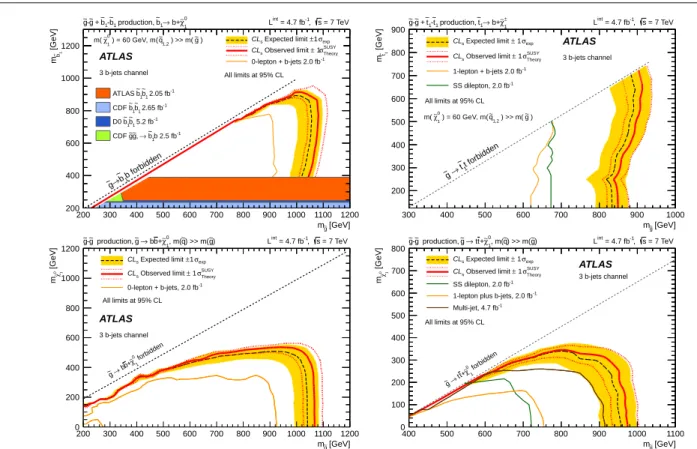
(7) 6. The ATLAS Collaboration. CLs Expected limit ± 1 σexp. 1. 1200. SUSY. CLs Observed limit ± 1σTheory. ATLAS. 0-lepton + b-jets 2.0 fb-1. 3 b-jets channel. 1000. = 4.7 fb-1, s = 7 TeV. 1. m( χ ) = 60 GeV, m( ~ q1,2 ) >> m( ~ g). int. m~t [GeV]. L. 1. ∼0. 1. mb~ [GeV]. ~ ~ ~ 0 ~ g-~ g + b1-b1 production, b1→ b+∼ χ. All limits at 95% CL. 600. SUSY. CLs Observed limit ± 1 σTheory. ~ b ~g→ b 1. 200 200. 300. 600. All limits at 95% CL. 500. ∼ ) = 60 GeV, m( ~ m( χ q1,2 ) >> m( ~ g). 400. 500. 600. 700. 800. 900 L. 1100 1200 m~g [GeV]. 300. = 4.7 fb-1, s = 7 TeV. mχ∼0 [GeV]. int. 1000. SUSY. 1. 1. n. 200. CLs Observed limit ± 1 σTheory 0-lepton + b-jets, 2.0 fb-1. 800. All limits at 95% CL. 500. 600. 700. 800 L. 1. CLs Expected limit ± 1 σexp. 700. int. 900 1000 m~g [GeV]. = 4.7 fb-1, s = 7 TeV. ATLAS. SUSY. CLs Observed limit ± 1 σTheory. 3 b-jets channel. SS dilepton, 2.0 fb-1 1-lepton plus b-jets, 2.0 fb-1 Multi-jet, 4.7 fb-1. 500. ATLAS 3 b-jets channel. All limits at 95% CL. 400 n. de. bid. r ∼0 fo +χ 1 bb. 400. 0 ~ g-~ g production, ~ g → tt +∼ χ , m(~ q) >> m(~ g). 600. 800. ~g →. 3 b-jets channel. de. ~ t for t1 ~g →. 300. f. 1. 400. ATLAS. 1. bid. CLs Expected limit ± 1 σexp. 600. = 4.7 fb-1, s = 7 TeV. 0. 0 ~ g-~ g production, ~ g → bb+∼ χ , m(~ q) >> m(~ g). 1000. int. 1-lepton + b-jets 2.0 fb-1. 400. 400. mχ∼0 [GeV]. 800. n. id orb. L. 1. CLs Expected limit ± 1 σexp. SS dilepton, 2.0 fb-1. de. 1200. ~~ ~ ± ~ g-~ g + t 1-t 1 production, t 1→ b+∼ χ. 700. ~~ ATLAS b1b1 2.05 fb-1 ~~ CDF b1b1 2.65 fb-1 ~~ D0 b1b1 5.2 fb-1 ~ CDF ~ g~ g, → b1b 2.5 fb-1. 800. 900. 300 200. 200. ~g →. n. de. bid. r ∼χ0 fo t t+ 1. 100. 0 200. 300. 400. 500. 600. 700. 800. 900. 1000. 1100 1200 m~g [GeV]. 0 400. 500. 600. 700. 800. 900. 1000 1100 m~g [GeV]. Fig. 2 Exclusion limits in the (mg̃ , mb̃ ) plane for the gluino-sbottom model (top left), in the (mg̃ , mt̃ ) plane for the 1. 1. gluino-stop model (top right) and in the (mg̃ , mχ̃01 ) plane for the Gbb (bottom left) and Gtt (bottom right) models. The dashed black and solid bold red lines show the 95% CL expected and observed limits respectively, including all uncertainties except the theoretical signal cross-section uncertainty. The shaded (yellow) bands around the expected limits show the impact of the experimental uncertainties while the dotted red lines show the impact on the observed limit of the variation of the nominal signal cross-section by 1σ theoretical uncertainty. Also shown for reference are the previous CDF [44, 45], D0 [46] and ATLAS [19, 42, 47, 48] analyses.. ics of the decay and the exclusion limits are presented in the (mg̃ , mχ̃0 ) plane. 1. The SR4 regions are mostly sensitive to the SUSY models where sbottom production dominates, whilst the SR6 regions are used to set exclusion limits in models characterised by on-shell or off-shell stop production, where top-enriched final states are expected. The signal region with the best expected sensitivity at each point in the parameter space is used to derive the limits at 95% CL. Signal cross-sections are calculated to nextto-leading order in the strong coupling constant, including the resummation of soft gluon emission at next-toleading-logarithmic accuracy (NLO+NLL) [49–53]. The SUSY nominal cross-section and the uncertainty σTheory are taken from an envelope of cross-section predictions using different PDF sets and factorisation and renormalisation scales, as described in Ref. [54]. All detectorrelated systematic uncertainties are treated as fully correlated between signal and backgrounds. In the Gbb scenario, the impact of initial-state radiation (ISR) is expected to be large in the region with low mg̃ − mχ̃01. due to the small signal acceptance. Therefore, an uncertainty on the modelling of ISR is assessed by comparing the signal acceptance obtained with the Herwig++ samples to the one obtained with dedicated MADGRAPH samples generated with additional jets. This uncertainty varies from 4% to 35% as a function of mg̃ − mχ̃01 and SUSY is included in the ±1σTheory band. The expected and observed 95% CL exclusion limits in the four models considered above are shown in Figure 2. In the gluino-sbottom model, gluino masses below 1000 GeV are excluded for sbottom masses up to SUSY about 870 GeV using the most conservative −1σTheory hypothesis. This extends by approximatively 100 GeV the limits derived in the same scenario by the previous ATLAS analysis performed with 2 fb−1 [19] and is complementary to the ATLAS search for direct sbottom pair production, also carried out with 2 fb−1 [47]. The exclusion is less stringent in the region with low mg̃ − mb̃ , where softer jets are expected. Because of 1 the kinematic cuts applied, the limits depend on the neutralino mass assumption for low mass splitting be-.
(8) Search for top and bottom squarks in final states with missing transverse energy and at least three b-jets. tween the sbottom and the neutralino as shown for the Gbb model where gluino masses below 1020 GeV are excluded for neutralino masses up to about 400 GeV, improving the previous ATLAS limits [19] by approximatively 100 GeV. In the gluino-stop model, gluino masses below 820 GeV are excluded for stop masses up to 640 GeV, extending the previous ATLAS limits [19, 42] by approximatively 150 GeV. In the Gtt model, gluino masses below 940 GeV are excluded for mχ̃01 < 50 GeV while neutralino masses below 320 GeV are excluded for mg̃ = 800 GeV. This search extends the exclusion limits on the gluino mass from the ATLAS multi-jet analysis carried out with the same data set [48] and from the CMS same-sign dilepton analysis performed with 5 fb−1 [20] by approximatively 60 GeV and 130 GeV, respectively, for neutralino masses below 100 GeV. In the region with low mg̃ − mχ̃01 , the limits obtained with the CMS analysis are most stringent due to the softer kinematic cuts.. NSC, Taiwan; TAEK, Turkey; STFC, the Royal Society and Leverhulme Trust, United Kingdom; DOE and NSF, United States of America. The crucial computing support from all WLCG partners is acknowledged gratefully, in particular from CERN and the ATLAS Tier-1 facilities at TRIUMF (Canada), NDGF (Denmark, Norway, Sweden), CC-IN2P3 (France), KIT/GridKA (Germany), INFN-CNAF (Italy), NL-T1 (Netherlands), PIC (Spain), ASGC (Taiwan), RAL (UK) and BNL (USA) and in the Tier-2 facilities worldwide.. References. 1. 2. 3. 4. 5. 6. 7. 8. In summary, this letter presents results from a search 9. for top and bottom squarks in the decay of gluino pairs 10. √ produced in pp collisions at s = 7 TeV, based on 11. 12. 4.7 fb−1 of ATLAS data. The events are selected with miss 13. large ET , four or six jets and at least three jets orig14. inating from b-quarks in the final state. The results are 15. in agreement with the SM background prediction and 16. 17. translate into 95% CL upper limits on excluded masses for a variety of SUSY benchmark scenarios. Gluino masses 18.. up to 1 TeV are excluded, depending on the model, which significantly extends the previous results. We thank CERN for the very successful operation of the LHC, as well as the support staff from our institutions without whom ATLAS could not be operated efficiently. We acknowledge the support of ANPCyT, Argentina; YerPhI, Armenia; ARC, Australia; BMWF, Austria; ANAS, Azerbaijan; SSTC, Belarus; CNPq and FAPESP, Brazil; NSERC, NRC and CFI, Canada; CERN; CONICYT, Chile; CAS, MOST and NSFC, China; COLCIENCIAS, Colombia; MSMT CR, MPO CR and VSC CR, Czech Republic; DNRF, DNSRC and Lundbeck Foundation, Denmark; ARTEMIS, European Union; IN2P3-CNRS, CEA-DSM/IRFU, France; GNAS, Georgia; BMBF, DFG, HGF, MPG and AvH Foundation, Germany; GSRT, Greece; ISF, MINERVA, GIF, DIP and Benoziyo Center, Israel; INFN, Italy; MEXT and JSPS, Japan; CNRST, Morocco; FOM and NWO, Netherlands; RCN, Norway; MNiSW, Poland; GRICES and FCT, Portugal; MERYS (MECTS), Romania; MES of Russia and ROSATOM, Russian Federation; JINR; MSTD, Serbia; MSSR, Slovakia; ARRS and MVZT, Slovenia; DST/NRF, South Africa; MICINN, Spain; SRC and Wallenberg Foundation, Sweden; SER, SNSF and Cantons of Bern and Geneva, Switzerland;. 7. 19. 20. 21. 22. 23. 24. 25. 26. 27. 28. 29. 30. 31. 32. 33. 34. 35. 36. 37. 38. 39. 40. 41.. H. Miyazawa, Prog. Theor. Phys. 36 (6), 1266 (1966). P. Ramond, Phys. Rev. D 3, 2415 (1971). Y. Golfand and E. Likhtman, JETP Lett. 13, 323 (1971). A. Neveu and J.H. Schwarz, Nucl. Phys. B 31, 86 (1971). A. Neveu and J.H. Schwarz, Phys. Rev. D 4, 1109 (1971). J. Gervais and B. Sakita, Nucl. Phys. B 34, 632 (1971). D. Volkov and V. Akulov, Phys. Lett. B 46, 109 (1973). J. Wess and B. Zumino, Phys. Lett. B 49, 52 (1974). J. Wess and B. Zumino, Nucl. Phys. B 70, 39 (1974). S. Weinberg, Phys. Rev. D 13, 974 (1976). E. Gildener, Phys. Rev. D 14, 1667 (1976). S. Weinberg, Phys. Rev. D 19, 1277 (1979). L. Susskind, Phys. Rev. D 20, 2619 (1979). P. Fayet, Phys. Lett. B 64, 159 (1976). P. Fayet, Phys. Lett. B 69, 489 (1977). G.R. Farrar and P. Fayet, Phys. Lett. B 76, 575 (1978). P. Fayet, Phys. Lett. B 84, 416 (1979). S. Dimopoulos and H. Georgi, Nucl. Phys. B 193, 150 (1981). ATLAS Collaboration, Phys. Rev. D 85, 112006 (2012), arXiv:1203.6193 [hep-ex]. CMS Collaboration, arXiv:1205.3933 [hep-ex] (2012), submitted to J. High Energy Phys. ATLAS Collaboration, J. Instrum. 3, S08003 (2008). M. Mangano et al., J. High Energy Phys. 07, 001 (2003). J. Pumplin et al., J. High Energy Phys. 07, 012 (2002). S. Frixione and B. Webber, arXiv:0601192 [hep-ph] (2006). P.M. Nadolsky et al., Phys. Rev. D 78, 013004 (2008). G. Corcella et al., J. High Energy Phys. 01, 010 (2001). G. Corcella et al., arXiv:0210213 [hep-ph] (2002). J. Butterworth et al., Z. Phys. C 72, 637 (1996). J. Alwall et al., J. High Energy Phys. 06, 128 (2011). T. Sjöstrand et al., J. High Energy Phys. 0605, 026 (2006). M. Bahr et al., Eur. Phys. J. C 58, 639 (2008). ATLAS Collaboration, Eur. Phys. J. C 70, 823 (2010). S. Agostinelli et al., Nucl. Instrum. Meth. A 506, 250 (2003). M. Cacciari et al., J. High Energy Phys. 04, 063 (2008). M. Cacciari and G. Salam, Phys. Lett. B 641(1), 57 (2006). ATLAS Collaboration, arXiv:1112.6426 [hep-ex] (2011), submitted to Eur. Phys. J. C. ATLAS Collaboration, ATLAS-CONF-2012-043 (2012). ATLAS Collaboration, ATLAS-CONF-2012-039 (2012). ATLAS Collaboration, ATLAS-CONF-2012-040 (2012). ATLAS Collaboration, Eur. Phys. J. C 72, 1909 (2012), arXiv:1110.3174 [hep-ex]. ATLAS Collaboration, to be published..
(9) 8 42. ATLAS Collaboration, Phys. Rev. Lett. 108, 241802 (2012), arXiv:1203.5763 [hep-ex]. 43. G. Cowan et al., Eur. Phys. J. C 71, 1554 (2011). 44. Aaltonen, T. et al. CDF Collaboration, Phys. Rev. Lett. 102, 221801 (2009). 45. CDF Collaboration, Phys. Rev. Lett. 105, 081802 (2010). 46. D0 Collaboration, Phys. Lett. B 693, 95 (2010). 47. ATLAS Collaboration, Phys. Rev. Lett. 108, 181802 (2012), arXiv:1112.3832 [hep-ex]. 48. ATLAS Collaboration, arXiv:1206.1760 [hep-ex] (2012), submitted to J. High Energy Phys. 49. W. Beenakker et al., Nucl. Phys. B 492, 51 (1997). 50. A. Kulesza and L. Motyka, Phys. Rev. Lett. 102, 111802 (2009). 51. A. Kulesza and L. Motyka, Phys. Rev. D 80, 095004 (2009). 52. W. Beenakker et al., J. High Energy Phys. 0912, 041 (2009). 53. W. Beenakker et al., Int. J. Mod. Phys. A 26, 2637 (2011). 54. M. Kramer et al., arXiv:1206.2892 [hep-ph] (2012).. The ATLAS Collaboration.
(10) Search for top and bottom squarks in final states with missing transverse energy and at least three b-jets. 9. The ATLAS Collaboration G. Aad47 , T. Abajyan20 , B. Abbott110 , J. Abdallah11 , S. Abdel Khalek114 , A.A. Abdelalim48 , O. Abdinov10 , R. Aben104 , B. Abi111 , M. Abolins87 , O.S. AbouZeid157 , H. Abramowicz152 , H. Abreu135 , E. Acerbi88a,88b , B.S. Acharya163a,163b, L. Adamczyk37 , D.L. Adams24 , T.N. Addy55 , J. Adelman175 , S. Adomeit97 , P. Adragna74, T. Adye128 , S. Aefsky22 , J.A. Aguilar-Saavedra123b,a , M. Agustoni16 , M. Aharrouche80, S.P. Ahlen21 , F. Ahles47 , A. Ahmad147 , M. Ahsan40 , G. Aielli132a,132b , T. Akdogan18a , T.P.A. Åkesson78 , G. Akimoto154 , A.V. Akimov93 , M.S. Alam1 , M.A. Alam75 , J. Albert168 , S. Albrand54 , M. Aleksa29 , I.N. Aleksandrov63 , F. Alessandria88a , C. Alexa25a , G. Alexander152 , G. Alexandre48 , T. Alexopoulos9 , M. Alhroob163a,163c , M. Aliev15 , G. Alimonti88a , J. Alison119 , B.M.M. Allbrooke17 , P.P. Allport72 , S.E. Allwood-Spiers52 , J. Almond81 , A. Aloisio101a,101b , R. Alon171 , A. Alonso78 , F. Alonso69 , B. Alvarez Gonzalez87 , M.G. Alviggi101a,101b , K. Amako64 , C. Amelung22 , V.V. Ammosov127,∗ , A. Amorim123a,b , N. Amram152 , C. Anastopoulos29 , L.S. Ancu16 , N. Andari114 , T. Andeen34 , C.F. Anders57b , G. Anders57a , K.J. Anderson30 , A. Andreazza88a,88b, V. Andrei57a , X.S. Anduaga69 , P. Anger43 , A. Angerami34 , F. Anghinolfi29 , A. Anisenkov106 , N. Anjos123a , A. Annovi46 , A. Antonaki8 , M. Antonelli46 , A. Antonov95 , J. Antos143b , F. Anulli131a , M. Aoki100 , S. Aoun82 , L. Aperio Bella4 , R. Apolle117,c , G. Arabidze87 , I. Aracena142 , Y. Arai64 , A.T.H. Arce44 , S. Arfaoui147 , J-F. Arguin14 , E. Arik18a,∗ , M. Arik18a , A.J. Armbruster86 , O. Arnaez80 , V. Arnal79 , C. Arnault114 , A. Artamonov94 , G. Artoni131a,131b , D. Arutinov20 , S. Asai154 , R. Asfandiyarov172, S. Ask27 , B. Åsman145a,145b , L. Asquith5 , K. Assamagan24 , A. Astbury168 , B. Aubert4 , E. Auge114 , K. Augsten126 , M. Aurousseau144a , G. Avolio162 , R. Avramidou9 , D. Axen167 , G. Azuelos92,d , Y. Azuma154 , M.A. Baak29, G. Baccaglioni88a , C. Bacci133a,133b , A.M. Bach14 , H. Bachacou135 , K. Bachas29, M. Backes48, M. Backhaus20, E. Badescu25a , P. Bagnaia131a,131b, S. Bahinipati2 , Y. Bai32a , D.C. Bailey157 , T. Bain157 , J.T. Baines128 , O.K. Baker175 , M.D. Baker24 , S. Baker76 , E. Banas38 , P. Banerjee92 , Sw. Banerjee172 , D. Banfi29 , A. Bangert149 , V. Bansal168 , H.S. Bansil17 , L. Barak171 , S.P. Baranov93, A. Barbaro Galtieri14 , T. Barber47 , E.L. Barberio85 , D. Barberis49a,49b , M. Barbero20 , D.Y. Bardin63 , T. Barillari98, M. Barisonzi174 , T. Barklow142, N. Barlow27, B.M. Barnett128 , R.M. Barnett14 , A. Baroncelli133a , G. Barone48 , A.J. Barr117, F. Barreiro79, J. Barreiro Guimarães da Costa56 , P. Barrillon114 , R. Bartoldus142 , A.E. Barton70 , V. Bartsch148 , R.L. Bates52 , L. Batkova143a, J.R. Batley27 , A. Battaglia16 , M. Battistin29 , F. Bauer135 , H.S. Bawa142,e , S. Beale97 , T. Beau77 , P.H. Beauchemin160 , R. Beccherle49a , P. Bechtle20 , H.P. Beck16 , A.K. Becker174 , S. Becker97 , M. Beckingham137 , K.H. Becks174 , A.J. Beddall18c , A. Beddall18c , S. Bedikian175 , V.A. Bednyakov63, C.P. Bee82 , L.J. Beemster104 , M. Begel24 , S. Behar Harpaz151 , M. Beimforde98 , C. Belanger-Champagne84, P.J. Bell48 , W.H. Bell48 , G. Bella152 , L. Bellagamba19a, F. Bellina29 , M. Bellomo29 , A. Belloni56 , O. Beloborodova106,f , K. Belotskiy95 , O. Beltramello29 , O. Benary152 , D. Benchekroun134a , K. Bendtz145a,145b , N. Benekos164 , Y. Benhammou152 , E. Benhar Noccioli48 , J.A. Benitez Garcia158b , D.P. Benjamin44 , M. Benoit114 , J.R. Bensinger22 , K. Benslama129 , S. Bentvelsen104 , D. Berge29 , E. Bergeaas Kuutmann41 , N. Berger4, F. Berghaus168, E. Berglund104 , J. Beringer14 , P. Bernat76 , R. Bernhard47 , C. Bernius24 , T. Berry75 , C. Bertella82 , A. Bertin19a,19b , F. Bertolucci121a,121b , M.I. Besana88a,88b , G.J. Besjes103 , N. Besson135 , S. Bethke98 , W. Bhimji45 , R.M. Bianchi29 , M. Bianco71a,71b , O. Biebel97 , S.P. Bieniek76 , K. Bierwagen53, J. Biesiada14 , M. Biglietti133a , H. Bilokon46 , M. Bindi19a,19b , S. Binet114 , A. Bingul18c , C. Bini131a,131b , C. Biscarat177 , U. Bitenc47 , K.M. Black21 , R.E. Blair5 , J.-B. Blanchard135 , G. Blanchot29 , T. Blazek143a , C. Blocker22, J. Blocki38 , A. Blondel48 , W. Blum80 , U. Blumenschein53 , G.J. Bobbink104 , V.B. Bobrovnikov106, S.S. Bocchetta78 , A. Bocci44 , C.R. Boddy117 , M. Boehler47 , J. Boek174 , N. Boelaert35 , J.A. Bogaerts29, A. Bogdanchikov106, A. Bogouch89,∗ , C. Bohm145a , J. Bohm124 , V. Boisvert75 , T. Bold37 , V. Boldea25a , N.M. Bolnet135 , M. Bomben77 , M. Bona74 , M. Boonekamp135 , C.N. Booth138 , S. Bordoni77 , C. Borer16, A. Borisov127, G. Borissov70, I. Borjanovic12a, M. Borri81, S. Borroni86, V. Bortolotto133a,133b , K. Bos104 , D. Boscherini19a , M. Bosman11 , H. Boterenbrood104, J. Bouchami92 , J. Boudreau122 , E.V. Bouhova-Thacker70, D. Boumediene33 , C. Bourdarios114, N. Bousson82 , A. Boveia30, J. Boyd29 , I.R. Boyko63, I. Bozovic-Jelisavcic12b, J. Bracinik17 , P. Branchini133a , A. Brandt7 , G. Brandt117 , O. Brandt53 , U. Bratzler155 , B. Brau83 , J.E. Brau113 , H.M. Braun174,∗ , S.F. Brazzale163a,163c , B. Brelier157 , J. Bremer29 , K. Brendlinger119 , R. Brenner165 , S. Bressler171, D. Britton52 , F.M. Brochu27 , I. Brock20, R. Brock87 , F. Broggi88a, C. Bromberg87 , J. Bronner98 , G. Brooijmans34 , T. Brooks75 , W.K. Brooks31b, G. Brown81 , H. Brown7 , P.A. Bruckman de Renstrom38 , D. Bruncko143b, R. Bruneliere47 , S. Brunet59 , A. Bruni19a , G. Bruni19a , M. Bruschi19a , T. Buanes13 , Q. Buat54 , F. Bucci48 , J. Buchanan117 , P. Buchholz140 , R.M. Buckingham117 , A.G. Buckley45 , S.I. Buda25a , I.A. Budagov63,.
(11) 10. The ATLAS Collaboration. B. Budick107 , V. Büscher80 , L. Bugge116 , O. Bulekov95 , A.C. Bundock72 , M. Bunse42 , T. Buran116 , H. Burckhart29 , S. Burdin72 , T. Burgess13, S. Burke128 , E. Busato33 , P. Bussey52 , C.P. Buszello165 , B. Butler142 , J.M. Butler21 , C.M. Buttar52 , J.M. Butterworth76 , W. Buttinger27 , S. Cabrera Urbán166 , D. Caforio19a,19b, O. Cakir3a , P. Calafiura14, G. Calderini77 , P. Calfayan97 , R. Calkins105 , L.P. Caloba23a , R. Caloi131a,131b , D. Calvet33 , S. Calvet33 , R. Camacho Toro33 , P. Camarri132a,132b , D. Cameron116 , L.M. Caminada14 , S. Campana29 , M. Campanelli76 , V. Canale101a,101b , F. Canelli30,g , A. Canepa158a , J. Cantero79 , R. Cantrill75 , L. Capasso101a,101b, M.D.M. Capeans Garrido29 , I. Caprini25a , M. Caprini25a , D. Capriotti98 , M. Capua36a,36b , R. Caputo80 , R. Cardarelli132a , T. Carli29 , G. Carlino101a , L. Carminati88a,88b , B. Caron84 , S. Caron103 , E. Carquin31b , G.D. Carrillo Montoya172 , A.A. Carter74 , J.R. Carter27 , J. Carvalho123a,h , D. Casadei107 , M.P. Casado11 , M. Cascella121a,121b , C. Caso49a,49b,∗ , A.M. Castaneda Hernandez172,i , E. Castaneda-Miranda172, V. Castillo Gimenez166 , N.F. Castro123a , G. Cataldi71a , P. Catastini56 , A. Catinaccio29 , J.R. Catmore29 , A. Cattai29 , G. Cattani132a,132b , S. Caughron87 , P. Cavalleri77 , D. Cavalli88a , M. Cavalli-Sforza11, V. Cavasinni121a,121b , F. Ceradini133a,133b , A.S. Cerqueira23b, A. Cerri29 , L. Cerrito74 , F. Cerutti46 , S.A. Cetin18b , A. Chafaq134a , D. Chakraborty105, I. Chalupkova125 , K. Chan2 , B. Chapleau84 , J.D. Chapman27 , J.W. Chapman86 , E. Chareyre77, D.G. Charlton17 , V. Chavda81 , C.A. Chavez Barajas29, S. Cheatham84 , S. Chekanov5 , S.V. Chekulaev158a , G.A. Chelkov63 , M.A. Chelstowska103 , C. Chen62 , H. Chen24 , S. Chen32c , X. Chen172 , Y. Chen34 , A. Cheplakov63 , R. Cherkaoui El Moursli134e , V. Chernyatin24 , E. Cheu6 , S.L. Cheung157 , L. Chevalier135 , G. Chiefari101a,101b , L. Chikovani50a,∗ , J.T. Childers29 , A. Chilingarov70 , G. Chiodini71a , A.S. Chisholm17 , R.T. Chislett76 , A. Chitan25a , M.V. Chizhov63 , G. Choudalakis30 , S. Chouridou136 , I.A. Christidi76 , A. Christov47 , D. Chromek-Burckhart29, M.L. Chu150 , J. Chudoba124 , G. Ciapetti131a,131b , A.K. Ciftci3a , R. Ciftci3a , D. Cinca33 , V. Cindro73 , C. Ciocca19a,19b , A. Ciocio14 , M. Cirilli86 , P. Cirkovic12b, M. Citterio88a , M. Ciubancan25a , A. Clark48 , P.J. Clark45 , R.N. Clarke14 , W. Cleland122 , J.C. Clemens82 , B. Clement54 , C. Clement145a,145b , Y. Coadou82 , M. Cobal163a,163c , A. Coccaro137, J. Cochran62 , J.G. Cogan142 , J. Coggeshall164, E. Cogneras177 , J. Colas4 , S. Cole105 , A.P. Colijn104 , N.J. Collins17 , C. Collins-Tooth52 , J. Collot54 , T. Colombo118a,118b , G. Colon83 , P. Conde Muiño123a , E. Coniavitis117 , M.C. Conidi11 , S.M. Consonni88a,88b , V. Consorti47 , S. Constantinescu25a , C. Conta118a,118b , G. Conti56 , F. Conventi101a,j , M. Cooke14 , B.D. Cooper76 , A.M. Cooper-Sarkar117, K. Copic14 , T. Cornelissen174 , M. Corradi19a , F. Corriveau84,k , A. Cortes-Gonzalez164, G. Cortiana98, G. Costa88a , M.J. Costa166 , D. Costanzo138 , T. Costin30 , D. Côté29 , L. Courneyea168, G. Cowan75, C. Cowden27 , B.E. Cox81 , K. Cranmer107 , F. Crescioli121a,121b , M. Cristinziani20 , G. Crosetti36a,36b , S. Crépé-Renaudin54, C.-M. Cuciuc25a , C. Cuenca Almenar175 , T. Cuhadar Donszelmann138 , M. Curatolo46 , C.J. Curtis17 , C. Cuthbert149 , P. Cwetanski59 , H. Czirr140 , P. Czodrowski43 , Z. Czyczula175 , S. D’Auria52 , M. D’Onofrio72 , A. D’Orazio131a,131b, M.J. Da Cunha Sargedas De Sousa123a , C. Da Via81 , W. Dabrowski37 , A. Dafinca117 , T. Dai86 , C. Dallapiccola83 , M. Dam35 , M. Dameri49a,49b , D.S. Damiani136 , H.O. Danielsson29 , V. Dao48 , G. Darbo49a , G.L. Darlea25b , J.A. Dassoulas41, W. Davey20 , T. Davidek125 , N. Davidson85 , R. Davidson70 , E. Davies117,c , M. Davies92 , O. Davignon77 , A.R. Davison76 , Y. Davygora57a, E. Dawe141 , I. Dawson138 , R.K. Daya-Ishmukhametova22, K. De7 , R. de Asmundis101a , S. De Castro19a,19b , S. De Cecco77 , J. de Graat97 , N. De Groot103 , P. de Jong104 , C. De La Taille114 , H. De la Torre79 , F. De Lorenzi62 , L. de Mora70 , L. De Nooij104 , D. De Pedis131a , A. De Salvo131a , U. De Sanctis163a,163c , A. De Santo148 , J.B. De Vivie De Regie114 , G. De Zorzi131a,131b , W.J. Dearnaley70 , R. Debbe24 , C. Debenedetti45 , B. Dechenaux54 , D.V. Dedovich63 , J. Degenhardt119 , C. Del Papa163a,163c , J. Del Peso79 , T. Del Prete121a,121b , T. Delemontex54 , M. Deliyergiyev73, A. Dell’Acqua29 , L. Dell’Asta21 , M. Della Pietra101a,j , D. della Volpe101a,101b , M. Delmastro4 , P.A. Delsart54 , C. Deluca104 , S. Demers175 , M. Demichev63 , B. Demirkoz11,l , J. Deng162 , S.P. Denisov127 , D. Derendarz38 , J.E. Derkaoui134d , F. Derue77 , P. Dervan72 , K. Desch20 , E. Devetak147 , P.O. Deviveiros104 , A. Dewhurst128 , B. DeWilde147 , S. Dhaliwal157 , R. Dhullipudi24 ,m , A. Di Ciaccio132a,132b , L. Di Ciaccio4 , A. Di Girolamo29 , B. Di Girolamo29 , S. Di Luise133a,133b , A. Di Mattia172 , B. Di Micco29 , R. Di Nardo46 , A. Di Simone132a,132b , R. Di Sipio19a,19b , M.A. Diaz31a , E.B. Diehl86 , J. Dietrich41 , T.A. Dietzsch57a , S. Diglio85 , K. Dindar Yagci39 , J. Dingfelder20 , F. Dinut25a , C. Dionisi131a,131b , P. Dita25a , S. Dita25a , F. Dittus29 , F. Djama82 , T. Djobava50b , M.A.B. do Vale23c , A. Do Valle Wemans123a,n , T.K.O. Doan4 , M. Dobbs84 , R. Dobinson29,∗ , D. Dobos29 , E. Dobson29,o , J. Dodd34 , C. Doglioni48 , T. Doherty52 , Y. Doi64,∗ , J. Dolejsi125 , I. Dolenc73 , Z. Dolezal125 , B.A. Dolgoshein95,∗ , T. Dohmae154 , M. Donadelli23d , J. Donini33 , J. Dopke29 , A. Doria101a , A. Dos Anjos172 , A. Dotti121a,121b , M.T. Dova69 , A.D. Doxiadis104 , A.T. Doyle52 , M. Dris9 , J. Dubbert98 , S. Dube14 , E. Duchovni171 , G. Duckeck97 , A. Dudarev29 , F. Dudziak62 , M. Dührssen29 , I.P. Duerdoth81 , L. Duflot114 ,.
(12) Search for top and bottom squarks in final states with missing transverse energy and at least three b-jets. 11. M-A. Dufour84 , L. Duguid75 , M. Dunford29 , H. Duran Yildiz3a , R. Duxfield138 , M. Dwuznik37 , F. Dydak29 , M. Düren51 , J. Ebke97 , S. Eckweiler80 , K. Edmonds80 , W. Edson1 , C.A. Edwards75 , N.C. Edwards52 , W. Ehrenfeld41 , T. Eifert142 , G. Eigen13 , K. Einsweiler14, E. Eisenhandler74 , T. Ekelof165 , M. El Kacimi134c , M. Ellert165 , S. Elles4 , F. Ellinghaus80 , K. Ellis74 , N. Ellis29 , J. Elmsheuser97 , M. Elsing29 , D. Emeliyanov128, R. Engelmann147 , A. Engl97 , B. Epp60 , J. Erdmann53 , A. Ereditato16 , D. Eriksson145a , J. Ernst1 , M. Ernst24 , J. Ernwein135 , D. Errede164 , S. Errede164 , E. Ertel80 , M. Escalier114, H. Esch42 , C. Escobar122, X. Espinal Curull11 , B. Esposito46 , F. Etienne82 , A.I. Etienvre135 , E. Etzion152 , D. Evangelakou53, H. Evans59 , L. Fabbri19a,19b , C. Fabre29 , R.M. Fakhrutdinov127 , S. Falciano131a , Y. Fang172 , M. Fanti88a,88b , A. Farbin7 , A. Farilla133a , J. Farley147 , T. Farooque157 , S. Farrell162 , S.M. Farrington169 , P. Farthouat29 , P. Fassnacht29 , D. Fassouliotis8 , B. Fatholahzadeh157 , A. Favareto88a,88b , L. Fayard114 , S. Fazio36a,36b , R. Febbraro33 , P. Federic143a , O.L. Fedin120 , W. Fedorko87 , M. Fehling-Kaschek47 , L. Feligioni82 , D. Fellmann5 , C. Feng32d , E.J. Feng5 , A.B. Fenyuk127 , J. Ferencei143b , W. Fernando5 , S. Ferrag52 , J. Ferrando52 , V. Ferrara41, A. Ferrari165 , P. Ferrari104, R. Ferrari118a , D.E. Ferreira de Lima52 , A. Ferrer166 , D. Ferrere48, C. Ferretti86 , A. Ferretto Parodi49a,49b, M. Fiascaris30, F. Fiedler80 , A. Filipčič73, F. Filthaut103 , M. Fincke-Keeler168, M.C.N. Fiolhais123a,h , L. Fiorini166 , A. Firan39 , G. Fischer41 , M.J. Fisher108 , M. Flechl47 , I. Fleck140 , J. Fleckner80 , P. Fleischmann173 , S. Fleischmann174 , T. Flick174 , A. Floderus78 , L.R. Flores Castillo172 , M.J. Flowerdew98 , T. Fonseca Martin16 , A. Formica135 , A. Forti81 , D. Fortin158a , D. Fournier114 , H. Fox70 , P. Francavilla11 , M. Franchini19a,19b , S. Franchino118a,118b , D. Francis29 , T. Frank171 , S. Franz29 , M. Fraternali118a,118b , S. Fratina119 , S.T. French27 , C. Friedrich41 , F. Friedrich43 , R. Froeschl29 , D. Froidevaux29 , J.A. Frost27 , C. Fukunaga155 , E. Fullana Torregrosa29, B.G. Fulsom142 , J. Fuster166 , C. Gabaldon29 , O. Gabizon171 , T. Gadfort24 , S. Gadomski48 , G. Gagliardi49a,49b, P. Gagnon59 , C. Galea97 , E.J. Gallas117 , V. Gallo16 , B.J. Gallop128 , P. Gallus124 , K.K. Gan108 , Y.S. Gao142,e , A. Gaponenko14 , F. Garberson175 , M. Garcia-Sciveres14, C. Garcı́a166, J.E. Garcı́a Navarro166, R.W. Gardner30 , N. Garelli29 , H. Garitaonandia104, V. Garonne29 , C. Gatti46 , G. Gaudio118a , B. Gaur140 , L. Gauthier135 , P. Gauzzi131a,131b , I.L. Gavrilenko93, C. Gay167 , G. Gaycken20, E.N. Gazis9 , P. Ge32d , Z. Gecse167 , C.N.P. Gee128 , D.A.A. Geerts104 , Ch. Geich-Gimbel20 , K. Gellerstedt145a,145b , C. Gemme49a , A. Gemmell52 , M.H. Genest54 , S. Gentile131a,131b , M. George53 , S. George75 , P. Gerlach174 , A. Gershon152 , C. Geweniger57a , H. Ghazlane134b , N. Ghodbane33 , B. Giacobbe19a , S. Giagu131a,131b , V. Giakoumopoulou8 , V. Giangiobbe11 , F. Gianotti29 , B. Gibbard24 , A. Gibson157 , S.M. Gibson29 , D. Gillberg28 , A.R. Gillman128 , D.M. Gingrich2,d , J. Ginzburg152 , N. Giokaris8 , M.P. Giordani163c , R. Giordano101a,101b , F.M. Giorgi15 , P. Giovannini98 , P.F. Giraud135 , D. Giugni88a , M. Giunta92 , P. Giusti19a , B.K. Gjelsten116 , L.K. Gladilin96 , C. Glasman79 , J. Glatzer47 , A. Glazov41 , K.W. Glitza174 , G.L. Glonti63 , J.R. Goddard74 , J. Godfrey141 , J. Godlewski29 , M. Goebel41 , T. Göpfert43 , C. Goeringer80, C. Gössling42 , S. Goldfarb86 , T. Golling175 , A. Gomes123a,b , L.S. Gomez Fajardo41 , R. Gonçalo75 , J. Goncalves Pinto Firmino Da Costa41 , L. Gonella20 , S. Gonzalez172 , S. González de la Hoz166 , G. Gonzalez Parra11, M.L. Gonzalez Silva26 , S. Gonzalez-Sevilla48 , J.J. Goodson147 , L. Goossens29 , P.A. Gorbounov94, H.A. Gordon24 , I. Gorelov102 , G. Gorfine174 , B. Gorini29 , E. Gorini71a,71b , A. Gorišek73, E. Gornicki38 , B. Gosdzik41 , A.T. Goshaw5 , M. Gosselink104 , M.I. Gostkin63 , I. Gough Eschrich162 , M. Gouighri134a , D. Goujdami134c , M.P. Goulette48 , A.G. Goussiou137 , C. Goy4 , S. Gozpinar22 , I. Grabowska-Bold37, P. Grafström19a,19b , K-J. Grahn41 , F. Grancagnolo71a, S. Grancagnolo15, V. Grassi147 , V. Gratchev120 , N. Grau34 , H.M. Gray29 , J.A. Gray147 , E. Graziani133a , O.G. Grebenyuk120 , T. Greenshaw72 , Z.D. Greenwood24,m , K. Gregersen35, I.M. Gregor41, P. Grenier142 , J. Griffiths137 , N. Grigalashvili63 , A.A. Grillo136 , S. Grinstein11 , Y.V. Grishkevich96 , J.-F. Grivaz114 , E. Gross171 , J. Grosse-Knetter53, J. Groth-Jensen171 , K. Grybel140 , D. Guest175 , C. Guicheney33 , S. Guindon53 , U. Gul52 , H. Guler84,p , J. Gunther124 , B. Guo157 , J. Guo34 , P. Gutierrez110 , N. Guttman152 , O. Gutzwiller172 , C. Guyot135 , C. Gwenlan117 , C.B. Gwilliam72 , A. Haas142 , S. Haas29 , C. Haber14 , H.K. Hadavand39 , D.R. Hadley17 , P. Haefner20 , F. Hahn29 , S. Haider29 , Z. Hajduk38 , H. Hakobyan176, D. Hall117 , J. Haller53 , K. Hamacher174 , P. Hamal112 , M. Hamer53 , A. Hamilton144b,q , S. Hamilton160 , L. Han32b , K. Hanagaki115 , K. Hanawa159 , M. Hance14 , C. Handel80 , P. Hanke57a , J.R. Hansen35 , J.B. Hansen35 , J.D. Hansen35 , P.H. Hansen35 , P. Hansson142 , K. Hara159 , G.A. Hare136 , T. Harenberg174 , S. Harkusha89 , D. Harper86 , R.D. Harrington45 , O.M. Harris137 , J. Hartert47 , F. Hartjes104 , T. Haruyama64 , A. Harvey55, S. Hasegawa100, Y. Hasegawa139, S. Hassani135 , S. Haug16 , M. Hauschild29 , R. Hauser87 , M. Havranek20, C.M. Hawkes17 , R.J. Hawkings29 , A.D. Hawkins78 , D. Hawkins162 , T. Hayakawa65, T. Hayashi159 , D. Hayden75 , C.P. Hays117 , H.S. Hayward72, S.J. Haywood128 , M. He32d , S.J. Head17 , V. Hedberg78 , L. Heelan7 , S. Heim87 , B. Heinemann14 ,.
(13) 12. The ATLAS Collaboration. S. Heisterkamp35 , L. Helary21 , C. Heller97 , M. Heller29 , S. Hellman145a,145b , D. Hellmich20 , C. Helsens11 , R.C.W. Henderson70 , M. Henke57a , A. Henrichs53 , A.M. Henriques Correia29, S. Henrot-Versille114 , C. Hensel53 , T. Henß174 , C.M. Hernandez7 , Y. Hernández Jiménez166 , R. Herrberg15, G. Herten47 , R. Hertenberger97 , L. Hervas29 , G.G. Hesketh76 , N.P. Hessey104 , E. Higón-Rodriguez166 , J.C. Hill27 , K.H. Hiller41 , S. Hillert20 , S.J. Hillier17 , I. Hinchliffe14 , E. Hines119 , M. Hirose115 , F. Hirsch42 , D. Hirschbuehl174 , J. Hobbs147 , N. Hod152 , M.C. Hodgkinson138 , P. Hodgson138 , A. Hoecker29, M.R. Hoeferkamp102 , J. Hoffman39 , D. Hoffmann82 , M. Hohlfeld80 , M. Holder140 , S.O. Holmgren145a , T. Holy126 , J.L. Holzbauer87 , T.M. Hong119 , L. Hooft van Huysduynen107 , C. Horn142 , S. Horner47 , J-Y. Hostachy54 , S. Hou150 , A. Hoummada134a , J. Howard117 , J. Howarth81 , I. Hristova15 , J. Hrivnac114 , T. Hryn’ova4 , P.J. Hsu80 , S.-C. Hsu14 , Z. Hubacek126 , F. Hubaut82 , F. Huegging20 , A. Huettmann41 , T.B. Huffman117 , E.W. Hughes34 , G. Hughes70 , M. Huhtinen29 , M. Hurwitz14 , U. Husemann41 , N. Huseynov63,r , J. Huston87 , J. Huth56 , G. Iacobucci48 , G. Iakovidis9, M. Ibbotson81 , I. Ibragimov140 , L. Iconomidou-Fayard114, J. Idarraga114, P. Iengo101a , O. Igonkina104 , Y. Ikegami64 , M. Ikeno64 , D. Iliadis153 , N. Ilic157 , T. Ince20 , J. Inigo-Golfin29 , P. Ioannou8 , M. Iodice133a , K. Iordanidou8 , V. Ippolito131a,131b , A. Irles Quiles166 , C. Isaksson165 , M. Ishino66 , M. Ishitsuka156 , R. Ishmukhametov39 , C. Issever117 , S. Istin18a , A.V. Ivashin127 , W. Iwanski38 , H. Iwasaki64 , J.M. Izen40 , V. Izzo101a , B. Jackson119, J.N. Jackson72, P. Jackson142 , M.R. Jaekel29 , V. Jain59 , K. Jakobs47, S. Jakobsen35, T. Jakoubek124 , J. Jakubek126 , D.K. Jana110 , E. Jansen76 , H. Jansen29 , A. Jantsch98 , M. Janus47 , G. Jarlskog78, L. Jeanty56 , I. Jen-La Plante30 , D. Jennens85 , P. Jenni29 , P. Jež35 , S. Jézéquel4, M.K. Jha19a , H. Ji172 , W. Ji80 , J. Jia147 , Y. Jiang32b , M. Jimenez Belenguer41 , S. Jin32a , O. Jinnouchi156 , M.D. Joergensen35, D. Joffe39 , M. Johansen145a,145b , K.E. Johansson145a , P. Johansson138, S. Johnert41 , K.A. Johns6 , K. Jon-And145a,145b , G. Jones169 , R.W.L. Jones70 , T.J. Jones72 , C. Joram29, P.M. Jorge123a , K.D. Joshi81 , J. Jovicevic146 , T. Jovin12b, X. Ju172 , C.A. Jung42 , R.M. Jungst29 , V. Juranek124 , P. Jussel60 , A. Juste Rozas11 , S. Kabana16, M. Kaci166 , A. Kaczmarska38, P. Kadlecik35 , M. Kado114 , H. Kagan108, M. Kagan56, E. Kajomovitz151 , S. Kalinin174 , L.V. Kalinovskaya63, S. Kama39 , N. Kanaya154, M. Kaneda29 , S. Kaneti27 , T. Kanno156 , V.A. Kantserov95, J. Kanzaki64 , B. Kaplan175 , A. Kapliy30 , J. Kaplon29 , D. Kar52 , M. Karagounis20, K. Karakostas9, M. Karnevskiy41, V. Kartvelishvili70, A.N. Karyukhin127 , L. Kashif172 , G. Kasieczka57b, R.D. Kass108 , A. Kastanas13, M. Kataoka4, Y. Kataoka154, E. Katsoufis9 , J. Katzy41 , V. Kaushik6 , K. Kawagoe68, T. Kawamoto154, G. Kawamura80, M.S. Kayl104 , V.A. Kazanin106 , M.Y. Kazarinov63, R. Keeler168 , R. Kehoe39 , M. Keil53 , G.D. Kekelidze63 , J.S. Keller137 , M. Kenyon52 , O. Kepka124 , N. Kerschen29 , B.P. Kerševan73, S. Kersten174 , K. Kessoku154, J. Keung157 , F. Khalil-zada10, H. Khandanyan164, A. Khanov111 , D. Kharchenko63, A. Khodinov95 , A. Khomich57a , T.J. Khoo27 , G. Khoriauli20 , A. Khoroshilov174, V. Khovanskiy94 , E. Khramov63, J. Khubua50b , H. Kim145a,145b , S.H. Kim159 , N. Kimura170 , O. Kind15 , B.T. King72 , M. King65 , R.S.B. King117 , J. Kirk128 , A.E. Kiryunin98 , T. Kishimoto65 , D. Kisielewska37 , T. Kitamura65 , T. Kittelmann122 , E. Kladiva143b , M. Klein72 , U. Klein72 , K. Kleinknecht80 , M. Klemetti84 , A. Klier171 , P. Klimek145a,145b , A. Klimentov24 , R. Klingenberg42 , J.A. Klinger81 , E.B. Klinkby35 , T. Klioutchnikova29, P.F. Klok103 , S. Klous104 , E.-E. Kluge57a , T. Kluge72 , P. Kluit104 , S. Kluth98 , N.S. Knecht157 , E. Kneringer60 , E.B.F.G. Knoops82 , A. Knue53 , B.R. Ko44 , T. Kobayashi154, M. Kobel43 , M. Kocian142 , P. Kodys125 , K. Köneke29 , A.C. König103 , S. Koenig80 , L. Köpke80, F. Koetsveld103 , P. Koevesarki20, T. Koffas28 , E. Koffeman104 , L.A. Kogan117, S. Kohlmann174 , F. Kohn53 , Z. Kohout126 , T. Kohriki64 , T. Koi142 , G.M. Kolachev106,∗ , H. Kolanoski15 , V. Kolesnikov63, I. Koletsou88a , J. Koll87 , M. Kollefrath47 , A.A. Komar93, Y. Komori154 , T. Kondo64 , T. Kono41,s , A.I. Kononov47, R. Konoplich107,t , N. Konstantinidis76 , S. Koperny37, K. Korcyl38 , K. Kordas153 , A. Korn117 , A. Korol106 , I. Korolkov11, E.V. Korolkova138, V.A. Korotkov127, O. Kortner98, S. Kortner98 , V.V. Kostyukhin20 , S. Kotov98, V.M. Kotov63 , A. Kotwal44, C. Kourkoumelis8, V. Kouskoura153, A. Koutsman158a , R. Kowalewski168, T.Z. Kowalski37, W. Kozanecki135 , A.S. Kozhin127 , V. Kral126 , V.A. Kramarenko96, G. Kramberger73, M.W. Krasny77, A. Krasznahorkay107, J.K. Kraus20, S. Kreiss107 , F. Krejci126 , J. Kretzschmar72, N. Krieger53, P. Krieger157 , K. Kroeninger53, H. Kroha98, J. Kroll119 , J. Kroseberg20, J. Krstic12a , U. Kruchonak63, H. Krüger20, T. Kruker16, N. Krumnack62 , Z.V. Krumshteyn63 , T. Kubota85 , S. Kuday3a , S. Kuehn47 , A. Kugel57c , T. Kuhl41 , D. Kuhn60 , V. Kukhtin63 , Y. Kulchitsky89 , S. Kuleshov31b, C. Kummer97 , M. Kuna77 , J. Kunkle119 , A. Kupco124 , H. Kurashige65, M. Kurata159 , Y.A. Kurochkin89 , V. Kus124 , E.S. Kuwertz146 , M. Kuze156 , J. Kvita141 , R. Kwee15 , A. La Rosa48 , L. La Rotonda36a,36b , L. Labarga79, J. Labbe4 , S. Lablak134a , C. Lacasta166, F. Lacava131a,131b, H. Lacker15, D. Lacour77 , V.R. Lacuesta166 , E. Ladygin63 , R. Lafaye4 , B. Laforge77 , T. Lagouri79 , S. Lai47 , E. Laisne54 , M. Lamanna29 , L. Lambourne76 , C.L. Lampen6 , W. Lampl6 , E. Lancon135 , U. Landgraf47 , M.P.J. Landon74 , J.L. Lane81 , V.S. Lang57a , C. Lange41 , A.J. Lankford162 ,.
(14) Search for top and bottom squarks in final states with missing transverse energy and at least three b-jets. 13. F. Lanni24 , K. Lantzsch174 , S. Laplace77 , C. Lapoire20 , J.F. Laporte135 , T. Lari88a , A. Larner117 , M. Lassnig29 , P. Laurelli46 , V. Lavorini36a,36b, W. Lavrijsen14 , P. Laycock72 , O. Le Dortz77 , E. Le Guirriec82 , C. Le Maner157 , E. Le Menedeu11 , T. LeCompte5 , F. Ledroit-Guillon54 , H. Lee104 , J.S.H. Lee115 , S.C. Lee150 , L. Lee175 , M. Lefebvre168 , M. Legendre135 , F. Legger97, C. Leggett14 , M. Lehmacher20 , G. Lehmann Miotto29 , X. Lei6 , M.A.L. Leite23d , R. Leitner125 , D. Lellouch171 , B. Lemmer53 , V. Lendermann57a , K.J.C. Leney144b , T. Lenz104 , G. Lenzen174 , B. Lenzi29 , K. Leonhardt43 , S. Leontsinis9 , F. Lepold57a , C. Leroy92 , J-R. Lessard168 , C.G. Lester27 , C.M. Lester119 , J. Levêque4, D. Levin86 , L.J. Levinson171 , A. Lewis117 , G.H. Lewis107 , A.M. Leyko20 , M. Leyton15 , B. Li82 , H. Li172,u , S. Li32b,v , X. Li86 , Z. Liang117,w , H. Liao33 , B. Liberti132a , P. Lichard29 , M. Lichtnecker97 , K. Lie164 , W. Liebig13 , C. Limbach20 , A. Limosani85 , M. Limper61 , S.C. Lin150,x , F. Linde104 , J.T. Linnemann87 , E. Lipeles119 , A. Lipniacka13 , T.M. Liss164 , D. Lissauer24 , A. Lister48 , A.M. Litke136 , C. Liu28 , D. Liu150 , H. Liu86 , J.B. Liu86 , L. Liu86 , M. Liu32b , Y. Liu32b , M. Livan118a,118b , S.S.A. Livermore117 , A. Lleres54 , J. Llorente Merino79 , S.L. Lloyd74 , E. Lobodzinska41 , P. Loch6 , W.S. Lockman136 , T. Loddenkoetter20 , F.K. Loebinger81 , A. Loginov175, C.W. Loh167 , T. Lohse15 , K. Lohwasser47, M. Lokajicek124 , V.P. Lombardo4, R.E. Long70 , L. Lopes123a , D. Lopez Mateos56 , J. Lorenz97 , N. Lorenzo Martinez114 , M. Losada161 , P. Loscutoff14 , F. Lo Sterzo131a,131b , M.J. Losty158a , X. Lou40 , A. Lounis114 , K.F. Loureiro161 , J. Love21 , P.A. Love70 , A.J. Lowe142,e , F. Lu32a , H.J. Lubatti137 , C. Luci131a,131b , A. Lucotte54 , A. Ludwig43 , D. Ludwig41 , I. Ludwig47 , J. Ludwig47 , F. Luehring59 , G. Luijckx104 , W. Lukas60 , D. Lumb47 , L. Luminari131a , E. Lund116 , B. Lund-Jensen146 , B. Lundberg78 , J. Lundberg145a,145b , O. Lundberg145a,145b , J. Lundquist35 , M. Lungwitz80 , D. Lynn24 , E. Lytken78 , H. Ma24 , L.L. Ma172 , G. Maccarrone46, A. Macchiolo98, B. Maček73, J. Machado Miguens123a , R. Mackeprang35, R.J. Madaras14, H.J. Maddocks70 , W.F. Mader43 , R. Maenner57c , T. Maeno24 , P. Mättig174 , S. Mättig41 , L. Magnoni29 , E. Magradze53, K. Mahboubi47 , S. Mahmoud72 , G. Mahout17 , C. Maiani135 , C. Maidantchik23a , A. Maio123a,b , S. Majewski24 , Y. Makida64 , N. Makovec114, P. Mal135 , B. Malaescu29 , Pa. Malecki38 , P. Malecki38 , V.P. Maleev120 , F. Malek54 , U. Mallik61 , D. Malon5 , C. Malone142 , S. Maltezos9 , V. Malyshev106 , S. Malyukov29, R. Mameghani97 , J. Mamuzic12b , A. Manabe64 , L. Mandelli88a , I. Mandić73 , R. Mandrysch15 , J. Maneira123a , P.S. Mangeard87, L. Manhaes de Andrade Filho23b , J.A. Manjarres Ramos135 , A. Mann53 , P.M. Manning136 , A. Manousakis-Katsikakis8, B. Mansoulie135 , A. Mapelli29 , L. Mapelli29 , L. March79 , J.F. Marchand28 , F. Marchese132a,132b , G. Marchiori77 , M. Marcisovsky124, C.P. Marino168 , F. Marroquim23a , Z. Marshall29 , F.K. Martens157 , L.F. Marti16 , S. Marti-Garcia166 , B. Martin29 , B. Martin87 , J.P. Martin92 , T.A. Martin17 , V.J. Martin45 , B. Martin dit Latour48 , S. Martin-Haugh148 , M. Martinez11 , V. Martinez Outschoorn56 , A.C. Martyniuk168 , M. Marx81 , F. Marzano131a, A. Marzin110 , L. Masetti80 , T. Mashimo154 , R. Mashinistov93 , J. Masik81 , A.L. Maslennikov106 , I. Massa19a,19b , G. Massaro104, N. Massol4, P. Mastrandrea147 , A. Mastroberardino36a,36b, T. Masubuchi154 , P. Matricon114 , H. Matsunaga154 , T. Matsushita65 , C. Mattravers117,c , J. Maurer82 , S.J. Maxfield72 , A. Mayne138 , R. Mazini150 , M. Mazur20 , L. Mazzaferro132a,132b, M. Mazzanti88a , S.P. Mc Kee86 , A. McCarn164 , R.L. McCarthy147 , T.G. McCarthy28 , N.A. McCubbin128 , K.W. McFarlane55,∗ , J.A. Mcfayden138 , G. Mchedlidze50b , T. Mclaughlan17 , S.J. McMahon128 , R.A. McPherson168,k , A. Meade83 , J. Mechnich104 , M. Mechtel174 , M. Medinnis41 , R. Meera-Lebbai110, T. Meguro115 , R. Mehdiyev92 , S. Mehlhase35 , A. Mehta72 , K. Meier57a , B. Meirose78 , C. Melachrinos30, B.R. Mellado Garcia172 , F. Meloni88a,88b , L. Mendoza Navas161 , Z. Meng150,u , A. Mengarelli19a,19b , S. Menke98 , E. Meoni160 , K.M. Mercurio56 , P. Mermod48 , L. Merola101a,101b , C. Meroni88a , F.S. Merritt30 , H. Merritt108 , A. Messina29,y , J. Metcalfe102 , A.S. Mete162 , C. Meyer80 , C. Meyer30 , J-P. Meyer135 , J. Meyer173 , J. Meyer53 , T.C. Meyer29 , J. Miao32d , S. Michal29 , L. Micu25a , R.P. Middleton128 , S. Migas72 , L. Mijović135 , G. Mikenberg171 , M. Mikestikova124, M. Mikuž73 , D.W. Miller30 , R.J. Miller87 , W.J. Mills167 , C. Mills56 , A. Milov171 , D.A. Milstead145a,145b , D. Milstein171 , A.A. Minaenko127 , M. Miñano Moya166 , I.A. Minashvili63 , A.I. Mincer107 , B. Mindur37 , M. Mineev63 , Y. Ming172 , L.M. Mir11 , G. Mirabelli131a , J. Mitrevski136 , V.A. Mitsou166 , S. Mitsui64 , P.S. Miyagawa138, J.U. Mjörnmark78 , T. Moa145a,145b , V. Moeller27 , K. Mönig41 , N. Möser20 , S. Mohapatra147, W. Mohr47 , R. Moles-Valls166 , J. Monk76 , E. Monnier82 , J. Montejo Berlingen11 , F. Monticelli69 , S. Monzani19a,19b , R.W. Moore2 , G.F. Moorhead85 , C. Mora Herrera48, A. Moraes52 , N. Morange135, J. Morel53 , G. Morello36a,36b , D. Moreno80 , M. Moreno Llácer166 , P. Morettini49a , M. Morgenstern43 , M. Morii56 , A.K. Morley29 , G. Mornacchi29 , J.D. Morris74 , L. Morvaj100 , H.G. Moser98 , M. Mosidze50b , J. Moss108 , R. Mount142 , E. Mountricha9,z , S.V. Mouraviev93,∗ , E.J.W. Moyse83 , F. Mueller57a , J. Mueller122 , K. Mueller20 , T.A. Müller97 , T. Mueller80 , D. Muenstermann29 , Y. Munwes152 , W.J. Murray128 , I. Mussche104 , E. Musto101a,101b , A.G. Myagkov127, M. Myska124 , J. Nadal11 ,.
(15) 14. The ATLAS Collaboration. K. Nagai159 , R. Nagai156 , K. Nagano64 , A. Nagarkar108, Y. Nagasaka58, M. Nagel98 , A.M. Nairz29 , Y. Nakahama29 , K. Nakamura154 , T. Nakamura154, I. Nakano109 , G. Nanava20 , A. Napier160 , R. Narayan57b, M. Nash76,c , T. Nattermann20 , T. Naumann41 , G. Navarro161, H.A. Neal86 , P.Yu. Nechaeva93 , T.J. Neep81 , A. Negri118a,118b , G. Negri29 , M. Negrini19a , S. Nektarijevic48 , A. Nelson162 , T.K. Nelson142 , S. Nemecek124 , P. Nemethy107 , A.A. Nepomuceno23a , M. Nessi29,aa , M.S. Neubauer164 , A. Neusiedl80 , R.M. Neves107 , P. Nevski24 , P.R. Newman17 , V. Nguyen Thi Hong135 , R.B. Nickerson117, R. Nicolaidou135 , B. Nicquevert29 , F. Niedercorn114 , J. Nielsen136 , N. Nikiforou34 , A. Nikiforov15 , V. Nikolaenko127 , I. Nikolic-Audit77 , K. Nikolics48 , K. Nikolopoulos17, H. Nilsen47 , P. Nilsson7 , Y. Ninomiya154 , A. Nisati131a , R. Nisius98 , T. Nobe156 , L. Nodulman5 , M. Nomachi115 , I. Nomidis153 , S. Norberg110 , M. Nordberg29 , P.R. Norton128 , J. Novakova125, M. Nozaki64 , L. Nozka112 , I.M. Nugent158a , A.-E. Nuncio-Quiroz20, G. Nunes Hanninger85 , T. Nunnemann97 , E. Nurse76 , B.J. O’Brien45 , S.W. O’Neale17,∗ , D.C. O’Neil141 , V. O’Shea52 , L.B. Oakes97 , F.G. Oakham28,d , H. Oberlack98 , J. Ocariz77 , A. Ochi65 , S. Oda68 , S. Odaka64 , J. Odier82 , H. Ogren59 , A. Oh81 , S.H. Oh44 , C.C. Ohm29 , T. Ohshima100 , H. Okawa24, Y. Okumura30 , T. Okuyama154 , A. Olariu25a , A.G. Olchevski63 , S.A. Olivares Pino31a , M. Oliveira123a,h , D. Oliveira Damazio24 , E. Oliver Garcia166 , D. Olivito119 , A. Olszewski38 , J. Olszowska38, A. Onofre123a,ab , P.U.E. Onyisi30 , C.J. Oram158a , M.J. Oreglia30, Y. Oren152 , D. Orestano133a,133b , N. Orlando71a,71b , I. Orlov106 , C. Oropeza Barrera52, R.S. Orr157 , B. Osculati49a,49b , R. Ospanov119 , C. Osuna11 , G. Otero y Garzon26 , J.P. Ottersbach104 , M. Ouchrif134d , E.A. Ouellette168 , F. Ould-Saada116, A. Ouraou135 , Q. Ouyang32a , A. Ovcharova14, M. Owen81 , S. Owen138 , V.E. Ozcan18a , N. Ozturk7 , A. Pacheco Pages11, C. Padilla Aranda11 , S. Pagan Griso14 , E. Paganis138, C. Pahl98 , F. Paige24, P. Pais83 , K. Pajchel116 , G. Palacino158b, C.P. Paleari6, S. Palestini29 , D. Pallin33 , A. Palma123a , J.D. Palmer17, Y.B. Pan172 , E. Panagiotopoulou9, P. Pani104 , N. Panikashvili86 , S. Panitkin24 , D. Pantea25a , A. Papadelis145a , Th.D. Papadopoulou9, A. Paramonov5, D. Paredes Hernandez33 , W. Park24,ac , M.A. Parker27, F. Parodi49a,49b, J.A. Parsons34, U. Parzefall47 , S. Pashapour53, E. Pasqualucci131a , S. Passaggio49a, A. Passeri133a, F. Pastore133a,133b,∗ , Fr. Pastore75, G. Pásztor48,ad , S. Pataraia174, N. Patel149 , J.R. Pater81, S. Patricelli101a,101b , T. Pauly29 , M. Pecsy143a , M.I. Pedraza Morales172, S.V. Peleganchuk106, D. Pelikan165 , H. Peng32b , B. Penning30 , A. Penson34 , J. Penwell59, M. Perantoni23a, K. Perez34,ae , T. Perez Cavalcanti41 , E. Perez Codina158a , M.T. Pérez Garcı́a-Estañ166, V. Perez Reale34 , L. Perini88a,88b , H. Pernegger29, R. Perrino71a, P. Perrodo4, V.D. Peshekhonov63, K. Peters29 , B.A. Petersen29 , J. Petersen29 , T.C. Petersen35 , E. Petit4 , A. Petridis153 , C. Petridou153 , E. Petrolo131a , F. Petrucci133a,133b , D. Petschull41 , M. Petteni141 , R. Pezoa31b, A. Phan85 , P.W. Phillips128 , G. Piacquadio29 , A. Picazio48 , E. Piccaro74, M. Piccinini19a,19b , S.M. Piec41 , R. Piegaia26, D.T. Pignotti108 , J.E. Pilcher30 , A.D. Pilkington81 , J. Pina123a,b , M. Pinamonti163a,163c , A. Pinder117 , J.L. Pinfold2 , B. Pinto123a , C. Pizio88a,88b , M. Plamondon168 , M.-A. Pleier24 , E. Plotnikova63, A. Poblaguev24, S. Poddar57a, F. Podlyski33 , L. Poggioli114, M. Pohl48 , G. Polesello118a, A. Policicchio36a,36b, A. Polini19a , J. Poll74 , V. Polychronakos24, D. Pomeroy22, K. Pommès29, L. Pontecorvo131a, B.G. Pope87 , G.A. Popeneciu25a , D.S. Popovic12a , A. Poppleton29 , X. Portell Bueso29 , G.E. Pospelov98 , S. Pospisil126 , I.N. Potrap98, C.J. Potter148 , C.T. Potter113 , G. Poulard29, J. Poveda59, V. Pozdnyakov63, R. Prabhu76 , P. Pralavorio82, A. Pranko14, S. Prasad29 , R. Pravahan24, S. Prell62 , K. Pretzl16 , D. Price59 , J. Price72 , L.E. Price5 , D. Prieur122 , M. Primavera71a, K. Prokofiev107, F. Prokoshin31b, S. Protopopescu24, J. Proudfoot5 , X. Prudent43 , M. Przybycien37, H. Przysiezniak4, S. Psoroulas20, E. Ptacek113 , E. Pueschel83 , J. Purdham86 , M. Purohit24,ac , P. Puzo114 , Y. Pylypchenko61 , J. Qian86 , A. Quadt53 , D.R. Quarrie14, W.B. Quayle172 , F. Quinonez31a , M. Raas103 , V. Radescu41 , P. Radloff113 , T. Rador18a , F. Ragusa88a,88b, G. Rahal177 , A.M. Rahimi108 , D. Rahm24 , S. Rajagopalan24, M. Rammensee47 , M. Rammes140 , A.S. Randle-Conde39 , K. Randrianarivony28, F. Rauscher97 , T.C. Rave47 , M. Raymond29 , A.L. Read116 , D.M. Rebuzzi118a,118b , A. Redelbach173 , G. Redlinger24 , R. Reece119 , K. Reeves40 , E. Reinherz-Aronis152 , A. Reinsch113 , I. Reisinger42 , C. Rembser29 , Z.L. Ren150 , A. Renaud114 , M. Rescigno131a , S. Resconi88a , B. Resende135 , P. Reznicek97 , R. Rezvani157 , R. Richter98 , E. Richter-Was4,af , M. Ridel77 , M. Rijpstra104 , M. Rijssenbeek147 , A. Rimoldi118a,118b , L. Rinaldi19a , R.R. Rios39 , I. Riu11 , G. Rivoltella88a,88b , F. Rizatdinova111 , E. Rizvi74 , S.H. Robertson84,k , A. Robichaud-Veronneau117 , D. Robinson27 , J.E.M. Robinson81 , A. Robson52 , J.G. Rocha de Lima105 , C. Roda121a,121b , D. Roda Dos Santos29 , A. Roe53 , S. Roe29 , O. Røhne116 , S. Rolli160 , A. Romaniouk95 , M. Romano19a,19b , G. Romeo26 , E. Romero Adam166 , L. Roos77 , E. Ros166 , S. Rosati131a , K. Rosbach48 , A. Rose148 , M. Rose75 , G.A. Rosenbaum157 , E.I. Rosenberg62, P.L. Rosendahl13 , O. Rosenthal140 , L. Rosselet48 , V. Rossetti11 , E. Rossi131a,131b , L.P. Rossi49a , M. Rotaru25a , I. Roth171 , J. Rothberg137 , D. Rousseau114 , C.R. Royon135 , A. Rozanov82 , Y. Rozen151 , X. Ruan32a,ag ,.
Figure

Documento similar
33 (a) Institute of High Energy Physics, Chinese Academy of Sciences, Beijing; (b) Department of Modern Physics, University of Science and Technology of China, Anhui; (c) Department
33 (a) Institute of High Energy Physics, Chinese Academy of Sciences, Beijing; (b) Department of Modern Physics, University of Science and Technology of China, Anhui; (c) Department
Institute of High Energy Physics, Chinese Academy of Sciences, Beijing; (b) Department of Modern Physics, University of Science and Technology of China, Anhui; (c) Department
4 (a) Department of Physics, Ankara University, Ankara, Turkey; (b) Istanbul Aydin University, Istanbul, Turkey; (c) Division of Physics, TOBB University of Economics and
35 (a) Institute of High Energy Physics, Chinese Academy of Sciences, Beijing; (b) Department of Modern Physics, University of Science and Technology of China, Anhui; (c) Department
Institute of High Energy Physics, Chinese Academy of Sciences, Beijing; (b) Department of Modern Physics, University of Science and Technology of China, Anhui; (c) Department
Institute of High Energy Physics, Chinese Academy of Sciences, Beijing; (b) Department of Modern Physics, University of Science and Technology of China, Anhui; (c) Department
33 (a) Institute of High Energy Physics, Chinese Academy of Sciences, Beijing; (b) Department of Modern Physics, University of Science and Technology of China, Anhui; (c) Department
