
A situational syllabus proposal, based on CLT principles, to activate vocabulary
175
0
0
Texto completo
(2) A SITUATIONAL SYLLABUS PROPOSAL, BASED ON CLT PRINCIPLES, TO ACTIVATE VOCABULARY. A SITUATIONAL SYLLABUS PROPOSAL, BASED ON CLT PRINCIPLES, TO ACTIVATE VOCABULARY. A research study presented as a requirement to obtain the degree of Bachelor in Foreign Language Teaching. Thesis advisor: Sebastian Concha Vargas. Corporación Universitaria Minuto de Dios Faculty of Education Bachelor in Foreign Language Teaching Bogotá. 2.
(3) A SITUATIONAL SYLLABUS PROPOSAL, BASED ON CLT PRINCIPLES, TO ACTIVATE VOCABULARY. ACKNOWLEDGEMENT. To our families, For supporting us in this process of becoming professionals.. To our advisors, Who guided us with patience and kindness during this research.. To our research colleagues, For their commitment, dedication and constancy, even when difficulties arrived and strength was not enough.. 3.
(4) A SITUATIONAL SYLLABUS PROPOSAL, BASED ON CLT PRINCIPLES, TO ACTIVATE VOCABULARY. Table of contents Acknowledgments……………………………………………………………………..3 Abstract………………………………………………………………………………..9 Chapter one Introduction..……………...…………………………………..…………….………….11 Justification..………………………...……………………….…..….………………… 13 Problem Statement……………………...…………………..………………..................14 Research Question.……………………………………..………….………....................16 Research Objectives……………………..…………………………………...................16 Chapter two Literature Review……………………………………………………………………….17 Theoretical Framework………………………………………………………………….29 EFL Syllabus………………………………………………………………..…... 29 Communicative Language Teaching (CLT)………………………………...….34 Vocabulary Activation in Young Learners……………………………………...40 Chapter three Research design……………………………………………………………….………...44 Research Paradigm………………………………………………………...……………44 Research Approach……………………………………………………………………...46 Participants……………………………………………………………………………....49 Instruments……………………………………………………………………………....51 Field notes………………………………………………………………………..51 Video recordings…………………………………………………………………53 Think alouds……………………………………………………………………...54 Ethics………………………………………………………………………........................56. 4.
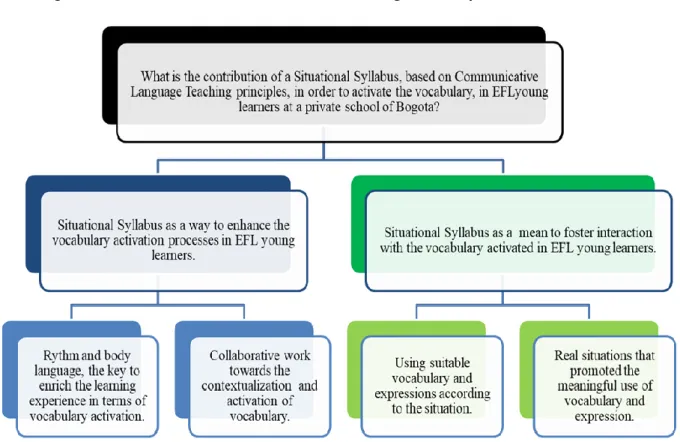
(5) A SITUATIONAL SYLLABUS PROPOSAL, BASED ON CLT PRINCIPLES, TO ACTIVATE VOCABULARY. Chapter four Instructional design………………………………………………………………………57 Vision of language……………………………………………………………….57 Vision of learning……………………………………………………….………..58 Vision of classroom…………………………………………………….………...59 Implementation…………………………………………………………………………..60 Pedagogical intervention………………………………………………………….……...60 Chapter five Data analysis………….………………………………………………………………….67 Category 1: Situational Syllabus as a way to enhance the vocabulary activation processes in EFL young learners……………………………………………............................................69 Rhythm and body language, the key to enrich the learning experience in terms of vocabulary activation………………………………………………………...…..70 Collaborative work towards the contextualization and activation of vocabulary.. 73 Category 2: Situational Syllabus as a mean to foster interaction with the vocabulary activated in EFL young learners…………………………………………………………………….75 Using suitable vocabulary and expressions according to the situation………....76 Real situations that promoted the meaningful use of vocabulary and expression....82 Chapter six Conclusions …………..……………...................................................................................89 Limitations……………………………………………………………....……………….91 Pedagogical Implications…………………………………………………..…....……….92 Further Research ………………………………………………………..……………….93 References……………………………………………………………………………….95 Appendixes………………………………………………………………………………99. 5.
(6) A SITUATIONAL SYLLABUS PROPOSAL, BASED ON CLT PRINCIPLES, TO ACTIVATE VOCABULARY. APPENDICES Appendix A: Journal made by the titular teacher of the private school…………………….99 Appendix B: English teacher interview……………………………………………………102 Appendix C: Principal‟s interview…………………………………………………………103 Appendix D: Observations by two of the researchers………………………………...……106 Appendix E: School English syllabus……………………………………………………...115 Appendix F: Parents‟ permission…………………………………………………………..118 Appendix G: Field Notes- Instrument…………………………………………………...…120 Appendix H: Tape script- Instrument……………………………………………....…...…124 Appendix I: Think aloud- Instrument……………………………………………………...126 Appendix J: Syllabus proposal…………………………………………………………….131 Appendix K: First lesson plan from the Situational syllabus……………………………………….133. 6.
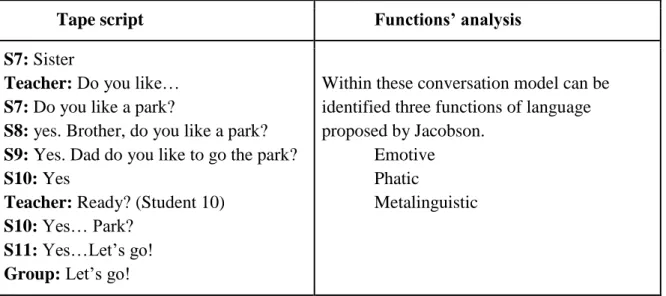
(7) A SITUATIONAL SYLLABUS PROPOSAL, BASED ON CLT PRINCIPLES, TO ACTIVATE VOCABULARY. LIST OF TABLES. TABLE 1: Field Notes form #1……………………………………………………………52 TABLE 2: Tape script #1………………………………………………………………….54 TABLE 3: Think aloud #1…………………………………………………………………55 TABLE 4: Situational syllabus…………………………………………………………….62 TABLE 5: Topic for the lessons…………………………………………………………...66 TABLE 6: Lesson 3- Role play moment…………………………………………………..85 TABLE 7: Lesson 6- Role play moment…………………………………………………..88. 7.
(8) A SITUATIONAL SYLLABUS PROPOSAL, BASED ON CLT PRINCIPLES, TO ACTIVATE VOCABULARY. LIST OF FIGURES. FIGURE 1: Action research cycle…………………………………………………………49 FIGURE 2: Data analysis- Categories and subcategories…………………………………69. 8.
(9) A SITUATIONAL SYLLABUS PROPOSAL, BASED ON CLT PRINCIPLES, TO ACTIVATE VOCABULARY. Abstract The following research project is a qualitative action research that emerged after a series of observations made in an EFL first grade class at a private school in Fontibón, Bogota. Bearing in mind the situations, procedures and activities that took place into this context, it was possible to identify some obstacles that were making the vocabulary activation and the interaction promotion difficult and interrupted processes. As an intervention plan, a Situational Syllabus Wilkins (1972), based on the main Communicative Language Teaching Principles Richards (2006), was designed and implemented to cover the units of the fourth school term. Its objective was to provide the learning experience with contextualized situations and interactive activities that encouraged the students to be active participants and users of the target vocabulary in order to activate prior knowledge, exchange information and understand English language as a way to perceive the world. Keywords: Situational Syllabus Design, Communicative Language Teaching, Vocabulary activation in Young Learners. Resumen El siguiente proyecto de investigación es una acción cualitativa que surgió después de una serie de observaciones realizadas en una clase EFL de primer grado en una escuela privada en Fontibón, Bogotá. Teniendo en cuenta las situaciones, procedimientos y actividades que tuvieron lugar en este contexto, se pudieron identificar algunos obstáculos que dificultaban y interrumpían la activación del vocabulario y la promoción de la interacción. Como plan de intervención, se diseñó e implantó un Plan de Situación Wilkins (1972), basado en los principales Principios de Enseñanza de Lenguas Comunicativas Richards (2006), para cubrir las unidades del cuarto término escolar. Su objetivo era proporcionar la experiencia de aprendizaje con situaciones contextualizadas y actividades interactivas que animaban a los estudiantes a ser participantes activos y usuarios del. 9.
(10) A SITUATIONAL SYLLABUS PROPOSAL, BASED ON CLT PRINCIPLES, TO ACTIVATE VOCABULARY. vocabulario objetivo a fin de activar conocimientos previos, intercambiar información y entender el idioma inglés como una manera de percibir el mundo. Palabras claves: Diseño de syllabus situacional, método llamado “Communicative language teaching”, Activación de Vocabulario en jóvenes aprendices. 10.
(11) A SITUATIONAL SYLLABUS PROPOSAL, BASED ON CLT PRINCIPLES, TO ACTIVATE VOCABULARY. Chapter one Introduction Teaching to young learners could be seen as a real challenge; even more when a foreign language is introduced. In this specific case, first graders, of a private school in Bogotá, are in an exploration process in which they are still learning new ways to express ideas in their mother tongue; and the foreign one (English) is limited to a single subject. The aforementioned fact is based on the primary English teacher‟s observations registered on his journals (See appendix A) from the last two months of 2015 to the first two months of 2016 and a couple of interviews to an English teacher (See appendix B) and the principal of the same school (See appendix C).For instance, in the first journal made by the titular English teacher of this private school, it was mentioned that: “Talking about speaking and their use of English, it is still limited to the isolated use of the vocabulary”. Additionally, in the principal's interview it was evident the necessity of applying new strategies and methods to enrich the English learning and practice within this population. Nevertheless, considering other reflective observations developed by the researchers during the methodology and didactics class in the first semester of the year 2016. It is necessary to clarify that the design of the observations was made by Cuervo (2016) who was the professor in charge of that class (See appendix D); it is possible to perceive a clear understanding of the vocabulary proposed by the school English syllabus (See appendix E). However, there was a constant teacher-student interaction. Furthermore, students showed motivation and interest on practicing the vocabulary learnt through questions (information requests and short questions). However, establishing interaction in short conversational moments with peers, which include the new vocabulary taught in previous lessons was still not possible because some factors such as the classroom arrangement, timing, the absence of the English subject in previous courses (Kindergarten) and the lack of interactive activities,. 11.
(12) A SITUATIONAL SYLLABUS PROPOSAL, BASED ON CLT PRINCIPLES, TO ACTIVATE VOCABULARY. such as conversational models, role plays, sharing personal information, personalizing the vocabulary, may have been affecting the learners‟ opportunities to communicate ideas and use the vocabulary learnt in English. In order to analyze this problematic situation, it was substantial to be aware of the different data collection instruments that guided this research: Direct observations- field notes to the target population (First graders) that were useful during six lesson plans implemented; observation made by a colleague/ teacher in charge of the class, a classroom document analysis to examine the activities sequence and its impact, and a couple of interviews made to the principal of the school. (See appendix A, B, C and D). In this chapter, the reader will find the description of the problem that is related to the lack of interaction activities and the use of vocabulary in the EFL classroom. Then, the rational of the study that intents to justify its importance for young learners‟ lessons when teaching a foreign language; the research questions which establish the starting point of the study; its general and specific objectives are showed in order to clarify the main goals to be achieved by this study which are stated to overthrow the difficulties explained during the problem statement; and a possible intervention plan, based on a Situational Syllabus proposal (Wilkins,1972) and its lesson plans which were designed by the researchers. Secondly, in chapter two, the literature review and theoretical framework that supported and guided the current research project are stated. It is necessary to remark those studies were mainly designed to overcome communication and interaction difficulties when learning a foreign language, to activate prior knowledge using a series of tasks and to contextualize the vocabulary use by means of situational activities. Afterward, in the third chapter, the reader will find the research type and design that corresponds to an action research one and the different instruments selected to collect the kind of data required to respond the general question and enrich the teaching experience. In addition, the chapter 3. 12.
(13) A SITUATIONAL SYLLABUS PROPOSAL, BASED ON CLT PRINCIPLES, TO ACTIVATE VOCABULARY. includes the ethical aspects related to the whole research procedures. Then, chapter four offers the implementation stage features such as schedule, dates, procedures, the syllabus proposal and a sample of one of its lesson plans based on Communicative Language Teaching principles stated by Richards (2006). Following out, chapter 5 shows the kind of data collected, its analysis that reflected the strengths and weaknesses of the lessons and the activities planned that helped to reach the objectives regarding interaction and the use of vocabulary in context. Finally, chapter 6 offers concrete conclusions, limitations and implications that are drawn based on each one of the previous chapters, information and procedures. Justification Richard (2006) said: Language teaching has been seen from different points of view and based on principles such as the importance of interaction with meaningful and purposeful intentions, collaborative creation of meaning and the incorporation of new forms into students‟ development of communicative competence. (p.4).. In concordance with the above-mentioned statement and comparing them with the procedures, methods and interactions that were observed in the English class for first grade in the private school during the second term of 2016, it was evident a lack of communicative activities in the English class which could promote interaction among the students and give them an active role in their learning processes. Throughout this research project, the reader could have a wide perspective about the significance of designing tools and strategies to promote interaction in the classroom. Most of the times young learners repeated words in English language due to the necessity to repeat and memorize them; but they did not have idea what their meanings were and, what may be worse, they were not guided to use them. Otherwise, Přibilová (2006), mentioned that it is recommendable to present new vocabulary at least into a simple context and provide oral practice for promoting interaction. Bearing in 13.
(14) A SITUATIONAL SYLLABUS PROPOSAL, BASED ON CLT PRINCIPLES, TO ACTIVATE VOCABULARY. mind that, Brown (2000), says that “Historically, “conversation” classes have ranged for quasi-communicative drilling to free, open and sometimes agenda-less discussion among students” (p. 268). It means that it is advisable to introduce at least simple and short conversation models in class, to start scaffolding the interaction process. Undoubtedly, it is essential to work on speaking proficiency from early ages, since first graders can learn quickly imitating what others say, facilitating the correction of mistakes and in that order the performance of new language might be successful. This research arises from the necessity to analyze the problem that has been presented in the private school, where first graders were facing difficulties when using the vocabulary learnt in communicative activities. Therefore, researchers proposed a syllabus that underlined situational characteristics and had some of the communicative language teaching approach principles, where the students could practice the vocabulary learnt by simulating real context situations. This research project and its proposal was as necessary as pertinent due to the conditions and situations faced by the target population when learning a foreign language with the lack of opportunities to exchange information, the absence of situations to understand and develop activities in a context and the use of the vocabulary learnt only in isolated situations such as repetition drills exercises and memorization. This project also lies on the principles of the National Bilingual Program (2016) that has been developed by the National Education Secretary and which main goal is fostering the use of the English language in every single classroom of the country, having real communication in meaningful tasks and giving students the chance to obtain influential and better jobs. Problem statement The English teacher of this school, who has been working for six years from first to fifth grade, has faced some challenges such as the implementation of a more interactive. 14.
(15) A SITUATIONAL SYLLABUS PROPOSAL, BASED ON CLT PRINCIPLES, TO ACTIVATE VOCABULARY. methodology along with the use of a formal textbook to guide reading and listening exercises. Even when the status of the English subject may have grown into the educational community (In the private school); and the possible improvement of the four comprehension and production abilities (reading, listening, speaking, writing) described by “Ministerio de Educacion Nacional” (Hereafter, MEN) have had an important impact into the academic field, the teacher researcher of this project noticed that the vocabulary learned was hardly used during short conversations and it could be constantly relegated to the memorization of new words to develop class exercises or tests. Indeed, there was an initial attempt to keep a short conversation moment with one of the students by means of the vocabulary learnt, but it was not successful. As a primary resource to collect information about the first graders needs, some helpful data collection instruments were used: Teaching journals, made by the current English teacher; direct interviews- field notes to the English teachers and the school principal, an overview to the syllabus proposed by the school and observations made by the researchers during the methodology and didactics class. (See appendix A, B, C, D and E). After analyzing the observations, interviews and the English study plan of the institution, it was possible to find some specific procedures that were leading the English class into one that could be interfering in the inclusion of communicative moments and the activation of the vocabulary previously learnt. The class had a dominating kind of interaction and it was the teacher- student one, something that made the class teacher-centered. Most of the activities were focused only on the learning, identification and repetition of vocabulary. In addition, the study plan did not specify the kind of activities and interactions, providing the topics and some possible grammar structures that were barely the starting point of an entire and common English class. Finally, the interviews showed the necessity to innovate the methodologies and strategies used in class to achieve an integral learning.. 15.
(16) A SITUATIONAL SYLLABUS PROPOSAL, BASED ON CLT PRINCIPLES, TO ACTIVATE VOCABULARY. As one of the main goals of this research project, it was considered to design a syllabus proposal based on the characteristics of a situational one. As it was stated by Wilkins (1972), this type of syllabus is suitable and pertinent because it can provide elements such as the development of a topic into a single and general situation that is familiar for the students and communicative and interactive activities around it. Research question What is the contribution of a Situational Syllabus, based on Communicative Language Teaching principles, in order to activate the vocabulary, in EFL young learners at a private school of Bogota? General objective: To propose a Situational Syllabus, based on Communicative Language Teaching principles, to activate vocabulary in young learners at a private school of Bogotá. Specific objectives: To diagnose the English vocabulary teaching and learning process and the interaction patterns during the activities proposed for first graders from 6 to 7 years old by the English teacher at a private school of Bogotá, during the second semester of 2016. To determine the lesson plan activities from the Situational Syllabus that contribute to the English learning experience in terms of interaction and vocabulary activation, in EFL young learners (first grade from 5 to 7 years old) at a private school of Bogotá. To assess the use of vocabulary in contextualized and simulated situations in order to activate vocabulary in EFL young learners (first grade from 5 to 7 years old) at a private school of Bogotá.. 16.
(17) A SITUATIONAL SYLLABUS PROPOSAL, BASED ON CLT PRINCIPLES, TO ACTIVATE VOCABULARY. Chapter Two Literature review Along this chapter, the readers will find a theoretical background that supports the current research. This literature review was made by the collection of foreign and national research studies that were focused on the vocabulary teaching to young learners, situational syllabus and suitable communicative activities that engaged the target population and that led to the authentic and meaningful use of English in class. The first study, “Teaching vocabulary to Young Learners”, was done by Přibilová in Brno (2006) in which she reported her experience as a teacher in a primary school. She admitted that at the beginning she doubted about any knowledge acquisition for young learners; but then, she realized chances and occasions that English language could offer to infants and she started to be a big fan of teaching English to young learners. So, basically it was the way in which she presented her research problem, because she thought that many other teachers could have the same doubts and she wanted to apply some strategies that could be applied in young learners to teach English effectively. In her research, the main objective was to show several ways that could be used for teaching vocabulary to young learners. So, she showed very explicitly her pedagogical intervention presenting the more efficient reasons and ways to teach vocabulary to that population using different methods like Suggestopedia, Total Physical Response and Communicative Language Teaching. Throughout her research project, she centered her attention in a focal group from 7 to 11 years old because she preferred to work with this kind of population and as Přibilová (2006) said: Learners at this age are grateful when someone invests time in them. The results are seen quite easily and of course teachers demand this kind of satisfaction. These children still want to learn something new. When they know it, they are happy to present it and they feel more important. (p.10). 17.
(18) A SITUATIONAL SYLLABUS PROPOSAL, BASED ON CLT PRINCIPLES, TO ACTIVATE VOCABULARY. It means that if the activities proposed by the teacher in an English lesson are planned in detail, the results could be efficient and meaningful because young learners can create a strong bound with the teacher. In other words, if a teacher works like a counsellor and guide in detail the introduction of the foreign language, unconsciously, the learners start feeling comfortable expressing ideas in a language different from the mother one due to the confidence sensation. Přibilová (2006), on first hand, defined young learners as anybody from the age of three to the age of eighteen; and on the other hand, she said that even teaching only words are the first part, it is indispensable to provide a simple context or conversational models in order to learn how and where to use those words .That is why, it is important to identify not only the topics that should be taught for that specific population; it is necessary to include in the lessons, activities that promote interaction among the students taking into account likes and interests to catch their attention immediately. However, teachers in the same classroom and grade find a variety of feelings, behaviors and knowledge. So, Přibilová (2006), established that teaching to young learners requires the knowledge of knowing the differences that each person has different ways of learning, thinking or styles because in that way teachers can understand the methods that are suitable in the process of teaching. Additionally, it is indispensable to provide communicative activities where students can put into practice the words which are being taught through the lessons in order to achieve a complete understanding of the words and its uses. This study contributes to this research project because the author emphasized on the importance of providing oral work to the use of the vocabulary learnt. That is why it is similar to the current research, as it was aforementioned, first graders of a private school in Bogotá do not use the vocabulary in communicative acts; they just memorize isolated words; but they do not know how to use them due to they are not totally engaged to practice. 18.
(19) A SITUATIONAL SYLLABUS PROPOSAL, BASED ON CLT PRINCIPLES, TO ACTIVATE VOCABULARY. speaking. Also, this literature reasserted the importance of choosing the right activities like oral work, games and competitions which might motivate students to produce the language. So, throughout the pedagogical intervention that was carried out in this research, the idea was to include some activities taken from the communicative language teaching approach to teach and practice the vocabulary assigned for the fourth term (jobs and family) by means of “real context” and games. The study which was done by Přibilová (2006), implemented a variety of methods such as Suggestopedia, Total Physical Response and Communicative Language Teaching to develop her activities; but in this case all the activities were designed by means of the last approach she used which was Communicative Language Teaching Approach because fit perfect to provide a real context. In that way, researchers could verify strengths and weaknesses of the syllabus that may have benefited the activation of vocabulary and pair and group interaction within situational contexts in first graders from 6 to 7 years old. The second study “ Methodological techniques used for English teaching in preschool education” which is supported by Rodriguez (2006), found the necessity to describe the experiences of a group of professors who implemented methodological techniques to English teaching in young learners (Specifically, younger than the age of 8), in non-bilingual environments such as the South of Galicia, Spain. The main objectives of this case study research were related to the necessity of working on the teachers‟ methodologies with kindergarten students and first graders in the foreign language (English) development; and to focus on the importance of learning a new language using a variety of communicative activities in early ages, which could define the bases of future achievements or failures. During this research project, an analysis of the language teaching techniques used in twenty- five different rural schools was made by non- participant observations and video recordings of the whole didactic process in every classroom. Using both data collection tools,. 19.
(20) A SITUATIONAL SYLLABUS PROPOSAL, BASED ON CLT PRINCIPLES, TO ACTIVATE VOCABULARY. it was possible to develop exhaustive statistics charts analysis to describe all the techniques and resources the teachers implemented in their daily performances and to identify the ones which kept the children engaged during the language learning process. It is indispensable to teach a new language not only to enrich their knowledge, but their personal development. Then, Rodríguez (2004) refers that the promotion of a healthy and motivating class is to create a setting where students used to feel the stress of listening and practicing with the foreign language, avoiding the risk of demotivation or inhibition. Finally, the importance of the activities was emphasized on the comprehension and oral skills improvement, taking them as the starting point of learning any foreign language and to imitate the natural process in which the mother tongue was learned. Regarding the types of activities implemented to work on comprehension and oral skills in this case study research, Rodríguez (2004) mentioned, the importance of using role plays to foster interaction, participation and self-confidence, images games such as puzzles, pictograms or memory challenges that are elements that link motor and communicative skills; the songs for the memorization of new words and expressions by repetition; fairy tales for listening skills, constant input and motivating stories and mimics. The last one, mimics, resulted to be one of the main resources to teach English because it engaged the target population in many ways: The use of the body, teamwork, interest in expressing and guessing ideas using body gestures and the new language. Significant contributions to the English teaching were given through the study. To start with, children‟s introduction should be gratifying and playfulness. Consequently, the author explained that the teacher has to take into account the affective, teacher- students‟ interaction, class rules based on respect and the constant recognition of the goals achieved, and motivational, activities which catch children's attention and are familiar to them: songs, rhymes, etc, factors when lesson planning.. 20.
(21) A SITUATIONAL SYLLABUS PROPOSAL, BASED ON CLT PRINCIPLES, TO ACTIVATE VOCABULARY. Research studies like the one developed by Rodriguez (2004), provided many useful techniques, ways and ideas, such as role plays and puzzles implementation, to work with young learners. Children‟s training in speaking skills, which are comprehension and oral expression, are the starting point to activate the use of vocabulary within context, and to foster a natural learning process based on the first language, even more when they were implemented in a non-bilingual context (Spanish is the mother tongue there) such as the current study and with the same target population (Children younger than 8). On the other hand, bearing in mind South America and its education system, it is different from the ones in continents such as Europe and Asia because their realities and necessities extremely changed due to factors such as the colonization process, violence and the priorities of the educational system itself. Without doubt, the way in which they are seen and practiced is quite different from here thanks to the population necessities and realities; So, it is highly recommendable to consider researches made in Colombia that were interested in fostering interaction, analyzing the communication features in class and, perhaps, providing different tools to promote the use of English in class. That is why; this third study “Oral communication and interaction: ways to use them in the EFL class” made by Alvarez & Rojas (2015) could give closer contributions to take into account to the current research project. Having as its purpose the oral communication and interaction improvement in a bilingual primary school of Bogota in fourth graders , this research project is based in similar problem statements, theoretical principles and procedures: Lack of interaction between students (Excessive use of mother tongue), the application of CLT principles to expand the speaking performance in young learners such as student-centered classes and the promotion of communicative models; and a possible alternative to tackle the students‟ difficulties based on a functional perspective of the language learning: The project- based one, a method that. 21.
(22) A SITUATIONAL SYLLABUS PROPOSAL, BASED ON CLT PRINCIPLES, TO ACTIVATE VOCABULARY. starts from the students‟ interests and intends to use the target language as a mean to produce knowledge by interacting. The type of activities proposed during the implementation were developed in groups of four and some of the examples were: Invention selection (Project), poster designing, negotiation between peers, choral drilling, brainstorming, asking for specific information and the use of L1 as a mediator to establish natural conversation moments. Even when the selection of activities could be directed to an advance level population, the participation roles given to the students were key elements to make them an active part of the class, and the guidance role of the teacher, providing models and stimulating the use of the L2 in every lesson. Some of the instruments to collect and analyze data where field notes, that are related to the classroom experience and reflections upon them to make the learning experience a more productive one, observation notes and interviews (Open and closed). This kind of resources are recommendable to focus on interaction patterns, levels of motivation, body language and the effectiveness of the lessons‟ structure, goals and activities selection. Definitely, this study contributed the current research project because the problem they encountered was very similar to the one pretended to be solved here. Also, they did not just share examples about the methods that could be implemented, but also, they used some instruments such as field notes, observations and interviews to gather information that perfectly fit to verify if the techniques that could be carried out in this study work. The analysis of this research project was useful too, because it highlighted the importance to not underestimate the students‟ abilities even when they are children, and also the necessity of an appropriate guidance role of the teacher, providing models and stimulating the use of the L2 in every lesson. In the next study “Vocabulary Techniques for Teaching English in Elementary. 22.
(23) A SITUATIONAL SYLLABUS PROPOSAL, BASED ON CLT PRINCIPLES, TO ACTIVATE VOCABULARY. schools” made by Arroyo & Crespo (2010) in Cuenca, Ecuador. One of the main objectives was to design and create activities to be implemented at Manuela Cazinares School, specifically in fourth graders. In concordance with Arroyo & Crespo (2010), the intention was to make the class more interesting for young learners and motivate them to learn vocabulary in a communicative and practical way, using different methodological strategies, educational resources and vocabulary techniques. Additionally, they tried to organize this study to change the concept that some teachers had about teaching vocabulary. It means that explaining is not only a requirement, and it demonstrates that it is essential for the real students‟ life. Also, the researchers explained the importance of the creation and implementation of strategies for teachers that could help them to teach in an appropriate way the vocabulary in primary schools. In this study, the authors said when teaching a second language, the vocabulary part is usually practiced as an isolated process; and those activities have become for learners in a constant study of list of words or isolated lexical sets that makes the students waste their time in memorization without learning meaning or correct grammatical use. On the other hand, this research emphasizes on the importance of finding possible changes in the English class and turn it in something fun for an effective communication and way to practice the target language. Additionally, Arroyo & Crespo (2010) are informing teachers that teaching vocabulary to kids involves: the use of different kind of methodological strategies, presentation, practice, application and evaluation as parts of a class, Total Physical Response and Task Based Approach, didactic resources, jumping rope, guessing games, mimics or the ABC contest, and vocabulary techniques, develop basic abilities of understanding through learning vocabulary, learning of English while having fun, use everyday expressions, such as greetings, farewells, self-introductions, etc. They used puppets as primordial material,. 23.
(24) A SITUATIONAL SYLLABUS PROPOSAL, BASED ON CLT PRINCIPLES, TO ACTIVATE VOCABULARY. supported by activities as games, songs, rhymes, “chants”, jokes and conversations. They had as a goal the motivation and interaction among the students throughout a variety of the aforementioned activities during the different lessons. Also, it is very important to mention what is going to be taught and learned in light of children‟s nature and their own experience where they can use it in different context. Besides, according to the research made by Arroyo & Crespo (2010), the vocabulary is more than teaching words and pronunciation. It is the raw material for the understanding and the complete learning of the target language (English). So, the current research could be benefited by this literary resource because it is highly important to make children feel motivated when they are learning a second language using innovative and creative strategies of teaching vocabulary as it was seen. Besides, students have to know about the correct use of the words apart from the meanings of each one of them. Arroyo & Crespo (2010), explain “The findings clearly indicate the limitations of this practice. Because definitions provide only a superficial level of word knowledge and rarely show students how to use the words, vocabulary instruction must move beyond the definitional level of word meanings” (p. 17). It is something that was taken into account at the moment to design the syllabus (and implement the instruments for the data collection according to the activities worked. Consequently, this project intends to inform teachers that they must give the students the opportunity to discover the different uses and features that English language has. However, it is necessary to know which communicative competences would be worked and the students‟ learning styles. On that way, the students will be capable of participating in communicative exercises in a more confident way. That is why, to achieve the aforementioned results in the study, different activities with different methodological strategies were used. Finally, it can be said that vocabulary is crucial for learning a foreign language and it 24.
(25) A SITUATIONAL SYLLABUS PROPOSAL, BASED ON CLT PRINCIPLES, TO ACTIVATE VOCABULARY. is involved in the learning of the other skills. They provide useful information about this topic using different kind of strategies, methods or techniques. So, the research is concluded by Arroyo & Crespo (2010) when they state that: Interaction is the best way to get good results in the language teaching learning process, so we recommended language teachers to get a good vocabulary the concept that language cannot be taught without a vocabulary purpose. In the same way, every language skill requires vocabulary for its development (p.46).. Another study called “Authentic Oral Interaction in the EFL Class: What it means, What it does not” made by Herazo (2010). He attempted to characterize samples of oral communication that occurs in EFL classes in public secondary schools of Montería – Colombia. The main objective proposed was to provide an informed discussion of what authentic oral communication involves and the possibilities that it has in the EFL classroom. In this study, the author gives the reader the opportunity to understand the learning conditions that a teacher should apply during the English educative process, especially at the moment to practice the oral production. For that, the researcher explores both; student – student and teacher – student interactions. This study highlights the variety of activities which come from the communicative language teaching approach and its importance for the development and promotion of communication in EFL classrooms, such as role plays, simulations, project work, conversation strategies, dialogues and presentations. However, the use of these activities might not be enough to say that a teacher understands what oral production is or if he/she achieved the communicative competences in a lesson, for that reason, when Herazo (2010) suggests that, he says: The use of these activities, we assume, renders our teaching practice „communicative‟ and so, when asked how we teach, we usually say we use the communicative approach, or that we develop oral communicative competence in our classrooms. However, have we ever 25.
(26) A SITUATIONAL SYLLABUS PROPOSAL, BASED ON CLT PRINCIPLES, TO ACTIVATE VOCABULARY. wondered about what we understand by oral communication and its characteristics? (p.48).. Consequently, to answer the question mentioned in the previous quotation the researcher implemented four interaction events. The first event was about the script-based exchange, dialogue based on a model presented, and the second was a survey, students collecting data from their classmates, to determine the effectiveness between a studentstudent interaction. The results showed that both contribute to the oral communication, but the second one was focused to the real communicative process. On the other hand, the third event was about the IRF Initiation Response Follow-up, exchange, learner‟s participation is limited to one turn, i.e. Questioning and Answering, and finally the fourth was based on contingent interaction (Conversations), to determine the effeteness of Teacher-Student interaction. Demonstrating that the contingent interaction seems to open possibilities for a more symmetric, meaningful, realistic, and effective interactional mode in the pursuit of EFL proficiency. Based on the results obtained from the interaction events presented, Herazo (2010), concluded that in the schools studied, “The script-based dialogue and the teacher-student IRF interaction have very little to offer in terms of EFL proficiency growth”. (Herazo, 2010, p.59). In the same way, the research allows the reader to understand that the oral production goes further than the simple implementation of activities from an approach and involves more aspects as it was stated by Herazo (2010) “for oral communication to be authentic there need to be a considerable degree of spontaneity and a true exchange of meaning to which the interacting parties are oriented and in which they are interested” (p.59). Consequently, the researchers of this current study can consider this researcha very relevant resource, because it might give a wide perspective about the different aspects that involve the oral production and the interaction between Student-Student and Teacher-student. Especially, considering that for the current research conversational models were used as. 26.
(27) A SITUATIONAL SYLLABUS PROPOSAL, BASED ON CLT PRINCIPLES, TO ACTIVATE VOCABULARY. according to the author the conversations offer more possibilities to apply the vocabulary learned in real context. For that reason, this study is considered useful because the results of Herazo's analysis helped to understand that communicative learning involves more than just interaction but aspects such as considerable degree of spontaneity and true exchange of meaning. For example, within a role- play, students have the possibility to simulate a real situation, they can use all the materials such as clothes and location to simulate as real as possible and if they are familiar with the situation presented, they cannot just take turns to speak, on the contrary the can exchange information with real meaning and act spontaneously. Even when the studies and researches mentioned before contributed, in a significant way, to the selection, design and application of each one of the activities and lesson that compound the situational syllabus proposal; it is vital to review other pedagogical experiences that are closely related to the implementation of situations and contextualized tasks in order to tackle different areas of the foreign language learning. In this case, “Improving speaking through role plays and dramatization” by Cárdenas & Robayo (2001), is a study that followed the action research method and had as its population a group of third graders from a school located in the Southeast of Bogotá, in Los Libertadores neighborhood. The problem that this population was facing was the lack of oral production, vocabulary and demotivation in the English class due to decontextualized topic and activities that were not related to the students‟ experiences. In order to find possible ways to intervene, a main objective was stablished to determine the impact of role-plays and dramatizations on students´ oral production and the effect they may have on students´ learning processes. Based on that, the two researches implemented a series of activities where the students‟ speaking development and acting skills were the most relevant aspects. These dramatizations and role plays were decorated in. 27.
(28) A SITUATIONAL SYLLABUS PROPOSAL, BASED ON CLT PRINCIPLES, TO ACTIVATE VOCABULARY. situations such as greetings, family photo album, fashion show, speaking by telephone and free dramatization. During the implementation, situational elements such as clothes, set items and different elements to make the situation a more realistic one were constantly used to support the learning process and encourage participants to feel as real characters. Some conclusions based on the data provided by the instruments, like direct observation (field notes), questionnaires and videos, were drafted gratifyingly because of the evident interaction and cooperative learning promotion. Firstly, the enjoyment and enthusiasm showed by the students when performing the dramatizations and role-plays. After each one of them took place, meaningful assessment moments were developed and they led to a deeper comprehension of each one of the situations showed and the vocabulary and expression used within them. Then, the models provided were key elements when interacting due to their effectiveness and the teacher‟s input and guidance importance of an appropriate environment. Additionally, the good and useful resources complemented the process. Besides, to implement activities that are situational ones and to let students create and make decisions when speaking could bring difficulties that interfere with the goals achievement and the teacher‟s motivation when proposing new ways to learn. One of the most evident ones was the lack of students‟ initiative when creating their own dramatizations. This study is different from the current research project because of the target population; they selected third graders to apply the aforementioned activities. In addition, the grammatical structures were not specified in each one of the dramatizations and role-plays; they were limited to the teacher‟s models. Finally, the implementation was not structured as an entire Situational syllabus even when the activities were completely contextualized Then, it is important to highlight the resemblance of this study with the current one,. 28.
(29) A SITUATIONAL SYLLABUS PROPOSAL, BASED ON CLT PRINCIPLES, TO ACTIVATE VOCABULARY. and the contributions that it offers to the consolidation of a syllabus that has as its main feature the implementation of contextualized situations to foster interaction and activate vocabulary learnt. At first moment, the fundamental role of contextualized, meaningful and familiar situations to encourage young learners to use the vocabulary and expression they know was reconfirmed and highly recommendable when the intention is to tackle oral production problems. At a second moment, the use of realia items supported the situations presented because the students personify characters that made them feel they are part of a real situation and that the expression and vocabulary included would be useful for them in the future. Theoretical Framework This research is focused on the analysis of the students‟ performance in a situational syllabus and communicative activities based on CLT Richards (2006), using the vocabulary proposed by the private school. Thus, as a support for the study three main concepts emerged from the research question. Those constructs are Situational Syllabus Design which explains how to create, the features that a Situational Syllabus includes and how the researchers adapted this kind of syllabus to the selected population. Communicative Language Teaching Approach which provides the communicative activities which were developed and applied in the pedagogical intervention. Each concept has some different theories that came from different authors who stated ideas about these three constructs to contextualize and guide the current study. Finally, vocabulary activation in EFL young learners, on the other hand, points the standards of competences, age and level that students should have in each grade according to the “Ministerio de Educación Nacional” in Colombia. EFL Syllabus Due to the main purpose war to do a syllabus proposal, it is fundamental to define the term syllabus before the way it should be designed and discussed. According to Nunan. 29.
(30) A SITUATIONAL SYLLABUS PROPOSAL, BASED ON CLT PRINCIPLES, TO ACTIVATE VOCABULARY. (1988) “a syllabus is a statement of content which is used as the basis for planning courses of various kinds, and that the task of the syllabus designer is to select and grade this content” (p.6). Bearing it in mind, a syllabus has as guidance role; so, it is vital to decide “what, how and why” when selecting content and possible activities. In this case, the first-grade syllabus of the private school has basic vocabulary and grammar topics which are taught according to their level of difficulty throughout the four periods. In addition, White (1988) remarks that a well-structured syllabus should be “based on the objectives to be achieved and the content to be learned” (p.5). In this way, it is possible to say that the first-grade syllabus of the school is based on objectives such as the knowledge of basic vocabulary that surrounds the students in their school and corresponding routines (Numbers, colors, class objects). Before a specific type of syllabus is chosen according to the needs of this research project, it is necessary to name and give a brief definition of the different ones that exist. In concordance with Mohsemi (2001), there are thirteen possible types of syllabus which were proposed to tackle different necessities and respond to diverse teaching styles and approaches: 1. Procedural syllabus: Structures are learnt by focusing on meanings. 2. Cultural syllabus: Based on acquiring knowledge from the natal country and fostering curiosity about the same. 3. Situational syllabus: Language is related to the situation, context and participants who are involve in. 4. Skill-based syllabus: Development of linguistic competences such as pronunciation, vocabulary, grammar and discourse. 5. Structural or formal syllabus: It gives priority to language form. 6. Multi-dimensional syllabus: It responds to a variety of orientations and requirements by tackling structures and notions learning.. 30.
(31) A SITUATIONAL SYLLABUS PROPOSAL, BASED ON CLT PRINCIPLES, TO ACTIVATE VOCABULARY. 7. Task-based syllabus: Activities directed to achieve purposes in multiple tasks. 8. Process syllabus: A type of syllabus that can be design in an on-going way and based on teaching and learning proceeds. 9. Learner-led syllabuses: Proposed to increase the learner‟s motivation interest and the development of specific skills required to learn. 10. Proportional syllabus: It tries to develop an overall competence due to the existence of learners who are not enough exposed to the target language. 11. Content-based syllabus: It uses the language as a mean to teach other subjects (e.g Science). 12. Notional/functional syllabus: Based on teaching and developing functions and notions of the language. It means that students learn how, when and where it is possible to use the language. 13. Lexical syllabus: Takes the lexis as the starting point to identify and understand the language features. Based on the aforementioned types of syllabus and their characteristics, it is selected the Situational Syllabus because it is appropriated to tackle different needs presented in the current population. Situational Syllabus Even when it is possible to use more than one of the syllabus and their characteristics to tackle the lack of interaction and to give an active role to the student in class, it is indispensable the guidance of the learning process through real-life situations in which the vocabulary learnt could be activated and the interaction between peers is promoted, due to the need of exchanging information with others and use role plays to guide the learning experience: The situational syllabus is defined by Wilkins (1972) as one that: “(…) is based upon predictions of the situations in which the learner is likely to operate through the foreign. 31.
(32) A SITUATIONAL SYLLABUS PROPOSAL, BASED ON CLT PRINCIPLES, TO ACTIVATE VOCABULARY. language” (p.257). In addition, Yalden (1987) states that: “it is aimed at meaningful conversational interchange in specific contexts” (p.35). This type of syllabus could foster some of the features of the English class in the first grade of the school, for example the vocabulary organization in thematic units, where topics, goals and materials can be explained. Also, the active participation, timing and students‟ motivation can be promoted due to they are being part of role games based on real life situations, and in that way, the vocabulary from the unit is included. Learners would have the chance to face a common situation (Going to the store) and find the words they had practiced in previous lessons, numbers, school supplies, but having as a plus the joy to feel like an “actor” or a “player” of one of the games they use to play during the break time. A situational syllabus also relies on some of the main principles of the CLT approach. As it was mentioned by Brandl (2008), this approach requires: Activities that require frequent interaction among learners or with other interlocutors to exchange information and solve problems, use of authentic (non-pedagogic) texts and communication activities linked to “real-world” contexts, often emphasizing links across written and spoken modes and channels and approaches that are learner-centered in that they take into account learners‟ backgrounds, language needs, and goals and generally allow learners some creativity and role in instructional decisions (p. 208). Then, it is necessary to understand that the syllabus needs to have specific content taking into account what will be taught. At the same time, it is indispensable to know well the educational competences and the population in order to design a structured syllabus. In that way, the method and strategies can be designed to reach the syllabus aims. To achieve that, Bok (2016) mentions eight steps that a Situational Syllabus should include in its structure: 1. Learning Objectives: What students will gain or take away from your course. Why these objectives are the most important skills/knowledge for the course (helpful if 32.
(33) A SITUATIONAL SYLLABUS PROPOSAL, BASED ON CLT PRINCIPLES, TO ACTIVATE VOCABULARY. objectives are included for each topic/session). 2. Goal/Rationale: How the course relates to primary concepts and principles of the discipline (where it fits into the overall intellectual area). Type of knowledge and abilities that will be emphasized. How and why the course is organized in a particular sequence. 3. Basic Information: Course name and number, meeting time and place, instructor name, contact information, office hours, instructional support staff information. 4. Course Content: Schedule, outline, meeting dates and holidays, major topics and sub-topics preferably with rationale for inclusion. 5. Student Responsibilities: Particulars and rationale for homework, projects, quizzes, exams, reading requirements, participation, due dates, etc. Policies on lateness, missed work, extra credit, etc. 6. Grading Method: Clear, explicit statement of assessment process and measurements. 7. Materials and Access: Required texts and readings, course packs. How to get materials including relevant instructional technologies. Additional resources such as study groups, etc. 8. Teaching Philosophy: Pedagogical approach including rationale for why students will benefit from it. The effectiveness of a Situational Syllabus depends on how well it is structured and if this instrument really helps the students and teachers to reach the aims proposed, as Yalden (1984) stated: “[The syllabus] replaces the concept of 'method', and the syllabus is now seen as an instrument by which the teacher, with the help of the syllabus designer, can achieve a degree of 'fit' between the needs and aims of the learner (as social being and as individual) and the activities which will take place in the classroom” (p.14).. So, the situational syllabus includes the most important aspects within the 33.
(34) A SITUATIONAL SYLLABUS PROPOSAL, BASED ON CLT PRINCIPLES, TO ACTIVATE VOCABULARY. communicative competence, and it is what can be incorporated considering the activities where the interaction and the application of vocabulary in context are allowed. Throughout this research, the idea was to improve the interaction among the students to encourage them to use the vocabulary learnt. That is the reason why a Situational Syllabus was designed in order to be concentrated in detail in some topics, and in that way, include appropriate resources to complement the learning and teaching process. But, as there are many types of syllabus, the situational one was applied in this study because it allowed to incorporate real situations, activities, materials, resources from CLT, where students felt in a real context, as Wilkins (1972) says “Situational Syllabus, therefore, is based upon predictions of the situations in which the learner is likely to operate through the foreign language” (p.256). e.g. Students performing a family in a supermarket using real accessories and following a conversation model given by the teacher that is likely to be used in the future. Hence, the information gathered about the situational syllabus design was important and useful at the moment to create a syllabus proposal within the parameters needed to apply activities from CLT approach in real context. Even when this kind of syllabus does not emphasize on grammatical structures and procedures, the one proposed in this research included, between the competences and the activities, a balance in relation to the grammatical and communication stages. However, the communicative practice was the main focus and it was designed according to the guidelines of the CLT approach. Communicative Language Teaching (CLT) According to Richards (2006), CLT can be defined as the approach that is focused mainly on the communication and interaction among students. The main goal of CLT is the development of the communicative competence facilitating the vocabulary in real situations especially for children. Affirming this, Klippel (2009) indicates that teachers in communicative classrooms will find themselves talking less and listening more becoming. 34.
(35) A SITUATIONAL SYLLABUS PROPOSAL, BASED ON CLT PRINCIPLES, TO ACTIVATE VOCABULARY. active facilitators of their students‟ learning. The teacher sets up the exercise, but because the students‟ performance is the goal. Therefore, communicative language teaching is very important in the complete development and practices focused on the orality and its application in real contexts. Additionally, Richards (2006) said “Communicative language teaching can be understood as a set of principles about the goals of language teaching, how learners learn a language, the kinds of classroom activities that best facilitate learning, and the roles of teachers and learners in the classroom” (p.2). That is why, CLT was crucial taking into account that one of the aims of the current research tried to know how students‟ performance was or how to improve it, in relation with the teaching of the application of vocabulary to children for their communicative act. Moreover, there are four main purposes of communicative activities that were mentioned by Richards (2006) and they were useful and relevant for this investigation. The first one was to provide for all the students different kind of communicative activities structured in order to suit the learners‟ level ability. The second, supported that the learning motivation could be maintained if the interaction and communication with their classmates was related to help the others to achieve their goals. The third one states that, there are some aspects inside the learners and teachers that go beyond the pedagogical control. It is likely, that many aspects of Language learning only take place through natural processes and the last one affirms that communicative activities can design a context which supports the learning where some activities provide opportunities for positive personal relationships to develop among learners and teachers. These relationships can help to create an environment that supports the individual in his efforts to learn. All the aforementioned purposes are important because they contributed in a. 35.
(36) A SITUATIONAL SYLLABUS PROPOSAL, BASED ON CLT PRINCIPLES, TO ACTIVATE VOCABULARY. significant way to the current research. That is, they provided support to understand about what the children had achieved during the implementation and during the development of the communicative activities, but especially at the moment to choose the activities that were convenient for this research. It means that throughout this bachelor project some activities were taken from this approach to promote a real interaction among them. Due to the use of this approach, it was possible to simulate a real context taking as a base the aims that proposed in this project. The topics that were worked were the ones which were established in the syllabus for the fourth term (jobs and family), so, the purpose was to design three classes per theme using communicative language activities. Bearing in mind the observations which supported the classroom management (See appendix D), the observers could notice that all the classes were in a teacher-centered way and according to this approach this should be avoided, as Richards (2006) says: Teachers now had to assume the role of facilitator and monitor. Rather than being a model for correct speech and writing and one with the primary responsibility of making students produce plenty of error-free sentences, the teacher had to develop a different view of learners‟ errors and of her/his own role in facilitating language learning (p.5).. In this case, researchers facilitated the topics and the activities, monitoring their performance during the implementation, and the students participated actively through the process. It means that all the activities should be developed to facilitate and promote studentstudent interaction and increase the autonomous work at the same time. What is more, Richards (2006) talks about three practical activities called mechanical practice, meaningful practice and communicative practice. In the first place the mechanical practice Richards (2006) says “the students do not have to understand for carrying out successfully the target language, and there are activities related to repetition drills and substitution drills designed for using a particular grammatical or other items” (p.16), in this case to practice the vocabulary. In the second place, with the same goal meaningful practice 36.
(37) A SITUATIONAL SYLLABUS PROPOSAL, BASED ON CLT PRINCIPLES, TO ACTIVATE VOCABULARY. can be found; as according to Richards (2006) “an activity where language control is still provided but where students are required to make meaningful choices when carrying out practice” (p.16). Here the common activities that may help to the development of this research were the ones related to ask and respond (Questions) with topics bound to the students‟ reality for facilitating their vocabulary learning. Finally, Richards (2006) says that communicative practice are “activities where practice in using language within a real communicative context is the focus, where real information is exchanged, and where the language used is not totally predictable” (p.16). In this case, it is necessary to mention that some activities from the communicative language teaching were taken throughout the implementation of this research project. Some activities were jigsaws (Photomontages), songs, conversational models, and role plays; because within these activities all the vocabulary used was related to the real context information, making the learning process through situations easier. Furthermore Littlewood (1981), propose in the same line of communicative practice, the group of two categories of communicative activities. In this first category, there are the pre-communicative activities; and within this field, there are the structural and the quasicommunicative activities, which are the ones that give the learners fluent control over linguistic forms, preparing the students for later communication. On the other hand, the second category has the communicative activities in which the functional communication and the social interaction activities can be found, with the aims of providing „whole - task practice‟, to improve motivation, to allow natural learning, and to create a context which supports learning. Considering the information given by Littlewood (1981), the activities which were useful to the current study were those that belonged to the functional communication and social interaction activities because they focused on appropriate simple utterances in. 37.
Figure

Documento similar
The broad research question this thesis aims to answer is what the examination of situated activities and language use in a state immigration office can tell us with regard to
The communicative approach popularized teaching activities which emphasised the need for learners to focus on meaning, fostering their participation in real
In order to answer research question number 5, that is to say, to what extent students with higher productive vocabulary knowledge acquire more vocabulary than those with
porpuses such as; reviewing vocabulary already checked or for introducing new vocabulary about food and drink and as a support for teaching how to order food in a
The coupling matrix is defined in order to best accommodate the acoustic resonators models, based on NRNs, and a smart optimization of its elements based on the
a) To determine the influence of the “freely talking” Program, based on the Communicative Approach, in reducing anxiety when speaking in the dimension “Confidence in the use of a
Inspired by the Federated Learning (FL) approach, in this work we tailor a collective per- ception architecture, introducing Situational Collective Perception (SCP) based on
ABSTRACT: This study examined the effect of classifying vocabulary into parts of speech using Google Drive sheets in order to improve reading comprehension.. Participants were 20
