
Characterization of Al2024 CNTs composites produced by mechanical alloying
19
0
0
Texto completo
(2) https://cimav.repositorioinstitucional.mx/jspui/ [3–7]. Their use as a strengthening phase has been evaluated in recent works where aluminum was the matrix phase. This is because aluminum exhibits some unique characteristics due to its low density. For instance, it can be strengthened by precipitation of phases formed from the alloying elements (i.e., Cu, Mg and Zn) through heat treatments. Additionally, it is possible to enhance the mechanical behavior of aluminum alloys by reducing the particle size through milling processes based on powders technology [8–10]. These microstructural features allow them to be used in a wide range of aerospace and automotive applications. The production of composites by CNTs dispersion into the metal matrix alloys has been investigated, lately [4,6,7,11–13]. However, it has been difficult to obtain an homogenous dispersion of the reinforcement into the based-metal matrix. In the case of Al alloys, this problem has been solved by milling process. Some researchers have studied the dispersion uniformity of CNTs during short- and long-time millings, from few minutes to several hours, respectively [7,12]. It has been found that, during this process, the reduction of the particle size is determined by the milling time. However, another important factors that must be considered during the synthesis of composites by MA are the concentration of CNTs and the addition of a process control agent (PCA), which is used to avoid agglomeration of particles during MM. High concentrations of CNTs (N10 wt.%) can cause a negative effect on the mechanical behavior of the composites, as found by Feng et al. [4] during fabrication of silver-matrix composites reinforced by CNTs.. 2.
(3) https://cimav.repositorioinstitucional.mx/jspui/. In the present investigation, CNTs have been dispersed homogeneously into an Al2024 (produced from elemental powders) by MM.. Finally, the effects of CNTs concentration and milling time on the microstructure of Al2024-CNTs composites were investigated. The limit values used during the production of the Al2024-CNTs composites, were 5.0 wt.% and 30 h, of CNTs concentration and milling time, respectively.. 3.
(4) https://cimav.repositorioinstitucional.mx/jspui/. Experimental Powders of Al (purity of 99.5%,−200mesh), Cu (purity of 99.3%, −325 mesh), Mg (purity of 99.8%, −325 mesh), Mn (purity of 99.3%, −325 mesh), Ti (purity of 99.3%, −325 mesh) and Zn (purity of 99.9%,−100 mesh)were used as the starting materials to fabricate the Al2024 alloy. Mechanical-alloyed Al2024-CNTs composites have been obtained using the Al2024 alloy as the matrix phase and CNTs as the reinforcement material. The later, has been produced by chemical vapor deposition (CVD) obtaining bundleshaped fibres with an average diameter of ~80 nm (Fig. 1). Millings were 4.
(5) https://cimav.repositorioinstitucional.mx/jspui/ performed in a high energy ball mill (SPEX-8000 M) during 5, 10, 20 and 30 h. Concentrations of CNTs were 0.0, 0.5, 1.0, 2.0, 3.0, 4.0 and 5.0 wt.%, and an inert argon atmosphere was used through the whole set of experiments to avoid oxidation. Table 1 presents the processing parameters studied in this work as well as the composites identification. The millings have been performed using hardened steel vials and balls with a ball-to-powder weight ratio of 5:1, being the weight of samples 8.4 g. Besides, methanol was used to avoid agglomeration acting as the process control agent (PCA). The preparation of cross-sectionmilled powders was carried by hot mounting the powders in bakelite and then prepared by conventional metallographic techniques. For the study of the interaction between CNTs and Al2024 particles a 0.5 g from the A50 composite were cold consolidated by using 1500 MPa during 1 min producing a sample of 10mm of length and 5mm of diameter. Compacted sample was then held in liquid nitrogen by 2 min and then caused a fracture for a further analysis.. 5.
(6) https://cimav.repositorioinstitucional.mx/jspui/. The particle size distribution was measured by the laser diffraction and scattering method using a Mastersizer-2000 particle size analyzer. X-ray diffraction (XRD) analyses were carried out in a Panalytical X'pertPRO diffractometer with Cu Kα radiation (λ=1.5406 Å) operated at 40 kV and 35 mA in the 2θ range of 20-100°. On the other hand, scanning electron microscopy (SEM) characterization was performed using two JEOL microscopes, a JSM5800-LV and a JSM7401F operated at 15 kV and 3–5 kV, respectively. Finally, transmission electron microscopy (TEM) characterization was performed in a JEOL JEM-2200FS microscope operated at 200 kV. Samples were prepared by focused ion beam (FIB) in a JEOL JEM 9320-FIB microscope operated at 30 kV and 25 mA. Results and discussion. 6.
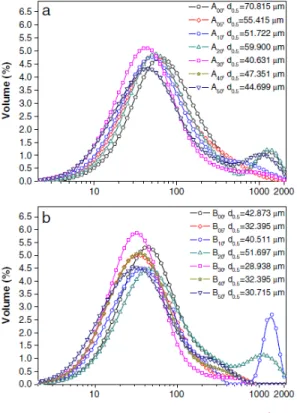
(7) https://cimav.repositorioinstitucional.mx/jspui/ Fig. 2 shows the effect of CNTs content and milling time on the microstructure of the Al2024-CNTs composites. As can be observed, the morphology and size of the powders particles depend strongly on the amount of CNTs and milling time. In any case, CNTs emerging fromthe powder particleswere observed(Fig. 2a, b and c)to display the effect of CNTs content on the microstructure of the composites milled during 5 h (A00, A20, A50). As can be seen, in A00 alloy, a uniform particle size was observed (Fig. 2a). Increasing the CNTs concentration up to 2.0 wt.% (A20) does not appear to cause a considerable change in the particle size (Fig. 2b). In contrast, when CNTs content was increased up to 5.0 wt.% (A50), a significantly reduction in the particle size was observed (Fig. 2c). Fig. 2d, g and j, shows the effect of milling time on the microstructure of alloys without the reinforcement material (B00, C00 and D00). As can be seen, increasing the milling time causes an increase in the particle size. Although PCA was used through the millings, this result suggests that welding process is predominant during MA. As a result, larger particles were observed. Nevertheless, when CNTs content was increased up to 5.0 wt.% (B50, C50 and D50), smaller particles were obtained (Fig. 2f, i and l). Therefore, it was clear that CNTs have a positive effect on the reduction of the particle size. Fig. 3 presents the particles size distribution and the median particle size value (d0.5) as a function of CNTs content and milling time. As can be seen, for the unreinforced alloys (A00, B00, and C00), when milling time was increased from 5 to 20 h, there was a small shift of the peaks to the left side. As a result, the d0.5 value decreases from 70.8 to 39.2 μm. However, when milling time was increased until 30 h (D00), a slight shift to the right side was observed and the d0.5 value was increased up to 52.8. 7.
(8) https://cimav.repositorioinstitucional.mx/jspui/ μm. The increase of the particle size was attributed to the dominant cold welding process during MA. Fig. 3 also shows the effect of CNTs content on the particle refinement. The most prominent effect on the particle size reduction was noticed when CNTs content was increased up to 3.0 and 5.0 wt.%. As can be seen in Fig. 3a, the particle size of composites with 3.0 wt.% of CNTs was reduced from 70.8 to 40.6 μm. Thus, the addition of the reinforcement material up to 3.0 wt.% results in a reduction of about 30 μm compared with the unreinforced alloy (for the same 5 h of milling), see A00 and A30. Fig. 3b shows the effect of CNTs content on the particles size distribution of composites milled during 10 h. As can be seen, a similar behavior was observed, but in this case, the particle size of the B30 composite was around 13.9 μm smaller than that observed in the B00 composite (42.8 vs 28.9 μm). On the contrary, when the CNTs concentration was increased up to 5.0 wt.%, a similar effect to that produced by milling time was observed. In other words, an increment in the d0.5 value was observed (Fig. 3a and b). Fig. 3c shows the effect of CNTs concentration on the particle size distribution of composites milled during 20 h. As can be observed, there was a reduction of the particle size, from 39.2 to 16.9 μm, when CNTs content was increased up to 5 wt.%, compare C00 and C50 alloys. In contrast, for the same concentration of the reinforcement material, but after 30 h of milling (Fig. 3d), the particle size was reduced from 52.8 to 21.8 μm, compare D00 and D50 alloys.. 8.
(9) https://cimav.repositorioinstitucional.mx/jspui/. Then, according to Fig. 3, the smallest particles size in samples milled during 5 and 10 h, was obtained with additions of 3.0 wt.% of CNTs, see A30 and B30. On the contrary, milling during 20 and 30 h causes the highest particles size reduction when a 5.0 wt.% of the reinforcement material was added, see C50 and D50. A bimodal distribution was observed in composites with 5 h of milling (Fig. 3a) where the small peaks observed at ~1500 μm, correspond to coarse particles. After 10 h of milling, the coarse particles were presented for the B10 composite, but after 20 h of milling, all the small peaks have been smoothed. In contrast, after 30 h of milling, a secondary peak was observed indicating that the particles agglomeration during MA has occurred. In general, the finest particle size was obtained with 20 h of milling for all CNTs contents. Although some researchers have found that longer milling times can cause an even greater powders refinement [14], it is known that prolonged milling times increase 9.
(10) https://cimav.repositorioinstitucional.mx/jspui/ the accumulated work hardening, affecting the consolidation process. In addition, the collection of finer powders could result in excessive reduction of the CNTs length. Therefore, the optimum results can be obtained by an appropriate selection of the processing parameters such as milling media, PCA and milling time, which are crucial factors that must be considered during MM. For instance, Esawi et al.[12] observed that CNTs kept their morphology after 48 h of milling using a low energy planetary ball mill without using PCA. Fig. 4 shows the microstructures of A00, D00, A50, and D50 composites. As can be seen, after 5 h of milling (A00), a lamellar structure was observed (Fig. 4a). This is attributed to the repeated fracture-welding cycles that occur among the alloying elements [15]. For the same milling time and additions of 5.0 wt.% of CNTs (A50), a different lamellar structure was observed (Fig. 4b). This effect was probably caused by the interaction between the CNTs and the alloying elements during the milling process. Therefore, a further analysis is necessary to carry out in order to confirm these observations. For the same concentration of CNTs but after 30 h of milling (D00 and D50), smaller equiaxial structures with some remnant Mn particles were observed (Fig. 4c and d). Fig. 5 shows the XRD spectra of the composites as a function of CNTs concentration and milling time. For comparison, an unreinforced alloy without milling (NM), was also analyzed. It was observed that only the Al, Cu and Mg signals were detected in the NM alloy. However, the rest of the alloying elements were not detected by XRD. This is related to their low concentration within the alloy. Fig. 5a shows the XRD patterns obtained after 5 h of milling. The intensity of the Cu main peaks increases. 10.
(11) https://cimav.repositorioinstitucional.mx/jspui/ while the intensity of the Mg main peaks disappears. This is probably due to the interference of the CNTs in the fracture-welding process that occur among the Al, Cu and Mg powders during MA. At this milling stage, the formation of a solid solution has not been reached. However, increasing the milling time until 10 h causes dissolution of the alloying elements indicating the formation of a solid solution. A similar behavior was observed after 20 and 30 h of milling. Fig. 5 shows that no peak broadening was presented in any XRD pattern, independently of the milling time. Thus, the crystal size reduction was not reached in any of the studied systems (despite the fact that a high energy mill has been used). Therefore, the study of longer milling times (N30 h) on the microstructural changes of these composites must be investigated. From XRD patters (Fig. 5(a–d) there is no evidence of CNTs reflections at any composition this could be explained because of the small amount of CNTs employed in the production of composites. In accordance with XRD results the increase in the milling time, as well as the increase in the CNTs content are facts that were considered in order to understand the effect on structure of the matrix composites. It was observed, in accord with XRD analysis, that Cu, Mg and other alloying elements were dissolved into the aluminum matrix, having reached a complete solid solution after 10 h of milling. No significant changes on broadening of the peaks as a function of the milling time in the powders here studied were observed. However, the SEM analysis indicates that there are some Mn particles that due to their size were not detected by XRD and this implies the possibility of a further studies about the increase in the milling time ( 30 h) for reach a complete solid solution and as consequence its effect on the microstructural and. 11.
(12) https://cimav.repositorioinstitucional.mx/jspui/ mechanical properties (i.e.: grain size, crystallite size, lattice strain, hardness) of the composites produced by milling routes.. 12.
(13) https://cimav.repositorioinstitucional.mx/jspui/. Even the composite material (Al2024-CNTs) is formed from the beginning of MA process, a better dispersion of CNTs into Al matrix is gotten at longer milling times, because to the welding and mainly to the fracturing events that occur during the milling process.. 13.
(14) https://cimav.repositorioinstitucional.mx/jspui/ Fig. 6 displays SEM micrographs of two different zones of the A50 composite particles after fracture. Due to the conditions of preparation of sample the sample, dimples or cavities are not observed as occur in fractures from tensile test. Short sections of CNTs appear well embedded in the Al2024 matrix which indicates a strong interfacial bonding between Al2024 particles and CNTs. This interaction is observed in detail in Fig. 6 (c and d). Observations carried out on the CNTs surfaces displays a minimal damage in CNTs structure after the first 5 h of milling. Fig. 7 shows the microstructure (TEM-images) of samples with 5.0 wt.% of CNTs milled during 5 and 30 h (A50 and D50). The presence of isolated nanotubes into the matrix corroborates the homogeneous dispersion produced by milling process. When milling time was increased from 5 to 30 h, a slight increment in the interplanar distance of the CNTs walls was observed. The observation of the interplanar distance between CNTs walls by TEM is given for three different zones, both for A50 and D50 composites. In the inset of each figure, intensity pattern of the CNTs walls is presented. The interplanar distance measured in the three zones in Fig. 7 (a–c), presents a constant value about 0.339 nm. However, a slight increment in the interplanar distance of the CNTs walls is observed from 5 to 30 h of milling. The interplanar distance measured for Fig. 7 (d–f) is in the range of 0.384 to 0.413 nm in the three measured zones. Even though defects in CNTs are presented during their synthesis, the damage effect observed in the CNTs structures displayed in Fig. 7 (d–f) can be attached to the MM effect during their dispersion into the aluminum matrix. This effect was caused by deformation of powder particles during MA (in the high-energy ball mill). The outer walls of CNTs start being dissolved into the Al-matrix.. 14.
(15) https://cimav.repositorioinstitucional.mx/jspui/ This leads to the conclusion that a stronger interaction between the CNTs and the Almatrix is presented. By increasing the milling time, carbon atoms were pulled out from the outer walls of the CNTs and form an amorphous Al-CNTs interface, which increases as a function of the milling time. The amount of bonds formed between the Al and the CNTs during milling, indicates a strong Al-CNTs interaction, which is higher for longer milling times. However, longer milling times (in a high energy ball mill) can destroy completely the CNTs, resulting in an amorphous phase of carbon dissolved into the Almatrix. Fig. 7 (a–c) shows the lattice fringes of the CNTs walls. However, an incipient amorphization in the last wall of the CNTs was observed. On the other hand, after 30 h of milling, the degree of amorphization was higher. Therefore, it was more difficult to identify the last wall of the CNTs (Fig. 7 d–f). These observations suggest that the mechanical bond between CNTs and the Al-matrix was strengthened with increments of the milling time. Conclusions The results of the present investigation show that Al2024-CNTs composites can be produced successfully by milling process. A homogeneous dispersion of CNTs into the Al2024 alloy was obtained. In general, the smallest particle size was obtained after 20 h ofmilling for all of the CNTs contents. Moreover, a different response for a given milling time was observed depending on the CNTs concentration. After 30 h of milling, an increment in the particles size of the unreinforced alloy (D00) was observed. However, with additions of CNTs up to 3.0 wt.% the smallest particles were obtained after 5 and 10 h of milling, while with 5.0 wt.%, the smallest particle size was reached after 20 and 30 h.. 15.
(16) https://cimav.repositorioinstitucional.mx/jspui/. The results of SEM and XRD analyses show that Cu, Mg and other alloying elements were dissolved into the Al-matrix and form a solid solution after 10 h of milling. Apparently, there was not a significant peak broadening for any milling time. However, it is necessary to study the effect of longer milling times (N30 h) on the crystallite size and lattice strain. The microstructures obtained by TEM show that there exist a strong interaction between the matrix and the reinforcing phase. Furthermore, a slight increment in the interplanar distance of CNTs walls was observed after 30 h of milling. Acknowledgements This research was supported by CONACYT under grant No. 106658. The authors of this work would like to thank W. Antúnez-Flores, ETorres- Moye, O. SolidCanto and K. Campos-Venegas for their valuable technical assistance.. 16.
(17) https://cimav.repositorioinstitucional.mx/jspui/ References [1] S. Iijima, Helical microtubules of graphitic carbon, Nature 354 (1991) 56–58.. [2] E.T. Thostenson, Z. Ren, T.-W. Chou, Advances in the science and technology of carbon nanotubes and their composites: a review, Compos. Sci. Tech. 61 (2001) 1899– 1912.. [3] A.M.K. Esawi, Mahmoud M. Farag, Carbon nanotube reinforced composites: Potential and current challenges, Mater. Design. 28 (2007) 2394–2401.. [4] Y. Feng, H.L. Yuan, M. Zhang, Fabrication and properties of silver-matrix composites reinforced by carbon nanotubes, Mater. Charact. 55 (2005) 211–218.. [5] R. Pérez-Bustamante, I. Estrada-Guel, P. Amézaga-Madrid, M. Miki-Yoshida, J.M. Herrera-Ramírez, R. Martínez-Sánchez, Microstructural characterization of AlMWCNT composites produced by mechanical milling and hot extrusion, J. Alloys Compd. 495 (2010) 399–402.. [6] Y. Shimizu, S. Miki, T. Soga, I. Itoh, H. Todoroki, T. Hosono, et al., Multi-walled carbon nanotube-reinforced magnesium alloy composites, Script. Mater. 58 (2008) 267–270.. 17.
(18) https://cimav.repositorioinstitucional.mx/jspui/ [7] R. George, K.T. Kashyap, R. Rahul, S. Yamdagni, Strengthening in carbon nanotube/aluminium (CNT/Al) composites, Scripta Mater 53 (2005) 1159–1163.. [8] K.R. Cardoso, C.A.D. Rodrigues, W.J. Botta F., Processing of aluminium alloys containing titanium addition by mechanical alloying, J. Mater. Sci. Eng. A 375–377 (2004) 1201–1205.. [9] S.S. Razavi Tousi, R. Yazdani Rad, E. Salahi, I. Mobasherpour, M. Razavi, Production of Al–20 wt.% Al2O3 composite powder using high energy milling, Powder Technol. 192 (2009) 346–351.. [10] N. Al-Aqeeli, G. Mendoza-Suarez, C. Suryanarayana, R.A.L. Drew, Development of new Al-based nanocomposites by mechanical alloying, J. Mater. Sci. and Eng. A. 480 (2008) 392–396.. [11] Q. Li, A. Viereckl, C.A. Rottmair, R.F. Singer, Improved processing of carbon nanotube/magnesium alloy composites, Compos. Sci. Tech. 69 (2009) 1193–1199.. [12] A. Esawi, K. Morsi, Dispersion of carbon nanotubes (CNTs) in aluminum powder, Composites: Part A. 38 (2007) 646–650.. [13] R. Pérez-Bustamante, I. Estrada-Guel, W. Antúnez-Flores, M. Miki-Yoshida, P.J. Ferreira, R. Martínez-Sánchez, Novel Al-matrix nanocomposites reinforced with. 18.
(19) https://cimav.repositorioinstitucional.mx/jspui/ multi-walled carbon nanotubes, J. Alloys Compd. 450 (2008) 323–326.. [14] D. Oleszak, H. Matyj, Nanocrystalline Fe-based alloys obtained by mechanical alloying, Nanostruct. Mater. 6 (1995) 425–428.. [15] C. Suryanarayana, Mechanical alloying and milling, Prog. Mater. Sci. 46 (2001) 1– 184.. 19.
(20)
Figure
Documento similar