
Validation of the Spanish version of the Prosocial Behavior toward different targets scale
25
0
0
Texto completo
(2) Paulina Guerra received her bachelor’s degree in Psychology from Universidad Nacional de Tucumán. Her research interest focuses on the psychology of children, especially in prosociality and inequity.. Florencia De Sactis received her bachelor’s degree in Psychology from Universidad Católica Argentina. Her research interest focuses on the psychology of children and adolescents, especially in attachment, empathy and prosociality. Lucas Marcelo Rodriguez. Ph.D in Psychology. Her research interest focuses on the psychology of adolescence, especially moral development, empathy and prosociality..
(3) Validation of the Spanish Version of the Prosocial Behavior Toward Different Targets Scale. The objective of this paper was to validate the Spanish version of a prosociality scale that evaluates prosociality toward family members, friends and strangers. This objective was developed in two studies. In Study 1, EFA was conducted to test the construct validity of the scale. The reliability was tested using McDonald’s omega coefficient and coefficient H. In Study 2, CFA was conducted to confirm the structure of the scale. Moreover, the convergent validity of the Prosocial Behavior Scale toward Different Targets was studied by analyzing its correlation with other well-known scales: the Prosocial Tendencies Measure (PTM) and Interpersonal Reactivity Index (IRI). Keywords: Prosociality; Empathy; Validation; Reliability; Exploratory Factor Analysis; Confirmatory Factor Analysis. 1.
(4) Validation of the Spanish Version of the Prosocial Behavior Toward Different Targets Scale. Introduction Several studies have shown that prosocial behavior varies depending on who is in need (Mesurado, Richaud, & Rodriguez, 2018, Padilla-Walker, & Christensen, 2011, Padilla‐ Walker, Carlo, & Memmott‐Elison, 2018). Therefore, it is important to have validated and reliable scales to measure prosocial behavior toward different targets to better understand how effective they are. In this paper, we developed two studies to test the construct validity (Study 1), convergent validity (Study 2), and reliability (Studies 1 and 2) of the Spanish version of the Prosocial Behavior Toward Different Targets Scale.. Prosocial behavior: motivation and target Prosocial behaviors are any kind of voluntary act intended to benefit other individuals (Chaparro & Grusec, 2016; Eisenberg & Mussen, 1989). Although prosocial behaviors are focused on helping others, they also enable “the individual actors themselves to flourish as inherently social beings” (Hepach & Warneken, 2018, p. iv). Prosocial behaviors represent a wide range of actions, from the smallest act of giving someone a pen (Warneken & Tomasello, 2009) to the highest act of altruism of giving one’s life for others. Several researchers have discussed whether prosocial behaviors are motivated by a genuine concern for others, such as compassion for other people’s circumstances, or if they just hide selfish motivations, such as the pursuit of social recognition or rewards (Grossmann, 2018). Batson and colleagues (1981) argue that the motivations that lead someone to help another person in need may be both altruistic and egoistic. To know what the behavior represents, we need to take into. 2.
(5) account the ultimate goal of the actor. If the goal of the helper is to achieve personal gain or to avoid a negative state, the act is considered egoistic. However, if the ultimate goal of the helper is to reduce the distress of the other person or to increase her/his welfare, the act is considered altruistic. Based on these distinctions, Carlo and Randall (2002) developed a scale for adolescents to measure different types of motivations for helping someone. The scale was called the Prosocial Tendency Measure (PTM), and it was used in studies conducted in the United States (McGinley, Opal, Richaud, & Mesurado, 2014), the Czech Republic (Mlcák & Záskodná, 2008) and Turkey (Tuncel, 2010). Moreover, the Prosocial Tendency Measure was translated into Spanish and validated by Richaud, Mesurado, and Kohan Cortada (2012). The validation results suggested the presence of four different prosocial helping tendencies: public (extrinsic motivation from a search for social approval), anonymous (tendency to benefit another person without this person knowing it), responsive (external motivation from other requirements) and altruistic (intrinsically motivated to help others) (Mesurado, Richaud, & Rodriguez, 2018). Prosocial behaviors may also differ depending on who the target of such behaviors is; providing help to a friend is not the same as helping a family member or a stranger. For example, it is likely that children behave more prosocially with their family members than with strangers (Padilla-Walker & Christensen, 2011), and during adolescence, friends become the major target of these prosocial behaviors (Padilla‐ Walker, Dyer, Yorgason, Fraser, & Coyne, 2015). Even within families, individuals behave differently depending on the target; for example, girls tend to be more prosocial with their mothers and grandparents than with other family members (Kumru, 2002).. 3.
(6) To measure prosocial behavior toward different targets, Padilla Walker and colleagues (2011) used a modified version of the Kindness and Generosity subscale of the Value in Action Inventory of Strengths developed by (Peterson & Seligman, 2004). The original subscale was developed to measure prosocial behavior toward strangers (e.g., “I really enjoy doing small favors for people I do not know”). However, Padilla Walker and colleagues added similar items to assess prosocial behavior toward friends and family members (e.g., “I really enjoy doing small favors for my friends/family”). Although this adaptation has been used in several studies, the psychometric properties of the scale have not been evaluated. Because this scale may be useful to assess prosocial behaviors depending on the target of such behaviors, the objective of this paper is to study the psychometric properties of the scale.. Empathy and prosocial behavior Empathy has long been related to prosocial behaviors (Davis, 1983; Eisenberg, Eggum, & Di Giunta, 2010; Eisenberg & Fabes, 1990; Eisenberg & Miller, 1987; Lockwood, Seara-Cardoso, & Viding, 2014), and in recent years, this relationship has been explained by neural components (Morelli, Rameson, & Lieberman, 2012). Davis (1983) understands empathy as the reactions that a person experiences when observing another individual’s emotional states. Some authors differentiate two components of empathy: the affective component, which is considered the observer’s visceral response to the affective state of another individual (also known as sympathy), and the cognitive component, in which the observer takes the perspective of the other person and attributes a mental state to him/her (Baron-Cohen & Wheelwright, 2004; Davis, 1980). Several authors have found a relationship between both components of empathy and. 4.
(7) prosocial behaviors (Eisenberg, Zhou, & Koller, 2001; Lockwood et al., 2014; Mesurado et al., 2018), although others authors have argued that prosocial behaviors are more closely related to the affective component than to the cognitive component (Nichols, 2001). It is important to note that Eisenberg and Fabes (1990) distinguish sympathy (or empathic concern, in Davis’ conceptualization) from personal distress. While sympathy involves other-oriented desires for the other person to feel better, personal distress is a self-oriented desire to reduce one’s own distress (Eisenberg & Fabes, 1990). Prosocial behavior has been positively associated with sympathetic responding, but personal distress reactions have been associated with lower levels of helping behaviors (Eisenberg & Fabes, 1990). However, this dispositional factor may only promote prosocial acts when directed toward friends and family and may not have much effect on prosocial acts toward strangers (Padilla-Walker, et al. 2010). Our study The objective of this paper was to validate the Spanish version of a prosociality scale that evaluates prosociality toward family members, friends and strangers. This objective was developed in two studies. In Study 1, exploratory factor analysis (EFA) was conducted to test the construct validity of the scale. The reliability was tested using McDonald’s omega coefficient and coefficient H. Previous research has indicated that McDonald’s omega and coefficient H are stronger coefficients for measuring reliability than Cronbach’s alpha because it is not affected by the number of items (McNeish, 2017). In Study 2, confirmatory factor analysis (CFA) was conducted to confirm the structure of the scale. Moreover, the convergent validity of the Prosocial Behavior Scale 5.
(8) toward Different Targets was studied by analyzing its correlation with other well-known scales: the Prosocial Tendencies Measure, which assesses different motivations to help others, and the Interpersonal Reactivity Index, which assesses two aspects of empathy (cognitive and emotional components). Method Study 1 Participants and procedure The sample included 539 participants from 18 to 25 years old (33% male, M = 22.13 years old; SD = 1.91) from Córdoba, Argentina. The participants were undergraduate students from five different majors recruited from an Argentinean university. Participation was voluntary, participants did not receive any compensation, and the confidentiality of the responses was guaranteed. The students completed the scale during class. Instrument 1). Prosocial Behaviors Toward Different Targets: strangers, friends and family. Students completed the adapted version created by Padilla‐Walker, Carlo, and Memmott‐Elison (2018) of the Kindness and Generosity Inventory of Strengths (Peterson & Seligman, 2004). The questionnaire consists of 27 items. Nine items measure prosocial behavior toward each of the targets (strangers, friends and family), which participants rated on a 5-point scale ranging from 1 (not at all like me) to 5 (very much like me). Items included “I voluntarily help my neighbors” (prosocial behaviors toward strangers), “I really enjoy doing small favors for my friends” (prosocial behaviors toward friends), and “I help my family even if it is not easy for me”. 6.
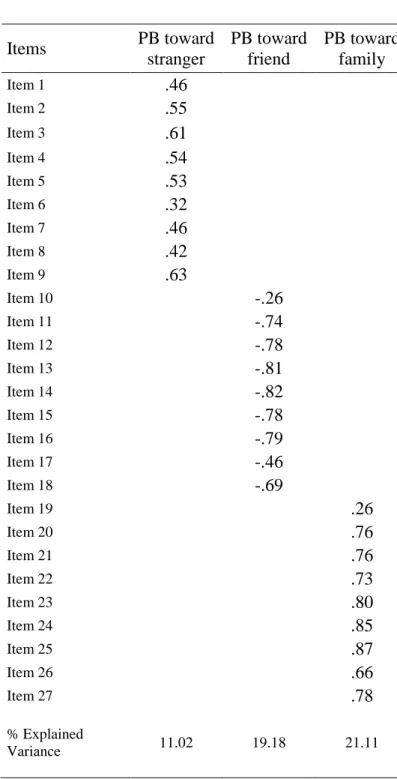
(9) (prosocial behaviors toward family members). The score of the dimensions is obtained from the average score of each item. Results Parallel analysis (PA) and exploratory factor analysis (EFA) Parallel analysis (PA) was used to determine how many dimensions could be identified in the scale. The PA was conducted using the FACTOR program developed by Lorenzo-Seva and Ferrando (2006). The results indicated the presence of three dimensions. Then, EFA was conducted. The Kaiser-Meyer-Olkin (KMO) statistic obtained indicated that the data were adequate to continue with a factor analysis (KMO =.91). The principle axis method with oblimin rotation was used to extract the factors. Table 1 shows the factor loading for each item and total variance for each dimension of the scale. Insert Table 1 The three factors showed moderate correlation: prosocial behavior toward strangers correlated with prosocial behavior toward friends (r =.37, p ≤. 001) and with prosocial behavior toward family (r = .31, p ≤. 001); prosocial behavior toward friends correlated with prosocial behavior toward family (r = .68, p ≤. 001).. Reliability McNeish (2017) states that the Omega coefficient does not assume the Tau equivalence as Cronbach's alpha does. This means that the Omega coefficient assumes that each item in an instrument may contribute unequally to the total score of the instrument, while Cronbach's alpha assumes that each item contributes equally.. 7.
(10) Moreover, Cronbach's alpha assumes that items included in an instrument are continuous and have normal distributions. McNeish (2017) and Hancock and Mueller (2001) suggest using the coefficient H as an index of maximum reliability to obtain an optimal weighting of the instrument. Furthermore, the advantage of the coefficient H is that it is not affected by the inclusion of poor items. In this study, the dimension of prosocial behavior toward strangers obtained a ω = .75 and a coefficient H = .77, the dimension of prosocial behavior toward friends obtained a ω = .89 and a coefficient H = .92, and the dimension of prosocial behavior toward family members obtained a ω = .91 and a coefficient H = .93. Thus, the three dimensions of the scale have good levels of reliability.. Study 2. Participants and procedure The sample included 458 participants from 18 to 24 years old (31% male, M = 21.62 years old; SD = 1.61) from Córdoba, Argentina. The participants were undergraduate students from six different majors recruited from an Argentinean university. Participation was voluntary, participants did not receive any compensation, and the confidentiality of the responses was guaranteed. The students completed the scale during class. Instruments 1). Prosocial Behaviors Toward Different Targets. The same scale version from Study 1 was used in Study 2. The McDonald’s omega coefficient was .77 and coefficient H was .79 for the prosocial behaviors toward strangers dimension, McDonald’s omega. 8.
(11) coefficient was .88 and coefficient H was .89 for the prosocial behaviors toward friends dimension, and McDonald’s omega coefficient was .91 and coefficient H was .93 for the prosocial behaviors toward family dimension. 2). Prosocial Tendency Measure. To measure the different types of prosocial behaviors, namely, altruistic, responsive, public and anonymous, students responded to the Spanish version of the Prosocial Tendency Measure by Carlo and Randall (2002) (Richaud et al., 2012). The scale consists of 21 items on a 5-point scale ranging from 1 (does not describe me at all) to 5 (describes me greatly), with sample items such as “I can help others best when people are watching me” (public, Cronbach’s α in the present sample .80), “I think that helping others without them knowing is the best type of situation” (anonymous, Cronbach’s α in the present sample .79), “I respond to helping others when the situation is highly emotional” (responsive, Cronbach’s α in the present sample .81), and “I often help even if I don’t think I will get anything out of helping” (altruistic, Cronbach’s α in the present sample .63). 3). Empathy. Considering its multidimensionality, empathy was evaluated with the Interpersonal Reactivity Index (Davis, 1980), which measures both components of empathy: the affective component, which includes empathic concern and personal distress dimensions, and the cognitive component, which includes perspective taking and fantasy dimensions. The measure includes 28 items (7 for each dimension) on a 5point scale ranging from 1 (does not describe me well) to 5 (describes me very well). For this study, we considered only the perspective taking and empathic concern dimensions, which are the most commonly used dimensions to evaluate empathic disposition. Perspective taking involves understanding another’s point of view (e.g., “I believe that there are two sides to every question and try to look at them both”), and empathic concern involves the feeling of care, compassion and concern for others (e.g., 9.
(12) “I would describe myself as a pretty soft-hearted person”). Cronbach’s α in the present sample was .70 for perspective taking and .71 for empathic concern.. Results Confirmatory factor analysis (CFA). CFA was used to test the three-dimensional structure of the scale using the AMOS Graphics program Version 19. Because multivariate normality was not found, the unweighted least squares (ULS) method was used. The results show that the three-factor model of the prosocial behaviors toward different targets dimension fit the data relatively well: χ2 = 1712.35, df = 321, p ≤. 001, χ2/df= 5.3, GFI=.92, AGFI=.91, CFI=.95, SRMR=.08, RMSEA=.08. The model is depicted in Figure 1, and the Spanish version of the scale is shown in the Supplementary Material. Insert Figure 1 Relationship of the Prosocial Behaviors Toward Different Targets Scale with the Prosocial Tendencies Measure (PTM) and Interpersonal Reactivity Index (IRI).. To study the convergent validity of the Prosocial Behaviors Toward Different Targets Scale, we correlated each dimension (prosocial behaviors PB toward strangers, friends and family) with the Prosocial Tendency Measure (PTM) by Carlo and Randall (2002) and with the Interpersonal Reactivity Index (IRI) by Davis (1980). The results of the Pearson correlation indicate that there is a moderate positive association of prosocial behavior toward strangers with the two dimensions of empathy (perspective taking r = .31, p < .001 and empathic concern r = .23, p < .001) and with anonymous (r = .34, p <. 10.
(13) .001) and responsive (r = .48, p < .001) prosocial tendencies. However, there is no relationship between prosocial behavior toward strangers and altruistic and public prosocial tendencies. Moreover, there is a moderate positive association of prosocial behavior toward friends and family members with the two dimensions of empathy (perspective taking with PB toward friends r = .28, p < .001 and family members r = .27, p < .001; empathic concerns with PB toward friends r = .38, p < .001 and family members r = .28, p < .001) and with responsive prosocial tendencies (PB toward friends r = .39, p < .001, PB toward family r = .25, p < .001). Furthermore, the results indicate a weak positive relation between prosocial behavior toward friends and family and altruistic (PB toward friends r = .10, p < .01, PB toward family r = .12, p < .01) and anonymous (PB toward friends r = .16, p < .001, PB toward family r = .10, p < .01) tendencies and a weak negative association with the public prosocial tendency (PB toward friends r = -11., p < .01, PB toward family r = -.10, p < .01). See Table 2. Insert Table 2 Discussion Because the effects of familiarity and anonymity on prosocial behavior vary across individuals, it is important to have a validated scale to adequately measure prosociality toward different targets. The objective of this paper was to study the psychometric properties of the Spanish version of the Prosocial Behavior Toward Different Targets Scale. In Study 1, we explored the existence of a three-dimensional model of the scale. Both parallel analysis and exploratory factor analysis confirmed the three-factor model identifying prosocial behavior toward strangers, family members and friends. The total model explained 51.31% of the variance. There is no accurate indicator of how much total variance should explain the exploratory factor analysis of. 11.
(14) an instrument. However, some literature suggests levels of 50% and higher (Watson, 2017), whereas other studies recommend 60% or even 75% (Henson, & Kyle, 2006, Watson, 2017). Our results indicated that the strongest dimension was prosocial behavior toward family members, followed by prosocial behavior toward friends and finally toward strangers. These results are consistent with the literature because different studies have shown that prosocial behaviors toward strangers are less common than prosocial behaviors directed toward people with whom a person has some kind of emotional relationship. Previous studies have shown that to maintain certain relationships, people act more prosocially within the group (Eberly & Montemayor, 1999) and act less prosocially with outsiders or strangers of that group when there is no relational motivation to help (Padilla-Walker & Christensen 2011). The second objective of this paper was to confirm the three-factor structure of the scale and study the convergent validity of the prosocial behavior scale toward different targets with two well-validated scales, the Prosocial Tendencies Measure developed to assess different motivations to help others and the Interpersonal Reactivity Index to assess two aspects of empathy (cognitive and emotional components). The results confirmed the three-factor model of the scale and adequate convergent validity with the empathy and prosocial tendency scales. Specifically, the results indicated that the perspective taking and empathic concerns, cognitive and emotional components of empathy, are related to prosocial behavior toward three different targets: strangers, family and friends. These results are consistent with several previous studies indicating that both aspects of empathy are closely related to the emergence of prosocial behavior (Mesurado, Richaud, Rodriguez, 2018).. 12.
(15) Another important indication of the construct validity of the scale is the relationships with the prosocial behavior tendencies. The anonymous and responsive prosocial tendencies are related to prosocial behavior toward the three targets studied. Importantly, the anonymous prosocial tendency is most strongly related to prosocial behavior toward strangers, while the responsive prosocial tendency is related to the three targets in a similar way. This could be because it is more difficult to act prosocially in an anonymous way with a relative or friend than with a stranger in terms of keeping one’s identity hidden during a prosocial action. On the other hand, the responsive prosocial tendency emerges from other requirements, so it is unsurprising that it is associated with the three targets of strangers, friends and family members in a similar way. The findings indicate that the public prosocial tendency, motivated by selfish reasons, is negatively related to prosocial behavior toward family and friends and is not related to prosocial behavior toward strangers. It is important to highlight that this study found a significant but weak association between prosocial behavior toward family and friends and the altruistic prosocial tendency but no relation between this tendency and prosocial behavior toward strangers. These results are consistent with previous studies that showed that altruistic behavior is strongly influenced by the level of familiarity with the recipient (Wynn, Bloom, Jordan, Marshall, & Sheskin, 2018). In summary, these results confirm that these two scales (Prosocial Behavior Toward Different Targets and the Prosocial Tendency Measure) are not substitutable; instead, they provide differentiated information on complementary aspects of prosocial behavior. These results are consistent with recent studies that have shown that different predictors of each type of prosocial behavior can be identified (Mesurado, Richaud & Rodriguez, 2018). For example, prosocial behavior toward family and toward friends is. 13.
(16) motivated more by the parental variable than by empathy and positive mental state, while prosocial behavior toward strangers is more motivated by positive mental state and empathy than by the parental variable. Moreover, the same study showed that these three variables (positive mental state, empathy and parental variables), empathy, and prosocial flow explained similar percentages of variance in the different types of the Prosocial Tendency Measure (altruistic, anonymous, responsive, and public) (for more details, see Mesurado, Richaud & Rodriguez, 2018).. Limitations and future studies In the future, it would be interesting to apply and test the stability of the threemodel structure of the Prosocial Behavior Toward Different Targets Scale in other Spanish-speaking countries, such as Latin American countries and Spain. Moreover, testing the invariance of the model across different countries and with participants of different ages may strengthen our results. Furthermore, it is necessary to test the convergent validity of the scale by studying its correlations with other constructs related to prosocial behavior, such as positive emotions and gratitude.. 14.
(17) Reference Baron-Cohen, S., & Wheelwright, S. (2004). The empathy quotient: an investigation of adults with Asperger syndrome or high functioning autism, and normal sex differences. Journal of autism and developmental disorders, 34(2), 163-175. doi:https://doi.org/10.1023/B:JADD.0000022607.19833.00 Batson, C. D., Duncan, B. D., Ackerman, P., Buckley, T., & Birch, K. (1981). Is empathic emotion a source of altruistic motivation? Journal of personality and Social Psychology, 40(2), 290-302. doi:http://dx.doi.org/10.1037/00223514.40.2.290 Carlo, G., & Randall, B. A. (2002). The development of a measure of prosocial behaviors for late adolescents. Journal of youth and adolescence, 31(1), 31-44. doi:https://doi.org/10.1023/A:1014033032440 Chaparro, M. P., & Grusec, J. E. (2016). Neuroticism moderates the relation between parenting and empathy and between empathy and prosocial behavior. MerrillPalmer Quarterly, 62(2), 105-128. doi:https://digitalcommons.wayne.edu/mpq/vol62/iss2/1 Davis, M. H. (1980). A multidimensional approach to individual differences in empathy. JSAS Catalog Select. Doc. Psychol., 10, 85. doi:http://www.ucp.pt/site/resources/documents/ICS/GNC/ArtigosGNC/Alexan dreCastroCaldas/24_Da80.pdf Davis, M. H. (1983). The effects of dispositional empathy on emotional reactions and helping: A multidimensional approach. Journal of personality, 51(2), 167-184. doi:https://doi.org/10.1111/j.1467-6494.1983.tb00860.x. 15.
(18) Eberly, M. B., & Montemayor, R. (1999). Adolescent affection and helpfulness toward parents: A 2-year follow-up. The Journal of Early Adolescence, 19(2), 226-248. doi:https://doi.org/10.1177/0272431699019002005 Eisenberg, N., Eggum, N. D., & Di Giunta, L. (2010). Empathy‐related responding: Associations with prosocial behavior, aggression, and intergroup relations. Social issues and policy review, 4(1), 143-180. doi:https://doi.org/10.1111/j.1751-2409.2010.01020.x Eisenberg, N., & Fabes, R. A. (1990). Empathy: Conceptualization, measurement, and relation to prosocial behavior. Motivation and Emotion, 14(2), 131-149. doi:https://doi.org/10.1007/BF00991640 Eisenberg, N., & Miller, P. A. (1987). The relation of empathy to prosocial and related behaviors. Psychological bulletin, 101(1), 91-119. Eisenberg, N., & Mussen, P. H. (1989). The roots of prosocial behavior in children: Cambridge University Press. Eisenberg, N., Zhou, Q., & Koller, S. (2001). Brazilian adolescents' prosocial moral judgment and behavior: Relations to sympathy, perspective taking, gender‐role orientation, and demographic characteristics. Child development, 72(2), 518534. Grossmann, T. (2018). How to build a helpful baby: a look at the roots of prosociality in infancy. Current opinion in psychology, 20, 21-24. doi:10.1016/j.copsyc.2017.08.007 Henson, R. K., & Kyle Roberts, J. (2006). Use of exploratory factor analysis in published research: Common errors and some comment on improved practice. Educational and Psychological Measurement, 66(3), 393–416. DOI:. 16.
(19) https://doi.org/10.1177/0013164405282485. Hepach, R., & Warneken, F. (2018). Editorial overview: Early development of prosocial behavior: Revealing the foundation of human prosociality. Current opinion in psychology, iv-viii. doi:10.1016/j.copsyc.2018.02.001 Kumru, A. (2002). Prosocial behavior within the family context and its correlates among Turkish early adolescents. Ph. D. Diss., Nebraska-Lincoln Univ. Retrieved from http://digitalcommons.unl.edu/dissertations/AAI3074086 Lockwood, P. L., Seara-Cardoso, A., & Viding, E. (2014). Emotion regulation moderates the association between empathy and prosocial behavior. PloS one, 9(5), e96555. doi:https://doi.org/10.1371/journal.pone.0096555 McGinley, M., Opal, D., Richaud, M. C., & Mesurado, B. (2014). Cross-Cultural Evidence of Multidimensional Prosocial Behaviors: An Examination of the Prosocial Tendencies Measure (PTM). In L. Padilla-Waker & G. Carlo (Eds.), Prosocial Development: A multidimensional approach (pp. 258-278). New York: Oxford University Press. McNeish, D. (2017). Thanks coefficient alpha, we’ll take it from here. Psychological methods, 23(3), 412-433. doi:http://dx.doi.org/10.1037/met0000144 Mesurado, B., Richaud, M. C., & Rodriguez, L. M. (2018). The varying roles of parents and the cognitive–emotional variables regarding the different types of adolescent prosocial behavior. Journal of Social and Personal Relationships. doi:10.1177/0265407518780365 Mlcák, Z., & Záskodná, H. (2008). Analysis of relationships between prosocial tendencies, empathy, and the five-factor personality model in students of helping professions. Studia Psychologica, 50(2), 201-216.. 17.
(20) Morelli, S. A., Rameson, L. T., & Lieberman, M. D. (2012). The neural components of empathy: predicting daily prosocial behavior. Social cognitive and affective neuroscience, 9(1), 39-47. doi:https://doi.org/10.1093/scan/nss088 Nichols, S. (2001). Mindreading and the cognitive architecture underlying altruistic motivation. Mind & language, 16(4), 425-455. doi:https://doi.org/10.1111/14680017.00178 Padilla-Walker, L. M., & Christensen, K. J. (2011). Empathy and Self-Regulation as Mediators Between Parenting and Adolescents’ Prosocial Behavior Toward Strangers, Friends, and Family. Journal of Research on Adolescence, 21(3), 545 – 551. doi:10.1111/j.1532-7795.2010.00695.x Padilla‐Walker, L. M., Carlo, G., & Memmott‐Elison, M. K. (2018). Longitudinal change in adolescents’ prosocial behavior toward strangers, friends, and family. Journal of Research on Adolescence, 28(3), 698-710. doi:https://doi.org/10.1111/jora.12362 Padilla‐Walker, L. M., Dyer, W. J., Yorgason, J. B., Fraser, A. M., & Coyne, S. M. (2015). Adolescents' prosocial behavior toward family, friends, and strangers: A person‐centered approach. Journal of Research on Adolescence, 25(1), 135-150. doi:https://doi.org/10.1111/jora.12102 Peterson, C., & Seligman, M. E. (2004). Character strengths and virtues: A handbook and classification (Vol. 1): Oxford University Press. Richaud, M. C., Mesurado, B., & Kohan Cortada, A. (2012). Analysis of dimensions of prosocial behavior in an Argentinean sample of children. Psychological Reports: Mental & Physical Health, 111(3), 687-696. doi:10.2466/10.11.17.PR0.111.6.687-696. 18.
(21) Tuncel, S. D. (2010). Comparing prosocial tendencies of athletes and nonathletes Journal of Physical Education and Sport, 29(4), 81-85. Warneken, F., & Tomasello, M. (2009). The roots of human altruism. British Journal of Psychology, 100(3), 455-471. doi:https://doi.org/10.1348/000712608X379061 Watson, J. C. (2017). Establishing evidence for internal structure using exploratory factor analysis. Measurement and Evaluation in Counseling and Development, 50-4, 232-238. DOI: https://doi.org/10.1080/07481756.2017.1336931. 19.
(22) Items Item 1 Item 2 Item 3 Item 4 Item 5 Item 6 Item 7 Item 8 Item 9 Item 10 Item 11 Item 12 Item 13 Item 14 Item 15 Item 16 Item 17 Item 18 Item 19 Item 20 Item 21 Item 22 Item 23 Item 24 Item 25 Item 26 Item 27 % Explained Variance. PB toward PB toward PB toward stranger friend family .46 .55 .61 .54 .53 .32 .46 .42 .63 -.26 -.74 -.78 -.81 -.82 -.78 -.79 -.46 -.69 .26 .76 .76 .73 .80 .85 .87 .66 .78 11.02. 19.18. 21.11. Note: PB = Prosocial behavior. Table 1. Results of the Principal Axes, Structure Matrix, and Oblimin rotation of Prosocial behavior toward different targets. 20.
(23) PB toward different targets Variables. PB toward strangers. PB toward friends. Prosocial Tendency Measure. PB toward family. Public. Altruism. Anonymous. Interpersonal Reactivity Index Responsive. Perspective taking. Empathic concern. PB toward strangers. -. PB toward friends. .35**. -. PB toward family. .30**. .67**. -. Public. -.02. -.11*. -.10*. -. Altruism. .01. .10*. .12**. -.61**. -. Anonymous. .34**. .16**. .10*. .01. -.05. -. Responsive. .48**. .39**. .26**. -.37. -.08. .34**. -. Perspective taking. .31**. .28**. .27**. -.26**. .22**. .23**. .27**. -. Empathic concern. .23**. .38**. .28**. -.32**. .25**. .07. .26**. .32**. -. M. 3.62. 4.49. 4.47. 1.67. 4.31. 3.25. 3.72. 3.72. 3.88. SD. 0.67. 0.53. 0.62. 0.87. 0.69. 0.95. 0.6. 0.56. 0.56. Skewness. .49. -1.83. -1.98. 1.27. -1.17. -.26. -.39. -.19. Kurtosis. 4.23. 5.74. 5.6. .82. 1.07. -.37. .63. -.01. .. -.27 -.60. Note: PB = Prosocial behaviors; *p < .01; **p <. 001.. 21.
(24) Table 2. Summary of intercorrelations, means and standard deviations, for scores on Prosocial behaviors and Empathy.. 22.
(25) Figure 1. The Path diagram of the the Prosocial Behavior Toward Different Targets Scale. Standardized factor loadings are shown on the straight arrows, whereas factors’ terms intercorrelations are shown on the curved arrows.. Note: **p<.01, *** p<.001. 23.
(26)
Figure
Documento similar