
Social cognitive factors in the empowerment of Mexican employees
192
0
0
Texto completo
(2) ABSTRACT. SOCIAL COGNITIVE FACTORS IN THE EMPOWERMENT OF MEXICAN EMPLOYEES by ENRIQUE BORES RANGEL, M.A. SUPERVISING PROFESSOR; JANICE M. BEYER. Research studies in the relationship between such empowering interventions as employee participation in decision making and quality circles present mixed results. These studies have typically conceptualized the relationship between managerial interventions and employees' responses by implicitly using a "black box" for the employee. Asan altemative, Bandura' s (1986) social cognitive theory proposes that employees' psychological intemal mechanisms mediate inbetween organizational interventions and employee's outcomes. Based in this theory, a social, cognitive and affective model that incorporates social, cognitive and affective assessments was proposed to understand the elements determining employees' empowerment. These are assessments of the self in relation to 1) specific tasks on the job, 2) the social context of such tasks, 3) the job as a whole and 4) the organization. Empowerment was defined not in terms of what managers or the organization do (for instance, to delegate orto promote team work) but in motivational terms. That is, empowerment refers to improvements in employees' social, cognitive and affective assessments of the selfthat are conducive to a potentiated and enriched result.. Vil.
(3) Drawing from a wide range of industries in central Mexico, from manufacturing to education, 238 white collar employees answered a questionnaire designed for the study. Factor analyses resulted in items of the questionnaire clustered as expected (except that sorne assessments resulted to be bi-dimensional) providing support to the structure of the model. Among the di verse assessments, only selfefficacy, meaningfulness and opportunity ofrealizing expectations played a major role in the prediction of affective and enactive employees' outcomes. Such prediction was better done by social, cognitive and affective assessments than by twelve organizational interventions, providing support for the incorporation of mediating psychological assessments in understanding empowerment. Surprisingly, choice, which relates to delegation, autonomy and participation, was an assessment not playing a major role in empowerment. The results indicate that meanings, intentions and perceptions of ones' own competence are the core elements of employee empowerment. Managers striving for higher levels of employees' commitment, satisfaction and performance should design empowering interventions that help them to improve their self-competence perceptions by programs that convey efficacy information through progressive mastering experiences and by adequate modeling by others. Also, tasks andjobs should be enriched by incorporating employees' expectations in such a way that they will find meaning and purpose. Further research should study blue-collar employees' assessments, because ceiling effects could have taken place in this study due to the sample of highly educated people used.. Vlll.
(4) TABLE OF CONTENTS Chapter 1: Introduction 1 Purpose of the Study 4 lmportance ofthe Study 4 Chapter 2: Empowerment and Social Cognitive Theory 7 Empowerment and the New Paradigms of Management 7 Social Cognitive Theory 8 Triadic Model of Reciproca( Determ ination 9 Self-Efficacy Model 10 14 Empirical Studies in Organizational Settings Integrative Role ofthe Theory 22 Definitions of Empowerment in the literature 23 lntroduction 23 Definitions of Empowerment in Terms of Externa! lnterventions 25 Definitions of Empowerment Considering Personal Factors 28 Chapter 3: The Social, Cognitive and Affective Model of Empowerment 30 Empowerment Defined 30 Social Cognitive Models of Empowerment 31 Conger and Kanungo's (1988) Model of Empowerment 32 Thomas and Velthouse's (1990) Model of Empowerment 34 Social, Cognitive and Ajfective Model of Empowerment 39 Leve Is of specificity 40 Social, Cognitive and Affective Factors of Empowerment 46 Self-efficacy 54 Hypotheses 77 Hypotheses for Task Assessments 78 Hypotheses for Job Assessments 78 Hypotheses for the Comparison of Assessment Specificity Leve( in the Prediction of0utcomes79 Hypotheses for Organizational Empowering lnterventions 79 Chapter 4: Method 81 Procedure 8I 81 Sample Measures 84 84 Measures of Task Assessments 91 Measures of Job Assessments Description ofthe Questionnaire in Social, Cognitive and Affective Assessments 95 Measures of Outcomes 96 103 Measures of Organizational lnterventions /06 Analysis 106 Testing of Hypothesis 1 107 Testing of Hypothesis 2 107 Testing of Hypotheses 3 and 4 107 Testing of Hypotheses 5 and 6 108 Testing of Hypothesis 7 109 Testing of Hypotheses 8 and 9. IX.
(5) Chapter 5: Results Descriptive Statistics for Items Factor Analyses Factor Analyses for Task ltems Factor Analyses for Job ltems Factor Analysis for Task Outcome ltems Factor Analysis for Job Outcome ltems Descriptive Statisticsfor Variables Resultsfor Task Variables Results for Job Variables Results for the Relationship between Task Assessments and Job Assessments Results for Organizational Empowering lnterventions Chapter 6: Discussion, Conclusions and Recommendations Structure of the Empowerment Model Task Assessments in Relation to Task Outcomes Job Assessments in Relation to Job Outcomes Discussion ofthe Resultsfor Control Variables Relationship Between Task and Job Assessments Organizational Empowering lnterventions Conclusions limitations Appendix A: Descriptive statistics for ltems Task self-efficacy Task meaningfulness Task choice Task impact Others' competence Social support Organizational support Mood Task involvement Task Performance Job self-efficacy Job Meaningfulness Job Choice Job lmpact Opportunity Alignment Resource Access Job Satisfaction Organizational Commitment Extra-role Behaviors Remain Intentions Tenure Personal Appendix B: Results of factor analyses References. X. 110 J/0 J/0. 112 114 115. 117 J/9 120. 123 129 132 139. 139 144 146. 149 150 151 153 155 157. 157 157 157 157 158 158 158 159 159 159 160 160 160 160 161 161. 161 162 162 162 162 163 163 164 172.
(6) LIST OF TABLES Table 1. Examples of assessments for di verse jobs, tasks and task purposes ........................................ 54 Table 2. Number and percentage of employees in the sample by age groups ....................................... 82 Table 3. Number and percentage of employees in the sample by study leve l. ...................................... 82 Table 4. Number and percentage of employees in the sample by sector of organizations .................... 83 Table 5. Number and percentage of employees in the sample by total of employees at location ......... 83 Table 6. Number and percentage of employees in the sample by organization's origin of capital. ...... 83 Table 7. Cronbach's alpha values for variables in the study ............................................................... 111 Table 8. Underlying dimensions ofthe model of empowennent as found by factor analyses ............ 119 Table 9. Descriptive statistics for main variables in the study ............................................................ 121 Table 10. Pearson's correlation coefficient matrix for Task variables ................................................ 122 Table 11. Pearson' s correlation coefficient matrix for Job variables .................................................. 122 Table 12. Degrees offreedom for hierarchical multiple regression analyses oftask outcomes .......... 122 Table 13. Results ofregression analyses for task outcome variables presented by steps ................... 124 Table 14. Beta weights for predictors of task outcomes in hierarchical regression analyses .............. 125 Table 15. Degrees of freedom for hierarchical multiple regression analyses of job outcomes ........... 126 Table 16. Results of hierarchical regression analyses for job outcome variables by steps ................. 127 Table 17. Beta weights for predictors ofjob outcomes in hierarchical regression analyses ............... 128 Table 18. Significance ofthe difference on the multiple coefficient of detennination changes for task vs. job assessments in the prediction of task-outcomes ............................................................. 130 Table 19. Significance of the difference on the multiple coefficient of detennination changes for task vs. job assessments in the prediction of job-outcomes .............................................................. 131 Table 20. Significance of the difference of multiple regression coefficients ...................................... 134 for interventions and assessments in the prediction of task-outcomes ................................................ 134 Table 21. Sign ificance of the difference of multiple regression coefficients for interventions and assessments in the prediction of job-outcomes .......................................................................... 135 Table 22. Multivariate mean difference (MANOV A) between organizations implementing empowering interventions and organizations not implementing them ..................................... 136 Table 23. Post hoc ANOV A for interventions with significant differences in Task assessments ..... 137 Table 24. Post hoc ANOV A for interventions in Job assessments ...................................................... 138 Table A 1. Descriptive statistics for items in task-self variables .......................................................... 157 Table A2. Descriptive statistics for items in context-self variables ..................................................... 158 Table A3. Descriptive statistics for items in task-outcome variables .................................................. 159 Table A4. Descriptive statistics for items in job-self variables ........................................................... 160 Table AS. Descriptive statistics for items in organization-self variables ............................................ 161 Table A6. Descriptive statistics for items in job-outcome variables ................................................... 162 Table A 7. Descriptive statistics for items in control variables ............................................................ 163 Table A8. Frequencies for Empowering lnterventions ....................................................................... 163 Table A9. Frequencies for qualifiers of Empowering lnterventions ................................................... 163 Table B l. Varimax Rotated Factor Matrix for Task items .................................................................. 164 Table B2. Final Statistics ofVarimax Rotated Factor Matrix for Task items ..................................... 165 Table B3. Varimax Rotated Factor Matrix for Job items .................................................................... 166 Table B4. Final Statistics of Varimax Rotated Factor Matrix for Job items ....................................... 167 Table BS. Varimax Rotated Factor Matrix for task-outcome items .................................................... 168 Table B6. Final Statistics of Varimax Rotated Factor Matrix for task-outcome items ........................ 169 Table B7. Varimax Rotated Factor Matrix for job-outcomes items .................................................... 170 Table B8. Final Statistics of Varimax Rotated Factor Matrix for job-outcome items ......................... 171 Xl.
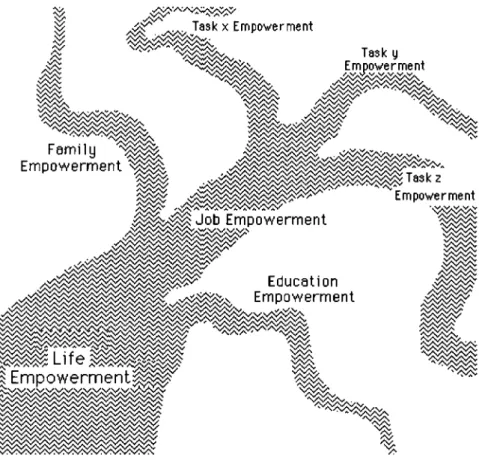
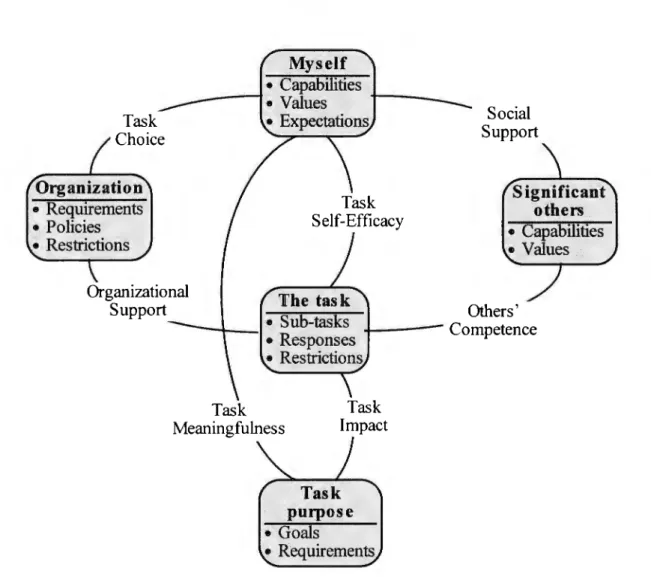
(7) LIST OF FIGURES Figure Figure Figure Figure. J. Black-box rnodel of ernployee's response ............................................................................... 3 2. Model incorporating rnediating psychological rnechanisrns .................................................... 3 3. Bandura's (1986) triadic rnodel ofreciprocal deterrnination ................................................... 9 4. Representation ofthe difference between self-efficacy and outcorne expectancy (Bandura, 1977a, with sorne changes) ............................................................................... 11 Figure 5. Social cognitive rnodel of ernpowerrnent.. ............................................................................. 31 Figure 6. Conger & Kanungo's (1988, p. 475) rnodel of ernpowering (With sorne rnodifications) .... 33 Figure 7. Thornas and Velthouse's (1990) cognitive rnodel of ernpowerrnent (With sorne rnodifications) ................................................................................................ 35 Figure 8. Social, cognitive and affective rnodel of ernpowerrnent. ....................................................... 38 Figure 9. The River of Personal Ernpowerrnent... ................................................................................. 45 Figure 1O. Social, cognitive and affective factors of ernpowerrnent.. ................................ ................. .4 7 Figure / l. Assessrnents as relationships between intervening elernents .............................................. 53 Figure 12. Social, cognitive and affective factors of ernpowerrnent with global assessrnents included ...................................................................................... 67 Figure /3. Independence ofboth dirnensions ofcornpetence: others' shortcornings and others cornpetence ..................................................................................................... 143. Xll.
(8) Chapter 1: Introduction. It has frequently been said that organizations need to rely on an empowered workforce to face the strong competition of global markets and the changing conditions of high velocity and turbulent environments (Bennis, 1984; Bowen & Lawler, 1992; Conger, 1989). Empowerment is seen as one of the necessary means to achieve high levels of profitability and fast responses to evolving customer demands and to other changes in the dimensions of competition. lt has not been until recently that theory has been emerging about how it is that empowerment works for individuals in the work place (Conger & Kanungo, 1988; and Thomas & Velthouse, 1990). The emergent theory in empowerment has considered factors that are interna} to the individual as key elements of empowerment. These factors, which are social, cognitive and affective in nature, mediate between the environment and the individual's response. The underlying psychological model used by the emergent theory of empowerment is best traced to Bandura's (1986) social cognitive theory. Bandura's (1986) Social Cognitive Theory has gained acceptance as a model to explain and predict human beings' leaming and behavior (Hergenhahn, 1982). Various aspects of the theory have successfully been tested in clinical and academic settings. The self-efficacy model, a central part of the theory, has widely been studied in such diverse areas as anxiety and phobia (e.g., Kent & Gibbons, 1987; Lee, 1984b), depressive affect (Davis & Yates, 1982), sports (Feltz, 1982), health (O'Leary, 1985), assertiveness (e.g., Lee, 1984a), achievement behavior (e.g., Campbell & Hackett, 1986; Schunk, 1984; 1985), career issues (e.g., Bores-Rangel, 1.
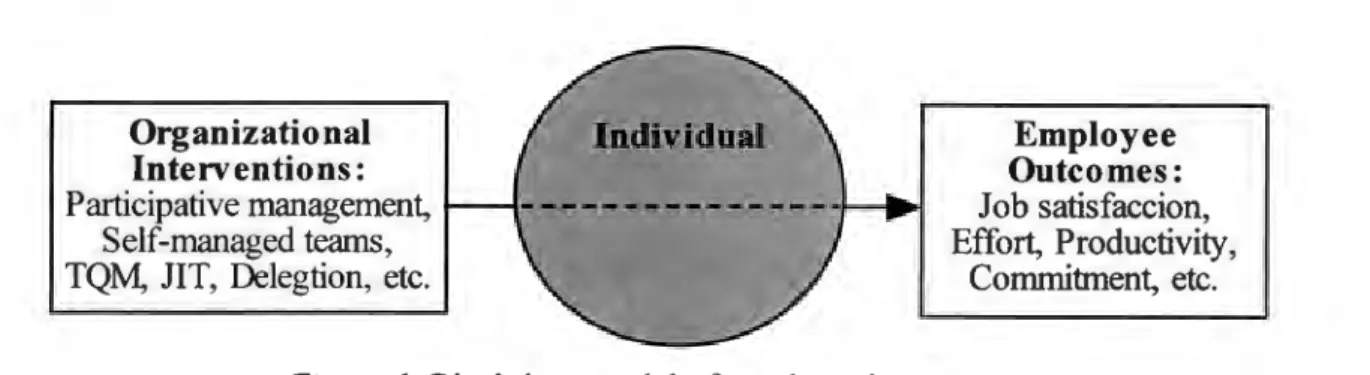
(9) 2. Church, Szendre & Reeves, 1990; Lapan, Boggs & Morrill, 1989; Lent & Hackett, 1987) and dissenting (Parker, 1993). Social cognitive theory has important implications for research in the field of organizational behavior. Except by a few studies (e.g., Burnaska, 1976, Moses & Ritchie, 1976), it has beenjust recently that the theory was conceptually presented (Gist, 1987; Wood & Bandura, 1989) and empirically tested (e.g., Ackerman & Kanfer, 1993; Eden & Aviram, 1993; Frayne & Latham, 1987; Latham & Frayne, 1989; Mitchell, et al. (1994); Stevens, Bavetta, & Gist, 1993) in the field. The theory is a promising model to understand the process of employees' empowerment. Empowerment is often presented in the literature of practitioners as a series of managerial interventions that pro mote employee' s participation in decision making at di verse levels of involvement, from delegation to self-managed teams. However, research in the relationship between organizational interventions and employee behavior frequently presents mixed results. For instance, studies do not appear to show a clear link between participation and employee productivity (Barrick & Alexander, 1987; Locke & Schweiger, 1979). Studies in employee participation implicitly assume an underlying "black box" model (see Figure 1) that does not consider in the analysis the mediating psychological mechanisms working between the extemal influences and the employee's behavior. A model incorporating mediating personal factors (see Figure 2) may prove to be crucial in the relationship between intended empowering interventions by managers and the results in empowered individuals as manifested by their covert behavior (e. g., motivation, satisfaction) and overt responses (e. g., effort, resiliency)..
(10) 3. Organizatio nal Interventions:. Employee Outcomes:. Participative management, Self-managed teams, TQM, JIT, Delegtion, etc.. Job satisfaccion, Effort, Productivity, Commitment, etc.. Figure l. Black-box model of employee's response.. Organizatio nal Interventions. Mediating psychological mechanis ms: Social, Cognitive and Affective. Employee Outcomes. Figure 2. Model incorporating mediating psychological mechanisms.. Although there is a great potential in the emergent paradigms of empowerment, research studies in the field are scant (Ford & Fottler, 1995; Fulford. & Enz, 1995; and Spreitzer, 1992) and there is not enough empirical evidence regarding the validity of the theory. Furthermore, the literature of practitioners on empowerment contains an unorganized set of definitions and concepts referring to di verse aspects of the phenomena. Sometimes the word empowerment is used to refer to the means to empower and other times to employees' responses. lt is necessary to.
(11) 4. introduce sorne order in the use of terms and to clarify how empowerment works for the individual. In summary, an emergent theory of empowerment, based on Bandura's (1986) social cognitive theory, offers a promising model to understand the phenomenon of empowerment by incorporating mediating psychological mechanisms into the analysis. However, empirical research is needed to validate the diverse social, cognitive and affective factors that determine whether individuals end up empowered in their job.. Purpose of the Study The purpose of this study was to investigate the relationship between 1) Employee's social, cognitive and affective assessments ofthe self in relation to the job and 2) employee's task/job outcomes. Assessments and outcomes are two out of three elements of the social cognitive model of empowerment presented below, which is based on Bandura's (1986) triadic model of reciprocal determination.. Importance of the Study This study contributes to the emerging theory of empowerment. lt incorporated mediating psychological factors affecting individuals in their job behavior (see Figure 2). This approach has been recently addressed by research (Fulford & Enz, 1995; and Spreitzer, 1992). The study adds to the body ofresearch validating social cognitive theory. By doing the study in Mexico, the results are directly of interest both to Mexican nationals studying management and to people in other countries interested in transferability of business concepts and theory. Considering the popularity of the concept of empowerment among managers, writers and business consultants, there is a need to provide empirical support. The.
(12) 5 emerging theory of empowerment is also in the need of more empirical support. This study clarifies the phenomena of empowerment from a research point of view.. It is not very common that studies of employee responses to managerial interventions consider the psychological mechanisms mediating between interventions and employee outcomes (see Figure 2). Most studies implicitly assume a" black box" model (see Figure 1) in which only individual inputs and outputs are incorporated, frequently yielding mixed results. This study will contribute by studying the role of interna} mechanisms in the determination of employees behavior. Bandura's (1986) Social Cognitive Theory presents a promising model to understand organizational processes and interventions. In fact, its use in management research has increased during the last years. However, most studies have included only a limited number of elements of the theory. This study provided more elements for the validation of the theory in the field of management by incorporating in the analysis diverse variables proposed by social cognitive theory. Serious research in empowering managerial approaches is scant in Mexico. Studies are needed in the field to help both practitioners and academicians to understand how it is that diverse factors related to organizational behavior and the human element function under such managerial practices. In addition, results of research in different settings and countries from those where most of the studies in management have been done are of interest not only to local managers and academicians but also to people interested in the transferability and generalizability of accepted managerial models across cultures. This is particularly true in a world moving toward a global economy, where an understanding of organizational behavior in di verse cultural and geographic contexts is necessary..
(13) 6. Mexican managers, company owners, other members of organizations, practitioners and academicians will benefit most from a study investigating the social, cognitive and affective factors that determine how Mexican employees become empowered..
(14) Chapter 2: Empowerment and Social Cognitive Theory. Empowerment and the New Paradigms of Management Empowerment is at the core of the new paradigms of management. Most writers in total quality management, re-engineering, just in time approaches, and other recent management trends point out the importance of empowering people in the organization to have the program be successful. Empowerrnent is about focusing on people in the organization. The strong competition that organizations are facing today is requiring them to achieve a more efficient use ofresources andan increase of productivity. To accomplish these objectives, a series of management theories and practices have been proposed, sorne of them trying to learn from the Japanese business success story of the 80's (Sullivan, 1992) and others doing that from the Western experience (Peters & Waterrnan, 1982; Peters, 1989). As a consequence, sorne models of management have appeared, such as Japanese management, total quality management (Berry, 1991 ), just in time systems (Holanda, 1993) and theory Z (Ouchi, 1979), among others. These models were originally introduced to Mexico by transnational companies with plants in the country and have been implemented by an increasing number of national companies. The new management paradigms demand transforrnations at all parts of the organization, particularly at the level of the human element. Organizations are turning toward more participative and team oriented structures and styles of management as a means to increase efficiency and enhance employee motivation. One of the. 7.
(15) 8 arguments is that top-down vertical, tight supervisory management results in such non-desirable outcomes as reduced initiative, resistance, low morale, and conformism (Hackman, 1986). Stressing that it is necessary to have an empowered work-force, diverse empowering practices have appeared. Among the most popular are employee involvement, team work (Olmedo, 1994), workers' participation (Stanton, 1993), long term commitment (Schuler & Harris, 1992), job enrichment (Cunningham, 1989), self-managed teams and clan control (Ouchi, 1979). The conceptual models are neither new nor Eastem. Sorne Japanese organizations have become highly successful by applying Western concepts regarding participation and group work as early as the first Deming and Juran seminars in Japan in the fifties (Ishikawa, 1985). Companies in the West have been trying to implement such models, but not without problems. However, there seems to be a common opinion that we need empowering companies that result in empowered people inside them if we are to remain competitive in today markets. Although there is a jungle of confusion in management theory (Koontz, 1989) and it is not easy or maybe even possible to integrate the diverse proposals, sorne commonalties may be found in the arising new paradigms. Akotuf (1992) pointed out that there is a convergence of these "second wind" management models toward the restoring of the human factor to the main place in the organizational performance of competitiveness and productivity. That is what empowerment is all about: focusing on people as the center of organizations.. Social Cognitive Theory Because it is a useful tool to understand individuals' behavior, Bandura's (1986) Social Cognitive theory is helpful to the study of empowerment. Social cognitive theory is an altemative to theories that consider the individual as either 1).
(16) 9. automatically controlled by the environment or 2) determined by inner drives or needs. Instead of any externa! or interna! determinants of behavior, social cognitive theory introduces a triadic model of reciproca! determination to explain psycho-social and learning processes, and self-efficacy as the main psychological mechanism taking place during such processes.. Triadic Model of Reciprocal Determination The triadic model of reciproca! determination distinguishes among three elements in human functioning: 1) individuals' environment, 2) their cognitions and other personal factors, 3) and their behavior (see Figure 3). More specifically, the model propases that there is a bi-directional determination among behavior, the environment and such personal factors as cognitions and affect, in which each of the elements influences the others (Bandura, 1986).. Cognitions and other personal factors. Environment. Behavior. Figure 3. Bandura's (1986) triadic model ofreciprocal determination.. The principie of reciproca! determination acknowledges that people are not passive processors of information but impose over externa! information their own meanings and participate in creating in the environment, particularly the social one, the reality they relate with (Mahoney, 1988; Parker, 1993). In fact, social cognitive.
(17) 10 theory especially emphasizes cognitive, vicarious, self-regulatory and self-reflective processes (Wood & Bandura, 1989).. Self-Efficacy Model Social cognitive theory presents perceptions of self-efficacy as one of the central self-regulatory mechanisms that controls motivation and performance attainments (Wood & Bandura, 1989). It is proposed that although knowledge, transformational operations, and component skills are important for performance, they are not sufficient: self-referent thoughts (that is, social, cognitive and affective assessments), mainly perceptions of self-efficacy, are presentas mediators inbetween knowledge and performance (Bandura, 1982). The theory proposes that if adequate incentives and skills are present, self-efficacy expectations determine whether a course of action is initiated, how much effort will be invested, and how much to persist in facing obstacles when pursuing the desired outcomes (Bandura, 1977a). Bandura' s first definition of perception of self-efficacy, "the conviction that one can successfully execute the behavior required to produce outcomes" (Bandura, 1977a, p. 193), was challenged to higher clarity and precision (Eastman & Marzillier, 1984; Marzillier & Eastman, 1984) and redefined as "people's judgments oftheir capabilities to organize and execute courses of action required to attain designed types ofperformances" (Bandura, 1986, p. 391). One ofthe most recent definitions IS:. People's beliefs in their capabilities to mobilize the motivation, cognitive resources, and courses of action needed to exercise control over events in their lives" (Wood & Bandura, 1989, p. 364).. Self-efficacy is something more that an evaluation of one's own isolated capabilities. Self-efficacy implies orchestration (Gist & Mitchell, 1992): It is an.
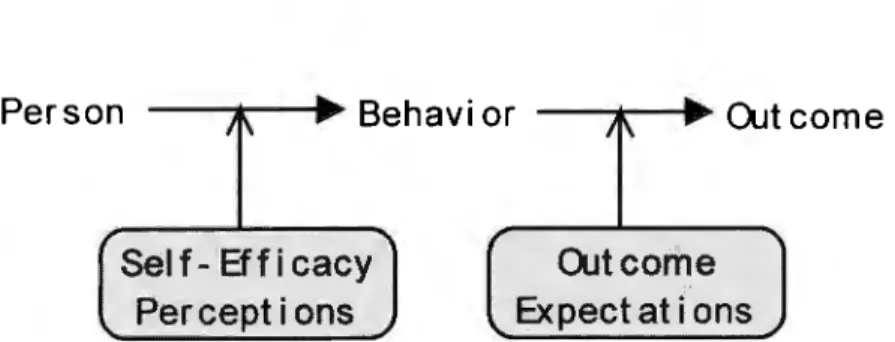
(18) 11. assessment whether I am able to orchestrate capabilities, cognitive resources, and motivational factors to maintain the necessary course of action. Social cognitive theory distinguishes between self-efficacy beliefs and outcome expectations, a term defined to clarify sorne confusion with Rotter's social leaming theory. Outcome expectancy refers to the beliefs about which behaviors produce particular outcomes. They are more a matter of knowledge of the environment, "what leads to what" (Bandura, 1978, p. 238) and which kind of behavior is important to perform determined tasks and accomplish specific goals. On the other side, self-efficacy expectancies are more a matter or knowledge about the one's own self and what can Ido. People may perfectly know which course of action to follow to obtain determined outcomes but they may believe they lack the capabilities to do so. As a consequence, they may decide to take no action in the direction of the outcomes (Bandura, 1977a). Outcome expectancy refers to the instrumentality of the behavior in the reaching of outcomes; whereas, self-efficacy perceptions refers to the assessment of the person in relation to the required behavior (see Figure 4).. Person. Sel f - Eff i cacy Per cept i ons. -~· 1...., -.... r. Out come. Out come '- Expect at i ons. i. ~. Figure 4. Representation of the difference between self-efficacy and outcome expectancy (Bandura, 1977a, with sorne changes)..
(19) 12 Although Bandura has not given too much attention to the construct in clinical environments, outcome expectancies are important to promote empowerment in organizational settings because people need to have an accurate picture of which kinds of responses are required to obtain the desired outcomes. In fact, lack of feedback, communication and information can bring personal impoverishment. Social cognitive theory proposes that leaming occurs symbolically by processing the information coming from observing both one's and others' behavior, and its environmental contingencies (Bandura, 1977a). Through observation and symbolic processing, people discover which pattems of behavior under determined circumstances are more likely of being successful, and which ones will be conducive to negative consequences; all of this without necessarily behaving. Self-efficacy perceptions are leamed like any other kind of cognition. They are products of cognitive processing of information coming from four sources: mastery experiences, modeling, social persuasion and physiological states (Wood & Bandura, 1989). Mastery experiences --also named performance accomplishments (Bandura, 1977a) and enactive attainments (Bandura, 1982)-- are the strongest source of information and refers to the experiencing of success because of one' s behavior. Repeated lack of success, especially at early experiences, can cause low self-efficacy expectations. Modeling is an observational leaming phenomenon. It works by vicarious experiences modifying efficacy expectations through the observation of others' accomplishments. The informative value of this source is higher when observing several models judged to be similar to oneself..
(20) 13 Bandura ( 1986) presented guided mastery modeling as an effective way to leam intellectual, social and behavioral abilities. The steps are as follows: first, the relevant skills are modeled and general rules and strategies are taught. Second, a guided practice of the observed skills takes place in simulated environments. Finally, individuals go through a transfer program that guarantees success. Part of the rationale underlying this method is expressed by the following statement: " ... cognitive events are induced and altered most readily by experience of mastery arising from effective performance" (Bandura, 1977a, p. 191 ). Guided mastery modeling may be helpful to accomplish organizational change through empowerment considering that such interventions require the acquisition of new attitudes and behaviors by employees. Social or verbal persuasion is frequently used by those attempting to influence others' efficacy beliefs because it is easy and socially acceptable. However, disaffirming experiences can easily diminish any increases in perceptions of selfefficacy coming from this source. lt is not uncommon for managers attempting to empower employees to use in isolation verbal persuasion, disregarding more vigorous sources of efficacy perception. Finally, the emotional responses of the organism also provide information, particularly when the tasks imply strong physiological arousal; for instance, coping with threatening events (Bandura, 1986). The individual may process the physiological reactions to stressing events as either evidence of power or as a signal of incompetence. lt has been stated that anxiety correlates negatively with efficacy expectations (Betz & Hackett, 1983 ). The effects of information in self-efficacy expectations depend not only on the content of the message but also on how it is cognitively appraised. Even information from successful performance may have low impact due to discriminatory.
(21) 14 processes, and attribution of one's behaviors to extemal factors and to the degree of difficulty of the task. Similarly, the effect of modeling is moderated by perceived models' characteristics and degree of identification with the model. In the same way, the effects of social persuasion on increasing self-efficacy are determined by the perceived credibility, prestige, and trustworthiness of the messenger (Bandura, 1977a). Thus, employees' preferred cognitive styles used in processing information are important determinants of self referent behaviors.. Empirical Studies in Organizational Settings There are sorne social cognitive empirical studies in organizational settings. Sorne of them have shown a positive relationship between modeling and behavior performance (Bumaska, 1976; Decker, 1983; and Meyer & Raich, 1983). It has also been found that modeling negative performance leads to low self-efficacy and performance (Brown & Inouye, 1978). Jones (1986), studying socialization of newcomers to organizations, analyzed the moderating role of newcomer' s self-efficacy about mastery of role and organizational requirements in the relationship between socialization practices of the organization and role orientation. Role orientation was defined as "the manner in which individuals perform their roles and adjust to task requirements" (p. 263). lt ranged from an innovative orientation (newcomers try to change role procedures) to a custodia! orientation (acceptance of organization's guidelines for the role). Jones ( 1986) study found that the correlation between self-efficacy and role orientation was significant but low. However, results showed significant differences between high self-efficacy newcomers and low self-efficacy ones in the correlation of socialization practices with role orientation. This suggests that high self-efficacy newcomers tend to rely more in themselves in adjusting to the role and the.
(22) 15. organization and low self-efficacy employees tend to define situations according to the dictates of the organization. A serious drawback ofthe study was a very low response rate. Although the author argues analyses of the sample showed that subjects' distribution by business areas resembled the distribution of the original, it is very probable that severa! unresponsive subjects were systematically different regarding the variables of the study (low self-efficacy, quitting the job, low job satisfaction, etc.) In Jones' (1986) study, self-efficacy was significantly negative in relation to both commitment and job satisfaction, and positive in relation to intentions to qui t. Although Jones did not discuss the implications of such results, they suggest that people who have very high confidence in their capabilities to be successful may not feel challenged any more to perform and they have to set higher goals to remain motivated. This might be true considering that Jones' subjects were newcomers-toorganizations MBA students, who probably are people leaded by high-level incentives and expectations. This provides support to the idea that behavior <loes not depend on isolated assessments as self-efficacy, but on an array of mutually influencing variables, as it is later proposed for the social cognitive model of personal empowerment. Mitchell and colleagues (1994) presented evidence that the role of both self-efficacy perceptions and goals in determining performance changes during the process of skill acquisition. Frayne and Latham (1987; Latham & Frayne, 1989) have applied social cognitive theory to such an elusive area as job attendance. Previously, Johns and Nicholson (1982) found that absenteeism was not really explained, predicted, nor regulated. The study tested ajob-attendance self-management training program based on the social cognitive constructs of self-efficacy and outcome expectancy..
(23) 16 One of the precepts underlying the self-management intervention of the study were that "people who come to work judge themselves as efficacious (Bandura, 1977, 1986) in coping with environmental demands (e.g., supervisory conflict, peer pressure, family obligations, transportation issues, illness), whereas those who do not come to work perceive themselves as inefficacious" (Latham & Frayne, 1989, pp. 411-412). The other precept was that, because they were considered poor employees, their outcome expectancies included the belief that neither manager nor peers would change in opinion even after changing their job attendance habits (Frayne & Latham, 1987). People in the training group significantly increased their job attendance and self-efficacy perceptions three, six, nine and 12 months after the pretraining measurement, whereas the control group remained without change (Frayne & Latham, 1987). In the last term, the control group was also trained resulting in significant increases of bothjob attendance and self-efficacy (Latham & Frayne, 1989). However, outcome expectancies did not increase significantly in the 1987 study and it was not incorporated in the 1989 one. The authors argued that this could be so because outcome expectancies were high before the study. Frayne and Latham's (1987, Latham & Frayne, 1989) research studies resulted in strong support for social cognitive theory. The intervention clearly was empowering for employees and beneficia! for the organization, because employees ended up with a feeling of being more powerful and in control of their own circumstances, at the same time that the organization was in a better of position after having more attendant employees. Podsakoff and Farh (1989) tested sorne aspects of social cognitive theory by having subjects write as many adjectives as they could after seeing a stimulus word. Negative feedback provided between a first anda second tria! resulted in higher.
(24) 17 performance increases compared with increases of the positive-feedback and control groups. The results provide support for social cognitive statement that when individuals do not accomplish their performance expectations a self-evaluative mechanism creates dissatisfaction, which works as a motivational force to attain individuals' interna! goals and standards. Podsakoff and Farh's (1989) study did not find any effect of feedback sign in subjects' self-efficacy after doing ANCOV A with the first period performance score as covariate. The authors justify this by arguing that they did not have a fair test of feedback effects on self-efficacy because they measured self-efficacy in absolute terms but provided feedback in a relative way (subjects were provided feedback according to their random group membership and not according to their performance). However, the major problem with the study might be that subjects' self-efficacy was measured in one shot instead of measuring their self-efficacy increases after providing feedback. lt is a mistake to consider that feedback produces a determined level of self-efficacy and not that feedback increases it. Self-efficacy changes should be measured instead of self-efficacy leve!. As predicted by the theory, path analyses in Podsakoff and Farh's (1989) study revealed that ability hada direct effect in self-efficacy, personal goals and performance. Although the authors were somewhat surprised with the effect of ability in the leve! of personal goals, it only reveals that subjects were both accurate in assessing their abilities (related to self-efficacy) and congruent in fixing goals. The analyses also revealed a direct effect of self-efficacy in personal goals and performance. Finally, feedback hadan effect in performance and self-satisfaction, and self-satisfaction hadan effect in personal goals. Almost ali of these results are in the direction predicted by social cognitive theory, except by the apparent null effects of feedback on self-efficacy. However, the study was an experiment with a very.
(25) 18 simple task to perform, making it difficult to generalize the result to organizational settings. Wood and Bandura (1989) conducted a series of experiments that incorporated the complexity of organizations. They worked with simulated environments where supervisors had to take decisions involving diverse levels of organizational complexity as determined by a different number of factors in consideration. They analyzed the relationships among managers' prior performance, perceived self-efficacy, personal goals, quality of analytic strategies and subsequent performance, in two successive stages. In the first stage, when the managerial task was new for the subjects in the study, the managers relied more in past performance than in self-efficacy to perform. However, self-efficacy had direct effect in the leve! of personal goals and in the quality of analytic strategies, and these in tum had a direct effect in performance. In the second stage, when subjects were familiar with the managerial task, self-efficacy hada direct effect in performance, personal goals and analytic strategies. There was not a direct effect of either prior performance in personal goals or personal goals in subsequent performance, indicating that subjects relied more in self-efficacy. Wood and Bandura's (1989) results were in support of the theory; however, there are sorne questions about the consistency of the relationship between the di verse cognitive and behavior factors. The main question is when self-efficacy is more relevant than the other factors in predicting performance. Regarding observational leaming, severa! studies has been conducted. One study (Gist, 1989) showed that modeling of cognitive functioning in idea generation improves self-efficacy, and this in tum has an impact in performance; that is, number of ideas generated. Both effects were very superior to those reached through an.
(26) 19 alternative procedure based on lecturing. In other study (Gist, Schwoerer, & Rosen's, 1989), modeling, as compared to computer-aided instruction, was a better method of training in computer software regarding both trainees' performance and software selfefficacy. Also, pre-training computer self-efficacy was a predictor of computer software mastery. Modeling was particularly better than computer-aided instruction in the results in software self-efficacy of trainees with initial low computer self-efficacy. Differential results of empowering interventions dueto di verse self-efficacy levels has also been found by other studies. For instance, Eden and A viram ( 1993) studied the moderating role of initial self-efficacy on the effects of boasting selfefficacy in job-search activity and in reemployment for unemployed participants of a workshop. The results confirmed that self-efficacy increases relate to both higher jobsearch activity and reemployment, the relationships being higher for people with low initial self-efficacy. Because training is a frequently used means to empower individuals and organizations, the study of factors determining its success is important. Other studies have focused social cognitive variables in the effectiveness of training. For instance, self-efficacy regarding a series of abilities needed to be successful in training (e.g., leaming, studying, performing in test situations) had predictive validity in a training program for air traffic controllers (Ackerman & Kanfer, 1993). Because self-efficacy was relatively low related to measures of ability, it added predictive value to these, with the advantage that it only took three minutes to apply. In addition, post-training measures showed a significant increase in the correlations between self-efficacy and task-performance, indicating a responsiveness of self-efficacy to training, as predicted by social cognitive theory. In other study (Morrison & Brantner, 1992), self-efficacy was among the factors enhancing leaming a new position in the job. Subordinate's competence, job.
(27) 20 challenge, job significance, and role clarity were other of the enhancing factors. Interestingly, job significance affected self-efficacy. Then, job significance had both a direct and indirect effect on learning. However, other studies have not presented results so positive. Noe and Wilk (1993) studied which factors determined employees' participation in training activities such as courses and seminars. Self-efficacy was not a significant predictor of participation, but both motivation to learn and social support from managers and peers were. The self-efficacy measured in the study was not a specific one about participation in training activities, as social cognitive theory proposes, but it was a more generalized self-efficacy across wide range of skills and abilities. Social cognitive theory will propose that motivation to leam and willingness to participate in courses and seminars depend on employees' beliefs that they can orchestrate ali the specific actions necessary to be successful in those courses and seminars. Then, selfefficacy measures should ask subjects directly for perceptions about such actions. More specifically about leaming processes, Eyring, Johnson and Francis' (1993) study focused the effect of self-efficacy, cognitive ability, and task familiarity in determining the shape of the learning curve during cognitive skill acquisition. The three variables were significantly related to the slope of the curve in such a way that subjects with higher levels of them had a more pronounced slope, indicating they learned faster. The high of the curve' s asymptote, that is, the highest amount of skill attained by subjects, was predicted only by self-efficacy. These results provide strong support for social cognitive theory hypothesis that self-efficacy affects performance.. lt also provides further information about how performance is affected in comparison with actual ability. "Ability has a significantly stronger effect early in task practice than later whereas self-efficacy has a strong effect throughout, accounting for the asymptotic effect" (p. 812)..
(28) 21. The role of goal-setting in relation to social cognitive theory has also been studied in organizational settings. For instance; by an experiment, Earley and Erez (1991) explored the effects of externally assigned goals and norms in performance through the mediation of personal goals and self-efficacy beliefs. Norms were operationalized as information provided to the subjects about how well other subjects did in the past. Assigned goals and presented norms affected both personal goals and self-efficacy; and, when they both generated personal goals, performance was also predicted. In addition, personal goals and self-efficacy also had a positive effect on performance. Finally, when assigned goals and norms convey different information, the most influential of them was the most recent one. Other studies (Gist, Stevens & Bavetta, 1991; and Stevens, Bavetta, & Gist, 1993) investigated the role of goal-setting, self-efficacy, and perceived control in the acquisition of salary negotiation skills. Changes in ali three variables accounted for significant variance in gains in negotiated salaries between pre- and post-training measures; however, only perceived control remained significant after controlling for gender, training method, and negotiation session. Sorne support was found for the hypothesis that perceived control and self-efficacy affect goal-setting. Perceived control was operationalized in a way that resembles sorne aspect of outcome expectancy. The items used were: "I know what to do to succeed, I amable to influence outcomes in the negotiation, and I understand what is expected of me in the negotiation" (p. 728). Gist ( 1987) has proposed that self-efficacy might be an important element for processes of selection and promotion, if it is a predictor of high performance. The same author talked about the possible relations of unrealistically high efficacy perceptions in such phenomena as groupthink (Janis, 1989). These are just sorne examples among severa] other cases of application..
(29) 22 Self-efficacy about critical aspects of the job and perceived control over decision making among nurses were predictors of dissent when facing adverse situations (Parker, 1993). Whereas, perceived control was negatively related to nurses' intentions to exit, job self-efficacy was not. However, contrary to social cognitive theory proposal that self-efficacy be measured specifically directed to the predicted behavior, self-efficacy regarding the critical aspects of quitting and going to a new job was not considered. In summary, the empirical studies of social cognitive theory in organizational settings resulted in strong support for it. However, there is still too much work to be done because the implications of the theory for the field of organizational behavior are countless, and ali of them are waiting for empirical support. For instance, selfefficacy might predict self-promotion by high self-efficacy believers and permanency in a position by low self-efficacy believers. Most of the studies were experimental, and used simple tasks. We still need research to gain insight over the complex relationship among the diverse personal and environmental elements influencing human behavior inside real organizations. Field research in the area will capture the complexity of day to day functioning of organizations and will complement the results coming from experimental studies.. Integrative Role of the Theory. Bandura has been prone to combat rival theories of behavioral functioning and to propose his models as the ultimate alternative. However, social cognitive proposals complement very well other models and concepts such as reinforcement, goal setting, attribution, locus of control, self-worth and expectancy. In fact, Kirsch (1985) has gone as far as criticizing the self-efficacy mechanism as "old wine with new labels" (p. 824). He argued about a functional equivalence of self-efficacy theory and Rotter's social learning theory..
(30) 23 Social cognitive theory has an integrative potential (Thornas & Velthouse, 1990); it does not rnatter who is regarded as the author and what is the final narne. For exarnple, Bandura's reaction against behaviorist's conception of autornatic control of the environrnent o ver behavior seerns to forget that leaming frequently occurs in absence of leamer's awareness, as counselors and other psychotherapy practitioners know well. The conclusion is that sorne leaming occurs autornatically and other under awareness, depending on the centrality of the association in the nervous systerns. Gist (1987) reviewed the rnodel of self-efficacy and showed how it relates to diverse rnotivational concepts such as goal setting, feedback, intrinsic interest, expectancy theory, Pygrnalion effect, locus of control and behavior rnodification. Finally, social cognitive theory was used in this study as a frarnework to the understanding of the ernpowerment phenornenon because of its potential to explain such behavioral phenornenon as ernpowerment. Two aspects of the theory were of particular relevance: the triadic rnodel of reciproca! deterrnination and the selfefficacy rnodel.. Definitions of Empowerment in the Litera tu re Introduction Ernpowerment has becorne a popular word arnong consultants and practitioners in rnanagernent (for instance, see Bennis, 1984; Covey, 1989). However, Schlesinger and Heskett ( 1991) pointed out that "ernpowerment is perhaps an overworked and underdefined term" (p. 98). There seerns to be as rnany definitions of ernpowerment as authors talking about the term; although there has been sorne work trying to clarify the concept (Conger & Kanungo, 1988; Thornas & Velthouse, 1990). A review of the di verse definitions of ernpowerment is presented in this.
(31) 24. section and then definitions of terms for this study are introduced and justified. The review uses Bandura's (1986) model of reciprocal determination to analyze the di verse elements employed by several definitions of empowerment. In the literature of empowerment, a great amount of confusion is raised because the word empowerment has been widely used to refer to the diverse aspects of human functioning as presented by Bandura's (1986) model of reciprocal determination: the means or interventions used by the organization to empower (that is; the environment in Bandura's model), the results of empowering manifested as employees' responses (the behavior), and the intemal factors of the individual, mainly psychological mechanisms, (cognitions and other personal factors). For instance,. Empowering interventions (the environment) are frequently mixed up with their actual manifestation in empowered people (behavior). As Conger and Kanungo (1988) pointed out, empowerment, as treated in the management literature, has a double meaning. On one hand, empowerment is considered a relational construct and, on the other, it is presented as a motivational one. In terms of the model ofreciprocal determination (see Figure 3), a relational construct focuses on the connection between the environment and the personal factors; meanwhile, a motivational construct stresses the relationship between the personal factors and behavior. To provide sorne common understanding in the definition of empowerment and also clarify the distinct treatment of the concept in the literature, it was necessary: 1) to discriminate between means (interventions) and ends (employees' behavior), and 2) to make a distinction between what individuals perceive and feel (personal factors of empowerment) and what organizations do to promote certain behaviors and attitudes (empowering interventions). These clarifications also helps to understand how the process of empowerment works. As Bandura's (1984) social cognitive theory.
(32) 25. propases, internal cognitive and affective mechanisms regulate what the individual receives from the environment and such mechanisms have a key role in the behavioral consequences of extemal interventions. It is as important to performance what kind of stimuli an individual receives as how such stimuli are cognitively processed. As a consequence, the process of empowerment may be better understood by using social cognitive theory.. Definitions of Empowerment in Terms of Externa( Interventions Empowerment is frequently defined in terms of elements that are extemal to the individual such as actions by bosses or other. Among such definitions, delegation and participation in decision making are among the most frequent correlates of empowerment. In fact, the Longman's (1983) Dictionary ofAmerican English defines "to empower" as "to give (someone) a power or lawful right." The verb used in the definition stresses what is done to the individual from outside and <loes not focus on the internal dynamics involved. This definition is closely related to the idea of delegation, which is defined as one person giving to another the right to act, make decisions, ask for resources and perform other duties necessary for the responsibilities of the job (Harris, 1990). Being closely related to the concept of vertical division of labor, delegation has been studied from the very beginning of industrial organizations. This definition of empowerment, therefore, <loes not contribute anything new. Empowerment is something different than delegation. In fact, under certain conditions, delegation may be an impoverishing event for the employee. For instance, if the employee feels that he or she is not ready or not capable enough to perform the delegated task, he or she may become unmotivated, less resilient and less committed..
(33) 26 Other definitions of empowerment equate it with employee participation in decision making. F or instance, Talley (1991) says that empowerment occurs when employees are given more authority to take decisions and act on problems met in their work area. In another example, Schlesinger and Heskett (1991) accepted the common definition of empowerment as participation in decision making. Equating empowerment with participation in decision making adds nothing new either. Schlesinger and Heskett ( 1991) recognized that and found a way out by using the word enfranchisement instead. This term refers to a system that gives service workers the freedom and responsibility to make decisions in their relationship with customers, tying pay to performance. The definition of enfranchisement has the advantage of recognizing a system of organizational elements being present to empower individuals but it still continues ignoring the interna! elements of the individual. Definitions of empowerment as sharing of power, like those defining empowerment as either delegation or participation, are, at least, redundant and, at worst, limiting. This meaning of empowerment provides nothing new to management theory besides what already has been said about power, delegation and participation.. lt is not necessarily true that either delegation or employee participation in decision making is going to automatically make people inside businesses feel more capable and powerful (Conger & Kanungo, 1988); sometimes it may be just the opposite. In fact, participation has not been without criticism (Smither, 1991; Stanton, 1993) and mixed results from research (Locke & Schweiger, 1979; Miller & Monge, 1986; Wagner & Gooding, 1987). The problem is that such interventions are studied without considering the interna) factors of the individual that processes and evaluates what is received from the environment before producing a response..
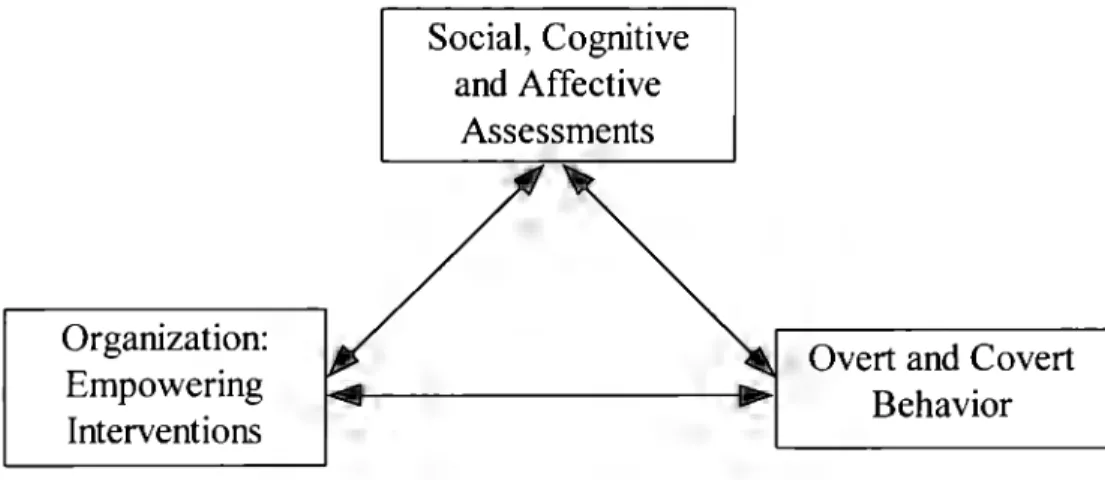
(34) 27 Employee participation may result in unexpected consequences regarding empowerment. lf employees are given an assignment requiring levels of performance and influence very far away from those available to them through training, allocation of resources, and the like, they may become frustrated after lack of success and generate devaluing self-referent thought. Once the experience has such a negative effect on employees' cognition and affect, they will feel less confident about their work in the future. This is clearly a position of powerlessness and impoverishment; that is, unempowerment. As a conclusion, participation is not always an empowering experience. lt may result in employees feeling less empowered. Regarding research, most studies have focused on such consequences of empowerment as job satisfaction, motivation and quality of work life. Only a few (for instance, Fulford & Enz, 1995; & Spreitzer, 1992), have tried to untangle the mechanisms interna! to the individual involved in specific interventions that result in employees becoming either empowered or impoverished (e.g., James & James, 1992). In summary, definitions of empowerment as participation or sharing of power make reference exclusively to what Bandura' s (1986) model of reciproca! determination refers as the environment; that is, what the organization proposes or does to the employee in form of managerial actions and organizational programs (that is, empowering interventions). These definitions do not address the interna! processes that operate between 1) employees being given the opportunity to participate and 2) their feeling as more powerful and being more motivated, involved and committed to the organization's goals (Conger and Kanungo, 1988). As a consequence, it is not possible to determine under which circumstances the external-to-the-individual organizational actions are more likely to become successful. Considering that participation and delegation are organizational variables that are externa! to the individual, any organizational factor that may have an impact on.
(35) 28 the process of empowerment is named here an "empowering intervention", but never "empowerment". Job enrichment, total quality management, just in time management, IS09000 certification procedures, training programs, and promotion of leadership, team work, or self-managed teams are examples of other empowering interventions.. Definitions of Empowerment Considering Personal Factors Other definitions of empowerment in the literature incorporate elements of the individual, but most of them use responses of the individual excluding the intemal mediating factors. For instance, Kieman (1993) said that empowerment has the purpose ofmotivating the manifestation of people's intelligence and creativity: The idea is to provide everybody with the responsibility and the resources to display real leadership within their own individual spheres of competence, while at the same time contributing to meeting company-wide challenges (p. 14).. In the same direction, Belasco (1992) pointed out that empowerment results in responsible, highly motivated employees, who leam, grow and make decisions. Bennis ( 1984) defined empowerment as a collective effect of leadership that is manifested in the workplace as employees' feeling significant, valuing leaming and competence, developing a sense of community, and finding their work stimulating, fun and challenging. Thomas and Velthouse (1990) also stressed the role of outcomes in empowerment. After pointing out that one of the meanings of power is energy, they clarified that the word empowerment makes also reference to motivation. They focused particularly on the motivational content of newer nontraditional paradigms of management that "involves relaxed (or broad) controls and an emphasis on intemalized commitment to the task itself' (p. 667). These definitions use two kind of employee outcomes: one is covert behavior, including such responses as.
(36) 29 motivation and satisfaction, and the other is overt behavior, incorporating such outcomes as effort and resiliency. Hossack's (1993) is among the definitions addressing not only employee's outcomes but also mediating personal factors , saying that empowerment is something more than the sharing of power (an idea emphasizing what was said about delegation and participation in decision making in the previous section) and that "empowering others involve helping them to find their own potential, and to gain the sense of confidence and autonomy necessary to make choices (p. 30)". With a somewhat different approach, Conger and Kanungo (1988) defined empowerment as a process of enhancing feelings of self-efficacy among organizational members through the identification of conditions that foster powerlessness and through their removal by both formal organizational practices and informal techniques of providing efficacy information" (p. 474).. Such elements as significance, sense of confidence, self-efficacy and sense of autonomy can be regarded as internal factors that mediate between organizational interventions (and other externa! elements) and employee outcomes. Defining empowerment in terms of employee internal variables, particularly motivational ones, appears to be a more promising line of research instead of doing that in terms of externa! factors, because it reveals the mechanisms determining whether externa! factors result in people really feeling empowered, being motivated, committed, and energized, and exercising effort and perseverance. It affords a higher chance of contributing new insights into management practice because the definition is conducive to considering the intervening motivational, cognitive and other personal constructs determining whether organizational interventions are conducive to the kind of desired employees' responses..
(37) Chapter 3: The Social, Cognitive and Affective Model of Empowerment. Empowerment Defined As it was presented in the previous chapter, empowerment is defined in the literature distinctly by using either externa! inputs, mediating interna! factors, or employee behavior as elements of the definition. However, Bandura ( 1986) proposed that human functioning is deterrnined by the reciprocal interaction of ali this three elements, as depicted by Figure 3. Considering Bandura's (1986) social cognitive theory, and more specifically, both the model ofreciprocal deterrnination and the model of self-efficacy, empowerment is defined as an ongoing process in which the environment, personal factors, and behavior interact to potentiate individuals inside organizations so as to increase motivation, commitment, initiative, effort, and resiliency in performance (see Figure 5).. A successful process of empowerrnent results in people feeling more potentiated and significant, less impoverished, gaining confidence and autonomy, developing a sense of community, finding their work stimulating, fun and challenging, and showing increased motivation, commitment, effort, and perseverance in the job place (Bennis, 1984; Conger & Kanungo, 1988; Hossack, 1993; and Thomas & Velthouse, 1990).. 30.
(38) 31. Considering that the phenomenon of empowerment is focused here on the point of view of the employee, the environment in Figure 3 refers mainly to the organization, which strives for changes through empowering interventions (see Figure 5); for instance, by leadership, cultural change, job enrichment, team-work implementation, total quality management, re-engineering, etc. The personal factors of empowerment are employee's social, cognitive and affective assessments that reflects his or her intemal reality or his or her perception of the self in relation to extemal realities: job, tasks, significant others, the organization, etc. Behavior refers to overt and covert responses by the employee. The process of empowerment works through the enhancement of the social, cognitive and affective factors of empowerment.. Social, Cognitive and Affective Assessments. Organization: Empowering Interventions. Overt and Covert Behavior. Figure 5. Social cognitive model of empowerment. Social Cognitive Models of Empowerment Two models of empowerment that use social cognitive theory have been proposed: Conger and Kanungo's (1988) and Thomas and Velthouse's (1990). There are important differences between both models but they complement each other. In.
(39) 32 this section, both models are presented as the basis for the social, cognitive and affective model of empowerment used by the present study.. Conger and Kanungo's (1988) Model of Empowerment Conger and Kanungo' s ( 1988) model incorporates sorne elements of social cognitive theory, particularly self-efficacy theory (see Figure 6). The model proposes a series of stages to promote empowerment in organizations. lt starts by determining the present conditions in the organization that foster interna} states of powerlessness in employees. Then, alternative managerial techniques and interventions are implemented, but in such a way that they convey information to employees regarding their efficacy, at the same time that conditions fostering powerlessness are removed. As self-efficacy beliefs become strengthened, it theorizes, people increase their productive behavior. Conger and Kanungo' s ( 1988) model pro vides a useful guide of the steps that managers should undertake to strength employees' self-efficacy. Particularly stage 3 incorporates elements from self-efficacy theory that enhance perceptions of efficacy. However, the model does not consider other empowering factors conveying assessments of meaning, outcomes, others' competence, support, or control. lt is not enough for an individual to feel competent (self-efficacy perception) for a person to behave in a certain way (Bores-Rangel et al. 1989). lt is also necessary that people see a reason to behave, and have a purpose to perform in terms of what is meaningful to them. Personal goals, a source of meaning, are important motivators and conditionings of behavior (Bandura, 1986). The purposes can be either selfish, such as expecting a pay increase or avoiding being fired, or sublimated, such as looking for social well-being, but the opportunity to realize personal goals is a source of energy for action..
(40) 33 oog1ca rgarnza 1ona ac ors Supervision Reward systems Nature of the job Stage 2: The use of managerial empowering strategies and techniques Participative management Goal setting Feedback system Modeling Contingent/Competence based reward Job enrichment Stage 3: To provide self-efficacy information to subordinates using tour sources Enactive attainment Vicarious experience Verbal persuasion Emotional arousal. and emove con 11ons listed under Stage 1. Stage 4: Result in empowering experience of subordinate personal empowerment Strengthening of - effort performance expectancy or - belief in personal efficacy Stage 5: Leading to performance rnt1at1on an pers1stence o e av1or to accomplish task objectives. Figure 6. Conger & Kanungo's (1988, p. 475) model of empowering (With sorne modifications )..
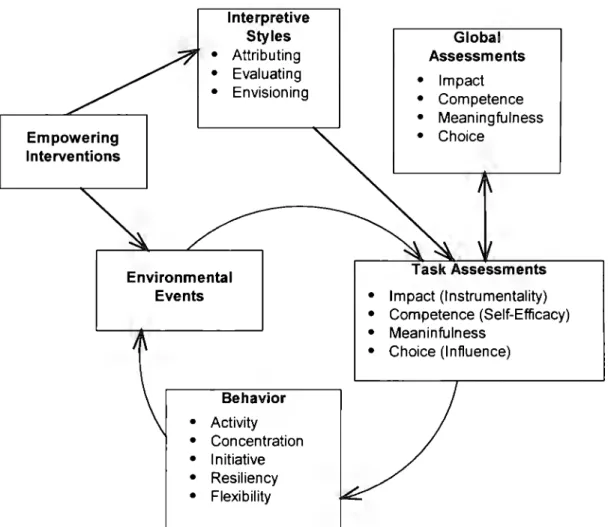
(41) 34. In fact, social cognitive theory propases that goal systems have an important role in the self-regulation of motivation and behavior. Similarly to goal seeking theories, social cognitive theory propases that discrepancies between outcomes and personal standards generate motivation in direction of the goals to reduce the difference. However, this theory emphasizes that once people reach their expectations they produce new discrepancies by fixing higher standards. Goals not only are important for motivation to take place but also to guide behavior and build self-efficacy (Wood & Bandura, 1989). As explained above, constructs conveying purpose (such as meaningfulness, interest or goal-seeking) are not excluded from the social cognitive theory; however, in practice and as promoted by Bandura, the theory has highlighted self-efficacy to such a degree that these constructs have not been fully incorporated into the model, as in Conger and Kanungo's (1988) model. Excluding them from a model explaining human behavior has no consequences in experimental settings when participation and interest are controlled, but it has important implications in organizational settings. For instance, when people's self-efficacy is very high, this variable losses predictive value, as Eden and Aviram (1993) found. They showed that training unemployed people in job-search and reemployment self-efficacy was successful only for those people with previous low levels of self-efficacy. For those people with high levels of self-efficacy, other factors such as meaningfulness and outcome expectancy may be more important.. Thomas and Velthouse's (1990) Model of Empowerment Thomas and Velthouse's (1990) model is more complete than Conger and Kanungo's (1988) regarding their coverage of self-referent thought (see Figure 7). They introduced the term "assessment" to refer to the psychological mediating mechanisms. The nature of such assessments are not only cognitive but also social.
(42) 35. lnterpretive Styles • Attributing • Evaluating • Envisioning. Global Assessments • • • •. Empowering lnterventions. Environmental Events. lmpact Competence Meaningfulness Choice. Task Assessments • • • •. lmpact (lnstrumentality) Competence (Self-Efficacy) Meaninfulness Choice (lnfluence). Behavior • • • • •. Activity Concentration lnitiative Resiliency Flexibility. Figure 7. Thomas and Velthouse' s (1990) cognitive model of empowerment (With sorne modifications).. and affective. Besides self-efficacy, the only assessment considered in Conger and Kanungo's model, three additional assessments were incorporated. The four assessments are presented below including the diverse synonymous used in the literature for them..
(43) 36. • Competence (Self-efficacy or personal mastery), • Meaningfulness (Caring, value of the purpose, or interest), • Choice (Influence, authority or self-determination), and • Impact (Outcome expectancy or behavior instrumentality). Another important characteristic of Thomas and Velthouse's (1990) model is that the relationship between assessments and behavior is analyzed at the task leve!, as social cognitive theory propases. Moreover, Thomas and Velthouse's (1990) model strongly emphasizes interna! psychological mechanisms. As depicted by Figure 7, the model only uses two boxes to refer to what is externa! to the individual: empowering interventions and environmental events (that is, stimuli). The remaining boxes are one for behavior and the other for di verse mechanisms of social, cognitive and affective processing of environment. The three boxes in a circle correspond to the three boxes in Bandura's (1986) model of reciproca! deterrnination (see Figure 3). According to the model, task and broad assessments determine employee's outcomes. One of the most noteworthy elements of Thomas and Velthouse's (1990) model is the representation of the principie ofreciprocal deterrnination as depicted by the circular never ended relationship among cognitions, behavior and environmental events. Cyclical models explain vicious and virtuous cycles of self-fulfilling prophecies (Alcorn, 1992). For instance, low leve! self expectations conduces to low leve! performance, and this, in tum, to a low impact in and response from the environment, which confirrns the initial low self expectations. There has been sorne work (Eden 1988 & 1990, Eden & Aviram, 1993) linking self-efficacy to manifestations of self-fulfilling prophecies such as the Pygmalion effect. "Task assessments" in the model are evaluative cognitions about specific tasks. Maybe a better name is "task-self assessments" because the cognitions are not.
(44) 37 about the task alone but about them in relation to the sel f. For instance,. meaningfulness is the assessment by the employee whether the task is significant to him or her in function of his or her interests, goals and values. Another example, choice refers to the employees' perception whether they have the resources and the authority to determine and follow the set of actions or events to accomplish the task or they feel beingjust a pawn anda subordinate instrument. Also, impact (Bandura's outcome expectancy) refers to what people believe they have to do to accomplish the task. Conger and Kanungo's (1988) and Thomas and Velthouse's (1990) models complement each other. The first model is very comprehensive regarding the consideration given to both empowering interventions and extemal determinants of people's responses. The second one provides much attention to the cognitive aspects of motivation. However, both models lack any consideration ofthe social determinants of behavior and motivation. That is, no one incorporates cognitive processing of perceptions about the organization and significant others in the workplace. Cognitive assessments about social and other relevant elements of the environment are very important to understand people's behavior inside organizations. This is not evident in such experimental settings as Bandura's (1977) recurrent studies in snake phobia. The event of subjects increasing self-efficacy perceptions about handling snakes occurs under controlled conditions where extemal influences are notas relevant as they are in real life situations. lf the experiment is about flying phobia, my assessment of the crew's competence to safely fly the plane and my beliefs about the conditions of the plane are as important as self-efficacy perceptions about being calm in my seat. That resembles the situation inside organizations: organizational members make assessments regarding the competence and other.
Figure

+7



Documento similar
model composed of two affect dimensions (one factor dominated by anxiety, depression, NA and expectancies for future negative events, and the second factor dominated by depression
Para cambiar desde TREVICTA a los comprimidos de palmitato de paliperidona de liberación prolongada, se debe iniciar la administración diaria de los comprimidos 3 meses después de
There are different profiles of alcohol consumption for men and women, and different courses and prognoses associated with problems caused by alcohol abuse. There is evidence of
While many studies point to a significant and greater prevalence (25-75%) of all types of violence and its severi- ty among women who are dependent on alcohol or other
Representative vascular endothelial growth factor A (VEGF-A) immunostaining of placenta sections (A) and Western blot VEGF-A protein analysis in placental lysed samples (B) for
FB, Factor B; P, Properdin; FH, factor H; FI, Factor I; NF, nephritic factor; C3NeF, C3 nephritic factor; C4NeF, C4 nephritic factor; C5NeF, C5 nephritic factor; C3G, C3
This analysis has pointed out the influence of different design parameters (resonator quality factor,.. transformer coupling factor, frequency mismatch between coupled oscillators)
Cluster analysis Factor analysis Heckit model (Probit) Heckit model (OLS) Ln (Number of introduced species known) Cluster analysis. Factor analysis EXOTIC_KNOWN Ordinal Square
