Advance Access publication 2016 October 27
Evidence for strong evolution in galaxy environmental quenching
efficiency between
z
=
1.6 and
z
=
0.9
Julie B. Nantais,
1‹Adam Muzzin,
2Remco F. J. van der Burg,
3Gillian Wilson,
4Chris Lidman,
5Ryan Foltz,
4Andrew DeGroot,
4Allison Noble,
6Michael C. Cooper
7and Ricardo Demarco
81Departamento de Ciencias F´ısicas, Universidad Andres Bello, Fernandez Concha 700, Las Condes 7591538, Santiago, Regi´on Metropolitana, Chile
2Institute of Astronomy, University of Cambridge, Madingley Road, Cambridge CB3 0HA, UK
3Laboratoire AIM-Paris-Saclay, CEA/DSM-CNRS-Universit´e Paris Diderot, Irfu/Service d’Astrophysique, CEA Saclay, Orme des Merisiers, F-91191
Gif-sur-Yvette, France
4Department of Physics and Astronomy, University of California-Riverside, 900 University Avenue, Riverside, CA 92521, USA
5Australian Astronomical Observatory, PO Box 2915, North Ryde NSW 1670, Australia
6Department of Astronomy and Astrophysics, University of Toronto, Toronto, ON M5S 3H4, Canada
7Department of Physics and Astronomy, University of California, Irvine, 4129 Frederick Reines Hall, Irvine, CA 92697, USA
8Departamento de Astronom´ıa, Universidad de Concepci´on, Casilla 160-C, Concepci´on, Regi´on del Biob´ıo, Chile
Accepted 2016 October 25. Received 2016 October 25; in original form 2016 August 6
A B S T R A C T
We analyse the evolution of environmental quenching efficiency, the fraction of quenched cluster galaxies which would be star forming if they were in the field, as a function of redshift in 14 spectroscopically confirmed galaxy clusters with 0.87 < z< 1.63 from the Spitzer
Adaptation of the Red-Sequence Cluster Survey. The clusters are the richest in the survey at each redshift. Passive fractions rise from 42+−1013per cent atz∼1.6 to 80+−129 per cent atz∼1.3 and 88+−43per cent atz<1.1, outpacing the change in passive fraction in the field. Environmental quenching efficiency rises dramatically from 16+−1519 per cent atz∼1.6 to 62+−2115 per cent at
z∼1.3 and 73+−87per cent atz1.1. This work is the first to show direct observational evidence for a rapid increase in the strength of environmental quenching in galaxy clusters atz∼1.5, where simulations show cluster-mass haloes undergo non-linear collapse and virialization.
Key words: galaxies: clusters: general – galaxies: evolution.
1 I N T R O D U C T I O N
The history of how galaxy clusters came to be dominated by pas-sive, early-type galaxies (Dressler1980) is a long-standing prob-lem. Over cosmic time, protoclusters, dominated by high-mass star-forming galaxies atz>2 (Overzier et al.2008; Galametz et al.2010; Hatch et al.2011a,b; Shimakawa et al.2014; Umehata et al.2015), must evolve into mature galaxy clusters with well-established red sequences atz<1 (Muzzin et al.2012; Foltz et al.2015; Balogh et al.2016). This observed evolution in the cluster population at 1<z<3 suggests a corresponding rapid increase in the environ-mental quenching efficiency, which is defined to be the fraction of passive group or cluster galaxies which would be star forming if they were in the field. Cluster galaxies at z∼ 1 are most likely to be quenched if they have spent significant time in the cluster (Stanford, Eisenhardt & Dickinson 1998; Blakeslee et al.2006; Demarco et al. 2010; Muzzin et al. 2012, 2014; Nantais et al.2013a,b; Noble et al.2013,2016), indicating that the
E-mail:[email protected]
ter environment is important for transforming galaxies from star forming to passive.
However, the redshift gap between clusters and protoclusters is only beginning to be bridged, and the transition between the two cannot necessarily be attributed to a single obvious factor such as redshift or cluster mass. For instance, thez∼2.5 protocluster in Wang et al. (2016) appears to be as massive as many richz∼1.5 galaxy clusters, but is still rich in high-mass dusty star-forming galaxies like otherz>2 protoclusters. Also, there is considerable variation even among galaxy clusters at 1.3<z<2, with many claiming notable enhancement in quenching (Kodama et al.2007; Bauer et al.2011; Quadri et al.2012; Gobat et al.2013; Straz-zullo et al.2013; Andreon et al.2014; Newman et al.2014; Balogh et al.2016; Cooke et al.2016) while others note still-substantial star formation among massive galaxies (Brodwin et al.2013; Fassben-der et al.2014; Bayliss et al.2014; Webb et al.2015,b; Bonaven-tura et al. 2016, submitted). Studies of groups and clusters in large, general surveys, such as Gerke et al. (2007), Cooper et al. (2007), Kawinwanichakij et al. (2016), and Darvish et al. (2016), show greater decline in group passive fractions than in the field at
z∼1.5 compared toz∼1, thereby showing signs of evolution in
C
Table 1. Passive fractions, quenching efficiencies, and comoving volume by redshift.
Redshift zphot,min zphot,max No. clusters fp Quenching eff. fp,field σfield Com. vol. field Com. vol. SpARCS 106Mpc3 106Mpc3 z∼0.95 0.77 1.14 6 0.88+−00..0304 0.73+−00..0807 0.552 0.025 3.21 83 z∼1.3 1.04 1.48 5 0.80+−00..0912 0.62+−00..2115 0.473 0.025 4.69 121 z∼1.6 1.47 1.76 3 0.42+−00..1310 0.16+−00..1519 0.317 0.032 4.37 113
quenching efficiency. However, these studies barely probe the very densest environments of rich galaxy clusters.
In this Letter, we use a sample of 14 spectroscopically confirmed galaxy clusters from theSpitzerAdaptation of the Red-Sequence Cluster Survey (SpARCS; Muzzin et al.2009; Wilson et al.2009) at 0.87<z <1.63 to study evolution in environmental quench-ing efficiency as rich galaxy clusters assemble. This work builds on Nantais et al. (2016, hereafterN+16a) by using homogeneous processing at all redshifts and splitting clusters into similar comov-ing volume bins. In Section 2, we briefly describe the data and analysis methods used in our study. In Section 3, we describe the results; in Section 4, we discuss the implications of the results; and in Section 5, we provide a brief summary. We assume acold dark matter cosmology withH0=70 km s−1Mpc−1,M=0.3,
and=0.7.
2 DATA A N D A N A LY S I S
Our sample contains 14 spectroscopically confirmed near-infrared-selected clusters at 0.869<z<1.633. The full redshift range of our clusters spans about 2.5 Gyr in cosmic time. SpARCS covers an area on the sky of 41.9 deg2(Wilson et al.2009), corresponding
to a comoving volume of about 310 million Mpc3 (see Table1)
betweenz=0.85 and 1.65. The multiband photometry and spec-troscopic members for the 10 clusters atz<1.35 [Galaxy Clus-ter Astrophysics Spectroscopic Survey (GCLASS) sample; Muzzin et al.2012] are described in detail in van der Burg et al. (2013, hereaftervdB+13). The GCLASS clusters range from 1014to 2.6×
1015M
(vdB+13, see also Biviano et al.2016).
More details regarding the high-redshift (z>1.35) objects are described inN+16a. In particular, the details of the broad-band photometry may be found inN+16a. All fourN+16aclusters were targeted for spectroscopic confirmation as being the most signifi-cant overdensities as identified using photometric redshifts (Muzzin et al.2013a). Rough preliminary estimates of the masses for the two highest redshift clusters inN+16aare given in Lidman et al. (2012). The two preliminary mass estimates in Lidman et al. (2012) for
N+16aclusters are consistent in their projected mass growth with
vdB+13clusters. Richness-based mass estimates for three of the N+16 clusters in Delahaye et al. (in preparation) range from 1014.3
to 1015 M
. No further radial velocity-based mass estimates are performed since these clusters are almost certainly not fully virial-ized, and because the spectroscopic instruments used to confirm the clusters bias our spectroscopic member sample towards unobscured star-forming galaxies.
The UltraVISTA/Cosmological Evolution Survey (COSMOS) field galaxy comparison data come from the 30-passband photo-metric catalogues of Muzzin et al. (2013b), and are processed in a similar way to the cluster catalogues. We usedEAZY(Brammer, van Dokkum & Coppi2008) to obtain photometric redshifts and the rest frameU−VandV−Jcolours needed to estimate pas-sive and star-forming fractions (Wuyts et al.2007). We use the Whitaker et al. (2011)UVJcriterion, as invdB+13. We usedFAST
(Kriek et al.2009) to derive stellar masses, using the same sets
of models and parameters for GCLASS and high-redshift clusters. Photometric cluster membership andUVJpassive and star-forming status are defined as invdB+13andN+16a. The photometric clus-ter membership criclus-terion, (zphot −zcluster)/(1+zcluster)≤0.05, is
similar to the normalized median absolute deviation scatter in the photometric redshifts:σ∼0.03 for GCLASS andσ∼0.04 for the
N+16aclusters. Whenever possible, we use spectroscopic redshifts to determine membership as inN+16aandvdB+13.
Cluster redshifts are binned into three redshift ranges for analy-sis: 0.85<z<1.1, 1.1<z<1.4 (including theN+16acluster atz
=1.37), and 1.4<z<1.65 (therefore excluding theN+16acluster atz = 1.37). Our different binning of the clusters is one of the major differences fromN+16awhich may lead to different results, the other being the use of homogeneous analysis methods at all redshifts for SpARCS clusters. In each of these bins, at least one cluster is complete down to a lower stellar mass limit of 1010.3M
. This redshift binning was chosen primarily due to the similarity of the survey volume covered in each redshift range: 83, 121, and 113 million Mpc3, respectively. Our binning also helps to reduce
the statistical uncertainties due to cluster-to-cluster variations at
z<1.5.
The growth of clusters between redshift bins in our sample is about two-third of that predicted by theory, according to Lidman et al. (2012). This implies that the higher redshift clusters may in fact be progenitors of somewhat more massive systems than some of the lower redshift clusters, making any difference in environmental quenching with redshift less expected on theoretical grounds than would otherwise be the case.
Each cluster has a different 80 per cent stellar mass completeness limit fromvdB+13or N+16a, based on the lowest mass passive galaxy visible at eachKslimit to preserve accurate passive frac-tions. Some are not complete to 1010.3M
, the lowest UltraVISTA passive stellar mass limit at z= 1.6. Therefore, the total galaxy counts, as well as the individual passive and star-forming counts, in each cluster redshift bin must be corrected for this incompleteness. We count galaxies in each cluster down to which each cluster’s respective completeness limit or, if the photometry is deep enough, to 1010.3M
. Low-mass galaxy counts, those between 1010.3and
1010.53M
Since the highest redshift (N+16a) clusters have almost entirely star-forming spectroscopic members due to instrument constraints, making adjustment for field contamination based on spectroscopy unfeasible, the adjustment of total cluster galaxy counts and pas-sive fractions for field contamination is performed via subtrac-tion of the expected contaminasubtrac-tion levels estimated from Ultra-VISTA/COSMOS (Muzzin et al.2013b). For each redshift bin, we subtract the number of field galaxies in the cluster photometric red-shift range in the equivalent volume of the 3–6 SpARCS clusters in that redshift bin. We estimate this volume by multiplying the area in square megaparsec of each SpARCS cluster by the distance in megaparsec between two non-gravitationally bound galaxies on opposite ends of the cluster’s photometric redshift selection range, which depends on the cluster’s spectroscopic redshift. The correc-tion is applied separately to passive and star-forming galaxies so as to be able to correct the passive fraction and quenching efficiency for field interlopers.
Field galaxy passive fractions are also estimated from UltraV-ISTA as inN+16a, selecting from the full photometric redshift range corresponding to each redshift bin. Total counts and passive counts are determined in these redshift ranges, and Poisson uncertainties are determined from these counts.
The environmental quenching efficiency, or conversion fraction, is the fraction of galaxies which would normally be star forming in the field which are quenched in a group or cluster. It is defined in the literature (van den Bosch et al.2008; Peng et al.2012; Phillips et al.2014) asfconv=(fp,cluster−fp,field)/(fsf, field). Total uncertainties
in both cluster passive fractions and quenching efficiencies are de-rived from the 68 per cent confidence interval around the median of the probability density function of 100 000 Monte Carlo sim-ulations, pairing 100 Monte Carlo simulations of the photometry randomly varied with Gaussian distributions around the photomet-ric error bars with 1000 random UltraVISTA field samples.
For the fourN+16aclusters, we consider only galaxies within 1 Mpc of the cluster centres, for consistency with vdB+13 and
N+16a, and because reliable virial radius estimates are not available for these clusters. For the GCLASS clusters, we include galaxies out to the individual virial radius of this cluster as recalculated in Biviano et al. (2016).
3 R E S U LT S
Fig.1shows the passive fractions in our clusters as a function of redshift, along with the UltraVISTA field controls in blue. At all redshifts, the passive fraction in clusters is higher than in the field. The passive fraction nearly doubles fromz∼1.6 to 1.3, jumping from 42 per cent to over 80 per cent, but changes little between
z ∼ 1.3 andz 1. The lower two redshift ranges have passive fractions consistent with thez=0 value from Omand et al. (2014). In the field, on the other hand, the passive fraction is only∼50 per cent higher atz∼1.3 than atz∼1.6, and does not nearly double until
z 1. Due to the large overdensities of our clusters, our results are still qualitatively robust, even without making a field galaxy background correction.
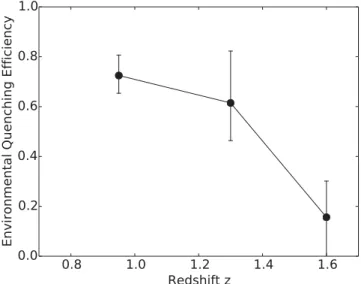
In Fig.2, we compare the environmental quenching efficiencies in the clusters as a function of redshift for all galaxies above 1010.3M
. Forz∼1.6, the environmental quenching efficiency is consistent with zero 16+−1519per cent, while it rises dramatically to 62+
21
−15per cent
atz∼1.3 and 73+8
−7per cent atz1.1. Our quenching efficiencies
atz < 1.5 are somewhat higher than, but statistically consistent with,vdB+13and Balogh et al. (2016). In Table1, we summarize
Figure 1. Passive fraction as a function of redshift for Ultra VISTA/COSMOS field galaxies and cluster members with stellar masses of log (M∗/M)≥10.3 in three cluster redshift bins (1.4<z<1.65, 1.1< z<1.4, and 0.86<z<1.1). Black symbols represent cluster galaxies and blue triangles are UltraVISTA/COSMOS field galaxies. The red point shows the passive fraction atz=0 from Omand, Balogh & Poggianti (2014).
Figure 2. Environmental quenching efficiency of cluster galaxies with log (M∗/M)≥10.3 as a function of cluster redshift for three cluster redshift bins (1.4<z<1.65, 1.1<z<1.4, and 0.86<z<1.1).
the above results as well as showing photometric cluster and field galaxy selection ranges and their corresponding comoving volumes. Our uncertainty calculations are performed in a more subtle way than inN+16a, combining random background and photometry samples into a single uncertainty rather than two added in quadra-ture, resulting in smaller error bars ultimately coming from the same two sources (background sampling and photometry). The lower pas-sive fraction and environmental quenching efficiency in our high-redshift bin than inN+16acan be attributed to the inclusion of only the threez=1.6 clusters in the highest redshift bin, whereasN+16a
also included thez=1.37 cluster.
We performed several checks on the robustness of our re-sults, including exclusion of galaxies within 0.1 mag of theUVJ
passive/star-forming line; using a 1 Mpc radius for all clusters; aver-aging and randomly bootstrap resampling environmental quenching
efficiencies for individual clusters instead of the combined galaxy population of all clusters in a given bin; and using only galaxies more massive than 1010.53M
. All yielded a similar difference be-tween thez=1.6 sample and the others, although some produced larger error bars. The consistency of our qualitative results with these tests suggests that ourz∼1.6 clusters do have a lower mean environmental quenching efficiency.
Darvish et al. (2016) also find evolution in the passive fraction and quenching efficiency betweenz∼1 and 1.5 down to 1010M
, but only at a 2σlevel as opposed to our 3σconfidence in quenching efficiency and>3σ confidence in passive fraction (see Table1). Our SpARCS cluster analysis is distinct from Darvish et al. (2016) in which our clusters are spectroscopically confirmed, and also drawn from a much larger survey; SpARCS covers about 26 times the comoving volume of UltraVISTA/COSMOS (see Table1), from which Darvish et al. draw their results. Our SpARCS cluster sample is therefore likely to include environments denser and rarer than the highest density environments appearing in Darvish et al. (2016), making our study complementary to theirs, extending the analysis to the extremes of environmental density.
4 D I S C U S S I O N
The timespan betweenz=1.6 andz∼1.3 is only∼1 Gyr, indicating possibly rapid evolution in environmental quenching efficiency in this redshift range. A dramatic change in quenching efficiency in a short time would make sense if, as Muldrew, Hatch & Cooke (2015) predict, galaxy clusters in this redshift range collapse rapidly, at which point the intracluster medium would then be capable of stripping the galaxies’ gas supplies. However, halo age may also matter. In Noble et al. (2013) and Muzzin et al. (2014), for instance galaxies with dynamical evidence for having spent less time in the cluster were more likely to be star forming or only very recently quenched.
The variety of quenched fractions in massive high-redshift clus-ters in the literature suggests that both halo mass and halo age may be important. For instance, the Cooke et al. (2016) cluster at
z∼1.6 has a red fraction of massive galaxies comparable toz∼1 clusters, while the similarly massivez∼2.5 protocluster of Wang et al. (2016) is still dominated by massive star-forming galaxies like its less-massivez>2 counterparts. The Quadri et al. (2012) cluster atz∼1.6 has an intermediate passive fraction between these two extremes.
In our data, considering only galaxies above the shallowest com-mon stellar mass limit for individual clusters (1010.53M
, 0.23 dex higher than our working limit of 1010.3 M
), the difference be-tween the largest and smallest environmental quenching efficiency is higher atz = 1.6 than any other redshift. This suggests that stochastic cluster-to-cluster variation in halo masses and ages may be especially important at the highest redshifts in determining en-vironmental effects on cluster galaxies.
5 C O N C L U S I O N S
We conclude that for cluster galaxies more massive than 1010.3M
, the evolution in the passive fraction in clusters outpaces that of the field, rising from 42+−1013 per cent atz ∼1.6 to 80+−129 per cent at
z∼1.3 and 88+−43per cent atz<1.1. The environmental quenching
efficiency evolves substantially, jumping from 16+−1519 per cent at
z∼ 1.6 to 62+21
−15 per cent at z ∼ 1.3 and 73+ 8
−7 per cent at z
1.1. Since our study selects galaxy clusters from similar comoving volumes using similar methods, and analyses each sub-sample in a
nearly identical manner, we have high confidence that our results represent genuine evolution of galaxy clusters as they grow over cosmic time.
Our work is the first to show directly that environmental quench-ing becomes increasquench-ingly dominant betweenz=1.6 and 0.9. In sim-ulations of structure formation, this is an epoch in which the average cluster-mass halo grows especially rapidly (Muldrew et al.2015) and is therefore very likely to become virialized in its central re-gions, suggesting a prerequisite for environmental quenching may be that galaxies are sub-haloes in a virialized halo. By extrapolation, our work also strongly indicates that quenching atz>2 may be caused almost entirely by internal processes.
Our study leaves open the question of the relative extent to which cluster mass versus cluster age is responsible for environmental quenching. Based on the variety of environmental quenching effi-ciencies and passive fractions reported in thez>1.5 cluster litera-ture and the variation within the SpARCS sample, we suggest that both halo mass and halo age are likely to play a role in the observed environmental quenching efficiency.
AC K N OW L E D G E M E N T S
This research uses observations obtained with MegaPrime/ MegaCam, a joint project of Canada–France–Hawaii Telescope (CFHT) and CEA/DAPNIA, at the CFHT which is operated by the National Research Council (NRC) of Canada, the Institut National des Sciences de l’Univers of the Centre National de la Recherche Scientifique (CNRS) of France, and the University of Hawaii. This work is based in part on data products produced atTERAPIXand the
Canadian Astronomy Data Centre as part of the CFHT Legacy Sur-vey, a collaborative project of NRC and CNRS. This project also uses observations taken at the ESO Paranal Observatory (ESO pro-grams 085.A-0166, 085.A-0613, 086.A-0398, 0145, 087.A-0483, 088.A-0639, 089.A-0125, and 091.A-0478), Las Campinas Observatory in Chile, the Keck Telescopes in Hawaii, and theSpitzer Space Telescope, which is operated by the Jet Propulsion Labo-ratory, California Institute of Technology under a contract with NASA.
Our research team recognizes support from the following grants: Universidad Andres Bello internal research project DI-651-15/R (JN), BASAL Center for Astrophysics and Associated Technolo-gies (CATA), and by FONDECYT grant no. 1130528 (RD), Eu-ropean Research Council FP7 grant number 340519 (RFJvdB), NSF grant AST-1518257 (MCC), NSF grant AST-1517863, NASA programs GO-13306, GO-13677, GO-13747 and GO-13845/14327 (GW). The GO grants come from the Space Telescope Science In-stitute, which is operated by AURA, Inc., under NASA contract NAS 5-26555.
R E F E R E N C E S
Andreon S., 2013, A&A, 554, 79
Andreon S., Newman A., Trinchieri G., Raichoor A., Ellis R. S., Treu T., 2014, A&A, 565, 120
Balogh M. et al., 2016, MNRAS, 456, 4364
Bauer A., Gr¨utzbauch R., Jorgensen I., Varela J., Burgmann M., 2011, MNRAS, 411, 2009
Bayliss M. et al., 2014, ApJ, 794, 12
Biviano A., van der Burg R., Muzzin A., Sartoris B., Wilson G., Yee H. K. C., 2016, A&A, 594, 51
Blakeslee J. et al., 2006, ApJ, 644, 30 Bonaventura N. et al., 2016, in press
Brodwin M. et al., 2013, ApJ, 779, 138 Cooke E. et al., 2016, ApJ 816, 83 Cooper M. et al., 2007, MNRAS, 376, 1445
Darvish B., Mobasher B., Sobral D., Rettura A., Scoville N., Faisst A., Capak P., 2016, ApJ, 825, 113
Demarco R. et al., 2010, ApJ, 725, 1252 Dressler A., 1980, ApJ, 236, 251 Fassbender R. et al., 2014, A&A, 568, A5 Foltz R. et al., 2015, ApJ, 812, 138 Galametz A. et al., 2010, A&A, 522, A58 Gerke B. et al., 2007, MNRAS, 376, 1425 Gobat R. et al., 2013, ApJ, 776, 9 Hatch N. et al., 2011a, MNRAS, 410, 1537
Hatch N., Kurk J., Pentericci L., Venemans B. P., Kuiper E., Miley G. K., R¨ottgering H. J. A., 2011b, MNRAS, 415, 2993
Kawinwanichakij L. et al., 2016, ApJ, 817, 9
Kodama T., Tanaka I., Kajisawa M., Kurk J., Venemans B., De Breuck C., Vernet J., Lidman C., 2007, MNRAS, 377, 1717
Kriek M., van Dokkum P. G., Labb´e I., Franx M., Illingworth G. D., March-esini D., Quadri R. F., 2009, ApJ, 700, 221
Lidman C. et al., 2012, MNRAS, 427, 550
Muldrew S., Hatch N., Cooke E., 2015, MNRAS, 452, 2528 Muzzin A. et al., 2009, ApJ, 698, 1934
Muzzin A. et al., 2012, ApJ, 746, A188 Muzzin A. et al., 2013a, ApJS, 206, A8
Muzzin A., Wilson G., Demarco R., Lidman C., Nantais J., Hoekstra H., Yee H. K. C., Rettura A., 2013b, ApJ, 767, A39
Muzzin A. et al., 2014, ApJ, 796, A65
Nantais J., Flores H., Demarco R., Lidman C., Rosati P., Jee M. J., 2013a, A&A, 555, A5
Nantais J., Rettura A., Demarco R., Demarco R., Gobat R., Rosati P., James J. M., 2013b, A&A, 556, A112
Nantais J. et al., 2016, A&A, 592, A161 (N+16a)
Newman A., Ellis R., Andreon S., Treu T., Raichoor A., Trinchieri G., 2014, ApJ, 788, 51
Noble A., Webb T., Muzzin A., Wilson G., Yee H. K. C., van der Burg R. F. J., 2013, ApJ, 768, 118
Noble A., Webb T., Yee H. K. C., Muzzin A., Wilson G., van der Burg R. F. J., Balogh M. L., Shupe D. L., 2016, ApJ, 816, 48
Omand C. M. B., Balogh M. L., Poggianti B. M., 2014, MNRAS, 440, 843 Overzier R. et al., 2008, ApJ, 673, 143
Peng Y., Lilli S., Renzini A., Carollo M., 2008, MNRAS, 387, 79 Peng Y.-j., Lilly Simon J., Renzini Al., Carollo M., 2012, ApJ, 757, 4 Phillips J., Wheeler C., Boylan-Kolchin M., Bullock J. S., Cooper M. C.,
Tollerud E. J., 2014, MNRAS, 437, 1930
Quadri R., Williams R., Franx M., Hildebrandt H., 2012, ApJ, 744, 88 Shimakawa R., Kodama T., Tadaki K., Tanaka I., Hayashi M., Koyama Y.,
2014, MNRAS, 441, L1
Stanford S., Eisenhardt P., Dickinson M., 1998, ApJ, 492, 461 Strazzullo V. et al., 2013, ApJ, 772, 118
Umehata H. et al., 2015, ApJ, 815, L8
van den Bosch F., Aquino D., Yang X., Mo H. J., Pasquali A., McIntosh D. H., Weinmann S. M., Kang X., 2008, MNRAS, 387, 79
van der Burg R. F. J. et al., 2013, A&A, 557, A15 (vdB+13) Vulcani B. et al., 2012, MNRAS, 420, 1481
Vulcani B. et al., 2013, A&A, 550, A58
Vulcani B., De Lucia G., Poggianti B. M., Bundy K., More S., Calvi R., 2014, ApJ, 788, 57
Wang T. et al., 2016, ApJ, 828, 56 Webb T. et al., 2015a, ApJ, 809, 173 Webb T. et al., 2015b, ApJ, 814, 96 Whitaker K. E. et al., 2011, ApJ, 735, 86 Wilson G. et al., 2009, ApJ, 698, 1943 Wuyts S. et al., 2007, ApJ, 655, 51
This paper has been typeset from a TEX/LATEX file prepared by the author.