
The use of blogs to help intermediate studentys improve their formal letter writing skill
112
0
0
Texto completo
(2) BLOGS TO IMPROVE FORMAL LETTER WRITING. The Use of Blogs to Help Intermediate Students Improve Their Formal Letter Writing Skill Adriana Alejandra Agudelo Arana. A research report submitted for the degree of Master in English Language Teaching – Autonomous Learning Environments. Directed by: Liubava Sichko Master in ELT – Autonomous Learning Environments Department of Foreign Languages and Cultures Universidad de la Sabana Chía, Colombia November, 2009. 2.
(3) BLOGS TO IMPROVE FORMAL LETTER WRITING. 3. This research report is the result of my own work and includes nothing that was done in collaboration with others.. _________________________ (Signature). Acknowledgements: First and foremost I thank God for giving me the strength to accomplish my goals. I also want to thank my tutor Liubava Sichko and Valeriya Lytvychenko, who have supported me throughout my thesis with their patience and knowledge whilst allowing me the room to work in my own way. I would also like to thank my family members, especially my parents, for supporting and encouraging me to pursue this degree. Lastly, I offer my regards and blessings to all of those who supported me in any respect during the completion of the project..
(4) BLOGS TO IMPROVE FORMAL LETTER WRITING. We are convinced that the disposition to study…the consequences of our own teaching is more likely to change and improve our practices than is reading about what someone else has discovered of his teaching. (Corey, 1953, p. 70). 4.
(5) BLOGS TO IMPROVE FORMAL LETTER WRITING. 5. ABSTRACT This action-research project was carried out with 11 English intermediate students, majoring different careers. The project, which lasted six lessons plus independent work, aimed to help to improve formal letter writing skill by using blogs. Students created blogs, posted and selfcorrected their products and filled in a reflection log. Qualitative and quantitative data were gathered and trend analysis was implemented to evidence that it is possible to improve this skill by increasing motivation for writing through the use of blogs, developing an autonomous learning behavior and self-correction routines. This research proved helpful for English as a foreign language (EFL) contexts and opens doors for further research about Information and Communication Technologies (ICT) in the classroom. Key words: writing skill, formal letter writing, teaching with ICT, blogs to teach writing..
(6) BLOGS TO IMPROVE FORMAL LETTER WRITING. 6. RESUMEN Este proyecto de acción-investigación se realizó con 11 estudiantes de inglés intermedio de diferentes carreras. El proyecto, seis sesiones más trabajo independiente, buscó ayudar a mejorar habilidad en escritura de cartas formales utilizando blogs. Los estudiantes crearon blogs, publicaron y corrigieron sus productos, y llenaron un diario de reflexión. Se recogieron datos cualitativos y cuantitativos y se implementó un análisis de patrones de actividad para evidenciar que es posible mejorar esta habilidad incrementando la motivación para escribir, usando blogs, y desarrollando un comportamiento de aprendizaje autónomo y rutinas de auto-corrección. El proyecto, útil para contextos de inglés como lengua extranjera (EFL), permite futuras investigaciones con Tecnologías de la Información y de la Comunicación (TICs) en el aula de clase. Palabras clave: habilidad de escritura, escritura de cartas formales, enseñar con TICs, blogs para enseñar escritura..
(7) BLOGS TO IMPROVE FORMAL LETTER WRITING. 7. TABLE OF CONTENTS CHAPTER 1: Introduction….………………………………………………………………..... 8 Statement of the problem…………………………………………………….…... 8 Research question………………………………………………………………... 9 Research objectives……………………….……………………………………… 9 Rationale…………………………………………………………………………. 9 CHAPTER 2: Theoretical framework…………………………………………………..….. 13 Writing skill………………………..…………………………………………….13 Formal letter writing...……………………………….…………………………..16 Teaching writing with ICT.………………………..…..…………………………20 Use of blogs to teach writing………..………………………………...…………23 CHAPTER 3: Research design………………………….……………………………………..27 Type of study………………………………….....………………………………27 Researcher’s role…………………………………………………………………30 Context…………………………….…………..…………………………………30 Participants……………………………………………………………………….32 Data collection instruments………………………………………………………33.
(8) BLOGS TO IMPROVE FORMAL LETTER WRITING. 8. Data collection procedures……………………………………………………….36 Validity………………………………………………………………………..…39 Reliability……………………………………………………………………...…39 CHAPTER 4: Pedagogical intervention and implementation………………………………..…41 CHAPTER 5 Data analysis and findings…………………………………………………….…45 ACR question # 1: What did I do?.....................................................................................45 ACR question # 2: What changes occurred regarding the achievement targets?..............56 ACR question # 3: What was the relationship between actions taken and any changes in performance on the targets?...............................................................76 CHAPTER 6………………………………………………………………………………….…81 Conclusions………………………………………………………………………………81 Pedagogical implications……………………………...…………………………………83 Limitations………………………………………………………………………………84 Further research………………………………………………………………………….85 REFERENCES.....……………………………………………………………...……………….86 APPENDICES…………………………………………………………………………………..90 Appendix A: Letter of consent………………………………………………………...…92.
(9) BLOGS TO IMPROVE FORMAL LETTER WRITING. 9. Appendix B: Diagnostic survey…………………………………………………………93 Appendix C: Pre-test……………………………………………………………………..94 Appendix D: Formal letter writing rubric……………………………………………..…95 Appendix E: List of conventions…….…………………………………………………..96 Appendix F: Letter of consent………………………………………………………...…97 Appendix G: Students’ reflection log……………………...…………………….……....98 Appendix H: Teacher’s reflection log…………………………………………….……...99 Appendix I: Sample of student’s works………………………………………………...100 Appendix J: Final survey………………………………………………………..……...107 Appendix K: Post-test……………………………………………………………….…108 Appendix L: Lesson plan sample…………………………………………………….…109.
(10) BLOGS TO IMPROVE FORMAL LETTER WRITING. 10. CHAPTER 1: Introduction Statement of the problem When thinking about this challenging opportunity to improve my teaching practice, to help my students better their performance and what is more, to contribute to the educational field development, it was not easy to make the decision about what the project was going to be focusing on. While observing my teaching context, which at the moment was an English intermediate level with eleven students majoring different programs at a private university, I thought about involving technology in my book-based class to make it more appealing for my students because, even though they were attending classes every week, most of them were suggesting to explore different materials in class besides the book. An additional aspect that helped me decide what to do was that one of the goals stated in the English program for this course was that by the end of the course students were going to be able to write formal letters for different purposes following the specific formats, and as a teacherobserver, I realized that their weakest skill as well as the one that made them feel less motivated to work in class, was indeed writing, since long and sad faces always followed my instructions about a class devoted to this skill. Additionally, after the end of the classes, it was clearly evident that not only were they reluctant to engage in a writing activity, but also that their written products were poor in quality and content. After sharing experiences with some colleagues, this is a problematic situation not only in my course, but also in various other courses, so this evidence the requirement of taking actions on students’ development of formal letter writing skill..
(11) BLOGS TO IMPROVE FORMAL LETTER WRITING. 11. Therefore, identifying students’ needs, noticing that they coincided with the course objectives and having Hyland’s words in mind, when saying that “in addition to knowing what students must write, we also need to know what they do when they write and how they can be helped to do it better” (2002, p.154), in other words not only giving instructions to students, but also checking their progress in order to guide them appropriately and help them improve their skills, I felt motivated to develop this research project. These observations and experiences helped me to realize that one way to positively influence the context in which I was involved was to make use of blogs as tools to improve the formal letter writing skill, which was one of the main topics in the writing program of the course. Research Question How will the use of blogs help intermediate students improve their formal letter writing skill? General objective To develop adequate general skills in formal letter writing through the use of blogs Specific objectives To increase students’ motivation towards formal letter writing through the use of blogs To provide students with various tools to independently edit and self-correct their writings To encourage students to develop autonomous learning behavior Rationale.
(12) BLOGS TO IMPROVE FORMAL LETTER WRITING. 12. The leading inspiration of this research project is to contribute to the qualification of educational language processes in general, and the improvement of the writing skill in a different language from the native one, in particular. Therefore a strategy, such as using blogs to improve formal letter writing which merge language learning with technology, can be applicable in the language teaching-learning processes and can serve as basis for future research projects in any field. This idea is supported by Witte (2007, p.92) when asserting that “by combining writing with online technology, teachers can provide opportunities for students and future educators to develop their digital fluency while also strengthening their traditional literacy skills”. With this in mind, I aimed to help the students in their writing learning process, specifically, in their formal letter writing skill, for this is one of the aims of the English 7 course. In this manner, I decided to research about the use of blogs to help intermediate students improve their formal letter writing skill. Within the course program, with which I was working at that time, writing was a fundamental topic to work with. One of the main objectives for this course was to help students to write formal letters in a proper way. In this way, I decided to use technology for educational purposes, in order to motivate students to write formal letters and to make them aware about autonomous behaviors. I decided to use blogs as a pedagogical tool to follow the writing process, because in this way students were going to be able to track their own progress, realize their weaknesses and act towards a better performance from there on. After observing that the students did not feel motivated towards writing and that they were not getting good results in the writing activities suggested, I decided to work on encouraging them to improve their formal letter writing. It had already been proved in a survey.
(13) BLOGS TO IMPROVE FORMAL LETTER WRITING. 13. applied during the pre-stage of this project, that the students were having many difficulties and were not feeling neither comfortable nor motivated enough when writing. In the same way, few students answered positively when being asked to write, while most of them received writing tasks without interest. Regarding formal letter writing, students expressed not to feel confident when writing such formal letters, but they nevertheless demonstrated enthusiasm to learn how to do it appropriately. This was manifested by most of them, when expressing in the survey that they were aware of the necessity to practice and learn this skill in order to be able to perform adequately in future situations. Some of them were about to graduate and they were interested in getting a job overseas, so developing this skill in formal letter writing was going to help this students familiarize theirselves with application letters which are the ones required to get jobs. Students were going to be familiar with the format and were going to analyze autonomously their letter and decide if all the requirements needed were included in their versions. I consider that the completion of the project is essential for my students to appropriately develop their formal letter writing skill and for them to increase their motivation and performance towards the writing skill while doing so. Such skill might help them to express their ideas, requests and points of view in an accurate and straightforward way while using an adequate and within standards format, useful for the current necessities of any professional. Concerning my personal experience, this opportunity was of utmost importance since it allowed me to implement and assess a new strategy for teaching formal letter writing in my teaching context. At the same time, I was able to implement different tasks and activities for the students' benefit and after reflecting, draw conclusions. Additionally, this project is a clear example of the current possibility, present to us all, of taking the leap towards these types of ICT tools, such as.
(14) BLOGS TO IMPROVE FORMAL LETTER WRITING. 14. blogs, webpages and wikis, which are already available and most of which might play a fundamental role in the development of educational purposes. In this action research report six chapters can be found. In the first chapter, the statement of the problem, the research question, the research objectives and the rationale are presented. This chapter will lead to the second one, the theoretical framework, in which constructs and state of the art support the project. Consequently, in chapter three the type of study, the researcher’s role, the context, the participants, the data collection instruments and procedures are enlightened. In chapter four, the pedagogical intervention and implementation are explained. Then, in chapter five data analysis and findings are expounded and in chapter six conclusions, pedagogical implications and further research are pointed out..
(15) BLOGS TO IMPROVE FORMAL LETTER WRITING. 15. CHAPTER 2: Theoretical Framework The theoretical foundations of the current research project are in essence the following four: writing skill, formal letter writing, teaching writing with ICT and using blogs to teach writing. First, I delve into the writing skill and the formal letter writing notions in order to ascertain some of the required features of this project. Second, the significance of using ICT when teaching writing is highlighted giving space to support the last construct, using blogs to teach writing. All the constructs take also into account the equivalent state of the art or different research samples carried out in Colombia and/or abroad. Writing Skill This is one of the four compulsory skills in the teaching and learning processes of a foreign language. Nowadays, in most EFL English courses, teachers and educational authorities in decision making processes are following a growing trend towards a communicative environment; thus, putting aside this fundamental skill. Now, as this trend is followed, learners are getting in trouble whenever they have to demonstrate their language awareness in real contexts throughout their lives, for example when applying for a job overseas or when taking an international exam. This idea can be supported by the following quote taken from “Good writing skills essential for student success” (2007, ¶1): “The basic literacy skills [referring to reading and writing] of high school students have been lamented in a plethora of education reports in recent times. One of them, an Achieve report in 2005, found that only 32 percent of students who graduate high school in four years have mastered basic literacy skills such as reading and.
(16) BLOGS TO IMPROVE FORMAL LETTER WRITING. 16. writing. Employers bemoan the literacy skills of their workers, too. In a 2005 survey, the National Associational of Manufacturers found that 36 percent of manufacturers had workers with “insufficient reading, writing and communication skills”. With this quote in mind and acknowledging the essential role of reading and writing for lifelong learning processes, plus the necessity to further analyze and implement strategies to assure that basic levels of proficiency are met, it is time to address, more specifically, some important aspects about the writing skill. Rogers (2005, p.2) considers writing as “the use of graphic marks to represent specific linguistic utterances”. He also highlights that its importance is in “the opportunity human beings have to communicate, to get a message across beyond the immediate moment, [it] allows us to exchange words at a distance, either at a distant place or at a distant time” (p.1). In fact, this research project has its roots in the idea of engaging students with the writing process and allowing them to recognize its importance. Another author who presents the impact of writing in our lives, is Hyland (2002, p.1) when saying that writing “has multiple roles in social, professional and academic contexts and that it has a great importance in determining our life chances. Writing is central to our personal experience and social identities, and we are often evaluated by our control of it”. Our students need to understand that what they are learning day after day is not only for the class purpose, but for their lifelong learning process. In this study, I found important to open students’ mind into a different way of learning how to write formal letters, I found useful to make them know that it is not only through the use of pencil and paper that you learn, but that it is also possible to use different tools, such us blogs, to improve and make the learning process a more enjoyable act..
(17) BLOGS TO IMPROVE FORMAL LETTER WRITING. 17. This significant skill, without underestimating the other ones, has its own process and characteristics, depending on the purpose of the writing piece. Students need to be conscious about the importance of writing and teachers need to foster its learning and practice by offering different opportunities to write inside and outside the classroom. Nation (2009, p.113) states the significance of making “sure that the uses of writing cover the range of uses that learners will perform in their daily lives. These can include filling forms, making lists, writing friendly letters and business letters, note-taking and academic writing. Each of these types of writing involves special ways of organizing and presenting the writing and this presentation also deserves attention.” Usually, within the language learning process, writing is one of the abilities that needs more attention, since there can be some established writing rules related to the way of performing in the target language. One of the studies done in relation to the writing skill is the one that “presents the results of a research project carried out with a group of second-year English students at the University of Costa Rica during the first semester of 2006. Its purpose was to find out if explicit grammar, punctuation, and vocabulary instruction based on feedback provided by journal entries improved the students writing skills. The results and recommendations are addressed mainly to the staff of the School of Modern Languages and to any teacher interested in helping his/her students become better readers and writers of the English language” (Hernandez, 2007, p.2). Likewise, the current study is done with university students and it differs in the purpose of the study. Hernandez’s study aimed to improve writing skills through feedback provided by journal entries and this study aim to improve writing skills too, but through the use of blogs, through the development of an autonomous learning behavior and through a self- correction practice..
(18) BLOGS TO IMPROVE FORMAL LETTER WRITING. 18. Another study presented by Huang (2009) “attempted to examine the extent to which students in the Department of Applied English in one selected university learn to sustain their English writing by using wordless picture books, and the effectiveness of using wordless picture books in terms of students’ English language learning. In this study, a qualitative case study methodology was used to gather data from the perspectives of the participants involved. This study employed the following techniques to collect data in this study: teacher observations of student participation in whole-class and small-group activities; students’ writing sample; informal interviews; class presentations; pre-test writing sample; students’ reflective writing; and questionnaires. The benefits of using wordless picture books showed that students improved their visual literacy and oral to written expression, promoted their creative writing and thinking skills, and enhanced their enjoyment of the writing process. It is significant to emphasize that in this study one of the purposes was to enhance students’ enjoyment when writing by using wordless picture books and one of the secondary objectives of the current study is to increase students’ motivation towards formal letter writing through the use of blogs. It is essential to have always present that students need to like and enjoy what they do, because if they do not like or want what they do, it can be a constraint for their learning process success. Formal Letter Writing In many contexts of today’s world, formal writing is needed to be able to deal with different situations for example, when complaining, when applying for a job, or when requesting information. Having this background, it is necessary to know that although its importance, sometimes formal writing is not taken in to account as a useful tool to be taught not only for academic purposes but also for life. Just as it is mention by Coffin et al. (2003, p.3), “Academic.
(19) BLOGS TO IMPROVE FORMAL LETTER WRITING. 19. writing continues to be at the centre of teaching and learning in higher education, but is often an invisible dimension of the curriculum; that is, the rules or conventions governing what counts as academic writing are often assumed to be part of the ‘common sense’ knowledge students have, and are thus not explicitly taught within disciplinary courses”. Different writing practices can be considered within formal writing. For example, in the latter reference the authors also state that “evidence [from the National Committee of Inquiry into higher Education, 1997] indicates that the most traditional of practices – that of essay writing – continues to hold sway across many disciplines”. Likewise, there are reports, case studies, and reflective journals, between others that can be written using the formal academic writing style. However, it is formal letter writing, the writing practice associated with the purpose of this project. One may think that formal letters are old-fashioned with all the technological tools available nowadays, but the reality shows the contrary. Kolin (2009, p.153) affirms that “even in this age of the Internet, letters are still vital in the world of work”. He mentions various reasons to highlight the importance of formal letters, within them that “letters represent your company’s public image and your competence”, that “letters constitute an official legal record of agreement” and that “a letter is the official and expected medium through which important documents and attachments (contracts, specifications, and proposals) are sent to readers”. According to Nevala and Palander-Collin (2005, p.2), a letter is understood today as “a written message from one person to another. This message has a certain function, which the reader interprets from the writer’s formulation of the topic(s) in order to respond to it. The meaning of the message can, however, be negotiated, and it may vary according to the person receiving it. [..] The process of.
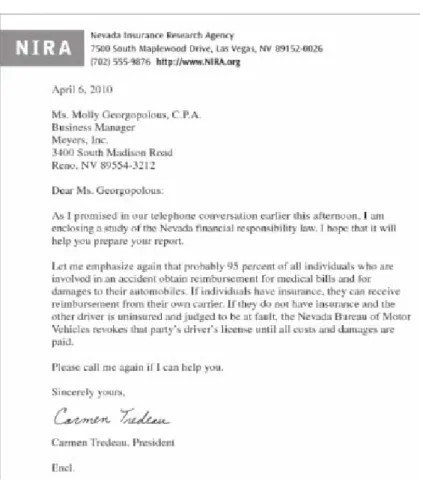
(20) BLOGS TO IMPROVE FORMAL LETTER WRITING. 20. letter writing consists of many stages, and these often influence the choice of language used in it.” In relation to the format of the formal letter, Kolin (2009, p.154) states that “letter format refers to the way in which you print a letter […] and several formats exist. Two of the most frequently used […] are full block and modified block”. For this research project, the full block will be used. In this format the writer’s address is at the right of the letter or centered, the date is at the right side but it can also go at the left side, the complimentary close, the signature and the name are always placed at the right side as well as the inside address, the salutation and the body of the letter as presented in Kolin (2009, p.154) and as it is seen in figure 1.. Figure 1: Full Block format.
(21) BLOGS TO IMPROVE FORMAL LETTER WRITING. 21. As part of the state of the art for this construct, it was not easy to find recent research studies related to formal letter writing directly, but there are some related to formal writing in general. For example, Myskow and Gordon (2009, p.1) show “how a genre approach has been used in an EFL high school writing course to teach the university application letter genre to students preparing for post-secondary studies. The authors discuss specific classroom materials to illustrate how a genre-based approach can be employed, not simply to teach static textual patterns, but to help learners gain a richer understanding of the complex relationship between written texts and the social contexts in which they are situated. The article begins with a brief overview of L2 writing scholarship, and as the authors acknowledge, some overlap exists between contemporary genre-based pedagogies and earlier product approaches. The authors argue, however, that awareness of the (somewhat slippery) distinction between these approaches is essential, if teachers are to present genres as resources to be drawn on to help learners achieve specific social purposes rather than inflexible text templates to be prescriptively imitated”. For the purpose of this study three different genres are considered in relation to formal letter writing: application, request and complaint. These three formats have been chosen because of their role in society. For instance, these are the most used when applying for further studies, for getting a job and/or for complaining about services. The authors of this study have also pointed out (2009, p.4) that “despite the importance of this genre for the graduate admissions process, there has been little research and instruction in academic writing courses […] and that the lack of research on application letters written specifically by high school students applying for university presented a challenge in the initial planning stages”..
(22) BLOGS TO IMPROVE FORMAL LETTER WRITING. 22. Cotterall and Cohen (2003, p.158), also describe in their paper “how a group of intermediate learners of English were guided through the process of producing their first academic essay in English. The approach applied the concept of scaffolding to the academic writing process by providing flexible support for the learners throughout the writing of their essays. Scaffolding included a number of features, each of which is discussed in the paper. The writers argue that the approach they adopted promotes learner autonomy by focusing on an authentic task, making the expectations of the task explicit, and providing flexible support for the learners as they approximate the target performance”. In the current study, also done with intermediate students, the idea of guiding and providing flexible support in the writing process was also followed. Moreover, the plan of promoting autonomy was taken into account, too. Teaching writing skills with ICT Nowadays in the context of language learning and teaching, there are many different technological tools available to support the different processes that take place in this environment. As it is expressed by Black (2009, p.689), the “rapid technological advances […] have given rise to serious consideration of the goals and responsibilities for institutions of formal learning in the 21st century”. Educational institutions have the need and the responsibility of assessing and including innovative ideas to be able to provide learners with variety and high educational quality, and ICT plays an important role. One UNESCO document (2007, p.22) highlights that “information and communication technologies (ICT), refers to forms of technology that are used to transmit, store, create, display, share or exchange information by electronic means. This broad definition of ICT includes such technologies as radio, television, video, DVD, telephone, satellite systems, computer and.
(23) BLOGS TO IMPROVE FORMAL LETTER WRITING. 23. network hardware and software; as well as the equipment and services associated with these technologies, such as electronic mail and videoconferencing”. Another UNESCO document (2002, p.13) establishes that “Information and communication technology, or ICT, is defined as the combination of informatics technology with other, related technologies, specifically communication technology”. Different gadgets such as computers, cellphones, IPods, and many other digital devices are now persuading the 21st century performance of learners and teachers during their lessons. From McKay’s points of view, “information and communication technology (ICT) has been found to be one of the most potent tools for promoting equity and access to education, and a great resource in bridging the gap of digital divide” (2007, p.XI). He also states that ICT affects almost all of our everyday activities and that the educational enterprises also benefit from the learning tools offered by ICT. It seems that using technology in the classroom to motivate students to work for academic purposes and to support their lifelong learner attitude is a strategy to take into consideration. These information and communication resources in the classroom can influence positively the language learners. Fotos & Brown (2004, p.70) state that “our access to information resources on computers […] expand our cognitive worlds and resources to a virtually unlimited degree”. Varied opportunities are at hand to learn different languages therefore the language education sector needs to take advantage of this benefit to help students improve their performance in the target language. For example in the case of writing, Knapp & Watkins (2005, p.16), express that “when teaching students to write in English, it is important for the teacher and the student to have a basic understanding of how English operates and functions as writing”. In.
(24) BLOGS TO IMPROVE FORMAL LETTER WRITING. 24. order to achieve this goal many tools exist. The same authors state that “since teachers necessarily employ a range of strategies to best cater for the needs of their students, there has been a shift in emphasis away from teacher-directed methodologies to student-centered and computer-assisted learning” (p.76). Learning writing through the use of ICT can motivate the learner to the point of making him/her improve his/her performance in a faster way. “The on-line teaching of writing covers a range of activities, from electronic mail to websites to synchronous and asynchronous conferencing” (Coffin et al. 2003, p.8). According to Stapleton (2005, p.135), “using the World Wide Web […], has become an increasingly viable way to source information in academic writing” and this is making the educational field a more interesting and attractive one. The state of the art for this construct makes reference to two studies. In the first one, Wheeler and Wheeler (2009, p.1) present their study in which they “investigated undergraduate teacher trainees' use of wikis, focusing on the use of shared spaces to communicate ideas and generate course specific content. [They] explored how students, through such activities, were able to improve their academic writing skills. We discuss writing as a social practice and discuss how wikis might promote better academic writing. […] findings indicate that most students raised their skill level in writing as a result of using the wiki space. From this study it is important to highlight that it differs from the current one in that it uses wikis as a space to communicate ideas and generate course specific content, while in this study blogs are used and with the aim of having students control their writing progress. In the second study, Gilmore (2009), states that “large corpora such as the British National Corpus and the COBUILD Corpus and Collocations Sampler are now accessible, free of charge,.
(25) BLOGS TO IMPROVE FORMAL LETTER WRITING. 25. online and can be usefully incorporated into a process writing approach to help develop students’ writing skills. This article aims to familiarize readers with these resources and to show how they can be usefully exploited in the redrafting stages of writing to both minimize the teachers’ workload and encourage greater cognitive processing of errors. An exploratory investigation comparing the use of these two online corpora in Japanese university writing classes is then described. This suggests that the participants in the study were able to significantly improve the naturalness of their writing after only a 90-minute training session and that the majority of students found these online resources beneficial, although there was a marked preference for the COBUILD Corpus and Collocations Sampler”. This study motivated the use of different technological devises as pedagogical tools to foster writing and encourage students to develop an autonomous learning behavior to learn a language. Use of blogs to teach writing Many different technological tools are being implemented in the teaching and learning context, specifically in the language learning environments. For the sake of this study, the technological tool that will help students to improve their formal letter writing skill is the blog. According to Budd et al. (2006, p.27), 2004 was the big time for blogs after being around for many years. Before this date, the word “blog” was used only by experts and did not appear in the dictionary. Richardson (2009, p.17) mentions that “the earliest blogs were literally “Web logs” or lists of sites a particular author visited on any given day […] But soon, the Internet Greeks who maintained these sites developed software to automate the process and allow other people to collaborate”. According to Lamshed (2002, p.9) “a blog (or weblog) is a web-based space for writing. Blogs can be thought of as an online journal where all the writing and editing of.
(26) BLOGS TO IMPROVE FORMAL LETTER WRITING. 26. information is managed through a web browser […] a blog is a personal web site managed by an individual who compiles lists of links to personally interesting material […] The user can instantly place their words and thoughts onto their own web log site through one of the many pieces of blogging software available. Like a journal, a blog can be a continually updated resource that grows over time with the accumulation of writing and other content”. Connecting blogs with the classroom atmosphere, allow professionals to explore many different teaching possibilities. For example, Richardson (2009, p.20) points up that “the early adopters of Weblogs in the classroom have already created a wide variety of ways to use them, and they have shown that blogs can enhance and deepen learning. Even at this still-early stage of development, blogs are being used as class portals, online filing cabinets for student work, eportfolio, collaborative space, knowledge management, and even school websites”. In the same line, Descy (n.d.) mentions that “the purpose or content of a blog varies according to the purposes and interests of the blogger. Blogs may take the form of a diary or journal, mini-essay, photo-essay, project updates, even fiction or non-fiction works”. Huffaker (2005, p.96), states that “blogs can be used to promote reading and writing, to showcase the work of students, or to exchange ideas among students, teachers, or school administrators”. Using blogs to enhance the writing skill makes students’ language learning context more appealing and it fosters the improvement of various skills at the same time and the development of an autonomous learning behavior. Witte (2007) highlights that “by combining writing with online technology, teachers can provide opportunities for students and future educators to develop their digital fluency while also strengthening their traditional literacy skills”. Implementing different strategies to help students to improve writing is necessary and blogs are.
(27) BLOGS TO IMPROVE FORMAL LETTER WRITING. 27. motivating this process. Zhang (2009, p.67) states that “one might expect blogs to offer many reading and writing incentives for English learning and writing because blogging places emphasis on content, the possibility of speedy feedback, the option of working with both words and images, and the ability to link one post to another. Scholars who use blogs also say that because students know they are going to have an audience by publishing their writing on the Web, they often produce higher quality work”. The aim of using blogs for this study is to allow students to discover one of is uses, which in this case is a pedagogical tool that will help them to keep track of their writing process, just as it was mention in the above lines, blogs are used as an online filing cabinet for student works to help them improve their formal letter writing. As part of the state of the art, Yang (2009, p.11) presents in his article that the aim of his study “was to explore the use of blogs as a reflective platform in the training processes of English as a Foreign Language (EFL) student teachers, who were learning to teach English for future employment in Taiwan. They made use of blogs as a platform to critically reflect on their learning processes as well as to gauge the impact of blogs on their own professional growth. […] Two instructors created a blog for use as a discussion forum so that the student teachers could engage in and examine their own reflection process. The data collected was qualitative in nature, consisting of student teachers’ posting messages and comments on the blog, surveys on the student teachers’ reflective experiences using blogs as reflection tools, and group reflective dialogues recorded by instructors in class meetings over the implementation of blogs during the course. The results showed that the student teachers actively discussed teaching theories and their implications through blogs..
(28) BLOGS TO IMPROVE FORMAL LETTER WRITING. 28. Another relevant study is the one found in Armstrong and Retterer (2008, p.233) in which the use of a blog and its effects upon students is examined in an intermediate level Spanish class. The main aim was “to have students participate in two different blogs: a community blog and a personal blog, with each serving very different functions. Students posted their more formal writing assignments in their personal blogs. This would serve as an e-portfolio during the semester, and students could look back on earlier postings/essays. The community blog would be a discussion board at the start of the semester and the students would post commentaries about a variety of topics and to which the other students would respond. […] The overall experience proved to be a positive one for students leading the authors to conclude that this generation of computer literate students found blogging an appealing way to communicate in a foreign language”. After reviewing information related to the constructs of this action research project and realizing that researchers, such us Zhang (2009), Witte (2007), Huffaker (2005), Richardson (2009) and Stapleton (2005) agree with the use of blogs as a tool to help to improve writing skills and some of them consent, at the same time, the importance of motivating formal letter writing, the following information can be concluded. Even though many of the studies done related to the use of blogs to improve writing skills are based on the idea of interaction, in this case it is related to students posting their products, re-writing them and looking back on previous postings to check their own progress, so they can keep track of their own process and they can also be able to review their works to perform better in future occasions..
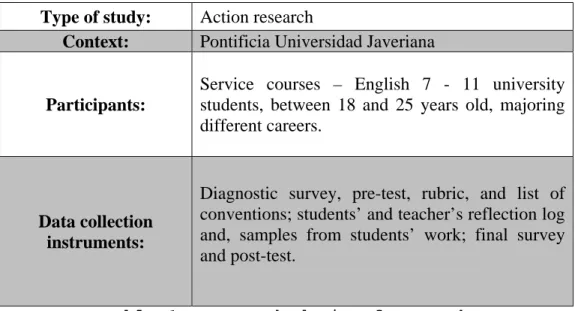
(29) BLOGS TO IMPROVE FORMAL LETTER WRITING. 29. CHAPTER 3: Research Design This chapter makes the design of the action research project evident. It will refer to the type of study carried out, the researcher’s role, the context in which the study took place, the participants involved and it will also offer an account of data collection instruments and data collection procedures. The table below reviews information related to this chapter and it is followed by an indepth analysis. Type of study: Context:. Action research Pontificia Universidad Javeriana. Participants:. Service courses – English 7 - 11 university students, between 18 and 25 years old, majoring different careers.. Data collection instruments:. Diagnostic survey, pre-test, rubric, and list of conventions; students’ and teacher’s reflection log and, samples from students’ work; final survey and post-test.. Table 1: Research design framework Type of Study The type of study applied in this research project was action research, since the point was to find a solution to an ongoing problem present in an educational context and to improve students’ achievements. In Ferrance words, (2000, p.1) action research “specifically refers to a disciplined inquiry done by a teacher with the intent that the research will inform and change his or her practices in the future […] is carried out within the context of the teacher’s environment.
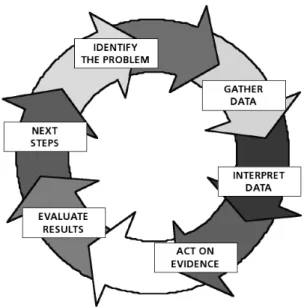
(30) BLOGS TO IMPROVE FORMAL LETTER WRITING. 30. […] on questions that deal with educational matters at hand”. She mentions five phases of inquiry: identification of problem area, collection and organization of data, interpretation of data, action based on data and reflection. The followings are the action research steps proposed by Ferrance (2000, p.9). Figure 2: Action research cycle Regarding the first step of this cyclical process, “identify the problem”, Ferrance (2000, p.10) makes reference to the importance of coming up with a question with the following features: it has to “be a higher-order question—not a yes/no, it needs to be stated in common language, avoiding jargon, to be concise, to be meaningful and not already answered. For the second step (Ferrance, 2000, p.11), she presents a list of possible vehicles to collect data and highlights the value of selecting the appropriate tools according to the issue being researched. In the data interpretation step, it is essential to identify and analyze major themes according to the research question in order to continue with the next step, “act on evidence”, in which by “using the information from the data collection and reviewing the current literature, a plan of action is.
(31) BLOGS TO IMPROVE FORMAL LETTER WRITING. 31. designed in order to make changes and study those changes (Ferrance, 2000, p. 12). Then, the point is to assess the intervention to determine if improvement has occurred to finally identify additional question or suggest possible further studies. This cycle was the one chosen to follow for carrying out this action research project because the steps fitted perfectly with the features of the environment I was going to apply my research on. Following the same position, Sagor (2005, p.4) defines action research as “an investigation conducted by the person or people empowered to take action concerning their own actions, for the purpose of improving their future actions”. Wallace (1998, p. 1) also describes it as a “systematic collection and analysis of data relating to the improvement of some aspect of professional practice”. As well Burns (1999, p.30) presents in her book a collection of definitions referring to action research from different authors and summarizes the main aspects as follows: 1. “Action research is contextual, small-scale and localised – it identifies and investigates problems within a specific situation. 2. It is evaluative and reflective as it aims to bring about change and improvement in practice. 3. It is participatory as it provides for collaborative investigation by teams of colleagues, practitioners and researchers. 4. Changes in practice are based on the collection of information or data which provides the impetus for change.” There are three different approaches to research: quantitative, qualitative and mixed. According to Creswell (2003, p.18) descriptions, the current study was based on the mixed.
(32) BLOGS TO IMPROVE FORMAL LETTER WRITING. 32. methods approach. He mentions that the “mixed methods approach is one in which the researcher tends to base knowledge claims on pragmatic grounds […] and collect data simultaneously or sequentially to best understand research problems”. Johnson & Christensen (2008, p.455) state that “mixed research is still an emerging field. [It] now appears to be accepted by most as the third major research or methodological paradigm, and mixed research studies are increasing dramatically in the literature”. Researcher’s Role In this study, the researcher’s role was that of teacher-observer when guiding intermediate students’ class and observing the process of the project designed and conducted by the researcher. It is important for teachers to move “from lesson plans, activities, and students to research-oriented questions, data analysis, and findings […] that can transform both the teacher and the classroom” (Freeman, 1998, p. 178). In consequence, the teacher-researcher role was played at the same time, since observation aimed to analyze participants’ performance based on a trend analysis, to improve the teaching practice and to be able to help the students move forward in one specific area of study. Context This project was held at Pontificia Universidad Javeriana, a well-recognized private higher education institution. Its main facilities in Bogotá city are available for anyone interested in taking one of the programs offered. Individuals can choose between 40 undergraduate programs, 122 professional specializations, 22 masters, and 4 PhDs. The university counts with 18 faculties with its corresponding departments. Within them, there is the Language and.
(33) BLOGS TO IMPROVE FORMAL LETTER WRITING. 33. Communication Faculty with three different departments: Information’s science, Communication and Modern Languages. This later, the Modern Language Department, has the goal of motivating people to use languages taking into account the role in the human and social development. This department has different programs to enroll, a well-equipped language resource center and useful bibliographic material available. At this university, every student has the possibility of choosing between presenting an English international exam and enrolling specific English levels as a graduation requirement. The level in which this research project took place was within the eight levels offered by the Modern Language Department for students from different majors. It was English 7 in which students have to accomplish the following requirements per skill in order to achieve B1 level form the Common European Framework of Reference for languages (2001). According to the Common European Framework of Reference for languages (2001, p.26) which is followed by the Modern Language Department, by the end of the course students, regarding the listening skill, will be able to “understand the main points of clear standard speech on familiar matters regularly encountered in work, school, leisure, etc.” they will be able to “understand the main point of many radio or TV programmed on current affairs or topics of personal or professional interest when the delivery is relatively slow and dear”. Concerning the reading skill students will be able to “understand texts that consist mainly of high frequency everyday or job-related language. […] They will understand the description of events, feelings and whishes in personal letters”. In terms of speaking they will be able to “deal with most situations likely to arise whilst travelling in an area where the language is spoken”. They will be able to “enter unprepared into conversation on topics that are familiar, of personal.
(34) BLOGS TO IMPROVE FORMAL LETTER WRITING. 34. interest or pertinent to everyday life”. They will also be able to “connect phrases in a simple way in order to describe experiences and events, dreams, hopes and ambitions”. They will be able to “briefly give reasons and explanations for opinions and plans […] and narrate a story or relate the plot of a book or film and describe reactions”. Regarding writing students will “write simple connected text on topics which are familiar or of personal interest and can write personal letters describing experiences and impressions”. Following the theory of the Common European Framework of Reference for languages and the program supported with the book (Obee & Evans, 2003), one of the aims in terms of writing, which is the focus of this project, is having students write formal letters appropriately. Participants This research project was carried out with eleven intermediate students. They belong to English 7 form one of the programs offered by the Modern Language Department. The group has three main features: there are students from electronic and system engineering, ecology, business administration, visual arts, literature studies and arquitecture; they range from the forth to the tenth semester and they are between 18 and 25 years old. In consequence, they have different needs, wants, beliefs, attitudes, abilities and learning styles. However, they all share the same objective of achieving the university requirements regarding the English language, to be able to obtain their diploma. They are attending English classes at Pontificia Universidad Javeriana twice a week. According to the Common European Framework of Reference (2001, p.24), they are capable of understanding “the main points of clear standard input on familiar matters regularly encountered in work, school, leisure, etc.; they can produce simple connected text on topics which are familiar or of personal interest and they can describe experiences and events,.
(35) BLOGS TO IMPROVE FORMAL LETTER WRITING. 35. dreams, hopes and ambitions briefly giving reasons and explanations for opinions and plans”. Some of the linguistic and affective needs students have are: to hear English in different contexts, to understand and communicate, to express feelings and opinions, to feel motivated, to pronounce properly, to increase lexical repertoire and to develop lifelong learning skills. Data collection instruments In order to give validity to the data collected before, while and after the intervention, it is a must to describe the data collection instruments and their purpose in relation to this project. For this concrete study, the following instruments were used to collect the appropriate data during workdays and while students were simultaneously induced to become aware purposefully and actively of their own learning progresses. One of the main reasons for choosing the instruments was Sagor’s words about the importance of using “instruments that could provide encouragement, directions and motivation for the learners”. (2005, p. 91) Surveys. According to Elliot, S. (1995, p.37) surveys are defined as a “research technique in which the investigator asks subjects questions about a particular issue, usually with structured questionnaires”. I decided to use surveys, at the beginning and at the end of the project, because I founded them appropriate since they were going to provide information necessary to support the reason why I was carrying out this project and in the same way, they were going to help answering the question related to the effectiveness of the use of blogs to improve formal letter writing in the English intermediate level. Sagor (2000, p.104) states that surveys are popular thanks to its efficient and versatile essence. In this case, open-ended items were used in the.
(36) BLOGS TO IMPROVE FORMAL LETTER WRITING. 36. surveys to be able to “explore the informant’s own perceptions, beliefs or opinions” (Burns, 1999, p. 131) related to different issues within the current project. According to Cohen et al. (2000, p.169) “typically, surveys gather data at a particular point in time with the intention of describing the nature of existing conditions, or identifying standards against which existing conditions can be compared, or determining the relationships that exist between specific events”. Pre- and post- tests. These instruments were helpful to determine the knowledge students had, in relation to formal letter writing, at the beginning of the project implementation and at the end. Cohen et al. (2000, p. 322) describe diagnostic testing as “an in-depth test to discover particular strengths, weaknesses and difficulties that a student is experiencing”, which was the main inspiration for the creation and application of these instruments. The validity of the instruments is, according to Cohen et al. (2000, p.334), “the extent in which the test tests what is supposed to test”. In both examinations, students are required to write a formal letter following the corresponding format and features. The reason of choosing this tool is to evidence my students’ formal letter writing level at the beginning and compare it with their performance at the end of the project, to be able to confirm my hypothesis, that the use of blogs helps intermediate students improve their formal letter writing skill. Henning et al. (2008, p.128) indicate that “pre-and post-tests, offer a helpful method to spot strengths and weaknesses of courses, individuals, or subgroups”. A pre-test was provided before beginning a project, for the teacher-researcher to adjust the instruction in advance and be able to compare results with the post-test to provide further insights. The reason of choosing this tool is to evidence my students’ formal letter writing level at the beginning and compare it with.
(37) BLOGS TO IMPROVE FORMAL LETTER WRITING. 37. their performance at the end of the project, to be able to confirm my hypothesis, that the use of blogs helps intermediate students improve their formal letter writing skill. Students’ works. Sagor (2000, p.100) presents students’ works as the most valid source and states that “an actual students paper will always contain far more robust data regarding writing competence than any possible grade”. For the purpose of this study, students’ works were collected to provide feedback, to check students’ improvement and for students to follow their own writing process. Documents. The project program, presented at the beginning, invited and oriented students to follow the project process. The list of conventions helped the teacher to provide part of the feedback necessary and allowed students to self-correct their work. Rubrics. Rubrics are written guidelines by which student work is assessed, and they articulate the standards for how student work should be judged (James et al., 2007, p.91). It was appropriate for the project to assess students work and allow them to realize the aspects they needed to improve in their writings and the points missing to achieve the standards. Teacher and student reflection logs. As Wallace mentions (1998, p.59), “field-notes can be kept in a highly-structured way, following a particular format. [They can be also called] “logs” to distinguish them”. I chose to create one for the students and one for me in order to make it appropriate for the project and.
(38) BLOGS TO IMPROVE FORMAL LETTER WRITING. 38. collect accurate data from them. The reflection logs were filled and collected after each session for further analysis. Data collection procedures After getting the corresponding permission from the institution through a consent letter (Appendix A) as strategy to guarantee the development of the study, three stages characterized the process of data collection during this study and for each stage different instruments were created. In the pre-stage the key instruments were: 1. a diagnostic survey, (Appendix B) 2. a pre-test, (Appendix C) 3. the rubric, (Appendix D) 4. the list of conventions and (Appendix E) The implementation of these instruments was done at the language resource center for students to get familiar with the setting for the following four sessions. The diagnostic survey was created using a useful Internet tool for carrying out any kind of survey. Then, they were concentrated in the pre-test, which was done by hand to check students’ performance in the layout and the format, between other aspects related to formal letter writing. Finally, the program of the project was presented to make students aware of their tasks and their independent work for the following four lessons, and to give them an idea about the objectives to be accomplished after each lesson. At the end of this same lesson, a letter of consent (Appendix F) signed by.
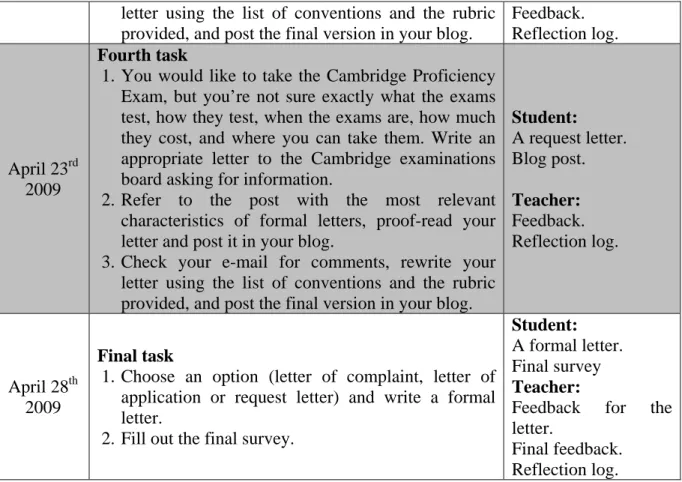
(39) BLOGS TO IMPROVE FORMAL LETTER WRITING. 39. students, provided the teacher with the permission required to carry out the project with the group of participants and to use the data collected from them. In the following stage, the while-stage, the implementation of the project’s program took place. The following were the assignments for the project: DATE April 9th 2009. April 14th 2009. April 16th 2009. April 21st 2009. TASKS. PRODUCTION Student: 1. Carry out the diagnostic survey provided. Diagnostic survey. 2. Take the pre-test. Pre-test. 3. Consider the project proposal. Letter of consent. 4. Agree with the letter of consent. Teacher: Reflection log. Student: First task Blog creation. 1. Create a blog for the project. A post with the main 2. Set up the layout of the blog. characteristics of 3. Look for information about letters of complaint, formal letters. letters of application, and request letters. Reflection log. 4. Share and complete information with classmates’ contributions and answer possible emerging Teacher: questions. Support and comment 5. Make a post with the most relevant characteristics on students’ work. of each category to review when writing the letters. Reflection log. Second task 1. Write a formal letter to the major of your city. You Student: are not happy about the dirty parks and streets A letter of complaint. around. Reflection log. 2. Refer to the post with the most relevant Blog post. characteristics of formal letters, proof-read your letter and post it in your blog. Teacher: 3. Check your e-mail for comments, rewrite your Feedback. letter using the list of conventions and the rubric Reflection log. provided, and post the final version in your blog. Third task 1. Check the classified ad section of an e-newspaper Student: and find a job that interests you. Then, write a letter A letter of application of application as if you were applying for the job. Reflection log. 2. Refer to the post with the most relevant Blog post. characteristics of formal letters, proof-read your letter and post it in your blog. 3. Check your e-mail for comments, rewrite your Teacher:.
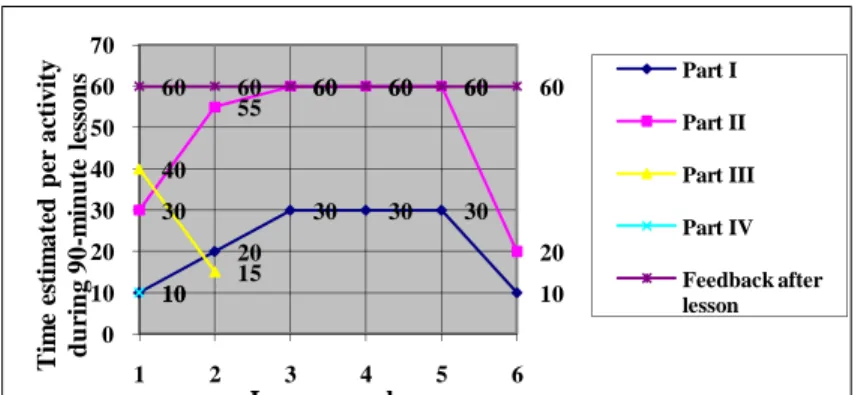
(40) BLOGS TO IMPROVE FORMAL LETTER WRITING. April 23rd 2009. April 28th 2009. letter using the list of conventions and the rubric provided, and post the final version in your blog. Fourth task 1. You would like to take the Cambridge Proficiency Exam, but you’re not sure exactly what the exams test, how they test, when the exams are, how much they cost, and where you can take them. Write an appropriate letter to the Cambridge examinations board asking for information. 2. Refer to the post with the most relevant characteristics of formal letters, proof-read your letter and post it in your blog. 3. Check your e-mail for comments, rewrite your letter using the list of conventions and the rubric provided, and post the final version in your blog.. 40. Feedback. Reflection log.. Student: A request letter. Blog post. Teacher: Feedback. Reflection log.. Student: A formal letter. Final task Final survey 1. Choose an option (letter of complaint, letter of Teacher: application or request letter) and write a formal Feedback for letter. letter. 2. Fill out the final survey. Final feedback. Reflection log. Table 2: Project assignments. the. The instruments implemented during the while-stage were: 1. students’ reflection log, (Appendix G) 2. teacher’s reflection log and, (Appendix H) 3. samples of students’ work (Appendix I) From these instruments mentioned above, the students’ and the teacher’s reflection logs and part of the samples from students’ work were picked up before the next lesson began, and the other part of the samples was collected during the lessons..
(41) BLOGS TO IMPROVE FORMAL LETTER WRITING. 41. Finally, in the post-stage, to evidence whether the students were improving their formal letter writing skill, a final survey (Appendix J) and a post-test (Appendix K) were created. The teacher had to fill out the reflection log after this lesson for further analysis. The post-test was designed for students to write a formal letter about a specific topic, after choosing between a letter of complaint, a letter of application and a request letter, the three types studied during the project. Validity It refers to the essential truthfulness of a piece of data. By asserting validity, the researcher is asserting that the data actually measure or reflect the specific phenomenon claimed (Sagor, 2000, p.110). At the beginning of the project, a careful observation and investigation was held in order to give evidence of the problematic situation. Then, during the project some instruments such as students’ works and reflection logs, were use to collect accurate data to achieve the aim of internal validity, which seeks to demonstrate that the explanation of a particular event, issue or set of data can actually be sustained by the data. (Ibídem) and which, according to Merriam (1998, p.210) “deals with the question of how research findings match reality”. Taking into consideration that Merriam (1998, p.207) also mentions that “external validity is concerned with the extent to which the findings of one study can be applied to other situations”, it can be said that this study can be applied in a wide variety of educational contexts, since it is related to the use of technology in the classroom. Reliability.
(42) BLOGS TO IMPROVE FORMAL LETTER WRITING. 42. According to Cohen et al. (2000, p. 334) “reliability concerns to the degree of confidence that can be places in the results and the data”. It relates to researcher’s claims regarding the accuracy of their data. In this aspect triangulation process, which is the comparison of one data set to another (Cresswell, cited in James, 2007, p.91), was completed and within it time triangulation, which is the similarity of data gathered at the same time and methodological triangulation, which is using the same method on different occasions or different methods on the same object of study (Cohen et al., 2000, p.113) were considered..
(43) BLOGS TO IMPROVE FORMAL LETTER WRITING. 43. CHAPTER 4: Pedagogical Intervention and Implementation The pedagogical intervention took place in six ninety-minute lessons and another ninety minutes of independent work among classes. The pedagogical approach that can inform the decisions and actions taken as an instructor is the Computer Assisted Language Learning (CALL) approach. As it is defined by Levy (1997, p. 1), CALL is “the search for and study of applications of the computer in language teaching and learning”, and it guided this study from the beginning. The objectives established were the following: through an online project, based on the use of blogs, students were going to practice their formal letter writing in order to improve their writing skill, and students were also going to become familiar with three different types of formal letters: letters of complaint, letters of application, and request letters. They had to create a blog individually, so that they were able to work during class, post individual products, wait for teacher’s feedback via e-mail, correct their work taking into account the rubric and the list of conventions given, upload their final product, answer questions from the reflection log and send it to the teacher’s e-mail account. For the purpose of this study, blogs are essential pedagogical tools to follow the writing process, to make it continuous and thanks to the structure of the blogs, they allow students to show improvement in their works. Regarding the lesson plans, they were useful to structure the objective of each of the lessons and at the same time, to organize the activities involved in the project. They were created by the teacher for the students to follow the activities suggested during the class time and finish them as individual work. It was necessary to plan six ninety-minute sessions, in which students were going to work autonomously, but with the teacher’s guidance. All the sessions were held at.
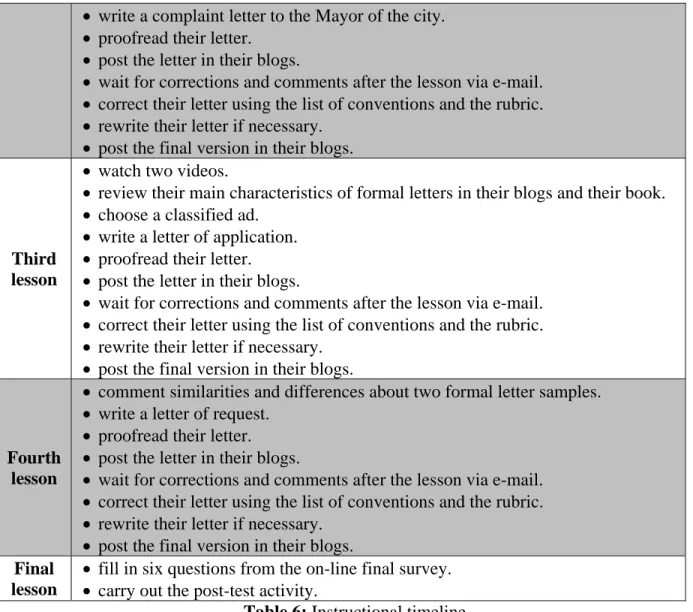
(44) BLOGS TO IMPROVE FORMAL LETTER WRITING. 44. the language resource center, where students had enough computers available to carry out the suggested activities. The teacher was in charge of giving the feedback necessary for students to correct their formal letters using the rubric and the list of conventions. The teacher corrected mainly writing, spelling and format, providing students with their work with corrections and the rubric with a grade corrected under twenty points and some comments to improve their works. Students, as independent work, had to check their writings and to understand the feedback from the teacher to be able to correct the letter taking also into account all the comments. The first lesson planned had four parts. In the first one, students were filling out the diagnostic survey then, in part two, they were taking the pre-test. In part three, the students were reflecting on the project proposal and finally, in part four, they were signing the letters of consent. Students had to fill out a reflection log using a specific format and send it to the teacher’s e-mail. The second lesson planned had three parts. For the first part, students were watching three videos related to writing letters and answering specific comprehension questions. For the second part, they were creating their blogs, searching for information related to formal letters on Internet and sharing it to understand as much as they could the main characteristics for each style. For the third part, as independent work, students had to review their notes, to post in their blogs the relevant information collected related to formal letters and to fill out and send to the teacher’s e-mail a reflection log. The third lesson (Appendix L) planned had two parts and the independent work. For the first part, students were working on an exercise reviewing the use of collocations and an exercise checking mild and strong expressions that could have help in the letter writing activity. In the.
Figure
+7


Documento similar
a) To determine the students’ perception of their teachers’ instructional behaviors that could support their autonomy. b) To determine the teachers’ perceptions of their
The sample is comprised of five museums, and their selection is justified by the fact that, since four years ago, these museums decided to work together to improve their position in
35 In short, the only extant epistolary writing in Austen's early work that is a sustained and lengthy use of the letter form as a mode through which to
Government policy varies between nations and this guidance sets out the need for balanced decision-making about ways of working, and the ongoing safety considerations
The areas studied through this database are how many heartbeats are needed to identify a user; the costs of convergence of the presented model; the classification of a non-seen user
Since writing complexity increases from one text to the other in the four studies performed (e.g. from a short writing task to a bachelor dissertation), the possibilities
• While undergraduate students in Saudi universities are expected to have desired English language skills in order to further advance in their specialized areas of study, writing
Bearing in mind the elements mentioned above, which are key to successful formal and academic writing, this paper focuses on a corpus-based analysis of student report-writing with
