CHEMISTRY LEARNING WITH APPLICATION OF THE ZONE OF PROXIMAL DEVELOPMENT AND USE OF
CONCEPTUAL MAPS IN THE CHEMISTRY LAB
FRANCISCO CAÑAS
1*, LEONTINA LAZO
2, CARLOS CARCAMO
31. Universidad Andres Bello, Departamento de Química, Facultad de Ciencias Exactas, Quillota 980, Viña del Mar, Chile.
2. Pontificia Universidad Católica de Valparaíso, Instituto de Química, Facultad de Ciencias, Avenida Universidad 330 Curauma, Valparaíso, Chile. 3. Universidad Santo Tomás, Departamento de Ciencias Básicas, Los Limonares 190, Viña del Mar, Chile.
ABSTRACT
The present study focuses on the deficient learning of health science students in the General Chemistry course in the first level higher education, specifically regarding the topic of aqueous dissolutions in terms of the meaning of pH and how to determine it. The causes of this problem are: i) the difficulty relating the theory to the practice, ii) the lack of strategies that help and motivate learning, iii) the inability to understand and resolve problems or exercises, and iv) a deficiency on basic mathematical aptitudes for application in resolving problems and exercises, among others. The research considered the academic results obtained by students of various careers in the area of health sciences students in the past, to subsequently determine the research group, resulting it the career of nursing students.
To achieve this type of learning, the Zone of Proximal Development (ZPD) was applied, together with the metacognitive strategy of Conceptual Maps (CM) and feedback & self-correction in practical laboratory activities. This study was carried out at a university and involved nursing students because they have many difficulties learning experimental sciences, especially chemistry, because the students of other careers do not have many weaknesses in this science, being evidenced in the results at end of the semester. The sample experimental group consisted of 336 nursing students and the control group 420 students of nutrition and dietetics and dentistry taking the unit “General Chemistry”, who provided all the information for this study.
Keywords: Feedback and self-correction, Cooperative Learning, Acids / Bases, pH.
1. INTRODUCTION
Independent training students have in chemistry, the purpose of this research is to improve learning chemistry in higher education, through the implementation of teaching strategies in first level courses.
The General Chemistry course gives students basic knowledge of chemistry in areas related to quantification of matter, chemical structure, physiochemical properties and chemical reactivity of substances. The aim is for the student to successfully perform in the upper-level course units that require such knowledge. The discipline of chemistry is composed of a system of concepts and abilities which represent the fundamental bases of a scientific understanding of the world, and as such it is of paramount importance to develop the scientific abilities of the student.
Specifically, chemistry learning and the development of the student, both academically and personally, are social and collaborative activities that cannot be “taught” but rather facilitated or guided; it thus depends on the student to build their own system of knowhow, according to the Vygotskian conception 1, 2, 3, 4.
Newman, Griffin and Cole 5, wrote:
“The concept of Zone of Proximal Development (ZPD) is central to the theory’s contribution to the analysis of practical educative activities and to the design of teaching strategies. Two levels can be considered in a student’s capability, one is the limit of what he/she can achieve alone, called the actual development level and the other is the limit of what can be achieved with help, called the potential development level” (p 80)
Therefore, ZPD can be used to access to adequate support for sustainable learning over time.
2. STRATEGIES FOR LEARNING CHEMISTRY 2.1 Zone of Proximal Development.
The concept is used to interpret open situations in which there is no clear hierarchy to the development of conduct and abilities, and where intervention by an adult or more proficient peer can seem ambiguous 5. One element open
to definition is what exactly is to be considered adequate help from the expert or more capable peer; Wertsch 6 proposes three additional concepts for a more complete understanding of ZPD:
a) definition of the task, b) intersubjectivity, and c) semiotic mediation. Along these same lines, Valsiner5 proposes the following concepts: a) Zone
of Free Movement and b) Zone of Promoted Action, which allow for a more comprehensive analysis of the interaction between the “expert” and the student, when the first instructs the latter on something 5, 7.
During the interactive process of teaching and learning in ZPD, development does not arise in all appropriation processes, but only in those that cause modification in the structure of psychic functions. The restructuring of a function allows the subject to access different ways of interacting cognitively
and emotionally, especially with objects, but also with other people and, under certain circumstances, with him/herself 8, 9, 10, 11, 12. As a result, teaching in ZPD aims to profound structural changes.
Vigotsky distinguished two types of results of teaching and learning in the zone: on the one hand, what is considered a direct product (for example, types of knowledge, abilities and habits), and on the other, indirect results of teaching and learning that imply restructuring function and access of the subject to a qualitatively different way of cognitive functioning, which in turn constitutes a genuine indication that development has occurred 9, 11, 12, 13. Others authors define the ZPD as the distance between the actual level of development, determined by the ability to independently solve a problem, and the level of development potential, given through the resolution of a problem under the guidance of teacher or in collaboration with a partner more capable. 14
Thus, cognitive development is understood as a deep and fundamental structural and functional change that subjects experience in some area(s), which places them in a better position to be able to act upon the world and upon themselves 9, 11, 12, 15, 16.
One of the most important and least studied of these aspects relates to the degree of conscious insertion a student can and should attain during learning in the zone, and to what boundaries or fields should this development extend 8, 12, 15. Then, the creation of ZPD and progress in it depend on the concrete interaction between the student and those who aid in his/her learning process, meaning that we must seek to identify the interactions in the basic processes responsible for the possibility of offering adequate help and the criteria that can be derived from these processes to be used as a guide to the design and development of teaching 17. The teacher is the main party responsible for assisting in a student’s
learning, teacher-student interaction therefore has certain characteristics, and in addition, interaction between students can equally lead to a ZPD that can also offer elements for improvement within it. The teacher-student interaction is the main source of generating a ZPD 18. He adds that cooperative work among
students can, under certain conditions, also be important in the creation of ZPD, and the characteristics of student interaction that help generate ZPD are as follows: Comparison of different points of view on the same content or task, presentation of his own views to their classmates and organization of roles, mutual control of work to be done and mutual offering and accepting of help. 19, 20
Green & Piel 21 describe 7 types of activities to stimulate the ZPD by
teachers. These activities are:
- Modeling the behavior by imitation providing the student a picture that reminds you run levels.
- Feedback and self-correction.
- Address of contingency by applying positive and negative reinforcements. - Direct instruction to provide clarity in the transmitted information. - Questions that need collective answers.
The reasoning of students must be explained by these for their cognitive structures and thus create new learning situations. Somehow, the activities described by these authors, only make reference to the resolution of problems in the academic context. The ZPD must include the integral development of the personality. An individual may know how to solve properly multi-task, but if after resolved these, it is not able to build a developer lifestyle, their development as personality is mortgaged. 21, pp. 280
Feedback and self-correction.
D’Angelo 11 explains: Learning is a process of participation, interaction
and collaboration, through the activity and communication with the other. It
occurs when students are motivated to engage thoughtful and strategically in learning activities within environments that encourage self-regulationor self-correctionby constructing their own knowledge either alone or helped with their peers, as well as listening to valuing the opinion of others, creating a new reality of learning. Some researchers 22 suggest: “that a student of under performance, to work in pairs with another high-performance, significantly raises the quality of learning, because among other things, the fund uses the memory of your partner”.
Similarly, the concept of group work as it is known needs to be changed in order to promote cooperative work as a function of the interaction processes among students. Several studies in the area of teaching and learning processes state that conceptual and is not explicative knowledge transferred in the common manner, but rather each individual builds it independently 7,22,23, 24 . As such, our research proposal aims for students to achieve sustainable and long lasting learning.
Sustainable learning is that in which the information received, or part of it, is correctly appropriated by the student, thus increasing and enriching the previously existing cognitive structure 24,25,26,27,28,29,30,31. To achieve this type of learning, the metacognitive strategy of Conceptual Maps (CM) is applicable in practical laboratory exercises, where the CM`s in question are related to the theory studied in the subject of Chemistry.
2.2 Conceptual Maps.
CM represent a simple way of visualizing concepts and the hierarchical connections between them, 31,32 and experimental activities allow students to better comprehend the theoretical concepts learned in the classroom, since the experiments performed in the laboratory related to the concepts learned, and are often considered more interesting as it is more tangible 33,34.
Different concepts of learning can be related to Joseph Novak’s C M, he defines them as a way of illustrating and presenting the cognitive and semantic structure possessed by students, and through which they perceive and process their experiences 33, 35. The creation of conceptual diagrams by students is an idea that began with the theory of Jean Piaget, which states that in order to adopt an adequate conception of learning, it is necessary to know how a subject proceeds to build and create, and not just how he/she repeats and copies 32, 35.
The aim of CM is to represent meaningful connections between concepts as propositions. A clause has two or more conceptual terminals joined by words to a semantic unit. The simplest form of a CM contains only two concepts joined by one link word forming a clause; for example, sea water is blue, would represent a simple CM that forms a valid clause referring to the concepts of sea water and blue 34,36,37,38, 39, 40.
To obtain meaningful learning two fundamental conditions are required: a) the student has a positive attitude towards learning and b) the new material is meaningful to the student 33.
Novak, 37, presents CM as a strategy, method and diagrammatic resource.
• Strategy: to help students learn and educators organize the material to be studied.
• Method: to help students and educators to grasp the meaning of the
material to be learned.
• Diagrammatic resource: to represent a set of conceptual meanings
as part of a structure of clauses.
CM can be created in many different ways for the same group of concepts
32, 37, 38, 39. Once the essence of the construction of CM has been understood,
their importance for learning is that they can be applied to the study of different subject matters 41, 42, 43.
3. METHODOLOGY
This study was carried out at a university during the first semester of 2014 and involved Nursing, Nutrition and Dietetics, Dentistry students. In general, students from these careers have difficulties learning experimental sciences, especially chemistry. This was observed in the results of assessments of
us assume that this course should be to intervene pedagogically introducing learning strategies that should lead to improved academic performance in this area. It should be noted that the teachers who taught this subject are the same semester, therefore teaching strategies are always the same. This led us to propose the following hypothesis: The use of conceptual maps (CM) and the zone of proximal development (ZPD) in practical laboratory exercises, as pedagogical strategies, allows students to attain sustainable learning observed both in their performance at the laboratory as well as through the grades obtained at the end of the academic semester. The objective was to improve learning in the subject of General Chemistry for the topics of solutions and pH, through application of ZPD in experimental work and through the use of conceptual maps.
3.1 Type of research.
The type of research is descriptive with a quasi-experimental design. It is descriptive because it describes the effect of the applied strategy and design is quasi-experimental because belonging to the sample subjects, are not, randomly selected 44
3.2 Sample group.
The sample group consisted of 756 students taking the unit “General Chemistry”, who provided all the information for this study. The study group was formed by students from the area of health sciences, which were divided in the following way: 420 students who formed the Control Group (CG) of the careers of nutrition and dietetics, dentistry and 336 students formed the Experimental Group (EG) who were students of nursing career. This was due to the performanceobtained in previous semesters were deficient approximately 35% of approval rating, on the other hand, the students of the CG had better final grades.
The variable is defines as that characteristic of interest measured in every unit of the sample, in this project the variable to be measured it is learning in terms of obtained qualifications, which is analyzed by means of the evaluations of the students.
3.3 Methods for data collection.
Two surveys, each consisting of four questions, were applied to the EG and CG.
Survey 1: Contains 4 questions, two with five alternatives and the other two with two alternatives yes / no, and it was applied at the beginning of the study to identify which learning strategies the students would like to apply or which they were interested in using.
Survey 2: The same survey was repeated at the end of the study in order to assess the degree of acceptance of the applied technique.
3.4 Strategy Application.
During the development of the experimental course there were realized 6 activities of 90 minutes of duration, whose objectives were teaching the fundamental concepts, exercises and laboratory experiences according to the studied contents. It should be noted that in the course control, the classes were developed in traditional form.
After completion of these activities a final test is applied to evaluate academic performance, and to establish whether the pedagogical tools used (CM and practical laboratory activities) allowed students to attain sustainable learning, compared with previous groups that did not use such tools.
3.4.1 Design of learning sessions.
To evaluate the objective of the study, the focus was the unit of solutions and pH, an area in which students present most learning difficulties. Learning difficulties of this unit have been reflected in their average ratings, for example Test 3 in the Control Group, which averaged 3.1 (of a maximum of 7).
The contents of chemistry taught were 45, 46, 47: General properties of liquids, Mixtures and dissolutions, dissolvent and solute, Units of concentration: molarity, molality, normality, percentages (m/m; v/v and m/v), Ionic equilibrium, Strong and weak electrolytes, Concepts of acid and base, Strength of acid and base, Acid-base equilibrium, Ionization of water, Calculation of pH, Strong acids and bases, Weak acids and bases.
In each laboratory session, in the first 15 minutes was explained experimental activity to be carried out and subsequently they were starting to work on the activity to develop.
The strategy used for each session wasthe creation and use of conceptual maps, while the experimental activities focused on specific contents, by applying ZPD with guidance from the professor, which was decreasing until the students work autonomously
way: beginning, development and closure, the objectives for each session were presented, In addition, in the first session was applied survey 1, which relates to the tools of learning with students at the beginning of the subject and without
having them taught making concept maps, CM, and ZDP.In the session 6, we
applied the survey 2, which relates to the tools of learning but at the end of the subject and because after applying the methodologies of learning of the CM and ZDP.
3.5 Didactic Material.
The didactic material provided to students at the virtual sessions, they showed how to prepare a solution, along with the materials, reagents, experimental protocols and both exercise and laboratory work sheets.
3.6 Statistics and Statistical Analysis.
The results obtained once applied the various assessments, such as the quizz of pre-laboratory, report and final test, were analyzed using the following statistical, as the arithmetic mean, standard deviation and t-student what allowed to validate hypothesis.To validate the hypothesis we used the following statistical analysis: Calculation of the average of each evaluation (quizzes and tests) for each group, and the respective standard deviation.
Comparison of means of different evaluations using t-Student to establish the validity of the hypothesis.
Null hypothesis: H0: µ1 = µ2.
The use of CM and the ZPD in practical laboratory activities as pedagogical strategies do not allow students to attain sustainable learning as observed in the grades obtained at the end of the academic semester.
Alternative hypothesis: H1: µ1< µ2.
The use of CM and the ZPD in practical laboratory activities as pedagogical strategies allow students to attain sustainable learning as observed in the grades obtained at the end of the academic semester.
4. RESULTS AND ANALYSIS
Although the groups are not equivalent, the results obtained are statistically valid
Survey 1: Learning Tools.
Question 1.How or in what way do you study?
The results show that 85.7% of students surveyed say that their strategies include reading, 40% complement this with memorizing, and 46% with summaries. Only 3.6% of students are aware of the technique of conceptual maps.
Moreover, only 50% of students report that making summaries is a best method for them, or the method that gives best results.
Finally, although the students already know some learning methods, the entire sample group is willing to learn and develop a new learning method.
4.1 Evaluation of CM.
CM were corrected according to a rubric designed for this purpose where the minimum number of concepts that should be included: material, physical properties, chemical properties, physical states (solid, liquid, and gas), classification (substance and mixture).
The points assigned to evaluate the map were: Level of differentiation (Hierarchy) 30 points, (40%), Valid simple connections (Clauses) 14 points, (20%), Valid crossed connections 30 points, (30%) and Specific examples 12 points, (10%).
The results obtained according to the evaluation criteria are shown below: Optimum: 21.9-27.4 points (80-100%) = 240 students; Satisfactory 16.4-21.6 points, (60-79%) = 72 students and Deficient 0-16.1 points (0-59%) = 24 students.
We observed that 92.9% of students, those classified as optimal or satisfactory, were able to create a CM with full collaboration with the teacher.
The conceptual maps of the concept “dissolutions” were corrected according to the following rubric and the minimum necessary concepts are: dissolution, components (solute and dissolvent), types of dissolution (unsaturated, saturated and supersaturated), factors that affect solubility (nature of solute and dissolvent, temperature and pressure), units of concentration.
The points assigned to evaluate the map are detailed in the evaluation criteria according to points obtained are as follows: 28.6% of students were able to develop a CM optimally. Similarly, 35.7% did so in a satisfactory manner and the remainder in a deficient manner. These results reflect reality better than previous results, as the Teacher participated less in the development of the activity.
The CM of the concept “pH” were corrected according to the following rubric and the minimum necessary concepts are: theories (Arrhenius, Brønsted-Lowry, Lewis), characteristics, classification of electrolytes (strong and weak). The assigned score is as follows: Level of differentiation (Hierarchy) 30 points, (40%), Valid simple connections (Clauses) 15 points, (20%), Valid crossed connections 30 points, (30%) and Specific examples 10 points, (10%).
The results obtained according to the evaluation criteria are shown below: Optimum: 20.0-25.0 points (80-100%) = 180 students; Satisfactory 15.0-19.8 points, (60-79%) = 120 students and Deficient 0-14.8 points (0-59%) = 36 students.
These results show that there is an increase in the number of student (180) who managed to optimally create a Conceptual Map (53.6%) and also was an increase in the number of students (120) able to create a CM at a satisfactory level (35.7%). It can also be seen that there was a considerable decrease in students deficient in creating CM. It is noteworthy that in this activity the teacher did not participate actively, and the conceptual maps were made autonomously by the students themselves. In summary, comparing the corrections of the three CM, we could observe an improvement in the creation and development of them.
4.2 Results of evaluations.
A statistical analysis was performed for each evaluation of each group using the software ORIGIN 8.0.
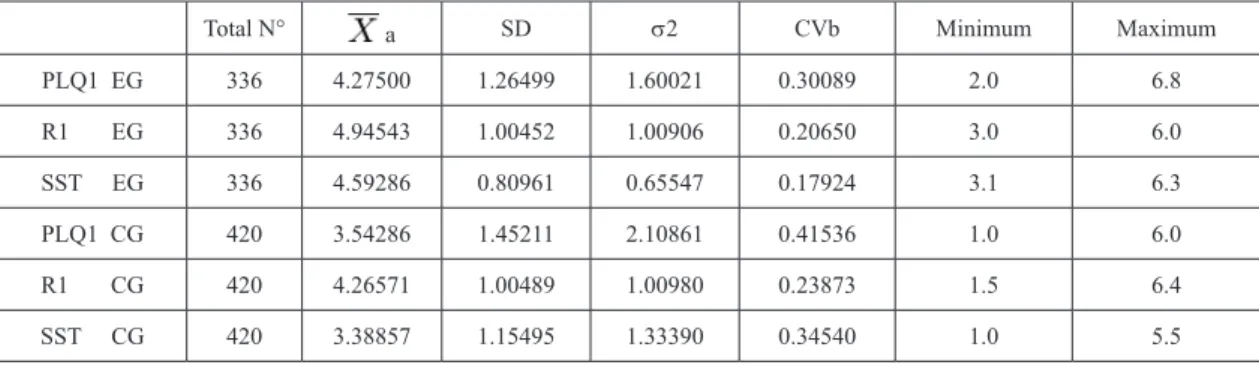
Table 1, shows a summary of the descriptive statistics for the group study, including the total number of data entries (N total), arithmetic mean, standard deviation, variance, coefficient of variation, minimum and maximum. The abbreviations for the evaluations are PLQ 1, Experimental Group (EG) (pre-laboratory quiz), R1 (EG) (report 1) and SST (EG) (test,) and the abbreviations for the evaluations are PLQ 1 Control Group, (CG) (pre-laboratory quiz), R1 (CG) (report 1) and SST (CG) (test).
Table 1: Statistical Data from Studies: First semester 2014.
Total N° a SD s2 CVb Minimum Maximum
PLQ1 EG 336 4.27500 1.26499 1.60021 0.30089 2.0 6.8
R1 EG 336 4.94543 1.00452 1.00906 0.20650 3.0 6.0
SST EG 336 4.59286 0.80961 0.65547 0.17924 3.1 6.3
PLQ1 CG 420 3.54286 1.45211 2.10861 0.41536 1.0 6.0
R1 CG 420 4.26571 1.00489 1.00980 0.23873 1.5 6.4
SST CG 420 3.38857 1.15495 1.33390 0.34540 1.0 5.5
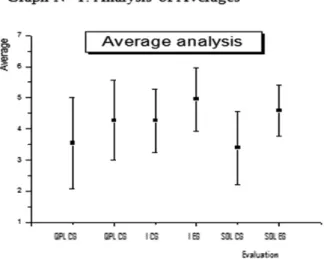
Graph 1: The graph below shows the averages and their respective standard deviations calculated for each evaluation per study group.
Graph N°1 Analysis of Averages between CG and EG for Quiz 1 and the Test 1.
The graph shows the averages and their respective standard deviations and increase in the averages for each evaluation, comparing the CG with the EG, for Quiz 1 and the Test 1.
In order to verify the proposed hypothesis the t-Student statistic was used (i.e. comparison of means).
The Null Hypothesis is H0: µ1 = µ2 - The Alternative Hypothesis is H1: µ1< µ2.
H0: The use of CM and practical laboratory activities as pedagogical strategies does not allow students to attain sustainable learning in terms of academic performance.
H1: The use of CM and practical laboratory activities as pedagogical strategies allows students to attain sustainable learning in terms of academic performance.
The tables below contain a summary of the calculations of mean comparisons (t-Student) for each evaluation, in the following order: PL Q (pre-laboratory quiz), R (report 1) and SST (Test):
Table 2: Statistical Data and t-Student for Pre-Laboratory Quiz EG and CG.
Total N° a SD SEM
PLQ 1 EG 336 4.275 1.26499 0.06901
PLQ 1 CG 420 3.54286 1.45211 0.07086
Difference 0.73214
t - student DF Prob>│t│
Variance Equality assumed 7.29013 754 7.8363×10⁻¹³
Variance Equality not assumed 7.40217 748.51937 3.61046×10⁻¹³
aArithmetic Mean
Null hypothesis: difference 1 – difference 2 = 0. Alternative hypothesis: difference 1 – difference 2 < > 0.
At the level of 0.05, the difference in the population means is significantly different from the test difference, and confidence level 95%, the lowest level 0.53499 and the upper limit 0.9293.
Table 3: Descriptive statistics and t-Student for the Laboratory Report.
Total N° a SD SEM
R 1 EG 336 4.94643 1.00452 0.0548
R 1 CG 420 4.26571 1.00489 0.04903
Difference 0.68071
t - student DF Prob> │t│
Variance Equality assumed 9.25659 754 2.14299×10⁻¹⁹
Variance Equality not assumed 9.25697 718,11344 2.37866×10⁻¹⁹
aArithmetic Mean
Null hypothesis: difference 1 – difference 2 = 0. Alternative hypothesis: difference 1 – difference 2 < > 0
At the level of 0.05, the difference in the population means is significantly different from the test difference and confidence intervals for the mean are confidence level 95%; lowest level 0.53635 and upper limit 0.82508
Table 4: Statistical Data and t-Student for Tests.
Total N° a SD SEM
SOL EG 336 4.59286 0.80961 0.04417
SOL CG 420 3.38857 1.15495 0.05636
Difference 1.20429
t - student Df** Prob> │t│
Variance Equality assumed 16.19283 754 7.803×10-51
Variance Equality not assumed 16.8193 741.77735 5.07789×10-54
The critical value for 754 degrees of freedom: tα; υ = t 0.95; 754= 1.645 (single tail test and 95% confidence). The results obtained per evaluations are Pre-Lab. Quiz t 7.29013, Report 1 T = 9.25659 and Test t = 16.19283.
Since the value of t in all cases is higher than the critical value (tα; υ= t 0.95; 754= 1.645), the results obtained are highly significant to rejecting the null hypothesis (H0).
Therefore, the use of ZPD and CM and practical laboratory activities as pedagogical strategies allows students to attain sustainable learning in terms of academic performance.
Survey 2: Learning tool.
The table below shows the data obtained from survey 2 on the use of Conceptual Maps and other techniques as learning tools:
Table 5: Question 1 & 2 Results.
Q 1: How or in what way do you study? Select your learning methods. Q 2: Of the methods you use, which is best for learning or which generates the best results?
Answers StudentsNº of % StudentsNº of %
Reading and memorizing 96 28.6 Discussing material with peers 120 35.7
Reading and making summaries 96 28.6 Problem solving under lab teacher guidance. 72 21.4
Studying and discussing with peers 24 7.1 Making summaries 48 14.3
Making conceptual maps 120 35.7 Making conceptual maps 96 28.6
Memorizing through use of images 0 0 Making drawings 0 0
Analysis of survey 2 shows that 57.2% of students surveyed say that their learning methods include reading, 28.6% complement this with memorizing and another 28.6% make summaries. After the study, 57.1% of students learn using of discussing material with peers and problem solving under teacher lab guidance, (ZPD) and 28.6 % they use the technique CM.
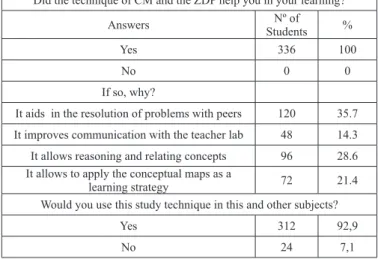
Table 6: Question 3.
Did the technique of CM and the ZDP help you in your learning?
Answers StudentsNº of %
Yes 336 100
No 0 0
If so, why?
It aids in the resolution of problems with peers 120 35.7
It improves communication with the teacher lab 48 14.3
It allows reasoning and relating concepts 96 28.6
It allows to apply the conceptual maps as a
learning strategy 72 21.4
Would you use this study technique in this and other subjects?
Yes 312 92,9
No 24 7,1
35.7% of the students surveyed said that solving problems with peer support increased learning of concepts studied and also it improves the communication with the lab teacher (14.3%), and 50% of students shows the use of the strategy of the CM on the studied content learning is useful.
The entire group of students indicated that the technique helped them improve their learning, which is in line with the improved academic performance attained by this group. Finally, 93% of students would be willing to use the technique to study this and other subjects.
5. CONCLUSIONS
This report shows the application of the ZPD and the use of CM in experimental activities in the learning of chemistry concepts, which are commonly regarded as difficult by students attempting to achieve sustainable learning over time.
The application of these strategies significantly helped in the learning of contents on pH and solutions. It also allowed students to participate in their own learning with their peers. All this promoted dialogue, creativity, feedback and self-correction and research study habits, thus strengthening tolerance and the ability for interact with peers and teachers of the lab. The lab teacher monitoring the practical activities and interacted with each of students, so they gradually became accustomed to the presence of the teacher as just another member of the group rather than a controlling outsider. This means that over time, the teacher is seen as an advisor and another peer, a situation that promotes
dialogue in the teaching and learning process, which is very productive and quickly leads to the development of the ZPD.
The socialization arising between the group members facilitated cooperative work as it allowed students to interact in a friendly manner, contributing ideas and opinions and helping each other through their shared knowledge and abilities. Again interaction among peers is sought as part of the teaching and learning process in order to facilitate development of the ZPD.
The fact that the work groups successfully performed the activities shows that social interaction, critical thinking and communication aided in the learning of the concepts of solutions and pH. Understanding of these concepts was favoured by work groups but also by practical and creative design, creation and application both in completing theoretical exercises and in performing practical laboratory activities.
CM were used as a general overview of the subject to be studied in class, specifying the different conceptual levels associated to the topic, thus helping students recognize those concepts relevant for learning the new material. They are also helpful to 1) identify misconceptions that may impede understanding of other theories or concepts 9, 11, 2) to establish the way students associate relevant concepts with other concepts, and 3) to help in the design of teaching strategies to correct any erroneous conceptions, thus facilitating learning which would otherwise be impossible to achieve 48.
The elaboration of CM also allowed observing the change in students’ cognitive structures 37, which can in turn be used to evaluate both the learning and the effect of the teaching. This tool can also be used as part of tests, as a marker for scoring or assigning a grade 9, 49, 50.
The use of corrected CM is also important for the students as it shows that the effort involved in meaningful learning is rewarded. Additionally, it trains them to participate and comprehend the subject matter. The process of building these maps requires for the person to relate new information with their prior knowledge. The possible associations between concepts depend on the person’s grasp of the knowledge, information and/or material to be learned. The process also helps thinking and learning, and as such a conceptual map is not a closed diagram, but rather a visualization of a certain moment in the learning process.
This tool cannot be created by using only memory-based learning strategies, and as such it helps stimulating attitudes and techniques for meaningful and sustainable learning.
The elaboration of CM through group work is a good way to promote participation and group dynamics; it can also be used to negotiate meanings between the teacher and the student, as well as among students 37, 43, 50.
Finally, the majority of students are willing to apply the technique when studying this and other subjects, which may be due to the characteristics of the strategy and the good performance obtained by the students during this study. Therefore, ZPD, the use of CM and practical laboratory activities as pedagogical tools allow students to attain sustainable learning.
apply new pedagogical strategies, so that their students improve their learning by working with tools such as ZPD, the use of CM and practical laboratory activities.
REFERENCES
1. L. Bello, Educ. Qca. 11, 374, (2000).
2. J. M. Campanario, A. Moya, Enseñanza de las Ciencias. 17, 179, (1999) 3. L. Vigotsky, El desarrollo de los procesos psicológicos superiores, Critica,
México, D.F., 1988.
4. H. Arias, L. Lazo, F. Cañas, J. Chil. Chem. Soc.59,4, (2014)
5. D. Newman, P. Griffin, M. Cole, La zona de Construcción del Conocimiento, Morata, Madrid, 1991.
6. J. Wertsch. ICHD and LCHC Quarterly Newsletters. 14, 35-44, (1992) 7. J. Valsiner, Culture and the Development of Children’s Action. A Theory
of Human Development, John Wiley & Sons, New York, 1997. 8. I. Ivic, L. Vygotski. Perspectivas: Revista trimestral de educación
comparada. 24, 773-799, (1994)
9. J. D. Novak, y B. Gowin, Aprendiendo a aprender, Martínez Roca, Barcelona, 1988.
10. L. Poggioli, Estrategias de aprendizaje, Una perspectiva teórica, Fundación Polar, Venezuela, 2005.
11. O. D´Angelo, Autonomía integradora y transformación social, el desafío ético emancipatorio de la complejidad, Publicaciones Acuario, La Habana, 2005.
12. N. Obozov, Los procesos y funciones psíquicas en condiciones de actividad individual y conjunta. En Bello Z, compiladora. Psicología general, Editorial Félix Varela, La Habana, 2007; pp. 62-75.
13. A. Labarrere, M. Quintanilla, La solución de problemas científicos en el aula: Reflexiones desde los planos de análisis y desarrollo, Pensamiento Educativo, Santiago, 2002.
14. M. Cole, Psicologia & Cultura, Morata, Madrid, 1996.
15. A. Labarrere, ¿Alumno o Profesional en Formación?: Implicancia de un dilema para la Formación Magistral, Colecciones CIAPRO, La Habana, 1997; 4, pp. 9-25.
16. A. Labarrere, Interacción en ZDP: ¿Qué puede ocurrir para bien y qué
para mal? Congreso ICCP-ARGOS, Ciudad de la Habana, 1997a.
17. A. Labarrere, M. Quintanilla, La solución de problemas científicos en el aula, Reflexiones desde los planos de análisis y desarrollo, Pensamiento Educativo, Santiago de Chile, 2002; 30, pp. 121-138.
18. C. Coll, & I. Solé, La interacción profesor-alumno en el proceso de enseñanza -Aprendizaje, Desarrollo psicológico y educación, Psicología de la Educación, Alianza, Madrid, 1990; 2, pp. 315-335.
19. M. Green, J.A. Piel, Theories of human development, A comparative approach.2/E. Pearson, Boston, 2009.
20. A. González, A. Rodríguez, D. Hernández, Educ Med Super. 25, 4, (2011) 21. A. Perinat, Psychool. Av. Discip, 5, 2, (2011)
22. A. Aguilera, Introducción a las dificultades del Aprendizaje, McGraw Hill/Interamericana, Madrid, 2005.
23. S. García, and E .Wolfenzon, El aprendizaje Cooperativo, Ventajas en la Educación. 2000. Retrieved from http://www.trener.edu.pe/files/ APRENDIZAJE%20COOPERATIVO.pdf. Accessed Oct. 2013. 24. L. R. Galagovsky, Del aprendizaje significativo al aprendizaje sustentable,
Parte 1: Derivaciones Didácticas, 2004; 22(2), pp. 229-240.
25. L. R. Galagovsky, Hacia un mejor aprendizaje, Claves en psicoanálisis y medicina, Troquel, Buenos Aires, 1993a.
26. L. R. Galagovsky, Hacia un nuevo rol docente, Una propuesta diferente para el t rabajo en el aula, Troquel, Buenos Aires, 1993b.
27. L. R. Galagovsky, Redes conceptuales, memoria, comunicación y aprendizaje, Troquel, Buenos Aires, 1999.
28. M. A. Moreira, Aprendizaje Significativo, Un concepto subyacente, Actas del Encuentro Internacional sobre Aprendizaje Significativo, Universidad de Burgos, España, 1997; pp. 17-45.
29. M. A. Moreira, Aprendizaje Significativo, teoría y práctica, Visor, Madrid, 2000a.
30. M. A. Moreira, I. Ma Greca, Cambio Conceptual, análisis crítico y propuestas a la l luz de la Teoría del Aprendizaje Significativo, Ciencia & Educación, 2003; 9 (2), pp. 301-315.
31. N. Boggino, Cómo elaborar mapas conceptuales, Aprendizaje significativo y globalizado, Homo Sapiens, Buenos Aires, 2002.
32. F.M. González, Los Mapas conceptuales como instrumento para la
33. D.P. Ausubel, Adquisición y retención del conocimiento, Una perspectiva cognitiva, Paidós, Barcelona, 2002.
34. G. Nicoll, J.S. Francisco, M. Nakhleh, J. Chem. Educ. 78(8), (2001) 35. R.E. Mayer, Psicología de la educación, Enseñar para un aprendizaje
significativo, Pearson, Madrid, 2004.
36. J. D. Novak, D. A. Musonda, American Educational Research Journal. 28 (1), (1991)
37. J. D. Novak, Conocimiento y aprendizaje, Los mapas conceptuales como herramientas facilitadoras para escuelas y empresas, Alianza, Madrid, 1998.
38. M. F. Aguilar, El mapa conceptual una herramienta para aprender y enseñar, Proceedings of the Second International Conference on Concept Mapping, Universidad de Costa Rica, San José, 2006; pp 62-72. 39. P. Kommers, y J. Lanzing, Mapas conceptuales para el diseño de sistemas
hipermedia, Navegación por la Web y autoevaluación. En: C. Vizcarro y J. A. León (Eds.), Nuevas tecnologías para el aprendizaje, Pirámide, Madrid, 1998.
40. A. Onrubia, Mapas conceptuales, una técnica para aprender, Paidós, Barcelona, 1991.
41. F. Cañas, C. Cárcamo, L. Lazo, Quim. Nova, 37, 2, (2014)
42. R. Pérez, y G. A. Rómulo, Corrientes constructivistas y mapas conceptuales, Magisterio, Bogotá, 1991.
43. P. Pichardo, Didáctica de los mapas conceptuales, Jertalhum, México D.F., 1999.
44. R. Hernandez, C. Fernández, P. Baptista, Metodología de la Investigación, McGraw Hill, México D.F., 1997.
45. T. Brown, E. Lemay, B. Bursten, Química, La Ciencia Central, Pearson, Madrid, 2004.
46. R. Chang, Química, Mc Graw Hill, Interamericana, México D.F., 2007. 47. K. Whitten, R. Davis, y M. Peck, Química General, McGraw-Hill, S.A,
México D.F., 1998.
48. K. M. Fisher, D. Moody, Student misconceptions in biology, In K. M. Fisher, J. H. Wandersee, & D. Moody (Eds.), Mapping biology knowledge, Kluwer, Dordrecht, 2000.
49. K. Edmondson, Assessing science understanding through concept maps, In J. Mintzes, J. Wandersee & J. Novak (Eds.), Assessing science understanding. Academic Press, San Diego, 2000.