PENÍNSULA OF SANTA ELENA STATE UNIVERSITY FACULTY OF SCIENCES OF EDUCATION AND LANGUAGES
ENGLISH LANGUAGE TEACHING CAREER
TOPIC:
“DIDACTIC GRAPHIC TECHNIQUES TO ENHANCE READING COMPREHENSION IN STUDENTS OF EIGHTH GRADE AT UNIDAD EDUCATIVA “JORGE BAREK”, LA LIBERTAD, SANTA ELENA PROVINCE, 2016-2017”
RESEARCH PAPER
AS A PREREQUISITE TO OBTAIN A: BACHELOR’ S DEGREE IN ENGLISH
AUTHOR:
ZOILA STEFANÍA RIVERA LACA
ADVISOR:
LCDO. BYRON VILLACRESES SANTILLÁN, MBA.
UNIVERSIDAD ESTATAL PENÍNSULA DE SANTA ELENA FACULTAD DE CIENCIAS DE LA EDUCACIÓN E IDIOMAS
CARRERA DE LICENCIATURA EN INGLÉS
TEMA:
“DIDACTIC GRAPHIC TECHNIQUES TO ENHANCE READING COMPREHENSION IN STUDENTS OF EIGHTH GRADE AT UNIDAD EDUCATIVA “JORGE BAREK”, LA LIBERTAD, SANTA ELENA PROVINCE, 2016-2017”
TRABAJO DE TITULACIÓN
Como un pre-Requisito para obtener el título de: LICENCIADA EN INGLÉS
AUTOR:
ZOILA STEFANIA RIVERA LACA
TUTORA:
LCDO. BYRON VILLACRESES SANTILLÁN, MBA.
PENÍNSULA OF SANTA ELENA STATE UNIVERSITY FACULTY OF SCIENCES OF EDUCATION AND LANGUAGES
ENGLISH LANGUAGE TEACHING CAREER
TOPIC:
“DIDACTIC GRAPHIC TECHNIQUES TO ENHANCE READING COMPREHENSION IN STUDENTS OF EIGHTH GRADE AT UNIDAD EDUCATIVA “JORGE BAREK”, LA LIBERTAD, SANTA ELENA PROVINCE, 2016-2017”
RESEARCH PAPER
AS A PREREQUISITE TO OBTAIN A: BACHELOR’ S DEGREE IN ENGLISH
AUTHOR:
ZOILA STEFANÍA RIVERA LACA
ADVISOR:
LCDO, BYRON VILLACRESES SANTILLÁN, MBA.
LA LIBERTAD – ECUADOR
vi DEDICATION
This thesis work is dedicated with much love and gratitude to those people who have been a guide and the main source of support and motivation to me during my entire personal and academic life; to my parents Saby Laca, Guillermo Rivera, Angel Rosales and to my grandparents Enrique Laca and Norma Guale. Moreover, this work is also dedicated to other important relatives; my sister Andrea, my brother Sahid, and my two uncles and to my aunt.
vii ACKNOWLEDGMENT
I wish to express my eternal gratitude to many special people who have been part of the development of this work. First and foremost, I have to thank God for guiding my steps and becoming my dreams in real experiences. I also have to express my gratitude to my dear parents because they have modeled a person with ethical and moral values that I am right now, without their support and encouragement I could have never achieved this academic goal and I would like to extend my especial recognition to a special friend José Carvajal who has always been there when I needed him the most.
I would like to sincerely thank to my thesis advisor, Lcdo Byron Villacreses Santillán MBA, for his support and motivation throughout the development of this project work and especially for his guidance and confidence.
Additionally, I have to thank Península of Santa Elena State University, to the Director of the English Language Teaching Career, MSc. Glenda Pinoargote, and to the professors from the Language school; they are definitely the responsible of forming the new English language teaching professionals. Thank you very much for sharing your worthwhile knowledge.
ix TABLE OF CONTENTS
ADVISOR’ S APPROVAL ... iii
STATEMENT OF AUTHORSHIP... iv
BOARD OF EXAMINERS ... v
DEDICATION ... vi
ACKNOWLEDGMENT ... vii
DECLARATION ... viii
TABLE OF CONTENTS ... ix
CHARTS PAGE... xiii
GRAPHICS PAGE... xiv
ILLUSTRATIONS PAGE ... xiv
APPENDIXES PAGE ... xv
ABSTRACT ... xvii
INTRODUCTION... 1
CHAPTER I ... 3
THE PROBLEM ... 3
1.1 Title ... 3
1.2 Statement of the Problem ... 3
1.3 Contextualization of the Problem... 5
1.4 Research questions ... 8
1.5 Significance ... 8
1.6 Research objective ... 9
1.7 Idea to defend ... 9
CHAPTER II ... 11
THEORETICAL FRAMEWORK ... 11
2.1 Previous research ... 11
2.1.1 How children learn reading ... 11
2.1.2 National Reading Panel ... 11
2.1.3 Reciprocal teaching strategy... 12
x
2.1.5 How to teach reading ... 13
2.1.6 Children’s reading motivation ... 14
2.1.7 English language teaching in Ecuador ... 15
2.2 Philosophical basis ... 18
2.2.1 Discovery learning theory ... 18
2.2.2 Meaningful learning ... 18
2.2.3 Zone of proximal development ... 19
2.2.4 Subsumption theory ... 19
2.2.5 Dual coding theory ... 20
2.3 Pedagogical basis ... 20
2.3.1 Constructivist approach ... 20
2.4 Fundamental categories ... 21
2.4.1 Reading ... 21
2.4.2 Importance of reading... 21
2.4.3 Types of reading ... 21
2.4.4 Reading comprehension ... 22
2.4.5 Graphic organizers... 23
2.4.6 Importance of using graphic organizers ... 23
2.4.7 Classification of graphic organizers ... 23
2.5 Legal basis ... 24
2.6 Hypothesis ... 25
2.7 Variables of study ... 25
CHAPTER III... 26
METHODOLOGY ... 26
3.1 Research design ... 26
3.1.1 Qualitative Method ... 27
3.2 Population and Sample ... 27
3.2.1 Population ... 27
3.2.2 Sample ... 28
3.3 Data collection ... 28
xi
3.3.1.1 Survey ... 28
3.3.1.2 Interview ... 29
3.3.1.3 Observation ... 29
3.3.2 Research tools ... 30
3.3.2.1 Questionnaires ... 30
3.3.2.2 Observation guides ... 30
3.3.2.3 Camera ... 31
3.4 Data analysis ... 31
3.4.1 Interview to English language experts ... 31
3.4.2 Interview to the principal of Unidad Educativa “Jorge Barek” ... 37
3.4.3 Interview to English teacher of Unidad Educativa “Jorge Barek” ... 39
3.4.4 Survey directed to eighth grade students ... 42
3.4.5 Results from the observation sessions ... 48
3.5 Results and discussion... 50
CHAPTER IV ... 52
THE PROPOSAL... 52
4.1 Title of the proposal ... 52
4.2 Description of the Proposal ... 52
4.2.1 Beneficiaries ... 53
4.2.2 Location ... 53
4.2.3 Estimated time for execution ... 53
4.2.4 Technical team responsible ... 53
4.2.5 Proposal Background... 54
4.2.6 Significance ... 54
4.3 Design and development of the proposal ... 56
4.3.1 Implementation of a booklet ... 59
4.3.2 Introduction to the booklet ... 60
4.3.3 Types of graphic organizers implemented in the proposal ... 61
4.3.4 Content of the booklet ... 65
4.3.5 Activities of the booklet ... 67
xii
Activity Nº 2: Places in the city ... 69
Activity Nº 3: Animals ... 71
Activity Nº 4: Adjectives of description ... 73
Activity Nº 5: Parts of the House ... 76
Activity Nº 6: Daily Routine ... 79
Activity Nº 7: Food and Vegetables ... 82
Activity Nº 8: Countries and Nationalities ... 85
Activity Nº 9: Can and Cannot/Can’t ... 88
Activity Nº 10: Sports ... 91
Activity Nº 11: Connectors ... 94
Activity Nº 12: Simple Past Tense ... 97
Activity Nº 13: Comparative Adjectives ... 100
Activity Nº 14: Simple Present Tense practice ... 103
Activity Nº 15: Simple Future Tense ... 106
4.4 Achievements and expected results ... 109
4.4.1 Results from proposal activities ... 109
4.4.2 Results from the Diagnostic and Final Test ... 110
4.5 Conclusions and Recommendations ... 111
4.5.1 Conclusions ... 111
4.5.2 Recommendations ... 112
4.6 Timetable... 113
4.7 Resources ... 114
4.8 References ... 115
xiii CHARTS PAGE
Chart Nº 1: Population Description ... 28
Chart Nº 2: Information of the first interviewed specialist ... 31
Chart Nº 3: Information of the second interviewed specialist ... 34
Chart Nº 4: Principal information ... 37
Chart Nº 5: English teacher's information ... 39
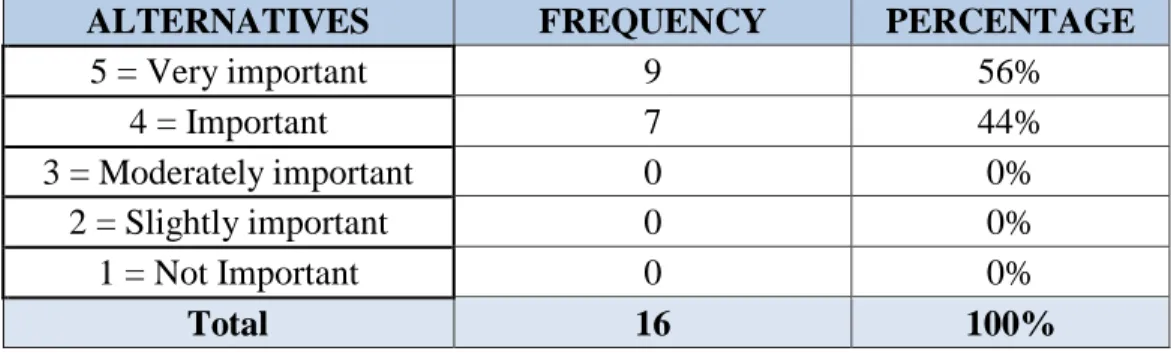
Chart Nº 6: Importance of reading comprehension skill ... 42
Chart Nº 7: Reading comprehension level of students ... 43
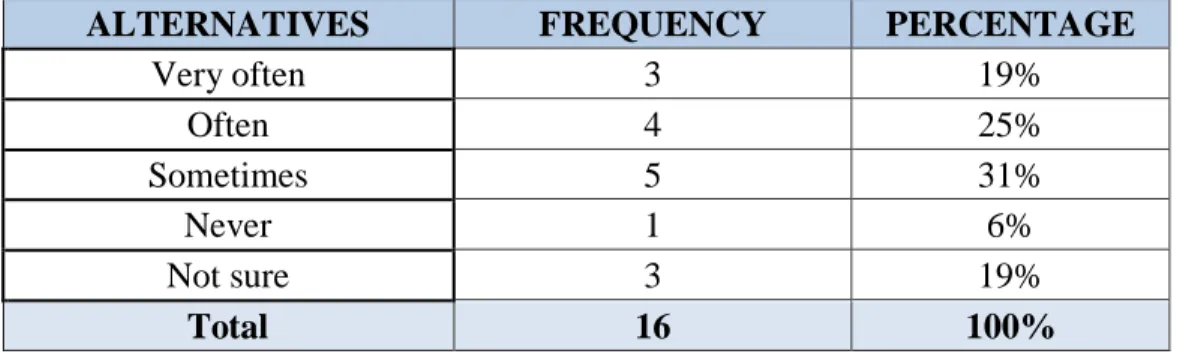
Chart Nº 8: Students’ reading frequency... 44
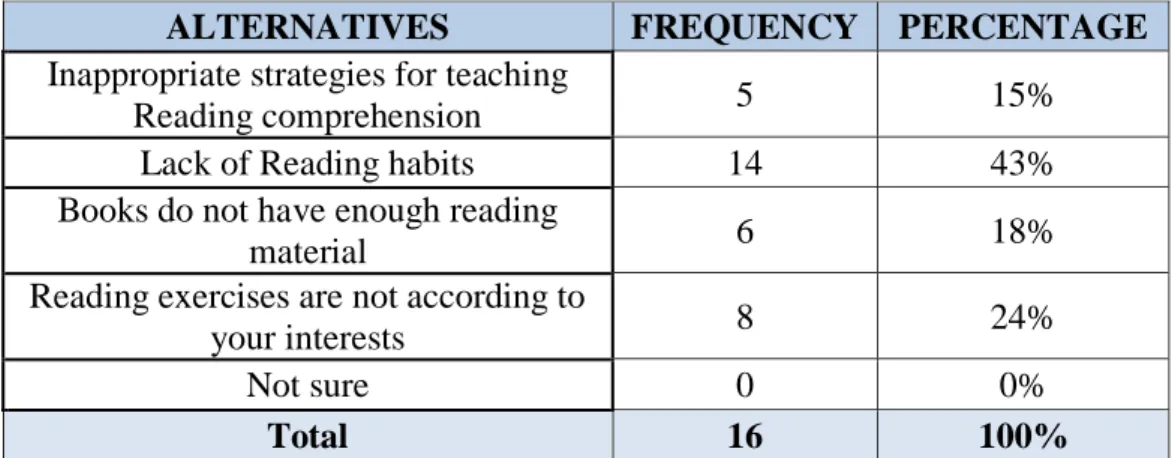
Chart Nº 9: Factors that affect the students’ reading comprehension ... 45
Chart Nº 10: Strategies application for reading comprehension ... 46
Chart Nº 11: Strategies for improving reading comprehension ... 47
Chart Nº 12: First observation session ... 48
Chart Nº 13: Second observation session ... 49
Chart Nº 14: Content of the booklet ... 65
Chart Nº 15: Square options organizer about occupations ... 68
Chart Nº 16: Square options organizer about places in the city ... 70
Chart Nº 17: Square options organizer about animals ... 72
Chart Nº 18: Analogy organizer about adjectives of description ... 75
Chart Nº 19: Descriptive organizer about parts of the house ... 78
Chart Nº 20: Sequence and descriptive organizer about daily routine ... 81
Chart Nº 21: Descriptive organizer about fruits and vegetables ... 84
Chart Nº 22: Analogy organizer about touristic places ... 87
Chart Nº 23: Descriptive organizer about innovative ovens ... 90
Chart Nº 24: Descriptive organizer about extreme sports ... 93
Chart Nº 25: Sequence and descriptive organizer-ceviche preparation ... 96
Chart Nº 26: Comparative and contrastive organizer-cultures in Santa Elena ... 99
Chart Nº 27: Comparative and contrastive organizer about beaches ... 102
Chart Nº 28: Analogy organizer about the Decease day ... 105
xiv
Chart Nº 30: Results from proposal activities ... 109
Chart Nº 31: Results of Diagnostic and Final Test ... 110
Chart Nº 32: Timetable ... 113
GRAPHICS PAGE Graphic Nº 1: Importance of reading comprehension skill ... 42
Graphic Nº 2: Reading comprehension level of students ... 43
Graphic Nº 3: Students’ reading frequency... 44
Graphic Nº 4: Factors that affect the students’ reading comprehension ... 45
Graphic Nº 5: Strategies application for reading comprehension ... 46
Graphic Nº 6: Strategies for improving reading comprehension ... 47
Graphic Nº 7: Students' improvement ... 111
ILLUSTRATIONS PAGE Illustration Nº 1: Problem Tree Analysis ... 6
Illustration Nº 2: Plan of Research Design... 26
Illustration Nº 3: Unidad Educativa "Jorge Barek" ... 52
Illustration Nº 4: Location of Unidad Educativa "Jorge Barek" ... 53
Illustration Nº 5: Graphic organizers and their benefits ... 56
Illustration Nº 6: Example of a Square options diagram ... 61
Illustration Nº 7: Example of a Descriptive organizer ... 62
Illustration Nº 8: Example of a Sequence organizer ... 62
Illustration Nº 9: Example of an analogy organizer ... 63
Illustration Nº 10: Example of Comparative and contrastive organizer ... 64
Illustration Nº 11: Example of a story map ... 64
Illustration Nº 12: Activity about occupations ... 67
Illustration Nº 13: Activity about places in the city ... 69
Illustration Nº 14: Activity about animals... 71
Illustration Nº 15: Activity about adjectives of description ... 73
xv
Illustration Nº 17: Activity about daily routines ... 79
Illustration Nº 18: Activity about food (fruits, vegetables, and others) ... 82
Illustration Nº 19: Activity about touristic places ... 85
Illustration Nº 20: Activity about innovative ovens ... 88
Illustration Nº 21: Activity about occupations ... 91
Illustration Nº 22: Activity using connectors ... 94
Illustration Nº 23: Activity about Simple Past Tense ... 97
Illustration Nº 24: Activity about comparative adjectives ... 100
Illustration Nº 25: Activity about Simple Present ... 103
Illustration Nº 26: Activity about occupations ... 106
APPENDIXES PAGE Appendix Nº 1: Students’ survey ... 119
Appendix Nº 2: Interview to English teacher ... 121
Appendix Nº 3: Interview to the principal ... 122
Appendix Nº 4: Interview to English language experts ... 123
Appendix Nº 5: Observation guide ... 124
Appendix Nº 6: Rubrics for evaluating students ... 125
Appendix Nº 7: Diagnostic Test... 126
Appendix Nº 8: Final Test ... 128
Appendix Nº 9: Legal articles ... 130
Appendix Nº 10: List of students’ names... 132
Appendix Nº 11: Students of eighth grade ... 133
Appendix Nº 12: Interview with the English teacher ... 133
Appendix Nº 13: Interview with the principal ... 134
Appendix Nº 14: Interview with the first English language expert ... 134
Appendix Nº 15: Interview with the second English language expert ... 135
Appendix Nº 16: Students during the survey ... 135
Appendix Nº 17: Students during the pre test ... 136
xvi
Appendix Nº 19: Students participating in class ... 137
Appendix Nº 20: The investigator during the proposal implementation ... 137
Appendix Nº 21: The investigator giving instructions to students ... 138
Appendix Nº 22: The investigator working with students ... 138
Appendix Nº 23: Acceptance letter from the educational institution ... 139
Appendix Nº 24: Implementation of the proposal certificate ... 140
Appendix Nº 25: Urkund certificate... 141
xvii PENÍNSULA OF SANTA ELENA STATE UNIVERSITY
FACULTY OF SCIENCES OF EDUCATION AND LANGUAGES ENGLISH LANGUAGE TEACHING CAREER
TOPIC:
“DIDACTIC GRAPHIC TECHNIQUES TO ENHANCE READING COMPREHENSION IN STUDENTS OF EIGHTH GRADE AT UNIDAD EDUCATIVA “JORGE BAREK”, LA LIBERTAD, SANTA ELENA PROVINCE, 2016-2017”
Author: Zoila Stefanía Rivera Laca Advisor: Lcdo. Byron Villacreses Santillán, MBA.
ABSTRACT
Reading comprehension is quite important in the development of language learning acquisition because it is the basis of the interpretation, regardless of its extension, this skill is applied not only at the moment of reading but also when students need to study and incorporate new knowledge, being an exercise that people perform even in a constant and automated way. Graphic organizers are useful strategies for students because not only include words but also visual images becoming very effective for students. “Didactic Graphic Organizers to Enhance Reading Comprehension Skills in Students of Eight Grade at Unidad Educativa “Jorge Barek”, La Libertad, Santa Elena Province, 2016-2017” has the purpose of helping teachers through several readings with didactic graphic organizers in order to include them in their everyday classes; In addition, this research is intended to demonstrate that teachers also have the needed imagination to design readings able to help students in the improvement of this necessary skill which is reading comprehension.
The methodology applied in the present work was through surveys directed to students in order to gather the necessary data, it was also important to interview specialist professors from YACHAY University of Experimental Technological Researchand from a professor of Casa Grande University, in order to get information that may help to this research.
1 INTRODUCTION
Common instructional practices can create barriers to engage reading and comprehension development in adolescents. In today’s society reading comprehension ability should be an important skill to develop because in this globalized world people must be able to think and make decisions using reasoning. Nowadays, Education demands the use of new techniques, methods and strategies which contribute students to develop their reading comprehension skill; this research paper is focused on the importance of reading comprehension and the use of different strategies which are helpful for teachers in order to reach the enhancement of it.
Reading comprehension has become an oppressive, annoying and boring task for students, nowadays. For this reason, teachers have to innovate strategies in order to introduce students to the world of reading in an enjoyable way. The adequate application of methodological strategies will support students to have a good level of reading which is needed for becoming literate.
The elaboration of this investigation was divided into five chapters which are mentioned and described below:
Chapter I-The Problem: this chapter provides details about the statement of the problem, the critical analysis, the significance of the problem, general and specific objectives of the investigation.
Chapter II-Theoretical Framework: this chapter describes all the theories of important authors and previous researches that support the investigation topic. It also gives details about the philosophical, psychological and legal basis of this work, and the research hypothesis.
2 level of research, population, techniques and instruments used to gather relevant information about the investigated topic, data collection with the respective analysis and interpretation, conclusions and recommendations.
Chapter IV-The Proposal: this chapter describes the solution for the problem and it analyses the outcomes of this investigative work.
3 CHAPTER I
THE PROBLEM
1.1 Title
“DIDACTIC GRAPHIC TECHNIQUES TO ENHANCE READING COMPREHENSION IN STUDENTS OF EIGHTH GRADE AT UNIDAD EDUCATIVA “JORGE BAREK”, LA LIBERTAD, SANTA ELENA PROVINCE, 2016-2017”.
1.2 Statement of the Problem
English is a universal language and nowadays due to the globalization it is practically mandatory to learn it in many countries since it is important to establish relationships with people around the world whether for businesses, studies or science. English has become quite important for people’s life but in order to succeed the person should develop the four main skills: listening, speaking, reading, and writing.
The traditional paradigm of Education has left abysmal consequences, which so far they have not been overcome, even nowadays when education is focused on students by applying active methodologies to reach a meaningful learning, this traditional model keeps influencing this is why students read without understand and as a result they can develop reading comprehension skill. Since people use comprehension skills every day either through conversations or reading written texts, the improvement of reading comprehension ability is an important problem for education in Ecuador.
4 a low level of English, and there are problems with the development of reading comprehension in Spanish and this will be even more difficult to improve in English. Moreover, according to The Centro Regional para el Fomento del libro en America Latina y el Caribe (CERLAC) and the Instituto Nacional de Estadísticas y Censos (INEC,) in a survey made in 2012, Ecuador is placed in the one of the last positions of those countries which do not have reading habits. It was reported that 27% of citizens do not have reading habits, 56.8% is not interested in reading and 31.7% do not have time to read.
Santa Elena is a rich in touristic places province. People from this province are in constant contact with English-speakers and that is why they need to have, at least, a little English knowledge. The authorities of education are improving the English teaching means; they want students to evolve the four English skills in order to put in practice what they learn. Reading is one of the four skills in the English language and most students have problems with it. Students do not have good habits of reading and due to this; they have serious problems at thinking critically and analytically.
Unidad Educativa “Jorge Barek” is an institution that has been focused on the
5 To conclude, the upgrading of reading comprehension in students of first year high school is the goal to achieve. The design of graphic organizers are useful strategies to keep learners engaged in their learning because these include both words and visual images thus, learners will feel stimulated to read for pleasure not for obligation. Obviously, they will practice and improve their reading comprehension skill through readings related to their ages and topics of real interest to adolescents.
1.3 Contextualization of the Problem
There are problems with the development of reading comprehension in Spanish and, therefore, it will be even more difficult to improve it in English. This problem could be because of diverse reasons. Students of tenth grade from Unidad Educativa “Jorge Barek” have faced serious problems in their English language acquisition.
6 Illustration Nº 1: Problem Tree Analysis
Author: Zoila Stefanía Rivera Laca
LOW PROFICIENCY OF READING COMPREHENSION IN STUDENTS OF EIGHTH GRADE AT UNIDAD EDUCATIVA “JORGE BAREK”
Students do not develop their reading comprehension
ability correctly
Students do not have reading habits Students do not understand what they are reading
Students read mechanically without understanding
Students get bored
Students do not comprehend meaning nor context of the
reading passages Students
get distracted
Students are not focused in the reading activity
Teachers apply inappropriate teaching methodologies
Lack of didactic materials for practicing reading comprehension
Students do not have enough knowledge of vocabulary and
grammar
Traditional methodologies
Readings from books are not interesting for students Difficulty to follow meaning of a sentence Very weak decoding ability with unfamiliar word Readings are not
related to their educational
7 As it was illustrated in the problem tree above, there are different reasons for the low proficiency that students have in their reading comprehension skill. The lack of reading materials in public and private schools, the absence of reading habits in families or, because some teachers still do not notice that reading is indeed one of the most important tools for knowledge development in education represents principal reasons for this problem.
The lack of resources for the practice and development of reading comprehension skill is a different reason for the problem. In some cases, readings from English textbooks are not related to students’ interests because topics are not interesting. Consequently, students do not have reading habits and during reading sessions carried out into the classroom they get distracted and bored and unfortunately, they do not focus on the activity and do not develop their critical and analytical thinking.
Additionally, students do not have a good knowledge of vocabulary and grammar. These two aspects are important at the moment of reading since they allow learners to comprehend the text in an easier way. The low vocabulary and grammar knowledge is the main reason for the misunderstanding of written sentences and students are not able to decode information. Therefore, students are not able to analyze and provide an analytical thinking.
It is important to mention that developing reading comprehension also involves the development of students’ critical ability which it is a tool that is not going to be
used only in the educational atmosphere but also along their lives. Unidad Educativa “Jorge Barek” is an institution which seeks not only that their students
acquire new knowledge, but also a critical thinking ability, that is why they are willing to implement new teaching techniques.
8 books do not have enough readings it is difficult to achieve this goal. Graphic organizers are interesting strategies, easy to understand and using standards of selection and prioritization they may be used for teaching students to think.
1.4 Research questions
What are graphic organizers?
How many types of graphic organizers are there?
What is the importance of improving reading?
Why is it necessary to develop reading habits?
What are the benefits of learning reading comprehension?
What activities can help to improve reading comprehension?
1.5 Significance
9 which for sure it will increase their enthusiasm for reading because it will include trendy topics. Learners at Unidad Educativa “Jorge Barek” will increment their desire of reading at any moment of their lives wherever they are. As a result of this, teachers and students will enjoy the classes due to the active participation making analysis and sharing ideas freely.
To finish, this paper is viable because of the approval and support of the main authorities at Unidad Educativa “Jorge Barek” and students of first year. Moreover, the investigator has the predisposition to work on this assignment having enough materials, resources and tools to accomplish with this task.
1.6 Research objective
To evaluate the influence of graphic organizers application focused on the enhancement of the reading comprehension skill of students of eighth grade from Unidad Educativa “Jorge Barek”
1.7 Idea to defend
The creation and application of graphic organizers as didactic and motivational resources will enhance the reading comprehension skill of students of eighth grade from Unidad Educativa “Jorge Barek”.
1.4.1 Specific tasks
To diagnose the significance of graphic organizers application during the
reading comprehension instruction and practice through the development of the theoretical framework based on diverse theories and investigations from different authors.
To analyze the data collected through the application of different sources of
10 To design and implement a booklet with graphic organizers for enhancing
11 CHAPTER II
THEORETICAL FRAMEWORK
2.1 Previous research
2.1.1 How children learn reading
Nation (2008) establishes that children are prepared for reading at an early age by listening to stories, being read to, and interacting with adults and others about the stories they hear. This is done not just with the objective of preparing a child for reading but as a way that parents and others interact with, show affection for, and entertain and educate children. The interaction involves asking questions about what is going to happen in the story, getting the kid to complete sentences in a known story, talking about the most interesting parts of the story.
When native-speaking children start to learn reading, they already have a vast vocabulary knowledge which includes most of the words they will meet in early reading. Moreover, they have a good control of grammar of the language, have knowledge of books and have had several stories read to them. English language learners often have problems at developing reading skill because of the lack of language knowledge. An essential part of this skill is the ability of being able to recognize written forms and to connect with their spoken forms and their meanings.
2.1.2 National Reading Panel
12 and fluently, and the ability to employ comprehension strategies deliberated when they read.
The National Reading Panel committee also emphasized that guided oral reading is an important item for developing reading fluency; this means learners must be able to read with efficiency and ease. The application of this strategy provides learners the opportunity to read out aloud, to parents, teacher, classmates, etc. who can check mistakes and provide feedback. On the other hand, the panel was unable to determine the efficiency of reading silently to upgrade reading skill. Reading silently to oneself would lead to fluency improvements, but the members of the panel did not make a final conclusion about the benefits of applying this strategy. However, there are several studies conducted on efficiency of silent independent reading and other instructional processes to fasten the fluency and the ability to read with property; the problem is that, these studies cannot differentiate if independent silent reading upgrade reading skill or that good readers just prefer to read to themselves more than poor readers.
2.1.3 Reciprocal teaching strategy
13 2.1.4 Reading engagement
Wide evidence indicates that when a teacher generates a good condition; it means a satisfactory environment, students get engaged and their level of reading comprehension increases successfully. Students are engaged readers when they read constantly for interest, enjoyment and learning. The center of engagement is the desire to obtain knew knowledge of a topic, to follow the excitement of a narrative to expand the experience through prints. Engaged readers can find books of personal relevance and make time for reading them. Furthermore, benefits to readers may occur through their satisfaction in possessing valued information about a topic that places a fundamental role in their own sense. Readers are curious and involve in a literate life style.
2.1.5 How to teach reading
Fry (2005) claims that there are six steps for teaching reading:
Step one: Determine the reading ability of students; recognizing student’s reading level is the first thing to determine, it is important to find out the material level a student can read successfully.
Step two: Select the appropriate material for the students to read; after the teacher has determined the reading level of students, he/she has to select or create reading material for the adequate level. The teacher can identify the adequate level for any story students can read.
Step three: Have students read aloud silently and comprehensively; after the teacher has found the students’ reading proficiency and matched it with the correct
14 be applied is rereading the same passage several times to upgrade fluency with each rereading.
Step four: Teach Vocabulary; in order to define the proper vocabulary and its order of presentation for teaching reading, much work has been done in the reading field. This is the strong point of most principal traditional series of reading texts; they start with few words in the first little book and increase the vocabulary load gradually. Teaching vocabulary represents an important aspect for improving reading. Students must recognize words from a text in order to understand it.
Step five: Develop phonic skills; a phonetic language means that letters and letter sounds have regular speech sounds. Phonic skills are a support to any student who is learning how to read. They are also helpful in spelling lessons and when using a dictionary. Fry (2005) agrees that phonics instruction should begin at kindergarten and some activities to practice it are; playing with letters, coloring them, mentioning their sounds and with phoneme awareness exercises like poems that make emphasis on various speech sounds.
Step six: Writing, Speaking, and Listening; in many cases teachers use to separate reading and writing into two different lessons. Now it is common to have both reading and writing as part of the same lesson. A strategy consists on encouraging students to write compositions of their own reading material, a story written by students can be a real creative outlet.
2.1.6 Children’s reading motivation
There are several principles that can help teachers to motivate students. According to Wigfield and Guthrie (2013)“motivation is stimulated for the reading environment in which students find themselves”. It means that tasks should not be
15 engage the student´s attention; at the same time, the class environment and classroom routine should always be changing. The use of rewards can also help teachers to motivate students.
Children´s motivation is crucial for reading engagement, the use of these practices can help students to develop self-confidence and become self-directed readers.
2.1.7 English language teaching in Ecuador
English Language Learning in Ecuador is no longer just a luxury for an elite class, but an essential right in education because speaking English language today has many advantages, both occupationally and academically. Since 1992 Ecuador is seeking "a substantial improvement and lasting of English language teaching at secondary level” as it is stated in the English Curriculum Reform.
According to the Ecuadorian Ministry of Education:
Taking into consideration the Common European Framework of Reference for Languages (CEFR) the following levels are established:
Toward the end of 9th year of Educación Básica General students should
acquire level A1.
Toward the end of 1st year Bachillerato students should acquire Level A2.
Toward the end At the end of 3rd year Bachillerato students should acquire
Level B1.
16 English learning is based on four skills: listening, speaking, writing and reading. All of these skills work together in order to succeed and acquire the language correctly. According to Israel and Duffy (2014),“reading is frequently thought as a combination of skills, from individual letters processing and their associated sounds, to word recognition to text-processing competencies”. It means that reading is extremely essential when students are learning English as a foreign language and the most important skill to master because it allows increasing their vocabulary, which is why educators should be able to encourage the learners to read because this way, language improvement and communicative skills will influence. In order to succeed, learners should practice reading textbooks, magazines, articles or journals in English because it allows to acquire new vocabulary and helps them to practice reading comprehension gathering the most important ideas from the text.
Most high schools inside the country have a low level of English, especially when referring to reading skills; students have a low English reading ability. This can be produced by many factors such as: the lack of reading resources, the deficiency of a strong reading culture, the lack of motivation or because some teachers do not have good strategies for teaching the subject. It seems that the biggest problem is that teachers are only focused on making students learn how to pronounce some basic words, and they can read a text. At this point, basically, what teachers do to evaluate students is to assign a page with a reading and the students only have to read, because of this there is a poor development of comprehensive reading.
17 One important form to develop reading comprehension in students is through graphic organizers because teenagers are more visuals. Teachers should take advantage of that and start teaching through the use of graphic organizers. Orlich, Harder, Callahan, Trevisan, and Brown (2012) state “teachers must use different teaching strategies, such as, graphic organizers because they help learners to understand the unconnected fragments of information. Graphic organizers provide visual structure for organizing and relating main ideas and concepts.” Little and
Akin-Little (2014) state that students will organize the information and make connections in order to understand the reading.
18 2.2 Philosophical basis
2.2.1 Discovery learning theory
Bruner (as cited in Legge & Harari, 2000) promotes Discovery learning showing that the principal point is that learners discover by themselves the correct structure of what they are going to learn. It is considered that learning is accomplished inductively, based on specific examples to reach generalizations that students must discover. Discovery learning encourages the increase and use of creative thinking skill, including feelings, dogmas and intentions of students.
According to Yount (2010), it is more possible that students remember concepts if they discover them, apply them to their own knowledge base, and structure them in order to fit into their own circumstances and life experience.
This constructivist method has three main characteristics:
Students are engaged in investigations and problems solving to generate,
integrate and extract knowledge.
Students learn at their own rhythm determined by their own interest.
Previous knowledge is the basis to construct new knowledge. (Gijlers & Jong,
2005)
2.2.2 Meaningful learning
19 material is connected to an existing piece of an individual’s knowledge structure. In meaningful learning, new material is connected previously to higher order concepts and ideologies in the cognitive structure by either derivative or correlative Subsumption.
2.2.3 Zone of proximal development
Vygotsky (as cited in Van der Veer, 2014) points out that this theory states a more accurately learning ability and provides the educator an implement through which the internal course of development can be understood; in the learning ability of a student two levels can be distinguished: the first one refers to what the student can do by his/her own and the second one refers to what he/she can do with help. Furthermore, Seel (2011) expresses that this theory not only allows us to delineate the immediate future of the student but also what is in the progress of maturating. Vygotsky describes the zone of proximal development as a space among a child´s actual developmental level and the child´s level of possible progress. It means that in the correct circumstances the cooperative social collaborations between peers, can stimulate and support intellectual development of children and provide a more advanced thinking and language skill than those that perform as individuals.
2.2.4 Subsumption theory
20 2.2.5 Dual coding theory
Nilson (2010) establishes that the memory process is the information in a verbal and visual form, together decodes the information and it helps to understand and retain the information. It refers to the way how visuals work together with the text, the brain processes and keeps verbal and visual information in different cognitive spaces, so when the new knowledge is presented with additional material such as visuals or audio, learners process it twice.
2.3 Pedagogical basis
2.3.1 Constructivist approach
According to Piaget(as cited in Walsh, Teo, & Baydala, 2014), students learn and develop their skills from experience and developing knowledge structure. The Ecuadorian educational system is currently based in the constructivist approach which emphasizes that students need to be involved in order to reflect their own learning; it is focused on how students construct their own knowledge and understanding through the experimentation and reflection. This approach collects several teaching methods where both teachers and students have the possibility to interact in the construction of knowledge and learning. Bloom (2008) makes the point that constructivism highlights a learner centered approach where students control what they are learning.
21 2.4 Fundamental categories
2.4.1 Reading
Cain (as cited in Cook, Lorch, & Jr, 2015) mentions that reading is an essential ability, it includes organization of a variety of skills, approaches and knowledge. Reading is an extraordinary achievement when the number of level to acquire this is considered, because to read we must take into account phonemes, morphemes preposition and stylist features.
2.4.2 Importance of reading
Students who read every day develop a broader vocabulary and at the same time improve their ability to write well, develop a better understanding and increase the general knowledge because learners are exposes to an extensive vocabulary. Reading works out student’s brain, because it strengthens brains connections and at the same time new connections are built.
Reading helps students to improve concentration and imagination. When learners read, their brain translates the description of places or things into pictures.
2.4.3 Types of reading
Previewing: Freedman (2013) determines that previewing involves checking the titles, headings etc. in order to have an idea of the content.
Predicting: Using the subject matter, picture or authors in order to make a prediction about the reading. According to Grimmes (as cited in Farwell & Teger, 2012), predicting is supposing, and it is an educated guess.
22 Scanning: Freedman (2013) also establishes that scanning is to look a reading with the purpose to locate a specific fact or find information, it is useful for finding specific names, numbers, or facts.
Detailed reading: Hickey (2013) mentions that detail reading is focused on the understanding of the text, it is an active reading where the reader includes an initial skimming of the text to get a general idea and then reads word by word in detail in order to understand the whole text and to know the information that it needs
Intensive reading: It is useful for students who want to develop skills in vocabulary because it is a slow reading, this way students can stop and search in the dictionary the unknown words. (Wang, 2011)
Extensive reading: Wan and Liao (as cited in Bárcena, Read, & Arus, 2013) determines that this approach is focused on the understanding of the whole text that is being read, in contrast to intensive reading because the reader does not stop to look up for unknown words.
2.4.4 Reading comprehension
Woolley (2011) states that “reading comprehension is a constructive and reconstructive process that is not only influenced by the text and the task demands, but is very much determined by personal factor within the reader” (p14). Likewise,
23 2.4.5 Graphic organizers
Hibbard and Wagner (2013) state that “a graphic organizer is a diagram that represents a relationship directed by a thinking-skill verb” (p117). Graphic organizers are active techniques of learning which represent concepts and visual schemes. These techniques are used to organize and represent information visually: it has to include definitions and relation which are linked to form prepositions.
2.4.6 Importance of using graphic organizers
The function of a graphic organizer is to provide students the correct support at the moment when they are processing the information. Graphic organizers are worth it to construct knowledge and develop thinking abilities of higher levels which permit to process, organize and prioritize new information, to identify wrong ideas and to visualize patterns and interrelations between different concepts. In addition to that, graphic organizers support students organizing ideas and thoughts, see relationships and retain information. Perez (2013) states the use of graphic organizer assists students in holding and transmitting knowledge giving students the opportunity to visualize the material that is being learnt and finally, it triggers a higher–level thinking skill in students, helping learners to link the previous and new knowledge.
2.4.7 Classification of graphic organizers
Although there are several combinations of graphic organizers, most of them are categorized into four groups:
Conceptual organizers: Novak (2010) mentions that these kind of graphic organizers are commonly used to promote student’s critical thinking about concepts
24 Cyclic organizers: Gurian, Stevens, and King (2010) determines that this kind of graphic organizers are normally used to understand a sequence of facts during a process. It is used to demonstrate in what way one step follows another, it is used for something that does not have a beginning, middle or end
Sequential organizers: It is used for events that have a start and end, normally chronological events, cause-effects or problem solutions; it helps to picture how the problematic in the story has been established. (Gurian et. al, 2010)
Hierarchy diagram: It helps students to superordinate and subordinate the categories of a topic, and separate a fact according to levels.
2.5 Legal basis
Constitution of Ecuador
Art. 26. - Education is an indispensable right of people along their lives, and the state must be in charge to accomplish this right and ensure the equity and social inclusion of people.
Art. 27. - Education will be focused in the human being, respecting human rights, including and education of quality without matter the gender, the critical sense and competences skills will be developed.
Art. 343. - The national education system will develop student’s capabilities and potentials in order to facilitate the correct learning and application of their learning.
Code of Children and Adolescence
25 religious convictions, the state have the obligation to provide teachers and resources in order to develop student’s knowledge.
ART. 38. – It describes that one of the main objectives of the educational program is to develop critical thinking in students.
2.6 Hypothesis
The use of didactic graphic techniques will enhance the reading comprehension ability in students of first year high school at “Dr. Luis Célleri Avilés”, La Libertad,
Santa Elena, 2015-2016
2.7 Variables of study
Dependent variable: Reading Comprehension.
26 CHAPTER III
METHODOLOGY
3.1 Research design
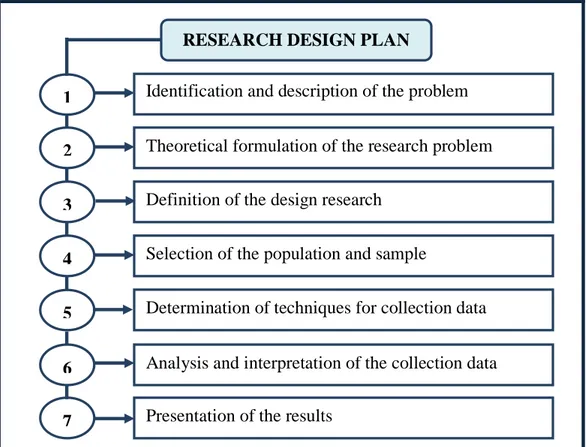
The action research was implemented at Unidad Educativa “Jorge Barek” from La
Libertad, Santa Elena province especially on students of eighth grade. In order to achieve the objectives of this research paper, it was necessary to define a plan to ensure the achievement of results. The researcher followed different processes to understand the deficiency in eight grade students’ reading comprehension; the
research design allowed understanding the elements of studies, and leading the process suitably.
Illustration Nº 2: Plan of Research Design
Author: Zoila Stefanía Rivera Laca
RESEARCH DESIGN PLAN
Identification and description of the problem
Theoretical formulation of the research problem
Definition of the design research
Selection of the population and sample
Determination of techniques for collection data
Analysis and interpretation of the collection data
Presentation of the results 1
3
4
5
27 Likewise, the design of this research paper was based on the implementation of the qualitative approach producing results and solutions to the problems in students of eighth grade at Unidad Educativa “Jorge Barek” located in La Libertad from the
province of Santa Elena. The results were obtained through the application of observation sessions, interviews to specialists, principal and English teacher from the educational institution previously mentioned, and surveys to eighth grade students.
3.1.1 Qualitative Method
The qualitative method refers to the collection of data and its presentation without statistics. It often categorizes data into patterns as the primary bases for organizing and reporting results. It refers to the description, analysis, and interpretation of the information obtained in a narrative way. Furthermore, qualitative research involves the following techniques for the collection of useful information: observations, notes, and interviews.
This research paper used this method, in order to collect information about the current proficiency level of eighth grade students in their English language reading comprehension skill from Unidad Educativa “Jorge Barek”, Additionally, the use
of camera to collect valuable audio and video was necessary during the implementation of these collection techniques.
3.2 Population and Sample
3.2.1 Population
The population considered in the development of this investigation were the principal, english teacher, and eighth grade students from Unidad Educativa “Jorge Barek”, and two English language experts.in order to provide a more detailed
28 Chart Nº 1: Population Description
Nº DESCRIPTION QUANTITY PERCENTAGE
1 Principal of Unidad Educativa “Jorge Barek”
1
5%
2 English teacher of Unidad
Educativa “Jorge Barek” 1 5%
3 Eighth grade students of Unidad Educativa “Jorge
Barek”
16
80%
4 English language experts 2 10%
TOTAL 20 100%
Author: Zoila Stefanía Rivera Laca
Source: Secretary Department from Unidad Educativa “Jorge Barek”
3.2.2 Sample
Since the population size is manageable (sixteen students), the 100% of the population was taken into account for the development and implementation of this investigative work. No sample size formula was required.
3.3 Data collection
In order to collect useful information, the application of different techniques and research tools were necessary.
3.3.1 Techniques
3.3.1.1 Survey
29 November 30th, 2016 and it allowed the researcher to obtain significant results about the importance of reading comprehension and the necessity of using a good strategy in order to improve the teaching process of students of eighth grade. These results provided precise information about the studied topic.
3.3.1.2 Interview
This technique was directly applied to the principal of Unidad Educativa “Jorge Barek” Lcdo. Luis Rodríguez Figueroa on December 1st, 2016. The English teacher
(Lcda. Clara Roca Matías) was also interviewed on December 1st, 2016. Furthermore, two English language experts were interviewed in different dates; MSc. María Rossana Ramírez Ávila (coordinator of the Mastery Degrees at Casa Grande University) on December 23rd, 106, and MSc. Hilda Gabriela Portilla Torres (English professor at University of Investigation and Experimental Technology-YACHAY) on January 11th, 2016. These interviews provided extra information to the research, such as, explanations, beliefs, advices, experiences, and attitudes to give to the teacher different perspectives concerning to the use of graphic organizers as didactic resources for the students’ improvement in their reading comprehension
ability.
3.3.1.3 Observation
This technique was directly applied to the English class of eighth grade from Unidad Educativa “Jorge Barek”. The application of the observation technique was
necessary because it permitted the determination of the real environment in the classroom during the development of the class and the relationship between teacher and students. Likewise, the observation sessions allowed to identify the reasons of the low students’ comprehension proficiency at the moment of reading written
30 3.3.2 Research tools
3.3.2.1 Questionnaires
The questionnaire is a document with a set of questions or statements concerning to the two variables of this investigation which was elaborated by the researcher in order to collect, quantify, and compare relevant information about the investigated problem. One questionnaire was applied to eighth grade students in order to examine and determine their point of view towards the reading comprehension skill development and improvement; for the principal it was necessary to include different questions and, finally, for the English teacher other different questionnaire was applied.
It is also important to mention that the questionnaires for surveys and interviews had some questions with diverse types of answers which provided fundamental information about the investigated issue. For instance, in the case of surveys applied to students, there were some questions with multiple options and responses because it was easier for students to provide an answer. This kind of questions and answers allowed students to select the alternative that described in the best way their responses.
3.3.2.2 Observation guides
The observation guide permitted a complete record of the research process because it was very useful for understanding the reasons, causes and origin of a determined problem. The observation guide was designed by the researcher and then implemented in an English language lesson in order to collect important data about the techniques and strategies that English teacher of eighth grade at Unidad Educativa “Jorge Barek” uses in the teaching process of English reading
31 3.3.2.3 Camera
This tool was implemented since it was important to have evidences of the developmental process of this research. Through the use of a camera, the researcher was able to take diverse pictures of eighth grade students from Unidad Educativa “Jorge Barek” during their participation in this project and to record videos of the
interviews and the two observation sessions
3.4 Data analysis
Once these techniques (survey, interviews, and observation sessions) and research tools (questionnaires, observation guides, camera) were implemented, all the collected information was analyzed, contrasted and presented in this research paper in the following items.
3.4.1 Interview to English language experts
Chart Nº 2: Information of the first interviewed specialist
PERSONAL INFORMATION Full name: María Rossana Ramírez Ávila
Degree:
Licenciada en Ciencias de la Educación Especialización Lengua Inglesa y Lingüística – Universidad de Guayaquil.
Magister en Educación Superior con Mención en Formación de Maestros de Inglés –
Universidad Casa Grande.
Years of Professional
Experience: 20 Years Author: Zoila Stefanía Rivera Laca Source: MSc. María Ramírez Ávila
32 Interpretation: The interviewed specialist said that teaching English language is very important for Latin American educational institutions not only for Ecuador because English is an international language and it is the language of businesses, so it is important that all educational institutions start teaching English from the elementary levels.
Question Nº 2: According to your criteria, how important is the development of reading comprehension skill on students?
Interpretation: The specialist said that teaching English language includes the four skills: listening, speaking, reading and writing but it depends on the focus of the teacher because some of them concentrate more in listening, others in speaking, but reading and writing are the least explored: This may be because teachers do not have to much information about the importance of developing reading comprehension skills. Furthermore, the specialist mentioned that, according to her criteria, reading is the most important because you learn by reading, so you need to be an efficiently and independent reader and that is what we have to teach to our students.
Question Nº 3: What problems do you consider students face at the moment of developing their reading comprehension skill?
33 Question Nº 4: According to your professional experience which are the causes for the poor English reading comprehension on students?
Interpretation: MSc. Ramírez mentioned that there are many causes for the poor reading comprehension of students. The most important is that Ecuador does not have a reading culture, in fact, the average of books that Ecuadorians read is one or two per year which it is low, maybe because our culture or because teachers do not focus on the development of the reading skill, if a student read in their native language, it is going to be easier for them to read in a new language.
Question Nº 5: What are the strategies you consider are the most beneficial for the developing English reading skill of students?
Interpretation: The interviewee said that she has made many reasearches about reading the first one was teaching professor to develop this skill so they can transfer this to their class, the second research was teach too students to transfer the training to students, they learnt about the reading techniques such us previewing, skimming, scanning, contextual guessing and summarizing , after that the results were that students had problem with contextual guessing and summarizing could be because summarizing is very difficult because you need a deep understanding to paraphrase, in previewing, skimming and scanning there are not problems because it is present in most of the exercises , so indirectly, we are teaching those techniques to them.
Question Nº 6: How frequent do you consider teachers should encourage students to practice their reading comprehension skill in class?
34 Question Nº 7: According to your point of view, do graphic organizers contribute to the reinforcement of student´s comprehension skills?
Interpretation: The interviewee said that the implementation of graphic organizers is useful for the development of reading comprehension skill of students because with a graphic organizer students can distribute and classify the ideas in a way that is easy to understand. Thus, the interviewee mentioned that one of the activities that she suggested to teachers during her researches were the use of graphic organizers. She concluded pointing out that graphic organizers are very efficient because they help students in the assimilation of concepts given in the readings.
Chart Nº 3: Information of the second interviewed specialist
PERSONAL INFORMATION Full name: Gabriela Hilda Portilla Torres
Degree:
Licenciada en Ciencias de la Educación-Especialización Idiomas – Universidad Técnica del Norte.
Master in Curriculum and Instruction of English as a Second Language – Kansas State University.
Years of Professional
Experience
14 Years
Author: Zoila Stefanía Rivera Laca
Source: Lcda. Gabriela Portilla Torres, MSc.
Question Nº 1: According to your criteria, how important is teaching English language in educational institutions from Ecuador?
35 stuffs in English that is why the specialist considered that it is important to teach this foreign language.
Question Nº 2: According to your criteria, how important is the development of reading comprehension skill on students?
Interpretation: The interviewee considered that reading comprehension is the base of English, when students read, they learn vocabulary, new phrases, and words; therefore, it is important to read in order to get a good level of English,
Question Nº 3: What problems do you consider students face at the moment of developing their reading comprehension skill?
Interpretation: The specialist stated that students do not have a reading culture, they do not like to read, that is why when the student is reading, they do not understand the context of the reading, so they block themselves and do not continue reading, they do not focus on words or the context. That is why teachers should create an environment in order to help their students to understand what they are reading.
Question Nº 4: According to your professional experience which are the causes for the poor English reading comprehension on students?
36 Question Nº 5: What are the strategies you consider are the most beneficial for the development English reading skill of students?
Interpretation: The specialist said that the application of strategies for teaching or practicing reading comprehension mainly depends on the proficiency level of students, for example, beginners should start reading concepts, sentences, and teachers should use engagement activities to help and motivate students in that level, for advanced levels, literature circles must be used, so students can interact and enjoy reading or make summaries.
Question Nº 6: How frequent do you consider teachers should encourage students to practice their reading comprehension skill in class?
Interpretation: MSc. Portilla considered that students need to practice reading comprehension every single day because it is required for following written instructions or advertisements in class or in tests and exams. Furthermore, sometimes they have to read subtitles from movies or videos. Hence, students need to practice this skill, at least, once a week but it would be perfect if reading is practiced every single day.
Question Nº 7: According to your point of view, do graphic organizers contribute to the reinforcement of student´s comprehension skills?
37 3.4.2 Interview to the principal of Unidad Educativa “Jorge Barek”
Chart Nº 4: Principal information PERSONAL INFORMATION Full name: Luis Rodríguez Figueroa
Degree: Licenciado en Educación Básica Years of
Professional experience
30 years
Author: Zoila Stefanía Rivera Laca Source: Lcda. Clara Roca Matías
Question Nº 1: According to your criteria, what do you think about the teaching English language in educational institutions from Ecuador?
Interpretation: The principal of Unidad Educativa “Jorge Barek”, Mr. Luis Rodríguez, answered that English language has become quite important because we are in globalized world so it is an obligation to learn this language in order to open new doors.
Question Nº 2: What is the level of the English teachers from the educational institution you manage?
Interpretation: The principal answered that Unidad Educativa “Jorge Barek” is formed by two excellent English teachers, they have many years of experience and they also use very good methods which are the base for making our students to understand this foreign language.
Question Nº 3: What is the level of English language of students of eighth grade from this educational institution?
38 public schools learners do not study English as a foreign language, for this reason, many students are not in the same level of other students but they are in the road of learning. Moreover, the principal mentioned that students are very enthusiastic and they love learning new things, this has been challenging for our teachers but we are improving every day.
Question Nº 4: According to your criteria, should the reading comprehension skill on students of eighth grade be developed?
Interpretation: The principal totally agreed with the development of students’ reading comprehension skill. He considered that reading is pretty important for the development not only of English language but any language and stated that when you read your learn, knowledge increase and get better and also learn new words and vocabulary.
Question Nº 5: What problems do you consider students face for developing their reading comprehension skill?
Interpretation: The interviewee mentioned that they have a big problem which is the lack of reading habits, our culture do not like to read, and students prefer social media, movies, television instead of reading a book, another problem that was mentioned by the principal is the lack of reading exercises in books.
Question Nº 6: What are the strategies that English teachers from this educational institution apply for their English reading skill lessons?
39 Question Nº 7: What strategies do you think could help to the development of reading comprehension ability?
Interpretation: The interviewee said that there are many different ways like summarizing or graphic organizers to teach reading but he personally prefers the one that teachers use, questions and answers because it is easier to teach and practice.
3.4.3 Interview to English teacher of Unidad Educativa “Jorge Barek”
Chart Nº 5: English teacher's information
PERSONAL INFORMATION Full name: Roca Matías Clara Beatriz
Degree: Licenciada en Inglés – Universidad Estatal Península de Santa Elena
Years of Professional
experience 6 Years Author: Zoila Stefanía Rivera Laca Source: Lcdo. Luis Rodríguez Figueroa
Question Nº 1: What do you think about the teaching English language in educational institutions from Ecuador?
Interpretation: The English teacher responded that English language is very important because it is the second most spoken language in the world. Moreover, in Ecuadorian educational institution, it is mandatory to learn it according the new reforms in the educational curriculum.
Question Nº 2: What is the level of English language of your students?
40 instruction in this subject so it is very difficult to work with them: On the other hand, the ones who were in private schools know more English.
Question Nº 3: What do you think about the development of reading comprehension skill of your students?
Interpretation: The interviewee considered that reading and speaking are the most important skills, reading is important because it opens your mind and help students to learn more vocabulary, grammar structures, and others.
Question Nº 4: What problems do you consider students face for developing their reading comprehension skill?
Interpretation: The interviewed teacher said that some students who do not have a good knowledge of English language feel afraid to make mistakes at the moment of reading because of the bullying and it does not help to them.
Question Nº 5: What are the strategies that you apply for your English reading skill lessons?
Interpretation: The English teacher responded that in eighth grade she uses questions and answers; she also uses pictures in order to help them to understand what they are reading.
Question Nº 6: How frequent do you encourage your students practice their reading comprehension skill?
41 Question Nº 7: Do you consider that reading exercises from the English book are according to your students’ interests and levels?
Interpretation: The interviewee mentioned that the English book students use just contains one reading for each unit; these readings are related to the main topic of each unit and they include the vocabulary words students need to practice, so in that case, reading s are good for students. Unfortunately, the English teacher considered that reading passages from English book are not according to students’ interests
because there scientific topics or reading that are not related to the reality of the country.
Question Nº 8: Do you consider that the application of graphic organizers contributes to the practice and development of reading comprehension skill of your students?