
Low speed vehicle impact against building structures : a review of relevant codes = Impactos de vehículos a baja velocidad sobre estructuras de edificación : revisión de la normativa relacionada
8
0
0
Texto completo
(2) Abstract. The new building codes tend to include vehicle impacts as part of the accidental actions to be considered. Most of these codes use equivalent static load to represent the effects of the impact against the structure. In this paper a bibliographical review of the indications is performed as provided by some of the most representative buildings codes in the world relating to impacts caused by. vehicles. In particular we will focus on impacts caused by horizontal actions on structures, like car crashes against parking columns. We will show that the indications provided by the different standards studied are widely different each other and that there is not a clearly agreed procedure allowing the assessment of the effects of a vehicle impact through an equivalent static load.. Keywords: Building codes & standards, impact, car parks, equivalent static load.. Resumen. Los nuevos códigos de edificación tienden a incluir, entre las acciones accidentales a considerar, las debidas a impactos de vehículos. La mayoría de estos códigos utiliza una carga estática equivalente para representar los efectos del impacto sobre la estructura. En este artículo se hace una revisión bibliográfica de las indicaciones dadas por algunos de los códigos más representativos a nivel mundial, en cuanto a impactos provocados por vehículos.. En concreto, se analizará el caso de impactos que provocan acciones horizontales sobre la estructura, como choques de vehículos contra pilares de aparcamiento durante su recorrido por el mismo. Se mostrará que las indicaciones dadas por las normas estudiadas son muy divergentes y no existe una regla o procedimiento consensuado que permita evaluar las consecuencias de un impacto a través de una carga estática equivalente.. Palabras clave: Códigos y normas de edificación, impacto, aparcamientos, carga estática equivalente.. páginas: 18 - 25. ]. Ferrer, B. - Ivorra, S. - Irles, R.. [. Revista de la Construcción Volumen 9 No 2 - 2010. [ 19.
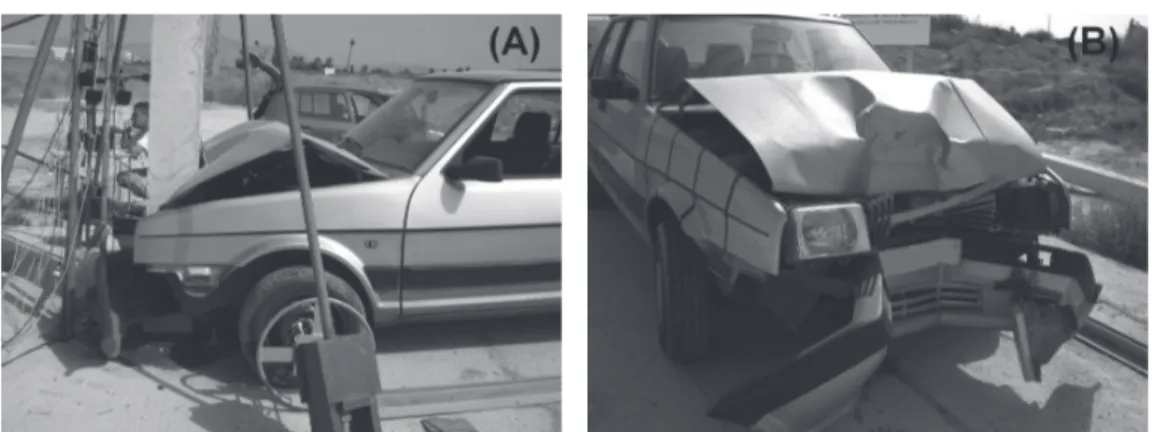
(3) 1. Introduction Accidental actions due to vehicle impacts against building structures are common and impose some actions for which the overall structure is not designed, even if these impacts are given at low speed. The consequences of the impact may be insignificant or, conversely, it can damage the structure, depending on the characteristics of both the structure and the vehicle, its mass and impact velocity. The impact speed is an important parameter that is ignored by some regulations. It is often thought that impact occurs at high velocity, similar to the travelling speed. However, just few moments before the crash, the driver brakes, reducing the speed as much as possible and the actual impact velocity is relatively low. Real crash tests experiments done by some of the authors (Ferrer et al., 2010) show that an impact at 20 km/h produces great damage in the car (see Figure 1).. Moreover, this velocity can be easily reached by a car in a parking with long straight streets, not perceiving the driver a potential risk. Therefore, in the study of the consequences of impacts caused by vehicles on structures, it is worth to analyze the low-speed impacts, meaning low speeds those below 20 km/h. To such end, one must refer to the building codes which establish the structural requirements due to the impact. Current trend in building structures is the incorporation of dynamic action in the design of structures due to vibrations, earthquakes, impacts or explosions. Most regulations characterize the consequences of impacts through an equivalent static load (ESL), either by proposing a specific value for this load or indicating a simplified calculation for its determination from the. main variables of the problem. Although the codes have been extensively analyzed for high speed (Ghose, 2009), the specifications related with low velocity are worse known. We make here a critical and comparative study on the indications given by some of the most relevant regulations about building structures, assessing whether the information given by each of the rules studied is consistent. As we will see, the codes provide very disperse information, thus making necessary a deeper analysis of low-speed impacts and its consequences.. 2. Review of regulations As we said above, many building codes include some considerations about accidental actions due to a car crash against the structure. Here we present a review of such regulations for some codes of interest:. 2.1 European regulation Eurocode 1: Actions on structures. Part 1-1: General actions - Densities, self weight, imposed loads for buildings (EC1 1-1, 2001). In Annex B of this code, which is only informative, one expression appears for the design of protective barriers for car parks: the characteristic strength required to withstand the impact of a vehicle can be calculated through the expression: Fc = 0.5 ⋅ m ⋅ v2 / (δc + δb). Figura 1 (A) One of the real scale experiments done by the authors. (B) Final state of a vehicle after impact under controlled conditions at a speed of 20 km/h. (image from our own tests). 20 ]. Revista de la Construcción Volumen 9 No 2 - 2010. ]. Ferrer, B. - Ivorra, S. - Irles, R.. [. páginas: 18 - 25. (1).
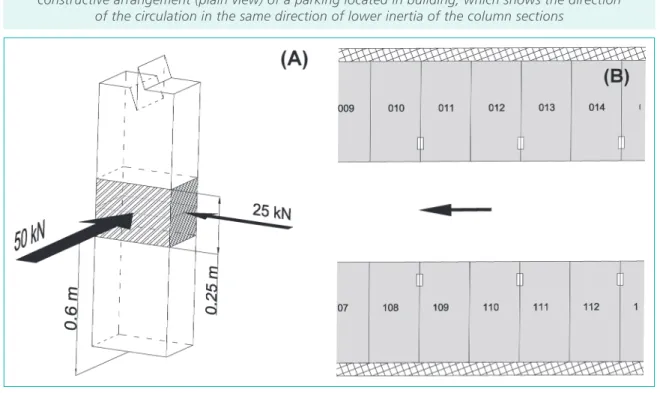
(4) where m is the vehicle mass (kg), v is the initial vehicle speed (m/s) perpendicular to the barrier, δ c is the deformation of vehicle (mm) and δb is the deformation of the barrier (mm). The code also includes orientative values for the parameters in expression (1): v = 4.5 m/s = 16.2 km/h and δc = 100 mm. If the vehicle mass is below 2500 kg a value of m = 1500 kg should be used while for heavier vehicles the real mass has to be used instead. For the case of lighter cars and assuming non-deformable barriers, a equivalent static force of 150 kN is obtained. Eurocode 1: Actions on structures. Part 1-7: General actions-Accidental actions (EC1 1-7, 2003). This part of Eurocode is specifically devoted to accidental actions and all other sections of the Eurocode regarding impacts refer to this part. Moreover, it explicitly includes garage parking, so its application to this study is straightforward. In this document an impact is defined as a process determined by the impact velocity of the colliding object together with the mass distribution, deformation behaviour and damping characteristics of both the colliding object and the structure. The code establishes the possibility to represent the action due to the impact as a static force that causes the same effects in the structure.. Two kinds of impacts are considered: soft impacts refer to actions against structures designed to absorb the impact energy by elastoplastic deformations of its members. In these structures the equivalent static loads can be tested both by the deformation capacity of the structure and the yield limit of material. Hard impacts refer to those in which the impact energy is dissipated mainly in the colliding object. For this kind of impact this code proposes an equivalent static load that depends on the type of vehicle and the velocity of the impact. In addition, the norm discriminates between the direction of the travel and the direction perpendicular to it, proposing different loads in each case and indicating that it should not be considered simultaneously. This classification of the impacts already exists in previous documents regarding concrete structures (CEB, 1988). For vehicle impacts on structures (hard impact) the code gives values for the equivalent static load depending on the type of road (with speed limits) and the type of vehicle. In the case of car parking located in buildings, and designed for cars with a maximum speed of 20 km/h the proposed values of equivalent static loads are in the range from 50 kN to 100 kN in the direction of movement of the road, being 50 kN the recommended value. For the direction perpendicular to the road the proposed values range from 25 kN to 50 kN, with a recommended value of 25 kN.. Figura 2 (A) Placement of the equivalent static loads according to (EC1 1-7, 2003), (B). Typical constructive arrangement (plain view) of a parking located in building, which shows the direction of the circulation in the same direction of lower inertia of the column sections. páginas: 18 - 25. ]. Ferrer, B. - Ivorra, S. - Irles, R.. [. Revista de la Construcción Volumen 9 No 2 - 2010. [ 21.
(5) In addition, these loads are applied on a rectangular area of 0.25 × 1.5 m (w × h) or the total width of the target element if less. The centre of this area should be located at 0.6 m above the running surface for vertical elements (Fig. 2A). On the other hand, one must bear in mind that it is quite common that the pillars of a parking are with rectangular shape in order to increase the usable area of the parking without decreasing the column section. In these cases the direction parallel to the path coincides with the axis with lower inertia of the column section (Fig. 2B) and consequently we are in the worst condition regarding an impact. In Annex C (informative) of this code a simplified procedure for dynamic calculation of the problem is proposed. In the case of hard impact and assuming that the impacting object deforms linearly during the impact phase, the following expression is proposed for determining the maximum force of interaction: Fmax = v √ k ⋅ m. (2). where k is the equivalent stiffness of the colliding object (i.e. the ratio between force and total deformation). Theoretical value of k=300 kN/m is also provided in this Annex. Eurocode 1: Basis of design and actions on structures. Part 2-7: Accidental actions due to impact and explosions (EC1 2-7, 1998). In this section of the code, the impact process is defined as determined by the mass distribution, the initial velocity of the colliding object and the deformation behaviours and damping characteristics of both the projectile and the structure. For the specific case of impacts against vertical structural elements, horizontal design loads are specified for different type of roads. For car parks located in buildings such loads are 40 kN in the direction of road and 25 kN in the perpendicular direction, not acting simultaneously. Moreover, in Annex A, which is only informative, an alternative view for the advanced study of the impact consequences is offered. In this document the indications for maximum force developed during impact exactly match those given in Annex C of Part 1.7 of Eurocode 1, which have been already described and discussed earlier in this document.. 22 ]. Revista de la Construcción Volumen 9 No 2 - 2010. ]. 2.2 American regulation Up to our knowledge, American regulation is disperse and includes few references in this regard: The American Institute of Steel Construction, Inc. issues the “Code for the standardization of the metal structures in buildings and bridges” (AISC 303, 2005) which does not take into account the loads due to such impacts. In addition, this agency issues the “Specification for structural steel buildings” (AINSI/ AISC 360-05, 2005) that replaces the traditional “Load and Resistance Factor Design” (LRFD, 1995) and refers to the document “Minimum design loads for building and other structures” (ASCE/SEI 7-05, 2006) for designing loads. This last document reports a value of 26.7 kN for the horizontal load that must withstand a protective barrier of a car park. The American Concrete Institute includes the standard “Analysis and Design of Reinforced and PrestresedConcrete Guideway Structures” (ACI 358.1-R92, 1992) which proposes an equivalent static load of 1000 kN to simulate the effect of an impact in a high speed way and high-mass vehicles. Consequently, this value is hardly comparable to those mentioned in this study. Another code that can be found within this body is the “Building Code Requirements for Structural Concrete and Commentary” (ACI 318S-05, 2005), indicating that the impact loads should be considered in the design without giving any further detail. Finally, it is very likely that the ACI 370R “Guidelines for the design of concrete structures for blast effects” (ACI 370R) which is under development will incorporate information on this issue. The International Code Council publishes the “International Building Code” (IBC, 2009), which deals about “Structural Design”, indicates that barriers in car parks should be designed to withstand a single load of 26.7 kN applied horizontally over the barrier. This load is the same of that stated in the standard ASCE / SEI 7-05 (ASCE/SEI 7-05, 2006). Moreover, in the IBC section 1607.8 it is specified that the designer must take into account the loads due to impact on the structural design, but no details are provided in case of impact due to collision of a vehicle.. 2.3 German regulation The standard DIN 1055-9:2003-08 “Actions on structures. Accidental actions “(DIN 1055-9: 2003) sets a horizontal load to represent different types of impacts. Ferrer, B. - Ivorra, S. - Irles, R.. [. páginas: 18 - 25.
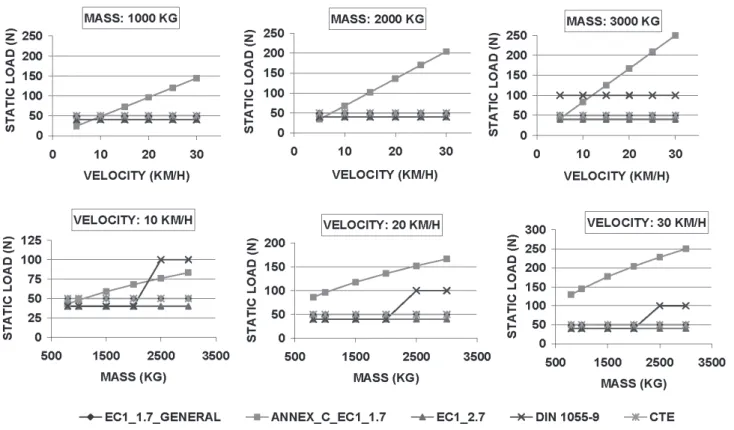
(6) caused by vehicles, depending on the type of street or place where the impact occurs and in some cases it differentiates between different masses and velocities of the impacting vehicle. Specifically, for parking, it differs depending on the mass of the vehicle for which they were designed: for vehicles with a mass of less than 2.5 tonnes, the equivalent static load in the direction of the road is 40 kN, while for a greater mass this load is 100 kN.. 2.4 British regulation The Standard BS6399-1:1996 “Loading for buildings. Part 1: Code of practice for dead and imposed loads” (BS 6399-1:1996, 2002) gives exactly the same recommendation that appears in Eurocode 1, Part 1-1 (EC1-1-1, 2001), which has been early discussed.. 2.5 Spanish regulation Actions due to impact are listed in the “Technical Building Code” (CTE, 2006), in paragraph 4.3.2. of its document “Loading for Buildings”. The indications given in this document are consistent with those included in Part 1.7 of Eurocode 1, described earlier in this document. However, in this case there is a significant difference between these two codes: while the part 1.7 of Eurocode 1 limits the maximum vehicle speed to determine the type of road involved and the range of values for the equivalent static load, Spanish rule limits the maximum mass of the vehicle for which a parking was designed. The reader should notice that during the impact there is an important energy exchange between the vehicle and the structure. The initial energy is the kinetic energy of the vehicle before the impact, which depends quadratically on the speed. Therefore it is more logical to limit the speed of the impact instead that the vehicle mass.. 3. Application to a case study and comparison Building codes presented in the previous section present disperse results for many different cases. In order to compare the consequences of an impact under each code, we will consider their application to a particular case. Let us consider an impact caused by a vehicle with a mass of 3000 kg at a speed of 20 km/h against a. páginas: 18 - 25. ]. building structure located in a parking. We will focus on the load to be applied in the direction of the road, since it is greater than the load to be applied in the direction perpendicular to the road as it is stated in all studied regulations. For this case, the ESL that the designer must consider is 166 kN according to Annex C of EC1 1-7 and Annex A of EC1 2-7, but 100 kN according to DIN 1055-9:200308, 50 kN according to EC1 1-7 and CTE and 40 kN according to EC1 2-7. In case of the same impact occurs against a parking barrier, instead of a building column, the application of Annex B of Part 1.1 of EC1 and BS6399-1:1996, gives a ESL of 308 kN, but ASCE/SEI 7-05 and IBC give 26.7 kN. To have a wider view of the comparison between codes regarding impact against structure, comparison of ESL given by different codes related with structural impact is done in Fig. 3 for different velocities and masses of the car. In the upper part of Fig. 3 the variation of ESL with velocity is analyzed for 3 different car masses while, in the lower part, the variation with mass is analyzed for 3 different velocities. One must remember that the indications given by Annex A of EC1 2-7 are coincident with those given by Annex C of EC1 1-7, and therefore, only this latest code is included on this comparison analysis. First remarkable result is that, in general, loads obtained from Annex C of EC1 1-7 are significantly higher than the rest for a velocity of 20 km/h or higher. Only for 10 km/h and a mass lower than 2000 kg, all the values from the codes are in the same order. For a higher velocity the loads from Annex C of EC1 1-7 quickly disjoin the rest increasing it value, while the rest are practically coincident. For a mass higher than 2000 kg the values from DIN 1055-9 also increases and they are similar to those from Annex C of EC1 1-7 for a velocity of 10 km/h, but they keep lower for higher velocities. The values from EC1 1-7 General, EC1 2-7 and CTE are nearly coincident.. 4. Conclusions This study presents an analysis of the indications given by the most relevant building regulations regarding to how take into account the actions due to horizontal impacts caused by vehicles in the design of a building structure.. Ferrer, B. - Ivorra, S. - Irles, R.. [. Revista de la Construcción Volumen 9 No 2 - 2010. [ 23.
(7) Figura 3 Variation of ESL with velocity and mass according to the studied codes concerning to impact against structures. First remarkable result is that there is a great disparity in the results obtained from different codes. Specifically, values from EC1 1-7 General, EC1 2-7 and CTE are in the same order but those from Annex C of EC1 1-7 and DIN 1055-9 are higher. Only for very low velocity, i.e. 10 km/h, and low mass of the car, i.e. lower than 2000 kg, all the codes give similar values. However, velocities higher than 10 km/h are not rare in car parks and for these velocities the ESL is not coherent in the studied codes.. In summary, we have shown that there is a wide dispersion between the values obtained for the equivalent static load which represents a vehicle impact. Our results make clear the existing confusion regarding the characterization of an impact through an equivalent static load thus showing the necessity of some normalization work.. On the other hand, ESL values obtained from EC1 1-7 General, EC1 2-7 and CTE do not vary with mass and velocity of the car, being these parameters essential in the impact definition. Therefore, these values could underestimate the ESL for velocities faster than 10 km/h, which are very common in car parks.. The authors gratefully thanked the support received from the Generalitat Valenciana, Conselleria d’Empresa, Universitat i Ciència who granted this research through the GVPRE/2008/192. 24 ]. Revista de la Construcción Volumen 9 No 2 - 2010. ]. Acknowledge. Ferrer, B. - Ivorra, S. - Irles, R.. [. páginas: 18 - 25.
(8) References 1.. ACI Committee 318 (2005) “318S-05/318SR-05 Spanish Edition Building Code Requirements for Structural Concrete and Commentary”, American Concrete Institute.. 2.. ACI Committee 358 (1992) “Analysis and design of reinforced and prestressed-concrete guideway structures”, American Concrete Institute. 3.. ACI Committee 370, “Guidelines for the Design of Concrete Structures for Blast Effects”, American Concrete Institute, under development. 4.. AISC 303 (2005) “Code of Standard Practice for Steel Buildings and Bridges”, American Institute of Steel Construction, Inc., Chicago, Illinois. 5.. AINSI/AISC 360-05 (2005) “Specification for structural steel buildings”, American Institute of Steel Construction, Inc., Chicago, Illinois. 6.. ASCE/SEI 7-05 (2006), “Minimun Design Loads for Buildings and Other Structures”, ASCE STANDARD, American Society of Civil Engineers. 7.. BS 6399-1:1996 (2002) “Loading for buildings. Part 1: Code of practice for dead and imposed loads”, British Standard.. 8.. CEB (1988), “Concrete structures under impact and impulsive loading”. Synthesis Report, Bulletin d’Information Nº 187, Comité Euro-International du Beton, Lausanne.. 9.. CTE (2006). “Código Técnico de la Edificación”, Ministerio de Vivienda, Spain (In Spanish).. 10. DIN 1055-9 (2003). “Actions on structures - Part 9: Accidental actions”, Deutsches Institut für Normung eV.. páginas: 18 - 25. ]. 11. EC1 1-1 (2001), “Eurocode 1: Actions on structures – Part 1-1: General actions – Densities, self-weight, imposed loads for buildings”. Final Draft prEN 1991-1-1, Technical committee CEN/TC 250, European Committee for Standardization. 12. EC1 1-7 (2003) “Eurocode 1: Actions on structures – Part 1-7: General actions – Accidental actions” Final Project Team Draft [Stage 34], Draft prEN 1991-1-7, Technical committee CEN/TC 250 European Committee for Standardization. 13. EC1 2-7 (1998) “Eurocode 1: Actions on structures – Part 2-7: Accidental actions due to impact and explosions” ENV 1991-2-7, Technical committee CEN/TC 250 European Committee for Standardization 14. Ferrer B., Ivorra S., Irles R., Mas D. (2010) “Real size experiments of car crash against building column”, Structures Under Shock and Impact XI, Wessex Institute of Thecnology, UK, 231-241. 15. Ghose, A. (2009), “Strategies for the management of bridges for vehicular impacts” Proceedings of the Institution of Civil Engineers, Structures and Buildings, 162, 3-10 16. International Code Council, (2009) “International Building Code”, International Code Council, Chapter 16, paragraph 1607.7.3. See http://www2.iccsafe.org/states /2009ICodes/Building/Building_Frameset.html for further details. Accessed at 01/09/2009. 17. LRFD (1995), “Manual of Steel Construction: Load and Resistance Factor Design”. American Institute of Steel Construction, Chicago, Illinois. 18. Sherif El-Tawil, P.E., Asce, M., Severino, E., Fonseca, P., (2005) “Vehicle collision with Bridge Piers”. Journal of Bridge Engineering, ASCE, p. 345-353. Ferrer, B. - Ivorra, S. - Irles, R.. [. Revista de la Construcción Volumen 9 No 2 - 2010. [ 25.
(9)
Figure
Documento similar