
The role of worked examples to teach concept mapping
17
0
0
Texto completo
(2) Journal for Educators, Teachers and Trainers, Vol. 10 (1) ISSN 1989 – 9572 http://www.ugr.es/~jett/index.php. The role of worked examples to teach concept mapping O papel dos exemplos trabalhados para ensinar mapeamento de conceitos Paulo R.M. Correia, [email protected] Joana G. Aguiar, [email protected] University of São Paulo, Brazil. Abstract: The growing interest in concept mapping has expanded the use of this graphical organizer as a way to represent and share declarative knowledge. However, training beginners to elaborate concept maps (Cmaps) has not received the deserved attention. Students must to think intensely about how to select and organise the content into coherent structures, using an unfamiliar graphic organiser. These concurrent tasks can exceed the students’ working memory capacity (overload situation), impairing meaningful learning. The aim of this paper was to explore the worked example approach to teach students how to construct good Cmaps in real classroom settings. Graduate students were divided into control (n = 32, did not study WE) and experimental groups (n = 34, studied WE). They were asked to perform five transfer tests involving Cmap elaboration. The WE approach helped the students to (1) develop highquality propositions, (2) apply a conceptual hierarchy to guarantee general-to-specific organisation, and (3) evaluate the propositional network integrity. However, there was no WE effect on learning how to state a proper focus question for the Cmap. The use of WE is valuable to set up reliable training activities about concept mapping, and the presented materials (WE) can be applied in any educational setting with some adaptations. Future studies should combine the use of WE with other instructional approaches to teach how to state a proper focus question Resumo: O crescente interesse na técnica de mapeamento conceitual expandiu o uso deste organizador gráfico como forma de representar e compartilhar conhecimento. Entretanto, o treinamento de iniciantes na elaboração de mapas conceituais (MCs) não vem recebendo a devida atenção. Os alunos devem pensar sobre como selecionar e organizar o conteúdo de forma coerente, usando um organizador gráfico desconhecido. Essas tarefas simultâneas podem extrapolar a capacidade de memória de trabalho dos alunos (situação de sobrecarga), prejudicando a aprendizagem significativa. O objetivo deste trabalho foi utilizar exemplos trabalhados (ETs) para ensinar aos alunos como construir bons MCs nas condições operacionais usualmente encontradas na sala de aula. Alunos de pós-graduação foram divididos em grupo controle (n = 32, não estudaram ETs) e experimental (n = 34, estudaram ETs). Eles foram convidados a realizar cinco testes de transferência envolvendo a elaboração de MCs. O uso de ETs ajudou os alunos a (1) desenvolver proposições de alta qualidade, (2) aplicar uma hierarquia conceitual para garantir a organização do geral para o específico, e (3) avaliar a integridade da rede proposicional. No entanto, não houve um efeito sobre como declarar uma pergunta focal adequada para o Cmap. O uso de ETs é valioso para configurar atividades de treinamento confiáveis sobre os MCs e os materiais apresentados (ETs) podem ser aplicados em qualquer contexto educacional, desde que sejam feitas as devidas adaptações. Estudos futuros devem combinar o uso de ETs com outras abordagens instrucionais para ensinar a declarar uma pergunta focal apropriada. Keywords: Concept maps; Knowledge representation; Higher education; Cognitive load theory; Worked example Palavras-chave: Mapas conceituais; Representação do conhecimento; Ensino superior; Teoria da carga cognitiva; Exemplo trabalhado. Journal for Educators, Teachers and Trainers JETT, Vol. 10 (1); ISSN: 1989-9572. 68.
(3) 1. Introduction Developed by Novak and colleagues in the 1970s (Novak, 2010), concept maps (Cmaps) are graphical organisers useful for making explicit the relationship between concepts through propositions (see Figure 1). Over the last three decades, Cmaps have been extensively used to encourage students to engage in active learning (Vanhear, 2013; Blunt & Karpicke, 2014; Correia & Aguiar, 2014), assess students’ conceptual knowledge (Novak, 2002; Shavelson, Ruiz-Primo & Wiley, 2005; Hay, 2007; Burrows & Mooring, 2015), and promote deeper information processing (Hauser, Nückles & Renkl, 2006; Hay, Kinchin & Lygo-Baker, 2008; Ahlberg, 2013). Most studies involve student-constructed Cmaps tasks, especially in science education field (e.g., Nesbit & Adesope, 2006; Valadares, 2013). Although producing Cmaps seems to be an active treatment which apparently induces deeper learning, Stull and Mayer (2007) showed that constructing graphic organisers with little training imposes high extraneous load (i.e., the unproductive load imposed to a learner’s working memory, which does not contribute to learning). As this load does not support the construction of knowledge, they argued that elaborating Cmaps could impair meaningful learning. Hilbert and Renkl (2008) carried out a study to characterise good and poor mappers after developing an effective training. They found that unsuccessful mappers rarely labelled the links that connect the concept nodes. On the other hand, effective mappers invested considerable effort into planning their mapping process to produce a coherent Cmap. Conradty and Bogner (2010) studied the implementation of concept mapping for novices in classroom settings. They showed that most errors found in students’ propositions were content dependent, explaining this lowquality Cmap feature due to a high intrinsic load (i.e., load imposed to the learners’ working memory, which is related to the content complexity). Training in concept mapping plays a crucial role in coping with beginners’ difficulties. However, a few studies exploring training did not reach a consensus about how this should be carried out to ensure mastery of concept mapping. Karpicke and Blunt (2011) summarised this issue as follows: We cannot find any studies that manipulated training to examine whether it enhances the effectiveness of concept mapping. Given the importance of identifying the best ways to implement effective strategies, it is surprising that the role of training in concept mapping has not been rigorously examined (Karpicke & Blunt, 2011, 453-d). When students construct their own Cmap, they are challenged to think intensely about how to select and organise the content into coherent structures, using an unfamiliar graphic organiser (Kinchin, 2013, 2016). According to Renkl, Hibert and Schworm (2009), concept mapping has a double-content feature: one related to how to construct Cmaps (i.e., learning domain) and other related to the specific content to be mapped (i.e., exemplifying domain). Although both domains are deeply intertwined, our concern here is how to address the learning domain. Informed by cognitive load theory (Sweller, Ayres & Kalyuga, 2011), learning how to construct Cmaps can be a source of (1) intrinsic load, related to understanding the elements that constitute good Cmaps (i.e., proposition, hierarchy and focus question); and (2) extraneous load, related to dealing with the graphical format of instruction. If both loads exceed the students’ working memory capacity (overload situation), they would not be able to represent their knowledge through concept mapping. Consequently, the teacher cannot assess students’ understanding due to a low-quality Cmap features (Correia, Cicuto, & Aguiar, 2014). One way to decrease the extraneous load and manage the intrinsic load imposed for constructing Cmaps is to offer a well-designed training in concept mapping prior to the learning period, which means before introducing the exemplifying domain (Aguiar & Correia, 2017). The use of work examples (WE) is well-recognised to decrease the extraneous load of learning tasks. Several studies have shown that learning from WE is more efficient than traditional methods of problem-solving (e.g., means-end analysis) because it guides the solution of a problem by presenting a systematic logic, scaffolding learning to reach a task solution. The review presented by Atkinson et al. (2000) is an insightful reading for better understand why and Journal for Educators, Teachers and Trainers JETT, Vol. 10 (1); ISSN: 1989-9572. 69.
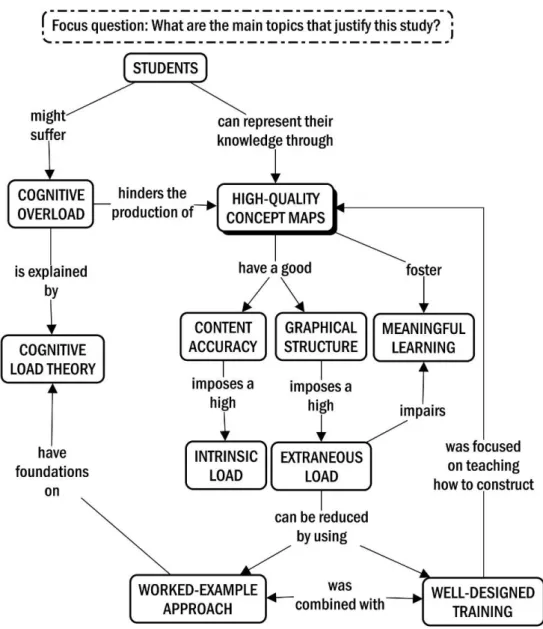
(4) how to use WE. In this paper, we explore the efficiency of the WE approach to teach students how to construct good Cmaps in real classroom settings. Assuming that WE decrease the extraneous load related to this unfamiliar graphic organiser, more working memory resources would lead to learning how to understand and handle the Cmap task. We used a WE that shows a problem, a goal state and the steps to the problem solution making the expert logic visible (van Gog, Paas & van Merriënboer, 2006). Stimulating the acquisition of schema through well-designed training might lead to transfer, which is the application of a specific schema to a problem that more or less deviates from problems faced during the study phase (Paas, 1992). Transfer tests require an application of the studied content to a different context, and the efficiency of the WE approach can be evaluated by performance during these tests (Mayer, 2001). We hypothesised that the students who studied WE would have better performance in transfer tests (i.e., elaborate better Cmaps) than students who did not have access to the training material. 1.1. Features of high-quality concept maps Cmaps are graphical tools that make explicit the relationship between hierarchically organised concepts (through propositions) which answer a specific focus question (Novak, 2010). A good Cmap is offered to summarise the introduction (Figure 1).. Figure 1. Concept map produced to summarise the introduction. Journal for Educators, Teachers and Trainers JETT, Vol. 10 (1); ISSN: 1989-9572. 70.
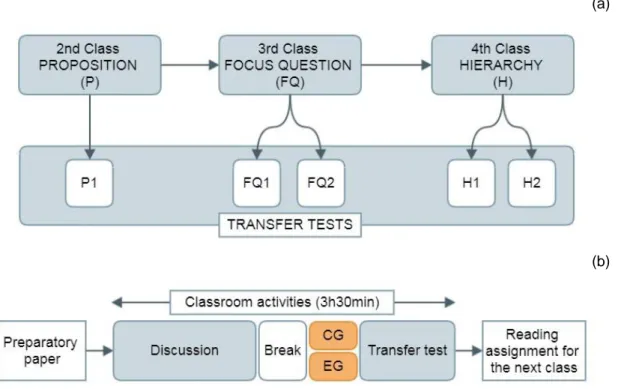
(5) According to Cañas, Novak and Reiska (2015), good Cmaps must fulfil some predefined criteria related to both graphical structure and content accuracy: Few words in concept labels appear just once during the Cmap elaboration. Correct, clear and relevant propositions. A pair of concepts united by linking phrase with a verb that make explicit the conceptual relationship originates a proposition (e.g., students might suffer cognitive overload). Minimum changes in the linking phrase can cause considerable differences in the propositional meaning (Correia, 2012). For instance, in Figure 1, replacing ‘might suffer’ by ‘will suffer’ or ‘do not suffer’ would both be incorrect. Conceptual hierarchy to organise the concepts. According to Ausubel (2000), knowledge construction occurs preferentially via progressive differentiation, when broader ideas and concepts are deployed into detailed concepts. During the Cmap elaboration, the learners externalise their knowledge structure, making visible their mental models. For this purpose, learners must organise the most inclusive concept as initial or ‘root’ and, from then on, any reader has to be able to read the entire propositional network (which means ensure the network’s integrity). Usually, Cmaps present a hierarchical, top-down fashion that facilitates the reading flow and content understanding. Context is defined by an explicit focus question, which the Cmap propositional network should answer. This question helps the mapper maintain his/her focus during the selection of the most relevant concepts and propositions to develop the Cmap (Novak, 2010; Cañas, Reiska & Novak, 2016). For instance, the Cmap in Figure 1 answers What are the main topics that justify this study? To become a good mapper, the students must not only understand, but also handle and apply the concepts of proposition, hierarchy, and focus question during the Cmap elaboration (Cañas, Novak & Reiska, 2015; Cañas, Reiska & Novak, 2016; Aguiar & Correia, 2017). Concept mapping training sessions should ensure the elaboration of high-quality Cmaps, which means a concise Cmap with well-balanced and well-structured concepts and propositions entirely relevant to answering the focus question in a clear fashion design (Derbentseva & Kwantes, 2014). For this reason, we provided a training session on concept mapping dismembered in three steps for learning how to (1) create semantically clear propositions, (2) choose and state a proper focus question and (3) establish a good conceptual hierarchy. 2. Method 2.1. Participants and design Sixty-six graduate students (M=27.1, SD=3.5; 54% men) enrolled in the Collaborative Learning and Concept Mapping course took part in this study. They were randomly assigned to the control group (CG, n=32, did not study WE) or experimental group (EG, n=34, studied WE). All participants were treated according to the APA’s ethical standards. They signed an informed consent form before participating in the research. 2.2. Materials, data collection and analysis The data collection occurred during three consecutive classes (Figure 2a). Each class started discussing a paper previously assigned by the teacher, followed by a coffee break. While the EG group studied WE, the CG waited outside the classroom. After that, the CG was gathered with EG to accomplish each transfer test (Figure 2b). The composition of both groups was the same throughout the data collection.. Journal for Educators, Teachers and Trainers JETT, Vol. 10 (1); ISSN: 1989-9572. 71.
(6) (a). (b). Figure 2. Data collection procedure: (a) transfer tests were applied during classes 2 to 4 embedded into (b) the classroom activity flow. Three WE about propositions, focus question and hierarchy were prepared as study materials (Table 1). They were printed on A4 sheets, providing brief information and Cmap examples to show step-by-step how to create semantically clear propositions, choose and state a proper focus question and establish a good conceptual hierarchy. Participants’ performance was assessed using five transfer tests (Table 2) which evaluate the presence of high-quality features on the Cmaps. A Kolmogorov-Smirnov test with Lilifoers correction confirmed the normal data distribution even with the reduced sample size. All CG and EG performance comparison analyses were made using Chi-square test carried out on IBM =.05).. HIERARC HY. FOCUS QUESTION. PROPOSITIO N. Table 1. WE developed to teach students how to construct good concept maps Contents organised by sections (1-4) 1. Shows the proposition’s generic structure, made by two concepts (e.g., nouns, adjectives, expressions) linked by a verb. 2. Highlights the importance of verbs in the linking phrase. 3. Illustrates how small changes in the link phrase can produce considerable transformations in the propositional meaning. 4. Explains how to evaluate propositions considering semantic clarity and conceptual correctness. 1. Highlights propositional network as the representation of the mapper’s declarative knowledge. 2. Compares two Cmaps about the same topic addressing different focus questions. The coherence between Cmap content and focus question must be ensured by the mapper. 3. Presents the focus question as criteria to select concepts and linking phrases – avoid the large Cmaps. 4. Shows tips to choose a clear and pertinent focus question. 1. Highlights the need of organising Cmap from the most general to the most specific concepts. 2. Shows that the top-down organisation of the concepts fosters content understanding. 3. Discusses the importance of chasing the propositional network integrity—the reader must be capable of reading the Cmap from the initial concept following the arrows. 4. Summarizes practical tips about Cmap hierarchy.. Journal for Educators, Teachers and Trainers JETT, Vol. 10 (1); ISSN: 1989-9572. 72.
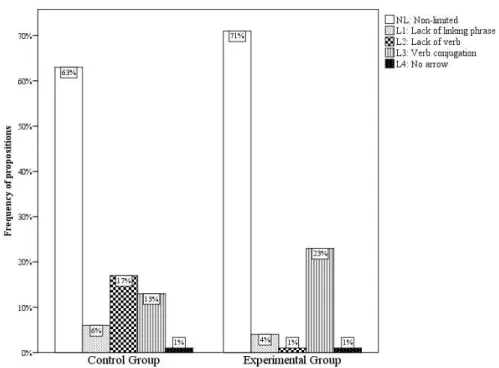
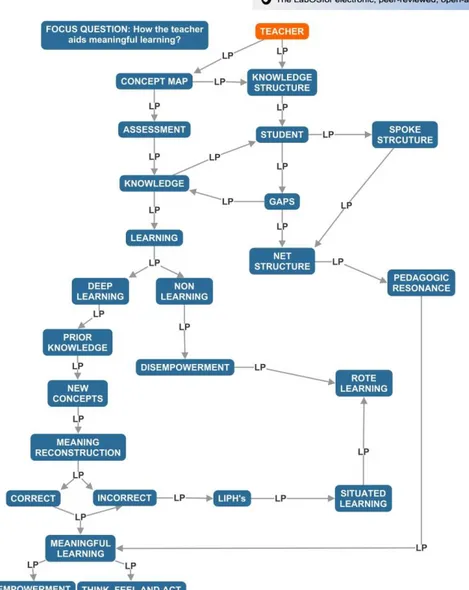
(7) Table 2. Material, task and data analysis used in transfer tests Test. Material and task description. Data analysis Propositions were classified by three specialists (blinded protocol) into categories according to their limitations or faults. Conceptual correctness was not considered in this analysis. L1. Limited by missing the linking phrase: University knowledge L2. Limited by the absence of verb: University and knowledge L3. Limited by problems in verb conjugation: University increasing knowledge L4. Limited by no direction of arrow: University increases knowledge NL. Non-limited: semantically clear: University increases knowledge. P1. Individually elaborated Cmap about the text discussed in class (max. 25 concepts).. FQ1. A multiple-choice questionnaire with five possible focus questions to be matched with a Cmap about coffee.. The frequency of correct and incorrect answers.. FQ2. Teacher’s Cmap about meaningful learning and the roles of the teacher and learner to foster it in classrooms. The students were asked to state the best focus question for this Cmap. See Appendix A.. Students’ focus questions were classified by three specialists (blinded protocol) into the following categories. NP. Not pertinent: do not have a relationship with Cmap content. PP. Partially pertinent: present a naive relationship with Cmap content or emphasise only one part of the contents. TP. Totally pertinent: have an acceptable relationship with Cmap content.. H1. Two Cmaps that answer the same focus question (What is pizza made of?). One Cmap was elaborated using a proper hierarchy, and the other was not. The students compared the Cmaps according to (a) propositional network integrity and (b) the number of initial concepts (not attached to the network). Finally, the students had to answer the question: Which Cmap is the easiest to read and understand? Explain your answer. See Appendix B.. The frequency of students who recognise: (a) the presence and absence of the propositional network integrity in each Cmap; and (b) the correct number of initial concepts. The students’ answers to the written question were analysed according to the choice of the easiest Cmap and their explanations.. H2. One written question about the importance of conceptual hierarchy followed by an individually elaborated Cmap (max. 25 concepts) task.. A combined analysis was made considering (a) the importance of conceptual hierarchy, which could be full, partially or non-recognised by the students, and (b) the proper application of the conceptual hierarchy during the Cmap elaboration.. 3. Results 3.1. Learning how to create good propositions The frequencies of propositional faults identified in the Cmaps elaborated in transfer test P1 by EG and CG are presented in Figure 3. The overall analysis showed a significant difference in 2 the frequencies of (4) = 25.91, p < .001, although the total number of propositions made by CG (n = 189) were very similar to EG (n = 171). This result indicated a main effect of studying WE considering propositional faults.. 73.
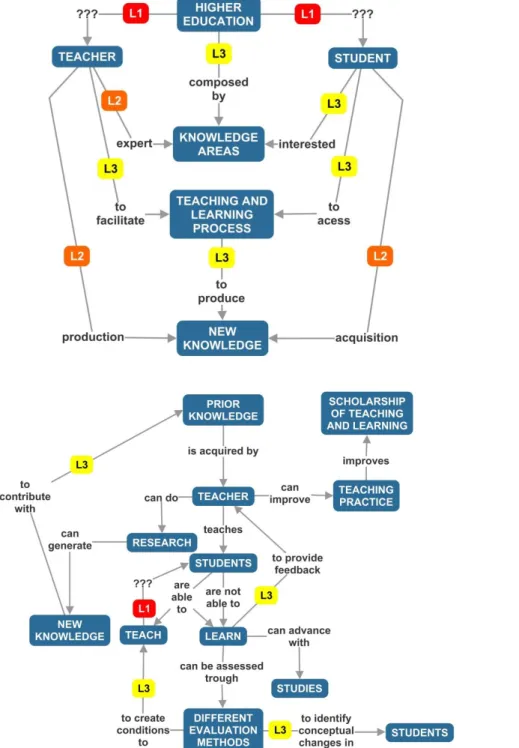
(8) Figure 3. Frequencies of propositions with and without faults identified in the P1 test. There was a main effect of studying WE regarding the L2 type of error. Whereas CG made 17% 2 (1) = 26.1, p < .001. On the other hand, EG showed a higher frequency of verbs with conjugation problems 2 (1) = 5.85, p < .05. No statistical differences between CG and EG were observed for the other categories (L1, L4 and NL). To sum up, EG students had higher performance than CG, mainly when making propositions with semantic clarity (Figure 4). Figure 4a presents a Cmap made by a student in CG who made all ten propositions with some limitation. The semantic meaning is hindered due to the lack of: . Linking phrases (L1): higher education ??? teacher. Verbs (L2): teacher expert knowledge areas. Proper verb conjugation (L3): higher education composed by knowledge areas. A clearly conveyed message (L3): student to access teaching-learning process.. Studying WE increased students’ ability to produce propositions with high semantic clarity, albeit with a few mistakes at times. Almost all propositions (94%, given by NL plus L3) made by the EG have a verb in the linking phrase. However, the L3 type of error (verb conjugation) was also higher in the EG compared to the CG. The more declared verbs, the more probable the occurrence of conjugation mistakes. For example, the Cmap in Figure 4b presents 18 propositions, mostly non-limited. In this case, the teacher can offer specific guidance to improve the Cmap quality by: Reminding learners that concepts can appear just once in the Cmap (e.g., student) and that verbs might be better fitted as a linking phrase instead of concepts (e.g., teach); Highlighting the importance of linking phrase (e.g., teach ??? students); and Asking for clarifications in verbs and propositions (e.g., learn to provide feedback to teachers. It might be: learner needs feedback given by the teachers) The previous items illustrated some expected faults that can be managed during the training, and that is also likely to happen during the first encounter with the technique. Conradty and Bogner (2010) pointed out two main reasons that explain faults when constructing propositions, as related to the method (e.g., no directional arrow) or the content (e.g., no linking phrase). Evidence suggested that studying WE increased the possibility of including verbs in the linking phrase although sometimes it was some conjugation problems (e.g., gerund and infinitive) confirming that the WE used was a valuable tool for decreasing both types of faults.. 74.
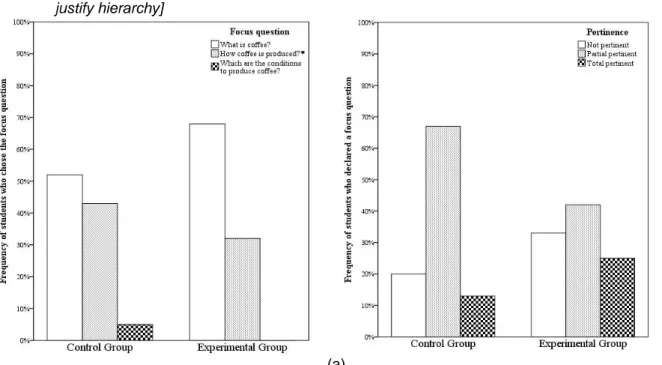
(9) 3.2. Learning how to choose and establish focus questions The evaluation of students’ performance on the first transfer test (FQ1) resulted in the frequency graph shown in Figure 5a. Among the five focus question options for answering the Cmap about coffee, the students only chose three of them, with ‘How is coffee produced?’ is the correct one. Although higher percentages of right answers for the CG (40%) than the EG (33%), no 2 (2) = 1.45, p > .05. These results indicated that studying WE does not affect choosing the best focus question. (a). (b). Figure 4. Concept maps elaborated by students in (a) CG and (b) EG during the P1 test. L1: lack of linking phrase; L2: lack of verb; L3: verb conjugation.1. 1. We kept the propositions exactly as the students elaborated.. 75.
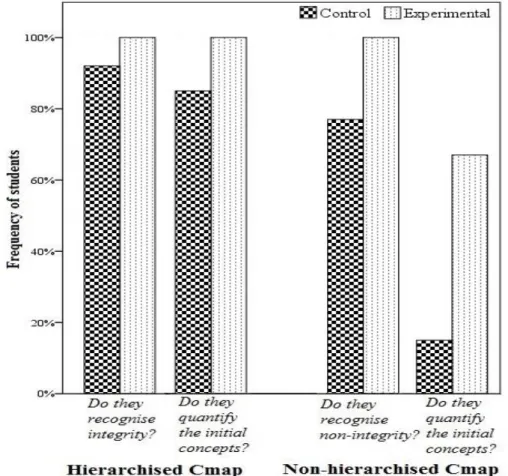
(10) The results of the second test (FQ2, see Appendix A) were presented in a frequency graph of the categories according to their pertinence (Figure 5b). The EG presented a higher percentage of the declared focus question that was non-pertinent for answering the Cmap (33%) compared to the CG (20%). In this case, the focus question has a descriptive feature and, typically, evades the Cmap issue. For focus questions that were partially pertinent, the CG showed higher values (67%) than the EG (42%). This type of focus question highlighted few relevant concepts and propositions. Finally, the EG showed almost twice the percentage (25%) of a total pertinent declared focus question compared to the CG (13%). In this case, the students recognised all conditions for the occurrence of meaningful learning. Although the EG seems to have demonstrated a higher performance, the results indicated no 2 (2) = 1.71, p > .05. There was no evidence that studying WE helped students establish the most pertinent focus question. As one topic can generate many different Cmaps, it is critical that the learner recognise and state the Cmaps’ focus question adequately. The WE approach failed to teach about focus questions once there was no difference between CG and EG performances. 3.3. Learning how to organise the concepts hierarchically The results of the first transfer test (H1, see Appendix B) are summarised in Figure 6. The EG and CG students had the same performance when recognizing (a) the presence of integrity in 2 (1) = 1.95, p > .05 and (b) the absence of integrity in the non2 (1) = .96, p > .05. Furthermore, no difference emerged between the EG and CG in identifying the correct number of initial concepts (just one) on the hierarchised Cmap, 2 (1) = .003, p > .05. On the other hand, students in the EG (67%) outperformed those in the CG (15%) when identifying the correct number of initial concepts (three) on non-hierarchised 2 (1) = 5.23, p < .05. All students chose the hierarchised Cmap as the easiest one for reading and understanding the content. Whereas the EG students justified the easiness as a result of conceptual hierarchy (80%) and logical structure to connect the concepts (20%), the CG students mainly justified it as a matter of conceptual organisation (50%) or related to other Cmap features, such as the propositional network or focus question (20%). For example, one CG student explained: The first Cmap is the easiest one because the concept related to the focus question is the initial one, which is being dismembered. Each new concept added is important to answer the focus question. [CG student using focus question to justify hierarchy]. (a). (b). Figure 5. Comparing control and experimental group performances for (a) selecting and (b) establishing the most pertinent focus question (FQ1 and FQ2 tests, respectively). 76.
(11) Figure 6. The frequency of students who recognise the integrity and the number of initial concepts on Cmaps with or without conceptual hierarchy (H1 test). Meanwhile, one EG student explained: The first Cmap is the easiest because it is arranged hierarchically from the broader concept to the more specific one. It has no ‘loose concepts’. The concepts are spatially distributed. The integrity allows me a more comprehensive reading. [EG student using conceptual arrangement to justify hierarchy] The results from the second transfer test (H2) indicated that 44% of EG students recognised the importance of conceptual hierarchy and 80% used this strategy during the Cmap elaboration. Conversely, 32% of CG students recognised the importance, and 40% used this ability on the Cmap elaboration. There is no main difference between EG and CG 2 (1) = 1.10, p > .05; however, considering its application during the Cmap elaboration, the EG outperformed the CG, 2 (1) = 5.58, p < .05. Figure 7 shows Cmaps made by students that recognised the importance of hierarchy. However, the student in CG (Figure 7a) did not follow its rules during the Cmap elaboration. We confirmed the lack of systematic use of the hierarchy rules due to the following factors: . The lack of top-bottom conceptual organisation. The most inclusive concepts are not on the top of the Cmap. Different possibilities to start reading the Cmap – there are five initial concepts (in orange). Some initial concepts did not have a broader feature, nor were they critical for answering the focus question (e.g., the concept of ‘teacher mediation’). Separated sub-domains of knowledge, which were not only placed in a different hierarchy ‘branch’ but also have weak connections between them.. 77.
(12) The Cmap elaborated by the EG’s student (Figure 7b) shows concepts hierarchically organised. The most general concepts on top (e.g., concept maps, teacher, students) were progressively detailed into specific concepts at the bottom (e.g., correct, incorrect, situated learning). There was just one possibility to start reading the content. From the concept of “teacher” (in orange), it is possible to read the entire network, ensuring ‘integrity and readability’. In this case, the aspects of layout and semantic reading flow leads to increased clarity and content understanding (Derbentseva & Kwants, 2014). Studying WE draws students’ attention to identifying the lack of integrity in a non-hierarchised Cmap. This is the first step in producing a better conceptual organisation and a high-quality propositional network. The WE approach profoundly increased the concern about the Cmap hierarchical organisation, confirming its effectiveness. 4. General discussion The results showed that WE enhanced the students’ ability to develop propositions with higher quality, reducing the linking phrases without verbs and using the conceptual hierarchy to ensure both a general-to-specific approach and the integrity of the propositional network. The cited abilities are critical for elaborating Cmaps with high-quality standards and communicability. Contrary to what we expected, there was no WE effect on learning how to choose and state a proper focus question. (a). (b). 78.
(13) Figure 7. Cmaps elaborated by students in (a) CG and (b) EG during transfer test H2. One initial concept (in orange) guarantees network integrity. LP: linking phrases2 Cognitive load theory has suggested that WE are particularly suited to skill domains where algorithms can be applied, and its effect is harder to obtain using ill-structured learning domains (e.g., Owens & Sweller, 2008; Rourke & Sweller, 2009; Oksa, Kalyuga, & Chandler, 2010). Indeed, Hilbert and Renkl (2009) argued that concept mapping is ‘not a straightforward process and, thus, cannot be presented in a traditional worked-out example’ (p. 268). However, our results demonstrate that WE are useful in most parts of the training process. One possible explanation is that establishing propositions with semantic clarity and using a general-to-specific conceptual hierarchy can be considered straightforward algorithmic processes. On the other hand, stating a proper focus question increases the solution variations exponentially, and impairs the algorithm-based approach (Renkl, 2005). The heterogeneous WE effect is because we decomposed the training into algorithmic (propositions and hierarchy) and heuristic (focus question) components. Teaching about focus question requires more complex and robust approaches (Koedinger, Corbett & Perfetti, 2002), such as heuristic examples, prompts of self-explanation and fading backwards WE. The socalled heuristic examples combine the idea of a process-oriented WE with modelling examples. Future studies should consider the use of such examples in which learners can observe the creation of a concept map based on the text source and the corresponding cognitive processes from an expert mapper (Hilbert & Renkl, 2009).. 2. We kept the conceptual organisation exactly as the students elaborated.. 79.
(14) 5. Final considerations A variety of techniques has been developed to elicit students’ mental models, such as concept mapping. The application of graphical approaches must include extensive training on how to use these tools; otherwise, we cannot ensure content reliability, especially during the assessment. In this paper, we explored the use of the WE approach during a systematic and well-designed training session on how to construct good Cmaps. Despite the fact that learning how to select and state a proper Cmap focus question depends on expert mediation and heuristic approaches (which was not explored in this paper), studying WE enhanced the Cmap overall quality, is very suitable in the classroom setting. There is a gap in the literature that invites us all to manipulate training on concept mapping by using different and more complex instructional strategies, especially when Cmap task elaboration requires modelling knowledge.. 6. References Aguiar, J. G., & Correia, P. R. M. (2017). From representing to modelling knowledge: proposing a two-step training for excellence in concept mapping. Knowledge Management & Elearning, 9(3): 366–379. Ahlberg, M. (2013). Concept mapping as an empowering method to promote learning, thinking, teaching and research. Journal for Educators, Teachers and Trainers, 4(1): 25–35. Atkinson, R. K., Derry, S. J., Renkl, A., & Wortham, D. (2000). Learning from examples: Instructional principles from the Worked Examples research. Review of Educational Research 70: 181–214. Ausubel, D. P. (2000). The acquisition and retention of knowledge: a cognitive view. Dordrecht: Kluwer Academic Publishers. Blunt, J. R., & Karpicke, J. D. (2014). Learning with retrieval-based concept mapping. Journal of Educational Psychology 106: 849–858. Burrows, N. L. & Mooring, S. R. (2015). Using concept mapping to uncover students’ knowledge structures of chemical bonding concepts. Chemistry Education Research and Practice 16(1): 53–66. Cañas, A. J., Novak, J. D., & Reiska, P. (2015). How good is my concept map? Am I a good cmapper? Knowledge Management & E-Learning 7: 6–19. Cañas, A. J., Reiska, P., & Novak, J. D. (2016). Is my concept map large enough? In A. J. Cañas, P. Reiska and J. D. Novak (Eds.), Innovating with Concept Mapping. Proceedings of the Seventh International Conference on Concept Mapping (Vol. 1). Springer Communications in Computer and Information Science Series. Conradty, C. & Bogner, F. X. (2010). Implementation of concept mapping to novices: reasons for errors, a matter of technique or content? Educational Studies 36: 47–58. Correia, P. R. M. & Aguiar, J. G. (2014). Concept mapping informed by Cognitive Load Theory: implications for tasks involving learner-generated Cmaps. In: Correia, P. R. M., InfanteMalachias, M. E., Cañas, A. J., & Novak, J. D. (Eds.) Concept Mapping for Learning and Innovation. Proc. of the Sixth Intl. Conference on Concept Mapping. Santos, Brazil Correia, P. R. M. (2012). The use of concept maps for knowledge management: from classrooms to research labs. Analytical and bioanalytical chemistry 402: 1979–1986. Correia, P. R. M., Cicuto, C. A. T., & Aguiar, J. G. (2014). Using novakian concept maps to foster peer collaboration in higher education. In: Ifenthaler, D. & Hanewald, R. (Org.). Digital Knowledge Maps in Education. New York: Springer, p. 195–217. Derbentseva, N. & Kwantes, P. (2014). Cmap readability: propositional parsimony, map layout and semantic clarity and flow. In: Correia, P. R. M., Infante-Malachias, M. E., Cañas, A. J., & Novak, J. D. (Eds.) Concept Mapping for Learning and Innovation. Proc. of the Sixth Intl. Conference on Concept Mapping. Santos, Brazil. Hauser, S., Nückles, M., & Renkl, A. (2006). Supporting concept mapping for learning from text. In: Barab, S. A., Hay, K. E., & Hickey, D. T. (Eds.), Proc. of the 7th Intl. Conference of the Learning Sciences, Mahwah, NJ. Hay, D. B. (2007). Using concept maps to measure deep, surface and non-learning outcomes. Studies in Higher Education 32: 39–57. Hay, D., Kinchin, I, & Lygo-Baker. S. (2008). Making learning visible: the role of concept mapping in higher education. Studies in higher education, 33 (3): 295–311.. 80.
(15) Hilbert, T. S. & Renkl, A. (2009). Learning how to use a computer-based concept-mapping tool: self-explaining examples helps. Computers in Human Behavior, 25: 267–274. Hilbert, T. S., & Renkl, A. (2008). Concept mapping as a follow-up strategy to learning from texts: What characterizes good an poor mappers? Instructional Science, 36: 53–73. Karpicke, J. D., & Blunt, J. R. (2011). Response to comment on retrieval practice produces more learning than elaborative studying with concept mapping. Science 331: 453-d. Kinchin, I. (2013). Concept mapping and the fundamental problem of moving between knowledge structures. Journal for Educators, Teachers and Trainers, 4(1), 96 – 106. Kinchin, I. M. (2016). Visualising powerful knowledge to develop the expert student: A knowledge structures perspective on teaching and learning at university. Rotterdam: Sense Publishers. Koedinger, K. R., Corbett, A. T., & Perfetti, C. (2002). The Knowledge-Learning-Instruction Framework: Bridging the Science-Practice Chasm to Enhance Robust Student Learning. Cognitive Science 36: 757-198. Mayer, R. E. (2001). Multimedia learning. New York: Cambridge University Press. Nesbit, J. C., & Adesope, O. O. (2006). Learning with concept and knowledge maps: A metaanalysis. Review of Educational Research 76: 413–448. Novak, J. D. (2002). Meaningful learning: the essential factor for conceptual change in limited or inappropriate propositional hierarchies leading to empowerment of learners. Science Education 86: 548–571. Novak, J. D. (2010). Learning, creating, and using knowledge: concept maps as facilitative tools in schools and corporations. New York: Routledge. Oksa, A., Kalyuga, S., & Chandler, P. (2010). Expertise reversal effect in using explanatory notes for readers of Shakespearean text. Instructional Science 38: 217–236. Owens, P. & Sweller. J. (2008). Cognitive Load Theory and music instruction. Educational Psychology, 28: 29–45. Paas, F. G. W. C. (1992). Training strategies for attaining transfer of problem-solving skill in statistics: A cognitive-load approach. Journal Educational Psychology 84: 429-434. Renkl, A. (2005). The worked-out examples principle in multimedia learning. In: R. E. Mayer (Ed.), The Cambridge handbook of multimedia learning (pp. 229–245). New York: Cambridge University Press. Renkl, A., Hilbert T., & Schworm, S. (2009). Example-based learning in heuristic domains: a cognitive load theory account. Educational Psychology Review, 21: 67–78. Rourke, A., & Sweller. J. (2009). The worked-example effect using ill-defined problems: Learning to recognise designers’ styles. Learning and Instruction 19: 185–199. Shavelson, R. J., Ruiz-Primo, M. A, & Wiley, E. W. (2005). Windows into the mind. Higher Education, 49: 413–430. Stull, A. T. & R. E. Mayer. (2007). Learning by doing versus learning by viewing: three experimental comparisons of learner-generated versus author-provided graphic organizers. Journal of Educational Psychology, 99: 808–820. Sweller, J., Ayres, P., & Kalyuga, S. (2011). Cognitive Load Theory. New York: Springer. Valadares, J. (2013). Concept maps and the meaningful learning of science. Journal for Educators, Teachers and Trainers, 4(1), 180 – 194. van Gog, T., F. Paas, G. W. C., & van Merriënboer, J. J. G. (2006). Effects of process-oriented worked examples on troubleshooting transfer performance. Learning and Instruction 16: 154–164. Vanhear, J. (2013). The use of concept mapping and vee heuristics in higher education to promote critical reflection and meaningful learning. Journal for Educators, Teachers and Trainers, 4(1), 195 – 210.. 81.
(16) Appendix A. Transfer test about focus question (FQ2). Task Read the concept map and declare the best focus question you can.. 82.
(17) Appendix B. Transfer test about hierarchy (H1). Task Answer the following questions: 1. Does Cmap A have integrity? How many initial concepts does it include? (Expected answer: Yes. One initial concept highlighted in grey) 2. Does Cmap B have integrity? How many initial concepts does it include? (Expected answer: No. Three initial concepts highlighted in grey) 3. Which Cmap has the content that is easiest to read and understand? Please, justify your answer.. 83.
(18)
Figure
+4
Documento similar