
Retired British expatriates with reference to the importance of social clubs and integration in local Spanish society: A case study
19
0
0
Texto completo
(2) Fieldwork and methodology The fieldwork for this study was carried out from September 2008 to May 2009 in the municipality of Benalmadena in the province of Malaga, Andalucia, Spain. The data was collected using a multi-method approach including survey questionnaires given to 200 individuals in five British social clubs located in Benalmadena, and by snowballing to members of the local University of the Third Age. Of the returned questionnaires 159 were considered for data analysis. The remainder were rejected because of inconsistencies, omissions, or were not returned for analysis. The questionnaire focussed on aspects of the life-styles of British retired residents and non-residents. The main focus of the questionnaire was on how and in what ways the respondents believed they were members of the local community, and the part played by membership of a club or association. The right to vote in local elections and whether that right was exercised was explored by appropriate questions, and might demonstrate a willingness to be an active member of the community. Data was also collected from 38 individuals who were asked a range of questions similar to those in the questionnaire. The interviews were recorded and transcribed to supplement the questionnaire data. Two focus groups were conducted among volunteer club members, and interviews were also held with Spanish and British stakeholders. During the study participant observation was undertaken in the social clubs.. Official figures on migration to Benalmadena There is ample evidence that official figures underestimate numbers of Britons and other foreigners living in Spain especially in the favoured coastal regions. (Rodriquez, Casado Diaz, and Huber 2005, and Sriskandarajah and Drew 2006) Recent data from the Benalmadena town hall (the Padron, August 2008) indicates that of a population 58,748 composed of 103 nationalities 39,715 are Spanish nationals (67.4%). The second largest group (10.4%, n=6138) are migrants from Britain. The study sample included retired British migrants from the age of 55 to 91 year with the age group from 60-79 years making up 77% of the sample (Figure 1) The focus group meetings and personal interviews showed that there is a noticeable trend in early retirement with individuals migrating at a younger age. Discussions with members of the town hall staff and local councillors over a number of years indicate that many more permanent and semi-permanent individuals do not register on the Padron (census) although Spanish law states that everybody who resides in Spain is obliged to register on the municipal register in which they habitually reside. Some of the staff at the Benalmadena town hall suggested that the actual pòpulation might be between 60-80,000 inhabitants..
(3) Figure 1 45 40 35 30 25 20 15 10 5 0 55-59. 60-64. 65-69. 70-74. 75-79. 80-84. 85-89. 90-99. Age Groups. Demographic data from the survey questionnaire There were 159 individuals in the sample, thirty-seven per cent (n=59) men and sixty-three per cent (n=100) women. The majority of the sample was from Benalmadena. The youngest was 59 and the oldest 91 years. Sixty-eight per cent (n=108) were married and thirty-two per cent (n=51) were widows, widowers or single. Some studies of International Retirement Migration (IRM) (Rodriguez, Fernandez-Mayorales, Rojo, and Abellan 2005, and Betty 2000) found that between seven-five and seven-seven percent were couples. The present study reports a drop in married couples which could suggest as people are living longer, and women generally outlive men, there may be an increase in individuals living on their own. The medical staff at the local Health Centre confirms that more third and fourth age individuals are using the services thus putting health services under strain. The amount of financial help that municipalities receive from national and regional governments depends on the number of residents on the Padron. The survey demonstrates that sixty-eight per cent (n=108) had a resident’s permit thirty-two per cent (n=51) did not. Some of the thirty-two per cent were non-residents usually wintering for several months and did not therefore register.. Why do retirees migrate to Benalmadena? Pull and Push factors Studies of IRM give similar reasons for moving to Spain although there are differences in the rating of pull factors. In the present study in descending order, climate, way of life, cost of living, health, friendship, Spanish people, Spanish culture, safety, outdoor life, and Spanish food were the major factors. Some of these factors could also be push factors as there is no clear literal distinction between pull and push reasons. For example, present day economic conditions mean that the everyday cost of living in Spain is little different from Britain because of the fall of the pound sterling against the euro, and may not be seen as a pull factor. In the interviews there were many expressions of admiration for Spanish people and especially for local culture as Ray aged 76 years said: In recent years there has been much more available information about Spain which I read before I retired to Benalmadena, so I was very pleased to find how friendly the people were. I also enjoy taking part as best I can in local fiestas. Eating out and trying Spanish food is great fun..
(4) What was particularly significant about the pull factors was how often respondents and interviewees mentioned Spanish people, their friendliness, culture, and what one respondent called ‘Spanish acceptance’. A small number of interviewees remarked that they left Britain because of increasing political correctness, rising crime rates, legal and illegal migrants entering the country which they considered was not conducive to a happy relaxed retirement. However, it could be argued that because many retirees lack sufficient language and do not integrate socially, nor understand local and national politics they are cocooned from the actuality of life in Spain where crime rates are rising, illegal migrants from Africa continue to be attracted to Spain, and drug abuse is increasing (Barbottta 2008). The majority of respondents were however very positive in their reasons for migrating to Spain. In the questionnaire survey question 9 (Why did you migrate to Spain…?) and question 30 (What do you enjoy most about living in Spain…?) there was little difference in the stated reasons for both questions. The only difference was in the rating for each factor and the difference was not significant. Most of the IRM studies indicate that British retirees to Spain enjoy a useful, happy and satisfying life-style. Comparing the present study with that undertaken by Betty in the year 2000 demonstrates a growing tendency, (approximately 5% of the survey sample) for retirees to consider returning to their country of origin, which was not previously evident. During participant observation in the clubs there were negative comments about various circumstances prompting a return to Britain. Several survey respondents provided reasons for their negative view of Spain. As a recently widowed resident Carol aged 79 years said: I was shocked by the inheritance tax (after my husband died) and how uncaring the government was. No compassion at all. I was really ill with the worry of it all… I am going back to the UK, where I can live the rest of my days in peace.. Doris aged 82 year wrote in her questionnaire: I have my family with me, but I would return home tomorrow. Some of us are too old to adapt to new countries, strange language, food and culture. And we are out of our depth, and worried about our future particularly if our health deteriorates. What happens then and there are few facilities for constant care?. Also during participant observation there were many occasions when the main topic of conversation was about health and the problem of ageing in a foreign country. It is noticeable that in the Province of Malaga there are voluntary organizations such as Age Concern Spain, Age Care Association, The Royal British Legion, Cudeca (a British inspired cancer hospice) and branches of the International Lions, reporting increasing numbers of older Britons requesting help and advice about health care issues, which is not available within the Spanish Health Service or Social Services. The health service is seen as excellent, but domiciliary care is virtually non-existent. Bill aged 80 years offered the following comment:.
(5) I believe the situation for older British people living in Benalmadena is going to get worse. People are living longer and therefore prone to more health problems. To whom do I turn if I need care in the home? It can only come from friends or expatriate voluntary care organizations. And if this were insufficient I would have to return to the UK, although I do not wish to do so.. As stated previously the majority of British retirees have a good and satisfying life-style. However, if more people need to return to Britain there are implications for repatriation, which needs addressing.. What do social clubs provide for retirees? The main focus of the study was the influence and importance of British social clubs in the daily life-style of retirees. The five clubs in the study have a combined membership of approximately 1,500 people although not all members attend weekly meetings. The meetings become a forum of debate and discussion about the challenges of retirement in a foreign country. The fact that nearly a third of the sample are members of more than one club seems to indicate a need, not only for companionship, but also for the acquisition of knowledge and information. It is clear that clubs provide valuable opportunities to extend social networks and forge new friendships. Members can share experiences with other individuals and gain fresh insights into possible problems and solutions thus helping settlement in a new and challenging environment (Sriskandarajah and Drew 2006). Over the years clubs have responded to the expressed wishes of members by providing a valuable range of activities to integrate people into the local British community, and hopefully into Spanish society (figure 2).. Club opportunities 180 160 140 120 100 80 60 40 20 0 meet people. social act.. info on Sp. financial. local taxes. club out.. impr.life. Figure 2. It cannot be stressed too strongly how important and critical social networks are especially for retirees leaving family in Britain. As Mary said, “I don’t know what I would do without my club. I would feel isolated.” This comment illustrates one of biggest concerns.
(6) expressed by fourth age retirees that of loneliness, a state that may have to be faced in the near future (Betty and Cahill 1999). Eighty-nine per cent (n=141) felt that club membership was an important part of their late years. Ninety-six per cent (n=151) noted that membership of a social club provides additional friendships, and the same percentage believed clubs contributed to their enjoyment of living in Spain. Social togetherness was believed to be a crucial element of club membership with ninety-nine per cent of members (n=157) noting that clubs also organize social activities such as eating out at Spanish restaurants, sports, visits to theatres, and local fiestas which were regarded as a staple part of their retirement environment. The difficulty of coping with diminishing personal financial assets and increasing cost of living was often a topic of conversation. To help members, financial commentators were occasionally invited to speak about how to cope in the present turbulent times. Fred aged 72 years commented, “The club invites speakers to talk on financial matters, and this is very important at the moment with the economic turn-down in the money markets.” As residents and some non-residents pay local taxes it was necessary for clubs to be aware of changes in taxation and to inform club members about how new taxes might affect them. Fifty-nine percent (n=93) of the respondents welcomed any information about taxes, where and when they should be paid. A general improvement in life-style was a factor noted in the questionnaires, and also in participant observation. Fifty-one percent (n= 80) thought the activities and social events organized by clubs contributed to a more satisfying retirement. One of the most eagerly anticipated social and friendship events were club outings. Almost ninety-seven per cent (n=155) had visited many places in Andalucia, and ninety-two per cent (n=147) had also traveled to other regions of Spain. Ninety-six per cent (n= 150) noted that club outings presented occasions when friendships could be strengthened, or new ones made. It is interesting to point out that some members also traveled to the USA, and countries of the European Union. Ann aged 72 years summed up the feelings of many members by writing this observation in her questionnaire. What would we do without our club organizing wonderful outings to places of great interest. I have really enjoyed my life since visiting lovely parts of Spain thanks to club outings.. Cultural integration Some observers of IRM might assume that because many British retirees are not fluent Spanish speakers they cannot access different cultural events. In nearby Fuengirola there is a theatre featuring plays, musicals and talks in English. The city of Malaga has a well-established theatre with some concerts in English. Benalmadena has an outdoor arena for plays, concerts etc. in Spanish attracting British people. So there are venues providing entertainment and cultural.
(7) events. Figure 3 shows visits to theatres, exhibitions, concerts, lectures and fiestas patronised by retirees. cultural events 120 100 80 60 40 20 0 concerts lectures. theatres exhibitions. fiestas. Figure 3. Comments have been made that a relaxed retirement lifestyle in Spain prompts individuals to access cultural events. As Jim aged 75 years said “I have the time to go to concerts and exhibitions” Fiestas are the most popular event enjoyed by retirees. Seventy-one per cent (n=111) believed that they were worth attending and for observing local culture. There is a feeling among club members that attending a fiesta is a good and useful way to integrate (however briefly) with local Spaniards and other older European people. Every town and village in Spain loves this form of community activity, and a Spaniard remarked, “We seem to find any opportunity to have a celebration.” Most villages and towns in Spain organise local events and when retirees attend them this is an excellent opportunity to mix with the indigenous population, and to try to understand a different culture. A composite opinion of the availability of, and attendance at, cultural events is neatly summed up by Katy aged 80 years who remarked: Spain offers a variety of interesting and evocative cultural events which add enormously to our retirement. The theatre in nearby Fuengirola founded and maintained by English speaking residents advertises a with range of shows. There is something for everyone. Access to exhibitions and talks are available for people who need this kind of culture. In many ways my life here is richer than in the UK.. Do British retirees integrate with Spanish people? Some IRM studies have suggested that British retirees seem to isolate themselves from the local community creating barriers to effective integration (O´Reilly 2000, King, Warnes, and Williams 1998). The questionnaires and interviews showed that any meaningful communication between retirees and Spaniards is minimal. Also discussions with local people such as municipal civil servants, lawyers and business entrepreneurs confirms this view, and suggest that apart from simple greetings there is little verbal contact because of language incompetence (Betty 1997). Yet surprisingly more retirees than expected said that they had Spanish friends. Clearly, there is a distinct difference between friends and acquaintances. There will be.
(8) occasions when retirees can meet Spanish people, but on a peripheral level. Members of social clubs are mainly British people, although in some clubs there are English speaking Europeans. So their main language environment is English. It was refreshing to find that some retirees acknowledge the problems of communication. Albert aged 72 years wrote: There is a real need for better communication with Spanish people and many of us who have attended Spanish classes have little or no opportunity to converse with local people.. And Brenda aged 74 years said: The Spanish people are usually very friendly, but object to English people not speaking Spanish. Unfortunately older individuals find it very hard to get to grips with the Spanish language.. On a number of occasions during observation in the clubs, and in general discourse with retirees the question often asked was why should we integrate with the local community. King, Warnes and Williams, 2000, p.137 asked searching questions, for example, Why bother to learn the language, and why bother to integrate? And very succinctly – integrate to what? Later in this paper reference will be made to the efforts many older migrants have made to integrate with Spanish neighbours and friends. However, it was disconcerting to find that several respondents noted that they love living in Spain, but do not ‘like not being liked.’ One retiree observed, “I always feel that the local population don’t really like us being here.” It must be stated that these extreme views are held by a tiny minority, nevertheless they should not be ignored. There is a general consensus among the local British population that there is a genuine wish to integrate as fully as possible. The barrier to integration is principally the inability of older migrants to speak sufficient Spanish to be able to communicate effectively not only with friends and neighbours, but also in negotiating Spanish bureaucracy. The study discloses that there are examples of interaction between Spaniards and British people. In the province of Malaga, CUDECA has several charity shops, and the majority of volunteer workers are retirees from the expatriate community and their customers are mainly Spaniards. Volunteering presents a valuable opportunity for social communication between individuals. A number of the sample mentioned that they had had holidays with Spanish pensioners organized by the local Hogar de Jubilados (a meeting place for pensioners found in most Spanish towns) and although there may not have been much verbal communication socialisation clearly took place.. How competent are older British retirees in the Spanish language? Some of the sample commented that they feel inadequate and frustrated because they cannot speak Spanish. Figure 4 shows that no knowledge, minimum knowledge, basic Spanish, and I can understand a lot and find it difficult to respond, represent the majority of the language selfassessment by respondents. As some of them ticked more than one category in the questionnaire it is not possible to give an exact figure, but as only fifteen per cent (n=24) said that they were reasonably fluent or fluent Spanish speakers it can be assumed that most of the.
(9) sample have insufficient language to engage locals in a rewarding and comprehensible conversation. However, relying solely on this evidence would not give a fair overview of the efforts many retirees have made to learn the language. Interviewees and observation in the clubs showed that many members would like to speak Spanish so that they could feel part of the community, and especially to be able to communicate with health care professionals. Fortunately, the Benalmadena Health Centre has a voluntary interpreter service, which has been operating for over a decade (Betty 1997).. Competency in Spanish 70 60 50 40 30 20 10 0 no know, min know, bas.Sp. can't resp, man, reas. flu., fluent. Figure 4. In the survey people were asked if they had tried to learn Spanish, and seventy- two percent (n=113) said yes. Spanish lessons had included private tuition, classes organized by local town halls, personal study using tapes and books, or DVD’s and computers; television and classes provided by Lux Mundi a Catholic charity based in Fuengirola. An examination of the extra written questions in the survey supplemented by interviewees revealed that when people thought they had sufficient knowledge of the Spanish language and wished to use it, local employees in shops, restaurants and other local businesses emphasized that it was more important for them to converse in English. Javier a local shopkeeper commented, “Many of my customers are British, and therefore I try to speak English to them, and if I succeed they will return to my shop.” What is clear from the study is that the majority did not continue learning Spanish. The lessons were generally considered to be too difficult to comprehend especially by older people because of their inability to absorb the intricacies of grammar and tenses. Many people felt that lessons provided by the town hall did not reflect their needs. Kay aged 64 years said: The town hall classes are too big. At least twenty-eight in a class with eight different nationalities. The teacher did not give us everyday language, but insisted on us learning lists of grammar and verbs..
(10) Private lessons as the most popular method of learning Spanish were considered largely inappropriate for older people because of the inexperience of teachers to comprehend and understand what retirees really required. What most of them wanted was to be fairly proficient in colloquial Spanish without necessarily being grammatically correct. This view was put to the researchers by Frank aged 72 years who wrote: My attempt to learn Spanish was at times annoying and frustrating. I couldn’t retain grammar and when I said I wished to have more Spanish, which helped me to speak in simple language the teacher merely shrugged his shoulders.. Nearly three quarters of the sample had tried to learn Spanish, and evidence from club conversations and interviewees, demonstrates that even though many withdrew from lessons it was believed that there were considerable benefits from acquiring some knowledge of the Spanish language. A number of respondents noted that social clubs would be an idea place for lessons. Others remarked that groups could be formed for British and Spanish people to learn together. Pauline clarified this suggestion by remarking: “I would welcome the opportunity to mix with Spanish people who are trying to learn English so we could muddle through together.” Language schools, and other providers of Spanish should teach what older retirees want rather than assume teaching techniques suitable for young people also apply to more mature people.. Political involvement European migrants who are citizens of an European Union country has the right to vote in local elections in Spain and in European Parliament elections (see O’Reilly 2004). In the survey questionnaire there were six questions that asked for information on politics (for more on this topic see Duran 2005). During many years living in Spain by the English researcher it was felt that there was very little interest in local or European politics. The questions would therefore, support or deny this feeling. Table 1 reveals that fifty-three percent (n=83) were very interested, or quite interested in politics, and forty-three per cent (n= 68) said they were hardly interested or not interested at all. The second question about interest in local local politics showed that sixty-tree per cent (n=99) were very interested, or quite interested. It would therefore, appear that more people were interested in local politics than in politics generally. An indicator of political interest would be whether retirees had registered to vote in Spain. Sixty-four per cent (n=101) replied yes and thirty-two percent (n=51) had not registered. Question 34 in the questionnaire said that some people don’t vote for one reason or another. And asked whether respondents had voted in the last Spanish local election held in May 2007, thirty-six per cent (n=55) said they had voted, and sixty-four per cent (n=98) did not. A number of reasons for not voting were given. Of particular interest were the following: little information was in English about a Parties electoral intentions, and what they proposed to do if elected, No candidate had visited a club or canvassed voting intentions. When asked which Party they had voted for 37 individuals chose the Partido Popular.
(11) (similar to the Conservative Party in Britain) 15 people preferred the Partido Socialista Obero Español (Old Labour) and the remainder voted for small local political groups. In answer to the question about which political party retirees usually voted for in Britain, of 115 respondents, sixty-one per cent (n=70) voted Conservative, thirty per cent (n=34) voted New Labour, and Liberal Democrats and the Scottish National Party together accounted for nine per cent (n=11). A question was asked about the possibility of expatriates standing as candidates and if retirees would vote for them. Forty-six per cent (n=68), said they would vote for an expatriate, thirteen per cent (n=19) replied no, and thirty-four per cent (n=50) that it wasn’t relevant for me to decide my vote, and five per cent (n=12) said don’t know. It could be argued that this question was the most important to be asked about politics and will be commented on in the next section.. Table 1: Questions about voting very int.. quite int.. hardly int.. not at all. don’t know. Q 31 Interested in politics?. 22. 61. 56. 12. 3. Q 32 Interested in local pol?. 23. 76. 45. 10. 4. yes. no. don’t know. Q 33 Registered to vote?. 101. 51. 6. Q 34 Voted in last Sp. local elections?. 55. 98. 1. PP. PSOE. Others. 37. 15. 8. Conservative. Labour. Lib/Dem. Others. 70. 34. 7. 4. yes. no. not relevant. don’t know. 68. 19. 50. 12. Q 34bis Party voted if yes. Q 35 Party voted for in own country. Q 37 Would you vote for a party with expats as candidates?. Note: Q 36 asked respondents to indicate whether they were on the right or the left or right in politics and was not analysed. Summary and recommendations There is evidence in the study that the economic turndown in the UK is beginning to affect the rate of migration by older retirees to Spain. Certainly, a good number of the sample population were acutely concerned about declining incomes and increasing living costs with some considering whether to return to their birth country (Betty 1996). Several town halls in the Province of Malaga anticipate that fewer migrants may register on the Padron if the rate of migration falls, and will therefore, mean less financial support from national and regional governments. Some town hall representatives have commented that this possibly suggests a reduction in the number of retirees migrating, and is expected to to continue for a couple of.
(12) years or more. The British Consul has suggested that migrants register not only on the Padron, but also at the Consulate so that relatives can be contacted in an emergency. So it will be interesting to see whether there is as expected fewer British retirees wishing to live in Spain. This study focussed on retirees, but comments have also been made by local business entrepreneurs and politicians that younger working migrants are experiencing difficulties in finding suitable work, or indeed becoming unemployed. Local English newspapers have printed letters from working people contemplating returning to the UK. They will be faced with the need to uproot a family, sell accommodation in a slack housing market, and find housing elsewhere with limited financial resources. As suggested above the study also reveals that a small number of older retirees want to return to their country of origin, and they will find it equally difficult if not more so. For returnees the Habitual Residence Test effectively prevents them accessing health and care provision until the necessary conditions have been met except in an emergency. This is a situation, which could be addressed by NGO’s. Collaboration might provide an informative solution helping returnees. They may also have to carry an increasing burden perhaps including repatriation with the resultant costs. The Royal British Legion is presently conducting research into the care needs of ex- service personnel and dependents. When the research reports it may prove to be a possible solution for some retirees’ future care requirements. The Malaga Consul and his staff are aware of retirees, particularly older men and women with much reduced monetary assets and possibly failing health, who wish to return to the UK. At the present time the Consul and his staff are organising meetings to inform expatriates about what assistance can be provided and which agency is appropriate to help. Those with health and care problems believe the UK offers benefits unavailable in Spain. Discussions should be started exploring how non-exportable UK benefits could be accessed by retirees. The study clearly showed how retirees feel about their membership of a club and the activities provided for them. For many people clubs were an essential part of their life in Spain and the weekly meetings and activities are eagerly anticipated. The variety of activities in each club is similar with one club owning its own premises thus able to respond to members’ requests for different occupations and events. Membership of a club where the medium of communication is in English erects a language barrier creating an exclusive environment that cannot be penetrated by foreigners unless they speak English. There is a genuine interest by members in integrating more fully with local Spanish people. British social club members should investigate how they can approach local Spanish organisations with the objective of achieving more productive cooperation. Recently, in nearby Mijas English retirees were invited to come into schools to talk with students to help improve their English. When I asked one of the Spanish teachers how it was working she replied that it was working very well. Some of the volunteers had taken small games and books into school, that proved popular with students. This is a prime example of integration, and benefits not only children but retirees as well..
(13) Living in Spain can be traumatic especially if people have not been well prepared for residence in a foreign country. To help prepare retirees and working migrants there is information on government web-sites about most aspects of settlement in Spain, including health matters, financial advice, registration, and legal issues. Yet, there were individuals in the sample who were either unaware of available support, or ignored advice and relied on what the ubiquitous ‘someone’ said about Spain. There should be more publicity about what help is available. There is a genuine interest by members in integrating more fully with local Spanish people. Social clubs have a decisive role in providing help and assistance. The Presidents welcome new arrivals, but it should be possible for more introductory information and ideas to be given to individuals to help them understand not only what a club can offer but, also about living in Spain. Many in the sample stated that they had more friends in Benalmadena than previously in the UK. Friendship networking is a core product of club membership and gives support to new and existing members. Networking is seen by some writers as a process by which individuals and groups share ideas, information, social strengths, problems, mutual support, enrichment and achieving cooperation to effect change (Wake and Vogel 1885, Ferguson 1980). It could be hypothesised that social clubs in Benalmadena and in other areas of Andalucia have similar aims not externally expounded, but implicit in their actions. One of the most mentioned topics of conversation in clubs, and in informal chats with nonclub members a major concern as retirees aged was health. This was especially significant with individuals in their late seventies and eighties. It was even more acute with people living on their own. This question was asked repeatedly, “Who is going to look after me when I am ill and cannot get out of my home?” Other comments were made about the onset of dementia. There are support groups for people with dementia and families, but they are generally for Spanish people and not accessible by linguistically deprived Britons. So who can help individuals with problems of old age especially those with few financial assets? The evidence from this study is that the Spanish Health Service is considered to be very good. It is customary for Spanish families to care for their elderly relatives, and although this is diminishing to some extent, it is not available to most foreign people. As people are live longer with possibly periods of poor health who will look after older retirees in Spain? The social security services in Spain are under stress and with finite resources. There must be better and more collaborative discussions between Spanish and voluntary providers of care with the aim of sharing expertise, resources and experiences enabling people to remain in Spain rather than return to the UK. In the region of Valencia in response to the national plan for the development of older people’s services there was the development of nursing home vouchers (Tortosa and Granell 2002). The target group were people of sixty plus years that needed to enter a nursing home but had insufficient resources to do so. The monthly vouchers were used to buy care with appropriate personal or family contributions where applicable. This sort of care scheme could be explored to discover.
(14) whether a Spanish version of it could be piloted for older British retirees requiring this kind of care. It is a truism to point out that without competence in the Spanish language integration in a meaningful way cannot take place. Mention has been made earlier about teachers being aware of the needs of mature people, and to adapt their lesson material accordingly. Clearly, this could result in more retirees speaking appropriate Spanish, and thus able to have a more positive role in the local community. The casual observer could assume that there was little interest or involvement by retirees in Spanish culture or local events. This paper has shown that even when there is little verbal communication between foreigners and hosts most retirees whether club members or not, are keen to attend and take part in a variety of cultural functions. One of the problems pointed out by several retirees is that it would be helpful if municipalities and other organisers of concerts, exhibitions etc. could print programmes and other information in English. Using evidence from periods of observation and interviewees, the majority of club members listen only to local English radio stations, read free English weekly papers, and watches satellite television. A tiny minority watch Spanish television mainly for the daily news and the weather forecast. However, it should not be assumed retirees are not interested in, or concerned about, what is happening politically or culturally in Spain. The English language radio stations in the Province of Malaga have daily programmes about current events and happenings in Andalucia and the rest of Spain. The result is that most retirees are well informed. Important questions should be asked about the political intentions of retirees at local and European elections. Table 1 shows that sixty-four per cent had registered to vote yet only thirtysix percent bothered to do so. If politicians want foreigners to vote, propaganda information must be in a language that is understood by readers. Additionally, politicians who speak English should arrange to attend gatherings of club members. At public meetings interpreters should be available to explain Party policies. Where foreign residents are local candidates for election they should be invited to address gatherings of expatriates so that informed choices can be made. One topic often discussed in club sessions was that Benalmadena did not have a Foreigners Advice Department similar to those in Mijas and Fuengirola. The general opinion was the municipality largely ignored the needs of British and other European retirees. There is a small Department but it was considered inadequate and out of touch with the British community who are the second largest group of residents in Benalmadena. It is encouraging that the present Mayor is beginning to cooperate with foreigners and has met groups to ascertain needs. However, if the concept of integration is to become reality there will be a need to harness the experiences and desires of some foreigners to have a proactive role in the community. A working party should be set-up including members of the municipality and volunteers from the expatriate community with the objective of providing a better and more complete service. This.
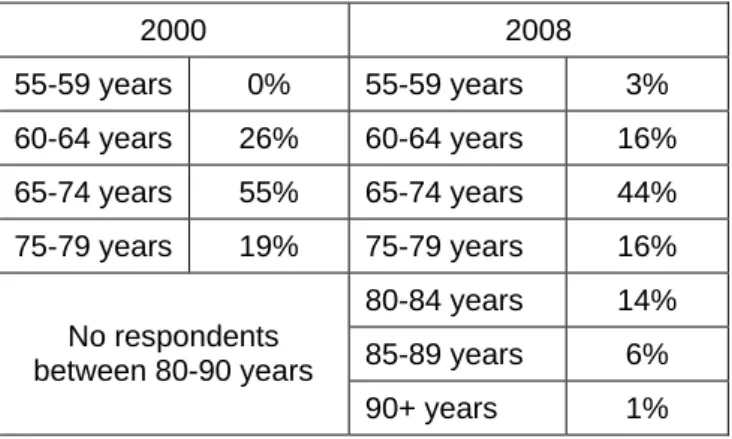
(15) single act could be the catalyst for more constructive cooperation and prompt better community integration.. The findings of the 2000 and 2008 investigations A comparison is made between the analysis and data relating to a selected range of similar questions in both questionnaires. The sample numbers were slightly different and some responses to questions were not completed. Nevertheless, with the analysis of participant observations and interviews added to the data, a reasonably reliable picture is captured. Drawing on the findings it is possible to reveal some insights and interpretations of the fluid and changing lifestyle of retired British expatriates on the Costa del Sol. The first striking difference is in the gender samples. In 2000 the gender ratio was approximately fifty per cent. In 2008 there was completely unexpected difference between genders with twenty-six per cent more females than males. It is difficult to explain this variation. There is ample evidence that in general women live longer than men. Social clubs have more female members, and Presidents report that women dominate their present membership. In addition, when the researchers were talking with club members, females were more prepared to complete survey questionnaires than males. If there is no rational reason why women agree to help a study; Alexandre Dumas (1803-1870) perhaps gave an answer by saying ‘There is a woman in every case; as soon as they bring me a report, I say look for a woman!’ There were variations in the range of age groups in the 2000 and 2008 data. Table 2 shows that in 2000 there were no respondents over the age of eighty, years, and in 2008 twenty-one per cent were at or beyond that age. Also eighty-one per cent were in the age groups sixty to seventy-four in 2000, and sixty per cent in the same group in 2008.. Table 2. Age Groups 2000. 2008. 55-59 years. 0%. 55-59 years. 3%. 60-64 years. 26%. 60-64 years. 16%. 65-74 years. 55%. 65-74 years. 44%. 75-79 years. 19%. 75-79 years. 16%. 80-84 years. 14%. 85-89 years. 6%. 90+ years. 1%. No respondents between 80-90 years. Some of the respondents were probably members in 2000 and 2008; therefore long serving members of a club over the years, and people living longer, might be one explanation. Another could be that in 2000 for reasons with no rational clarification the sample group simply did not include individuals over the age of eighty years. There was no attempt by the.
(16) researchers to exclude individuals because they were too old! The probable reason for the difference is that an examination of the 2000 data reveals that although the clubs had older members many of them did not complete the survey questionnaires. In examining the reasons for living in Spain the top five categories in the 2000 and 2008 studies showed climate was the primary reason for migrating. However, there was a difference of twenty-four per cent comparing 2000 and 2008. In 2000 ninety-four per cent said that climate was a priority in decision-making. The first study replicated previous IRM investigations where the sunny Spanish weather was a major factor in the decision to retire to the Costa del Sol. However, the weather was noted by only seventy per cent of the 2008 sample as a fundamental reason for retirement. A good number of this sample thought cultural and retirement issues were also important which wasn’t clearly stated in 2000. Since the Sriskandarajah and Drew 2006 publication there has been more emphasis about what is available in Spain, and how groups and individuals can obtain information on many aspects of retirement. This publication has been an essential study prompting others to communicate more with retirees, and the 2008 sample have benefited. What were significant in the comparison were the relative positions in the migration hierarchy of the cost of living. In 2000 the cost of living was considered to be important, but the worldwide economic financial debate has concentrated retirees’ minds in the 2008 sample where it was placed number three in their reasons. In both questionnaires it was felt that there might be differences in reasons for, and enjoyment of, living in Spain. In 2000 climate featured as a primary asset, with a relaxed way of life, environment, social factors and friendly Spanish people as the five categories. Eight years later the categories for enjoyment were climate, relaxed way of life, friendships, eating out and the environment. Although there were differences in rank order it was surprising that in 2008 thirty- three per cent said that eating out in Spanish restaurants was an enjoyment factor. In 2000 there was no mention of this practice yet observations at the time suggested that many retirees did enjoy meals with local people and compatriots. One reason for this could be that people feel more comfortable eating out as there are more local restaurants where staff speak a little English, and British retirees can also use what Spanish they have. This is a good example of interaction and integration. There has been much debate about the importance of acquiring some knowledge of the Spanish language. Analysing the 2000 and 2008 data there was little statistical difference in respondents’ self-assessment of their competence in Spanish. In the 2008 study forty-five per cent had undertaken various kinds of lessons as noted earlier in this report. By contrast in 2000 thirty- two per cent felt it necessary to learn Spanish. The probable reason for the thirteen per cent difference is that there are more language providers in areas populated by British people. Local towns and language schools are now aware of the need to offer courses for foreign residents. There are opportunities for retirees and others to access these facilities. But the.
(17) provision of lessons reflecting what older people want, rather than the assumption that what is presently offered for younger people is suitable for all should be addressed. If appropriate lesson material could be provided it would have an impact on community and social integration. Most of IRM studies comment about whether older Britons regard themselves as members of the Spanish community. In 2000 forty-five per cent said yes to the question about membership, and fifty-five per cent replied no. In 2008 there was almost a turn around with fiftytwo per cent believing that they were members, and forty-eight per cent who for several reasons did not consider that were partners in local society. It is argued that the thirteen per cent gap between the years is the result of comments by local Spanish observers of the about the advantages of emigration; better information concerning how a working knowledge of Spanish aids integration, and awareness by local town halls of the advantages of politically and socially aware citizens. What is also needed is an in depth study investigating how working and retired foreigners can become active and contributory members of Spanish society. There is evidence in the 2000 and 2008 studies of the intrinsic value of taking part in cultural events as a factor of social integration. The comparison data demonstrates that attendance at cultural events is an activity enjoyed by retirees. In 2008, but not in 2000 sixteen per cent said they went to lectures. It is not clear whether the talks were in Spanish or another language. What is apparent is that many British expatriates are prepared to take part in various events and enjoy meeting people. It cannot be denied that the intermixing of people can be a potent influence on community involvement, and subsequently on integration.. Conclusion The study has shown that most of the sample is very satisfied with their move overseas; would recommend it to other people and believed that their life-styles had improved beyond that experienced in the UK. Membership of a social club is seen as a crucial and important part of daily living. The friendship network and mutual support is highly valued. Opportunities to widen personal experiences by travelling to regions of Spain has added enormously to a productive retirement. The information club highway has meant that retirees have access to a set of shared experiences. Social clubs could become powerful centres of information because British expatriates have much to offer the community. A lifetime’s experience of work, and time and opportunity is largely uncommitted. Most of the older British migrants in Benalmadena have adapted to successful ageing. They have increased self-esteem and a better quality of life with a desire to enjoy their remaining years. They have clear views of what constitutes success in late age migration, and would recommend retirement to the Costa del Sol. When the present economic conditions improve it is likely that more retired people will relocate to Spain. If they do so the host country will welcome them. International Retirement Migration may, therefore,.
(18) provide creative opportunities for new communities, and the adoption of a different and compensatory life-style for older people.. References Barbottta H (2008) A total of 102 criminal groups operate on the Costa del Sol, most made up of Spaniards and foreigners. Sur in English, p. 2, 5th-11th. September. Malaga, Spain. Betty C (1996) Life isn’t really like that. Sur in English (p.10) October. Betty C (1997) Language Problems of Older British Migrants on the Costa del Sol. Generations Review, Vol. 7, No. 2, June. Betty C (2001) Why don’t you ask me whether I have a better quality of life? Generations Review Vol. 11, No. 2 June. Betty C and Cahill M (1999) British Expatriate Experience of Health and Social Services on the Costa del Sol. Chapter 5 in Anthias F and Laziridis G (eds), Into the Margins and Exclusion in Southern Europe, Aldershot, Ashgate, UK. Betty C (2000) The International Retirement Migration of Older British People To Spain: A Case Study of Benalmadena. Unpublished M’Phil thesis, University of Brighton, UK. Duran R (2005) Implicación política de los gerontoinmigrantes comunitarios, in M. Echezarreta (dir.), El Lugar Europeo de Retiro. Indicadores de excelencia para administrar la gerontoinmigración de ciudadanos de la Unión Europea en municipios españoles, Granada, Comares, pp. 64-93. Echezarreta M (dir.), El Lugar Europeo de Retiro. Indicadores de excelencia para administrar la gerontoinmigración de ciudadanos de la Unión Europea en municipios españoles, Granada, Comares. Ferguson M (1980) The Aquarian Conspiracy. JP Tucker, Los Angeles, USA. King R, Warnes AM, and Williams AM (1998) International Retirement Migration in Europe. International Journal of Population Geography 4, pp 91-111. King R, Warnes AM and Williams AM (2000) Sunset Lives: British retirement Migration to the Mediterranean. Berg, Oxford. O’Reilly K (2000) The British on the Costa del Sol: Transnational Identities and Local Communities. Routledge, UK. O’Reilly K, (2004) The Extent and Nature of Integration of European Migrants in Spanish Society – with special reference to the British case. University of Aberdeen, UK. Rodriguez V, Mayoralas G, and Rojo F, (1998) European Retires on the Costa del Sol: A Cross National Comparison. International Journal of Population Geography, 4, 1-18. Rodriguez V, Casado Díaz MA, Huber A (2000) La Migración de Retirados en España. UPC, Madrid. Sriskandarajah DJ and Drew C (2006) Brits Abroad, Mapping the Scale and Nature of British Emigration. Institute of Public Policy Research, London..
(19) Tortosa MA and Granell (2002) Nursing Home Vouchers in Spain: the Valencian Experience. Ageing and Society. Vol. 22, No. 6. Wake M and Vogel G (1985) Networking: Reducing Competition while Increasing Collegiality. Dimensions of Critical Care Nursing 4, (3) pp. 132-134.. http://www.gerontomigracion.uma.es/.
(20)
Figure

Documento similar