FACULTAD de FILOSOFÍA Y LETRAS
DEPARTAMENTO de FILOLOGÍA INGLESA
Grado en Estudios Ingleses
TRABAJO DE FIN DE GRADO
Slang in
The Great Gatsby
: A Comparative Analysis of Two
Spanish Translations
Rocío Martínez Alonso
Tutor: Esther Álvarez de la Fuente
ABSTRACT
The present project offers a comparative analysis of two Spanish translations of the canonical American novel written by Francis Scott Fitzgerald, The Great Gatsby. The aim of this research is to show the differences between a translation made in the 1970´s by Piñas (1975) and a translation made 36 years later by Navarro (2001), focusing on the translation techniques used when translating into Spanish the slang terms from the
1920’s used by Fitzgerald and on how they showed the social values and lifestyles of
the American decadence decade.
Literary translation, Gatsby, slang translation, translation techniques,
Este proyecto ofrece un analisis comparativo de dos traducciones españolas de la canónica novela norteamericana escrita por Francis Scott Fitzgerald, El Gran Gatsby. El objetivo de esta investigación es mostrar las diferencias entre la traducción de Piñas (1970) y la traducción de Navarro (2011) realizada 36 años después. Más concretamente, este trabajo se centra en el estudio del argot de los años 1920 usado por Fitzgerald y de las técnicas de traducción empleadas por estos dos traductores para reproducir la sociedad y la forma de vida de la década de la decadencia norteamericana.
Index
1. Introduction 1
2. Literary translation: Slang 2
2.1 What is Slang? 2
2.2 How do we translate Slang? 3
2.2.1 The importance of the social context 4 2.2.2 Approaches to literary translation: the peculiarities and applications to slang 5 2.2.2.1 Literary translation approaches 6
2.2.2.2 Slang translation approaches 7
2.2.2.3 Translation techniques 8
3. The English/Spanish slang translation: the importance of the historical context10
3.1 The Great Gatsby as a source text 10
3.2 Two Spanish translations: Piñas (1975) & Navarro (2011) 11
4. Aim: A comparison of the translation techniques used in both translations 13
5. Procedures 13
6. Analysis and results 15
7. Conclusion 18
References 19
1.
Introduction
As stated by some authors (Dumas and Lighter 1978, among others), slang has been stigmatized for ages by linguistic experts and literary experts, due to its vulgar character and lack of a consistent definition:
“Although the phenomenon has frequently been discussed, the term slang has rarely been
defined in a way that is useful to linguists. Annoyance and frustration await anyone who
searches the professional literature for a definition or even a conception of SLANG that can
stand up to scrutiny.” (Dumas and Lighter 1978: 5)
However, slang reflects an important part of the linguistic development of the speakers’ communities, as a reflection of the oral expression and the lifestyles of each group. This research discusses over the difficulties when translating slang by analysing how slang is translated from English into Spanish in two Spanish versions of Francis Scott Fitzgerald´s novel The Great Gatsby.
Section 2 offers the theoretical background of the project, which is divided into three main subsections. The first one provides two different definitions of slang and its characteristics. The second one deals with slang translation and focuses on the importance of the social context with a discussion over the differences between American and Spanish societies during the 1920´s decade. Some approaches to literary slang translation and some techniques typically found in this type of texts are also found in this section.
Section 3 deals with the three texts under analysis in our study: the original novel and both translations. The first subsection introduces the novel and the use of vocabulary on the part of the author, focusing on slang terms. The second subsection shows the historical context in which each translation was made, focusing on literary translation trends.
2.
Literary translation: Slang
This section is focused on the concept of slang and what has been considered as slang in this research. It provides definitions of the term, its characteristics, its difficulties when translating it, and some of the different types of approaches a translator may follow to overcome the challenging task of translating slang.
2.1 What is Slang?
Slang is one of the most debatable and problematic issues in linguistics because, although it is usually a popular topic, its marginal and non-academic nature, together with its ephemeral character, produce scarce academic research for its practical analysis.
At the same time, it is not easy to find an accurate definition of what we understand by
slang. In general terms, common slang is “a group of words and expressions
characteristic and singular of the register or colloquial diphasic variant” (Sanmartín 2003: 2). This means that speakers change their use of language depending on the communicative framework (formal vs. informal contexts); in this case, they use it in a relaxed and colloquial way, usually in oral registers. For this reason, literature on the topic records this special use of language in plays or dialogues, as in this research.
Slang is usually defined in terms of sociology, which is the approach adopted by Real Academia de la Lengua Española (2015), that describes it as “Lenguaje especial entre
personas de un mismo oficio o actividad.” In this sense, slang concerns the language
used by a certain group or community, while Collins English Dictionary (2003) includes a more restricted definition of slang as “vocabulary, idiom, etc., that is not appropriate to the standard form of a language or to formal contexts, may be restricted as to social status or distribution, and is characteristically more metaphorical and transitory than standard language.”. That is, slang is not appropriate in formal contexts and is restricted to a certain social class or status, and not only to a certain professional association.
of these communities, the society of the 1920´s in North America surrounded by “the Jazz Age, the Roaring Twenties, marked by bathtub gin, speakeasies, jukebox music, with middle-class, well-brought up young women smoking cigarettes in public, wearing
their skirts and their hair short.” (Carlisle 2008: vii).
From this perspective, the 1920´s slang has also been considered a dialect since it fits perfectly with the definition of dialect(Collins Dictionary 2003): “a form of a language
spoken in a particular geographical area or by members of a particular social class or
occupational group, distinguished by its vocabulary, grammar, and pronunciation”.
Therefore, as a dialect, slang could be translated under the standards of the dialect translations, since it was commonly used in a specific period of time (the 1920´s), in a concrete geographic emplacement (North American West Coast), and by a specific social class (North American middle class.)
As a form of colloquially spoken speech, slang can also be defined as a form of linguistic creativity since speakers make use of new slang expressions constantly. This inherent innovative and productive character of slang will imply certain difficulties when translating this type of expressions, since the translation process in this case does not follow an established set of translation rules but rather depends on the translator's creative skills. In the following section, we will show the peculiarities found in the translation of slang in the novel The Great Gatsby and some of the sociolinguistic factors that surrounded it.
2.2 How do we translate Slang?
2.2.1. The importance of the social context
As aforementioned, slang sets out translation problems due to its creative and colloquial nature. The translator may solve some of these barriers when there is a group of
speakers in the target language that is parallel to the speakers’ community of the source
text. But, even though this parallelism could be established, more difficulties can be added to the translator's task when slang expressions are new and/or unknown for the receiving culture (Calvo 2010).
In fact, these are the main difficulties found by Spanish translators when translating accurately F. Scott Fitzgerald´s The Great Gatsby (1925). More specifically, when comparing both North American and Spanish societies and cultures throughout the 1920´s decade, it is difficult to identify common or parallel points between both countries. In America, the Roaring Twenties meant the exaltation of happiness after the I World War, a period of strong economic growth, and a resulting social lack of inhibition. This situation provoked the literary trends gave birth to the Lost Generation, a group of writers that reflected the American society of that decade, and to which Fitzgerald belonged (Rodríguez 2010).
In the case of Spain, it experienced a decade of contrasts. The restored monarchy was characterized by mediocre politics, an excess of clerical power given by the unpopular king Alfonso XIII, and a strong presence of the armed forces due to the constant social clashes spread across the country. The consequence of this situation was the political uprising of Miguel Primo de Rivera, who imposed a dictatorship until the end of the decade. Although Spain tried to turn into a Modern country as the rest of Europe strengthening a cultural development, its society came to a standstill and remained living as in the 19th century in many ways (Esdaile and Beevor 2007). In view of this situation, Spanish writers only experienced Modernist and Postmodernist trends reflecting this underdevelopment, a very different situation from that found by the Lost Generation.
exploited by the books, movies, newspapers, and magazines of its own day” (Dalzell 1996: 9). This decade was a prolific period for the country in many different areas and, for this reason, the new society required a new way of expression and language was highly developed. Many of the new terms and expressions became popular and the American society included them into their everyday language, even some of them are still present in American English language, like “Absolutely!” or “sweetheart”. These new language trends meant the beginning of the slang dictionaries, which recorded the modernity of language (like The English Language in America, by George Krapp; or
American English, by Gilbert M. Tucker).
Meanwhile, the colloquial characteristics of Spanish language were recorded for the first time in history by Werner Beinhauer, in his book Frases y Diálogos de la Vida Diaria in 1925. This text includes a set of sentences and conversations extracted from literary texts, describing the communicative skills of Spanish language and its colloquial nature, focusing on conversational situations recording the common use of greetings, farewells, social life, or moods (Montero 2013).
In conclusion, as in the 1920´s both societies were following different paths in their social and cultural evolution, it is a hard task to find a parallelism between the source audience (i.e. North American society) and the target audience (i.e. Spanish society) of Fitzgerald's novel. This circumstance, together with other difficulties associated with the translation of slang, makes the translator's work not only a conscious reflection of the differences between texts at the level of context but also a laborious mediation where certain specific techniques are necessary when translating this particular kind of speech.
2.2.2. Approaches to literary translation: Particularities and applications to slang
2.2.2.1 Literary translation
The translation of literary texts requires a special kind of approach that considers the different uses of language implicit in this type of texts. This type of translation usually considers the peculiarities of literary language such as aesthetic and figurative style; therefore, it is very different from the approaches followed in technical translations. However, this research displays two different trends in literary translation: the norm-system and the polynorm-system.
The norm-system approach was developed by Gideon Toury (1995) who asserts that translation is a simple activity of substitution in which the linguistic units are replaced by equivalent units in the target language. .This kind of approach was commonly used in the 20th century translations. However, it was not suitable for literary translations because of its artistic and aesthetic nature. The results of translations based on this perspective made translators reconsider the way of approaching literary texts. They realized that the production of perfect equivalent translations was useful for specialized texts, but overlooked the artistic roots of literary texts. At the same time, in the case of slang translation, this theoretical approach made the translation activity not a very easy-going task since certain slang terms do not usually have linguistic equivalents in the target language.
Consequently, at the end of the 20th century, translation theories started to change.
Translators following this second trend consider translation as an activity influenced by everything around the source text and target text, like the historical context, society, or economical context. Thus, the translator’s success depends on the ability to produce a target text that transmits the source culture and influences the target culture, considering the content over the form, which would be a key matter especially in the case of slang translation.
These two theoretical approaches to literary translation will be relevant when comparing the two Spanish versions of The Great Gatsby, the focus of this work, since these approaches can imply the rendering of different productions as the final translation.
2.2.2.2 Slang translation
The translation of the colloquial and spontaneous nature of slang would pose a difficulty for professionals adopting one approach or the other. Every language includes a series of slang terms that only know a certain group of speakers. Therefore, any type of text containing a large amount of slang terms will require the use of certain techniques on the part of the translator to solve the difficulties derived from the slang translation.
Peter Newmark (1988) established two different techniques in order to approach the slang translation: (1) through semantic translation, by which the translator tries to keep the content and form of the source text. Consequently, the main translator´s barrier is to make the readers understand the message of the original text in a foreign context; and (2) through communicative translation, by which the translator tries to produce a target text that makes readers feel in the same way as those readers of the original text, keeping its cultural value. However, when performing this type of translation, the translator has to be careful with the distance that exists between the source text and the translated text, avoiding an interpretation away from the original piece (Newmark 1988).
translation type (both consider the accuracy of form over the proper transmission of the text message); and the polysystem approach is linked with the communicative translation type (both are focused on the reader's’ comprehension and the expression of the content over the form).
Whether adopting one theoretical approach or the other, or performing one type of translation or the other, the translator will use different translation techniques in order to focus on the form or the content. A brief classification of the main translation techniques will be described in the following section.
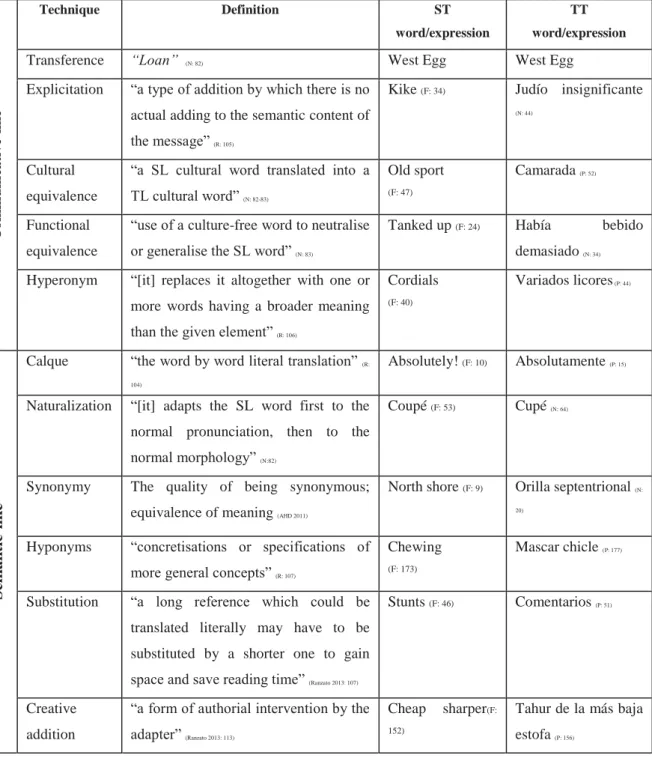
2.2.2.3 Translation techniques
Table 1. The main translation techniques used in literary translation1
Co
mmun
ica
tive
-like
Technique Definition ST
word/expression
TT
word/expression
Transference “Loan” (N: 82) West Egg West Egg
Explicitation “a type of addition by which there is no
actual adding to the semantic content of
the message” (R: 105)
Kike (F: 34) Judío insignificante
(N: 44)
Cultural
equivalence
“a SL cultural word translated into a
TL cultural word” (N: 82-83)
Old sport
(F: 47)
Camarada (P: 52)
Functional
equivalence
“use of a culture-free word to neutralise
or generalise the SL word” (N: 83)
Tanked up (F: 24) Había bebido
demasiado (N: 34)
Hyperonym “[it] replaces it altogether with one or
more words having a broader meaning
than the given element” (R: 106)
Cordials
(F: 40)
Variados licores (P: 44)
Seman
tic
-l
ike
Calque “the word by word literal translation” (R:
104)
Absolutely! (F: 10) Absolutamente (P: 15)
Naturalization “[it] adapts the SL word first to the
normal pronunciation, then to the
normal morphology” (N:82)
Coupé (F: 53) Cupé (N: 64)
Synonymy The quality of being synonymous;
equivalence of meaning (AHD 2011)
North shore (F: 9) Orilla septentrional (N:
20)
Hyponyms “concretisations or specifications of
more general concepts” (R: 107)
Chewing
(F: 173)
Mascar chicle (P: 177)
Substitution “a long reference which could be
translated literally may have to be
substituted by a shorter one to gain
space and save reading time” (Ranzato 2013: 107)
Stunts (F: 46) Comentarios (P: 51)
Creative
addition
“a form of authorial intervention by the
adapter” (Ranzato 2013: 113)
Cheap sharper(F:
152)
Tahur de la más baja
estofa (P: 156)
Following the proposal of Newmark´s (1988) about the types of translations exposed in section 2.2.2.2., in the present work, we have established the following assumptions: (1)
1 The definitions included in the “Definition” column are either taken from Newmark (1988) (N), from Ranzato
(2013) (R), or from American Heritage Dictionary (AHD). In the “ST word/expression” column the page numbers
if the translator’s performance is determined by the abuse of techniques such as calque, synonymy, and/or transference, the translator works under the precepts of the semantic translation; (2) if the translator uses a lot of functional equivalences and explicitations, and makes a balanced use of the rest of techniques, the translator is producing a communicative translation rather than a semantic one.
In this work, we will determine which is the type of translation that prevails in each of the Spanish translations under analysis, as it will be explained in the following section.
3. The English-Spanish slang translation in The Great Gatsby: The
importance of the historical context
3.1. The Great Gatsby as a source text
In 1925, F. Scott Fitzgerald published his canonical novel The Great Gatsby, which was considered at that time the great American novel. He was a writer strongly influenced by the culture of his time, being his work is a reflection of his own thoughts about the American society, settled in his own present, and that was characterized by the American dream of the 1920´s that encouraged young people to accomplish a life full of satisfactions and money; but also by the disillusionment produced by reality behind the non-sense excess and opulence of the decade.
In order to develop that realist setting, one of the most reliable techniques is the use of language. The novel narrates the story of Nick Carraway, a young man who moves to New York to work in the bond business. His new house is placed in the West Egg, next
to Jay Gatsby’s opulent mansion and his wild parties. He visits his cousin living in the
East Egg, Daisy, married with Tom Buchanan, a famous and wealthy polo player. Through the whole summer, Nick will discover all the secrets of the American high social class: the affairs, the corruption and snobbism of society, and the no-limits of ambition.
episodes in which he included more slang terms are usually those where he portraits the young and wild society and its amusements. For instance, in chapter 3, which narrates one of Gatsby’s parties, is one of the most prolific in terms of the use of slang -with 20 terms- because it shows a scene plenty of dialogues placed in a common social meeting. This fact demonstrates what was previously said in section 2.1: literary texts record slang in special registers trying to create a social portrait.
3.2. Two Spanish Translations: Piñas (1975) & Navarro (2011)
Two have been the most important Spanish translations of this classic novel: The first one, published in 1975 by Plaza & Janés and translated by E. Piñas, and the second one, published by Anagrama in 2011 and translated by J. Navarro. In order to understand the importance of these translations, it is convenient to talk about some different factors that have surrounded the translation activity throughout the last 50 years in Spain: the historical period from Franco´s regime to the democracy and the influence of European ideas. The first translation of the novel was influenced by the censorship and the lack of foreign ideas and theories dealing with linguistics and translation procedures that started to be developed in the rest of Europe; while the second translation is a product of the globalization and the exchange of linguistic ideas, following modern translation models.
Regarding Piñas´ translation, it was conceived as a work aimed at keeping the literacy and accuracy of the original text, following the norm-system approach (Toury 1995). As aforementioned in section 2.2.2, this theoretical approach produces a target text by substituting the source units by equivalents in the target language. The slang terms translated under this influence are specific and very accurate, like examples such as (1), where Piñas (1975: 51) makes a literal translation of Fitzgerald´s (1925: 46) original term:
(1) a baby act in costume >> [Representaron], debidamente caracterizadas, un número infantil
This literal translation in (1) produces loss of meaning, because “a baby act in costume”
means “to act like a sweetheart” (McCutcheon 1995: 6), similar to “actuación de
caracterizadas, un número infantil”. This technique does not take into account the external influences the original text receives, like the social, cultural, or economic context. As a result, the translator does not pay attention to the trends, such as the amusements or lifestyles that influence the text and that had a strong presence in America in the 1920´s decade. In consequence, the translator (Piñas 1975: 74) reproduces Fitzgerald´s (1925: 70) text with erroneous expressions, as shown in example (2):
(2) highballs >> albóndigas
In (2), “highballs” refers to alcoholic beverages but it was translated into a word that
refers to a food, which is a concept that moves away from the original one.
The conception of translations like these made translators reconsider the way of approaching the texts and developed new processes. In this framework appears
Navarro’s translation, influenced by theories like the polysystem approach defined in
2.2.2.1: the accuracy of the translated text does not consist in the maintenance of the form and content, but in the transmission of the same message throughout a catching language. In this way, as shown in example (3a), Navarro translates the term “kike” (Fitzgerald 1925: 38), which is a despective way to refer to a Jew, with an explicitation
as “judío insignificante” (Navarro 2011: 44). In (3b), there is another example where he
(Navarro 2011: 85) uses a functional equivalent to translate “roadster” (Fitzgerald 1925:
74), which is a type of convertible car, as “descapotable”:
(3a) kike >> judío insignificante
(3b) roadster>> descapotable
4. Aim: A comparison of the translation techniques used in both
translations
The main goal of this project is to compare the two Spanish translations of the novel written by F. Scott Fitzgerald, The Great Gatsby, focusing on the analysis of the North American slang words and expressions appearing in the original novel and their translation into Spanish. This comparative analysis will lead to the classification of each translation into one theoretical approach or the other (see section 2.2.2.1). In order to eventually confirm this classification, attention will be paid to the techniques used by each translator (see Table 1 in section 2.2.2.3) when rendering the interpretation of the slang terms found in the novel.
More specifically and as the main hypotheses of our work, this research establishes that, even though both versions will combine translation techniques of a different kind:
(a) Piñas’ version will follow the norm-system and semantic approach because it was
influenced by the translation approaches of that time and so, it will content a high number of synonyms, calques, creative additions, or substitutions; and
(b) Navarro’s version will follow modern approaches as influenced by polysystemic and
communicative approaches; therefore, it will content plenty of transferences, explicitations, functional equivalences, or cultural equivalences.
5. Procedures
sources appear either as archaic or belong to the standard English that people use nowadays.
This is a consequence of the time gap: some terms were slang in the 1920’s, but some of them have been assimilated as common expressions or have suffered a change of meaning by the pass of time. This is what happens with the word “Absolutely!” in (4), where the term meant an emphatic affirmation in the past, but has more connotations in
the present like “completely” or “perfectly” (CED 2003), and no slang connotations in
neither of the Spanish translations:
(4) “Absolutely!”(F 1925: 10) >> “Absolutamente”(P 1975: 10) >> “¡Por supuesto!”(N 2011: 21)
Besides, Fitzgerald sometimes plays with the double meaning of some of the
expressions as in (5a) and (5b), where the words “police dog” and “Airedale” are used
as dog races as a first interpretation, but they also have a slang figurative meaning.
(5a) “Police dog” (F: 27)>> “Perro policía” (P: 32) (N: 38)
(5b) “Airedale” (F: 27)>> “Airedale” (P: 32) (N: 38)
In the context of examples (5a) and (5b), one of the female characters, Myrtle, wants a
“Police dog” because she wants a new fianceé -Tom Buchanan, a rich man-, but she has
to do with just an “Airedale”, which means “a homely man”–that is, her husband-.
Once the terms where verified and following the typology shown in Table 1, each term or expression was classified into a specific translation technique, as shown in table 2:
Table 2. Analysis chart model.
# ST Def TT (Piñas) P Tech TT (Navarro) N Tech
In the classification process, all the words and expressions were numbered (#) to facilitate its inquiry. Then, the original terms/expressions were included in the ST
common dictionaries, such as American Heritage Dictionary (2011) (AHD) and Collins English Dictionary (2003) (CED). However, some meanings were provided by slang dictionaries, like Flappers 2 Rappers (F2R), American Youth Slang (Dalzell 1996) (AYS) or McGraw-Hill Dictionary of American Idioms and Phrasal Verbs (2002) (M-HDAIPV). TT (Piñas) heading provides information about the term extracts from Piñas´ translation, followed by the translation technique used in that TT (P Tech), and TT (Navarro) heading includes Navarro´s versions also followed by the used technique in his translation (N Tech). These techniques are taken from the classification provided in 2.2.2.3.
The complete chart of classification of each of the slang terms/expressions extracted for its analysis is found in Appendix. The analysis of the information contained in this database will result in a possible final dichotomy of the two Spanish translations as, on one hand, influenced by the norm-system or by the polysystem approach (see section 2.2.2.1), and, on the other hand, as a semantic or communicative type of translation (see section 2.2.2.2).
6. Analysis and results
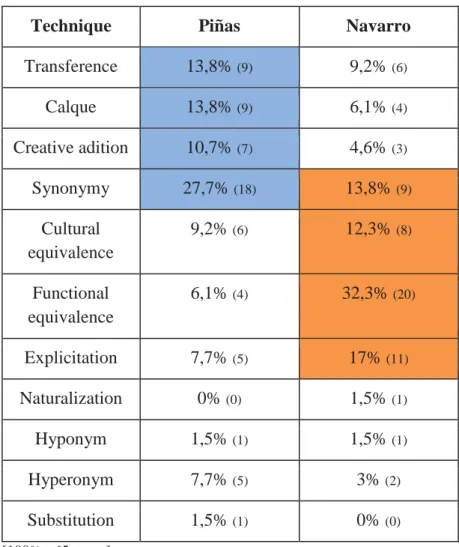
Table 3. Statistic results
Technique Piñas Navarro
Transference 13,8% (9) 9,2% (6)
Calque 13,8% (9) 6,1% (4)
Creative adition 10,7% (7) 4,6% (3)
Synonymy 27,7% (18) 13,8% (9)
Cultural equivalence
9,2% (6) 12,3% (8)
Functional equivalence
6,1% (4) 32,3% (20)
Explicitation 7,7% (5) 17% (11)
Naturalization 0% (0) 1,5% (1)
Hyponym 1,5% (1) 1,5% (1)
Hyperonym 7,7% (5) 3% (2)
Substitution 1,5% (1) 0% (0)
[100%= 65 terms]
Table 3 shows the percentage of use of each translation technique in both versions. Globally speaking, it is observed that in most cases both translators produced similar expressions in Spanish, using the same techniques, which shows that the use of these techniques are common in literary translation. Nevertheless, in the rest of cases they produced different translations, providing different interpretations of the same reality.
The items highlighted in blue show the first 4 techniques with higher percentages in
Piñas’ translation, which are synonymy, calque, creative addition, and transference.
Although transference is one of the techniques usually related with communicative translations, we have included this technique as close to semantic translations rather than to communicative ones because Piñas’ results under this technique may be difficult to recognize in the target culture. This is justified with examples (6a) and (6b), where Piñas does not change the terms and so, he keeps the same form without rendering any known meaning to the target reader. However, Navarro uses functional and cultural equivalents producing familiar expressions in the target language, like “ginebras con soda y zumo de lima” for “gin rickeys” and “conducto subterráneo a Canadá” for
“underground pipe-line to Canada”, using a technique more communicative-like than
semantic-like:
(6a) underground pipe-line to Canada (F: 97) >> la pipe-line subterránea al Canadá (P: 101)
>> conducto subterráneo a Canadá (N: 107)
(6b) gin rickeys (F: 118) >> gin rickeys (P: 118) >> ginebras con soda y zumo de lima (N: 127)
Thus, this analysis demonstrates that Piñas´ version is closer to the norm-system approaches and so, to a more semantic type of translation, which confirms our first hypothesis.
The results highlighted in orange provide Navarro’s performance, where cultural equivalence, functional equivalence, synonymy, and explicitation stand out as the 4 most used techniques. Three of them -explicitation, cultural equivalence, and functional equivalence- belong to the group of translation techniques that usually result in communicative translations, representing 61,6% of the total results and functional equivalence being the technique that the translator uses the most (32,3%). This means
that Navarro’s version tries to transmit the original message taking into account the
cultural and social differences between both languages and producing comprehensible
expressions in the target language. For instance, in (7a) he translates “tipsy”, which
means slightly drunk, as the functional equivalent “borracho” instead of “chispeante”
like Piñas does. In (7b), he translates “bob of red head”, which means a very short
(7a) tipsy (F: 106) >> chispeante (P: 110) >> borracho (N: 116)
(7b) bob of red hair (F: 30) >> compacta y pegajosa melena (P: 34)
>> pelada como un muchacho (N: 40)
For these reasons, this version is close to the polysystem approach and so, it is more a communicative type of translation than a semantic one, which confirms our second hypothesis.
7. Conclusion
After the analysis of the results, it has been demonstrated that the two hypotheses established in section 5 are confirmed. Piñas’ version was influenced by the translation techniques developed in the 20th century, focused on being as accurate and close to the form as possible; while Navarro followed recent approaches developed in the 21th century, expressing the original concepts in a comprehensible way and keeping the cultural and social aspects of the text. This demonstrates that the time gap between both translations is large enough to show relevant differences in the Spanish translation panorama.
Besides, both translators make a combination of translation techniques to produce their works, underlining that literary translation containing slang is a difficult task that does not follow a specific process and may have different interpretations about the same reality. The large differences between them highlight the subjective nature of slang that provides a wide list of options when translating it. Thus, literary translation is more than a replacement of linguistics units; it is an artistic and creative process that may transmit not only the content of a novel, but also the personal linguistic interpretation of each translator.
References
“The Great Gatsby by F. Scott Fitzgerald | English Literature Course Notes | Tower
Notes.” Tower Notes. 2015. 23 May 2015.
American Heritage® Dictionary of the English Language, Fifth Edition. 2011. Houghton Mifflin Harcourt Publishing Company 23 May. 2015
American Jewish Desk Reference. “David Belasco (1853 - 1931)”. NY: Random House, 1999.
Calvo, José Ramón. "Análisis contrastivo de las escuelas lingüísticas de traducción y de la escuela de polisistemas aplicado al estudio del argot." Tonos digital: Revista electrónica de estudios filológicos 20 (2010): 1.
Carlisle, Rodney P. Day by Day: The Twenties. Vol. 1. Facts on File, 2008.
Chomsky, Noam. Sobre la naturaleza y el lenguaje. Ediciones AKAL, 2003.
Collins English Dictionary – Complete and Unabridged. 1991, 1994, 1998, 2000, 2003. HarperCollins Publishers 23 May. 2015
Cowles, R. K. Slang Poetry Volume I. Lulu.com. 2013.
Curnutt, Kirk. The Cambridge Introduction to F. Scott Fitzgerald. Cambridge University Press, 2007.
Dalzell, Tom. Flappers 2 Rappers: American Youth Slang. Springfield, MA: Merriam-Webster, 1996.
Diccionario de La Lengua Española. Web. 2015. Real Academia Española. 23 Mar. 2015.
Eble, Kenneth Eugene. F. Scott Fitzgerald. Twayne publishers, 1963.
Esdaile, Charles J., and Antony Beevor. El Fin De La Monarquía: República Y Guerra
Civil. Madrid: El País, 2007.
Even-Zohar, Itamar. “Factors And Dependencies in Culture: A Revised Outline for
Polysystem Culture Research.” SSRN Journal SSRN Electronic Journal. 2002
Lowry, Ed, Charlie Foy, and Paul M. Levitt. Joe Frisco: Comic, Jazz Dancer, and Railbird. Carbondale: Southern Illinois University Press, 1999.
Mahony, David. English: Excel Preliminary. Glebe, NSW: Pascal Press, 2003.
McCutcheon, Marc. The Writer's Guide to Everyday Life from Prohibition through World War II. Cincinnati, OH: Writer's Digest Books, 1995.
Hill Dictionary of American Idioms and Phrasal Verbs. 2002. The McGraw-Hill Companies, Inc. 23 May. 2015
Montero, Pilar. En la prehistoria de los estudios sobre el español coloquial:" Frases y diálogos de la vida diaria" de Werner Beinhauer. Univ. de Extremadura, 2013.
Murphy, Tom. “An Index to The Great Gatsby.” An Index to The Great Gatsby by F.
Scott Fitzgerald. 2002. 24 May 2015.
Newmark, Peter. A textbook of translation. New York: Prentice Hall, 1988.
Partridge, Eric. Slang To-Day and Yesterday, with a Short Historical Sketch and Vocabularies of English, American and Australian Slang. London: Routledge & K. Paul, 1970.
Random House Kernerman Webster’s College Dictionary. 2010. 2010 K Dictionaries Ltd. Copyright 2005, 1997, 1991 by Random House, Inc. 23 May. 2015
Ranzato, Irene. 'The Translation Of Cultural References In The Italian Dubbing Of Television Series'. Doctoral. Imperial College London, 2013.
Rodríguez, Gabriel. "Generación perdida." Técnica Industrial. 289. 2010.
Sanmartín, Julia, and A. MODO DE PRESENTACIÓN. "Lingüística aplicada y argot: los útiles lexicográficos del traductor." Lexicografía y Lexicogía en Europa y América: Homenaje a Günter Haensch. Editorial Gredos, 2003.
Toury, Gideon 1995. "The Nature and Role of Norms in Translation". Descriptive Translation Studies and Beyond. Amsterdam-Philadelphia: John Benjamins, 1995, 53-69.
Webster's Revised Unabridged Dictionary. 1913. C. & G. Merriam Co. 23 May. 2015
22 ST Def TT (Piñas ) Tec h TT (N avarro ) Tec h bon d bu si n e ss (p . 3 ) Or bon d m ark et ; t h e m ark et in w h ic h bon ds are trad ed . (C E D 2003) A cti v idad es b o lsís ticas (p . 7 ) Sy n onym y C o m p rav e n
ta de bon
os (p . 13 ) Sy n onym y W est Eg g/East E gg (p . 4 ) Metap h o
r; an eg
g is a pers on w h o liv e s th e big lif e. (M a h o n y 2003: 178) W es t E gg/ E a st E g g (p .8 ) T ransf erence W es t E g g/ E ast E g g (p . 14) T ransf erence A w ell -r oun ded ma n (p . 3 ) Co m p rehe n si v el y develo ped and w ell -b alanced in a ran g
e or v
ariet y of a spects . (A HD 2011) E l ho m b re mu y c u lt iva d o (p .9 ) Cu lt u ral eq u iv ale n t El h o m b re co m p leto (p .15) Fun ction al eq ui va le nt No rth sh o re (p . 9 ) L a k e Forrest, w ith c u lt iv ated lan dscape a s w ell as peo p le, ep ito m ized an un a b ash ed u pper -cla ss social w h irl. (E bn er 1988: 195) Orilla norte (p . 14) Calq ue Orilla septen trio n al (p .20) Sy n onym y A b sol u tel y ! (p . 10) Yes (A
YS 1996: 11)
A b sol u ta m en te (p .15) Calq ue ¡P or s u pu es to ! (p .21) Fun tion al eq ui va le nt anon (p . 18) (archaic) soon ; sh ortl y ( C E D 2003) pron to (p . 23) Sy n onym y Pr on to (p .29) Sy n onym y red g as-p u m p s (p . A p u m p in a service sta tion t h at dra w s g asoli n e fr o m u n d erg roun d storage ta nk s. (T F C C 2008) B o m b as nu evec itas de ga so li na (p . 25) Calq ue S u rtidores roj os (p .31) Fun ction al eq ui va le nt ta n ke d up (p . 24 ) D run k (A HD 2011) Hab ía e m pin ad o el co do en de m as ía (p . 28) Ex plicitation Hab ía beb ido dem a si ado (p .34) Fun ction al eq ui va le nt B
e a blin
d (p . 25) H idden f ro m sigh t (A HD 2011) T apa dera (p . 29) Creativ e ad dition C o rtin
a de hum
o (p . 35) Creativ e ad dition East Egg ers (p . 26) Wh o liv e
s on t
h e Eas t Egg , pe ople liv in g t h e big Hab itan tes del Eas t E g g (p . T ransf erence Hab itan
tes de East Egg
T
ransf
23 lif e. 31) (p .37) P o lice d o g (p . 27 ) Y o un g w o m a n 's fi a n ce (C o w le s 20 13) P erro policía (p . 32 ) Cu lt u ral eq u iv ale n t P erro policía (p .37) Cul tur al eq ui va le nt A ired ale (p . 27) A h o m el y ma n (C o w le s 2013) A ired ale (p .32) T ransf erence A ired ale (p .38) T ransf erence Bob of red h air (p . A w o m an
's or child
's s h ort h aircut (A HD 2011) It becam e fa m ous in t h e 1920 ´s Co m p acta y pe g aj o sa me le na r o ja (p . 34 ) Creativ e ad dition P elad a co m o un muc h ac ho (p .40) Ex plicitation A rti stic g a m e (p . 30) T o
be an artis
t. Ra m o artís tico (p .35) Sy n onym y Mun d il lo artís tico (p .40) Cul tur al eq ui va le nt Fellas (p . 31) A m a n or boy
; a f
ello w . (A HD 2011) Gent u za (p . 35) Fun ction al eq u iv ale n t Gent u za (p .41) Fun ction al eq ui va le nt Gasolin e pum p (p . Gas p u m p . B o m b
a de g
asoli n a (p . 37) Sy n onym y Su
rtidor de g
asolin a (p .43) Fun ction al eq ui va le nt Kik e (p . 34)
Used as a disparaging
ter
m
f
o
r a J
ew (A HD 2011) Ti p ejo (p . 38) Fun tion al eq u iv ale n t Ju dío in si g n if ica n te (p .44) Ex plititatio n S w eetie (p . 35) S w eeth eart; d ear. (A HD 2011) Am o r (p . 39) Sy n onym y Am ig o (p .45) H y perony m Cordials (p . 40) (A rchaic) Inv ig o rating ; st im u lati n g . Used especiall y of a bevera g e. (A HD 2 011) Var iad os licores (p . 44) H y perony m B eb idas alco h ó licas (p .50) Fun ction al eq ui va le nt T h e dream s of Castile (p . 40) Sug g e sts t h at th e s h a w ls of w o m
en at Gatsb
y 's parties w ere fi n er th a n a n y t h at t h e i n h ab ita n ts of Cast ile co u ld h
ope to o
w n . (M ur phy 2002) L o s s u e ñ
os de Casti
lla (p . 44) Calq ue L o s s u eño
s de la
anti g u a Casti lla (p .50) Ex plicitation In fu ll s w in g (p . 40) at th e peak of acti v it y ; m o v in g fa st or ef ficien tl y . (M -H D A IP V 2002) En plen o ap og eo (p . 44 ) Creativ e ad dition B u
lle de ani
m ación (p .50) Creativ e ad dition Yello w co c k tail m u sic (p . 40) Ja zz m u sic. M ú sica popu
lar para la
h
o
ra del co
cktail (p . 45 ) H y perony m
Música de co
cktail
(p
.50)
Calq
24 S w ell (p . 40) G o od (A
YS 1996: 17
) H inc ha n (p .45) Creativ e ad dition Crecen (p .51) Creativ e ad dition L ik e Frisco (p . 41) L ik e J o
e Frisco, a p
opu
lar Am
erican actor and
dan cer. (L o w ry , E d , C h ar li e F o y , an d Pau l M . L evi tt 1999) Co m o Frisco (p . 45) T ransf erence Co m o Frisco (p .51) T ransf erence R o arin g drun k (p . O r d runk a s a l o rd ; ve ry d runk (M -H DA IP V 2002) E m borrach ar m e co m o un a cuba (p . 46 ) Ex plicitation E m borrach ar m e escandalo sa m en te (p .52) Ex plicitation P o sitiv el y (p . 44) Yes (A
YS 1996: 16)
Af ir m ó res u elta m e n te (p . 48) Ex plicitation Asegu ró categ órica m e n te (p . 54) Ex plicitation F irs t su pper (p . 44) A li g h t eve n ing m ea l w h e n din n
er is ta
k en at mi d d a y (A HD 2011) P rim era cen a (p . 49) Sy n onym y P rim era cen a (p . 55) Sy n onym y Ow l-ey ed (p . 45) H av in g ey es l ik e an ow l' s (W e b st er 's R e vi se d U n a b ri dged D ict io n ar y 1913) Gaf as d e lech u za (p . 50) Creativ e ad dition O jos de bu h o (p .55) Calq ue regu lar B elasco (p . L ik
e David B
elasco , J ew is h Am erica n th eatrical produ cer, im
presario, director and pla
y w righ t, recog n ized f o r creating stag e sets (A m er ic a n J ewi sh De sk R e fe re n c
e 1999: 347)
Au té n tico B elasco (p . 50 ) Calq ue Ver d ad ero B elasco (p .56) Calq ue Stun ts (p . 46) a perf orm a n ce displa y in g a person 's s k ill, dex terity
, or daring
; f ea t (K er ne rm a n We bs te r' s C o lle g e D ict io n ar y 2010) Co m e n tarios (p . 51) Su bsti tu ti on Su propio espectáculo sen sacion al (p .57) Ex plicitation A B ab y act i n co stum e (p . 46) A ct lik e a s w eet h eart. A
lso denotes so
25
fi
n
g
ers at t
h e tab le. (A H D 2011) eq ui va le nt O ld s port (p . 47) Sen se of " st y li sh m an" ; a f a m iliar f o rm of ad dress
to a m
a n . (O nli n e E ty m o lo g y D ict io n ar y 2015) Ca m ar ad a (p . 52) Cu lt u ral eq u iv ale n t Co m p añero (p .58) Cul tur al eq ui va le nt H avi ng a ga y ti m e? (p . 47 ) g iv e n to pleasu re, es p in social entertainm e n t. (C ED 2003) ¿T e div iertes ahora? (p . 52) Sy n onym y ¿L o pas as bien ? (p .58) Fun ction al eq ui va le nt R oug hn ec k (p . 48) A w il d , unc o u th ma n (P ar tr idge 197 0: 312) Mo zallón (p . 53) Sy n onym y Matón (p .48) Fun ction al eq ui va le nt Ja un ty sal u te (p . 52) H av in g or ex pres si n g a bu o y an
t or s
elf -co n fide n t air. (A HD 2011) G arbos o s alu do (p . 57) Fun ction al eq u iv ale n t A leg re s alu d o (p .63) Fun ction al eq ui va le nt Co up é (p . 53) A clos ed t w o -door au tom obile . (A HD 2011) Co up é (p . 58) T ransf erence Cup é (p .64) Naturalizatio n Jau n ty bod y (p . 58) Mark ed b y u p -t o -date n es s i n dress and m an n ers; dapper (F ar le x c li p ar t c o ll ect io n 2012) G arbos o cu erpo (p . 63) Fun ction al eq u iv ale n t C u erpo f u erte y f eliz (p .69) Sy n onym y Bootleg g er (p .61) A dealer in s u ppress ed n o v els (A
YS 1996: 11)
Con
trab
andís
ta de alco
h o l (p . 65 ) Ex plicitation T raf
icante de licores
(p .71) Ex plicitation T h re e no te d ho rn . 63 ) Ho rn of t h ree n o tes th at belo n g s to an osten tatio u s car. Clax o n
de tres n
o tas (p . 68) Calq ue
Melodía de tres n
o tas (p .73) Fun ction al eq ui va le nt Cho k ed (p . 65 ) T o h ave diff ic u lt y i n breat h in g , s w allo w ing , or sp ea ki ng. (A HD 2011) Sorbiera (p . 69 ) Sy n onym y At ra g an tó (p .75) Fun ction al eq ui va le nt Negro es (p . 69) A black perso n . Of te n off e n si v e. (A HD 2011) Negro s (p . 73) Cu lt u ral eq u iv ale n t Negro s (p .79) Cul tur al eq ui va le nt Bu ck s (p . 69) Off en si v
e, a Nativ
e
Am
erica
n or black m
26 a carbon ated beverage. (A HD 2011) Ga m b ler (p . 73) A v en tu re, a specu lator. (R o g et 's 21s t C en tur y T h e saur u s 2009) Ju g ad o r prof esion al (p . 77) Ex plicitation Juga d o r (p .83) Cul tur al eq ui va le nt Road ster (p . 74 ) An of te n roof less or co n v ertible auto m obile h avi ng a si ng le seat in t h e fr on t fo r t w
o or th
ree
peo
p
le and a ru
m
b
le s
eat or lu
g g a g e co m p art m e n t in t h e back . ( A HD 2 011) Road ster (p . 79 ) T ransf erence Descap otab le (p .85) Cul tur al eq ui va le nt B ea ux (p . 75) A g irl 's o r w o m an 's sw eet h e ar t. (K er ne rm an W eb st er ’s C o ll eg e D ict io n ar y 2010) P retendien tes (p . 80) Sy n onym y Ad mi ra d o re s (p .85) Sy n onym y D run k a s a mo n k e y (p . 76) T o b e dr unk. M ás borrach a qu e un a cuba (p . 80 ) Cu lt u ral eq u iv ale n t T o talm en te borrach a (p .86) Ex plicitation Sh e w as g a y (p . 75) Sh o w in g or characterized b y cheerfu ln e ss a n d ligh th earted e x cite m ent ; m err y . (A HD 2011) Vo lv
ió a estar alegre
(p . 80) Sy n onym y Estab
a otra v
ez alegre (p .86) Sy n onym y Victo ria (p . 78 ) A lo w , li g h t fo u r-w heeled carriag e f o r t w o w ith a f o lding
top and an ele
v at ed driv er' s sea t in fr o n t. (A HD 2011) Victo ria (p . 82 ) T ransf erence Victo ria (p .88) T ransf erence Sh ell -r im m ed g las ses (p .94) Ho rn-ri m m ed g lass e s, h a v ing th e f ra m e m ad e of h o rn
or tortoise sh
el
l or plastic t
27 Orchid w o m an (p . Any thing ex pe n si v e (A
YS 1996: 15)
Muj er m ara v illosa, orqu ídea (p . 109) Calq ue M u je r orqu ídea (p .115) Calq ue Ti p sy (p . 106) S lig ht ly d ru nk. (C E D 2003) Ch is pean te (p . 110) Sy n onym y Borrach o (p .116) Fun ction al eq ui va le nt S w eeth eart (p . 117) A pers on reg arded as g e n erou
s or lov
able. (A H D 2011) Car iño (p . 122) Sy n onym y Te so ro (p .127) Sy n onym y Gin rick e y s (p . 118) a m ix ed drin k m ad e of s w e etened li m e ju ice, soda w ater
, and g
in . (T F C C 2008) Gin ricke y s ( p. 118) T ransf erence G ine b ra s c o n so d a y zu m o de li m a (p .127) Fun ction al eq ui va le nt A s w ell s u ite (p . 126) A g ood su it. (A
YS 1996: 17)
Un saló n est u pendo (p . 131) Sy n onym y Un a s u ite m u y c h ic (p. 136) T ransf erence Co m m o n s w in dler . 133 ) a pers on w ho sw in dles you b y m ea n s of deception or f rau d. (T F C C 2008) D o nna d ie (p . 134) Cu lt u ral eq u iv ale n t Vu lg ar esta fa d o r (p .143 ) Fun ction al eq ui va le nt Stun ts (p . 133) A f ea t displa y ing unu su al stren g th , s k ill, or darin g . (A H D 2011) P eq u eñas h aza ñ as (p .138) Sy n onym y Tr u co s (p .143) Fun ction al eq ui va le nt S o n-o f-a -b it c h (p . A pers on reg arded as m ea n or dis ag reeable. (A H D 2011) E l m uy … gr an uj a (p . 144 ) Sy n onym y H ij o de pu ta (p .149) Cul tur al eq ui va le nt C h eap sh arper (p . O n e t h at deals dish on e st ly w ith oth ers , especiall y a c h eating g a m b ler. (A HD 2011) T ah ú
r de la
m á s baj a estof a (p . 156) Creativ e ad dition Vu lg ar esta fa d o r (p . 161) Fun ction al eq ui va le nt Caho o ts (p . 154) T o b e in partn ersh
ip or c
o n spirac y . (K er n erm a n W ebs te r’ s C ol le ge D ic ti on ar y 2010) A c u erdo (p . 158) Sy n onym y Co m p in che s (p . 163) Fun ction al eq ui va le nt Hick to w n s (p . 166) P rov in cial; un soph is ticated . (A HD 2011) Estas ci u d ad es (p . 171 ) H y perony m Ciu d ad es atrasadas (p . 176) Sy n onym y Che w in g (p . 173) T o che w tobacco
as a h