RELATIONSHIP BETWEEN OBJECTIVE AND
SUBJECTIVE INDICATORS IN URBAN SOUNDSCAPE
ANALYSIS. THE CASE OF CÓRDOBA - ARGENTINA
Arturo Maristany; Manuel Recuero López
Centro de Investigaciones Acústicas y Luminotécnicas (CIAL), Universidad Nacional de Córdoba -Argentina; Grupo de Investigación en Instrumentación y Acústica Aplicada (I2A2), Universidad
Politécnica de Madrid.
[email protected]; [email protected]
Abstract
This paper presents the main results of a comparative evaluation of some acoustical parameters with the user´s perception of urban sounds. The study was carried out in three open spaces integrated with different environmental characteristics but similar objective conditions of urban noise. The subjective evaluation was done by means of a survey simultaneously with the objective measurements. The results of the crossed analysis confirmed that in environments with similar noise levels not always exists direct correlation between the objetive indicators and the acoustic comfort of the people. To predict the acustical quality of the soundscape it is necessary to consider aspects such as the background noise and the perception of natural or technological sounds as complements of the general sound level.
Keywords: Soundscape; urban open space; sound perception
1 Introduction
introduction of a pleasant sound, especially as a masking sound, could significantly improve the acoustic comfort, even when noise level is somewhat high.
Human perception in terms of noise, in contrast to a physical instrument such as a sound level meter, is not absolute and is based mainly on the effects of sounds in the context of the relation between sources that emit noise and people who are exposed to it [2]. Several studies are following this line of research in recent years, aimed at articulating the objective measurements of urban noise with acoustic comfort criteria of the studied outer urban areas. Most are based on a comparative study between measured objective acoustic parameters and simultaneous surveys on the reaction of users of the analyzed outdoor spaces [3] [1] [4].
2 Methodology
2.1 Definition of Analyzed Spaces
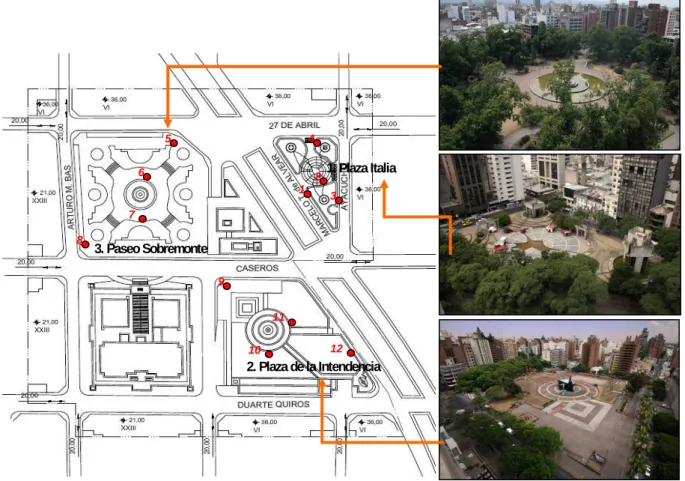
The selected group is the open space system located in the central area of the City of Cordoba - Argentina, consisting of Paseo Sobremonte, Plaza Italia and the Plaza de la Intendencia (Figure 1).
Figure 1 - Group of urban areas analyzed
The three spaces, with different settings, are located around the city hall and court building, acting as a framework for institutional buildings and as recreational spaces of various kinds. For the analysis the choice of the urban area was determined based on the following criteria:
1 2
3 4 5
6
7
8
9
10 11
12
3. Paseo Sobremonte
identical boundaring conditions, different spatial configuration, different appropriation and constituent urban elements. The objective is an area of analysis that allows, by comparing different scenarios with similar conditions, to draw conclusions in relation to the quality and characteristics of the soundscape.
2.2 Subjective
Soundscape Assessment
Various works implement field surveys to determine the comfort level of users of the analyzed outdoor spaces. Questionnaires based on open and closed questions are directed to general sociological and individual aspects in relation to the physical space to be assessed, and the characterization of its soundscape. The questionnaire applied in the context of this work has taken as a general reference the one developed in an european project [5]. It contains a structure with initial questions intended to characterize the user’s sociological profile, then the overall assessment of the landscape of analyzed urban space and finally the characterization of sound sources and the degree of discomfort. Following the criteria established in similar works, the application of semantic scales of a maximum of five categories was adopted for the characterization [3] [6].
The proposed survey model was applied to the three outer urban areas selected for the study. The polls were conducted, simultaneously with the objective acoustic measurements, to groups of people selected at random. Surveys were conducted in two different types of days with respect to sector activity, affluence and traffic flow.
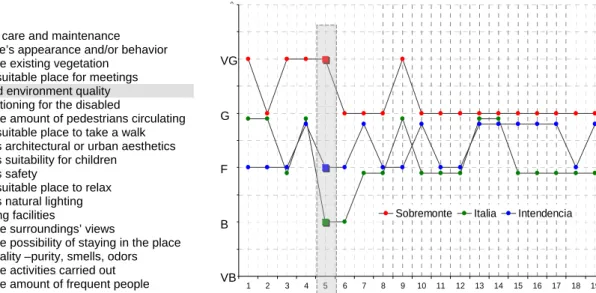
The first two questions in the questionnaire refer to the user’s frequency and reasons for attending the urban space and the time they spend there. Question 3 deals with the general environmental aspects of the urban space analyzed, under a semantic weighting scale of five entries: "very good," "good," "fair," "bad" and "very bad". Figure 2 summarizes the overall result achieved.
Figure 2 - Graphical Summary of response to environmental conditions in the sector
The question referring to sound sources finds out the level of perception in a scale from "not heard", "rarely heard", "sometimes heard", "frequently heard" and "completely prevailing", and the level of pleasure or discomfort under the scale: "Pleasant", "indistinct", "Unpleasant", "annoying" and "irritating". The sounds are divided into three categories: those produced directly by people, natural and technological [6] [7].
1 Place care and maintenance 2 People’s appearance and/or behavior 3 For the existing vegetation 4 As a suitable place for meetings 5 Sound environment quality 6 Conditioning for the disabled
7 For the amount of pedestrians circulating 8 As a suitable place to take a walk 9 For its architectural or urban aesthetics 10 For its suitability for children
11 For its safety
12 As a suitable place to relax 13 For its natural lighting 14 Seating facilities
15 For the surroundings’ views
16 For the possibility of staying in the place 17 Air quality –purity, smells, odors 18 For the activities carried out 19 For the amount of frequent people
0 0.5 1 1.5 2 2.5 3 3.5 4 4.5 5
1 2 3 4 5 6 7 8 9 10 11 12 13 14 15 16 17 18 19 Sobremonte Italia Intendencia
Table 1 – Human, natural and technological sounds
Human Sounds Natural Sounds Technological Sounds
• Pedestrians’ talks • Pedestrians’ steps • Children’s games • Street music
• Music from the stores around
• Dogs barking • Birds singing • Water
• Insects’ sounds
• General traffic • Mopeds and motorbikes • Trains
• Airplanes • Public transport
• Building construction • Pedestrian crossing • Music from cars
• Car parkings
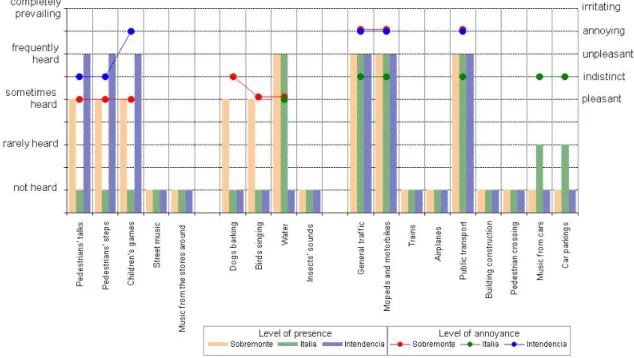
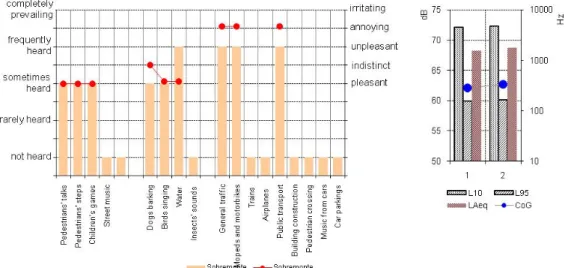
The charts in Figures 3 and 4 show a graphic summary of results in relation to degrees of presence and discomfort of various sources of noise potentially present in the area. The bars indicate the level of presence -its reading on the left scale, and the dots indicate the level of annoyance -its reading on the right scale.
Figure 3 - Comparative Summary of presence and discomfort levels on weekdays
It is pointed out from the analysis of the graphs that traffic in its various forms: general, motorcycles and public transport are the main affecting sources, considered to be "frequently heard" in the three spaces. The situation remains on weekdays as well as on the weekend and is generally considered as annoying or irritating.
people, start to appear on the weekends when the influence of other sound sources decreases.
Figure 4 - Comparative summary of presence and discomfort levels on the weekend
Pedestrians’ talks and steps and children's games have a significant presence during business days in Paseo Sobremonte and Plaza de la Intendencia. Out of the comparison of both places it is highlighted that these sounds are "sometimes heard" in Paseo Sobremonte and are considered pleasant, whereas in Plaza de la Intendencia they are "frequently heard" and are considered "not pleasant" to "annoying”. This situation suggests that for the same type of sound there is a limit on the level of presence over which the same sound which may be pleasant becomes annoying. The noise of natural origin is always accepted as pleasant, even when dominant; this situation does not occur in the case of noise produced by people.
2.3 Soundscape Objective Analysis
For the purpose of an objective assessment of the studied area statistical measurements were carried out in the inner areas of the tested spaces and on their perimeters, coinciding with vehicular traffic routes. The measured parameters were LAeq, LN (N = 1, 5, 10, 50, 90, 95,
99) and LZeq in one-third octave bands from 12.5 Hz to 20KHz. Measurements were carried
out using a type 2250 Brüel & Kjaer sound level meter, equipped with BZ 7223 frequency analysis software.
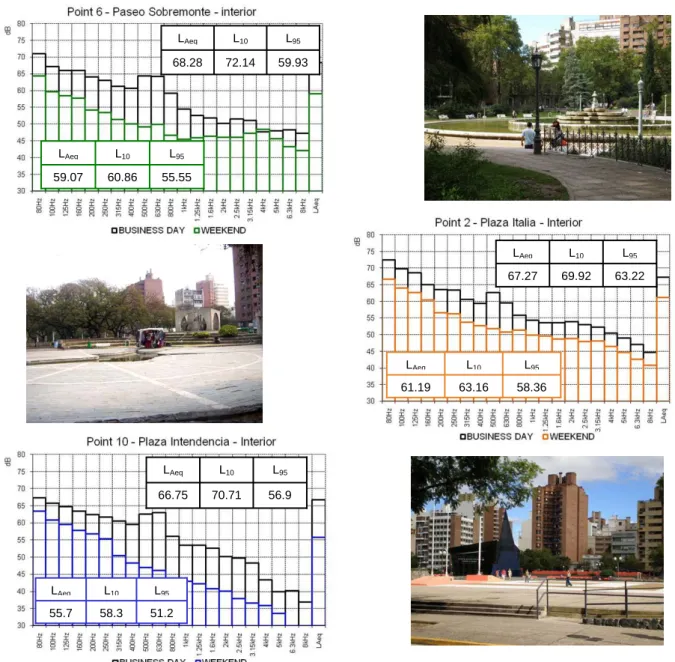
Figure 5 - Results of inner measurement points
The resulting spectrum of the measurements on weekdays shows a progressive increase of the energy towards low frequencies, typical of traffic noise, dominant source during weekdays and which characterizes the spectral distribution of all the analyzed points regardless of their location. In Paseo Sobremonte during the weekend the relative content in mid and high frequencies produced by the water movement increases. In Plaza de la Intendencia the spectrum shape is kept at a lower level highlighting the absence of specific sources of noise. The CoG spectral center of gravity was calculated for each spectrum, which is deemed as appropriate to characterize the spectral content of the analyzed sound.
2.4 Relation between Subjective and Objective Indicators
Graphs of Figures 5 through 7 compare the results of subjective analysis of each area with objective parameters derived from the measurements performed. The chart on the right
59.93 72.14
68.28
L95 L10
LAeq
55.55 60.86
59.07
L95 L10
LAeq
63.22 69.92 67.27
L95 L10
LAeq
58.36 63.16
61.19
L95 L10
LAeq
56.9 70.71
66.75
L95 L10
LAeq
51.2 58.3
55.7
shows L10 and L95 statistical levels, LAeq equivalent continuous noise level and CoG spectral
center of gravity.
Figure 5 - Subjective and objective indicators - Paseo Sobremonte - Weekdays
In Paseo Sobremonte the presence of water together with birds singing are the prevailing and most accepted natural sounds. Although transport noise has a lower level of perception on the weekend, its level of acceptance decreases, and is then qualified as irritating. The reverse situation is also displayed on the sounds produced by the presence of people: for lesser presence the acceptance level is lower. Apparently as the sound quality in the space increases the demand of users is higher. This may also be due to the difference in the type of user during the weekend in relation to the users on weekdays.
Obviously the reduction in objective noise levels during the weekend is directly related to the decrease in traffic flow in the sector. The decrease in traffic noise levels allows the appearance of masked sounds, especially natural ones, changing the users’ acoustic perception of the sector. The relation "figure - background" in the noise situation changes.
Figure 6 - Subjective and objective indicators - Plaza Italia – Weekdays.
The background now consists of more pleasant sounds and therefore the demand in relation to particular and specific sounds is greater. Even so the CoG value keeps on moving towards
low frequencies due to the influence of traffic noise. The traffic noise disturbance seems, in this situation, independent of its noise level, being more concerned with overall quality of the sound environment expected by the user at the time of the analysis. Levels during the weekend decrease in more than 10 dB; however, they are more irritating (or less pleasant). In Plaza Italia during weekdays, despite the strong presence of water as a sound source in the center of the square, traffic noise appears to be highly dominant and annoying. Even on weekends, when the noise level decreases and allows the appearance of masked sounds. Only the presence of water can be considered as pleasant in this space. A minimal occurrence of sounds produced by people on weekends reaches levels of acceptance from not pleasant to unpleasant. Again, the influence of external factors is evident, independently of objective levels of noise, which influence or control the level of pleasure or discomfort that sound conditions in the site have for people.
Figure 7 - Subjective and objective indicators – Plaza de la Intendencia – Weekends.
In Plaza de la Intendencia the acoustical characteristics are well defined: strong presence of traffic noise during the whole week and important and almost exclusive influence of sounds produced by people. Sounds of natural origin are almost nonexistent. The situation is generally regarded as not pleasant or unpleasant in relation to noise from people and as annoying to very irritating in relation to traffic noise. It is pointed out that it is the area where there is a greater decrease in noise levels towards the weekend; however, the overall subjective appreciation regarding the acoustic environment is still "regular". It is the only environment where there is a shift in the CoG, towards low frequencies during the weekend, the cause may have its origin in that, despite having lower noise levels on the weekend, there is almost a preponderance of traffic noise; during weekdays there is also a significant presence of people.
The highest general subjective score in relation to the sound environment corresponds to Paseo Sobremonte, considered as "very good" during weekdays and "good" over the weekend, Plaza Italia is considered as "bad" and "regular" and Plaza de la Intendencia as "regular".
3 Conclusions
The reasons for the overall rating not only depend on the objective sound pressure levels
studied; it is noteworthy that since the three areas form an integrated area, they are affected by the same type of vehicular traffic. The causes are therefore in the type of sound source, the figure-background relation of these sources, the urban shaping of the space and mainly general environmental conditions, such as the presence of vegetation and water among other factors. The positive influence of natural sounds is reflected in the sharp subjective distinction between Plaza de la Intendencia, where there is a total absence of natural sounds, and Paseo Sobremonte, where the presence of water and birdsinging definitely characterize the place.
In this analysis it is noted that the equivalent continuous sound level cannot be the only objective parameter to characterize the soundscape of outdoor spaces. The tight correlation between LCeq-LAeq level and CoG spectral center of gravity suggests that the latter may be a good parameter so as to incorporate elements of objective evaluation of the spectral behavior.
Consistent with other works analyzed [1] and [3], it is evident that the sound levels and the spectral characteristics of background noise are critical in the subjective evaluation of public urban spaces. The sound source character is more influential than the general noise level. The increased discomfort, or displeasure, though not directly related to noise levels, from a certain point and regardless of the source type, the subjective assessment begins to relate to the objective survey. For Yang the limit at which the user will perceive the environment as annoying, whatever the sound source and the type of space or activity, it is placed at levels equal to or above 65 - 70 dBA. In the cases analyzed these values are exceeded in a few circumstances and mainly on vehicular traffic routes. In this situation it seems desirable to distinguish between discomfort and displeasure, considering the level of annoyance for noise situations higher than 65-70 dBA directly related to the objective noise levels, and the level of discomfort for noisy situations below 65-70 dBA where other acoustic as well as environmental aspects come into action.
References
[1] Yang, W.; Kang, J. Acoustic comfort evaluation in urban open public spaces, Applied
Acoustics, vol 66, 2005, pp 211-229.
[2] Raimbault, M.; Dubois, D. Urban soundscapes: Experiences and knowledge, Cities, Vol 22 (5), 2005, pp 339–350.
[3] Raimbault, M.; Lavandier, C.; Berengier, M. Ambient sound assessment of urban environments: field studies in two French cities, Applied Acoustics, vol 64, 2003, pp. 1241–1256.
[4] De Coensel, Bert; Botteldooren, Dick. The Quiet Rural Soundscape and How to Characterize it, Acta Acustica United with Acustica, Vol. 92, 2006, pp. 887 – 897.
[5] Semidor, C.; Barlet, A.; Chartier, F. Soundscape approach as a tool for urban design. Second part: Frequentation, use and sound environment perception in four cities in Europe: Barcelona, Bristol, Brussels and Genoa, European Commission DG Research. 2007.
[6] Nilsson, M.; Botteldooren, D.; De Coensel, B. Acoustic indicators of soundscape quality and noise annoyance in outdoor urban areas. 19th International Congress on Acoustics, Madrid, Spain, september 2007.