Individual creativity constitutes the cornerstone of organizational innovation (Amabile, 1988) when the latter is required in the workplace (Amabile, 2004). In this respect, innovative behaviour at work entails coming up with new ideas (creativity) and putting them into practice (innovation) although this may be affected by stress in the workplace (Byron, Khazanchi, & Nazarian, 2010) and time pressure (Hsu & Fan, 2010). Hence, there is scientifi c agreement that innovation is rooted both in the contributions of individuals who are fl exible and open minded (Yukl, 2002) as well as in social beliefs and ideologies (Niu, 2013). Highly creative people redefi ne problems, analyse ideas, convince others and take reasonable risks to generate ideas (Sternberg, 2001).
An employee’s creative potential can be defi ned as a series of factors that include personality, creativity competencies and
skills and expertise concerning specifi c knowhow (Hinton, 1968, 1970; Shalley, 2008). Tierney and Farmer (2002) have named this construct creative self-effi cacy, knowing and perceiving oneself as good at being creative, but it also incorporates other aspects of creative potential, such as possessing the necessary knowledge for good performance at work and the perception of one’s capacity to take riskS when trying out new creative ideas.
According to Houghton and DiLiello (2010), the more creative self-effi cacy people have, the more likely they are to perceive opportunities where they can effectively apply their creative potential in the form of practised creativity. In fact, the relationship between creative potential and practised creativity can be smoothened or improved by factors that infl uence an individual’s motivation, in addition to the contextual factors outlined by Amabile (1998), such as organizational support, supervision style, freedom, resources, support from work teams, work load and organizational challenges and obstacles.
Hinton (1968, 1970) puts forward a clear distinction between practised creativity, what actually exists, and creative potential, in other words, what could have been but did not materialise due to various inhibiting factors of a personal, group or organizational
Spanish adaptation of the Creative Potential and Practised Creativity
scale (CPPC-17) in the workplace and inside the organization
Joan Boada-Grau
1, José-Carlos Sánchez-García
2, Aldo-Javier Prizmic-Kuzmica
3and Andreu Vigil-Colet
11 Universitat Rovira i Virgili, 2 Universidad de Salamanca and 3 Escuela de Alta Dirección y Administración
Abstract
Background: This study follows the theoretical framework put forward by Hinton on creative potential and practised creativity. The objective was to adapt the 17-item Creative Potential and Practised Creativity scale into Spanish and examine its psychometric properties. Method:
The study sample was made up of 975 Spanish employees (48.5% men and 51.5% women). Results: After performing a confi rmatory factor analysis, the fi ndings revealed a three-factor structure: Creative potential, Practised creativity and Perception of organizational support. Furthermore, appropriate reliability was found for all three factors as well as initial evidence of construct validity in relation to certain external correlates and a series of scales measuring workaholism, irritation, burnout and personality. Conclusions: The present scale may prove ideal for adequately identifying Creative potential, Practised creativity and Perceived organizational support.
Keywords: Creativity, creative potential, practised creativity, scale, Spanish adaptation.
Resumen
Adaptación española de la escala de Potencial Creativo y de la Creatividad Practicada (CPPC-17) en el trabajo y en la organización.
Antecedentes: este estudio se enmarca dentro de la propuesta de Hinton sobre el potencial creativo y la creatividad practicada. El objetivo fue realizar la adaptación al español de la escala Creative Potential and Practised de 17 ítems y analizar sus propiedades psicométricas. Método:
los participantes de la presente investigación son 975 empleados españoles (48,5% hombres y 51,5% mujeres). Resultados: los resultados obtenidos demuestran, después de realizar análisis confi rmatorio, una estructura constituida por tres factores: potencial creativo, creatividad practicada y percepción de apoyo organizacional. Además, los tres factores obtenidos tienen una fi abilidad adecuada e igualmente se constatan evidencias de validez si se toman como referencia algunos correlatos externos y algunas escalas que hacen referencia a la adicción al trabajo, la irritación, el burnout y la personalidad. Conclusiones: la presente escala puede resultar idónea para identifi car de manera apropiada el potencial creativo, la creatividad practicada y el apoyo organizacional percibido.
Palabras clave: creatividad, potencial creativo, creatividad practicada, escala, adaptación español.
Received: March 11, 2013 • Accepted: September 9, 2013 Corresponding author: Joan Boada-Grau
Research Center for Behavior Assessment Universitat Rovira i Virgili
nature. Hence, creative potential is what a person can do, and practised creativity is what the person is going to do in terms of generating new and useful ideas; practised creativity can be defi ned as the perceived opportunity to use these skills and creative competencies (DiLiello & Houghton, 2008).
Having said this, in many workplaces and in many organizations, putting creative potential into practice can be very risky, and besides that, it may require a lot of time and effort on the part of workers (Tesluk, Farr, & Klein, 1997). Therefore, organizational support is needed in order to develop creative potential and carry out practised creativity. This minimises threats (Amabile, 1996) because organizational support entails encouraging risk taking and generating ideas (Cummings, 1965; Delbecq & Mills, 1985), promotes the evaluation of new ideas of employees who perceive that their ideas are not being appreciated (Kanter, 1983), involves team work initiatives that stimulate the fl ow of novel ideas (Monge, Cozzens, & Contractor, 1992), and rewards and recognises creative efforts (Abbey & Dickson, 1983).
In keeping with the above, organizational obstacles such as infi ghting, conservatism, rigid and formal structures inside organizations will inhibit practised creativity (Kimberley, 1981; Kimberley & Evanisko, 1981; Amabile, 1996). Practised creativity and creative potential are infl uenced by restrictive organizational practices, in that the latter stifl e the intrinsic motivation needed to generate creative ideas (Amabile, 1988; Deci & Ryan, 1985).
The objective of this study is to analyse the internal structure (Confi rmatory factor analysis), the reliability and evidence of convergent validity of the scale under study.
Method
Participants
The sample was made up of 975 Spanish employees from the Autonomous Communities of Castilla-León and Catalonia, 48.5% men and 51.5 % women. Their mean age was 42.49 years (SD = 11.25). Their marital status was: Married (60.8%), civil union (6.9%), single (23.8%), divorced / separated (7.5%) and widowed (1.1%). Their academic qualifi cations were as follows: 1.4% had no academic certifi cate or degree, 22.6% had fi nished primary education, 39.1% had fi nished secondary education, 18.4% had taken a 3-year university degree, 12.6% had a 5-year university degree as a higher engineer or architect, and 6% had completed a master / doctorate.
Instruments
The Creative Potential and Practised Creativity scale (CPPC; DiLiello & Houghton, 2008) in its original version in English consists of 17 items. It was translated into Spanish using the back-translation method (Hambleton, 1994; Hambleton, Merenda, & Spielberger, 2005; Muñiz & Bartram, 2007; Muñiz, Elosua, & Hambleton, 2013) and also following the method outlined by Balluerka, Gorostiaga, Alonso and Haranburu (2007). In the English version, the items are distributed into three subscales: Creative Potential has 6 items (α = .84; e.g., for example, “1.-I think I am good at generating innovative ideas”), Practised Creativity is made up of 5 items (α = .84; e.g., “7.-In my workplace, I have the opportunity to use my creative skills and abilities”) and Perceived Organizational Support” consists of 6 items (al α = .94; e.g.,
“12.-Creative work is recognised in my organization”). The response format was a fi ve-point scale ranging from 1 (Totally disagree) to 5 (Totally agree).
The Creative Environment Perceptions scale (CEP; Mayfi eld & Mayfi eld, 2010) is made up of 9 items. The Spanish adaptation, drawn up by Boada-Grau, Sánchez-García, Prizmic-Kuzmica and Vigil-Colet (2012), also has 9 items structured into three subscales, which have 3 items each. The subscales are: Support for Creativity (e.g., “1.-My superior encourages me to be creative”), Work Characteristics (e.g., “4.-I have the resources I need to carry out my work”), and Blocks to Creativity (e.g., “7.-My organization’s policy”). The reliabilities were .85, .71 and .81 respectively. The Likert response scale was a fi ve-point scale, ranging from 1 (Completely disagree) to 5 (Completely agree).
The Workaholism Scale (WorkBAT;Burke, 1999, 2000; Burke, Richardsen, & Martinussen, 2002; McMillan, Brady, O’Driscoll, & Marsh, 2002; Spence & Robbins, 1992), in its Spanish version, drawn up by Boada-Grau, Prizmic-Kuzmica, Serrano-Fernández, & Vigil-Colet (2013), has 19 items and 2 subscales. The fi rst subscale is called D (Driven)” and is made up of 12 items (e.g., “2.-I feel guilty when I am absent from work”), the second is called J (Work Enjoyment) and is made up of 7 items (e.g., “3.-My work is more fun than work”). The reliabilities were .82 and .83 respectively. The response format was a fi ve-point scale, ranging from 1 (Don’t agree at all) to 5 (Totally agree).
The Dutch Work Addiction Scale (DUWAS; Schaufeli, Shimazu, & Taris, 2009), in the Spanish version (Del-Líbano, Llorens, Salanova, & Schaufeli, 2010) has a two-factor structure and 10 items. Each of these two factors has fi ve items. The fi rst factor is Work Excessive (α = .75; e.g., “4.- I often stay behind and work after my colleagues have left”) and the second factor is Working Compulsive (α = .81; e.g., “11.- I often feel there is something inside me that drives me to work hard”). The responses were anchored on a fi ve-point scale ranging from 1 (Almost never) to 5 (Almost always).
The Irritation Scale (IS; Mohr, 1986; Mohr, Müller, Rigotti, Aycan, & Tschan, 2006) has a Spanish version (Merino, Carbonero, Moreno, & Morante, 2006). The present scale has 8 items and 2 subscales. The fi rst subscale is called Emotional Irritation (α = .86) and is made up of 5 items (e.g., “3.-When other people talk to me, it irritates me”); the second is called Cognitive Irritation (α = .87) and is made up of 3 items (e.g., “1.-I fi nd it hard to switch off after work”). The Likert responses were gathered on a 7-point scale, ranging from 1 (Very much disagree) to 6 (Very much agree).
The Maslach BurnoutInventory (MBI-GS; Schaufeli, Leiter, Maslach, & Jackson, 1996), in the Spanish version (Salanova, Schaufeli, Llorens, Peiró, & Grau, 2000), assesses burnout and is made up of 15 items (3 subscales). The Exhaustion (α = .87) subscale is made up of 5 items (e.g., “6.-I am burnt out by the job”), the Cynicism (α = .85) subscale is made up of 5 items (e.g., “9.-I have lost enthusiasm for my job”) and the Professional Effi cacy (α
= .78) subscale has 6 items (e.g., “12.-I have accomplished many worthwhile things in this job”). The responses were anchored using a 6-point scale, ranging from 1 (never) to 6 (every day).
“2.-I’m the life of the party”), Emotional Stability (α = 0.86; e.g., “32.-I often change moods”), Responsibility (α = 0.77; e.g., “5.-I always keep my word”), Agreeability (α = 0.71; e.g., “12.-I respect others”) and Openness to Experience (α = 0.81; e.g., “24.-I like trying out new things”). Furthermore, the resulting scores were corrected for social desirability and acquiescence bias by applying different specifi c psychometric procedures (Ferrando, Lorenzo-Seva, & Chico, 2009; Lorenzo-Seva & Ferrando, 2009).
Finally, in order to assess evidence of convergent validity we also used a series of correlates, known as external indicators (Boada-Grau, Sánchez-García, Prizmic-Kuzmica, & Vigil-Colet, 2012; Boada et al., 2013), in the form of questions that the respondents had to answer.
Procedure
Non-probabilistic sampling was used (Hernández, Fernández, & Baptista, 2000), also known as random accidental sampling
(Kerlinger, 2001), to obtain the sample. With the prior consent from the respective company managers and after contacting with employees to take part in the study, they were administered the scales on an individual basis during their work time. Participants were given instructions on how to answer the scales and were also assured that their replies would be treated as strictly confi dential and anonymous.
Data analysis
Taking into account that we adapted the CPPC test, whose factorial structure was stated in the original English version, we performed a confi rmatory factor analysis using the three-factor structure proposed by DiLiello and Houghton (2008). We performed this analysis with MPlus 6.12, by means of maximum likelihood estimation.
Evidence of convergent validity was calculated by means of Pearson’s correlations between the scores of the three subscales
F1. Creative potential
F2. Practised creativity
ITEM 1
ITEM 2
ITEM 3
ITEM 4
ITEM 5
ITEM 6
ITEM 7
ITEM 8
ITEM 9
ITEM 10
ITEM 11
ITEM 12
ITEM 13
ITEM 14
.48
.40
.66
.37
.77
.64
.45
.44
.78
.63
.37
.26
.38
.59 .27
.44
.86
.72
.77
.58
.79
.47
.59
.73
.74
.46
.60
.79
.85
.78
.63
F3. Perceived organizational support
that make up the CPPC-17 and other measures such as creativity (CEP), workaholism (WorkBAT y DUWAS), irritation, burnout (MBI-GS), personality (OPERAS) and various external correlates. We made use of the SPSS 19.0 to calculate reliabilities and evidence of convergent validity.
Results
We carried out a confi rmatory factor analysis (CFA) based on structural equations in order to verify the appropriateness
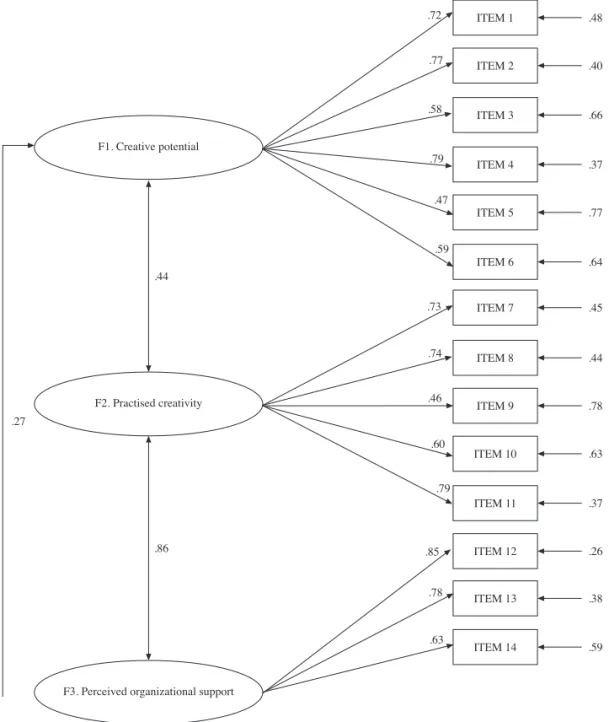
of the 3-factor structure of the original in English. We made use of the following goodness-of-fi t indicators: Tucker-Lewis Index (TLI), Comparative Fit Index (CFI), Root Mean Square Error of Approximation (RMSEA). Despite the lack of unanimity concerning the optimal cut-off points of the structural model fi t indexes, values above .90 in the TLI and the CFI are generally considered acceptable, and excellent if they are above .95 (Lévy-Mangin & Varela-Mallou, 2006). Furthermore, values below .08 are considered acceptable for the RMSEA and excellent if equal to or below .05 (Bentler, 1990; Hu & Bentler, 1999; Fan & Sivo, 2007). Figure 1 displays the following
Table 1
Factors of the CPPC-17 scale: Descriptive statistics, reliability, confi dence intervals and correlations between social-demographic variables and the factors of the (CEP-9, WorkBAT, DUWAS, Irritation, MBI-GS, OPERAS) scales, plus the correlations matrix between the three factors of the analysed scale
M SD Score
range
F1 F2 F3
Mean 22.72 17.49 17.89
SD 3.43 4,25 5.61
Reliability .82 ,80 .90
Confi dence interval .80-.83 .77-.81 .89-.90
Score range 9-30 5-25 6-30
External correlates Do you feel healthy on the whole? 4.26 .93 1-5 .15** .12** .09**
As far as happiness is concerned how happy are you with your life?
4 .96 1-6 .12** .06* .04
How often do you take work home? .11** .26** .19**
How many nights have you woken up thinking of job matters? 13.06 42.48 0-365 .02 .11* .02
How many hours of overtime do you do a year? 96.70 232.25 0-693 .10* .08 .06
Are you obliged/pressured in your organization to give the knowledge you have to it?
2.53 1.38 1-5 .08* .11** .09**
Are you obliged/pressured in your organization to come up with innovative proposals for improvement?
2.14 2.14 1-5 .15** .33** .30**
CEP-9: Support for creativity 9.65 2.89 3-15 .28** .68** .75**
Work characteristics 11.28 2,14 3-15 .25** .47** .50**
Blocks to creativity 9.5 2.91 3-15 .10** .34** .45**
WorkBAT D-Driven 31.18 9.01 13-60 .22** .11* .14**
J-Work enjoyment 15.37 5.37 7-32 .30** .41** .40**
DUWAS Work excessive 20.11 7.72 10-25 .19** .12* .13**
Work compulsive 17.27 6.30 7-25 .14** .07 .11*
Irritation Emotional 13.66 6.69 5-30 -.04 -.10* -.05
Cognitive 8.83 4.81 3-18 .09 .05 .09*
MBI-GS Exhaustion 10.68 6.54 5-30 -.02 -.19** -.15**
Cynicism 5.88 5.38 5-24 -.10* -.30** -.28**
Personal effi cacy 27.88 5.59 12-36 .31** .30** .27**
OPERAS Extraversion 47.36 9.95 21-69 .09* .02 .03
Emotional stability 49.26 9.11 8-71 .09* .12** .12**
Responsibility 49.31 9.22 17-71 .08 .02 .05
Agreeableness 48.62 8.9 20-77 .07 .03 .04
Openness to experience 48.52 9.8 4-68 .06 .02 .03
F1 – – –
F2 .36 – –
F3 .24 .71 –
indicators (TLI= .923; CFI= .934; RMSEA= .066). They indicate an acceptable fi t of the model whereby all the indicators are close to values that are considered acceptable. In addition, all the saturations range between .46 and .85.
Table 1 shows the mean, standard deviation, reliability, confi dence intervals, external correlates and correlations between the three factors of the CPPC-17 scale and the factors of the CEP-9, WorkBAT, DUWAS, Irritation, MBI-GS and OPERAS scales. Table 2 lists the items and the 5-point Likert scale.
We performed Kolmogorov-Smirnov’s normality test on the three scales, rejecting in all cases the null hypotheses (z statistics ranged between z = 2.766 and z = 3.087, p<0.001). Nevertheless, when we computed the equivalent effect sizes associated with these departures from normality we found that these were small, ranging from d = .089 to d = .01, so these deviations from normality may be considered negligible.
As far as proof of validity is concerned, we should point out that DiLiello and Houghton (2008) did not carry out a study in this respect. However, we have included some contrast scales and external criteria. In general terms, we found signifi cant correlations between the three factors of the scale we analysed both with external correlates as well as with the other scales (CEP-9, WorkBAT, DUWAS, Irritation, MBI-GS and OPERAS).
Alpha coeffi cients ranged from .80 to .90 which indicates that reliability for all three factors is satisfactory and may even be regarded as excellent if we take into account the small number of items that make up each factor. The correlations between factors are also featured and range from .24 to .71.
Discussion
The present study examined the factor structure and other psychometric properties of the CPPC-17 scale. According to the fi ndings, the scale under study has a three-factor internal structure, appropriate reliability as well as evidence of appropriate validity. The CPPC-17 scale is an instrument that enables us to evaluate creative potential, practised creativity and support from the organization for developing new ideas, using three factors. This is the fi rst time that the scale has been presented to a Spanish sample.
The results of the confi rmatory factor analysis (CFA) of the CPPC-17, with a heterogeneous Spanish sample validate DiLiello and Houghton’s (2008) three-factor model with a sample of employees working for the United States Department of Defense. This was corroborated by the indexes that showed the goodness of fi t of the model (TLI = .923, CFI = .934, RMSEA = .066). The fi rst factor consists of six items and is called F1.-Creative Potential. This refers to one’s ability to generate innovative ideas, to the ability to solve problems creatively and to feel comfortable experimenting with new ideas. The second is called F2.-Practised Creativity and has to do with the possibility of having the opportunity to use one’s own creative capacities, of putting forward ideas for improvement and of taking full advantage of one’s creative competencies; this factor is made up of fi ve items. And the last factor is F3.-Perceived Organizational Support, made up of six items, which have to do with the degree of recognition the organization gives to its employees’ creativity, how it rewards
Table 2
Spanish version of the CPPC-17 scale
Instrucciones: A continuación encontrarás algunas afi rmaciones sobre TU TRABAJO Y/O TU ORGANIZACIÓN. No hay respuestas correctas ni incorrectas, ni tampoco respuestas buenas o malas. Lee atentamente cada frase e indica por favor el grado de desacuerdo o acuerdo con respecto a las mismas.
1 Completamente
en desacuerdo
2 En desacuerdo
3 Neutral
4 De acuerdo
5 Completamente
de acuerdo
01. Creo que soy bueno/a generando ideas innovadoras (I feel that I am good at generating novel ideas)
02. Tengo confi anza en mi capacidad para solucionar problemas de forma creativa (I have confi dence in my ability to solve problems creatively)
03. Tengo la habilidad de desarrollar más a fondo las ideas de los demás (I have a knack for further developing the ideas of others)
04. Soy bueno/a a la hora de encontrar maneras creativas de resolver problemas (I am good at fi nding creative ways to solve problems)
05. Cuento con talento y habilidades para hacer bien mi trabajo ( I have the talent and skills to do my work well)
06. Me siento cómodo/a probando ideas nuevas (I feel comfortable trying out new ideas)
07. En el trabajo tengo oportunidad de usar mis habilidades y capacidades creativas (I have opportunities to use my creative skills and abilities at work)
08. En el trabajo me invitan a que presente ideas de mejora (I am invited to submit ideas for improvements in the workplace)
09. Tengo la oportunidad de participar en equipos (I have the opportunity to participate on team(s))
10. Tengo libertad para decidir cómo llevar a cabo mis tareas (I have the freedom to decide how my job tasks get done)
11. En el trabajo mis capacidades creativas se aprovechan al máximo (My creative abilities are used to my full potential at work)
12. En mi organización se reconoce el trabajo creativo (People are recognized for creative work in this organization)
13. Mi organización juzga las ideas de un modo justo (Ideas are judged fairly in this organization)
14. En mi organización se anima a la gente a resolver los problemas de forma creativa (People are encouraged to solve problems creatively in this organization)
15. Mi organización cuenta con buenos mecanismos para fomentar y desarrollar las ideas creativas (This organization has a good mechanism for encouraging and developing creative ideas)
16. En mi organización se anima a la gente a asumir riesgos (People are encouraged to take risks in this organization)
creative ideas and takes on risks. The reliability obtained for the English version by DiLiello and Houghton (2008) was acceptable for all three factors and ranged between .84 and .94. In the version we drew up for the present study, reliability was similar to that of the original version and ranged between .80 and .90.
The correlations of the instrument we are presenting with the previous scales and a series of external criteria revealed some evidence of validity. Hence, some signifi cant correlations were observed. In general, the three factors of the scale we have presented correlate positively with the correlates that were used (feeling healthy, happiness, work at home, nights that one has woken up thinking about work, overtime, giving knowledge and innovative proposals). We also found that creative potential, practised creativity and perceived organizational support correlate positively with support for creativity, workplace characteristics, blocks to creativity, workaholism, cognitive irritation, personal effi cacy, extraversion and emotional stability. However, some factors present negative correlations with emotional irritation, cynicism and exhaustion.
By way of conclusion, the different analyses carried out point to the existence of a three-factor structure, and reveal appropriate statistical indexes (Tabachnick & Fidell, 2007). The CPPC-17 has proved to be a brief instrument that can be quickly applied and interpreted and is easy to understand. In fact, the three subscales that make it up can each be evaluated independently of the others.
As regards its applicability, given that the scale shows good psychometric properties, the information obtained from the evaluation performed using the CPPC-17 will enable us to implement creativity development programmes (Leenders, van
Engelen, & Kratzer, 2007) inside organizations with the aim of narrowing the gap between creative potential and practised creativity. This can be achieved by designing work environments that support creativity. Modern organizations must be able to reap the latent creative potential of their employees in order to address the wide range of challenges (DiLiello & Houghton, 2006) they are faced with in today’s market environment.
The research studies we intend to carry out in the future will follow on from the limitations of the present study. We shall comment on these now: First of all, we need to analyse evidence of discriminant validity (Blanch & Aluja, 2009; Campbell & Fiske, 1959; Messick, 1995) by looking into both the type of work and professional categories. Another aspect that calls for further attention is that of determining in which ways different types of leadership such as servant leadership (Liden, Wayne, Zhao, & Henderson, 2008), ethical leadership (Kalshoven, Den Hartog, & De Hoogh, 2011), transformational leadership (Molero, Cuadrado, Navas, & Morales, 2007), authentic leadership (Moriano, Molero, & Lévy Mangin, 2011), transcendental leadership (Crossan, Vera, & Nanjad, 2008) and charismatic leadership (Conger & Kanungo, 1994) infl uence the development of creativity in employees. Thirdly, it needs to be demonstrated whether individuals with strong creative yet untapped potential are more likely to develop creativity when they perceive strong support from the organization (DiLiello & Houghton, 2006). And fi nally, we need to investigate with a multilevel methodology (Browne & Rasbash, 2004; Raudenbush, 2004; Snijders, 2005) in what way the climate of innovation teams (Boada-Grau, De-Diego, & De-Llanos, 2009; Boada-Grau, De-Diego, De-Llanos-Serra, & Vigil-Colet, 2011) fosters both creative potential and practised creativity.
References
Abbey, A., & Dickson, J.W. (1983). Work climate and innovation in
semiconductors.Academy of Management Journal, 26, 362-368.
Amabile, T.M. (1988). A model of creativity and innovation in organizations. In B.M Staw & L. Cummings (Eds.), Research in
Organizational Behavior, 10, 123-167.
Amabile, T.M. (1996). Creativity in context. Westview. Press, Boulder, CO.
Amabile, T.M. (2004). Stimulate creativity by fueling passion. In E.A. Locke (Eds.), Handbook of principles of organizational behavior (pp. 331-341). Oxford, UK: Blackwell.
Balluerka, N., Gorostiaga, A., Alonso-Arbiol, I., & Haranburu, M. (2007). La adaptación de instrumentos de medida de unas culturas a otras: una perspectiva práctica [Test adaptation to other cultures: A practical approach]. Psicothema, 19, 124-133.
Bentler, P.M. (1990). Comparative fi t indices in structural models.
Psychological Bulletin, 107, 238-246.
Blanch, A., & Aluja, A. (2009). Validation study of the Spanish Version of the Work-Family Confl ict Questionnaire (CCTF). The Spanish
Journal of Psychology, 12, 746-755.
Boada-Grau, J., Sánchez-García, J.C., Prizmic-Kuzmica, A-J., & Vigil-Colet, A. (2012). Work health and hygiene in the transport industry (TRANS-18): Factorial structure, reliability and validity. The Spanish
Journal of Psychology, 15, 357-366.
Boada-Grau, J., De-Diego, R., & E. De-Llanos. (2009). Team climate as an antecedent of burnout and psychosomatic manifestations. Ansiedad
y Estrés, 15, 279-289.
Boada-Grau, J., De-Diego, R., De-Llanos-Serra, E., & Vigil-Colet, A. (2011). Short spanish version of Team Climate Inventory (TCI-14): Development and psychometric properties. Psicothema, 23, 308-313.
Boada-Grau, J., Prizmic-Kuzmica, A.J., Serrano-Fernández, M.J., & Vigil-Colet, A. (2013). Estructura factorial, fi abilidad y validez de la escala de adicción al trabajo (WorkBAT): versión española [Factorial structure, reliability and validity of the workaholism scale (WorkBAT): Spanish version]. Anales de Psicología, 29, 923-933.
Boada-Grau, J., Sánchez-García, J.C., Prizmic-Kuzmica, A.J., & Vigil-Colet, A. (2012). Adaptación de la escala de medida sobre las percepciones del ambiente creativo [Adaptation of the measurement
scale on the perceptions of creative environment]. Manuscrito no
publicado. Universitat Rovira i Virgili, Tarragona, Spain.
Browne, W.J., & Rasbash, J. (2004). Multilevel Modelling. In A. Bryman & M. Hardy (Eds.), Handbook of data analysis (pp. 459-479). London: Sage Publications.
Burke, R.J. (2000). Workaholism in organizations: Psychological and physical well-being consequences. Stress Medicine, 16, 11-16. Burke, R.J., Richardsen, A.M., & Martinussen, M. (2002). Psychometric
properties of Spence and Robbins’ measures of workaholism components. Psychological Reports, 91, 1098-1104.
Burke, R.J. (1999). Workaholism in organizations: Measurement validation and replication. International Journal of Stress Management, 6, 45-55. Byron, K., Khazanchi, S., & Nazarian, D. (2010). The relationship between
stressors and creativity: A meta-analysis examining competing theoretical models. Journal of Applied Psychology, 95, 201-212. Campbell, D.T., & Fiske, D.W. (1959). Convergent and discriminant
validation by the multitrait - multimethod matrix. Psychological
Bulletin, 56, 81-105.
Conger, J.A., & Kanungo, R.N. (1994). Charismatic leadership in organizations: Perceived behavioral atributes and their measurement.
Crossan, M., Vera, D., & Nanjad, L. (2008). Transcendent leadership: Strategic leadership in dynamic environments. The Leadership
Quarterly, 19, 569-581.
Cummings, L.L. (1965). Organizational climates for creativity. Journal of
the Academy of Management, 3, 220-227.
Deci, E.L., & Ryan, R.M. (1985). Intrinsic Motivation and
Self-Determination in Human Behaviour. Plenum Press, New York.
Delbecq, A.L., & Mills, P.K. (1985). Managerial practices that enhance innovation. Organizational Dynamics, 14, 24-34.
Del-Líbano, M., Llorens, S., Salanova, M., & Schaufeli, W. (2010). Validity of a brief workaholism scale. Psicothema, 22, 143-150.
DiLiello, T.C., & Houghton, J.D. (2006). Maximizing organizational leadership capacity for the future: Toward a model of self-leadership, innovation and creativity. Journal of Managerial Psychology, 21, 319-337.
DiLiello, T.C., & Houghton, J.D. (2008). Creative potential and practised creativity: Identifying untapped creativity in organizations. Creativity
and Innovation Management, 17, 37-46.
Fan, X., & Sivo, S.A. (2007). Sensitivity of Fit Indices to Model Misspecifi cation and Model Types. Multivariate Behavioral Research, 42, 509-529.
Ferrando, P.J., Lorenzo-Seva, U., & Chico, E. (2009). A general factor analytic procedure for assessing response bias in questionnaire measures. Structural Equation Modeling, 16, 364-381.
Hambleton, R.K. (1994). Guidelines for adapting educational and psychological tests: A progress report. European Journal of
Psychological Assessment,10, 229-244.
Hambleton, R.K., Merenda, P.F., & Spielberger, C.D. (2005). Adapting
educationaland psychological tests for cross-cultural assessment.
London: Erlbaum.
Hernández, R., Fernández, C., & Baptista, P. (2000). Metodología de la
investigación [Research metodology]. México: McGraw-Hill.
Hinton, B.L. (1968). A model for the study of creative problem solving.
Journal of Creative Behavior, 2, 133-142.
Hinton, B.L. (1970). Personality variables and creative potential. Journal
of Creative Behavior, 3, 210-217.
Houghton, J.D., & DiLiello, T.C. (2010). Leadership development: The key to unlocking individual creativity in organizations. Leadership &
Organization Development Journal, 31, 230-245.
Hsu, M.L.A., & Fan, H-L. (2010). Organizational innovation climate and creative outcomes: Exploring the moderating effect of time pressure.
Creativity Research Journal, 22, 378-386.
Hu, L., & Bentler, P. (1999). Cutoff criteria for fi t indexes in covariance structure analysis: Conventional criteria versus new alternatives.
Structural Equation Modeling, 6, 1-55.
Joreskog, K.G. (1993). Testing structural equation models. In K.A. Bollen & J.S. Long (Eds.), Testing structural equation models (pp. 294-316). Newbury Park, CA: Sage.
Kalshoven, K., Den Hartog, D.N., & De Hoogh, A. (2011). Ethical leadership at work questionnaire (ELW): Development and validation of a multidimensional measure. The Leadership Quarterly, 22, 51-69. Kanter, R.M. (1983). The Change Masters: Innovation and
Entrepreneurship in the American Corporation. Simon & Schuster,
New York.
Kerlinger, F.N. (2001). Investigación del comportamiento: métodos de investigación en Ciencias Sociales [Research of behavior: Research
methods in social sciences]. México: McGraw-Hill.
Kimberley, J.R. (1981). Managerial innovation. In P.C. Nystrom & W.H. Starbuck, Handbook of organizational design (pp. 84-104). New York: Oxford University Press.
Kimberley, J.R., & Evanisko, M.J. (1981). Organizational innovation: The infl uence of individual, organizational and contextual factors on hospital adoption of technological and administrative innovations.
Academy of Management Journal, 24, 689-713.
Leenders, R.Th.A.J., van Engelen, J.M.L., & Kratzer, J. (2007). Systematic design methods and the creative performance of new product teams: Do they contradict or complement each other? Journal of Product
Innovation and Management, 24, 166-179.
Lévy-Mangin, J.P., & Varela-Mallou, J. (2006). Modelización con estructuras de covarianzas en Ciencias Sociales. Temas esenciales, avanzados y aportaciones especiales [Modelling covariance structures in the social sciences. Topics essential, advanced and
special contributions]. Madrid: Gesbiblo.
Liden, R.C.,Wayne, S.J., Zhao, H., & Henderson, D. (2008). Servant leadership: Development of a multidimensional measure and multi-level assessment. The Leadership Quarterly, 19, 161-177.
Lorenzo-Seva, U., & Ferrando, P.J. (2009). Acquiescent responding in partially balanced multidimensional scales. British Journal of
Mathematical and Statistical Psychology, 62, 319-326.
Mayfi eld, M., & Mayfi eld, J. (2010). Developing a scale to measure the creative environment perceptions: A questionnaire for investigating garden variety creativity. Creativity Research Journal, 22, 162-169. McMillan, L.H.W., Brady, E.C., O’Driscoll, M.P., & Marsh, N.V. (2002).
A multifaceted validation study of Spence and Robbins’ (1992) Workaholism Battery. Journal of Occupational and Organizational
Psychology, 75, 357-368.
Merino, E., Carbonero, M.A., Moreno, B., & Morante, M.E. (2006). Irritation: Analysis of an instrument to assess stress at work.
Psicothema, 18, 419-424.
Messick, S. (1995). Validity of psychological assessment. American
Psychologist, 50, 741-749.
Mohr, G. (1986). Die erfassung psychischer befi ndensbeeinträchtigungen
bei Industriearbeitern. Europäische hochschulschriften. Frankfurt:
Lang.
Mohr, G., Müller, A., Rigotti, T., Aycan, Z., & Tschan, F. (2006). The assessment of psychological strain in work contexts: Concerning the structural equivalency of nine language adaptations of the Irritation-scale. European Journal of Psychological Assessment, 22, 198-206.
Molero, F., Cuadrado, I., Navas, M.,, & Morales, J.F. (2007). Relations and effects of transformational leadership: A comparative analysis with traditional leadership styles. The Spanish Journal of Psychology, 10, 358-368.
Monge, P.R., Cozzens, M.D., & Contractor, N.S. (1992). Communication and motivational predictors of the dynamics of organizational innovation. Organizational Science, 3, 250-274.
Moriano, J.A., Molero, F., & Lévy Mangin, J.-P. (2011). Liderazgo auténtico. Concepto y validación del cuestionario ALQ en España [Authentic leadership. Concept and validation of the ALQ in Spain].
Psicothema, 23, 336-341.
Muñiz, J., & Bartram, D. (2007). Improving international tests and testing.
European Psychologist, 12, 206-219.
Muñiz, J., Elosua, P., & Hambleton, R.K. (2013). Directrices para la traducción y adaptación de los tests: segunda edición [International Test Commission Guidelines for test translation and adaptation: Second edition]. Psicothema, 25, 151-157.
Niu, W. (2013). Confucian ideology and creativity. The Journal of
Creativity Behavior, 46, 274-284.
Raudenbush, S.W. (2004). What are value-added models estimating and what does this imply for statistical practice? Journal of Educational
and Behavioral Statistics, 29, 121-129.
Salanova, M., Schaufeli, W.B., Llorens, S., Peiró, J.M., & Grau, R. (2000). Desde el ‘burnout’ al ‘engagement’: ¿una nueva perspectiva? [From the ‘burnout’ to ‘engagement’: a new perspective?] Revista de Psicología
del Trabajo y las Organizaciones, 16, 117-134.
Schaufeli, W.B., Leiter, M.P., Maslach, C., & Jackson, S.E. (1996). Maslach Burnout Inventory - General Survey. In C. Maslach, S.E. Jackson & M.P. Leiter (Eds.), The Maslach Burnout Inventory- Test Manual (3rd ed.) Palo Alto, CA: Consulting Psychologists Press.
Schaufeli, W.B., Shimazu, A., & Taris, T.W. (2009). Driven to work excessively hard: The evaluation of a two-factor measure of workaholism in the Netherlands and Japan. Cross-Cultural Research, 43, 320-348.
Schumacker, R.E. , & Lomax, R.G. (1996). A beginner’s guide to structural
equation modeling. Mahwah, NJ: Lawrence Erlbaum Associates.
Shalley, C.E. (2008). What managers can do to establish expectations for creative performance. In J. Zhou & C.E. Shalley (Red.), Handbook
of Organizational Creativity (pp. 147-164). New York: Lawrence
Erlbaum.
Snijders, T. (2005). Power and sample size in multilevel linear models. En B.S. Everitt & D.C. Howell (Eds.), Encyclopedia of Statistics in
Behavioral Scienc, 3, 1570-1573. Chicester: Wiley.
Spence, J.T., & Robbins, A.S. (1992). Workaholism: Defi nition, measurement, and preliminary results. Journal of Personality
Sternberg, R.J. (2001). What is the common thread to creativity: Its dialectical relation to intelligence and wisdom. American Psychologist, 56, 360-362.
Tabachnick, B.G., & Fidell, L.S. (2007). Using multivariate statistic. Boston: Allyn and Bacon.
Tesluk, P.E., Farr, J.L., & Klein, S.R. (1997). Infl uences of organizational culture and climate on individual creativity. The Journal of Creative
Behavior, 31, 27-41.
Tierney, P., & Farmer, S.M. (2004). The pygmalion process and employee creativity. Journal of Management, 30, 413-423.
Vigil-Colet, A., Morales-Vives, F., Camps, E., Tous, J., & Lorenzo-Seva. U. (2013). Development and validation of the Overall Personality Assessment Scale (OPERAS). Psicothema, 25, 100-106.