G T H - U P M System for Search on Speech
Evaluation
Julian Echeverry-Correa, Alejandro Couchciro-Limeres, and Javier Ferreiros-López
A b s t r a c t . This paper describes the GTH-UPM system for the Albayzin 2014 Search on Speech Evaluation. The evaluation task consists of searching a list of terms/queries in audio files. The GTH-LPM system we are presenting is based on a LVCSR (Large Vocabulary Continuous Speech Recognition) system. We have used MAVIR corpus and the Spanish partition of the E P P S (European Parliament Plenary Sessions) database for training both acoustic and language models. The main effort has been focused on lexicon preparation and text selection for the language model construction. The system makes use of different lexicon and language models depending on the task that is performed. For the best configuration of the system on the development set, we have obtained a FOM of 75.27 for the keyword spotting task.
K e y w o r d s : keyword spotting, spoken term detection, query by example, automatic speech recognition
1 Introduction
T h e search of information on speech h a s found m a n y applications in t h e ñeld of a u t o m a t i c speech recognition (ASR.) in recent years. For applications such as dialog managers, conversational agents or spoken information retrieval systems, s p o t t i n g significant keywords could be more i m p o r t a n t t h a n recognizing t h e whole content of a n u t t e r a n c e .
crucial in
order to
look
for
supplementary material corpus, whose
audios should
have
similar
acoustic
conditions,
There arc four
tasks proposed in
the
Search on
Speech
Evaluation: Keyword
Spotting
(KWS), Spoken
Term
Detection (STD).
Query-
by-Example
Spoken
Term
Detection
(QhE
STD)
and Query-hy-Example
Spoken Document
Retrieval
(QbE SDR).
They arc
very
similar
between them,
since for all we have a list of
terms
(written or
spoken)
that
we must
search on
the
input
speech,
out put ting
the timestamps and a score of
trust. We
briefly describe their particularities.
For
KWS,
the list of written
terms (keywords) is
known
before processing the
audios, so
we can prevent
the system
to listen
carefully for them. For
STD, wc
pursue
the
same goal as for
KWS
except that the
list
of
terms
is known after
processing the audios, so no prevention
can
be made. For QbE
STD.
we have the
same
conditions as
for STD except
that
the
search
list
is
made by spoken terms
and then
an
initial stage of recognition
of
these terms has to be
made
before
searching.
And for QbE SDR, as
for
QbE STD, the
list
is provided by
spoken
terms (with the possibility of more instances pier
term,
all in Basque
language)
,
hut now
the
output is a score
of
confidence
for
a spoken term
appearing in a
spoken document.
There
are several approaches to each task in
the
state-of-art of Automatic
Speech Recognition. As a first
gross division, specially
for the KWS
and
STD
detection tasks, we
can distinguish between systems based on Large
Vocabulary
Continuous Speech Recognition
(LVCSR)
and systems based only on
keywords
and
non-keywords
models,
LVCSR
systems
allow
a
simple
word-level search,
hut
they
need a complete
training of
the models
in
order
to
make possible
the recognition of
such
a large
vocabulary.
Besides, they
also
need a proper
language
model
for
the
correct
connection
between
words
in
a
continuous
speech
recognition system.
Only Terms in the
vocabulary may
he
recognized,
so any term
out-of-vocabulary will
never
be
recognized.
For
open vocabulary systems where
no information
about
the
set
of keywords is
provided
while
training
the models,
it
may be required a large amount of training data
in
order to increase the
probability
of
modeling the
probahle keywords [1], And even using
an
extremely
large
corpus,
we
can
never
accurately
model all possible strings of
words.
In
this
sense,
the
most
common
probabilistic approach
for building
language
models
in
ASR
applications is based on N-grams. This approach models the
pro
liability
of
finding
ordered
sequences
of
N
words. Nevertheless,
in
order to face the data
sparsity when
modeling language, regarding
to its variety
and
complexity, wc
can
employ a
smooth variation of
Pi-gram,
that
is
skip-grams.
Skip-grams allow
us to form
new
N-grams
by skipping
one or more words
in a
word sequence,
so
the
context
can be obtained
widely
around
a
word. This may
overcome
the
data
sparsity problem
and
may
reduce the need of
larger
corpus.
In
[2],
skip-grams
are proven to outperform the standard
N-grams
for
different test
documents by
using
less amount of training data.
the phonetic sequence that best
fits
the
phonetic transcription of each
keyword,
making use
of
a
confident
measure based on word segments or on the proportion
of correct phonemes. In order to minimize
the
number
of
false
alarms, these
systems do not only model the keywords, but also the non-keyword parts of
speech. This
background
model
is
referred
as
filler
model,
and
it
is
also based
in phonetic models. One advantage of these systems over
LVCSR systems is
the higher speed due to their simplicity. Besides,
phonetic-
based systems
do
not
depend
on a large
vocabulary
like LVCSR. so the problem with out-
of-
vocabulary
terms is avoided, and can be used as well for the
STD
[3] and QhESTD
J4]
tasks.
Some systems, as in [5], are hybrid systems of LVCSR and phonetic engines.
LVCSR is
reserved
for in-
vocabulary terms
due
to its
robustness and phonetic
search and alignment is
employed with
out-of-
vocabulary
terms, so
no query is
uncovered by the system.
The
systems
mentioned above often make
use
of Hidden Markov Models.
However,
other approaches have
been
developed based
on
neural networks, on
discriminative learning procedures, or on graplucal models (GM). As an example,
GM makes use
of
the graph theory
hi
order
to describe the time evolution
of speech statistically.
In
[1]. GM
was
used
to
perform a KWS task with a
non-LVCSR system, with the particularity of being vocabulary independent
and
without require the training of an explicit
filler
model.
In the
next section, we will describe the system submitted by our group for
this
Search on Speech Evaluation. We have attempted to perform tasks
1
to 2,
with a LVCSR system as described below.
2 System description
As we previously said, the system developed
for
this evaluation consists of a
LVCSR system. The
feature
vectors we used
for the
acoustic model
training
consisted of the
first
13 PLP coefficients,
as
well as
their
first and
second
order
time derivatives. The phoneme models
were
composed of three hidden states
each.
We
used
cross-word triphone models in order to
account
for
contextual
information and we consider up to 10 Gaussians per state during training.
We
used
the transcriptions of
the training/development
data set,
which
are
available in the MAVIR web page
l, for
training the
models
and for testing the
performance
of the
ASR.
These
transcriptions
are
composed
of
2878 sentences
and a vocabulary size of
5300
words. We also
used
the transcriptions of the
Spanish Parliament partition of the
EPPS
database (this database is described
in section 2.1)
to compose
the
training
corpora for
the
language models.
This
database
is
composed
of
1G514 sentences and a
17.5k
vocabulary.
To
enrich the vocabulary
and the
robustness
of the language
models,
we
performed a
manual
data search based on the
topics
found in
the
training dataset
of the MAVIR corpus. For instance, we searched for data related to language
technologies
and from
the
obtained results we
selected texts
on
various
topics,
like
sentiment analysis, d a t a crawling, etc. We also guided our d a t a search t h r o u g h t h e websites of t h e companies t h a t are mentioned in t h e audio files (for instance: daedalus. bitext, isoco, etc.). We collected nearly 2000 sentences, composed of a 7.2k vocabulary. T h e s e complementary7 d a t a have been used in t h e training of language models.
As a first step foT t h e recognition stage, we used a voice activity detector (VAD) t o segment t h e speech signal and perform ASR on t h e segments of detected speech. T h e VAD t h a t we used is included in the Voicebox toolbox [6], We t u n e d t h e VAD for splitting t h e audio in segments with a length under 30 seconds.
For t h e K W S task and in order t o boost t h e probability of keywords, we repeated twice t h e sentences in t h e LM training corpora t h a t contained any keywords and we also repeated the keywords t h a t were missing in t h e initial vocabulary from t h e training corpora. Also for this task we added t o t h e initial vocabulary the pre-specificd keyword tcrnis so t h a t t h e r e were no O O V keywords during A S R search. Multi-term keywords were added as separate words (each of these keywords is t r e a t e d as a set of single words during recognition).
Regarding t h e implementation issues, t h e H T K Toolkit [7] was used for training acoustic models and for t h e ASR decoding stage. T h e SRILM Toolkit [8] was employed for creating t h e language models t h a t t h e s y s t e m uses. We use t r i g r a m models.
2 . 1 D a t a b a s e s d e s c r i p t i o n We have used two d a t a b a s e s :
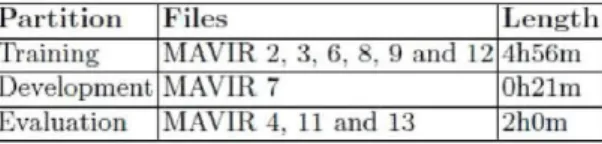
- MAVIR corpus is a collection of audio a n d video recordings, with their corresponding orthographic transcriptions. T h e audio recordings come from lectures and talks held by t h e MAVIR consortium. T h e corpus is m a d e u p of 13 recordings in Spanish and English language {nevertheless for this evaluation, only t h e Spanish p a r t i t i o n is available for training, development a n d evaluation purposes). D a t a were collected during t h e I, II, a n d III MAVIR Conference held in M a d r i d in 2006, 2007 a n d 2008 respectively. T h e details of this d a t a b a s e are shown in Table 1. We used all t h e training audio
Table 1. Details of the MAVTR database P a r t i t i o n
Training Development Evaluation
F i l e s
MAVIR 2. 3, 6, 8. 9 and 12 MAVIR 7
MAVIR 4, 11 and 13
L e n g t h 4h56m 01v21m 2htlm
acoustic conditions
in
which they were recorded. Nevertheless,
we use
the
transcriptions of the
all
training
files in
order to train the language models.
EPPS (European Parliament Plenary Sessions) is a database developed
by the project TC-STAR (Technology and Corpora for Speech to
Speech
Translation) [9]. It
consists of
61 hours
of audio
recordings
with their
corresponding
orthographic
transcriptions. These recordings
were
collected
between 200 Í and '2007. Most
of
the speakers arc interpreters, nevertheless
there are
also
native Spanish speakers. This database also includes
38
hours
of audio recordings of
the
Spanish
Parliament
(PARL)
collected
between
2004 and 2006. All
the
speakers hi this group are native Spanish
speakers.
We selected this database hecausc its acoustic conditions can be similar
to those encountered in MAVTIÍ corpus. Wc
use
the
audio files
of
both
EPPS and PARL partitions to train acoustic models and wc use the texts
provided by
the PARL partition to enrich
the vocabulary
of
the system and
the robustness
of
the language models.
3
Evaluation metrics
For the keyword spotting
task,
the Figure-of-Merit (FOM). as
defined
in [7], will
be the
primary metric for
the
evaluation. The
FOM is defined
as the
detection
rate averaged
over the range of (I to 1U false alarms per
hour,
and
in
its
calculation
it is assumed that the
total
duration of the
test
speech is T hours. For
each
keyword,
all
of the spots must be
ranked
in score order. The percentage of true
hits pi
found
before
the
i'th
false
alarm
is
then calculated for i
=
1
.
.
.
N
+ 1
where N
is
the
first
integer
>
10T — 0.5. The FOM
is
defined as
POM
= — -
(p! + p 2 4- .
. .
+p
N+ apN+i)
where
a
—
WT
— N interpolates
to 10
false
alarms
per hour. Table 2 show the
results
obtained
in
the
development
set for the
keyword
spotting task.
The
results are presented in
terms of
the
H i t s ,
FA (false alarms)
and FOM.
4
Final results
Tahle 2. Final results with the development set {mavir 07)
System P R I P R I C O N l
T a s k WW'S S T D K W S
H i t s 211 227 231 FA :.', ;is 52
A c t . 296 296 296 FOM 75.27 72.78 72.45
number of false
alarms to the
system. Next, we show the results obtained iu the
training set of the database. We are aware that these results do not reflect the
performance
of
the system, since they are obtained over the same dataset for
which the system was trained. Nevertheless, these results may offer an oracle
approximation
of
the performance of
the
system.
Table 3. Results with the training set
File mavir 02
mavir 03
mavir OC mavir 08 mavir 09 mavir 12 mavir 02 mavir 03 mavir 06
mavir 08 mavir 09 mavir 12 mavir 02 mavir 03 mavir 06 mavir 08 mavir 09 mavir 12
S y s t e m P R I P R I P R I P R I
P R I
P R I P R I P R I P R I P R I P R I P R I C O N l C O N l C O N l C O N l C O N l C O N l
T a s k K W S K W S K W S K W S K W S K W S
S T D S T D S T D S T D
S T D S T D K W S K W S K W S K W S K W S K W S
H i t s 599 596 •127 197 106 637 426 551 412 189 39 609 577 598 433 196 91 636 FA 281 52 20 10 186 41 203 3 8 19 10 94 3 8 227 3 8 20 9 147 34 A c t . 1016 C53 446 200 671 1016 653 446 200 910 671 1016 653 446 200 910 671 FOM 55.31 87.71 94.12 93.66 11.26 92.70 40.06 82.47 91.36 89.99 4.16 88.65 54.22 89.05 95.88 93.65 10.08 92.78
5 Conclusions
for t h e training of t h e language models may improve, t h e keyword s p o t t i n g b u t may also introduce a higher n u m b e r of false alarms.
From this evaluation it is clear t h a t for developing a proper system for a concrete task it is necessary t o study t h e corpus under s t u d y so we can collect t h e a d e q u a t e training d a t a t h a t best fits t h a t corpus. T h i s applies not only for the acoustic conditions and varii ty of sp< pikers hut also W the tupir- discussed in t h e audio recordings.
A c k n o w l e d g e m e n t s . T h e work leading t o t h e s e results h a s received funding
from T I M P A N O (TIN2011-28169-005-03), a n d MA2VTCMR (Comunidad A u t ó n o m a de Madrid. S2009/ TIC-1542) projects. It has also been s u p p o r t e d by t h e E u r o p e a n Union under grant agreement n u m b e r 287678. Julian Echeverry-Correa also acknowledges t h e support from Colcieneias a n d from t h e
Universidad Tecnológica dc Percira, Colombia.
R e f e r e n c e s
[1] Wollmer, M. et al. "Robust vocabulary independent keyword spotting with graphical models". Automatic Speech Recognition & Understanding {ASRU 2009. IEEE Workshop on, 2009. 349-353). 2009.
[2] Guthrie, D. et al. "A closer look at skip-gram modelling". In Proc. of the 5th international Conference on Language Resources and Evaluation (LR EC-20 06). 1-4, 2000.
[3] Wallace, R. et al. "A phonetic search approach to the 200G NIST spoken term detection evaluation". International Speech Communication Association (ISCA), 2007
[4] Shen, W. et al. "A comparison of query- by-ex am pie methods for spoken term detection". DTIC Document, 2009
[5] Mamou, J. et al. "Vocabulary independent spoken term detection". In Proc. of the 30lh annual international ACM SIGIR conference on Research and development in information retrieval, G15-G22. 2007.
[6] Brookes. M. "Voicebox: A Speech Processing Toolbox for Matlab". Department of Electrical and Electronic Engineering, Imperial College, London.
[7] Young, S. et al. "The HTK Book". Engineering Department of Cambridge University, 2006.
[8] Stolcke, A. "SRILM-An extensible language modeling toolkit''. In 3rd International Conference on Speech and Language Technology (INTERSPEECH02). 2002. [9] Mostefa, D. and Hamon, O. and Moreau, N. and Clioukri, K. ''Evaluation Report for