Review
A review of estimation of distribution algorithms in bioinformatics
Rubén Armañanzas*1, Iñaki Inza1, Roberto Santana1, Yvan Saeys2'3,
José Luis Flores
1, José Antonio Lozano
1, Yves Van de Peer
2'
3, Rosa Blanco
4,
Víctor Robles5, Concha Bielza6 and Pedro Larrañaga6
Address: Department of Computer Science and Artificial Intelligence, University of the Basque Country, Donostia - San Sebastián, Spain, 2Department of Plant Systems Biology, Ghent University, Ghent, Belgium, 3Department of Molecular Genetics, Ghent University, Ghent, Belgium, 4Department of Statistics and Operations Research, Public University of Navarre, Pamplona, Spain, Departamento de Arquitectura y Tecnología de Sistemas Informáticos, Universidad Politécnica de Madrid, Madrid, Spain and Departamento de Inteligencia Artificial, Universidad Politécnica de Madrid, Madrid, Spain
Email: Rubén Armañanzas* - [email protected]; Iñaki Inza - [email protected]; Roberto Santana - [email protected];
Yvan Saeys - [email protected]; José Luis Flores - [email protected]; José Antonio Lozano - [email protected]; Yves Van de Peer - [email protected]; Rosa Blanco - [email protected]; Víctor Robles - [email protected];
Concha Bielza - [email protected]; Pedro Larrañaga - [email protected] * Corresponding author
Abstract
Evolutionary search algorithms have become an essential asset in the algorithmic toolbox for solving high-dimensional optimization problems in across a broad range of bioinformatics problems. Genetic algorithms, the most well-known and representative evolutionary search technique, have been the subject of the major part of such applications. Estimation of distribution algorithms (EDAs) offer a novel evolutionary paradigm that constitutes a natural and attractive altemative to genetic algorithms. They make use of a probabilistic model, learnt from the promising solutions, to guide the search process. In this paper, we set out a basic taxonomy of EDA techniques, underlining the nature and complexity of the probabilistic model of each EDA variant. We review a set of innovative works that make use of EDA techniques to solve challenging bioinformatics problems, emphasizing the EDA paradigm's potential for further research in this domain.
Introduction
As a consequence of increased computational power in the last decades, evolutionary search algorithms emerged as important heuristic optimization techniques in the early eighties. Evolutionary optimization techniques have demonstrated their potential across a broad spectrum of áreas such as transportation, machine learning or indus-try. Based on the development of current high-throughput data capturing devices in biotechnology, a wide range of high-dimensional optimization problems surfaced in the
algo-rithms (GAs) are the most well known class of techniques, have thus been the method of choice for many of these bioinformatics problems.
Estimation of distribution algorithms (EDAs) are a novel class of evolutionary optimization algorithms that were developed as a natural alternative to genetic algorithms in the last decade. The principal advantages of EDAs over genetic algorithms are the absence of múltiple parameters to be tuned (e.g. crossover and mutation probabilities) and the expressiveness and transparency of the probabil-istic model that guides the search process. In addition, EDAs have been proven to be better suited to some appli-cations than GAs, while achieving competitive and robust results in the majority of tackled problems. In this review, we focus on a group of pioneering papers that have shown the power of the EDA paradigm in a set of recent bioinfor-matic, mainly genomic and proteomic, tasks. For each problem, we give a brief description, the EDA used, and the associated literature references. The solution
represen-ta tion and the cardinality of the search space are also dis-cussed in some cases. Before discussing these problems, the next section presents what an EDA is and how it works, sets out a detailed taxonomy based on their main features and what potential they have within the bioinfor-matic discipline.
Estimation of distribution algorithms
Estimation of distribution algorithms [1-5] are evolution-ary algorithms that work with a multiset (or population sets) of candidate solutions (points). Figure 1 illustrates the flow chart for any EDA approach. Initially, a random sample of points is generated. These points are evaluated using an objective function. An objective function evalu-ates how accurate each solution is for the problem. Based on this evaluation, a subset of points is selected. Henee, points with better function valúes have a bigger chance of being selected.
1. Genérate mitin! populütiün
1
f
2. Select A iiiímber o! indi vid jais
\ <
5. Ctvtitc LIL'W popuküion
^ . 1 I£stiilla[4> pi'obílhilily dislñbuiiüil
v
4. Genérate new individuáis by sampling the estimaied diütribution
NO
LND
Figure I
Then, a probabilistic model of the selected solutions is built, and a new set of points is sampled from the model. The process is iterated until the optimum has been found or another termination criterion is fulfilled.
For more details, Table 1 sets out the pseudocode that implements a basic EDA. The reader can find a complete running example of an EDA in [6].
Characterístics of EDAs
Essentially EDAs assume that it is possible to build a model of the promising áreas of the search space, and use this model to guide the search for the optimum. In EDAs, modeling is achieved by building a probabilistic graphical model that represents a condensed representation of the features shared by the selected solutions. Such a model can capture different patterns of interactions between sub-sets of the problem variables, and can conveniently use this knowledge to sample new solutions.
Probabilistic modeling gives EDAs an advantage over other evolutionary algorithms that do not employ mod-els, such as GAs. These algorithms are generally unable to deal with problems where there are important interac-tions among the problems' components. This, together with EDAs' capacity to solve different types of problems in a robust and scalable manner [3,5], has led to EDAs some-times also being referred to as competent GAs [7,8].
A taxonomy of EDAs
Since several EDAs have been proposed with a variety of models and learning algorithms, the selection of the best EDA to deal with a given optimization problem is not always straightforward. One criterion that could be fol-lowed in this choice is to trade off the complexity of the probabilistic model against the computational cost of storing and learning the selected model. Both issues are also related to the problem dimensionality (i.e. number of variables) and to the type of representation (e.g. dis-crete, continuous, mixed).
Table I: E D A pseudocode
Set t <— 0. Genérate Al points randomly
D o
Evalúate the points using the fitness function
Select a set S of N < Al points according t o a selection method Estímate a probabilistic model for S
Genérate Al new points sampling from the distribution represented in the model
t < - t + I
until Termination criteria are met
Estimation of distribution algorithms: evolutionary computation based on learning and simulation of probabilistic graphical models.
Researchers should be aware that simple models generally have minimal storage requirements, and are easy to learn. However, they have a limited capacity to represent higher-order interactions. On the other hand, more complex models, which are able to represent more involved rela-tionships, may require sophisticated data structures and costly learning algorithms. The impact that the choice between simple and more complex models has in the search efficiency will depend on the addressed optimiza-tion problem. In some cases, a simple model can help to reach non-optimal but acceptable solutions in a short time. In other situations, e.g. deceptive problems, an EDA that uses a simple model could move the search away from the área of promising solutions.
Another criterion that should be taken into consideration to choose an EDA is whether there is any previous knowl-edge about the problem structure, and which kind of probabilistic model is best suited to represent this knowl-edge. The following classification of EDAs is intended to help the bioinformatic researcher to find a suitable algo-rithm for his or her application.
EDAs can be broadly divided according to the complexity of the probabilistic models used to capture the interde-pendencies between the variables: univariate, bivariate or multivariate approaches. Univariate EDAs, such as PBIL [9], cGA [10] and UMDA [4], assume that all variables are independent and factorize the joint probability of the selected points as a product of univariate marginal proba-bilities. Consequently, these algorithms are the simplest EDAs and have also been applied to problems with con-tinuous representation [11].
The bivariate models can represent low order dependen-cies between the variables and be learnt using fast algo-rithms. MIMIC [12], the bivariate marginal distribution algorithm BMDA [13], dependency tree-based EDAs [14] and the tree-based estimation of distribution algorithm (Tree-EDA) [15] are all members of this subclass. The lat-ter two use tree and forest-based factorizations, respec-tively. They are recommended for problems with a high cardinality of the variables and where interactions are known to play an important role. Trees and forests can also be combined to represent higher-order interactions using models based on mixtures of distributions [15].
There-FDA EBNA, BOA EcGA
F i g u r e 2
E B N A a n d B O A p a r a d i g m s ( F i g u r e 2 E B N A
-B O A . e p s ) . Diagram of probability models for the proposed
EDAs in combinatorial optimization with múltiple dependen-cies (FDA, EBNA, BOA, and EcGA).
fore, these approaches require a more complex learning process. Some of the EDA approaches based on multiply connected Bayesian networks are:
• The (Factorized Distribution Algorithm) FDA [16] is applied to additively decomposed functions for which, using the running intersection property, a factorization of the mass-probability based on residuals and separators is obtained.
• In [17], a factorization of the joint probability distribu-tion encoded by a Bayesian network is learnt from the selected set in every generation. The estimation of Baye-sian network algorithm (EBNA) uses the BayeBaye-sian infor-mation criterion (BIC) score as the quality measure for the Bayesian network structure. The space of models is searched using a greedy algorithm.
• The Bayesian optimization algorithm (BOA) [18] is also based on the use of Bayesian networks. The Bayesian Dirichlet equivalent metric is drawn on to measure the goodness of every structure. The algorithm enacts a greedy search procedure. BOA has been improved by adding dependency trees and restricted tournament replacement. The resulting, more advanced, hierarchical BOA (hBOA) [5] is one of the EDAs for which extensive experimenta-tion has been undertaken. The results show good scalabil-ity behavior.
• The extended compact Genetic Algorithm (EcGA) pro-posed in [10] is an algorithm in which the basic idea is to factorize the joint probability distribution as a product of marginal distributions of variable size.
There are alternatives to the use of Bayesian networks for representing higher order interactions in EDAs. Markov network-based EDAs [19-21] could be an appropriate choice for applications where the structure of the optimi-zation problem is known and can be easily represented
using an undirected graphical model. EDAs that use dependency networks [22] can encode dependencies that Bayesian networks cannot represent. Both classes of algo-rithms need relatively complex sampling procedures based on the use of Gibbs sampling [23].
In addition to the order of complexity encoded by the probability model, there is another key feature when deal-ing with an EDA algorithm: the way that model is learned. There are two alternatives: induce the model structure and its associated parameters, or induce just the set of param-eters for an a priori given model. The first class is denoted as structure+parameter learning, whereas the second is known as parameter learning. Both approaches need to induce the parameters of their models, but the first approach's need for structural learning makes it more time consuming. By contrast, parameter learning is dependent on the fixed model, whereas structure+param-eter learning exhibits a greater power of generalization.
Population-based incremental learning (PBIL) [9], the compact GA (cGA) [10], the univariate marginal tion algorithm (UMDA) [4] and the factorized distribu-tion algorithm (FDA) [16] which use a fixed model of interactions in all generations, are all parameter approaches. On the other hand, the mutual information maximization for input clustering algorithm (MIMIC) [12], the extended compact GA (EcGA) [10] and EDAs that use Bayesian and Gaussian networks [5,13,17,24-26] belong to the structural+parameter class.
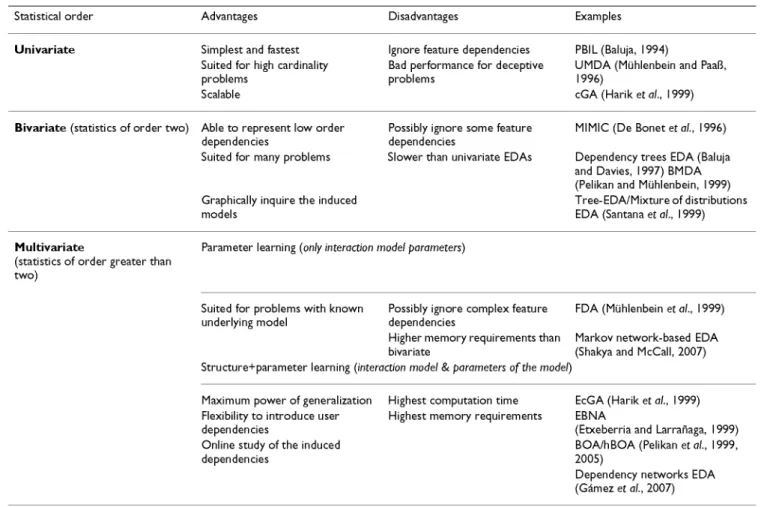
So as to have a graphical taxonomy of the subdivisions presented through this section, Table 2 illustrates all the above features and models providing a graphical taxon-omy of the subdivisions presented throughout this sec-tion. It also includes some useful tips to choose among the available EDAs, such as their pros and cons.
Potential of EDAs in bioinformatics
Evolutionary algorithms, and GAs in particular, have been widely and successfully applied in bioinformatics. It is reasonable to expect that the improvements in EDA effi-ciency and scalability can contribute to expanding the use of these algorithms, particularly for difficult problems where other evolutionary algorithms fail [3,27].
Table 2: EDAs taxonomy
Statistical order
Univariate
Advantages
Simplest and fastest Suited for high cardinality problems
Scalable
Disadvantages
Ignore feature dependencies Bad performance for deceptive problems
Examples
PBIL(Baluja, 1994)
U M D A (Mühlenbein and PaaB, 1996)
cGA (Harik et al., I<
Bivariate (statistics of order two) Able t o represent low order
dependencies
Suited for many problems
Graphically inquire the induced models
Possibly ignore some feature dependencies
Slower than univariate EDAs
M I M I C ( D e B o n e t e t a / . , 1996)
Dependency trees EDA (Baluja and Davies, 1997) BM DA (Pelikanand Mühlenbein, 1999) Tree-EDA/Mixtureof distributions EDA (Santana et al., 1999)
Multivariate
(statistics of order greater than two)
Parameter learning (only interaction model parameters)
Suited for problems with known Possibly ignore complex feature FDA (Mühlenbein et ai, 1999) underlying model dependencies
Higher memory requirements than Markov network-based EDA bivariate (Shakya and McCall, 2007) Structure+parameter learning (interaction model & parameters ofthe model)
Máximum power of generalization Highest computation time Flexibility t o introduce user Highest memory requirements dependencies
Online study o f t h e induced dependencies
EcGA (Harik et ai, 1999) EBNA
(Etxeberria and Larrañaga, 1999) BOA/hBOA (Pelikan et al., 1999, 2005)
Dependency networks EDA (Gámez et al., 2007)
A taxonomy of some representative EDAs. W e highlight a set of characteristics that can guide the choice of a particular EDA suited t o the goals and properties of a given problem.
with certain pre-established partial configurations. This way they can test particular hypotheses about the config-uration ofthe optimal solution.
EDAs have another advantage, also associated with the capacity to model key features of the search space. The models generated during the search can be mined to reveal previously unknown information about the prob-lem [28-30].
Furthermore, recent results of applying EDAs to problems from other domains [31] have shown that the informa-tion gathered by the models to solve a given problem instance can, in some cases, also be employed to solve other instances of the same problem. This pavés the way for building bioinformatics applications where the infor-mation extracted from previous searches is reused to solve different instances of a similar problem.
E D A s in genomics
Introduction
Gene structure analysis
As genomes are being sequenced at an increasing pace, the need for automatic procedures for annotating new genomes is becoming more and more important. A first and important step in the annotation of a new genome is the location of the genes in the genome, as well as their correct structure. As a gene may contain many different parts, the problem of gene structure prediction can be seen as a segmentation or parsing problem. To solve this problem automatically, pattern recognition and machine learning techniques are often used to build a model of what a gene looks like. This model can then be used to automatically lócate potential genes in a genome [32,33].
A gene prediction framework consists of different compo-nents, where each component (often modeled as a classi-fier) aims at identifying a particular structural element of the gene. Important structural elements include the start of the gene (start codon), the end of a gene (stop codon) and the transitions between the coding and non-coding parts of the gene (splice sites).
The exact mechanisms that the cell uses to recognize genes and their structural elements are still under research. As this knowledge is missing, one major problem in this con-text is to define adequate features to train the classifiers for each structural element. Consequently, large sets of sequence features are extracted in the hope that these sets will contain the key features. However, it is known that not all of these features will be important for the classifi-cation task at hand, and many will be irrelevant or redun-dan!
To find the most relevant features for recognizing gene structural elements, feature subset selection (FSS) tech-niques can be used. These techtech-niques try to select a subset of relevant features from the original set of features [34,35]. As this is an NP-hard optimization problem with 2" possible subsets for evaluation (given n features), pop-ulation-based heuristic search methods are an interesting engine for driving the search through the space of possible feature subsets. Each solution in the population decodes a feature subset as a binary string: features having a valué of 1 are included in the subset, whereas the ones having a valué of 0 are discarded.
As a natural altemative to genetic algorithms, the use of EDAs for FSS was initiated in [36] for classic benchmark problems, and their use in large scale feature subset selec-tion domains was reported to yield good results [37,38]. Furthermore, the EDA-based approach to FSS was shown to generalize to feature weighting, ranking and selection [39]. This has the advantage of getting more insight into the relevance of each feature separately, focusing on strongly relevant, weakly relevant, and irrelevant features.
The application of EDA-based FSS techniques in gene structure prediction was pioneered for the most important gene prediction components in [40]. Its most important application was the recognition of splice sites. Using naive Bayes classifiers, support vector machines and C4.5 deci-sión trees as base classifiers, an UMDA-based FSS scheme was used to obtain higher performance models.
In addition to better models, an UMDA-based approach was also used to get more insight into the selected fea-tures. This led to both the identification of new character-istics, as well as the confirmation of important previously known characteristics [41].
Gene expression analysis
The quantitative and qualitative DNA analysis is one of the most important áreas of modern biomedical research. DNA microarrays can simultaneously measure the expres-sion level or activity level of thousands of genes under a set of conditions. Microarray technology has become a popular option for partial DNA analysis since Golub et fll.'s pioneering work [42].
The starting point of this analysis is the so called gene expression matrix, where rows represent genes, columns represent experimental conditions (or samples), and the valúes at each position of the matrix characterize the expression level of the particular gene under the particular experimental condition. Additional biological informa-tion about the genes and the experimental condiinforma-tions can be added to the matrix in the form of gene and/or sample annotation. Depending on how we treat the annotation, gene expression data analysis can be either supervised or unsupervised. When sample annotation is used to split the set of samples into two or more classes or phenotypes (e.g. 'healthy' or 'diseased' tissues), supervised analysis (or class prediction) tries to find patterns that are characteris-tic of each of the classes. On the other hand, unsupervised analysis (or class discovery) ignores any annotation. Examples of such analysis are gene clustering, sample clustering and gene expression data biclustering.
Classification ofDNA microarray data
It is broadly assumed that a limited number of genes can cause the onset of a disease. Within this scenario biolo-gists demand a reduction in the number of genes. In addi-tion, the application of a FSS technique to microarray datasets is an essential step to achieve an accurate classifi-cation performance for any base classifier.
Although univariate gene ranking procedures are very popular for differential gene expression detection, the multivariate selection of a subset of relevant and non-redundant genes has borrowed from the field of heuristic search engines to guide the exploration of the huge solu-tion space (there are 2" possible gene subsets, where n is the number of initial genes). Two research groups have proven that the EDA paradigm is useful for this challeng-ing problem. Both groups have implemented efficient algorithms that have achieved accuracy levéis comparable to the most effective state-of-the-art optimization tech-niques:
• Using a naive Bayes network as the base classifier and the UMDA as the search algorithm, Blanco et al. [43] achieve competitive results in two gene expression bench-marking datasets. The authors show that the predictive power of the models can be improved when the probabil-ity of each gene being selected in the first population is initialized using the results provided by a set of simple sequential search procedures.
• Paul and Iba [44,45] propose two variations of the PBIL search algorithm to identify subsets of relevant and non-redundant genes. Using a wide variety of classifiers, nota-ble results are achieved in a set of gene expression bench-marking datasets with subsets of extremely low dimensionality.
Using a continuous-value versión of the UMDA proce-dure, EDAs have been used as a new way of regularizing the logistic regression model for microarray classification problems [46]. Regularization consists of shrinking the parameter estimates to avoid their unstability present when there are a huge number of variables compared to a small number of observations (as in the microarray set-ting). Therefore, the parameter estimators are restricted máximum likelihood estimates, i.e. the máximum valué of a new function including the likelihood function, plus a penalty term where the size of the estimators is con-strained. There are different norms for measuring estima-tors size. This leads to different regularized logistic regression ñames [47]: ridge, Lasso, bridge, elastic net, etc.
EDAs could be used to optimize these new functions and be a good optimization method especially in some cases where numerical methods are unable to solve the
corre-sponding non-differentiable and non-convex optimiza-tion problems. However, another possibility, taken up in [46], is to use EDAs to maximize the likelihood function without having to be penalized (which is a simpler opti-mization problem) and to include the shrinkage of the estimates during the simulation of the new population. New estimates are simulated during EDA evolutionary process in such a way that guarantees their shrinkage while maintaining their probabilistic dependence rela-tionships learnt in the previous step. This procedure yields regularized estimates at the end of the process.
Clusteríng ofDNA microarray data
Whereas the above papers propose a supervised classifica-tion framework, clusteríng is one of the main tools used to analyze gene expression data obtained from microarray experiments [48]. Grouping together genes with the same behaviour across samples, that is, gene clusters, can sug-gest new functions for all or some of the grouped genes. We highlight two papers that use EDAs in the context of gene expression profile clusteríng:
• Peña et al. [49] present an application of EDAs for iden-tifying clusters of genes with similar expression profiles across samples using unsupervised Bayesian networks. The technique is based on an UMDA procedure that works in conjunction with the EM clusteríng algorithm. To eval-úate the proposed method, synthetic and real data are analyzed. The experimentation with both types of data provides clusters of genes that may be biologically mean-ingful and, thus, interesting for biologists to research fur-ther.
• Cano et al. [50] use UMDA and genetic algorithms to look for clusters of genes with high variance across sam-ples. A real microarray dataset is analyzed, and the Gene Ontology Term Finder is used to evalúate the biological meaning of the resulting clusters.
Like clusteríng, biclustering is another NP-hard problem that was originally considered by Morgan and Sonquist in 1963 [51]. Biclustering is founded on the fact that not all the genes of a given cluster should be grouped into the same conditions due to their varying biological activity. Thus, biclustering assumes that several genes will only change their expression levéis within a specified subset of conditions [52]. This assumption has motivated the development of specific algorithms for biclustering analy-sis.
codification discussed for the FSS problem, the authors use two concatenated binary arrays to represent a biclus-ter, (Xj, ..., xn | yv ..., ym). The first array represents each gene of the microarray, where the size is the number of genes. The second array represents each condition, with a size equal to the number of conditions. A valué of 1 in the
ith position of the first array shows that the ith gene has been selected for inclusión in the bicluster. Likewise, a valué of 1 in the jth position of the second array indicates that the j * condition has been selected for inclusión in the bicluster. This codification results in a space of 2n+m possi-ble biclusters.
Inference ofgenetic networks
The inference of gene-gene interactions from gene expres-sion data is a powerful tool for understanding the system behaviour of living organisms [54].
This promising research área is now of much interest for biomedical practitioners, and a few papers have even applied EDAs to this domain. One of these early works uses Bayesian networks as the paradigm for modeling the interactions among genes, while an UMDA approach explores the search space to find the candidate interac-tions [55]. The subsequent litera ture evaluation of the most reliable interactions unveils that many of them have been previously reported in the literature.
E D A s in proteomics
Introduction
The objective of protein structure prediction is to predict the native structure of a protein from its sequence. In pro-tein design, the goal is to créate new propro-teins that satisfy some given structural or functional constraints. Fre-quently, both problems are addressed using function opti-mization. As the possible solution space is usually huge, complex and contains many local óptima, heuristic mization methods are needed. The efficiency of the opti-mization algorithm plays a crucial role in the process. In this section, we review applications of EDAs to different variants of protein structure prediction and protein design problems.
We start by reviewing some important concepts related to protein models and energy functions in optimization. Then, we propose an initial general classification of EDA applications to protein problems according to how sophisticated and detailed the protein models used are. Subsequently, we give a more detailed classification based on the specificities of the protein problems.
Protein structure prediction and protein design
Protein structure prediction and protein design are usually addressed by minimizing an energy function in the candi-date solution space. Two essential issues in the
applica-tion of EDAs and other optimizaapplica-tion algorithms to these problems are the type of protein representation employed and the energy function of choice.
There are many factors that influence the stability of pro-teins and have to be taken into account to evalúate candi-date structures. The native state is thought to be at the global free energy minimum of the protein. Electtostatic interactions, including hydrogen bonds, van der Waals interactions, intrinsic propensities of the amino acids to take up certain structures, hydrophobic interactions and conformational entropy contribute to free energy. Deter-mining to what extent the function can represent all of these factors, as well as how to weight each one are diffi-cult questions that have to be solved before applying the optimization method.
Simplified protein models omit some of these factors and are a first problem-solving approximation. For example, the approximate fold of a protein is influenced by the sequence of hydrophobic and hydrophilic residues, irre-spective of what the actual amino acids in that sequence are [56]. Therefore, a first approximation could simply be constructed by a binary patterning of hydrophobic and hydrophilic residues to match the periodicity of secondary structural elements. Simplification can be further devel-oped to consider proteins represented using this binary patterning and to approximate the protein structure pre-diction problem as two- and three-dimensional lattices. In this case, the energy function measures only hydrophobic and hydrophilic interactions. An example of this type of representation is shown in Figure 3, where a sequence of 64 aminoacids is represented on a two-dimensional lat-tice.
EDA approaches
Depending on how sophisticated and detailed the protein model used is, EDAs can be divided into two groups: EDAs applying a simplified model [57-60] and EDAs using more detailed (atomic-based) models [61-63]. A more thorough classification is related to the type of prob-lems addressed:
• Protein structure prediction in simplified models [58,60].
• Protein side chain placement [62,63].
• Design of protein peptide ligands [61].
• Protein design by minimization of contact potentials [59,64].
L C
c
y.
r
y——t
W ^
P Y Y T Y
T ¿
T — ¿
^ f ^ ^ DFigure 3
Optimal protein structure (Figure 3-ProteinStruc-ture.eps). Optimal solution of an HP model found by an EDA that uses a Markovian model.
• Using EDAs as a simulation tool to investígate the influ-ence of different protein features in the protein folding process [63].
In [58-60], EDAs are used to solve bi-dimensional and three-dimensional simplified protein folding problems. The hydrophobic-polar (HP) [65], and functional protein models [66] are optimized using EDAs based on probabi-listic models of different complexity (i.e. Tree-EDA [67], mixtures of trees EDA (MT-EDA) [67] and EDAs that use fc-order Markov models (MK-EDAfe) [58]).
The results achieved outperform other evolutionary algo-rithms. For example, the configuration shown in Figure 3 is the optimal solution found by MK-EDA2. Due to the particular topology of this instance, other evolutionary algorithms consistently fail to find the optimal solution [58].
Side chain placement problems are dealt with using UMDA with discrete representation in [62,63]. The approach is based on the use of rotamer libraries that can represent the side chain configurations using their rotamer angles. For these problems, EDAs have achieved very good results in situations where other methods fail [63]. Results are better when EDAs are combined with local optimization methods as in [63], where variable neighborhood search [68] is applied to the best solutions found by UMDA.
Belda et al. [61] use different EDAs to genérate potential peptide ligands of a given protein by minimizing the docking energy between the candidate peptide ligand and a user-defined área of the target protein surface. The results of the population based incremental learning algo-rithm (PBIL) [9] and the Bayesian optimization algoalgo-rithm (BOA) [18] are compared with two different types of genetic algorithms. Results showed that some of the lig-ands designed using the computational methods had bet-ter docking energies than peptides designed using a purely chemical knowledge-based approach [61].
In [64], three different EDAs are applied to solve a protein design problem by minimizing contact potentials: UMDA, Tree-EDA and Tree-EDAr (the structure of the tree is deduced from the known protein structure, tree param-eters are learned from data). Combining probabilistic models able to represent probabilistic dependencies with information about residue interactions in the protein con-tact graph is shown to improve the search efficiency for the evaluated problems. In [59], EDAs that use loopy probabilistic models are combined with inference-based optimization algorithms to deal with the same problems. For several protein instances, this approach manage to improve the results obtained with tree-based EDAs.
The alphabet reduction problem is addressed in [57] using the extended compact genetic algorithm (EcGA) [69]. The problem is to reduce the 20-letter amino acid (AA) alphabet into a lower cardinality alphabet. A genet-ics-based machine learning technique uses the reduced alphabet to induce rules for protein structure prediction features. The results showed that it is possible to reduce the size of the alphabet used for prediction from twenty to just three letters resulting in more compact rules.
Results of using EDAs and the HP model to simúlate the protein folding process are presented in [64]. Some of the features exhibited by the EDA model that mimics the behaviour of the protein folding process are investigated. The features considered include the correlation between the EDA success rate and the contact order of the protein models, and the relationship between the generation con-vergence of EDAs for the HP model and the contact order of the optimal solution. Other issues analyzed are the dif-ferences in the rate of formation of native contacts during EDA evolution, and how these differences are associated with the contact separation of the protein instance.
Conclusión
pos-sible solution space is huge for most of the addressed problems, researchers have made use of efficient EDA implementations.
A group of interesting papers demónstrate the efficiency and the competitive accuracy of this novel search para-digm in a set of challenging NP-hard genomic and pro-teomic bioinformatic tasks. As the number of EDA application papers in bioinformatics is modest and the number and variety of problems is constantly growing, there is room for new EDA applications in the field.
An interesting opportunity for future research is the adap-tation and application of multivariate EDA models that can efficiently deal with the huge dimensionality of cur-rent bioinformatic problems. Going further than simple univariate models, bio-experts could explicitly inspect the probabilistic relationships among problem variables for each generation of the evolutionary process. This would créate opportunities for improved accuracy. These proba-bilistic relationships induced from the evolutionary model are an attractive way of proposing novel biological hypotheses to be further tested by bio-experts.
C o m p e t i n g interests
The authors declare that they have no competing interests.
A u t h o r s ' contributions
RA, II, and PL conceived of the manuscript. II, YS, ILF, RB, VR and CB participated in writting the genomics section. The proteomics section was designed and written by RS and IAL. The introduction to EDAs was carried out by RA, RS and YS. RA was in charge of the writing and coordina-tion process. II, YVP and PL helped to write and correct the manuscript draft. All authors read and approved the final manuscript.
A c k n o w l e d g e m e n t s
This work has been partially supported by the 2007-2012 Etortek, Saiotek and Research Group (IT-242-07) programs (Basque Government), TIN2005-03824 and Consolider Ingenio 20I0-CSD2007-000I8 projects (Spanish Ministry of Education and Science) and the COMBIOMED net-work in computational biomedicine (Carlos III Health Institute).
R. Armañanzas is supported by Basque Government grant AE-BFI-05/430. Y. Saeys would like to thank the Fund for Scientific Research Flanders (FWO) for funding his research.
References
1. Bosman PA, Thierens D: Linkage information processing in
dis-tribution estimation algorithms. In Proceedings ofthe Genet/c and Evolutionary Computatíon Conference GECCO-1999 Volume I. Edited by:
Banzhaf W , Daida J, Eiben AE, Garzón MH, Honavar V, Jakiela M, Smith RE. Orlando, FL: Morgan Kaufmann Publishers, San Francisco, CA; 1999:60-67.
2. Larrañaga P, Lozano JA, Eds: Estimation ofDistribution Algorithms. A New
Tool for Evolutionary Computatíon Kluwer Academic Publishers; 2002.
3. Lozano JA, Larrañaga P, Inza I, Bengoetxea E, Eds: Towards a New
Evo-lutionary Computatíon: Advances on Estímatíon of Distributíon Algorithms
Springer-Verlag; 2006.
4. Mühlenbein H, PaaB G: F r o m recombination of genes to the
estimation of distributions. Binary parameters. Leclure Notes in Computer Science 1411: Parallel Problem Solving from Nature, PPSN IV
1996:178-187.
5. Pelikan M: Hierarchical Bayesian Optímization Algorithm. Toward a New
Generation of Evolutionary Algorithms, of Studies in Fuzziness and Soft Computing Volume 170. Springer; 2005.
6. Larrañaga P: Estimation ofDistribution Algorithms A New Tool for Evo-lutionary Computatíon, Kluwer Academic Publishers 2002 chap. A review on estimation of distributíon algorithms:55-98.
7. Goldberg DE: The Design oflnnovation: Lessons from and for Competent
Genetic Algorithms Kluwer Academic; 2002.
8. Pelikan M, Goldberg DE, Lobo F: A survey of optímization by
building and using probabilistic models. Computational Optímiza-tion and ApplicaOptímiza-tions 2002, 21:5-20.
9. Baluja S: Population-based incremental learning: A method
for integrating genetic search based function optímization and competitive learning. Tech Rep CMU-CS-94-163, Carnegie
Mellon University, Pittsburgh, PA; 1994.
10. Harik GR, Lobo FG, Goldberg DE: T h e compact genetic
algo-r i t h m . IEEE Talgo-ransactions on Evolutionaalgo-ry Computatíon 1999,
3(4):287-297.
I I. Sebag M, Ducoulombier A: Extending population-based
incre-mental learning to continuous search spaces. Parallel Problem Solving from Nature - PPSN V 1998:418-427.
12. De Bonet JS, Isbell CL, Viola P: M I M I C : Finding ó p t i m a by
esti-mating probability densities. In Advances in Neural Information Processing Systems Volume 9. Edited by: Mozer MC, Jordán MI, Petsche
T. The MIT Press; 1997:424-430.
I 3. Pelikan M, Mühlenbein H: T h e bivariate marginal distributíon
algorithm. In Advances in Soft Computing - Engineering Design and Manufacturing Edited by: Roy R, Furuhashi T, Chawdhry PK. London:
Springer-Verlag; 1999:521-535.
14. Baluja S, Davies S: Using optimal dependency-trees for
combi-natoria! optímization: Learning the structure of the search space. Proceedings ofthe I4th International Conference on Machine Learning 1997:30-38.
15. Santana R, Ponce de León E, Ochoa A: T h e edge incident model.
Proceedings ofthe Second Symposium on Artificial Intelligence (CIMAF-99)
1999:352-359.
16. Mühlenbein H, Mahnig T, Ochoa A: Schemata, distributions and
graphical models in evolutionary optímization. Journal ofHeu-ristícs 1999, 5(2):21 3-247.
17. Etxeberria R, Larrañaga P: Global optímization using Bayesian n e t w o r k s . Proceedings ofthe Second Symposium on Artificial Intelligence
(CIMAF-99) 1999:151-173.
18. Pelikan M, Goldberg D, Cantú-Paz E: B O A : T h e Bayesian
optími-zation algorithm. Evol Comput 2000, 8(3): 31 I -340.
19. Alden MA: M A R L E D A : Effective Distributíon Estimation
Through Markov Random Fields. In PhD thesis Faculty of the
Gradúate Schoool, University of Texas at Austin, USA; 2007. 20. Shakya S, McCall J: Optímization by estimation of distributíon
with D E U M f r a m e w o r k based on Markov random fields. International Journal ofAutomation and Computing 2007, 4(3):262-272.
21. Santana R: Estimation of distributíon algorithms with Kikuchi
approximations. Evolutionary Computatíon 2005, I 3:67-97.
22. Gámez JA, Mateo JL, Puerta JM: E D N A : Estimation of
depend-ency networks algorithm. Bio-inspired Modeling ofCognitíve Tasks, Second International Work-Conference on the Interplay Between Natural and Artificial Computatíon, IWINAC, ofLecture Notes in Computer Science
2007, 4527:427-436.
23. Geman S, Geman D: Stochastic relaxation, Gibbs distributions,
and Bayesian restoration of images. IEEE Transactions on Pattern Analysis and Machine Intelligence 1984:721 -741.
24. Mühlenbein H, Mahnig T: Evolutionary synthesis of Bayesian
networks for optímization. In Advances in Evolutionary Synthesis of Intelligent Agents Edited by: Patel M, Honavar V, Balakrishnan K. MIT
Press; 2001:429-455.
25. Ochoa A, Mühlenbein H, Soto M: Factorized distributíon
algo-rithms using Bayesian networks bounded complexity. Pro-ceedings ofthe Genetic and Evolutionary Computatíon Conference
26. Ochoa A, Mühlenbein H, Soto MR: A factorized distribution
algo-r i t h m using single connected Bayesian netwoalgo-rks. In Paalgo-rallel Problem Solving from Nature - PPSN VI 6th International Conference
Edited by: Schoenauer M, Deb K, Rudolph G, Yao X, Lutton E, Merelo JJ, Schwefel H. Springer Verlag; 2000:787-796.
27. Pelikan M, Sastry K, Cantú-Paz E, Eds: Scalable Optimizaron via
Proba-bilistic Modeling: From Algorithms to Applications Studies ¡n
Computa-tional Intelligence, Springer; 2006.
28. Bengoetxea E: Inexact Graph Matching Using Estimation of
Distribution Algorithms. In PhD thesis Ecole Nationale Supérieure
des Télécommunications; 2003.
29. Hauschild M, Pelikan M, Lima C, Sastry K: Analyzing probabilistic
models in hierarchical B O A on traps and spin glasses. Pro-ceedings ofthe Genet/c and Evolutionary Computation Conference
GECCO-2007 GECCO-2007,1:523-530.
30. Echegoyen C, Santana R, Lozano JA, Larrañaga P: Linkage in
evolution-ary computation Studies in Computational Intelligence 2008 chap. The
impactof probabilistic learning algonthms in EDAs based on Bayesian networks.
31. Hauschild M, Pelikan M, Sastry K, Goldberg DE: Using previous
models to bias structural learning in the hierarchical B O A .
MEDAL Report No. 2008003, Missouri Estimation of Distribution Algorithms Laboratory (MEDAL); 2008.
32. Mathé C, Sagot M, Schiex T, Rouzé P: C u r r e n t methods of gene
prediction, their strengths and weaknesses. Nucleic Acids Research 2002, 30(19):4103-41 17.
33. Majoros W : Methods for Computational Gene Prediction Cambridge Uni-versity Press; 2007.
34. Liu H, Yu L: T o w a r d integrating feature selection algorithms
for classification and clustering. IEEE Transactions on Knowledge and Data Engineering 2005, I 7(4):491 -502.
35. Saeys Y, Inza I, Larrañaga P: A review of feature selection
tech-niques in bioinformatics. Bioinformatics 2007, 23(I9):2507-25I7.
36. Inza I, Larrañaga P, Etxebarria R, Sierra B: Feature subset selection
by Bayesian networks based optimization. Artificial Intelligence
1999,27:143-164.
37. Inza I, Merino M, Larrañaga P, QuirogaJ, Sierra B, Gírala M: Feature
subset selection by genetic algorithms and estimation of dis-tribution algorithms - A case study in the survival of cir-rhotic patients treated with T I P S . Artificial Intelligence in Medicine
2001, 23(2): 187-205.
38. Saeys Y, Degroeve S, Aeyels D, Peer Y Van de, Rouzé P: Fast feature
selection using a simple estimation of distribution algorithm: A case study on splice site prediction. Bioinformatics 2003,
l9(Suppl 2): 179-188.
39. Saeys Y, Degroeve S, Peer Y Van de: Towards a New Evolutionary
Com-putation: Advances in Estimation of Distribution Algorithms Springer 2006
chap. Feature rankíng using an EDA-based wrapper approach:243-257.
40. Saeys Y: Feature Selection for Classification of Nucleic Acid
Sequences. In PhD thesis Ghent Uníversity, Belgíum; 2004.
41. Saeys Y, Degroeve S, Aeyels D, Rouzé P, Peer Y Van de: Feature
selection for splice site prediction: A new method using EDA-based feature ranking. BMC Bioinformatics 2004, 5:64.
42. Golub TR, Slonim DK, Tamayo P, Huard C, Gaasenbeek M, Mesírov JP, Coller H, Loh ML, Downing JR, Calíguri MA, Bloomfíeld CD, Lander ES: Molecular classification of caneen Class discovery
and class prediction by gene expression monitoring. Science
1999,286:531-537.
43. Blanco R, Larrañaga P, Inza I, Sierra B: Gene selection for cáncer
classification using wrapper approaches. International Journal of Pattern Recognition and Artificial Intelligence 2004, 18(8): I 373-1 390.
44. Paul TK, Iba H: Identification of informative genes for
molecu-lar classification using probabilistic model building genetic algorithms. Proceedings ofthe Genetic and Evolutionary Computation Conference GECCO-2004. Lecture Notes in Computer Science 3102
2004:414-425.
45. Paul T, Iba H: Gene selection for classification of cancers using
probabilistic model building genetic algorithm. BioSystems
2005, 82(3):208-225.
46. Bíelza C, Robles V, Larrañaga P: Estimation of distribution
algo-rithms as logistic regression regularizers of microarray clas-sifiers. Methods of Information in Medicine 2008 in press.
47. Hastíe T, Tíbshiraní R, Friedman J: The Elements of Statistical Learning:
Data Mining, Inference, and Prediction Springer-Verlag; 2001.
48. Ben-Dor A, Shamir R, Yakhíni Z: Clustering gene expression
pat-terns. Journal of Computational Biology 1999, 6(3/4):28l-297.
49. Peña J, Lozano J, Larrañaga P: Unsupervised learning of Bayesian
networks via estimation of distribution algorithms: an appli-cation to gene expression data clustering. International Journal ofUncertainty, Fuzziness and Knowledge-Based Systems 2004, I 2:63-82.
50. Cano C, Blanco A, García F, López FJ: Evolutionary algorithms for
finding interpretable patterns in gene expression data. Inter-national Journal on Computer Science and Information System 2006,
I (2):88-99.
51. Morgan J, Sonquístz J: Problems in the analysis of survey data,
and a proposal. Journal of the American Statistical Association 1963,
58:415-434.
52. Cheng Y, Church GM: Biclustering of expression data. In
Pro-ceedings ofthe Eighth International Conference on Intelligent Systems for Molecular Biology AAAI Press; 2000:93-103.
53. Palacios P, Pelta DA, Blanco A: Obtaining biclusters in
microar-rays with population-based heuristics. Evo Workshops, Springer 2006:1 15-126.
54. Armañanzas R, Inza I, Larrañaga P: Detecting reliable gene
inter-actions by a hierarchy of Bayesian network classifiers. Com-put Methods Programs Biomed 2008, 91 (2): 110-121.
55. Daí C, Liu J: Inducing pairwise gene interactions f r o m t i m e
series data by E D A based Bayesian network. ConfProc IEEE Eng Med Biol Soc 2005, 7:7746-7749.
56. Steípe B: Protein design concepts. In The Encyclopedia of
Compu-tational Chemistry Edited by: Schleyer PVR, Allínger NL, Clark T,
Gasteiger J, Kollman PA, Schaefer III HF, Schreiner PR. Chíchester: John Wiley & Sons; 1998:2168-2185.
57. BacarditJ, Stout M, HírstJD, Sastry K, Llora X, Krasnogor N:
Auto-m a t e d alphabet reduction Auto-method with evolutionary algo-rithms for protein structure prediction. Proceedings of the Genetic and Evolutionary Computation Conference GECCO-2007 2007, 1:346-353.
58. Santana R, Larrañaga P, Lozano JA: Protein folding in
2-dimen-sional lattices with estimation of distribution algorithms. In Proceedings ofthe First International Symposium on Biological and Medical Data Analysis, of Lecture Notes in Computer Science Volume 3337.
Barce-lona: Springer Verlag; 2004:388-398.
59. Santana R: Advances in Probabilistic Graphical Models for
Optimization and Learning Applications in Protein Model-ling. In PhD thesis Uníversity o f t h e Basque Country; 2006.
60. Santana R, Larrañaga P, Lozano JA: Protein folding in simplified
models with estimation of distribution algorithms. IEEE Trans-actions on Evolutionary Computation 2008, 12(4):418-438.
61. Belda I, Madurga S, Llora X, Martínell M, Tarrago T, Piqueras M, Nicolás E, Giralt E: E N P D A : A n evolutionary structure-based
de novo peptide design algorithm. Journal of Computer-Aided Molecular Design 2005, 19(8):585-601.
62. Santana R, Larrañaga P, Lozano JA: Side chain placement using
estimation of distribution algorithms. Artificial Intelligence in Medicine 2007, 39:49-63.
63. Santana R, Larrañaga P, Lozano JA: Combining variable
neighbor-hood search and estimation of distribution algorithms in the protein side chain placement problem. Journal of Heuristics 2007
in press.
64. Santana R, Larrañaga P, Lozano JA: T h e role of a priori
informa-tion in the minimizainforma-tion of contact potentials by means of estimation of distribution algorithms. Proceedings ofthe Fifth European Conference on Evolutionary Computation, Machine Learning and Data Mining in Bioinformatics, of Lecture Notes in Computer Science 2007, 4447:247-257.
65. Dill KA: Theory for the folding and stability of globular
pro-teins. Biochemistry 1985, 24(6): 1501 -1509.
66. HírstJD: T h e evolutionary landscape of functional model
pro-teins. Protein Engineering 1999, 12:721-726.
67. Santana R, Ochoa A, Soto MR: T h e mixture of trees factorized
distribution algorithm. In Proceedings ofthe Genetic and Evolution-ary Computation Conference GECCO-2001 Edited by: Spector L,
Good-man E, W u A, Langdon W , Voigt H, Gen M, Sen S, Dorígo M, Pezeshk S, Garzón M, Burke E. San Francisco, CA: Morgan Kaufmann Publísh-ers; 2001:543-550.
68. Mladenovic N: A variable neighborhood algorithm - a new
69. Harik GR, Lobo FG, Sastry K: Linkage learning via probabilistic
modeling in the EcGA. In Scalable Optiinization via Probabilistic Modeling: From Algorithms to Applications, Studies in Computational Intel-ligence Édited by: Pelikan M, Sastry K, Cantú-Paz E. Springer-Verlag;