
Hydrogen Production by a Fe based Oxygen Carrier and Methane Steam Redox Process: Thermodynamic Analysis
7
0
0
Texto completo
(2) Even though several other metal oxides have been proposed under the chemical looping concept for hydrogen production, the Fe3O4/Fe redox system is one of the most studied systems due to the fact that employs inexpensive materials and because it produces a high yield of H2 per mass of iron (48 g H2/kg Fe, from equation 4). One of the main challenges of a looping operation of the steam-iron process lies in the temperature swings and different gaseous atmospheres that the material needs to be exposed in order to perform a cycle operation in the process. This operation mode, performed at high temperatures, often produce sintering in the material with the consequent loss of activity and this being reflected in a significant decrease of lifetime, thus reducing the overall efficiency of the process. In order to overcome this problematic, several studies have concentrated in improving reactor kinetics and the stability of the materials by modifying iron oxide with the addition of metals like Al, Mo and Ce as reported by Otsuka et al [6]. Takenaka et al [7] employed a mixture of Ni–Cr–FeOx reacted with methane followed by reaction with steam to produce pure hydrogen, where Cr species in Ni–Cr–FeOx were stabilized as octahedral Cr3+O6 in the ferrites CrxFe3−xO4 during the redox reactions. It was concluded that Cr helped to inhibit sintering of iron species. While Urasaki et al [8] added palladium and zirconia to the iron-based oxygen carrier to accelerate both the reduction and oxidation rates and also found that zirconia enhanced structural and thermal stability in iron oxides. Zafar et al [9] used SiO2 and MgAl2O4 as supports to reduce the sintering of iron oxide, while Galvita and Sundmacher [10] proposed the use of Cr2O3–Fe3O4–CeO2–ZrO2 to provide stability to the oxygen carrier up to 100 redox cycles. However, some carbon monoxide in the hydrogen product stream was observed during the re-oxidation phase, whereas Liotta et al [11] examined the redox behavior and structural stabilization of ceria-zirconia solid solutions supported on alumina towards the CO oxidation catalysis. The unique oxygen storage capacity of the CeO2–ZrO2 combined with iron oxides produced an oxygen carrier that combines this important feature with the thermal stability and activity as confirmed by several research studies [12-14]. Moreover, several researchers [15-19] have proposed a novel two-step SMR process for hydrogen production based on the chemical looping concept and a scheme of this is presented in in Figure 1.. In the fuel reactor (I) the oxygen carrier, typically a metal oxide (MeO), is reacted with methane to produce syngas and the reduced metal (Me) according to: Reaction 6: CH4 (g) + MeO = Me + 2H2 (g) + CO(g) Reaction 7: H2 O(g) + Me = MeO + H2 (g) Finally, the regenerated oxygen carrier is sent back to the fuel reactor to complete one full loop or reaction cycle. The combination of reactions (6) and (7) leads to reaction (1), which is the SMR reaction. The reaction process indicated in Figure 1 is usually called as chemical looping steam methane reforming (CL-SMR). This process separate the feed of methane and steam in two step reactors thus, producing a syngas stream in the first and a H2 gas product in the second that needs no further purification. One critical issue of this proposed reaction scheme deals with the relatively low reactivity of the oxygen carrier towards the reoxidation of the reduced metal (reaction 6). Several metal oxides have been reported as oxygen carriers for the CL-SMR such as Fe3O4, WO3, SnO2, Ni–Fe, (Zn, Mn)–Fe, Cu–Fe and Cebased oxides [15] . Among all these oxygen carriers such as Feoxides have proven to be suitable for the CL-SMR. Nevertheless, thermodynamic constrains for the hydrogen evolution make this oxygen carrier to behave in a complex way, since in some cases the complete reduced Fe phase is required for a high H2 production yield, while the complete oxidation with steam beyond Fe3O4 is thermodynamically limited [20]. However, this oxygen carrier can be considered ideal for CLSMR applications and this is based on its reduced propensity to carbon formation and resistance to form agglomerates. These last features are critical for an oxygen carrier to retain its activity over continuous redox cycles. Furthermore, iron oxide oxygen carriers are not susceptible to form sulfide or sulfate compounds under sulfur-containing atmospheres [21], while large natural reserves and low cost make them suitable for implementation at large scales [22-24]. Some drawbacks of these Fe-based oxygen carriers include weak redox characteristics, relatively low oxygen storage capacity (OSC), and limited reactivity towards gaseous fuels like methane [25]. Additionally, Fe presents multiple oxidation states such as Fe2O3, Fe3O4, FeO and Fe and as indicated above it presents thermodynamic limitations, since only the transformation from Fe2O3 to Fe3O4 is feasible for the total oxidation of methane, whereas partial oxidation of methane (POX) is favored in the transition reduction from FeO to Fe according to Monzam et al [26]. Thermodynamic Considerations. Figure 1. Conceptual scheme of the SMR chemical looping. Several thermodynamic analyses have studied different approaches to the CL-SMR process. Fraser et al. [26] performed a thermodynamic analysis of the reformer sponge iron cycle (RESC) process that consisted in the hydrogen production including a hydrocarbon reformer and a sponge iron reactor (SIR). The reformer output gas (H2 and CO) reduces the pellets from magnetite (Fe3O4) and wuestite (FeO) into iron metal (Fe) through reactions (2) and (3) and the reduced Fe is reoxidized with steam by reaction (4). They found that the process offers hydrocarbon to hydrogen conversion efficiencies in the order of.
(3) 75% vs LHV for methane and at a temperature range of 750 ° C and above. Steinfeld and Kuhn [27] presented a high temperature thermochemistry analysis of the Fe3O4 reduction with methane for the production of syngas. They studied the reaction system at temperatures above 1000 °C aimed for the use of concentrated solar radiation as the energy source. They found that a mixture of 66.7% H2 and 33.3% CO can be achieved with complete reduction to metallic Fe. Kang et al [28] performed a Thermodynamic analysis of the three-reactor chemical-looping process (TRCL), which consisted in a fuel reactor, a steam reactor, and an air reactor. In the fuel reactor, natural gas (mainly CH4) is oxidized to CO2 and H2O by the lattice oxygen of the oxygen carrier (Fe2O3, WO3, and CeO2). In the steam reactor, the steam is reduced to hydrogen through oxidation of the reduced oxygen carrier, while in the air reactor; the oxygen carrier is fully oxidized by air. Results indicate that an expected hydrogen production of 2.64 mol H2 per mol CH4 under thermoneutral conditions can be achieved and this was affected mainly by the steam-conversion rate. Bohn et al [29] studied the hydrogen production with simultaneous capture of CO2 using the redox reactions of iron oxides in packed beds. They examined the thermodynamics of exposing Fe2O3 to a syngas to produce a high purity CO2 stream ready for sequestration, while the oxidation of FeO to Fe3O4 with steam produced a high purity hydrogen stream. They found that reduction to Fe, rather than FeO, in step 1 gave low levels of H2 and after 10 cycles of reduction and oxidation led to the deposition of carbon at lower temperatures. Furthermore, Svoboda et al [30] studied the thermodynamic and chemical equilibrium of the reduction of Fe3O4 by CH4 and oxidation of iron by steam. The study was concentrated on finding convenient conditions for reduction of Fe3O4 to iron at temperatures from 400- 800 K, but also on the possible formation of undesired soot, Fe3C and iron carbonate. Reduction of magnetite with methane did not produce iron carbides or carbonates, whereas conditions favored the formation of Fe and CO2, and H2O as gas products. From all previous thermodynamic studies related to the use of iron oxides as oxygen carrier for the complete oxidation of methane (reactions 2 and 3) or the partial oxidation of methane, which is a special case of the so called chemical looping steam methane reforming (CL-SMR) that involve the partial oxidation of methane through: Reaction 8: 3𝐹𝑒2 𝑂3 + 𝐶𝐻4 (g) = 2𝐹𝑒3 𝑂4 + 2H2 (g) + CO(g) Reaction 9: 𝐹𝑒3 𝑂4 + 𝐶𝐻4 (g) = 3𝐹𝑒𝑂 + 2H2 (g) + CO(g). important aspect to be considered in this process through the Boudouard and methane pyrolysis reactions: Reaction 12: 2CO(g) = CO2(g) + C Reaction 13: CH4 (g) = 2H2(g) + C Galvita and Sundmacher [31] studied the CL-SMR reaction system and concluded that at a reduction of approximately 60% of the Fe2O3 carbon formation was avoided. Further reduction towards Fe produced carbon deposits on the oxygen carrier. Therefore, the restrictions in order to avoid carbon formation and the steam oxidation of the reduced iron lead to select the Fe3O4/FeO as the ideal redox pair for the CL-SMR process. Up to date, no thermodynamic analysis have been performed to explore optimal reactions conditions. From one end: complete oxidation of methane by Fe3O4 (steam iron process, SIP, which produce only CO2 and FeO in the reduction reactor) to the other end: partial oxidation of methane (POX-MeO or CL-SMR, where syngas and FeO is produced) and subsequent hydrogen production from reoxidation of FeO. This proposed process operation aims to restrict the oxidation states between the two reactors of Figure 1 to the Fe3O4/FeO redox pair, while avoiding carbon formation to insuring a high purity hydrogen stream from the steam oxidation reactor. Therefore, the aim of the present investigation is to perform a thermodynamic and process simulation studies to find optimal operating conditions (avoiding carbon formation) close to equilibrium for a high H2 and/or syngas production. In addition, these under the SIP/CL-SMR reaction system using methane as a feed (for the fuel reactor) and steam (for the oxidation reactor), while employing the Fe3O4/FeO redox pair between the reduction and oxidation reactors. This analysis will include the evaluation of the thermodynamic equilibrium composition of the reaction system, the behavior of the Fe3O4/CH4 and H2O/FeO feed molar ratios as a function of temperature and products composition for the reduction and oxidation reactors, respectively. Furthermore, it is expected that the feed molar ratio of Fe3O4 to CH4 will determine the operation mode of the process from complete oxidation (SIP) to a partial oxidation of methane (CL-SMR). Consequently, a process simulation will examine oxygen carrier recirculation from the oxidation to the reduction reactors and its influence on the process operating conditions. II. METHODS. Reaction 10: 𝐹𝑒𝑂 + 𝐶𝐻4 (g) = 𝐹𝑒 + 2H2 (g) + CO(g). Thermodynamics Method. Reaction 11: 3𝐹𝑒𝑂 + H2 O(g) = 𝐹𝑒3 𝑂4 + H2 (g). Thermodynamic calculations in the present study were performed by the Gibbs free energy minimization technique. In a reaction system where many simultaneous reactions take place, equilibrium calculations can be performed through the Gibbs energy minimization approach (also called the nonstoichiometric method). Details of this technique can be found elsewhere [32]. All calculations were performed using the ASPEN Plus® RGIBBS reactor model and the Redlich–Kwong equation of state for correction of non-ideal conditions. In a RGIBBS reactor the equilibrium composition of all possible combination of reactions that are able to take place within the. This last reactions present the advantage to produce a syngas mixture in the iron reduction reactor (reactions 8-10), while the regeneration of the reduced Fe with steam is able to produce a high purity H2 stream. However, this regeneration will only produce Fe3O4 as reaction (11) is thermodynamically limited. Therefore, in a cyclic operation the redox reaction between the two reactors of Figure 1 will only be reactions (9) and (11). However, carbon deposition during the operation is another.
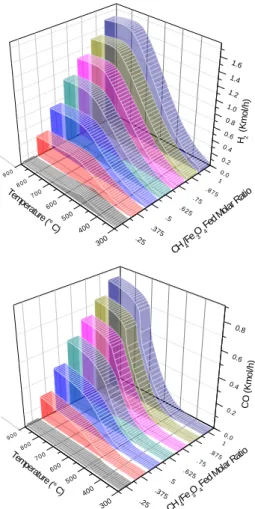
(4) For the fuel reactor the temperature was varied in the range of 300-900 °C at 1 atm. While, the CH4/Fe3O4 feed molar ratio was varied from 0.25 (stoichiometric value according to reaction (5)) to 1 (stoichiometric value according to reaction (9)). Whereas, for the oxidation reactor the temperature was also varied in the range of 300-900 °C at 1 atm. The solid product of the fuel reactor was fed to the steam oxidation reactor. In this reactor, the FeO is to be reacted with steam according to reaction (11). In this reactor the FeO/H2O feed molar ratio was varied from 3 (stoichiometric value according to reaction (11)) to 0.546. This represents a gradual increase from 1 kmol/h of H2O per 3 kmol/h of FeO up 6 kmol/h of H2O per 3 kmol/h of FeO. This feed steam variation was intended to find the minimum amount of steam needed in order to regenerate FeO to Fe3O4 at a reasonable oxidation temperature, where kinetics are favorable (500-600 °C) [39]. It is important to notice that all the present simulation calculations are based on theoretical thermodynamic considerations and these are to be taken as a guide to further experimental evaluation of the reaction systems, since no heat and mass diffusional limitations as well as kinetics effects were taken into account for the conformation of the present thermodynamic analysis.. fuel reactor in a temperature range of 300-900 °C and CH4/Fe3O4 feed molar ratios from 0.25 to 1. At the studied conditions the conversion of methane was gradually increased from about 4% at 300 °C, 90% at 500 °C and up to 99.9% at 600°C. This is associated to the intrinsic equilibrium reactivity of a solid Fe3O4 with respect to a gaseous fuel such as CH4 and availability of the metal oxide lattice oxygen into the gas phase. Fig. 3 shows the equilibrium production of H2 (3a) and CO (3b) from the fuel reactor (dry basis) in kmol/h as a function of temperature and CH4/Fe3O4 feed molar ratio.. 1.6 1.4 1.2 1 .0 0 .8 0 .6 0 .4 0 .2 90. 0 .0. 0. 80. 1. 0. Te mp 7 0 0 era 00 tur 6 e( °C ). .8 7. .7 5. 5. .6 2. 00. .5. 40. .3 7. 0. 3. .2 5. 00. 5. O3 /4Fe CH. 5. tio Ra lar o dM Fe 5. 4. Process simulation calculations was performed using the Aspen-Plus© Engineering Process Simulator. This is a program for simulation of chemical processes in which the analysis of chemical processes as well as heat integration can be made. This simulator was employed for the analysis of the process scheme of Fig. 2. The module of Aspen-Plus that was used to evaluate the reaction systems were: the RGibbs (Gibbs Reactor), wherein RGibbs method is based on the Gibbs free energy minimization technique for multiphase reactions and material balance, cyclone units were used to separate solid and gas streams. RGIBBS-2. GASP-1. OUTPUT-1. 0 .4. 0 .2. 90. 0 .0. 0. 80. 1. 0. Te mp 7 0 0 era 00 tur 6 e( °C ). tio Ra lar o dM Fe .8 7. .7 5. 50. .6 2. 0. .5. 40. .3 7. 0. 30. 0. .2 5. 5. 5. O 3 /Fe. 5. 4. 4 CH. H2PROD. Figure 3. Equilibrium content of H2 (a) and CO (b) for the fuel reactor. STEAM. INPUT1. 0.6. CO (Kmol /h). 0.8. Process Simulation Method. RGIBBS-1. H2 (Kmol /h). thermodynamic system. The RGIBBS program of this reactor finds the most stable phase combination and establish the phase compositions where the Gibbs free energy of the reaction system reaches its minimum at a fixed mass balance, constant pressure, and temperature. For the oxidation of methane and regeneration of the iron oxide species the gaseous species included were: CH4, CO, CO2, H2, and H2O, while solid species were: C, Fe, FeO, Fe2O3, F3C, and FeCO3.. OUTPUT-2. CYCLONE1 CYCLONE2 INPUT2 RECIRC. Figure 2. Process simulation flowsheet. III. RESULTS AND DISCUSSION A. Thermodynamic Analysis The Fuel Reactor This section presents results from the equilibrium amounts of H2, CO, CO2, CH4 and C, Fe, FeO, Fe2O3 and Fe3O4 from the. At low temperatures (300-500 °C) and where CH4/Fe3O4 ratio is small (below 0.5), there is no enough temperature and/or oxygen available for the reaction between Fe3O4 and methane to produce syngas (CO + H2) and therefore, this metal oxide is poorly reactive towards reaction (9). However, the small reactivity in this region is attributed to the complete oxidation of methane by Fe3O4 (reaction 5) where at the SIP conditions (CH4/Fe3O4 = 0.25 and higher but not greater than 0.5) the production of CO2 and H2O dominate. Greater temperatures than 500 °C and CH4/Fe3O4 ratios than 0.5 will lead to the promotion of the partial oxidation of methane by Fe3O4 to form syngas through reaction (9) according to results presented in Figures 3(a) and 3(b)..
(5) Figures 4(a) and 4(b) present results of unreacted CH4 and formed CO2 contents in the gas product from the fuel reactor.. 0.30. 0 .2 0 .1 0 .1 0 .0. 3. 00. .2 5. 40. .3 7. 0. .5. 0 50. Te mp 0 era 6 0 tur e( °C ). .6 2. 70. .7. 0. 80. .8 7. 0. 1. 0 90. 5. 5. 5. O 3 /4Fe CH. 0 .0. 0. 5. 0. CO (Km ol/h) 2. 0.2 5. 5. ol/h) FeO (Km. 3. CH. 2. 1. .2 5. 90. 0 .3 7. 4 /F e3 O. 80. 5. 70. .5. tio Ra lar o dM Fe 5. 50. .7 5. .8 7. Ra tio. 40. 5. 1. 30. 0. 0. 0. 0. C) (° re u t era mp Te 60. 25. Fe .6 dM ola r. 4. 0. 0. 0. 0. 4. 0.40 0.35 0. 0.3. ) C (Kmol/h. 1.0 0 .9. ol/h) CH 4 (Km. 0 .8 0 .7 0 .6. 0 .2. 5. 0 0 .2 0 .1. 5. 0 .1. 0 .5. 0. 0 .0. 0 .4. CH. 0 .2. 4. 0 .1 1 0 .0. 30. 5 .8 7. /Fe 3 O 4. 5. d Fe O4 /Fe3 CH4. .8 7. 5. 0 0 .0 1. 0 .3. 30. .7 5. .6. 40. 25. .5. 5. .2 5. 80 0. 0 90. tio Ra lar Mo .3 7. 70 0. Te. 60 0. mp. t e ra. 50 0. u re. 0. 0. (° C. ). Figure 4. Equilibrium content of CO2 (a) and CH4 (b) for the fuel reactor In this Figure it is evident that low temperatures (T < 500 °C) and small CH4/Fe3O4 ratios, CO2 formation is favored, which is the region where complete oxidation of methane is promoted and the CO2 content is reduced as the available oxygen content is increased as the CH4/Fe3O4 ratio is also grown. Also in Figure 4(b) it is evident that methane reactivity is high at low oxygen lattice content (Fe3O4) and this is reflected in small methane content in the product gas at temperatures greater than around 500 °C and small CH4/Fe3O4 ratios (smaller than 0.5). Here in this plot the gradual increase in methane conversion is clear that increases as temperature rises and the CH4/Fe3O4 ratio decrease, which is translated in the promotion of the partial oxidation of methane reaction with Fe3O4 (oxygen starving conditions, reaction 9) Moreover, Figure 5 describe de behaviors of the FeO and C solid content at the effluent stream from the fuel reactor of Figure 1.. 40. 50. .7 5. .6 2. 5. .5 Fe dM 5 ola .37 rR ati o. 80. .2 5. 90. 0. 0. 0. 0. ) 60 °C 0 e( r 70 u t 0 era mp Te 0. Figure 5. Equilibrium content of FeO (a) and C (b) for the fuel reactor In this plot the maximum conversion from Fe3O4 to FeO at a feed of 1 kmol/h of Fe3O4 is according to reaction (5) of 3 kmol/h and that means that the iron oxide is in the oxidation state where in the next reactor can be combined with the appropriate amount of steam to produce a pure hydrogen stream. Therefore, optimal reaction conditions will be those which complete conversion of Fe3O4 to FeO is achieved and those are where the amount of FeO in Figure 5 (a) is 3 kmol/h. From this figure, it is clear that those conditions are achieved at temperatures between 500 to 700 °C at all CH4/Fe3O4 ratios. At those conditions, methane is able to reduce iron oxide to magnetite either through complete or partial oxidation of methane. However, not only at those conditions magnetite is also thermodynamically stable, greater temperatures from 700 up to 900 °C in a CH4/Fe3O4 range from 0.375 to 0.625 will also insure the production of magnetite and these last conditions coincide with partial oxidation of methane through equation (9). Also important in the present investigation is to find operating conditions where no carbon formation is feasible, since any carbon contamination over the oxygen carrier will be gasified in the oxidation reactor, thus producing carbon dioxide gases that will ultimately combine with the expected hydrogen production and consequently become a gaseous byproduct. Figure 5(b) show that the carbon free operating windows of the.
(6) fuel reactor are as follows: from CH4/Fe3O4 = 0.25-0.375 no carbon is present in a temperature range of 480-900 °C, CH4/Fe3O4 = 0.5 from 580-900 °C, CH4/Fe3O4 = 0.625 from 660-900 °C and CH4/Fe3O4 = 0.75-1 from 700-900 °C. These free carbon regions that can be seen in Figure 5(b) is where either the Boudouard and/or the methane decomposition reactions (12 and 13) are not thermodynamically favorable. These results agree well with experimental results reported by Tang et al [40]. A more careful analysis of the generated data allows to conclude that according to the previous thermodynamic analysis optimum conditions in order to produce a maximum hydrogen production and carbon free operation is at T = 650-700°C and CH4/Fe3O4 = 0.75-1. It is important to indicate that no metallic iron (Fe) was present at the studied fuel reactor conditions. The Oxidation Reactor This section presents results from the equilibrium amounts of H2 and Fe3O4 from the oxidation reactor in a temperature range of 500-600 °C and H2O feed molar flowrate range from 16 kmol/h. At the studied conditions, it is expected to find the minimum amount of steam per three kmols of FeO at a reasonable temperature from 500-600 °C, where the reaction kinetics are reported to be favorable [39]. Figure 6 (a) and (b) presents results from the oxidation reactor at conditions above described.. ) H 2 (Kmol/h. Furthermore, Figure 5(b) presents the Fe3O4 content at different steam feed to the oxidation reactor. Here in this plot it can be seen that the only conditions where complete conversion of FeO to Fe3O4 is achieved at regions where the amount of steam and temperature both increase. These results mimic the same conditions where the maximum hydrogen production is achieved from Figure 5(a). Therefore, this regenerated 1 kmol/h is expected to be recirculated back to the fuel reactor. Process Simulation Fig. 1 presented a diagram of the process scheme employed during the simulation of the SIP/CL-SMR reaction system with either the production of pure CO2 or a syngas stream from the fuel reactor, while in the oxidation reactor the H2 evolution and iron oxide regeneration is achieved. While, Table 1 summarizes results from the process simulation of selected streams from Figure 1.. 1.0. 0 .5. Table 1. Summary of process simulation results of the SIP process. 00 .0 50 0 51. 0 52 0 53. 6. °C) e( tur era mp Te. 0 54 0 55. 5. 0 56 0 57. 4. 0 58 0 59. 60. 3. 2 0. 1. H 2O. e Fe. Km d(. ol/h. ). 1.0 0.9 0.8. ol/h) Fe 3O 4 (Km. In plot 5 (a) the maximum hydrogen production can be seen as a function of temperature and the feed molar flow to the reactor. From this figure, it is evident that there is a defined region where the maximum hydrogen production is achieved which happens to be of 1 kmol/h. These conditions increase as the amount of steam and temperature both increase. For example, at 500 °C a minimum range of 3.4 to 6 kmol/h of steam is needed in order to produce the maximum amount of hydrogen according to reaction (11), while at 550 °C a range of steam of 4.6-6 kmol/h are needed to obtain the maximum possible H2 production. Finally, at 600 °C 6 kmol/h of steam or greater are needed for this purpose. However, research points out that H2 evolution via water the splitting reaction (11) requires Fe phase to be as fully reduced as possible, while it is difficult for Fe phase to be completely oxidized beyond Fe3O4 by using steam [40]. Moreover, other research indicate that the reduction from Fe3O4 to Fe promotes carbon deposition [31].. 0 .7 0 .6. Stream Nane Mole Flow, Kmol/h CH4 CO CO2 H2 H2O FE3O4 FEO FE Mole Flow, Kmol/h Mass Flow, Kg/h. INPUT1. RECIRC. Volume Flow, m3/h Temperature,°C. 20.38051 0.044524 61.1744308 720 600 720. 0.25 0 0 0 0 0 0 0 0 0 0 1 0 0 0 0 0.25 1 4.01069 231.5386. OUTPUT-1. GASP-1. INPUT2. STEAM. 4.1329E-07 0.0174931 0.2325064 0.0505711 0.449428 0.0680659 2.795802 0 3.6138672 235.54928. 4.13E-07 0.017493 0.232506 0.050571 0.449428 0 0 0 0.749999 18.92108. 0 0 0 0 0 0.068066 2.795802 0 2.863868 216.6282. 0 0 0 0 0 0 0 0 0 0 0.9319341 0.9319341 6 5.068066 5.068066 0 1 0 0 0 0 0 0 0 6 7 6 108.0917 324.71989 93.18129. 61.1246 0.049831 720 720. OUTPUT-2. 429.693 429.823224 600 600. H2PROD. 429.7787 600. 0 .5 0 .4 0 .3 0 .2 0 .1 00 .0 50 0 51. 0 52 0 53. 6. C e° tur era mp Te. 0 54 0 55. 5. 0 56 0 57. 4. 0 58 0 59. 60. ) ol/h Km. 3. 2 0. 1. d( ee OF. H2. Figure 5. Equilibrium content of H2 (a) and H2O (b) for the oxidation reactor.. In this Table, the extreme case where complete production of CO2 is targeted (SIP) and therefore the CH4/Fe3O4 feed molar ratio is equal to 0.25. Here in this table stream INPUT-1 denotes the fresh CH4 feed of 0.25 kmol/h, while the RECIRC stream contains the 1 kmol/h of Fe3O4. Stream OUTPUT-1 contains the products from the fuel reactor at a temperature of 700 °C where no carbon formation is possible and the complete oxidation of methane by magnetite is favored. In this stream, a methane conversion of 99.99% is reflected with the production of 0.23 kmol/h of CO2 compared to the theoretical 0.25 kmol/h according to reaction (5) makes these operating conditions very.
(7) convenient, while the other carbon specie produced is CO with 0.017 kmol/h accompanied with the production of water. Furthermore, in this stream only 2.79 kmol/h of FeO is produced, while only a small amount of unreacted Fe3O4 is present (0.068 kmol/h). Gases and solids are separated in streams GASP-1 and INPUT-2, where this last is fed to the oxidation reactor together with stream STEAM, which consist of 6 kmol/h at a reactor temperature of 600 °C. Stream OUTPUT-2 contains the products from the oxidation reactor where 0.93 kmol/h of H2 combined with 1 kmol/h of Fe3O4 and 5 kmols/h of excess steam are produced. This stream is separated in H2PROD and RECIRC streams, where this last one is stent back to the fuel reactor. The yield of this process based on the hydrogen product is of 3.72 mols of H2 produced per mols of methane being fed. Moreover, Table 2 presents results from the simulation of the other process (CL-SMR), which represents the other mode of operation of the process described in Figure 1. In this simulation a CH4/Fe3O4 feed molar ratio is equal to 1 was employed in the fuel reactor. Table 2. Summary of process simulation results of the CLSMR process Stream Nane Mole Flow, Kmol/h CH4 CO CO2 H2 H2O FE3O4 FEO FE Mole Flow, Kmol/h Mass Flow, Kg/h Volume Flow, m3/h Temperature,°C. INPUT1. RECIRC. 1 0 0 0 0 0 0 0 1 16.0. 0 0 0 0 0 1 0 0 1 231.5. 81.5 720. 0.0 0. OUTPUT-1. GASP-1. INPUT2. 0.100206 0.100206 0 0.7035638 0.7035638 0 0.1962302 0.1962302 0 1.536961 1.536961 0 0.2626274 0.2626274 0 0 0 0 2.641348 0 2.641348 0.3586516 0 0.3586516 5.799588 2.799588 3 247.6 37.8 209.8 223.7 700. 223.6 700. 0.0 700. STEAM. OUTPUT-2. H2PROD. 0 0 0 0 8.2 0 0 0 8.2 147.7. 0 0 0 1.358652 6.841348 1 0 0 9.2 357.5. 0 0 0 1.358652 6.841348 0 0 0 8.2 126.0. 587.2 600. 587.4 600. 587.4 600. In this table stream INPUT-1 contains the fresh CH4 feed of 1 kmol/h, while the RECIRC stream contains also 1 kmol/h of Fe3O4. Stream OUTPUT-1 comprises the products from the fuel reactor at a temperature of 700 °C where no carbon formation is possible and the complete oxidation of methane by magnetite is favored. In this stream a methane conversion of 90% is reflected with the production of 1.53 kmol/h of H2 compared to the theoretical 2 kmol/h according to reaction (9), while the production of CO was 0.7 kmol/h compared to the theoretical value of 1 kmol/h of the same reaction. With respect to the reaction of the Fe3O4 with methane, it is significant that two reduced iron species were produced with a combination of 2.64 and 0.36 kmol/h of FeO and Fe3O4, respectively. Here, it is possible that the syngas formed (H2 + CO) is able to further reduce the FeO to a small extent. Gases and solids are separated in streams GASP-1 (syngas) and INPUT-2 (solid product), where this last is fed to the oxidation reactor together with stream STEAM, which consist of 8.2 kmol/h at a reactor temperature of 600 °C. This excess of steam being fed at the oxidation reactor in further needed to reoxide FeO and Fe reduced species back to Fe3O4. Stream OUTPUT-2 contains the products from the oxidation reactor where 1.36 kmol/h of H2 combined with 1 kmol/h of Fe3O4 and 6.8 kmols/h of excess steam are found. This stream is separated. in H2PROD and RECIRC streams, where this last one is stent back to the fuel reactor. The yield of this process based on the hydrogen product is of 1.35 mols of H2 produced per mols of methane being fed. While based on the syngas produced is 2.24 mols of syngas (CO+H2) per mol of methane fed at a H2/CO product ratio of 2.19, which is very convenient, since this streams can be used in the Fischer-Tropsch process for the production of liquid fuels (GTL). IV. CONCLUSSIONS In the present research, the redox performance of iron oxide magnetite (Fe3O4) as an oxygen carrier was investigated for hydrogen (H2) and/or syngas (H2+CO) production through a methane-steam redox process using a thermodynamic analysis and process simulation to find most favorable reactions conditions. The studied reaction system was divided in two reactors. In the fuel reactor the complete or the partial oxidation of methane with Fe3O4 were studied. . Results indicate that in the reduction reactor the most favorable reactions conditions consisted in T = 650-700°C and CH4/Fe3O4 = 0.75-1, While for the regenerator were: T = 520-600 °C. Finally, these results can be taken as a basis for future experimental and theoretical studies in search for a suitable catalyst and conditions to evaluate the present proposed technology. ACKNOWLEDGMENT The authors of this paper wish to thank the Mexican Society of Hydrogen for accepting the proposed research for dissemination and discussion, as well as the scholarship. We thank equally to CONACYT for scholarships awarded to students involved in the project.. REFERENCES [1]. [2]. [3]. [4]. [5]. [6] [7]. [8]. Mueller-Langer F, Tzimas E, Kaltschmitt M, Peteves S. Technoeconomic assessment of hydrogen production processes for the hydrogen economy for the short and medium term. Int J Hydrogen Energy 2007; 32(16):3797-810. HIS Markit, Hydrogen, Chemical Economics Handbook, June 2015, available at: https://www.ihs.com/products/hydrogen-chemicaleconomics-handbook.html. Yang J. Cai N. Li Z., Hydrogen Production from the Steam-Iron Process with Direct Reduction of Iron Oxide by Chemical Looping Combustion of Coal Char, Energy & Fuels 2008, 22, 2570–2579. Bayham S C., Kim H R., Wang D, Tong A, Zeng L, McGiveron O, Kathe M V., Chung E, Wang W, Wang A, Majumder A, Fan L. Iron-Based Coal Direct Chemical Looping Combustion Process: 200-h Continuous Operation of a 25-kWth Subpilot Unit, Energy Fuels, 2013, 27 (3), pp 1347–1356. Lee DH, Cha KS, Lee YS, Kang KS, Park CS, Kim YH. Effects of CeO2 additive on redox characteristics of Fe-based mixed oxide mediums for storage and production of hydrogen. Int J Hydrogen Energy 2009; 34(3):1417-22. Otsuka K, Kaburagi T, Yamada C, Takenaka S. Chemical storage of hydrogen by modified iron oxides. J Power Sources 2003;122(2):111-21. Takenaka S, Hanaizumi N, Son VTD, Otsuka K. Production of pure hydrogen from methane mediated by the redox of Ni- and Cr-added iron oxides. J Catal 2004; 228(2):405-16. Urasaki K, Tanimoto N, Hayashi T, Sekine Y, Kikuchi E, Matsukata M. Hydrogen production via steam-iron reaction using iron oxide modified.
(8)
Figure



+2

Documento similar