
Orthostatic hypotension in Parkinson's disease
44
0
0
Texto completo
(2) Orthostatic hypotension in Parkinson’s Disease. Santiago Perez-Lloret MD PhD1,2, María Verónica Rey PharmD1,2, Anne PavyLe Traon MD PhD1, Olivier Rascol MD PhD1. 1. Departments of Clinical Pharmacology and Neurosciences, and Clinical. Investigation Center CIC9302, INSERM and University Hospital, University of Toulouse III, Toulouse, France. 2. Clinical Pharmacology & Epidemiology Laboratory, Pontifical Catholic. University, Buenos Aires, Argentina.. Short title: Orthostatic hypotension in PD.. Word count: Abstract: 156, Text:, References:, Tables:. Correspondence to: Santiago Perez-Lloret, MD, PhD, Department of Clinical Pharmacology, Faculty of Medicine, 37 Allées Jules Guesde, 31000, Toulouse, France E-mail: [email protected]. 1.
(3) Summary Orthostatic hypotension (OH) is a frequent non-motor symptom in Parkinson’s Disease (PD) affecting between 22.9 and 38.4% of patients. OH is related in PD to increased risk of falls and possibly to cognitive dysfunction and increased mortality. These data emphasizes the importance of its prompt recognition and treatment. OH is related to pre-ganglionic and post-ganglionic adrenergic denervation, but other factors such as drugs, heat, meals or alcohol intake might also induce or aggravate it. Evidence about the efficacy and safety of pharmacological or non-pharmacological strategies for OH treatment in PD is weak. Non-pharmacological measures include liberal addition of salt to the diet, exercise, compression stocking or physical maneuvers. Severe cases may be treated with midodrine or fludrocortisone. Some results suggest that droxidopa and fipamezole might be effective treatments. We finish this review article by discussing the most important unanswered questions about PD-related OH, which might be the focus of future research.. Keywords: orthostatic hypotension, blood pressure, Parkinson’s Disease, midodrine, fludrocortisone, droxidopa, fipamezole, non-pharmacological measures, evidence-based medicine, pathophysiology, epidemiology.. 2.
(4) Introduction Parkinson’s disease (PD) is a progressive neurodegenerative condition [1] affecting over 1 million people worldwide [2,3]. It is characterized by a progressive degeneration of the dopaminergic nigrostriatal pathway, but also of many other central and peripheral neuronal systems [4]. The involvement of dopamine and non-dopaminergic systems is responsible for the occurrence of the motor and non-motor parkinsonian symptoms. Non-motor symptoms and their management are now recognized as an important unmet need in PD [5]. They affect the great majority of PD patients and may sometimes be more closely related to reduced quality of life than the core motor symptoms [6,7]. It has also been shown that significant health gains could be achieved if nonmotor symptoms such as pain, depression, insomnia or orthostatic hypotension were treated since the onset of the disease [8]. A variety of neurocirculatory abnormalities have been noted in PD, including orthostatic hypotension (OH), supine hypertension, labile blood pressure or the absence of a decrease in pressure during the night (non-dipping) [9]. OH can cause falls and increase the risk for cognitive dysfunction [10]. In the elderly, OH has been also shown to predict all-cause mortality [11]. These data emphasizes the importance of its prompt recognition and treatment. Interestingly, in some cases, OH can precede PD diagnosis, highlighting its importance as a preclinical marker [12,13]. In this review we will focus in the clinical features, epidemiology, pathophysiology, prognosis and treatment of OH in PD.. Clinical evaluation of OH in PD 3.
(5) According to a recent consensus OH can be operationally defined as a sustained reduction of systolic blood pressure of at least 20 mm Hg or diastolic blood pressure of 10 mm Hg within 3 min of standing (i.e. Schellong test) or head-up tilt to at least 60° on a tilt table [14]. It has been shown that many PD patients shows OH after the first 3 min after orthostatism [15], thus suggesting that evaluation should be routinely extended. Nonetheless, the clinical significance of delayed orthostatic hypotension, which may represent a mild or early form of sympathetic disturbance, remains unknown [14]. It should be kept in mind that delayed OH can only be diagnosed after a head-up tilt test with continuous BP monitoring over a sufficient period of time [15-17]. Orthostatic symptoms and standing test can only be considered as screening tools. Studies have shown moderate reproducibility for tilt test [18-20], highlighting the problems imposed by the great variability in OH expression. Schellong test showed low sensibility but high specificity (60% and 100% respectively) when compared to tilt test [21] for the evaluation of some neurocirculatory disturbances. Regrettably, the number of patients with OH was small, thus precluding any conclusion. One of the difficulties in assessing patients with possible OH is that a number of hemodynamic stresses, such as meals, medications, heat, hydration, etc, may be involved in producing exaggerated orthostatic blood pressure responses [20,22]. The degree of response can vary according to the influence of these factors. A person’s vulnerability to OH may only become clinically apparent during stressful situations that exceed the individual’s adaptive capacity for dealing with such influences. Orthostatic vasovagal responses may contribute to development of OH symptoms and further complicate assessment [17,23]. 4.
(6) Beat-to-beat blood pressure non-invasive measurement during a Valsalva maneuver can be of help during the evaluation of neurogenic OH. Systolic blood pressure decreases progressively during the maneuver, increasing slowly toward the baseline value with no pressure overshoot after release of the maneuver [24]. BP responses to deep breathing can also be analyzed. Plasmatic norepinephrine change after and orthostatic test can be used to assess denervation of blood vessels. Cardiac responses can be assessed by analyzing heart rate variability. Calculation by Fast Fourier Transform of the low or high frequency spectral power allows for the evaluation of respiratory sinus arrhythmia, related to parasympathetic activity, and the baroreflex which depends on the sympathetic and parasympathetic mechanisms [25,26].. OH can be symptomatic or asymptomatic. When present such symptoms may include lightheadedness, dizziness, presyncope and syncope [14,17]. Some patients present with more general complaints such as weakness, fatigue, cognitive slowing, leg buckling, visual blurring, hearing disturbances, headache, neck, low back or precordial pain, orthostatic dyspnea or chest pain [17]. Loss of consciousness is usually of gradual onset but may occur suddenly, depending on the predominant mechanism of OH in each patient [17]. It has been suggested that the presence and severity of orthostatic symptoms in PD should be evaluated by the AUTonomic SCale for Outcomes in PArkinson’s Disease (SCOPA-Aut) or the COMPosite Autonomic Symptom Scale (COMPASS) [27]. The SCOPA-AUT is a reliable, validated, and easily selfadministered questionnaire for assessing the frequency and burden of autonomic dysfunction in PD patients. It is a brief questionnaire and easy to 5.
(7) implement. On the other hand, COMPASS is a complex questionnaire containing 73 items, that are time-consuming and has not been specifically validated for use in PD. Agreement between blood pressure fall during an orthostatic challenge and OH symptoms is very poor both in PD [15,28] and in the general population [29]. In the general population, more than 30% of sample displaying systolic BP fall > 60 mmHg after tilting didn’t report any symptom. In PD, it was observed that symptoms have high specificity, but low sensitivity for predicting OH both after tilt test or Schellong test [15]. The reason of such disagreement remains unclear. Many of the symptoms of OH such as dizziness, lightheadedness, cognitive slowing, visual blurring, fatigue or syncope, only occurs when cerebral blood flow becomes compromised [30]. It has been shown that among patients with OH, only those showing altered cerebral autoregulation displayed symptoms, while patients with preserved function didn’t report them [31]. The findings that cerebral blood flow autoregulation was not altered in PD patients with mild OH during and orthostatic challenge [32,33], may thus explain why these patients does not always show symptoms of OH. This hypothesis is further supported by the findings that PD patients with OH and orthostatic symptoms showed greater drops in cerebral arteries blood flow after tilting as compared to PD with OH but without symptoms [34]. The curve of the cerebral blood flow autoregulation mechanism was found to be shifted to the right in symptomatic PD patients compared to symptomatic non-PD patients [34]. This findings may represent an adaptation to resist frequent blood pressure falls by increasing the set point.. 6.
(8) It must be mentioned that attenuation of an initially brief vasodilator response examined during the cold pressor test and the hyperemic response after leg cuff release has been observed in PD [35]. Asymmetries of the autoregulatory responses to rise and fall of blood pressure, may thus be present in PD. The reason for disagreement regarding the symptoms unralted to brain hypoperfusion is less clear. It has been hypothesized that patients may have lost afferent input as part of their disease process or that aberrant signal integration or processing, due to habituation and chronic exposure to low pressures [29]. Clearly this hypothesis may also apply for symptoms depending on cerebral blood flow autoregulation as well.. Epidemiology Several studies have investigated the prevalence of OH in PD. This issue has been recently assessed in a systematic review and meta-analysis [36]. Retrospective, cross-sectional, or prospective English, French, German or Spanish cohort studies involving undemented PD patients were included in this review. Studies that based OH diagnosis on history and not on blood pressure recording were excluded. Twenty-five studies were finally included and further analyzed. The prevalence rate across studies ranged from 9.6% to 64.9% with an estimated pooled prevalence of 30.1% (95% confidence interval: 22.938.4%). Such figures were not affected by study characteristics, such as methodological quality, risk of selection bias, sample size, OH definition and the complexity level of the center where the study was carried out. These results lie in the range stated in previous non-systematic reviews concerning this subject [12]. 7.
(9) Prevalence of delayed orthostatic hypotension has been much less frequently studied in PD. Only one study is available, which showed a prevalence of delayed OH of 22% [15].. Normal regulation of blood pressure The relative stability of arterial blood pressure encourages the conclusion that it is a highly controlled variable. Blood pressure is indeed regulated by two complementary mechanisms. On one hand, fluctuations in blood pressure are controlled in the long-term by complex, time-dependent interactions among multiple renal, neural, hormonal and intrinsic regulatory systems some of which are depicted in Figure 1 [37]. Central to these models has been the concept that a ‘long-term arterial pressure set-point’ exists and that, for example, hypertension is caused by a primary shift of this set-point to a higher operating pressure [38]. On the other hand, the baroreflex is the main short-term compensatory mechanism to buffer blood pressure changes and maintain circulatory homeostasis. As shown in Figure 1, blood pressure variations are sensed by arterial or venous baroreceptors [39]. The information is conveyed to the brainstem, where autonomic nervous system activity is modified to revert blood pressure fluctuations. The baroreflex does not appear to have an important role in long-term blood pressure regulation [40]. Alteration of the baroreflex appears to be the most important factor leading to orthostatic hypotension in PD, as will be discussed in the following section [16].. Pathophysiology of orthostatic hypotension in PD 8.
(10) In PD, orthostatic hypotension may results from the disease process as well as from extrinsic influences [41]. In this section we will discuss extrinsic influences in first place, including non-specific determinants and drugs, followed by the pathophysiologic disturbances specific to PD itself. General extrinsic factors include in first place older age and polypharmacy [28,42-44]. Excessive heat has been related to more frequent and more severe OH-related events, such as syncope [45]. Alcohol elicits hypotension during orthostatic stress because of impairment of vasoconstriction, as has been shown in healthy young volunteers [46]. Female gender, hypertension, increased heart rate, diabetes, low body mass index or smoking are also risk factors for OH. In second place, exposure to drugs can either cause or aggravate OH. For example, we have recently observed that OH was more frequent in subjects exposed to diuretics or amantadine [28]. Some studies have also suggested that OH is more frequent in patients on levodopa or dopamine agonists [10,47,48]. Nonetheless, some studies failed to show any effect for levodopa [49-51], while the effect of dopamine agonists appears to be more consistent [50,52]. Dopamine receptors appears to have a sympatholytic effects which may be related to alpha-adrenoreceptor antagonism, among other unknown mechanisms [53,54]. Recently, sustained OH has been also observed after duodenal levodopa infusion [55]. In any case, the findings of autonomic cardiovascular impairment and orthostatic hypotension in recently diagnosed “de novo” PD patients demonstrates that OH is independent of dopaminergic replacement therapy [56]. In this study, 51 PD patients were selected out from a cohort of 60 patients with a diagnosis of parkinsonism, the other patients having 9.
(11) received diagnosis of Parkinson-plus syndromes. A statistically significant difference was found in postural hypotension (p<0.02) and deep breathing test results (p<0.03) between patients and controls. Finally, some studies have shown that OH is related to PD severity [48,57], suggesting that disease-related factors also play a role in OH development. Indeed, there are a number of cardiovascular alterations that has been linked to PD. Indeed, altered baroreflex appears to be the hallmark of OH in PD. For example, compared with age-matched controls, patients with PD have low baroreflex-cardiovagal gain [41,58]. Reduced gain is even greater in PD with orthostatic hypotension. The question which now arises is which are the mechanisms leading to altered baroreflex in PD. Such alterations could be related to impaired function of the baroreceptor or the input pathways, to pre- or post-ganglionic denervation in the output pathway or to effector organs. As we will discuss in the following paragraphs, the evidence points towards postganglionic sympathetic denervation as the principal alteration, but not the only one. As seen in Figure 1, the heart is one of the organs regulated by the baroreflex. Several pieces of evidence have shown that autonomic control of cardiac function is altered in PD. Spectral and non-spectral components of heart rate variability were analyzed after 24 Hour ambulatory ECG was recorded in 54 untreated PD patients and 47 age matched healthy subjects [59]. All spectral components (p<0.01) and the slope of the power-law relation (p<0.01) were lower in the patients with Parkinson’s disease than in the control subjects. These results suggest that both the sympathetic and the parasympathetic components of heart innervation may be altered in PD. In another study it was 10.
(12) shown that these alteration were restricted to the LF component (i.e. sympathetic stimulation) and was evident only in levodopa treated patients during daytime [60]. Interestingly, it was found the sympathetic stimulation appeared to be stronger during nighttime [60]. In studies, bradykinesia but not rigidity or tremor were related to altered heart variability regulation. Finally, other studies support the alteration of both the sympathetic and parasympathetic components of heart innervation [61]. Reduced heart rate variability, which is the common finding to all aforementioned studies, has been generally connected with adverse cardiac outcomes [62]. Several lines of evidence suggest that altered heart rate regulation is connected with heart sympathetic denervation. Indeed, several studies have shown that in PD there sympathetic denervation in some tissues such as the heart and thyroid glands but not in other such as salivary glands, spleen or liver [63]. It should be mentioned that while cardiac denervation affects almost all sporadic PD cases, less than half of patients with genetic PD are affected [64]. Interestingly, case reports suggest that in some cases cardiac denervation may precede PD motor symptoms onset by many years [65]. When 123Iodine-labeled metaiodobenzylguanidine (MIBG) uptake, a marker of sympathetic denervation, was used to assess PD patients with or without OH, no differences were found in the heart [66]. These results suggest that other alterations of baroreflex function must account for OH development in PD. Alterations are not restricted to the autonomic regulation of heart function. Indeed, results from several studies suggest reduced sympathetic tone in blood vessels, which is the other effector of the baroreflex (Figure 1). For example, in a study PD patients with our without OH and control subjects, plasma 11.
(13) norepinephrine (NE) concentration was three-fold lower in the former group of patients as compared to the other groups [67]. Furthermore, NE release is reduced in PD patients with OH compared to those without OH [68]. Similar results were found in similar studies, in some of which the level of adrenaline was unchanged in PD patients with or without OH [69]. The findings of adrenergic supersensitivity in PD with OH suggest that reduced NE release is due to sympathetic denervation [67]. It remains to determined if denervation ir pre- or post-ganglionic. The findings of the co-existence of reduced NE with normal adrenalin levels together with the results from a study showing normal amounts of sympathetic neurons in the rostral ventrolateral medulla [70] suggest that denervation is mostly postganglionic. Nonetheless, a certain degree of pre-ganglionic denervation in PDOH has also been suggested by some authors [68], based on the findings of increase deposition of lewy bodies in the brainstem of PD patients [71]. Interestingly, PD patients has been shown to be less sensitive to NE-releasing central-acting drugs [72], which may be compatible with cell loss in the substanctia nigra. Even if several pieces of evidence suggest that basal ganglia contributes to autonomic regulation of blood pressure and heart rate [73], recent results suggest that its dysfunction, which is responsible for development of motory symptoms in PD, may not be related to autonomic alterations [74]. In this study, the association of neurocirculatory changes with striatal dopamine transporter status was explored in 69 patients with early PD, 17 of whom suffered from OH. Results failed to show differences in FP-CIT uptake, which reflects nigrostriatal dopaminergic denervation, between patients with or without OH. 12.
(14) Finally, it must be mentioned that according to some authors, OH will develop in PD patients when denervation affects both the heart and the vessels. This is compatible with a “double hit” hypothesis [68]. Accordingly, in one study 22 of 23 patients with PD and orthostatic hypotension showed both supine plasma norepinephrine (NE) concentration less than 2 nmol/L and baroreflexcardiovagal gain less than 2 ms/mm Hg, whereas only six of 15 patients with PD without orthostatic hypotension had both (p=0·0002) [41]. Further research is needed to confirm this theory.. In the majority of PD patients, OH coexists with supine hypertension [75]. The pathophysiology of this association is not well understood. It surely goes beyond the effects of drug used to treat OH, which may produce hypertension as side effect and might involve some of the mechanisms depicted in Figure 1 [75]. Many of these mechanisms may be also involved in the genesis of delayed orthostatic hypotension [16] or of nocturnal hypertension [76]. The combination of OH and diurnal or nocturnal hypertension poses a challenging clinical dilemma because the clinician must balance the risk of chronic high blood pressure versus the immediate risk of falls and consequent morbid events.. Prognosis and consequences of OH Large epidemiological studies have shown that patients with OH are exposed to increased risk of trauma secondary to fall and fainting, stroke [77], ischemic heart diseases and mortality [16]. In a recently published study, prospective data of the Swedish ‘Malmö Preventive Project’ were analyzed [11]. This cohort 13.
(15) included more than 33 thousand people with a mean follow-up of 22.7 years. OH was defined according to the international consensus, which has already been discussed in this review article. Blood pressure recording after standing test was done only one time for each subject. Multivariate Cox regression analysis showed that individuals with OH had significantly increased all-cause mortality and coronary event risk. Mortality was higher in younger patients. Interestingly, OH was specifically related to death by injuries or by neurological diseases [78]. Authors suggested that subclinical neurodegenerative process may have already been present at baseline and the orthostatic challenge was sensitive enough to detect the accompanying autonomic dysfunction. These results have been partially replicated in PD. A recent study included 30 patients with dementia with Lewy bodies and Parkinson’s disease with dementia, who were followed for up to 36 months [79]. These patients represented a sub-cohort of patients included in a memantine clinical trial. OH was defined according the usual criteria, but subjects were evaluated more than once. “Persistent OH” was defined when subject displayed OH in at least 4 different occasions. Presence of urinary incontinence or constipation was also assessed by means of rating scales. Patients with persistent orthostatic hypotension had a significantly shorter survival compared to those with no or non-persistent orthostatic hypotension. Cumulative mortality rate at 36 months was 40% in the former vs. <10% in the latter. Patients with constipation and/or urinary incontinence, in addition to persistent orthostatic hypotension, had the poorest prognosis. These symptoms were not related to higher mortality rates on their own. These studies does not allow to discriminate between two competing hypothesis. It is possible that OH leads to increased mortality, but it 14.
(16) is also possible that OH is in fact a sign of an underlying disease, which is responsible for increased mortality. In another study, 171 new onset PD patients were followed for a mean of 11.3 years in China [80]. Postural hypotension was found in 58 (34%) patients. Dementia, postural instability, older disease onset or postural-instability gait disorders increased mortality, whereas OH didn’t. Further studies are needed to clarify this issue. Some studies have suggested that OH may be related to cognitive decline [10], but controversy still surrounds the issue. In a recent study, 48 PD patients underwent a tilt table test OH as well as an extensive neuropsychological evaluation to evaluate cognitive function [81]. Brain magnetic resonance imaging was used to evaluate white matter loss. Patients with OH showed worse cognitive performance in specific tasks, such as sustained attention, visuospatial and verbal memory, compared with patients without OH. However, there were no differences in vascular burden between the two groups. In another study, results from comprehensive neuropsychological tests and brain magnetic resonance scans were correlated with OH in PD patients [9]. In this study, dementia and white matter hyperintensities were more frequent among patients with OH. Finally, white matter hyperintensities were more frequent in demented patients, further suggesting that OH may lead to impaired cognition by means of vascular lesions. As with mortality, it is not possible to exclude the hypothesis that hidden factors may lead to OH and vascular lesions causing white matter loss. OH has been found to increase risk of falls among the general population [82,83]. Falls are a major problem in the elderly because they cause significant morbidity and mortality. This is due to complications arising from falls causing a 15.
(17) significant decrease in functional status, serious injury, and increased utilization of medical services [84]. Cardiac autonomic dysfunction may also increase risk of falling in PD. In a recent study, relationship between OH and falls have been assessed in 53 PD patients, who either experienced at least one fall during 12 months preceding the study onset (fallers) or did not fall (non-fallers) [85]. Based on the number of falls at study closure, three subgroups were identified: non-fallers, chronic fallers, and new fallers. Cardiac autonomic influence was evaluated in all patients by monitoring hear rate variability. At study entry, LF/HF ratio (i.e. sympathetic influence) was lower in fallers than non-fallers at rest and upon tilting. After follow-up, HR and RRI-CoV responses to tilting (i.e. parasympathetic influences) were reduced in new fallers as compared to study entry.. Treatment The first step consists in the identification of the mechanism of orthostatic hypotension (disease, drug or other causes) [86]. Drugs known to induce or aggravate hypotension should be reconsidered and if possible discontinued. Antihypertensive medication such as nitrates, long-acting vasoselective calcium channel blockers or loop diuretics [16]. Morning doses of antihypertensives can be moved to the evening in order to avoid reversed dipping [16]. Patients should also be advised to avoid precipitating factors such as sudden postural change, large meals, hot baths or alcohol [17,87]. Afterwards, non-pharmacological methods for treating OH such as liberal addition of salt to the diet, exercise, compression stocking or physical maneuvers that help raising blood pressure by increasing venous return and increasing peripheral resistance should be 16.
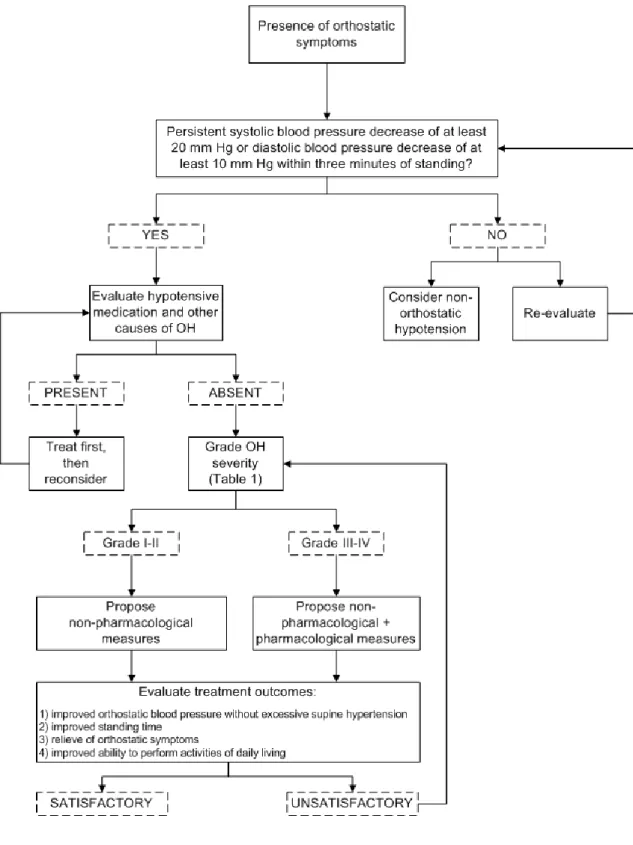
(18) recommended. Physical maneuvers include toe raising, leg crossing, thigh contraction, and bending at the waist, which reduce venous capacity and increase total peripheral resistance [39]. Raising the head of the patient’s bed by 30 degrees might also be useful [88]. In patients with insufficient or absent response, pharmacological options should be offered, such as yohimbine, midodrine, pyridostigmine or fludrocortisone. A recent systematic review demonstrated that several common pharmacological or non-pharmacological treatments for orthostatic hypotension have been examined only in low-quality trials [89]. Similarly, the Movement Disorders Society Evidence-based medicine (MDS-EBM) review did not identify any clinically useful drug [90]. Therefore, the treatment of OH in PD still relies on personal experiences or on low-quality level of evidence. Before reviewing some of the most important pharmacological options for OH treatment, the issue of patient selection must be further discussed. As all pharmacological treatments have the potential of inducing adverse reactions, this is a crucial issue. Disagreement between BP fall after standing and OH symptoms makes the exercise difficult. It might be suggested that all patients with excessive BP fall (i.e. Consensus criteria) should be treated in order to reduce OH-related mortality [11]. Nonetheless, treatment of asymptomatic patients might pose ethical problems. A formal grading scale such as the one proposed by Low and colleagues [39] might be useful (Table 1). A patient with grade I OH might not need drugs, whereas those with grades III or IV will need aggressive therapy. Even if scale needs further refinement and more precise definitions, it might be a good starting point. A treatment algorithm is proposed in Figure 2. 17.
(19) We will now discuss some pharmacological alternatives for the management of OH in PD. We will begin by discussing the use of midodrine and fludrocortisone as they the first-line drugs [16,17]. Then, we will focus on upcoming promising alternatives, including droxidopa and fipamezole. Finally, data about frequently used but probably ineffective alternatives in PD such as pyridostigmine or yohimbine or about potentially useful but unstudied treatments such as erythropoietin or vasopressin analog DDAVP will be briefly reviewed.. Midodrine Midodrine, an alpha1-adrenergic agonist, is considered as a first line drug for OH treatment [24], even if there is not abundant evidence about its efficacy. It is the only drug approved for OH treatment by the FDA and in many European countries [39]. In a double-blind randomized controlled trial, 25 patients with neurogenic OH (pure autonomic failure= 14, MSA= 7, diabetic neuropathy=3, PD=1) were randomized to receive on successive days placebo or midodrine 2.5, 10, or 20 mg [91]. A significant linear relation between midodrine dosage and mean systolic blood pressure was observed. Mean increases in standing systolic blood pressure 1 hour postdose were: placebo = 5 mm Hg; midodrine 2.5 mg = 7 mm Hg; 10 mg = 34 mm Hg; and 20 mg = 43 mm Hg. The main side-effects were supine hypertension, paresthesias (including troublesome scalp-tingling), and goose-bumps. Caution in its use in older males is necessary because of adverse effects on urinary outflow [17]. Similar results have been found in similar trials [92-94], none of which was conducted exclusively in PD patients. Therefore, further studies involving exclusively PD patients, lasting more than 12 weeks and with appropriate outcomes are needed [95]. 18.
(20) Midodrine is a pro-drug that is metabolized to desglymidodrine, the compound responsible for the hypertensive effects [39]. Such effects are short-lived, usually lasting less than 2-4 hs. Minimum effective dose is 5 mg, but patients usually need 10 mg or more. Patients should take the drug before getting out of bed or lunch, to avoid hypotension following postural change and postprandial hypotension, and at mid-afternoon [39]. The drug should never be taken after 18 hs to avoid nocturnal hypertension. It has been found that blockade of apha1-adrenergic receptors impaired cerebral blood flow autoregulation after a 3-min upright stand in healthy volunteers [96]. As was discussed earlier, cerebral autoregulation is essential to avoid adverse consecuences of orthostatic BP decreseas. Therefore it can be hypothesized that midodrine may contribute to avoid such symptoms by enhancing cerebral autoregulation. Interestingly, 10 mg of midodrine have been shown to attenuate reductions in cerebral artery mean blood flow velocity after tilting in tetraplegic subjects [97].. Fludrocortisone This mineralocorticoid is commonly used for OH management. This mineralocorticoid is commonly used for OH management. It increases renal sodium re-absorption and expands plasma volume, thus leading to increased blood pressure [98]. Treatment is initiated with 0.1 mg a day and then increased up to 0.3 mg/day. The effect on plasma volume is only transient; its long-term benefit may be related to potentiation of the pressor effects of norepinephrine and angiotensin II [98]. These effects last longer than those of midodrine.. 19.
(21) Therefore, it is more difficult to avoid undesirable effects such as nocturnal hypertension. The efficacy of fludrocortisone is insufficiently documented [98]. Furthermore, there is only one study available, in which the efficacy and safety of domperidone or fludrocortisone were explored [99]. In this double-blind, crossover trial, 13 PD patients with symptomatic orthostatism were randomly assigned to one of two possible treatment sequences (fludrocortisonedomperidone or vice versa) allowing a 1-week wash-out period in between. Composite Autonomic Symptom Scale scores were 9±3 at baseline, 6±3 on fludrocortisone (p<0.04), and 7±2 on domperidone (p<0.02). Adverse events to fludrocortisone included nausea, chest discomfort, morning headache, lightheadedness and dizziness. With prolonged treatment, nocturnal hypertension, hypokalemia, postural edemas, pulmonary edema and Addison syndrome can also be observed.. L-dihydroxyphenylserine (droxidopa) Droxidopa is an oral pro-drug that is converted to norepinephrine via decarboxylation which efficacy and safety has been explored in orthostatic hypotension related to a number of neurological conditions [100]. Droxidopa could exert its pressor effect by being converted to epinephrine and activating the sympathetic preganglionic neurons in the spinal cord; by converting to norepinephrine in post ganglionic sympathetic neurons and released when sympathetic neurons are activated; or droxidopa could be converted to norepinephrine outside neurons (in the stomach, kidney and liver), and released into the blood stream as a circulating hormone [100]. Its efficacy and safety was 20.
(22) explored 121 patients with either MSA or PD were randomized and received doses of 100, 200, 300 mg of droxidopa or matching placebo. Droxidopa treatment resulted in a reduction in the orthostatic fall in blood pressure [101], with an overall trend towards improvement in symptoms that did not reach statistical significance. A preliminary analysis of efficacy data from 51 PD patients with orthostatic enrolled in a longer-term (8-10 week) double-blind, placebo-controlled study showed that there was there was no statistically significant difference at the end of the study in terms of orthostatic hypotension signs and symptoms [102,103]. A post-hoc analysis of data coming from clinical trials in PD evaluated the clinical efficacy and safety of droxidopa in repeat fallers with orthostatic hypotension [104]. Patients treated with droxidopa (n=24) experienced fewer falls compared to placebo (n=27): 79 vs. 197. The repeat fallers group (n=22) showed greater benefit from droxidopa therapy vs. the non-repeat fallers group (n=29) as measured by dizziness, HY, and MDS-UPDRS scores. It can be hypothesized thus that the effects of droxidopa are greatest in subjects in whom cerebral autoregulation mechanism are more compromised. Such subjects are those with the greatest risk of syncope and falls. In this group of patients, droxidopa may act by enhancing cerebral autoregulation, as has been shown for midodrine [97].. Fipamezole Fipamezole is an alpha 2-adrenergic receptor antagonist with a moderate affinity for histamine H1 and H3 receptors and the serotonin transporter and low affinity for the norepinephrine and dopamine transporters, the alpha-adrenergic 21.
(23) 1A and 1B receptors and the 5-HT1A and 5-HT7 receptors [105,106]. The acute hemodynamic effects of fipamezole were evaluated in a double blind placebo controlled study in 21 PD patients [107]. Blood pressure was evaluated during an acute intravenous levodopa challenge. Continuous levodopa treatment significantly decreased mean blood pressure (P<0.01). Compared to placebo, fipamezole returned blood pressure to preinfusion values in a dose-dependent fashion (p<0.01).. Pyridostigmine and yohimbine. This cholinesterase inhibitor, may improve OH by facilitating ganglionic transmission [39]. A double-blind, randomized, 4-way cross-over study tested the efficacy and safety of a single 60-mg dose of pyridostigmine bromide alone or in combination with a subthreshold (2.5 mg) or suprathreshold (5 mg) dose of midodrine hydrochloride, compared with placebo [108]. It was observed that the fall in standing diastolic BP was significantly reduced (P=.02) with treatment. Pairwise comparison showed significant reduction by pyridostigmine alone (BP fall of 27.6 mm Hg) and pyridostigmine and 5 mg of midodrine hydrochloride (BP fall of 27.2 mmHg) vs placebo (BP fall of 34.0 mm Hg). OH symptoms improved accordingly. The efficacy of pyridostigmine was further studied in a single-blind, randomized, placebo-controlled, crossover trial [109]. A total of 31 patients with severe autonomic failure of different origins were included. Yohimbine, but not pyridostigmine significantly improved standing diastolic BP as compared with placebo [109]. Nonetheless, results of a double-blind placebo-controlled crossover trial involving only PD patients yohimbine failed to show significant effects [110]. 22.
(24) Other drugs Recombinant erythropoietin has been used to revert the anemia of autonomic dysfunction [98]. These effects were accompanied by improvements in standing blood pressure and reduced orthostatism symptoms in some reports. Regrettably, there are no long-term studies evaluating the safety and efficacy of this medication for the treatment of orthostatic hypotension. Finally, the vasopressin analog desmopressin has also been used to prevent nocturia and early morning worsening of orthostatic hypotension [16,98]. Its use also remains investigational.. Conclusion OH might affect between 23 and 38% of PD patients, according to most recent evidence, and in some cases precede the development of motor symptoms. It is defined as a sustained reduction of systolic blood pressure of at least 20 mm Hg or diastolic blood pressure of 10 mm Hg within 3 min of standing or after tilting, but many patients display exaggerated BP fall after that period. Symptoms of orthostatism can be evaluated in PD patients by the SCOPA-Aut or COMPASS scales, as recommended by The Movement Disorders Task Force on Dysautonomia Rating Scales. Agreement between BP fall and OH symptoms is limited. OH has been related to increased risk of falls and mortality, thus warranting treatment. Both non-pharmacological and pharmacological measures have been proposed, but evidence about their efficacy and safety remains. 23.
(25) insufficient. Midodrine and fludrocortisone are the first line treatments while droxidopa and Fipamezole remain investigational.. Future perspective There are many unresolved issues that deserve further research in the coming years. In first place, several controversies surround clinical evaluation of OH. Actual criteria are based on BP fall after either standing (i.e. Schellong test) or tilting to 60º. Nonetheless, it has been shown that tilting can identify exaggerated BP fall when Schellong test doesn’t [15]. More research is needed in order to explore the utility of Schellong test in the evaluation of OH in PD. Disagreement between orthostatism test and presence of OH symptoms poses a problem for selecting appropriately the patients who should be treated. The staging system proposed by Low and colleagues [39] may help with this problem, but further validation in needed. While OH is related to increased mortality in the general population, contradictory results have been obtained in PD [79,80], thus warranting further research. Similarly, there is some controversy surrounding the suggestion that OH might increase risk of cognitive impairment [9]. Further research is needed to establish a causal link between OH and these events. A link between OH and falls appears to be more firmly established, especially because treatments for OH appears to reduce the risk of falls [104], but more evidence is needed. Finally, relationship with Health-related Quality of Life also remains unknown and should be explored. Both pharmacological and non-pharmacological measures may be employed for the treatment of OH. Regrettably evidence about efficacy and safety of such 24.
(26) treatments is weak. Properly designed randomized, controlled trials, including exclusively PD patients with OH of sufficient duration (12 weeks at least) are needed to firmly establish the efficacy and safety of treatments. It is expectable that in the coming years, such trials will be available for drug agents currently used. Nonetheless, further elucidation of OH mechanism may provide new possible useful agents. In particular, the involvement of central adrenergic pathways should be more deeply explored. Finally, the relationship between OH and other neurocirculatory abnormalities, such as supine hypertension or reduced nocturnal BP fall should be further studied.. Executive summary . OH can be operationally defined as a sustained reduction of systolic blood pressure of at least 20 mm Hg or diastolic blood pressure of 10 mm Hg within 3 min of standing or head-up tilt to at least 60° on a tilt table.. . Most frequent OH symptoms include lightheadedness, dizziness, fatigue, cognitive slowing, visual blurring or headache and may be evaluated in PD by SCOPA-Aut or COMPASS scales, as recommended by the The Movement Disorders Task Force on Dysautonomia Rating Scales.. . OH affects between 22.9 and 38.4% of PD patients.. . OH in PD is related to pre-ganglionic and post-ganglionic adrenergic denervation. Other factors such as drugs, heat, meals or alcohol can also induce or aggravate OH.. . OH is related to increased mortality in the general population and it has been related to increased risk of falls in PD.. 25.
(27) . Evidence about the efficacy and safety of pharmacological or nonpharmacological strategies for OH treatment in PD is weak.. . Severe cases may be treated with midodrine or fludrocortisone. Fipamezole and droxidopa are promising candidates.. Acknowledments: The authors are grateful to the Association FranceParkinson for its support.. Conflict of interests MVR and AP have no conflicts to declare. SPLL has consulted for UCB Pharma and Neurohealing Pharmaceuticals Inc. OR has act as an advisor for most drug companies developing drugs for the treatment of orthostatic hypotension in Parkinson’s disease (Chelsea, Santhera).. 26.
(28) References 1. Poewe W. The natural history of Parkinson's disease. J.Neurol. 253 Suppl 7, VII2-VII6 (2006). 2. Andlin-Sobocki P, Jonsson B, Wittchen HU, Olesen J. Cost of disorders of the brain in Europe. Eur.J.Neurol. 12 Suppl 1, 1-27 (2005). 3. Lang AE , Lozano AM. Parkinson's disease. First of two parts. N.Engl.J.Med. 339(15), 1044-1053 (1998). 4. Jellinger KA. Neuropathology of sporadic Parkinson's disease: Evaluation and changes of concepts. Mov Disord. 27(1), 8-30 (2012). 5. Chaudhuri KR , Schapira AH. Non-motor symptoms of Parkinson's disease: dopaminergic pathophysiology and treatment. Lancet Neurol. 8(5), 464-474 (2009). 6. Martinez-Martin P. The importance of non-motor disturbances to quality of life in Parkinson's disease. J.Neurol.Sci. 310(1-2), 12-16 (2011). 7. Martinez-Martin P, Rodriguez-Blazquez C, Kurtis MM, Chaudhuri KR. The impact of non-motor symptoms on health-related quality of life of patients with Parkinson's disease. Mov Disord. 26(3), 399-406 (2011). 8. Shearer J, Green C, Counsell CE, Zajicek JP. The impact of motor and non motor symptoms on health state values in newly diagnosed idiopathic Parkinson's disease. J.Neurol. (2011). 9. Kim JS, Oh YS, Lee KS, Kim YI, Yang DW, Goldstein DS. Association of cognitive dysfunction with neurocirculatory abnormalities in early Parkinson disease. Neurology 79(13), 1323-1331 (2012).. 27.
(29) 10. Allcock LM, Kenny RA, Mosimann UP et al. Orthostatic hypotension in Parkinson's disease: association with cognitive decline? Int.J.Geriatr.Psychiatry 21(8), 778-783 (2006). 11. Fedorowski A, Stavenow L, Hedblad B, Berglund G, Nilsson PM, Melander O. Orthostatic hypotension predicts all-cause mortality and coronary events in middle-aged individuals (The Malmo Preventive Project). Eur Heart J. 31(1), 85-91 (2010). 12. Goldstein DS. Orthostatic hypotension as an early finding in Parkinson's disease. Clin.Auton.Res. 16(1), 46-54 (2006). 13. Milazzo V, Di SC, Servo S, Zibetti M, Lopiano L, Maule S. Neurogenic orthostatic hypotension as the initial feature of Parkinson disease. Clin.Auton.Res. 22(4), 203-206 (2012). 14. Freeman R, Wieling W, Axelrod FB et al. Consensus statement on the definition of orthostatic hypotension, neurally mediated syncope and the postural tachycardia syndrome. Auton.Neurosci. (2011). 15. Jamnadas-Khoda J, Koshy S, Mathias CJ, Muthane UB, Ragothaman M, Dodaballapur SK. Are current recommendations to diagnose orthostatic hypotension in Parkinson's disease satisfactory? Mov Disord. 24(12), 1747-1751 (2009). 16. Fedorowski A , Melander O. Syndromes of orthostatic intolerance: a hidden danger. J.Intern.Med. 273(4), 322-335 (2013). 17. Moya A, Sutton R, Ammirati F et al. Guidelines for the diagnosis and management of syncope (version 2009). Eur.Heart J. 30(21), 2631-2671 (2009).. 28.
(30) 18. Brooks R, Ruskin JN, Powell AC, Newell J, Garan H, McGovern BA. Prospective evaluation of day-to-day reproducibility of upright tilt-table testing in unexplained syncope. Am.J.Cardiol. 71(15), 1289-1292 (1993). 19. Gabbett TJ , Gass GC. Reliability of orthostatic responses in healthy men aged between 65 and 75 years. Exp.Physiol 90(4), 587-592 (2005). 20. Ward C , Kenny RA. Reproducibility of orthostatic hypotension in symptomatic elderly. Am.J.Med. 100(4), 418-422 (1996). 21. Winker R, Prager W, Haider A, Salameh B, Rudiger HW. Schellong test in orthostatic dysregulation: a comparison with tilt-table testing. Wien.Klin.Wochenschr. 117(1-2), 36-41 (2005). 22. Ooi WL, Barrett S, Hossain M, Kelley-Gagnon M, Lipsitz LA. Patterns of orthostatic blood pressure change and their clinical correlates in a frail, elderly population. JAMA 277(16), 1299-1304 (1997). 23. Morillo CA, Eckberg DL, Ellenbogen KA et al. Vagal and sympathetic mechanisms in patients with orthostatic vasovagal syncope. Circulation 96(8), 2509-2513 (1997). 24. Goldstein DS , Sharabi Y. Neurogenic orthostatic hypotension: a pathophysiological approach. Circulation 119(1), 139-146 (2009). 25. Stauss HM. Heart rate variability. Am.J.Physiol Regul.Integr.Comp Physiol 285(5), R927-R931 (2003). 26. Task Force of the European Society of Cardiology and the North American Society of Pacing and Electrophysiology. Heart rate variability: standards of measurement, physiological interpretation and clinical use. Circulation 93(5), 1043-1065 (1996).. 29.
(31) 27. Pavy-Le TA, Amarenco G, Duerr S et al. The Movement Disorders task force review of dysautonomia rating scales in Parkinson's disease with regard to symptoms of orthostatic hypotension. Mov Disord. 26(11), 1985-1992 (2011). 28. Perez-Lloret S, Rey MV, Fabre N et al. Factors related to orthostatic hypotension in Parkinson's disease. Parkinsonism Relat Disord. 18(5), 501-505 (2012). 29. Arbogast SD, Alshekhlee A, Hussain Z, McNeeley K, Chelimsky TC. Hypotension unawareness in profound orthostatic hypotension. Am.J.Med. 122(6), 574-580 (2009). 30. van Beek AH, Claassen JA, Rikkert MG, Jansen RW. Cerebral autoregulation: an overview of current concepts and methodology with special focus on the elderly. J.Cereb.Blood Flow Metab 28(6), 1071-1085 (2008). 31. Khandelwal E, Jaryal AK, Deepak KK. Cardiovascular autonomic functions & cerebral autoregulation in patients with orthostatic hypotension. Indian J.Med.Res. 134, 463-469 (2011). 32. Angeli S, Marchese R, Abbruzzese G et al. Tilt-table test during transcranial Doppler monitoring in Parkinson's disease. Parkinsonism Relat Disord. 10(1), 41-46 (2003). 33. Gurevich T, Gur AY, Bornstein NM, Giladi N, Korczyn AD. Cerebral vasomotor reactivity in Parkinson's disease, multiple system atrophy and pure autonomic failure. J.Neurol.Sci. 243(1-2), 57-60 (2006). 34. Haubrich C, Pies K, Dafotakis M, Block F, Kloetzsch C, Diehl RR. Transcranial Doppler monitoring in Parkinson's disease: cerebrovascular 30.
(32) compensation of orthostatic hypotension. Ultrasound Med.Biol. 36(10), 1581-1587 (2010). 35. Vokatch N, Grotzsch H, Mermillod B, Burkhard PR, Sztajzel R. Is cerebral autoregulation impaired in Parkinson's disease? A transcranial Doppler study. J.Neurol.Sci. 254(1-2), 49-53 (2007). 36. Velseboer DC, de Haan RJ, Wieling W, Goldstein DS, de Bie RM. Prevalence of orthostatic hypotension in Parkinson's disease: a systematic review and meta-analysis. Parkinsonism Relat Disord. 17(10), 724-729 (2011). 37. Guyton AC, Coleman TG, Cowley AW, Jr., Liard JF, Norman RA, Jr., Manning RD, Jr. Systems analysis of arterial pressure regulation and hypertension. Ann.Biomed.Eng 1(2), 254-281 (1972). 38. Osborn JW. Hypothesis: set-points and long-term control of arterial pressure. A theoretical argument for a long-term arterial pressure control system in the brain rather than the kidney. Clin.Exp.Pharmacol.Physiol 32(5-6), 384-393 (2005). 39. Low PA , Singer W. Management of neurogenic orthostatic hypotension: an update. Lancet Neurol. 7(5), 451-458 (2008). 40. Osborn JW, Jacob F, Guzman P. A neural set point for the long-term control of arterial pressure: beyond the arterial baroreceptor reflex. Am.J.Physiol Regul.Integr.Comp Physiol 288(4), R846-R855 (2005). 41. Goldstein DS. Dysautonomia in Parkinson's disease: neurocardiological abnormalities. Lancet Neurol. 2(11), 669-676 (2003). 42. Rutan GH, Hermanson B, Bild DE, Kittner SJ, LaBaw F, Tell GS. Orthostatic hypotension in older adults. The Cardiovascular Health 31.
(33) Study. CHS Collaborative Research Group. Hypertension 19(6 Pt 1), 508-519 (1992). 43. Poon IO , Braun U. High prevalence of orthostatic hypotension and its correlation with potentially causative medications among elderly veterans. J.Clin.Pharm.Ther. 30(2), 173-178 (2005). 44. Low PA. Prevalence of orthostatic hypotension. Clin.Auton.Res. 18 Suppl 1, 8-13 (2008). 45. Pathak A, Lapeyre-Mestre M, Montastruc JL, Senard JM. Heat-related morbidity in patients with orthostatic hypotension and primary autonomic failure. Mov Disord. 20(9), 1213-1219 (2005). 46. Narkiewicz K, Cooley RL, Somers VK. Alcohol potentiates orthostatic hypotension : implications for alcohol-related syncope. Circulation 101(4), 398-402 (2000). 47. Magerkurth C, Schnitzer R, Braune S. Symptoms of autonomic failure in Parkinson's disease: prevalence and impact on daily life. Clin.Auton.Res. 15(2), 76-82 (2005). 48. Senard JM, Rai S, Lapeyre-Mestre M et al. Prevalence of orthostatic hypotension in Parkinson's disease. J.Neurol.Neurosurg.Psychiatry 63(5), 584-589 (1997). 49. Goldstein DS, Eldadah BA, Holmes C et al. Neurocirculatory abnormalities in Parkinson disease with orthostatic hypotension: independence from levodopa treatment. Hypertension 46(6), 1333-1339 (2005).. 32.
(34) 50. Haapaniemi TH, Kallio MA, Korpelainen JT et al. Levodopa, bromocriptine and selegiline modify cardiovascular responses in Parkinson's disease. J.Neurol. 247(11), 868-874 (2000). 51. Mehagnoul-Schipper DJ, Boerman RH, Hoefnagels WH, Jansen RW. Effect of levodopa on orthostatic and postprandial hypotension in elderly Parkinsonian patients. J.Gerontol.A Biol.Sci.Med.Sci. 56(12), M749M755 (2001). 52. Kujawa K, Leurgans S, Raman R, Blasucci L, Goetz CG. Acute orthostatic hypotension when starting dopamine agonists in Parkinson's disease. Arch.Neurol. 57(10), 1461-1463 (2000). 53. Perez-Lloret S, Bondon-Guitton E, Rascol O, Montastruc JL. Adverse drug reactions to dopamine agonists: a comparative study in the French Pharmacovigilance Database. Mov Disord. 25(12), 1876-1880 (2010). 54. Montastruc JL, Rascol O, Senard JM. Current status of dopamine agonists in Parkinson's disease management. Drugs 46(3), 384-393 (1993). 55. Pursiainen V, Lyytinen J, Pekkonen E. Effect of duodenal levodopa infusion on blood pressure and sweating. Acta Neurol.Scand. 126(4), e20-e24 (2012). 56. Bonuccelli U, Lucetti C, Del DP et al. Orthostatic hypotension in de novo Parkinson disease. Arch.Neurol. 60(10), 1400-1404 (2003). 57. Haensch CA, Lerch H, Jorg J, Isenmann S. Cardiac denervation occurs independent of orthostatic hypotension and impaired heart rate variability in Parkinson's disease. Parkinsonism Relat Disord. 15(2), 134-137 (2009). 33.
(35) 58. Oka H, Mochio S, Yoshioka M, Morita M, Inoue K. Evaluation of baroreflex sensitivity by the sequence method using blood pressure oscillations and R-R interval changes during deep respiration. Eur Neurol. 50(4), 230-243 (2003). 59. Haapaniemi TH, Pursiainen V, Korpelainen JT, Huikuri HV, Sotaniemi KA, Myllyla VV. Ambulatory ECG and analysis of heart rate variability in Parkinson's disease. J.Neurol.Neurosurg.Psychiatry 70(3), 305-310 (2001). 60. Devos D, Kroumova M, Bordet R et al. Heart rate variability and Parkinson's disease severity. J.Neural Transm. 110(9), 997-1011 (2003). 61. Kallio M, Haapaniemi T, Turkka J et al. Heart rate variability in patients with untreated Parkinson's disease. Eur J.Neurol. 7(6), 667-672 (2000). 62. Vigo DE, Nicola SL, Ladron De Guevara MS et al. Relation of depression to heart rate nonlinear dynamics in patients > or =60 years of age with recent unstable angina pectoris or acute myocardial infarction. Am.J.Cardiol. 93(6), 756-760 (2004). 63. Goldstein DS, Holmes CS, Dendi R, Bruce SR, Li ST. Orthostatic hypotension from sympathetic denervation in Parkinson's disease. Neurology 58(8), 1247-1255 (2002). 64. Quattrone A, Bagnato A, Annesi G et al. Myocardial 123metaiodobenzylguanidine uptake in genetic Parkinson's disease. Mov Disord. 23(1), 21-27 (2008). 65. Goldstein DS, Sharabi Y, Karp BI et al. Cardiac sympathetic denervation preceding motor signs in Parkinson disease. Cleve.Clin.J.Med. 76 Suppl 2, S47-S50 (2009). 34.
(36) 66. Matsui H, Nishinaka K, Oda M, Komatsu K, Kubori T, Udaka F. Does cardiac metaiodobenzylguanidine (MIBG) uptake in Parkinson's disease correlate with major autonomic symptoms? Parkinsonism Relat Disord. 12(5), 284-288 (2006). 67. Senard JM, Valet P, Durrieu G et al. Adrenergic supersensitivity in parkinsonians with orthostatic hypotension. Eur J.Clin.Invest 20(6), 613619 (1990). 68. Goldstein DS. Dysautonomia in Parkinson's disease: neurocardiological abnormalities. Lancet Neurol. 2(11), 669-676 (2003). 69. Barbic F, Perego F, Canesi M et al. Early abnormalities of vascular and cardiac autonomic control in Parkinson's disease without orthostatic hypotension. Hypertension 49(1), 120-126 (2007). 70. Benarroch EE, Schmeichel AM, Parisi JE. Involvement of the ventrolateral medulla in parkinsonism with autonomic failure. Neurology 54(4), 963-968 (2000). 71. Braak H, Del TK, Bratzke H, Hamm-Clement J, Sandmann-Keil D, Rub U. Staging of the intracerebral inclusion body pathology associated with idiopathic Parkinson's disease (preclinical and clinical stages). J.Neurol. 249 Suppl 3, III/1-III/5 (2002). 72. Sharabi Y, Imrich R, Holmes C, Pechnik S, Goldstein DS. Generalized and neurotransmitter-selective noradrenergic denervation in Parkinson's disease with orthostatic hypotension. Mov Disord. 23(12), 1725-1732 (2008). 73. Pazo JH , Belforte JE. Basal ganglia and functions of the autonomic nervous system. Cell Mol.Neurobiol. 22(5-6), 645-654 (2002). 35.
(37) 74. Oh YS, Kim JS, Chung YA et al. Orthostatic hypotension, non-dipping and striatal dopamine in Parkinson disease. Neurol.Sci. (2012). 75. Goldstein DS, Pechnik S, Holmes C, Eldadah B, Sharabi Y. Association between supine hypertension and orthostatic hypotension in autonomic failure. Hypertension 42(2), 136-142 (2003). 76. Berganzo K, ez-Arrola B, Tijero B et al. Nocturnal hypertension and dysautonomia in patients with Parkinson's disease: are they related? J.Neurol. (2013). 77. Rose KM, Eigenbrodt ML, Biga RL et al. Orthostatic hypotension predicts mortality in middle-aged adults: the Atherosclerosis Risk In Communities (ARIC) Study. Circulation 114(7), 630-636 (2006). 78. Fedorowski A, Hedblad B, Melander O. Early postural blood pressure response and cause-specific mortality among middle-aged adults. Eur.J.Epidemiol. 26(7), 537-546 (2011). 79. Stubendorff K, Aarsland D, Minthon L, Londos E. The impact of autonomic dysfunction on survival in patients with dementia with Lewy bodies and Parkinson's disease with dementia. PLoS.One. 7(10), e45451- (2012). 80. Auyeung M, Tsoi TH, Mok V et al. Ten year survival and outcomes in a prospective cohort of new onset Chinese Parkinson's disease patients. J.Neurol.Neurosurg.Psychiatry 83(6), 607-611 (2012). 81. Pilleri M, Facchini S, Gasparoli E et al. Cognitive and MRI correlates of orthostatic hypotension in Parkinson's disease. J.Neurol. 260(1), 253-259 (2013).. 36.
(38) 82. Azidah AK, Hasniza H, Zunaina E. Prevalence of Falls and Its Associated Factors among Elderly Diabetes in a Tertiary Center, Malaysia. Curr.Gerontol.Geriatr.Res. 2012, 539073- (2012). 83. Gangavati A, Hajjar I, Quach L et al. Hypertension, orthostatic hypotension, and the risk of falls in a community-dwelling elderly population: the maintenance of balance, independent living, intellect, and zest in the elderly of Boston study. J.Am.Geriatr.Soc. 59(3), 383-389 (2011). 84. Nevitt MC, Cummings SR, Hudes ES. Risk factors for injurious falls: a prospective study. J.Gerontol. 46(5), M164-M170 (1991). 85. Czarkowska H, Tutaj M, Rudzinska M et al. Cardiac responses to orthostatic stress deteriorate in Parkinson disease patients who begin to fall. Neurol.Neurochir.Pol. 44(4), 339-349 (2010). 86. Bradley JG , Davis KA. Orthostatic hypotension. Am.Fam.Physician 68(12), 2393-2398 (2003). 87. Thompson P, Wright J, Rajkumar C. Non-pharmacological treatments for orthostatic hypotension. Age Ageing 40(3), 292-293 (2011). 88. Walter BL. Cardiovascular autonomic dysfunction in patients with movement disorders. Cleve.Clin.J.Med. 75 Suppl 2, S54-S58 (2008). 89. Logan IC , Witham MD. Efficacy of treatments for orthostatic hypotension: a systematic review. Age Ageing 41(5), 587-594 (2012). 90. Seppi K, Weintraub D, Coelho M et al. The Movement Disorder Society Evidence-Based Medicine Review Update: Treatments for the Non-Motor Symptoms of Parkinson's Disease. Movement Disorders 26, S42-S80 (2011). 37.
(39) 91. Wright RA, Kaufmann HC, Perera R et al. A double-blind, dose-response study of midodrine in neurogenic orthostatic hypotension. Neurology 51(1), 120-124 (1998). 92. Fouad-Tarazi FM, Okabe M, Goren H. Alpha sympathomimetic treatment of autonomic insufficiency with orthostatic hypotension. Am.J.Med. 99(6), 604-610 (1995). 93. Kaufmann H, Brannan T, Krakoff L, Yahr MD, Mandeli J. Treatment of orthostatic hypotension due to autonomic failure with a peripheral alphaadrenergic agonist (midodrine). Neurology 38(6), 951-956 (1988). 94. Low PA, Gilden JL, Freeman R, Sheng KN, McElligott MA. Efficacy of midodrine vs placebo in neurogenic orthostatic hypotension. A randomized, double-blind multicenter study. Midodrine Study Group. JAMA 277(13), 1046-1051 (1997). 95. Perez-Lloret S, Rey MV, Pavy-Le TA, Rascol O. Emerging drugs for autonomic dysfunction in Parkinson's disease. Expert.Opin.Emerg.Drugs 18(1), 39-53 (2013). 96. Lewis NC, Ainslie PN, Atkinson G, Jones H, Grant EJ, Lucas SJ. Initial orthostatic hypotension and cerebral blood flow regulation: effect of alpha1-adrenoreceptor activity. Am.J.Physiol Regul.Integr.Comp Physiol 304(2), R147-R154 (2013). 97. Wecht JM, Radulovic M, Rosado-Rivera D, Zhang RL, LaFountaine MF, Bauman WA. Orthostatic effects of midodrine versus L-NAME on cerebral blood flow and the renin-angiotensin-aldosterone system in tetraplegia. Arch.Phys.Med.Rehabil. 92(11), 1789-1795 (2011).. 38.
(40) 98. Shibao C, Okamoto L, Biaggioni I. Pharmacotherapy of autonomic failure. Pharmacol.Ther. 134(3), 279-286 (2012). 99. Schoffer KL, Henderson RD, O'Maley K, O'Sullivan JD. Nonpharmacological treatment, fludrocortisone, and domperidone for orthostatic hypotension in Parkinson's disease. Mov Disord. 22(11), 1543-1549 (2007). 100. Kaufmann H. L-dihydroxyphenylserine (Droxidopa): a new therapy for neurogenic orthostatic hypotension: the US experience. Clin.Auton.Res. 18 Suppl 1, 19-24 (2008). 101. Mathias CJ. L-dihydroxyphenylserine (Droxidopa) in the treatment of orthostatic hypotension: the European experience. Clin.Auton.Res. 18 Suppl 1, 25-29 (2008). 102. Hauser RA, Gil R, and Isaacson S. Efficacy of droxidopa in Patients with PD. http://www.movementdisorders.org/congress/congress11/ (2011) 103. Shang W, Han P, Yang CB et al. Synergism of irbesartan and amlodipine on hemodynamic amelioration and organ protection in spontaneously hypertensive rats. Acta Pharmacol.Sin. 32(9), 1109-1115 (2011). 104. Hauser RA , Isaacson S. Impact of treatment with droxidopa in repeat fallers with Parkinson's disease and symptomatic neurogenic orthostatic hypotension (NOH 306A). Mov Disord. 27 Suppl 1, S423-S423 (2012). 105. Savola JM, Hill M, Engstrom M et al. Fipamezole (JP-1730) is a potent alpha(2) adrenergic receptor antagonist that reduces levodopa-induced dyskinesia in the MPTP-lesioned primate model of Parkinson's disease. Movement Disorders 18(8), 872-883 (2003).. 39.
(41) 106. Sorbera LA, Castaner J, Bayes M. Fipamezole hydrochloride. Antiparkinsonian, alpha(2)-adrenoceptor antagonist. Drugs of the Future 28(1), 14-17 (2003). 107. Bara-Jimenez W , Chase TN. Hemodynamic effects of fipamezole in advanced Parkinson's disease. Neurology 66(5), A214-A215 (2006). 108. Singer W, Sandroni P, Opfer-Gehrking TL et al. Pyridostigmine treatment trial in neurogenic orthostatic hypotension. Arch.Neurol. 63(4), 513-518 (2006). 109. Shibao C, Okamoto LE, Gamboa A et al. Comparative efficacy of yohimbine against pyridostigmine for the treatment of orthostatic hypotension in autonomic failure. Hypertension 56(5), 847-851 (2010). 110. Senard JM, Rascol O, Rascol A, Montastruc JL. Lack of yohimbine effect on ambulatory blood pressure recording: a double-blind cross-over trial in parkinsonians with orthostatic hypotension. Fundam.Clin.Pharmacol. 7(8), 465-470 (1993).. 40.
(42) Figure 1. Schematic representation of long- and short-term blood pressure regulation mechanisms. Positive or negative influences are represented in full or dashed lines respectively.. 41.
(43) Figure 2. Algorithm for the evaluation and treatment of orthostatic hypotension in Parkinson’s Disease.. 42.
(44) Table 1. Orthostatic intolerance grading scale.. OH symptoms. OH symptoms. Grade I. Grade II. Grade III. Grade IV. infrequent,. At least once a. On most. Constant. inconstant. week. occasions. Infrequent. Common. Common. during stress. Constant. Syncope is common. Standing time. Activities of daily. typically ≥15 min. Unrestricted. ≥5 min on most. ≥1 min on most. <1 min on most. occasions. occasions. occasions. Some limitations. Marked. bed-bound or. limitations. wheelchair-. living. bound because of OH Autonomic. Normal or. OH, reduction in. OH ≥50% of the. OH is. function tests. abnormal. pulse pressure,. time, recorded. consistently. ≥50%, or high. on different days. present. BP variability. BP= Blood pressure, OH= Orthostatic hypotension. From Low and colleagues [39].. 43.
(45)
Figure

Documento similar