
Optimization and validation of an isocratic HPLC method for caffeine, 8 chlorotheophylline and diphenhydramine determination : stress test for stability evaluation / C Barbas [et al ]
8
0
0
Texto completo
(2) Journal of Chromatography A, 870 (2000) 97–103 www.elsevier.com / locate / chroma. Optimization and validation of a method for the determination of caffeine, 8-chlorotheophylline and diphenhydramine by isocratic high-performance liquid chromatography Stress test for stability evaluation ´ Luis Saavedra, Mario Castro Coral Barbas*, Antonia Garcıa, ´ ´ Monteprıncipe ´ , Universidad S. Pablo-CEU, Urbanizacion , Ctra. Boadilla del Monte km 5,3, Facultad de CC Experimentales y Tecnicas 28668 Madrid, Spain. Abstract The optimization of a HPLC method for caffeine, 8-chlorotheophylline and diphenhydramine separation with UV detection at 229 nm is described. The conditions studied included: stationary phase, compositions of mobile phases with pH modulators. Optimal conditions were: SymmetryShield RP8 column and acetonitrile–(0.01 M H 3 PO 4 –triethylamine, pH 2.8) (22:78, v / v). Validation was performed using standards and a pharmaceutical preparation containing the compounds described above. Results from both standards and samples show suitable validation parameters. The pharmaceutical grade substances were tested by factors that could influence the chemical stability. These reaction mixtures were analyzed to evaluate the capability of the method to separate degradation products. Degradation products did not interfere with the determination of the substances tested by the assay. 2000 Elsevier Science B.V. All rights reserved. Keywords: Pharmaceutical analysis; Validation; Stability studies; Caffeine; Chlorotheophylline; Diphenhydramine; Theophyllines; Dimenhydrinate. 1. Introduction 8-Chloroteophylline and diphenhydramine form a compound named dimenhydrinate (antiemetic), one of the most common pharmacological agents for alleviation of motion sickness. It is usually measured by high-performance liquid chromatography (HPLC) though its 8-chlorotheophylline content [3] because the components have quite different acid–basic characteristics and absorbance wavelengths. When it is necessary to determine product stability, the concentration of both substances ought to be mea*Corresponding author. Fax: 134-91-3510-475. E-mail address: [email protected] (C. Barbas). sured. Caffeine is a central nervous stimulant frequently added to dimenhydrinate in pharmaceutical formulations. It has a chemical structure and polarity very similar to 8-chlorotheophylline, complicating the chromatographic separation. Fig. 1 shows the chemical structures and pKa data of the substances measured using this assay. The HPLC method found for measuring these three compounds [1] employs a gradient. Due to acid–basic characteristic of the substances measured, separation is highly dependent on pH. Resolving the separation of 8-chlorotheophylline and caffeine while eluting diphenhydramine simultaneously is critical. There are many possible ways of suppressing the interaction of residual silanols in the silica-gel. 0021-9673 / 00 / $ – see front matter 2000 Elsevier Science B.V. All rights reserved. PII: S0021-9673( 99 )01186-3.
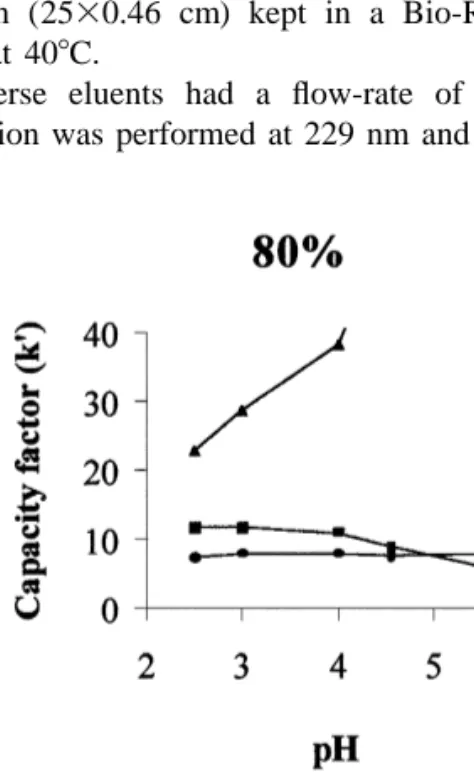
(3) 98. C. Barbas et al. / J. Chromatogr. A 870 (2000) 97 – 103. conditions. This packing was chosen because it is advertised to have one of the lowest hydrophobicity and silanol activity factors. After optimizing the separation, the method was validated for standards and tablets of a pharmaceutical preparation containing these substances by determining linearity, precision and accuracy. Simultaneously, as the method could be used for stability testing, standards and samples were subjected to degradation conditions to prove that no interferences appeared.. 2. Experimental. 2.1. Instrumentation and chromatographic analysis. Fig. 1. Chemical structures of analytes and pKa values.. surface with basic analytes, which frequently leads to inferior separations due to the tailing of peaks. The reduction of ionization of acidic SiOH sites by employing mobile phases of low pH (pH,4) or, in contrast, decreasing the ionization of the basic sample by increasing the pH of the mobile phase are the easiest methods. Other approaches take advantage of the addition of ‘‘silanol blockers’’, e.g., triethylamine, to the mobile phase [9] and this has proved to be necessary to permit diphenhydramine elution in the assay. pH has also a determining influence on caffeine and 8-chlorotheophylline separation since differences in the degree of ionization change elution order and modify resolution. A systematic study of the chromatographic behavior of these compounds was undertaken in two different reversed-phase columns (C 18 and C 8 ) at diverse pH and organic–aqueous phase rates. To develop the study, a Nova-Pak C 18 column was chosen because this packing has an intermediate hydrophobicity and silanol activity. A systematic run of pH and organic–aqueous phase rates was performed. Using this configuration, the results were not satisfactory, mainly because of diphenhydramine tailing and very high capacity factors. So a SymmetryShield RP8 column was used under the same. A Beckman (Palo Alto, CA, USA) HPLC system equipped with a 126 pump, an automatic injector (507e), a 168 diode array detector, and a Gold System data processor were used. The chromatographic analyses were performed on a 4 mm particle C 18 Nova-Pak (Waters, Madrid, Spain) column (153 0.39 cm) and on a Symmetry Shield RP8 (Waters) column (2530.46 cm) kept in a Bio-Rad column oven at 408C. Diverse eluents had a flow-rate of 1 ml / min. Detection was performed at 229 nm and peaks were. Fig. 2. Effect of pH variation on capacity factors of analytes. Conditions: SymmetryShield RP8 column, acetonitrile–(0.01 M H 3 PO 4 –triethylamine, pH 3.0) (20:80, v / v), flow-rate of 1 ml / min and UV detection at 229 nm. (d) Caffeine; (h) 8-chlorotheophylline; (n) diphenhydramine..
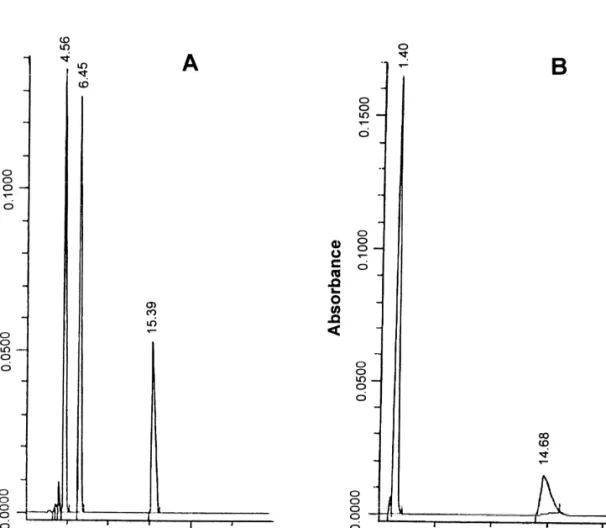
(4) C. Barbas et al. / J. Chromatogr. A 870 (2000) 97 – 103. identified with retention times as compared with standards and confirmed with characteristic spectra using the photodiode array detector.. 2.2. Reagents All solvents were HPLC-grade quality purchased from Scharlau (Barcelona, Spain). General reagents were from Merck (Darmstadt, Germany) and standards of diphenhydramine hydrochloride, 8-chlorotheophylline and caffeine were from Sigma (Madrid, Spain). Tablets containing these active compounds were from CINFA (Pamplona, Spain). Through the optimization and validation of the method the individual components of the di-. 99. menhydrinate (8-chlorothephylline and diphenhydramine hydrochloride) were employed to better understand their behavior, individual identification and identification of possible products of degradation of each of the substances, but in practice quantification of the active principle can be carried out using the same dimenhydrinate previously quantified.. 2.3. Methods Mobile phases consisted of aqueous buffer–acetonitrile in proportions ranging from 75 to 90%. Acetonitrile was selected instead of methanol because it yielded a more stable baseline at this wavelength. Buffers were prepared with 0.01 M. Fig. 3. Chromatograms of standards of caffeine, 8-chlorotheophylline and diphenhydramine in acetonitrile–(0.01 M H 3 PO 4 –triethylamine pH, 3.0) (20:80, v / v) at a flow-rate of 1 ml / min and UV detection at 229 nm. (A) in a SymmetryShield RP8 column; (B) In a Nova-Pak C 18 column..
(5) 100. C. Barbas et al. / J. Chromatogr. A 870 (2000) 97 – 103. H 3 PO 4 and pH adjusted by adding NaOH, NH 3 or triethylamine. The assayed pH values were in the recommended working range for these columns (from 2.5 to 7.5) and they were measured in all instances before the addition of acetonitrile. For optimization, the sample solutions were prepared by dissolving the analytes in a mixture of water–acetonitrile (1:1, v / v) to give a concentration of 0.2 mg / ml. Injection volumes were 20 ml to produce adequate UV responses to detect degradation products.. 2.4. Validation Once chromatographic conditions were established, method validation was performed following ICH specifications [6,7]. Standard and sample linearity was verified by analysis in triplicates of five points in the range 0.125 mg / ml to 0.376 mg / ml for caffeine and 0.063 to 0.188 mg / ml for 8-chlorotheophilline and diphenhydramine which corresponded to 50 to 150% of the expected sample values. Recoveries were evaluated with the same method, by comparing the calculated concentrations and measured concentrations. Instrumental repeatability and intermediate precision were determined by processing two series of injections of the same standard, corresponding to the mid point in linearity range, on different days. Intraand inter-assay precision of the method applied to final product was determined by processing two series of six samples, prepared as described, on different days and with the corresponding standards for quantification. Sample treatment: 791 mg of sample was added to 80 ml of mobile phase, sonicated for 15 min and then the volume was completed with the same mobile phase in a 100-ml flask. A 4-ml volume of this solution was diluted to 25 ml in a flask with the mobile phase. The samples were filtered through 0.45-mm nylon membranes before passing to injection vials.. for stability testing should be able to separate degradation products from the active substances. Degradation conditions included the following: acidic media with 0.1 M phosphate buffer, pH 3.0; water; basic media with 0.1 M phosphate buffer, pH 8.0 and oxidating media with 0.3% H 2 O 2 . In all cases 1% (w / v) of standard or sample were heated in an autoclave for 1 h at 1208C.. 3. Results and discussion During the optimization it was observed that when the pH was fixed with either NaOH or NH 3, diphenhydramine was not eluted in a reasonable time (,45 min) at any pH, triethylamine presence was necessary for eluting diphenhydramine in both columns acting, as previously described [8,10], as a ‘‘silanol blocker’’. 8-Chlorotheophylline elution order changed with pH in the mobile phase independently of which compound was used to adjust pH or which proportion of aqueous to organic phase was used. The change in elution order under the different conditions took place between pH 4.5 and 5.0. At pH,4.5 8-chlorotheophylline eluted after caffeine and at pH.5.8 it eluted first. It must be related with variations in the ionization degree. Caffeine has pKa. 2.5. Accelerated degradation Stability testing [5] is performed to ensure that drug products do not degrade at the end of their expiration date. Analytical methods to be employed. Fig. 4. Effect of % of aqueous phase on capacity factors of analytes. Conditions: SymmetryShield RP8 column, mobile phase: acetonitrile–(0.01 M H 3 PO 4 –triethylamine, pH 3.0) at diverse v / v ratios at a flow-rate of 1 ml / min and UV detection at 229 nm. (d) Caffeine; (j) 8-chlorotheophylline; (m) diphenhydramine..
(6) C. Barbas et al. / J. Chromatogr. A 870 (2000) 97 – 103. value of 8.3 [2] and does not ionize in the assayed pH range, 8-chlorotheophylline has a pKa of 5.8 and it is near its ionization value resulting in a less retained form. Small differences in pH values might reasonably be due to the presence of acetonitrile in the mobile phase. Fig. 2 shows the dependence of capacity factors on pH for one of the assayed conditions (0.01 M H 3 PO 4 with triethylamine in the aqueous phase–acetonitrile, 80:20, v / v). They do not match the described sigmoidal form [9,11] corresponding to analytes whose retention depends solely on hydrophobic interaction because it seems clear. 101. that ionization plays an important role in the chromatographic behavior of these compounds. Furthermore, the capacity factor of diphenhydramine increases with increasing pH. That could be interpreted by a lesser degree of ionization of its basic group (pKa 59.6) under such conditions and higher retention of the molecular form. Considering the stationary phase, the study was not planned to evaluate the influence of one specific parameter, since almost all of them changed from one column to the other. The study began with a stationary phase described in the literature as. Table 1 Summary of method validation parameters a R II.1.A. II.2.. Precision final product RSD (%). II.2.1. Instrumental. 0.9998 0.9998 0.9999. 0.261.5 20.260.6 20.360.4. 54765 49664 38263. 0.125–0.376 mg / ml 0.063–0.188 mg / ml 0.063–0.188 mg / ml. 0.9997 0.9997 0.9997. 20.0762 20.461 20.860.6. 54968 49667 38265. 50–150% 50–150% 50–150%. Repeatability Day 1. Caffeine 8-Chlorothephylline Diphenhydramine Method Caffeine 8-Chlorothephylline Diphenhydramine II.3A.. II.3B.. a. Range. Linearity and range final product Caffeine 8-Chlorothephylline Diphenhydramine. II.2.2. b6C.L.. Linearity and range raw material Caffeine 8-Chlorothephylline Diphenhydramine. II.1.B. a6C.L.. 0.07 0.10 0.09. Intermediate precision Day 2 0.14 0.21 0.12. Repeatability 2.08 1.90 1.04. Accuracy raw material. Mean recovery (%). Caffeine 8-Chlorothephylline Diphenhydramine. 99.93 99.94 99.95. Accuracy final product. Mean recovery (%). Caffeine 8-Chlorothephylline Diphenhydramine. 99.96 99.71 98.72. a: Intercept; b: slope; C.L.: confidence limit.. 0.59 0.79 0.60 Intermediate precision. 1.80 0.97 0.96 RSD (%) 0.84 0.77 0.70 RSD (%) 1.22 1.24 1.27. 1.90 1.44 1.02.
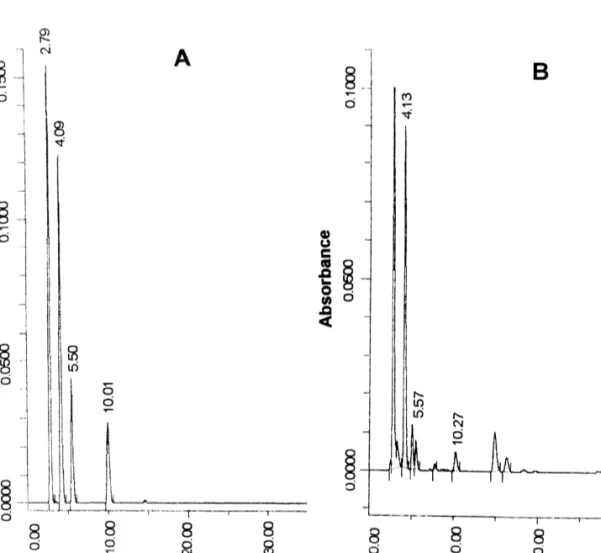
(7) 102. C. Barbas et al. / J. Chromatogr. A 870 (2000) 97 – 103. medium in hydrophobicity and silanol activity (Nova-Pak C 18 ) to evaluate the behavior of the three analytes, but having a 4 mm particle diameter to improve resolution. Results showed, as can be seen in Fig. 3A, that in Nova-Pak, silanol activity has an important role in retention, because caffeine and 8-chlorotheophylline are not retained and separated under the assay conditions while diphenhydramine peak shows an important tailing probably due to free silanols. A second stationary phase with lower hydrophobicity and silanol activity (SymmetryShield RP8) was chosen to reduce the secondary interactions leading to tailing in peaks and higher capacity factors for basic compounds.. Fig. 3 shows an example of a chromatogram of standards with SymmetryShield (C 8 ) (Fig. 3B) compared with Nova-Pak (C 18 ) (Fig. 3A). There bad resolution at low retention times and important tailing of diphenhydramine, a basic compound, with Nova-Pak and the opposite behavior with SymmetryShield can be clearly seen. Dorsey and Cooper [4] illustrated the role of stationary phases in reversed-phase chromatography, as a function of chain density and that the predominant driving force in the retention changes from an enthalpic to an entropic mechanism. SymmetryShield with a 15.0% carbon load and C 8 is expected to have a higher density of chains than Nova-Pak with a 7.3% carbon and C 18 .. Fig. 5. Chromatograms of 1% solutions of a pharmaceutical preparation containing caffeine, 8-chlorotheophylline and diphenhydramine as active principles submitted to oxidative stress. Conditions: SymmetryShield RP8 column, acetonitrile–(0.01 M H 3 PO 4 –triethylamine, pH 2.8) (22:78, v / v), flow-rate of 1 ml / min and UV detection at 229 nm. (A) Before decomposition; (B) after 1 h heating with 0.3% H 2 O 2 in an autoclave at 1208C..
(8) C. Barbas et al. / J. Chromatogr. A 870 (2000) 97 – 103. Established SymmetryShield RP8 as stationary phase and as aqueous phase 0.01 M H 3 PO 4 -triethylamine, pH 3.0, the ratio of the acetonitrile– aqueous phase was evaluated. Results of capacity factors of the three compounds for 50 to 90% of aqueous phase (Fig. 4) show that around 80% is the best ratio for separation of these compounds with reasonable retention times for diphenhydramine. Final conditions for which method was validated were: SymmetryShield RP8 column, and acetonitrile–(0.01 M H 3 PO 4 –triethylamine, pH 2.8) (22:78, v / v). Validation results appear in Table 1. Both standards and samples show a good linearity for the three analytes with correlation coefficients over 0.999; relative standard deviation (RSD) of slopes ranged between 0.4 and 0.6% for the three compounds in standards and samples showing the good fit of individual points to the regression line. In all cases the intercept with the confidence limits include the zero value showing that there is no bias. RSD of the values are #2% for intra-assay and intermediate precisions and recoveries do not statistically differ from 100% (t-test, P,0.05) in any case, having RSD values ranging from 0.7 to 1.3%. In relation to the accelerated degradation, the results showed that when each one of the assayed substances were decomposed with the stress test the decomposition products did not interfere with the primary substances determination. The condition that produced the most severe degradation was the oxidation with H 2 O 2 . Fig. 5 shows the chromatograms of a tablet containing caffeine and dimenhydrinate after degradation to show how the degradation products are separated of the analytes in working conditions.. 103. Only first 20 min are displayed since no peaks were found after this time. In conclusion, the studied method is suitable for separation, quantification and stability testing of caffeine, 8-chlorotheophylline and diphenhydramine in pharmaceutical preparations.. Acknowledgements The present study has been realized with the collaboration of CINFA S.A.. References [1] United States Pharmacopoeia National Formulary, Vol. 23, USPC, Rockville, MD, 1995, pp. 526–528, NF 18. [2] Pallas for Windows, 2.0, CompuDrug Chemistry, 1997. [3] British Pharmacopoeia, 2.0, The Stationary Office, Norwich, 1998. [4] J.G. Dorsey, W.T. Cooper, Anal. Chem. 66 (1994) 857A– 866A. [5] W. Grimm, in: K. Krummer (Ed.), Stability Testing in the EC, Japan and the USA, International Association for Pharmaceutical Technology: Paperback APV, Stutgart, 1993, p. 191. [6] ICH, in: ICH Harmonised Tripartite Guideline, Ch. Consensus Guideline, Vol. Step 3, 1996. [7] ICH, in: ICH Harmonised Tripartite Guideline, Ch. Consensus Guideline, Vol. Step 4, 1996. [8] M.A. Stadalius, J.S. Berus, L.R. Snyder, LC?GC Int. 6 (1988) 494. ´ ´ M. Popl, J. Chromatogr. A 758 [9] D. Sykora, E. Tesarova, (1997) 37. [10] R.J.M. Vervoort, F.A. Maris, H. Hindriks, J. Chromatogr. 623 (1992) 207. [11] Q.-H. Wan, M.C. Davies, P.N. Shaw, D.A. Barret, Anal. Chem. 68 (1996) 437..
(9)
Figure
Documento similar
In chapter 2 the methodology is introduced, including the description of the different steps: design parameters, force-stroke and work-stroke curves, discussion of the
The hypotheses considered in this study are firstly that the AUDIT questionnaire is a good tool for the early detec- tion of drinking problems and discrimination between low-,
Again, as in Takada's method, ELL (efficient) identification in the limit is possible by using a regular language (efficient) identification method, and this requires the
b)Which are the factors that may influence different learning experiences?(e.g, students´ attitudes towards the programs, students´ learning style, appropriateness and level of
Products Management Services (PMS) - Implementation of International Organization for Standardization (ISO) standards for the identification of medicinal products (IDMP) in
Products Management Services (PMS) - Implementation of International Organization for Standardization (ISO) standards for the identification of medicinal products (IDMP) in
‐ EMMAservice: Servicing the European Biomedical Research Community: archiving and dissemination of Mouse Models of Human Disease, European
In this regard, previous studies identified that RBP1 (retinol binding protein 1) was amongst the genes silenced by promoter hypermethylation not only in TCA cycle-mutated
