
In search of a new prototype in CK2 inhibitors design / José M Zapico [et al ]
18
0
0
Texto completo
(2) Prof. Julio Alvarez-Builla. ARKIVOC 2010 (iii) 54-71. that elevated CK2 activity is functionally linked to different cancer types.6,7 Cancer cells with activated CK2 signaling pathways show distinct features such as enhanced growth and survival, as well as rapid adaptation to stress. CK2 is involved in oncogenesis by regulation of various oncogenes, tumor suppressor proteins, and protection of antiapoptotic proteins from caspasemediated cleavage.8 Moreover, CK2 overexpression is an unfavorable prognostic marker in acute myeloid leukemia, prostate and lung cancer.9-11 Additionally, several viral proteins have been shown to be CK2 substrates, indicating a role for this enzyme in viral infections.12-15 Therefore, the pharmacological inhibition of CK2 appears as a promising strategy in order to better understand its various cellular functions. Various classes of ATP-site directed inhibitors of CK2 have been reported (Figure 1). TBB 1,16 DMAT 2,17,18 and ellagic acid 3,19 with IC50 values of 0.9, 0.14 and 0.04 µM, respectively, are representative of this class of inhibitors. Br Br. H N. Br. N. OH. Br Br. H N. Br. N. N Br TBB 1. O. OH. O. N HO. Br DMAT 2. O. O. OH Ellagic acid 3. Figure 1. ATP-site directed inhibitors of CK2. However, none of the already described CK2 inhibitors fulfill the requirements for successful clinical settings, and the design of new CK2 inhibitors is desired to effectively suppress different pathologies, such as cancer.. Results and Discussion In this work a series of purines with different substitutions at positions 6, 7 and 9 were synthesized. The first step in the synthesis of purine 8 was the alkylation of commercially available 6-chloro-9H-purin-2-amine 4 with 1-iodopropane in the presence of NaH. In this reaction, an 8:1 mixture of 5:6 regioisomers was obtained, which had to be separated by column chromatography. The major isomer 5 was used in the synthesis of 7 by reaction with ethyl 2mercaptoacetate and NaOCH3/MeOH. Basic hydrolysis of 7 gave carboxylic acid 8, which was finally obtained with an overall 53% yield (Scheme 1).. Page 55. ©. ARKAT USA, Inc..
(3) Prof. Julio Alvarez-Builla. ARKIVOC 2010 (iii) 54-71. Scheme 1. Reagents and conditions: (a) 1-iodopropane, NaH, DMF, 0 ºC; (b) HSCH2CO2Et, NaOMe/MeOH, H2O cat., 70 ºC; (c) NaOH, THF/H2O Compound 6 was reacted with ethyl 2-mercaptoacetate to obtain 9, which was also biologically evaluated. 1H-NMR spectra of 7 and 9 showed signals for the aromatic proton at 7.62 and 7.78 ppm, respectively. In order to avoid the time-consuming chromatography separation of regioisomers 5 and 6, and to improve the yield of the process, an alternative pathway for the synthesis of 8 was developed (Scheme 2). Thus, 6-thioguanine 10 was Salkylated by reaction with 1 equivalent of methyl bromoacetate, in the presence of K2CO3 to yield ester 11 in 64% yield (A method). In this reaction the amount of methyl bromoacetate must be carefully controlled, as an excess of the alkylating agent brings about the formation of polyalkylated compound 12, which is the only product when 2 equivalents are used. Hydrolysis of 12 gave 13, which was also tested for its activity against CK2. An alternative for the synthesis of 11 is the reaction between 6-chloro-9H-purin-2-amine 4 and ethyl 2-mercaptoacetate (B method). Although the yield of the reaction is similar, the lower price of the starting material makes it advantageous compared to the previous method.. Page 56. ©. ARKAT USA, Inc..
(4) Prof. Julio Alvarez-Builla. ARKIVOC 2010 (iii) 54-71. MeO. O. SH. S a. N. N. 10. c. H2N. N. N. H2N. HO2C 13 MeO. d. HO. O. O S. S N. N H2N. N. N. 12 O. N. N. S e. N H. N. H2N. 11. N. N. N. N. b. N. N H2N. N. N 8. 7. B Method N. N H2N. S. MeO2C. A Method MeO. Cl. O. b. N. N. N H. N. H2N. HO. N H. N 4. Scheme 2. Reagents and conditions: (a) methyl bromoacetate (2 equiv.), K2CO3, DMF; (b) NaOH, THF/H2O; (c) methyl bromoacetate (1 equiv.), K2CO3, DMF; (d) HSCH2CO2Me, NaOMe/MeOH, H2O cat., 70 ºC; (e) CH3CH2CH2I, K2CO3, DMF Spectroscopic data for compounds 7 and 8 synthesized following this pathway are identical to those from the sample obtained by the route described in Scheme 1, and these spectral data confirm our previous structural assignment for isomers 5 and 6. This synthetic route allowed us the access to a series of esters 14-23, differently substituted at N-9, by reaction of 11 with the corresponding alkyl bromide. Hydrolysis in basic conditions of the esters gave the corresponding acids 24-34 (Scheme 3).. Scheme 3. Reagents and conditions: (a) R-X, K2CO3, DMF; (b) NaOH THF/H2O. Page 57. ©. ARKAT USA, Inc..
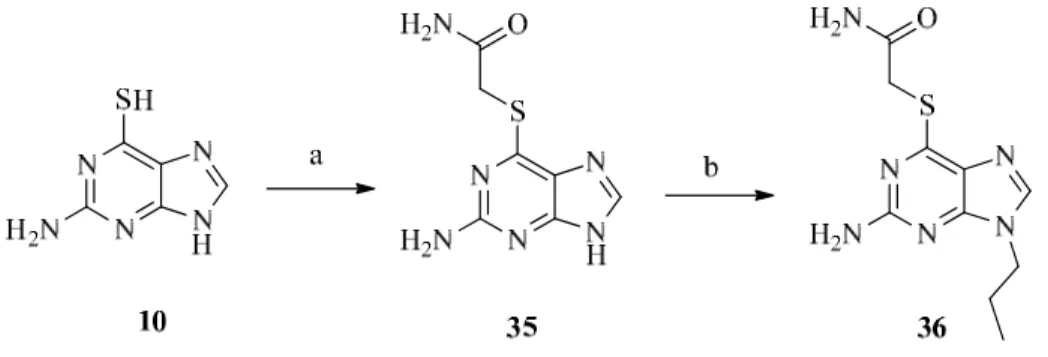
(5) Prof. Julio Alvarez-Builla. ARKIVOC 2010 (iii) 54-71. Amides 35 and 36 were obtained following the method A (Scheme 2) using chloroacetamide instead of methyl bromoacetate (Scheme 4).. Scheme 4. Reagents and conditions: (a) ClCH2CONH2, K2CO3, DMF; (b) CH3CH2CH2I, K2CO3, DMF. Selected compounds, listed in Table 1, were tested using the CK2 radiometric assay. The assays were performed at 10 µM concentration of the appropriate compound in the presence of catalytic subunit CK2α and [γ-32P]ATP. The kinase activity was measured as the quantity of 32P incorporated into substrate. Table 1. Remaining CK2 activity after treatment with a 10 µM solution of purine derivatives R1. O S 5 N. N H2N. Compound 7 8 9* 11 12 13 14 15 16 17. R1 OMe OH OMe OMe OMe OH OMe OMe OMe OMe. N 4 N R2. R2 CH3CH2 CH2 CH3CH2 CH2 CH3CH2 CH2 H CH3O2CCH2 HO2CCH2 HOCH2CH2 CH3OCH2CH2 C3H5CH2 CH2=CHCH2. Page 58. Activity [%] 75.4±7.4 100 93.46±3.18 n.d. 100 95.29±5.54 84.86±9.23 60.73±3.67 73.32±3.59 85.02±8.19. ©. ARKAT USA, Inc..
(6) Prof. Julio Alvarez-Builla. ARKIVOC 2010 (iii) 54-71. Table 1. Continued Compound 18 19 20 21 22 23 24 25 26 27 28 29 30 31 32 33 34 35 36. R1 OMe OMe OMe OMe OMe OMe OH OH OH OH OH OH OH OH OH OH OH NH2 NH2. R2 Activity [%] n.d. (CH3CH2)2NCH2CH2 C6H5CH2 76.38±3.2 71.65±2.89 p-CH3OC6H4CH2 92.2±5.27 p-ClC6H4CH2 80.36±9.54 p-NO2C6H4CH2 78.61±1.94 p-CF3C6H4CH2 n.d. HOCH2CH2 100 CH3OCH2CH2 86.6±7.67 C3H5CH2 82.6±6.96 CH2=CHCH2 (CH3CH2)2NCH2CH2 n.d. C6H5CH2 100 n.d. p-CH3OC6H4CH2 p-ClC6H4CH2 71.6±4.46 p-NO2C6H4CH2 n.d. 76.3±5.92 p-CF3C6H4CH2 H 65.2±5.07 H 64.31±6.09 CH3CH2 CH2 74.02±7.41. * Purine N-7 substituted. In general, ester and amide functionalities in R1 were found to achieve better activity (compounds 15, 20, 35, 7, and 36), although the presence of polar groups in R2 (compounds 12, and 13) leads to the decrease in the activity (Table 1). The best inhibitions were obtained with short alkyl or alkoxy chains at R2 (compounds 7, 15, and 36). The absence of R2 group leads to the active compound 35. Carboxylic acid derivatives are less active although, again, the absence of substituents in R2 leads to the active compound 34. Molecular modeling was performed with the aim of revealing the potential interactions that govern the recognition and the binding of this family of compounds into CK2. The automated docking calculations of selected compounds into the CK2 (PDB code: 1DAW) were performed using Glide 5.5 (Grid-based Ligand Docking with Energetics) in extra precision mode and following the protocol described in the Experimental Section. We selected 14 compounds bearing different functional groups at R1 position: esters 7, 15, 16, 17, 22, and 23; carboxylic acids 8, 13, 26, 27, 29 and 33; and amides 35, and 36. In order to estimate the ability of these compounds to mimic ATP adenosine (ANP), a post-docking step was performed by carrying out root-mean-square deviation (RMSD) calculations for junction carbons C-4 and C-5, using ANP as reference molecule (Table 2).. Page 59. ©. ARKAT USA, Inc..
(7) Prof. Julio Alvarez-Builla. ARKIVOC 2010 (iii) 54-71. Table 2. RMSD values for selected compounds with reference to ANP Compound 17 15 26 27 8 7 16. RMSD [Å] 0.69 0.87 1.05 1.08 1.08 1.18 1.21. Compound 36 13 35 29 22 23 33. RMSD [Å] 1.22 1.66 1.84 4.48 5.18 5.28 8.03. All compounds were predicted to be able to form stable complexes with CK2 and occupying the ANP binding site. Among all predicted binding orientations, the representatives that better mimicked the adenosine ring by establishing hydrophobic interactions with key residues like Ile66, Met163, Val53, Ile174 or Val116 were selected (ligands with RMSD values from 0.69 to 1.84 Å, see Table 2). Figure 2 shows the docked complex predicted for compound 15, which is the purine derivative with the highest inhibitory activity of all the synthesized compounds, inside CK2, superimposed with ANP. Significant differences were found for compounds with an aromatic ring as R2 (22, 23, 29, and 33, see Table 2) that led to higher RMSD values. This fact could be pointing to the loss of adenosine mimicking ability. In spite of this fact, only compound 29 showed a complete loss of activity.. Figure 2. Predicted mode of binding of 15 (light yellow) superimposed to crystallographic ANP (brick red) inside CK2 (PDB code: 1DAW).. Page 60. ©. ARKAT USA, Inc..
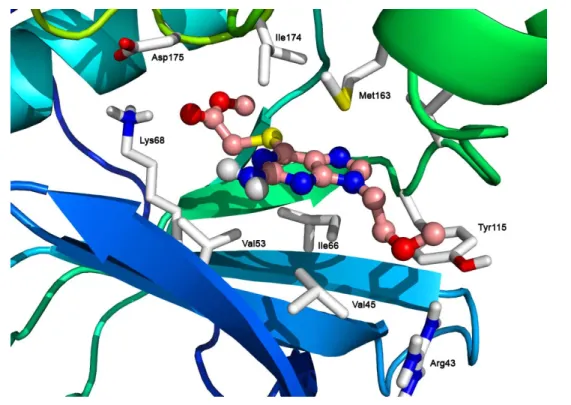
(8) Prof. Julio Alvarez-Builla. ARKIVOC 2010 (iii) 54-71. A second common feature was found for ligands with low RMSD values. Binding poses showed that the R2 chain is pointing towards the entrance of the ATP binding pocket, establishing hydrophobic interactions with Val45, Tyr115 and Ile66 side chains. On the opposite side of the binding pocket, ester, acid or amide R1 groups are located, establishing electrostatic interactions with Lys68 or Asp175 side chains (Figure 3). Additionally, compounds 8, 13, 15, 17, 26, and 27 are able to establish hydrogen bonds with Lys68 side chain and the backbone nitrogen of Asp175. In a few cases those hydrogen bonds are found with Lys43 7, 16.. Figure 3. Predicted mode of binding of 15 (pink carbons) with key residues (white carbons) of the ATP binding pocket inside CK2 (PDB code: 1DAW).. Conclusions Novel purine-based scaffolds are proposed as promising CK2 inhibitors. They are readily synthesized by S-alkylation followed by N9-alkylation of 6-mercaptopurine. Docking studies have allowed us to identify ligand-CK2 interactions that account for the molecular recognition process, and can help to further optimize this family of compounds as CK2 inhibitors.. Page 61. ©. ARKAT USA, Inc..
(9) Prof. Julio Alvarez-Builla. ARKIVOC 2010 (iii) 54-71. Experimental Section General. Melting points (uncorrected) were determined on a Stuart Scientific SMP3 apparatus. Infrared (IR) spectra were recorded with a Perkin-Elmer 1330 infrared spectrophotometer. 1H and 13C NMR data were recorded on a Bruker 300-AC instrument. Chemical shifts (δ) are expressed in parts per million relative to internal tetramethylsilane; coupling constants (J) are in hertz. Mass spectra were run on a Bruker Esquire 3000 spectrometer. Elemental analyses (C, H, N, S) were performed on a LECO CHNS-932 apparatus at the Microanalyses Service of the University Complutense of Madrid; unless otherwise stated all reported values are within ± 0.4% of the theoretical compositions. Thin-layer chromatography (TLC) was run on Merck silica gel 60 F-254 plates. Unless stated otherwise, starting materials used were high-grade commercial products. Alkylation of 6-chloro-9H-purin-2-amine (4). To a solution of 6-chloro-9H-purin-2-amine 4 (509 mg, 3 mmol) in dry DMF (20 ml) at 0 ºC was added NaH (120 mg, 3 mmol). After stirring for 30 min, 1-iodopropane was added and the mixture was stirred at 0 ºC for 5 h. Then, the solution was concentrated in vacuum and the solid obtained was suspended in H2O and extracted with DCM. The extracts were dried (MgSO4), filtered, evaporated to dryness, and the residue was chromatographed on silica gel (DCM:MeOH 60:1 to 25:1) to give 5 (475 mg, 75%) and 6 (62 mg, 10%) as white solids. 6-Chloro-9-propyl-9H-purin-2-amine (5). IR: 3390, 3300, 3150, 2960, 2925 cm-1. 1H NMR (CDCl3): δ 0.94 (t, J = 7.40 Hz, 3H, CH3), 1.84-1.93 (m, 2H, CH2), 4.03 (t, J = 7.14 Hz, 2H, CH2N), 5.29 (bs, 2H, NH2) 7.75 (s, 1H, ArH). 13C NMR (CDCl3): δ 11.1, 22.9, 45.4, 125.2, 142.4, 151.1, 153.8, 159.0. MS (ESI): m/z 324.20 [M+Na]+. Anal. Calcd. for C8H10ClN5: C, 45.40; H, 4.76; N, 33.09. Found: C, 45.09; H, 4.66; N, 32.81. 6-Chloro-7-propyl-7H-purin-2-amine (6) IR: 3400, 3320, 3150, 2970, 2920, cm-1. 1H NMR (DMSO-d6): δ 0.83 (t, J = 7.35 Hz, 3H, CH3), 1.74-1.87 (m, 2H, CH2), 4.24 (t, J = 6.72 Hz, 2H, CH2N), 6.65 (bs, 2H, NH2) 8.38 (s, 1H, ArH). 13C NMR (DMSO-d6): δ 10.6, 24.1, 47.7, 114.8, 142.2, 149.5, 159.9, 164.3. MS (ESI): m/z 324.20 [M+Na]+. Anal. Calcd. for C8H10ClN5: C, 45.40; H, 4.76; N, 33.09. Found: C, 45.22; H, 4.78; N, 32.86. Methyl [(2-amino-9-propyl-9H-purin-6-yl)sulfanyl]acetate (7). Method A. To a solution of 5 (379 mg, 1.8 mmol) and NaOCH3 (1 g, 18 mmol) in MeOH (15 ml), ethyl sulfanylacetate (0.79 ml, 7.2 mmol) and H2O (0.1 ml) were added. The reaction mixture was heated at 70 ºC for 6 h in a sealed tube. The solution was concentrated in vacuum, suspended in H2O and extracted with DCM. The extracts were dried (MgSO4), filtered, evaporated to dryness and the residue was chromatographed on silica gel (hexane:AcOEt 1:4) to give 7 (359 mg, 71%) as a white solid, mp 104.7-106.5 ºC (AcOEt/hexane). IR: 3480, 3280, 3160, 3085, 2920, 1720, cm-1. 1H NMR (CDCl3): δ 0.91 (t, J = 7.50 Hz, 3H, CH3), 1.77-1.90 (m, 2H, CH2), 3.72 (s, 3H, CH3O) 3.98 (t, J = 7.14 Hz, 2H, CH2N) 4.05 (s, 2H, CH2S), 4.88 (bs, 2H, NH2) 7.62 (s, 1H, ArH). 13C NMR (CDCl3): δ 10.8, 22.7, 30.3, 44.7, 52.4, 125.0, 140.1, 150.6, 158.5, 158.6, 169.5. MS (ESI): m/z. Page 62. ©. ARKAT USA, Inc..
(10) Prof. Julio Alvarez-Builla. ARKIVOC 2010 (iii) 54-71. 282.00 [M+H]+, 303.99 [M+Na]+. Anal. Calcd. for C11H15N5O2S: C, 46.96; H, 5.37; N, 24.89; S, 11.40. Found: C, 46.85; H, 5.25; N, 24.76; S, 11.41. Methyl [(2-amino-7-propyl-7H-purin-6-yl)sulfanyl]acetate (9). The same method described above was used for the synthesis of 9. Thus, from 6 (195 mg, 0.92 mmol), NaOCH3 (515 mg, 9.2 mmol) and ethyl sulfanylacetate (0.41 ml, 3.68 mmol) and after chromatography (AcOEt:MeOH 25:1) compound 9 (82 mg, 32%) was obtained as a white solid, mp 155.1-156.3 ºC (AcOEt). IR: 3480, 3280, 3150, 1720 cm-1. 1H NMR (CDCl3): δ 0.87 (t, J = 7.7 Hz, 3H, CH3), 1.79-1.91 (m, 2H, CH2), 3.71 (s, 3H, CH3O), 4.04 (s, 2H, CH2S), 4.17 (t, J = 7.7 Hz, 2H, CH2N), 5.22 (bs, 2H, NH2) 7.78 (s, 1H, ArH). 13C NMR (DMSO-d6): δ 10.6, 24.6, 30.3, 48.3, 52.5, 116.0, 147.7, 150.4, 159.4, 161.3, 169.2. MS (ESI): m/z 282.44 [M+H]+, 304.11 [M+Na]+. Anal. Calcd. for C11H15N5O2S: C, 46.96; H, 5.37; N, 24.89; S, 11.40. Found: C, 47.08; H, 5.39; N, 24.90; S, 11.45. Methyl [(2-amino-9H-purin-6-yl)sulfanyl]acetate (11). Method A. To a solution of 6thioguanine 10 (334 mg, 2 mmol) in DMF (5 ml), was added K2CO3 (285 mg, 2 mmol). After 30 min methyl bromoacetate (306 mg, 2 mmol) was added and the mixture was stirred for 2 h. The solution was concentrated in vacuum, solved in DCM:MeOH 3:1 and the insoluble residue was removed by filtration. The organic layer was concentrated in vacuum and purified by chromatography on silicagel (DCM:MeOH 20:1 to 10:1) to give 11 (307 mg, 64%) as a yellowish solid mp. 200.1-203.5 ºC. Method B. To a solution of 6-chloro-9H-purin-2-amine 4 (5.1 g, 30 mmol) in MeOH (30 ml), were added NaOCH3 (8.1 g, 150 mmol), ethyl sulfanylacetate (6.6 ml, 60 mmol) and H2O (0.5 ml). The reaction mixture was heated for 4 h at 80 ºC in a sealed tube. After completion of the reaction, the solution was concentrated in vacuum, the residue was solved in DCM:MeOH 3:1. The insoluble salts were removed by filtration and the organic layer was concentrated in vacuum and purified by chromatography on silica gel (AcOEt:MeOH 25:1) to give 11 (3.95 g, 55%) as a white solid, mp 200.1-203.5 ºC (AcOEt). IR: 3480, 3360, 1730 cm-1. 1H NMR (DMSO-d6): δ 3.66 (s, 3H, CH3O), 4.21 (s, 2H, CH2S), 6.36 (sa, 2H, NH2) 7.93 (s, 1H, ArH). 13C NMR (DMSO-d6): δ 29.7, 52.4, 123.7, 139.2, 152.0, 157.0, 159.5, 169.6. [M+Na]+. Anal. Calcd. for C8H9N5O2S: C, 40.16; H, 3.79; N, 29.27; S, 13.40. Found: C, 40.34; H, 3.93; N, 28.80; S, 13.43. General procedure for the alkylation of purines at N-9 using K2CO3 as a base To a suspension of the purine (1 equiv) in DMF was added K2CO3 (1.5 equiv.). After 30 min of stirring at room temperature the respective alkyl bromide or chloride was added (1.1 to 2.0 equiv.). The mixture was stirred until no evolution of reaction was observed (8 - 24 h). The solution was concentrated in vacuum, the residue suspended in H2O and extracted with DCM. The extracts were dried (MgSO4), filtered, evaporated to dryness and the residue was chromatographed on silica gel. Methyl [(2-amino-9-propyl-9H-purin-6-yl)sulfanyl]acetate (7). Method B. From 11 (720 mg, 3 mmol) in DMF (15 ml), K2CO3 (500 mg, 3 mmol) and 1-iodopropane (0.29 ml, 3 mmol). Reaction time: 2h. Chromatographed using hexane:AcOEt 1:5 as eluent. Compound 7 (365 mg,. Page 63. ©. ARKAT USA, Inc..
(11) Prof. Julio Alvarez-Builla. ARKIVOC 2010 (iii) 54-71. 31%) was obtained as a white solid showing the same spectroscopic data as the sample obtained by A Method (see above). Methyl {[2-amino-9-(2-methoxy-2-oxoethyl)-9H-purin-6-yl]sulfanyl}acetate (12). From 6thioguanine (10) (167 mg, 1 mmol) in DMF (5 ml), K2CO3 (142 mg, 1 mmol) and methyl bromoacetate (0.19 ml, 2 mmol). Reaction time: 2h. Chromatographed using (DCM:MeOH 60:1 to 25:1) as eluent. Compound 12 (223 mg, 72%) was obtained as a white solid, mp 155.2-157.1 ºC (EtOH). IR: 3410, 3320, 3200, 2980, 2910, 1720 cm-1. 1H NMR (CDCl3): δ 3.74 (s, 3H, CH3), 3.76 (s, 3H, CH3), 4.07 (s, 2H, CH2S) 4.82 (s, 2H, CH2N) 4.93 (bs, 2H, NH2) 7.69 (s, 1H, ArH). 13 C NMR (CDCl3): δ 30.7, 43.6, 52.7, 52.9, 124.9, 140.3, 155.0, 158.9, 159.5, 167.6, 169.7. [M+Na]+. MS (ESI): m/z 334.17 [M+Na]+. Anal. Calcd. for C11H13N5O4S: C, 42.44; H, 4.21; N, 22.50; S, 10.30. Found: C, 42.30; H, 4.33; N, 22.05; S, 10.10. Methyl {[2-amino-9-(2-hydroxyethyl)-9H-purin-6-yl]sulfanyl}acetate (14). A slight modification of the general procedure was used. Thus, to a solution of 11 (400 mg, 1.67 mmol) in DMF (10 ml) was added K2CO3 (346 mg, 2.51 mmol). After 30 min, 2-bromoethanol (0.24 ml, 3.34 mmol) was added and the mixture was stirred overnight. The solution was concentrated in vacuum, the residue was solved in DCM:MeOH 3:1, the insoluble salts were removed by filtration. The organic layer was concentrated in vacuum and the residue was recrystallized from EtOH and water to obtain 14 (279 mg, 59%) as a white solid, mp 150.5-152.0 ºC. IR: 3410, 3280, 3150, 1715 cm-1. 1H NMR (DMSO-d6): δ 3.66 (s, 3H, CH3O), 3.69 (t, J = 5.3 Hz, 2H, CH2N), 4.06 (t, J = 5.3 Hz, 2H, CH2O), 4.21 (s, 2H, CH2S), 5.01 (bs, 1H, OH), 6.47 (bs, 2H, NH2), 7.91 (s, 1H, ArH). 13C NMR (DMSO-d6): δ 29.7, 45.5, 52.4, 59.0, 123.9, 141.7, 151.3, 157.3, 159.3, 169.5. Anal. Calcd. for C10H13N5O3S: C, 42.39; H, 4.63; N, 24.72, S, 11.32. Found: C, 42.38; H, 4.70; N, 24.13; S, 11.14. Methyl {[2-amino-9-(2-methoxyethyl)-9H-purin-6-yl]sulfanyl}acetate (15). From 11 (200 mg, 0.84 mmol) in DMF (5 ml), K2CO3 (179 mg, 1.26 mmol) and 2-chloroethyl methyl ether (0.09 ml, 0.92 mmol). Reaction time: 24 h. Chromatographed using DCM:MeOH (100:1 to 40:1) as eluent. Compound 15 (182 mg, 73%) was obtained as a white solid, mp 146.5-147.6 ºC (AcOEt/hexano). IR: 3420, 3300, 3170, 3070, 2980, 1730 cm-1. 1H NMR (CDCl3): δ 3.31 (s, 3H, CH3O), 3.64 (t, J = 5.0 Hz, 2H, CH2), 3.74 (s, 3H, CH3OCO), 4.01 (s, 2H, CH2S), 4.20 (t, J = 5.0 Hz, 2H, CH2), 5.00 (bs, 2H, NH2), 7.75 (s, 1H, ArH). 13C NMR (CDCl3): δ 30.6, 43.1, 52.6, 58.9, 70.4, 125.2, 141.3, 150.7, 158.6, 159.0, 169.7. MS (ESI): m/z 298.11 [M+H]+, 320.11 [M+Na]+. Anal. Calcd. for C11H15N5O3S: C, 44.43; H, 5.08; N, 23.55; S, 10.78. Found: C, 44.40; H, 5.06; N, 23.22; S, 10.65. Methyl {[2-amino-9-(cyclopropylmethyl)-9H-purin-6-yl]sulfanyl}acetate (16). From 11 (200 mg, 0.84 mmol) in DMF (5 ml), K2CO3 (179 mg, 1.26 mmol) and bromomethylcyclopropane (0.09 ml, 0.92 mmol). Reaction time: 24 h. Chromatographed using DCM:MeOH (100:1 to 60:1) as eluent. Compound 16 (90 mg, 37%) was obtained as a white solid, mp 166.4-167.1 ºC (AcOEt/hexano). IR: 3460, 3300, 3170, 1730 cm-1. 1H NMR (CDCl3): δ 0.37-0.43 (m, 2H, CH2), 0.61-0.67 (m, 2H, CH2), 1.20-1.33 (m, 1H, CH), 3.75 (s, 3H, CH3O), 3.89 (d, J = 7.2 Hz, 2H, CH2N), 4.09 (s, 2H, CH2S), 4.96 (bs, 2H, NH2), 7.77 (s, 1H, ArH). 13C NMR (CDCl3): δ 4.7,. Page 64. ©. ARKAT USA, Inc..
(12) Prof. Julio Alvarez-Builla. ARKIVOC 2010 (iii) 54-71. 11.4, 31.1, 48.5, 53.2, 125.9, 140.5, 151.3, 159.1, 159.5, 170.3. MS (ESI): m/z 294.55 [M+H]+, 316.12 [M+Na]+. Anal. Calcd. for C12H15N5O2S: C, 49.13; H, 5.15; N, 23.87; S, 10.93. Found: C, 49.39; H, 5.29; N, 23.80; S, 10.93. Methyl {[2-amino-9-(prop-2-en-1-yl)-9H-purin-6-yl]sulfanyl}acetate (17). From 11 (200 mg, 0.84 mmol) in DMF (5 ml), K2CO3 (179 mg, 1.26 mmol) and allyl iodide (0.09 ml, 0.92 mmol). Reaction time: 12 h. Chromatographed using hexane:AcOEt 1:4 to AcOEt 100% as eluent. Compound 17 (152 mg, 65%) was obtained as a white solid, mp 102.7-103.9 ºC (AcOEt/hexano). 1H NMR (CDCl3): δ 3.73 (s, 3H, CH3O) 4.08 (s, 2H, CH2S), 4.64 (d, J = 4.7 Hz, 2H, CH2N) 5.06 (bs, 2H, NH2), 5.08 (d, J = 17.0 Hz, 1H, 1/2C=CH2), 5.26 (d, J = 9.9 Hz, 1H, 1/2C=CH2), 5.90-6.03 (m, 1H, CH=C), 7.64 (s, 1H, ArH). 13C NMR (CDCl3): δ 31.1, 45.7, 53.1, 119.1, 125.7, 132.2, 140.6, 151.2, 159.3, 159.6, 170.2. MS (ESI): m/z 279.98 [M+H]+, 301.97 [M+Na]+. Anal. Calcd. for C11H13N5O2S: C, 47.30; H, 4.69; N, 25.07; S, 11.48. Found: C, 47.29; H, 4.74; N, 24.92; S, 11.49. Methyl ({2-amino-9-[2-(diethylamino)ethyl]-9H-purin-6-yl}sulfanyl)acetate (18) From 11 (200 mg, 0.84 mmol) in DMF (5 ml), K2CO3 (179 mg, 1.26 mmol) and 2-chloro-N,Ndiethylethanamine hydrochloride (158 mg, 0.92 mmol). Reaction time: 12 h. Chromatographed using DCM:MeOH (40:1 to 25:1) as eluent. Compound 18 (177 mg, 62%) was obtained as a white solid, mp 157.9-159.7 ºC. 1H NMR (CDCl3): δ 0.86 (t, J = 7.1 Hz, 6H, 2CH3), 2.45 (q, J = 7.1 Hz, 4H, 2CH2), 2.67 (t, J = 6.1 Hz, 2H, CH2), 3.68 (s, 3H, CH3O), 4.00 (t, J = 6.1 Hz, 2H, CH2), 4.03 (s, 2H, CH2S), 5.16 (bs, 2H, NH2), 7.71 (s, 1H, ArH). Anal. Calcd. for C14H22N6O2S: C, 49.69; H, 6.55; N, 24.83; S, 9.47. Found: C, 49.48; H, 6.64; N, 25.03; S, 9.39. Methyl [(2-amino-9-benzyl-9H-purin-6-yl)sulfanyl]acetate (19). From 11 (200 mg, 0.84 mmol) in DMF (5 ml), K2CO3 (179 mg, 1.26 mmol) and benzyl bromide (0,11 ml, 0.92 mmol). Reaction time: 12 h. Chromatographed using hexane:AcOEt (1:1 to 1:5) as eluent. Compound 19 (209 mg, 76%) was obtained as a white solid, mp 147.3-148.1 ºC (AcOEt/hexano). 1H NMR (CDCl3): δ 3.73 (s, 3H, CH3O) 4.08 (s, 2H, CH2S), 5.08 (bs, 2H, NH2), 5.20 (s, 2H, CH2Ph), 7.18-7.22 (m, 2H, ArH), 7.26-7.61 (m, 3H, ArH), 7.61 (s, 1H, ArH). 13C NMR (CDCl3): δ 30.6, 46.6, 52.6, 125.1, 127.4, 128.2, 128.9, 135.5, 140.1, 151.0, 158.9, 159.2, 169.7. MS (ESI): m/z 352.18 [M+Na]+. Anal. Calcd. for C15H15N5O2S: C, 54.70; H, 4.59; N, 21.26; S, 9.74. Found: C, 54.46; H, 4.78; N, 20.89; S, 9.60. Methyl {[2-amino-9-(4-methoxybenzyl)-9H-purin-6-yl]sulfanyl}acetate (20). From 11 (200 mg, 0.84 mmol) in DMF (5 ml), K2CO3 (179 mg, 1.26 mmol) and 4-methoxybenzyl bromide (0.13 ml, 0.92 mmol). Reaction time: 12 h. Chromatographed using hexane:AcOEt (2:1 to 1:2) as eluent. Compound 20 (158 mg, 53%) was obtained as a white solid, mp 133.9-134.7 ºC (AcOEt/hexano). IR: 3450, 3280, 3150, 1720 cm-1. 1H NMR (CDCl3): δ 3.76 (s, 3H, CH3O), 3.81 (s, 3H, CH3O) 4.16 (s, 2H, CH2S), 5.20 (s, 2H, CH2N), 5.35 (bs, 2H, NH2), 6.88 (AA’XX’, ArH), 7.24 (AA’XX’, 2H, ArH), 7.64 (s, 1H, ArH). 13C NMR (CDCl3): δ 30.6, 46.2, 52.6, 55.2, 114.2, 125.2, 127.4, 129.1, 140.1, 150.0, 158.8, 159.1, 159.4, 169.7. MS (ESI): m/z 360.01 [M+H]+, 382.01 [M+Na]+. Anal. Calcd. for C16H17N5O3S: C, 53.47; H, 4.77; N, 19.49; S, 8.92. Found: C, 54.57; H, 4.77; N, 19.28; S, 8.88.. Page 65. ©. ARKAT USA, Inc..
(13) Prof. Julio Alvarez-Builla. ARKIVOC 2010 (iii) 54-71. Methyl {[2-amino-9-(4-chlorobenzyl)-9H-purin-6-yl]sulfanyl}acetate (21). From 11 (200 mg, 0.84 mmol) in DMF (5 ml), K2CO3 (179 mg, 1.26 mmol) and 4-chlorobenzyl chloride (148 mg, 0.92 mmol). Reaction time: 24 h. Chromatographed using hexane:AcOEt 1:4 to AcOEt 100% as elluent. Compound 21 (247 mg, 81%) was obtained as a white solid, mp 159.7-162.3 ºC (AcOEt/hexano). IR: 3470, 3300, 3170, 1720 cm-1. 1H NMR (CDCl3) δ: 3.74 (s, 3H, CH3O), 4.08 (s, 2H, CH2S), 5.03 (bs, 2H, NH2), 5.18 (s, 2H, CH2N), 7.15 (AA’XX’, 2H, ArH), 7.29 (AA’XX’, 2H, ArH), 7.62 (s, 1H, ArH). 13C NMR (CDCl3): δ 31.1, 46.5, 53.2, 125.6, 129.3, 129.4, 129.6, 134.5, 140.4, 151.3, 159.2, 159.9, 170.2. MS (ESI): m/z 363.99 [M+H]+, 386.99 [M+Na]+. Anal. Calcd. for C15H14ClN5O2S: C, 49.52; H, 3.88; N, 19.25; S, 8.81. Found: C, 49.54; H, 3.97; N, 19.12; S, 8.74. Methyl {[2-amino-9-(4-nitrobenzyl)-9H-purin-6-yl]sulfanyl}acetate (22). From 11 (200 mg, 0.84 mmol) in DMF (5 ml), K2CO3 (179 mg, 1.26 mmol) and 4-nitrobenzyl bromide (199 mg, 0.92 mmol). Reaction time: 12 h. Chromatographed using hexane:AcOEt (1:1 to 1:2) as eluent. Compound 22 (97 mg, 31%) was obtained as a white solid, mp 142.0-143.2 ºC (AcOEt/hexano). IR: 3450, 3340, 3200, 1730 cm-1. 1H NMR (CDCl3) δ: 3.75 (s, 3H, CH3O), 4.09 (s, 2H, CH2S), 5.00 (bs, 2H, NH2), 5.34 (s, 2H, CH2N), 7.36 (AA’XX’, 2H, ArH), 7.68 (s, 1H, ArH), 8.16 (AA’XX’, 2H, ArH). 13C NMR (CDCl3): δ 30.6, 45.9, 52.7, 124.1, 125.1, 128.1, 139.7, 142.8, 147.6, 150.8, 158.9, 159.7, 169.6. Anal. Calcd. for C15H14N6O4S: C, 48.12; H, 3.77; N, 22.45; S, 8.56. Found: C, 48.20; H, 3.97; N, 22.23; S, 8.48. Methyl ({2-amino-9-[4-(trifluoromethyl)benzyl]-9H-purin-6-yl}sulfanyl)acetate (23). From 11 (200 mg, 0.84 mmol) in DMF (5 ml), K2CO3 (179 mg, 1.26 mmol) and 4trifluoromethylbenzyl bromide (220 mg, 0.92 mmol). Reaction time: 12 h. Chromatographed using hexane:AcOEt (1:4 to 1:9) as eluent. Compound 23 (182 mg, 55%) was obtained as a white solid, mp 150.5-152.4 ºC (AcOEt/hexano). IR: 3450, 3340, 3200, 1735 cm-1. 1H NMR (CDCl3) δ: 3.73 (s, 3H, CH3O), 4.07 (s, 2H, CH2S), 5.06 (bs, 2H, NH2), 5.27 (s, 2H, CH2N), 7.29 (AA’XX’, 2H, ArH), 7.29 (AA’XX’, 2H, ArH), 7.70 (s, 1H, ArH). MS (ESI): m/z 398.03 [M+H]+, 419.97 [M+Na]+. Anal. Calcd. for C16H14F3N5O2S: C, 48.36; H, 3.55; N, 17.62; S, 8.07. Found: C, 48.45; H, 3.70; N, 17.56; S, 8.08. 2-[(2-Amino-9H-purin-6-yl)sulfanyl]acetamide (35). To a solution of 6-thioguanine (10) (500 mg, 3 mmol) in DMF (10 ml), was added K2CO3 (413 mg, 3 mmol). After 30 min, chloroacetamide (280 mg, 3 mmol) was added and the mixture was stirred for 12 h. The solution was concentrated in vacuum, the residue was solved in DCM:MeOH 3:1 and the insoluble salts were removed by filtration. The organic layer was concentrated in vacuum and the solid obtained was washed with water and crystallized from EtOH/H2O to give 35 (378 mg, 56%) as a white solid, mp 258.6-260.1 ºC (lit.20 285 ºC dec) IR: 3480, 3360, 3260, 3080, 2780, 1700 cm-1. 1H NMR (CDCl3): δ 3.89 (s, 2H, CH2S), 6.42 (s, 2H, NH2), 7.19 (s, 1H, 1/2CONH2), 7.50 (s, 1H, 1/2CONH2), 7.91 (s, 1H, ArH), 12.57 (s, 1H, NH). 13C NMR (CDCl3): δ 31.3, 123.7, 139.1, 151.9, 157.8, 159.6, 170.1. Anal. Calcd. for C7H8N6OS: C, 37.49; H, 3.60; N, 37.48; S, 14.30. Found: C, 37.42; H, 3.68; N, 37.16; S, 14.33. Page 66. ©. ARKAT USA, Inc..
(14) Prof. Julio Alvarez-Builla. ARKIVOC 2010 (iii) 54-71. 2-[(2-Amino-9-propyl-9H-purin-6-yl)sulfanyl]acetamide (36). Following the general procedure for the alkylation of purines at N-9, from 35 (200 mg, 0.89 mmol) in DMF (10 mL), K2CO3 (127 mg, 0.89 mmol) and 1-iodopropane (0.09 ml, 0.89 mmol). Reaction time: 5 h. The solution was concentrated in vacuum, the residue was solved in DCM:MeOH 3:1 and the insoluble salts were removed by filtration. The organic layer was concentrated in vacuum and purified by chromatography on silicagel (DCM:MeOH 15:1) to give 36 (107 mg, 45%) as a white solid, mp. 188.2-189.3 ºC (H2O). IR: 3400, 3320, 3200, 2950, 2860, 1650 cm-1. 1H NMR (DMSO-d6): δ 0.81 (t, J = 7.3 Hz, 3H, CH3), 1.72-1.79 (m, 2H, CH2), 3.89 (s, 2H, CH2S), 3.97 (t, J = 7.3 Hz, 2H, CH2N), 6.56 (s, 2H, NH2), 7.20 (s, 1H, 1/2CONH2), 7.52 (s, 1H, 1/2CONH2), 7.97 (s, 1H, ArH). 13C NMR (DMSO-d6): δ 11.1, 22.7, 31.3, 44,4, 124.0, 141.2, 151.2, 158.3, 159.5, 170.2. MS (ESI): m/z 289.13 [M+Na]+. Anal. Calcd. for C10H14N6OS: C, 45.10; H, 5.30; N, 31.56; S, 12.04. Found: C, 45.01; H, 5.25; N, 31.31; S, 11.85 General procedure for ester hydrolysis in basic conditions The ester (1 equiv) was solved in a mixture of THF and NaOH aqueous solution (1.5 to 3.0 equiv) and stirred at room temperature until all starting material was disappeared. The solution was concentrated in vacuum, the residue dissolved in H2O and acidified with 1N HCl until a solid appeared, which was filtered and characterized as the corresponding acid. [(2-Amino-9-propyl-9H-purin-6-yl)sulfanyl]acetic acid (8). From 7 (300 mg, 1.07 mmol), THF (3 ml) and NaOH (3.2 ml, 1.61 mmol, 0.5 N), compound 8 (265 mg, 93%) was obtained as a white solid, mp 201.7-203.5 (EtOH/H2O) (dec) (lit21 200 ºC dec). IR: 3400, 3200, 2950, 2920, 1650 cm-1. 1H NMR (DMSO-d6): δ 0.83 (t, J = 7.50 Hz, 3H, CH3), 1.70-1.82 (m, 2H, CH2), 3.95 (t, J = 7.30 Hz, 2H, CH2N) 4.14 (s, 2H, CH2S), 6.50 (bs, 2H, NH2) 7.98 (s, 1H, ArH). 13C NMR (DMSO-d6): δ 11.0, 22.6, 30.1, 44.3, 124.0, 141.1, 151.2, 157.9, 159.4, 170.3. MS (ESI): m/z 268.00 [M+H]+. Anal. Calcd. for C10H13N5O2S·H2O: C, 42.09; H, 5.30; N, 24.55; S, 11.24. Found: C, 42.04; H, 5.22; N, 24.38; S, 11.12. {[2-Amino-9-(carboxymethyl)-9H-purin-6-yl]sulfanyl}acetic acid (13). From 12 (60 mg, 0.19 mmol), THF (3 ml) and NaOH (1.16 ml, 0.57 mmol, 0.5 N), compound 13 (25 mg, 46%) was obtained as a white solid, mp 239.0-239.8 ºC (EtOH/H2O) (dec.). IR: 3420, 3320, 3200, 3110, 1720 cm-1. 1H NMR (DMSO-d6): δ 4.15 (s, 2H, CH2S) 4.83 (s, 2H, CH2N) 6.55 (s, 2H, NH2) 7.93 (s, 1H, ArH). 13C NMR (DMSO-d6): δ 30.2, 43.8, 123.5, 141.5, 151.4, 158.0, 159.5, 169.4, 170.3. MS (ESI): m/z 284.08 [M+H]+, 306.06 [M+Na]+. Anal. Calcd. for C9H9N5O4S: C, 38.16; H, 3.20; N, 24.72; S, 11.32. Found: C, 38.24; H, 3.41; N, 24.41; S, 11.25. {[2-Amino-9-(2-hydroxyethyl)-9H-purin-6-yl]sulfanyl}acetic acid (24). From 14 (275 mg, 0.97 mmol), THF (3 ml) and NaOH (3.1 ml, 1.5 mmol, 0.5 N), compound 24 (90 mg, 34%) was obtained as a white solid, mp 227.0-228.7 ºC. IR: 3320, 3240, 3080, 2930, 2880, 1660 cm-1. 1H NMR (DMSO-d6): δ 3.69 (t, J = 5.1 Hz, 2H, CH2N), 4.01 (t, J = 5.1 Hz, 2H, CH2O), 4.23 (s, 2H, CH2S), 6.51 (bs, 2H, NH2), 7.97 (s, 1H, ArH). MS (ESI): m/z 270.15 [M+H]+, 292.32 [M+Na]+. Anal. Calcd. for C9H11N5O3S: C, 40.14; H, 4.12; N, 26.01; S, 11.91. Found: C, 39.60; H, 4.27; N, 25.90; S, 11.61.. Page 67. ©. ARKAT USA, Inc..
(15) Prof. Julio Alvarez-Builla. ARKIVOC 2010 (iii) 54-71. {[2-Amino-9-(2-methoxyethyl)-9H-purin-6-yl]sulfanyl}acetic acid (25). From 15 (81 mg, 0.27 mmol), THF (3 ml) and NaOH (1.09 ml, 0.54 mmol, 0.5 N), compound 25 (17 mg, 22%) was obtained as a white solid, mp 211.4-213.0 ºC (EtOH/H2O). IR: 3450, 3310, 3180, 1700 cm-1. 1H NMR (DMSO-d6): δ 3.23 (s, 3H, CH3O), 3.64 (t, J = 5.5 Hz, 2H, CH2), 4.13 (s, 2H, CH2S), 4.18 (t, J = 5.5 Hz, 2H, CH2), 6.49 (s, 2H, NH2), 7.91 (s, 1H, ArH). 13C NMR (DMSO-d6): δ 30.1, 42.4, 58.1, 69.6, 123.8, 141.4, 151.2, 157.9, 159.4, 170.3. MS (ESI): m/z 284.47 [M+H]+, 306.21 [M+Na]+. Anal. Calcd. for C10H13N5O3S: C, 42.39; H, 4.63; N, 24.72; S, 11.32. Found: C, 42.88; H, 4.78; N, 24.27; S, 11.31 {[2-Amino-9-(cyclopropylmethyl)-9H-purin-6-yl]sulfanyl}acetic acid (26). From 16 (72 mg, 0.25 mmol), THF (3 ml) and NaOH (0.74 ml, 0.38 mmol, 0.5 N), compound 26 (42 mg, 61%) was obtained as a white solid, mp 228.1-229.6 ºC (EtOH/H2O) (dec). IR: 3480, 3290, 3160, 1700 cm-1. 1H NMR (DMSO-d6): δ 0.36-0.42 (m, 2H, CH2), 0.44-0.53 (m, 2H, CH2), 1.21-1.29 (m, 1H, CH), 3.87 (d, J = 6.7 Hz, 2H, CH2N), 4.15 (s, 2H, CH2S), 6.49 (s, 2H, NH2), 8.02 (s, 1H, ArH). 13C NMR (DMSO-d6): δ 6.9, 11.2, 30.1, 46.9, 123.9, 140.8, 151.1, 157.9, 159.4, 170.3. Anal. Calcd. for C11H13N5O2S: C, 47.30; H, 4.69; N, 25.07; S, 11.48. Found: C, 47.23; H, 4.68; N, 24.75; S, 11.51 {[2-Amino-9-(prop-2-en-1-yl)-9H-purin-6-yl]sulfanyl}acetic acid (27). From 17 (49 mg, 0.22 mmol), THF (3 ml) and NaOH (0.53 ml, 0.33 mmol, 0.5 N), compound 27 (14 mg, 30%) was obtained as a white solid, mp 195.6-197.5 ºC (EtOH/H2O). IR: 3300, 3190, 1680 cm-1. 1H NMR (DMSO-d6): δ 4.15 (s, 2H, CH2S), 4.66 (d, J = 4.9 Hz, 2H, CH2N), 4.95 (dd, J = 17.1, 1.2 Hz, 1H, 1/2C=CH2), 5.17 (dd, J = 10.4, 1.2 Hz, 1H, 1/2C=CH2), 5.98-6.52 (m, 1H, CH=C), 6.52 (s, 2H, NH2), 7.94 (s, 1H, ArH). 13C NMR (DMSO-d6): δ 30.1, 44.5, 117.1, 123.8, 133.3, 140.9, 151.0, 158.0, 159.5, 170.3. MS (ESI): m/z 266.41 [M+H]+, 288.36 [M+Na]+. Anal. Calcd. for C10H11N5O2S: C, 45.27; H, 4.18; N, 26.40; S, 12.09. Found: C, 45.03; H, 4.32; N, 25.94; S, 11.87 ({2-Amino-9-[2-(diethylamino)ethyl]-9H-purin-6-yl}sulfanyl)acetic acid (28). From 18 (75 mg, 0.22 mmol), THF (3 ml) and NaOH (0.89 ml, 0.44 mmol, 0.5 N), compound 28 (32 mg, 45%) was obtained as a white solid, mp 229.2-231.0 ºC (EtOH/H2O). 1H NMR (MeOD-d4): δ 1.26 (t, J = 6.7 Hz, 6H, 2CH3), 3.20 (q, J = 6.7 Hz, 4H, 2CH2), 3.38 (t, J = 6.7 Hz, 2H, CH2), 3.89 (s, 2H, CH2S), 4.33 (t, J = 6.7 Hz, 2H, CH2), 7.74 (s, 1H, ArH). 13C NMR (DMSO-d6): δ 11.4, 30.2, 46.5, 51.0, 123.9, 141.5, 151.2, 157.8, 159.3, 170.4. Anal. Calcd. for C13H20N6O2S: C, 48.13; H, 6.21; N, 25.91; S, 9.88. Found: C, 47.83; H, 6.11; N, 25.55; S, 9.78 [(2-Amino-9-benzyl-9H-purin-6-yl)sulfanyl]acetic acid (29). From 19 (81 mg, 0.25 mmol), THF (3 ml) and NaOH (0.98 ml, 0.50 mmol, 0.5 N), compound 29 (44 mg, 57%) was obtained as a white solid, mp 219.8-221.4 ºC (EtOH/H2O). IR: 3300, 3190, 1680 cm-1. 1H NMR (DMSOd6): δ 4.15 (s, 2H, CH2S), 5.26 (s, 2H, CH2N), 6.53 (s, 2H, NH2), 7.20-7.23 (m, 2H, ArH), 7.267.36 (m, 3H, ArH), 8.07 (s, 1H, ArH). 13C NMR (DMSO-d6): δ 30.2, 45.7, 123.8, 127.1, 127.7, 128.7, 137.1, 141.0, 151.1, 158.2, 159.5, 170.2. MS (ESI): m/z 316.00 [M+H]+, 337.97 [M+Na]+. Anal. Calcd. for C14H13F3N5O2S: C, 53.32; H, 4.16; N, 22.21; S, 10.17. Found: C, 53.21; H, 4.30; N, 22.79; S, 10.03. Page 68. ©. ARKAT USA, Inc..
(16) Prof. Julio Alvarez-Builla. ARKIVOC 2010 (iii) 54-71. {[2-Amino-9-(4-methoxybenzyl)-9H-purin-6-yl]sulfanyl}acetic acid (30). From 20 (80 mg, 0.22 mmol), THF (3 ml) and NaOH (0.67 ml, 0.33 mmol, 0.5 N), compound 30 (51 mg, 67%) was obtained as a white solid, mp 214.1-216.1 ºC (EtOH/H2O). IR: 3600, 3460, 3310, 3190, 1710 cm-1. 1H NMR (DMSO-d6): δ 3.70 (s, 3H, CH3O), 4.14 (s, 2H, CH2S), 5.17 (s, 2H, CH2N), 6.52 (s, 2H, NH2), 6.88 (AA’XX’, ArH), 7.21 (AA’XX’, 2H, ArH), 8.04 (s, 1H, ArH). 13C NMR (DMSO-d6): δ 30.1, 45.3, 55.1, 114.1, 123.9, 128.8, 129.0, 140.9, 151.1, 158.1, 158.9, 159.6, 170.3. MS (ESI): m/z 346.47 [M+H]+, 368.24 [M+Na]+. Anal. Calcd. for C15H15N5O3S·1/2H2O: C, 50.84; H, 4.55; N, 19.76; S, 9.05. Found: C, 50.73; H, 4.54; N, 19.58; S, 8.75 {[2-Amino-9-(4-chlorobenzyl)-9H-purin-6-yl]sulfanyl}acetic acid (31). From 21 (134 mg, 0.34 mmol), THF (3 ml) and NaOH (1.1 ml, 0.51 mmol, 0.5 N), compound 31 (83 mg, 70%) was obtained as a white solid, mp 205.8-207.1 ºC (EtOH/H2O). IR: 3320, 3100, 1680 cm-1. 1H NMR (DMSO-d6): δ 4.15 (s, 2H, CH2S), 5.26 (s, 2H, CH2N), 6.53 (s, 2H, NH2), 7.23 (AA’XX’, 2H, ArH), 7.39 (AA’XX’, 2H, ArH), 8.07 (s, 1H, ArH). 13C NMR (DMSO-d6): δ 30.1, 45.1, 123.8, 128.7, 129.0, 132.3, 136.1, 151.1, 158.3, 159.6, 170.3. Anal. Calcd. for C14H12ClN5O2S: C, 48.07; H, 3.46; N, 20.02; S, 9.17. Found: C, 48.14; H, 3.71; N, 19.97; S, 8.83 {[2-Amino-9-(4-nitrobenzyl)-9H-purin-6-yl]sulfanyl}acetic acid (32). From 22 (35 mg, 0.09 mmol), THF (3 ml) and NaOH (0.27 ml, 0.14 mmol, 0.5 N), compound 32 (14 mg, 43%) was obtained as a white solid, mp 224.3-225.5 ºC (EtOH/H2O). IR: 3420, 3300, 3200, 1710 cm-1. 1H NMR (DMSO-d6): δ 4.15 (s, 2H, CH2S), 5.43 (s, 2H, CH2N), 6.55 (s, 2H, NH2), 7.42 (AA’XX’, 2H, ArH), 8.11 (s, 1H, ArH), 8.20 (AA’XX’, 2H, ArH). 13C NMR (DMSO-d6): δ 30.2, 45.3, 123.8, 124.0, 128.1, 141.1, 144.7, 147.0, 151.2, 158.4, 159.6, 170.3. MS (ESI): m/z 361.13 [M+H]+, 383.07 [M+Na]+. Anal. Calcd. for C14H12N6O4S: C, 46.66; H, 3.36; N, 23.32; S, 8.90. Found: C, 46.70; H, 3.52; N, 23.05; S, 8.74 ({2-Amino-9-[4-(trifluoromethyl)benzyl]-9H-purin-6-yl}sulfanyl)acetic acid (33). From 23 (96 mg, 0.24 mmol), THF (3 ml) and NaOH (0.76 ml, 0.36 mmol, 0.5 N), compound 33 (67 mg, 73%) was obtained as a white solid, mp 226.8-229.2 ºC (EtOH/H2O). IR: 3500, 3310, 3190, 3080, 1700 cm-1. 1H NMR (DMSO-d6): δ 4.15 (s, 2H, CH2S), 5.38 (s, 2H, CH2N), 6.54 (s, 2H, NH2), 7.39 (AA’XX’, 2H, ArH), 7.71 (AA’XX’, 2H, ArH), 8.10 (s, 1H, ArH). 13C NMR (DMSO-d6): δ 30.1, 45.3, 123.8, 124.2 (q, J = 272 Hz), 125.7 (q, J = 4 Hz), 127.7, 128.2 (q, J = 32 Hz), 141.1 141.8, 151.2, 158.3, 159.6, 170.3. Anal. Calcd. for C15H12F3N5O2S: C, 47.00; H, 3.16; N, 18.27; S, 8.36. Found: C, 46.96; H, 3.41; N, 18.00; S, 8.63 [(2-Amino-9H-purin-6-yl)sulfanyl]acetic acid (34). From 11 (124 mg, 0.52 mmol), THF (3 ml) and NaOH (1.55 ml, 0.78 mmol, 0.5 N), compound 34 (97 mg, 83%) was obtained as a white solid, mp 259.1-260.5 ºC (lit.20,22 > 300 ºC dec). IR: 3300, 3080, 3940, 1670 cm-1. 1H NMR (DMSO-d6): δ 4.13 (s, 2H, CH2S), 6.36 (bs, 2H, NH2) 7.94 (s, 1H, ArH), 12.62 (bs, 1H, NH). 13C NMR (DMSO-d6): δ 30.2, 123.7, 139.4, 152.0, 157.0, 159.5, 170.4. MS (ESI): m/z 225.94 [M+H]+. Anal. Calcd. for C7H7N5O2S·1/3H2O: C, 36.36; H, 3.34; N, 30.29; S, 13.87. Found: C, 36.62; H, 3.41; N, 30.08; S, 13.89. Page 69. ©. ARKAT USA, Inc..
(17) Prof. Julio Alvarez-Builla. ARKIVOC 2010 (iii) 54-71. Determination of CK2 activity The reaction mixture (50µl) for determination of CK2 (apoenzyme CK2α from www.proteinkinase.de) activity contained: peptide substrate (40 µM, RRRADDSDDDDD from SIGMA); Tris-HCl pH 7,5 (20 mM); MgCl2 (10 mM), γ [32P] ATP (100 µM) and the appropriate compound (10 µM) in 1% DMSO. After 10 min of incubation at 37 oC, 10 µl of the assay mixture was spotted onto a square (1 cm x 1cm) of Watman P81 paper, and allowed to dry. Next square was immersed in cold 0,5 % phosphoric acid, and washed 3 times during 10 min. Then the squares were washed with 96% EtOH and allowed to dry. The radioactivity was quantified using a BECKMAN LS6500. The activity was calculated as the percentage of incorporated 32P (measured in scintillation counter). Molecular modeling studies Molecular docking of selected compounds to the X-ray structure of CK2 (PDB code: 1DAW) was carried out using the Glide 5.523 software in extra-precision (XP)24,25 mode using Glidescore for ligand ranking. Maestro 9.0.21126 was employed as the graphical user interface. The 2005 implementation of the OPLS-AA force field and a van der Waals radii scale factor of 1.0/0.8 was used for receptor and ligand respectively. Ligands were prepared using Lig-Prep 2.3 as implemented in Maestro. The target protein was prepared using the protein preparation wizard in Maestro 9.0.211. PDB code 1DAW was used as target protein which corresponds to the 3D structure of protein kinase CK2 in complex with ANP (phosphoaminophosphonic acid-adenylate ester). Water molecules were removed. Hydrogen atoms were added and a minimization was performed until the RMSD value of all heavy atoms was within 0.3 Å3 of the crystal structure. The binding pocket was identified by placing a 20A cube around the geometrical center of ANP.. Acknowledgements This work was supported by the Spanish Ministry of Education (SAF2008-00945) and Fundación Universitaria San Pablo CEU (PC8-09). Grant to J. M. Z. from Fundación Universitaria San Pablo CEU is also acknowledged. We thank EADS-CASA for fellowships to M.M. and R.S.. References 1. Litchfield, D. W. Biochem. J. 2003, 369, 1. 2. Glover, C. V. Prog. Nucleic Acid Res. Mol. Biol. 1998, 59, 95. 3. Lou, D. Y.; Dominguez, I.; Toselli, P.; Landesman-Bollag, E.; O'Brien, C.; Seldin, D. C. Mol. Cell Biol. 2008, 28, 131.. Page 70. ©. ARKAT USA, Inc..
(18) Prof. Julio Alvarez-Builla. ARKIVOC 2010 (iii) 54-71. 4. Escalier, D.; Silvius, D.; Xu, X. Mol. Reprod. Dev. 2003, 66, 190. 5. Buchou, T.; Vernet, M.; Blond, O.; Jensen, H. H.; Pointu, H.; Olsen, B. B.; Cochet, C.; Issinger, O. G.; Boldyreff, B. Mol. Cell. Biol. 2003, 23, 908. 6. Tawfic, S.; Yu, S.; Wang, H.; Faust, R.; Davis, A.; Ahmed, K. Histol. Histopathol. 2001, 16, 573. 7. Faust, M.; Montenarh, M. Cell Tissue Res. 2000, 301, 329. 8. Duncan, J. S.; Litchfield, D. W. Biochim. Biophys. Acta 2008, 1784, 33. 9. Laramas, M.; Pasquier, D.; Filhol, O.; Ringeisen, F.; Descotes, J. L.; Cochet, C. Eur. J. Cancer 2007, 43, 928. 10. Charoenrat, P., O.; Rusch, V.; Talbot, S. G.; Sarkaria, I.; Viale, A.; Socci, N.; Ngai, I.; Rao, P.; Singh, B. Clin. Cancer Res. 2004, 10, 5792. 11. Kim, J. S.; Eom, J. I.; Cheong, J. W.; Choi, A. J.; Lee, J. K.; Yang, W. I.; Min, Y. H. Clin. Cancer Res. 2007, 13, 1019. 12. Wadd, S.; Bryant, H.; Filhol, O.; Scott, J. E.; Hsieh, T. Y.; Everett, R. D.; Clements, J. B. J. Biol. Chem. 1999, 274, 28991. 13. Souquere-Besse, S.; Pichard, E.; Filhol, O.; Legrand, V.; Rosa-Calatrava, M.; Hovanessian, A. G.; Cochet, C.; Puvion-Dutilleul, F. Microsc. Res. Tech. 2002, 56, 465. 14. Nuesch, J. P.; Rommelaere, J. Proc. Natl. Acad. Sci. U S A 2007, 104, 12482. 15. Medina-Palazon, C.; Gruffat, H.; Mure, F.; Filhol, O.; Vingtdeux-Didier, V.; Drobecq, H.; Cochet, C.; Sergeant, N.; Sergeant, A.; Manet, E. J. Virol. 2007, 81, 11850. 16. Sarno, S.; Moro, S.; Meggio, F.; Zagotto, G.; Dal Ben, D.; Ghisellini, P.; Battistutta, R.; Zanotti, G.; Pinna, L. A. Pharmacol. Ther. 2002, 93, 159. 17. Pagano, M. A.; Andrzejewska, M.; Ruzzene, M.; Sarno, S.; Cesaro, L.; Bain, J.; Elliott, M.; Meggio, F.; Kazimierczuk, Z.; Pinna, L. A. J. Med. Chem. 2004, 47, 6239. 18. Battistutta, R.; Mazzorana, M.; Sarno, S.; Kazimierczuk, Z.; Zanotti, G.; Pinna, L. A. Chem. Biol. 2005, 12, 1211. 19. Cozza, G.; Bonvini, P.; Zorzi, E.; Poletto, G.; Pagano, M. A.; Sarno, S.; Donella-Deana, A.; Zagotto, G.; Rosolen, A.; Pinna, L. A.; Meggio, F.; Moro, S. J. Med. Chem. 2006, 49, 2363. 20. Daves, G. D.; Noell, C. W.; Robins, R. K.; Koppel, H. C.; Beaman, A. G. J. Am. Chem. Soc. 1960, 82, 2633. 21. Noell, C. W.; Robins, R. K. J. Med. Pharm. Chem. 1962, 91, 558. 22. Elion, G. B.; Goodman, I.; Lange, W.; Hitchings, G. H. J. Am. Chem. Soc. 1959, 81, 1898. 23. Glide, version 5.5; Schrödinger, LLC: New York, 2009. 24. Friesner, R. A.; Murphy, R. B.; Repasky, M. P.; Frye, L. L.; Greenwood, J. R.; Halgren, T. A.; Sanschagrin, P. C.; Mainz, D. T. J. Med. Chem. 2006, 49, 6177. 25. Friesner, R. A.; Banks, J. L.; Murphy, R. B.; Halgren, T. A.; Klicic, J. J.; Mainz, D. T.; Repasky, M. P.; Knoll, E. H.; Shelley, M.; Perry, J. K.; Shaw, D. E.; Francis, P.; Shenkin, P. S. J. Med. Chem. 2004, 47, 1739. 26. Maestro, version 9.0.211; Schrödinger, L.L.C.: New York, 2009.. Page 71. ©. ARKAT USA, Inc..
(19)
Figure

![Table 1. Continued Compound R1 R2 Activity [%] 18 OMe (CH 3 CH 2 ) 2 NCH 2 CH 2 n.d](https://thumb-us.123doks.com/thumbv2/123dok_es/3168367.577889/6.918.102.576.129.623/table-continued-compound-activity-ome-ch-ch-nch.webp)
![Table 2. RMSD values for selected compounds with reference to ANP Compound RMSD [Å] Compound RMSD [Å] 17 0.69 36 1.22 15 0.87 13 1.66 26 1.05 35 1.84 27 1.08 29 4.48 8 1.08 22 5.18 7 1.18 23 5.28 16 1.21 33 8.03](https://thumb-us.123doks.com/thumbv2/123dok_es/3168367.577889/7.918.97.602.142.338/table-rmsd-values-selected-compounds-reference-compound-compound.webp)
+2
Documento similar
f The culture was transferred to minimal medium with For the estimation of molecular weight by gel cellulose as the sole carbon source (1000 mL) and after
The reaction mixture was diluted with AcOEt (50 mL) and washed with water (3 × 50 mL), dried (Na 2 SO 4 ) and concentrated in vacuo and the crude mixture was purificated by
The organic layer was separated, dried with MgSO 4 , the solvent evaporated to dryness and the residue purified by column chromatography (SiO 2 : DCM). The solvent
Linked data, enterprise data, data models, big data streams, neural networks, data infrastructures, deep learning, data mining, web of data, signal processing, smart cities,
At that moment, electrophoresis was stopped and the gel was stained using colloidal Coomassie (Fermentas). The piece of stained gel in which the sample was concentrated was excised
After filtration of the drying agent, the solvent was removed under reduced pressure, and the residue purified by column chromatography on silica gel (eluent: heptane/ethyl
The crude mixture was concentrated under reduced pressure and the crude solid was purified by column chromatography on silica gel eluted with CHCl 3 /MeOH (10:1), affording 2.4 g
Statistical analysis was performed using one-way ANOVA Tukey’s test (each group vs Control).. The crude was purified by column chromatography using ciclohexane/AcOEt (10:1)
