
A new record of the rare alpheid shrimp Coronalpheus natator from Isla Coiba, Panama, with remarks on Coronalpheus and Automate (Crustacea: Decapoda)
8
0
0
Texto completo
(2) Fig. 1. Coronalpheus natator Wicksten, 1999, female from Coiba (LACM CR 2005-011.2). a. frontal region, lateral view; b. same, dorsal view; c. first pleopod; d. tail fan; e. telson, lateral view. Scales: 1 mm.. 298. Rev. Biol. Trop. (Int. J. Trop. Biol. ISSN-0034-7744) Vol. 56 (Suppl. 4): 297-304, December 2008.
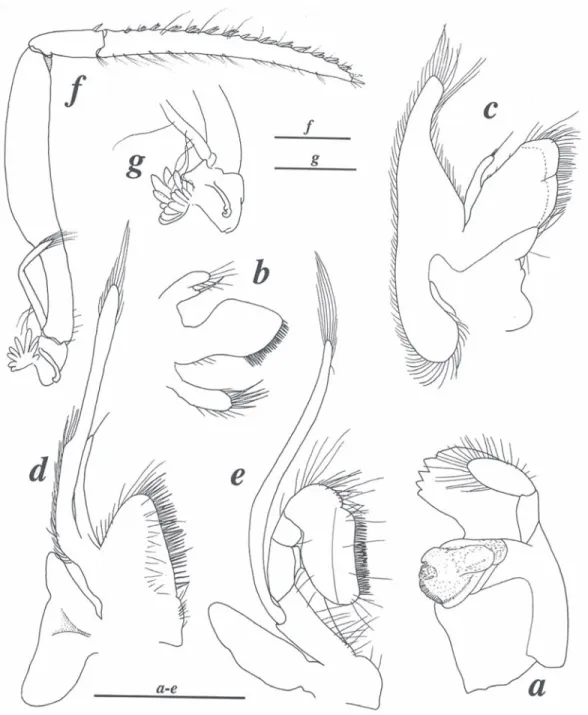
(3) Fig. 2. Coronalpheus natator Wicksten, 1999, female from Coiba (LACM CR 2005-011.2): a. mandible; b. maxillule; c. maxilla; d. first maxilliped; e. second maxilliped; f. third maxilliped; g. same, detail of coxa and arthrobranch. Scales: 1 mm.. Rev. Biol. Trop. (Int. J. Trop. Biol. ISSN-0034-7744) Vol. 56 (Suppl. 4): 297-304, December 2008. 299.
(4) Fig. 3. Coronalpheus natator Wicksten, 1999, two females from Coiba (a, b: LACM CR 2005-011.2, c: LACM CR 2005012.1): a. major cheliped, lateral view; b. same, mesial view; c. major chela of different specimen. Scales: 1 mm.. 300. Rev. Biol. Trop. (Int. J. Trop. Biol. ISSN-0034-7744) Vol. 56 (Suppl. 4): 297-304, December 2008.
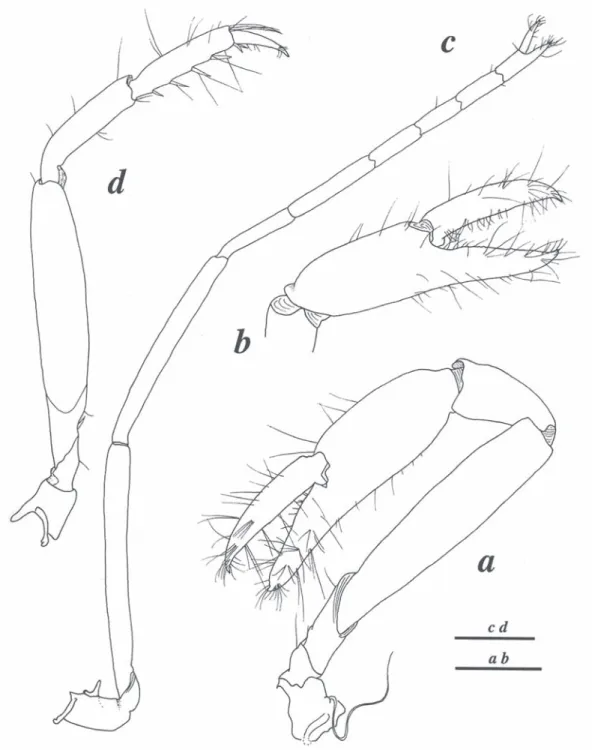
(5) Fig. 4. Coronalpheus natator Wicksten, 1999, female from Coiba (LACM CR 2005-011.2): a. minor cheliped, lateral view; b. same, chela, mesial view; c. second pereiopod; d. third pereiopod. Scales: 1 mm.. Rev. Biol. Trop. (Int. J. Trop. Biol. ISSN-0034-7744) Vol. 56 (Suppl. 4): 297-304, December 2008. 301.
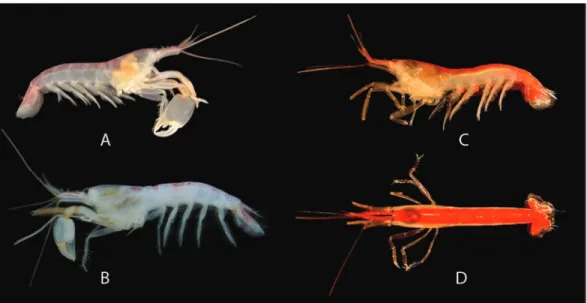
(6) Fig. 5. Coronalpheus natator Wicksten, 1999, live colour pattern of Coiba specimens (all females): a. LACM CR 2005011.2; b. LACM CR 2005-012.1 (specimens photographed shortly after death); c, d. MZUCR 4015-01 (specimen photographed alive).. north end, 7˚48’40’’ N, 81˚45’40’’ W, scuba, depth: 5 m, coll. P. Glynn et al., 9 Mar 2005 [specimen drawn]; LACM CR 2005-011.1, 1 female (CL 5.4, TL 18.9), same data as for LACM CR 2005-011.2. Description. – For complete description see Wicksten (1999). Detailed figures of Coiba material are provided herein (Figs. 1-5). Size. – The carapace length of Coiba specimens ranges from 4.3 to 5.9 mm; the maximum total length is approximately 18.9 mm. The maximum total length of Galapagos specimens according to Hickman and Zimmerman (2000) is 23 mm. Coloration. – The colour pattern of C. natator is very characteristic and consists of a broad, bright red mediodorsal band running from the rostrum to the posterior margin of the telson (Fig. 5); the band widens posteriorly, resulting in an almost entirely red sixth abdominal somite and tail fan; the antennules are also bright red; the remaining body and appendages 302. are whitish except for amber-yellow areas on the chelipeds and third maxillipeds. Ecology. – The Coiba specimens were collected at depth of about 5 m (relative to mean low water), on pocilloporid coral reef. The Galapagos specimens were collected under subtidal rocks in slightly deeper water, 9-15 m (Wicksten, 1999). Distribution. – Galapagos Islands (Isla Onslow – type locality, Isla Santa Cruz) (Wicksten, 1999) and Isla Uva in the Isla Coiba National Park, Panama (present study). The present record is the first finding of C. natator outside the type locality (extending its range by more than 1200 km), and also the first record of this species and the genus Coronalpheus in the near-continental waters of the eastern Pacific. Remarks. – The morphology of the Coiba specimens (Fig. 1-4) agrees well with the description provided by Wicksten (1999). The eyestalks are almost perfectly parallel and have a small anteromesial tubercle (Fig. 1b), thus. Rev. Biol. Trop. (Int. J. Trop. Biol. ISSN-0034-7744) Vol. 56 (Suppl. 4): 297-304, December 2008.
(7) being very similar to those of the holotype (cf. Wicksten, 1999), in contrast to the slightly divergent eyes of the paratype (cf. Anker and Komai 2004). The slightly divergent position of the eyestalks in the paratype may be due to the relative mobility of eyes (e.g., spreading during ethanol fixation). Therefore, the statement “the eyestalks clearly separated and divergent (not parallel and not mesially touching)” in Anker and Komai (2004, p. 1911) should be changed to “the eyestalks clearly separated (not mesially touching) (see below). The large tooth on the pollex of the major chela present in the holotype and one of Coiba specimens appears to develop gradually, from a broad, truncate process (Fig. 3c) to a strong and distinct tooth, as illustrated (Fig. 3a, b). The chelipeds of C. natator appear to be antisymmetrical, i.e., the major cheliped is situated randomly on left or right side, as in most if not all alpheid shrimps (A. Anker, pers. obs.). The minor cheliped (Fig. 4a, b), tail fan (Fig. 1d,. e) and second and third pereiopods (Fig. 4c, d) agree well with those of the Galapagos specimens (cf. Wicksten 1999; Anker and Komai 2004). The pleopods of ovigerous specimens bears very stiff, straight setae on the protopod (Fig. 1c), a previously unnoticed feature. The mouthparts (Fig. 2a-e) appear to be generally fairly typical for the Alpheidae. However, the third maxilliped is rather untypical in proportions of segments and especially in the armature of the ultimate segment (Fig. 2f, g, see also illustrations in Anker and Komai 2004). This type of third maxilliped is known only in Coronalpheus, Automate De Man, 1888 and Bermudacaris Anker and Iliffe 2000, indicating along with other characters (e.g., frontal margin, eyestalks etc.) a close relationship between these three genera (see discussion in Anker and Komai 2004). Coronalpheus natator may be confused with two species of Automate present in the eastern Pacific, viz. A. rugosa Coutière, 1902. TABLE 1 Comparison of some features between Automate and Coronalpheus Features. A. hayashii. A. salomoni. Automate s. str. (other species). Coronalpheus. Rostrum. broad, rounded. long, triangular. small, triangular or reduced. long, triangular. Eyestalks. adjacent. adjacent. adjacent. separated. Eyestlalks, anteromesial tubercle. absent. present. absent. present. Eyestalks, setae. absent. present. absent. present. absent ? (only 1 specimen known). ? (2nd pleopod missing). absent. present. Major cheliped carried. extended ?. ? (missing). extended. flexed. Major cheliped, merus. robust. ? (missing). robust. slender. Major cheliped, carpus. cup-shaped, ventrally not excavated. ? (missing). cup-shaped, ventrally not excavated. vase-shaped, ventrally excavated. Antennule, number of mesiodorsal spines. 2-3. 5. 1-2 or absent. 5-7. present. present. absent. present. exceeding distal margin of first segment. exceeding distal margin of first segment. not exceeding distal margin of first segment. exceeding distal margin of first segment. Appendix masculina. Antennule, mesioventral tooth Stylocerite. Rev. Biol. Trop. (Int. J. Trop. Biol. ISSN-0034-7744) Vol. 56 (Suppl. 4): 297-304, December 2008. 303.
(8) and A. cf. dolichognatha De Man, 1888 (= A. haightae Boone 1931) (Wicksten 1981). However, Coronalpheus differs from all species of Automate by the shape and position of eyestalks, the number of mesiodorsal spines of the antennule, the presence of appendix masculina in males, and the ventrally excavated carpus and more slender merus of the major cheliped (Table 1; see also Anker and Komai 2004). Further, the major cheliped is carried flexed in Coronalpheus (see photograph of a living specimen in Hickman and Zimmerman 2000), whereas it is carried extended in Automate. However, A. hayashii Anker and Komai 2004 and A. salomoni Coutière, 1908, differ in some aspects from the other species of Automate, and share a number of features with Coronalpheus. In particular, A. salomoni, known from an incomplete specimen from Chagos Islands in the Indian Ocean (Coutière 1908, 1921), appears to be very closely related to Coronalpheus (Anker and Komai 2004; see also Table 1). These features suggest that A. salomoni may belong to Coronalpheus, however, due to the missing major cheliped and pleopods in A. salomoni, its true identity remains unresolved. ACKNOLWLEDGMENTS We thank the collectors, Peter W. Glynn and his team (University of Miami, RSMAS/ MBF, Miami, USA), and Leslie Harris (Natural History Museum of Los Angeles County, Los Angeles, USA), who made the present material available for study. The research on the family Alpheidae is supported by Dr. Nancy Knowlton (Scripps Institution of Oceanography, La Jolla, USA) and was accomplished in the Smithsonian Tropical Research Institution (STRI) facilities at Naos laboratory in Panama City, Repubic of Panama.. 304. RESUMEN El camarón alfeido Coronalpheus natator Wicksten, 1999, originalmente descrito de las Islas Galápagos, se reporta para las aguas del Parque nacional Isla Coiba, costa Pacífica de Panamá. Este es el primer registro de C. natator fuera de la localidad tipo y además el primer registro para aguas continentales del Pacífico oriental. El material, recientemente colectado en Panamá, se ilustra en detalle. Coronalpheus parece estar cercanamente relacionado con algunas especies del género Automate De Man, especialmente de A. salomoni Coutière. Eso sugiere que Automate, bajo su definición actual, podría no ser monofilético. Palabras clave: Caridea, Alpheidae, Coronalpheus, Automate, Pacífico oriental, Panamá, Islas Galápagos, registro nuevo.. REFERENCES Anker, A. & T. Komai. 2004. Descriptions of two new species of alpheid shrimps from Japan and Australia, with notes on taxonomy of Automate De Man, Coronalpheus Wicksten and Bermudacaris Anker & Iliffe (Crustacea: Decapoda : Caridea). Journal of Natural History 38: 1895-1914. Coutière, H. 1908. Sur quelques nouvelles espèces d’Alpheidae. Bulletin de la Société Philomatique de Paris, série 9, 10: 191-216. Coutière, H. 1921. Les espèces d’Alpheidae rapportées de l’Océan Indien par M. J. Stanley Gardiner. The Percy Sladen Trust Expedition to the Indian Ocean, under the leadership of Mr. J. Stanley Gardiner, M.A., 6(10). Transactions of the Linnean Society of London, Zoology, ser. 2, 17: 413-428, pls. 60-64. Hickman, C.P.Jr. & T.L. Zimmerman. 2000. A field guide to crustaceans of Galapagos - Guía de campo de los crustáceos de Galápagos. Sugar Spring, Lexingon, Virginia, U.S.A. Wicksten, M.K. 1981. The species of Automate (Caridea: Alpheidae) in the eastern Pacific Ocean. Proceedings of the Biological Society of Washington 94: 11041109. Wicksten, M.K. 1999. A new genus and species of alpheid shrimp (Caridea: Alpheidae) from the Galapagos Islands. Crustacean Research 28: 104-111.. Rev. Biol. Trop. (Int. J. Trop. Biol. ISSN-0034-7744) Vol. 56 (Suppl. 4): 297-304, December 2008.
(9)
Figure

Documento similar
The drawings and description of this species by Jurine (1820), where he noticed a pattern of concentric lines on the valves similar to growth annuli of bivalves (as also
As a first step, we verify the analysis procedure using simu- lated point-like sources with the computed spectra correspond- ing to (1) the inner part of the lunar disk (the total
We present the concept of the Galapagos Islands as a linked SES and revisit its current situation from a systems approach, using resilience theory as a new perspective (sensu Folke
In addition to two learning modes that are articulated in the literature (learning through incident handling practices, and post-incident reflection), the chapter
To do that, we have introduced, for both the case of trivial and non-trivial ’t Hooft non-abelian flux, the back- ground symmetric gauge: the gauge in which the stable SU (N )
Since differences of market regulations in United Kingdom (UK) and recent financial crises (global financial crisis-GFC 2007-2009; Eurozone debt crisis-EDC 2010-2012)
Five new records of Glomeromycota are reported from the Neotropical region of Mexico, seven new records of AMF for Veracruz and one new record from Mexico
Abstract.- The culture of white shrimp Litopenaeus vannamei in low salinity waters (1.2 ± 0.5 g L -1 ) presents challenges, the deviation of the ionic composition
