
Exploration of learning styles of English subject in the student’s knowledge assimilation de Noveno a Décimo de Educación Básica at Institución Educativa “Liceo Policial Chimborazo” during the school year 2015 2016
65
0
0
Texto completo
(2) II.
(3) III.
(4) CERTIFICACIÓN. IV.
(5) ACKNOWLEDGEMENT. First I gratitude to God to given me the life and guide me for the good way. To Universidad Nacional de Chimborazo to given the best opportunity of life that is to come to be professional and serve to my country. To my teachers in special to my tutor of this project for to share me their knowledge during my life as student. (By: Abigail Garrido). ACKNOWLEDGEMENT I thank my God to bless me and give me the opportunity of life. To Universidad Nacional de Chimborazo to given a good education, illustrating my wise thoughts, adding more knowledge to can apply in the best way in personal aspect and professional too to solve education necessities. Finally, I thank Ms.C. Elsa Basantes to given the opportunity to work with my final project. (By: Jose Sinaluisa). V.
(6) DEDICATION. This project is dedicated first to God for given the opportunity of study. To my parents and my daughter because they are the motor of my life they day to day were the strength to continue with my career. To my uncle and my brothers for their advices and unconditional support. (By: Abigail Garrido). DEDICATION I dedicated with my all heart this project to my God to given the best ideas to develop the academic process. Second to my parents who taught me with their example, love, values and thoughts to develop in the better way into the academic process. Third to my brothers and sisters that support me with his/ her good and friendly advices. Finally, my teachers and classmates who enrichment with their happiness and attitudes the fanny way to finish with a success goal in my life as English teacher. (By: Jose Sinaluisa). VI.
(7) GENERAL INDEX CONTENTS. PAG. COMMITTEE MEMBERS CERTIFICATE................................ ¡Error! Marcador no definido. AUTHORSHIP ............................................................................. ¡Error! Marcador no definido. CERTIFICACIÓN ........................................................................................................................ IV ACKNOWLEDGEMENT ............................................................................................................. V GENERAL INDEX .....................................................................................................................VII TABLE INDEX ............................................................................................................................. X ILUSTRATIONS INDEX ............................................................................................................ XI INTRODUCTION ..................................................................................................................... XIV CHAPTER I.................................................................................................................................. 16 1.. REFERENCE FRAMEWORK.......................................................................................... 16 1.1.. THE RESEARCH PROBLEM................................................................................... 16. 1.2.. PROBLEM DEFINITION.......................................................................................... 16. 1.3.. FORMULATION OF THE PROBLEM .................................................................... 18. 1.4.. QUESTIONS GUIDELINES ..................................................................................... 18. 1.5.. OBJECTIVES:............................................................................................................ 19. 1.5.1. GENERAL OBJECTIVE ............................................................................................ 19 1.5.2. SPECIFIC OBJECTIVES............................................................................................ 19 1.6.. JUSTIFICATION ....................................................................................................... 20. CHAPTER II................................................................................................................................. 21 THEORETICAL FRAMEWORK ............................................................................................ 21 2.1. BACKGROUND OF PREVIOUS INVESTIGATIONS RELATED TO THE PROBLEM TO BE INVESTIGATED.................................................................................. 21 2.2. THEORETICAL FOUNDATION ................................................................................. 23. VII.
(8) 2.2.1. LEARNING STYLES ................................................................................................. 23 2.2.1.1 IMPORTANCE OF LEARNING STYLE ................................................................ 25 2.2.1.2 FACTORS THAT HELP TO DEVELOP LEARNING STYLES............................ 26 2.2.2 MAIN KINDS OF LEARNING STYLES .......................................................................... 30 2.2.2.1. ACTIVIST LEARNING STYLE ............................................................................. 30 2.2.2.1.2 REFLECTOR LEARNING STYLE ...................................................................... 31 2.2.2.1.3 THEORIST LEARNING STYLE .......................................................................... 33 2.2.2.1.4 PRAGMATIC LEARNING STYLE...................................................................... 34 2.2.3 CHARACTERISTICS OF MAIN LEARNING STYLES........................................... 34 2.2.3. KNOWLEDGE’S ASSIMILATION .................................................................................. 35 2.2.3.2 LEVELS OF ASSIMILATION................................................................................. 37 2.2.3.3 INDICATORS PERFECT MASTERY OF CONTENT ........................................... 38 2.2.3.4 OBSTACLES TO ACHIEVE THE HIGHEST MASTERY OF CONTENT........... 39 2.2.3.5 LEVELS OF ASSIMILATION OF CONTENT AND TRAINING STUDENT...... 39 2.6. OBJECTIVE OPERACIONALIZATION............................................................................. 42 CHAPTER III ............................................................................................................................... 44 METHODOLOGICAL FRAMEWORK ...................................................................................... 44 3.1. RESEARCH DESIGN.................................................................................................... 44 3.2. TYPE RESEARCH ........................................................................................................ 44 3.3. LEVEL OF RESEARCH................................................................................................ 44 3.4. POPULATION AND SAMPLE..................................................................................... 45 3.4.1. POPULATION ............................................................................................................ 45 3.4.2. SAMPLE ..................................................................................................................... 45 3.6. FIELD WORK................................................................................................................ 46 3.6.1. TECHNIQUES AND TOOLS FOR DATA COLLECTION...................................... 46 VIII.
(9) TECHNIQUE ........................................................................................................................ 46 3.7. TECHNIQUES FOR PROCESSING AND INTERPRETATION OF DATA ..................... 47 3.7.1 METHOD ..................................................................................................................... 47 CHAPTER IV ............................................................................................................................... 48 4. DATA PROCESSING, ANALYSIS OF RESULTS................................................................ 48 CHAPTER V ................................................................................................................................ 52 5. CONCLUSIONS AND RECOMMENDATIONS ................................................................... 52 5.1 CONCLUSIONS ............................................................................................................. 52 5.2 RECOMMENDATIONS................................................................................................. 53 BIBLIOGRAPHY / WEBGRAPHY ............................................................................................ 54 ATTACHMENT 1 ........................................................................................................................ 57 ATTACHMENT 2 ........................................................................................................................ 59 ATTACHMENT 3 ........................................................................................................................ 62. IX.
(10) TABLE INDEX. Tabla 1. Objective Operacionalization......................................................................................... 30 Tabla 2. Survey to the teachers of Noveno and Décimo de Educación Básica General at “Liceo Policial Chimborazo” during the school year 2015-2016” in the Riobamba city......................... 35 Tabla 3. Learning Styles in students of Noveno de Bàsica de Educacion General " Liceo Policial Chimborazo" ................................................................................................................................. 38. X.
(11) ILUSTRATIONS INDEX. Ilustración 1. Kolb’s learning style model .................................................................................... 28 Ilustración 2. Assimilation ............................................................ ¡Error! Marcador no definido.. XI.
(12) RESUMEN. El desconocimiento de los estilos de aprendizaje en profesores y estudintes es un problema para la asimilación de conocimientos en los estudiantes de Noveno y Décimo de Educación General Básica de la Unidad Educativa “Liceo policial Chimborazo” durante el año lectivo 2015-2016 en la ciudad de Riobamba, ya que ellos no adquieren un aprendizaje significativo durante el proceso enseñanza- aprendizaje. El problema estudiado fue el desconocimiento de los estilos de aprendizaje en la asimilación de conocimientos. La presente investigación tiene como objetivo determinar, identificar, analizar y establecer los estilos de aprendizaje en la asimilación de conocimientos en la asignatura del Idioma Ingles. La misma fue de tipo cualitativo y de nivel Exploratorio, la cual nos permitió una recoleccion de datos mediante la técnica de la observación que fue aplicada a los estudiantes y maestros para conocer los diferentes estilos de aprendizaje que posee cada uno y métodos/ técnicas usados para impartir la clase. El método cualitativo empleado fue el etnográfico ya que nos permitio realizar el estudio en un contexto directo y natural. Obteniendo como resultado la identificacion de los estilos de aprendizaje que predominan en el grupo de estudiantes tales como, pragmático/reflexivo. Concluyendo que los estilos de aprendizaje si influyen en la asimilación de conocimientos del Idioma Inglés.. XII.
(13) XIII.
(14) INTRODUCTION. This research is entitled “Exploration of Learning Styles of English subject in the student’s knowledge Assimilation de Noveno a Décimo de Educación Básica at Institución Educativa Liceo Policial Chimborazo” during the school year 2015-2016”. Currently the majority of students and teachers do not know the learning styles and this affect the knowledge’s assimilation during the Teaching-Learning process. Teachers unknow the Learning Styles that each one of their students have and for this reason, the students do not acquire a meaningful or true learning. Learning styles are so important into of knowledge assimilation of a second language and the teacher should help to their students to know what learning style have each one so use adequate methods, which help to acquire in a better way the new knowledge and practice the language for instance the general content is divided in five chapters such as: The Unidad Educativa Liceo Policial Chimborazo is located in Chimborazo Province, in the city of Riobamba, Nowadays the student population has grown, as have a number of 554 students and 32 teachers and administrators, distributed from Primero to Dècimo de Educaciòn Bàsica General. The propose of this research is to explore why teachers and students do not know the learning styles to obtain a good knowledge’s assimilation during the learning process in Noveno and Décimo año de Educación Básica at Unidad Educativa “Liceo Policial Chimborazo”. This study is to observe why the students do not use the learning styles to acquire relevant or true information that let them to increase their knowledge so obtain a significant learning to be competitive as a good student in different educational necessities and the other hand teachers can use correct methods, techniques and materials. The problem is caused by teachers and students unknow the learning styles so students have limited use of their sense and skills, inactive participation; these are the main causes of which teacher detect the learning style is so important for students assimilate the knowledge in a best way. This problem is caused, first because teachers do not know how detect the learning styles of each one their students. Second teachers do not use the correct methods and techniques according students’ learning styles for increasing the knowledge of students and finally students XIV.
(15) do not know what is their learning style for a good assimilation of knowledge into the English subject. For all of these motives the present research hopes to notice the learning styles for teachers and students uses to involve the teaching-learning of learning styles, that will pemit to achieving a meaningful learning which they domain the second language. CHAPTER I: Referential Framework, it shows the problem posed by we that be going to solve, outlining of the problem for verify the real situation or problem in our national context, question guidelines to facilitate the develop of the research, objectives to be achieved and justification which have the problem and its importance to be a feasible research. CHAPTER II: Theorical Framework, it contains some research related to the two variables such as: Learning Styles and Knowledge’s assimilation. CHAPTER III: Methodological Framework, it contains the research design, type research and level research that will be used to obtain the information of investigation from the population CHAPTER IV: It contains the interpretation and analyze of all results of the research. CHAPTER V: It contains the conclusions and recommendations of the research. XV.
(16) CHAPTER I. 1. REFERENCE FRAMEWORK. 1.1. THE RESEARCH PROBLEM. Teachers and students do not know the learning styles therefore it is the principal problem for students de Noveno and Décimo de Educación Básica at Institución Educativa “Liceo Policial Chimborazo” do not acquire a good assimilation of knowledge during the learning process into the English subject. 1.2. PROBLEM DEFINITION. Ecuador has a low level of English language, according to reported by Education First. "The English proficient adults continue being weak in Latin America. Of the 14 Latin American countries included in the Index, 12 have a low-level domain. However, the average ranking EF EPI in the region has improved, getting 2.16 points since 2007. Brazil, Chile, Colombia, Ecuador and Peru are characterized by above-average growth”. (Universo, 2015). An incorrect educational approach, it happens when into the learning- teaching process the teacher does not focus in the best learning style used by each student to knowledge’s assimilation for this motive students and teacher do not exchange the knowledge in right way and there is not a real practice of English language so Learning styles must be identified by teacher to facilitate the acquisition of the new knowledge in an intelligent way in academic process of the students. In Chimborazo province, it has been observed by students have a low level of English language, the factor which affect the assimilation of knowledge is unknown the learning styles that have each student. The Unidad Educativa Liceo Policial Chimborazo is located in Chimborazo Province, in the city of Riobamba, which mission is “Our institution is made up of highly trained police and civilian teachers; The same that is at the service of children, providing a comprehensive education that develops in students the skills and values established by the Ministerio de Educacion through didactic-pedagogic, constructivist and altruistic processes. The same that are divided into five blocks. Nowadays the student population has grown, as have a number 16.
(17) of 554 students and 32 teachers and administrators, distributed from Primero to Dècimo de Educaciòn Bàsica General. The propose of this research is to explore why teachers and students do not know the learning styles to obtain a good knowledge’s assimilation during the learning process in Noveno and Décimo año de Educación Básica at Unidad Educativa “Liceo Policial Chimborazo”. This study is to observe why the students do not use the learning styles to acquire relevant or true information that let them to increase their knowledge so obtain a significant learning to be competitive as a good student in different educational necessities and the other hand teachers can use correct methods, techniques and materials. Then, after many observations accomplished in the professional practices, it was noticed at Unidad Educativa “Liceo Policial Chimborazo”, where the 90% of the Students of Noveno and Décimo Año de Educación General Básica, have troubles in using their learning styles for example: a student that is theoric do not acquiere knowledge in the same way that a student pragmatic. In fact, it was detected that one of the biggest problem at English subject is; that teachers do not know the learning styles of each one their students for this reason teachers do not apply good methods at the moment to teach. In addition, students do not use their own learning style to increase their English level. The problem is caused by teachers and students unknow the learning styles so students have limited use of their sense and skills, inactive participation; these are the main causes of which teacher detect the learning style is so important for students assimilate the knowledge in a best way. This problem is caused, first because teachers do not know how detect the learning styles of each one their students. Second teachers do not use the correct methods and techniques according students’ learning styles for increasing the knowledge of students and finally students do not know what is their learning style for a good assimilation of knowledge into the English subject. For all of these motives the present research hopes to notice the learning styles for teachers and students uses to involve the teaching-learning of learning styles, that will pemit to achieving a meaningful learning which they domain the second language through observation technique applied to the students to know about the learning styles and methods/techniques used by teachers into the class. With this exploration, researches can have an idea about how the learning styles influence in the knowledge’s assimilation in the students to improve the 17.
(18) development of second language based in a good development into the class using the domain learning style of students’s group that is essential in the process of learning a new language. Therefore, it is necessary to conduct this study because it will help to understand why learning style is not used. In this way, this research will give some guides to teacher and student for eluding those difficulties. Then, teacher may use any approach together with the use of good methods, techniques and adequate didactic material. For the reasons mentioned above, it was confirmed that it is necessary that teachers and students must know about the different learning styles, which are involved in the learning of the English subject in a right way. 1.3. FORMULATION OF THE PROBLEM. How do learning styles influence in the assimilation of knowledge of students in Noveno and Dècimo año de Educación Básica at Institución Educativa "Liceo Policial Chimborazo" during the school year 2015 – 2016? 1.4. QUESTIONS GUIDELINES. What are learning styles and their importance? Why do not teachers know the learning styles of their students? How do learning styles influence in the knowledge´s assimilation? What is the assimilation of knowledge and its causes? How do the teachers influencing learner´s assimilation of knowledge?. 18.
(19) 1.5. OBJECTIVES:. 1.5.1. GENERAL OBJECTIVE. . To determine if the learning styles influence in the assimilation of knowledge of the subject of English, in the students of Noveno and Décimo año de Educación Básica at Institución Educativa “Liceo Policial Chimborazo” during the school year 2015-2016.. 1.5.2. SPECIFIC OBJECTIVES. . To identify the learning styles used in the English subject, for the assimilation of knowledge in the students of Noveno and Décimo año de Educación Básica at Institución Educativa “Liceo Policial Chimborazo”.. . To analyze the level of assimilation of knowledge with relation to learning styles used in the English subject in the students of Noveno and Décimo año de Educación Básica at Institución Educativa “Liceo Policial Chimborazo” to Project their improvement.. . To establish the different learning styles in the assimilation of knowledge with relation to learning styles used in the English subject in the students of Noveno and Décimo año de Educación Básica at Institución Educativa “Liceo Policial Chimborazo” during the teaching-learning process.. 19.
(20) 1.6. JUSTIFICATION. The project was done, based on the exploration learning styles in knowledge`s assimilation to discover the better learning style in each student of Noveno and Décimo de Educaciòn Bàsica de la Institución Educativa " Liceo Policial Chimborazo". To students acquire relevant or true information that let them to increase their knowledge so obtain a significant learning to be competitive as a good student in different educational necessities. This research was feasible perform it because it had the bibliography, the approval of the highest authority of the institution to develop, we also had the financial resources, time required, and also to investigate in the library of the Universidad Nacional de Chimborazo, it was verified that there is no research conducted by students of the Language Career related variables, or the place where this research was develop. The beneficiaries this project was 54 students and 2 teachers in Noveno and Décimo de Educaciòn Bàsica de la Institución Educativa " Liceo Policial Chimborazo" in the academic period 2015- 2016 in Riobamba City. This project helped to correct the difficulties that arising of the problem through adequate intervention by teachers. Using some methods and material according the learning styles that the students have so they can learn an easy way the English language and put in practice in and outside the class. Also this research must help us because we are going to be teachers and all this information must be to know to facilitate the learning- teaching into the learning process at English subject to find up what kind of learning style is useful for most of students into the class so we can motivate, facilitate and teach with more effective where the students will get a significant learning at English language. In the same way, this research must permit the finalization of our career to graduate as English teachers. Finally, it helps the Universidad Nacional de Chimborazo, because the students and teachers can find a good information about learning styles and will provide a guide according their necessities and wide their knowledge so they can help the Ecuador education in the English language subject given the solution using the learning styles for the best knowledge´s assimilation thus get a best education of students in Ecuador.. 20.
(21) CHAPTER II. THEORETICAL FRAMEWORK. 2.1. BACKGROUND OF PREVIOUS INVESTIGATIONS RELATED TO THE PROBLEM TO BE INVESTIGATED. Once reviewed the library’s files of the Facultad de Ciencias de la Educación, Humanas y tecnologías at UNACH and, it was verified that there are not similar researches, but there is one research, which has similar variables it is: “ANÁLISIS DE LOS ESTILOS DE APRENDIZAJE DEL IDIOMA INGLÉS EN LOS ALUMNOS DE PRIMER AÑO DE BACHILLERATO DEL COLEGIO, CAPITAN EDMUNDO CHIRIBOGA, AÑOS 2012-2013.” By: Jessica Poma and RinaVizuete, 2014. (Universidad Nacional de Chimborazo) This project’s objective is to analyze the learning styles so it helps the intellectual, effectiveness, and social necessities. To improve the best development in the interaction process at English language. This research is based in the Kolb’s model (active reflexive, theory, pragmatic) honey and Alonso too. They explain clearly way about learning styles. “STUDENT LEARNING STYLE ADAPTATION METHOD BASED OF TEACHING STRATEGIES AND ELECTRONIC MEDIA” By: Ana Lidia Franzoni, 2009. (Instituto Tecnológico Autónomo de Mexico) This research´s objective is to know the different learning styles and that students apply the learning styles to solve various problems according their learning necessities. The learning styles are combined with an appropriate teaching of teacher to improve their skills during the learning- teaching process. “ANALYZING THE EFFECT OF LEARNING STYLES AND STUDY HABITS OF DISTANCE LEARNERS ON LEARNING PERFORMANCES: A CASE OF AN INTRODUCTORY PROGRAMMING COURSE”. 21.
(22) By: Ünal Çakıroğlu, 2014. (Karadeniz Technical University, Turkey) This research is based in comparing some aspects such as behavior learning styles, study habits and performances in a programming language course on study of Kolb. Each leaner has different characteristics to assimilate the knowledge during the learning process. “LOS ESTILOS DE APRENDIZAJE Y LAS COMPETENCIAS DE APRENDER A PENSAR Y PENSAR PARA APRENDER” By: Lcda. Guillermina E. García Muñoz, 2015. (Universidad Regional Autónoma De Los Andes, Ecuador) This research allows to get the knowledge about different individual characteristics to response the necessities in social context. It is important that teachers identify the skills or learning styles that each student has to obtain more opportunities into the learning process. “DETERMINAR LOS ESTILOS DE APRENDIZAJE DE LOS ALUMNOS DEL SÉPTIMO AÑO DE EDUCACIÓN GENERAL BÁSICA DE LA UNIDAD EDUCATIVA RIGOBERTO NAVAS DEL CANTÓN CAÑAR DURANTE EL AÑO LECTIVO 20102011” By: Daniel Verdugo, 2011. (Universidad Politécnica Salesiana, Ecuador) This research determines that teachers can apply some strategies and methods to know the different learning styles in each student because each one is different among them, in their think, behavior and feel way so the teacher has a great responsibility in the student´s training.. 22.
(23) 2.2. THEORETICAL FOUNDATION. 2.2.1. LEARNING STYLES Conceptualization. – Kneefe (1988) says that, Learning styles is the composite of characteristic, cognitive, affective, and physiological factors that use as stablished pointers of how a student acquieres and interacts the new knowledge and practive in any environment. It shows which models of mood and development throught which students demonstrate the good schooling and better ways to learn. Learning styles are features of organization and personality which are acquired in different places and ways such as, school, home and general society. Styles are theorical concepts that help to clarify the teaching- learning process. They are potentials in the performance of each student that persevere throught teaching techniques and experiences. Gregorc (1979) Dunn and Griggs (1988) Learning style defines the way of how the environment of a classroom would be prepared according the requirements of the learners to get a best learning’s athmosphere. It advises the ways in which students concentrate in a best way alone, with other people, with different kinds of teachers, or in a combination thereof. It advises the skills through which students incline to recall hard information in an easy way by hearing, speaking, seeing, using, writing, or notetaking, experiencing, or also, a combination of these. Learning styles also considers motivation, on task persistence or the necessity for different assigments simultaniusly, the types and amount of structure required, and conformity versus nonconformity levels. Learning styles are affective, interactive and cognitive behaviors that show the characteristics and perceptional ways and respond to the learning context by student. Therefore, if we talk about these terms, we observe that they refer to the fact of that each student uses their proper learning way by strategy and method, although the strategies vary according to what students want to learn, each one develops certain preferences or global trends, style. These trends that be defined as learning. So each student can learn in different ways using different strategies, to learn with different speeds, however the learning styles are not a tool to classify students in closed categories or 23.
(24) label, they must be to use as a way to learn constantly. On the other hand, Dunn says learning style is a classroom organized that help to respond to individual needs that each student has during the process of teaching- learning. Teachers should use adequate methods and technique during the process of learning thus make their students recognize their learning styles in this way students develop their skills and apply the new knowledge in different areas or subjects. Students using learning styles improve information processing. “Cognitive features in students have relation with “how students structure the content, form and use concepts, analize the learned information, solve problems, even they select the different ways of representation such as, visual, auditory, kinesthetic and others” (kneefe, 1988), all these aspects are so relevant to motivate and increase the expectations within academic process of the students. Dunn Learning Style Model anticipates an observable improvement in student learning and behavior when a match has been achieved between instructional environments and Learning Styles (Dunn, 1970). Teacher must have all information, have necessary knowledge for teaching process can be adequate, and respond the necessity of the student in the process of knowledge’s assimilation. Revilla (1998) argues, “finally, some characteristics of learning styles: are relatively stable, although they may change; they may be different in different situations; they are susceptible of improvement; and when to students are taught according to their own learning style, they learn more effectively”. It can be interpreted that the called learning styles allow us to establish relation between a student and a learning style, therefore styles are characterized by a series of strategies within learning that be correlated significantly. The style works as a research tool that enables a meaningful analysis of the observed behaviors, it appears with a more accurate classification, and the styles define as the preferred ways to study and learn to develop a particular style, it may not always ensure that use of style will be effective, therefore in these cases some students may benefit developing new ways to learn.. 24.
(25) The different models and existent theories about learning styles provide a conceptual framework that allow us to understand the daily behaviors in the classroom, how they learn and the type of action that may result more effective in a given time. 2.2.1.1 IMPORTANCE OF LEARNING STYLE According Tobias (1995), there are reasons that teacher should know about children's learning styles: . If you know your student's learning styles, you'll be better prepared to guide into the learning process. Most parents assume their children acquiere the new knowledge according their learning styles. For example, if the parents are kinesthetic learners, it's not at all uncommon for them to suppose that their kids to be kinesthetic learners, too. However, children develop different learning styles than their parents and their siblings. if the parents understand the learning styles of their children in a fast way they can connect with them in a meaningful and effectively learning and also they can teach with great succesfully.. . Parents have to be prepared to choose a good curriculum into the home. Parents can choose a curriculm without know the learning styles of their children. It will be an adequate job to obtain a good education for them, however it can not a significant education in their education. After parents know the learning styles of their children, you will choose a great curriculum that adapt to their necessities and you can be confortable with your decision.. . Finally, parents will recognize the way how your children understand to others. Sometimes children feel unsatisfied because they do not obtain a good communication with the society. Parents to understand their children, first they should know their different learning styles, it will benefit them to obtain a good communication with the society in their life.. 25.
(26) Learning styles are important because it allows to know specifically the way of learning of each student thus teacher can teach more effectively to get meaningful learning. The teacher need to prepare the best curriculum according the necessities of each students based on learning styles to that students can use the English language according their level in the best way within the society. When the students recognize their learning styles, they feel prepare to understand and communicate with various person. 2.2.1.2 FACTORS THAT HELP TO DEVELOP LEARNING STYLES According to Curry (1987), the factors involved can be classified into four categories: 1. Relative preferences to the mode of instruction and environmental factors: where assess the preferred environment for the student during the learning, here we find the term learner. The factors that are included in this category are: . Class Environmental Preferences. . Relative emotional preference of the students. . Preferences of social type that be establish between the different students.. . Physiological Preferences. . Psychological Preferences. 2. Social Interaction Preferences: that target the interaction of students in the class. According interaction students can be classified into: . Independent and dependent field. . Collaborative / competitive. . Participatory / non-participatory. 3. Processing Information of Preference: relative to how the student assimilates information. Some factors involved in this category are: . Right Brain / Left 26.
(27) . Cortical / limbic. . Concrete / abstract. . Active / thoughtful. . Visual / verbal. . Inductive / deductive. . Sequential / Global. 4. Personality Dimensions: inspired in the Jung's analytical psychology and evaluate the influence of behavior in comparative to how to get and assimilate information. The different typologies that define to the student in based on this category are: . Extroverted / Introverted.. . Sensory / Intuitive. . Rational / Emotive. He found within the learning styles the model encompassed in this category is the model of Kolb "Experimental Learning" (Kolb 1984). The learning styles model developed by Kolb supposed that to learn something we must work or process the information that we received. Kolb says that, on the one side, we can start: a) Of a direct and concrete experience b) Abstract experience Within of the different experiences that we have when find that these can be concrete or abstract and thus become knowledge when we elaborate of any of these two ways, either by reflecting and thinking about them and they may be experiencing in actively way with the information received. The learning styles have relation with the twenty dimensions that are classified into the four main categories. These categories influence in a strongly way. They are factors that influence into the learning style of each person but not all dimensions are necessary to be successful. According to the model of Kolb, an optimal learning is the result of working the information into four phases:. 27.
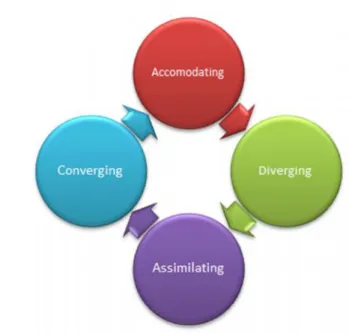
(28) Graphic Kolb’s Model. Ilustración 1. Kolb’s learning style model Kolb’s learning style model. (Adapted from Srichanyachon, 2011). Kolb (1985) mention four prinviple groups of learning styles. The types are not inflexible and students may lead to one or another side in between them. . Diverging. . Assimilating. . Converging. . Accomodating. 1) Diverging style: These kind of people have the capacity for looking the things with different point of views. They are sensitive people. They like to look rather than manipulate things or do activities, tending to obtain information and put in practice their imagination and own ideas to face troubles. They have the best perceptions in real situations throught some point of views. People who has diverging style develops in any activities where they can generate new ideas and can participate in a confortable way, for example, debate. They must interest to exchange some information about cuture, religión, customs, etc.. 28.
(29) They use their own creativity and imagination. Their strong point are the arts. They have open mind to increase their own knowledge and they like to work in small groups. Thus they get more feedback to their previous knowledge. 2) Assimilating style: they like the true theoris, they prefer the logic explanation about all kind of information. They like to put in logical order the gather information. They comprenhend and increase the good manner of all information throught grouping in logical way. This kind of people who have assimilating style must interest in thoughts and scientific knowledge more than on simple thoughts of people. They focus in verified theories in a logical way than in practical experiments. Thus it is benefit to obtain a sure information and scientific majors. Into the learning process, search information throught lectures, readings, logical books and they spend their time to think in theories. 3) Converging style: People who have this style like to face a lot troubles and they use their own previous knowledge to figure out simple problem solutions. They like practical tasks, and have close relation with society and interpersonal characteristics. Thus they are so practical to emplees opiniones and concepts on real situations. This kind of people have the facility to figure out solutions to obstacles and doubts. They must have more attention to give troubles and technical activities solutions than general or individual problems. The people who has converging style have special capacity in the field of technology. Thus they practice using the new ideas, to experiment and to develop practical jobs. 4) Accommodating style: This style is practical and based on hyphotesis more than analytic. They use all knowledge acquired from other ones that have previous learning on real situation. They prefer to get new goals and practical life, and complete the all objectives. These kind of people frequently manifest in a natural way instead of analitic way. People who have this learning style dependent on other ones to obtain new knowledge so they do their own logic. Accommodating style is relevant in general society. 29.
(30) Ecuador’s education system is not neutral. If we think in the four phases of the Kolb is very clear that the conceptualization is the phase most valued, especially at the levels of secondary and higher education phase, is to say, our education system favors to theorist students. In some subjects, the pragmatists students can take advantage of their capabilities, on the other hand the reflective students often find with exactly time that is imposed on the activities that not them leaves time to analyze the information as they need, but students like to learn from an experience. 2.2.2 MAIN KINDS OF LEARNING STYLES Main kinds of Learning Styles were established by Peter Honey and Alan Mumford, constructed in the Kolb’s job, so they found four main learning styles or favorites: Activist, Theorist, Pragmatist and Reflector. All learning styles are mentioned by these authors to figure out what learning style have each student student. So facilitating the fast learning and increase the thoughts each learner must have: . comprehend their learning style. . try to find out new chances to study throught usage that style. Honey & Mumford (1982) Learning Styles. These learning ways can permit the best learning process how the teacher teaches and how the student learns, so facilitate the gather of new information to students. 2.2.2.1. ACTIVIST LEARNING STYLE P. Honey and A. Mumford (1982) say that, Activists include themselves completely and lacking prejudice in innovative practices. They love the now and nowadays, and are glad to be controlled by fast practices. They are liberal, not sceptical, and this inclines to create them 30.
(31) animated about new something. Their thinking is: "I going to work so hard". They must experiment to doing something so later get the results. Their days are full with works. They face difficulties by brainstorming. As rapidly as the enthusiasm from one action has expired down, they are full observing for the following. They incline to increase on the challenge of original practices but are tired with application and longer-term consolidation. They are sociable people continually connecting themselves with someone however in doing, so they try to find to centre all events around themselves. Attributes: Activists are those people who learn by doing. Activists require to obtain a previous knowledege to will integrate in new experiences. They need to have an free mind with a logical approach for learning, integrating themselves fully and without perjudices in new practices. P. Honey and A. Mumford (1982) These kind of people can apply in easy way the following activities: . brainstorming. . results of troubles. . debates. . puzles. . competitions. . role-play. Honey and Mumford (1995) argues that, “students usually find these self-review activities informative and helpful, enabling them to engage more effectively in the seminars. However, there is a danger that ideas introduced in study skills modules can become detached from the core elements of an economics degree if they are not overtly reinforced by seminar leaders”. These kind of students interact first in any activity because they have the capacity to catch and put in practice all their knowledge. They like to live new experinces without that these can be negative or positive. They like to be the center of attention in any activity but get bored fastly with long-term activities 2.2.2.1.2 REFLECTOR LEARNING STYLE According P. Honey and A. Mumford (1982), Reflectors corresponding to stand back to consider practices and look them from various diverse perceptions. They gather information, 31.
(32) both primary hand and from some one, and desire to reflect about it carefully before upcoming to a decision. The detailed gathering and examination of information about practices and actions are what counts so they incline to suspend getting decisive decisions during the possible time. Their thinking is to be careful. They are attentive people who prefer to study all probable perspectives and suggestions before creating an action. They select a posterior seat in conferences and debates. They like looking otherone in action. They put attention to other people and to get the main idea of the discussion before creating their own opinions. They incline to accept a low profile and have a considerably distant, tolerant unperturbed air about them. When they performance, it is part of an extensive picture, which contains the prior as fine as the present and others' comments as well as their own. Attributes: These people learn by observing and thinking about what happened. They prefer to ommiting the troubles and look from their own point of views. Prefer to return back and look experiences from various perspectives, gathering information and getting the time to work towards an best result. These kind of people can apply in easy way the following activities: . group work. . self analysis questionnaires. . personality questionnaires. . time out. . observing activities. . feedback from others. . coaching. . interviews. These kind of students are so analytic, they always analize different point of views according to real situation so they get the best solution to share to the rest of group showing their analitic capacity, thus they feel confortable. They like to take notes and compare with other ones to get new knowledge, add relevant information so to increse the level of knowledge.. 32.
(33) 2.2.2.1.3 THEORIST LEARNING STYLE According to P. Honey and A. Mumford (1982), Theorists adjust and incorporate explanations into difficult but rationally sound philosophies. They reflect troubles through in a vertical, step-by-step rational mode. They integrate different evidences into comprehensible philosophies. They incline to be perfectionists who will not break easy until things are organized and adequate within a comprehensible method. They like to examinate and verify. They are interesting on elementary expectations, values, philosophies models and schemes thoughtful. Their philosophy leads prudence and reason. If its logical its good. Questions they frequently ask are: Does it do sense? How does this adequate with that? What are the information? They like to maintain logic, rational and dedication to coherent objectivity rather than anything subjective or confusing. Their method to difficulties is consistently reasonable. This is their 'mental disposition' and they strictly discard anything that does not adequate with it. They select to maximize conviction and feel uncomfortable with subjective decisions, lateral thoughtful and anything frivolous. Attributes: These learners like to understand the theory behind the actions. They requiere squemes, theories and evidences in sequence to attract in the learning process. They like to think and analyze, acquiring new data within a systematical and analitical theory. These kind of people can apply in easy way the following activities: . Models. . Statistics. . Stories. . Quotes. . background information. . applying theories. They are logical and systematic people, they like to learn through of Reading of philosophical books, they can find the answer with simple previous information so they can anticipate what happen in the future time. They are perfectionist and like to do the things in a better way without mistakes.. 33.
(34) 2.2.2.1.4 PRAGMATIC LEARNING STYLE According to P. Honey and A. Mumford (1982), Pragmatists are interested on verify ideas, concepts and methods to prove if they work in practice. They positively examine out original information and choose the first chance to experiment with practices. They are the kind of people who reappearance from courses full with new thoughts that they need to put in practice. They prefer to get on with goals and performance rapidly and self-confidently on ideas that fascinate them. They incline to be annoyed with reflecting and open-ended conferences. They are principally concrete, down to earth people who like taking concrete conclusions and answering troubles. They reply to difficulties and chances as a challenge. Their thinking is, there is permanently a well method and If it develops it is worthy. Attributes: They requiere to has ability to observeting how to apply the learning into practice in the true situations. Abstract theories and games are not useful unless they can look a form to apply the information within activity in their real world. Experimenters, verifing new ideas, concepts and methods to look if they develop. These kind of people can apply in easy way the following activities: . time to analize about how to put in practice the learning in the real world. . case studies. . problem solving. . discussion. They like to experiment new ideas in directly way with concret objects and put in practice in the real world to get more information. They like to practice solving problems in environment into the class. 2.2.3 CHARACTERISTICS OF MAIN LEARNING STYLES Alonso, C. (1992) Learning styles are those proposed by P. Honey and A. Mumford, and were modified by Catalina Alonso and that these learning styles are called "CHAEA" which are: 1) Active Style: Main Features: . Animator 34.
(35) . Improviser. . Discoverer. . Risky. . Spontaneous. 2) Reflective Style: Main Features: . Weighted. . Conscientious. . Receptive. . Analytical. . Exhaustive. 3) Theoretical Style: Main Features: . Methodical. . Logical. . Critical. . Structured. 4) Pragmatic Style: Main Features: . Experimenter. . Practical. . Direct. . Effective. . Realistic. 2.2.3. KNOWLEDGE’S ASSIMILATION. Conceptualization. – “Assimilation is a cognitive process that manages how we take in new information and incorporate that new information into our existing knowledge” (Jean Piaget 1988), so a person develops skills, attitudes and consistent values. For example, when a 35.
(36) young child learns the word dog for the family pet, he eventually begins to identify every similar-looking canine as a dog. The child has extended his learning, or assimilated, the concept of dog to include all similar 4-footed friends. Therefore, the assimilation in the process of teaching-learning of the students of Noveno and Décimo de Educación General Básica is vital to the retention of content and the proper development of the skills to be developed at this stage where they acquire good study habits and learning that will affect them for all their life. Thus, the teacher is responsible to create the necessary strategies that help to fix the knowledge in the students, thus obtain a meaningful learning in the students. The difficulties that present the students in the assimilation of knowledge is the way how teachers teach the different content and in especially way the foreign language, as this situation leads that students have little understanding of these contents, therefore they do not achieve a meaningful knowledge for their life. 2.2.3.1 HOW WORK THE KNOWLEDGE ASSIMILATION?. The knowledge’s assimilation is an important process that incorporate the new knowledge to knowledge already acquired previously. These knowledge is reflected from real world and to be incorporated into the internal world of each student so they will use in the better way all information to facing some troubles that there are in the development of life. In the following graphic we can understand in a better way the process of Knowledge’s assimilation.. Illustration 2. Assimilation: fit practice to theory (Piaget, 1988). 36.
(37) So people understand how their brain work during the process of Knowledge’ assimilation obtaining any kind of information from outside world after assimilating the new knowledge in our head and finish to share with the other people. 2.2.3.2 LEVELS OF ASSIMILATION. Flores Herminia (2011) argues, to continue each of the levels of assimilation that occur within the teaching-learning process are described:. a) First level or assimilation degree.. To know, make sense, to know that something exists. It refers to the knowledge of things, ideas, facts, processes, etc. The students retain the knowledge and can put in practice, but they do not know the reason of it or how to apply properly it. There is not a reflexive action, much less, a real integration of situations, the knowledge is in short-term memory, there is not meaningful learning, only learning memoristic.. The teaching and learning activities for this level by the teacher that will require to be the descriptive class or masterly exposition, which can complement with an annotated reading, with any audiovisual, attend a conference, the presentation of a film. In all these activities the student's participation is limited to listen, take notes, ask questions, but can not see beyond, they do not have great involvement in the process of content acquisition.. a) Second level or assimilation degree.. Cognitive understanding, deep understanding, deepen in the management of information, memorization, more understanding, etc. At this stage is given a retention of knowledge, a reflexive understanding, there is already a real learning, although it is an unproductive knowledge, because the student has difficulty to apply it in solve problem and real life situations.. Teaching- learning activities. At this level has still useful expository class, but this should be complemented with other more complex activities, in which the student put in practice the 37.
(38) knowledge received, such as debates, directed discussions, arguments, interrogations or problematized class, etc. Here the student's participation is more active.. a) Third level of assimilation. Deep learning, management and application of information, autonomous understanding, etc. Here the students have full understanding the knowledge which they have been exposed, they know how to use them safely and apply, express correctly ideas using their own words to formulate independent ideas so acquire a perfect and independent domain of knowledge, in conclusion they achieve the real learning.. Teaching- learning activities. To achieve this level, the expository class is not use, it requires that students develop essays and expose for the group, which make the practices or experiments and apply in previous classes, to solve problems, work in the cases study integrating the acquired knowledge and relate the theory with practice, to realize research, etc. It is essential carry out the active participation of students inside and outside of the classroom.. It concludes that the teacher always uses a method of teaching the expository class to have excellent result, only will manage the content on the first level of assimilation of content, so memoristic learning, which is not enough to develop all skills that have relation with the student's learning. 2.2.3.3 INDICATORS PERFECT MASTERY OF CONTENT. The teacher must evaluate constantly, that their students have achieved the highest level of assimilation of content, some manifestations of the result of this process are: . Self-expression and self-organization of the knowledge acquired.. . Demonstration of their ideas, through own and original examples.. . Discovery themselves from new relationships and applications of the principles learned.. . Application of theoretical knowledge in practical activities with safely, property and success. 38.
(39) . Seek to expand and deepen in the knowledge, discover new relationships, pose new problems, etc.. . When a teacher achieves it in their students, he/she can be sure that there has been a real learning by the student. They really assimilated knowledge and are able to transfer it to real life.. 2.2.3.4 OBSTACLES TO ACHIEVE THE HIGHEST MASTERY OF CONTENT. . The insistence of teachers in the textual reproduction of knowledge, which only achieves a mechanical memorization, devoid of cognitive understanding.. . Lack of motivation for those students to analyze and criticize intelligently the ideas in the texts.. . The absence of activities that result in the student's cognitive independence as debates, discussions, arguments, problem solving, etc.. . The development and application of rigid and dogmatic tests, which require textual reproduction of material, and sometimes-irrelevant data.. The teacher during the teaching-learning process and development of practice should avoid these activities that does not lead to the formation of the student. The teacher should propose a motivational activity to start with the class to obtain a good and interesting environment. Teachers do not have to address the students to the memorization but make of their class a meaningful learning. 2.2.3.5 LEVELS OF ASSIMILATION OF CONTENT AND TRAINING STUDENT. All following levels of assimilation can be applied in the better way according of the necessities of each student. a) Intellectual training: It refers the development of cognitive skills, thinking skills, are the acquisition of methods, habits, attitudes and values of intellectual kind in the environment of reason and understanding. Intellectual formation has relation with the student to learn, think, reason, analyze, synthesize, deduce, abstract, induce, learn to read, to prepare exhibitions,. 39.
(40) express ideas, discuss and argue, investigate, have a scientific attitude and intellectual curiosity, critical, finally learn to learn. b) Human Formation: It has relation with the acquisition and strengthening of attitudes and values by students such as encourage honesty, sense of responsibility, civil value, truthseeking, professional ethics, the desire to overcoming.. c) Social training: It refers the development of skills, attitudes and values about how to be in relationship with others, which forms part of various groups, learn to live together, to work in group, have a spirit of collaboration, learn to respect standards, and know to share.. d) Professional training: In this aspect is considered the skills, attitudes and values oriented to train students as future professional in a certain field of knowledge, it has ethical sense, learn to observe for the opposite way, to give the best of theirself, have initiative, be creative, with sense of commitment and responsibility, learn to analyze problems and conflicts.. In these levels of assimilation, the teacher and main authorities of an institution must have a clear purpose of their academic process so they can apply the best way according to the levels because they are different from each other in and it is necessary to get successful in the learning process and meaningful Knowledge’ assimilation. Teacher has considered all the levels of content and assimilation because each one depends on the next one.. 2.5. DEFINITIONS OF BASIC TERMS. Learning styles. - Learning styles are the characteristics cognitive, affective and physiological behaviors that serve as relatively stable indicators of how students perceive, interact with, and respond to their learning environments. (Kneefe, 1988) Assimilation. – Assimilation is a cognitive process that manages how we take in new information and incorporate that new information into our existing knowledge. (Piaget, 1988) Knowledge. - It is the fact or condition or knowing something with familiarity gained through experience or association. (Webster´s Dictionary, 1995) Adaptively. - It means pertaining or relative to the adaptation or to the capacity of adaptability. (Collins English Dictionary, 1891) 40.
(41) Skills. - It is a capacity of a person to do a thing correctly and with easily. (Cambridge Dictionary, 1991) Behavior. – It is a response of an individual or a group of people to an action, environment, person, or stimulus. (Webster´s Dictionary, 1995) Interaction. – Participate in groups activities. (Stutman, 1997) Awareness. -It is the knowledge that human beings have of his own existence, of their statements and of their actions. (Cambridge Dictionary, 1992). 41.
(42) 2.6. OBJECTIVE OPERACIONALIZATION. SPECIFIC. DEVELOP OF. PLACE OF. INFORMATION. OBJECTIVE. THE. THE. RESOURSE. RESEARCH. RESEARCH. 1. To identify the learning styles used in. the. English. subject,. for. assimilation. the of. knowledge in the students of Noveno and Décimo año de Educación at. Básica. Institución. Educativa. “Liceo. -Identify. the. principal learning. teach. INSTRUMENTS. Universidad. Chimborazo. that teacher uses to. TIME. - Internet Nacional de. styles. TECHNIQUES/. the. - Books. T: survey.. - Teachers. I: questionnaire.. One week. - Students. English language for the correct assimilation. of. knowledge. Policial Chimborazo”.. 2.To analyze the -Identify level. how. of the. learning Universidad of styles influence Nacional de. assimilation knowledge. with in. the Chimborazo. relation to learning knowledge´s styles used in the assimilation. -Internet - Books. T: survey.. - Teachers. I: questionnaire.. One week. - Students. of. English subject in each student. the. students. Noveno. and. Décimo. año. Educación at. of. de. Básica. Institución 42.
(43) Educativa. “Liceo. Policial Chimborazo” Project. to their. improvement.. 3.To establish the -Research different. learning information. styles. in. the about. assimilation. of learning. knowledge. with used. Universidad. the. Nacional de. styles. Chimborazo. in. the. relation to learning English subject. -Internet. T: survey.. -Books. I: questionnaire.. 3 days. -Students - Teachers. styles used in the to an appropriate English subject in knowledge´s the. students. Noveno. in. and each student.. Décimo. año. Educación at. of assimilation. de. Básica. Institución. Educativa. “Liceo. Policial Chimborazo” during. the. teaching-learning process.. SOURCE: Objective Operacionalization DONE BY: Abigail Garrido and José Sinaluisa. 43.
(44) CHAPTER III. METHODOLOGICAL FRAMEWORK. 3.1. RESEARCH DESIGN. Qualitative method to be used: Ethnographic. – It is a systematic process that is studied in a natural context. In this research, Documentary and Field research was applied. Field research. - The information or data was collected at “Liceo Policial Chimborazo” where the reviewed event occurs. Documentary. - The purpose was to extend and deepen the knowledge collected the data and used proper handling books, papers and printed documents from Universidad Nacional de Chimborazo. No experimental. - It was done without of variables. 3.2. TYPE RESEARCH. This research is of qualitative type because it can be explained through existent theories using data collection that contribute with this research. 3.3. LEVEL OF RESEARCH. This research was Exploratory. It was determined throught observation method if a theory can be explained in base on currently existing theory with the data collection, it was exposed the information to get significant generalization that contribute with the investigation.. 44.
(45) 3.4. POPULATION AND SAMPLE 3.4.1. POPULATION The population is relatively small; for this reason, was not necessary to take a sample therefore this study was made up of 2 Teachers, 33 Students of Noveno Grade and 19 Students of Décimo Grade, given as result 54 beneficiaries in Unidad Educativa “Liceo Policial Chimborazo” during school year 2015-2016. This group was choosed because we evidenced during the pre-professional practices the existence of a low level of English learning. Students of Noveno and Decimo grade have problems at the moment to acquiere a new knowledge because teacher and students do not know the learning styles to develop their skills and abilities into the English subject. Their principal necessities are to know their learning styles and facilitate the use of adequate methods and techniques according to domain of each student for obtain a meaningful learning during the teaching-learning process. 3.4.2. SAMPLE The population is small therefore no sample is applied consequently; the work is involved with anyone indicated in the research process. 3.5. PROCEDURE This research belong to Methodology area. The same was chosen because Methodology is the systematic and theoretical analysis of the methods applied to a field of study. It comprises the theoretical analysis of the body of methods and principles associated with a branch of knowledge. In Methodology área the learning styles are very important because they are phisiological, cognitive and affective characteristics that a student has to assimilate the knowledge using different abilities. In this research was investigated the specific problem “teachers and students do not know the learning styles, for this motive they do not have a good assimilation of knowledge at English language”.. 45.
(46) 3.6. FIELD WORK. The first step was requested authorization to the authorities at “ Liceo Policial Chimborazo” Institution, after that our investigation title was approved in h- consejo, we requested in the career direction the office directed to the main authority of that Institution, which gave us the authorization in order to perform the field research. We did not have inconvenience in this process as the authorities of the institution gave us the approval to carry out this investigation. The authorities gave us a specific time to apply the evaluation instruments to teachers and students, in this time we can observe the students in active way during the class. They performed very happy and very active; the student developed some questions to teacher. There was some main aspects that were observed such as; the use of the learning styles, techniques and methods according the learning styles, level of the assimilation knowledge. To be realized this project we needed to know if the teachers and students know the learning styles for a good knowledge’s assimilation. This research verified that teachers and students did not know the learning styles obtaining a low level of knowledge´s assimilation in the English subject. The information was obtained from teachers, students, books and internet. 3.6.1. TECHNIQUES AND TOOLS FOR DATA COLLECTION TECHNIQUE. The technique that was applied in this research is survey used to gather the necessary information. Survey: This technique helped us to gather information from students and teacher, the Unidad Educativa about the problems. Also it allowed to know the degree of feasibility that had the research proposal.. 46.
(47) INSTRUMENT. The instruments applied to be the questionnaire, where it was recorded the relevant aspects about learning styles and assimilation of knowledge that will be investigated. Questionnaire: It is a group of questions in a write way to get information about of this research from different point of views. It was used with students and teacher of Noveno and Décimo de Educación Básica de la Institución Educativa “Liceo Policial Chimborazo” to obtain specific information for each student and teachers according our research’s topic. 3.7. TECHNIQUES FOR PROCESSING AND INTERPRETATION OF DATA. To determine the analysis of the collected information will be used the following techniques: . Review the information obtained of the survey applied to the teachers and students at “Liceo Policial Chimborazo” during 2015-2016 school year.. . Analysis showing the results obtained of the survey.. . Conclusions and Recommendations were given according to the results of analysis of the survey.. 3.7.1 METHOD. . Scientific method: because it is a systematic rational and logical process by which begin on the definition and delimitation of the problem, specifying clear and concrete objectives, gathering reliable information.. . Inductive method: because it seeks to know the reality and apply theoretical concepts in the research problem.. 47.
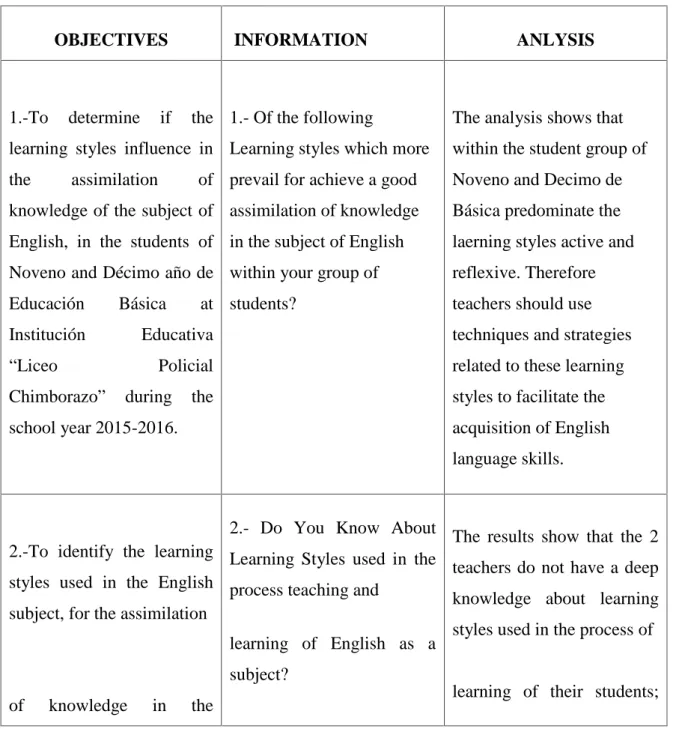
(48) CHAPTER IV SURVEY 1 4. DATA PROCESSING, ANALYSIS OF RESULTS This research was developed at the Unidad Educativa “Liceo Policial Chimborazo” with Noveno y Decimo de Educacion Basica General in 2015-2016 school year in order to explore the learning styles in the knowledge’s assimilation. Table 2. Survey to the teachers of Noveno and Décimo de Educación Básica General at “Liceo Policial Chimborazo” during the school year 2015-2016” in the Riobamba city.. OBJECTIVES. 1.-To. determine. if. INFORMATION. the 1.- Of the following. ANLYSIS. The analysis shows that. learning styles influence in Learning styles which more. within the student group of. the. of prevail for achieve a good. Noveno and Decimo de. knowledge of the subject of assimilation of knowledge. Básica predominate the. English, in the students of in the subject of English. laerning styles active and. Noveno and Décimo año de within your group of. reflexive. Therefore. Educación. teachers should use. assimilation. Básica. Institución. Educativa. “Liceo Chimborazo”. at students?. techniques and strategies. Policial during. related to these learning. the. styles to facilitate the. school year 2015-2016.. acquisition of English language skills.. 2.- Do You Know About The results show that the 2 2.-To identify the learning Learning Styles used in the teachers do not have a deep styles used in the English process teaching and knowledge about learning subject, for the assimilation styles used in the process of learning of English as a subject? of. knowledge. in. the. learning of their students;. 48.
(49) students of Noveno and. the. unknow. makes. to. Décimo año de Educación 3.- How often do you use difficult to recognize the techniques described Básica at Institución learning styles that each below to teach English? Educativa “Liceo Policial student has and likewise the Brainstorming,. project interaction and assimilation development, directed knowledge into the subject study, forum and role play. of English Language. The. Chimborazo”.. 4. - How often do you relate learning styles are essential the methodology with to improve the quality study of the students because they. Learning Styles?. allow them motivate in the teaching-learning process. 5.- How often do you updated about the thematic of. study. within. the. teaching-learning process?. 3.-To analyze the level of 6.- How Do you consider. The results show us that the. assimilation of knowledge that the level of success. 2 teachers think that the. with relation to learning achieved in the assimilation. success of learning in this. styles used in the English of knowledge in the process. school year is fairly. subject in the students of of teaching-learning of. satisfactory revealing that. Noveno and Décimo año de English Language in this. the planted objectives for. Educación. this year were not met with. Básica. Institución. Educativa. “Liceo Chimborazo”. at school year to be?. Policial to. Project. 7.- How often the obstacles that are described below. success in the area of English Language.. their improvement. prevailing in the learning. Students do not receive the. process of the subject of. English classes in a good. English? Lack of. manner for this reason the. motivation, tiredness, lack. knowledge’ assimilation is 49.
(50) of appropriate teaching. fairly satisfactory.. materials and use of traditional methods.. The analysis shows that one 4.-To establish the different 8.- Have you diagnosed the learning styles in the Learning Style of your students? assimilation of knowledge. teacher. with relation to learning. teacher never. This result. styles used in the English. shows us that teachers do. subject in the students of. not. Noveno and Décimo año de. techniques. Educación. at. methodologies for the group. Educativa. of students as each student. Policial. has different learning style. Institución “Liceo Chimborazo”. Básica. during. the. teaching-learning process.. sometimes. diagnosed learning styles of their students and another. use. the. appropriate and. and not all assimilate new knowledge in the same way. Is necessary that teachers use the adequate techniques for. obtain. a. good. assimilation of Knowledge. SOURCE: Survey applied to teachers DONE BY: Abigail Garrido and José Sinaluisa. 50.
(51) SURVEY 2 LEARNING STYLES IN STUDENTS OF NOVENO DE BÀSICA DE EDUCACION GENERAL “LICEO POLICIAL CHIMBORAZO" Learning Styles in students of Noveno de Bàsica de Educacion General " Liceo Policial Chimborazo" Tabla 3. Learning Styles in students of Noveno de Bàsica de Educacion General " Liceo ITEM. FREQUENCY. PORCENTAGE. Theoric/ Reflexive. 11. 33%. Active/ Pragmatic. 7. 2%. Theoric/Pragmatic. 3. 1%. Pragmatic/Reflexive. 20. 61%. Active/Theoric. 4. 1%. Active/ Reflexive. 7. 2%. TOTAL. 52. 100%. Policial Chimborazo" SOURCE: Survey applied to teachers DONE BY: Abigail Garrido and José Sinaluisa. ANALYSIS: The most of the students have Pragmatic/ Reflexive Learning Styles in this grade that permit to acquiere the new knowledge’s assimlation through activities according to these styles. They permit that students use the skills into the English language to obtain a meaningful learning in academic process and students can use the language in real world.. 51.
(52) CHAPTER V. 5. CONCLUSIONS AND RECOMMENDATIONS 5.1 CONCLUSIONS . The learning styles influence in the assimilation of knowledge becuase they are cognitive and physiological features that permit the learner to get the meaningful learning using the skills or abilities to study a second language in this case English language.. . There is different kind of learning styles such as; active, pragmatic, theoric and reflective. In this group of students exist a high necessity to know the learning styles and relationship with adequate strategies and methods to improve teaching- learning in the English subject so achieve with succsess the posed goals in Noveno and Decimo de Educación Básica General de la Institución Educativa “Liceo Policial Chimborazo”. . There is a low level of assimilation of knowledge with relation to learning styles because teacher and students do not know learning styles, it can not permit teacher help to that students have an high level of learning at English subject.. . The most of the students in Noveno and Decimo de Educacion Basica have Pragmatic /reflexive learning styles which are useful to increase the knowledge into the students and describe what level of assimilation has each student to learn a second language in the learning process.. 52.
Figure


Documento similar
ii) The tendency seems to be that mixed pairs in the active-reflective and the sensing-intuitive dimensions work better. Learn by means of trying things out and doing something
Although some public journalism schools aim for greater social diversity in their student selection, as in the case of the Institute of Journalism of Bordeaux, it should be
In the “big picture” perspective of the recent years that we have described in Brazil, Spain, Portugal and Puerto Rico there are some similarities and important differences,
For instance, the best overall accuracy of bagging in Breast with 20% noise is achieved using a 10% sampling ratio: The test error goes from 4.1% when no noise is injected to 3.5%
In particular, different versions of the training set for the base learners can be used, as in bagging (bootstrap sampling of training data), class-switching (noise injection in
Application of learning styles for automatic grouping The results of the case study presented in section 3 seem to indicate that there exist a relationship between the way in
Keywords: Metal mining conflicts, political ecology, politics of scale, environmental justice movement, social multi-criteria evaluation, consultations, Latin
The underlying idea of adaptive hypermedia based on learning styles is quite simple: adapt the presentation of course material so that it is more conductive to each student
