
Feedback as a methodological strategy to improve the teaching learning process in the students of Segundo de Bachillerato at Unidad Educativa Alfredo Pérez Guerrero, Guano canton, in the Chimborazo province, during the school academic year 2014 2015
84
0
0
Texto completo
(2) TUTOR CERTIFICATION. Riobamba, 22 de Abril de 2016. Máster Carlos Loza. DECANO DE LA FACULTAD. Presente De mi consideración: En mi calidad de tutora de la tesis titulada "FEEDBACK AS A METHODOLOGICAL STRATEGY TO IMPROVE THE TEACHING LEARNING PROCESS IN THE STUDENTS OF SEGUNDO DE BACHILLERATO AT UNIDAD EDUCATIVA ALFREDO PÉREZ GUERRERO, GUANO CANTÓN, IN THE CHIMBORAZO PROVINCE, DURING THE SCHOOL ACADEMIC YEAR 2014 2015", cuya autora es la señorita estudiante Digna Verónica Narváez Guapulema, tengo a bien informar que la autora en mención ha cumplido a cabalidad con las fases establecidas en el anteproyecto de tesis y ha terminado con la investigación propuesta como trabajo de graduación en un 100%. En tal virtud, la supra indicada autora puede presentar su trabajo en las instancias correspondientes para que reciba la autorización para la defensa pública según la normativa vigente. Del señor Decano, me suscribo,. Magdalena Ullauri M. TUTORA DE TRABAJO DE GRADUACIÓN. Atentamente,. ii.
(3) MEMBERS OF THE COURT OF THESIS. “FEEDBACK AS A METHODOLOGICAL STRATEGY TO IMPROVE THE TEACHING LEARNING PROCESS IN THE STUDENTS OF SEGUNDO DE BACHILLERATO AT UNIDAD EDUCATIVA ALFREDO PÉREZ GUERRERO, GUANO CANTON, IN THE CHIMBORAZO PROVINCE, DURING THE SCHOOL ACADEMIC YEAR 2014 -2015”. Trabajo de tesis de Licenciatura en IDIOMAS. Aprobado en nombre de la Universidad Nacional de Chimborazo por el siguiente Tribunal Examinador Mayo 2016.. MSC. Mónica Cadena PRESIDENT OF THE COUR. MSC. Magdalena Ullauri THESIS TUTOR. MSC. Luis Machado VOCAL. NOTA iii.
(4) RESPONSIBILITY STATEMENT AUTHOR. Digna Verónica Narvaez Guapulema. I declare that this thesis is a prerequisite to obtain a Bachelor's Degree in Languages, English mention.. Express also that this investigative work has been of my authorship, after having been subjected to a systematic process of analysis, opinions and criteria of other authors have been taken and duly mentioned; the interpretation and analysis of the information is original in all its content and own of the author.. Digna Verónica Narvaez Guapulema C.I.: 0604798256 .. iv.
(5) ACKNOWLEDGEMENTS The Universidad Nacional de Chimborazo by having allowed an opportunity for selfimprovement and learning that guarantee a personal and professional success.. My parents, my husband and my beautiful daughter who with infinite love through life have been able to guide me through his example of work and honesty, for all their effort and reflected his constant support they have helped to achieve this goal and professional staff and be able to successfully complete this important phase of my life.. A special thanks to MSc. Magdalena Ullauri Director thesis who has guided and permanently contributed in this degree work with guidelines for its preparation of pedagogical and didactic manner, by the friendship and trust granted.. Verónica Narvaez. v.
(6) DEDICATORY. This work is dedicated to God, my parents, my husband and my beautiful daughter with love and understanding are the most important to meet this objective strength, leading me through the path of truth and justice in order to enlarge the homeland and honor to the family. I thank for giving me the fruit of his is effort and sacrifice by giving me a morning better support me unconditionally, to successfully reach the culmination of this stage of my life so that they'll take on the altar of my heart.. Verónica Narvaez. vi.
(7) GENERAL INDEX. PORTADA. I. TUTOR CERTIFICATION. ii. MEMBERS OF THE COURT OF THESIS. iii. RESPONSIBILITY STATEMENT AUTHOR. iv. ACKNOWLEDGEMENTS. v. DEDICATORY. vi. GENERAL INDEX. vii. INDEX OF GRAPHIC. xi. INDEX OF ANNEX SUMMARY INTRODUCTION. XII. XIII xiv. CHAPTER I. 1. 1.. REFERENTIAL FRAMEWORK. 1. 1.1.. PROBLEM STATEMENT. 1. 1.2.. FORMULATION OF THE PROBLEM. 2. 1.3.. OBJECTIVES. 2. 1.3.1.. GENERAl.. 2. 1.3.2.. SPECIFIC. 2. 1.4.. JUSTIFICATION AND IMPORTANCE OF THE PROBLEM. 3. CHAPTER II. 4. 2.. THEORETICAL FRAMEWORK. 4. 2.1.. BACK GROUND INVESTIGATION REGARDING THE PROBLEM TO. INVESTIGATE. 4. 2.2.. THEORETICAL FOUNDATION. 4. 2.2.1.. FEEDBACK. 4. 2.2.3. How feedback is used in the English Learning process. 6. 2.2.5.. Give and Receive Feedback. 8. 2.2.5.1. Give. 8. vii.
(8) 2.2.5.2. Receive. 10. 2.2.6.. Conditions for and effective Feedback. 11. 2.2.7.. Feedback objectives. 12. 2.2.8.. Importance of the feedback as a teaching - learning strategy. 12. 2.2.9.. Feedback functions. 13. 2.2.10. Advantages and disadvantages of the feedback. 14. 2.2.11. Feedback methodology. 16. 2.2.12. Feedback Kinds. 16. 2.2.13. Strategies that are applying on the feedback. 17. 2.2.14. Different kinds of Feedback. 18. 2.2.15. Feedback techniques. 21. 2.2.15.1. Improve Empathy: Empathic attitude and response.. 21. 2.2.15.2. Reiteration. 22. 2.2.15.3. Do questions. 22. 2.2.15.4. Exposition of concordance or disagreements. 22. 2.2.15.5. Communication of ideas. 23. 2.2.16.. Feedback generalization by an evaluation. 23. 2.2.17.. Feedback in the educative field:. 25. 2.3.. Teaching – learning. 26. 2.3.1. School learning. 27. 2.3.2.. Learn to learn. 28. 2.4. HYPHOTESIS SYSTEM. 31. 2.5. VARIABLE SYSTEMS. 31. 2.5.. OPERATIONALIZATION 0F VARIABLES. 32. 2.5.1. INDEPENDENT: Feedback. 32. 2.5.2. DEPENDENT VARIABLE: Teaching- learning process. 33. CHAPTER III. 34. 3.. METHODOLOGICAL FRAMEWORK. 34. 3.1.. METHODS. 34. 3.2.. TYPE OF RESEARCH. 34. 3.3.. RESEARCH DESIGN. 35 viii.
(9) 3.4.. POPULATION AND SAMPLE. 36. 3.4.1.. POPULATION. 36. 3.4.2.. SAMPLE. 36. 3.5.. TECHNIQUES AND DATA COLLECTION INSTRUMENTS. 36. 3.5.1.. TECHNIQUES. 36. 3.5.2.. INSTRUMENTS. 36. 3.6. TECHNICAL PROCEDURES FOR ANALYSIS. 37. CHAPTER IV. 38. 4.. ANALYSIS AND INTERPRETATION DATA. 38. 4.1. Application of the parallel A of the Second of Bachillerato. 38. 4.2. Application to the parell B of the Second of Bachillerato. 46. 4.3. CARD OF OBSERVATION DIRECTED THE TEACHER OF ENGLISH. 54. CHAPTER V. 58. 5.. CONCLUSIONS AND RECOMENDATIONS. 58. 5.1.. CONCLUSIONS. 58. 5.2.. RECOMENDATIONS. 59. BIBLIOGRAPHY. 60. ATTACHEMENTS. 63. ix.
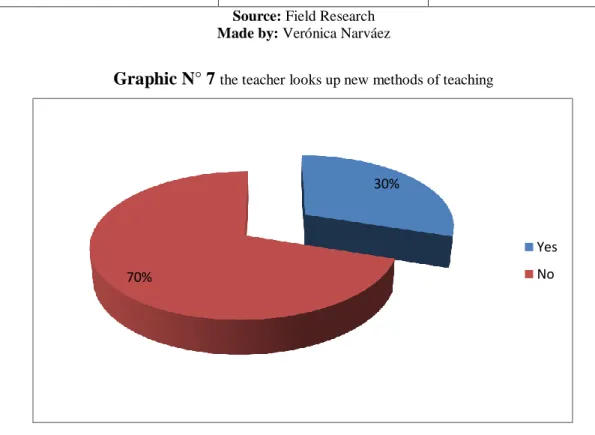
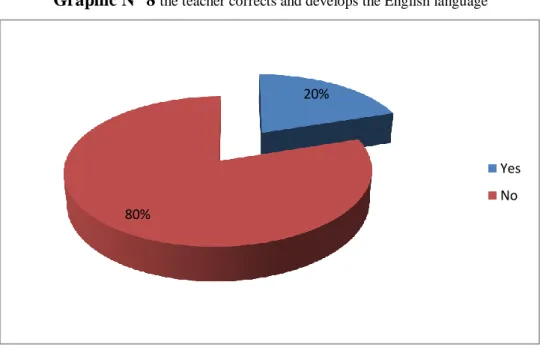
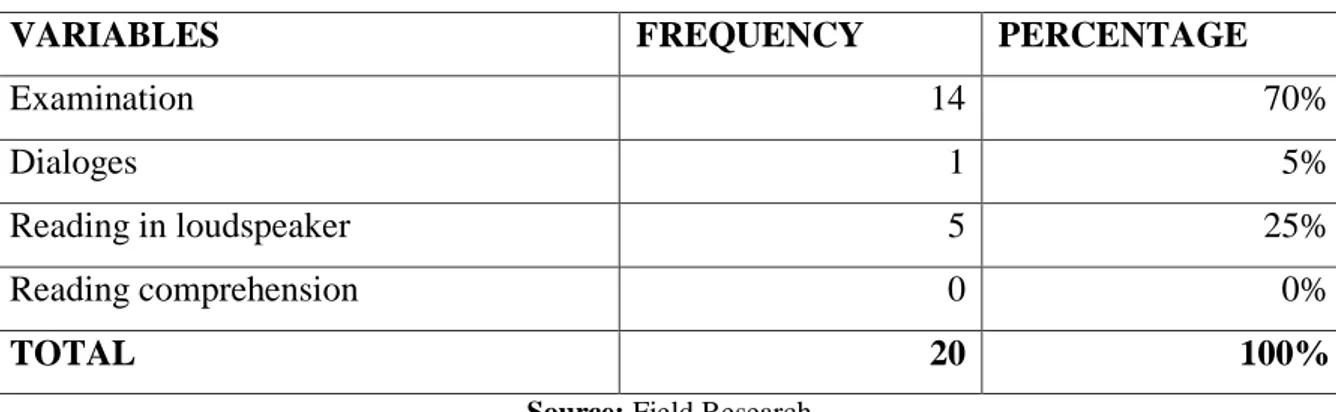
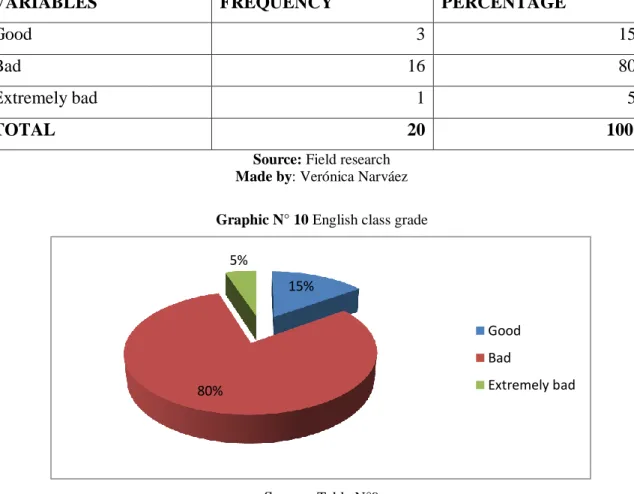
(10) INDEX OF TABLES Table N° 1 English class grade ............................................................................................. 38 Table N° 2 Participation opportunities ................................................................................. 39 TableN° 3 The teacher corrects students‟ pronunciation.................................................... 40 Table N° 4 The teacher uses didactic material ..................................................................... 41 Table N° 5 The teacher evaluates what students have learned ............................................ 42 Table N° 6 The teacher looks up new teaching methods ..................................................... 43 Table N° 7 The teacher corrects and improve the English language................................... 44 Table N° 8 Evaluation method ............................................................................................. 45 Table N° 9 English class grade ............................................................................................. 46 Table N° 10 Participation opportunities ............................................................................... 47 Table N° 11 The teacher corrects students´ pronunciation................................................... 48 Table N° 12 The teacher used didactic material ................................................................... 49 Table N° 13 The teacher evaluates what has been learned.................................................. 50 Table N° 14 The teacher looks up new teaching methods ................................................... 51 Table N° 15 The teacher corrects and improve the English language.................................. 52 Table N° 16 Evaluation method ........................................................................................... 53 Table N° 17 observation card ............................................................................................... 54 Table N° 18 Hypothesis testing …………………………………………………………….56. x.
(11) INDEX OF GRAPHIC Graphic N° 1 Communication Process ................................................................................... 5 Graphic N° 2 English class grade ......................................................................................... 38 Graphic N° 3 Participation opportunities ............................................................................. 39 Graphic N° 4 the teacher correct students‟ pronunciation .................................................... 40 Graphic N° 5 The teacher uses didactic materia................................................................... 41 Graphic N° 7 The teacher looks up new methods of teaching ............................................. 43 Graphic N° 8 The teacher corrects and develop the English language ................................ 44 Graphic N° 9 Evaluation methods ........................................................................................ 45 Graphic N° 10 English class grade ....................................................................................... 46 Graphic N° 11 Participacion Opportunities .......................................................................... 47 Graphic N° 12 The teacher correct students‟ pronunciation ................................................ 48 Graphic N° 13 The teacher uses didactic material ............................................................. 49 Graphic N° 14 The teacher evaluates what students have learned ....................................... 50 Graphic N° 15 The teacher look up new teaching methods ................................................. 51 Graphic N° 16 The teacher correct and improve the language............................................. 52 Graphic N° 17 Evaluation methods ...................................................................................... 53 Graphic N° 18 Observation card .......................................................................................... 55 Graphic N° 19 Hypothesis testing …………………………………………………………57. xi.
(12) INDEX OF ANNEX Annex N° 1 survey ............................................................................................................... 64 AnnexN° 2 Observation card................................................................................................ 66 Annex N° Diagnostic survey……………………………………………………………….67 Annex N° 3 Photo evidence ................................................................................................. 67. xii.
(13) SUMMARY This document analyzes the use of feedback in the process of teaching – learning as a methodological strategy teachers use to reinforce what students have learned. The topic of the thesis is Feedback as a pedagogical tool to potentiate the English learning. When a teacher uses it, they are tapping all the techniques of the feedback. The proposal mentioned before will allow students to reinforce the learning process through using all the techniques of the feedback. To this research, it was descriptive and deductive methodologies. As techniques, the survey and as instrument questionnaire the used. In the field investigation, there were 40 students from two parallels: A and B and a teacher who participated in the research. After conducting an analysis using statistical tables, they were represented in cakes to reach the hypothesis testing, both with conclusions and recommendations determining the students are at an average level. According to the results, it concludes that the usage of different techniques of feedback using by the teacher is old-fashion. Therefore, it is recommended the usage of different techniques of feedback using didactic material. These materials must be easy to hang out to facilitate students‟ comprehension.. xiii.
(14) INTRODUCTION The Ministry of Education through its policy of quality in the education has considered the English language as a second language. However, some mistakes have been denoted in the processes of the English teaching – learning. It has been because of the lack of application of the new methodology in the assessments. The use of feedback serves as a strategy to learn a new language. In addition, feedback is used to mark the distance between what students have learned, and what students need to reinforce to internalize in its long-term memory. Feedback points out the interaction of students in order to reduce the mistakes in the English learning, and at the same time, it allows to reinforce the classes. The research covers five chapters which will be describe in the following terms: Chapter I: It refers to the problem, approach, formulation, and justification of the problem and its objectives. Chapter II: It has to do with the theoretical framework and research background as well as theoretical foundation. Chapter II: It contains the methodological framework where it describes the research kind, type of population, and sample. Additionally, some methods and techniques used to gather information are described here. Chapter IV: Here, it explains the analysis and interpretation of applied data. It is described through the pool and the observation form. Chapter V: Here, there are conclusions and recommendations.. xiv.
(15) CHAPTER. I. 1. REFERENTIAL FRAMEWORK 1.1.PROBLEM STATEMENT The Unidad Educativa Alfredo Pérez Guerrero is located in the center town of Guano, on Agustín Dávalos Avenue and Teniente Coronel Fernando Hidalgo Proaño Street. It was founded on October 1st 1968. Currently Alfredo Perez Guerrero High School offers a secular education, has experienced limitations to develop effectively the academic activity on the English field. It is disclosed that the investigator did her teaching practices during all the academic year in the high school with 40 students from Segundo de Bachillerato at Unidad Educativa Alfredo Perez Guerrero, that is why it had experienced and it had evidenced that the problem that the students have is that they are not orientated in their learning.. The students are inclined to reprove the quarter period or the same school year. It was noticed that the teacher does very few of feedback. The teacher omits the academic reinforcement. There was not realized an evaluation about the integral learning of the students and the teacher does not use a proper methodology during the teaching and learning process of English Language.. As a consequence there are students without interest that are passive, indolent, receptionist with low participation in high school. Furthermore there is little use of teaching learning process, suitable material and lack of creativity in activities in class, the low use of technology hurting the process of feedback. Also it is showed that students had disinterest in the classroom in the process of teaching-learning process during the observation of classroom activities on the behavior of students they are regularly were distracted, disobedient do not like working, feeling sleepy, lazy and tired. They talk among themselves and they bother with their classmates. 1.
(16) 1.2.FORMULATION OF THE PROBLEM In what way the use feedback as a methodological strategy affect the teachinglearning process in the students of Segundo Bachillerato at Unidad Educativa Alfredo Pérez Guerrero, Guano canton, in the Chimborazo province, during the Academic year 2014 -2015”? 1.3.OBJECTIVES 1.3.1. GENERAl. To evaluate the feedback in the teaching process Bachillerato at Unidad Educativa Alfredo Pérez. in the students of Segundo. Guerrero, Guano canton, in the. Chimborazo province, during the school academic year 2014 -2015” 1.3.2. SPECIFIC To observe the feedback done by the teacher. To appreciate the feedback done in the teaching learning process. 2.
(17) 1.4.. JUSTIFICATION AND IMPORTANCE OF THE PROBLEM. This research studies the “Feedback” as methodologic strategy to improve the teaching learning process, in order to provide a new methodological strategy in evaluating and improve the academic environment. It is known that regeneration is an essential part of effective learning that helps students understand the topics which are being studied and give them clear guidance on how to improve their learning .This allows students to reflect on their learning; clarifies the areas where students can improve; and it provides students the opportunity to self-assess their skills and capabilities. On this study will participate many people and institutions, as teachers will have a new vision if the academic performance of students that they will evaluate 'improve the teaching-learning process, students will know exactly what to do and how to do the various activities set by the teacher, thus enhance their knowledge as well as their rankings, and they already know what their strengths and weaknesses are. The researcher will have the opportunity to apply knowledge acquired in the classroom and use it in the society, showing her potential as English teacher. Education Unit Alfredo Perez Guerrero and the National University of Chimborazo will improve their academic relationship and cooperation. Thanks to the readiness of the authorities, teachers and students of the high school, it is possible to carry out the investigation. There is a good institutional relationship and the willingness of the authority‟s .This study has necessary material for development, such as literature, human, technological and financial resources, knowledge and experience of the investigator, etc. Therefore, it is possible to ensure feasibility. 3.
(18) CHAPTER II 2. THEORETICAL FRAMEWORK 2.1.. BACK GROUND INVESTIGATION REGARDING THE PROBLEM TO INVESTIGATE There are not research works entitled as the presented one at the Universidad Nacional de Chimborazo, it was reviewed all the thesis done to the date in the whole institution, that is why, it is possible to assure the exposed fact, but; there are many international studies related to the present, which are going to be its theoretical base, for example: “The Power of feedback” argues that Feedback is one of the most powerful influences on learning and achievement, but this impact can be either positive or negative”. (Hattie & Timperley, 2007) “Assessment: Feedback to promote student learning” argues that feedback is an important part of the learning cycle, but, both students and teachers frequently express disappointment and frustration in relation to the conduct of the feedback process”. (Spiller, 2009). 2.2.THEORETICAL FOUNDATION 2.2.1. FEEDBACK According to (Cervantes, 1997) defines: Feedback is an essential part of education and training programmers. It helps learners to maximize their potential at different stages of training, raise their awareness of strengths and areas for improvement, and identify actions to be taken to improve performance. The feedback consists in a mechanism through which the L2 students embody to their speech the effect that a receptor produce (it can be over their classmates or teacher), and these effects are display through linguistically or paralinguistic ally. The discourse generates in the classroom, feedback, can affect as the content of communication as the process of learning that is develop through itself.” 4.
(19) The feedback is considered as a control method which strengthens the learned contents in the classroom. In addition, feedback activities contribute to a meaningful English teaching – learning process. This definition has been extended to any process in which incorporates as an output as an input part of a system. (Cervantes, 1997) Graph N° 1 Communication Process. Transmitter. Message. Receptor. FEEDBACK Made by: Verónica Narváez. The process of English learning in the traditional classrooms consists on the production of any text where the transmitter just read or hear his/her own words, so at this way, s/he controls the development of the text. It becomes a unidirectional learning process. “In the theory of feedback nature and effects, there is some relief on the followings items: . The transmitter uses the message to test the achievement of the communicative intention. It is carried out through noticing the effect that it produces on their listeners to keep the initial line or modify it.. . The listener can influence on the transmitter communicative behavior by providing accurate feedback.. . Consequently, an appropriate feedback impacts on the better communication channels. ” (Cervantes, 1997). . The feedback uses by the teacher is oriented to develop the linguistic awareness and the student autonomy.. 5.
(20) 2.2.2 Definition according to several authors According to (Martín & Ferrero, 2010, p. 328) feedback means words duplication as opinion, evaluation, and review. On the other hand, according to (Pérez, 2007, pág. 177) the feedback during the learning process must be appropriate and systematic; namely, it describes what must be improve using stimulator comments instead of marks. 2.2.3. How feedback is used in the English Learning process. Feedback is an essential part of effective learning. It helps students understand the subject being studied and gives them clear guidance on how to improve their learning. Bellion et al. state 'academic feedback is more strongly and consistently related to achievement than any other teaching behavior...this relationship is consistent regardless of grade, socioeconomic status, race, or school setting.' Feedback can improve a student's confidence, self-awareness and enthusiasm for learning. Effective feedback during the first year in university can aid the transition to higher education and may support student retention. Providing students engage with feedback, it should enhance learning and improve assessment performance. The application of feedback is a strategy that allows to the teacher identifies what is students‟ reception or learning that she /he has about a topic. Teachers use feedback as a way to return to the evaluation that has been done in advanced. Furthermore, teachers employ the feedback strategy as a base for the new knowledge and as a source of enrichment. The evaluation is not only a way to grade the students‟ performance at school but also to reinforce to students and parents. (López & Osorio, 2014, pág. 19). 6.
(21) 2.2.4 The feedback in the Communication In the communication context, it is seen as feedback the answer transmitting by a receiver to a transmitter. The communication bases on the received message which nourishes the talk. In the communication process, the communicative feedback is the quality allowing keeping the active communication and stimulating receiver changes or modifies his /her message in function of received answer. Regarding feedback during the communication transmitter and receiver roles, they exchange their position. The receptor is who produces and sends the feedback information. On the other hand, the transmitter is who receives the information. Therefore, the receptor should now to provide feedback, and the transmitter should know to receive it. Thus, it is necessary to exercise the abilities implies in the reception and emission Thus, the receptor should know to give feedback, and the transmitter should to know to receive it. So it is necessary to exercise the skills imply in the feedback reception and emission to create a constructive communication. The capacity to generate feedback during the communication is one of the most important skills since it has enough power to benefit or damage to any member of a determined organization. To our own development, it is essential make a good use of feedback. Occasionally, the given feedback can become to be too hard and awkward as the transmitter as the receptor. Nonetheless, when there is the generation of constructive feedback, it influences on people‟s behavior. The constructive feedback influences on people to change their behavior and ensure their development of new skills and modification their behavior constantly. These facts help to the improvement of the group to which these people belong to. Overall, feedback helps to cope three situations which obstruct the communication: Deficiency of comprehension between receptor and transmitter Lack of attention during the communication Misunderstanding of a given message In order to develop and improve our skills when feedback is to giving or receiving in the following section will be described the feedback types and its best principle and techniques to generate it efficiently. (Florido J. , 2012). 7.
(22) 2.2.5. Give and Receive Feedback 2.2.5.1. Give The communication capacity is an ability that can be cultivated, they are the same as others skills, through training and attention to other‟s opinions about how they perform their work. (Dunphy, 2002) The feedback consists in the application of pedagogical tools. The teachers use these pedagogical tools to improve the teaching – learning process by applying activities to develop students‟ cognitive part. Attempt: Be specific: when teachers are concrete and direct in giving feedback, students who receive it get more advantage. For example, instead of saying “Manolo, sometimes you do not articulate clearly……” you can say to Manolo where he has exactly been imprecise and describe why y Our have problems to understand him. Generalizations are particularly unhelpful. Base your comments on concrete observable behavior or materials. Always check your general impressions or inferences against the particular and use the particular in your response. Focusing on behavior implies that it is something related to a specific situation that might be changed. The person should be given sufficient information to pinpoint the areas to which you are referring and have a clear idea of what is being said about those specific areas. Be descriptive, not evaluative: you should be concrete when give the feedback, so that students will have more benefits from it since they can understand you. So instead of saying “Manolo sometimes you do not express clearly” you can say to Manolo what the parts are that you do not understand and describe why you have problems to understand him. describe your views. Don‟t be evaluative or say what you think the person should feel. Don‟t be emotionally manipulative: you are offering your considered views which should have the characteristics described here; it is up to the other person to accept or reject them as he or she sees fit 8.
(23) Describe something on what people can work on:. when teachers make. comments about the student‟s quality of voice, the only thing that teachers get is to disappoint to students. However, when the tone of voice is acute because of nerves, teachers can say “Barbara maybe it is good you take a deep breath to relax yourself” It can serve to decrease her tone of voice. Choose one or two topics on which students can concentrate: Normally, it is not possible to concentrate on several pieces of information at the same time. When people are overwhelmed with many suggestions, they tend to frustrated themselves. Therefore, while teachers are providing feedback to students, they should focus on areas that really need improvement. Be consciously non-judgmental: offer your personal view, do not act as an authority even if you may be one elsewhere. Give your personal reactions and feelings rather than value-laden statements. One way of doing this is to use comments of the type „I feel ... when you ...‟ Don’t compare: treat each person‟s work as their own, not part of some supposed competition with others. Be cautious about giving feedback in a context in which the comments which you give one person will be compared with those of another. Such comparisons undermine intrinsic motivation. Be diligent: check your response. Is it an accurate reflection of what you want to express? Have you perceived the contribution accurately There is nothing more annoying than to receive criticism from someone who clearly hasn‟t bothered to pay attention to what you have done. Be direct: say what you mean. Don‟t wrap it up in circumlocution, fancy words or abstract language. Be positive: say what you appreciate. Don‟t just focus on what you react negatively towards. Try to find something which is genuinely felt, rather than being positive because you feel it is required. Avoid interferences relating to teachers’ assumptions: If a teacher says “you do not seems so excited with the presentation” teacher is implying something about the students. It is better to say “when you vary your voice volume and velocity, the speech will get a cheerful style”. 9.
(24) The idea is to stimulate to children learn in order they are motivating and willing to enrich their knowledge. The process of feedback in class occurs not only in formal evaluations but also during the teaching and learning process. (López & Osorio, 2014, pág. 20). 2.2.5.2. Receive When students get feedback, teachers should attempt Be receptive: when students receive any critism, it is not easy to accept. However, the positive criticism is an important process in the learning process. Although sometimes criticism can hurt, teacher should attempt to take advantage of the feedback to help students to improve in their comprehension and process. Take notes: when students are participating or talking in class, teachers should take notes in order to use them to provide positive feedback to students. Besides, these notes can help teachers to evaluate to the comments to realize that the tough comments were which help more to students. Be explicit: make it clear what kind of feedback you are seeking. If necessary indicate what kinds you do not want to receive. The feedback from others is entirely for your benefit and if you do not indicate what you want you are unlikely to get it. Be attentive: concentrate fully on what is being said. Focus on what the person wants you to know, not on what you would like to hear. Be aware: notice your own reactions, both intellectual and emotional. Particularly notice any reactions of rejection or censorship on your part. If the viewpoint from which the other is speaking is at variance with your own do not dismiss it: it can be important to realize the misapprehensions of others. Some people find it useful to partially dissociate or distance themselves in this situation and act as if they were witnessing feedback being given to someone else. Be silent: refrain from making a response. Don‟t even begin to frame a response in your own mind until you have listened carefully to what has been said and have considered the implications. Don‟t use the excuse of correcting factual errors to avoid hearing and resonating with the substance of what has been said. Don‟t be 10.
(25) distracted by the need to explain: if you continue to feel that you need to give an explanation do it later after the feedback session once you are sure you have attended to all that has been said. Ask specific examples: if you receive a criticism and it is confusing or imprecise, you will ask to the person to give a specific example to try to come up to the point. Judge the feedback base on the people who are providing it: it is not necessary you agree to all the comments. Think on the person‟s credibility when you evaluate the validity of his / her arguments. Ask to others about their opinions on the critiques. (Dunphy, 2002). Nowadays, there is another strategy to help students to improve their English called feedforward. It is known as a foresight feedback; that is information that will be used in a short term and long term, and they can be in the academic or labor field. It is supposed some classmates and teachers‟ comments should have implications on the current task and for future tasks. “Meanwhile feedback includes comments on done tasks; the feedforward includes information that pretends to help students to improve their similar future tasks and assignments”. (Lon, Silva, & Cano, 2013) 2.2.6. Conditions for and effective Feedback Different conditions to provide an effective feedback: Knowledge about evaluation criteria Comparation between the knowledge and their own work. The teacher must clearly understand the desired goal/outcome for the student‟s learning/behavior. The teacher must rely on relevant evidence of the present position of the student in relation to that goal/outcome. The teacher must have methods/strategies to close the gap between the student's present position and the desired goal/outcome. 11.
(26) Actions that are taken to back the gaps between the knowledge and their works (Pérez, 2007, pág. 177) Amidst the conditions of a good feedback, students must be trained over how to interpret and relate the contents that allow them to get a useful knowledge. Feedback is essential to keep and learn new contents which are not just a notion, but it is supported in the literature of educational investigation.. Argue that secondly, the. immediate feedback has an enormous impact on the group development. ( Michaelsen & Michael , s.f). 2.2.7. Feedback objectives Humans‟ behaviors and relationships require feedback process to get back the way or enhance their effectively. That is why the feedback process is seen as an aspect for developing human relationships. The feedback process presumes that people who give it know the objective that has the others; namely, they know the results that they want to achieve through feedback. (Bossi , s.f) That is people who give the feedback can help to others to enhance the effectiveness on the consecutions other‟s objectives 2.2.8. Importance of the feedback as a teaching - learning strategy In order to give any efficient evaluation to students, it is essential to provide them with an specific feedback. It fosters to students to realize and self-correct their own mistakes or bad study habits. It does not mean that teacher tells to students what the errors are, but the students should realize about their mistakes and be able to correct their errors by themselves. The teacher's work is not just teaching a lesson weekly in the traditional way. Yet, the teacher's work becomes to be a facilitator who has an instructional conversation with students to guide them through the learning process. (Morales, 2009, pág. 32) This practice is not either easy or difficult; however, it gives us an insight about the importance of proving feedback to students. When the feedback is correct and immediate, it encourages and motivates to students to build their own learnings. In fact, in some 12.
(27) universities where this strategy has been used in classes has been the gist strategy of teaching. (Morales, 2009, pág. 32) 2.2.9. Feedback functions According to (Morales, 2009, pág. 32). as in the formative as well as summative. evaluations, the functions of the feedback are to provide positive and harmless corrections to students. This process of returning back information to students is extremely useful to learners' instruction. The functions are: To facilitate students' self-evaluation and reflection over their own learnings. Most of the time, the students should be concern to the teacher's assessment; nevertheless, they are not aware of their own assessment. Therefore, it is important to develop the necessary skills to students can make a self-evaluation about their learnings. At this point, self-evaluation is quite important because it fosters students as an independent learner. When the teacher provides a great amount of feedback and corrections, it might inhibit the students grow up as self- learners. To facilitate the communication between teachers and students, and students and students which lead a cooperative learning environment in the classroom frequently, students among themselves should clarify and explain some difficult topics that are not clear during the lesson. In addition, using this strategy, teacher creates a cooperative community in the classroom, and she is just a facilitator and external authority in the class. To clarify the evaluation criteria.. This helps to communicate which the. expectations of the students are, which objectives of the lesson are, and which demanding levels are. Even though these requirements are presented at the begging of the curse, it is beneficial when they are gone over with the real examples. To catalyze in the students' learning styles. It means that to receive a positive feedback during the first year at the University is crucial. Students need to be oriented since all subjects and information are complete new for them. Contrary, negative feedback on the students who are starting their studies can be devastated. 13.
(28) To improve students' outcomes. The improvement is not automatic, it takes time, so the teacher should encourage to the students keep trying until coming up to better results on their work. To motivate students to initiate their effectiveness and success in their learning. The teacher can highlight some partial success to students realize that errors are opportunities to improve and learn. To encourage students to look for problem-solving techniques which enhance their effort. (Morales, 2009, págs. 33-34). 2.2.10. Advantages and disadvantages of the feedback Advantages Wake a belonging feeling in the people. Act enforcement the probability that perpetuate the behavior required, overall if it is practiced intermittently. If the feedback is negative could infer to the guy to fight with more strength to improve and develop his/her performance. Increase the strengths of the person and his/her contributions to the organization. Create a relationship between the teacher and the student generating confidence and communication of double sense between transfer and receiver. It can be less threatening to students than one-to-one feedback, especially when critical. . Individuals' needs can be addressed, while still retaining some degree of relative anonymity within the group. . Students can learn from the detail of feedback to others in the group, avoid the problems which others have encountered, and put their own work into context. . You can enter into detailed discussion if the students in the group wish, so that matters arising are followed up in as much - often more - depth than would have happened with individual one-to-one appointments.. Feedback is likely to be found to be personal, intimate and authoritative. You can address each individual student's needs, strengths and weaknesses. 14.
(29) It is often much quicker to talk rather than write or type. Generate self-steam, confidence and security. Help to the collaborator to unlearn unproductive habits or ineffective. (Arcas, 2014). Disadvantage One-to-one face-to-face feedback can be extremely threatening when critical. Students may become defensive when receiving critical feedback, and you may feel tempted to go in harder to justify the feedback. Students can be embarrassed when receiving positive feedback, and this can cause them not to fully benefit from praise. It takes a great deal of time to organize individual appointments with each member of large classes. . There can be even more time wasted between appointments, and with students who don't turn up.. Students often tend to remember only some of a feedback interview with an important person like you, often the most critical element, and this may undermine confidence unduly. It becomes impossible to remember exactly what you said to whom, when class sizes are large.. Students may not take quite as much notice of feedback to them as members of a group than they would have done to one-to-one feedback. It can be hard to remember to include all the feedback matters which are needed by the group as a whole.. Discussions may get out of perspective, and result in only part of the intended overall feedback agenda being covered by the group session. ( Race , s.f) 15.
(30) 2.2.11. Feedback methodology 1. Know the objectives of the other and had observed some features that in his opinion help the other to improve his /her effectiveness. 2. Create a context of listening and learning. One dialogue about feedback is effective if who practice it learn something about the process. Both should be open-ended to learning. Both may read and think before the conversation, the common enemy of learning. 3. See if the other gives the opportunity to give feedback on the content to study. All the process is vain if the other is not ready to listen. 4. Specify about what aspects or contents we will give feedback. Previously should love the axis that cross the objectives that the other proposed with the abilities or contents that you think the other must consider or improve. After in groups could put together a list of topic to study. 5. On every topic, invite the other participant to open a synergetic conversation about new possibilities of action, which will have more opportunities of focusing on what we want to produce and escape from the usual explanations from the past. 6. It will help you that organize an Action Plan for each one of the points. Open the possibilities to do request and offers between both. 7. To close, it is interesting check what happened, during the same, how did you feel during the conversation? It is fundamental that both people complement each other; it may become a support in the future to the relationship. (Bossi , s.f). 2.2.12. Feedback Kinds Supportive feedback The supportive feedback stimulates to students to repeat a behavior that is having a positive result. It improves students‟ performance at school which has a positive impact on their grades. Moreover, it narrows the links reinforcing the relationship between the teacher and the students and creating an empathy stream that connects to the teacher and students. This aspect influences on students‟ motivation. If this tool is essential, why cannot we put it into practice frequently? Why it is frequently to find teachers and managers that do not have time to provide feedback to their students or co-workers? When 16.
(31) people work on coaching, it is hard to provide supportive feedback. It is difficult since the belief that the employees or students should behave on this way: . “Do not recognize something that is students or employees‟ obligation. I pay for it.”. . “If I congratulate students or employees, they relax themselves”. . “If I show my admiration, they will tap on me or they will ask something in return.”. . “ They have done something good, however they can improve on other fields”. . “It can always improve.”. . “My responsibility is to teach what they can do better, not to indicate what they are doing well.” People‟s each behavior is backing on two forces. ( Piera , 2008). If people cannot give supportive feedback, probably they associate it with negative one. The way how people change behavior is to change the association that they have with pleasure. Thus, when they change their behavior, they associate it with pleasure, and for that they ask themselves the following questions: What do they get from providing supportive feedback? What is the positive impact? On the hand, they associate paint to the former behavior and they evaluate themselves through the following questions: What is the results if we do not provide feedback? What is the negative impact when we do not change our behavior? The feedback is an executive‟s (and personal) skill. Unfortunately, there are many executives that are not educated on it. Therefore, in this institutions or enterprises, feedback is not practiced or fostered; nevertheless, feedback is an executive´s duty and employees´ rights. Feedback helps people to know they are developing their work and how they can improve it. When feedback is denied people can feel the effects of this negation, and probably the staff answers showing an inappropriate or unproductive behavior. 2.2.13. Strategies that are applying on the feedback There are to strategies of corrective feedback. a) Strategies on which the system correct the mistake (from English, target form.)or correct the errors in an explicit way Fixing an error, it substitutes a fixed error by another (in this case the teacher). There are two strategies in this group. (Ferreira, 2007). 17.
(32) 1. Explicit correction of the error, giving the correct answer: For instance, Teacher: What happened after? Student: When she walks; Teacher: walked. 2. Repeat the error or part of the sentence that has the error (not the whole sentence) Here, teacher uses an upward intonation. For example, Teacher: What did you do on weekend? Student: Meet with my boyfriend‟s parents. Teacher: To my boyfriend‟s parents…? Student: To my boyfriend‟s parents b) Using strategies which try to draw students’ correction of the error. The objective of this strategy is to investigate if students can notice the grammatical error in their responses. The main point here is to guide to students to be able to selfrepair of errors. There are one strategies in this group: 1. Give clues or metalinguistic keys, information, or questions relating to the students‟ errors self- repairmen without giving a direct answer about the error- correction. For instance: Teacher: What would you do if you had much money? Student: I buy Teacher: you should use a conditional. Student: I would buy. 2. Elicit the error, in this case the strategy suggests students to give the correct answer through asking until finding the correct answer: For instance how do you translate it into Spanish? Or making pauses to learner can complete the expression that teacher has asked, or asking to students to reformulates their expressions. For example: Teacher Where is Jorge? Student: … Teacher: In the…… Student: In the drugstore. 2.2.14. Different kinds of Feedback The feedback should be generating as a dialogue and no as a monologue; so that the effective feedback is: . Rich in details. . Suitable to students‟ needs.. . Oriented to Foster reflection.. Taking into account that this kind of feedback takes its time, the strategy that has undergone increase during these years has been pair feedback in the collaborative learning. 18.
(33) If students learn to give effective feedback to their pairs (for example: avoiding useless feedback, generating formative criticism, and suggesting improvements) it maximizes the opportunities for providing feedback in the learning. At the same time, receiving feedback form their partners can enhance confidence, self-efficacy, and opportunities to listen to others‟ opinions and points of view. (Educar Chile, 2008) Recommendations to feedback are helpful and effective: 1. It should be opportune: The feedback needs to be given just after the evaluative event or given task in order to emphasize the error – correction. If students do not get feedback right away, students lose concentration and interest on the subject. Moreover, students concentrate their attention in the new concepts, and the former information results irrelevant for them. At this way feedback loses the effectiveness on students‟ learnings. 2. It should be frequent: In order feedback is effective, it should be applied regularly. If an only feedback activity, event thought it is detailed, is given during a big assignment or a design assignment, it can hardly cause a positive effect and make improvements on the students‟ learnings during the course.. 3. It should be coherent: The feedback should be interrelated with the expected learnings, evaluation criteria, and evaluation of tasks. Additionally, it should refer to preset and precise evaluation criteria.. 4. It should be clear: it should have understandable and readable messages. Here it is important to consider the ways how students comprehend and interpret the feedback messages, and not only the way that teachers use to come up to the results. Learners frequently complain about the negative comments received on their works. These kinds of comments are devastating for their performance at school since these comments are too subjective. At the same way, good students feel frustrated since the comments are not clear, and they do not how to keep their high performance at school. For example, some comments like “good work”, “excellent assignment” are not helpful because teachers do not point out the students‟ strengthens on the work. It can result helpful if students know the concept of “excellent”. 19.
(34) Teachers habituate to use certain words and think that students know the explicit meaning of these words. Learners face a big challenge when they do not have enough knowledge to interpret the comments on their works. For example, a teacher could write down the following comment on one part of the assignment. “This part does not have a logical relationship with the previous paragraph”. A student that does not have idea about the logical problems, s/he cannot correct the mistake. Otherwise, explaining what the logical relationship is not suitable, it can be needed a big explanation, or it can consist in more than one conversation. Moreover, teacher is not sometimes conscious students need this explanation. Anyway, the opportunity of learning from the mistake disappears instantly. 5. It should be documented: It is advisable the feedback is documented orally, visually, or written in order students can go over it to refresh knowledge.. 6. It should be constructive: Pupils tend to be more receptive to the improvement suggestions when these suggestions are given in constructive terms. Teachers should avoid negative or acquiescent comments, and they should convert negative suggestions into positive ones to motivate students.. 7. Lastly, maybe the most important recommendation is transformed feedback into feedforward. That means although feedback is retrospective, it can also be used to improve the learning or develop of future occasions. This specific content that has relationships with future activities that can be carried out in a better way in an evaluation progressive.. Progressive Evaluation In a traditional approach of learning evaluations, feedback has a small impact on students since it refers to a task or test that has already summited and grade. Furthermore, these activities cannot be changed and the information received seems does not have validity and importance on the studied contents. It happens because feedback is gotten when the topic or unit is changed.. 20.
(35) Then the main question is how can teachers make feedback interest to students? How can students use it to improve their performance at school? Maybe the answer is changing the evaluation towards a progressive or continued approach. That means teachers can choose a group of complex and basic learnings of their subjects and assignment and work through learning activities. These activities progress throughout the semester or year. Learners summit several times an assignment or performance to be evaluated by teacher and get feedback based on them. The key is that each time that students summit the assignment, it should have an improvement. In each delivery, teacher can grade it and replace the former grade, or each grade has a higher weighing than the previous one in the evaluation of the subject. It is the classic case of the writing and rewriting exercise, but this strategy can be carried out on laboratory activities, investigation.. 2.2.15. Feedback techniques 2.2.15.1. Improve Empathy: Empathic attitude and response. In order the dialogue and interaction are productive, it is necessary comprehension occurs in the communication process. Not only did comprehension has the capacity to catch the meaning of the message, but also it has the capacity to give back an appropriate message to the receptor. It is significant during the process since it makes receptor really feels understood. Therefore, the emphatic answer consists in the ability conveying verbally and non-verbally what receptor understood by different responses ways. . Reformulation: paraphrase and use other words.. . Reiteration: say again what receptor has heard.. . Elucidation: clear up a received message. . Reflection of feeling: react before emotions, it implies to reflect the message to the transmitter, with expressions as “you feel……” When people are capable to reach a high degree of understanding of the situation.. . Interpretation: explain or declare the message‟s mean that transmitter sent to receptor 21.
(36) . Personalization: give a personal touch by personal remarks. (Florido J. , 2012). 2.2.15.2. Reiteration It consists in repeating the message until it is safe and being sure it has been received correctly. It is used when there are suspicions that there has been a syntactic noise, or when there is risk to produce a semantic noise. (Florido J. , 2012). 2.2.15.3. Do questions Clarification of a message that was not understood by making questions. Questions should be short and concise. Refers to the skill of the teacher to use different classes of questions with diverse educational purposes. Many teachers use the questions as part of his methods of education; others even change the classes and functions of his questions to be adapted to his instructive purposes. Often one gives the case in that the teacher, of a constant way, does questions without a clear purpose or intention, with normally ineffective results. When a teacher is conscious of his aims, of the class of questions that it can do and of the functions that the questions can recover, it can take better decisions on how to lead a lesson and use strategies of questions more really. (Florido J. , 2012). 2.2.15.4. Exposition of concordance or disagreements It is exposed what receptor has understood by an agreement or opposition. Through this exposition, the transmitter knows the information was gotten correctly; otherwise he had to correct the mistake. For many of the occasions you do not value the responsibility that you have with your own learning, complain of teacher, of the form in which the classes give you or / and of the way in which they deliver you the material of study, since you wish that everything provides you in a simplest way and with the minor degree of difficulty. But I warn a thing, while you should do less mental effort, that is to say, while less use your minor mind it will be Your minor mind will be your performance and earnings in the life, since your mind will betray you in the moment in which you need to use it because it will not be exercised well. This comes to that I need that you understand that the participation that you have in the 22.
(37) school is extremely important and very valuable, already be exhibiting or intervening with your comment in class since if you interfere in the process of your learning you were gaining information, not only academician, but also as person (experience). In addition this will serve you as a test for the life: to request in the future a work; for when they interview you for the same one; for when there asks you that des for a conference, or if you want to devote to the education, etc. (Florido J. , 2012). 2.2.15.5. Communication of ideas A message is issued to give continuity to the former one. It is an illation technique. In the school context it is an intentional meeting where there takes place a set of experiences that are orientated to inform and form systematically the pupil. It is in this relation where the learning and the communication are constituted in two essential props for the acquisition of experiences. Learning, it is the achievement of a new behavior thanks to an experience. If this action is realized in the frame of a good communication, the experience that modifies our conduct, it has to have better achievements and has to approach more his ideal goal. This way, the communication has a very important paper in the human interaction and in the significant learning. The communication is a process that is present at all time of our life. It is the exchange of verbal and not verbal messages between two or more persons. Communication is any form of behavior. (Florido J. , 2012). 2.2.16. Feedback generalization by an evaluation The continue evaluation establishes a mean by which teacher controls students‟ learning progress. Overall, teacher can generate feedback by the following kinds of evaluation. . Evaluation by diagnostic: It provides students‟ preparation and competence indicator to determine a task or module and identifies possible learning problems. This diagnostic evaluation will inform our instructional focus for your child. In our reading clinic, every child receives an individual program based on his or her assessment results. A few weeks after the clinic sessions end, you will receive a copy of your child‟s diagnostic evaluation. We recommend that you share this information with your child‟s teachers. 23.
(38) . Formative: Evaluation: It has an educational and orienting nature. Its objective is to provide to students a feedback about their progress and inform about their development. In this evaluation, it analyzes the reached results by students. Besides, it gives clues to students‟ reorientation in all the elements that intervene in their learning process. Serves to improve products, programs and learning activities by providing information during planning and development. Data collected during design and development provide information to the designers and developers about what works and what doesn‟t early enough to improve the system while it remains malleable. Is part of the instructional process When incorporated into classroom practice, it provides the information needed to adjust teaching and learning while they are happening. In this sense, formative assessment informs both teachers and students about student understanding at a point when timely adjustments can be made. These adjustments help to ensure students achieve targeted standardsbased learning goals within a set time frame. Although formative assessment strategies appear in a variety of formats, there are some distinct ways to distinguish them from summative assessments.. . Summative Evaluation: Its objective is to know and value the results that have been gotten by the students at the end of teaching – learning process. It has do with their achievement, failures, and deviations regardless to the specific objectives to tasks and modules. Summative assessment takes place after the learning has been completed and provides information and feedback that sums up the teaching and learning process. Typically, no more formal learning is taking place at this stage, other than incidental learning which might take place through the completion of projects and assignments. Rubrics, often developed around a set of standards or expectations, can be used for summative assessment. Rubrics can be given to students before they begin working on a particular project so they know what is expected of them (precisely what they have to do) for each of the criteria. Rubrics also can help you to be more objective when deriving a final, summative grade by following the same criteria students used to complete the project. (Florido J. , 2012). 24.
(39) 2.2.17. Feedback in the educative field: In the educative field, it is essential to provide to students an appropriate feedback about their performance and academic evolution. It is important to help students to improve their learning. Teachers should guide students through the specific contents of the subject and in their formal points in the assignments. At the same way, students should supply feedback to teachers when it is necessary. It facilitates the evaluation one another. During the communications, in the learning process there are two types of feedback. The first one is seen from teacher‟s point of view. It has been gotten from students by several means of continue evaluation that teacher has used. On the other hand, from student‟s perspective teacher produces a feedback based on teaching actions which try to guide students during their learning process. It can appreciate the collaborative system that teacher and student build. This system has an objective that is to achieve determined achievements in student‟s learning and teacher‟s performance. Teacher insights are critical to developing the tools and systems to implement education reforms that help students and teachers do their best work together. With our partners, we are working to support states to access teacher, principal, and district insights on what works best in the classroom. We expect this information to influence decision makers on how best to invest time, money, and staff to ensure teachers receive the top resources available to support practice. For the next five years, as schools are implementing reforms across the country, partner states will be administering annual feedback surveys of teachers, principals, and school district administrators to elevate, in real-time, the most effective teaching tools and professional development supports. The data, which will be aggregated at a state-level, will allow states to create reports and visual representations of teacher feedback and to learn from other implementation efforts in their own state and across the country. (Florido J. , 2012). 25.
(40) 2.3. Teaching – learning According to (Towars, 2006) defines to teaching – learning as Individual students may be better suited to learning in a particular way, using distinctive modes for thinking, relating and creating. The notion of students having particular learning styles has implications for teaching strategies. Because preferred modes of input and output vary from one individual to another, it is critical that teachers use a range of teaching strategies to effectively meet the needs of individual learners. Sound health instruction should incorporate a variety of teaching methods intended to complement the learning styles of children. This should lead to young learners who are both intrinsically and extrinsically motivated to inquire, infer, and interpret; to think reflectively, critically and creatively; and in the final analysis to make use of the knowledge and skills they have gained by becoming effective decision makers. A number of students will require support to meet the objectives of the prescribed curriculum. This support may be in the form of changes in teaching strategies, approaches or materials and may require the support of resource and/or special education teachers. A student-centered approach which actively engages the young person in the learning process is critical if skills which result in healthy behaviors are to be fostered and developed. Some of the learning strategies that could be incorporated in a comprehensive approach include self-directed learning, co-operative learning, role playing, behavioral rehearsal, peer education and parent involvement. Consideration should be given to allowing students to plan some learning experiences. They could be provided with opportunities to identify topics or areas for further study, contribute information relevant to an issue for study and/or make suggestions for follow-up activities. Students should also be given the opportunity for self-assessment and be encouraged to evaluate their habits, attitudes, and behavior‟s with respect to personal health and wellbeing. This can be accomplished through real-life activities or simulations in which students can become involved in a meaningful way. Activities such as recording eating habits and designing a plan for healthy eating, taking a classmate‟s pulse, and analyzing advertisements for obvious and hidden messages, help young people apply their understanding of concepts to everyday situations and occurrences. 26.
(41) The school environment must be a supportive and non-threatening one in which both the students and the teacher are comfortable. This is critical for the child‟s cognitive, physical, social and emotional growth. Within the classroom, teachers need to be sensitive to values which are promoted by family, peers, and friends, religious and cultural backgrounds. The health classroom provides numerous opportunities for students to share personal anecdotes ask explicit questions and make disclosures. The climate of the classroom must be such that students may speak openly while being assured of the confidentiality, trust and respect of their classmates and teacher. The nature of some incidents may warrant professional intervention in which case School Board policy must be followed. (Note: The issue of confidentiality is addressed in the section entitled Role of the Teacher.) It is important; too, that the learning environment of the school be extended to involve the home and the community for health is so intricately related to both. Health education will take on more meaning as partnerships with the home, school, and community develop and grow. Throughout the teaching and learning process instruction should be guided by the goals and objectives of the program. Students must be actively involved and provided with the opportunity to experience success.. 2.3.1 School learning Society has delegated to school the formation of the future citizen. The formation is divided into different development stages. That is why the scholar learnings represents a source of development to learners since these learnings promote pipils‟ socialization as members of society and culture. Moreover, these learnings enable personal development. The school environment must be a supportive and non-threatening one in which both the students and the teacher are comfortable. This is critical for the child‟s cognitive, physical, social and emotional growth. Within the classroom, teachers need to be sensitive to values which are promoted by family, peers, friends, religious and cultural backgrounds. The health classroom provides numerous opportunities for students to share personal anecdotes ask explicit questions and make disclosures.. 27.
(42) The climate of the classroom must be such that students may speak openly while being assured of the confidentiality, trust and respect of their classmates and teacher. The nature of some incidents may warrant professional intervention in which case School Board policy must be followed. (Note: The issue of confidentiality is addressed in the section entitled Role of the Teacher.) It is important; too, that the learning environment of the school be extended to involve the home and the community for health is so intricately related to both. Health education will take on more meaning as partnerships with the home, school, and community develop and grow. Throughout the teaching and learning process instruction should be guided by the goals and objectives of the program. Students must be actively involved and provided with the opportunity to experience success. (Garcia, Escalante, Fernandez, Escandón, Mustria, & Puga, 2000). 2.3.2. Learn to learn One updated educative psychology topics refer to development of thinking skills (learn to learn) and stimulate students‟ learning skills (learn to learn). A priority in the educative systems is to promote these kinds of skills in pupils since nowadays, knowledge is produced in high speed, and it is almost impossible to be updated at any topic. Before thinking in learning contents, it poses school should promote cognitive skills in their students which allow them a permanent and self – learning skills. Besides, these skills can be used in general and meaningful situations, namely, use them in the real life. (Garcia, Escalante, Fernandez, Escandón, Mustria, & Puga, 2000). 2.3.3. THE TEACHING LEARNING PROCESS Learning is the change in the disposition of the subject with character of relative permanency and that is not attributable to the simple process of development (ripeness). As process: it is a variable that intervenes in the learning, not always it is observable and has to see with the methodological strategies and with the globalization of the results. Usually we suppose what the pupil knows, it is and does, concentrating on his academic qualifications, or on the fact of being in a group where the majority they are of a certain 28.
(43) form. It is not sufficient to suppose which are the skills Or conducts that the pupil possesses for having a career or a profession. It is needed to know the conducts and capacities that the pupil possesses really, since the aims of the learning, they are fixed from them. All that major and more precise is the knowledge more guessed right they are going to be, undoubtedly, the decisions that take during the learning process. Cognitive learning process Executive control: Everything what refers to the previous learnings, to the feedback, to the study of needs of the pupils and of the company, etc. Environment: Everything what wraps the educational process. Receptor: They are the senses affected by the exterior stimuli that allow receiving the information to the nervous system. Short-term memory: where one gives the second codification or conceptualization sensory record: where one gives the first codification, simple codification or representation. Long-term memory: In her there are stored some of the representations and conceptualizations. Recuperation: It is the process for which the stored goes out afloat so much in the shortterm as long-term memory. Without this process we might not have any type of behavior. Generator of answers: The behaviors, knowledge and recovered skills can go out on the outside. Effectors: The senses that allow that the stored should go out on the outside and the behaviors demonstrate. Process of the learning and the associate processes 1. Definition of Learning Like result: I change in the disposition of the subject with character of relative permanency and that is not attributable, to the simple process of development (ripeness) As process: variable intervener (not observable in everything the cases) between conditions, precedents and results, 29.
(44) 2. Learning process Executive Control: previous Learnings, feedback, study of needs, etc. The stimuli concern the recipients entering the nervous System across the sensory Record. From there it takes place: The first codification: simple Codification is a mere Representation. The second codification. Conceptualization on having entered short-term Memory. Storage in the long-term Memory. Recovery: on the part of the short-term Memory Conducts: I go on to the Generator of answers 3. Stages of the process Motivation: Expectation established before to the learning. Attention or selective perception: Selection of the received stimulating. Revise: Permanency in more time in the short-term Memory. It serves to relate information with previous and later. (Martinez & Sánchez). 30.
(45) 2.4 HYPHOTESIS SYSTEM The application of feedback influences on the teaching-learning process in the students of Segundo Bachillerato at Unidad Educativa Alfredo Pérez Guerrero, Guano canton, in the Chimborazo province, during the school academic year 2014 -2015”. 2.5. VARIABLE SYSTEMS. Independent Variable Feedback Dependent Variable Teaching-learning Process. 31.
(46) 2.5. OPERATIONALIZATION 0F VARIABLES 2.5.1 INDEPENDENT: Feedback CONCEPT. CATEGORY. INDICATOR. INSTRUMENT AND TECHIQUES. Technique Survey Process by which there is data Supportive exchange that is the interaction between cause and effect in English learning.. Positive grade. impact. on. Instruments questionnaire. 32.
(47) 2.5.2 DEPENDENT VARIABLE: Teaching- learning process CONCEPT. CATEGORY. INDICATOR. INSTRUMENT AND TECHIQUES. Motivation Process by which teachers knowledge transmit their knowledge, acquired by applying pedagogic resources which can determine the level of knowledge acquired by students. Habits Technique Attitudes Survey Behavior Environment Instruments Questionnaire. 33.
(48) CHAPTER III. 3. METHODOLOGICAL FRAMEWORK 3.1.METHODS In the present research work it will be applied the deductive methods, because through their use, it‟ll be possible to generalize the problem detected during the observation process, and based on it, use feedback strategies to overcome it. Descriptive method: It will involve a systematic compilation and reporting of data to give a clear view about a specific situation through the use of questionnaire Deductive method. - to the research process it will be considered the following steps; application; comparison and demonstration, which will contribute to start from a comprehensive analysis of the facts and phenomenon presented according to the research process observation guide applied to the students with purpose the problem with activities focused on improving feedback. Analytic and synthetic method. - It will help to analyze the study object deeply and to understand the relationship between its elements.. 3.2.TYPE OF RESEARCH Predictive Research: predictive investigation has as intention foreseen or anticipate future situations, required the exploration, the description, the comparison, the analysis and the explanation. It consists of foreseeing situations futures, from exhaustive studies of the dynamic evolution of the events, of her interaction with the context, of the volitional forces of the actors who intervene, and of the study the probabilities of which some of these events they could present Descriptive Research: It was used with the purpose of describing in an explicit and concise manner the facts and phenomena present in the investigation according to the results obtained from questionnaire applied to the students.. 34.
Figure

+7

Documento similar
The results obtained from students’ responses to the questionnaire used in this research study indicate that the academic trajectory of students in the Language Teaching program at
Government policy varies between nations and this guidance sets out the need for balanced decision-making about ways of working, and the ongoing safety considerations
The Dwellers in the Garden of Allah 109... The Dwellers in the Garden of Allah
Para ello, ini- ciamos un estudio sistematizado y compara- do en nuestra población de alumnos del ciclo básico y superior de la carrera de Ciencias Biológicas de la
The aim of this paper is to demonstrate that reading authentic literary material in the English as a Foreign Language (EFL) classroom can improve students’ language learning skills as
Curation Practices Multimodal Literacy Critical Dispositions Global Discourses COLLABORATION.?. Searching,
In any case, we will group students in such a way that the most able students can help the weaker ones, we will adapt the teaching and learning process to the student’s pace and
In the “big picture” perspective of the recent years that we have described in Brazil, Spain, Portugal and Puerto Rico there are some similarities and important differences,
