
Impact of Communicative Activities supported by Technological Resources on Listening and Speaking Processes in an EFL Classroom
101
0
0
Texto completo
(2) 2 Impact of Communicative Activities supported by Technological Resources on Listening and Speaking Processes in an EFL Classroom. Juan Carlos BELTRÁN FONSECA Cristian Camilo PALOMINO HERRERA. Fanny Abella Hernández Study Advisor. Pedagogical study submitted in partial fulfillment of the requirements for the degrees of Bachelor of Arts in Spanish and English Teaching and Spanish and Foreign Language Teaching. Universidad Pedagógica Nacional de Colombia School of Humanities Bogotá D. C. May 2016.
(3) 3 Approved and recommended for acceptance as undergraduate study in partial fulfillment of the requirements for Bachelor Degree.. Date of Acceptance. _________________________. Note of acceptance _______________________________________ _______________________________________ _______________________________________ _______________________________________ _______________________________________ _______________________________________. ____________________________________ President of the Jury’s signature Fanny Abella Hernández Teacher Advisor.
(4) 4 Resumen Analítico en Educación RAE. 1. Información General Tipo de documento. Trabajo de grado.. Acceso al documento. Autor(es). Universidad Pedagógica Nacional. Biblioteca Central. Impact of Communicative Activities supported by Technological Resources on Listening and Speaking Processes in an EFL Classroom. (El Impacto de las actividades comunicativas apoyadas en Recursos Tecnológicos en las habilidades de Escucha y Habla en un aula de enseñanza de Inglés como lengua extranjera). Beltrán Fonseca, Juan Carlos; Palomino Herrera, Cristian Camilo.. Director. Abella Hernández, Fanny.. Publicación. Bogotá, Universidad Pedagógica Nacional. 2016. 101,p.. Título del documento. Universidad Pedagógica Nacional. ACTIVIDADES COMUNICATIVAS, RECURSOS TECNOLOGICOS,ENFOQUE COMUNICATIVO, HABILIDAD DE Palabras Claves ESCUCHA, HABILIDAD DE HABLA. 2. Descripción El presente estudio es un proyecto de investigación acción cualitativo en pequeña escala, que busca describir el impacto que las actividades comunicativas tienen en los procesos de escucha y habla de los estudiantes de séptimo grado, aprendices de inglés como lengua extranjera, en el Colegio Prado Veraniego. Como los problemas de escucha y habla fueron generalizados en los salones, este estudio los aborda al fomentar un ambiente comunicativo que permita a los estudiantes asumir un rol más activo en sus procesos de aprendizaje. Para identificar el impacto que las actividades comunicativas tuvieron en los procesos de escucha y habla, este proyecto implementó una intervención pedagógica basada en actividades de escucha y habla dentro de contextos comunicativos, realizadas con la ayuda de recursos tecnológicos. Con la implementación de estos enfoques pedagógicos, los estudiantes mejoraron en sus habilidades de comprensión auditiva y la producción oral en inglés como lengua extranjera, al asumir un rol más activo e interactivo en su proceso de aprendizaje. 3. Fuentes En el presente trabajo se citan 34 fuentes bibliográficas. Aquí se presentan las diez fuentes más relevantes: 1. Burns, A. (1999) Collaborative Action Research for English Language Teachers. Cambridge, United Kingdom: Cambridge University Press. 2. Cheung, Y. (2010). The importance of teaching listening in the EFL classroom. Education Resources Information Center (ERIC). ERIC Number: ED512082. Retrieved from http://files.eric.ed.gov/fulltext/ED512082.pdf. 3. Freeman, D. (1998). Doing Teacher-Research: From Inquiry to Understanding. Canada: Heinle & Heinle Publishers. 4. Harmer, Jeremy. The practice of English Language Teaching. England: Longman, 2002. 5. Hodges, G. C. (2009). Speaking and listening. Learning to Teach English in the Secondary School: A Companion to School Experience, 179. 6. Littlewood, W. (1981). Communicative Language Teaching: An Introduction. Cambridge University Press. 7. Lynch, T. (2009). Teaching Second Language Listening. Oxford: Oxford University Press. 8. Mitchell, R. (1994). The communicative approach to language teaching. Teaching modern languages. 9. Rost, M. (2013). Teaching and researching: Listening. Routledge. 10. Tsui, A. (2001). Cap. 17: Classroom interaction in The Cambridge Guide to Teching English to Unidad Patrocinante.
(5) 5 Speakers of Other Languages (pp. 120-125). Cambridge, United Kingdom: Cambridge University Press.. 4. Contenidos Este trabajo está dividido en seis capítulos: el primer capítulo presenta los contextos interno y externo del Colegio Prado Veraniego, su población, características cognitivas, socioemocionales, culturales y lingüísticas, así como un diagnóstico general de dicha población específicamente en el aprendizaje del inglés como lengua extranjera, el planteamiento del problema evidenciado en la fase diagnóstica, la pregunta problema, sus objetivos (tanto general como específicos) y la justificación de dicha problemática. En el segundo capítulo, se contemplan aspectos teóricos que sustentan el trabajo como el estado del arte y el marco teórico. En el tercer capítulo, se presenta el diseño metodológico de la investigación, compuesto por tipo de estudio realizado, instrumentos y procedimientos para la recolección de datos, validez y unidades de análisis que se tienen en cuenta para realizar la investigación. El cuarto capítulo trata sobre la intervención pedagógica donde se describen las bases pedagógicas y el diseño pedagógico tenidos en cuenta para su implementación en el aula. En el quinto capítulo se desarrolla un proceso de análisis que responde a los planteamientos problémicos previamente mencionados. Para finalizar, se describen las conclusiones obtenidas a lo largo del proceso investigativo y se mencionan algunas recomendaciones que pueden ser tomadas en cuenta en futuros estudios sobre el mismo tema. 5. Metodología Este trabajo se desarrolló a la luz de la metodología de investigación-acción, la cual comprendió tres momentos: un primer momento caracterizado por el diagnóstico hecho por los profesores investigadores a la población objetivo, donde se implementaron encuestas, pruebas diagnósticas y diarios de campo, que llevaron a evidenciar el problema a trabajar. En un segundo momento, se dio la implementación de dicha planeación y se repitió el proceso de observación para evidenciar los posibles avances de la población respecto al problema suscitado; prueba de ello fueron los diarios de campo, las encuestas y la producción escrita de los estudiantes. Por último, en el tercer momento, se completó todo el proceso investigativo con una mirada reflexiva a través del análisis e interpretación de los datos obtenidos en la fase de aplicación, que consecuentemente evidenció el impacto de la propuesta sobre las habilidades de escucha y habla de los estudiantes. 6. Conclusiones En primer lugar, la realización de actividades comunicativas es una herramienta eficaz para trabajar en las aulas de inglés como lengua extranjera, ya que ayudan a fortalecer la escucha de los estudiantes y la habilidad del habla, que son el foco de este estudio. Por otra parte, estas actividades sirven como una herramienta significativa para los estudiantes mediante su inmersión en un entorno comunicativo y por lo tanto mejoran sus habilidades lingüísticas. Se considera que las actividades comunicativas y precomunicativas aplicadas fueron apropiadas para el fortalecimiento de la escucha de los estudiantes y la habilidad del habla, en primer lugar, ya que condujeron a los estudiantes a estar en contacto con la lengua extranjera, lo que les permitió interiorizar en diferentes niveles; el aprendizaje de vocabulario, estructuras, esquemas, colocaciones, rasgos fonológicos, entre otros. Se observó que al final de la ejecución, los estudiantes fueron capaces de comunicar sus ideas de una manera sencilla, haciendo uso del vocabulario y el lenguaje aprendido; así mismo, mejoraron su capacidad para comprender las ideas generales de mensajes cortos, al escuchar videos y canciones. Del mismo modo, se fortaleció su capacidad para reconocer palabras, a pesar de que es necesario seguir trabajando estas habilidades con ellos. Por otra parte, estos resultados fueron confirmados por las percepciones que los estudiantes tuvieron sobre su propio aprendizaje, como la gran mayoría de las encuestas lo evidenció. Por otra parte, el uso de los recursos tecnológicos captó la atención de los estudiantes más fácil, más rápido y mejor, debido al impacto visual y auditivo que tuvo en sus mentes, lo que les condujo a mejorar sus habilidades de escucha y más tarde su habla. Específicamente, se considera que el uso de los recursos tecnológicos ayudó en la creación de un entorno significativo para el desarrollo de las habilidades comunicativas de los estudiantes, no solo porque fueron elegidos de acuerdo a los gustos de los estudiantes, sino también, porque el uso de ayudas audiovisuales.
(6) 6 sirvió como conocimiento previo que hizo más fácil para los estudiantes entender y aprender el nuevo idioma. Del mismo modo, se considera que el empleo de los recursos tecnológicos, alternando diferentes recursos a través de la puesta en práctica, dio lugar a clases más dinámicas y más atractivas debido a la "novedad" de los materiales didácticos. Además, el uso de los recursos tecnológicos facilitó el trabajo de las diferentes habilidades comunicativas (escuchar, hablar, leer y escribir) en su conjunto, en lugar de trabajar cada una aislada. Por último, los investigadores concluyen que trabajar en contextos comunicativos ayudó a los estudiantes en la práctica de significados, ideas, gustos, hacer y responder preguntas, etc., todo esto para el fortalecimiento de su desempeño comunicativo. Beltrán Fonseca, Juan Carlos; Palomino Herrera, Cristian Camilo. Elaborado por: Abella Hernández, Fanny. Revisado por: Fecha de elaboración del 13 Resumen:. 04. 2016.
(7) 7 Abstract The present study is a small-scale qualitative action research project that search to describe the impact that communicative activities has on the listening and speaking processes of the EFL seventh grade students at Prado Veraniego School. As listening and speaking issues were generalized problems in classrooms, this study intended to address these problems by fostering a communicative environment that allowed students to assume a more active role in their learning processes. In order to identify the impact that communicative activities had on the listening and speaking processes, this project implemented a pedagogical intervention based on the Communicative Approach along with listening and speaking tasks, and implemented with the support of technological resources. The application of these pedagogical approaches improved the students’ listening comprehension and speaking production skills in English as a foreign language as they assumed a more active and interactive role in their learning process. Key words: Communicative Activities; Pre-communicative activities; Technological Resources; Communicative Approach; Listening Skill; Speaking Skill..
(8) 8 Resumen El presente estudio es un proyecto de investigación acción cualitativo en pequeña escala, que busca describir el impacto que las actividades comunicativas tienen en los procesos de escucha y habla de los estudiantes de séptimo grado, que aprenden inglés como lengua extranjera, en el Colegio Prado Veraniego. Como los problemas de escucha y habla fueron generalizados en los salones, este estudio intentó abordarlos al fomentar un ambiente comunicativo que les permitiera a los estudiantes asumir un rol más activo en sus procesos de aprendizaje. Para identificar el impacto que las actividades comunicativas tuvieron en los procesos de escucha y habla, este proyecto implementó una intervención pedagógica basada en el enfoque comunicativo y por tareas, con la ayuda de recursos tecnológicos. Los estudiantes mejoraron sus habilidades de comprensión auditiva y la producción oral en inglés como lengua extranjera, al asumir un rol más activo e interactivo en su proceso de aprendizaje. Palabras clave: Actividades comunicativas; Recursos tecnológicos; Enfoque comunicativo; Habilidad de escucha; Habilidad de habla..
(9) 9 CONTENTS Abstract ...................................................................................................................................... 7 Resumen ..................................................................................................................................... 8 CHAPTER ONE ...................................................................................................................... 12 1. Context and problem ............................................................................................................ 15 1.1. Context .............................................................................................................................. 15 1.2. Population ......................................................................................................................... 17 1.3. Diagnosis ........................................................................................................................... 21 1.4. Statement of the Problem .................................................................................................. 25 1.5. Research Question ............................................................................................................. 28 1.6. Main Objective .................................................................................................................. 28 1.7. Specific Objectives............................................................................................................ 28 1.8. Justification ....................................................................................................................... 29 CHAPTER TWO ..................................................................................................................... 31 2. Literature Review ................................................................................................................ 31 2.1. State of the Art .................................................................................................................. 31 2.2. Theoretical Framework ..................................................................................................... 33 2.2.1. Listening ....................................................................................................................... 33 2.2.2. Speaking ....................................................................................................................... 37 2.2.3. Communicative Approach ............................................................................................ 39.
(10) 10 2.2.4. Technological Resources .............................................................................................. 41 CHAPTER THREE .................................................................................................................. 44 3. Methodological Design ....................................................................................................... 44 3.1. Type of Study .................................................................................................................... 44 3.2. Data Collection Instruments.............................................................................................. 45 3.3. Validity.............................................................................................................................. 47 3.4. Units of Analysis ............................................................................................................... 48 3.5. Ethical Considerations ...................................................................................................... 48 CHAPTER FOUR .................................................................................................................... 49 4. Pedagogical Intervention ..................................................................................................... 49 4.1. Pedagogical Basis.............................................................................................................. 49 4.2. Pedagogical Design ........................................................................................................... 50 4.3. Curricular Plan .................................................................................................................. 53 CHAPTER FIVE ...................................................................................................................... 55 5. Analysis and Interpretation of Results ................................................................................ 55 5.1. Triangulation ..................................................................................................................... 55 5.2. Data Analysis and Interpretation ....................................................................................... 55 5.3. Categories of Analysis ...................................................................................................... 56 5.3.1. Communicative activities as promoter of basic listening and speaking skills ............. 57 5.3.1.1.. Listening activities .................................................................................................. 58.
(11) 11 5.3.1.2.. Communicative and pre-communicative activities ................................................. 60. 5.3.2. Technological resources as a meaningful instrument for foreign language learning ... 62 5.3.2.1.. Technological resources as an engaging tool to teach EFL ..................................... 63. 5.3.2.2.. Technological resources as a tool to provide input ................................................. 64. 5.3.3. Teacher as a learning facilitator ................................................................................... 64 5.3.3.1.. Teacher’s role as an overseer on students’ learning and classroom manager ......... 65. 5.3.3.2.. Teacher’s role as a language instructor ................................................................... 67. 5.3.4. Classroom Interaction as a booster of basic speaking skills development ................... 68 5.3.4.1.. Teacher’s talk and questions ................................................................................... 69. 5.3.4.2.. Turn allocation in different types of activities ........................................................ 70. 5.3.4.3.. Teacher’s feedback ................................................................................................. 72. 5.3.4.4.. Basic conditions for classroom interaction ............................................................. 73. 5.4. Theorizing Findings .......................................................................................................... 74 CHAPTER SIX ........................................................................................................................ 77 6. Conclusions ......................................................................................................................... 77 6.1. Recommendations ............................................................................................................. 79 REFERENCES ......................................................................................................................... 80.
(12) 12 ANNEXES Annex 1: Characterization Survey ........................................................................................... 83 Annex 2: Coordinator’s Interview ........................................................................................... 84 Annex 3: Diagnostic Tests taken from Cambridge University Press ....................................... 84 Annex 4: Field Note 1 .............................................................................................................. 86 Annex 5: Teachers’ Interview .................................................................................................. 87 Annex 6: Diagnostic Test 1 ...................................................................................................... 88 Annex 7: Diagnostic Test 2 ...................................................................................................... 88 Annex 8: Surveys (Students’ Insights) ..................................................................................... 89 Annex 9: Students’ Artifacts Examples: Listening, Pre-communicative and Communicative Activities.............................................................................................................................. 91 Annex 10: Consent Form ......................................................................................................... 92 Annex 11: Examples of Technological Resources ................................................................... 93 Annex 12: Examples of Lesson Plans ...................................................................................... 94 Annex 13: Field Note 8 ............................................................................................................ 96 Annex 14: Field Note 6 ............................................................................................................ 97 Annex 15: Field Note 5 ............................................................................................................ 99 Annex 16: Field Note 7 .......................................................................................................... 100 Annex 17: Field Note 9 .......................................................................................................... 101.
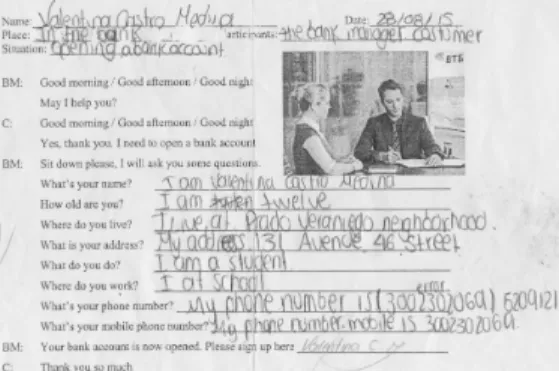
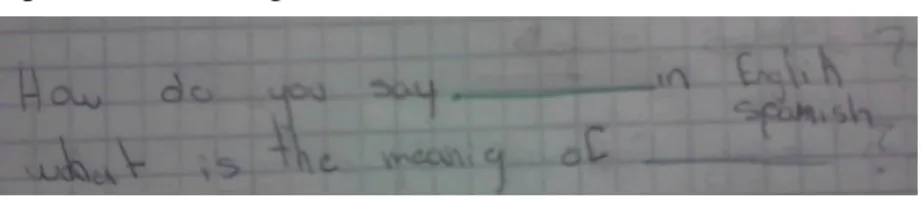
(13) 13 TABLES AND FIGURES. Table 1 Units of Analysis ......................................................................................................... 48 Table 2 Interrelation of categories and subcategories for the current research project............ 57 Figure 1: A student using his mother tongue to express the words heard in English .............. 59 Figure 2: A student says that he is able to comprehend general ideas from videos and songs 60 Figure 3: Students express that activities help them to learn vocabulary and pronunciation .. 61 Figure 4: A student’s opinion on learning vocabulary and pronunciation through role plays . 62 Figure 5: PowerPoint presentation about countable nouns ...................................................... 62 Figure 6: Student’s answer to a survey about resources that help to improve English (Annex 9). 64. Figure 7: U2’s “With or Without You” video song with subtitles ........................................... 64 Figure 8: Student’s answer to a question on their music likes ................................................. 64 Figure 9: Basic oral interaction in a bank account situation .................................................... 66 Figure 10: Students express that the teachers’ help improved their vocabulary learning ........ 68 Figure 11: The importance of teacher’s correction revealed by a student ............................... 68 Figure 12: Basic common expressions used in the classroom ................................................. 70 Figure 13: A student expresses that contests helps him learn and practice what he learns ..... 71 Figure 14: A student’s opinion on teamwork with his classmates ........................................... 72 Figure 15: Teachers-researchers motivate students by giving positive feedback .................... 72.
(14) 14 Figure 16: A student highlights the importance of the teacher’s corrections .......................... 73 Figure 17: A student’s reflection on the importance of listening to each other ....................... 74 Figure 18: A student’s opinion on his and his classmates’ behavior during English class ...... 74.
(15) 15 CHAPTER ONE 1. Context and problem In order to develop this project, the researchers give a detailed summary in terms of the internal and external context, about the target population; some cognitive, socio-emotional, cultural, and linguistic characteristics, and a description of the research problem as follows. 1.1. Context Prado Veraniego School is located in the north of Bogota at Prado Veraniego neighborhood; therefore, it belongs to the district of Suba, the 11th locality in Bogota. This is a public school with two shifts: morning and afternoon, from Monday to Friday. In the physical aspect, the school is composed by two branches, one for primary school and another for fifth to eleventh grades. For the English classes, Branch A (Sede A) has an English Room, equipped with a smart board, a video beam, a computer, and a television. The school focuses all its actions towards the human development, for which the educational community assumes quality as a way to proceed and the continuous improvement as the strategy to develop effectively the Institutional Educative Project (PEI, for its initials in Spanish): “Quality communication towards human development” (Institutional Educative Project, PEI, 2014). On one hand, the mission of Prado Veraniego School is to build and strengthen, in the educational community, cognitive, social, and practical processes oriented to the training of competent human beings through communication with quality; this, in order to interiorize values inside the classes that encourage a healthy coexistence among the school population. On the other hand, the institutional vision is to position itself at local and national levels in 2016 as an institution that prepares committed people to their human development, who.
(16) 16 continue their academic learning and lead positive social changes, making possible a harmonious coexistence that allows the construction of a fair and solidary country. The pedagogical model adopted by Prado Veraniego School is Social Cognitive, whose major exponents are Piaget, Makarenko, Reigeluth, Bruner, Vygotsky, Bandura, Feuerstein, Ausubel, Novak, Freinet, and Freire (PEI, 2014). The school paradigm refers to knowledge and learning as social constructions that evolve with every experience, allowing the maximum and multifaceted development of students' capabilities and interests. To develop the school PEI and the pedagogical model proposed, it adopts a curricular organization based on cycles. These divide the students’ academic processes into five stages as follows: the first one that goes from preschool to second grade (ages between 5 and 7 years old); next, the second cycle is composed of the third and fourth grades (students’ ages from 8 to 10 years old). Students in fifth, sixth and seventh grades are part of the third stage (between 10 and 12 years old). Eighth and ninth graders belong to the fourth cycle (from 12 to 15 years old); and finally, the fifth stage goes from tenth to eleventh grades (ages between 15 to 17 years). In this study, the population is framed in the third cycle; therefore, according to Secretaría de Educación del Distrito Capital, the objectives in language development deal with processes of inquiry and experimentation in order to use the language with social interaction purposes, as well as to help students to build possible worlds through the improvement of their language skills. (Guzmán, Varela, and Arce, 2010) For this reason, students at this school take English classes for three hours per week in high school from sixth grade to ninth grade; in tenth and eleventh grades, students only have two hours of English class..
(17) 17 The school syllabus of English is based on the Basic Standards of Competences in Foreign Languages: there is a guiding question, topics, achievement indicators, strengths, and improvement strategies. In the case of seventh grade, the guiding questions centers the school work on “the city” as the immediate students’ context to reflect upon daily situations in life. In regard to the topics that the syllabus shows, it proposes grammar affairs (like simple present, present progressive, verbs to be, to do, to have, can, etc.) and vocabulary themes (such as sports, description of places, food) that aims at developing the language skills through different real situations, including the comprehensive reading ability. 1.2. Population The characterization of the group was made during the second semester of 2014 based on the observation registered in field notes and a survey (see Annex 1). The population of this study is composed of two groups of seventh graders at Prado Veraniego School, 701 and 702 respectively. The whole group consists of 79 students: 38 boys and 41 girls aged between 11 and 14 years old; most of them live in Prado Veraniego neighborhood and others in Ciudad Jardín Norte, a close neighborhood. The great majority of students belong to the third social stratum and some to the second stratum. To obtain a broad understanding of this population, they were characterized from a cognitive, socio-emotional, cultural, and linguistic perspective, as follows. According to cognitive characteristics, the majority of students are in the right age to study on this cycle, since the age of students in the third cycle (6th and 7th grades) varies from 10 to 12. All of the students attend to classes on a regular basis; however, their performance in class differ from one group to the other. On one hand, the 701 graders tend to avoid participation, class work is evaluated depending on the exercises they do; thus, participation just consists in sharing.
(18) 18 their homework and exercises with their classmates. In 702 grade, on the other hand, participation is not remarkable, as only a few students participate and work in class, even though almost all of them have books to work with. During classes, most of the students are able to concentrate in their activities; nevertheless, there are some who are not able to do it, and sometimes talk, which could be considered as a normal behavior, since preadolescents are at a stage where socializing and forming groups is important in their development (Guzmán et al., 2010). Students’ lack of concentration could be also caused because some of them do not bring the school implements and thus, they have to walk around their desks trying to find what they need, in order to complete the activities. It is important to mention that students like to watch movies, play games, and talk during the English class. Moreover, many of them expressed that they preferred listening activities while others expressed their preference for speaking and writing ones. Regarding Piaget’s stages of cognitive development (in Wadsworth, 1996), he states that children from 11 years on (until their adulthood) are in the Formal Operational Stage. At this point, children are able to think about abstract concepts and come up with creative solutions to different problems, hypothesize, and manipulate ideas in their heads, which leads to more sophisticated and advanced thinking (like metacognition, or the ability to think about their own and other people’s ideas), not having perceptional nor physical constraints for doing so. With regard to socio-emotional characteristics, students have an appropriate relationship among them, yet sometimes they scream and yell at each other. Their relationship with the teacher reflects in some instances lack of respect. Most of them live with their families (mother, father, and siblings), and there are a few ones who live with other family members..
(19) 19 According to the Morning Day Academic Coordinator (see Annex 2), one of the biggest problem of the students is the fact that their parents are often absent of their educational process. There are some students who do not pay attention in class due to their indiscipline and lack of listening disposition, which affect English classes considerably. As stated by Guzmán (2010), students of the third cycle (5th – 7th grade) are in a transitional stage where changes in their way of socializing and feeling towards others are changing; in this stage, same gender groups of friends grow stronger, where they get a sense of belonging, which ultimately strengthens their self-esteem. Likewise, in this stage, the preadolescents start to feel attracted towards other people. Regarding cultural characteristics, most of the students like Physical Education and Computer Science subjects as well as others like Arts and Biology; some of them like English and Spanish classes. In regard to their hobbies, students like listening to music, using the computer and surfing the net, playing videogames and football, as well as watching TV and talking to their friends (inside the school and outside through social networks like Facebook), among other activities. Talking about linguistic characteristics, it is relevant to highlight that during the observation period (second semester of 2014), students in 701 grade were learning vocabulary such as food, professions, sports, and objects of the house. They were learning the morphological part of words through lexical activities like word search games and drawing the words; nevertheless, this vocabulary was neither used in a communicative level nor in a meaningful way for them, since they did not create their own phrases. Besides, they did not have a proper listening comprehension level, which might be caused by their lack of vocabulary and the lack of listening activities that could enhance this skill; either way, this issue made translation into.
(20) 20 Spanish mandatory most of the times. In the case of 702 students, they lacked of writing activities, because they just jotted down what the teacher wrote on the board and followed her instructions about what to write; when it came to speaking, students were capable to pronounce some words clearly, and even short sentences with their teacher’s guidance; thus, their accuracy and fluency was quite poor. Moreover, students’ listening skills in English were not evidenced, as it was necessary for their teacher to translate almost everything she said in the classroom. At that moment, students were using simple present tense through the implementation of different activities such as short stories -read by the teacher- which included comprehension tasks, writing, and creating sentences based on their own reality, and so on. According to the Standards, in terms of the listening skill, seventh graders should be able to comprehend short texts (like descriptions of places and people) with certain level of difficulty on daily routines and students' social environment, as well as understand the general ideas of a narration. Likewise, related to the speaking skill, students at this level should be able to express their thoughts, likes, and feelings with simple vocabulary, as well as making simple presentations with comprehensible pronunciation and participating in simple communicative situations, such as greeting and apologizing. Moreover, in regard to the reading skill, students should identify the meaning of words depending on the context, extract general and specific information from a short, easy text. Furthermore, in relation to the writing skill, students should be able to write short texts in which they narrate stories and describe things and people that are close to their social environment. Finally, this is an EFL group because English is not the country main language and English is only taught as a foreign language, according to Oxford University Press ELT (2011),.
(21) 21 English as a Foreign Language is when the language is taught to people whose mother tongue is not English and who live in a country English is not the main or official language. 1.3. Diagnosis The diagnosis of this study is based on the observation process in two groups of seventh grade, developed in two phases. The first one was held during the observation process in the second semester of 2014; the second, made during the first school period (February of 2015). In the first phase, the observations were registered in field notes, which took into account the students’ performance on their speaking skill, an interview to the English homeroom teachers, and two diagnostic tests that were applied to the students in order to check their performance in the listening, writing, and reading in English as a foreign language. The first test was based on a Cambridge University listening test for children in basic (starters) and ten questions were selected from that test with the purpose of determining the students' listening skill level. The exam intended to identify if students were able to understand short and simple dialogues in simple present and present continuous tenses; these dialogues were presented in a slow rate of speech and were based on basic vocabulary such as objects and parts of the house, food, and clothing (see Annex 3). The second test was based on the school syllabus, which took into account the Standards, and it was composed of a set of fifteen questions, including a short reading. Firstly, for the writing skill, the test aimed to identify if students were able to describe their daily routine using at least four phrases, and secondly, for the reading skill, it proposed -literal and inferentialquestions in order to determine the students’ reading level. The diagnostic tests in this study were carried out to determine the level of students in the mentioned skills. The levels were determined according to the number of questions answered:.
(22) 22 high level if the students answered between 80 to 100% of the questions, medium level for 60 to 79%, and low level for scores from 0 to 59%. The results of the listening comprehension test revealed that only one student had a high level, which means that only him was able to understand dialogues that used simple present and present continuous tenses easily; four of them had a medium level, meaning that they partially understood dialogues and managed somehow vocabulary such as food, clothing, and parts of the house; the rest had a low level, that is to say, they were not able to understand short and simple dialogues in simple present and present continuous tenses, even if they were uttered in a slow rate of speech and used basic vocabulary. Besides, the students not only had a low level in their listening skills, but they also had problems with listening to each other. For example, during an activity in which some students were answering different questions posed by the researcher, other learners were talking among themselves and did not even try to listen to their classmates’ answers. Therefore, it was seen that, apart from the difficulties evidenced in the listening comprehension skills, the students also had difficulties at a pragmatic level, since they did not always follow a social code of behavior when communicating (see Annex 4). With respect to the reading skill, the test had a short text with four literal questions and one inferential question. The results evidenced that there were few (6) students who reached a high reading comprehension level, some (14) were in a medium level, and the majority (57) of the learners had a low level. Only few (17) of them answered the inferential question, which showed that it was difficult for a big number of students to recognize literal information in a text, and very few were able to identify the implicit information of a text. In reference to the writing skill, it was observed that just a few students (13) were able to express their ideas in full.
(23) 23 sentences, and the rest of the learners answered the writing part of the test in Spanish or did not answer at all. Additionally, in regard to the speaking skill, it was observed that students were not able to answer basic questions related to themselves. For instance, they could not answer questions about their names, ages, or likes, with complete sentences, and when they understood the questions, they answered in Spanish. “They lack the vocabulary necessary and the practice in common communicative situations such as getting to know another person and presenting oneself. Even when the questions were explained in Spanish, they were not able to speak or answer the questions and used Spanish to answer them” (see Annex 4). Besides, when asking to the English homeroom teachers in an interview about students’ speaking skill, they said the lack of listening caused a low speaking performance (see Annex 5). On the other hand, on the second phase of the diagnostic process, developed throughout the first academic period of 2015, two diagnostic tests were applied in order to corroborate the results obtained in the first phase, bearing in mind the English syllabus of the school. Firstly, a listening test was applied to confirm the students' current level in this language skill; it was based on a listening exercise from the students’ current book Easy English 6. Taking into account some achievement indicators from the Standards, the exam was divided into three parts: the first one evaluated students’ word recognition capability by a fill-in-the-blank exercise in two short paragraphs; the second one revised the comprehension of an oral description of people’s physical appearance; and the third part intended to determine students’ ability to identify specific information in a short oral presentation. It is important to mention that it was implemented after helping students to familiarize with the vocabulary uttered in the oral presentation, with the aim.
(24) 24 assuring that the lack of vocabulary would not interfere with the assessment of the listening skill (see Annex 6). Besides, the second test was composed of a set of eleven questions, divided into two parts: the first one aimed to assess the writing skill by evaluating if students were able to describe people through the use of short phrases as the Standards suggests for students of the third cycle, and the second one aimed at evaluating some vocabulary that the students were supposed to manage, in this case, some adjectives used for describing physical appearance and some verbs managed throughout the first school period (see Annex 7). The results of the second phase of this diagnostic process shows that regarding the listening skill and taking into account all the questions as a whole, only eight students out of seventy-four that took the test were in a high level, which means that they were able to understand oral descriptions of people, identifying the general topic and relevant details of a short oral presentation; some of them (17) were in a medium level, meaning that they could only reach those achievement indicators in a partial way, whereas the majority of the students (49) were in a low level in their listening comprehension skill, which indicates that they could not reach those goals. Analyzing the listening skill in detail, it was found that some students (17) reached a high level when recognizing words from a short oral presentation; few of them (10) had a medium level in word recognition, and the majority (47) were in a low level when recognizing words. Besides, the results showed that it was easier for students to understand people's descriptions when the vocabulary was familiar to them; in this way, thirty-six students were able to understand the description, nineteen were able to do it partially and the other nineteen were not able to understand it. In regard to identification of details in a short oral presentation, few of.
(25) 25 them (12) reached a high level, eleven reached a medium level and the majority (51) were in a low level. Furthermore, the results of the second test evidenced that with respect to the writing skill, the majority of the learners (48) were in a low level, and were not able to use short phrases to describe themselves; some of them (14) reached a medium level, describing themselves partially using short phrases; and some (14) had a high level, which indicates they could successfully describe themselves using short phrases. Finally, in relation to their vocabulary knowledge, the great majority (64) were in a low level, seven students achieved the medium level, and only four students had a high level. 1.4. Statement of the Problem Based on the data gathered throughout the observation process, the use of field notes to register those observations, the diagnostic tests, an interview answered by the English homeroom teachers, and a survey answered by the students, it was determined that, in fact, most of the common problems inside the classroom, and specifically in the English classes, are related to the listening and as a result, their speaking process and their capacity for learning the language were reduced. As stated in the diagnosis, the majority of the students (67%) are in a low level in their listening comprehension skill, some (23%) are in a medium level, whereas only few students (10%) are in a high level, becoming almost mandatory to address this problem to help the pupils to improve in their English language learning. Besides, the listening process is a big issue for these students in their English language development, due to the fact that they lack practice on how to pay attention to what their fellows and teacher say; some students do not often follow the teacher’s directions when doing activities, and some also interrupt when a peer is answering a.
(26) 26 question, which end up hindering their learning process as well as the development of their language skills. The lack of listening comprehension makes that almost everything during the classes is translated into Spanish, hindering thereby the internalization process of the language, because Spanish, and not English, is used for classroom interaction. Besides, as explained in the diagnosis, students are not able to communicate using English, as they cannot answer simple questions about themselves, such as “How old are you?” or “How are you?” In addition, both homeroom teachers agree on their students’ listening skills as the most difficult ability for them to work on, since they are not usually able to concentrate on listening, and the weakness in this skill make more difficult the development of the other communicative skills including speaking. In the same way, the teachers also say that students are not able to learn a foreign language in the no-listening-to-each-other condition that they live every day in their classrooms. Bearing in mind that, the main purpose of the language learning process is developing the ability to interact with other people using the target language, it is pertinent to give learners the ability to communicate by enhancing their listening and speaking skills. Consequently, it is considered that the creation of communicative activities with real input provided by technological resources will help to create a meaningful environment where students will be able to develop their communicative skills. As Richard (2006) states that a language can be easily learned through the process of communicating in it, and that meaningful communication for the learner provides him with better opportunities to learn the language; thus, communicative activities are expected to help students to enhance the use of English, and more specifically to improve their listening and speaking skills, which are at the core of the communicative methodology..
(27) 27 Besides, Rost (2011), from a neurological perspective, explains that listening occurs when language perception and processing is carried out, which only occurs when the listener’s model of the surrounding world is activated. He explains that this model is related to other factors in language learning experience, and it is constructed from perceptual contact with external events, in this case, communicative activities based on oral input. Likewise, Swain (2000) mentions that correct development of the listening capability requires an extensive exposure to L2 input, but he goes on to say that successful language learning requires opportunities for output, that is to say, to enhance as well the development of speaking skills along with the listening ones. Furthermore, according to Zhang (2009), EFL teachers should provide rich listening input that contains familiar vocabulary and pronunciation, as well as useful models of culture and interaction styles, which consequently help the learners’ emergent speaking to be modeled upon this input. Moreover, it is considered that the use of technological resources is going to help the students to develop their listening and speaking skills, because as the learners stated in the survey, most of them like activities related to videos and songs; as stated by Pozo (2008), students' interests makes it easier to focus their attention on learning materials, and in the case of developing listening skills, it is mandatory to help students to focus their attention on the input managed in class. As Rost (2011) explains, attention and consciousness are key factors necessary to initiate and achieve both listening and speaking. All in all, this study considers that addressing students’ difficulties regarding their listening and speaking mechanisms will help them to improve their learning processes, and to strengthen the development of communicative skills in English as a foreign language..
(28) 28 Considering that communicative activities might help to tackle these problems, the following research question leading the study is stated: 1.5. Research Question What is the impact that communicative activities, in a meaningful environment supported by technological resources, has on an EFL group of seventh graders’ listening and speaking skills at Prado Veraniego School? In order to answer the research question stated above, the following general and specific objectives were also set: 1.6. Main Objective To identify the impact that communicative activities, in a meaningful environment supported by technological resources, has on an EFL group of seventh graders’ listening and speaking skills at Prado Veraniego School. 1.7. Specific Objectives . To propose communicative activities supported by technological resources with the aim to strengthen students’ listening and speaking skills.. . To determine students’ insights in respect to the use of communicative activities on their listening and speaking processes.. . To establish the relevance of working within communicative contexts in order to strengthen students’ communicative performance.. . To identify how communicative activities supported by technological resources provide students a meaningful environment of learning..
(29) 29 1.8. Justification Taking into account that this study intends to address the difficulties observed in seventh graders’ listening and speaking processes through the implementation of communicative activities supported by technological resources, this following section aims to give strong reasons why this study is developed. It is considered that this study is pertinent at Prado Veraniego School, as it intends to support the school Institutional Educative Project PEI (“Quality communication towards human development”) by integrating it with communicative activities supported by technological resources; thus, creating a proper environment of interaction that not only helps to develop basic listening and speaking skills by using English as a foreign language, but also benefits social and human cooperation. Thus, communicative activities are seen in the current study as a possible tool that may help to strengthen Prado Veraniego students’ communicative and social skills, since communicative language teaching fosters students’ development of communicative and interactional skills (Littlewood, 1981). On the other hand, Guzmán, Varela, and Arce (2010) affirm that students on the third cycle (from fifth to seventh grades) are in a period of transition where socializing and forming groups are very important for their social development. Likewise, the authors state that language should be used to learn and should not be separated from its communicative function, since language is internalized through its use. Consequently, these aspects of socialization and communicative interaction specified for the third cycle are expected to be addressed in this study through the use of communicative activities..
(30) 30 Moreover, in terms of the field of language teaching and learning, it is believed that the current project would be useful to address students’ listening and speaking skills. In this case, it is important to clarify that listening for this research is not only seen as a linguistic skill, but also as a communicative skill where the individual listens attentively to others, valuing the other as a person. Hence, it is the wish to go as deeply as possible into this problem so that this study could bring about new possibilities for Colombian teachers to boost up the listening and speaking skills in the EFL classrooms..
(31) 31 CHAPTER TWO 2. Literature Review Taking into account that the main problems evinced throughout the observation process to the population of the current study are related to students’ listening and speaking skills, and this intends to address these issues through the implementation of communicative activities supported by technological resources, this research takes into consideration some previous researches that have addressed these issues in similar EFL contexts. 2.1. State of the Art Research on students’ listening and speaking process has been conducted extensively; for instance, Romero (2010) conducted an action research project regarding the development of listening skills in an EFL classroom through task-based approach, specifically, the use of songs, which required some contextualized and authentic materials. As results, the improvement of not only the communicative listening skill, but also the reading, speaking and writing, were perceived in her study. Hence, her statements are important for this study, since she used technological resources, specifically songs in English, to help students improve their listening skill. Thus, the use of songs in her study was helpful, as students’ music likes catch their attention and create a comfortable English learning environment. However, Peñaloza (2012) focused her study on the improvement of eighth graders’ listening and speaking skills with the use of artistic projects. She states that this technique has not been deeply explored in the language field, which allows her not only to reach the goal of developing students’ communicative skills but also helps them to develop their creativity through working on projects. Besides, she highlights that identifying learners’ interests is a helpful step to involve students in teaching and learning processes. Therefore, her contributions are very helpful.
(32) 32 for this study, as it takes into account the use of artistic media (like music and short videos) chosen by the researchers and students to boost up the development of their basic listening and speaking skills, including the importance of these skills for their everyday life inside and outside the classroom. Furthermore, Romero’s (2011) findings are important for this project, as she intends to develop communicative skills based on cooperative working and cartoon videos; she declares that group activities actually worked through interesting TV cartoons for students, that led students to be conscious about other ways to learn a foreign language. She observes that the use of videos in class is useful for students, as it helps them to recognize the relation between spoken words and the images presented. Moreover, regarding the listening skill, she indicates that it is important to select acoustic materials that have familiar vocabulary for the students. These indications serve for this study as it tells that audio-visual texts help students to understand and learn vocabulary easier and also, that it is necessary to elaborate pre-listening activities that allow students to become familiarized with the vocabulary they will hear during the exercises. Furthermore, it should be highlighted that this project was able to develop the four communicative skills in a way that listening, speaking, reading, and writing were integrated in language learning activities efficiently. In addition, Cruz (2014) gives great importance to the use of technological resources, especially videos, as they are a very useful tool for the learning-teaching process, which caused her target population (first graders) to be more involved in the English classes by participating, interacting, and developing communicative skills. Additionally, in terms of the listening and speaking skills, she used on-line songs in order to improve their levels on these skills, resulting in a very successful way of teaching EFL, since students learned contextualized vocabulary and.
(33) 33 came up with short phrases. This study is relevant for the current research since it provides some tools and proofs that listening and speaking can actually be improved in a context where the implementation of communicative activities is difficult. 2.2. Theoretical Framework As mentioned in the previous chapter, this study is based on specific constructs: listening and speaking processes, communicative approach as language approach, and technological resources. A review on the theory that surrounds these concepts was done to provide a stronger ground to this study. This section comprehends the notions that some authors have on each specific element. 2.2.1. Listening Along with speaking, listening is a fundamental part of language learning and communication, and helping students to develop these skills is necessary if they are going to use the foreign language in a communicative way. In terms of the listening processes, Anderson (1985) and Levelt (1993) in Lynch (2009) affirm that spoken language processing is developed into three stages: first, the perception of ‘input’, which refers to the verbal (significant and insignificant noises) and non-verbal information (facial expressions, gestures) that the listener perceives. Second, the ‘decoding process’ which is associated with the significant elements that the listener hears; some of this information is directed to the short-term memory and to different parts of the brain cortex where the mind recognizes significant items in regard to the language levels (phonological, lexical, semantic, and syntactical), originating an interpretation of what the speaker expresses; in order to comprehend what the speaker have said, the listener takes into account as well what the listener knows about the speaker: accent, age, sex, attitude, status, the knowledge they share with each.
(34) 34 other, and so on. And third, the ‘output’, which consists in the production of an appropriate response to the speaker (that might be verbal and/or non-verbal). In addition, Lynch (2009) mentions three stages that cover the listening processes basing their description on Levelt’s model of spoken communication: Recognition, which basically consists of all the aspects previously described on the Information Processing theory. Next, Interpretation, that represents the understanding of what the speaker has just said, in terms of the context (when, where, how, why, what, who… is speaking), the background knowledge, or schematic knowledge, perceived through the listener’s perspective in a schema, or “a mental structure consisting of relevant individual knowledge, memory and experience, which allows us to incorporate what we hear into what we know” (Anderson & Lynch, 1988, p. 139), and the sociocultural knowledge (or cultural background), including aspects like religion, customs, and linguistic elements like sayings or proverbs. Finally, the Participation stage closes the listening process, in which the highlighted topic is the “two-way listening, also known as reciprocal, interactive, bi-directional, or conversational listening” (Lynch, 2009, p. 60), as well as the negotiation of meaning, defined by Lynch as the way of adjusting what and how we say things to make these understandable for the listener by monitoring our speech. Furthermore, Segalowitz (2008) in Rost (2011) affirms that the basis of spoken language comprehension is recognizing words in fluent speech, and the developing automaticity in word recognition is a crucial aspect of first language acquisition and second and foreign language learning. Cutler and Broersma (2005) in Rost (2011) manifest that word recognition is a process that involves not only identifying a word during the listening task, but it is also related to recognizing lexical units and boundaries within larger phonological groupings. That is to say, that phonological words and lexical phrases are recognized amidst phonological units such as.
(35) 35 intonation units or phonological phrases and utterances. This explanation shows as well that word recognition includes identifying the boundaries that exist among words in speech, taking into account that there are not identifiable pauses between words when a speechmaker speaks fluently, as there are in written language. Hence, as speech is processed essentially in a sequence (word by word), word recognition has the fundamental goal of locating the beginning of the immediate succeeding word or lexical phrase; in this sense, words are accessed from the mind lexicon through the sounds that initiate the word. Rost (2011) uses Morton’s (1969) Logogen model to explain the word recognition process, which declares that each person has a neural representation for each word he has stored in the long-term memory, hence, Morton names the representation of the word ‘logogen’ (for genesis of the word). It is considered that each word has a resting level of activity in the brain, and this level of activity can be increased by the contextual information that surrounds the word during the interaction; in this way, every logogen has a threshold that helps the mind to recognize the word when reached. Taking into account that every word has a resting level of activity, words that have phonetic similarity get activated during the phonological perception, and the word is only recognized above the others when all other contenders are excluded either by phonological or contextual evidence, or both. Rost (2011) points out that subsequent models added the notion of feature inhibitors which helped to explain the process in real time; word recognition is accelerated by eliminating the competing words that would infringe the phonotactic rules of the language. It is important to mention that the threshold of the logogens is related to word frequency, which means that if a word is more frequently used or heard, it would be activated easier in the mind of the listener; thus, it is important for foreign language teachers to.
(36) 36 help students interact with the oral language, since the more familiarity the learner has with a word, the easier he will recognize it when listening. Up until now, it has been explained the first part of word recognition -the identification of words and lexical phrases-, but it is just the surface of the process of recognition as when the word is validated; in the listener’s mind the knowledge associated to those words and phrases gets activated. In this way, word recognition is more than remembering a single sense of a word. As Rost (2011) enounces, word recognition summons a frame for the word, which includes its admissible word forms, its principal sense or lemma, grammar likelihood for its usage, as well as other associations of semantic meaning such as collocations with other words, case relationships and extended senses. The activation of these word frames helps language comprehension in two ways: firstly, the syntactic information that becomes available for the listener helps him to predict new words that could be uttered by the speaker, thus, providing new constraints for the recognition of subsequent words as it narrows the possibility of hearing words that are out of the logical context of the utterance; secondly, it helps language comprehension because it provides meaningful information for understanding the utterance as a whole, taking into account that words become semantically linked in the short term memory. All in all, this theoretical description on the listening process is quite important for this study, as it shows some aspects that were unknown for understanding, in a clear and precise way, what happens inside the listener’s mind when the listening processes take place, as well as other pragma-linguistic elements that surround the listener and affect the comprehension of a message. Thus, this theory helps the researchers to design strategies that could help to solve the listening problems evidenced in the target population..
(37) 37 In this way, it is important to create a propitious environment where students can be constantly exposed to English input through songs, videos, and the classroom interaction; as it is stated previously, the phonological excitation patterns will become automated in the learner’s brain through experience with stimuli. In the same way, the design of listening activities will allow the students develop strategies to recognize words and lexical units easier; to do so, students first will have pre-listening activities that allow them to become familiarized with words and lexical units, taking into account that the recognition of words is directly related to word frequency. Then, the comprehension process of the input will be guided by questions and exercises that will help them recognize words and boundaries among them, as well as understanding specific and general ideas of the aural texts they came across. The activities in the proposal are going to help the students to identify contextual information as well, such as who, where and when is speaking. Finally, these activities will serve as a model and input that would allow the students to use the vocabulary and structures learned in a communicative way. Apart from the previous theoretical background on the listening skill, the following one about the speaking skill is given. 2.2.2. Speaking The speaking skill can be defined as the ability to produce utterances (communicate) with an intention and a purpose; that is to say, what a person genuinely wants to communicate in order to achieve a particular objective, which can involve expressing opinions, ideas, wishes, as well as negotiating, solving problems or establishing social relationships like friendships (Harmer, 2002). In that sense, Levelt (in Bygate, M., 2001) explains that speaking is composed of 4 main processes: in the first place, conceptualization, which is the process of planning the content of.
(38) 38 the message. This process is based on the knowledge the speaker has on the background, the topic, the communicative situation, and discourse patterns. The second process is formulation, which allows the speaker to organize his ideas by deciding on the appropriate words and phrases he will use in order to express the intended meanings, and placing them as well in a grammatical and discursive sequence; it is also the moment where the speaker prepares the speech sound patterns. In the third place, the articulation relates to the actual use of the articulatory organs (tongue, lips, teeth and so on.) In the last place, self-monitoring deals with the mind capacity to monitor speech and allows the speaker to identify and correct mistakes in real-time. Bygate (2001) clarifies that these four processes happen very fast and almost simultaneously, and they must be automated in the speaker’s mind in order to be able to speak and interact efficiently in real time. This is so, because the human brain does not have the attentional capacity to focus consciousness in each process at the same time. Besides, Bygate explains that development of fluency, accuracy, and complexity in the learner speech cannot take place at the same time, and class materials and activities must focus on the improvement of one or two of them at the same time. Bearing in mind that the population of this study is in a basic level of their English learning process, this study considers the theory proposed by Littlewood (1981) which explains that in order to bridge the gap between fluency and accuracy, pre-communicative activities can be used to help the learners to learn and automate the partial skills needed in communication, as it will be explained further on. Likewise, other details regarding the speaking skill will be provided in the following section. Moreover, as Communicative Approach is a very important concept for this study, its theoretical background is given as follows..
(39) 39 2.2.3. Communicative Approach In regard to the Communicative Approach (also known as Communicative Language Teaching), Mitchell (1994) explains its origin: it appears after the World War II, when people started to feel more interested in learning foreign languages with different purposes (like access to higher education, business etc.), due to the economy growth and the drastic changes in the educational systems around the world. In the 1960s and 1970s especially, this phenomenon was extended in order to improve the education for people in general, regardless their social strata or their education. Therefore, some drastic changes in the curricula (by adding active and experiential modes of learning, which are very different from the traditional one, the inclusion of new population into the language learning process, and the interest for the learning outcomes) were implemented and created new pressures and expectations in the teaching of foreign languages. Moreover, Mitchell (1994) states that there is still a lot of debate on the classroom activities that could make a communicative methodology recognizable. However, he summarizes three aspects that have to do with the educational process in schools: the first one states that the classroom activities should maximize the use of the target language by the learners, including their attention on tasks and messages rather than on correctness; the second one explains how normal and counterproductive making errors is in the learning process, and the third one explicates the importance of extensive experiences in the target language use rather than grammatical explanations and language analysis. In relation to the communicative approach, the concepts of linguistic competence and linguistic performance arise. As Brumfit and Johnson explain (1979), on the one hand, the linguistic competence “is understood as concerned with the tacit knowledge of language.
(40) 40 structure, that is, knowledge that is commonly not conscious or available for spontaneous report” (p. 7), which means that having a sort of an explicit, innate theory is the reason why one can understand and create infinite sentences. In other words, this has to do with the grammaticality that a sentence can have; moreover, its acquisition requires the suitable environment in which the child lives. On the other hand, the linguistic performance has to do with the use of language that a person makes in certain situations, which might also be the reflection of the competence previously mentioned. These processes, from Brumfit and Johnson’s perspective, have been affected by the social interaction that people have. It means how acceptable a sentence can be. Littlewood (1981) explains that CLT intends to help the learner to use the language to communicate meanings and ideas effectively and appropriately. To achieve this goal, the learner must develop four broad domains of his or her communicative competence: firstly, the apprentice must learn to manage the linguistic system to the extent of using it flexibly and spontaneously so as to express a determined message. Secondly, the student must be able to relate the linguistic forms to the communicative functions they perform. Thirdly, the learner must develop a social awareness that helps him or her to use socially accepted language forms and vary his speech if necessary to suit diverse social situations. And fourthly, the pupil must gain specific communicative strategies that help him or her to use properly language in specific social situations, for instance, using feedback to avoid or correct misinterpretations. Littlewood (1981) asserts that when learners are in a basic level they must develop a set of partial skills of communication before they are actually able to use language communicatively and interactively. He suggests a set of pre-communicative activities which allow the learner to develop the partial skills of communication without actually demanding him to executing communicative acts. In this way, these activities aim not only to assist the student to learn.
(41) 41 linguistic forms and vocabulary, but also to help him develop links between the linguistic structures learned and the functional meaning they perform, which will later enable him to use language for communicative purposes. Besides, the pre-communicative activities intend to help the learner to relate the structures and vocabulary learned to the actual use of language in social contexts and non-linguistic reality. Thus, the activities in the current proposal should be designed in a way that exercises reflect a real environment of communication, giving the students the opportunity to practice the language forms recently acquired with exercises that would be realistic communicative acts, and in social situations they might come across in their future. Also, it is important to mention that pre-communicative activities should be created with the intention of regulating the linguistic requirements made on the learner, to gradually develop the linguistic competence that is the base for the communicative competence. In reference to this study, it is important to mention the previous aspects, as they guide the process are going to be developed throughout the implementation. Furthermore, since technological resources is another construct taken into account in this project, its theoretical background is given as follows. 2.2.4. Technological Resources Area (2009) states that technological resources, in the context of education, are devices with specific material support (such as hardware) that convey information that is codified by means of symbolic systems and forms that provide the student a learning experience. He also asserts that digital media used as didactic material allows teachers to use, create, and combine different formats of information such as textual, visual, auditory, and iconic; thus, creating a more meaningful environment for learning. Furthermore, depending on their use, technological.
Figure




+7




Documento similar
Experiments showed that MARS models have the ability to control the impact on the user while increasing the profit by varying the weights associated to the considered attributes.. It
To limit the impact of transport on animal welfare, in an effort to reduce the exposure to hazards and related welfare consequences, it is recommended to consider that:
To limit the impact of transport on animal welfare, in an effort to reduce the exposure to hazards and related welfare consequences, it is recommended to consider that: motion
It is important to highlight that in some cases the school and political capital accumulated, as in the case of Ati’s campaign for the Senate of the Republic, and a collaborative
Considering this, the aim of this study is to examine notions about participatory methodologies among elementary and secondary school teachers in the Biobío Region of Chile at
The aim of this paper is to demonstrate that reading authentic literary material in the English as a Foreign Language (EFL) classroom can improve students’ language learning skills as
Validation is an important feature in any method of measurement because it is closely related to the quality of the results. A method of analysis is characterised by its
Each one of these constructs refers to the impact of IT on each one of the eight TQM dimensions shown in Figure 1: impact of IT on top management support, impact of IT on
