
Social affective strategies in EFL self confidence
100
0
0
Texto completo
(2) Note of acceptance: _________________________________________ _________________________________________ _________________________________________ _________________________________________ _________________________________________ _________________________________________ _________________________________________ _________________________________________ Accepted date ___________________________________________ Study Advisor’s signature ___________________________________________ President of the Evaluation committee’s signature ___________________________________________ Committee Member’s signature ___________________________________________ Committee Member’s signature. ..
(3) FORMATO RESUMEN ANALÍTICO EN EDUCACIÓN - RAE Código: FOR020GIB. Versión: 01. Fecha de Aprobación: 10-10-2012. Página 3 de 100. 1. Información General. Tipo de documento. Trabajo de Grado. Acceso al documento. Universidad Pedagógica Nacional. Biblioteca Central. Título del documento. Social affective strategies in EFL self-confidence(Estrategias socio afectivas para la confianza en Inglés como lengua extranjera). Autor(es). Páez Socha, Abelardo Andrés. Director. Rojas López, Ronald Andrés. Publicación. Bogotá. Universidad Pedagógica Nacional, 2017. 95 p.. Unidad Patrocinante. Universidad Pedagógica Nacional.. Palabras Claves. TASK BASED LEARNING, SELF-CONFIDENCE, SOCIAL AFFECTIVE STRATEGIES. 2. Descripción El presente trabajo realizado en la institución Rafael Bernal Jiménez ubicada en Bogotá, Colombia describe un proyecto que hizo uso de la investigación acción para analizar el impacto de la aplicación de estrategias socio afectivas en la producción oral de los estudiantes en un aula de inglés como lengua extranjera. La implementación buscaba dar cuenta de los cambios que pudiera generar la aplicación de este método sobre la confianza en la producción oral de los estudiantes. Para ello se diseñaron tareas de habla que permitieran a los estudiantes participar en el proceso de aprendizaje, y cuya finalidad radicaba en promover la confianza en el momento de enfrentarse a la producción oral en lengua extranjera entre los estudiantes. Los resultados arrojados por la implementación fueron analizados desde una perspectiva cualitativa a través de tres instrumentos de recolección. Los resultados fueron reportados y analizados en la última parte de este documento.. 3. Fuentes. Brown, H. D. (1977). Cognitive and Affective Characteristics of Good Language Learners. Paper Presented at Los Angeles Second Language Acquisition Research Forum, UCLA. Brown, H. D. (2000). Principles of Language Learning and Teaching. Fourth edition. Addison, Wesley Longman..
(4) FORMATO RESUMEN ANALÍTICO EN EDUCACIÓN - RAE Código: FOR020GIB. Versión: 01. Fecha de Aprobación: 10-10-2012. Página 4 de 100. Burns, A. (1999). Doing Action Research in English Language Teaching: A Guide for Practitioners. Routledge Taylor and Francis group. Chamot & O’Malley. (1996). Implementing the Cognitive Academic Language Learning Approach (CALLA). Ed. R. Oxford Manoa: U of Hawaii P. Cole, D., Ellis, C., Mason, B., Meed, J., Record, D., Rosseti, A., & Willcocks, G. (2007). Teaching speaking and listening: a toolkit for practitioners. Bristol: portishead press. Creswell, S. (2014). Research Design. Qualitative, Quantitative and Mixed Methods Approaches. Sage Editions. Hendrickson, J.M. (1980). Error correction in foreign language teaching: Recent theory, Research and practice. In Croft, Kenneth (Ed.), Readings on English as a Second Language. Second Edition.Winthrop. Intihar, Natasa. (2006) The Internet TESL Journal. Vol. XII, No. 11. MacIntyre, P. D., & Gardner, R. C. (1991). Investigating language class anxiety using the focused essay technique. The Modern Language Journal, 75(3), 296-304.. Nunan, David. (2002). Designing Tasks for The Communicative Classroom. Cambridge. Cambridge University Press..
(5) FORMATO RESUMEN ANALÍTICO EN EDUCACIÓN - RAE Código: FOR020GIB. Versión: 01. Fecha de Aprobación: 10-10-2012. Página 5 de 100. 4. Fuentes. Krashen, Stephen. (1987). Principles and Practice in Second Language Acquisition. Practice Hall-International. Krashen, Stephen. (1997). Foreign Language Education. The Easy Way. California: Language. Education Associates Muhren, A. 2003. Total Physical Response (TPR): An Effective Language Learning Method at Beginner/Intermediate Levels. home.planet.nl/ ~mhren000/tpr/primer_tpr.pdf Long and crooks. (1992) Three Approaches to Task-Based Syllabus Design. TESOL. quarterly 26:1: 27-55 Nattiez, Jean-Jacques. (1990). Music and Discourse: Toward a Semiology of Music. Princeton: Princeton University Press. Maslow, A. H. (1970). Motivation and personality. New York: Harper & Row. Maley, A. and Duff, A. (1982). Drama Techniques in Language Learning. Cambridge: Cambridge University Press. Oxford, R. L. (1990). Language learning strategies: What every teacher should know. Boston, MA: Heinle & Heinle. Park, G. (1994). Language Learning Strategies: Why Do Adults Need Them? University of Texas, Austin. Perilla, Nelson. (2015). The Influence Learning Strategies Related to Autonomous Work Have in EFL Intermediate 1st Students Oral Communication at Language Center. Universidad Pedagogíca Nacional. Bogotá. Colombia. Rubin, Joan. (1981). The Study of Cognitive Processes in Second Language Learning. Appplied linguistics 2:127-131.
(6) FORMATO RESUMEN ANALÍTICO EN EDUCACIÓN - RAE Código: FOR020GIB. Versión: 01. Fecha de Aprobación: 10-10-2012. Página 6 de 100. 5. Fuentes. Secretaria de Educación del Distrito. (2015). Aulas de inmersión: ´Yes´ al Inglés! Available in http://www.educacionbogota.edu.co/sitios-de-interes/nuestros-sitios/agencia-demedios/noticias-institucionales/aulas-de-inmersion-yes-al-ingles. Scott, Wendy A., & Ytreberg, Lisbeth H. (1992). Teaching English to Children. Longman. Tudor, Ian. (2001). The Dynamics of Language Classroom. Cambridge University Press. Vygotsky, L.S. (1978) Mind in Society: The Development of Higher PsycholUNIogical Processes Great Britain: Harvard University Press. Willis, J. (1996). A framework for task-based learning. Harlow, U.K. Longman AddisonWesley. Zheng, Y. (2008). Anxiety and second/foreign language learning revisited. CJNSE/RCJCÉ, 1(1), 1-12.
(7) FORMATO RESUMEN ANALÍTICO EN EDUCACIÓN - RAE Código: FOR020GIB. Versión: 01. Fecha de Aprobación: 10-10-2012. Página 7 de 100. 6. Contenidos. El documento fue dividido en 8 capítulos de la siguiente manera:. Capítulo 1: Introducción En esta parte se describió el contexto general en el que se enmarcó la investigación, la población con quien se aplicó, el planteamiento del problema, la justificación del proyecto, así como la pregunta problema y los objetivos establecidos para la implementación.. Capítulo 2: Marco teórico Este capítulo describió conceptos y teorías tomadas como base para la construcción de la propuesta y la revisión de investigaciones elaboradas previamente que presentan puntos en común con este proyecto.. Capítulo 3: Metodología de investigación Aquí se describieron aspectos importantes en relación con la metodología como el enfoque investigativo, la técnica de recolección y tratamiento de los datos, y los indicadores a ser analizados.. Capítulo 4: Propuesta pedagógica Este apartado describió la propuesta pedagógica en general, da a conocer su enfoque, las etapas de implementación, el tiempo en el aula y las actividades que fueron desarrolladas..
(8) FORMATO RESUMEN ANALÍTICO EN EDUCACIÓN - RAE Código: FOR020GIB. Versión: 01. Fecha de Aprobación: 10-10-2012. Página 8 de 100. 7. Contenidos Capítulo 5: Análisis de datos Se presentaron los resultados obtenidos y analizados durante el proceso de implementación en función de las categorías y los indicadores expuestos anteriormente.. Capítulo 6: Resumen de resultados Se hizo una exposición general de los resultados obtenidos en el análisis de cada una de las categorías.. Capítulo 7: Conclusiones Se realizó un balance de cada uno de los objetivos planteados para el proyecto y de los aprendizajes obtenidos de la intervención pedagógica.. Capítulo 8: Recomendaciones generales Por último, se dio una serie de sugerencias pedagógicas, investigativas y disciplinarias dirigidas a los diferentes actores del proceso pedagógico en la institución y en la universidad..
(9) FORMATO RESUMEN ANALÍTICO EN EDUCACIÓN - RAE Código: FOR020GIB. Versión: 01. Fecha de Aprobación: 10-10-2012. Página 9 de 100. 8. Metodología Teniendo en cuenta la implementación y sus resultados, se llegó a las siguientes conclusiones: La aplicación de tareas de habla garantizó a los estudiantes el hacer uso de la lengua extranjera ya que les permitió involucrarse en actos comunicativos en los cuales enfrentaron desafíos relacionados con el acto de hablar, pero se necesitó implementar ciertas estrategias socio afectivas para que los niños estuvieran motivados, confiados de sí mismos y con bajos niveles de ansiedad para que su proceso de aprendizaje tuviera éxito. Los estudiantes más inseguros en términos de habilidades de escucha y habla sintieron una mejora considerable luego de la aplicación de las tareas de hablas, al mismo tiempo mejoraron su auto confianza en términos de uso de la lengua extranjera. El investigador aprendió y reflexionó sobre las ventajas y las desventajas en la implementación del aprendizaje por medio de tareas de habla, también aprendió la importancia de la preparación de clases como una forma de ejecutar de manera apropiada las tareas en clase. El investigador reflexionó también sobre las implicaciones que conlleva el trabajar con niños.. 9. Conclusiones Teniendo en cuenta la implementación y sus resultados, se llegó a las siguientes conclusiones: La aplicación de tareas de habla garantizó a los estudiantes el hacer uso de la lengua extranjera ya que les permitió involucrarse en actos comunicativos en los cuales enfrentaron desafíos relacionados con el acto de.
(10) FORMATO RESUMEN ANALÍTICO EN EDUCACIÓN - RAE Código: FOR020GIB. Versión: 01. Fecha de Aprobación: 10-10-2012. Página 10 de 100. hablar, pero se necesitó implementar ciertas estrategias socio afectivas para que los niños estuvieran motivados, confiados de sí mismos y con bajos niveles de ansiedad para que su proceso de aprendizaje tuviera éxito.. Los estudiantes más inseguros en términos de habilidades de escucha y habla sintieron una mejora considerable luego de la aplicación de las tareas de hablas, al mismo tiempo mejoraron su auto confianza en términos de uso de la lengua extranjera.. El investigador aprendió y reflexionó sobre las ventajas y las desventajas en la implementación del aprendizaje por medio de tareas de habla, también aprendió la importancia de la preparación de clases como una forma de ejecutar de manera apropiada las tareas en clase. El investigador reflexionó también sobre las implicaciones que conlleva el trabajar con niños.. Elaborado por:. Abelardo Andrés Páez Socha. Revisado por:. Ronald Andrés Rojas Lopez. Fecha de elaboración del Resumen:. 10. 10. 2017.
(11) TABLE OF CONTENTS RAE__________________________________________________________________3 ABSTRACT___________________________________________________________13 CHAPTER 1 RESEARCH CONTEXT _____________________________________ 13 1.1 Population and Setting _______________________________________________ 15 1.2 Needs Analysis_____________________________________________________ 18 1.3 Statement of the problem_____________________________________________ 25 1.4 Research Question___________________________________________________28 1.5 Research Objectives (General-Specific)__________________________________28 1.6 Rationale _________________________________________________________ 28 CHAPTER 2: THEORETICAL FRAMEWORK _____________________________31 2.1 State of art ________________________________________________________31 2.2 Self-confidence____________________________________________________ 34 2.2. Social affective strategies____________________________________________32 2.3 Speaking tasks_____________________________________________________34 CHAPTER 3: RESEARCH DESIGN _____________________________________ 37 3.1 Type of study _____________________________________________________ 37 3.2 Method of research_________________________________________________ 43 3.3 Context of study ___________________________________________________45 3.4 Researcher’s role___________________________________________________45 3.5 Instruments and procedures __________________________________________47 3.6 Validity and Reliability _____________________________________________ 47 CHAPTER 4: PEDAGOGICAL DESIGN _________________________________ 50 4.1 Pedagogical approach______________________________________________ 50 4.2 Vision of language__________________________________________51 4.3 Vision of the classroom________________________________________52 4.4 Chronogram_________________________________________________55 CHAPTER 5: DATA ANALYSIS ______________________________________58 5.1 Procedures for data analysis ________________________________________58 5.2 Data analysis ___________________________________________________ 59 5.3 Motivation______________________________________________________60 5.4 Self-confidence__________________________________________________65 5.5 Anxiety________________________________________________________69 RESULTS ANALYSIS ______________________________________________72 CONCLUSIONS ___________________________________________________73 GENERAL SUGGESTIONS__________________________________________75 REFERENCES ____________________________________________________ 77 APPENDICES _____________________________________________________80.
(12) LIST OF TABLES AND ANNEXES TABLE 1. List of projects to support the literature review ANNEX 1. Informed consent form ANNEX 2. Field Notes sample.
(13) ABSTRACT. The aim of this action research project was to examine the impact of speaking tasks in a group of EFL students at school Rafael Bernal Jimenez in Bogotá, Colombia. After having identified that the students were not using the target language to speak and there were not any activity related to this ability, a set of speaking tasks were proposed, to deal with that situation and they were implemented during the year 2016. That implementation aimed to document the changes, the application of this approach had over the students' oral production. In order to do that, speaking tasks were designed based on music, poems, songs and slides to present to the students with the purpose of creating a familiarity with the language through social affective strategies. The data analysis showed the students’ perspectives to approach their language learning process; it also showed that the students showed little exposition to EFL; and the use of social affective strategies related to motivation, self-confidence and anxiety with the purpose of helping them completing speaking tasks. The proposed tasks evidenced that as long as there is a positive environment to learn and a systematic way to get them involved of the process, speaking tasks will connect them with EFL and they find a real communicative purpose to learn a foreign language.. KEY WORDS TASK BASED LEARNING, SELF-CONFIDENCE, SOCIAL AFFECTIVE STRATEGIES, MOTIVATION, ANXIETY, SPEAKING TASKS..
(14) Chapter 1 Research context Nowadays, the development in communicative abilities in English as Foreign Language (EFL) is seen as a principal goal for different educative institutions, the secretary of education in Bogotá has established a resolution in which they have created some spaces inside the school known as “immersion rooms”. They consist of exposing students to foreign languages in a very cultural way in order to foster their communicative abilities, especially in speaking and listening skills. In spite of the implementation of this project in Bogota, it was observed in a public institution that those immersion rooms were not accessible for the students in elementary school. The “immersion room” was only implemented in the high school grades. Due to the importance of having an early process of learning in a foreign language, English is a necessity to the institutions since the students are in their first years of school. In relation to the number of students in the public education in Bogotá, the “immersion rooms” are not enough for the entire population that is studying English as a foreign language (Secretaría del Distrito, 2015) It is important to know that the school where took place this research is an elementary school, which has the beforementioned characteristics in its relationship with EFL. For example, the “immersion rooms” are a strategy to get involved the students with a foreign language, however this strategy to learn English in natural ambiances is only implemented in secondary school, losing the opportunity in early stages with the students..
(15) For this reason, the aim of this project is to describe how a group of second grade students, who are in the process of learning the basic levels (A1) of English as a foreign language, experiences their first contact with EFL. Finally, the way they are exposed to the language is addressed using images, matching and drilling exercises excluding other methodologies and approaches for teaching English in a non-grammatical way, thus the students demonstrate learning of some vocabulary. In addition, other objectives include providing the students with some tools for being able to achieve a communicative competence in English as a foreign language, which it is to say, first, making what the students learn inside the classroom meaningful and emotional and second fostering social interactions among pairs and the head teacher. These two visions take into account the fact that the complete dimension of learning a new language has not only a grammatical perspective but also is a tool for representing the world and creating social relationships. (Widdowson, 1983) Making meaningful and mediate social interchanges are interdependent for the necessity of direction in the young learners, when sometimes the written direction must be supported with other elements such as images, slides, short-stories to reveal to the students the purposes of learning English and showing a clear message. For instance, the oral speech is used for giving at the same time a complete message with specific intention and supported by the corporality and the expression. Francois Waquet (2003), mentions the importance of oral expression with all its characteristics representing a more complete message to the listener. He also states that in terms of the individual capacity of understanding social phenomena and how the written or the oral utterances are not primordial for depicting a scenario in which there is an interaction between two subjects..
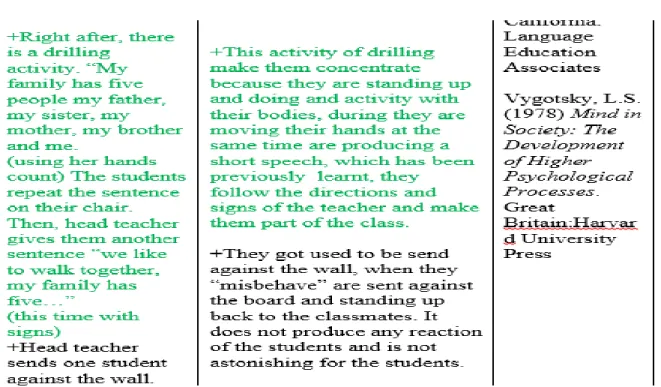
(16) 1.1.Population and setting This study is located in the central western zone of Bogotá in an elementary public school in the urban area of twelfth District called Rafael Bernal Jimenez. It was made between 2015 and 2016. The institution has two branches, and it is in branch “B” that the study takes place. There are 560 students in this branch of the institution who are just part of elementary education and defined by the CEFR as Basic A1 learners in EFL. The population involved in the research is a group of thirty-five students between six and eight years old, twenty are girls and fifteen are boys who are in morning shift second grade of elementary school, in socio-economic terms they take part of 1 to 3 strata. Inside the classroom, the students are divided into four rows, three of them are double seated and the others are sitting in individual positions. As the classroom is a big space that allows movement, the students tend to go to other seats and play around, they also go in front of the classroom to play and talk while the students of the individual line go to the other lines to talk and interact with their classmates. The classroom permits to do activities in which the can move around and be standing, so the seating arrangement and the space inside the classroom is an opportunity for the students to learn through the movement and to decrease the level of stamina and anxiety in the process of learning English. The students are in the process of learning English with an intensity of one hour per week; at the same time, in their mother tongue, they are focused on learning how to read and write in their native language. In these two simultaneous processes, they sometimes do not identify the graphemes in their own mother tongue; on the other hand, they try to pronounce in English the.
(17) words with the Spanish phonemes making no difference between English and Spanish in drilling activities, it is just when the teacher makes them repeat that the students pronounce in English. “Some of them are repeating the refrain others do not pay attention, the difference with the same activity in the last class is related with the position of the students, in which they repeat but not standing up of their seats. This produces lack of attention and disorder because some of them pay attention to their classmates or being quiet and passive” (Journal 2) They show a real interest when physical or drilling activities are proposed inside the classroom, they try to repeat every single word that the teacher says. In contrast, some of the directions are not in the foreign language; so the classes are carried out in two languages: Spanish and English and the language class are a process of vocabulary learning in topics such as family members and animals. They do not use the language for directions inside the classroom as “wash the hands” or “open the books”, it is based on the moment of the activity no matter what topic. (Video 1 2015) Observations inside the classroom were taken from different journals, which are organized according to date, problem/issue, notes making, notes taking and the back-up theory for supporting the comments. This model guarantees not only a simple list of events but also some perceptions and comments in the context, having as such a recording and one individual perspective of the phenomena inside the classroom (Burns, 1999). Furthermore, some videotaping was considering to analyse the impact of some oral activities and the seating arrangement inside the classroom..
(18) 1.2.Needs analysis The data recollected from the two sources, the journals and the video recording showed aspects of the classroom that represent interactive and real context learning issues, those aspects can be improved inside the classroom for guiding the learning process of the students in terms of content and social component of the foreign language. Taking into account these two aspects, the necessities are focused on the significance of learning English from the social affective component that students can find with their teacher and pairs; on the same hand, the relation of the content with their realities to emerge some confidence within students to be able to express their ideas in short oral productions or even to understand the world through the foreign language. First, the English class observations show that the use of English is evident in the moment of the activity lead by the head teacher, in which drilling and memorization are included in order to get students involved in their learning process. For instance, the repetition of a song about their families with some paralinguistic signs aims at evaluating their memory and their understanding of their realities, however, the students repeat a pattern that was taught and do not show how they live or understand their realities..
(19) Figure 1. Description oral production.. Commonly, inside the classroom some activities were essentially to keep the focus of the students. Besides the fact that they were using their bodies and their speaking drills. The purpose of this activity is to make them part of a mental process of memorization of some words related to their common activities and language. So, the head teacher said something aloud and make them repeat after to learn some vocabulary and utterances from English in order to make the students familiar with sounds and words in English. For instance, in this song: “Right after, there is a drilling activity. Teacher: “My family has five people my father, my sister, my mother, my brother and me..
(20) Students: “My family has five people my father, my sister, my mother, my brother and me” (using her hands count) the students repeat the sentence on their chair. Then, head teacher gives them another sentence “we like to walk together, my family has five…” (This time with signs) (Journal 4) Despite their concentration on the activity, they do not represent their individual experiences or have the opportunity to show others how they live. In the case of the family song, the missing aspects to be considered as one activity in relation their real lives, are the family context in which they live and how their reality can be connected to the content of the song. Assuming that all their families have a specific number and certain members, the song is including all in the same reality regarding the composition of one traditional family as it is shown in the journal but the learning process in this research tries to go beyond, the students express orally in a foreign language their actual context; for this reason they have to connect their individual realities with what they learn inside the classroom, representing their self-being and normal situations and perceptions. Each class has a worksheet assigned in relation to the drilling activity, the papers have the words and images to be matched, that is to say, students have to classify the words with a respective image or they have to form words from scrambled words and matching with their respective graphic representation. For instance, to learn animals they can have a bunch of flashcards with the words which are flipping in front of them to memorize in a process of repeating. The teacher says the word looking at the image and then they repeat. After that, a worksheet is given for all the students with the words of animals and the respective images to match in the written activity..
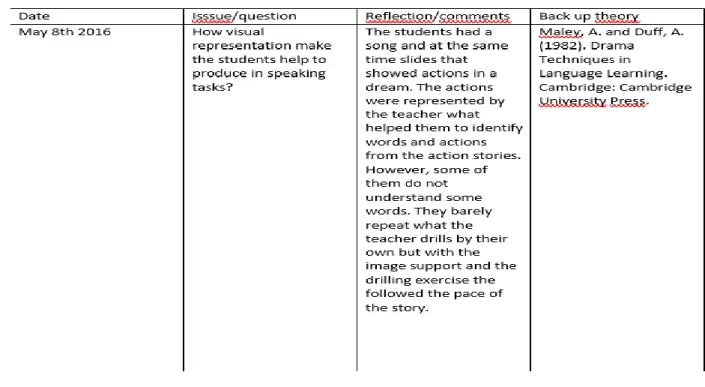
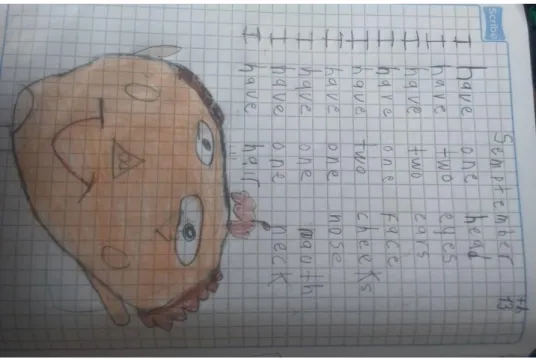
(21) As the vocabulary, sometimes is not directly related with their contexts, they do not identify at once what is the image related to the vocabulary given; such as wild animals which do not exist in a rural context or are not noticeable in their daily experiences. Therefore, they barely find a relation between their contexts and the contents included inside the classroom and how English can be used to communicate. In the materials made for evaluating the understanding and learning of the vocabulary, the aspects to be analysed are the relation of the animals with their common activities and the procedure used for assessing the effectiveness of the previous drilling activity. Seen in this journal:. Figure 2 Writing production to evaluate oral production. + “They work in the worksheet which has the image and the respective word of the image in disorder. The idea is that they had to organise the word. Some students do not identify the order in spite of the previous activity that was linked to the vocabulary in the worksheet.” (Journal 5) Firstly, the reason the students do not identify the animals, it is because they are not familiar with the words even in their mother tongue; considering the context in which they live that is in an urban area where they have never seen these kinds of animals. On the other hand, the assessment of the drilling activity does not follow the kind of tool used to introduce the topic to.
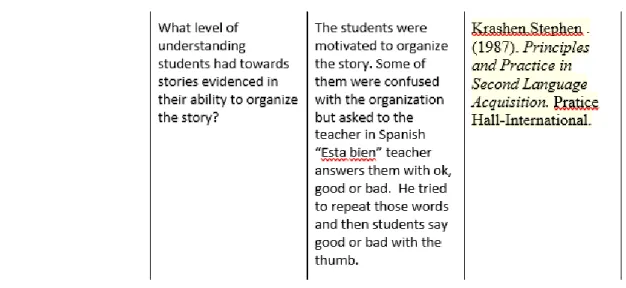
(22) the students; due to the speaking ability that is reinforced and used first in the activity when it is evaluated through a worksheet does not match with the oral way the students learnt previously the vocabulary. Therefore, repeating orally the words does not mean they could write what was repeated right at the beginning. The step between speaking and writing in a foreign language, it is a long process of constantly practice making the relation between graphemes and sound. That is evident in the following journals: Figure 3. Vocabulary for oral production.. The visual literacy helps them to understand signs and meanings that come from the culture and the conventions of a foreign language, fostering an effective reception of the message because of the universality of some graphic representations. So visual literacy becomes an element, in which images are susceptible to be understood by reading, interpreted and in terms of effective communication has some important contributions to the human perception some of them are delimited by three aspects: the attention that recalls the visual information, the efficiency of the message through images that can catch the attention in specific point and the effectiveness in the message because it goes directly to the senses (Wileman, 1993).
(23) “The teacher uses some images for showing the students some vocabulary in English related to animals: cows, birds, cats, dogs and horses.” (Journal 4) Otherwise, the images have to be chosen in order to maintain that universality in the image and instead of relating to a word, linking a context or situation in which the students have been involved in their experiences and memories, interacting with their families, their friends, their teachers and other familiar contexts: “The teacher uses a chair for sitting down and with the flash cards speak and repeat the animals that she is passing, the students repeat after her and sometimes mispronounced the words” (Journal 4 ) As a result, it is observed that the students show some features that cause a concern for the study: As learning English as a foreign language, some events have been observed in relation to the learning process. The students are learning in their mother tongue how to write and read, they have some activities in relation to reading and colouring images as they match the images and written words with some basic vocabulary that includes family, animals, colours, classroom objects. Furthermore, some of those activities have images and scrambled words to identify the image and the grapheme which are adequate due to their ongoing process in formal literacy. On the other hand, in spite of the communication with images, they are not familiar with the vivid experiences of the children, because in the content of the images there is not a direct relation to their experiences as children who come from diverse places, experiences, and settings. For instance, wild animals are not part of their realities and this vocabulary is included in the worksheet and activities of students, the ideal is to include some images and vocabulary which.
(24) concerns their realities to give them enough confidence to start their oral production even just to express some basic ideas. Hence, the visual language just has a momentary value and does not connect to their lifestyle and common experiences. Furthermore, the current direction of their learning process in EFL has evidenced that young learners are seen as students who have finished the process of their mother tongue acquisition; where English is a tool for learning some vocabulary in a quest to immerse young students to make a relation between images and phonemes or between phonemes and graphemes. The students are learning some words without the presence of a context or situation that introduce them in a foreign language standing on their common background, focusing on literacy just for reading and writing. But at this moment of the process a major concern is the oral recognition. Resulting from the activities proposed inside the classroom, the students do not use English among themselves or with the teacher; as a matter of fact the students just use English in the moment of the drilling activity with the teacher, but teacher and students use the mother tongue for communicating basic information that concerns all the students and the development of the class; even if the given information is related to directions to do an activity or give orders to the students, the target language is not used for interacting among the entities which are present in the process of learning the foreign language in this case, English. In conclusion, the usage of English inside the classroom gives to the student’s familiarity and the opportunity to learn how to express in the foreign language, the classroom can be a moment and place where the students learn some basic directions and essentials to keep growing in their.
(25) learning process through communication, contrary to the fact of learning English and expressing everything in Spanish. For instance: Video transcription: Head teacher: “vamos a salir y lavarnos las manos” “Saquen el cuaderno y busquen las guías” (Video 2 2016) English directions in young learners are part of their first ways to understand the foreign language, so they can get used to receive those commands in English to understand their functionality in their real interactions inside the classroom and how they can act towards those stimuli or messages creating a bridge between the subject in the school and a real interaction. 1.3. Statement of the problem Considering the dimension of language learning in which social interactions among the subjects; the importance of a social affective element has to be considered for enabling students to develop social skills, such as understanding their own realities and interact with others about their perceptions (Oxford, 1999). It permits the discovery of a direct relation between what is learnt inside the classroom and the student’s realities, fostering their confidence in the moment of expressing in English as the target language and creating links of communication among pairs and the teacher. Because of an analysis of these two considerations, most of the time the role of the student inside the classroom is limited to be a reader of the images and finding their correspondents in words, showing a language classroom centred in mnemotechnic activities which do not give them.
(26) the opportunity to represent the world in their own ways and their perceptions in a foreign language. In contrast, as long as the students can explore through the riddle of the daily discovering of a new language, they will find the reason and the sense of learning a foreign language. In that way, the language development of the students will be fostered through the social impact that a foreign language generates in the social interactions inside the classroom (Brown, 2000). On the same hand, the classroom is a space where various insights and perceptions are linked, therefore the students have their own participation in the activities to make a direct relation between their real contexts and the contents present day by day. So, the foreign language becomes a tool to express themselves with others and explore their perceptions which come from their immediate reality. Therefore, it is important to understand their stage of learning and the way of understanding the world, regarding the abilities to be developed and what is inherent at their age such as their short span of attention and their hyperactivity when emotional activities are not included in the classroom. The language and interests of young learners must be included in their learning in EFL for diminishing the level of anxiety (Scott & Ytreberg, Lisbeth, 1992.) Some reactions can be evident in the following observations: “+they cannot be quiet on their seats, plus they do not want to work on their class tasks. They do not have minimal periods of concentration, they are doing other activities: Walking around, talking with others and playing with pairs. Some students get sleep and some go to the teacher´s seat for telling her stories about their lives” (Journal 6) The analysis of videos and journals depicts what kind of problems can be problematic for the students to learn a foreign language and which aspects can be included to achieve an.
(27) improvement in this learning process. Some of the conclusions which emerged from this analysis lead us to the next step. Taking into account that students interweave their reality and the contents inside the classroom, they are able to create confidence in their production of a foreign language, which represents an inner interest from the students to discover. Thus, an active participation from the students in the classroom requires to empower themselves and make them aware of their role as main subjects of their learning process, giving confidence and the opportunity to speak inside the classroom. The ideal is to allow the active participation like a result of the aforementioned. In conclusion, teachers and students take part in an educational community, in which they create social links in a learning environment and represent the world through a foreign language (Vygotsky, 1978.) This sort of learning environment connects their emotions and desires where their daily lives and the contents inside the classroom create a bridge between language learning and social development. The research’s concerns are related of aspects of communication in which the language is a tool to give to the students the ability to express their perceptions and necessities in a foreign language; otherwise they do not start to understand as an opportunity to communicate with others in their first meeting with EFL and the significance for language can just be underestimated in order to be perceived like another subject that is mandatory and does not have any link with their ways of living as community. If the students do not have the opportunity of practicing with English, they probably do not want to learn the foreign language because it becomes a process that is not going to make any sense. They have to make their first step in order to represent or understand through a foreign.
(28) language their current reality in the way a kid can see the world, putting them at ease in their relation of English and avoiding a future reluctance towards learning a foreign language. 1.4.Research question What does the implementation of social affective strategies reveal about students´ selfconfidence in speaking tasks in an A1 EFL classroom? 1.5. General objective: . To analyse the impact of social affective strategies in student´s EFL speaking confidence with the second grade in the school Rafael Bernal Jimenez.. 1.6 Specific objectives: . To describe the attitudes and behaviours of the students inside the oral production tasks in EFL.. . To define the relation between EFL student`s oral production and the social affective strategies.. 1.7 Rationale In Bogotá, the learning English for different purposes, is considered essential an opinion which is common in many countries give English a character of “lingua franca” as part of the project of the nation to be included in the globalization phenomenon what affects in the worldwide perspective of culture and society (Brown, 2000).
(29) This awareness in the conception of English as the necessity for making business and international trade and marketing has a business interests; otherwise the context in which the language is learnt is ignored and puts aside the interests and perceptions of the participants of the learning process. Basically, understanding the immersion of a new language as the opportunity to facilitate the human relations of the context from the students and make them participant of the construction of their learning in EFL, what intents to give the students a global culture of mass media where English has a preponderant position like a tool of communication with many cultures. This kind of approach will impact their relationship with a foreign language that is not commonly used in any contexts in their real lives. They will be able to understand how EFL is used for communicative purposes and create social links. The social intention is to make the community aware of learning a foreign language like in a place to get different insights together and to participate in children’s reality. Students can empower themselves to participate actively according to their level of understanding of a foreign language, staring from signs and their relations with English to real interactions that give them confidence to keep growing their knowledge in relation to English. Students perceive English as a global language which is used inside their lessons and can represent simple actions that they usually do in the different spaces: the playground, the break, the school, the park. Besides, the fact that students depict the immediate world through the foreign language, the learning process in EFL affects other contexts in which the students daily live and observe in their real interactions with the mediate world, in contrast with lists of vocabulary that just want to.
(30) increase and encyclopaedic knowledge, giving an abstract vision of language of representation and lack of a bridge with student`s reality. The purpose of learning will not be limited to the interest of getting good grades at school, instead the students will recognize the production of a language as way to communicate ideas and to live the language through playing and speaking. Hence, the students can understand that language is not a limit to communicate because they will play and express themselves via body language and speaking tasks. In terms of the researcher-teacher, the research provides experience in the system of education to get used with the teaching EFL in local communities, to recognise their limitations and the opportunities to propose a different model that can solve the concerns that emerge from the daily labour. Besides, the conclusions that can result from the interactions with very young learners can document in researcher’s experience to understand their ways to learn, live and act towards a process of learning in a foreign language. On the other hand, for the school’s curriculum and syllabus the contents proposed can be enhanced in order to give different visions of language, classroom and learning, trying to innovate the way EFL is taught, to create a different ambiance of learning in the school. Specifically, this research wants to modify the teacher centered classes in which students participate actively and be considered as fundamental to create the contents inside the classroom..
(31) Chapter two Theoretical framework The purpose of this chapter is to present the theories that support this research. Such theories should be taken into account to understand the phenomena inside the classroom. This literature discussion starts with the studies in relation to learning affective strategies that present the necessity of children to express their thoughts and experiences. The students interpreted through their vivid contexts in order to reach low levels of anxiety and a huge level of confidence, which is the second concept to be defined. On the same hand, a portrait of speaking tasks is implemented for making the communication in the English classroom effective regarding an environment of reliability and self-determination in the students. 2.1. State of art The social affective strategies have been implemented in order to get the students engaged in the process of learning a second language, in which they are able to manage the anxiety in the moment of communicating in a foreign language. The studies have demonstrated that students who have low levels of anxiety, are able to have a better performance and can put the challenge.
(32) of learning a new language at ease (Parker, 2010) Ezana Habte-Gabr (2000) found in a study; interactions inside the classroom help the students in their learning process because of their necessity to bring their experiences and realities in the classes. As a result, the students generate a high level of confidence with the head teacher and the other classmates, including two aspects firstly being the social aspect and the affective in the path of learning a foreign language. These affective strategies have described some factors to take into account in the mental and emotional process of the students (Rossiter,2003) including conscious-raising activities and training in relaxation , visualization , positive self-talk , humour , risk-taking and monitoring emotions, which are considered primordial to the performance in the students regarding their relation between what is learned in English sessions and the realities in which they take part; resulting in the natural interaction in the classroom and the comfortability from the students in expressing their ideas. Confidence is one of the factors that can highly affect the performance of students in an EFL classroom. For instance, the studies have shown an elevated level of anxiety in relation to low results in students and low levels of anxiety in students who have successful results in learning a language (Al-Hebaish, 2012.) However not all the studies have demonstrated the direct relation between confidence and satisfactory results which it is attributed to the different factors which affect the process of learning. The factors, which affect performance in students regarding their confidence, have been mentioned as a subject with no much interest in the Colombian context (Mendez, 2011). Therefore, the emotions and feelings directly related to student´s performance in EFL showed a lack of interests in the studies and a starting point for finding probable strategies that come from.
(33) the solution in high levels of anxiety and unconformity to EFL learners. Hence, Mendez in her study shows that the responses and behaviours from the students come from personal and external aspects of the classroom that can boost or hinder their development in the learning process with regards to their confidence to speak their minds. These aspects are present in all sorts of performances of the students, as matter of fact the confidence that motivates the oral production in the students, makes fundamental the learning of a language considering the emotional aspects which come from outside that can interfere in the interest from the students to participate and increase their level of anxiety and discomfort with EFL. Since the studies in oral abilities have pointed out the speaking ability as one of the most challenging concerns to be implemented inside an EFL classroom. Many studies have focused their interests on finding the most effective ways for getting students involved; both from their ability to speak in a foreign language and creating relatedness with the contents through their socio-cultural aspects, which can transform social aspects of their realities (Perilla, 2015). With this concern in mind, the studies have demonstrated that the oral production can influence the social constructions which motivate the students to do an autonomous construction of their realities and motivate them to be actively part of their learning in EFL. These studies help to understand how social affective strategies were implemented inside the classrooms and which results can support this study, for instance, the confidence as one aspects that comes from within the students but it can affect the normal development in learning a foreign language, so the social affective aspects present one of the challenges inside the classrooms because of their double effect, from one part the success in the learning process and second in.
(34) student’s attitude toward learning foreign language. On the same hand, these concerns start a quest from how and what kind of actions in speaking production inside the classroom can solve the problem between English knowledge and comfortability from the students. This study as novelty has a group of students that have just learnt to speak Spanish and the idea is to create and ambience in which students get familiar with EFL, taking with them the first step to invite the students to freely express and participate in their learning process, getting rid of nervousness and making appealing EFL because of its connexion with student’s realities and oral instruction. 2.2 Self-Confidence Self-confidence is one of the learning factors that can affect directly the process of learning because of its effect in learning a foreign language. It can hinder or foster the abilities and motivate students to take risks and accept errors with more facility than a less self-confident person than can understand but not master different abilities to communicate and act freely toward the learning process (H.D. Brown, 1977). Self-confidence in students can increase or diminish the outcomes in the learning process of the students; even if the students would be able to express their ideas in EFL in a natural environment, there are some situations in which students can feel threatened. Regarding this emotional aspect of learning Krashen (1981) defines the low anxiety contexts as more effective for the learners in which traditional classrooms are not suitable because they hinder the possibility of having better outcomes and making a direct connection with more threatening contexts..
(35) In spite of the fact that the studies have ended up with different results, it is important to analyse the factors which influence the self-confidence in a learner’s performance; those categories correlated are considered by two authors first Krashen’s (1982) theory and Brown’s theory (2001) which are classified with the term “Affective Filter” that can evaluate some factors in relation to self-confidence to express in a foreign language. They include other factors which are narrowly related and implicit one from another. First, Krashen’s theory proposes three categories of analysis: Motivation, self-confidence and anxiety. First motivation as starting point for students to be immersed in what is learning in real time, finding a purpose and make the experience with EFL worthy, then self-confidence for speaking out their thoughts through the language production and their performance. Finally, anxiety which is considered as a determinant of having a low rate of production inside the classroom for getting better results in the final outcomes of students. On the other hand, Brown’s remarks in other items related to psychological and socio-cultural aspects in order to understand the language as a product of the societies and the learning process self-centred in the willingness of the learner and the empowerment. Bearing this in mind the author states four categories: language ego, self-confidence, risk taking and the language-culture connection. Language ego is connected with self-confidence in which learners have the reassurement of their ability to learn a new language. These two empower students to keep on track and make them curious towards the knowledge which have been learning. Secondly, risk taking is addressed to the decisions learners make for playing an active role in their learning, in which they take into account the common difficulties that a person commonly has in the moment of learning.
(36) and dispose of insecurities and fears regarding correction or evaluation. At last, the languageculture connection lets the students catch a glimpse of the socio-cultural dynamics through the language, in others words the language is a tool for having a big picture of the reality from its users in manifold such as their insights, visions, perspectives, lifestyles among others. Self-confidence is an essential point to be developed in very young learners as in adults for making production according to their level (Scott & Ytreberg, Lisbeth, 1992.) This consideration will affect the final outcomes and increase or decrease the effectiveness of the educative proposals that would be implemented. Therefore, the stage determines which activities are implemented and are in agreement with their individual, social, and cultural development; for very young children of an EFL classroom which is important concerning the use of oral input and visual input to develop their abilities in a foreign language. For instance, the visual aids for very young learners represent a tool to communicate ideas passing from the visual exposition to the EFL exposition, to create first a comprehension through signs and visuals. Then, the students had the opportunity to see and identify some words and vocabulary through images that represent the meanings, after to receive a auditive stimuli in relation to the words previously explored and finally to evaluate through the process of self-representation, identification or oral production. On the same hand, some presentations supported by images, songs, lyrics and vocabulary introduced to give them and idea what was the text talking about and which relation had with some situations in their lives or the stories presented inside the classroom. Both images and oral exposition intend to give them a total comprehension of the situation and to understand the contexts of the stories, songs, directions among others..
(37) Those strategies provide from more tools to get involved the students, intending to reduce the level of anxiety and difficulty of activities. Furthermore, increasing their interests on the tasks proposed inside the classroom, in which they can willingly participate as a group and playing with the language through oral production and metacognitive processes. 2.3 Social affective strategies These kinds of strategies are not in the direct process of learning the language, but they allow the learner to follow some steps to find the most effective way to understand the reality through a different language. Moreover, the learners are able to mediate the social interactions and the meanings using strategies as lowering the anxiety, maintaining motivation in relation with the affective part of learning (Oxford, 1999). Furthermore, affective learning strategies create a bridge between students who are in a constant relation with the society in which they live in, passing through their personal interactions and beyond their surrounded reality as in the relation with the system of beliefs of a culture, (Oxford, 1990) the relationships that can be evident inside a classroom among the subjects, who are part of the learning process, have been considered in the Colombian context a unique opportunity; The social affective learning strategies are those elements which students utilize for interacting in a foreign language to feel more comfortable; not only with their classes in a foreign language but also for laying down the social relations that permit them to create affective links with their pairs and all the subjects of the learning process (O’malley & Chamot,1990). Thus, the learners and teachers create a positive environment in which all the participants are able to express their ideas and contribute to self-learning and other learning processes..
(38) On the same hand, social affective strategies have as a main purpose student’s interaction with another person and a control of the affect in the learning process (O’malley & Chamot, 1990) what can foster in terms of listening comprehension in the students when spoken tasks are implemented. O’malley & Chamot (1990) find some strategies in the following kind of activities inside the classroom: “1. Cooperation, or working with peers to solve a problem, pool information, check notes, or get feedback on learning activity; 2. Questioning for clarification, or eliciting from a teacher or peer additional explanation, rephrasing, or examples; and 3. Self-talk, or using mental control assure oneself that a learning activity will be successful or to reduce anxiety about a task. (O’malley & Chamot, 1990, page 45). Those strategies can be implemented inside the classroom for a variety of studies and populations inside an EFL classroom, however as the first step for students in the classroom is considered as suitable the third point which states a mental control that can be used to reduce the anxiety resulting an anxiety reduction inside the process of learning a foreign language.. Those strategies include other techniques to find more effective applications inside the classrooms such as clarification/verification, monitoring, memorization, guessing/inductive inference, deductive reasoning, practicing, creating opportunities for practice and production tricks (Rubin,1981) the techniques provide a guide to elaborate speaking tasks to reaffirm the place of the social component in the process of learning a how it is directly connected with some cognitive strategies to develop a social language learner and user..
(39) 2.3 Speaking tasks According to Willis (2007) the speaking tasks have the purpose of encouraging students to talk more and say what they want to say, remarking the difference between activities and tasks. Therefore, tasks are not conditioned by what students have learnt in language patterns or how they master the language items. On the contrary they express their ideas in order to create a narrow relation with what they live and think from their vivid world, building a knowledge that is useful for their real interactions with the world. On the same hand, the purpose of those oral productions come from two purposes, first from the necessity for conveying information and for interacting to get on well with others. Harmer (1991) respectively defines them as transactional and interpersonal, these situations work simultaneously taking into consideration the communicative event in which they fit for being used by every single user in the speaking event. Hence, speaking tasks are part of the interactions through material inside the classroom that allow students to understand the object of what they are learning, students can see what are the objectives traced by the teacher regarding their personal development and attitudes through the tasks proposed.(Nunan, 2002). That is to say, learners speak out their minds in order to use their experiences and go deeper in their insights in an interactive construction with all the entities of the learning process. Speaking tasks are not unconnected activities one from the another, they have an interconnexion among them and do not forget the real purpose of learning the foreign language, however they use the purpose of completing a task instead of going directly to the interest of using EFL in the class(Willis,1996). It means to find strategies to facilitate and enable the.
(40) students to fill the gaps with their understanding and capabilities in a post-task, making a clear limit between an activity and task where the second its final purpose is to achieve meaningfulness in the process, regardless grammar and structured ways to achieve a task completion. For the research and the role of researcher mean having less control in the expectations, but in exchange a higher participation and motivation from the students who are the centre of the learning process creating unpredictable outcomes. Plews and Zhao (2010) synthetized from some authors the following principles from this speaking task implemented in various contexts and researchers: . Learners require exposure to the real (authentic) and varied language of speakers of the target language (often modified; always comprehensible). . Learners must be exposed to and use the kind of language that they want and need for their own interests or purposes.. . Learners must be provided with opportunities for unrehearsed and meaningful language use in purposeful interaction, where they take informed risks, make choices, and negotiate meaning while seeking solutions to genuine queries.. . Teachers ensure that activities are interconnected and organized with clearly specified objectives and promote the desire to learn.. . Teachers should elicit self-correction, enable personalized feedback, and consider learners’ individual developing language systems (interlanguage).. . Teachers must set learners activities that help them notice language forms; induction/discovery is preferable to deduction/presentation; teachers should (explicitly) instruct form in the context of activities where meaning is primary.. . The whole language (listening, speaking, reading, and writing) should be integrated..
(41) . Teachers evaluate learners in a formative manner and in terms of the process of achieving a goal; learners need to evaluate their own performance and progress.. From these principles, the activities are centred in the role of all participants inside classroom not only the teacher but also the student’s participation is part of learning process to construct ways of communicating and identifying their mediate reality..
(42) Chapter three Research design This chapter presents the nature of the research in terms of methods and how the issues in the population chosen are interpreted. In order to show the suitability of the project and the validity of the instruments used, there are some methods and instruments regarding the type of analysis and the population involved in the implementation. 3.1 Type of study This study is defined from the perspective of a qualitative research project, which has some specific development in the area of action research. Regarding the intention of the project to be included inside a classroom for understanding a social event and depicting a social situation through different subjectivities. The qualitative perspective is the way to get away of a stern and limited method for observing, analysing and reflecting the phenomena. As it is defined by Burns (2010) the qualitative methods intend to describe, clarify and interpret the social events in a naturalistic environment, that is to say, not to control the variables inside the classroom and for the researcher hypothesis, a constant transformation of the insights that are produced in the analysis and reflections during the steps of the process. Taking into account the previous aspect, as the qualitative research does not intend to find generalization or outcomes that can be applicable for every context, the qualitative way is the most suitable to this project because of located specific population which is studied through.
(43) social and cultural perspectives. Moreover, the intention is to put the concerns inside the classroom at ease, as a result finding out more effective methods for solving matters and figuring out the aspects that can affect an intervention, including methods defined by the researcher and the data analysis (Brindley, 1990) 3.2 Method of research This project has a qualitative nature in action research which is defined as the daily systematic collection of data in order to foresee possible changes which would affect social situations (Bogdan & Bliken 1982). This method takes into account different sessions for narrowing down the real purpose of the research, making the research a cyclical process that includes four steps in the intervention planning, acting, observation and reflection. Furthermore, the four steps of action research are taken for the understanding of the classroom events in relation to learning and teaching. Besides the action research is adequate to describe in a detailed report social concerns for the researcher because of its cyclical permits in the first place, planning the possible effects of an intervention, then acting and at the same time observing the phenomena presented in the classroom making reflections which include a feedback of what has been done inside the classroom (Kemmis and McTaggart, 1998). Notably, it becomes a building and rebuilding insights and perceptions, which due to the human component of the research flexibility is necessary, as a result the method makes a complete portrait of the situation regarding the moments and the space. Furthermore, these steps have not to be highly followed as a pattern, for instance according to Mcniff (1988) the four steps do not accomplish showing the events in an educational contexts with this intention, the author proposes to include a method that entails more steps for being.
(44) applied in the action research; exploring, identifying, planning, collecting data, analysing/reflecting, hypothesising/speculating, intervening, observing, reporting, writing and presenting, those possible steps that help the study to have a whole idea of what can be evidenced. That choice is made during the process of observation, fitting into the situation and the population who intervenes in the study. During the year and a half of work with the group of study, the first semester was a process of observation and construction inside the classroom, where some concerns in relation to communication in the target language and the usage of itself emerged. From these concerns, the researcher created a plan to intend to change the vision of language and student’s length of participation in their classroom. Then next semester, the teacher in charge gave constantly feedback of lesson plans of the research, that person evaluated and gave some comments to readjust. This feedback helped to reflect in terms of the core of the research, the research’s guide observed some classes to guarantee the coherence between what is proposed inside the classroom and the proposal implemented. The last semester, the implementation was according to the precepts and comments from the teacher who guides the research, however the lessons kept being planned and after there was a feedback and discussion between the researcher and the guiding teacher, considering new aspects for the following sessions. Then, the researcher created a journal to identify which issue, action and commentaries in relation to the reaction of students and the results in terms of oral production, taking into account the comments from the guiding teacher about aspects to be improved and strengths of the intervention.
(45) 3.3 Context of study This study is located in the central western zone of Bogotá in an elementary public school in an urban area of twelfth District. The institution has two branches, and it is in branch “B” that the study takes place. There are 560 students in this branch of the institution who are just part of elementary education and defined by the CEFR as Basic A1 learners in EFL. The population that is part of this research is a group of second grade in ages between seven and eight years old, including the whole group as a source of study. First semester when the students were observed, there were 37 students, next year in 2016, first and second semester there were 34 students due to the promotion of students to second grade and they changed their classroom to a smaller one. 3.4 Researcher’s role In qualitative research, it is important to neglect personal insights that affect the study, exploring some subjectivities and prior judgements have to be put aside from what it is observed inside the context. In this case, the researcher cohabits with the study and the context which has to be considered as positive contribution rather than detrimental (Locke, 1987) I have studied in public institutions since 2003, this item can give a character of emic and ethic (Nattiez, 1990) in which I have already experienced the English classroom in my public high school and how it affected my perceptions of learning a new language and now as externalinternal entity. Thus, I study in a public institution that carries out teaching and learning events in an EFL setting and as a practitioner inside the public institution of this study. Because of the direct relation with the study in my personal and academic background, I have some preconceptions and biases about the ongoing exploration in the public school. However, all the instruments will be used to keep away those biases that would be harmful for finding real.
(46) answers and outcomes of the study. In addition to this fact, the data analysis and the evidences will be showed to make the readers participants of the process of understanding the issue or situation analysed. In relation to the time to implement the research, the number of sessions per week were limited on just one hour with the target group what made more difficult the exposition time with the foreign language to get an immersion more effective. Furthermore, between the syllabus and the activities from the school, the students missed some sessions that were put off until the next week and in other cases cancelled because of the chronogram of the head teacher who needed some spaces to make reports from the progress of the students. 3.5 Instruments and procedures According to the suitability and the pertinence of the instruments for collecting data inside the classroom, this project will use some tools that are in relation to solve and evidence the concerns previously presented. The following lines considered the pros and cons of the instruments of the research, including an explanation of the selection of these strategies to depict a wide vision of the context for supporting the reliability of the description in the events through the vision of the researcher supported in manifold strategies. These strategies include observations, audio visual materials and documents (Creswell, 2014) The observation is an instrument that allows the recording of information at the same time of events in the context in which they are occurring. This is essential for the reflection upon the practices with prior collection of perceptions and sensations that are present in the intervention, afterwards, the researcher is able to reflect and analyse data. In contrast, the students can feel uncomfortable because the researcher is taking notes all the time which can affect their natural.
(47) performance inside the classroom, changing the possible outcomes of the observation. In spite of the fact that a stranger inside the classroom can be an intrusive instrument, students get used to a person taking notes in the classroom and it is considered as a novelty for some sessions. (Creswell, 2014) On the same hand, measuring the effectiveness of the instrument is based on the systematic model but simultaneously is a flexible tool, where the researcher writes and documents the attitudes and aptitudes of the actors involved in the classroom. Those observations have a foregoing question to be solved and a participatory intervention. (Burns, 1999). Secondly, the documents are the written proof of the ongoing process of learning because of its individual or collective elaboration process inside or outside the classroom. The written document is chiefly understood for the researcher as a tool that is susceptible to be analysed, implemented or reflected. Moreover, the register comes directly from the production of the students, representing a language and words of the participants. (Creswell, 2014) Lastly, the audio-visual materials give the researcher the opportunity to analyse real events one where the participants can share their reality in order to have a wider understanding of the phenomenon. In contrast, this sort of instruments can be disruptive and the answers of the participants can be influenced by the presence of a camera, tape recorder, among other devices. (Creswell, 2014) 3.6 Validity and Reliability The instruments which are used in this project aim at discovering the affective response of the students and their level of confidence through the different sessions in their speaking ability in EFL. These instruments will follow some procedures to ensure the accuracy of the outcomes..
(48) Moreover, the researcher backs-up the procedures with the vision in different researchers and authors (Gibbs, 2007) The three instruments, observation, documents and audio-visual materials framed through some particular procedures for convincing the reader of the accuracy of the interventions and the analysis of the information. Those procedures are the triangulation, clarifying bias, spending prolong time in the field and using an external auditor. (Creswell, 2014) They are mixed with the instruments accomplishing validity and the reliability. Those objectives realized through an observation of different issues that interfere with the learning process inside the classroom, having fundamental results for drawing a social and academic context which serve to the researcher with a particular insight of the local context and how it is a hint to understand the problematic that a public school has with the process of learning a second language. The understanding of the problematic was analysed through some categories which allowed to select the information in relation the categories of analysis, defining some guidelines to implement the sessions and scoping the attitudes and behaviours. That procedure let the researcher create a wide vision of the real problem aforementioned in relation the question research. In the following hierarchical structure is defined the guidelines of this research and the categories with their items to be observed:.
(49) CATEGORIES OF THE STUDY. Self-confidence. Self-monitoring. Oral eliciting. What does the implementation of social affective strategies reveal about students´ selfconfidence in speaking tasks in an A1 EFL classroom?. Motivation. Willingness to participate. Self-practicing. Anxiety. Reducing stamina. EFL performance.
Figure


+5


Documento similar
In the “big picture” perspective of the recent years that we have described in Brazil, Spain, Portugal and Puerto Rico there are some similarities and important differences,
In this sense the grouping of students with similar learning behavior could significantly help in the e-learning personalization, by the fact that the teacher can
The aim of this paper is to demonstrate that reading authentic literary material in the English as a Foreign Language (EFL) classroom can improve students’ language learning skills as
The analysis revealed significant differences in categories such as word count, clout, emotional tone, or analytical thinking when comparing the texts written by an
Taking into account that the tendency in Spanish schools is to establish a bilingual primary education system (Spanish and English), those students who do not major in English
The broad “WHO-ICF” perspective on HrWB provided at Figure 1 has a significant implication also for HRQoL. The develop- ment of ICF and its conceptual approach has challenged to
We can use/make students use the new technologies in the classroom in different ways: by using commercially developed language programs or activities on the web; by assigning
Our conclusion is that the main predictor for students grading learning in English or using part of the material in English is the previous basic knowledge on the subject, and of
