Communication
In Vitro Antimicrobial Activity of
Embothrium
coccineum
Used as Traditional Medicine in Patagonia
against Multiresistant Bacteria
Nicole Canales1, Iván Montenegro2, Mario Párraga3, Yusser Olguín4, Patricio Godoy5, Enrique Werner6and Alejandro Madrid7,*
1 Escuela de Tecnología Médica Facultad de Ciencias de la Salud, Universidad Central de Chile, Edificio Gonzalo Hernández Uribe, Lord Cochrane 417, Santiago Centro 8320000, Chile; [email protected]
2 Escuela de Obstetricia y Puericultura, Facultad de medicina, Campus de la Salud,
Universidad de Valparaíso, Angamos 655, Reñaca, Viña del Mar 2520000, Chile; [email protected] 3 Centro de Investigaciones Biomédicas (CIB), Escuela de Medicina, Universidad de Valparaíso,
Av. Hontaneda No. 2664, Valparaíso 2340000, Chile; [email protected]
4 Center for Integrative Medicine and Innovative Science (CIMIS), Facultad de Medicina, Universidad Andrés Bello, Santiago 8320000, Chile; [email protected]
5 Instituto de Microbiología Clínica, Facultad de Medicina, Universidad Austral de Chile, Los Laureles s/n, Isla Teja, Valdivia 5090000, Chile; [email protected]
6 Departamento de Ciencias Básicas, Campus Fernando May Universidad del Biobío, Avda. Andrés Bello s/n casilla 447, Chillán 3780000, Chile; [email protected]
7 Departamento de Química, Facultad de Ciencias Naturales y Exactas, Universidad de Playa Ancha, Avda. Leopoldo Carvallo 270, Playa Ancha, Valparaíso 2340000, Chile; [email protected] * Correspondence: [email protected]; Tel.: +56-032-250-0526; Fax: +56-032-250-0546
Academic Editor: Derek J. McPhee
Received: 29 August 2016; Accepted: 25 October 2016; Published: 31 October 2016
Abstract:Embothrium coccineumJ.R. Forst. & G. Forst is an evergreen tree that has been used as a folk remedy for the treatment of neuralgia, tooth pains, wound healing, and glandular conditions, as well as an antiseptic agent against bacterial infection. The antibacterial activities of sequential extracts (hexane, dichloromethane, ethyl acetate, and ethanol) from the leaves ofE. coccineumwere evaluated by means of the micro-dilution assay against six (Escherichia coli;Klebsiella pneumoniae;Proteus mirabilis; Pseudomonas aeruginosa;Staphylococcus aureusandStreptococcus pyogenes) multiresistant bacteria strains. Ethyl acetate extract showed the best spectra of antibacterial activity against all tested bacteria, and was analyzed by gas chromatography–mass spectrometry (GC-MS) for its composition. The results of the present work provide useful baseline information for the potential development and use of nanoparticles and/or nanofibers doped with extracts ofE. coccineumin the fight against multiresistant bacteria, which would allow the validation of the traditional use ofE. coccineumby native peoples of Patagonia as an antimicrobial agent in the biomedical Field.
Keywords:antimicrobial activity; sequential extracts; leaves;Embothrium coccineum; multiresistant bacteria
1. Introduction
Embothrium coccineum J.R. Forst. & G. Forst belongs to the Embothriumgenus in the family Proteaceae, which is an evergreen tree mainly distributed in the southern temperate regions of Argentina and Chile [1,2]. The aerial parts of E. coccineumhave been used as a folk remedy for the treatment of neuralgia, tooth pains, wound healing, and glandular conditions, as well as an antiseptic agent in various cultures, for example among the Aónikenk, Huilliche, Kawésqar and Yagan
people [3,4]. An earlier study by Mølgaard suggested that the ethanol extract ofE. coccineumdoes not exhibit significant antibacterial activity againstE. coliandP. aeruginosa[5], while in other studies it has been shown that extracts ofE. coccineumhave antioxidant activity because of their contents of phenols, flavonoids and anthraquinones, and molecules which were related to antimicrobial activity [6]. However, the available information concerningE. coccineumis particularly limited. Therefore, in view of the fact thatE. coccineumhas been widely used as a dermatologic drug [7], and therefore is likely safe and effective, and the importance of finding new anti-infective extracts to be loaded into or coated onto biomaterials, the aims of this study were to evaluate the antibacterial activities of sequential extracts from the leaves ofE. coccineumagainst Gram-positive and Gram-negative multidrug-resistant strains and determine the composition of the most active extract by GC-MS.
2. Results
2.1. Extract Yields
The sequential method adapted to obtain differentE. coccineumextracts was as follows: hexane (Hex), dichloromethane (DCM), ethyl acetate (AcOEt) and ethanol (EtOH). The highest yields were achieved with ethanol 12.62% (w/w), followed by hexane 5.49% (w/w), and dichloromethane 4.76% (w/w), while the lowest was ethyl acetate 3.55% (w/w).
2.2. Chemical Composition of AcOEt Extract
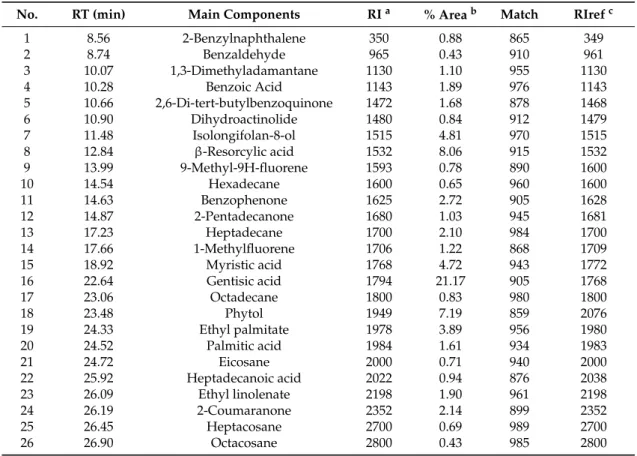
Results of the gas chromatographic analysis of ethyl acetate extract from the leaves ofE. coccineum are summarized in Table1.
Table 1.Main components of AcOEt extract.
No. RT (min) Main Components RIa % Areab Match RIrefc
1 8.56 2-Benzylnaphthalene 350 0.88 865 349
2 8.74 Benzaldehyde 965 0.43 910 961
3 10.07 1,3-Dimethyladamantane 1130 1.10 955 1130
4 10.28 Benzoic Acid 1143 1.89 976 1143
5 10.66 2,6-Di-tert-butylbenzoquinone 1472 1.68 878 1468
6 10.90 Dihydroactinolide 1480 0.84 912 1479
7 11.48 Isolongifolan-8-ol 1515 4.81 970 1515
8 12.84 β-Resorcylic acid 1532 8.06 915 1532
9 13.99 9-Methyl-9H-fluorene 1593 0.78 890 1600
10 14.54 Hexadecane 1600 0.65 960 1600
11 14.63 Benzophenone 1625 2.72 905 1628
12 14.87 2-Pentadecanone 1680 1.03 945 1681
13 17.23 Heptadecane 1700 2.10 984 1700
14 17.66 1-Methylfluorene 1706 1.22 868 1709
15 18.92 Myristic acid 1768 4.72 943 1772
16 22.64 Gentisic acid 1794 21.17 905 1768
17 23.06 Octadecane 1800 0.83 980 1800
18 23.48 Phytol 1949 7.19 859 2076
19 24.33 Ethyl palmitate 1978 3.89 956 1980
20 24.52 Palmitic acid 1984 1.61 934 1983
21 24.72 Eicosane 2000 0.71 940 2000
22 25.92 Heptadecanoic acid 2022 0.94 876 2038
23 26.09 Ethyl linolenate 2198 1.90 961 2198
24 26.19 2-Coumaranone 2352 2.14 899 2352
25 26.45 Heptacosane 2700 0.69 989 2700
26 26.90 Octacosane 2800 0.43 985 2800
aRI: Retention indices relative to C
Twenty-six components were identified in the ethyl acetate extract: 31.12% were hydroxybenzoic acids, 13.10% were terpenes, 13.06% were fatty acids and derivatives, 5.86% were aldehydes and ketones, 5.41% were linear hydrocarbons, 2.98% were lactones, 2.88% were aromatic hydrocarbons and 25.59% were unknown compounds. The ethyl acetate extract was mainly characterized by gentisic acid (21.17%),β-resorcylic acid (8.06%), phytol (7.19%), myristic acid (4.72%), and ethyl palmitate (3.89%). In addition, this is the first report made on the composition of leaves fromE. coccineumin which hydroxybenzoic acids were the predominant portion.
2.3. In Vitro Antimicrobial Assay
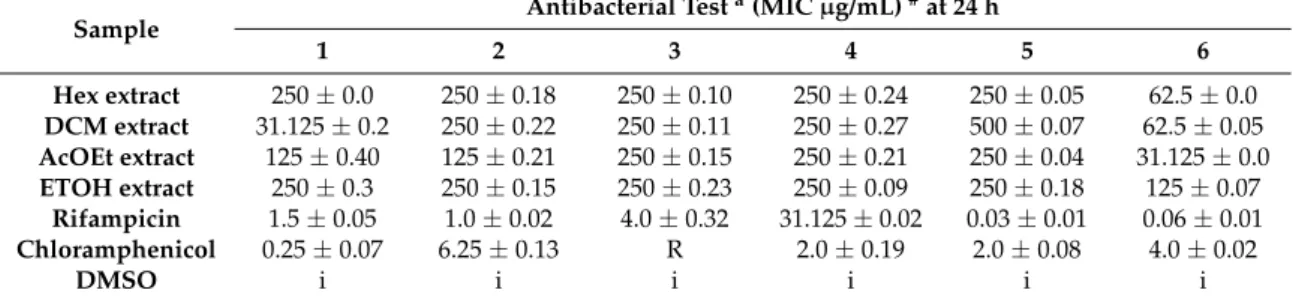
A previous study showed that the chemical components ofE. coccineuminclude anthraquinones, flavonoids and phenols [6]. It is known that secondary metabolites such as those described in E. coccineum have good antimicrobial properties. As shown in Tables 2 and 3, the sequential extracts of the leaves showed antibacterial activity against all bacteria with minimum inhibitory concentration (MIC) values of 31.125–500µg/mL and minimum bactericidal concentration (MBC) values of 62.5–500µg/mL.
Table 2.Minimum inhibitory concentration of extracts fromE. coccineum.
Sample Antibacterial Test
i, inactive; R = Resistant;a1,Escherichia coli;2,Klebsiella pneumoniae;3,Proteus mirabilis;4,Pseudomonas aeruginosa; 5,Staphylococcus aureus;6,Streptococcus pyogenes;#Mean of triplicates±standard deviation of three replicates.
Table 3.Minimum bactericidal concentration of extracts fromE. coccineum.
Sample Antibacterial Test
i, inactive; R = Resistant;a1,Escherichia coli(1022);2,Klebsiella pneumoniae(1023);3,Proteus mirabilis(1024);
4,Pseudomonas aeruginosa(1025);5,Staphylococcus aureus(1026);6,Streptococcus pyogenes(1027);#Mean of
triplicates±standard deviation of three replicates.
3. Discussion
However, this study showed that the MIC and MBC values ofE. coccineumextracts found highest againstS. aureuswere 250–500µg/mL. Moreover, due to the activity shown by the ethyl acetate, it was subjected to GC-MS to identify the components in the extract responsible for the antibacterial activities observed in the study. Gentisic acid andβ-resorcylic acid were the main metabolites in the extract; these hydroxybenzoic acids are found in many plants and fruits, and these compounds show a wide spectrum of action involving antitumor, antiviral, antibacterial, cardioprotective, pro-oxidant and antimutagenic activity [11]. The presence of the hydroxyl group and a system of delocalized electrons might be responsible for the antimicrobial activity of these compounds [12]. Furthermore, there is phytol in the extract, which is an important member of branched-chain unsaturated terpene and is a product of the chlorophyll metabolism in plants. It has also been reported that phytol can inhibit microorganisms [13]. In addition, the presence in the extract of fatty acids as myristic acid and ethyl palmitate, which are in natural fats and dietary oils, and are known to have antibacterial and antifungal properties [14], justifies the potential antimicrobial activity of this extract.
The results of the present work provide useful baseline information for the potential development and use of nanoparticles and/or nanofibers doped with extracts ofE. coccineumin the fight against multiresistant bacteria, which would allow the validation of the traditional use ofE. coccineumby native peoples of Patagonia as antimicrobial agents in the biomedical field.
4. Materials and Methods
4.1. Chemicals and Materials
Chemical reagents, culture media, solvents and positive controls were purchased from Sigma-Aldrich (Darmstadt, Germany).
4.2. Plant Material
E. coccineumwas collected in November 2015 at Valdivia, Los Ríos Region, Chile. A voucher specimen (VALPL 2156) was deposited at the VALP Herbarium, Department of Biology, Universidad de Playa Ancha, Valparaíso, Chile.
4.3. Extraction
In brief, leaves ofE. coccineum(500 g) were isolated manually from aerial parts and dried at room temperature for four weeks. The dry plant was powdered, and then mixed with 1.0 L hexane. The extraction was carried out by using an orbital shaker (150 rpm) at 25◦C for 72 h. The resulting mixture was filtered through Whatman No. 1 filter paper (Sigma-Aldrich, Darmstadt, Germany) and the hexane was removed from the filtrate under reduced pressure with a rotatory evaporator. The residue was further extracted with dichloromethane, ethyl acetate, and ethanol, sequentially and serially. Finally, each extract was weighed and the yield was calculated. E. coccineumextracts were kept at−4◦C prior to further analyses.
4.4. Chromatographic Analysis
the standard spectrum in the NIST Library (the value 1000 indicates a perfect fit), and by comparison of their retention index with those reported in the literature [18], for the same type of column or those of commercial standards, when available. The retention indices were determined under the same operating conditions in relation to a homologousn-alkanes series (C8–C36) by the equation:
RI = 100×(n + Tr(unknown)−Tr(n)/Tr(N)−Tr(n)) (1)
where, n = the number of carbon atoms in the smallern-alkane; N = the number of carbon atoms in the largern-alkane; and Tr = the retention time. Components relative concentrations were obtained by peak area normalization.
4.5. Bacterial Strains
The bacteria were recent clinical isolates, belonging to the Facultad de Ciencias de la Salud (Universidad Central de Chile) collection. They comprised of:Escherichia coli, Klebsiella pneumoniae, Proteus mirabilis, Pseudomonas aeruginosa, Staphylococcus aureus, Streptococcus pyogenes.All isolates were identified according to the latest Clinical and Laboratory Standards Institute (CLSI) guidelines [19]. Strains were cultured in Luria-Bertani (LB) broth, Mueller-Hinton Broth (MHB) and Mueller-Hinton agar, at 37◦C.
4.6. In Vitro Antimicrobial Assay
The Minimum Inhibitory Concentration (MIC) and minimum bactericidal concentration (MBC) of plant extract was determined using the broth dilution method, following the CLSI guidelines [20]. Briefly, the test extracts were first dissolved in dimethyl sulfoxide (DMSO) and the final concentration of DMSO in each medium was 1%, which did not affect the growth of the test strain. A dilution range of the extracts from 1 mg/mL to 12.5µg/mL was tested. Later, 100µL of microbial suspension (1×10⁵CFU/mL) of each strain was inoculated in tubes with equal volume of nutrient broth and plant extracts. After, the tubes were incubated aerobically at 37◦C for 24 h. After the cultures were incubated at 37◦C for 24 h, the minimum inhibitory concentration (MIC) was determined as the lowest concentration of the test extract that demonstrated no visible growth. MBC value was determined by sub culturing the test dilution (100µL) (which showed no visible turbidity) on to freshly prepared nutrient agar media. The plates were incubated further for 48 h at 37◦C. The highest dilution that yielded no single bacterial colony on the nutrient agar plates was taken as MBC. Rifampicin (1 mg/mL) and chloramphenicol (250 mg/mL) were used as positive control for bacterial strains and 1% DMSO was used as negative control. Each concentration of the extracts were tested in triplicate.
4.7. Statistical Analysis
Data were expressed as mean and standard deviation. A one-way variance was used to analyze data, withp< 0.05 representing a significant difference between means (Student’st-test).
5. Conclusions
Acknowledgments:The authors thank DAVE of Universidad Central de Chile (IU1406), DGI Universidad de Playa Ancha and Escuela de Obstetricia Universidad de Valparaíso.
Author Contributions:Alejandro Madrid supervised the whole work. Yusser Olguín performed the sequential extracts ofE. coccineum. Nicole Canales and Mario Párraga performed the biologic experiments. Iván Montenegro and Enrique Werner conceived and designed the biologic experiments. Patricio Godoy contributed with identification and sequencing of bacteria strains. Alejandro Madrid, Iván Montenegro, Mario Párraga and Enrique Werner collaborated in the discussion and interpretation of the results. Alejandro Madrid wrote the manuscript.
Conflicts of Interest:The authors declare no conflict of interest.
References
1. Donoso, C.Las especies arbóreas de los bosques templados de Argentina y Chile. Autoecología, 1st ed.; Marisa Cuneo Ediciones: Valdivia, Chile, 2006; pp. 233–245.
2. Devoto, M.; Montaldo, N.H.; Medan, D. Mixed hummingbird: Long-proboscid-fly pollination in “ornithophilous” Embothrium coccineum(Proteaceae) along a rainfall gradient in Patagonia, Argentina.
Austral Ecol.2006,31, 512–519. [CrossRef]
3. Zárraga, C.; Vogel, O.; Calderón, C.; González, J.Haoa Usi Mitsana: Remedio de mi Tierra: Pequeño Libro de la Medicina Yagan, 1st ed.; Ediciones Kultrún: Valdivia, Chile, 2005; pp. 12–14.
4. Domínguez, E. Flora de interés etnobotánico usada por los pueblos originarios: Aónikenk, Selk’nam, Kawésqar, Yagan y Haush en la Patagonia Austral.Dominguezia2010,26, 19–29.
5. Mølgaard, P.; Holler, J.G.; Asar, B.; Liberna, I.; Rosenbæk, L.B.; Jebjerg, C.P.; Jørgensen, L.; Lauritzen, J.; Guzman, A.; Adsersen, A.; et al. Antimicrobial evaluation of Huilliche plant medicine used to treat wounds. J. Ethnopharmacol.2011,138, 219–227. [CrossRef] [PubMed]
6. Leyton, M.; Mellado, M.; Jara, C.; Montenegro, I.; González, S.; Madrid, A. Free radical scavenging activity of sequential leave extracts ofEmbothrium coccineum.Open Life Sci.2015,10, 260–268.
7. Estomba, D.; Ladio, A.H.; Lozada, M. Medicinal wild plant knowledge and gathering patterns in a Mapuche community from North-western Patagonia.J. Ethnopharm.2006,103, 109–119. [CrossRef] [PubMed] 8. Darsini, D.T.P.; Srinivasan, P.; Guna, G.; Manimekalai, K.; Dineshbabu, J. In vitro anti-biofilm activity of
Piper longumandPiper nigrumagainst clinical isolates ofS. pyogenesisolated from pharyngitis patients. Int. J. Pharm.2015,6, 122–132.
9. Janda, J.M.; Abbott, S.L. The Genera Klebsiella and Roaultella. The Enterobacteria, 2nd ed.; ASM Press: Washington, WA, USA, 2006; pp. 115–129.
10. Dahiya, P.; Purkayastha, S. Phytochemical Screening and Antimicrobial Activity of Some medicinal plants against multi-drug resistant bacteria from clinical isolates.Indian J. Pharm. Sci.2012,74, 443–450. [PubMed] 11. Khadem, S.; Marles, R.J. Monocyclic phenolic acids; hydroxy- and polyhydroxybenzoic acids: Occurrence
and recent bioactivity studies.Molecules2010,15, 7985–8005. [CrossRef] [PubMed]
12. Ultee, A.; Bennik, M.H.; Moezelaar, R. The phenolic hydroxyl group of carvacrol is essential for action against the food-borne pathogenBacillus cereus.Appl. Environ. Microbiol.2002,68, 1561–1568. [CrossRef] [PubMed] 13. Ghaneian, M.T.; Ehrampoush, M.H.; Jebali, A.; Hekmatimoghaddam, S.; Mahmoudi, M. Antimicrobial activity, toxicity and stability of phytol as a novel surface disinfectant.Environ. Health Eng. Manag. J.2015,2, 13–16.
14. Agoramoorthy, G.; Chandrasekaran, M.; Venkatesalu, V.; Hsu, M.J. Antibacterial and antifungal activities of fatty acid methyl esters of the blind-your-eye mangrove from India.Braz. J. Microbiol.2007,38, 739–742. [CrossRef]
15. Montenegro, I.; Madrid, A.; Zaror, L.; Martínez, R.; Werner, E.; Carrasco, H.; Cuellar, M.; Palma, H. Antimicrobial activity of ethyl acetate extract and essential oil from bark ofLaurelia sempervirensagainst multiresistant bacteria.Bol. Latinoam. Caribe Plant. Med. Aromat.2012,11, 306–315.
16. NIST/EPA/NIH Mass Spectral Library with Search Program (Data Version: NIST 11, Software Version 2.0 g). Available online: http://webbook.nist.gov/chemistry/name-ser.html (accessed on 15 May 2016).
18. Adams, R.P.Identification of Essential Oil Components by Gas Chromatography/Mass Spectrometry, 4th ed.; Allured Publishing Corporation: Carol Steam, IL, USA, 2007.
19. Clinical and Laboratory Standards Institute.Methods for Dilution Antimicrobial Susceptibility Tests f or Bacteria That Grow Aerobically, Approved Standard, 10th ed.; Clinical and Laboratory Standards Institute: Wayne, PA, USA, 2015.
20. Clinical and Laboratory Standards Institute.Performance Standards for Antimicrobial Disk Susceptibility Tests: Approved Standard, 12th ed.; Clinical and Laboratory Standards Institute: Wayne, PA, USA, 2015.
Sample Availability:Samples of the plant extracts are available from the authors.