molecules
Article
Hemi-Synthesis and Anti-Oomycete Activity of
Analogues of Isocordoin
Beatriz Escobar1, Iván Montenegro2,3, Joan Villena3, Enrique Werner4, Patricio Godoy5, Yusser Olguín6and Alejandro Madrid1,*
1 Departamento de Química, Facultad de Ciencias Naturales y Exactas, Universidad de Playa Ancha,
Avda. Leopoldo Carvallo 270, Playa Ancha, Valparaíso 2340000, Chile; [email protected] 2 Escuela de Obstetricia y Puericultura, Facultad de medicina, Campus de la Salud,
Universidad de Valparaíso, Angamos 655, Reñaca, Viña del Mar 2520000, Chile; [email protected] 3 Centro de Investigaciones Biomédicas (CIB), Escuela de Medicina, Universidad de Valparaíso,
Av. Hontaneda Nº 2664, Valparaíso 2340000, Chile; [email protected]
4 Departamento De Ciencias Básicas, Campus Fernando May Universidad del Biobío.
Avda. Andrés Bello s/n casilla 447, Chillán 3780000, Chile; [email protected]
5 Instituto de Microbiología Clínica, Facultad de Medicina, Universidad Austral de Chile, Los Laureles s/n,
Isla Teja, Valdivia 5090000, Chile; [email protected]
6 Center for Integrative Medicine and Innovative Science (CIMIS), Facultad de Medicina,
Universidad Andrés Bello, Santiago 8320000, Chile; [email protected] * Correspondence: [email protected]; Tel.: +56-032-250-0526
Received: 25 May 2017; Accepted: 8 June 2017; Published: 10 June 2017
Abstract: An efficient synthesis of a series of 40-oxyalkyl-isocordoin analogues (2–8) is reported for the first time. Their structures were confirmed by 1H-NMR, 13C-NMR, and HRMS. Their anti-oomycete activity was evaluated by mycelium and spores inhibition assay against two selected pathogenic oomycetes strains: Saprolegnia parasiticaandSaprolegnia australis. The entire series of isocordoin derivatives (except compound7) showed high inhibitory activity against these oomycete strains. Among them, compound2exhibited strong activity, with minimum inhibitory concentration (MIC) and minimum oomyceticidal concentration (MOC) values of 50µg/mL and 75 µg/mL, respectively. The results showed that 40-oxyalkylated analogues of isocordoin could be potential anti-oomycete agents.
Keywords:isocordoin; oxyalkyl derivates; anti-oomycete activity;Saprolegniasp.
1. Introduction
Chalcones bearing prenyl groups are an abundant subclass of naturally occurring chalcones [1]. The biosynthesis of C-prenyl chalcones involves the coupling of products from the shikimic and mevalonic acid pathways. The latter produces the prenyl group, while the former produces the aromatic compound. The two products are linked together by prenyl tranferase enzymes [2]. Almost 80% of these molecules are monoprenylated and the remaining 20% consist of di and/or triprenyl derivatives. C-prenylation takes place more frequently on ring A at positions 30 and/or 50, as well as 3 and/or 5 [3]. Prenylated chalcones have been isolated from plants mainly belonging to the families of Leguminosae and Moraceae [4]. This class of compounds has been found to display a variety of biological activities that are anticarcinogenic, antiprotozoal, larvicidal, anti-inflammatory, antibacterial, antioxidant, and antifungal [5,6]. A representative example of naturally occurring bioactive C-prenylated chalcones, isocordoin (1), was isolated from Lonchocarpus species [7,8] or Aeschynomene fascicularis [9]. Isocordoin has been found to have a range of interesting biological properties in vitro that may have therapeutic and industrial
utilities including antiprotozoal (for treatment ofLeishmania mexicana,L. braziliensis,L. amazonensis andTrypanosoma cruzi) [10,11], insect antifeedant (for treating lepidopterous larvae of Spodoptera littoralisandS. exempta, which are considered one of the most destructive pests of crops) [12] and a vasorelaxant effect [13], as well as a potential “broad-spectrum” anticancer agent (applicable to both oral-laryngeal and prostate cancers) [9,10,14]. These bioactivities have stimulated the interest of researchers in the preparation of isocordoin. The synthesis of 1 via the Claisen–Schmidt condensation was obtained in unsatisfactory yields [15,16]. In contrast, the enzymatic prenylation of 20,40-dihydroxychalcone with cell cultures ofMorus nigrabiosynthetically produced isocordoin in very high yield [16,17]. Recent works have explored the introduction of isoprenoids into the structure of chalcones to obtain more active hybrid compounds [18], or even with new biological properties for the development of novel products either in medicine or in agrochemistry. In this paper, a series of 4-oxyalkyl-isocordoin analogues2–8were synthesized and evaluated for their anti-oomycete activity againstSaprolegnia parasiticaandS. australis.
2. Results and Discussion
2.1. Synthesis and Characterization
One naturally occurring chalcone, 1, and seven oxyalkyl derivates, 2–8, were synthesized. The synthetic strategies applied for the synthesis of new chalcones are outlined in Scheme1[19,20].
Molecules 2017, 22, 968 2 of 9
antifeedant (for treating lepidopterous larvae of Spodoptera littoralis and S. exempta, which are
considered one of the most destructive pests of crops) [12] and a vasorelaxant effect [13], as well as a potential “broad-spectrum” anticancer agent (applicable to both oral-laryngeal and prostate cancers) [9,10,14]. These bioactivities have stimulated the interest of researchers in the preparation of
isocordoin. The synthesis of 1 via the Claisen–Schmidt condensation was obtained in unsatisfactory
yields [15,16]. In contrast, the enzymatic prenylation of 2′,4′-dihydroxychalcone with cell cultures of
Morus nigra biosynthetically produced isocordoin in very high yield [16,17]. Recent works have explored the introduction of isoprenoids into the structure of chalcones to obtain more active hybrid compounds [18], or even with new biological properties for the development of novel products
either in medicine or in agrochemistry. In this paper, a series of 4-oxyalkyl-isocordoin analogues 2–8
were synthesized and evaluated for their anti-oomycete activity against Saprolegnia parasitica and S.
australis.
2. Results and Discussion
2.1. Synthesis and Characterization
One naturally occurring chalcone, 1, and seven oxyalkyl derivates, 2–8, were synthesized. The
synthetic strategies applied for the synthesis of new chalcones are outlined in Scheme 1 [19,20].
O
Scheme 1. Synthesis of 4-oxyalkyl-isocordoin derivatives 2–8. Reagents and conditions: (i) K2CO3/CH3CN, reflux at 80 °C for 4 h.; (A) CH3I; (B) allyl bromide; (C) 2-methyl-1-propenyl bromide;
(D) crotyl bromide; (E) prenyl bromide; (F) geranyl bromide; (G) farnesyl bromide.
Isocordoin (1) was purified in analogy to the procedures described in [21,22] with small
variations from the resinous exudate of Adesmia balsamica. The targeted compounds 2–8 were easily
attained in high yields (70–92%) through nucleophilic substitution of isocordoin with the
Scheme 1. Synthesis of 4-oxyalkyl-isocordoin derivatives 2–8. Reagents and conditions:
Isocordoin (1) was purified in analogy to the procedures described in [21,22] with small variations from the resinous exudate ofAdesmia balsamica. The targeted compounds2–8were easily attained in high yields (70–92%) through nucleophilic substitution of isocordoin with the appropriate alkyl halide in acetonitrile. This reaction resulted in the exclusive formation of the 4-oxyalkyl-derivative, due to steric hindrance caused by the the prenyl chain in position 30of the aromatic ring A [23,24] and the influence exerted by the intramolecular hydrogen bond present in the isocordoin [25].
The structures of compounds 1–8 were established on the basis of IR, NMR, and HR-MS techniques.13C-NMR assignments were achieved by 2D heteronuclear single quantum correlation (HSQC) and heteronuclear multiple bond correlation (HMBC) experiments.
The IR, NMR, and MS data of compound 1 concurred with those reported for the known chalcone, commonly named as isocordoin, previously reported from Lonchocarpus xuul [8]. The1H spectrum of 40-oxyalkyl-isocordoin derivatives2–8showed a number of signals that correspond to an isocordoin-type structure. The spectra of these compounds showed two trans-olefinic protons at δ= 7.89 and 7.60 ppm (d,J= 15.4 Hz) readily assigned to those of the 8 and 7 position, respectively; two aromatic protons at ortho positions (d,J= 9.1 Hz atδ= 6.48 and 7.77 ppm); and the presence of a prenyl group (d, J = 7.1 Hz, 2H at δ = 3.39–3.40 ppm; m, 1H at δ = 5.25 ppm; and two singlets, 3H each, atδ= 1.68 and 1.80 ppm), and two multiplets atδ= 7.65 ppm (2H) and 7.42 ppm (3H), corresponding to the five protons of a unsubstituted aromatic ring. The1H-NMR spectrum of 2–8showed a chelated hydroxyl-proton signal atδ 13.39–13.37 ppm, together with a chelated carbonyl-carbon resonance atδ= 192.1 ppm, were consistent with the selectivity of theO-alkylation at position 40of isocordoin. The compound2, obtained as an amorphous bright yellow solid, proved to be identical to derricin, previously reported fromLonchocarpus sericeus[26]. For 40-oxyalkyl-isocordoin derivatives3–8the1H-NMR spectrum revealed resonances atδ= 4.54–4.65 ppm (d, 2H) ascribed to O-CH2protons of alkoxy chain linking 40-OH-chalcone ring. This is characteristic of allylic chains
on aromatic rings, resulting by the alkylation reaction. For example, the1H-NMR spectrum of
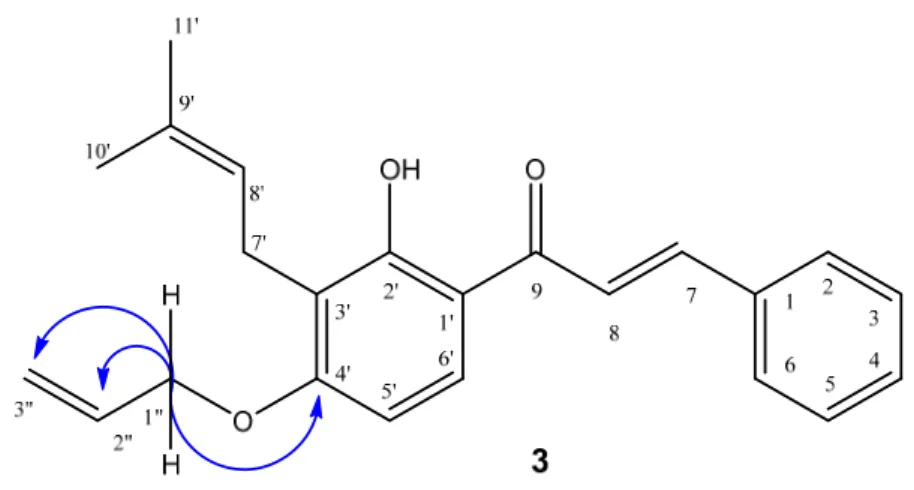
compound3showed the signal at 4.65 ppm (d,J= 5.1 Hz, 2H, H-100) correlated (by 2D HSQC) with a carbon atom atδ65.4 ppm (C-1”), indicating the coupling point between the allyl fragment and the aromatic hydroxyl group. These data also were corroborated by 2D HMBC correlations, where H-1” showed heteronuclear3Jcorrelations with the carbons signal atδ= 117.6 (C-300) and 162.6 (C-40) ppm. Heteronuclear2Jcorrelations were also observed atδ132.7 (C-2”) (Figure1).
Molecules 2017, 22, 968 3 of 9
appropriate alkyl halide in acetonitrile. This reaction resulted in the exclusive formation of the
4-oxyalkyl-derivative, due to steric hindrance caused by the the prenyl chain in position 3′ of the
aromatic ring A [23,24] and the influence exerted by the intramolecular hydrogen bond present in the isocordoin [25].
The structures of compounds 1–8 were established on the basis of IR, NMR, and HR-MS
techniques. 13C-NMR assignments were achieved by 2D heteronuclear single quantum correlation
(HSQC) and heteronuclear multiple bond correlation (HMBC) experiments.
The IR, NMR, and MS data of compound 1 concurred with those reported for the known
chalcone, commonly named as isocordoin, previously reported from Lonchocarpus xuul [8]. The 1H
spectrum of 4′-oxyalkyl-isocordoin derivatives 2–8 showed a number of signals that correspond to
an isocordoin-type structure. The spectra of these compounds showed two trans-olefinic protons at δ
= 7.89 and 7.60 ppm (d, J = 15.4 Hz) readily assigned to those of the 8 and 7 position, respectively; two
aromatic protons at ortho positions (d, J = 9.1 Hz at δ = 6.48 and 7.77 ppm); and the presence of a
prenyl group (d, J = 7.1 Hz, 2H at δ = 3.39–3.40 ppm; m, 1H at δ = 5.25 ppm; and two singlets, 3H
each, at δ = 1.68 and 1.80 ppm), and two multiplets at δ = 7.65 ppm (2H) and 7.42 ppm (3H),
corresponding to the five protons of a unsubstituted aromatic ring. The 1H-NMR spectrum of 2–8
showed a chelated hydroxyl-proton signal at δ 13.39–13.37 ppm, together with a chelated
carbonyl-carbon resonance at δ = 192.1 ppm, were consistent with the selectivity of the O-alkylation
at position 4′ of isocordoin. The compound 2, obtained as an amorphous bright yellow solid, proved
to be identical to derricin, previously reported from Lonchocarpus sericeus [26]. For
4′-oxyalkyl-isocordoin derivatives 3–8 the 1H-NMR spectrum revealed resonances at δ = 4.54–4.65
ppm (d, 2H) ascribed to O-CH2 protons of alkoxy chain linking 4′-OH-chalcone ring. This is
characteristic of allylic chains on aromatic rings, resulting by the alkylation reaction. For example,
the 1H-NMR spectrum of compound 3 showed the signal at 4.65 ppm (d, J = 5.1 Hz, 2H, H-1′′)
correlated (by 2D HSQC) with a carbon atom at δ 65.4 ppm (C-1″), indicating the coupling point
between the allyl fragment and the aromatic hydroxyl group. These data also were corroborated by
2D HMBC correlations, where H-1″ showed heteronuclear 3J correlations with the carbons signal at δ
= 117.6 (C-3′′) and 162.6 (C-4′) ppm. Heteronuclear 2J correlations were also observed at δ 132.7 (C-2″)
(Figure 1).
Figure 1. The most important correlations shown by 2D 1H-13C HMBC, compound 3.
2.2. Anti-Oomycete Activity Assays of Compounds 1–8
In this study, isocordoin (1) and a series of seven oxyalkylated derivatives (2–8) were screened
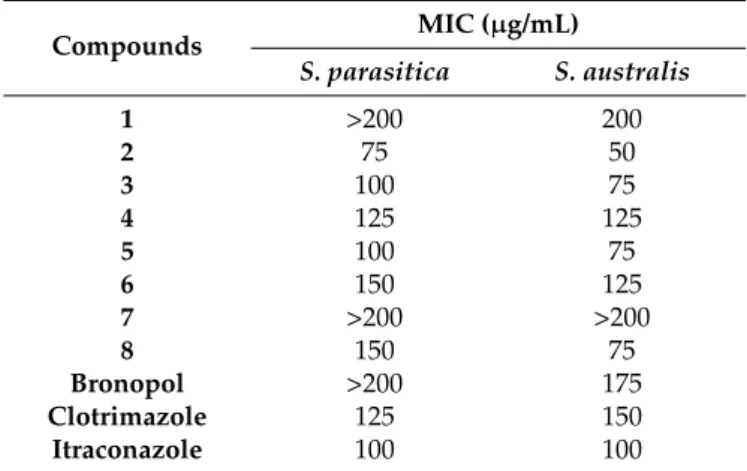
for minimum inhibitory concentration (MIC) values (Table 1).
Figure 1.The most important correlations shown by 2D1H-13C HMBC, compound3.
2.2. Anti-Oomycete Activity Assays of Compounds1–8
Table 1.The MIC valuesaof the compounds1–8againstSaprolegniaspecies.
Compounds MIC (µg/mL)
S. parasitica S. australis
1 >200 200
2 75 50
3 100 75
4 125 125
5 100 75
6 150 125
7 >200 >200
8 150 75
Bronopol >200 175
Clotrimazole 125 150
Itraconazole 100 100
aEach value represents the mean±SD of three experiments (p< 0.05), performed in quadruplicate.
Among them, isocordoin (1) and compound7were considered to have no inhibition effect against Saprolegniawith MIC values≥200.0µg/mL, while the other six compounds showed anti-oomycete activities with MIC≤150.0µg/mL, in which derricin (2) and compound3had the most promising anti-Saprolegniaactivities with MIC values of 50 and 75µg/mL, respectively.
Table2lists the minimum oomyceticidal concentration (MOC) values of compounds1–8against Saprolegniaspores at 72 h. The results reveal that derricin (2) showed significant anti-oomycete activity with an MOC value of 75µg/mL, followed by compound3with a value of 100µg/mL.
Table 2.The MOC valuesaof the compounds1–8against spores at 72 h.
Compounds MOC (µg/mL)
S. parasitica S. australis
1 >200 >200
2 75 75
3 100 100
4 125 125
5 125 100
6 150 150
7 >200 >200
8 150 100
Bronopol >200 200
Clotrimazole 150 175
Itraconazole 100 100
aEach value represents the mean±SD of three experiments, performed in quadruplicate.
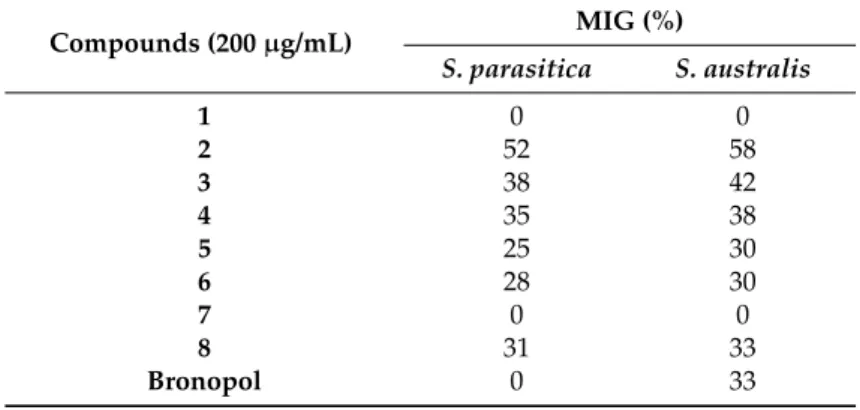
Table3lists the mycelial growth inhibition (MIG) percentage values of compounds1–8against Saprolegniamycelium at 48 h.
The growth inhibition rate ofSaprolegniaafter 48 h of exposure to derricin (2) to was partially affected by the concentration of the chemical. However, it was more than twice as effective as bronopol, a broad-spectrum biocide, that has been used as an effective and economically acceptable alternative in the treatment and control ofSaprolegniasp. [20]. The inhibition ofS. parasiticaandS. australiswas 52% and 58%, respectively, with concentrations of derricin at 200µg/mL.
Table 3.The MIG values of the compounds1–8against mycelium at 48 h.
Compounds (200µg/mL) MIG (%)
S. parasitica S. australis
1 0 0
2 52 58
3 38 42
4 35 38
5 25 30
6 28 30
7 0 0
8 31 33
Bronopol 0 33
3. Materials and Methods
3.1. General
All chemicals were obtained from Aldrich (St. Louis, MO, USA) and were used without further purification. A detailed description of conditions used to register Fourier transform infrared (FT-IR) spectra, high resolution mass spectra, and 1H, 13C, 13C DEPT-135, gs-2D Heteronuclear Single Quantum Coherence (HSQC) and gs-2D HMBC spectra has been given elsewhere [32]. Column chromatography (CC) was performed with silica gel 60 from Merck (Darmstadt, Germany), and thin layer chromatography (TLC) was carried out on precoated silica plates F-254 from Merck (Darmstadt, Germany). Melting points were determined on an electrothermal instrument and are uncorrected.
3.2. Plant Material
Adesmia balsamicawere collected in Melosillas, Casablanca, Chile, in October 2016. A voucher specimen was deposited at the Valparaíso (VALP) Herbarium, Department of Biology, Universidad de Playa Ancha, Valparaíso, Chile and was identified by comparison with the herbarium specimen (collection number 1899).
3.3. Isolation and Characterization of Isocordoin(1)
The fresh plant (1.0 kg) extracted with cold dichloromethane (5 L) at room temperature for 40 s. The organic extract was concentrated in a rotatory evaporator to give a residue of 120.5 g of resin. Pure isocordoin (1) was isolated to obtain 166.5 mg of a solid yellow powder. Its structure was established by comparison of their spectroscopic data (1H and13C-NMR and HRMS) with those in the literature [8].
3.4. General Procedure for the Synthesis of 4-Oxyalkyl-isocordoin Analogues(2–8)
A solution of isocordoin (1) (5 mmol), alkyl halide (6 mmol), and K2CO3(6.5 mmol) in anhydrous
acetonitrile (3 mL) was refluxed for 4 h at 80◦C. After the reaction, the mixture was distilled to remove the solvent. The residue was poured into ice water (40 mL), and then filtered. The resulting filtrate was extracted three times with ethylacetate. The resulting organic phase was dried over anhydrous magnesium sulfate, and distilled in vacuo to remove the solvent to provide the target compounds2–8. (2E)-1-[2-Hydroxy-4-methoxy-3-(3-methylbut-2-en-1-yl)phenyl]-3-phenylprop-2-en-1-one(2). Yellow solid. Yield: 89.0%. Spectroscopic data and physical properties of compound2were consistent with those reported in the literature [26].
(2E)-1-[4-(Allyloxy)-2-hydroxy-3-(3-methylbut-2-en-1-yl)phenyl]-3-phenylprop-2-en-1-one(3). Yellow solid. Yield: 92.0%, melting point: 93–96◦C. IR (KBr, cm−1): 3024, 2895, 1647, 1577, 1298, 1195, and 1134.
1H-NMR (400 MHz, CDCl
1H, H-60); 7.65 (m, 2H, H-2 and H-6); 7.60 (d, J = 15.4 Hz, 1H, H-7); 7.42 (m, 3H, H-3, H-4 and H-5); 6.48 (d,J = 9.0 Hz, 1H, H-50); 6.07 (m, 1H, H-200); 5.45 (m, 1H, H-300b); 5.31 (m, 1H, H-300a); 5.26 (m, 1H, H-80); 4.65 (d, J = 5.1 Hz, 2H, H-100); 3.40 (d,J= 7,1 Hz, 1H, H-70); 1.80 (s, 3H, H-100); 1.68 (s, 3H, H-110).13C-NMR (100 MHz, CDCl3):δ192.4 (C-9); 163.2 (C-20); 162.4 (C-40); 144.1 (C-7);
134.8 (C-1); 132.7 (C-200); 131.8 (C-60); 130.5 (C-90); 129.1 (C-4); 129.0 (C-2 y C-6); 128.5 (C-3 y C-5); 121.9 (C-80); 120.6 (C-8); 118.4 (C-30); 117.6 (C-300); 114.6 (C-10); 103.2 (C-50); 65.4 (C-100); 25.8 (C-110); 21.8 (C-70); 17.9 (C-100). MS: M + H ionm/z349.4432 (C23H24O3: 348.4348).
(2E)-1-[4-[(2-Methylprop-2-en-1-yl)oxy]-2-hydroxy-3-(3-methylbut-2-en-1-yl)phenyl]-3-phenylprop-2-en-1-one(4). Yellow solid. Yield: 85.0%, melting point: 99–101◦C. IR (KBr, cm−1): 2958, 1635, 1519, 1243, and 1131.
1H-NMR (400 MHz, CDCl
3):δ13.39 (s, 1H, 20-OH), 7.87(d,J= 15.5 Hz, 1H, H-8); 7.77 (d,J= 9.0 Hz, 1H,
H-60); 7.65 (m, 2H, H-2 and H-6); 7.60 (d,J= 15.4 Hz, 1H, H-7); 7.42 (m, 3H, H-3, H-4 and H-5); 6.48 (d, J= 9.0 Hz, 1H, H-50); 5.26 (m, 1H, H-200); 5.11 (s, 1H, H-3b00); 5.01 (s, 1H, H-3a00); 4.54 (s, 2H, H-100); 3.43 (d,J= 7.1Hz, 1H, H-70); 1.84 (s, 3H, H-400); 1.80 (s, 3H, H-100); 1.68 (s, 3H, H-110).13C-NMR (100 MHz, CDCl3):δ192.2 (C-9); 163.2 (C-20); 162.4 (C-40); 144.1 (C-7); 140.3 (C-200); 134.9(C-1); 131.8 (C-60);
130.5 (C-90); 129.1 (C-4); 129.0 (C-2 and C-6); 128.5 (C-3 and C-5); 122.0 (C-80); 120.6 (C-8); 117.8 (C-30); 114.6 (C-10); 113.0 (C-300); 103.2 (C-50); 71.9 (C-100); 25.8 (C-110); 21.8 (C-70); 19.3 (C-400); 17.9 (C-100). MS: M + H ionm/z363.4702 (C24H26O3: 362.4616).
(2E)-1-[4-(Crotyloxy)-2-hydroxy-3-(3-methylbut-2-en-1-yl)phenyl]-3-phenylprop-2-en-1-one(5). Yellow solid. Yield: 85.0%, melting point: 93–94◦C. IR (KBr, cm−1): 2958, 1635, 1519, 1243, and 1131.1H-NMR (400 MHz, CDCl3):δ13.37 (s, 1H, 20-OH), 7.87 (d,J= 15.5 Hz, 1H, H-8); 7.77 (d,J= 9.1 Hz, 1H, H-60); 7.65 (m,
2H, H-2 and H-6); 7.60 (d,J= 15.4 Hz, 1H, H-7); 7.42 (m, 3H, H-3, H-4 and H-5); 6.49 (d,J= 9,0 Hz, 1H, H-50); 5.87 (m, 1H, H-200); 5.82 (m, 1H, H-300); 5.26 (m, 1H, H-80); 4.57 (d, J = 5.9 Hz, 2H, H-100); 3.40 (d,J= 7.2 Hz, 1H, H-70); 1.80 (s, 3H, H-100); 1.77 (s, 3H, H-400); 1.68 (s, 3H, H-110).13C-NMR (100 MHz, CDCl3):δ192.2 (C-9); 163.2 (C-20); 162.6 (C-40); 144.0 (C-7); 134.9 (C-1); 131.7 (C-60); 130.5 (C-90);
130.3 (C-4); 129.1 (C-200); 129.0 (C-2 and C-6); 128.5 (C-3 and C-5); 125.6 (C-300); 122.0 (C-80); 120.7 (C-8); 118.0 (C-30); 117.8 (C-30); 115.6 (C-10); 103.3 (C-50); 69.0 (C-100); 25.8 (C-110); 21.8 (C-70); 17.9 (C-100); 17.8 (C-400). MS: M + H ionm/z363.4702 (C24H26O3: 362.4614).
(2E)-1-[4-(Prenyloxy)-2-hydroxy-3-(3-methylbut-2-en-1-yl)phenyl]-3-phenylprop-2-en-1-one(6). Yellow solid. Yield: 79.0%, melting point: 106–108◦C. IR (KBr, cm−1): 2959, 1631, 1519, 1374, 1211, 1147, and 990. 1H-NMR (400 MHz, CDCl
3):δ13.37 (s, 1H, 20-OH), 7.87 (d,J= 15.5 Hz, 1H, H-8); 7.77 (d,J= 9.1 Hz,
1H, H-60); 7.65 (m, 2H, H-2 and H-6); 7.60 (d, J = 15.4 Hz, 1H, H-7); 7.42 (m, 3H, H-3, H-4 and H-5); 6.49 (d,J= 9.0 Hz, 1H, H-50); 5.48 (m, 1H, H-200); 5.25 (m, 1H, H-80); 4,62 (d,J= 6.6 Hz, 2H, H-100); 3.39 (d,J = 7.2 Hz, 1H, H-70); 1.80 (s, 6H, H-400 and H-100); 1.75 (s, 3H, H-500); 1.68 (s, 3H, H-110).13C-NMR (100 MHz, CDCl3):δ192.1 (C-9); 163.2 (C-20); 162.8 (C-40); 144.0 (C-7); 138.1 (C-300);
134.9 (C-1); 131.7 (C-60); 130.5 (C-90); 129.1 (C-4); 129.0 (C-2 and C-6); 128,5 (C-3 and C-5); 122.1 (C-80); 120.7 (C-8); 119.5 (C-200) 117.9 (C-30); 114.5 (C-10); 103.3 (C-50); 65.3 (C-100); 25.8 (C-400); 25.7 (C-110); 21.8 (C-70); 18.3 (C-500); 17.8 (C-100). MS: M + H ionm/z377.4972 (C25H28O3: 376.4880).
(2E)-1-[4-(Geranyloxy)-2-hydroxy-3-(3-methylbut-2-en-1-yl)phenyl]-3-phenylprop-2-en-1-one(7). Yellow solid. Yield: 73.0%, melting point: 78–80◦C. IR (KBr, cm−1): 2940, 2865, 1631, 1530, 1512, 1338, 1241, 1129, 817.1H-NMR (400 MHz, CDCl3):δ13.37 (s, 1H, 20-OH), 7,87 (d,J= 15.5 Hz, 1H, H-8); 7.77 (d, J= 9.1 Hz, 1H, H-60); 7.65 (m, 2H, H-2 and H-6); 7.60 (d,J= 15.4 Hz, 1H, H-7); 7.42 (m, 3H, H-3, H-4 and H-5); 6.49 (d,J= 9.0 Hz, 1H, H-50); 5.48 (m, 1H, H-200); 5.25 (m, 1H, H-80); 5.08 (m, 1H, H-600); 4.65 (d, J= 6.4 Hz,2H, H-100); 3.39 (d,J= 7.2 Hz, 1H, H-70); 2.10 (m, 4H, H-400and H-500); 1.80 (s, 3H, H-100); 1.75 (s, 3H, H-900); 1.68 (s, 3H, H-800); 1.61 (s, 3H, H-110).13C-NMR (100 MHz, CDCl3):δ191.1 (C-9); 163.1
(2E)-1-[4-(Farnesyloxy)-2-hydroxy-3-(3-methylbut-2-en-1-yl)phenyl]-3-phenylprop-2-en-1-one(8). Yellow solid. Yield: 70.0%, melting point: 62–64◦C. IR (KBr, cm−1): 2955, 1632, 1541, 1374, 1203, 1140, 978.
1H-NMR (400 MHz, CDCl
3):δ13.37 (s, 1H, 20-OH), 7.87 (d,J= 15.5 Hz, 1H, H-8); 7.77 (d,J= 9.1 Hz,
1H, H-60); 7.65 (m, 2H, H-2 and H-6); 7.60 (d,J= 15.4 Hz, 1H, H-7); 7.42 (m, 3H, H-3, H-4 and H-5); 6.49 (d,J= 9.0 Hz, 1H, H-50); 5.48 (m, 1H, H-200); 5.25 (m, 1H, H-80); 5.08 (m, 2H, H-600and H-1000); 4.65 (d,J= 6.6 Hz, 2H, H-100); 3.39 (d,J= 7.2 Hz, 1H, H-70); 2.09 (m, 4H, H-400, H-500, H-800and H-900); 1.80 (s, 6H, H-100and H-1300); 1.75 (s, 3H, H-110); 1.67 (s, 6H, H-1400and H-1500).13C-NMR (100 MHz, CDCl3): δ192.1 (C-9); 163.2 (C-20); 162.9 (C-40); 144.0 (C-7); 141.3 (C-300); 135.3 (C-700); 134.9 (C-1);
131.5 (C-90and C-1100); 131,3 (C-60); 130.5 (C-4); 129.0 (C-2 and C-6); 128.5 (C-3 and C-5); 124.3 (C-600); 123.6 (C-1000); 122.1 (C-8); 120.7 (C-8); 119.3 (C-200) 117.9 (C-30); 114.5 (C-10); 103.3 (C-50); 65.4 (C-100); 39.7 (C-400); 39.5 (C-800); 26.7 (C-900); 26.2 (C-500); 25.8 (C-1200); 25.7 (C-110); 21.8 (C-70); 17.9 (C-100); 17.7 (C-1500); 16.7 (C-1400); 16.0 (C-130). MS: M + H ionm/z513.7351 (C35H44O3: 512.7220).
3.5. Oomycete Strain
Pure strains ofS. parasiticaandS. australiswere received from the Cell Biology Laboratory, Faculty of medicine, Universidad de Valparaíso, placed on potato dextrose agar (PDA) slants, and stored at 4◦C. This pure strain was isolated fromSalmo salarcarp eggs [33].
3.6. Minimum Inhibitory Concentration Evaluation
The method used in this study for anti-oomycete activity assay was performed according to methods previously reported [34]. The compounds1–8were tested at 200.0, 150.0, 100.0, 50.0, 25.0, 12.5, 6.3, and 3.1 µg/L to find a preliminary minimum inhibitory concentration (MIC) interval. The MIC values were recorded visually on the basis of mycelia growth. All the independent experiments were conducted three times with quadruplicates at each test concentration. Ethanol solution 1% in water was the negative control and bronopol, clotrimazole, and itraconazole were the positive controls.
3.7. Spores Germination Inhibition Assay
The spore germination assay againstSaprolegniastrains was performed according to the agar dilution method [35]. The minimum oomyceticidal concentration (MOC) and detailed protocols for the biological assays was defined previously [34].
3.8. Mycelial Growth Inhibition Assay
Inhibition of mycelial growth was assayed using the method described by Hu [29] with small modifications. Oomycete growth was measured as the colony diameter, and toxicity of the compounds 1–8 against Saprolegniastrains was measured in terms of the percentage of mycelia inhibition by a formula described in detail elsewhere [34].
3.9. Statistical Analysis
The statistical data of recovery rates were performed by comparison within isolates and between culturing media following a standard method [20].
4. Conclusions
Acknowledgments: The authors thank FONDECYT (grant No. 11140193) and the Dirección General de Investigación of Universidad de Playa Ancha.
Author Contributions:A.M. supervised the whole study. B.E. performed the synthesis of all compounds. P.G.
contributed to the identification and sequencing ofSaprolegnia parasiticastrains. I.M. conceived and designed the biologic experiments; I.M., J.V. and E.W. performed the biologic experiments. A.M., I.M. and Y.O. collaborated in the discussion and interpretation of the results. A.M. wrote the manuscript. All authors read and approved the final manuscript.
Conflicts of Interest:The authors declare no conflict of interest.
References
1. Sugamoto, K.; Matsusita, Y.; Matsui, K.; Kurogi, C.; Matsui, T. Synthesis and antibacterial activity of chalcones bearing prenyl or geranyl groups fromAngelica keiskei.Tetrahedron2011,67, 5346–5359. [CrossRef]
2. Yazaki, K.; Sasaki, K.; Tsurumaru, Y. Prenylation of aromatic compounds, a key diversification of plant secondary metabolites.Phytochemistry2009,70, 1739–1745. [CrossRef] [PubMed]
3. Barron, D.; Ibrahim, R. Isoprenylated flavonoids—A survey.Phytochemistry1996,43, 921–982. [CrossRef] 4. Botta, B.; Vitali, A.; Menendez, P.; Misitia, D.; Delle Monache, G. Prenylated flavonoids: Pharmacology and
biotechnology.Curr. Med. Chem.2005,12, 713–739. [CrossRef]
5. Chen, X.; Mukwaya, E.; Wong, M.S.; Zhang, Y. A systematic review on biological activities of prenylated flavonoids.Pharm. Biol.2014,52, 655–660. [CrossRef] [PubMed]
6. Patil, V.; Barragan, E.; Patil, S.A.; Patil, S.; Bugarin, A. Direct Synthesis and antimicrobial evaluation of structurally complex chalcones.Chem. Sel.2016,1, 3647–3650. [CrossRef]
7. Delle Monach, F.; Cuca Suarez, L.E.; Marini-Bettolo, G.B. Flavonoids from the seeds of sixLonchocarpus
species.Phytochemistry1978,27, 1812–1813. [CrossRef]
8. Borges-Argáez, R.; Peña-Rodríguez, L.M.; Waterman, P. Flavonoids from two Lonchocarpus species of the Yucatan Peninsula.Phytochemistry2002,60, 533–540. [CrossRef]
9. Caamal-Fuentes, E.E.; Peraza-Sánchez, S.R.; Torres-Tapia, L.W.; Moo-Puc, R.E. Isolation and identification of cytotoxic compounds fromAeschynomene fascicularis, a Mayan medicinal plant. Molecules 2015, 20, 13563–13574. [CrossRef] [PubMed]
10. Borges-Argáez, R.; Poot-Díaz, M.E.; Waterman, P.G.; Peña-Rodríguez, L.M. Cytotoxic and antiprotozoal activity of flavonoids fromLonchocarpusspp.Phytomedicine2007,14, 530–533. [CrossRef] [PubMed] 11. Borges-Argáez, R.; Vela-Catzín, T.; Yam-Puc, A.; Chan-Bacab, M.J.; Moo-Puc, R.E.; Cáceres-Farfán, M.
Antiprotozoal and cytotoxic studies on some isocordoin derivatives. Planta Med. 2009, 75, 1336–1338.
[CrossRef] [PubMed]
12. Simmonds, M.S.J.; Blaney, W.M.; Delle Monache, F.; Marini-Bettolo, G.B. Insect antifeedant activity associated with compounds isolated from species ofLonchocarpusandTephrosia. J. Chem. Ecol. 1990, 16, 365–380.
[CrossRef] [PubMed]
13. Avila-Villarreal, G.; Hernández-Abreu, O.; Hidalgo-Figueroa, S.; Navarrete-Vázquez, G.; Escalante-Erosa, F.; Peña-Rodríguez, L.M.; Villalobos-Molina, R.; Estrada-Soto, S. Antihypertensive and vasorelaxant effects of dihydrospinochalcone-A isolated fromLonchocarpus xuulLundell by NO production: Computational and ex vivo approaches.Phytomedcine2013,20, 1241–1246. [CrossRef] [PubMed]
14. Zhang, E.H.; Wang, R.F.; Guo, S.Z.; Liu, B. An update on antitumor activity of naturally occurring chalcones.
Evid. Based Complement Altern. Med.2013,2013, 815621. [CrossRef] [PubMed]
15. Shen, J.H.; Shi, S.C.; Ma, X.J.; Zhou, B.N. Total synthesis of two prenylated flavanonols fromMaackia tenuifolia.
Nat. Prod. Lett.1992,1, 99–102. [CrossRef]
16. Vitali, A.; Ferrari, F.; Monache, G.D.; Bombardelli, E.; Botta, B. Synthesis and biosynthesis of isocordoin.
Planta Med.2001,67, 475–477. [CrossRef] [PubMed]
17. Bolasco, A.; Fioravanti, R.; Rossi, F.; Rossi, P.; Vitali, A. Use of cyclodextrins in biotransformation reactions with cell cultures ofMorus nigra: Biosynthesis of prenylated chalcone isocordoin.Biotechnol. Appl. Biochem. 2010,56, 77–84. [CrossRef] [PubMed]
18. Basabe, P.; de Román, M.; Díez, D.; Marcos, I.S.; Blanco, A.; Bodero, O.; Mollinedo, F.; Sierra, B.G.; Urones, J.G. Prenylflavonoids and prenyl/alkyl-phloroacetophenones: Synthesis and antitumour biological evaluation.
19. Seyedi, S.; Jafari, Z.; Attaran, N.; Sadeghian, H.; Saberi, M.; Riazi, M. Design, synthesis and SAR studies of 4-allyoxyaniline amides as potent 15-lipoxygensae inhibitors.Bioorg. Med. Chem. 2009,17, 1614–1622.
[CrossRef] [PubMed]
20. Flores, S.; Montenegro, I.; Villena, J.; Cuellar, M.; Werner, E.; Godoy, P.; Madrid, A. Synthesis and Evaluation of novel oxyalkylated derivatives of 20,40-dihydroxychalcone as anti-oomycete agents against bronopol resistant strains ofSaprolegniasp.Int. J. Mol. Sci.2016,17, 1366. [CrossRef] [PubMed]
21. Modak, M.; Rojas, M.; Torres, R. Chemical analysis of the resinous exudate isolated fromHeliotropium taltalense and evaluation of the antioxidant activity of the phenolics components and the resin in homogeneous and heterogeneous systems.Molecules2009,14, 1980–1989. [CrossRef] [PubMed]
22. Madrid, A.; Espinoza, L.; González, C.; Mellado, M.; Villena, J.; Santander, S.; Silva, V.; Montenegro, I. Antifungal study of the resinous exudate and of meroterpenoids isolated fromPsoralea glandulosa(Fabaceae).
J. Ethnopharmacol.2012,144, 809–811. [CrossRef] [PubMed]
23. Kito, T.; Yamamoto, K.; Hirao, I. TheO-alkylation of phenols of esters II. The steric hindrance and electronic effect in the O-alkylation of phenols by esters.Bull. Chem. Soc. Jpn.1977,50, 706–709. [CrossRef]
24. Lei, T.; Wang, J.Y.; Pei, J. Roles of Flexible Chains in Organic Semiconducting Materials.Chem. Mater.2014,
26, 594–603. [CrossRef]
25. Da Silva, G.; da Silva, M.; Souza, E.; Barison, A.; Simões, S.; Varotti, F.; Barbosa, L.; Viana, G.; Villar, J. Design and Synthesis of New Chalcones Substituted with Azide/Triazole Groups and Analysis of Their Cytotoxicity Towards HeLa Cells.Molecules2012,17, 10331–10343. [CrossRef] [PubMed]
26. Do nascimento, M.C.; Mors, W.B. Chalcones of the root bark ofDerris sericea. Phytochemistry1972, 11, 3023–3028. [CrossRef]
27. Tse, B.; Balkovec, J.M.; Blazey, C.M.; Hsu, M.J.; Nielsen, J.; Schmatz, D. Alkyl side-chain derivatives of sordaricin as potent antifungal agents against yeast.Bioorg. Med. Chem. Lett.1998,8, 2269–2272. [CrossRef] 28. Schreier, S.; Malheiros, S.V.P.; Paula, E. Surface active drugs: Self-association and interaction with membranes and surfactants. Physicochemical and biological aspects. Biochim. Biophys. Acta. 2000,1508, 210–234.
[CrossRef]
29. Mousa, W.K.; Raizada, M.N. The Diversity of Anti-Microbial Secondary Metabolites Produced by Fungal Endophytes: An Interdisciplinary Perspective.Front. Microbiol.2013,4, 65. [CrossRef] [PubMed]
30. Warrilow, A.G.S.; Hull, C.; Rolley, N.J.; Parker, E.; Nes, W.N.; Smith, S.N.; Kelly, D.E.; Kelly, S.T. Clotrimazole as a Potent Agent for Treating the Oomycete Fish PathogenSaprolegnia parasiticathrough Inhibition of Sterol 14α-Demethylase (CYP51).Appl. Environ. Microbiol.2014,80, 6154–6166. [CrossRef] [PubMed]
31. Kandaswamy, N.; Raveendiran, N. Synthesis, Characterization, and In Vitro Antimicrobial and Anticancer Evaluation of Copolyester Bearing 4-Arylidene Curcumin in the Main Chain.Int. Sch. Res. Not.2014,495927.
[CrossRef]
32. Madrid Villegas, A.; Espinoza Catalán, L.; Montenegro Venegas, I.; Villena García, J.; Carrasco Altamirano, H. New Catechol derivatives of safrole and their antiproliferative activity towards breast cancer cells.Molecules 2011,16, 4632–4641. [CrossRef] [PubMed]
33. Zaror, L.; Collado, L.; Bohle, H.; Landskron, E.; Montaña, J.; Avendaño, F.Saprolegnia parasiticaen salmones y truchas del sur de Chile.Arch. Med. Vet.2004,36, 71–78. [CrossRef]
34. Madrid, A.; Godoy, P.; González, S.; Zaror, L.; Moller, A.; Werner, E.; Cuellar, M.; Villena, J.; Montenegro, I. Chemical Characterization and Anti-Oomycete Activity ofLaureliopsis philippiannaEssential Oils against
Saprolegnia parasiticaandS. australis.Molecules2015,20, 8033–8047. [CrossRef] [PubMed]
35. Hu, X.G.; Liu, L.; Hu, K.; Yang, X.L.; Wang, G.X. In vitro screening of fungicidal chemicals for antifungal activity againstSaprolegnia.J. World Aquacult. Soc.2013,44, 528–535. [CrossRef]
Sample Availability:Samples of the compounds1–8are available from the authors.